
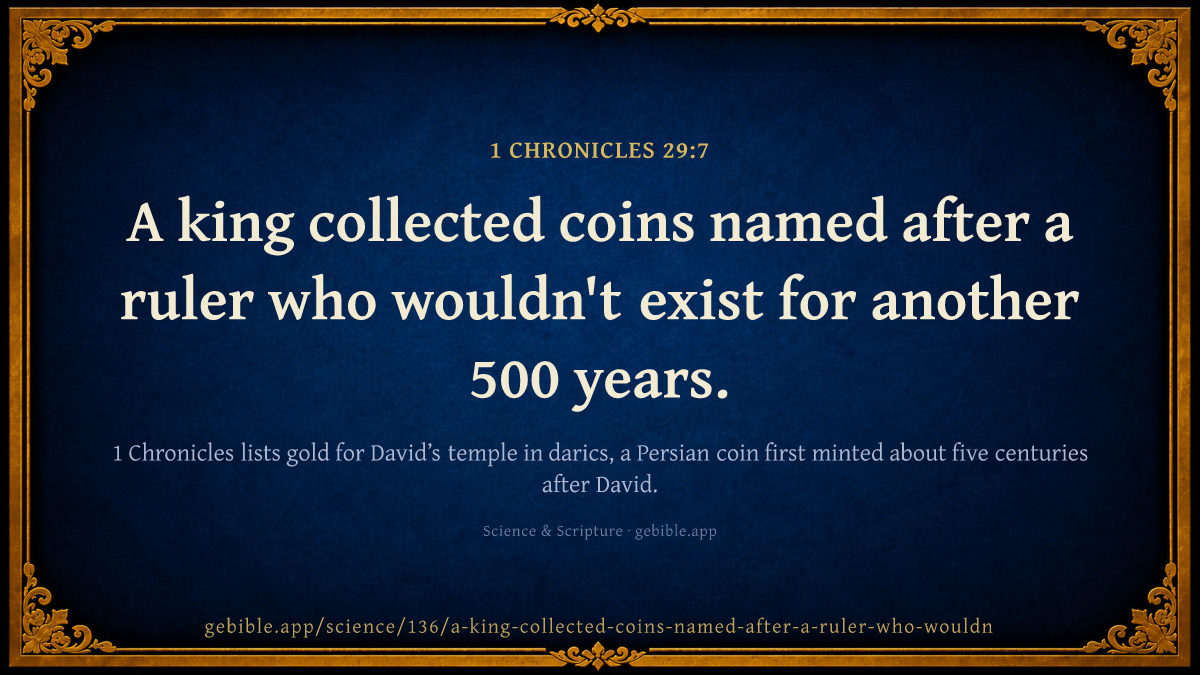
and they gave for the service of God’s house of gold five thousand talents and ten thousand darics, of silver ten thousand talents, of bronze eighteen thousand talents, and of iron one hundred thousand talents.
A king collected coins named after a ruler who wouldn't exist for another 500 years.
History/Archaeology
26
passages in this field
Show this passage in
The cited passage
Anatomy of the claim
- Documented The daric is a Persian gold coin first minted under Darius I (reigned about 522–486 BCE). American Numismatic Society
- Documented David is traditionally dated to about 1000 BCE, roughly five centuries before the daric was struck. Encyclopaedia Britannica
- Debated Whether the post-exilic Chronicler expressed older values in his audience’s monetary units, or the term marks the passage as a later composition, is debated. Sara Japhet, I & II Chronicles (Old Testament Library); H. G. M. Williamson
What the text says
This comes from 1 Chronicles 29:7. King David's temple fund includes 'darics' — coins named after King Darius I of Persia, who lived roughly 500 years later. It's like George Washington paying in Bitcoin.
Three honest ways to read this passage
-
As history
The text records how its authors understood the world with the knowledge they had. Read this way, a difference from modern science is a window into the ancient mind, not a failure.
-
As accommodation
The text speaks to its first audience in their own terms, to make a point that isn't mainly about physics or biology. Read this way, the scientific detail is the vehicle, not the cargo.
-
As contradiction
The text makes a claim about the physical world that modern findings dispute. Read this way, the difference is a genuine factual disagreement worth naming.
GEBible doesn't pick one of these for you. Each entry shows the passage, what it says, and what current science says — nothing more.