
Yahweh is good to all. His tender mercies are over all his works.
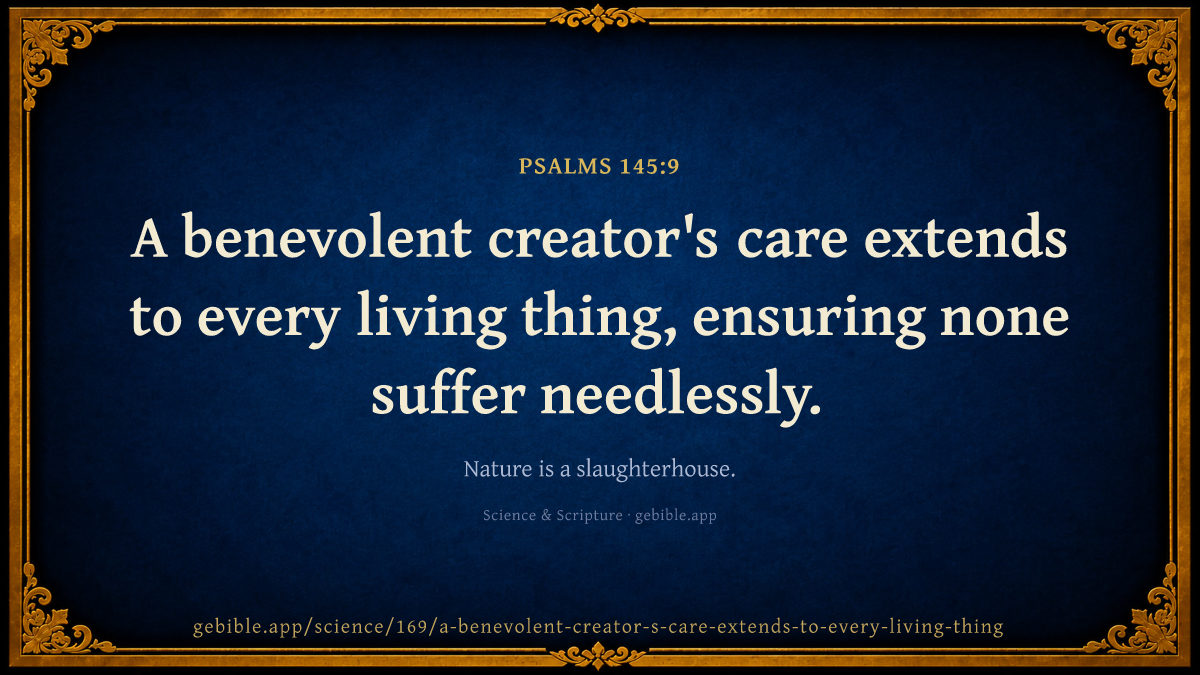
A benevolent creator's care extends to every living thing, ensuring none suffer needlessly.
Biology
59
passages in this field
Show this passage in
The cited passage
What current science says
Nature is a slaughterhouse. Over 99% of all species that have ever existed are extinct. Most individual animals die from starvation, predation, parasitism, or disease before reaching reproductive age. Sea turtle hatchlings have a survival rate of roughly 1 in 1,000. Ichneumon wasps lay eggs inside living caterpillars, and the larvae eat the host alive from the inside out. About 20 quadrillion ants are alive right now, and most of them will die horribly. If tender mercies are at work here, they're doing an impressively bad job of it.
What the text says
This comes from Psalms 145:9. 'The LORD is good to all: and his tender mercies are over all his works' — a claim of universal benevolence that covers every creature on Earth.
Three honest ways to read this passage
-
As history
The text records how its authors understood the world with the knowledge they had. Read this way, a difference from modern science is a window into the ancient mind, not a failure.
-
As accommodation
The text speaks to its first audience in their own terms, to make a point that isn't mainly about physics or biology. Read this way, the scientific detail is the vehicle, not the cargo.
-
As contradiction
The text makes a claim about the physical world that modern findings dispute. Read this way, the difference is a genuine factual disagreement worth naming.
GEBible doesn't pick one of these for you. Each entry shows the passage, what it says, and what current science says — nothing more.