
Therefore as sin entered into the world through one man, and death through sin; so death passed to all men, because all sinned.
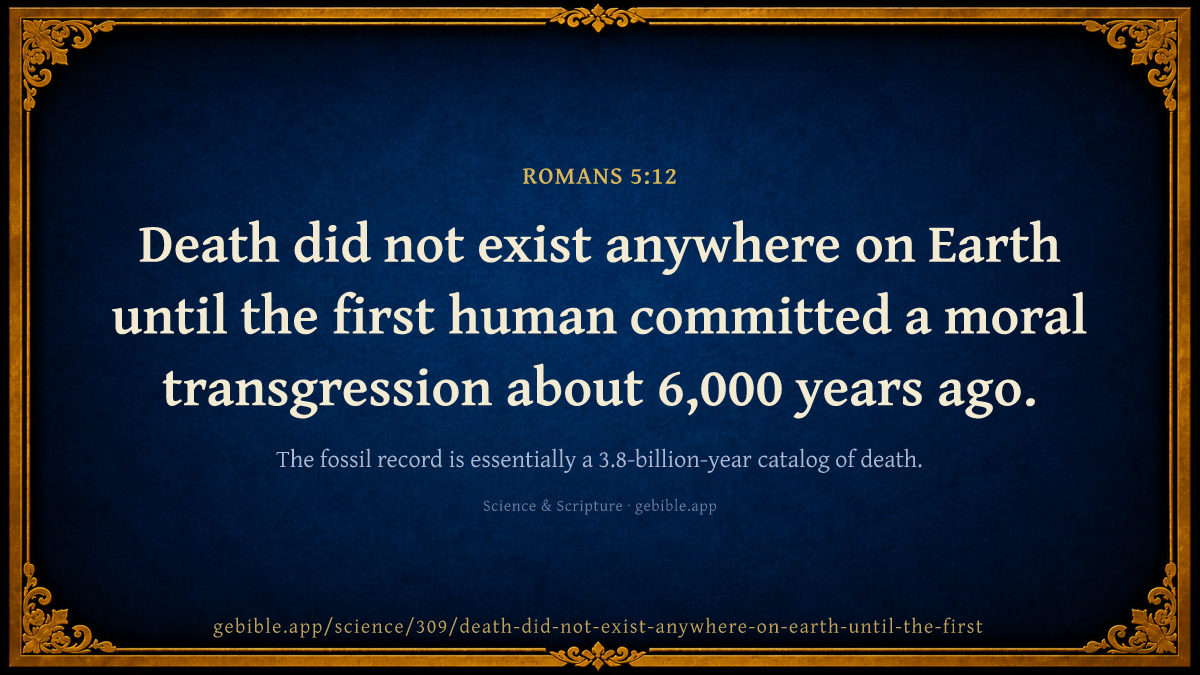
Death did not exist anywhere on Earth until the first human committed a moral transgression about 6,000 years ago.
Biology
59
passages in this field
Show this passage in
The cited passage
What current science says
The fossil record is essentially a 3.8-billion-year catalog of death. The earliest known fossils are microbial mats from roughly 3.5 billion years ago, and organisms have been dying ever since. The mass extinction that killed the non-avian dinosaurs happened 66 million years ago — roughly 65,994,000 years before the claimed start of death. We have fossils of predators eating prey dating back over 500 million years. Death isn't a bug introduced by human behavior — it's a fundamental feature of biology. Without death, evolution couldn't function, ecosystems would collapse, and the planet would have been buried under immortal bacteria billions of years ago.
What the text says
This comes from Romans 5:12, which claims 'by one man sin entered into the world, and death by sin' — asserting that death itself was introduced to the entire planet as a consequence of one person's disobedience a few thousand years ago.
Three honest ways to read this passage
-
As history
The text records how its authors understood the world with the knowledge they had. Read this way, a difference from modern science is a window into the ancient mind, not a failure.
-
As accommodation
The text speaks to its first audience in their own terms, to make a point that isn't mainly about physics or biology. Read this way, the scientific detail is the vehicle, not the cargo.
-
As contradiction
The text makes a claim about the physical world that modern findings dispute. Read this way, the difference is a genuine factual disagreement worth naming.
GEBible doesn't pick one of these for you. Each entry shows the passage, what it says, and what current science says — nothing more.