
For as in Adam all die, so also in Christ all will be made alive.
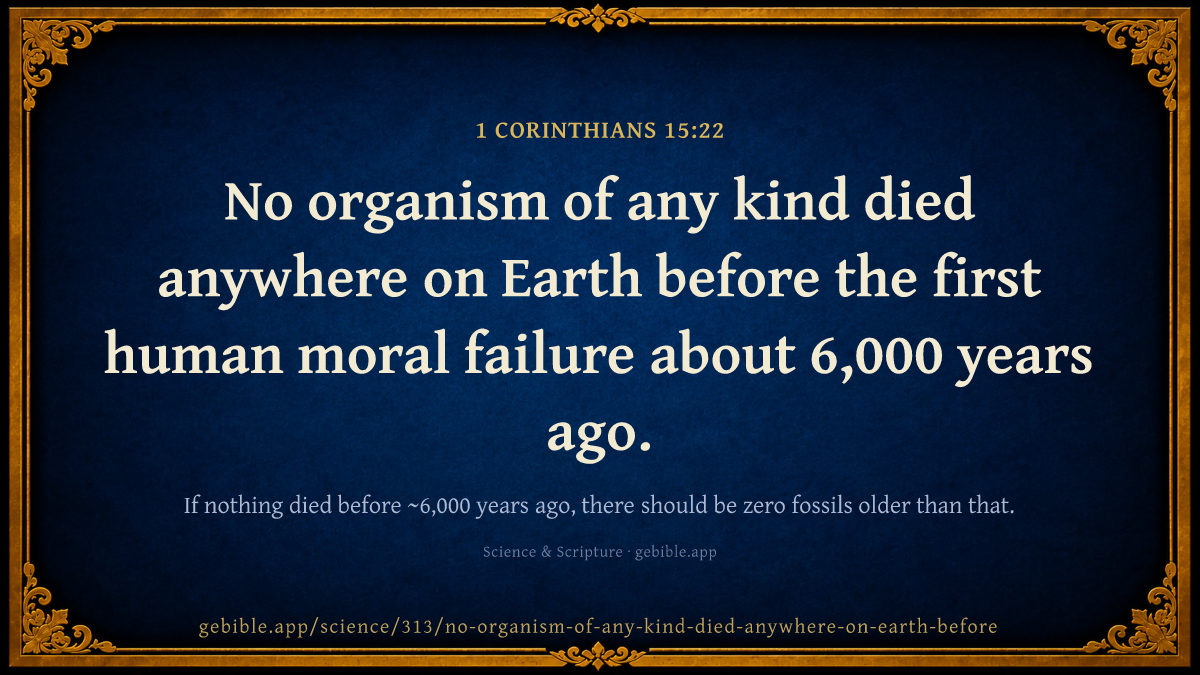
No organism of any kind died anywhere on Earth before the first human moral failure about 6,000 years ago.
Biology
59
passages in this field
Show this passage in
The cited passage
What current science says
If nothing died before ~6,000 years ago, there should be zero fossils older than that. Instead, we have billions of fossils spanning 3.5 billion years of Earth's history. The fossil record documents five mass extinction events, the biggest of which (the Permian-Triassic extinction, ~252 million years ago) killed about 96% of all marine species. We have fossils of animals with teeth designed for killing, digestive systems designed for processing meat, and immune systems designed to fight infection — all of which only make sense in a world where death existed. An immortal biosphere wouldn't evolve claws, venom, or immune systems, because nothing would need them.
What the text says
This comes from 1 Corinthians 15:22, which states 'in Adam all die' — reinforcing the claim from Romans 5:12 that death itself entered the world only through human sin, meaning the entire biosphere was immortal before one person disobeyed.
Three honest ways to read this passage
-
As history
The text records how its authors understood the world with the knowledge they had. Read this way, a difference from modern science is a window into the ancient mind, not a failure.
-
As accommodation
The text speaks to its first audience in their own terms, to make a point that isn't mainly about physics or biology. Read this way, the scientific detail is the vehicle, not the cargo.
-
As contradiction
The text makes a claim about the physical world that modern findings dispute. Read this way, the difference is a genuine factual disagreement worth naming.
GEBible doesn't pick one of these for you. Each entry shows the passage, what it says, and what current science says — nothing more.