
All flesh is not the same flesh, but there is one flesh of men, another flesh of animals, another of fish, and another of birds.
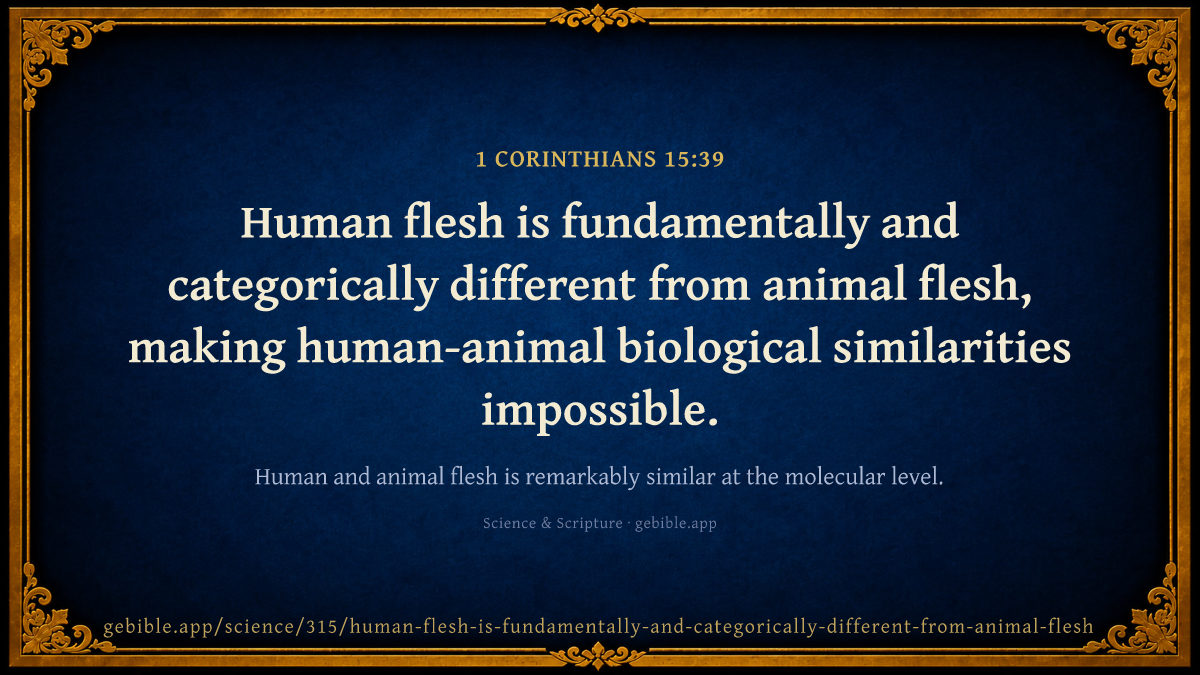
Human flesh is fundamentally and categorically different from animal flesh, making human-animal biological similarities impossible.
Biology
59
passages in this field
Show this passage in
The cited passage
What current science says
Human and animal flesh is remarkably similar at the molecular level. Human and chimpanzee DNA is roughly 98.7% identical. We share about 85% of our protein-coding genes with mice, which is why mouse models are used in medical research. Pig heart valves have been transplanted into humans for decades. In 2022, a genetically modified pig heart was transplanted into a human patient. Human-animal chimeric embryos are routinely created in labs to grow human-compatible organs. At the biochemical level, human muscle tissue uses the same actin and myosin proteins as virtually every other animal. Our flesh isn't special — it's variations on a deeply shared biological theme.
What the text says
This comes from 1 Corinthians 15:39, which states 'there is one kind of flesh of men, another flesh of beasts.' This verse is used by creationists to argue against evolution and to oppose human-animal chimera research, claiming that human and animal tissues are categorically incompatible.
Three honest ways to read this passage
-
As history
The text records how its authors understood the world with the knowledge they had. Read this way, a difference from modern science is a window into the ancient mind, not a failure.
-
As accommodation
The text speaks to its first audience in their own terms, to make a point that isn't mainly about physics or biology. Read this way, the scientific detail is the vehicle, not the cargo.
-
As contradiction
The text makes a claim about the physical world that modern findings dispute. Read this way, the difference is a genuine factual disagreement worth naming.
GEBible doesn't pick one of these for you. Each entry shows the passage, what it says, and what current science says — nothing more.