
The days of Terah were two hundred five years. Terah died in Haran.
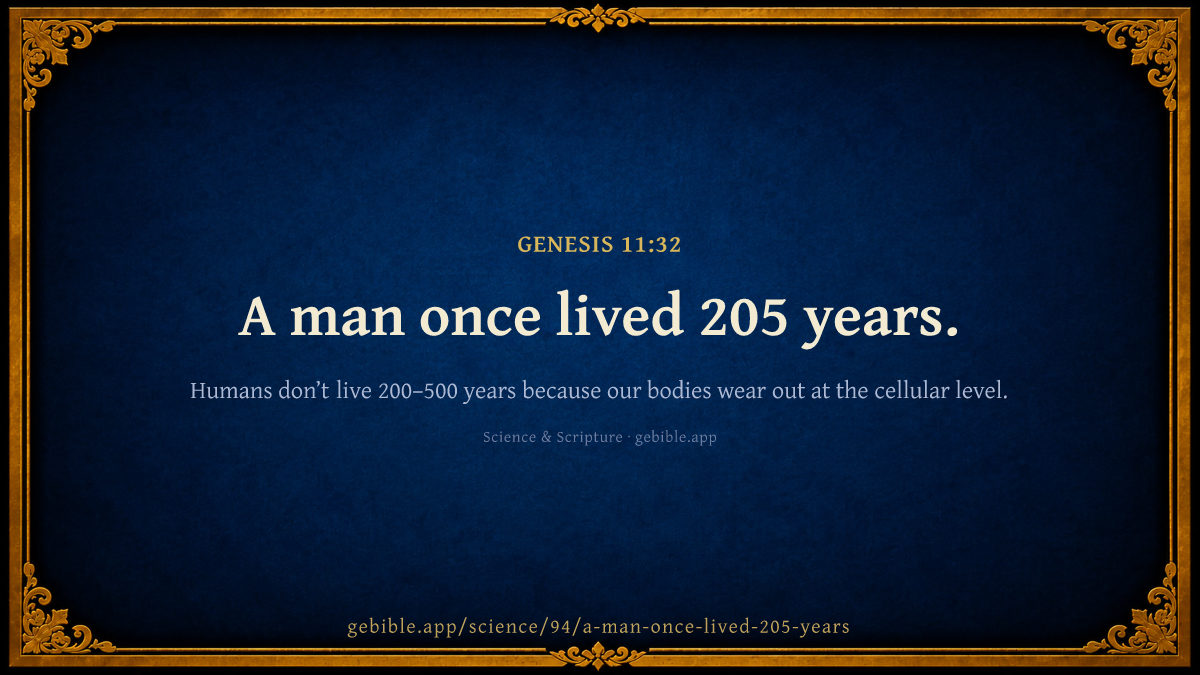
A man once lived 205 years.
Biology
59
passages in this field
Show this passage in
The cited passage
What current science says
Humans don’t live 200–500 years because our bodies wear out at the cellular level. Cells can only divide a limited number of times, and each division shortens protective DNA caps called telomeres. Over time, damage accumulates in DNA and proteins, organs lose function, and the risk of disease and systemic failure increases. Natural selection also didn’t “aim” for extreme lifespans; it mainly favored living long enough to grow, reproduce, and raise offspring, not to stay healthy for centuries.
What the text says
And the days of Terah were two hundred and five years.
Three honest ways to read this passage
-
As history
The text records how its authors understood the world with the knowledge they had. Read this way, a difference from modern science is a window into the ancient mind, not a failure.
-
As accommodation
The text speaks to its first audience in their own terms, to make a point that isn't mainly about physics or biology. Read this way, the scientific detail is the vehicle, not the cargo.
-
As contradiction
The text makes a claim about the physical world that modern findings dispute. Read this way, the difference is a genuine factual disagreement worth naming.
GEBible doesn't pick one of these for you. Each entry shows the passage, what it says, and what current science says — nothing more.