
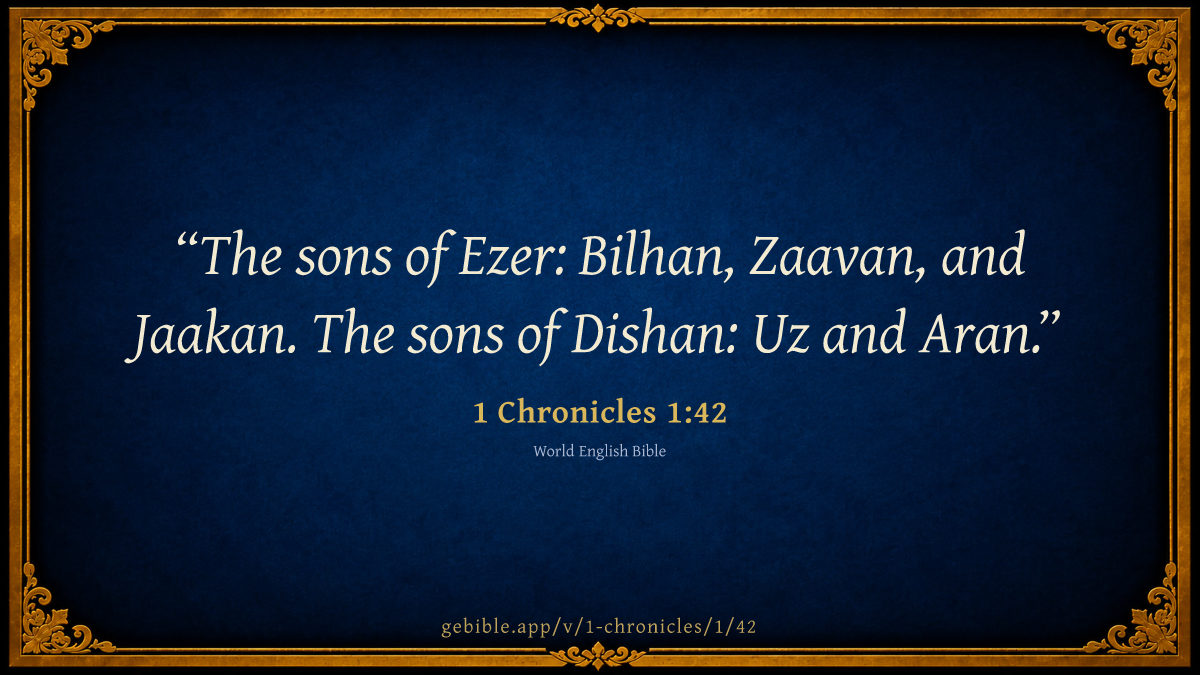
The sons of Ezer: Bilhan, Zaavan, and Jaakan. The sons of Dishan: Uz and Aran.
Parallel Translations
-
The sons of Ezer: Bilhan, Zaavan, and Jaakan. The sons of Dishan: Uz and Aran.
-
The sons of Ezer; Bilhan, and Zavan, and Jakan. The sons of Dishan; Uz, and Aran.
-
The sons of Ezer: Bilhan, and Zaavan, Jaakan. The sons of Dishan: Uz, and Aran.
Cross-references (2)
Passages linked to 1 Chronicles 1:42 in the Treasury of Scripture Knowledge, ordered by reader-vote popularity; verse text shown in World English Bible.
- Genesis 36:27-28 These are the children of Ezer: Bilhan, Zaavan, and Akan. These are the children of Dishan: Uz and Aran.
- Lamentations 4:21 Rejoice and be glad, daughter of Edom, that dwells in the land of Uz. The cup will pass through to you also. You will be drunken, and will make yourself naked.
Cross-references from openbible.info (CC BY 4.0)
Explain this verse (1 source)
Historical commentary, presented as a primary source — not an endorsement.
Private notes
Saved on this device only — never synced or sent anywhere.
The Pulpit Commentary 1880 · Public Domain Vers. 42-50. G. LIST OF KINGS OF EDOM. These…
Vers. 42-50. G. LIST OF KINGS OF EDOM. These verses contain a list of kings who reigned in Edom, during a period expressly notified as anterior to the institution of kings in Israel. Some further point of practical use than has been yet ascertained may lie in the preservation of these snatches of Edom"s history. Something surely hangs on the emphatic but otherwise gratuitous statement, that kings were unknown in Israel when this line reigned in Edom. It may turn out to cover the fulfilment of some obscure point of prophecy, or to subserve some important chronological purpose; but wedged in as it is, it cannot be permitted to count for nothing. That it stands in identical words in Gen_36:31 increases not a little the attention to be paid to it. It has hence been asserted far too dogmatically, as by Spinoza, that the Book of Genesis was no work of Moses; or again, that the passage, in the course of some transcription of manuscripts, had found its way from Chronicles, through a marginal note, at last into the text of Genesis (see Kennicott) But these positions are only forced by the assumption that kings must have reigned in Israel before the sentence could have been written, which is an unnecessary assumption. Kings had been promised to Jacob, (Gen_35:11) as among his posterity, and had been prophesied of by Moses. (Deu_28:36) It may have been that Edom, secure in her kings for generations, had been wont to make her boast of them. in comparison of and in presence of her neighbours, and the remark may have thence originated. Lastly, it has been correctly pointed out that the structure of the sentence in the original does not at all necessitate the suggestion (of which in the English Version there is confessedly the appearance), that kings had already been in Israel. At the same time, too great stress must not be laid upon this, for the slight alteration of translation that would suit the time for Genesis, would throw it out again for our text here, and yet the words of the original are identical. These kings are eight in number; the parentage or the land of each is given. It is to be noticed that the line of royalty is not hereditary, and that several dukes, or heads of tribes, or princes of districts, rule under the king. The names, whether of persons or places, agree in the Authorized Version as they occur here and in Gen_36:31-39, except that Saul is here spelt Shaul, and that we have here Hadad and Pai for Hadar and Pan there. These two differences are occasioned by the Hebrew text, and are the only differences between the two Hebrew texts, except that wOj here is given ju there, and that the incorrect spelling here of twyi is found right (tywi) in Genesis. The superfluous statement, Hadad died also, which begins our fifty-first verse, is not found in Genesis. In the Septuagint the variations between the two places are greater, as well as those from the Hebrew text in either place. Thus we have Asom, Gethaim, Sebla, Roboth, Balaennor, Achobor, Adad, here, for Asom, Getthaim, Samada, Robboth, Ballenon, Achobor, Arad, there. There is also an entire omission here of the name of the wife of the last king, with those of her mother and grandmother, all of which are given in the passage of Genesis, as found in the Hebrew text.
The Pulpit Commentary (1880–1919), ed. H.D.M. Spence-Jones & Joseph S. Exell — public domain. Text from a community e-Sword module.