
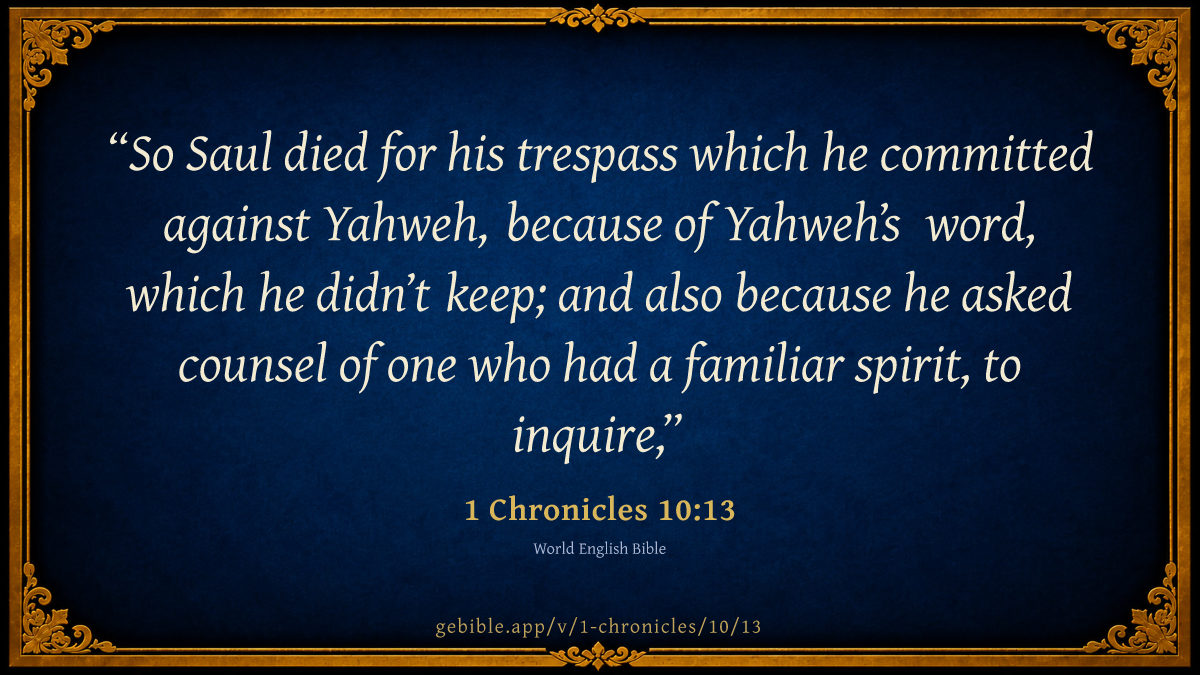
So Saul died for his trespass which he committed against Yahweh, because of Yahweh’s word, which he didn’t keep; and also because he asked counsel of one who had a familiar spirit, to inquire,
Parallel Translations
-
So Saul died for his trespass which he committed against Yahweh, because of Yahweh’s word, which he didn’t keep; and also because he asked counsel of one who had a familiar spirit, to inquire,
-
So Saul died for his transgression which he committed against the LORD, even against the word of the LORD, which he kept not, and also for asking counsel of one that had a familiar spirit, to enquire of it;
-
So Saul died for his transgression which he committed against the LORD, because of the word of the LORD, which he kept not; and also for that he asked counsel of a ghost, to inquire thereby,
Examined in Scripture Analysis
Contradictions (1)
Questions where the Bible appears to say two different things, with the passages on each side set together.
Cross-references (12)
Passages linked to 1 Chronicles 10:13 in the Treasury of Scripture Knowledge, ordered by reader-vote popularity; verse text shown in World English Bible.
- Leviticus 20:6 “ ‘The person that turns to those who are mediums and wizards, to play the prostitute after them, I will even set my face against that person, and will cut him off from among his people.
- Leviticus 19:31 “ ‘Don’t turn to those who are mediums, nor to the wizards. Don’t seek them out, to be defiled by them. I am Yahweh your God.
- 1 Samuel 15:23 For rebellion is as the sin of witchcraft, and stubbornness is as idolatry and teraphim. Because you have rejected Yahweh’s word, he has also rejected you from being king.”
- Isaiah 8:19 When they tell you, “Consult with those who have familiar spirits and with the wizards, who chirp and who mutter,” shouldn’t a people consult with their God? Should they consult the dead on behalf of the living?
- Deuteronomy 18:10-14 There shall not be found with you anyone who makes his son or his daughter to pass through the fire, one who uses divination, one who tells fortunes, or an enchanter, or a sorcerer, or a charmer, or someone who consults with a familiar spirit, or a wizard, or a necromancer. For whoever does these things is an abomination to Yahweh. Because of these abominations, Yahweh your God drives them out from before you. You shall be blameless with Yahweh your God. For these nations that you shall dispossess listen to those who practice sorcery and to diviners; but as for you, Yahweh your God has not allowed you so to do.
- 1 Samuel 28:7-20 Then Saul said to his servants, “Seek for me a woman who has a familiar spirit, that I may go to her, and inquire of her.” His servants said to him, “Behold, there is a woman who has a familiar spirit at Endor.” Saul disguised himself and put on other clothing, and went, he and two men with him, and they came to the woman by night. Then he said, “Please consult for me by the familiar spirit, and bring me up whomever I shall name to you.” The woman said to him, “Behold, you know what Saul has done, how he has cut off those who have familiar spirits, and the wizards, out of the land. Why then do you lay a snare for my life, to cause me to die?” Saul swore to her by Yahweh, saying, “As Yahweh lives, no punishment will happen to you for this thing.” Then the woman said, “Whom shall I bring up to you?” He said, “Bring Samuel up for me.” When the woman saw Samuel, she cried with a loud voice; and the woman spoke to Saul, saying, “Why have you deceived me? For you are Saul!” The king said to her, “Don’t be afraid! What do you see?” The woman said to Saul, “I see a god coming up out of the earth.” He said to her, “What does he look like?” She said, “An old man comes up. He is covered with a robe.” Saul perceived that it was Samuel, and he bowed with his face to the ground, and showed respect. Samuel said to Saul, “Why have you disturbed me, to bring me up?” Saul answered, “I am very distressed; for the Philistines make war against me, and God has departed from me, and answers me no more, by prophets, or by dreams. Therefore I have called you, that you may make known to me what I shall do.” Samuel said, “Why then do you ask me, since Yahweh has departed from you and has become your adversary? Yahweh has done to you as he spoke by me. Yahweh has torn the kingdom out of your hand, and given it to your neighbor, even to David. Because you didn’t obey Yahweh’s voice, and didn’t execute his fierce wrath on Amalek, therefore Yahweh has done this thing to you today. Moreover Yahweh will deliver Israel also with you into the hand of the Philistines; and tomorrow you and your sons will be with me. Yahweh will deliver the army of Israel also into the hand of the Philistines.” Then Saul fell immediately his full length on the earth, and was terrified, because of Samuel’s words. There was no strength in him; for he had eaten no bread all day long or all night long.
- Exodus 22:18 “You shall not allow a sorceress to live.
- 1 Samuel 15:2 Yahweh of Armies says, ‘I remember what Amalek did to Israel, how he set himself against him on the way, when he came up out of Egypt.
- 1 Samuel 13:13-14 Samuel said to Saul, “You have done foolishly. You have not kept the commandment of Yahweh your God, which he commanded you; for now Yahweh would have established your kingdom on Israel forever. But now your kingdom will not continue. Yahweh has sought for himself a man after his own heart, and Yahweh has appointed him to be prince over his people, because you have not kept that which Yahweh commanded you.”
- 2 Kings 21:6 He made his son to pass through the fire, practiced sorcery, used enchantments, and dealt with those who had familiar spirits, and with wizards. He did much evil in Yahweh’s sight, to provoke him to anger.
- Acts 8:9-11 But there was a certain man, Simon by name, who used to practice sorcery in the city and amazed the people of Samaria, making himself out to be some great one, to whom they all listened, from the least to the greatest, saying, “This man is that great power of God.” They listened to him, because for a long time he had amazed them with his sorceries.
- Acts 16:16-18 As we were going to prayer, a certain girl having a spirit of divination met us, who brought her masters much gain by fortune telling. Following Paul and us, she cried out, “These men are servants of the Most High God, who proclaim to us a way of salvation!” She was doing this for many days. But Paul, becoming greatly annoyed, turned and said to the spirit, “I command you in the name of Jesus Christ to come out of her!” It came out that very hour.
Cross-references from openbible.info (CC BY 4.0)
Explain this verse (16 sources)
Historical commentary, presented as a primary source — not an endorsement.
Private notes
Saved on this device only — never synced or sent anywhere.
Geneva Bible translators 1599 · Public Domain Or, witch, and sorceress.
Or, witch, and sorceress.
Geneva Bible (1599) marginal notes — public domain.
John Trapp 1656 · Public Domain 1Ch 10:13 So Saul died for his transgression which…
1Ch 10:13 So Saul died for his transgression which he committed against the LORD, [even] against the word of the LORD, which he kept not, and also for asking [counsel] of [one that had] a familiar spirit, to enquire [of it];
Ver. 13. So Saul died, &c.] This and the subsequent verse we have here about the causes of Saul’s death, more than that we read in 1Sa 31:3-6.; like as we meet with many remarkable passages in St Mark, that are not in Matthew or Luke.
Read full note →
For his transgression which he committed.] "Adding rebellion to sin," {Job 34:37} for he was not so very bad at first, as neither is any wicked person. He first neglected the word of God, and then despised it, and then harboured in his heart hypocrisy, hatred, envy, cruelty, &c. Here he is taxed for three vices especially: (1.) For flat disobedience, which "is as the sin of witchcraft"; {1Sa 15:23} (2.) For consulting with a witch; (3.) For not inquiring of the Lord. He did not "draw nigh to God with a true heart, in full assurance of faith, having his heart sprinkled from an evil conscience, and his body washed with pure water." {Heb 10:22}
John Trapp, A Commentary or Exposition upon All the Books of the Old and New Testament (1647–1656) — public domain. Text from a community e-Sword module.
Matthew Poole 1685 · Public Domain Saul died for his transgression: the sense is, Wonder…
Saul died for his transgression: the sense is, Wonder not that Saul fell by the hands of the Philistines, who were armed against him by his own sin and by God’s vengeance for it.
Against the word of the Lord; against God’s express, and plain, and positive command; which is a great aggravation of any sin.
Read full note →
For asking counsel of one that had a familiar spirit; which also was contrary to a manifest command, Lev 19:31, and moreover, contrary to his own conscience, which was so fully convinced hereof, that he had endeavoured the utter extirpation of all such persons, in pursuance of God’s law. See 1Sa 28:9.
To inquire of it, concerning the event of the approaching battle.
Matthew Poole's English Annotations on the Holy Bible (1683–1685) — public domain. Text from a community e-Sword/MySword module.
John Gill 1763 · Public Domain And inquired not of the Lord,.... For though he…
And inquired not of the Lord,.... For though he did inquire in some sense in an external, careless, and hypocritical manner, yet not done seriously, sincerely, and heartily, nor with constancy; it was accounted as if he inquired not at all, Sa1 28:6 the Targum adds another reason of his death, because he killed the priests of Nob; but that is not in the text:
therefore he slew him; or suffered him to be slain:
Read full note →
and turned the kingdom unto David the son of Jesse; translated the kingdom of Israel out of Saul's family, upon his death, into Jesse's, even unto David; for the sake of which observation this short account is given of the last end of Saul.
Next: 1 Chronicles Chapter 11
John Gill's Exposition of the Whole Bible (1746–1763) — public domain (CC PDM 1.0). Text via the HelloAO Bible API.
John Wesley 1765 · Public Domain The word - Against God's express command: which is…
The word - Against God's express command: which is a great aggravation of any sin. Familiar spirit - Which also was contrary to a manifest command, Levit xix, 31.
John Wesley, Explanatory Notes Upon the Whole Bible (1754–1765) — public domain. Text via the GEBible commentary corpus.
Adam Clarke 1810 · Public Domain Verse 13. Saul died for his transgression] See the…
Verse 13. Saul died for his transgression] See the concluding observations on the first book of Samuel. 1Sa 31:13.
Adam Clarke's Commentary on the Bible (1810–1826) — public domain. Text from a community e-Sword/MySword module.
Joseph Benson 1811 · Public Domain 1Ch 10:13. So Saul died for his transgression —…
1Ch 10:13. So Saul died for his transgression — The sense is, wonder not that Saul fell by the hands of the Philistines, who were armed against him by his own sin, and by God’s vengeance for it. Against the word of the Lord — Against God’s express, and plain, and positive command; which is a great aggravation of any sin. For asking counsel of one that had a familiar spirit — Which also was contrary to a manifest command,
(Lev 19:31,) and moreover contrary to his own conscience, which was so fully convinced of the evil of such practices, that he had endeavoured the utter extirpation of all such persons, in pursuance of God’s law, 1Sa 28:9. To inquire of it — Concerning the event of the approaching battle.
Joseph Benson's Commentary on the Old and New Testaments (1811–1818) — public domain. Text from a community e-Sword module.
Albert Barnes 1834 · Public Domain For his transgression - Compare 1Ch 9:1. The “transgression”…
For his transgression - Compare 1Ch 9:1. The “transgression” intended is probably the disobedience with respect to Amalek, recorded in 1Sa 15:1-9 (compare 1Sa 28:17-18).
Albert Barnes' Notes on the Bible (1834–1885) — public domain. Text from a community e-Sword/MySword module.
Haydock's Catholic Bible Commentary 1859 · Public Domain For. Septuagint, "in his iniquities." (Haydock) --- See 1…
For. Septuagint, "in his iniquities." (Haydock) --- See 1 Kings xiii. 9., and xv. 23. Saul offered sacrifice unlawfully, and spared some of the Amalecites. (Worthington)
George Leo Haydock (1774–1849), Haydock's Catholic Family Bible and Commentary, 1859 edition — public domain. Excludes Psalms (Douay-Rheims chapter numbering differs from Protestant) and Deuterocanonical books (Catholic canon only).
Robert Jamieson, A. R. Fausset & David Brown 1871 · Public Domain Saul died for his transgression which he committed against…
Saul died for his transgression which he committed against the Lord--in having spared the king of the Amalekites and taken the flocks of the people as spoils [Sa1 15:9], as well as in having consulted a pythoness [Sa1 28:7]. Both of these acts were great sins--the first as a violation of God's express and positive command [Sa1 15:3], and the second as contrary to a well-known statute of the kingdom (Lev 19:31).
Jamieson, Fausset & Brown — Commentary Critical and Explanatory on the Whole Bible (1871) — public domain (CC PDM 1.0). Text via the HelloAO Bible API.
Daniel D. Whedon 1874 · Public Domain 13. So Saul died for his transgression… and also…
13. So Saul died for his transgression… and also for asking counsel of… a familiar spirit — These reflections on the death of Saul, and the causes of his fall, show that the writer is merely preparing the way to the history of David. Saul’s ruin is attributed particularly to two great sins: 1) in not observing Jehovah’s word, which enjoined upon him the destruction of Amalek, (see 1 Samuel 15, and 1Sa_28:17-18, and notes there;) 2) in seeking for help and counsel of the witch of Endor. See 1Sa_28:3-20, notes.
Daniel D. Whedon (gen. ed.), Commentary on the Old and New Testaments (1874–1909) — public domain. Text from a community e-Sword module.
The Cambridge Bible for Schools and Colleges 1878 · Public Domain 13. his transgression] R.V. his trespass; cp. 2Ch_26:16. The…
13. his transgression] R.V. his trespass; cp. 2Ch_26:16. The reference is to Saul’s sacrifice (1Sa_13:13-14), and disobedience (ib. 1Sa_15:23).
even against the word] R.V. because of the word.
Read full note →
also for asking] R.V. also for that he asked.
to inquire of it] R.V. to inquire thereby; cp. 1Sa_28:8.
The Cambridge Bible for Schools and Colleges (gen. ed. J. J. S. Perowne; Cambridge University Press, 1878–1918) — public domain. Text from a community e-Sword module.
Ellicott's Commentary for English Readers 1878 · Public Domain (13) Even against the word of the Lord.—Saul’s unfaithfulness…
(13) Even against the word of the Lord.—Saul’s unfaithfulness was twofold: (1) he did not observe the prophetic word of Jehovah (comp. 1Sa_13:13; 1Sa_15:11); and (2) he consulted a necromancer, to the neglect of consulting Jehovah (1 Samuel 28).
And also for asking counsel.—And also by consulting the necromancer in order to get a response. “Turn ye not to the necromancers” (Lev_19:31). (See also Isa_8:19.) Saul broke the general law of his people, as well as special commands addressed to himself. No allusion is made to his cruel slaughter of the priests (1Sa_22:18), nor to his implacable hatred of David.
Read full note →
(13, 14) A concluding reflection from the mind of the chronicler himself. He sums up his extract concerning the ruin of Saul by assigning the moral ground of it, viz., Saul’s “unfaithfulness whereby he showed himself unfaithful to Jehovah.” The same charge was made against the Transjordan tribes in 1Ch_5:25, and against the people of Judah in 1Ch_9:1.
A Bible Commentary for English Readers, edited by Charles John Ellicott (1878–1897) — public domain. Text from a community e-Sword module.
The Pulpit Commentary 1880 · Public Domain So Saul died for his transgression. (For this transgression…
So Saul died for his transgression. (For this transgression and the stress laid upon it and its predicted consequences, (see 1Sa_15:1-9, 1Sa_15:11, 14 28:18) For asking of a familiar spirit. (1Sa_28:7-24)
Vers. 13, 14.
Read full note →
The epitaph, a beacon-warning.
So far as this work is concerned, Saul is introduced to us, and takes "for ever" his farewell of us, in this one and the same chapter. We know him, however, well elsewhere. On the background of a bright sky, we are at once prepared to say, his figure stands out, and ever will stand out, dark in appearance, of somewhat commanding proportions, with the bearing of no altogether ordinary man a striking figure, indeed, but one that strikes fear and a chill feeling throughout one, rather than one that inspires reverence, emulation, love, It cannot be said of him or of his career that they lack incident or dramatic effect. On the contrary, they were born in these and abound in them. Saul and his career were remarkably differenced from anything which could be called commonplace. And while the world continues, they must needs stand among the foremost examples for impressiveness, of grand opportunity and splendid prospects grievously missed and dishonoured. Our chapter is itself but a summary, the concluding snatch of a strange, eventful, solemn life, to the condemning faults of which, in its course, the present text points. And we, following a similar plan, will pass beneath our eye, in brief summary, the prominent facts, the moral qualities, and the opportunities of Saul; the troubled current on which they are hurried along, the dark abyss in which at last they are lost. Let us notice
I SAUL"S SUMMONS FROM OBSCURITY TO THE SERVICE OF HIS COUNTRY AND THE FULL GLARE OF DAY. What we have to notice, especially about this, is that undoubtedly it was the doing of an upper power, of a special providence, of no purpose nor seeking of the man who was thus elevated, nor even of the contrivance of others. It was something outside of the individual life and outside the national life. No calculation of coincidence could count upon it nor account for it. In the presence of it, the man who disbelieves Providence and providences, and special and particular providences, because they make too large a demand on his fund of belief, prefers parsimoniously to spare expenditure in one direction, in order to lavish unscrupulous, disproportionate outlay in another. What he can believe, this he drains to the dregs in one of its resources, because he will not draw a fair measure of it from another. Of him it may well be said that the heart that refuses a healthy faith is that which grows the most abundant crop of credulity. The kingdom of God"s people only known as yet for a kingdom, inasmuch as he himself was its King has reached one of its great crises. Moses foresaw it, and, strange to say, foreshadowed and sketched the legislation adapted to it. The special ministers, consisting of individual and local judges, have had their day. The majority of the nation dawns consciously upon it. The nation compares its composite, federal, fraternal constitution with the unity and cohesion of other nations, foes around; and, blessed though it is in comparison of them, yet deliberately estimates the balance as unfavourable to itself. Nay, Samuel himself, at this time by a moral force and growth the one judge and prophet of nearly the whole people, seems raised up at the moment to suggest that that embodiment of authority in one person king that might judge us, and go out before us, and fight our battles was quite within the range of possibility in the midst of themselves. In fact, the national voice, in a remarkable way and with a remarkable unanimity, had pronounced for this. But no man, no name even, was before them for king. They express no wish, ask no choice, solicit no help nor advice from Samuel on this particular point, but seem to leave it entirely with him, (1Sa_8:22) and he leaves it entirely with God. Saul, however, a young man whose only known distinction at present is of tallness and bodily "goodliness," by a little chain of circumstances as uncertain from one to another as they were trivial in themselves, finds himself in the presence of Samuel, the seer of the tribes. The supreme Seer of the nation, God himself, has already instructed Samuel; and the issue is that Saul, "of the smallest of the tribes of Israel," his "family the least of all the families of the tribe of Benjamin", (1Sa_9:21) is called to be king over all God"s people] This was "the Lord"s doing, and marvellous was it in the eyes" of Saul, at all events, as we are expressly told.
II SAUL"S CONVERSION. It was a conversion of the old day, of the old Church, also of the old yet ever new Spirit. How stirred the heart, the thoughts, the amazement of Saul at the new future which had been so suddenly presented before him! We may well understand that he could not, did not, take it in all at once. But his heart was to k now a greater stirring, a deeper moving. "God gave him another heart" before ever he got back to his earthly father"s house again. "The Spirit of God came upon him". (1Sa_10:9, 1Sa_10:10) The. great facts of conversion for the old day, for the old Chinch, and for all time are intrinsically the same, and are two God"s gift of another heart and of his Spirit therewith. And what transporting experience that must have been for him, when "all the signs" which had been given him by Samuel "came to pass;" and when "he prophesied" among the company of prophets that met him; and when, at his formal anointing, "all the people, shouted, God save the king" "and when, at the close of that solemn day, he went to Gibeah, and "there went with him a band of men, whose hearts God had touched," also! Could there have been a more striking, a fuller, a richer beginning of a new religious life, and one shaped to highest ends? Who could ever lose the memory, the impressions, the force of hallowed resolutions belonging to such a time?
III THE FACT OF THE GREAT OUTER OPPORTUNITIES WHICH THE POSITION OF SAUL AND THE PROVIDENCE OF GOD COMBINED TO PROFFER TO SAUL. Outer opportunity is not everything, and indeed it is not anything where inner fitness and intrinsic gift and the spirit of a mission may not be present. But otherwise, outer opportunity is matter of great advantage. As the plant must flower and the tree must fruit, in order to develop to the highest advantage, so thought and purpose, feeling and love, and all life of man, crave the help of some outer opportunity. They find expression thereby, and, in finding expression, unfailingly develop power and quality. God, no doubt, measures opportunity justly, wisely, kindly to us all. And where any child of his may find or fancy he finds himself cramped and stinted in such respect, there may be overpoweringly good reasons for it, of a kind difficult for us to trace with any dogmatic assurance at present; and there may be found overwhelmingly ample compensation for it later on in life, or when the span of the present life is passed. Yet can there be little doubt that, so far as the present life taken by itself is concerned, many a beautiful soul pines away for want of outer opportunity of action and of exhibition? many a mighty courage dwarfs its growth? many a great heart infolds its rich powers and qualities, instead of unfolding them? An old Roman exile poet, who exchanged sunny Rome for the forbidding Pontus, and who shivered as he wrote it, said, "What am I to do alone? How can I utilize enforced idleness? How speed the day unhallowed by work? When disappointment is my only pay, when to dance in the dark is my mocking destiny, when to write a poem that can find no reader is my fate, then I learn how much the speaker depends on the hearer, and the fostering of virtue depends on the awarding of praise, and how immense the stimulus of glory"s opportunity." This old heathen seized and put into most effective poetry some of life"s most affecting facts. Now, to the unbroken length of Saul"s public life, an uninterrupted series of inspiring opportunity was undeniably proffered, both of God and man. Zeal that knew no bounds, enthusiasm that threatened to consume intelligent devotion that should disdain and fling even to an infinite distance all the petty interferences of the brood of envy and jealousy and suspicion"s spawn, these were the legitimate expectations of a whole world, from the grand sphere of opportunity in the midst of which Saul presided. Some of them he realized, and be began well, and did "awhile run well.
IV SOME OF THE LEADING INDICATIONS OF SAUL"S QUALITIES OF CHARACTER. For instance, before his call, we find him the faithful, trusted, considerate son. (1Sa_9:5) The very tone of his recorded conversation with his servant (1Sa_9:6-10) impresses us favourably, as affable, respectful, and open to suggestion and to reply. The master, especially if a young man, who knows how to unite such qualities as these in his treatment of his servants, may well beget the prepossessions of the very best judges for the virtue is rare. Then at the time of his private call and the first communications made to him by Samuel, he does not disappoint us for modesty, retiringness, unostentatious reticence and guardedness of the tongue. No boastful word was on his lip, no eager ambition grasped at what lay before him; the opposite of even family vain-glory seems to have characterized him. (1Sa_9:21 1Sa_10:16) At the time of his public call and Divine election from among the tribes, he would fain hide from the honour, and decline the exalted responsibility about to be laid upon him. (1Sa_10:21-24) And he crowned the day with an instance of self-mastery; temperateness, forbearance (1Sa_10:27, compared with 11:12, 13). The promptness of righteous indignation and zeal of resolution were very conspicuous in the dashing engagement by which he delivered those of Jabesh-gilead in the hour of the Ammonites" power, (1Sa_11:4-11) and they were witnessed to by the aid and effectual blessing of the "Spirit of God." The events of that day also were crowned with renewed consecration, with sacrifices of thanksgiving, and with a sacred and general joy on the part of "Saul and all the men of Israel." Yet from this point all went amiss. The strange reversal of all that Saul had formerly seemed began with the unwarrantable impatience and unpardonable presumption which found him anticipating Samuel and sacrificing to the Lord in Gilgah This was, no doubt, the self-willed presumption on which his whole career was now wrecked. It was succeeded by fault after fault of wayward "rebellion," and of wilful "stubbornness", (1Sa_15:23) of alleged "fear of the people" and craving to be "honoured" before them, (1Sa_15:24, 1Sa_15:30) till the ominous knell is heard, and his conversion "by the Spirit of the Lord" is reversed, when "the Spirit of the Lord departed" from him. (1Sa_16:14) The sequel is too well known. Jealousy of his successor, fierce fits of passion and fits of brief repentance, outbursts of short-lived affection and visitations of remorse, unattended by any single symptom of real reformation, argued the torn, distracted, disordered spirit within. He is brave in war; he is cowardly in the massacre of the priests; he is high in spirit and high-handed; he is morbidly sensitive to disgrace. He seals the Spirit"s departure and final forsaking of him when, with a formal, faithless, professional inquiry of the Lord, he really makes his inquiry of the witch, and fills up the measure of his iniquities. It is hard to say whether the manner of his death (on the field of flight rather than of battle)expressed most aptly his better or worse quality, but anyway it was not altogether deficient in self-devotion or spirit, such as the circumstances would allow. Yet what a commentary the barest facts now utter forth! He who had often conquered the Philistines and other hostile nations, with little of material help, fell before them, because he had guiltily forfeited the Divine help. He had presumed on himself it brings him to make an end of himself! As repentance had been the stranger of his company, so now despair is the bosom friend he hugs. And trace as best we may the course he ran, his character, and the end of a life which had opened in providence so abundant and so encouraging, the skilled pen of Scripture guides our last thought, and reveals the just conclusion of the whole matter: "Saul died for his transgressions which he committed against the Lord, even against the Word of the Lord, which he kept not, and also for asking of a familiar spirit, to inquire thereof, and he inquired not of the Lord this low-lying epitaph, a beacon of warning set up aloft to all time.
Vers. 13, 14.
The danger of spiritualism.
Saul died for his transgression which he committed against the Lord, even against the word of the Lord, which he kept not, and also for asking counsel of one that had a familiar spirit, to inquire of it; and inquired not of the Lord. " Consider not the many and grievous faults of Saul, but one, and that his last. In modern language, the witch of Endor was a "medium," and Saul"s act simply one of those acts of consulting the dead which many believe to be at once practicable and proper. It is not part of my province to defend what some deem the severity of the Mosaic laws against all manner of witchcraft in all its forms. I only remark that a defence of the law which inflicted death upon such might be made by men of tenderest charity; that such would only need to indicate the universal tendency of magic to become "the black art a means of revenge, prolific in murder and in crime to justify the severest measures necessary to repress it. It is easy for the sorcerer to destroy, difficult for him to save life. So in all ages and lands, from the astrologers of Europe, in the Middle Ages, down to the Obeamen of the West Indies to-day, the sorcerers have been the instruments of revenge, at once ready to commit and able to conceal the greatest crimes. Even the English law, with its nineteenth-century indifferentism, finds it necessary to punish the common and vulgar forms of fortune-telling. I prefer to take not the forensic but the personal side of this question; and to deal with it, not in its darker phases, in which it would appear as a superstition, enslaving the mind, tempting to by offering facilities for crime, investing life with awful horrors, but rather in the lighter form in which it seems harmless, in which a few years ago in this country and America it was somewhat fashionable, in which it might even seem to be a means of grace, furnishing some proof of the existence of the soul after death to a gainsaying and materialistic age. I would make two or three preliminary observations.
1. That in the nature of things one would expect a great deal of deceptionto be practised in connection with spiritualism. Even if a large substratum of fact is in it, yet there will always be a temptation to guess when the oracle provokes by its silence a reluctance to be caught at a loss; and the tendency to eke out the oracles by guesses will be all the greater when (as usually happens) it would be impossible to convict immediately of error.
2. That we are at a loss in this matter from not knowing exactly how manysenses we have. To the five commonly recognized, one has been added a sense of heat and cold. But probably we have a great many more senses than six: powers of perception, too subtle to be tabulated, but, in some natures of fine sensibility, quite strong enough to perceive by direct and natural but subtle apprehension what lies outside of the knowledge of the five homely senses that are merely the strong, rough ones, common to us all.
3. That whatever be the explanation (and probably a simple scientific one ispossible), the existence and practices of clairvoyants in every age and country, and the record of undoubted wonders done by them, make it almost impossible to doubt that some persons in some circumstances can perceive more than comes within the range of ordinary perception. From Apollonius of Tyana down to Swedenborg; from the Delphic oracle, which told what Croesus was doing on a certain day, several hundreds of miles away, to the instances of second sight still at least supposed to exist in the Scottish Highlands, you get strange facts, too numerous to be met by a universal denial, for which we should, if possible, find some explanation consistent with natural science. But the more of truth there is in the claim of power to reveal the distant or the future, the less, in my judgment, will any wise man have to do with such practices. I therefore urge on many grounds the danger and wrong of spiritualism. Perhaps the following heads may sum up what is material on this matter:
I WE DO NOT NEED ANY SUPERNATURAL HELP BEYOND THAT OF GOD. For ordinary life the ordinary senses and faculties of man suffice. For all work it is a mistake if the tool be too fine, as well as if it is too coarse. Finer faculties than we have would be too fine for the work of life; would be a source, not of strength, but only of pain and torment. That knowledge of the unseen and future, which we always crave for, would have been given us had it been good for us. But God has concluded that, as regards the unknowable, faith is better than sight, and, as regards the future, hope is better than foreknowledge. For common life, common sense is requisite and is sufficient, especially as we all have within reach aids of grace and enlightenment, that will make our steps safe, if it do not altogether satisfy our curiosity. If we pray to God for guidance, he will answer that prayer, not in some strange and supernatural way, but by calming our over-anxiety, by fortifying our judgment, by presenting in clear light the determining considerations which should weigh with us, by restraining the temptation that might mislead us, by ordering our circumstances so that the only open path is the path of wisdom and of duty. More than this no one needs, and the imagination that the knowledge of the concealed would benefit us is misleading and worrying. Beyond that of God we need no supernatural help or light.
II SUCH LIGHT IS USELESS AS WELL. There are some things not essential but still soothing, comforting, and helpful. But the knowledge of the concealed is not only not essential it is useless in any shape in which it can come to us. And that for one reason It is never capable of being verified. You are at the mercy of any "tricksy sprite" that likes to play with your solicitude. If ghosts are free to report themselves, any one of them could simulate Samuel, and, instead of the sober oracle you expect, could give you something with just that shade of error in it that would make it fatally seductive. You cannot apply rule-and-compass argument or faculty to the verification of the message. You must "trust them all or not at all." You cannot prove the spirits in any of the matters on which you seek their light. I say therefore it is valueless. Such oracles are unsigned cheques, which you cannot treat as money. Seeking to escape from the painful necessity of relying on your own judgment, you (like Roman Catholics) have still to rely on your private judgment on the most momentous question of the whole, viz. whether they are worthy to be your guides. Therefore "pick no locks;" be content to be in the dark where God has left you in the dark. It will be safer for you to travel the unknown road by God"s moonlight or starlight, than to have a blazing gleam thrown round you, which comes you know not whence and leads you know not whither.
III THERE IS MANIFOLD INJURY IN HAVING RECOURSE TO SUCH
1. There is injury to the body. There are few whose nervous systems can stand either real or imaginary communion with the unseen world. Converse with fellow men and women has no exciting element; but spirits either find or leave the nerves unstrung. Fancy takes reason"s throne. Man lives in two worlds, instead of in one bright with the presence of God and man. There can hardly be enjoyment of the friendship without solicitude as to the enmity of the spirits; so that calmness of nerve and that fine physical health which furthers all good growth is generally seriously impaired.
2. There is injury to the mind. The proper self-reliance which dignifies and develops man is interfered with by this reference of all things to a mysterious oracle. The faculties grow strong by being trusted. Judgment inspired and brightened by God, the more it is used the more it grows. Subordinate it to mysterious oracles, and the whole mental energy deteriorates and slackens. Above all:
3. The soul suffers. We cannot well have two guides two oracles. We can leave God, and be guided by the dubious light which mediums may find for us; or we may leave them, and take God"s light and God"s darkness as he sees fit to give it; but we cannot very well have both. Even the devoutest we imagine will find the simplicity of their dependence on God somewhat impaired by resorting to other guides; and their simple acceptance of the Saviour"s teaching impaired by their sitting at the feet of those whose suggestions do not always concur with his. So the writer speaks of Saul"s act as of a backsliding, pointing the despair into which he had sunk. Keep your heart free of all that enfeebles it and of all that divides it from the Lord. Poor Saul got nothing but a deeper despair that drove him to his doom. Take Isaiah"s exhortation, therefore, to the spiritualists of his day: "When they shall say unto you, Seek unto them that have familiar spirits, should not a people seek unto their God?". (Isa_8:19)
G.
Saul"s sin.
What was Saul"s sin for which he was slain? He followed God just so far as suited his convenience; when it interfered in any way with his own interests he cast him off. He destroyed the Amalekites so far he obeyed God"s word, because he had no interest in doing otherwise; but he saved Agag and part of the cattle and the chief things of the Amalekites, because they were of advantage to himself. This is the sin of this day. We serve God so far as it does not interfere with personal advantage, present or future; but when God comes in and demands a full surrender at any cost, we cast him off. Self-interest and advantage are our god in reality, though it may be very convenient to us, and even help us to the attainment of our ends, to acknowledge Jesus Christ. But Saul committed a twofold sin against God. He sought in a time of perplexity to know God"s will. The Lord was silent. He was left in darkness. Probably it was only in form that he sought God. God had given his will in the matter of Agag, and he had refused to act upon it. If we go deliberately against God"s will in any matter, we must expect God to be silent. It is the punishment for our sin. Instead of repenting and again seeking God, he had recourse to a witch. This was forbidden by the Law, and Saul knew it. It mattered not. It was for his advantage; and Saul, true to his character, cared little for the law or anything else when it stood in his way. Nay, worse than all, he had put down necromancy. He had issued penalties of death upon it, and now he is actually seeking it himself! What tremendous inconsistency! Ah, but Saul would do as King of Israel what he would not do as an individual. He could carry out God"s will when it did not interfere with himself in any way; but when it did, he would trample it under his feet. It is the picture of thousands. W.
Vers. 13, 14.
Saul"s death.
As we look at the account of Saul"s death (vers. 2-4), how natural it seems just in the ordinary course of battle! No eye looking at it could put anyother interpretation upon it. But mark the Divine testimony slew him." The battle and the archers and all the second causes are simply but the drapery behind which the Divine hand was carrying out its purposes of removing Saul to set up David. Thus must we look at everything that passes before the eye. It is the province of faith to look behind all the drapery and see the Divine hand. To this moral elevation none can reach but they who are habitually in communion with God. Not the archers," not the armour-bearer"s "sword not these, but "God slew him," and "turned the kingdom unto David." And observe the identification of the Lord"s word here with the Lord himself. To sin against the Word is the same as to sin against God. So it is said of Jonah when he disobeyed the Lord"s Word , "he rose up to flee from the presence of the Lord. " Let us ever learn that the Lord"s Word is God himself, and the despite done to one is done to the other. W.
The Pulpit Commentary (1880–1919), ed. H.D.M. Spence-Jones & Joseph S. Exell — public domain. Text from a community e-Sword module.
The Biblical Illustrator 1887 · Public Domain So Saul died for his transgression which he committed…
1Ch_10:13-14
So Saul died for his transgression which he committed against the Lord.
Read full note →
The doom of King Saul
We have no right to understand this account of Sauls death as referring to one act of his life. It speaks as well of his general transgression against the Lord. Saul consulted the witch the night before he died; and whether it was his worst offence or no, it was the immediate precursor of his destruction, the last drop which made the cup of vengeance overflow: there remained for him no other recorded act of sin before his self-murder. Look well to the next sin you are tempted to commit. It may be your last act. If indulged it may prove a step on the road to destruction from which there is no receding. Was Saul a man who lived and died without repentance? In one sense--the highest sense of repentance--he was; in another he was not. The repentance which God acknowledges is not momentary sorrow or good resolutions, soon repented of in the wrong direction; it is that thorough change of heart which works in us the steadiness of real Christian principle; which makes us, who have been baptized and reared as Christians, to love the Lord Jesus Christ above all things; to hold His favour dearer than life itself; and to have no stronger desire than that our thoughts, feelings, life may be conformed to His will. Such a change the history leads us to believe King Saul never knew. After his first interview with Samuel, we read that God gave him another heart. But his after-life shows that this change was not an abiding change. Sin springing up, reckless self-indulgence, blighted and destroyed feelings of good which gave such hopeful promise at first. The true change of heart must be abiding. Look at the recorded acts by which Saul grieved Gods Spirit.
1. His sacrificing to the Lord (1Sa_13:9). Self-will was at the root of this act--that self-will which poisoned all Sauls after-life.
2. The rash vow by which he forbade the people to taste any food (1Sa_14:24). This showed the same unchecked impetuosity, reckless in its self-willed way of honouring God.
3. His sparing the Amalekites (1Sa_15:9) These earlier acts of Sauls rebellion were but the precursors of what was worse.
4. His yielding himself up to the one master passion of envy (1Sa_18:7-9). The king obviously is lost now, and there is no compunction, for he cherishes his sin.
5. The atrocious massacre of the priests (1Sa_22:17-18). And now his own life hurries to its miserable close. He feels that he is deserted of God, and that nothing prospers with him. Forsaken of God? Why? Because of unrepented sin. No wonder that the degraded king seeks death by his own hand, when life has become intolerable. Read here the melancholy end of the self-will and evil passions long indulged, till the soul becomes their slave, and all hope is gone, and God with it. The reckless self-willed life must lead to a death without hope. (Bp. Archibald Campbell.)
And also for asking counsel of one that had a familiar spirit.
Saul inquiring of the enchantress
Thus perished one who entered with fair promise on an arduous office, and gave indications of capacities and dispositions which seemed to ensure a prosperous career. But the root of the matter was not in Saul; he had not been renewed in the spirit of his mind, and therefore was he unable to bear himself meekly in greatness, and gave way to an arrogant and impetuous temper, forgetting that to obey is better than sacrifice, and to hearken than the fat of rams. Thus was he turned into a wild and desperate man, sparing not in his rage the priests of God, and calling to his aid enchantments and sorcery. So that at length it came to pass that Saul died for his transgressions against the word of the Lord--for asking counsel of one who had a familiar spirit. There are many important lessons that might be drawn from the history thus briefly reviewed.
I. You are carefully to observe that Saul, who here had recourse to witchcraft, had before taken measures, vigorous measures, for exterminating witchcraft; and it was at once a proof that he was far gone in iniquity, and an evidence that his ruin came on apace, when he could thus become the patron of a sin of which he had before been the opponent. There is no greater moral peril than that which surrounds an individual who, after he has given up a sinful practice, again betakes himself to it. The last state of that man is worse than the first. We cannot doubt of numbers amongst you, that they have had, and still have, their seasons of spiritual disquietude, when, obeying a mighty impulse, which is not of this earth, they break away from associations and customs which they feel to be injurious, and become, if not altogether, yet almost, Christians. Now our business with such is to announce to them their immeasurable peril, if, after being convinced of the sinfulness of a practice, and proving their conviction by temporary abstinence, they again indulge in what they profess to forsake. To resume a renounced habit is to give tenfold energy to the tyranny from which you broke loose. Are you then seared by the visit of Saul to the sorceress? do you marvel at the infatuation of the monarch as you mark him, under cover of the night, stealthily approaching the scene of foul arts and unhallowed incantations? are you ready with the sentence of stern condemnation, prepared to find Saul given over to destruction, now that you behold him tampering with witchcraft, and seeking to invade the repose of the dead? But what, after all, is the king of Israel doing, but that with which yourselves may be justly charged? He is only returning to that which he had forsaken; and the worst feature in his case (the worst, because it proves a seared conscience, and the absence of deep-wrought impressions) is just that with which your own conduct is marked--the seeking comfort where you had detected sin. If men have felt the evil of covetousness, for example, and if he have set himself vigorously against the love of money, and if, after a while, he yield himself once more to the passion for gold, what is he, if he returns to the dominion of avarice, but Saul hurrying to the cave of the enchantress? He was originally beguiled by the witchery of money, and he escaped from the witchery; and now he is again giving himself up to that witchery. If a man have been the slave of his appetites, and if he have felt the degradation, and acted on the resolve of keeping under the body, and if he then plunge back into sensuality, what is he, if he allow his passions to re-assume the lost sovereignty, but Saul consorting with the wizard? He was originally under the spell of voluptuousness, and he broke that spell; and now is again weaving that spell. If a man have lived in utter carelessness with regard to another world, and if he have been stirred from his insensibility, so that he have set himself in good earnest to the making provision for death and for judgment; and if, after awhile, he relapse into moral apathy, what is he, as he goes back to his stupor, but Saul seeking out a woman with a familiar spirit? Observe, we entreat of you, that it was not until Saul had consulted God, and God had refused to answer him by dreams, or by Urim, or by prophets, that he took the fatal resolve of applying to the necromancer. We fear for those of you on whose minds some serious impressions may have been wrought, and who have been made uneasy as to their spiritual condition, lest, not finding much comfort in religion, they should seek it once more in the world. Men are apt to forget, when roused to anxiety as to the soul, how long they have made God wait for them, and how justly, therefore, they might expect that the peace and happiness of the gospel will not be imparted at the first moment they are sought; and then there is great danger of their being quickly wearied, and turning to other and worthless sources of comfort. They have consulted God, and they have received no answer, whether by dreams, or by Urim, or by prophets; and therefore they seek peace in earthly fascinations, and strive to lull the conscience by enchantments of the sorceress. Oh! if there be any amongst you who, in order to get rid of uneasy thoughts about their souls, would bury themselves in the occupations and pleasures of the world, we stand here to arrest them in their fatal determination.
II. There is something very touching in the fact that it was Samuel whom Saul desired the witch to call up. Samuel had boldly reproved Saul, and, as it would appear, offended him by his faithfulness. And yet Saul said, Bring up Samuel. And herein is an instance of what frequently occurs. How many who have despised the advice of a father or a mother, and grieved their parents by opposition and disobedience, long bitterly to bring them back, when they have gone down to the grave, that they may have the benefit of the counsel which they once slighted and scorned I If they could go to the necromancer in the hour of their distress, it would not be, Bring me up the companion who cheered me in my gaieties, who was with me at the revel, and the dance, and the public show, but Bring me up the father, with his grey hairs, who solemnly told me that the way of transgressors was hard; or the mother who, with weeping eyes and broken voice, admonished me against sinful indulgences. Yet if you neglect the Lord, and continue to resist the strivings of His Spirit, so that at length He departs from you as He departed from Saul, what would it avail that the grave should give up its inhabitants--that the parent, or the friend, or the minister should return at your bidding? The father or the mother could only say, Why hast thou disquieted me to bring me up? and wherefore dost thou ask of me, seeing the Lord has departed from thee, and become thine enemy? And thus also is it with your minister. He has reproved and admonished week by week, and year after year, and you have been either indifferent to his offended at their pleadings, or urgency. And then he dies; and you are, perhaps, almost pleased to be freed from his pointed remonstrances. But you may think of him again when you feel that this world is slipping from your grasp, and you have not laid hold on eternal life. You shall have your wish. An old man cometh up, and he is covered with a mantle. But what can you expect to hear from his lips? Your wretchedness is of your own making. If you have no hope, it is because God hath called a thousand times and you would not answer. If you are oppressed with terror, it is because Christ hath entreated you for many years to receive pardon through His blood; and you have set at nought the Mediator. What then, shall the minister say to you, when you exclaim with Saul, I am sore distressed, for the Philistines make war against me, and God is departed from me, and answereth me no more, neither by prophets nor by dreams? what shall he say to you if not what Samuel said to Saul--Why hast thou disquieted me to bring me up? Wherefore dost thou ask of me, seeing the Lord is departed from thee, and is become thine enemy? (H. Melvll, B. D.)
Sauls declension
I. The possibility that a man may fall from spiritual communion with the divine and invisible.
II. The rapidity with which a man may fall from the highest eminence.
III. The certainty that one day the impenitent will want their old teachers. (City Temple.)
The Biblical Illustrator, edited by Joseph S. Exell (c. 1880s–1900s) — public domain. Text from a community e-Sword module.
unfoldingWord translationNotes 2017 · CC BY-SA 4.0 Connecting Statement:
Connecting Statement:
These verses give a summary of why Saul died. If your language has a way of showing that this is not part of the story line, you could use it here.
Read full note →
did not seek guidance from Yahweh
"did not ask Yahweh to guide him"
turned over the kingdom to David son of Jesse
Here "turned over the kingdom" is an idiom that means to give someone authority over a kingdom. AT: "made David, son of Jesse, king" (See: Idiom)
translationWords
die
faithful
Yahweh
obey
seek
kingdom
David
Jesse
unfoldingWord translationNotes — © Distant Shores Media and the Door43 World Missions Community, licensed CC BY-SA 4.0. Source: git.door43.org/Door43/en_tn.