
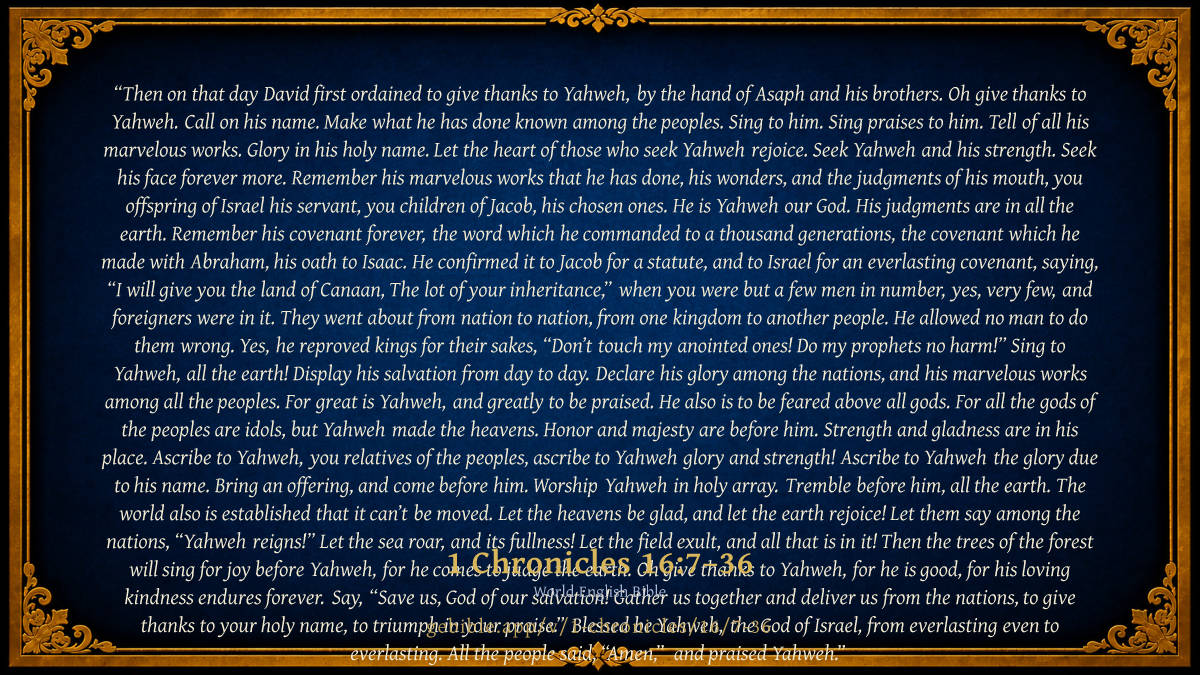
Then on that day David first ordained to give thanks to Yahweh, by the hand of Asaph and his brothers.
Oh give thanks to Yahweh. Call on his name. Make what he has done known among the peoples.
Sing to him. Sing praises to him. Tell of all his marvelous works.
Glory in his holy name. Let the heart of those who seek Yahweh rejoice.
Seek Yahweh and his strength. Seek his face forever more.
Remember his marvelous works that he has done, his wonders, and the judgments of his mouth,
you offspring of Israel his servant, you children of Jacob, his chosen ones.
He is Yahweh our God. His judgments are in all the earth.
Remember his covenant forever, the word which he commanded to a thousand generations,
the covenant which he made with Abraham, his oath to Isaac.
He confirmed it to Jacob for a statute, and to Israel for an everlasting covenant,
saying, “I will give you the land of Canaan, The lot of your inheritance,”
when you were but a few men in number, yes, very few, and foreigners were in it.
They went about from nation to nation, from one kingdom to another people.
He allowed no man to do them wrong. Yes, he reproved kings for their sakes,
“Don’t touch my anointed ones! Do my prophets no harm!”
Sing to Yahweh, all the earth! Display his salvation from day to day.
Declare his glory among the nations, and his marvelous works among all the peoples.
For great is Yahweh, and greatly to be praised. He also is to be feared above all gods.
For all the gods of the peoples are idols, but Yahweh made the heavens.
Honor and majesty are before him. Strength and gladness are in his place.
Ascribe to Yahweh, you relatives of the peoples, ascribe to Yahweh glory and strength!
Ascribe to Yahweh the glory due to his name. Bring an offering, and come before him. Worship Yahweh in holy array.
Tremble before him, all the earth. The world also is established that it can’t be moved.
Let the heavens be glad, and let the earth rejoice! Let them say among the nations, “Yahweh reigns!”
Let the sea roar, and its fullness! Let the field exult, and all that is in it!
Then the trees of the forest will sing for joy before Yahweh, for he comes to judge the earth.
Oh give thanks to Yahweh, for he is good, for his loving kindness endures forever.
Say, “Save us, God of our salvation! Gather us together and deliver us from the nations, to give thanks to your holy name, to triumph in your praise.”
Blessed be Yahweh, the God of Israel, from everlasting even to everlasting. All the people said, “Amen,” and praised Yahweh.
Geneva Bible translators 1599 · Public Domain On vv7, 8, 9, 12, 13, 18, 19, 21, 22, 26, 30, 31, 33, 35, 36 David gave them this Psalm to praise the Lord,…
David gave them this Psalm to praise the Lord, signifying, that in all our enterprises the Name of God ought to be praised and called upon.
Geneva Bible (1599) marginal notes — public domain.
John Trapp 1656 · Public Domain On vv7, 8, 9, 23, 34, 35 1Ch 16:7 Then on that day David delivered first…
1Ch 16:7 Then on that day David delivered first [this psalm] to thank the LORD into the hand of Asaph and his brethren.
Ver. 7. David delivered.] David, "the sweet psalmist of Israel." {2Sa 23:1}
John Trapp, A Commentary or Exposition upon All the Books of the Old and New Testament (1647–1656) — public domain. Text from a community e-Sword module.
Matthew Poole 1685 · Public Domain On vv7, 35 David delivered first this psalm; whereby it is implied,…
David delivered first this psalm; whereby it is implied, that after this he delivered many other psalms successively into their hands, to be sung by them to the praise of God in his public service. See 2Sa 23:1; 2Ch 29:30. As for the matter of this psalm, I shall defer the explication of it till I come to the Book of Psalms, where we shall find it in the same words, in Psa 96; Psa 105.
Matthew Poole's English Annotations on the Holy Bible (1683–1685) — public domain. Text from a community e-Sword/MySword module.
Matthew Henry 1710 · Public Domain On v7 We have here the thanksgiving psalm which David, by…
We have here the thanksgiving psalm which David, by the Spirit, composed, and delivered to the chief musician, to be sung upon occasion of the public entry the ark made into the tent prepared for it. Some think he appointed this hymn to be daily used in the temple service, as duly as the day came; whatever other psalms they sung, they must not omit this. David had penned many psalms before this, some in the time of his trouble by Saul. This was composed before, but was now first delivered into the hand of Asaph, for the use of the church. It is gathered out of several psalms (from the beginning to Ch1 16:23 is taken from Psa 105:1, etc.; and then Ch1 16:23 is the whole 96th psalm, with little variation; Ch1 16:34 is taken from Psa 136:1 and divers others; and then the last two verses are taken from the close of Ps. 106), which some think warrants us to do likewise, and make up hymns out of David's psalms, a part of one and a part of another put together so as may be most proper to express and excite the devotion of Christians. These psalms will be best expounded in their proper places (if the Lord will); here we take them as they are put together, with a design to thank the Lord (Ch1 16:7), a great duty, to which we need to be excited and in which we need to be assisted. 1. Let God be glorified in our praises; let his honour be the centre in which all the lines meet. Let us glorify him by our thanksgivings (Give thanks to the Lord), by our prayers (Call on his name, Ch1 16:8), by our songs (Sing psalms unto him), by our discourse - Talk of all his wondrous works, Ch1 16:9. Let us glorify him as a great God, and greatly to be praised (Ch1 16:25), as supreme God (above all gods), as sole God, for all others are idols, Ch1 16:26. Let us glorify him as most bright and blessed in himself (Glory and honour are in his presence, Ch1 16:27), as creator (The Lord made the heavens), as the ruler of the whole creation (His judgments are in all the earth, Ch1 16:14), and as ours - He is the Lord our God. Thus must we give unto the Lord the glory due to his name (Ch1 16:28, Ch1 16:29), and own it, and much more, his due. 2. Let other be edified and instructed: Make known his deeds among the people (Ch1 16:8), declare his glory among the heathen (Ch1 16:24), that those who are strangers to him may be led into acquaintance with him, allegiance to him, and the adoration of him. Thus must we serve the interests of his kingdom among men, that all the earth may fear before him, Ch1 16:30. 3. Let us be ourselves encouraged to triumph and trust in God. Those that give glory to God's name are allowed to glory in it (Ch1 16:10), to value themselves upon their relation to God and venture themselves upon his promise to them. Let the heart of those rejoice that seek the Lord, much more of those that have found him. Seek him, and his strength, and his face: that is, seek him by the ark of his strength, in which he manifests himself. 4. Let the everlasting covenant be the great matter of our joy and praise (Ch1 16:15): Be mindful of his covenant. In the parallel place it is, He will be ever mindful of it, Psa 105:8. Seeing God never will forget it, we never must. The covenant is said to be commanded, because God has obliged us to obey the conditions of it, and because he has both authority to make the promise and ability to make it good. This covenant was ancient, yet never to be forgotten. It was made with Abraham, Isaac, and Jacob, who were long since dead (Ch1 16:16-18), yet still sure to the spiritual seed, and the promises of it pleadable. 5. Let God's former mercies to his people of old, to our ancestors and our predecessors in profession, be commemorated by us now with thankfulness to his praise. Let it be remembered how God protected the patriarchs in their unsettled condition. When they came strangers to Canaan and were sojourners in it, when they were few and might easily have been swallowed up, when they were continually upon the remove and so exposed, when there were many that bore them ill-will and sought to do them mischief, yet no man was suffered to do them wrong - not the Canaanites, Philistines, Egyptians. Kings were reproved and plagued for their sakes. Pharaoh was so, and Abimelech. They were the anointed of the Lord, sanctified by his grace, sanctified by his glory, and had received the unction of the Spirit. They were his prophets, instructed in the things of God themselves and commissioned to instruct others (and prophets are said to be anointed, Kg1 19:16; Isa 61:1); therefore, if any touch them, they touch the apple of God's eye; if any harm them, it is at their peril, Ch1 16:19-22. 6. Let the great salvation of the Lord be especially the subject of our praises (Ch1 16:23): Show forth from day to day his salvation, that is (says bishop Patrick), his promised salvation by Christ. We have reason to celebrate that from day to day; for we daily receive the benefits of it, and it is a subject that can never be exhausted. 7. Let God be praised by a due and constant attendance upon him in the ordinances he has appointed: Bring an offering, then the fruit of the ground, now the fruit of the lips, of the heart (Heb 13:15), and worship him in the beauty of holiness, in the holy places and in a holy manner, Ch1 16:29. Holiness is the beauty of the Lord, the beauty of all sanctified souls and all religious performances. 8. Let God's universal monarchy be the fear and joy of all people. Let us reverence it: Fear before him, all the earth. And let us rejoice in it: Let the heavens be glad and rejoice, because the Lord reigns, and by his providence establishes the world, so that, though it be moved, it cannot be removed, nor the measures broken which Infinite Wisdom has taken in the government of it, Ch1 16:30, Ch1 16:31. 9. Let the prospect of the judgment to come inspire us with an awful pleasure, Let earth and sea, fields and woods, though in the great day of the Lord they will all be consumed, yet rejoice that he will come, doth come, to judge the earth, Ch1 16:32, Ch1 16:33. 10. In the midst of our praises we must not forget to pray for the succour and relief of those saints and servants of God that are in distress (Ch1 16:35): Save us, gather us, deliver us from the heathen, those of us that are scattered and oppressed. When we are rejoicing in God's favours to us we must remember our afflicted brethren, and pray for their salvation and deliverance as our own. We are members one of another; and therefore when we mean, "Lord, save them," it is not improper to say, "Lord, save us." Lastly, Let us make God the Alpha and Omega of our praises. David begins with (Ch1 16:8), Give thanks to the Lord; he concludes (Ch1 16:36), Blessed be the Lord. And whereas in the place whence this doxology is taken (Psa 106:48) it is added, Let all the people say, Amen, Hallelujah, here we find they did according to that directory: All the people said, Amen, and praised the Lord. When the Levites had finished this psalm or prayer and praise, then, and not till then, the people that attended signified their consent and concurrence by saying, Amen, And so they praised the Lord, much affected no doubt with this newly instituted way of devotion, which had been hitherto used in the schools of the prophets only, Sa1 10:5. And, if this way of praising God please the Lord better than an ox or a bullock that has horns and hoofs, the humble shall see it and be glad, Psa 69:31, Psa 69:32.
Matthew Henry's Commentary on the Whole Bible (1708–1710) — public domain (CC PDM 1.0). Text via the HelloAO Bible API.
John Gill 1763 · Public Domain On vv7, 35 And say ye, save us, O God of our…
And say ye, save us, O God of our salvation,.... The author of temporal, spiritual, and eternal salvation; the words are a direction to the singers, and those that sung with them, to express the prayer and doxology in the next verse, which both are the same with Psa 106:47. See Gill on Psa 106:47, Psa 106:48; which David directed by a spirit of prophecy, foreseeing the people of Israel would be in captivity among the Heathens; though some think these were added by Ezra; for though there was in his time a return from the captivity, yet many still remained in it.
; which David directed by a spirit of prophecy, foreseeing the people of Israel would be in captivity among the Heathens; though some think these were added by Ezra; for though there was in his time a return from the captivity, yet many still remained in it.
Read full note →
1 Chronicles 16:37
ch1 16:37
ch1 16:37
ch1 16:37So he left there, before the ark of the covenant of the Lord, Asaph and his brethren,.... Whom he, that is, David, had appointed for the service of it:
to minister before the ark continually; in singing the praises of God:
as every day's work required; at the time of the morning and evening sacrifice, as Jarchi and Kimchi interpret it.
John Gill's Exposition of the Whole Bible (1746–1763) — public domain (CC PDM 1.0). Text via the HelloAO Bible API.
John Wesley 1765 · Public Domain On vv7, 35 First - Hereby it is implied, that after this…
First - Hereby it is implied, that after this he delivered many other psalms into their hands, to be sung by them to the praise of God in his public service. We shall find it in the same words, in Psalm cv, 1-15 and Psalm 9vi, 1-11, all but the three last verses.
John Wesley, Explanatory Notes Upon the Whole Bible (1754–1765) — public domain. Text via the GEBible commentary corpus.
Adam Clarke 1810 · Public Domain On vv7, 10, 12, 22, 31, 35 Verse 7. David delivered first this psalm] I believe…
Verse 7. David delivered first this psalm] I believe the meaning of this place to be this: David made the psalm on the occasion above specified; and delivered it to Asaph, who was the musician, and to his brethren, to be sung by them in honour of what God had done in behalf of his people.
Adam Clarke's Commentary on the Bible (1810–1826) — public domain. Text from a community e-Sword/MySword module.
Joseph Benson 1811 · Public Domain On vv7, 35 1Ch 16:7. Then David delivered first this psalm, &c.…
1Ch 16:7. Then David delivered first this psalm, &c. — Or, as Houbigant renders it, On that same day David delivered this psalm, that Asaph and his brethren might praise the Lord by it — That is, on the day in which David appointed the Levites to sing before God, he gave them the song or hymn which follows. There is, however, nothing in the Hebrew for psalm. And the translation of the LXX. is perfectly accurate, save that they have rendered נתן, he gave, by εταξε, he appointed. It is, Then, in that day David appointed at first (εν αρχη, in the beginning) to praise the Lord, by the hand of Asaph and his brethren. The Hebrew expression, בראשׁ, barosh, at first, or in the beginning, seems to imply that David, after this, delivered many other psalms successively into their hands to be sung by them to the praise of God in his public service: see 2Sa 23:1; 2Ch 29:30. The reader will find some explanatory observations on the following verses, Psalms 96. and 105., in which they occur with little or no variation, all but the three last verses of the Psalm.
Joseph Benson's Commentary on the Old and New Testaments (1811–1818) — public domain. Text from a community e-Sword module.
Haydock's Catholic Bible Commentary 1859 · Public Domain On vv7, 11, 13, 22, 27, 29, 30, 35, 36 Made. Hebrew, "gave first, to thank the Lord, into…
Made. Hebrew, "gave first, to thank the Lord, into the hand of Asaph and his brethren this psalm," (Haydock) in order the 104th; and from ver. 23 we find the 95th in the Psalter, with some improvements. (Tirinus)
George Leo Haydock (1774–1849), Haydock's Catholic Family Bible and Commentary, 1859 edition — public domain. Excludes Psalms (Douay-Rheims chapter numbering differs from Protestant) and Deuterocanonical books (Catholic canon only).
Robert Jamieson, A. R. Fausset & David Brown 1871 · Public Domain On vv7, 36 HIS PSALM OF THANKSGIVING. (1Ch. 16:7-43)
HIS PSALM OF THANKSGIVING. (1Ch. 16:7-43)
Then on that day David delivered first this psalm--Among the other preparations for this solemn inauguration, the royal bard had composed a special hymn for the occasion. Doubtless it had been previously in the hands of Asaph and his assistants, but it was now publicly committed to them as they entered for the first time on the performance of their sacred duties. It occupies the greater part of this chapter (1Ch. 16:8-36), and seems to have been compiled from other psalms of David, previously known to the Israelites, as the whole of it will be found, with very slight variations, in Psa 96:1-13; Psa 105:1-15; Psa 106:47-48. In the form, however, in which it is given by the sacred historian, it seems to have been the first psalm given for use in the tabernacle service. Abounding, as it does, with the liveliest ascriptions of praise to God for the revelation of His glorious character and the display of His marvellous works and containing, as it does, so many pointed allusions to the origin, privileges, and peculiar destiny of the chosen people, it was admirably calculated to animate the devotions and call forth the gratitude of the assembled multitude.
Jamieson, Fausset & Brown — Commentary Critical and Explanatory on the Whole Bible (1871) — public domain (CC PDM 1.0). Text via the HelloAO Bible API.
Daniel D. Whedon 1874 · Public Domain On v7 7. On that day David delivered first this psalm…
7. On that day David delivered first this psalm — This statement seems clearly to settle the question of the origin of the psalm that follows. A number of critics, in spite of this statement of the chronicler, maintain that the psalm was compiled from extracts of psalms already existing and familiar to the Israelites. 1Ch_16:8-22 are found again in Psa_105:1-15; 1Ch_16:23-33 are nearly the same as Psalm cxvi; and 1Ch_16:34-36 agree with Psa_106:1; Psa_106:47-48. A number of expressions in this book are more archaic than are the corresponding ones in the psalms named; and while some differences may seem to bespeak a greater antiquity for the psalms, they are more than counterbalanced by the above positive assertion of the chronicler. We therefore, with Keil, regard this psalm, as it stands in this book, as the original poem, from which the parts of the several psalms above mentioned were subsequently derived. Our common English version is so faithful to the Hebrew text as to call for no revision in these notes, and textual comment will be found at the corresponding passages in the notes on the psalms.
Daniel D. Whedon (gen. ed.), Commentary on the Old and New Testaments (1874–1909) — public domain. Text from a community e-Sword module.
The Cambridge Bible for Schools and Colleges 1878 · Public Domain On vv7, 8, 9, 11, 12, 13, 14, 15, 17, 18, 19, 20, 21, 22, 23, 24, 25, 26, 27, 28, 29, 30, 31, 33, 34, 35, 36 7–36. The Psalm of Praise
7–36. The Psalm of Praise
7. David delivered first this psalm to thank the Lord into the hand etc.] R.V. did David first ordain to give thanks unto the LORD, by the hand etc. The psalm which follows consists of Psa_105:1-15; Psa_96:1 b – Psa_96:13 a, Psa_106:1; Psa_106:47-48.
The Cambridge Bible for Schools and Colleges (gen. ed. J. J. S. Perowne; Cambridge University Press, 1878–1918) — public domain. Text from a community e-Sword module.
Ellicott's Commentary for English Readers 1878 · Public Domain On vv7, 8, 9, 10, 11, 12, 13, 14, 15, 16, 17, 18, 19, 20, 21, 22, 23, 34, 35 (7-36) An ode of thanksgiving appropriate to the occasion.
(7-36) An ode of thanksgiving appropriate to the occasion.
(7) Then on that day David delivered first this psalm.—Rather, On that day then (viz., after the Ark had been placed in its tent, and the minstrels appointed) David originally committed the giving of thanks to Jehovah into the hands of Asaph and his brethren. Thus understood, the verse merely asserts that this was the occasion when “Asaph and his brethren” were first charged with the duties described in 1Ch_16:4-6. But the words seem really intended to introduce the long ode which follows, and therefore we should perhaps render, “On that day, then David gave for the first time into the hands of Asaph and his brethren, for giving thanks to Jehovah, Give thanks unto the Lord,’” &c., the whole psalm being regarded as the object of the verb. It may be that this composite hymn was sung in the time of the compiler, on the anniversary of the removal of the Ark, which may in after-times have been commemorated by a special service. Hence it was easy to infer that it was the ode sung at the original service under David. The words “then” (’âz) and “on that day” certainly seem to introduce the psalm. (Comp, their use, Exo_15:1, and Jdg_5:1. Comp. also 2Ch_7:6.)
Read full note →
But the ambiguity of 1Ch_16:7 may be taken along with other considerations to indicate that this ode does not constitute an original part of the Chronicles, but has been inserted by a later hand. For (1) the Psalm is clearly a cento consisting of portions of three others extant in the Psalter, and so loosely patched together that the seams are quite visible; (2) the Psalter itself does not refer the three psalms in question to David; if, however, the editors of the Psalter had read in the Chronicles a clear assertion of Davidic authorship, they would hardly have left them anonymous; (3) all critics agree that it is not here expressly said that David composed this ode, and, in fact, its ideas and language betray a later origin than the Davidic age; and (4) it contains no specific allusion to the occasion for which it purports to have been written. If no record was preserved of the psalms actually sung at the festival, it was natural that some editor should attempt to supply the apparent lacuna from the Psalter.
A Bible Commentary for English Readers, edited by Charles John Ellicott (1878–1897) — public domain. Text from a community e-Sword module.
The Pulpit Commentary 1880 · Public Domain On vv7, 8, 11, 12, 14, 15, 23, 29, 31, 33, 34, 36 The rendering should run, On that day did David…
The rendering should run, On that day did David first commit to the hand of Asaph and his brethren to render praises to Jehovah; i.e. after the following manner and words. The word first marks the solemn establishment of set public worship in the metropolis.
Vers. 7-36.
Read full note →
A psalm.
When the king had organized a choir of musicians, had provided them with their instruments, had assigned them their duties and their maintenance, it remained for him to decide what they were to sing. He was himself "the sweet psalmist of Israel." It is difficult for us to imagine what psalmody must have been before the time of David. It is a grand vocation that of putting words of praise into the lips of worshippers. And it was a glorious burst of sacred song which pealed from the heights of Jerusalem when the sublime odes of David were first rolled to heaven upon the wings of the wind. What a revelation of God, what an inspiration for man, what new life to the world, when the psalms were first wrought into shape by the glowing heart and the glorious eloquence of David! The later Levitical psalms are perhaps more reflective and elaborate, but those composed by the lyrical sovereign of Israel have at once the simplest piety, the profoundest feeling, and the most vigorous eloquence. The occasion of the composition, or, at all events, the first public rendering of David"s odes, was one worthy of such efforts. When the ark found a resting-place in the city of David, when Jerusalem was consecrated by the public and regal recognition of the Divine Law, when the Levites solemnly addressed Jehovah in the name of Israel, then this magnificent psalm was sung, now in melodious recitative, and again in resounding chorus, to the accompaniment of cymbal, of trumpet, and of harp. It was a fitting inauguration of a series of sublime solemnities. When we examine the structure of the psalm, we are surprised and filled with admiration at the appropriateness, the beauty, the comprehensiveness of the composition. The psalm, as it is recorded in this place, agrees with what we find in the hundred and fifth, ninety-sixth, hundred and seventh, and hundred and sixth psalms. Taken as we here find it, it contains
I AN ADMONITION AND SUMMONS TO PRAISE THE LORD. This is addressed to nature (vers. 30-33), to mankind in general (ver. 28), especially to Israel (ver. 13).
II A RECORD OF GOD"S GOODNESS. And this both to the patriarchs (vers. 15-18), and to Israel as a nation, to whom that goodness had been displayed in the most critical period of their history (vers. 19-22).
III PRAISE OF GOD"S ATTRIBUTES AND CHARACTER. (Vers. 2429, 34.) Never had these been so devoutly and at the same time so poetically celebrated as now and here.
IV PRAYER FOR SALVATION. This petition (ver. 35) flows most naturally out of what precedes. In the register of Divine acts, in the recounting of Divine attributes, a foundation had Been laid for this devout and urgent entreaty.
V BLESSING AND AMEN. A glorious closing (ver. 36) to a glorious psalm. "All the people" here concurred with, adopted as their own, the worship of the Levites. The reval psalmist"s heart must have beat high with sacred joy when his plans proved successful, when his ministers rendered his compositions in a manner worthy of their substance, and when the soul of a nation was raised into fellowship with God. T.
The Pulpit Commentary (1880–1919), ed. H.D.M. Spence-Jones & Joseph S. Exell — public domain. Text from a community e-Sword module.
The Biblical Illustrator 1887 · Public Domain On vv7, 9, 11, 15, 19, 23, 25, 27, 28, 29, 31, 34, 36 Then on that day David delivered first this psalm.
1Ch_16:7-22
Then on that day David delivered first this psalm.
Read full note →
A psalm of thanksgiving
This, a composite psalm, represents a form of service rather than a psalm. The whole of it, with slight variations, found in Psa_96:1-13; Psa_105:1-15; Psa_106:47-48. It celebrates redemption as unfolded in the history of Israel, proclaimed to the world, and triumphant in judgment. This part sets forth.
I. An exhortation to the noblest work--praising God. In three ways, chiefly, is this duty recommended.
1. In giving thanks to God.
(1) By singing psalms (verse 9).
(2) By social conversation.
(3) By glorying in His name (verse 10).
2. In seeking God.
(1) Earnestly.
(2) Joyfully.
(3) Continually.
3. In commemorating Gods works (verse 12).
II. Motives to influence us in this noblest work.
1. Gods great love.
2. Gods great manifestations of love.
3. Gods great dominion.
4. Gods great claims.
5. Gods vindication of these claims. (J. Wolfendale.)
A memorable day
Let us gather up a few of the lessons which Providence read out to humanity on that day.
I. That religion is a subject in which the leaders of the people should endeavour to interest the masses.
1. Religion is suited to the common and primary instincts of human nature.
2. Religion provides for the fallen condition of human nature.
II. That religion develops the distinctive characteristics of mankind. Through it the thoughts of many hearts are revealed. In the history of this day four states of mind are developed in relation to the Divine.
1. An enthusiastic interest in the Divine. Such was Davids state.
2. A stolid unconsciousness of the Divine. This was revealed in Uzzahs conduct. To him the ark only appeared as a common chest. He was a type of those who engage in religious services without the religious spirit.
3. A calm confidence in the Divine. This was revealed in the conduct of Obed-edom. The terrible fate of Uzzah filled David with overwhelming excitement. The people were panic-stricken. But Obed-edom was calm. He took the ark into his own house for three months; he stands by a deserted cause.
4. A thoughtless contempt for the Divine. This was developed in Michal (1Ch_15:29). She is a type of a class who despise religious observances, religious people, and religious services.
III. That religion is always associated with the cheerful and the generous.
1. Here is music.
2. Here is hospitality. True religion is evermore the parent of true philanthropy.
IV. That religion is the patron of the highest art as well as the inspirer of the holiest feelings (1Ch_15:16-24). (Homilist.)
The Biblical Illustrator, edited by Joseph S. Exell (c. 1880s–1900s) — public domain. Text from a community e-Sword module.
C. I. Scofield 1917 · Public Domain On vv16, 25 (See Scofield "Gen 15:18").
Abraham
(See Scofield "Gen 15:18").
The Scofield Reference Bible (1917 edition), notes by C. I. Scofield — public domain. Text from a community e-Sword module.
Paul E. Kretzmann 1924 · Public Domain On v7 David’s Psalm of Praise
David’s Psalm of Praise
v. 7. Then, on that day, David delivered first this psalm, to thank the Lord, into the hand of Asaph and his brethren, for use in the public worship at the Tabernacle (the hymn, as here recorded, is almost identical with Psalms 96; Cf also Psa 105:1-15; Psa 106:47-48):
Read full note →
v. 8. Give thanks unto the Lord, call upon His name, in acknowledgment of His Godhead, make known His deeds among the people.
v. 9. Sing unto Him, sing psalms unto Him, talk ye of all His wondrous works.
v. 10. Glory ye in His holy name, in proud praise; let the heart of them rejoice that seek the Lord.
v. 11. Seek the Lord and His strength, in firm trust and confidence; seek His face continually. So this first strophe is a summons to praise the Lord and to seek His face.
v. 12. Remember His marvelous works that He hath done, His wonders, and the judgments of His mouth, in dealing justly both with His own people and with His enemies,
v. 13. O ye seed of Israel, His servant, ye children of Jacob, His chosen ones.
v. 14. He is the Lord, our God; His judgments are in all the earth, unmistakably plain to everyone that cares to see them, the strophe being a summons to consider the Lord’s ways and judgments.
v. 15. Be ye mindful always of His covenant, the Word which He commanded to a thousand generations, as it was given from Mount Sinai and, before that, to the patriarchs;
v. 16. even of the covenant which He made with Abraham, and of His oath unto Isaac;
v. 17. and hath confirmed the same to Jacob for a law and to Israel for an everlasting covenant,
v. 18. saying, Unto thee will I give the land of Canaan, the lot of your inheritance (there is a Messianic element in these lines, and the entire strophe is a summons to keep His wonderful covenant in mind, to trust in the Messiah and His work),
v. 19. when ye were but few, even a few, and strangers in it, namely, the families of the patriarchs.
v. 20. And when they went from nation to nation and from one kingdom to another people, as in the journeys of Abraham and Isaac to Philistia and Egypt, and that of Jacob to Mesopotamia,
v. 21. He suffered no man to do them wrong, as the history of each of the patriarchs shows; yea, He reproved kings for their sakes, Gen 12:17; Gen 20:3,
v. 22. saying, Touch not Mine anointed, and do My prophets no harm; for everyone of the patriarchs was, at the same time, a prophet of Jehovah, and the remembrance of the Lord’s protection afforded to their fathers was to keep the descendants in the fear of Jehovah.
v. 23. Sing unto the Lord, all the earth, His praise should not be confined to the children of Israel; show forth from day to day His salvation, the deliverance wrought through the Messiah.
v. 24. Declare His glory among the heathen, His marvelous works among all nations; for the missionary spirit has actuated the believers of all times.
v. 25. For great is the Lord, and greatly to be praised; He also is to be feared above all gods, ever thing that bears that name.
v. 26. For all the gods of the people, of the heathen nations far and wide, are idols, literally, "vanities, nothingnesses"; but the Lord made the heavens.
v. 27. Glory and honor are in His presence; strength and gladness are in His place, strength and beauty in His Sanctuary, for which reason all the world should join in the praise of His greatness.
v. 28. Give unto the Lord, ye kindreds of the people, give unto the Lord glory and strength.
v. 29. Give unto the Lord the glory due unto His name; bring an offering, and come before Him; worship the Lord in the beauty of holiness, in a manner harmonizing with the majesty of His holiness.
v. 30. Fear before Him, all the earth, in the veneration due to His glorious Godhead; the world also shall be stable, firmly established, that it be not moved.
v. 31. Let the heavens be glad, and let the earth rejoice; and let men say among the nations, The Lord reigneth, this being the message which the believers of all times are to bring to all men.
v. 32. Let the sea roar and the fulness thereof; let the fields rejoice, and all that is therein, the very forces of inanimate nature being appealed to in properly picturing the glory of the Lord.
v. 33. Then shall the trees of the wood sing out at the presence of the Lord, because He cometh to judge the earth, and even the inanimate things of creation will exult before His coming to Judgment, since it will result in their being delivered from the bondage of sin, Romans 8.
v. 34. O give thanks unto the Lord, for He is good; for His mercy endureth forever, this again being a summons addressed to the believers in particular.
v. 35. And say ye, Save us, O God of our salvation, and gather us together, and deliver us from the heathen, that we may give thanks to Thy holy name, and glory in Thy praise, for the elect of the Lord will be assembled from every nation and tongue and people.
v. 36. Blessed be the Lord God of Israel forever and ever. The same doxology is found at the close of the fourth book of the Psalter, Psa 116:19. And all the people, signifying their glad assent to the entire hymn in all its parts, just as believers do today, said, Amen, and praised the Lord.
Paul E. Kretzmann, Popular Commentary of the Bible (1921–1924) — public domain. Text from a community e-Sword module.
unfoldingWord translationNotes 2017 · CC BY-SA 4.0 On vv7, 10, 12, 15, 19, 23, 25, 28, 30, 32, 34, 36 on that day
on that day
Here "that day" refers to the day the ark of the covenant was moved from the house of Obed Edom to Jerusalem.
Read full note →
song of thanksgiving
"song of giving thanks"
call on his name
Here "his name" represents Yahweh. AT: "call on Yahweh" (See: Metonymy)
the nations
This refers to the people in the nations. AT: "the people of the nations" (See: Metonymy)
translationWords
brother
call
name
works
nation
amazed
unfoldingWord translationNotes — © Distant Shores Media and the Door43 World Missions Community, licensed CC BY-SA 4.0. Source: git.door43.org/Door43/en_tn.
Tyndale Open Study Notes 2022 · CC BY-SA 4.0 On v7 16:7-36 David’s song of thanksgiving is a composite of…
16:7-36 David’s song of thanksgiving is a composite of three psalms: 16:8-22 draws from Ps 105:1-15; 1 Chr 16:23-33 draws from Ps 96; and 1 Chr 16:34-38 draws from Ps 106:1, 47-48. The composer made several adjustments to the sources to fit this occasion. The Temple did not exist when the Ark was brought to Jerusalem, so the Chronicler says that strength and joy fill his dwelling (1 Chr 16:27) instead of “his sanctuary” (Ps 96:6) and requires the worshiper to come into his presence (1 Chr 16:29) instead of “into his courts” (Ps 96:8). The name “Abraham” (Ps 105:9) is also changed to Israel (1 Chr 16:13) to focus specifically on the nation as the fulfillment of the promises to Abraham. The hymn does not mention the judgment of the earth (Ps 96:10, 13; cp. 1 Chr 16:30, 33) because it was not relevant to the dedication of the Ark.
Tyndale Open Study Notes — © Tyndale Open Resources, licensed CC BY-SA 4.0. Text via the HelloAO Bible API.