
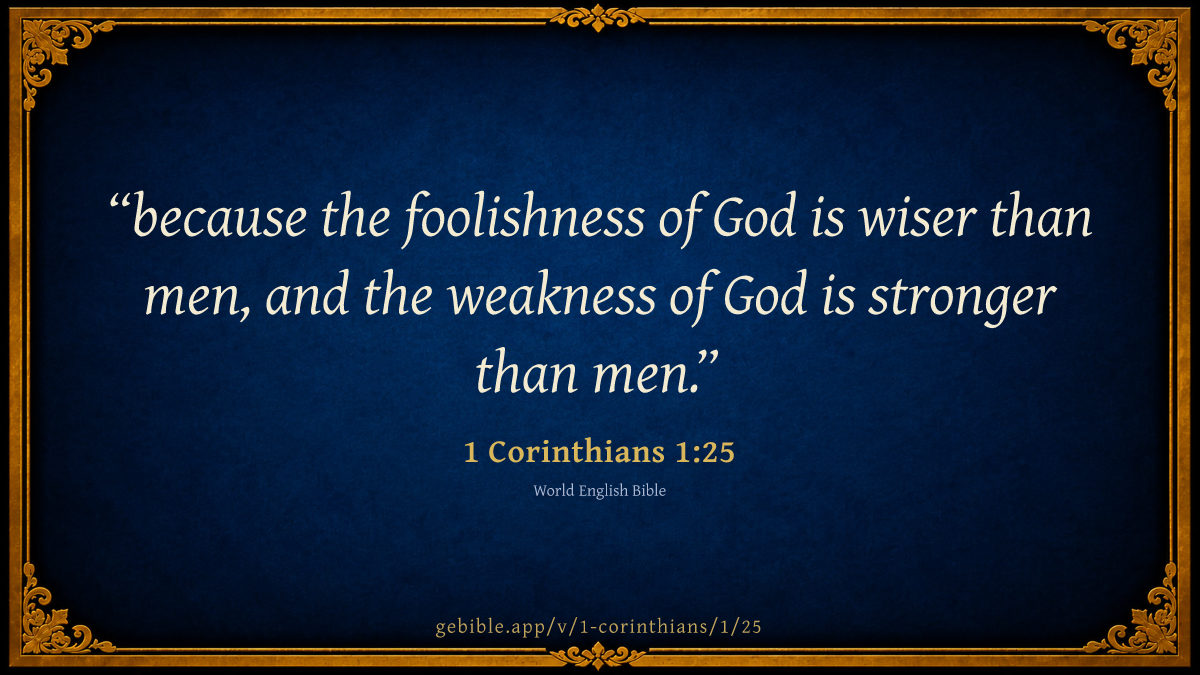
because the foolishness of God is wiser than men, and the weakness of God is stronger than men.
Parallel Translations
-
because the foolishness of God is wiser than men, and the weakness of God is stronger than men.
-
For the folishnes of God is wyser then men: and the weakenes of God is stronger then men.
-
For the foolishnesse of God is wiser then men, and the weakenesse of God is stronger then men.
Cross-references (13)
Passages linked to 1 Corinthians 1:25 in the Treasury of Scripture Knowledge, ordered by reader-vote popularity; verse text shown in World English Bible.
- Romans 11:33-36 Oh the depth of the riches both of the wisdom and the knowledge of God! How unsearchable are his judgments, and his ways past tracing out! “For who has known the mind of the Lord? Or who has been his counselor?” “Or who has first given to him, and it will be repaid to him again?” For of him, and through him, and to him are all things. To him be the glory for ever! Amen.
- 1 Corinthians 1:18 For the word of the cross is foolishness to those who are dying, but to us who are being saved it is the power of God.
- Zechariah 4:6-7 Then he answered and spoke to me, saying, “This is Yahweh’s word to Zerubbabel, saying, ‘Not by might, nor by power, but by my Spirit,’ says Yahweh of Armies. Who are you, great mountain? Before Zerubbabel you are a plain; and he will bring out the capstone with shouts of ‘Grace, grace, to it!’ ”
- 2 Corinthians 13:4 For he was crucified through weakness, yet he lives through the power of God. For we also are weak in him, but we will live with him through the power of God toward you.
- Judges 7:2-8 Yahweh said to Gideon, “The people who are with you are too many for me to give the Midianites into their hand, lest Israel brag against me, saying, ‘My own hand has saved me.’ Now therefore proclaim in the ears of the people, saying, ‘Whoever is fearful and trembling, let him return and depart from Mount Gilead.’ ” So twenty-two thousand of the people returned, and ten thousand remained. Yahweh said to Gideon, “There are still too many people. Bring them down to the water, and I will test them for you there. It shall be, that those whom I tell you, ‘This shall go with you,’ shall go with you; and whoever I tell you, ‘This shall not go with you,’ shall not go.” So he brought down the people to the water; and Yahweh said to Gideon, “Everyone who laps of the water with his tongue, like a dog laps, you shall set him by himself; likewise everyone who bows down on his knees to drink.” The number of those who lapped, putting their hand to their mouth, was three hundred men; but all the rest of the people bowed down on their knees to drink water. Yahweh said to Gideon, “I will save you by the three hundred men who lapped, and deliver the Midianites into your hand. Let all the other people go, each to his own place.” So the people took food in their hand, and their trumpets; and he sent all the rest of the men of Israel to their own tents, but retained the three hundred men; and the camp of Midian was beneath him in the valley.
- Zechariah 12:7-8 Yahweh also will save the tents of Judah first, that the glory of David’s house and the glory of the inhabitants of Jerusalem not be magnified above Judah. In that day Yahweh will defend the inhabitants of Jerusalem. He who is feeble among them at that day will be like David, and David’s house will be like God, like Yahweh’s angel before them.
- 1 Corinthians 1:27-29 but God chose the foolish things of the world that he might put to shame those who are wise. God chose the weak things of the world that he might put to shame the things that are strong. God chose the lowly things of the world, and the things that are despised, and the things that don’t exist, that he might bring to nothing the things that exist, that no flesh should boast before God.
- Exodus 14:2-4 “Speak to the children of Israel, that they turn back and encamp before Pihahiroth, between Migdol and the sea, before Baal Zephon. You shall encamp opposite it by the sea. Pharaoh will say of the children of Israel, ‘They are entangled in the land. The wilderness has shut them in.’ I will harden Pharaoh’s heart, and he will follow after them; and I will get honor over Pharaoh, and over all his armies; and the Egyptians shall know that I am Yahweh.” They did so.
- Joshua 6:2-5 Yahweh said to Joshua, “Behold, I have given Jericho into your hand, with its king and the mighty men of valor. All of your men of war shall march around the city, going around the city once. You shall do this six days. Seven priests shall bear seven trumpets of rams’ horns before the ark. On the seventh day, you shall march around the city seven times, and the priests shall blow the trumpets. It shall be that when they make a long blast with the ram’s horn, and when you hear the sound of the trumpet, all the people shall shout with a great shout; and the city wall shall fall down flat, and the people shall go up, every man straight in front of him.”
- Judges 15:15-16 He found a fresh jawbone of a donkey, put out his hand, took it, and struck a thousand men with it. Samson said, “With the jawbone of a donkey, heaps on heaps; with the jawbone of a donkey I have struck a thousand men.”
- 1 Kings 20:14-22 Ahab said, “By whom?” He said, “Yahweh says, ‘By the young men of the princes of the provinces.’ ” Then he said, “Who shall begin the battle?” He answered, “You.” Then he mustered the young men of the princes of the provinces, and they were two hundred and thirty-two. After them, he mustered all the people, even all the children of Israel, being seven thousand. They went out at noon. But Ben Hadad was drinking himself drunk in the pavilions, he and the kings, the thirty-two kings who helped him. The young men of the princes of the provinces went out first; and Ben Hadad sent out, and they told him, saying, “Men are coming out from Samaria.” He said, “If they have come out for peace, take them alive; or if they have come out for war, take them alive.” So these went out of the city, the young men of the princes of the provinces, and the army which followed them. They each killed his man. The Syrians fled, and Israel pursued them. Ben Hadad the king of Syria escaped on a horse with horsemen. The king of Israel went out, and struck the horses and chariots, and killed the Syrians with a great slaughter. The prophet came near to the king of Israel, and said to him, “Go, strengthen yourself, and mark, and see what you do; for at the return of the year the king of Syria will come up against you.”
- 1 Samuel 17:40-51 He took his staff in his hand, and chose for himself five smooth stones out of the brook, and put them in the pouch of his shepherd’s bag which he had. His sling was in his hand; and he came near to the Philistine. The Philistine walked and came near to David; and the man who bore the shield went before him. When the Philistine looked around, and saw David, he disdained him; for he was but a youth, and ruddy, and had a good looking face. The Philistine said to David, “Am I a dog, that you come to me with sticks?” The Philistine cursed David by his gods. The Philistine said to David, “Come to me, and I will give your flesh to the birds of the sky, and to the animals of the field.” Then David said to the Philistine, “You come to me with a sword, with a spear, and with a javelin; but I come to you in the name of Yahweh of Armies, the God of the armies of Israel, whom you have defied. Today, Yahweh will deliver you into my hand. I will strike you, and take your head from off you. I will give the dead bodies of the army of the Philistines today to the birds of the sky, and to the wild animals of the earth; that all the earth may know that there is a God in Israel, and that all this assembly may know that Yahweh doesn’t save with sword and spear; for the battle is Yahweh’s, and he will give you into our hand.” When the Philistine arose, and walked and came near to meet David, David hurried, and ran toward the army to meet the Philistine. David put his hand in his bag, took a stone, and slung it, and struck the Philistine in his forehead. The stone sank into his forehead, and he fell on his face to the earth. So David prevailed over the Philistine with a sling and with a stone, and struck the Philistine, and killed him; but there was no sword in the hand of David. Then David ran, stood over the Philistine, took his sword, drew it out of its sheath, killed him, and cut off his head with it. When the Philistines saw that their champion was dead, they fled.
- Exodus 13:17 When Pharaoh had let the people go, God didn’t lead them by the way of the land of the Philistines, although that was near; for God said, “Lest perhaps the people change their minds when they see war, and they return to Egypt”;
Cross-references from openbible.info (CC BY 4.0)
Explain this verse (17 sources)
Historical commentary, presented as a primary source — not an endorsement.
Private notes
Saved on this device only — never synced or sent anywhere.
John Calvin 1540 · Public Domain 25. For the foolishness of God While the Lord…
25. For the foolishness of God While the Lord deals with us in such a way as to seem to act foolishly, because he does not exhibit his wisdom, what appears foolishness surpasses in wisdom all the ingenuity of men. Farther, while God appears to act with weakness, in consequence of his concealing his power, that weakness, as it is reckoned, is stronger than any power of men. We must, however, always keep it in view, that there is a concession, as I have noticed a little ago. For no one can but perceive, that in strict propriety neither foolishness nor weakness can be ascribed to God, but it was necessary, by such ironical expressions, to beat down the mad presumption of the flesh, which does not scruple to rob God of all his glory.
John Calvin's Commentaries (1540-1563) — public domain. Text from the Calvin Translation Society English edition (1840s-50s) via the Christian Classics Ethereal Library (ccel.org). Calvin's coverage is partial (roughly two-thirds of the Bible); uncommented books and verses are honest gaps, never fabricated. The 19th-century editor's footnotes and remarks are omitted so the notes are faithfully Calvin's own voice.
John Trapp 1656 · Public Domain 25 Because the foolishness of God is wiser than…
25 Because the foolishness of God is wiser than men; and the weakness of God is stronger than men.
Ver. 25. Because the foolishness] The wisest man compared to God, Simia videbitur, non sapiens, said Heraclitus, as Plato relateth it, he will appear to be an ape rather than a wise man. But what meant that malicious fool Genebrard, to call reverend Beza, Theomorus for Theodorus? Was it not of God, so to direct the tongue of this Caiaphas the second, that in Beza and himself might this Scripture be fulfilled, το μωρον του θεου σοφωτερον των ανθρωπων, &c., "The foolishness of God," &c.
John Trapp, A Commentary or Exposition upon All the Books of the Old and New Testament (1647–1656) — public domain. Text from a community e-Sword module.
Matthew Poole 1685 · Public Domain The foolishness of God is wiser than men; the…
The foolishness of God is wiser than men; the least things that are the products of the wisdom of God, or the contrivance of God for man’s salvation, which the sinful and silly world calls foolishness, are infinitely more wise, and have more wisdom in them, than the wisest imaginations, counsels, and contrivances of men.
And the weakness of God is stronger than men; and those things and means which God hath instituted in order to an end, have in them more virtue, power, and efficacy in order to the production of God’s intended effects, than any such means as appear to men’s eyes of reason to have the greatest strength, virtue, and efficacy. Whence we may observe, that the efficacy of preaching for the changing and convering souls, dependeth upon the efficacy of God working in and by that holy institution, which usually attendeth the ministry of those who are not only called and sent out by men, but by God, being fitted for their work, and faithfully discharging of it.
Matthew Poole's English Annotations on the Holy Bible (1683–1685) — public domain. Text from a community e-Sword/MySword module.
John Gill 1763 · Public Domain Because the foolishness of God,.... Not that there is…
Because the foolishness of God,.... Not that there is any such thing as "foolishness" in God, nor the least degree of weakness in him; but the apostle means that which the men of the world esteem so, and therefore, by an ironical concession, calls it by those names; by which is intended either Christ, who, as crucified, is counted foolishness; yet he "is wiser than men": yea, even than Solomon, who was wiser than all men besides; Christ is greater than he in wisdom, having all the treasures of wisdom and knowledge in him; yea, in redemption by the blood of his cross, which is accounted such an egregious instance of folly, there is such a display of wisdom as surpasses all the wisdom of men and angels: and though he is, as crucified, esteemed as
the weakness of God, yet in this respect,
Read full note →
is stronger than men; stronger than the strong man armed; and has done that by his own arm, has brought salvation for his people, which neither men nor angels could ever have done: or all this may be understood of the Gospel of Christ, which is condemned as folly and weakness, and yet has infinitely more wisdom in it, than is to be found in the best concerted schemes of the wisest philosophers; and has had a greater influence on the minds and manners of men than theirs ever had; it is the manifold wisdom of God, and the power of God unto salvation. Moreover, these words may be applied to the saints, called in Co1 1:27.
the foolish and weak things of the world; and yet even these, in the business of salvation, how foolish soever they may be in other respects, are wiser than the wisest of men destitute of the grace of God; and however weak they are in themselves, in their own esteem, and in the account of others, they are able to do and suffer such things, through the strength of Christ that no other men in the world are able to perform or endure. The phrases here used seem to be a sort of proverbial ones; and the sense of them is, that whatever, in things divine and spiritual, has the appearance of folly and weakness, or is judged to be so by carnal men, is wiser and stronger not only than the wisdom and strength of men, but than men themselves with all their wisdom and strength. It is very likely, that proverbial expressions of this kind, with a little alteration, were used by the Jews. The advice the young men gave to Rehoboam is thus paraphrased by the Targumist (o), , "my weakness is stronger than the strength of my father"; which is very near the same with the last clause of this verse,
(o) In 2 Chron. x. 10.
John Gill's Exposition of the Whole Bible (1746–1763) — public domain (CC PDM 1.0). Text via the HelloAO Bible API.
John Wesley 1765 · Public Domain Because the foolishness of God - The gospel scheme,…
Because the foolishness of God - The gospel scheme, which the world judge to be mere foolishness, is wiser than the wisdom of men; and, weak as they account it, stronger than all the strength of men.
John Wesley, Explanatory Notes Upon the Whole Bible (1754–1765) — public domain. Text via the GEBible commentary corpus.
Adam Clarke 1810 · Public Domain Verse 25. The foolishness of God is wiser, c.]…
Verse 25. The foolishness of God is wiser, c.] The meaning of these strong expressions is, that the things of God's appointment, which seem to men foolishness, are infinitely beyond the highest degree of human wisdom and those works of God, which appear to superficial observers weak and contemptible, surpass all the efforts of human power. The means which God has appointed for the salvation of men are so wisely imagined and so energetically powerful, that all who properly use them shall be infallibly brought to the end-final blessedness, which he has promised to them who believe and obey.
Adam Clarke's Commentary on the Bible (1810–1826) — public domain. Text from a community e-Sword/MySword module.
Albert Barnes 1834 · Public Domain Because the foolishness of God - That which God…
Because the foolishness of God - That which God appoints, requires, commands, does, etc., which appears to people to be foolish. The passage is not to be understood as affirming that it is really foolish or unwise; but that it appears so to people - Perhaps the apostle here refers to those parts of the divine administration where the wisdom of the plan is not seen; or where the reason of what God does is concealed.
Is wiser than men - Is better adapted to accomplish important ends, and more certainly effectual than the schemes of human wisdom. This is especially true of the plan of salvation - a plan apparently foolish to the mass of people - yet indubitably accomplishing more for the renewing of people, and for their purity and happiness, than all the schemes of human contrivance. They have accomplished nothing toward people’s salvation; this accomplishes everything. They have always failed; this never fails.
Read full note →
The weakness of God - There is really no weakness in God, any more than there is folly. This must mean, therefore, the things of his appointment which appear weak and insufficient to accomplish the end. Such are these facts - that God should seek to save the world by Jesus of Nazareth, Who was supposed unable to save himself Mat 27:40-43; and that he should expect to save people by the gospel, by its being preached by people who were without learning, eloquence, wealth, fame, or power. The instruments were feeble; and people judged that this was owing to the weakness or lack of power in the God who appointed them.
Is stronger than men - Is able to accomplish more than the utmost might of man. The feeblest agency that God puts forth - so feeble as to be esteemed weakness - is able to effect more than the utmost might of man. The apostle here refers particularly to the work of redemption; but it is true everywhere. We may remark:
(1) That God often effects his mightiest plans by that which seems to men to be weak and even foolish. The most mighty revolutions arise often from the slightest causes; his most vast operations are often connected with very feeble means. The revolution of empires; the mighty effects of the pestilence; the advancement in the sciences, and arts, and the operations of nature, are often brought about by means apparently as little suited to accomplish the work as those which are employed in the plan of redemption.
(2) God is great. If his feeblest powers put forth, surpass the mightiest powers of man, how great must be his might. If the powers of man who rears works of art; who levels mountains and elevates vales; if the power which reared the pyramids, be as nothing when compared with the feeblest putting forth of divine power, how mighty must be his arm! How vast that strength which made, and which upholds the rolling worlds! How safe are his people in his hand! And how easy for him to crush all his foes in death!
Albert Barnes' Notes on the Bible (1834–1885) — public domain. Text from a community e-Sword/MySword module.
Robert Jamieson, A. R. Fausset & David Brown 1871 · Public Domain foolishness of God--that is, God's plan of salvation which…
foolishness of God--that is, God's plan of salvation which men deem "foolishness."
weakness of God--Christ "crucified through weakness" (Co2 13:4, the great stumbling-block of the Jews), yet "living by the power of God." So He perfects strength out of the weakness of His servants (Co1 2:3; Co2 12:9).
Jamieson, Fausset & Brown — Commentary Critical and Explanatory on the Whole Bible (1871) — public domain (CC PDM 1.0). Text via the HelloAO Bible API.
Daniel D. Whedon 1874 · Public Domain 25. Foolishness of God—A remarkable ironical phrase, and refers…
25. Foolishness of God—A remarkable ironical phrase, and refers to the preaching of 1Co_1:21. Foolishness is it? But it is God’s foolishness, and God’s foolishness is wiser than man’s wisdom. God’s foolishness is the preaching of the cross; man’s wisdom is the philosophy of the Grecian schools, the noblest efforts of the human mind in that direction, yet yielding no reposeful certainty for the human soul on the great question of the origin of things or the destiny of man.
Daniel D. Whedon (gen. ed.), Commentary on the Old and New Testaments (1874–1909) — public domain. Text from a community e-Sword module.
The Cambridge Bible for Schools and Colleges 1878 · Public Domain 25. Because the foolishness of God is wiser than…
25. Because the foolishness of God is wiser than men, &c.] What was folly in the eyes of the Greek, or weakness in the eyes of the Jew, was yet far wiser and stronger than their highest conceptions. The revelation of God in the man Christ Jesus, the Infinite allying itself to the Finite—the foolishness of God—was the perfection of the Divine Wisdom; the crucifixion of sin in the Death of Christ; God suffering, dying—the weakness of God—was the highest manifestation of Divine Power, in that it destroyed what nothing else could destroy. For whosoever unites himself to Christ by faith in His Blood acquires the faculty of putting sin to a lingering death.
The Cambridge Bible for Schools and Colleges (gen. ed. J. J. S. Perowne; Cambridge University Press, 1878–1918) — public domain. Text from a community e-Sword module.
Ellicott's Commentary for English Readers 1878 · Public Domain (25) Because.—This introduces the reason why Christ, as being…
(25) Because.—This introduces the reason why Christ, as being crucified, is the power and wisdom of God, viz., because God’s folly (as they call it) is wiser, not “than the wisdom of men,” as some understand this passage, but than men themselves—embracing in that word all that men can know or hope ever to know; and the weakness of God (as they regard it) is stronger than men.
A Bible Commentary for English Readers, edited by Charles John Ellicott (1878–1897) — public domain. Text from a community e-Sword module.
The Pulpit Commentary 1880 · Public Domain The foolishness of God the weakness of God; the…
The foolishness of God the weakness of God; the method, that is, whereby God works, and which men take to be foolish and weak, because with arrogant presumption they look upon themselves as the measure of all things. But God achieves the mightiest ends by the humblest means, and the gospel of Christ allied itself from the first, not with the world"s strength and splendour, but with all which the world despised as mean and feeble with fishermen and tax gatherers, with slaves, and women, and artizans. The lesson was specially needful to the Corinthians, whom Cicero describes ("De Leg. Age," 2:32) as "famous, not only for their luxuriousness, but also for their wealth and philosophic culture."
The Pulpit Commentary (1880–1919), ed. H.D.M. Spence-Jones & Joseph S. Exell — public domain. Text from a community e-Sword module.
The Biblical Illustrator 1887 · Public Domain Because the foolishness of God is wiser than men;…
1Co_1:25-28
Because the foolishness of God is wiser than men; and the weakness of God stronger than men.
Read full note →
The gospel as contemplated by man and employed by God
I. Its doctrine--is foolishness, yet wiser than men.
II. Its agencies--are weak, yet stronger than men. (J. Lyth, D. D.)
For ye see your calling, brethren.--
The Christian calling
1. The word calling means the great primary truth of religion, viz., that our erring life is governed by a will above it, and is capable of receiving influences of attraction from the Spirit of God. A mans common employment, too, is spoken of as his calling. But this usage discovers the same origin; for it must have sprung up in days when it was verily believed that each mans business in the world was a sacred appointment. A living faith not only justifies that view, but requires it; for it supposes that in the soul which has confessed its calling there is a power of holy consecration supreme over all the choices and pursuits of the mind.
2. The expression stirs some feeling of mystery. More is suggested than the understanding clearly grasps. But there is something here that is plain enough to common sense, and, to earnest moods at least, very welcome. How many weeks will any of us be able to live without coming to some spot where it will be felt as a rational comfort to believe that all our way was ordered for us by Him who sees the end from the beginning? If there is a calling, there is one who calls, and who when calling has a right to be heard. It follows that there is one object in existence so pre-eminent that to accomplish that is to fulfil the great purpose of our being, and to fail of that is to miss the chief end. It is only triflers who conceive of their life as without a plan, and have never heard the call of the Master, Go, work to-day in My vineyard. So true is this, that it has been observed of the most efficient and commanding men in the history of the world, that they were apt to represent themselves as led on by some Power beyond themselves--a demon, a genius, a destiny, or a Deity. But the apostle refers to something higher and holier than any dreamy sentiment like this. Standing on the verities of the gospel, speaking to those that have nominally assented to it, he summons them to a more solemn and searching sense of what it requires of them: Ye see your calling, brethren. The truth is clear; you see it. It is not of men, but of God, who calls. Christ has lived, and He asks living followers.
3. It is remarkable how perseveringly the New Testament clings to this particular conception of the Christian relation. Disciples are said to be the called of Jesus, called out of darkness into marvellous light, called unto liberty, called to peace, called to eternal life, called first, to be afterwards justified and glorified, called to inherit a blessing, called in one body and one hope, called by Gods grace to holiness, to His kingdom and glory, with a holy calling, a heavenly calling. The apostles are called from one place, work, suffering, joy, to another. To walk worthy of the vocation is made the business of a careful conscience. To make our calling and election sure is the victory of our warfare. The promise that subdues all anxiety as to the result is Faithful is He which calleth you. Notice the prominent teachings of this language.
I. That the business of a Christian life is something special--a calling by itself, to be distinguished from all other occupations. A Christian character springs from its own root, grows by its own laws, and bears its own peculiar fruit. It must have a beginning, which the New Testament everywhere speaks of as being born into a new life. Then there must be a growing into greater strength and goodness, without end. Here, therefore, is a new principle of conduct. It is a Divine calling. Paul speaks as if no pursuit were to be thought of in comparison with it.
II. That this idea of a calling individualises not only the Christian obligation, but the Christian person. Paul had no conception of a social Christianity apart from the personal righteousness of the men that make up society. It is your calling. It is quite vain for us to congratulate each other on a state of general integrity and order if we tolerate depravity in ourselves or the class to which we belong. If we have a community here of a thousand people, in which we want to see the Christian graces flourishing, our only way is to go to work and turn one and another of the thousand into a Christian person, each beginning with himself. How weary and indignant God must be at hearing the Pharisaic praises of a Christian religion, legislation, literature, country, from speakers and writers who allow Christianity to conquer no one of their propensities to pleasure or to pride! The vocation is an individual matter. Ye see it, each for himself. The work is for each. Repent, Thou shalt love the Lord thy God, Take up the cross and come after Me, are for each. Ye see your calling.
III. That, notwithstanding all this, Christs truth is a matter, not of partial, but of universal application. The Christian spirit, revelation, privilege, and promises are not meant for a class of men culled out arbitrarily here and there; not for a few persons of special constitutional proclivities or whose circumstances happen to predispose them for a spiritual plane of being, making it easy for them to reach it. The Bible makes no such exceptions. Whosoever will. Nor is the Christian calling a whit the less universal and impartial for the reason that it is special, requiring a personal consecration. On the contrary, its speciality is the very ground of its universality. The more definite, important, and searching you make the Christian command to be, the more will the principles of its righteousness send their pressure into every department of life, and the spirit of its charity diffuse its fragrance into every nook and corner of the household of humanity. If there were any variations excusing men from this calling, they might be expected to exist either in their nature, their place, or their time. Yet how far these things are from constituting an apology for disregarding the duty of a disciple!
1. Take the inequalities of intellectual equipment. There is not much likelihood of mens seeking a release from taking up the Christian work and cross on a plea of mental infirmity. More probably the plea of exemption will arise in the opposite quarter, and be a pretence of gifts or a culture superior to the need of faith, independent of the humiliating doctrines of the Crucified (1Co_1:20-24).
2. Take the excuse of unfavourable outward fortunes. What are those fortunes? Poverty and hardship? Unto the poor the gospel was first preached, and in every age it is with them that its simple and consoling truths have found their most cordial and fruitful reception. Wealth and station? But unto whom much is given, of them shall much be required. Or is it the busy and contented state of pecuniary mediocrity or a competency? Yet that is the very state which, of all others, a wise man is represented as praying for, and which common sense would pronounce most favourable to a useful and healthy piety. Indeed, the whole honest spirit of our religion disallows the evasive notion that any position can liberate the child of God from loving his Maker, serving his Saviour, and living in godly charity with his fellow-men.
3. The changing aspects of the times are just as powerless to acquit any single conscience of its accountability for a Christian walk and conversation. Principles do not change with periods. The Christ of whom it is written that He is the same yesterday, to-day, and for ever, is not subject to fluctuation, either in the measure of His affection or in His demands for allegiance.
Conclusion: Ye see your calling--
1. Families. On every domestic sanctuary Christ lays She law of a consecrated and holy economy. Set thy house in order; for these earthly tabernacles are to be dissolved. And while they last they take in no calm, no abiding light, save through invisible windows that open upward into the unshadowed and undivided heaven.
2. Parents. To exercise your trust you will have to feel that the Christian character of every child committed to your charge is immeasurably the most urgent interest of your parental office.
3. Men of action. I have written unto you, young men, because ye are strong, and the Word of God abideth in you. (Bp. Huntington.)
Behold your calling
A concrete fact of faith. Our vague and vagrant life is attracted by a magnetism and swayed by a will superior to itself and supremely wise and good--the Spirit of God. Behold your calling--
I. Is of god. Supreme, authoritative, irreversible. The call of wisdom and love. Faithful is He that calleth you.
II. His glorious, comprehensive blessings. Called out of darkness into marvellous light--unto liberty, to peace, to eternal life, to holiness, to His kingdom and glory. It is a heavenly calling, a holy calling.
III. Is to special, distinctive mode of living.
IV. Is intensely personal.
V. Includes the whole man in all his relations in life. (Homiletic Monthly.)
How that not many wise men after the flesh, not many mighty, not many noble, are called.
Not many wise, &c., are called
I. The fact.
1. Undeniable.
2. Lamentable.
3. Worthy of consideration.
II. The reason. Not that God despises human wisdom, &c.
it is His gift--but that these gifts are perverted--
1. By pride, in judging the things of God which are beyond human understanding.
2. By unbelief which rejects salvation.
3. By moral blindness occasioning self-sufficiency and independence. (J. Lyth, D. D.)
The few and the many
1. There is a great difference between a historical statement and a doctrinal one. The former tells you something which is true with reference to a particular place or time; the latter what is always and everywhere true. It must, therefore, often be a grave, often a most ridiculous blunder, to take the one for the other.
2. Now, here is a statement which has been often taken as if it were doctrinal, though it is, in fact, historical, with mischievous results; for if these classes are always to be reckoned unchristian and unbelieving--
(1) Thoughtful men of all classes would, on that account alone, hesitate to embrace the gospel. If Christianity were only fit for the mob, its prospects would be poor, especially as the education of the people will not suffer from having now been made a national affair.
(2) It would be a misfortune for the world if what we call civilisation advances. Each generation more nearly than its predecessor approaches to the condition of the privileged classes of society--the wise, the mighty, the noble.
3. On the other hand, consider the text as historical, and it is plain enough. We still sometimes hear explanations given of how it is that the learned and the great and the noble are not Christians, but--
(1) These explanations account for what is not the fact, for there are as many Christians among cultivated and aristocratic people as in any other class; and--
(2) These explanations, as a rule, would not account for the fact, if it were one. It is nonsense, e.g., to say that wise men in their conceit reject Christianity because it is simple or because it is supernatural; for there is more conceit, not with those who have some knowledge, but with those who have none.
4. Now if we glance at Corinth, it is easy to understand why the classes specified were more reluctant than others to embrace Christianity.
I. As regards the wise men after the flesh.
1. By these the apostle did not mean the great sages of antiquity. It would certainly not be anything to boast of if we had to suppose that Christianity rejected them or they it; for one could wish that the majority of Christians had attained to as lofty, as enlightened ideas as some in the golden age of Greek wisdom entertained and taught. But we have to do here with the men of a degenerate time--smatterers, would-be wise men, pretenders to universal knowledge, which is often largest and loudest where ignorance and frivolity divide between them the empire of the human mind.
2. Nor were they thinkers of our modern type.
(1) The principles according to which our scientific men conduct their inquiries are modern discoveries. Our wise men try to discover the facts of nature, life, and history, and construct their theories according to the facts. But exactly the reverse was the common way of the wise men here spoken of.
(2) Our modern thinkers are seekers after truth, and they are as likely to discover the truth of Christianity as other people, if not more so. These ancient wise men, on the other hand, were rather like our ignorant and superstitious masses, who take a side without candid inquiry, and are resolute to defend their side just because it is theirs.
(3) Our literary and scientific men, as far as they are faithful to their vocation, inquire each man for and by himself, and own no allegiance to a party or a master, but to truth alone. But these ancient wise men, as leaders or adherents of their school, enjoyed what credit and influence they had, and were jealous of new opinions, as possibly inimical to their authority and its repute.
II. As regards the mighty and the noble.
1. When Christianity was new it had all the disadvantages of novelty.
(1) So it most repelled those who had least to gain and most to lose by any change. These, of course, were the privileged classes here mentioned.
(2) Remember, too, that the changes which Christianity threatened were the most violent, and therefore the most distasteful possible to these classes. They were free, and a great part of the community were their slaves. It is now a maxim--thanks to Christianity--that property has its duties as well as its rights. But that maxim had no existence then.
(3) Then it was not some magnate of their own lofty order, or even of their own race, who told those lords of many to become the servants of all; it was a company of artisans, fishermen, slaves, foreigners.
(4) Then consider that the gospel was gospel in those days. It was a plain, straightforward declaration of the truth that God is love, and mans true life is love; that to be selfish is to be damned, to love is to be saved.
2. The gospel has no longer these disadvantages. When sons of nobles are ill-paid clergymen, and sovereigns and statesmen are gratuitous defenders of the faith, there is nothing to hinder the great and noble, any more than the poor and lowly, from professing Christianity. And, as regards the practice of Christianity, the case is not different. The mighty and the noble, as a matter of course, now accept, along with their honours and their privileges, a host of duties, public and social, which are enjoined rather by public opinion than by law. So much are things changed, property now has not only duties as well as rights, but has fewer rights than duties, and there are at least as many of these classes as of any other who exhibit the true spirit of Christianity in lives of faith towards God and charity towards men. (J. Service, D. D.)
The benefits arising from human learning to Christianity
1. Of all the apostles St. Paul was the one endued with the greatest natural powers, cultivated with the most assiduous care, and one would have expected him ever to have been the advocate of knowledge. Against this, however, the text is often quoted. But this admits of a double construction--either that not many wise men after the flesh were called to believe the gospel, or were called to preach the gospel. Now, that the former interpretation is erroneous will be apparent when we tell you that, although during Christs life the majority of the Pharisees and rulers did not believe on Him (Joh_7:48; comp. 12:42), immediately after the day of Pentecost a great company of the priests became obedient unto the faith (Act_6:7), and also that many of those who used curious arts at Ephesus brought their books together, and burned them before all men (Act_19:19-20). Since these two classes, converted to the faith, are to be reckoned amongst the wise and learned, with truth it cannot be said, Not many wise men after the flesh are called to become disciples of the Messiah. So we conclude that the text means that not many wise men after the flesh, &c., called the Corinthians into the gospel.
2. Should, however, the correctness of the present version be maintained, we still deny that it was written to warn us against the acquisition of human learning, for the use and abuse of knowledge are not identical, and the text thus understood could only apply to the Greeks, who preferred their wisdom to revelation, and to the Jews, who, having misinterpreted their Scriptures, required a sign to confirm that misinterpretation. The passage which was intended to apply to such as these can never be quoted to condemn that which only becomes reprehensible when it is not made subservient to the religion of our Lord. This is a conclusion worthy your attention, inasmuch as, if disproved, it would tend to cause the pious scholar to throw aside all the aids he might derive from history, criticism, and science in explaining and defending the oracles of God. That such a course would prove a serious detriment to religion the records of our race abundantly testify. Where ignorance has prevailed, there infidelity or superstition has abounded, whilst in the train of knowledge more accurate conceptions of the Deity and of social duties have ever followed. When Christianity was spreading many of the wise, indeed, rejected it, but the more obstinate were found among those whose prejudices in favour of their ancient faith remained unshaken, because their minds had not been trained by knowledge to estimate the value of those doctrines propounded for their acceptance. Note, then--
I. The advantages of knowledge to religion.
1. The annals of the Reformation speak an unmistakable language in favour of human acquirements.
2. It is from the arsenal of knowledge that the most formidable weapons have been taken wherewith to resist the assaults of infidelity.
3. The benefits of a knowledge of science, history, &c., to the missionary are simply incalculable.
4. The cultivation of learning greatly conduces to a right understanding of the Bible.
II. The opposition to knowledge commenced in primitive times. Whilst Origen and Clement recommended the study of literature, Tertullian declaimed against it as the source of those heresies which disturbed the peace of the Church. Because philosophers had erred philosophy was condemned; and yet, in defiance of the experience which has proved that there is no necessary connection between philosophy and infidelity, in spite of the fact that Newton and Bacon and Pascal and Boyle have submitted their powerful minds to the teaching of the gospel, the same objection and the same plea is boldly advanced.
III. The abuses to which it is liable.
1. Prior to the promulgation of the gospel (though there then existed minds as powerful as any which have since adorned the pages of history) the grossest immorality prevailed amongst the wise ones of the earth. Hence we deduce the fact that by itself the wisdom of the world now, as then, is unable to reform the morals of mankind. The world by wisdom knew not God; and the writings of infidels have confirmed the assertion of our apostle.
2. Knowledge is fatally abused when Scripture is wrested from its obvious meaning in order to make it coincide with some cherished theory or to advance some favourite doctrine. Suppose that by an induction of facts we arrive at a conclusion opposed to a certain portion of the Bible, our duty is to extend our observation till we obtain a result in accordance with that indicated in the Word of God. (D. H. Cotes, LL. B.)
Gods strange choice
Note--
I. The elector Some men are saved and some men are not saved. How is this difference caused? The reason why any sink to hell is their sin, and only their sin. But how is it that others are saved? The text answers the question three times--God hath chosen. This will be clear if we consider
1. The facts. God elected fallen man, but not the fallen angels; Abraham, the Jews, David, &c. God is a king. Men may set up a constitutional monarchy, and they are right in so doing; but if you could find a being who was perfection itself, an absolute form of government would be undeniably the best. The absolute position of God as king demands that, especially in the work of salvation, His will should be the great determining force.
2. The figures--
(1) Salvation consists in part of an adoption. Who is to have authority in this matter? The children of wrath? Surely not. It must be God who chooses His own children.
(2) The Church, again, is called--
(a) A building. With whom does the architecture rest? With the building? Do the stones select themselves? No; the Architect alone disposes of His chosen materials according to His own will.
(b) Christs bride. Would any man here agree to have any person forced upon him as his bride?
II. The election itself. Now observe--
1. How strange is the choice He makes. He hath not chosen many wise, &c. If man had received the power of choosing, these are just the persons who would have been selected. But God hath chosen, &c. If man had governed the selection, these are the very persons who would have been left out.
2. It is directly contrary to human choice. Man chooses those who would be most helpful to him; God chooses those to whom He can be the most helpful. We select those who may give us the best return; God frequently selects those who most need His aid. We select those who are most deserving; He selects those who are least deserving, that so His choice may be more clearly seen to be an act of grace and not of merit.
3. It is very gracious. It is gracious even in its exclusion. It does not say, Not any, it only says, Not many; so that the great are not altogether shut out. Grace is proclaimed to the prince, and in heaven there are those who on earth wore coronets and prayed.
4. It is very encouraging. Some of us cannot boast of any pedigree; we have no great learning, we have no wealth, but He has been pleased to choose just such foolish, despised creatures as ourselves.
III. The elected. They are described--
1. Negatively.
(1) Not many wise men after the flesh. God has chosen truly wise men, but the sophoi--the men who pretend to wisdom, the cunning, the metaphysical, the rabbis, the doctors, the men who look down with profound scorn upon the illiterate and call them idiots, these are not chosen in any great number. Strange, is it not? and yet a good reason is given. If they were chosen, why then they would say, Ah! how much the gospel owes to us! How our wisdom helps it!
(2) Not many mighty. And you see why--because the mighty might have said, Christianity spreads because of the good temper of our swords and the strength of our arm. We can all understand the progress of Mahommedanism during its first three centuries.
(3) Not many noble, for nobility might have been thought to stamp the gospel with its prestige.
2. Positively. God hath chosen--
(1) The foolish things; as if the Lords chosen were not by nature good enough to be called men, but were only things.
(2) The weak things--not merely weak men, but the world thought them weak things. Ah! said Caesar in the ball, if he said anything at all about it, Who is King Jesus? A poor wretch who was hanged upon a tree I Who is this Paul? A tent-maker! Who are his followers? A few despised women who meet him at the water-side.
(3) The base things--things without a father, things which cannot trace their descent.
(4) Things that are despised, sneered at, persecuted, hunted about, or treated with what is worse, with the indifference which is worse than scorn.
(5) Things that are not hath God chosen. Nothings, nonentities.
IV. The reasons for the election.
1. The immediate reason.
(1) To confound the wise. For one wise man to confound another wise man is remarkable; for a wise man to confound a foolish man is very easy; but for a foolish man to confound a wise man--ah! this is the finger of God.
(2) To confound the mighty. Oh! said Caesar, we will soon root up this Christianity; off with their heads. The different governors hastened one after another of the disciples to death, but the more they persecuted them the more they multiplied. All the swords of the legionaries which had put to rout the armies of all nations, and had overcome the invincible Gaul and the savage Briton, could not withstand the feebleness of Christianity, for the weakness of God is mightier than men.
(3) To bring to nought the things that are. What were they in the apostles days? Jupiter, Saturn, Venus, Diana. Here comes Paul with There is no God but God, and Jesus Christ whom He hath sent. He represents the things that are not. So contemptible is the heresy of Christianity that if a list were made out of contemporary religions of different countries Christianity would have been left out. But where are Jupiter, &c., now? What was true in Pauls day is true to-day. Existing superstitions, though attacked by those who are things that are not, shall yet cease to be, and the truth as it is in Jesus, and the pure simple faith backed by the Spirit of God, shall bring to nought the things that are.
2. The ultimate reason is that no flesh may glory in His presence. He does not say that no man; no, the text is in no humour to please anybody; it says, that no flesh. What a word! Here are Solon and Socrates, the wise men. God points at them with His finger and calls them flesh. There is Caesar, with his imperial purple; how the Praetorian guards shout, Great is the Emperor! long may he live! Flesh, saith Gods Word. Here are men whose sires were of royal lineage. Flesh, says God. That no flesh may glory in His presence. God puts this stamp upon us all, that we are nothing but flesh, and He chooses the poorest, the most foolish, and the weakest flesh, that all the other flesh that is only flesh and only grass may see that God pours contempt on it, and will have no flesh glory in His presence. (C. H. Spurgeon.)
Weak things chosen
Luther says: Next unto my just cause the small repute and mean aspect of my person gave the blow to the Pope; for when I began to preach and write the Pope scorned and contemned me. He thought, Tis but one poor friar; what can he do against me? I have maintained and defended this doctrine in Popedom, against emperors, kings, and princes; what, then, shall this one man do? We all know what the one man did, and we often see that weak ones who come in the name of the Lord of Hosts conquer where stronger ones have failed. The Lord often chooses weak things in order that we may more easily see that the victory is due to Him.
Gods choice of instruments
A native convert originally belonging to one of the lowest castes thus delivered himself in my hearing: I am, by birth, of an insignificant and contemptible caste--so low that if a Brahmin should touch me he must go and bathe in the Ganges for purification; and yet God has called me, not merely to the knowledge of the gospel, but to the high office of teaching it to others. My friends, do you know the reason of Gods conduct? It is this: If God had selected one of you learned Brahmins, and made you the preacher, when you were successful in making converts bystanders would have said it was the amazing learning of the Brahmin and his great weight of character that were the cause; but now, when any one is converted by my instrumentality, no one thinks of ascribing any of the praise to me, and God, as is His due, has all the glory. (H. Townley.)
The gospel ministry--its power exemplified in the Corinthians
In proof of the superiority of the gospel over human learning, the apostle points to their own knowledge of the working of the Divine power and wisdom. Two facts are adduced in proof.
I. The unfavourable condition in which the gospel found them, and how it made them the subjects of its power. The apostle divides society into two classes--
1. The one consisting of the wise, the mighty, and the well-born--the man of thought, the man of action, and the man of leisure. These three he further describes as those who are (1Co_1:28)--those who are deemed somebody, the recognised of the world; those for whose sole interest all things are deemed to exist--what would now be termed society.
2. The other class consists of the foolish, the weak, and the base, or despised, &c. Those forming this class are further described as those which are not. They were those who had no status, and were ignored by the world as things utterly beneath notice. Of this class were the bulk of the Corinthian believers. For ye see your calling. Thus it will be seen that the gospel chose as the subjects of its gracious operations
(l) Those whom the so-called wise, mighty, and noble utterly neglected, those who in the estimation of the world are not.
(2) Those who were incapable of helping themselves. Supposing they had been able to help themselves, societys neglect of them would not have mattered so much. Their utter helplessness is indicated by the descriptive epithets. But to such as these came the gospel. This proves its truly benevolent character, and sets it in direct contrast to the worlds ways and methods. The spirit of this world is always to give where it sees the prospect of a return. The ancient gods always bestowed their favours upon those who brought to their altars the costliest sacrifices. The world follows the example of its gods. But it is the glory of the gospel that it seeks out the foolish, the weak, the base, and despised (Mat_11:4-5). It was a new thing in the world to supply a gospel to the poor. A gospel preached to the poor must be something more than human. God alone can afford such grace as this.
II. Its effects upon its subjects far transcends the worlds highest good and most desirable possessions. The worlds highest good are wisdom, might, and nobility, i.e., culture, prowess, and rank. But the gospel bestows upon its subjects far higher things (1Co_1:30).
1. Things that are not, i.e., without a status in the world, obtain one in Christ--one infinitely surpassing anything the world can boast of.
2. In Christ they are endowed with qualities far transcending the worlds best gifts. Has the world wisdom, might, and nobility? The gospel--
(1) Endues men with a wisdom far surpassing in worth the worlds highest philosophy or culture--the wisdom that makes wise unto salvation.
(2) It confers a might far surpassing in degree and nature the might of the world--the might of right.
(3) It endows with a nobility far more glorious than that of blood, the nobility of holiness. Nobility gives a right of entrance into the highest society, holiness into the heavenly society. It requires blood to give the social nobility that men prize. Similarly the spiritual nobility comes of the blood of Jesus Christ, which cleanseth from all sin. And by virtue of this we become endowed with rank. The blood is royal blood, and they who come under its influence become royally related--they become kings and priests to God His Father.
(4) They who are not are redeemed. This state of being not, i.e., of being without social status, implies a state of slavery. But He Who was made for them redemption brings them freedom from the bondage and degradation of sin, a freedom far more glorious than any social one. From being slaves of sin, and ,though still slaves of men, they become, not merely free, but sons of the heavenly King. (A. J. Parry.)
But God hath chosen the foolish things of the world to confound the wise.--
Gods choice of the weak and foolish to confound the wise and mighty
Dr. Vinton was a sceptical physician. A friend advised him to read Butlers Analogy, which satisfied his reason. A short time after he was called to the dying bed of a little girl who whispered that she had something to say to him, that she hardly had the courage, as it was about his peace with God; but she added, To-morrow morning, when I am stronger, I will tell you. And on to-morrow morning she was dead. This led to Dr. Vintons conversion, and a grand life in the ministry was the result. Who shall deny that God hath chosen the weak things of the world to confound the things which are mighty? (Bp. Phillips Brooks.)
Gods choice of feeble agencies
I. The fact.
1. God has chosen feeble agencies.
2. Has by them confounded the mighty.
II. The importance of it. It shows that Christianity--
1. Regards all men alike.
2. Is independent of human help.
3. Is sustained only by the power of God.
III. The lesson.
1. The humble should be thankful.
2. The proud humble. (J. Lyth, D. D.)
God destroying the conventionally great by the conventionally contemptible
I. Evils exist under conventionally respectable forms. In Corinth dangerous errors wore the costume of wisdom. Power was also on their side. Statesmen, wealth, and influence stood by them, and they appeared mighty. Here, as in Corinth, evils wear fine clothing, and pass under great names.
1. Infidelity writes and speaks in the stately formularies of philosophy and science. It is a wise thing of the world.
2. Licentiousness passes under the grand name of liberty. The vaunted religious liberty of Englands population means often only power to neglect sacred ordinances.
3. Social injustice does most of its fiendish work in the name of law.
4. Selfishness goes under the taking name of prudence.
5. Bigotry, superstition, fanaticism, wear the sacred name of religion.
6. War is called glory. Could we take from sin the mantle of respectability that society has thrown over it, we should do much towards its annihilation.
II. God is determined to overthrow evil by conventionally contemptible means.
1. Negatively. This language does not mean
(1) That the gospel is an inferior thing. The gospel is not foolish, weak, or base. As a history of facts, as a system of thought, as a code of laws, it is incomparably the grandest thing within the whole range of human thought. What light it throws on man, the universe, God! What influence it has exerted, and what changes it has wrought!
(2) That the men appointed as its ministers are to be inferior. This passage has been abused to support the claims of an ignorant ministry, than which few things have tended more to degrade Christianity. There are several things to show that the gospel ministry requires the highest order of mind.
(a) The character of the work: Teaching men in all wisdom.
(b) The character of the system. What a system it is to learn! What mines of truth lie beneath the surface of the letter! What digging is required to reach the golden ore! Simpletons call the gospel simple, but intelligence has ever found it of all subjects the most profound and difficult. The greatest thinkers of all ages have found the work no easy task.
(c) The character of society. Who exerts the most influence upon the real life of the men and women around him? The man of capacity, thought, sound judgment. If the gospel ministry is to influence men, it must be employed by men of the highest type of culture and ability.
(d) The spirit of the work. Humble, charitable, forbearing, reverent. Such a spirit as this comes only from deep thought and extensive knowledge. Ignorance generates a spirit of pride, bigotry, intolerance, and irreverence.
(e) The character of the apostles. Where can you find greater force of soul than Peters, a more searching sagacity than Jamess, a more royal intellect than Pauls, a finer intuitional nature than Johns? They were men of talent and men of thought. And more, they all understood Hebrew and Greek. We require a long college course for this, and then only very partially reach their linguistical attainments.
2. Positively. It means--
(1) That the gospel was conventionally mean. It was so in the estimation of the age. The schools, religions, institutions, and great men of the day regarded it with contempt. It was a foolish thing to the Greek, a weak thing to the Jew, and a base and contemptible thing more or less to all.
(2) The first ministers were conventionally mean. They were not selected from chairs of philosophy, or seats of civil power, or homes of opulence. They were fishermen. The system and its ministers, however, are merely conventionally contemptible, nothing more. But these, like many other things that erring man regard as insignificant and mean, shalt do a great work. The flake of snow is insignificant, but it is commissioned to build up a mountain that shall overwhelm widespread districts. The coral insect is insignificant, but it builds up vast islands, beautiful as paradise. The insignificant things do the work of the world. They clothe the earth with verdure, and provide subsistence for man and beast; they rear majestic forests, and provide materials for building our cities and our fleets. Even so the gospel. What work it has already done! What systems it has shattered! What towering institutions it has levelled to the dust! It has brought to nought a vast world of things; and so it shall proceed until all the things that are great in the estimation of man, but bad in themselves, are for ever brought to nought. The little pebble shall smite the giant and send him reeling to the grave; the little stone shall shiver the colossus and scatter its particles to the winds.
Conclusion: From this subject we may infer--
1. That so long as evils exist in the world great commotions are to be expected. God hath chosen this system to confound, to put to shame, and bring to nought things that are. It will overturn, overturn, overturn, the whole system of human things. The gospel, when it first enters a soul, confounds it. When it enters a country and begins its work it is revolutionary in its action. In the first ages it confounded the Jewish Sanhedrin, and the heathen priesthood, and the Gentile philosophy.
2. That the removal of evil from the world is, under God, to be effected through man as man. The gospel is to make its way, not by men invested with political power, scientific attainments, or brilliant oratory, but by men as men, endowed with the common powers of human nature, inspired and directed by the living gospel. Let no one say he is too poor or too obscure, too destitute of artificial endowments to minister the gospel to others; all that is wanted is the common sense, the common affection, and the common speech of man. (D. Thomas, D. D.)
Yea, and things which are not, to bring to nought things that are.--
The things which are not: Gods chosen instruments for advancing His kingdom
This clause is the last of a series of clauses, of which each that precedes it prepares the way for it, and by natural progress leads the mind toward it. The foolish and the weak, the base and the despised things--it is only natural that from the last and lowest of these the apostle should step to the things which are not; that is, which have no existence that is recognised by mankind; which arrest no thought, excite no fear, and are not prominent enough to be scorned. And these things, he says, the Lord hath chosen, to bring to nought the things that are; the great institutions, establishments, forces, which mark or mould the constitution of society. He hath chosen them for this purpose, to the end that His name may be magnified by their agency, and His glory be revealed in their ultimate triumph. That the things which are, at any time, in human society, however venerable, are always liable to be displaced by others which were not in existence, or were not of recognised importance when the former were established. These are facts familiar as any fact of nature, which impress immediately the most careless observer. Things which are not, so far as mens earlier knowledge is concerned, which exist but in embryo, and are only to be developed by a keener observation, are yet usually superior to the things which precede them, and more replete with a vitalising energy; that thus each industrious community is likely to surpass in its later years the attainments of its earlier, and the race itself to be gradually enriched and elevated as the centuries proceed; these also are facts which modern history clearly illustrates. But these things of which the age knows not and dreams not are all the time present to the mind of the Most High; they are indeed His preordained instruments, not only for working the changes which shall come in the aspects or in the life of society, but for the grander purpose of establishing supremely His kingdom in the world. So here, as everywhere, does Christianity vindicate its origin in Gods mind, by placing us at once upon the highest levels of truth, and opening to our minds the widest range for reflection. Let us review the scenes amid which the text was written, and then the events which became its immediate and complete vindication. It was written from that delightful and populous city planted by the Ionian colony on the hills overlooking the Asian meadows, along the Cayster. In this city of Ephesus, important and peculiar, partly Greek but still more Oriental in its manners and spirit, the metropolis of a province, and with a commerce that drew to its wharves the representatives of all nations, in which schools of philosophy seem so much to have abounded that one of them was opened to Paul for his labours, yet in which the Eastern superstitions and magic haughtily confronted philosophy, and still had a power which they had not either at Athens or at Rome. In this city, where the East and the West were commingled, and within whose spacious walls and harbour was assembled so busy and so various a life, the apostle, coming westward from Antioch, abode for more than two years, and from thence wrote this Epistle. It was written to Corinth, that wealthier, more brilliant, and more luxurious town planted upon the celebrated Greek Isthmus, and by its position attracting the trade not only of Greece, but of all the countries whose shores were washed by either of the seas between whose almost meeting waves it fortunately stood. It is evident, then, at once, what were the institutions which Paul describes as things that are; the great established powers in society, which withstood, or at least did not harmonise with, the extension of Christianity. Foremost amongst them we must reckon, of course, that haughty Judaism, dogmatic and secular, into which the religion given by God to the people of His election had by degrees been transformed, and which now had the seat of its dominion in Palestine, but the outposts of its influence in many, cities of the empire. Ennobled and vitalised as it had been at the beginning, by the supreme truth of the being of God, eternal and holy, almighty and wise the Creator, moral Governor, and Judge of the universe, it received a practical impressiveness from the discoveries which it made of His presence and providence, and of His perfect law. Yet from this religion the nation had early and persistently swung away into grossest idolatries, reproducing in gold the Egyptian Apis beneath the very pavement of sapphire on which the feet of God were treading above the mount; in their subsequent history, polluting the hills which looked out upon Jerusalem with the fury and lust of sacrilegious observances. Second in order of these things that are--these powerful institutes of the day of the apostle, opposed to Christianity--must be reckoned of course the heathenism which prevailed outside of the Jews among all nations; which confronted Paul everywhere, ancient as man, but still vigorous in strength, imperial in place, and arrayed in universal opposition to the gospel. First of all it is to be recognised by us that this heathenism which so withstood Christianity was not an altogether artificial system in any nation; that it grew out of real and even deep motions in the general mind, and was not in its substance a matter of chance or a creature of contrivance, least of all an arbitrary and fabricated arrangement either of statecraft or of priestcraft; nay, that it had a certain real moral life in it, and was related not to depraved desire alone, to the lust and the pride which it never denied and too often deified, but related also, however insufficiently, to needs which the soul always feels to be inmost and knows to be abiding. Its answer was a vain one, but it sought to give an answer, to questions which never since the exile from Eden have ceased profoundly to agitate the race. Unconscious prophecies of better things lurked in many of its forms and in some of its traditions. Its sacrifices were efforts to staunch the flow from bleeding hearts. And while the popular mind acknowledged chiefly the hold of its ceremonies and shows, the thoughtful found also some solace or stimulus in its sublimated legends. Then further it must be noticed that as existing in any nation it took the form most germane to that people, to its genius and spirit, to its circumstances and habits; and that everywhere it allied itself with whatever was strongest, whatever most attracted mens minds. Thus in Greece, from the first, it enshrined itself in art; made eloquence its advocate; was indebted for the memorable form which it assumed to the noble poetry in which its mythologies were melodiously uttered. In Rome the same power allied itself with politics, and became a military force. Still further we must remember that in no land was this recent; in none was it devoid of that dignity and authority which were derived from a high antiquity; while to all the peoples, in proportion to their advancement, it was associated with whatever was to them most renowned and inspiring in their history. It was dear to them as the bond which connected their life with heroic ages. There remains a third thing to be recognised as standing among the things that are--the powerful institutes and establishments of society, opposed to Christianity--when Paul was writing from Ephesus to Corinth. But this was also the most powerful of all; the most dangerous to assail, to human view the most inaccessible to change or decay; supreme over every force that could touch it, and comparing with them all as the Mediterranean with the restless streams which sought and sank into it. It was, of course, the authority and power of imperial Rome. It was hardly as yet at its uttermost height, this imperial power; for scores of years still slowly passed before that age of Trajan and the Antonines which marked its consummate might and splendour; while it was later even than this that Severus carried his victorious arms to Ctesiphon and Seleucia, transferred the entire legislative power from the senate to himself, and scattered the profuse memorial of his reign over Africa and the East. And so was this empire now exhibited to Paul, encircling the sea which was the centre of his thoughts, from Carthage to Alexandria, from Alexandria to Ephesus, and on to the very pillars of Hercules, with no sign of weakness. Considering its history, its growth, it seemed hardly so much a construction of man, this empire of Rome, as one of the preordained elements of nature; reaching in its exhaustive roots to the centres of history, and draining the earth to give it nutriment. So it stood before Paul, as at Ephesus he saw it, as everywhere he met it, as he knew and felt it environing the earth. And Paul knew that this mightiest establishment of government on the earth, this impregnable despotism which was touched by no fear, against which human power seemed vain, that this should also, in Gods own time, be wrecked and brought to nought. But how should it be done? By what agencies should each of these prophesied victories over Judaism, heathenism, and the terrible iron-limbed empire of Rome, be brought to pass? Not, he affirms, by the forces which already are at work in the world, and which may be still further multiplied, and made to bear on this new issue; not by armies revolting, or statesmen conspiring, or philosophers projecting new answers to heathenism; not by nations reclaiming their ravaged rights, or the still existing senate combining with the people to bury the haughty imperial prerogative in a cataclysm of revolution. The forces which God shall employ for this work, and to which He shall give a might irresistible, are simply thus far the things which are not; the things which He alone can bring out of the secrets of thought and life, and make triumphant on their mission. How utterly insignificant was Christianity in the beginnings before one temple had sprung toward heaven; before one treatise had wrought its principles into scientific statement, or clothed them in the grace and the majesty of letters; before any government had sought to incorporate its rules into statutes; before any one of all the great names now associated with it had become its bulwark in the popular confidence. In the simply spiritual elements it involved, it was set against this array which opposed it; and of all the auxiliaries which it afterward gained, not one had as yet appeared on the earth. How utterly insignificant seemed then its force! How incredibly inadequate to the end to be accomplished! The truths which had been taught the apostles, and afterward recalled to them and unfolded more fully by the witness of the Spirit, and which were to be enshrined in evangelical narratives, not one of which had yet been written--these were the primary instruments to be used, with the oral proclamation of their principles and laws, for the spread of Gods kingdom, and the overthrow of whatever withstood its advance. And these!--it seemed like binding the lightning in the meshes and knots of metaphysical argument. Epistles and talks in the synagogue against armies! The might that lay on letters and lips against the might that ruled from thrones! The publication of doctrines against establishments of power as rooted- as the hills! And yet these were the very agencies--these things which were not in every sense--which were not regarded, and which hitherto existed only in germ, these Gospels and Epistles which were still to be written, these teachings and preachings which had scarcely commenced, these Christian forces in life and character which hardly thus far had appeared on the earth--these were the forces which God had chosen to bring to nought the things that were--the ancient, immense, and impregnable institutions that stood in all their august might and tremendous effectiveness fronting the gospel. Not with energy only, but with an exact precision of speech, had Paul then described them. The philosopher thought of them, if he thought of them at all, with a contempt only greater than that which he gave to the most absurd or childish of fables. The soldier regarded them less than the mists which had hovered last year around the crests of the hills. To the Jew, in comparison of his august forms and world-challenging miracles, they seemed as frail and shadowy as dreams. The whole: wisdom of the world anticipated as little an impression from them as we that the tiny animalculae in the ocean, streaking its waves with phosphorescent glow, will arrest the revolution of shaft and wheel, and stay the steamship on its march. Those secondary forces, too, which were in time to be evolved by Gods plans, and confederated in effective alliance with these, although, of course, existing in embryo, they were, if possible, still more unrecognised, and even unrealised, when Paul was writing. The awakening spiritual longings under Judaism, at which his ministry to so large an extent was sympathetically aimed; the awakening moral instincts within heathenism, whose premonitions he must have felt, of which Plutarch soon afterward became so illustrious an example; the gradual progress of moral decline in all the systems that were rooted in error and maintained by force--all these were things which one by one came into development, each in its time, as the truths and the spirit of the gospel went forward, but which were as latent, when Paul looked forth from Ephesus on the sea, as were the germs of modern oaks. And those still additional procedures and events, also auxiliary to these more silent forces, already were purposed in the mind of the Most High; already He saw their seeds unfolding; but how vaguely, if at all, were they thus far foreshown even to Paul; how entirely unsuspected were they yet by the world! The destruction of Jerusalem by the arms of Titus, who seems to have felt himself but the instrument of a power which he could not comprehend and could not contravene, in his overthrow of the city; the consequent extinction of the Jewish nationality, the final obliteration of all distinctions between the tribes, and the scattering of their impoverished remnant to the ends of the earth--this was a fact lying still as hidden among Gods plans. Judaism was surpassed and terminated in a higher religion, more adequate to mans wants, more illustrative of Gods glory. Heathenism was not only broken down, but it was made, thenceforth and for ever, the veriest outcast of civilisation. The Roman Empire was as finally extinguished as if the crust of the globe had been opened to swallow it up. And all was wrought within a few centuries by what; at the outset had appeared so unreal or so ineffectual. (B. S. Storrs, D. D.)
The Biblical Illustrator, edited by Joseph S. Exell (c. 1880s–1900s) — public domain. Text from a community e-Sword module.
B. W. Johnson 1891 · Public Domain 25. The foolishness of God. In one thing that…
25. The foolishness of God. In one thing that men call foolishness, in Christ Crucified, there is greater wisdom than in all the philosophers, and though it seemed weakness of God to let Christ be crucified, yet the Crucified Savior is mightier than all the strength of men. If folly and weakness be of God, these will be wiser and stronger than men.
B. W. Johnson's The People's New Testament with Notes (1889–1891) — public domain. Electronic text from the Christian Classics Ethereal Library (CCEL) ThML edition.
William B. Godbey 1900 · Public Domain 25. “Because the foolishness of God is wiser than…
25. “Because the foolishness of God is wiser than men.” It is a solid matter of fact that this gospel of God, which is an object of universal ridicule among the worldly wise as contemptuous folly, silly and ridiculous burlesque, after all, in point of true wisdom, infinitesimally transcends all the boasted achievements of worldly wisdom from the days of Cain, the inventor of counterfeit religion and atheistic philosophy, down through the sweep of intervening ages, beclouding in total eclipse the magical lore of Egypt, the boasted wisdom of Oriental Magi, the metaphysical lore of Greece and the lofty dictations of didactic Rome. “And the weakness of God is stronger than men.” The Christian religion in all ages has been denominated mental weakness. The worldly churches with their boasted college culture, and the mighty eloquence of the modern pulpit, join in with a besotted world in the relegation of true Holy Ghost religion to the uncultured rabble and the illiterate lay preachers, thus turning away from the true life and power of vital Christianity, as manifested in the present Holiness Movement, with contempt and disgust, since they are too intellectual, refined and cultured to condescend to seek and appreciate a shouting experience down in the straw or the sawdust of a holiness camp meeting. Amid all their ridicule and contumely it is a demonstrated fact that the illiterate sanctified people, in contrast of true wisdom, i. e., a knowledge of God, the Bible and experimental salvation, have in all ages thrown a cloud of total eclipse over all the lofty pretensions of proud churchism and cultured clergy, as well as the boasted assumptions of infidelity and atheism.
William B. Godbey, Commentary on the New Testament (1896–1900) — public domain. Text from a community e-Sword module.
J. W. McGarvey 1914 · Public Domain Because the foolishness of God is wiser than men;…
Because the foolishness of God is wiser than men; and the weakness of God is stronger than men . [The apostle here enlarges the thought of 1Co_1:18 ; and describes the two methods by which worldly wisdom sought to be led to God, or to know him when he revealed himself as he did in Christ. The Jews looked for him to prove his claims by miracles of power, such as signs from heaven ( Mat_12:38 ; Mat_16:1 ; Joh_2:18 ; Joh_4:48 ); and the Greeks required that he transcend all their philosophers before they gave him their allegiance. But God revealed himself in his crucified Son, and so was rejected by both classes of wiseacres, the one stumbling at a crucified Messiah, whom they regarded as an accursed one ( Deu_21:23 ; Gal_3:13 ), when they expected a regal and victorious Messiah ( Rom_9:33 ; comp. Isa_8:4 ); the other, looking upon crucifixion as a slave's death, regarded salvation by such a one as absurd. But believing Jews saw in Jesus a power of God far transcending all their dreams of an earthly Messiah, and believing Greeks found in him a divine wisdom higher than all their ideals of truth, goodness and holiness. Thus God vindicated his so-called foolishness as wiser than all man's wisdom, and his so-called weakness in Christ as stronger than all the conceptions of an earthly Messiah--yet the Corinthians were leaving this transcendent sign and incarnate truth to return to their old worldly wisdom with its human leaders.]
J. W. McGarvey (with Philip Y. Pendleton), Commentaries on the New Testament (The Fourfold Gospel, 1914; Acts; and the epistles) — public domain. Text from a community e-Sword/MySword module.
Tyndale Open Study Notes 2022 · CC BY-SA 4.0 1:25 What the unbelieving world considers foolish and weak—Christ…
1:25 What the unbelieving world considers foolish and weak—Christ and the message of the cross—is in reality wiser and stronger than anything the world has to offer. It solves the world’s greatest problem, the problem of sin, and overcomes all the powers of evil that oppose human beings.
Tyndale Open Study Notes — © Tyndale Open Resources, licensed CC BY-SA 4.0. Text via the HelloAO Bible API.