
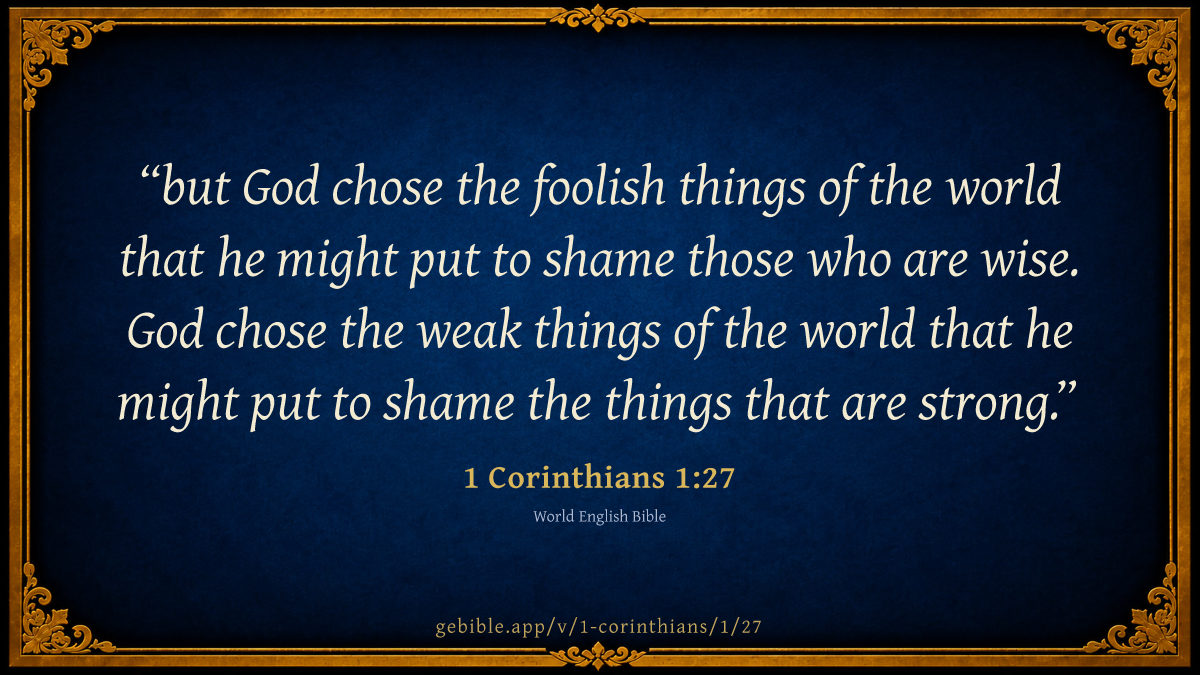
but God chose the foolish things of the world that he might put to shame those who are wise. God chose the weak things of the world that he might put to shame the things that are strong.
Parallel Translations
-
but God chose the foolish things of the world that he might put to shame those who are wise. God chose the weak things of the world that he might put to shame the things that are strong.
-
but God hath chosen the folysshe thinges of the worlde to confounde the wyse. And God hath chosyn the weake thinges of the worlde to confounde thinges which are mighty.
-
But God hath chosen the foolish thinges of the world to confound the wise, and God hath chosen the weake thinges of the worlde, to confound the mightie things,
Examined in Scripture Analysis
Contradictions (1)
Questions where the Bible appears to say two different things, with the passages on each side set together.
Cross-references (22)
Passages linked to 1 Corinthians 1:27 in the Treasury of Scripture Knowledge, ordered by reader-vote popularity; verse text shown in World English Bible.
- James 2:5 Listen, my beloved brothers. Didn’t God choose those who are poor in this world to be rich in faith, and heirs of the Kingdom which he promised to those who love him?
- Matthew 11:25 At that time, Jesus answered, “I thank you, Father, Lord of heaven and earth, that you hid these things from the wise and understanding, and revealed them to infants.
- 1 Corinthians 1:20 Where is the wise? Where is the scribe? Where is the lawyer of this world? Hasn’t God made foolish the wisdom of this world?
- Psalms 8:2 From the lips of babes and infants you have established strength, because of your adversaries, that you might silence the enemy and the avenger.
- Luke 21:15 for I will give you a mouth and wisdom which all your adversaries will not be able to withstand or to contradict.
- Isaiah 29:14 therefore, behold, I will proceed to do a marvelous work among this people, even a marvelous work and a wonder; and the wisdom of their wise men will perish, and the understanding of their prudent men will be hidden.”
- Acts 4:11-21 He is ‘the stone which was regarded as worthless by you, the builders, which has become the head of the corner.’ There is salvation in no one else, for there is no other name under heaven that is given among men, by which we must be saved!” Now when they saw the boldness of Peter and John, and had perceived that they were unlearned and ignorant men, they marveled. They recognized that they had been with Jesus. Seeing the man who was healed standing with them, they could say nothing against it. But when they had commanded them to go aside out of the council, they conferred among themselves, saying, “What shall we do to these men? Because indeed a notable miracle has been done through them, as can be plainly seen by all who dwell in Jerusalem, and we can’t deny it. But so that this spreads no further among the people, let’s threaten them, that from now on they don’t speak to anyone in this name.” They called them, and commanded them not to speak at all nor teach in the name of Jesus. But Peter and John answered them, “Whether it is right in the sight of God to listen to you rather than to God, judge for yourselves, for we can’t help telling the things which we saw and heard.” When they had further threatened them, they let them go, finding no way to punish them, because of the people; for everyone glorified God for that which was done.
- 2 Corinthians 10:4-5 for the weapons of our warfare are not of the flesh, but mighty before God to the throwing down of strongholds, throwing down imaginations and every high thing that is exalted against the knowledge of God and bringing every thought into captivity to the obedience of Christ,
- 2 Corinthians 4:7 But we have this treasure in clay vessels, that the exceeding greatness of the power may be of God, and not from ourselves.
- Matthew 21:16 and said to him, “Do you hear what these are saying?” Jesus said to them, “Yes. Did you never read, ‘Out of the mouth of babes and nursing babies you have perfected praise?’ ”
- Zephaniah 3:12 But I will leave among you an afflicted and poor people, and they will take refuge in Yahweh’s name.
- Isaiah 26:5-6 For he has brought down those who dwell on high, the lofty city. He lays it low. He lays it low even to the ground. He brings it even to the dust. The foot shall tread it down, even the feet of the poor and the steps of the needy.”
- Isaiah 29:19 The humble also will increase their joy in Yahweh, and the poor among men will rejoice in the Holy One of Israel.
- 2 Corinthians 10:10 For, “His letters”, they say, “are weighty and strong, but his bodily presence is weak, and his speech is despised.”
- Matthew 4:18-22 Walking by the sea of Galilee, he saw two brothers: Simon, who is called Peter, and Andrew, his brother, casting a net into the sea; for they were fishermen. He said to them, “Come after me, and I will make you fishers for men.” They immediately left their nets and followed him. Going on from there, he saw two other brothers, James the son of Zebedee, and John his brother, in the boat with Zebedee their father, mending their nets. He called them. They immediately left the boat and their father, and followed him.
- Matthew 9:9 As Jesus passed by from there, he saw a man called Matthew sitting at the tax collection office. He said to him, “Follow me.” He got up and followed him.
- Acts 24:24-25 But after some days, Felix came with Drusilla, his wife, who was a Jewess, and sent for Paul, and heard him concerning the faith in Christ Jesus. As he reasoned about righteousness, self-control, and the judgment to come, Felix was terrified, and answered, “Go your way for this time, and when it is convenient for me, I will summon you.”
- Luke 19:39-40 Some of the Pharisees from the multitude said to him, “Teacher, rebuke your disciples!” He answered them, “I tell you that if these were silent, the stones would cry out.”
- Acts 6:9-10 But some of those who were of the synagogue called “The Libertines”, and of the Cyrenians, of the Alexandrians, and of those of Cilicia and Asia arose, disputing with Stephen. They weren’t able to withstand the wisdom and the Spirit by which he spoke.
- Acts 17:18 Some of the Epicurean and Stoic philosophers also were conversing with him. Some said, “What does this babbler want to say?” Others said, “He seems to be advocating foreign deities,” because he preached Jesus and the resurrection.
- Acts 7:54 Now when they heard these things, they were cut to the heart, and they gnashed at him with their teeth.
- Acts 7:35 “This Moses, whom they refused, saying, ‘Who made you a ruler and a judge?’—God has sent him as both a ruler and a deliverer by the hand of the angel who appeared to him in the bush.
Cross-references from openbible.info (CC BY 4.0)
Explain this verse (16 sources)
Historical commentary, presented as a primary source — not an endorsement.
Private notes
Saved on this device only — never synced or sent anywhere.
John Trapp 1656 · Public Domain 27 But God hath chosen the foolish things of…
27 But God hath chosen the foolish things of the world to confound the wise; and God hath chosen the weak things of the world to confound the things which are mighty;
Ver. 27. But God hath chosen] In our Church assemblies the meaner usually, like little fishes, bite more than the greater. The poor are gospelized, Mat 11:5.
John Trapp, A Commentary or Exposition upon All the Books of the Old and New Testament (1647–1656) — public domain. Text from a community e-Sword module.
Matthew Poole 1685 · Public Domain God hath even amongst you chosen persons that are…
God hath even amongst you chosen persons that are in the account of the world as foolish things, to put the wise to shame; and persons of weak esteem, to confound those that are mighty in the repute of the world.
Matthew Poole's English Annotations on the Holy Bible (1683–1685) — public domain. Text from a community e-Sword/MySword module.
John Gill 1763 · Public Domain But God hath chosen the foolish things of the…
But God hath chosen the foolish things of the world,.... So the Jews, in distinction from their wise Rabbins and doctors, call others, , "the fools of the world" (p); the persons whom God made choice of from all eternity, as appears by his calling them in time, are such who with respect to the wisdom of the world are foolish; have not those natural parts and abilities, that sagacity and penetration in things natural and civil, that knowledge and learning which many others have; and are therefore esteemed foolish by the men of the world, in comparison of whom; who are the wise and prudent, they are but babes: and God's end in his choice of them, and calling them, is
to confound the wise; who sooner or later will be brought to shame and confusion, to see such idiots, as they took them to be, wiser than they in the business of salvation; having been directed and influenced by divine grace to choose that good part, which shall never be taken from them, when they will be stripped of their nobility, wealth, and wisdom; to see these men go into the kingdom of heaven, and they themselves shut out:
Read full note →
and God hath chosen the weak things of the world; who cannot boast of their birth and pedigree, of their ancient and illustrious families; have no titles of honour to aggrandize them, nor estates, possessions, and worldly substance to support themselves with; and this he has done,
to confound the things which are mighty; as Haman was by the advancement of Mordecai. It will be to the utter confusion of the rich and mighty, to see persons of the lowest class in life made kings and priests by Christ, set among princes, and upon the throne of glory; and they themselves fleeing, and calling to the mountains to fall upon them, and cover them from the sight of him that sits on the throne, and the Lamb,
(p) Zohar in Numb. fol. 63. 3. & 65. 4.
John Gill's Exposition of the Whole Bible (1746–1763) — public domain (CC PDM 1.0). Text via the HelloAO Bible API.
Adam Clarke 1810 · Public Domain Verse 27. But God hath chosen the foolish things]…
Verse 27. But God hath chosen the foolish things] God has chosen by means of men who are esteemed rude and illiterate to confound the greatest of the Greek philosophers, and overturn their systems; and, by means of men weak, without secular power or authority, to confound the scribes and Pharisees, and in spite of the exertions of the Jewish sanhedrin, to spread the doctrine of Christ crucified all over the land of Judea, and by such instruments as these to convert thousands of souls to the faith of the Gospel, who are ready to lay down their lives for the truth. The Jews have proverbs that express the same sense as these words of the apostle. In Shemoth Rabba, sec. 17, fol. 117, it is said: "There are certain matters which appear little to men, yet by them God points out important precepts. Thus hyssop in the sight of man is worth nothing, but in the sight of God its power is great; sometimes he equals it to the cedar, particularly in the ordinance concerning the lepers, and in the burning of the red heifer. Thus God commanded them in Egypt, Ex 12:22: And ye shall take a bunch of hyssop, c. And concerning Solomon it is said, 1Kgs 4:33: And he discoursed of trees, from the cedar on Lebanon to the hyssop that grows out of the wall. Whence we may learn that great and small things are equal in the eyes of the Lord, and that even by small things He can work great miracles."
Adam Clarke's Commentary on the Bible (1810–1826) — public domain. Text from a community e-Sword/MySword module.
Joseph Benson 1811 · Public Domain 1Co 1:27-29. But God hath chosen the foolish things…
1Co 1:27-29. But God hath chosen the foolish things — Or, supplying the word προσωπα, the foolish persons of the world. Such persons as are of little esteem in the world, for want of learning, parts, eloquence, and such other endowments as some have attained, and who are judged altogether unfit to teach others, especially the Greeks and Romans. To confound the wise — To shame those who account themselves, and are accounted wise; and of whom the world is most ready to boast. In this passage the apostle imitates the contemptuous language in which the Greek philosophers, and men of learning, affected to speak of the Christian preachers: yet, as he does it in irony, he aggrandizes them. The first preachers of the gospel, as Bishop Newton observes, “were chiefly a few poor fishermen, of low parentage, of no learning or eloquence, of no reputation or authority, despised as Jews by the rest of mankind, and by the Jews as the meanest and worst of themselves. What improper instruments were these to contend with the prejudices of the world, the superstition of the people, the interests of the priests, the vanity of the philosophers, the pride of the rulers, the malice of the Jews, the learning of the Greeks, and the power of Rome!” But the weaker the instruments who converted the world, the greater was the display of the power of God by which they acted. See on 2Co 4:7. And the weak things of the world — Persons who pretend to no extraordinary abilities or endowments; to confound — Or shame; the things which are mighty — Which, with all their boasted powers and qualifications, have never been able to work such a reformation among men, as these despised disciples of Jesus have been the means of effecting. And base things of the world — Things accounted vile and despised, εξουθενημενα, set at naught; and things which are not — Which are as little regarded, or as much overlooked, as if they had no being, and were below contempt itself; hath God chosen — To be his instruments in renewing and saving mankind; to bring to naught — To annihilate; things that are — In the highest esteem, and that make the most illustrious figures among mankind. That no flesh — A fit appellation; flesh is fair, but withering as grass; should glory in his presence — That no human being might boast of any advantages or distinctions, or of any excellence in himself, as the cause of his being appointed an apostle, evangelist, or minister of Christ, and employed in preaching the gospel: and that none who are converted by the preaching of such, should consider their conversion as the effect of any human abilities, natural or acquired, but should be compelled to ascribe the glory of all to God.
Joseph Benson's Commentary on the Old and New Testaments (1811–1818) — public domain. Text from a community e-Sword module.
Albert Barnes 1834 · Public Domain But God hath chosen - The fact of their…
But God hath chosen - The fact of their being in the church at all was the result of his choice. It was owing entirely to his grace.
The foolish things - The things esteemed foolish among people. The expression here refers to those who were destitute of learning, rank, wealth, and power, and who were esteemed as fools, and were despised by the rich and the great.
Read full note →
To confound - To bring to shame; or that he might make them ashamed; that is, humble them by showing them how little he regarded their wisdom; and how little their wisdom contributed to the success of his cause. By thus overlooking them, and bestowing his favors on the humble and the poor; by choosing his people from the ranks which they despised, and bestowing on them the exalted privilege of being called the sons of God, he had poured dishonor on the rich and the great, and overwhelmed them, and their schemes of wisdom, with shame. It is also true, that those who are regarded as fools by the wise men of the world are able often to confound those who boast of their wisdom; and that the arguments of plain people, though unlearned except in the school of Christ; of people of sound common sense under the influence of Christian principles, have a force which the learning and talent of the people of this world cannot gainsay or resist. They have truth on their side; and truth, though dressed in a humble garb, is more mighty than error, though clothed with the brilliancy of imagination, the pomp of declamation, and the cunning of sophistry.
And the weak things - Those esteemed weak by the people of the world.
The mighty - The great; the noble; the learned.
Albert Barnes' Notes on the Bible (1834–1885) — public domain. Text from a community e-Sword/MySword module.
Robert Jamieson, A. R. Fausset & David Brown 1871 · Public Domain the foolish things--a general phrase for all persons and…
the foolish things--a general phrase for all persons and things foolish. Even things (and those, too, foolish things) are chosen by God to confound persons, (and those too persons who are wise). This seems to me the force of the change from neuter to masculine.
to confound--The Greek is stronger, "that He might confound (or put to shame)." God confounds the wise by effecting through His instruments, without human wisdom, that the worldly wise, with it, cannot effect, namely, to bring men to salvation.
Read full note →
chosen . . . chosen--The repetition indicates the gracious deliberateness of God's purpose (Jam 2:5).
Jamieson, Fausset & Brown — Commentary Critical and Explanatory on the Whole Bible (1871) — public domain (CC PDM 1.0). Text via the HelloAO Bible API.
Daniel D. Whedon 1874 · Public Domain 27. God hath chosen—It is a divine revolution; and…
27. God hath chosen—It is a divine revolution; and we have the divine honour of being its instruments chosen of God. In this revolution the foolish things and the weak overthrow the wise and the mighty.
Daniel D. Whedon (gen. ed.), Commentary on the Old and New Testaments (1874–1909) — public domain. Text from a community e-Sword module.
The Cambridge Bible for Schools and Colleges 1878 · Public Domain 27. to confound] Literally to disgrace, bring to shame.…
27. to confound] Literally to disgrace, bring to shame. That which is disgraced can have no ground for self-glorification.
The Cambridge Bible for Schools and Colleges (gen. ed. J. J. S. Perowne; Cambridge University Press, 1878–1918) — public domain. Text from a community e-Sword module.
Ellicott's Commentary for English Readers 1878 · Public Domain (27) Foolish things.—The neuter is used probably for the…
(27) Foolish things.—The neuter is used probably for the purpose of generalising, and it expresses the qualities of the men whom God has chosen—“the wise” is masculine in the Greek, showing that it is still of “persons” the Apostle is speaking.
A Bible Commentary for English Readers, edited by Charles John Ellicott (1878–1897) — public domain. Text from a community e-Sword module.
The Pulpit Commentary 1880 · Public Domain God chose; not, hath chosen out. We may remark,…
God chose; not, hath chosen out. We may remark, once for all, that there was no reason why the translators of 1611 should thus have turned the Greek aorists of the New Testament into perfects. In this and in many instances the change of tense is unimportant, but sometimes it materially and injuriously affects the sense. The foolish things the weak things. So, too, the psalmist, "Out of the mouths of babes and sucklings hast thou ordained strength"; (Psa_8:2) and St. James, "Hath not God chosen the poor of this world rich in faith?". (Jam_2:5)
The Pulpit Commentary (1880–1919), ed. H.D.M. Spence-Jones & Joseph S. Exell — public domain. Text from a community e-Sword module.
B. W. Johnson 1891 · Public Domain 27. But God hath chosen the foolish things. Men…
27. But God hath chosen the foolish things. Men whom the world would call foolish, with a gospel that it called foolishness; yet these “confounded the wise” and upturned the world's philosophies.
B. W. Johnson's The People's New Testament with Notes (1889–1891) — public domain. Electronic text from the Christian Classics Ethereal Library (CCEL) ThML edition.
William B. Godbey 1900 · Public Domain 27. “But God elected out the foolish things of…
27. “But God elected out the foolish things of the world that he may confound the wise.” We see this Scripture verified in our Savior’s apostles, “unlearned and ignorant men” (Act 4:13). He could equally conveniently have put His hand on the champions of Rabbinical and Grecian lore. Why did He select the heralds of salvation from the illiterate and uninfluential rabble? He wanted blank paper on which to write the message of salvation. The learned clergy would have been under great temptation to mix their human dogmata with the pure message of gospel grace, and thus adulterate it. Again, the popular mind would intuitively attribute the power to the gifted and cultured dispenser of the gospel benefactions, and fail to see the real Divinity in the plan of salvation. Hence Divine wisdom has in all ages utilized the elements regarded as “foolish” in worldly estimation to bear the message of redeeming grace and dying love to earth’s perishing millions. “And the weak things of the world God elected out that he may confound the strong.” When a church becomes strong numerically, financially and influentially, God lets her slide away. He has no more use for her. The Holy Ghost retreats away and leaves her to enjoy her worldly power and glory. You must remember that the Holy Ghost is God in the Church. What an awful evacuation of the Protestant churches by the Holy Ghost in the last twenty years. “He that rejecteth sanctification rejecteth not man but God, who giveth unto you his Holy Spirit.” God gives His Holy Spirit to all His people to sanctify them. When they reject the work, in so doing they reject the worker, and fall into the hands of Satan, who then delights to play off on them, robed as an angel of light, passing himself for God, inflating them with wonderful enthusiasm in church work, thus employing and comforting them in the absence of the Holy Ghost. The churches are apostatizing fearfully in the trend of human power and worldly influence, and equally rapidly forsaken by the Holy Ghost and given over to the delusions of the devil. Consequently God the Holy Ghost is everywhere raising up an army of blood-washed and fire-baptized evangelists, male and female, from hovels of poverty, retreats of ignorance, slums and jungles of iniquity, and sending them out to preach the unsearchable riches of Christ “with the Holy Ghost sent down from Heaven,” thus rapidly laying in the shade the cultured clergy, who depend on their intellect and education, instead of the omnipotent Galilean.
William B. Godbey, Commentary on the New Testament (1896–1900) — public domain. Text from a community e-Sword module.
J. W. McGarvey 1914 · Public Domain but God chose the foolish things of the world,…
but God chose the foolish things of the world, that he might put to shame them that are wise; and God chose the weak things of the world [ Psa_8:2 ; Joh_2:5 ], that he might put to shame the things that are strong ;
J. W. McGarvey (with Philip Y. Pendleton), Commentaries on the New Testament (The Fourfold Gospel, 1914; Acts; and the epistles) — public domain. Text from a community e-Sword/MySword module.
C. I. Scofield 1917 · Public Domain kosmos = mankind. (See Scofield "Mat 4:8").
world
kosmos = mankind. (See Scofield "Mat 4:8").
The Scofield Reference Bible (1917 edition), notes by C. I. Scofield — public domain. Text from a community e-Sword module.
Tyndale Open Study Notes 2022 · CC BY-SA 4.0 1:27-29 God chose despised and humble people in order…
1:27-29 God chose despised and humble people in order to demonstrate his judgment on human pride (cp. Rom 3:27; 4:2; 2 Cor 4:7-11; 12:8-10; Eph 2:9).
Tyndale Open Study Notes — © Tyndale Open Resources, licensed CC BY-SA 4.0. Text via the HelloAO Bible API.