
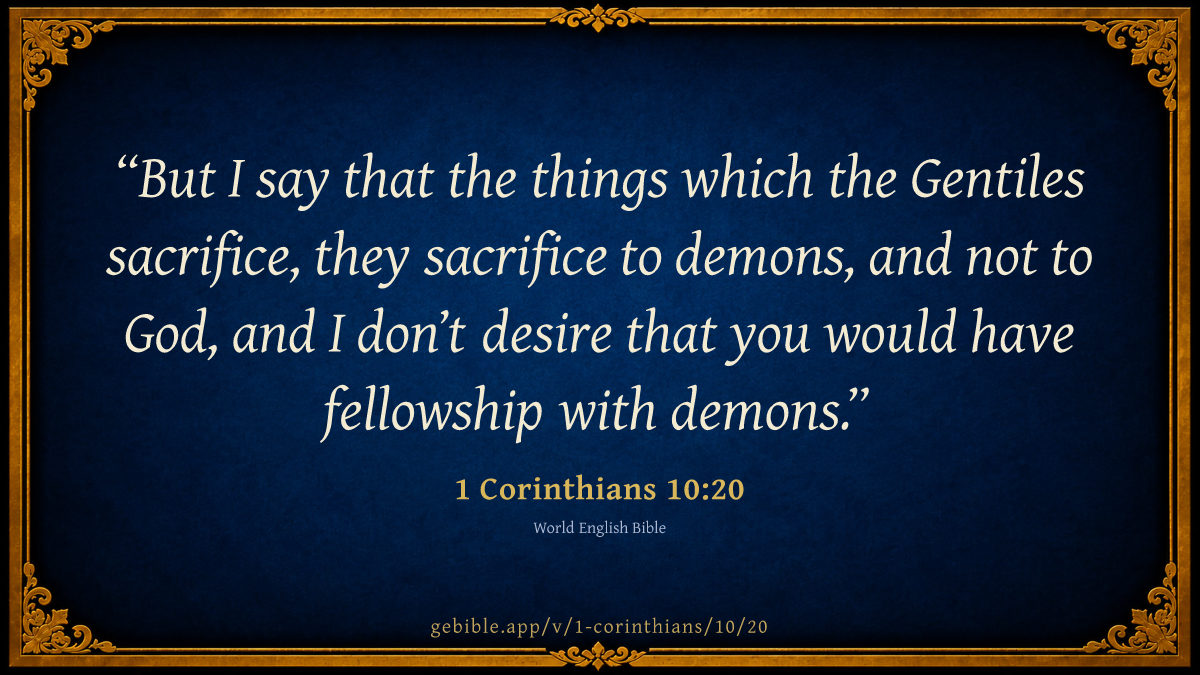
But I say that the things which the Gentiles sacrifice, they sacrifice to demons, and not to God, and I don’t desire that you would have fellowship with demons.
Parallel Translations
-
But I say that the things which the Gentiles sacrifice, they sacrifice to demons, and not to God, and I don’t desire that you would have fellowship with demons.
-
Nay but I saye that those thinges which the gentyle offer they offer to devyls and not to god. And I wolde not that ye shuld have fellishippe with the devils.
-
Nay, but that these things which the Gentiles sacrifice, they sacrifice to deuils, and not vnto God: and I would not that ye should haue fellowship with the deuils.
Cross-references (6)
Passages linked to 1 Corinthians 10:20 in the Treasury of Scripture Knowledge, ordered by reader-vote popularity; verse text shown in World English Bible.
- Revelation 9:20 The rest of mankind, who were not killed with these plagues, didn’t repent of the works of their hands, that they wouldn’t worship demons, and the idols of gold, and of silver, and of brass, and of stone, and of wood; which can’t see, hear, or walk.
- Psalms 106:37-39 Yes, they sacrificed their sons and their daughters to demons. They shed innocent blood, even the blood of their sons and of their daughters, whom they sacrificed to the idols of Canaan. The land was polluted with blood. Thus they were defiled with their works, and prostituted themselves in their deeds.
- Deuteronomy 32:16-17 They moved him to jealousy with strange gods. They provoked him to anger with abominations. They sacrificed to demons, not God, to gods that they didn’t know, to new gods that came up recently, which your fathers didn’t dread.
- 2 Corinthians 4:4 in whom the god of this world has blinded the minds of the unbelieving, that the light of the Good News of the glory of Christ, who is the image of God, should not dawn on them.
- Leviticus 17:7 They shall no more sacrifice their sacrifices to the goat idols, after which they play the prostitute. This shall be a statute forever to them throughout their generations.’
- 2 Chronicles 11:15 He himself appointed priests for the high places, for the male goats, and for the calves which he had made.
Cross-references from openbible.info (CC BY 4.0)
Explain this verse (16 sources)
Historical commentary, presented as a primary source — not an endorsement.
Private notes
Saved on this device only — never synced or sent anywhere.
John Calvin 1540 · Public Domain 20. But the things that the Gentiles sacrifice. To…
20. But the things that the Gentiles sacrifice. To complete the answer, a negative must be understood in this way: “I do not say that an idol is anything, nor do I imagine it to be endued with any virtue, but I say that the Gentiles sacrifice to the devil and not to gods those things which they do sacrifice, and hence I estimate the work by their wicked and impious superstition. For we must always look to the intention with which a thing is done. He, then, who connects himself with them, declares that he has fellowship with them in the same impiety.” He proceeds accordingly with what he had commenced: “If we had to do with God only, those things would be nothing, but, in relation to men, they become faulty; because no one sits down to an idol feast, who does not declare himself to be a worshipper of the idol.”
Some, however, understand the term demons here as meaning the imaginary deities of the Gentiles, agreeably to their common way of speaking of them; for when they speak of demons they meant inferior deities, as, for example, heroes, and thus the term was taken in a good sense. Plato, in a variety of instances, employs the term to denote genii, or angels. That meaning, however, would be quite foreign to Paul’s design, for his object is to show that it is no light offense to have to do with actions that have any appearance of putting honor upon idols. Hence it suited his purpose, not to extenuate, but rather to magnify the impiety that is involved in it. How absurd, then, it would have been to select an honorable term to denote the most heinous wickedness! It is certain from the Prophet Baruch, (4:7,) that those things that are sacrificed to idols are sacrificed to devils (Deuteronomy 32:17; Psalm 96:5.) In that passage in the writings of the Prophet, the Greek translation, which was at that time in common use, has δαιμόνια — demons, and this is its common use in Scripture. How much more likely is it then, that Paul borrowed what he says from the Prophet, to express the enormity of the evil, than that, speaking after the manner of the heathen, he extenuated what he was desirous to hold up to utter execration!
Read full note →
It may seem, however, as if these things were somewhat at variance with what I stated a little ago — that Paul had an eye to the intention of idolaters, for it is not their intention to worship devils, but imaginary deities of their own framing. I answer, that the two things are quite in harmony, for when men become so vain in their imaginations (Romans 1:21) as to render divine honor to creatures, rather than to the one God, this punishment is in readiness for them — that they serve Satan. For they do not find that “middle place” that they are in search of, but Satan straightway presents himself to them, as an object of adoration, whenever they have turned their back upon the true God.
I would not that ye. If the term demon were used in an indifferent sense, how spiritless were Paul’s statement here, while, instead of this, it has the greatest weight and severity against idolaters! He subjoins the reason — because no one can have fellowship at the same time with God and with idols. Now, in all sacred observances, there is a profession of fellowship. Let us know, therefore, that we are then, and then only, admitted by Christ to the sacred feast of his body and blood, when we have first of all bid farewell to every thing sacrilegious. For the man who would enjoy the one, must renounce the other. O thrice miserable the condition of those who, from fear of displeasing men, do not hesitate to pollute themselves with unlawful superstitions! For, by acting in this way, they voluntarily renounce fellowship with Christ, and obstruct their approach to his health-giving table.
John Calvin's Commentaries (1540-1563) — public domain. Text from the Calvin Translation Society English edition (1840s-50s) via the Christian Classics Ethereal Library (ccel.org). Calvin's coverage is partial (roughly two-thirds of the Bible); uncommented books and verses are honest gaps, never fabricated. The 19th-century editor's footnotes and remarks are omitted so the notes are faithfully Calvin's own voice.
Geneva Bible translators 1599 · Public Domain Have anything to do with the devils, or enter…
Have anything to do with the devils, or enter into that society which is begun on the devil’s name.
Geneva Bible (1599) marginal notes — public domain.
John Trapp 1656 · Public Domain 20 But I say, that the things which the…
20 But I say, that the things which the Gentiles sacrifice, they sacrifice to devils, and not to God: and I would not that ye should have fellowship with devils.
Ver. 20. They sacrifice to devils] A good intention then excuseth not. The Gentiles thought they had sacrificed to God. So do the Papists, who yet worship devils, while they worship idols of gold, and silver, and brass, and stone, Rev 9:20. The devil is ειδωλοχαρης, saith Synesius, an idol lover.
John Trapp, A Commentary or Exposition upon All the Books of the Old and New Testament (1647–1656) — public domain. Text from a community e-Sword module.
Matthew Poole 1685 · Public Domain The heathens might not intentionally offer sacrifices to devils,…
The heathens might not intentionally offer sacrifices to devils, (such a thing can hardly be supposed of men), but actually they offered sacrifices to devils; for they were devils, that is, evil angels, which deluded the poor heathen, and gave answers from the images and statues which they worshipped, believing the true God to be in them: which answers they accounted for oracles. Besides, the apostle saith, they sacrificed to devils, because in God’s esteem it was so, though not in their intention; God judgeth of men’s acts of worship and homage pretendedly done unto him, not according to their intention, but according to the truth and reality of the thing: now, really the heathen in their sacrifices paid a homage to devils, though such a thing was far from their intention; and this deserves the consideration, both of the papists, who worship images, and also of those protestants (if any such be) who would excuse the papists in their idolatries from their intentions. The nature of idolatry doth not lie in men’s intending to worship the creature instead of the Creator, (there were hardly every any such idolaters in the world), but in their actual doing of the thing; and except they can find a direct rule in holy writ ordering the adoration of the Creator in the creature, or before the creature, it is much to be feared, that in the last day God will judge their homage performed to the creature, not to him. Now, saith the apostle, you had need take heed that, by this action, you prove not yourselves to have fellowship with devils, instead of Christ and the true and living God.
Matthew Poole's English Annotations on the Holy Bible (1683–1685) — public domain. Text from a community e-Sword/MySword module.
John Gill 1763 · Public Domain But I say,.... This is my sense and meaning,
But I say,.... This is my sense and meaning,
that the things which the Gentiles sacrifice, they sacrifice unto devils, and not to God; reference is had to Deu 32:17 for what the Gentiles sacrificed, though they did not sacrifice intentionally to the idols of gold, silver, wood, and stone, but to God in them, as they pretended; yet inasmuch as in such worship and sacrifices they were directed, instigated, influenced, and assisted by devils, who took up their residence in these idols, and gave forth their oracles from them, they sacrificed to them; and which some have done, as in India and China, professedly and openly, and all other idolaters, eventually, virtually, and covertly:
Read full note →
and I would not that ye should have fellowship with devils; as all wicked men have, in the commission of any lust, sin, or immorality; and as all idolaters have in their superstitious practices, and idolatrous worship; and if grace prevent not, will have to all eternity in everlasting fire, prepared for the devil and his angels; wherefore the apostle would have the Corinthians flee from idolatry, and all appearance of it, and abstain from eating things offered to idols, of which they could not eat without having fellowship with devils; this he says, to deter them from such practices, which must be very horrible and shocking, and bespeaks in him great care of them, and affection for them.
John Gill's Exposition of the Whole Bible (1746–1763) — public domain (CC PDM 1.0). Text via the HelloAO Bible API.
Albert Barnes 1834 · Public Domain But - The negative here is omitted, but is…
But - The negative here is omitted, but is understood. The ellipsis of a negative after an interrogative sentence is common in the Classical writers as well as in the Scriptures. Bloomfield. The sense is, “No; I do not say this, but I say that there are reasons why you should not partake of those sacrifices; and one of those reasons is, that they have been really offered to devils.”
They sacrifice to devils - (δαιμονίοις daimoniois, “demons”). The pagans used the word demon either in a good or a bad sense. They applied it commonly to spirits that were supposed to be inferior to the supreme God; genii; attending spirits; or, as they called them, divinities, or gods. A part were in their view good, and a part evil. Socrates supposed that such a demon or genius attended him, who suggested good thoughts to him, and who was his protector. As these beings were good and well disposed, it was not supposed to be necessary to offer any sacrifices in order to appease them. But a large portion of those genii were supposed to be evil and wicked, and hence, the necessity of attempting to appease their wrath by sacrifices and bloody offerings. It was therefore true, as the apostle says, that the sacrifices of the pagan were made, usually at least, to devils or to evil spirits.
Read full note →
Many of these spirits were supposed to be the souls of departed people, who were entitled to worship after death, having been enrolled among the gods. The word “demons,” among the Jews, was employed only to designate evil beings. It is not implied in their writings to good angels or to blessed spirits, but to evil angels, to idols, to false gods. Thus, in the Septuagint the word is used to translate אלילים Elilim, “idols” Psa 95:5; Isa 65:10; and שׁד shēd, Shaid, as in Deu 32:17, in a passage which Paul has here almost literally used, “They sacrificed unto devils, not to God.” No where in the Septuagint is it used in a good sense. In the New Testament the word is uniformly used also to denote “evil spirits,” and those usually which had taken possession of people in the time of the Saviour; Mat 7:22; Mat 9:33-34; Mat 10:8; Mat 11:18; Mar 1:34, Mar 1:39, et al. See also Campbell on the Gospels, Pre. Dissertation vi. part 1, Section 14-16. The precise force of the original is not, however, conveyed by our translation. It is not true that the pagans sacrificed to “devils,” in the common and popular sense of that word, meaning thereby the apostate angel and the spirits under his direction; for the pagans were as ignorant of their existence as they were of the true God; and it is not true that they designed to worship such beings. But it is true:
(1) That they did not worship the supreme and the true God. They were not acquainted with his existence; and they did not profess to adore him.
(2) They worshipped “demons;” beings that they regarded as inferior to the true God; created spirits, or the spirits of people that had been enrolled among the number of the gods.
(3) It was true that many of these beings were supposed to be malign and evil in their nature, and that their worship was designed to deprecate their wrath. So that, although an idol was nothing in itself, the gold or wood of which it was made was inanimate, and incapable of aiding or injuring them; and although there were no real beings such as the pagans supposed - no genii or inferior gods; yet they “designed” to offer sacrifice to such beings, and to deprecate their wrath. To join them in this, therefore, would be to express the belief that there were such beings, and that they ought to be worshipped, and that their wrath should be deprecated.
I would not that ye should have fellowship with devils - I would not that you should have communion with demons. I would not have you express a belief of their existence; or join in worship to them; or partake of the spirit by which they are supposed to be actuated - a spirit that would be promoted by attendance on their worship. I would not have you, therefore, join in a mode of worship where such beings are acknowledged. You are solemnly dedicated to Christ; and the homage due to him should not be divided with homage offered to devils, or to imaginary beings.
Albert Barnes' Notes on the Bible (1834–1885) — public domain. Text from a community e-Sword/MySword module.
Robert Jamieson, A. R. Fausset & David Brown 1871 · Public Domain I would not that ye . . . have…
I would not that ye . . . have fellowship with devils--by partaking of idol feasts (Co1 8:10).
Jamieson, Fausset & Brown — Commentary Critical and Explanatory on the Whole Bible (1871) — public domain (CC PDM 1.0). Text via the HelloAO Bible API.
Daniel D. Whedon 1874 · Public Domain 20. But—On the contrary, what I say is that,…
20. But—On the contrary, what I say is that, etc.
Devils—Demons. Note on Luk_10:17. Our translators should never have confounded devil and demon. In pagan mythology a demon was intermediate between gods and men. One class were supposed to be the spirits of dead men, either good or evil, according to their character in life. Another class were beings of supernatural origin, somewhat like the angels. They might be good, like the demon which Socrates claimed to be his supernatural monitor; and it is singular to note how wonderfully many of the attributes of the Pythian Apollo prefigured Christ! They might be evil, as held by the wisest philosophers, and send diseases and pestilences to men and animals, and supply temptations to wrong.
Read full note →
In the Septuagint the word demon is used to designate, generally, an evil supernatural spirit, or whatever evil living reality there was to appropriate the service of pagan worshippers. So Psa_96:5. All the gods of the pagans are demons; Deu_32:17, they sacrificed unto demons, and not unto God. It is clear from 1Co_10:22 that the apostle has this passage in mind. Josephus uses the word demons to denote the surviving spirits of wicked dead men, who often possess the living, and are to be expelled by exorcisms and fumigations.
In the New Testament the word is always used in a bad sense. There is but one Satan, one devil, and his angels, (Mat_25:41,) and his angels are doubtless identical with the demons. There is no intimation in Scripture that they are the surviving spirits of the wicked dead. Wherever in our translation the plural word devils is used, the Greek is demons. Paul denies that there is any real god or goddess in paganism, but Satan’s spiritual emissaries may so impersonate those imaginary beings as to appropriate the honours of the worship, and keep the worshippers in paganism. Notes on Mar_5:2, and Act_16:16; Act_16:18.
Not to God—They belong to the idolatrous and infernal, and antagonize the true religion and the true God.
I would not—And this would not, he shows next verse, involves a cannot.
Daniel D. Whedon (gen. ed.), Commentary on the Old and New Testaments (1874–1909) — public domain. Text from a community e-Sword module.
The Cambridge Bible for Schools and Colleges 1878 · Public Domain 20. they sacrifice to devils, and not to God]…
20. they sacrifice to devils, and not to God] Third reason. The worship of idols is a worship of devils. The words here used are found in Deu_32:17, and similar ones are found in the Septuagint version of Psa_96:5; cf. Psa_106:37. The point of the argument is shewn in the last words of this sentence, ‘and not to God’. As they were not sacrificed to God, they were sacrificed to His enemies, the ‘evil spirits,’ ‘dæmons,’ not ‘devils’ properly, for this word is confined to the ‘prince of this world’ (St Joh_12:31), ‘which is the Devil, and Satan’[134] (Rev_20:2). Such beings as these are no mere conceptions of the fancy, but have a real and active existence. Their power over humanity when Christ came was great indeed. Not only was their master the Prince of this world (see above and cf. St Luk_4:6), but the fact of demoniacal possession was a proof at once of their existence and influence upon man.
[134] See note on St Mat_4:24 in Mr Carr’s Commentary in this series.
Read full note →
fellowship] Translated communion in 1Co_10:16. See note on ch. 1Co_1:9.
The Cambridge Bible for Schools and Colleges (gen. ed. J. J. S. Perowne; Cambridge University Press, 1878–1918) — public domain. Text from a community e-Sword module.
Ellicott's Commentary for English Readers 1878 · Public Domain (20) But I say.—Better, No; but that the things…
(20) But I say.—Better, No; but that the things which they sacrifice they sacrifice to devils, and not to God.
The word “devils” means evil spirits. The heathen world is regarded by the Christian Church as under the dominion of the Evil Spirit and his emissaries (Eph_2:2; Eph_6:12), and in reminding the Corinthians that in Israel an eater of the sacrificial meat became a partaker with the altar of God, the Apostle meant to warn them that they would, if they partook of sacrificial meats offered on an altar of devils, become a sharer with that altar and the beings to whom the altar appertained.
A Bible Commentary for English Readers, edited by Charles John Ellicott (1878–1897) — public domain. Text from a community e-Sword module.
The Pulpit Commentary 1880 · Public Domain But. The word rejects the former hypothesis. No I…
But. The word rejects the former hypothesis. No I do not admit that, but what I say is that," etc. They sacrifice to devils, and not to God. The word "demons" should be used, not" devils". (Deu_32:17) The argument is that, though the idol is nothing a mere stock or stone it is yet the material symbol of a demon. (see Psa_96:5 Psa_106:37 RAPC Bar 4:7) So Milton
And devils to adore for deities; Then were they known to men by various names, And various idols through the heathen world, The chief were those who, from the pit of hell, Roaming to seek their prey on earth, durst fix Their seats long after next the seat of God, Their altars by his altar, gods adored Among the nations round. ("Paradise Lost," 1. )
Read full note →
St. Paul uses a word which, while it would not be needlessly offensive to Gentiles, conveyed his meaning. The Greeks themselves called their deities daimonia, and St. Paul adopts the word; but to Jewish ears it meant, not "deities" or "demigods," but "demons."
The Pulpit Commentary (1880–1919), ed. H.D.M. Spence-Jones & Joseph S. Exell — public domain. Text from a community e-Sword module.
B. W. Johnson 1891 · Public Domain 20. He affirms nothing of the kind, but he…
20. He affirms nothing of the kind, but he does say that the sacrifices which the Gentiles sacrifice are to devils. The idol is nothing, but to the worshiper it is a reality. That reality is not God, but really a demon. The gods were mainly dead kings and heroes who had been deified. The diamonia, or demons, were the spirits of dead men. The worship was really demon worship. Fellowship with devils. Demons. If the feast of the Lord's Supper is communion with Christ, the feast of the altar sacrifice communion with God, who is worshiped, the feast of the idol is communion with the idol. Yet this idol in the mind of the worshiper is a diamonion, a demon.
B. W. Johnson's The People's New Testament with Notes (1889–1891) — public domain. Electronic text from the Christian Classics Ethereal Library (CCEL) ThML edition.
William B. Godbey 1900 · Public Domain 20. “But those things which they sacrifice, they really…
DEMON WORSHIP
20. “But those things which they sacrifice, they really sacrifice to demons, and not to God: I do not wish you to be the communicants of demons.
Read full note →
21. “You are not able to drink the cup of the Lord and the cup of demons:you are not able to partake of the table of the Lord and the table of demons.”
22. “Whether shall we provoke the Lord to jealousy? Whether are we stronger than He?” Here he warns the Corinthians against the communion of demons, i. e., devil worship. All the Grecian gods were but the personifications of the evil passions, tempers, lusts, and ambitions peculiar to fallen humanity; as the demons, resident in human hearts and flying through the air, make it their constant enterprise to stir up the evil tempers, passions, lusts predilections in fallen humanity, doing their utmost to lead people into conservatism and subordination to these demons. Hence the heathen world in all ages has been full of demon worship. The Greek philosophers, in their writings, actually used the word “demon.” The great Socrates stated that his guardian demon made revelations to him and held communion with him. Millions of heathens, Moslems and Romanists, as well as doubtless many Protestants, this day worship demons. The vast sectarian diversity in the Christian world is really another manifestation of the Pagan polytheism, in which the heathens worship many gods, variant in character and attributes, like the diversified and even warring sects of Christendom. Oh! how many today are groping in demon worship! The Greek has “demon” in this paragraph, where E.V. has “devil,” a word which properly applies to Satan himself, the innumerable subordinate evil spirits thronging earth and Hell being denominated demons. They are prone to dress up in the habiliments of angels (such as they once were, and hence know how to play the angel), and pass themselves for the Holy Ghost, thus deceiving the people by millions, leading them into demon worship, thinking they are worshipping God. Such is the case with the millions who profess and practice a sinning religion, which they get from the demons, because God has none such. Our sacramental boards are crowded by carnal, wicked people who actually, as Paul here says, “drink not the cup of the Lord, but the cup of demons, and sit not at the table of the Lord, but the table of demons.”
William B. Godbey, Commentary on the New Testament (1896–1900) — public domain. Text from a community e-Sword module.
J. W. McGarvey 1914 · Public Domain But I say, that the things which the Gentiles…
But I say, that the things which the Gentiles sacrifice, they sacrifice to demons, and not to God: and I would not that ye should have communion with demons . [It was true that the idol was nothing, but it represented a reality, and it was well established both among Jews and Greeks that that reality was a demon. Among Jews and Christians this word represented an evil spirit ( Deu_32:17 ; Lev_17:7 ; 2Ch_11:15 ; Psa_96:5 ; Psa_106:37 ; Mat_25:41 ; Rev_9:20 ; Eph_6:12 ). Among the Greeks the word had a broader significance. With them it meant a demi-god or minor deity--a being between God and men. One part of them were spirits of dead men, mainly dead kings or heroes who had been deified and honored with idols and worship. Another part were regarded as having a supernatural origin, and were like angels. These might be good or evil. Thus Socrates regarded himself as under the care and influence of a good demon. Thus at the core idolatry was demon-worship, and if the Christian who ate the Lord's Supper communed with the Lord, and the Jew who ate the sacrifice of the altar communed with the God of the altar; so the man, be he pagan or Christian, who partook of the idol sacrifice, communed with the demon who appropriated the worship offered to the idol.]
J. W. McGarvey (with Philip Y. Pendleton), Commentaries on the New Testament (The Fourfold Gospel, 1914; Acts; and the epistles) — public domain. Text from a community e-Sword/MySword module.
C. I. Scofield 1917 · Public Domain devils (Greek - Ἀδμίν; 1Co 10:21, (See Scofield "Mat…
devils (Greek - Ἀδμίν; 1Co 10:21, (See Scofield "Mat 7:22").
fellowship 1Co 10:16. trans. communion.
The Scofield Reference Bible (1917 edition), notes by C. I. Scofield — public domain. Text from a community e-Sword module.
unfoldingWord translationNotes 2017 · CC BY-SA 4.0 You cannot drink the cup of the Lord and…
You cannot drink the cup of the Lord and the cup of demons
Paul speaks of a person drinking from the same cup as the demon as evidence that that person is a friend of the demon. AT: "It is impossible for you to be true friends with both the Lord and demons" (See: Metonymy)
Read full note →
You cannot have fellowship at the table of the Lord and the table of demons
"It is impossible for you to be truly one with the Lord's people and also with demons"
Or do we provoke the Lord to jealousy?
Paul wants the Corinthians to answer this question in their minds. AT: "You should know without me telling you that it is not right to make the Lord jealous."
provoke
to anger or irritate
Are we stronger than he is?
Paul wants the Corinthians to answer this question in their minds. AT: "You should know without me telling you that we are not stronger than God." (See: Rhetorical Question)
translationWords
Gentile
pagan
sacrifice
demon
God
lord
fellowship
jealous
unfoldingWord translationNotes — © Distant Shores Media and the Door43 World Missions Community, licensed CC BY-SA 4.0. Source: git.door43.org/Door43/en_tn.