
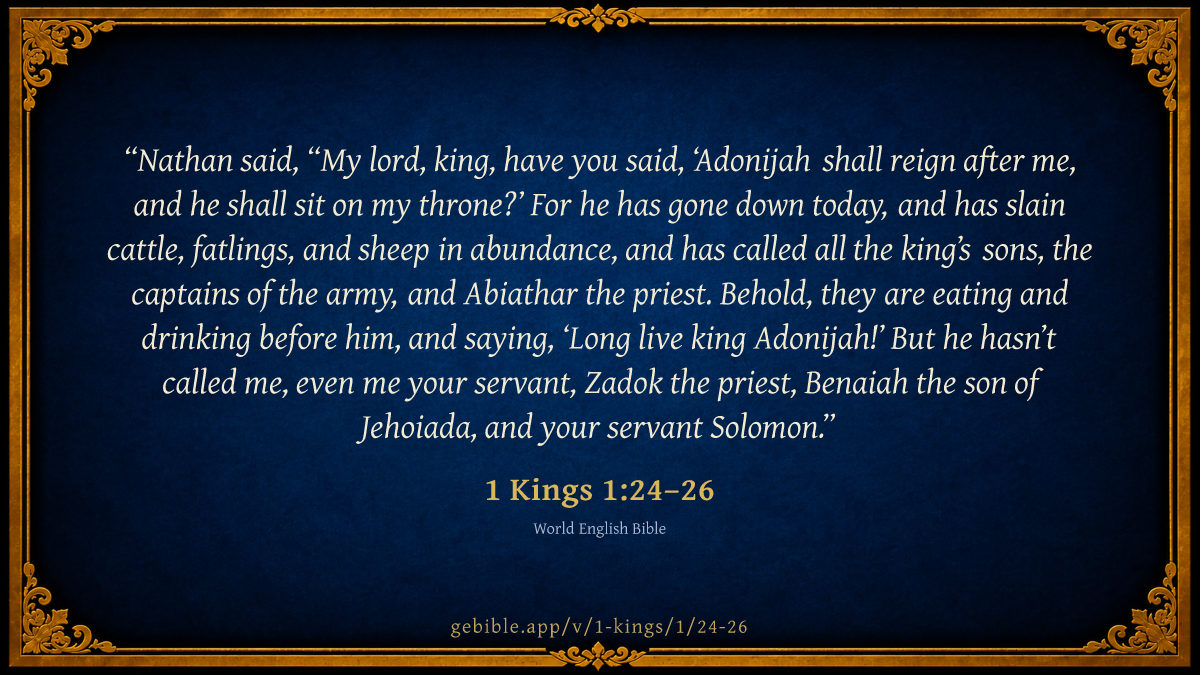
Nathan said, “My lord, king, have you said, ‘Adonijah shall reign after me, and he shall sit on my throne?’ For he has gone down today, and has slain cattle, fatlings, and sheep in abundance, and has called all the king’s sons, the captains of the army, and Abiathar the priest. Behold, they are eating and drinking before him, and saying, ‘Long live king Adonijah!’ But he hasn’t called me, even me your servant, Zadok the priest, Benaiah the son of Jehoiada, and your servant Solomon.
Show the surrounding paragraph
1 Kings 1:24-26 sits inside this longer paragraph.
Nathan said, “My lord, king, have you said, ‘Adonijah shall reign after me, and he shall sit on my throne?’ For he has gone down today, and has slain cattle, fatlings, and sheep in abundance, and has called all the king’s sons, the captains of the army, and Abiathar the priest. Behold, they are eating and drinking before him, and saying, ‘Long live king Adonijah!’ But he hasn’t called me, even me your servant, Zadok the priest, Benaiah the son of Jehoiada, and your servant Solomon. Was this thing done by my lord the king, and you haven’t shown to your servants who should sit on the throne of my lord the king after him?”
Parallel Translations
-
Nathan said, “My lord, king, have you said, ‘Adonijah shall reign after me, and he shall sit on my throne?’
For he has gone down today, and has slain cattle, fatlings, and sheep in abundance, and has called all the king’s sons, the captains of the army, and Abiathar the priest. Behold, they are eating and drinking before him, and saying, ‘Long live king Adonijah!’
But he hasn’t called me, even me your servant, Zadok the priest, Benaiah the son of Jehoiada, and your servant Solomon.
-
And Nathan said, My lord, O king, hast thou said, Adonijah shall reign after me, and he shall sit upon my throne?
For he is gone down this day, and hath slain oxen and fat cattle and sheep in abundance, and hath called all the king’s sons, and the captains of the host, and Abiathar the priest; and, behold, they eat and drink before him, and say, God save king Adonijah.
But me, even me thy servant, and Zadok the priest, and Benaiah the son of Jehoiada, and thy servant Solomon, hath he not called.
Show all 3 translations
-
And Nathan said: 'My lord, O king, hast thou said: Adonijah shall reign after me, and he shall sit upon my throne?
For he is gone down this day, and hath slain oxen and fatlings and sheep in abundance, and hath called all the king's sons, and the captains of the host, and Abiathar the priest; and, behold, they eat and drink before him, and say: Long live king Adonijah.
But me, even me thy servant, and Zadok the priest, and Benaiah the son of Jehoiada, and thy servant Solomon hath he not called.
Cross-references (22)
- 1 Kings 1:8 (v26) But Zadok the priest, Benaiah the son of Jehoiada, Nathan the prophet, Shimei, Rei, and the mighty men who belonged to David, were not with…
- 1 Samuel 10:24 (v25) Samuel said to all the people, “Do you see him whom Yahweh has chosen, that there is no one like him among all the people?” All the people…
- 1 Kings 1:19 (vv25–26) He has slain cattle and fatlings and sheep in abundance, and has called all the sons of the king, Abiathar the priest, and Joab the captain…
- 1 Kings 1:9 (v25) Adonijah killed sheep, cattle, and fatlings by the stone of Zoheleth, which is beside En Rogel; and he called all his brothers, the king’s…
- 1 Kings 1:10 (v26) but he didn’t call Nathan the prophet, and Benaiah, and the mighty men, and Solomon his brother.
Show all 21 cross-references
- 1 Samuel 11:14-15 (v25) Then Samuel said to the people, “Come! Let’s go to Gilgal, and renew the kingdom there.” All the people went to Gilgal; and there they made…
- 2 Samuel 7:2 (v26) the king said to Nathan the prophet, “See now, I dwell in a house of cedar, but God’s ark dwells within curtains.”
- 2 Samuel 7:12-17 (v26) When your days are fulfilled, and you sleep with your fathers, I will set up your offspring after you, who will proceed out of your body,…
- 2 Samuel 12:25 (v26) and he sent by the hand of Nathan the prophet, and he named him Jedidiah, for Yahweh’s sake.
- 2 Samuel 16:16 (v25) When Hushai the Archite, David’s friend, had come to Absalom, Hushai said to Absalom, “Long live the king! Long live the king!”
- 1 Kings 1:5 (v24) Then Adonijah the son of Haggith exalted himself, saying, “I will be king.” Then he prepared him chariots and horsemen, and fifty men to…
- 1 Kings 1:13-14 (v24) Go in to king David, and tell him, ‘Didn’t you, my lord, king, swear to your servant, saying, “Assuredly Solomon your son shall reign after…
- 1 Kings 1:17-18 (v24) She said to him, “My lord, you swore by Yahweh your God to your servant, ‘Assuredly Solomon your son shall reign after me, and he shall sit…
- 1 Kings 1:34 (v25) Let Zadok the priest and Nathan the prophet anoint him there king over Israel. Blow the trumpet, and say, ‘Long live king Solomon!’
- 2 Kings 11:12 (v25) Then he brought out the king’s son, and put the crown on him, and gave him the covenant; and they made him king, and anointed him; and they…
- 1 Chronicles 29:13 (v25) Now therefore, our God, we thank you, and praise your glorious name.
- 1 Chronicles 29:21 (v25) They sacrificed sacrifices to Yahweh, and offered burnt offerings to Yahweh, on the next day after that day, even one thousand bulls, one…
- 2 Chronicles 23:11 (v25) Then they brought out the king’s son, and put the crown on him, and gave him the covenant, and made him king. Jehoiada and his sons…
- Matthew 21:9 (v25) The multitudes who went in front of him, and those who followed, kept shouting, “Hosanna to the son of David! Blessed is he who comes in…
- Mark 11:9-10 (v25) Those who went in front, and those who followed, cried out, “Hosanna! Blessed is he who comes in the name of the Lord! Blessed is the…
- Luke 19:38 (v25) saying, “Blessed is the King who comes in the name of the Lord! Peace in heaven, and glory in the highest!”
21 distinct cross-references across this passage (22 total citations).
Cross-references from openbible.info (CC BY 4.0)
Explain this passage (12 sources)
Historical commentary, presented as a primary source — not an endorsement.
Private notes
Saved on this device only — never synced or sent anywhere.
Geneva Bible translators 1599 · Public Domain On v25 Hebrew, let the king Adonijah live.
Hebrew, let the king Adonijah live.
Geneva Bible (1599) marginal notes — public domain.
John Trapp 1656 · Public Domain On vv24–26 1Ki 1:24 And Nathan said, My lord, O king,…
1Ki 1:24 And Nathan said, My lord, O king, hast thou said, Adonijah shall reign after me, and he shall sit upon my throne?
Ver. 24. Hast thou said?] q.d., I think not. Exordium ex abrupto, per admirationem.
John Trapp, A Commentary or Exposition upon All the Books of the Old and New Testament (1647–1656) — public domain. Text from a community e-Sword module.
Matthew Poole 1685 · Public Domain On vv24, 26 Is this done by thy consent? without which it…
Is this done by thy consent? without which it seems strange that he durst attempt it.
Matthew Poole's English Annotations on the Holy Bible (1683–1685) — public domain. Text from a community e-Sword/MySword module.
John Gill 1763 · Public Domain On vv24–26 And Nathan said, my lord, O king,.... He addresses…
And Nathan said, my lord, O king,.... He addresses him as with great veneration and respect due to his office, so as if he knew noticing of Bathsheba's application to him; and therefore begins and tells his story, as if the king had never heard anything relative to it:
hast thou said, Adonijah shall reign after me, and he shall sit upon my throne? surely it can never be, because of the notice which he himself had given him from the Lord, that one to be born should succeed him, plainly pointing to Solomon; and also because of the oath which he had sworn, to which Nathan was privy, that Solomon should reign after him; and yet if he had not given such orders, it was exceeding strange that Adonijah should presume to do what he had done.
John Gill's Exposition of the Whole Bible (1746–1763) — public domain (CC PDM 1.0). Text via the HelloAO Bible API.
John Wesley 1765 · Public Domain On v26 But me - Whom he knew to be acquainted…
But me - Whom he knew to be acquainted with thy mind, and with the mind of God in this matter: and therefore his neglect of me herein gives me cause to suspect that this is done without thy privity.
John Wesley, Explanatory Notes Upon the Whole Bible (1754–1765) — public domain. Text via the GEBible commentary corpus.
Joseph Benson 1811 · Public Domain On v26 1Ki 1:26-27. But me hath he not called —…
1Ki 1:26-27. But me hath he not called — Whom he knew to be acquainted with thy mind, and with the mind of God in this matter; and therefore his neglect of me herein gives me cause to suspect that this is done without thy knowledge. Thou hast not showed it to thy servant — Who, having been an instrument in delivering God’s message to thee concerning thy successor, might reasonably expect that if thou hadst changed thy mind, thou wouldest have acquainted me with it, as being both a prophet of the Lord, and one whom thou hast found faithful to thee. He insinuates that, in a matter of such importance, he could not believe the king would act without his advice, whom he was wont to consult on other occasions, and who had acquainted him with the mind of God concerning Solomon. Nathan knew that David had given no orders about this thing, but thought it prudent to introduce in this manner a relation of what Adonijah had done.
Joseph Benson's Commentary on the Old and New Testaments (1811–1818) — public domain. Text from a community e-Sword module.
Albert Barnes 1834 · Public Domain On v24 Hast thou said - Thou hast said. In the…
Hast thou said - Thou hast said. In the original no question is asked. Nathan assumes, as far as words go, that the king has made this declaration. He wishes to draw forth a disclaimer.
Albert Barnes' Notes on the Bible (1834–1885) — public domain. Text from a community e-Sword/MySword module.
Haydock's Catholic Bible Commentary 1859 · Public Domain On v25
CHAPTER I.
George Leo Haydock (1774–1849), Haydock's Catholic Family Bible and Commentary, 1859 edition — public domain. Excludes Psalms (Douay-Rheims chapter numbering differs from Protestant) and Deuterocanonical books (Catholic canon only).
The Cambridge Bible for Schools and Colleges 1878 · Public Domain On vv24–25 24. hast thou said] There is nothing in the…
24. hast thou said] There is nothing in the Hebrew to mark the question. It must have been indicated by the tone. It would come with much force from Nathan, as he knew all the circumstances of God’s promise that Solomon should be king after David. He shews by his language in 1Ki_1:27 that any change in the plans for the succession should not have been made without his knowledge. After the divine messages which had been sent to the king through Nathan, the prophet’s relation to David was different from that of other subjects.
The Cambridge Bible for Schools and Colleges (gen. ed. J. J. S. Perowne; Cambridge University Press, 1878–1918) — public domain. Text from a community e-Sword module.
Ellicott's Commentary for English Readers 1878 · Public Domain On vv24–25 (24) Hast thou said.—The question here and in 1Ki_1:27…
(24) Hast thou said.—The question here and in 1Ki_1:27 is, of course, merely intended to draw out denial; but it is singularly true to nature that it does so by the assumption (natural in court language) that nothing of such a kind could be even conceived as done without the king’s will. There is something striking in the contrast of the deference of Nathan as a counsellor on state business with the bold superiority of his tone in the discharge of his true prophetic office (as in 2Sa_7:2-17; 2Sa_12:1-14).
A Bible Commentary for English Readers, edited by Charles John Ellicott (1878–1897) — public domain. Text from a community e-Sword module.
The Pulpit Commentary 1880 · Public Domain On vv24–26 And Nathan said, My Lord, O king, hast thou…
And Nathan said, My Lord, O king, hast thou said the Hebrews has no question, but a strong affirmation: "thou hast said," i.e., " thou must have said (Du hast wohl gesagt." Bahr). Nathan puts it thus forcibly, in order to draw from the king a disclaimer, Adonijah shall reign after me, and he shall sit upon my throne? Same words as in vers. 13, 17, and possibly designedly so. The coincidence conveys the meaning, "Thou hast sworn Solomon shall reign," etc. "Thou hast said, Adonijah shall reign," etc. And the king said, Bring me a sword. And they brought a Heb. the; the sword, i.e., of the executioner, or the sword for which he asked sword before the king.
The Pulpit Commentary (1880–1919), ed. H.D.M. Spence-Jones & Joseph S. Exell — public domain. Text from a community e-Sword module.
unfoldingWord translationNotes 2017 · CC BY-SA 4.0 On vv24, 26 General Information:
General Information:
Nathan the prophet continues to speak to King David.
Read full note →
have you said, 'Adonijah will reign after me, and he will sit on my throne?'
This can be stated as an indirect quotation. AT: "have you said that Adonijah will reign after you, and he will sit on your throne?" (See: Direct and Indirect Quotations)
he will sit on my throne
Sitting on the throne is a metonym for being king. See how you translated this in 1 Kings 1:13. AT: "he will be king just as I was"
eating and drinking before him
Adonijah probably sat at a table where he could watch all those he had invited as they ate and drank. The main idea is that the people Nathan named were with Adonijah and they were celebrating together. AT: "eating and drinking with him" or "eating and drinking where he can see them" (See: Idiom and Assumed Knowledge and Implicit Information)
translationWords
reign
throne
sacrifice
life
unfoldingWord translationNotes — © Distant Shores Media and the Door43 World Missions Community, licensed CC BY-SA 4.0. Source: git.door43.org/Door43/en_tn.