
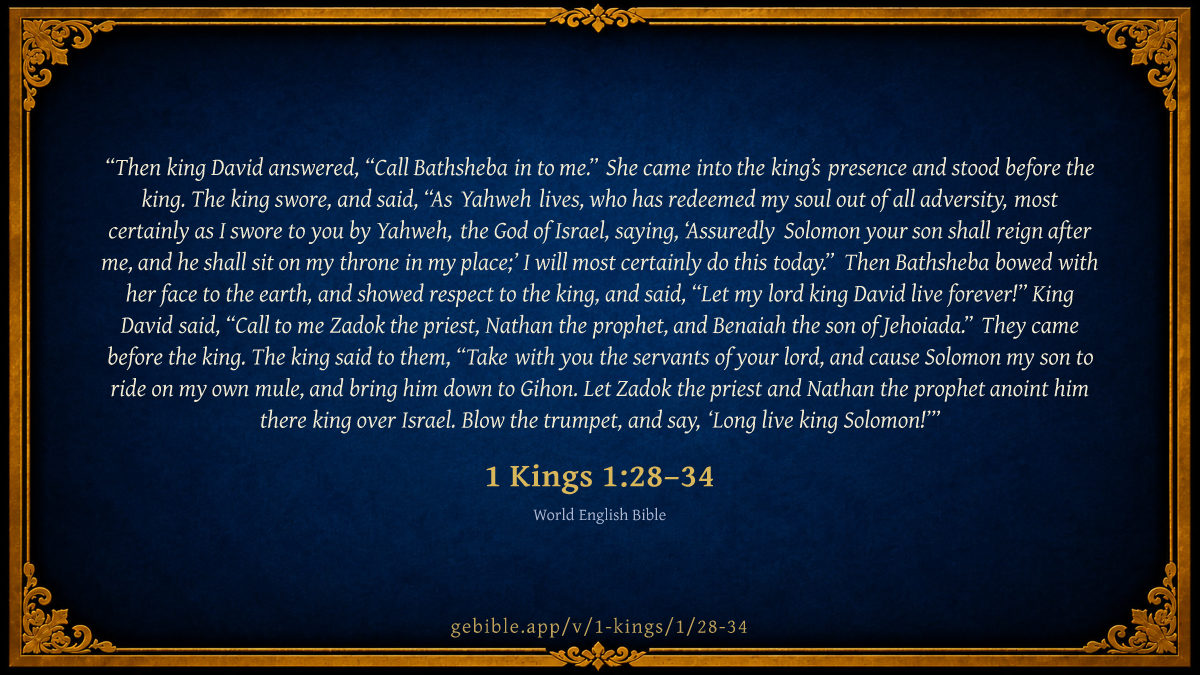
Then king David answered, “Call Bathsheba in to me.” She came into the king’s presence and stood before the king. The king swore, and said, “As Yahweh lives, who has redeemed my soul out of all adversity, most certainly as I swore to you by Yahweh, the God of Israel, saying, ‘Assuredly Solomon your son shall reign after me, and he shall sit on my throne in my place;’ I will most certainly do this today.”
Then Bathsheba bowed with her face to the earth, and showed respect to the king, and said, “Let my lord king David live forever!”
King David said, “Call to me Zadok the priest, Nathan the prophet, and Benaiah the son of Jehoiada.” They came before the king. The king said to them, “Take with you the servants of your lord, and cause Solomon my son to ride on my own mule, and bring him down to Gihon. Let Zadok the priest and Nathan the prophet anoint him there king over Israel. Blow the trumpet, and say, ‘Long live king Solomon!’
Geneva Bible translators 1599 · Public Domain On vv30, 33 Moved by the Spirit of God so to do,…
Moved by the Spirit of God so to do, because he foresaw that Solomon should be the figure of Christ.
Geneva Bible (1599) marginal notes — public domain.
John Trapp 1656 · Public Domain On vv28–34 1Ki 1:28 Then king David answered and said, Call…
1Ki 1:28 Then king David answered and said, Call me Bathsheba. And she came into the king’s presence, and stood before the king.
Ver. 28. Call me Bathsheba.] See on 1Ki 1:22.
John Trapp, A Commentary or Exposition upon All the Books of the Old and New Testament (1647–1656) — public domain. Text from a community e-Sword module.
Matthew Poole 1685 · Public Domain On vv28, 31, 33, 34 Call me Bath-sheba; who, upon Nathan’s approach to the…
Call me Bath-sheba; who, upon Nathan’s approach to the king, had modestly withdrawn herself, either in another room, or into another part of this room, more remote from the bed upon which David lay.
Matthew Poole's English Annotations on the Holy Bible (1683–1685) — public domain. Text from a community e-Sword/MySword module.
Matthew Henry 1710 · Public Domain On v32 We have here the effectual care David took both…
We have here the effectual care David took both to secure Solomon's right and to preserve the public peace, by crushing Adonijah's project in the bud. Observe,
I. The express orders he gave for the proclaiming of Solomon. The persons he entrusted with this great affair were Zadok, Nathan, and Benaiah, men of power and interest whom David had always reposed a confidence in and found faithful to him, and whom Adonijah had passed by in his invitation, Kg1 1:10. David orders them forthwith, with all possible solemnity, to proclaim Solomon. They must take with them the servants of their lord, the lifeguards, and all the servants of the household. They must set Solomon on the mule the king used to ride, for he kept not such stables of horses as his son afterwards did. He appoints them whither to go (Kg1 1:33 and Kg1 1:34, Kg1 1:35), and what to do. 1. Zadok and Nathan, the two ecclesiastical persons, must, in God's name, anoint him king; for though he was not the first of his family, as Saul and David were, yet he was a younger son, was made king by divine appointment, and his title was contested, which made it necessary that hereby it should be settled. This unction was typical of the designation and qualification of the Messiah, or Christ, the anointed one, on whom the Spirit, that oil of gladness, was poured without measure, Heb 1:9, Psa 89:20. And all Christians, being heirs of the kingdom (Jam 2:5), do from him receive the anointing, Jo1 2:27. 2. The great officers, civil and military, are ordered to give public notice of this, and to express the public joy upon this occasion by sound of trumpet, by which the law of Moses directed the gracing of great solemnities; to this must be added the acclamations of the people: "Let king Solomon live, let him prosper, let his kingdom be established and perpetuated, and let him long continue in the enjoyment of it;" so it had been promised concerning him. Psa 72:15, He shall live. 3. They must then bring him in state to the city of David, and he must sit upon the throne of his father, as his substitute now, or viceroy, to despatch public business during his weakness and be his successor after his death: He shall be king in my stead. It would be a great satisfaction to David himself, and to all parties concerned, to have this done immediately, that upon the demise of the king there might be no dispute, or agitation, in the public affairs. David was far from grudging his successor the honour of appearing such in his life-time, and yet perhaps was so taken up with his devotions on his sick-bed that, if he had not been put in mind of it by others, this great good work, which was so necessary to the public repose, would have been left undone.
Read full note →
II. The great satisfaction which Benaiah, in the name of the rest, professed in these orders. The king said, "Solomon shall reign for me, and reign after me." "Amen" (says Benaiah heartily); "as the king says, so say we; we are entirely satisfied in the nomination, and concur in the choice, we give our vote for Solomon, nemine contradicente - unanimously, and since we can bring nothing to pass, much less establish it, without the concurrence of a propitious providence, The Lord God of my lord the king say so too!" Kg1 1:36. This is the language of his faith in that promise of God on which Solomon's government was founded. If we say as God says in his word, we may hope that he will say as we say by his providence. To this he adds a prayer for Solomon (Kg1 1:37), that God would be with him as he had been with David, and make his throne greater. He knew David was not one of those that envy their children's greatness, and that therefore he would not be disquieted at this prayer, nor take it as an affront, but would heartily say Amen to it. The wisest and best man in the world desires his children may be wiser and better than he, for he himself desires to be wiser and better than he is; and wisdom and goodness are true greatness.
III. The immediate execution of these orders, Kg1 1:38-40. No time was lost, but Solomon was brought in state to the place appointed, and there Zadok (who, though he was not as yet high priest, was, we may suppose, the suffragan, the Jews called him the sagan, or second priest) anointed him by the direction of Nathan the prophet and David the king, Kg1 1:39. In the tabernacle, where the ark was now lodged, was kept among other sacred things, the holy oil for many religious services thence Zadok took a horn of oil, which denotes both power and plenty, and therewith anointed Solomon. We do not find that Abiathar pretended to anoint Adonijah: he was made king by a feast, not by an unction. Whom God calls, he will qualify, which was signified by the anointing; usurpers had it not. Christ signifies anointed, and he is the king whom God hath set upon his holy hill of Sion, according to decree, Psa 2:6, Psa 2:7. Christians also are made to our God (and by him) kings, and they have an unction from the Holy One, Jo1 2:20. The people, hereupon, express their great joy and satisfaction in the elevation of Solomon, surround him with their Hosannas - God save king Solomon, and attend him with their music and shouts of joy, Kg1 1:40. Hereby they declared their concurrence in the choice, and that he was not forced upon them, but cheerfully accepted by them. The power of a prince can be little satisfaction to himself, unless he knows it to be a satisfaction to his people. Every Israelite indeed rejoices in the exaltation of the Son of David.
Matthew Henry's Commentary on the Whole Bible (1708–1710) — public domain (CC PDM 1.0). Text via the HelloAO Bible API.
John Gill 1763 · Public Domain On vv28–34 Then King David answered and said,.... Observing that Nathan…
Then King David answered and said,.... Observing that Nathan confirmed the account that Bathsheba had given, and that it must be a matter of fact that Adonijah had usurped the throne, gave orders to those about him, saying,
call me Bathsheba; who either went out of the room when Nathan entered it, or however removed to some distant part of it, out of the sight of David:
Read full note →
and she came into the king's presence, and stood before the king; came to the side or foot of his bed, hearkening to what he had to say to her.
John Gill's Exposition of the Whole Bible (1746–1763) — public domain (CC PDM 1.0). Text via the HelloAO Bible API.
John Wesley 1765 · Public Domain On vv28, 29, 31, 34 Call Bathsheba - Who, upon Nathan's approach to the…
Call Bathsheba - Who, upon Nathan's approach to the king had modestly withdrawn.
John Wesley, Explanatory Notes Upon the Whole Bible (1754–1765) — public domain. Text via the GEBible commentary corpus.
Adam Clarke 1810 · Public Domain On vv28, 33, 34 Verse 28. Call me Bath-sheba.] She had gone out…
Verse 28. Call me Bath-sheba.] She had gone out when Nathan came in, and he retired when she was re-admitted. Each had a separate audience, but to Nathan the king did not express any will.
Adam Clarke's Commentary on the Bible (1810–1826) — public domain. Text from a community e-Sword/MySword module.
Joseph Benson 1811 · Public Domain On vv28, 31, 33, 34 1Ki 1:28-29. King David said, Call Bath-sheba — Who,…
1Ki 1:28-29. King David said, Call Bath-sheba — Who, upon Nathan’s approach to the king, had modestly withdrawn. That hath redeemed my soul out of all distress — The words contain a grateful acknowledgment of the goodness of God to him, in bringing him safe through the many difficulties that had lain in his way, and which he now mentions to the glory of God, (as Jacob when he lay a dying,) thus setting to his seal, from his own experience, that the Lord redeemeth the souls of his servants.
Joseph Benson's Commentary on the Old and New Testaments (1811–1818) — public domain. Text from a community e-Sword module.
Albert Barnes 1834 · Public Domain On vv29, 31, 32, 33, 34 “As the Lord liveth” was the most common form…
“As the Lord liveth” was the most common form of oath among the Israelites (e. g. Jdg 8:19; 1Sa 14:39; 1Sa 19:6). It was unique to David to attach a further clause to this oath - a clause of thankfulness for some special mercy 1Sa 25:34, or for God’s constant protection of him (here and in 2Sa 4:9).
Albert Barnes' Notes on the Bible (1834–1885) — public domain. Text from a community e-Sword/MySword module.
Haydock's Catholic Bible Commentary 1859 · Public Domain On vv28, 33, 34 Come in. Nathan went out, at the same time;…
Come in. Nathan went out, at the same time; (Menochius) so that each had a private audience. (Calmet)
George Leo Haydock (1774–1849), Haydock's Catholic Family Bible and Commentary, 1859 edition — public domain. Excludes Psalms (Douay-Rheims chapter numbering differs from Protestant) and Deuterocanonical books (Catholic canon only).
Robert Jamieson, A. R. Fausset & David Brown 1871 · Public Domain On vv28, 33, 34 Then king David answered and said, Call me Bath-sheba--He…
Then king David answered and said, Call me Bath-sheba--He renews to her the solemn pledge he had given, in terms of solemnity and impressiveness which show that the aged monarch had roused himself to the duty the emergency called for.
Jamieson, Fausset & Brown — Commentary Critical and Explanatory on the Whole Bible (1871) — public domain (CC PDM 1.0). Text via the HelloAO Bible API.
Daniel D. Whedon 1874 · Public Domain On vv28, 29, 33 28. Call me Bathsheba — She had withdrawn from…
28. Call me Bathsheba — She had withdrawn from the king’s presence at the entrance of Nathan, and, as we see from 1Ki_1:32, he in turn retired when she was readmitted. This was done in accordance with the rules of court propriety, and also to avoid the appearance of mutual concert between them.
Daniel D. Whedon (gen. ed.), Commentary on the Old and New Testaments (1874–1909) — public domain. Text from a community e-Sword module.
The Cambridge Bible for Schools and Colleges 1878 · Public Domain On vv28–34 28–40. David causes Solomon to be proclaimed and anointed…
28–40. David causes Solomon to be proclaimed and anointed king (Not in Chronicles)
28. Call me Bath-sheba] The queen had not been present during Nathan’s interview, and no doubt both she and the prophet desired to appear as much as possible independent of each other in their tidings.
The Cambridge Bible for Schools and Colleges (gen. ed. J. J. S. Perowne; Cambridge University Press, 1878–1918) — public domain. Text from a community e-Sword module.
Ellicott's Commentary for English Readers 1878 · Public Domain On vv29, 32, 33, 34 (29) As the Lord liveth, that hath redeemed my…
(29) As the Lord liveth, that hath redeemed my soul.—A characteristic adjuration of David, found also in 2Sa_4:9; but now peculiarly appropriate in the old man, who was so near the haven of rest, after all the storms of life. “O Lord, my strength and my Redeemer,” is the climax of his address to God, as the Creator of all things and the ruler of all men, in Psa_19:14.
A Bible Commentary for English Readers, edited by Charles John Ellicott (1878–1897) — public domain. Text from a community e-Sword module.
The Pulpit Commentary 1880 · Public Domain On vv28–34 Then king David see on ver. I answered and…
Then king David see on ver. I answered and said, Call me Bathsheba she evidently left the chamber when Nathan entered it. "This was done, not to avoid the appearance of a mutual arrangement (Cler., Then. al. ), but for reasons of propriety, inasmuch as in audiences granted by the king to his wife or one of his counsellors, no third person ought to be present unless the king required his assistance." Keil. And she came into the king"s presence, and stood before the king. Here, as in numberless other instances, our translators have disregarded literalness in favour of euphony. The Hebrew has here an exact repetition, "came before the king, and stood before the king." The Authorized Version rendering was adopted as the more spirited and rhythmical. And an Israel heard of the judgment which the king had judged, and they feared the king i.e., were impressed and awed by his almost supernatural penetration. Bahr refers to, (Luk_4:36 Luk_8:25) for they saw that the wisdom of God for which he asked (ver. 9) and which God gave (ver. 12 was in him Heb. within him to do Judgment. Most of the commentators cite from Grotius, the familiar story found in Diodorus Siculus, of Ariopharnes, king of Thrace. Three youths claimed before this king each to be the son, and therefore successor, of a deceased king of the Cimmerians. He decided that that one was the real son who refused to cast a javelin at his father"s corpse.
Ver. 28.
Read full note →
Solomon"s Judgment a Foreshadowing of the Judgment to come.
Again we see in Solomon a type of the true "Son of David." The arraignment of the two harlots is an adumbration of the "great assize." This striking scene the young king sitting on his throne, probably in a void place at the gate of the city, in the bright clear Eastern morning; around him his guards, counsellors, and ministers of state; (1Ki_12:6) before him the two harlots and the helpless child carries our thoughts to a day of storm and cloud, a day of darkness and dread, when the "Son of Man shall sit upon the throne of His glory," with "the holy angels" around Him and "all nations" before Him (St. Mat_25:31) Let us see in this first judgment, then, an outline of the last. Observe:
I THE JUDGE. It is
(1) the Son of David. We do not read of David"s judgments. This a duty which he was apparently remiss in discharging. (2Sa 15) He devolved the duty of judging and punishing upon his son. (1Ki_2:1-10) Even so, the "Eternal Father judgeth no man, but hath committed all judgment to the Son." Because He is the Son of David, i.e., the Son of Man, our Lord will judge the sons of men. The Judge is, therefore, one who knows us, one who feels for us. It is
(2) the wisest of men. "He was wiser than all men". (1Ki_4:31) The wisdom of God was in him to do judgment. (1Ki_3:28) But the Judge of men and angels not only has, but is the Wisdom of God. (Proverbs 1Co_1:24) The Supreme, the Essential Wisdom will sit upon the great white throne. His judgments, therefore, must be "just and true." Now consider
II THE JUDGED. They were
(1) of two classes. There was the innocent babe and the impure women. And of the latter one was true, the other false; one right, the other wrong. There will be two classes, and only two, in the judgment to come: sheep and goats, wheat and tares, good fish and bad, the righteous and the sinner.
(2) Both were harlots. "Whoremongers and adulterers GOD will judge." Men cannot, or do not. Our pleasant vices are often undetected; or, if known, are not reprobated. But see 1Co_5:11 1Co_6:9-19; Gal_5:19-21.
III THE JUDGMENT. Thereby
(1) a sin was brought to light. No eye saw that midnight theft. They two were alone. But the deed is now dragged to the light of day. And the Lord "will bring to light the hidden things of darkness." What was "whispered in the ear in closets shall be proclaimed upon the housetops.
(2) A wrong was redressed. The pretended mother probably held the child when they came before the king. The true mother carried it in her arms when they left the judgement seat. Restitution, i.e., was enforced. And the judgement seat of Christ shall accomplish the restitution of all things. There every wrong shall have its remedy. Now the "foundations of the earth are out of course." Might stands for right. Possession is nine points of the law. But in that day suum cuique. It is related of one of the Wesleys that on paying an account which was a gross imposition, he wrote upon the bill, "To be readjusted in that day.
(3) Character was revealed. The true mother and the pretended alike proclaim themselves. A word from each decides the question, and reveals their inmost thoughts. So shall it be at the end of the world. "Out of thine own mouth will I judge thee." "By thy words thou shalt be justified, and by thy words thou shalt be condemned." The Son of Man shall "make manifest the counsels of the heart.
IV THE REWARD AND PUNISHMENT. To the one the tribunal brought justification, joy, peace. To the other, condemnation, shame, contempt. But notice especially
(1) the difference it made in their emotions and
(2) the difference in their reputations.
(1) The joy of the mother who had received her child again may be better imagined than described. The same may be said of the vexation, confusion, remorse, of the pretender when her villainy was made manifest. And in these emotions we may see a faint image of the unspeakable joy of the saved: of the weeping and gnashing of teeth of the lost.
(2) The true mother would have the sympathy of bystanders, the congratulations of her friends, etc.; the other would be pointed at with scorn and reproach. Here, too, we have a picture, albeit an imperfect one, of the issues of the day of judgment. To the saint, the "Come ye blessed" of the Judge will lead to "pleasures forevermore;" to the sinner, "Depart ye cursed" will be the beginning of "shame and everlasting contempt."
The Pulpit Commentary (1880–1919), ed. H.D.M. Spence-Jones & Joseph S. Exell — public domain. Text from a community e-Sword module.
The Preacher's Complete Homiletical Commentary 1892 · Public Domain On v32 1Ki_1:33. Take the servants of your lord: viz., the…
CRITICAL AND EXPLANATORY NOTES.—
1Ki_1:33. Take the servants of your lord: viz., the royal body-guard (1Ki_1:38). Ride upon mine own mule—The command that he “ride” was especially significant, for no one, under pain of death, might mount the king’s mule; to ride thereon was an actual declaration that be was king. A she-mule, טִּרְדָּה, because more docile and enduring than the male. Gihon—A pool or fountain on the west side of Jerusalem; favourable as a scene for a vast assemblage, and removed sufficiently from En-rogel to avoid a collision with Adonijah’s adherents.
Read full note →
1Ki_1:34. Anoint him—Done only in the case of a new dynasty or disputed succession.
1Ki_1:35. Sit on my throne—David would resign it to Solomon. Over Israel and over Judah—The kingdoms were not yet separate, but the union of the names was designed to arrest the growing disposition to separation which the envy of Ephiaim was fostering.
1Ki_1:39. An horn of oil out of the tabernacle: the priestly consecrated oil, prepared according to divine directions (Exo_30:22-25); the king was thus emphatically “the anointed of the Lord.”
1Ki_1:40. People came up after him—i.e., to Zion, the citadel.
HOMILETICS OF 1Ki_1:32-40
THE CORONATION OF SOLOMON
1Ki_1:1. Was undertaken with the full approbation and by the express directions of the reigning monarch. 1. The king voluntarily abdicated in favour of his son Solomon. “He shall be king in my stead; and I have appointed him to be ruler over Israel and Judah” (1Ki_1:35). No sooner is David roused to comprehend the gravity of the occasion than he proceeds to make the most complete arrangements for carrying out his own intentions and the Divine will. He surrenders into the hand of the youthful Solomon the kingdom which, for the most part, had been conquered and consolidated by his own military and administrative genius. He had subdued Ephraim, which took the name of Israel, and united it with Judah. Considerable jealousy existed between these two portions of the empire, which ultimately forced on a separation. The old disunion reappeared in the revolt of Absalom, and was again revived by the attempt of Adonijah. It was therefore with a view of strengthening Solomon’s authority over the whole kingdom that David expressly declared that his son should be ruler over Israel and Judah. The abdication of a monarch in favour of a son is not always a wise proceeding. King Henry II. of England lived to regret that he had so acted. Prince Henry, inflated with his new dignity, and instigated to filial disobedience by his mother, rebelled against the king; and in 1183, in the midst of his wicked designs, was seized with a fatal illness, and died. But Solomon had learned better things from his father (Pro_4:4), from his mother (Proverbs 31), and from his tutor, Nathan.
2. The king was explicit in his directions (1Ki_1:32-35). He summoned into his presence Zadok, Nathan, and Benaiah, the chief representatives of the church and the army, and commanded them to take with them the royal body-guard, to set Solomon on his own mule, an honour never conferred but as a mark of the highest distinction; to conduct him in state down to Gihon, there to anoint him with the sacred oil, to sound the trumpet and proclaim him king in the public street; to bring him back to the court in magnificence and triumph, with all the necessary and imposing ceremonies of coronation. The minuteness with which these orders were given indicates the clearness and vigour of David’s mind, and the fervour of his soul in doing what he believed to be the right. Zeal for God should ever be controlled by particularity, method, and purpose.
3. The action of the king met with signal approval (1Ki_1:36-37). Benaiah, on behalf of the rest, applauds the act, and adds his devout Amen. He also utters a prayer that Jehovah may be with Solomon, and exalt his throne above that of his father. The best of men desire their children to be wiser and better than themselves; as they themselves desire to be wiser and better. To be wise and good is to be truly great. Benaiah neither flattered not reflected upon David; but, convinced that the king’s arrangements were in conformity with the Divine will, he wished that the blessing of heaven might rest upon the newly-formed government. God heard the prayer, and confirmed Solomon’s reign, characterized by a lengthened period of civil and religious felicity, representing the triumphant church in heaven, as David’s reign had been a figure of the church militant on earth.
II. Was celebrated with becoming solemnities.
1. There was all the outward display of regal magnificence. Among the Persians it was a capital offence to ride on a king’s horse, to sit on his throne, or to handle his sceptre without the royal permission: on the other hand, to be authorised to mount the royal palfrey was accounted by them the highest dignity. Solomon was placed on the king’s own mule, as a token that he was invested with the regal office; and, attended by the principal officers of the church, the state, and the army, with all the external pomp of a royal procession, was conducted down to Gibon, a small brook on the west side of Jerusalem which emptied itself into the Kedron. The Rabbins assert that all the Hebrew kings were anointed beside a fountain or river as a symbol of the perpetuity of their kingdom. It was a spot where a large assemblage could be gathered, and from which an imposing entrance into the city, which had no open public square, could be made. External display is an important means of impressing the people with the majesty of the throne. That was a striking spectacle in the city of Brussels in 1555, when Charles V. abdicated in favour of his son Philip II. (vide Motley’s Rise of the Dutch Republic, vol. i., chap. 1). What a sight for the universe was that when the triumphant Messiah ascended on high, and was invested with the kingly authority!
2. There was the solemn anointing. An oil flask of horn, containing the anointing oil, which was used only for the anointing of priests and kings, was taken out of the tabernacle, where it was always carefully laid up; and Zadok and Nathan anointed the youthful king, one of them pouring out the oil, and the other anointing his head, drawing a circle round about it with oil, according to the maxim that the Hebrew kings were anointed in the form of a crown, to denote their delegation to the royal dignity. The pouring of the oil upon the head symbolized the communication of the Spirit of Jehovah (1Sa_16:13), and that the king should be endued with all regal virtues, and reign in submission to and for the furtherance of the will of God. The horn of oil was emblematic of power and plenty. The Messiah was anointed to his mediatorial office, not with oil, but with the immeasurable fulness of the Spirit (Psa_45:7).
3. There was the public proclamation. Zadok blew his sacred ram’s-horn, that gave a far-sounding note, and was specially employed for giving signals, and on other solemn occasions; and, as was the custom on the inauguration of kings, the trumpeters of the guard followed with a loud blast, which announced to the assembled crowd the completion of the impressive ceremony. A shout then went up amid the acclamations of the multitude, “God save king Solomon!” Thus, with all the honours befitting the occasion, and in the most public manner, the youthful prince, at the age of fifteen according to some, of twenty according to others, was raised to the throne of his father David. The kingly character of the Messiah was openly proclaimed to the universe (Psa_24:7-10).
III. Was the occasion of great national rejoicing (1Ki_1:40). The people escorted their newly-crowned king to the city, and expressed their exuberant joy, after the manner of the Orientals, with the wild music of flutes, with vehement dancing, and with loud enthusiastic plaudits, so that the earth rang again. The excessive jubilation of the whole people showed that they did not side with Adonijah, but accepted the decision of David as authoritative and binding. They saw in the elevation of Solomon a victory over the daring usurper. The coronation of a monarch is a fitting time for national joy; the more so when the character of the king wins the confidence of the people. There is everything in the kingly character of the Messiah to call forth the joyous acclaim of all angelic powers, of all peoples, of all ages.
LESSONS:—
1. A wise king will make the best arrangement for the future stability and peace of his kingdom.
2. The accession of a good prince should be celebrated with all due honours.
3. All thrones are at the divine disposal. He disconcerts the most cleverly-conceived cabal, and works through the confusion his own peaceful ends.
THE ACCESSION OF SOLOMON TYPICAL OF THE KINGLY CHARACTER OF CHRIST
I. Like Solomon, Christ was appointed to the regal office by His Father. Years before the actual event the voice of prophecy declared: “I have set my king upon my hill of Zion” (Psa_2:6). Gabriel announced to the Virgin: “The Lord God shall give unto him the throne of his father David, and he shall reign over the house of Jacob for ever; and of his kingdom there shall be no end” (Luk_1:32-33). The highest expectations were cherished as to the permanent results of Solomon’s brilliant reign; but it was reserved for the true, the later Son of David to fulfil the prophetic yearnings which had gathered round the birth of the earlier. All the weight and magnificence of the Father’s authority belonged to the Messiah absolutely (Mat_28:18).
II. Like Solomon, Christ was established in His throne, notwithstanding the violent opposition of His enemies. The greatest dignitaries of both the Jewish and heathen worlds plotted against the Messiah, and strove to prevent the establishment of his kingdom. “The kings of the earth set themselves, and the rulers took counsel together against the Lord and against his anointed,” &c. (Psa_2:2-3). There had been a similar confederacy among the Ammonites, Syrians, &c., against David, but it was completely crushed. And terrible was the vengeance that fell on the enemies of God’s anointed One. The Romans were the instruments of the Divine wrath against the Jews, and, in course of time, punishment fell upon the Romans; the imperial city was captured by the Goths, and the conquered people subjected to the most barbarous cruelties. All opposition to Christ, the Father looks upon as opposition to Himself, and it can end only in unutterable disaster and defeat.
III. Like Solomon, Christ was solemnly anointed. His name, Christos, implies it. But the Messiah was not anointed to the regal office with oil. Indeed, the consecrated oil, specially compounded and specially appropriated to the anointing of kings and priests, was lost hundred of years before the birth of Christ, and the custom of anointing in that manner had long ceased. The only anointing of the Messiah of which we read is, the anointing of the Spirit. Peter testifies “how God anointed Jesus of Nazareth with the Holy Ghost and with power” (Act_10:38). And this anointing took place, partly at His conception (Luk_1:35), by which He was prepared for His mission, and more fully at His baptism (Mat_3:16), when He formally entered upon the performance of all the functions belonging to His Messiahship. His baptism in the river Jordan still retained the analogy suggested by the old Jewish custom of anointing kings near a stream, to signify the perpetuity of the kingdom. The unction of the Holy Ghost was poured on Him with an immeasureable fulness (Joh_3:34).
IV. Like Solomon, Christ made His triumphal entry into the Holy City amid the joyous plaudits of the people. Great was the joy and loud were the hosannas of the people when Jesus rode in glorious but homely pomp into his own loved Jerusalem—“Blessed is the King of Israel that cometh in the name of the Lord” (Joh_12:13). But grander and louder was the shout of victory that shook the heavens when the triumphant Messiah ascended to His court on high, and took possession of His mediatorial throne (Psa_47:5-8; Psa_24:7-10).
LESSONS:—
1. Jesus reigns—His people may therefore rejoice.
2. Jesus reigns—His people will therefore triumph over every foe.
3. Jesus reigns—the present and future interests of His people are therefore secure.
The Preacher's Complete Homiletical Commentary (gen. ed. Joseph S. Exell; Funk & Wagnalls, c. 1892) — public domain (pre-1929). A full-Bible homiletical/sermon-outline anthology covering 65 of 66 books (2 John is absent from the source module). Text from a community e-Sword module.
Alexander MacLaren 1905 · Public Domain On v28 1 Kings
1 Kings
DAVID APPOINTING SOLOMON
Read full note →
1Ki 1:28 - 1Ki 1:39.
The earlier part of this chapter must be taken into account in order to get the right view of this incident. David’s eldest surviving son, Adonijah, had claimed the succession, and gathered his partisans to a feast. Nathan, alarmed at the prospect of such a successor, had arranged with Bathsheba that she should go to David and ask his public confirmation of his promise to her that Solomon should succeed him, and that then Nathan should seek an audience while she was with the king, and, as independently, should prefer the same request.
The plan was carried out, and here we see its results. The old king was roused to a flash of his ancient vigour, confirmed his oath to Bathsheba, and promptly cut the ground from under Adonijah’s feet by sending for the three who had remained true to him-Nathan, Benaiah, and Zadok-and despatching them without a moment’s delay to proclaim Solomon king, and then to bring him up to the palace and enthrone him. The swift execution of these decisive orders, and the burst of popular acclamation which welcomed Solomon’s accession, shattered the nascent conspiracy, and its supporters scattered in haste, to preserve their lives. The story may be best dealt with, for our purpose, by taking this brief summary and trying to draw lessons from it.
I. It points anew the truth that ‘whatsoever a man soweth, that shall he also reap.’ As Absalom, so Adonijah, had been spoiled by David’s over-indulgence {1Ki 1:6}, and having never had his wishes checked, was now letting his unbridled wishes hurry him into rebellion. Nor was that fault of David’s the only one which brought about the miserable squabbles round his deathbed, as to who should wear the crown which had not yet fallen from his head. Eastern monarchies are familiar with struggles for the crown between the sons of different mothers when their father dies. David had indulged in a multitude of wives, and his last days were darkened by the resulting intrigues of his sons. No doubt, too, Solomon was disliked by his brethren as the child of Bathsheba, and the shame of David’s crime was an obstacle in his younger son’s way. Thus, as ever, his evil deeds came home to roost, and the poisonous seed which he had sown grew up and waved, a bitter harvest, which he had to reap. Repentance and forgiveness did not neutralise the natural consequences of his sin. Nor will they do so for us. God often leaves them to be experienced, that the experience may make us hate the sins the more.
II. The sad defection to Adonijah of such tried friends as Joab and Abiathar has its lesson. The reason for Joab’s treachery is plain. He had been steadily drifting away from David for years. His fierce temper could not brook the king’s displeasure on account of his murders of Abner and Amasa, and his slaying of Absalom had made the breach irreparable. No doubt, David had made him feel that he loved and trusted him no longer; and his old comrade in many a fight, Benaiah, had stepped into the place which he had once filled. Professional rivalry had darkened into bitter bate. Joab commanded the native-born Israelites; Benaiah, the ‘Cherethites and Pelethites,’ who are now generally regarded as foreign mercenaries. They were David’s bodyguard, and were probably as heartily hated by Joab and the other Israelite soldiers as they were trusted by David. So there were reasons enough for Joab’s abetting an insurrection which would again make him the foremost soldier. He wanted to be indispensable, and would prop the throne as long as its occupant looked only to him as its defender. Besides, he probably felt that he would have little chance of winning distinction in a kingdom which was to be a peaceful one.
Abiathar’s motives are unexplained, but if we notice that he had been obliged to acquiesce in the irregular arrangement of putting the high-priest’s office into commission, we can understand that he bore no goodwill to Zadok, his colleague, or to David for making the latter so. Self was at the bottom of these two renegades’ action. The fair fellowship, which had been made the closer because of dangers and privations faced together, crumbled away before the disintegrating influences of petty personal jealousies. When once self-regard gets in, it is like the trickle of water in the cracks of a rock, which freezes in winter and splits the hardest stone. No common action for a great cause is possible without the suppression of sidelong looks towards private advantage. Joab and Abiathar tarnished a life’s devotion and broke sacred bonds, because they thought of themselves rather than of God’s will. Surely they must have had some pangs as they sat at Adonijah’s feast, when they thought of the decrepit old king lying in his chamber up on Zion, and remembered what he and they had come through together.
III. We may note the pathetic picture of decaying old age which is seen in David. He was not very old in years, being about seventy, but he was a worn-out man. His early hardships had told on him, and now he lay in the inner chamber, the shadow of himself. His love for Bathsheba had died down, as would appear both from her demeanour before him, and from her ignorance of his intentions as to his successor. She was little or nothing to him now. He seems to have been torpidly unaware of what was going on. The noise of Adonijah’s revels had not disturbed his quiet. He had not even taken the trouble to designate his successor, though ‘the eyes of all Israel were upon him that he should tell who was to sit on his throne after him’ {1Ki 1:20}. Such neglect was criminal in the circumstances, and brings out forcibly the weary indifference which had crept over him. Contrast that picture with the early days of swift energy and eager interest in all things. Is this half-comatose old man the David who flashed like a meteor and struck swift as a thunderbolt but a few years before? Yes, and a like collapse of power befalls us all, if life is prolonged. Those who most need the lesson will be least touched by it; but let not the young glory in their strength, for it soon fades away; and let them give the vigour of their early days to God, that, when the years come in which they shall say, ‘I have no pleasure in them,’ they may be able, like David, to look back over a long life and say, with him, that the Lord ‘hath redeemed my soul out of all adversity.’
IV. We note the flash of fire which blazed up in the dying embers of David’s life. The old lion could be roused yet, and could strike when roused. It took much to shake him out of his torpor. Nathan’s plan of bringing the double influence of Bathsheba and himself to bear was successful beyond what he had hoped. All that they desired was a formal declaration of Solomon as successor. They knew that the king’s name was still dear enough to all Israel to ensure that his wish would settle the succession; and they would have been content to have left the actual entrance of Solomon on office till after David’s death, so sure were they that his word was still a spell. But the old king, shaking off his languor, as a lion does the drops from his mane, goes beyond their wishes, and strikes one decisive blow as with a great paw, and no second is needed. Without a moment’s delay, he sends for the trusty three, and bids them act on the instant. So down to Gihon goes the procession, with the youthful prince seated on his father’s mule, in token of his accession, the trusty bodyguard round him with Benaiah at their head, and the great prophet Nathan, side by side with the high-priest Zadok, representing the divine sanction of the solemn act.
It would take stronger men than the spoiled Adonijah and his revellers to upset anything which that determined company resolved to do. The lad is anointed with the holy oil which Zadok as high-priest had the right to bring forth from the temporary sanctuary. That signified and effected the communication from above of qualifications for the kingly office, and indicated divine appointment. Then out blared the trumpets, and the glad people shouted ‘God save the king!’ What thoughts filled the young heart of Solomon as he stood silent there his vision in Gibeon may partly tell. But the distant roar of acclaim reached Adonijah and his gang as they sat at their too hasty banquet.
They had begun at the wrong end. The feast should have closed, not inaugurated, the dash for the crown. They who feast when they should fight are likely to end their mirth with sorrow. David’s one stroke was enough. They were as sure as Nathan and Bathsheba had been that the declaration of his wish would carry all Israel with it, and so they saw that the game was up, and there was a rush for dear life. The empty banqueting-hall proclaimed the collapse of a rebellion which had no brains to guide it, and no reason to justify it. Let us learn that, though ‘the race is not always to the swift,’ promptitude of action, when we are sure of God’s will, is usually a condition of success. Life is too short, and the work to be done too pressing and great, to allow of dawdling. ‘I made haste, and delayed not, but made haste to keep Thy commandments.’ Let us learn, too, from Adonijah’s fiasco, to see the end of a thing before we commit ourselves to it, and to have the work done first before we think of the feast.
Nathan and Bathsheba and David all believed that God had willed Solomon’s succeeding to the throne. No doubt, the reason for their belief was the divine word to David through Nathan {2Sa 7:12}, which designated a son not yet born as his successor, and therefore excluded Adonijah as well as Absalom. But, while they believed this, they did not therefore let Adonijah work his will, and leave God to carry out His purposes. Their belief animated their action. They knew what God willed, and therefore they worked strenuously to effect that will. We may bewilder our brains with speculations about the relation between God’s sovereignty and man’s freedom, but, when it comes to practical work, we have to put out the best and most that is in us to prevent God’s will from being thwarted by rebellious men, and to ensure its being carried into effect through our efforts, ‘for we are God’s fellow-workers.’
Alexander MacLaren, Expositions of Holy Scripture (1904–1910) — public domain. Text from a community e-Sword module.
C. I. Scofield 1917 · Public Domain On v29 Exo 14:30; Isa 59:20. (See Scofield "Exo 14:30"). See…
redeemed
Exo 14:30; Isa 59:20. (See Scofield "Exo 14:30"). See Scofield "Isa 59:20".
The Scofield Reference Bible (1917 edition), notes by C. I. Scofield — public domain. Text from a community e-Sword module.
Arno C. Gaebelein 1922 · Public Domain On v28 2. The Anointing of Solomon and Adonijah’s Submission
2. The Anointing of Solomon and Adonijah’s Submission
CHAPTER 1:28-53
Read full note →
1. The renewed promise to Bath-sheba (1Ki 1:28-31)
2. The anointing of Solomon commanded (1Ki 1:32-37)
3. Solomon made king (1Ki 1:38-40)
4. The consternation of Adonijah (1Ki 1:41-49)
5. Adonijah’s fear and submission (1Ki 1:50-53)
Bath-sheba had withdrawn while Nathan was before the king. She is called back and David once more assures her that Solomon her son should reign after him. Then David commands that Solomon be anointed king without further delay. His instructions are at once carried out. Zadok the priest, Nathan the prophet, and Benaiah caused Solomon to ride upon King David’s mule and brought him to Gihon. The priest anointed him king and the people rejoiced with great joy. But what joy will come to this earth when He who is greater than Solomon will be enthroned and receive His great kingdom, which is only faintly foreshadowed in Solomon’s glorious reign! All David did was according to Jehovah’s will and purpose. Solomon was a mere youth when he was anointed. In 1 Chronicles 28 and 29 where the most impressive scene is fully described which followed Solomon’s anointing, we find David’s own words concerning him, “Solomon my son, whom alone God hath chosen is yet young and tender, and the work is great” (1Ch 29:1). We shall follow the remarkable utterances of King David at that occasion when we reach the Chronicles. Like Saul and David, King Solomon was likewise anointed a second time. “And they made Solomon the son of David king the second time, and anointed him unto the LORD to be the chief governor, and Zadok to be priest” (1Ch 29:22). And while the people were rejoicing in Gihon over God’s true King, Adonijah’s feast was about ended. Abiathar’s son Jonathan appeared on the scene. Adonijah said, “Come in; for thou art a valiant man, and bringest good tidings.” And the tidings he brought were good tidings for God’s people: “Solomon sitteth on the throne of the Kingdom.” Fear and consternation took hold on Adonijah and his guests and while the people gathered around Solomon, Adonijah and his company scattered. When another One, the greater Son of David, is enthroned and the glad tidings flash forth, He has taken His throne, all His enemies will be scattered and be made the footstool of His feet. Adonijah took hold of the horns of the altar (Exo 21:12-14). Solomon promises him that his life would be spared, “but if wickedness shall be found in him, he shall die.” Mercy shown and righteousness demanded were the first acts of King Solomon. In this he is a type of Him who will reign in peace and execute mercy and righteousness on the earth. Righteousness will reign in the millennial Kingdom and evil doers will be cut off.
Arno C. Gaebelein, The Annotated Bible (1913–1922) — public domain. Text from a community e-Sword module.
Paul E. Kretzmann 1924 · Public Domain On v28 Solomon Anointed King
Solomon Anointed King
v. 28. Then King David, now thoroughly aroused to the danger of the situation, answered and said, Call me Bathsheba. And she came into the king’s presence and stood before the king, awaiting his pleasure.
Read full note →
v. 29. And the king sware, with a very solemn oath, and said, As the Lord liveth, that hath redeemed my soul out of all distress, giving David evidence of His mercy and truth in so many great dangers, for which reason this word of praise was all the more appropriate,
v. 30. even as I sware unto thee by the Lord God of Israel, saying, Assuredly Solomon, thy son, shall reign after me, and he shall sit upon my throne in my stead, even so will I certainly do this day. He was evidently deeply moved, and saw the necessity for quick and decisive action.
v. 31. Then Bathsheba bowed with her face to the earth, and did reverence to the king, and said, Let my lord, King David, live forever. It was an expression of her heartfelt gratitude.
v. 32. And King David said, Call me Zadok, the priest, and Nathan, the prophet, who had also retired from the king’s presence after his interview, and Benaiah, the son of Jehoiada. And they came before the king. David now showed that he was still strong in mind and will in spite of his bodily weakness.
v. 33. The king also said unto them, they were to act as his representatives in the matter which he had in mind, Take with you the servants of your lord, the king’s own body-guard, and cause Solomon, my son, to ride upon mine own mule, this being an actual declaration that the latter was king, and bring him down to Gihon, a place west of Jerusalem, with a spring of water which fed two reservoirs,
v. 34. and let Zadok, the priest, and Nathan, the prophet, anoint him there king over Israel, the investiture being emphasized as taking place by divine right; and blow ye with the trumpet, as was done on solemn occasions, and say, God save King Solomon!
v. 35. Then ye shall come up after him, in a procession befitting the importance of the occasion, that he may come and sit upon my throne; for he shall be king in my stead; and I have appointed him to be ruler over Israel and over Judah, over the united nation, as David had twice consolidated the tribes.
v. 36. And Benaiah, the son of Jehoiada, upon whom rested the responsibility for the outward arrangements, answered the king and said, Amen; the Lord God of my lord the king say so too, a prayer that God might permanently establish the throne of Solomon as the successor of David.
v. 37. As the Lord hath been with my lord the king, even so be He with Solomon, and make his throne greater than the throne of my lord, King David, since this growth and establishment depended upon the gracious blessing of Jehovah.
v. 38. So Zadok, the priest, and Nathan, the prophet, and Benaiah, the son of Jehoiada, and the Cherethites and the Pelethites, the body-guard of the king, went down, according to David’s command, and caused Solomon to ride upon King David’s mule, and brought him to Gihon.
v. 39. And Zadok, the priest, took an horn of oil out of the Tabernacle, for the oil of holy ointment was kept in the tent in which the Ark of the Covenant was stationed, and anointed Solomon. And they blew the trumpet; and all the people said, God save King Solomon!
v. 40. And all the people came up after him, full of happiness over David’s decision, and the people piped with pipes, flutes being used on festival occasions, and rejoiced with great joy, so that the earth rent, resounding mightily, with the sound of them. The anointing of Solomon is a type of the anointing of that greater Son of David, Jesus Christ, whom the Lord has set as His King on His holy hill Zion.
Paul E. Kretzmann, Popular Commentary of the Bible (1921–1924) — public domain. Text from a community e-Sword module.
unfoldingWord translationNotes 2017 · CC BY-SA 4.0 On vv28, 32 General Information:
General Information:
King David makes a promise to Bathsheba.
Read full note →
came into the king's presence
"came before the king" or "came back to the king"
made an oath
"made a solemn promise"
he will sit on my throne in my place
Sitting on the throne is a metonym for being king. See how you translated similar words in 1 Kings 1:13. AT: "he will take my place and be king just as I was" (See: Metonymy)
May my master King David live forever
Bathsheba knew David would not live forever; this is a way of saying that he is a good king. (See: Hyperbole and Generalization)
translationWords
oath
Yahweh
redeem
vow
bow
eternity
unfoldingWord translationNotes — © Distant Shores Media and the Door43 World Missions Community, licensed CC BY-SA 4.0. Source: git.door43.org/Door43/en_tn.
Tyndale Open Study Notes 2022 · CC BY-SA 4.0 On vv28, 31, 33, 34 1:28-30 David reassured Bathsheba that Solomon would be the…
1:28-30 David reassured Bathsheba that Solomon would be the next king by repeating his earlier vow in God’s name (see 1:17).
Tyndale Open Study Notes — © Tyndale Open Resources, licensed CC BY-SA 4.0. Text via the HelloAO Bible API.