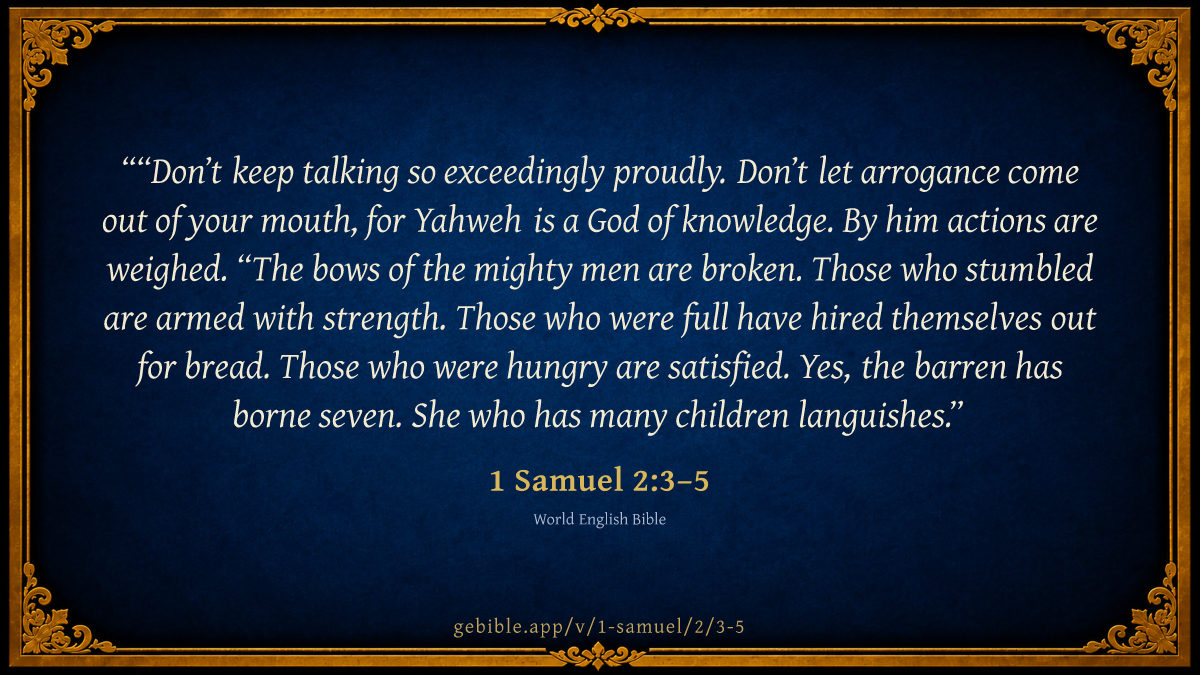
3“Don’t keep talking so exceedingly proudly. Don’t let arrogance come out of your mouth, for Yahweh is a God of knowledge. By him actions are weighed.
4“The bows of the mighty men are broken. Those who stumbled are armed with strength.
5Those who were full have hired themselves out for bread. Those who were hungry are satisfied. Yes, the barren has borne seven. She who has many children languishes.
3 “Don’t keep talking so exceedingly proudly. Don’t let arrogance come out of your mouth, for Yahweh is a God of knowledge. By him actions are weighed.
4 “The bows of the mighty men are broken. Those who stumbled are armed with strength.
5 Those who were full have hired themselves out for bread. Those who were hungry are satisfied. Yes, the barren has borne seven. She who has many children languishes.
KJVKing James Version
3 Talk no more so exceeding proudly; let not arrogancy come out of your mouth: for the LORD is a God of knowledge, and by him actions are weighed.
4 The bows of the mighty men are broken, and they that stumbled are girded with strength.
5 They that were full have hired out themselves for bread; and they that were hungry ceased: so that the barren hath born seven; and she that hath many children is waxed feeble.
Show all 3 translations
JPSJPS Tanakh (1917)
3 Multiply not exceeding proud talk; let not arrogancy come out of your mouth; for the LORD is a God of knowledge, and by Him actions are weighed.
4 The bows of the mighty men are broken, and they that stumbled are girded with strength.
5 They that were full have hired out themselves for bread; and they that were hungry have ceased; while the barren hath borne seven, she that had many children hath languished.
1 Kings 8:39(v3)then hear in heaven, your dwelling place, and forgive, and act, and give to every man according to all his ways, whose heart you know (for…
Proverbs 8:13(v3)The fear of Yahweh is to hate evil. I hate pride, arrogance, the evil way, and the perverse mouth.
Psalms 113:9(v5)He settles the barren woman in her home as a joyful mother of children. Praise Yah!
Proverbs 24:12(v3)If you say, “Behold, we didn’t know this,” doesn’t he who weighs the hearts consider it? He who keeps your soul, doesn’t he know it? Shall…
Jeremiah 15:9(v5)She who has borne seven languishes. She has given up the spirit. Her sun has gone down while it was yet day. She has been disappointed and…
Show all 40 cross-references
Luke 1:53(v5)He has filled the hungry with good things. He has sent the rich away empty.
Psalms 34:10(v5)The young lions do lack, and suffer hunger, but those who seek Yahweh shall not lack any good thing.
Jude 1:15-16(v3)to execute judgment on all, and to convict all the ungodly of all their works of ungodliness which they have done in an ungodly way, and of…
Hebrews 4:12(v3)For the word of God is living and active, and sharper than any two-edged sword, piercing even to the dividing of soul and spirit, of both…
Psalms 37:15(v4)Their sword shall enter into their own heart. Their bows shall be broken.
Psalms 76:3(v4)There he broke the flaming arrows of the bow, the shield, and the sword, and the weapons of war.
Proverbs 16:2(v3)All the ways of a man are clean in his own eyes; but Yahweh weighs the motives.
1 Samuel 1:6(v5)Her rival provoked her severely, to irritate her, because Yahweh had shut up her womb.
1 Samuel 16:7(v3)But Yahweh said to Samuel, “Don’t look on his face, or on the height of his stature, because I have rejected him; for I don’t see as man…
Job 31:6(v3)(let me be weighed in an even balance, that God may know my integrity);
Psalms 44:21(v3)won’t God search this out? For he knows the secrets of the heart.
Psalms 46:9(v4)He makes wars cease to the end of the earth. He breaks the bow, and shatters the spear. He burns the chariots in the fire.
Psalms 94:4(v3)They pour out arrogant words. All the evildoers boast.
Psalms 94:7-10(v3)They say, “Yah will not see, neither will Jacob’s God consider.” Consider, you senseless among the people; you fools, when will you be…
Psalms 147:5(v3)Great is our Lord, and mighty in power. His understanding is infinite.
Isaiah 37:23(v3)Whom have you defied and blasphemed? Against whom have you exalted your voice and lifted up your eyes on high? Against the Holy One of…
Isaiah 54:1(v5)“Sing, barren, you who didn’t give birth; break out into singing, and cry aloud, you who didn’t travail with child: for more are the…
Daniel 4:30-31(v3)The king spoke and said, “Is not this great Babylon, which I have built for the royal dwelling place, by the might of my power and for the…
Luke 16:25(v5)“But Abraham said, ‘Son, remember that you, in your lifetime, received your good things, and Lazarus, in the same way, bad things. But here…
Philippians 4:13(v4)I can do all things through Christ, who strengthens me.
1 Samuel 1:20(v5)When the time had come, Hannah conceived, and bore a son; and she named him Samuel, saying, “Because I have asked him of Yahweh.”
Psalms 37:17(v4)For the arms of the wicked shall be broken, but Yahweh upholds the righteous.
Isaiah 10:4(v4)They will only bow down under the prisoners, and will fall under the slain. For all this his anger is not turned away, but his hand is…
Daniel 4:37(v3)Now I, Nebuchadnezzar, praise and extol and honor the King of heaven; for all his works are truth, and his ways justice; and those who walk…
Daniel 5:27(v3)TEKEL: you are weighed in the balances, and are found wanting.
Malachi 3:13(v3)“Your words have been stout against me,” says Yahweh. “Yet you say, ‘What have we spoken against you?’
2 Corinthians 12:9(v4)He has said to me, “My grace is sufficient for you, for my power is made perfect in weakness.” Most gladly therefore I will rather glory in…
Hebrews 11:34(v4)quenched the power of fire, escaped the edge of the sword, from weakness were made strong, grew mighty in war, and caused foreign armies to…
Revelation 2:23(v3)I will kill her children with Death, and all the assemblies will know that I am he who searches the minds and hearts. I will give to each…
Jeremiah 17:10(v3)“I, Yahweh, search the mind. I try the heart, even to give every man according to his ways, according to the fruit of his doings.”
Jeremiah 37:10(v4)For though you had struck the whole army of the Chaldeans who fight against you, and only wounded men remained among them, they would each…
2 Corinthians 4:9-10(v4)pursued, yet not forsaken; struck down, yet not destroyed; always carrying in the body the putting to death of the Lord Jesus, that the…
Galatians 4:27(v5)For it is written, “Rejoice, you barren who don’t bear. Break out and shout, you who don’t travail. For the desolate have more children…
Isaiah 26:7(v3)The way of the just is uprightness. You who are upright make the path of the righteous level.
Ephesians 6:14(v4)Stand therefore, having the utility belt of truth buckled around your waist, and having put on the breastplate of righteousness,
Cross-references from openbible.info (CC BY 4.0)
Explain this passage (17 sources)
Historical commentary, presented as a primary source — not an endorsement.
Geneva Bible translators1599 · Public DomainOn vv3, 5In that ye condemn my barrenness, ye show your…
In that ye condemn my barrenness, ye show your pride against God.
Geneva Bible (1599) marginal notes — public domain.
John Trapp1656 · Public DomainOn vv3–51Sa 2:3 Talk no more so exceeding proudly; let…
1Sa 2:3 Talk no more so exceeding proudly; let [not] arrogancy come out of your mouth: for the LORD [is] a God of knowledge, and by him actions are weighed.
Ver. 3. Talk no more so exceeding proudly.] Heb., Multiply not, speak not loftiness, loftiness. Peninnah, that odious woman, had vexed and troubled holy Hannah both in her prayers and meals, with her insolent speeches. Now she is warned to have done, and not to let hard words any more to come out of her mouth, Ne lapides loquantur. See Jdg 1:15. And why? for divers good reasons: -
Read full note →
For the Lord is a God of knowledge.] Heb., Of knowledges; and he taketh cognizance of your pride and petulancy. See Mal 3:13 Mat 12:17 {See Trapp on "Mal 3:13"} {See Trapp on "Mat 12:17"}
And by him actions are weighed,] i.e., Exactly examined, and their {a} obliquities discovered and punished. Or, By him enterprises are established viz., if they be to his good liking, else not.
{a} The elephant, that largest of beasts, hath the smallest tongue; and nothing is said of his voice, {Job 39:1-30} to teach great men not to speak big words.
John Trapp, A Commentary or Exposition upon All the Books of the Old and New Testament (1647–1656) — public domain. Text from a community e-Sword module.
Matthew Poole1685 · Public DomainOn vv3–5Talk no more so exceeding proudly; thou Peninnah, boast…
Talk no more so exceeding proudly; thou Peninnah, boast no more of thy numerous offspring, and speak no more insolently and scornfully of me, as thou hast done. She speaks of her in the plural number, brings many because she would not expose her name to censure, but only instruct and reprove her for her good.
Arrogancy, Heb. hard speeches, as those are called, Jud 1:15, harsh, heavy, and not to be borne. Or, the old sayings; either the old proverbs concerning barren women, which thou appliedst to me; or the old reproaches, to which for a long time thou hast accustomed thyself.
Read full note →
The Lord is a God of knowledge; he knoweth thy heart, and all that pride, and envy, and contempt of me which thy own conscience knows, and all thy perverse carriages towards me.
By him actions are weighed, i.e. he pondereth or trieth all men’s thoughts and actions, (for the Hebrew word signifies both,) as a just Judge, to give to every one according to their works; and therefore he hath pitied my oppressed innocency, and rebuked her arrogancy. Or, by him counsels, or actions, or events are disposed or ordered, and not by ourselves; and therefore he things to pass contrary to men’s expectations, as now he hath done; he maketh one barren, and another fruitful, when and how it pleaseth him. In the Hebrew text it is lo the adverb; and so the words may be rendered thus, His actions are not, or cannot, be directed, or rectified, or corrected by any others; none can mend his work; he doth every thing best, and in the best season, as now he hath done: or weighed, or numbered; his ways are unsearchable. Or thus, Are not his works right and straight? who can blame his actions? So lo is for halo, as it is 2Sa 13:26; 2Ki 5:26; Job 2:10.
Matthew Poole's English Annotations on the Holy Bible (1683–1685) — public domain. Text from a community e-Sword/MySword module.
John Gill1763 · Public DomainOn vv3–5Talk no more so exceeding proudly,.... At such an…
Talk no more so exceeding proudly,.... At such an high rate, in such an overbearing manner, as if above everyone; this may have respect to Peninnah, and all that joined with her to provoke Hannah to anger, and make her fret, insulting and triumphing over her, because she had not children, as they had; but now their mouths would be stopped, and their talk over, and not give themselves the haughty airs they had done, at least there would be no occasion for them:
let not arrogancy come out of your mouth; arrogating to themselves, and to their merits, what they enjoyed, as children, riches, &c. when all come from the Lord; or what is "hard" (i), intolerable, which bears so hard on those to whom it is said, that it cannot be bore with; or what is "old" (k), and trite, old sayings concerning barren women, as if of no use in the world, and disagreeable to God, and as having no share in his favour. The Targum renders the word by reproaches, or blasphemies:
Read full note →
for the Lord is a God of knowledge; or knowledges (l): of perfect knowledge; he knows all persons and things; he knows himself, his perfections, purposes, thoughts, words and works; he knows all his creatures, animate and inanimate, rational and irrational, angels and men; the hearts of all men; all that they say, all their hard sayings, all their proud, haughty, overbearing expressions, calumnies, and reproaches, as well as all they think and all they do, good or bad; and God will sooner or later convince them of and punish them for their hard speeches against his people: and he is the author of all knowledge, natural, civil, spiritual, and evangelical:
and by him actions are weighed: his own actions; his works "ad intra"; his purposes and decrees, the counsels of his will, and the thoughts of his heart, the things his mind is set upon; all his appointments and designs, his whole will and pleasure; all are pondered by him, and are formed with the utmost wisdom, and for the best ends and purposes: and all, his actions and works without, whether of creation, providence, and grace, all are weighed and done according to infinite wisdom, unerring justice and truth; all respecting things temporal or spiritual, what relate to the outward estate of men, or to their everlasting happiness: all the actions of men, as they are known unto him, they are weighed and examined by him, whether they proceed from a right principle to a right end or not; upon which, many actions, thought to be good, are not found to be so, and others, though good, yet not found perfect before God; so that there is no justification nor salvation by the best: or the sense is, such actions as are done well, they are "directed to him" (m); as they are ordained by him that men should walk in them, they are for his use, and are done with a view to his glory. There is a double reading of these words; the marginal, which we follow, is "to" or "by him" actions are directed or weighed; but the textual reading is a negative, "actions are not weighed" (n), or numbered; the works of God cannot be comprehended, or the actions of men are not disposed and ordered without his will and pleasure, or cannot be performed unless he wills or permits; and all are disposed of, overruled, and directed, to answer his own ends and purposes.
(i) "durum", Vatablus, Drusius, Piscator; so R. Isaiah. (k) "Vetera", V. L. "vetus", Pagninus, Montanus. (l) "Deus scientiarum", V. L. Pagninus, Montanus, Tigurine version, Drusius. (m) "ipsi directa sunt", Pagninus. (n) "Non disponuntur", Junius & Tremellius; "non numerantur", so some in Vatablus; "non perficiuntur", so some in Munster.
John Gill's Exposition of the Whole Bible (1746–1763) — public domain (CC PDM 1.0). Text via the HelloAO Bible API.
John Wesley1765 · Public DomainOn vv3–5Talk no more - Thou Peninnah, boast no more…
Talk no more - Thou Peninnah, boast no more of thy numerous off-spring, and speak no more insolently and scornfully of me. She speaks of her in the plural number, because she would not expose her name to censure. Of knowledge - He knoweth thy heart, and all that pride, and envy, and contempt of me, which thy own conscience knows; and all thy perverse carriage towards me. Actions - That is, he trieth all mens thoughts and actions, (for the Hebrew word signifies both) as a just judge, to give to every one according to their works.
John Wesley, Explanatory Notes Upon the Whole Bible (1754–1765) — public domain. Text via the GEBible commentary corpus.
Adam Clarke1810 · Public DomainOn vv3–5Verse 3. A God of knowledge] He is the…
Verse 3. A God of knowledge] He is the most wise, teaching all good, and knowing all things.
Actions are weighed] נתכנו nithkenu, they are directed; it is by his counsel alone that we can successfully begin, continue, or end, any work.
Adam Clarke's Commentary on the Bible (1810–1826) — public domain. Text from a community e-Sword/MySword module.
Joseph Benson1811 · Public DomainOn vv3–51Sa 2:3. Talk no more — Thou Peninnah, boast…
1Sa 2:3. Talk no more — Thou Peninnah, boast no more of thy numerous offspring, and speak no more insolently and scornfully of me. She speaks of her in the plural number, because she would not expose her name to censure. A God of knowledge — He knoweth thy heart, and all that pride, and envy, and contempt of me, which thy own conscience knows: and all thy perverse carriage toward me. By him actions are weighed — That is, he trieth all men’s thoughts and actions, (for the Hebrew word signifies both,) as a just judge, to give to every one according to his works.
Joseph Benson's Commentary on the Old and New Testaments (1811–1818) — public domain. Text from a community e-Sword module.
Albert Barnes1834 · Public DomainOn v5See an instance in 1Sa 2:36. See, too, in…
See an instance in 1Sa 2:36. See, too, in Eze 13:19, another example of hire paid in bread.
Ceased - i. e. were at rest, did no work. The general sense is expressed by the translation of the Latin Version, “they were filled.”
Albert Barnes' Notes on the Bible (1834–1885) — public domain. Text from a community e-Sword/MySword module.
Haydock's Catholic Bible Commentary1859 · Public DomainOn vv3–5Old. Hebrew hathak means also, "hard things." (Du Hamel)…
Old. Hebrew hathak means also, "hard things." (Du Hamel) --- "Let arrogance come out of your mouth," to return no more. Yet most people supply the negation from the former member; "Let not arrogance or hard things." Chaldean, "blasphemy," &c. (Calmet) --- Cease to praise idols, as you have done. (Worthington) --- Use not the malevolent language to which you have been accustomed. --- Knowledge. The secrets of hearts are open to him. --- And to him. Hebrew, "and by him actions are weighed," as in scales; (Haydock) or, "thoughts (and actions) are not established." (Symmachus) The Syriac and Arabic also read the negation, "there are not pretexts before him;" or, "are not actions founded upon him?" Will he not execute what he has wisely designed, in spite of opposition? (Haydock) --- Septuagint, "and God prepares his thought;" (Calmet) (Greek: epitedeumata autou) or, "what is convenient for him." (Haydock) --- They have read lu, "of him," instead of la, "not," as they are authorized to do by the Keri, (or various readings in the margin) and by several Hebrew manuscripts. The Protestants think rightly, and suppose that la, "not," has been omitted, "Let not arrogancy;" because we find it in Chaldean, Septuagint, Syriac and Arabic versions. Lu is substituted for la, ver. 16. When some have been pressed with the argument of variations, called Keri, they have said that they were rather explanations of obscure words in the text: but is there any obscurity in lu, "to him," and la, "not;" or can they explain each other? Leusden answers in the affirmative, ver. 16! (Kennicott)
George Leo Haydock (1774–1849), Haydock's Catholic Family Bible and Commentary, 1859 edition — public domain. Excludes Psalms (Douay-Rheims chapter numbering differs from Protestant) and Deuterocanonical books (Catholic canon only).
Robert Jamieson, A. R. Fausset & David Brown1871 · Public DomainOn v5they that were hungry ceased--that is, to hunger.
they that were hungry ceased--that is, to hunger.
the barren hath born seven--that is, many children.
Jamieson, Fausset & Brown — Commentary Critical and Explanatory on the Whole Bible (1871) — public domain (CC PDM 1.0). Text via the HelloAO Bible API.
Daniel D. Whedon1874 · Public DomainOn vv3–53. Arrogance… Impudence — Reference is here primarily to…
3. Arrogance… Impudence — Reference is here primarily to the haughty and impudent conduct of her adversary Peninnah, who had vexed her with taunting words. Chap. 1Sa_1:6. For (introducing the reason for the reproof just given) a God of knowledge is Jehovah — The word rendered knowledge is in the plural דעות, knowledges, multifarious knowledge, indicating the fulness of the Divine wisdom.
With him — In his mind; by him. The Hebrew text (kethib) has לא, not, instead of לו, to or with him, (keri,) but with that reading no tolerable sense can be made from the passage without too great a departure from the natural meaning of the words.
Read full note →
Actions are weighed — The actions of men, whether they be good or evil. Therefore arrogance and impudence in thought and action should be stopped, and all men fear Jehovah. Some interpreters, with less propriety, say that the actions of God are here meant; thus: With him (his own) actions are established.
Daniel D. Whedon (gen. ed.), Commentary on the Old and New Testaments (1874–1909) — public domain. Text from a community e-Sword module.
The Cambridge Bible for Schools and Colleges1878 · Public DomainOn vv3–53. arrogancy] The old form of the word arrogance…
3. arrogancy] The old form of the word arrogance (cp. innocency for innocence) from the Lat. arrogantia. It signifies “claiming more than one’s due,” “assumption,” “pride.”
knowledge] The Heb. word is plural, denoting varied and extensive knowledge.
Read full note →
by him actions are weighed] Jehovah knows the hearts of men and estimates men’s actions at their true value. See Pro_16:2; Pro_24:12. This explanation is probably right, but the Heb. may also be rendered, “His (i.e. God’s) actions are weighed,” or, “measured:” i.e. are just and right. Cp. the use of the same word in Eze_18:25, “Is not my way equal?” “By him” is the Qrî or traditional read text. (See p. 14.) The Kthîbh or written text has “not” instead of “by him,” the words being similar in pronunciation though differently spelt. This may be rendered either, “though actions be not weighed,” or interrogatively, “and are not actions weighed?”
The Cambridge Bible for Schools and Colleges (gen. ed. J. J. S. Perowne; Cambridge University Press, 1878–1918) — public domain. Text from a community e-Sword module.
Ellicott's Commentary for English Readers1878 · Public DomainOn vv3–5(3) A God of knowledge.—The Hebrew words are placed…
(3) A God of knowledge.—The Hebrew words are placed thus: A God of knowledge is the Lord, The Talmud quaintly comments here as follows:—Rabbi Ami says: “Knowledge is of great price, for it is placed between two Divine names; as it is written (1Sa_2:3), ‘A God of knowledge is the Lord,’ and therefore mercy is to be denied to him who has no knowledge; for it is written (Isa_27:11), ‘It is a people of no understanding, therefore He that made them will not have mercy on them.’”—Treatise Berachoth, fol. 33, Colossians 1.
And by him actions are weighed.—This is one of the fifteen places reckoned by the Masorites where in the original Hebrew text, instead of “lo” with an aleph, signifying not, “lo” with a vaw, signifying to, or by him, must be substituted. The amended reading has been followed by the English Version. The meaning is that all men’s actions are weighed by God according to their essential worth, all the motives which led to them are by Him, the All-knowing, taken into account before He weighs them.
A Bible Commentary for English Readers, edited by Charles John Ellicott (1878–1897) — public domain. Text from a community e-Sword module.
The Pulpit Commentary1880 · Public DomainOn v3The Divine judgment of human actions.
The Divine judgment of human actions.
him actions are weighed." It is customary to determine the worth of many things by weighing them. For this purpose a fixed standard is used, and a comparison is made with it by means of a balance and scales or other instrument. Nothing can be more natural than to speak of determining the moral worth of actions in the same manner, and Justice is commonly represented as a woman holding in her hand a pair of scales in which "actions are weighed." In this sense the above expression is employed; not, however, of men, whose judgment is often mistaken or unjust; but of "God, the Judge of all." His judgment is
Read full note →
I A PRESENT JUDGMENT. They are (now) weighed. According to the ancient Egyptians, there was erected at the entrance of the unseen world a balance or scales, over which the Judge of the dead presided, and by it the character of every man was tested as soon as he died. In one of the scales the figure or emblem of truth was placed, and in the other the heart of the deceased; and the result determined his destiny. This is not an unworthy conception of the judgment to come. But their religion pertained chiefly to what would be in the future, rather than to what exists in the present. And there are many at the present day who never think that they have anything to do with God or his judgment except when they come to die. They forget that the living and all-seeing God "pondereth their goings", (Pro_5:21) "judgeth according to every man"s work", (1Pe_1:17) and that to him they stand responsible. (Heb_4:13 whom is the account
II ACCORDING TO A PERFECT STANDARD. The estimate which men form of themselves and others is often false, because it is not formed by means of such a standard. As "weights and measures" need to be examined and to be rectified by an imperial standard, so the human judgment and conscience need to be examined and to be rectified by the righteousness of God as declared in the Law and the Prophets and the Gospel of Christ. What is our relation to this standard?
III ACCORDING TO MOTIVES. The moral worth of actions does not depend upon their "outward appearance," but upon the heart. In the sight of God, who sees hearts as we see faces, the inward motives, principles, and intentions are in reality the actions which are weighed (Pro_16:2 Pro_21:2 Pro_24:11, Pro_24:12; Isa_26:7) Our ignorance of these necessarily makes our judgment imperfect, even in relation to ourselves. But "he is a God of knowledge," "searches the heart," and perceives the motives which underlie all actions, and which are often so different from what they are thought to be. (Psa_139:3)
IV UNIVERSAL. "The Judge of all the earth." It pertains to all actions that have in them a moral element; to the actions of every individual soul (for each soul stands before him in its separate personality, bearing its own burden of responsibility and of sin, and is dealt with by him as though there were no other); and to every one of its actions, however apparently insignificant, though it cannot be really such because of its relation to God, and its bearing upon character and destiny.
V EXERCISED WITH A VIEW TO REWARDING EVERY MAN ACCORDING TO HIS WORKS. It is not useless and ineffective; but is attended with important consequences. (Jer_17:10) This life is not simply one of probation; it is also, in part, one of retribution. The approbation or disapprobation of God is always followed by corresponding effects in the mind and heart and conscience of men, and often by startling providential occurrences; as when it was said, "Thou art weighed in the balances, and art found wanting"; (Dan_5:27, Dan_5:30) "The world"s history is the world"s judgment;" and, "We must all appear before the judgment seat of Christ" (Rom_14:12; 2Co_5:10) Application:
1. "Let a man examine himself.
2. Seek forgiveness of the sins that are past.
3. "Walk before me, and be thou perfect. D.
The Pulpit Commentary (1880–1919), ed. H.D.M. Spence-Jones & Joseph S. Exell — public domain. Text from a community e-Sword module.
The Biblical Illustrator1887 · Public DomainOn v3Talk no more exceeding proudly.
1Sa_2:3-4
Talk no more exceeding proudly.
Read full note →
The different forms of pride
1. The pride of conquest. The bows of the mighty men are broken.
2. The pride of abundance. There may be pride in any and every condition of life. Children, as well as grown people, may be very proud; and God hates pride in the young as much as in the old. Some children,--nay, and some grown people, too, are proud of fine clothes, and like to strut about while the gloss is new on their wearing apparel. Others are proud of being clever; whereas they should regard their talents as a trust given them by God, of which they will have to render an account. Others are vain of their beauty; and then perhaps their beauty is taken away by some loathsome complaint, or worse still, it becomes a snare to them, as Absaloms fine long hair was the means of bringing him to his end. (Dean Goulburn.)
The Lord is a Lord of Knowledge.
The knowledge of God
Knowledge considers things absolutely, and in themselves: wisdom considers the respects and relations of things one to another, and under the notion of means and ends. The knowledge of God, is a perfect comprehension of the nature of all things, with all their powers and qualities, and circumstances: the wisdom of God, is a perfect comprehension of the respects and relations of things one to another; of their harmony and opposition; of their fitness and unfitness to such and such ends.
I. For the proof of it, I shall attempt it two ways.
1. From the dictates of natural light and reason. Unless natural reason assures us, that God is endowed with knowledge and understanding, it is in vain to inquire after Divine revelation. For to make any revelation credible, two things are requisite on the part of the revealer, ability and integrity. The Divine perfections are not to be proved by way of demonstration, but by way of conviction, by showing the absurdities of the contrary.
(1) It is a perfection, and therefore belongs to God.
(2) Knowledge is to be found in some of the creatures, and therefore is much more in God the Creator, because it is derived from Him. Understand, ye brutish among the people; and ye fools, when will ye be wise? He that planted the ear, shall He not hear? He the formed the eye, shall He not see?
(3) The denial of this perfection to God, argues many other imperfections in the Divine nature. Nothing would more eclipse the Divine nature, than to take away this perfection from it; this would bring an universal obscurity upon Gods other perfections; this would be to put out the light of heaven, and to turn the brightness of the morning into the shadow of death. If we remove this perfection from God, we deny His wisdom. And we weaken His power. What an impotent and ineffectual thing would power be without knowledge! What irregular things would it produce! And, consequently, we take away His providence; for without knowledge, there can be no counsel, no provision for the future, no government of the world. And that is not all; for without knowledge there could be no such thing as goodness, for He is not good that does good out of ignorance, or from a blind necessity. There could be no veracity, nor justice, nor mercy in God; for all these suppose knowledge.
2. From Scripture, and Divine revelation. I will only instance in two or three: (Job_36:4) He that is perfect in knowledge, is with thee. (Job_37:16) Dost thou know the wondrous works of Him who is perfect in knowledge?
(1) That God takes notice of all our actions. The Scripture frequently mentions this: (Psa_129:1, etc. Pro_5:21) The ways of man are before the eyes of the Lord, and He pondereth all his goings. (Jer_32:19) Thine eyes are open upon all the ways of the sons of men, to give every one according to his ways, and according to the fruit of his doings.
(2) He is a curious observer, one that takes exact notice of all that we do.
(3) He taketh notice of those actions which are most secret and hidden, the good as well as bad.
3.God knows the hearts and thoughts of men; which implies these two things: God perfectly knows the hearts of men (Jer_17:10). (1Ki_8:39) For Thou, even Thou, knowest the hearts of all the children of men. (1Ch_27:9). He knoweth the secrets of the hearts (Pro_15:11).
(1) The reason of every mans mind tells him, that the supreme Being whom we call God, is endowed with all perfection, and among His other perfections, that He excels in knowledge.
(2) The natural fears of men are likewise a secret acknowledgment of this.
2. That to have a perfect and thorough knowledge of mens hearts, is the peculiar prerogative of God.
3. Gods knowledge of future events. This God proposes as the way to discern the true God from idols (Isa_41:21, etc.)
(1) That God knows future events.
(2) That He only knows them.
Objection the first: The impossibility of the thing. The certainty of all knowledge depends upon the certainty of the object; therefore there cannot be a certain and determinate knowledge of any thing, but what is certainly and determinately true; but future events, which may or may not be, have no certain and determinate truth; that is, it is not certain either that they will or will not be, because they have no certain cause; therefore there can be no infallible knowledge concerning them.
1. I might say, with a very fair probability, that the certainty of knowledge doth not depend upon the uncertainty of the cause, but of the object, which may be certain, though the cause be contingent.
2. Though we could not explain the possibility of Gods knowing future contingencies, much less the manner how; yet we are sufficiently assured that God doth know them.
3. It is very unreasonable to expect we should know all the ways which infinite knowledge hath of knowing things. We have but finite faculties and measures, which bear no proportion to infinite powers and objects.
Secondly, It is objected, that if we can admit such a knowledge in God as seems contradictions and impossible to our reason, why may we not allow and frame such notions of His goodness and justice. To this I answer, There is a great difference between those perfections of God which are imitable, and those which are mot. Knowledge of future events is a perfection wherein we are not bound to be like God; and if we are assured of the thing, that He doth know them, it is not necessary that we should know the manner of it, and disentangle it from contradiction and impossibility: but it is otherwise in Gods goodness and justice, which are imitable; he that imitates, endeavours to be like something that he knows, and we must have a clear idea and notion of that which we would bring ourselves to the likeness of; these perfections of God we are capable of knowing, and therefore the knowledge of these perfections is chiefly recommended to us in Scripture (Jer_9:24). The third objection is made up of several inconveniences that would follow from Gods knowledge of future events.
1. It would prejudice the liberty of the creature. Answer.--Gods foreknowledge lays no necessity upon the event; in every event, we may consider the effect in itself, or with relation to the cause, and the manner how it comes to pass; considered in itself, it is future--with relation to its causes, it is contingent. God sees it as both.
2. If God infallibly foreknows what men will do, how can He be serious in His exhortations to repentance, in His expectation of it, and His grieving for the impenitency of men? Answer.--All these are founded in the liberty of our actions. God exhorts to repentance, and expects it, because by His grace we may do it: He is said to grieve for our impenitency, because we may do otherwise, and will not. Exhortations are not in vain themselves, but very proper to their end. Having answered the objections against Gods foreknowing future events, I proceed to show that God only knows future events (Isa_44:6-7). I have now done with the first general head I proposed to be spoken to from these words; viz., To prove that this attribute of knowledge belongs to God. I proceed to the
II. To consider the perfection and prerogative of the Divine knowledge; which I shall speak to in these following particulars:
1. Gods knowledge is present and actual, His eye is always open, and every thing is in the view of it. The knowledge of the creature is more power than act.
2. Gods knowledge is an intimate and thorough knowledge, whereby He knows the very nature and essence of things. The knowledge which we have of things is but in part, but outward and superficial.
3. Gods knowledge is clear and distinct. Our understandings in the knowledge of things are liable to great confusion; we are often deceived with the near likeness and resemblance of things, and mistake one thing for another.
4. Gods knowledge is certain and infallible. We are object to doubt and error in our understanding of things.
5. The knowledge of God is easy, and without difficulty. We must dig deep for knowledge, take a great deal of pains to know a little.
6. The knowledge of God is universal, and extends to all objects. We know but a few things; our ignorance is greater than our knowledge.
III. I come now to draw some inferences from the several parts of this discourse.
1. From the perfection of Gods knowledge.
(1) The perfection of the Divine knowledge calls for our veneration.
(2) We may hence learn humility, and that on this double account--as we have all our knowledge from Him: What have we that we have not received?
(3) This is a matter of comfort and encouragement; He knows our wants and our weaknesses.
2. From Gods knowing our secret actions, I infer,
(1) If God sees our most secret actions, this discovers and confutes the secret atheism of many. He that commits the most secret sin, denies the omniscience of God.
(2) Live as those that believe this: be continually under the power of this apprehension, that God takes a particular and exact notice of all thy actions.
3. Gods knowledge of the heart teaches us,
(1) The folly of hypocrisy: how vain is it to make a show of that outwardly, which inwardly, and in our hearts, we are not; to put on a mask of religion, and paint ourselves beautifully without.
(2) If God know your hearts, then endeavour to approve your hearts to Him; charge yourselves with inward purity and holiness.
(3) This is matter of encouragement to us in many cases: in our secret troubles (Psa_142:3).
(4) This renders all the deep and profound policies of wicked men a vain thing: The Lord knows the thoughts of men, that they are vanity (Psa_94:11): because He knows them, and can defeat them.
(5) If God only knows the hearts of men, then what art thou, O man, that judgest anothers heart?
4. From Gods knowledge of future events, we may learn,
(1) The vanity of astrology, and all other arts that pretend to foretell future events, things that depend on the will of free agents.
(2) Refer future things to God, who only knows them; trust Him with all events; cast your care upon Him. (J. Tillotson, D. D.)
By Him actions are weighed.--
Actions weighed by God
In all Gods dealings with us there is one thing of which we may be perfectly sure,--they will be done deliberately; delicately, by measurement, with accuracy, in proportion. We are quite safe there from all hastiness and inconsideration--those two banes of human judgment. Jobs prayer is always answered, Let me be weighed in the balance. Alike the greatest and the leash--from those giants of nature, the everlasting hills, down to the dust of the earth, and to the smallest thought which ever flashed through a mans mind--all are weighed.
I. Let us be sure that we give actions their proper place in the plan of our salvation. Actions never save a man. Actions have, strictly speaking, nothing to do with our salvation. But actions occupy four parts in the great scheme of our redemption.
1. They are the tests of life--He that abideth in Me, the same bringeth forth much fruit.
2. They are the language of love--If ye love Me, keep My commandments.
3. They glorify God before men--Let your light so shine before men that they, seeing your good works, may glorify your Father which is in Heaven.
4. And although they are not the meritorious causes of our final rewards, yet they determine the degrees and proportions of our final state--He will reward every man according as his work shall be
II. It would be the greatest presumption on our part to say how God weighs our actions. It is sufficient to know that He does weigh them. That hand cannot err But we may carry out Gods own metaphor a little way and conceive it thus:
1. On the one hand is the action; on the other, what that action might have been, and ought to have been, and, but for our sin, would have been.
2. On the one side the action we did; on the other, the action we meant to do, and promised to do.
3. On the one side, what we have received; on the other, what we have rendered.
III. When God holds the scales of his childrens actions, He puts in something of His own over and above, and when He puts that in, the beam that had preponderated against us, turns the other way, and mercy rejoiceth against judgment. We should be careful not to usurp an office which only Omniscience can rightly exercise.
IV. We must all feel that when we are weighed in these Holy scales the verdict can only be, Tekel; thou art weighed in the balances and found wanting. But the Lord Jesus Christ died upon the cross. That death is on the one side, and the whole worlds guilt is on the other. God is weighing them--the blood of Christ and the sins of all mankind. God has balanced you and your substitute, and God is satisfied for His sake forever and ever (J. Vaughan.)
The Kings weighings
It is very beautiful to see how the saints of old time were accustomed to find comfort in their God. Thus Hannah thinks of the Lord, and comforts herself in His name. Like others of Gods instructed people, Hannah was very happy in the thought of Gods holiness. Hannah also turned her heart to celebrate the power of Jehovah. Hannah touched, in her rapturous hymn, upon the wisdom of the Lord. Hannah also derived comfort from the fact that God is strictly just.
I. The staple of our discourse will consist of a consideration of the process of Divine judgment, which is continually going on: The Lord is a God of knowledge, and by Him actions are weighed. The figure of weighing suggests a thorough testing, and an accurate estimating of the matters under consideration.
1. Our first note here shall stand thus,--this is not as man dreams. Consider, next, that this form of procedure is not as man judges. By men actions are judged flippantly, but by God actions are weighed. Men are exceedingly apt to measure actions by their consequences. How wrong it is to measure actions by results, rather than by their own intrinsic character! A man upon the railway neglected to turn a switch, but by the care of another no accident occurred. Is he to be excused? Another man was equally negligent, certainly not more so; but in his case the natural result followed--there was a collision, and many lives were lost. The last man was blamed most deservedly, but yet the former offender was equally guilty. If we do wrong and no harm comes of it, we are not thereby justified. Yea, if we did evil and good came of it, the evil would be just as evil. It is not the result of the action but the action itself which God weighs. He who swindles and prospers is just as vile as he whose theft lodged him in prison. He who acts uprightly, and becomes a loser thereby, is just as honoured before God as if his honesty had led on to wealth. If we seek to do good and fail in our endeavour, we shall be accepted for the attempt, and not condemned for the failure. If a man gives his life to convert the heathen, and he does not succeed, he shall have as much reward of God as he who turns a nation to the faith. I would now have you note that this weighing is a very searching business. By him actions are weighed. A man enters a goldsmiths shop and says, Here is old gold to sell. See, I have quite a lot of it. Yes, says the goldsmith, Let me weigh it. Weigh it? Why, look at the quantity; it fills this basket. What is the goldsmith doing? Looking for his weights and certain acids by which he means to test the metal. When he has used his acids, he puts the trinkets into the scale. You are not going to buy by weight? I never buy in any other way, says the goldsmith. But there is such a quantity. That may be, but I buy by weight. It is always so with God in all our actions: he estimates their real weight. We may hammer out our little gold, and make a great show of it, but the Lord is not mocked or deceived. Every dealing between us and God will have to be by a just balance and standard weight. And in what way will He weigh it? The weights are somewhat of this sort. The standard is His just and holy law, and all which falls short of that is sin. Any want of conformity to the law of God is sin, and by so much our acts are found wanting. Remember this, ye who would justify yourselves. The Lord also enquires how much of sincerity is found in the action. The Lord also weighs actions according to their motives. Another mode of judging is by our spirit and temper. Sometimes actions may be weighed by the circumstances which surround them. Multitudes of men are honest because they never had a chance of making a grand haul by setting up a bubble company--which is the modern mode of thieving. The lieu in the Zoological Gardens is very good because he is behind iron bars, and many a mans goodness owes more to the iron bars of his position than to his own heart and motive. Another weight to put in the scale is this,--Was there any godliness about your life? Once more--have we lived by faith? for without faith it is impossible to please God; and if there be no faith in our life then are we nothing worth.
4. This weighing of our lives must be exceedingly accurate because it is done personally by God himself. I once heard a story (I do not know if it is true) of an old banker who said to his son to whom he bequeathed the business, This is the key of our large iron safe: take great care of it. The bank depends upon that safe; let the people see you have such a safe, but never open it unless the bank should be in the utmost difficulty. The bank went on all right as long as the iron safe was fast closed, but, at last there came a run upon it, and in his greatest extremity the young gentleman opened it, and he found in it--nothing at all. That was the stock of the bank: poverty carefully concealed, imaginary wealth winning confidence, and living on the results. Are there not many persons who all their lives long are doing a spiritual banking business, and deriving a considerable income of repute from that which will turn out to be mere nothing? Beware of driving a trade for eternity upon fictitious capital, for failure will be the sure result.
5. Again, I want you to notice that this weighing is carried on at this present time--By Him actions are weighed. As at the Bank all moneys are put through a process by which the light coins are detected, so evermore our life passes over the great weighing machine of the Lords justice, and He separates that which is short in weight from that which is precious, doing this at the moment as infallibly as at the judgment day. By Him actions are weighed. This is true of all of us--not of open sinners only, but of those who are considered saints.
6. And one day, to conclude this point, the Kings weighing will be published--set up where men and angels shall read them
II. The humbling nature of this consideration. Talk no more so exceedingly proudly; let not arrogance come out of your mouth; for the Lord is a God of knowledge, and by Him actions are weighed. The fact of Divine judgment on ourselves should forever prevent our insulting over others. Next, I think we must give up all idea of speaking proudly in the presence of God. If ever you have had the weighing process carried on in your own heart I know you have given up all hope of being saved by your own merit or strength if conscience has been awakened, and if the law has fulfilled its office upon you, you have given up all idea of appearing before God in your own righteousness.
III. The position in which all this leaves us. If God weighs our actions and we are thereby found wanting, and can only cry, Guilty in his sight, what then? Then we are in Gods hands. That is where I wish every one of my hearers to feel himself to be. But who is the Lord?
1. First, according to Hannah, He is a God of salvation.
2. Next, according to Hannahs song, tie is the God who delights in reversing the order of things. He throws down those who are on high, and sets up those that are down.
3. Once more, this God is one who delights to carry on strange processes in the hearts of His people. The Lord killeth, and maketh alive: He bringeth down to the grave, and bringeth up. (C. H. Spurgeon.)
Divine knowledge of human action.
Gods knowledge extends to--
I. The material universe. There is nothing in any part of this universe which comes not beneath His glance. Our imagination fails us as we try to think what is included in the knowledge of God in the wide sphere of the physical creation.
II. All finite intelligences. We should conclude from the exercise of our reason, and Scripture fully confirms the belief (Col_1:16), that beside and above our own, are many grades of spiritual intelligences peopling the vast spaces of the heavens. The all-embracing wisdom of God must include a perfect knowledge of these--of their nature, of their capacities, of their habits, of their life. But let us rather pursue that which practically concerns us, our Fathers knowledge of His human children. God knew from the beginning--
1. The possibilities of our nature; how high we could rise and how far we might sink, how much we could enjoy and how much we could endure.
2. The course of human history. He saw what use and what misuse of his great opportunity man would make, how he would be overcome in the day of trial, and what long and dark course of sin and suffering he would pursue.
3. Our capacity to rise.
III. The worth and the unworthiness of human life and action. By the God of knowledge actions are weighed.
1. What is included in human action? We must not take a restricted view of those actions which are weighed by the Judge of all. They include--
(1) All visible movement, all overt deeds; the things which our hands execute, the paths which our feet tread, the activities of the busy world, the discharge of household duties, our indulgences, our studies, our devotions. But they include very much more than this; they embrace
(2) all utterance, both premeditated and casual. The distinction between words and deeds is only true in part. It is often the case that speaking is the finest and noblest action.
(3) All thoughts, feelings, and determination are the actions of the soul. The spirit of man is constantly at work when no sound is heard and no deed is witnessed. We may go so far as to say that human action includes
(4) our fixed attitude of soul--especially that which we deliberately take toward the Father and the Saviour of our spirit.
2. Weights in the Divine balance. By what does God determine the worth or the guilt of an action?
(1) By the purity or impurity of our motive (Mat_6:1; Mat_6:5; Mat_6:16; Mat_23:15; 1Co_13:1).
(2) By the measure of difficulty to be mastered. God knows our frame; He remembers that we are dust. He requires of us according to that we have, and not according to that we have not.
(3) By the presence or absence of privilege. Far more was expected from those who had the law than from those who had it not (Mat_5:46-47; Rom_2:12). (W. Clarkson, B. A.)
The even balance
Great is our Lord, and of great power: His understanding is infinite. He who hath weighed the mountains in scales and the hills in a balance weigheth the spirit: and by Him actions are weighed. Looking forward, faithful Abraham said: Shall not the Judge of all the earth do right?
I. The truth itself. By him actions are weighed:--
1. Unerringly. The Lord is a God of knowledge; and all of us may say with the Psalmist, Thou understandest my thoughts afar off: Thou are acquainted with all my ways. We are sure that the judgment of God is according to truth.
2. In connection with and having regard to their antecedents. When the Israelites provoked the Lord at the Sea--even at the Red Sea--their sinfulness was aggravated by their want of remembrance of the multitude of His mercies. On the other hand, the moral value of worthy actions is enhanced by relation to unfavourable antecedents. To the Canaanitish woman Jesus said: O woman, great is thy faith.
3. In connection with the degree of knowledge at the time possessed. That Abraham obeyed and went out, not knowing whither he went, and that he offered up Isaac, quite in the dark as to the Divine design. On the other hand, the sin of Saul of Tarsus, when he was a blasphemer, a persecutor, and injurious, great as it was, was far below what it would have been had he then believed that Jesus was the Christ.
4. In connection with and having regard to the circumstances under which they are performed.
5. In connection with and having regard to the motive from which they spring. When Hezekiah displayed all that was found in his treasures it was the character of his motives, so peculiarly unbecoming amid such great and tender mercies from the Lord, that had specially to do with his subsequent humiliation under the providence of Him who weigheth the spirits (Pro_16:2). It was the loving motive of Mary, who took very costly and precious ointment and anointed the feet of Jesus, that led to the signal honour conferred by our Lord.
II. Reflections.
1. In view of the great truth, that by Him actions are weighed, how forcible trod full of suggestiveness the words: Many that are first shall be last, and the last first (Mar_10:31).
2. How differently should different minds be affected by the truth now under consideration. I know thy works and where thou dwellest, oven where Satans seat is; and thou holdest fast My name.
3. What gratitude should be enkindled by the assurance that the Lord, by whom actions are weighed, delighteth in mercy. A false balance is not good: and they measuring themselves by themselves, and comparing themselves among themselves, are not wise (2Co_3:2). It is well to feel with Job--Let me be weighed in an even balance. (J. Elliot.)
The true valuation of mens actions
The man of science has electrometers, spectroscopes, gossamer gauges, fairy balances, magic tests; he can do the most wonderful things in the way of analysing physical bodies, in measuring subtle natural forces. But all this delicacy of criticism is mere barbarism compared with the criticism of God. The Lord weigheth the spirits. He puts thoughts, tastes, emotions into the scales; with severer tests than we dream, the hidden qualities and principles of every heart are made manifest in his sight. It is reported that an American physician, Dr. Upham, of Salem, Massachusetts, recently demonstrated to an audience to whom he was lecturing the variations of the pulse in certain diseases by causing the lecture room to be placed in telegraphic communication with the City Hospital at Boston, fifteen miles distant; and then, by means of a special apparatus and a vibrating ray of magnesian light, the pulse beats were exhibited upon the wall. There is not a throb of our heart but it makes its sign on the great white throne. He knoweth our thoughts afar off. Thou hast set our sins before Thee, our secret sins in the light of Thy countenance. And what stands thus revealed is bound to meet with just retribution. (W. L. Watkinson.)
Actions revealed in their true light
Men forget their sinfulness in their prosperity. If the soldier wins the battle he concludes that his cause was right; if the politician wins his election he concludes that his policy is right; if the merchant accumulates a fortune he considers that heaven has endorsed his principles, whatever they may be. And yet this line of argument may be, and often is, utterly false. A man may be a conqueror, and yet his glory be his shame; he may attain honour, and his scarlet robe be the firing sign of his scarlet sins; he may grow rich, and every coin in his coffers witness against him; he may possess every means of happiness, and yet have forfeited all right to happiness itself. His honour rooted in dishonour still. Many a man has a certain sense of self-respect who ought to have none, for his self-respect is based on his wealth and position, not on his personal merit; on his clothes, not on his character. So by various methods men disguise their sins from themselves and from others; villains before heaven, they are gentlemen, moralists, salts before their fellows. In Venice, Quinet was shown a helmet of studied beauty, constructed to crush the heads of the accused. Thus, the philosopher remarks, Venice was artistic even in her tortures. How many men are artistic in their sins. Cleverly disguised as sin may be, it will inevitably suffer detection. (W. L. Watkinson.)
The Biblical Illustrator, edited by Joseph S. Exell (c. 1880s–1900s) — public domain. Text from a community e-Sword module.
unfoldingWord translationNotes2017 · CC BY-SA 4.0On vv3, 5Connecting Statement:
Connecting Statement:
Hannah continues to recite a song to Yahweh. She speaks as if other people were listening to her. (See: Parallelism)
Read full note →
no arrogance
"no arrogant words"
by him actions are weighed
This can be stated in active form. AT: "he weighs people's actions" or "he understands why people act as they do" (See: Active or Passive)
The bow of the mighty men are broken
Possible meanings are 1) the bows themselves are broken or 2) the men who carry the bows are prevented from acting. AT: "Mighty bowmen are kept from acting"
The bow of the mighty men are broken
This can be stated in active form. AT: "Yahweh breaks the bows of the mighty men" or "Yahweh can make even the strongest of people weak" (See: Active or Passive)
those who stumble put on strength like a belt
This metaphor means they will no longer stumble, but their strength will remain with them as tightly as a belt. AT: "he will make those who stumble strong" (See: Metaphor)
put on ... a belt
This is the general term for putting something around one's waist to prepare for work.

Geneva Bible translators 1599 · Public Domain On vv3, 5 In that ye condemn my barrenness, ye show your…
In that ye condemn my barrenness, ye show your pride against God.
Geneva Bible (1599) marginal notes — public domain.
John Trapp 1656 · Public Domain On vv3–5 1Sa 2:3 Talk no more so exceeding proudly; let…
1Sa 2:3 Talk no more so exceeding proudly; let [not] arrogancy come out of your mouth: for the LORD [is] a God of knowledge, and by him actions are weighed.
Ver. 3. Talk no more so exceeding proudly.] Heb., Multiply not, speak not loftiness, loftiness. Peninnah, that odious woman, had vexed and troubled holy Hannah both in her prayers and meals, with her insolent speeches. Now she is warned to have done, and not to let hard words any more to come out of her mouth, Ne lapides loquantur. See Jdg 1:15. And why? for divers good reasons: -
Read full note →
For the Lord is a God of knowledge.] Heb., Of knowledges; and he taketh cognizance of your pride and petulancy. See Mal 3:13 Mat 12:17 {See Trapp on "Mal 3:13"} {See Trapp on "Mat 12:17"}
And by him actions are weighed,] i.e., Exactly examined, and their {a} obliquities discovered and punished. Or, By him enterprises are established viz., if they be to his good liking, else not.
{a} The elephant, that largest of beasts, hath the smallest tongue; and nothing is said of his voice, {Job 39:1-30} to teach great men not to speak big words.
John Trapp, A Commentary or Exposition upon All the Books of the Old and New Testament (1647–1656) — public domain. Text from a community e-Sword module.
Matthew Poole 1685 · Public Domain On vv3–5 Talk no more so exceeding proudly; thou Peninnah, boast…
Talk no more so exceeding proudly; thou Peninnah, boast no more of thy numerous offspring, and speak no more insolently and scornfully of me, as thou hast done. She speaks of her in the plural number, brings many because she would not expose her name to censure, but only instruct and reprove her for her good.
Arrogancy, Heb. hard speeches, as those are called, Jud 1:15, harsh, heavy, and not to be borne. Or, the old sayings; either the old proverbs concerning barren women, which thou appliedst to me; or the old reproaches, to which for a long time thou hast accustomed thyself.
Read full note →
The Lord is a God of knowledge; he knoweth thy heart, and all that pride, and envy, and contempt of me which thy own conscience knows, and all thy perverse carriages towards me.
By him actions are weighed, i.e. he pondereth or trieth all men’s thoughts and actions, (for the Hebrew word signifies both,) as a just Judge, to give to every one according to their works; and therefore he hath pitied my oppressed innocency, and rebuked her arrogancy. Or, by him counsels, or actions, or events are disposed or ordered, and not by ourselves; and therefore he things to pass contrary to men’s expectations, as now he hath done; he maketh one barren, and another fruitful, when and how it pleaseth him. In the Hebrew text it is lo the adverb; and so the words may be rendered thus, His actions are not, or cannot, be directed, or rectified, or corrected by any others; none can mend his work; he doth every thing best, and in the best season, as now he hath done: or weighed, or numbered; his ways are unsearchable. Or thus, Are not his works right and straight? who can blame his actions? So lo is for halo, as it is 2Sa 13:26; 2Ki 5:26; Job 2:10.
Matthew Poole's English Annotations on the Holy Bible (1683–1685) — public domain. Text from a community e-Sword/MySword module.
John Gill 1763 · Public Domain On vv3–5 Talk no more so exceeding proudly,.... At such an…
Talk no more so exceeding proudly,.... At such an high rate, in such an overbearing manner, as if above everyone; this may have respect to Peninnah, and all that joined with her to provoke Hannah to anger, and make her fret, insulting and triumphing over her, because she had not children, as they had; but now their mouths would be stopped, and their talk over, and not give themselves the haughty airs they had done, at least there would be no occasion for them:
let not arrogancy come out of your mouth; arrogating to themselves, and to their merits, what they enjoyed, as children, riches, &c. when all come from the Lord; or what is "hard" (i), intolerable, which bears so hard on those to whom it is said, that it cannot be bore with; or what is "old" (k), and trite, old sayings concerning barren women, as if of no use in the world, and disagreeable to God, and as having no share in his favour. The Targum renders the word by reproaches, or blasphemies:
Read full note →
for the Lord is a God of knowledge; or knowledges (l): of perfect knowledge; he knows all persons and things; he knows himself, his perfections, purposes, thoughts, words and works; he knows all his creatures, animate and inanimate, rational and irrational, angels and men; the hearts of all men; all that they say, all their hard sayings, all their proud, haughty, overbearing expressions, calumnies, and reproaches, as well as all they think and all they do, good or bad; and God will sooner or later convince them of and punish them for their hard speeches against his people: and he is the author of all knowledge, natural, civil, spiritual, and evangelical:
and by him actions are weighed: his own actions; his works "ad intra"; his purposes and decrees, the counsels of his will, and the thoughts of his heart, the things his mind is set upon; all his appointments and designs, his whole will and pleasure; all are pondered by him, and are formed with the utmost wisdom, and for the best ends and purposes: and all, his actions and works without, whether of creation, providence, and grace, all are weighed and done according to infinite wisdom, unerring justice and truth; all respecting things temporal or spiritual, what relate to the outward estate of men, or to their everlasting happiness: all the actions of men, as they are known unto him, they are weighed and examined by him, whether they proceed from a right principle to a right end or not; upon which, many actions, thought to be good, are not found to be so, and others, though good, yet not found perfect before God; so that there is no justification nor salvation by the best: or the sense is, such actions as are done well, they are "directed to him" (m); as they are ordained by him that men should walk in them, they are for his use, and are done with a view to his glory. There is a double reading of these words; the marginal, which we follow, is "to" or "by him" actions are directed or weighed; but the textual reading is a negative, "actions are not weighed" (n), or numbered; the works of God cannot be comprehended, or the actions of men are not disposed and ordered without his will and pleasure, or cannot be performed unless he wills or permits; and all are disposed of, overruled, and directed, to answer his own ends and purposes.
(i) "durum", Vatablus, Drusius, Piscator; so R. Isaiah. (k) "Vetera", V. L. "vetus", Pagninus, Montanus. (l) "Deus scientiarum", V. L. Pagninus, Montanus, Tigurine version, Drusius. (m) "ipsi directa sunt", Pagninus. (n) "Non disponuntur", Junius & Tremellius; "non numerantur", so some in Vatablus; "non perficiuntur", so some in Munster.
John Gill's Exposition of the Whole Bible (1746–1763) — public domain (CC PDM 1.0). Text via the HelloAO Bible API.
John Wesley 1765 · Public Domain On vv3–5 Talk no more - Thou Peninnah, boast no more…
Talk no more - Thou Peninnah, boast no more of thy numerous off-spring, and speak no more insolently and scornfully of me. She speaks of her in the plural number, because she would not expose her name to censure. Of knowledge - He knoweth thy heart, and all that pride, and envy, and contempt of me, which thy own conscience knows; and all thy perverse carriage towards me. Actions - That is, he trieth all mens thoughts and actions, (for the Hebrew word signifies both) as a just judge, to give to every one according to their works.
John Wesley, Explanatory Notes Upon the Whole Bible (1754–1765) — public domain. Text via the GEBible commentary corpus.
Adam Clarke 1810 · Public Domain On vv3–5 Verse 3. A God of knowledge] He is the…
Verse 3. A God of knowledge] He is the most wise, teaching all good, and knowing all things.
Actions are weighed] נתכנו nithkenu, they are directed; it is by his counsel alone that we can successfully begin, continue, or end, any work.
Adam Clarke's Commentary on the Bible (1810–1826) — public domain. Text from a community e-Sword/MySword module.
Joseph Benson 1811 · Public Domain On vv3–5 1Sa 2:3. Talk no more — Thou Peninnah, boast…
1Sa 2:3. Talk no more — Thou Peninnah, boast no more of thy numerous offspring, and speak no more insolently and scornfully of me. She speaks of her in the plural number, because she would not expose her name to censure. A God of knowledge — He knoweth thy heart, and all that pride, and envy, and contempt of me, which thy own conscience knows: and all thy perverse carriage toward me. By him actions are weighed — That is, he trieth all men’s thoughts and actions, (for the Hebrew word signifies both,) as a just judge, to give to every one according to his works.
Joseph Benson's Commentary on the Old and New Testaments (1811–1818) — public domain. Text from a community e-Sword module.
Albert Barnes 1834 · Public Domain On v5 See an instance in 1Sa 2:36. See, too, in…
See an instance in 1Sa 2:36. See, too, in Eze 13:19, another example of hire paid in bread.
Ceased - i. e. were at rest, did no work. The general sense is expressed by the translation of the Latin Version, “they were filled.”
Albert Barnes' Notes on the Bible (1834–1885) — public domain. Text from a community e-Sword/MySword module.
Haydock's Catholic Bible Commentary 1859 · Public Domain On vv3–5 Old. Hebrew hathak means also, "hard things." (Du Hamel)…
Old. Hebrew hathak means also, "hard things." (Du Hamel) --- "Let arrogance come out of your mouth," to return no more. Yet most people supply the negation from the former member; "Let not arrogance or hard things." Chaldean, "blasphemy," &c. (Calmet) --- Cease to praise idols, as you have done. (Worthington) --- Use not the malevolent language to which you have been accustomed. --- Knowledge. The secrets of hearts are open to him. --- And to him. Hebrew, "and by him actions are weighed," as in scales; (Haydock) or, "thoughts (and actions) are not established." (Symmachus) The Syriac and Arabic also read the negation, "there are not pretexts before him;" or, "are not actions founded upon him?" Will he not execute what he has wisely designed, in spite of opposition? (Haydock) --- Septuagint, "and God prepares his thought;" (Calmet) (Greek: epitedeumata autou) or, "what is convenient for him." (Haydock) --- They have read lu, "of him," instead of la, "not," as they are authorized to do by the Keri, (or various readings in the margin) and by several Hebrew manuscripts. The Protestants think rightly, and suppose that la, "not," has been omitted, "Let not arrogancy;" because we find it in Chaldean, Septuagint, Syriac and Arabic versions. Lu is substituted for la, ver. 16. When some have been pressed with the argument of variations, called Keri, they have said that they were rather explanations of obscure words in the text: but is there any obscurity in lu, "to him," and la, "not;" or can they explain each other? Leusden answers in the affirmative, ver. 16! (Kennicott)
George Leo Haydock (1774–1849), Haydock's Catholic Family Bible and Commentary, 1859 edition — public domain. Excludes Psalms (Douay-Rheims chapter numbering differs from Protestant) and Deuterocanonical books (Catholic canon only).
Robert Jamieson, A. R. Fausset & David Brown 1871 · Public Domain On v5 they that were hungry ceased--that is, to hunger.
they that were hungry ceased--that is, to hunger.
the barren hath born seven--that is, many children.
Jamieson, Fausset & Brown — Commentary Critical and Explanatory on the Whole Bible (1871) — public domain (CC PDM 1.0). Text via the HelloAO Bible API.
Daniel D. Whedon 1874 · Public Domain On vv3–5 3. Arrogance… Impudence — Reference is here primarily to…
3. Arrogance… Impudence — Reference is here primarily to the haughty and impudent conduct of her adversary Peninnah, who had vexed her with taunting words. Chap. 1Sa_1:6. For (introducing the reason for the reproof just given) a God of knowledge is Jehovah — The word rendered knowledge is in the plural דעות, knowledges, multifarious knowledge, indicating the fulness of the Divine wisdom.
With him — In his mind; by him. The Hebrew text (kethib) has לא, not, instead of לו, to or with him, (keri,) but with that reading no tolerable sense can be made from the passage without too great a departure from the natural meaning of the words.
Read full note →
Actions are weighed — The actions of men, whether they be good or evil. Therefore arrogance and impudence in thought and action should be stopped, and all men fear Jehovah. Some interpreters, with less propriety, say that the actions of God are here meant; thus: With him (his own) actions are established.
Daniel D. Whedon (gen. ed.), Commentary on the Old and New Testaments (1874–1909) — public domain. Text from a community e-Sword module.
The Cambridge Bible for Schools and Colleges 1878 · Public Domain On vv3–5 3. arrogancy] The old form of the word arrogance…
3. arrogancy] The old form of the word arrogance (cp. innocency for innocence) from the Lat. arrogantia. It signifies “claiming more than one’s due,” “assumption,” “pride.”
knowledge] The Heb. word is plural, denoting varied and extensive knowledge.
Read full note →
by him actions are weighed] Jehovah knows the hearts of men and estimates men’s actions at their true value. See Pro_16:2; Pro_24:12. This explanation is probably right, but the Heb. may also be rendered, “His (i.e. God’s) actions are weighed,” or, “measured:” i.e. are just and right. Cp. the use of the same word in Eze_18:25, “Is not my way equal?” “By him” is the Qrî or traditional read text. (See p. 14.) The Kthîbh or written text has “not” instead of “by him,” the words being similar in pronunciation though differently spelt. This may be rendered either, “though actions be not weighed,” or interrogatively, “and are not actions weighed?”
The Cambridge Bible for Schools and Colleges (gen. ed. J. J. S. Perowne; Cambridge University Press, 1878–1918) — public domain. Text from a community e-Sword module.
Ellicott's Commentary for English Readers 1878 · Public Domain On vv3–5 (3) A God of knowledge.—The Hebrew words are placed…
(3) A God of knowledge.—The Hebrew words are placed thus: A God of knowledge is the Lord, The Talmud quaintly comments here as follows:—Rabbi Ami says: “Knowledge is of great price, for it is placed between two Divine names; as it is written (1Sa_2:3), ‘A God of knowledge is the Lord,’ and therefore mercy is to be denied to him who has no knowledge; for it is written (Isa_27:11), ‘It is a people of no understanding, therefore He that made them will not have mercy on them.’”—Treatise Berachoth, fol. 33, Colossians 1.
And by him actions are weighed.—This is one of the fifteen places reckoned by the Masorites where in the original Hebrew text, instead of “lo” with an aleph, signifying not, “lo” with a vaw, signifying to, or by him, must be substituted. The amended reading has been followed by the English Version. The meaning is that all men’s actions are weighed by God according to their essential worth, all the motives which led to them are by Him, the All-knowing, taken into account before He weighs them.
A Bible Commentary for English Readers, edited by Charles John Ellicott (1878–1897) — public domain. Text from a community e-Sword module.
The Pulpit Commentary 1880 · Public Domain On v3 The Divine judgment of human actions.
The Divine judgment of human actions.
him actions are weighed." It is customary to determine the worth of many things by weighing them. For this purpose a fixed standard is used, and a comparison is made with it by means of a balance and scales or other instrument. Nothing can be more natural than to speak of determining the moral worth of actions in the same manner, and Justice is commonly represented as a woman holding in her hand a pair of scales in which "actions are weighed." In this sense the above expression is employed; not, however, of men, whose judgment is often mistaken or unjust; but of "God, the Judge of all." His judgment is
Read full note →
I A PRESENT JUDGMENT. They are (now) weighed. According to the ancient Egyptians, there was erected at the entrance of the unseen world a balance or scales, over which the Judge of the dead presided, and by it the character of every man was tested as soon as he died. In one of the scales the figure or emblem of truth was placed, and in the other the heart of the deceased; and the result determined his destiny. This is not an unworthy conception of the judgment to come. But their religion pertained chiefly to what would be in the future, rather than to what exists in the present. And there are many at the present day who never think that they have anything to do with God or his judgment except when they come to die. They forget that the living and all-seeing God "pondereth their goings", (Pro_5:21) "judgeth according to every man"s work", (1Pe_1:17) and that to him they stand responsible. (Heb_4:13 whom is the account
II ACCORDING TO A PERFECT STANDARD. The estimate which men form of themselves and others is often false, because it is not formed by means of such a standard. As "weights and measures" need to be examined and to be rectified by an imperial standard, so the human judgment and conscience need to be examined and to be rectified by the righteousness of God as declared in the Law and the Prophets and the Gospel of Christ. What is our relation to this standard?
III ACCORDING TO MOTIVES. The moral worth of actions does not depend upon their "outward appearance," but upon the heart. In the sight of God, who sees hearts as we see faces, the inward motives, principles, and intentions are in reality the actions which are weighed (Pro_16:2 Pro_21:2 Pro_24:11, Pro_24:12; Isa_26:7) Our ignorance of these necessarily makes our judgment imperfect, even in relation to ourselves. But "he is a God of knowledge," "searches the heart," and perceives the motives which underlie all actions, and which are often so different from what they are thought to be. (Psa_139:3)
IV UNIVERSAL. "The Judge of all the earth." It pertains to all actions that have in them a moral element; to the actions of every individual soul (for each soul stands before him in its separate personality, bearing its own burden of responsibility and of sin, and is dealt with by him as though there were no other); and to every one of its actions, however apparently insignificant, though it cannot be really such because of its relation to God, and its bearing upon character and destiny.
V EXERCISED WITH A VIEW TO REWARDING EVERY MAN ACCORDING TO HIS WORKS. It is not useless and ineffective; but is attended with important consequences. (Jer_17:10) This life is not simply one of probation; it is also, in part, one of retribution. The approbation or disapprobation of God is always followed by corresponding effects in the mind and heart and conscience of men, and often by startling providential occurrences; as when it was said, "Thou art weighed in the balances, and art found wanting"; (Dan_5:27, Dan_5:30) "The world"s history is the world"s judgment;" and, "We must all appear before the judgment seat of Christ" (Rom_14:12; 2Co_5:10) Application:
1. "Let a man examine himself.
2. Seek forgiveness of the sins that are past.
3. "Walk before me, and be thou perfect. D.
The Pulpit Commentary (1880–1919), ed. H.D.M. Spence-Jones & Joseph S. Exell — public domain. Text from a community e-Sword module.
The Biblical Illustrator 1887 · Public Domain On v3 Talk no more exceeding proudly.
1Sa_2:3-4
Talk no more exceeding proudly.
Read full note →
The different forms of pride
1. The pride of conquest. The bows of the mighty men are broken.
2. The pride of abundance. There may be pride in any and every condition of life. Children, as well as grown people, may be very proud; and God hates pride in the young as much as in the old. Some children,--nay, and some grown people, too, are proud of fine clothes, and like to strut about while the gloss is new on their wearing apparel. Others are proud of being clever; whereas they should regard their talents as a trust given them by God, of which they will have to render an account. Others are vain of their beauty; and then perhaps their beauty is taken away by some loathsome complaint, or worse still, it becomes a snare to them, as Absaloms fine long hair was the means of bringing him to his end. (Dean Goulburn.)
The Lord is a Lord of Knowledge.
The knowledge of God
Knowledge considers things absolutely, and in themselves: wisdom considers the respects and relations of things one to another, and under the notion of means and ends. The knowledge of God, is a perfect comprehension of the nature of all things, with all their powers and qualities, and circumstances: the wisdom of God, is a perfect comprehension of the respects and relations of things one to another; of their harmony and opposition; of their fitness and unfitness to such and such ends.
I. For the proof of it, I shall attempt it two ways.
1. From the dictates of natural light and reason. Unless natural reason assures us, that God is endowed with knowledge and understanding, it is in vain to inquire after Divine revelation. For to make any revelation credible, two things are requisite on the part of the revealer, ability and integrity. The Divine perfections are not to be proved by way of demonstration, but by way of conviction, by showing the absurdities of the contrary.
(1) It is a perfection, and therefore belongs to God.
(2) Knowledge is to be found in some of the creatures, and therefore is much more in God the Creator, because it is derived from Him. Understand, ye brutish among the people; and ye fools, when will ye be wise? He that planted the ear, shall He not hear? He the formed the eye, shall He not see?
(3) The denial of this perfection to God, argues many other imperfections in the Divine nature. Nothing would more eclipse the Divine nature, than to take away this perfection from it; this would bring an universal obscurity upon Gods other perfections; this would be to put out the light of heaven, and to turn the brightness of the morning into the shadow of death. If we remove this perfection from God, we deny His wisdom. And we weaken His power. What an impotent and ineffectual thing would power be without knowledge! What irregular things would it produce! And, consequently, we take away His providence; for without knowledge, there can be no counsel, no provision for the future, no government of the world. And that is not all; for without knowledge there could be no such thing as goodness, for He is not good that does good out of ignorance, or from a blind necessity. There could be no veracity, nor justice, nor mercy in God; for all these suppose knowledge.
2. From Scripture, and Divine revelation. I will only instance in two or three: (Job_36:4) He that is perfect in knowledge, is with thee. (Job_37:16) Dost thou know the wondrous works of Him who is perfect in knowledge?
(1) That God takes notice of all our actions. The Scripture frequently mentions this: (Psa_129:1, etc. Pro_5:21) The ways of man are before the eyes of the Lord, and He pondereth all his goings. (Jer_32:19) Thine eyes are open upon all the ways of the sons of men, to give every one according to his ways, and according to the fruit of his doings.
(2) He is a curious observer, one that takes exact notice of all that we do.
(3) He taketh notice of those actions which are most secret and hidden, the good as well as bad.
3.God knows the hearts and thoughts of men; which implies these two things: God perfectly knows the hearts of men (Jer_17:10). (1Ki_8:39) For Thou, even Thou, knowest the hearts of all the children of men. (1Ch_27:9). He knoweth the secrets of the hearts (Pro_15:11).
(1) The reason of every mans mind tells him, that the supreme Being whom we call God, is endowed with all perfection, and among His other perfections, that He excels in knowledge.
(2) The natural fears of men are likewise a secret acknowledgment of this.
2. That to have a perfect and thorough knowledge of mens hearts, is the peculiar prerogative of God.
3. Gods knowledge of future events. This God proposes as the way to discern the true God from idols (Isa_41:21, etc.)
(1) That God knows future events.
(2) That He only knows them.
Objection the first: The impossibility of the thing. The certainty of all knowledge depends upon the certainty of the object; therefore there cannot be a certain and determinate knowledge of any thing, but what is certainly and determinately true; but future events, which may or may not be, have no certain and determinate truth; that is, it is not certain either that they will or will not be, because they have no certain cause; therefore there can be no infallible knowledge concerning them.
1. I might say, with a very fair probability, that the certainty of knowledge doth not depend upon the uncertainty of the cause, but of the object, which may be certain, though the cause be contingent.
2. Though we could not explain the possibility of Gods knowing future contingencies, much less the manner how; yet we are sufficiently assured that God doth know them.
3. It is very unreasonable to expect we should know all the ways which infinite knowledge hath of knowing things. We have but finite faculties and measures, which bear no proportion to infinite powers and objects.
Secondly, It is objected, that if we can admit such a knowledge in God as seems contradictions and impossible to our reason, why may we not allow and frame such notions of His goodness and justice. To this I answer, There is a great difference between those perfections of God which are imitable, and those which are mot. Knowledge of future events is a perfection wherein we are not bound to be like God; and if we are assured of the thing, that He doth know them, it is not necessary that we should know the manner of it, and disentangle it from contradiction and impossibility: but it is otherwise in Gods goodness and justice, which are imitable; he that imitates, endeavours to be like something that he knows, and we must have a clear idea and notion of that which we would bring ourselves to the likeness of; these perfections of God we are capable of knowing, and therefore the knowledge of these perfections is chiefly recommended to us in Scripture (Jer_9:24). The third objection is made up of several inconveniences that would follow from Gods knowledge of future events.
1. It would prejudice the liberty of the creature. Answer.--Gods foreknowledge lays no necessity upon the event; in every event, we may consider the effect in itself, or with relation to the cause, and the manner how it comes to pass; considered in itself, it is future--with relation to its causes, it is contingent. God sees it as both.
2. If God infallibly foreknows what men will do, how can He be serious in His exhortations to repentance, in His expectation of it, and His grieving for the impenitency of men? Answer.--All these are founded in the liberty of our actions. God exhorts to repentance, and expects it, because by His grace we may do it: He is said to grieve for our impenitency, because we may do otherwise, and will not. Exhortations are not in vain themselves, but very proper to their end. Having answered the objections against Gods foreknowing future events, I proceed to show that God only knows future events (Isa_44:6-7). I have now done with the first general head I proposed to be spoken to from these words; viz., To prove that this attribute of knowledge belongs to God. I proceed to the
II. To consider the perfection and prerogative of the Divine knowledge; which I shall speak to in these following particulars:
1. Gods knowledge is present and actual, His eye is always open, and every thing is in the view of it. The knowledge of the creature is more power than act.
2. Gods knowledge is an intimate and thorough knowledge, whereby He knows the very nature and essence of things. The knowledge which we have of things is but in part, but outward and superficial.
3. Gods knowledge is clear and distinct. Our understandings in the knowledge of things are liable to great confusion; we are often deceived with the near likeness and resemblance of things, and mistake one thing for another.
4. Gods knowledge is certain and infallible. We are object to doubt and error in our understanding of things.
5. The knowledge of God is easy, and without difficulty. We must dig deep for knowledge, take a great deal of pains to know a little.
6. The knowledge of God is universal, and extends to all objects. We know but a few things; our ignorance is greater than our knowledge.
III. I come now to draw some inferences from the several parts of this discourse.
1. From the perfection of Gods knowledge.
(1) The perfection of the Divine knowledge calls for our veneration.
(2) We may hence learn humility, and that on this double account--as we have all our knowledge from Him: What have we that we have not received?
(3) This is a matter of comfort and encouragement; He knows our wants and our weaknesses.
2. From Gods knowing our secret actions, I infer,
(1) If God sees our most secret actions, this discovers and confutes the secret atheism of many. He that commits the most secret sin, denies the omniscience of God.
(2) Live as those that believe this: be continually under the power of this apprehension, that God takes a particular and exact notice of all thy actions.
3. Gods knowledge of the heart teaches us,
(1) The folly of hypocrisy: how vain is it to make a show of that outwardly, which inwardly, and in our hearts, we are not; to put on a mask of religion, and paint ourselves beautifully without.
(2) If God know your hearts, then endeavour to approve your hearts to Him; charge yourselves with inward purity and holiness.
(3) This is matter of encouragement to us in many cases: in our secret troubles (Psa_142:3).
(4) This renders all the deep and profound policies of wicked men a vain thing: The Lord knows the thoughts of men, that they are vanity (Psa_94:11): because He knows them, and can defeat them.
(5) If God only knows the hearts of men, then what art thou, O man, that judgest anothers heart?
4. From Gods knowledge of future events, we may learn,
(1) The vanity of astrology, and all other arts that pretend to foretell future events, things that depend on the will of free agents.
(2) Refer future things to God, who only knows them; trust Him with all events; cast your care upon Him. (J. Tillotson, D. D.)
By Him actions are weighed.--
Actions weighed by God
In all Gods dealings with us there is one thing of which we may be perfectly sure,--they will be done deliberately; delicately, by measurement, with accuracy, in proportion. We are quite safe there from all hastiness and inconsideration--those two banes of human judgment. Jobs prayer is always answered, Let me be weighed in the balance. Alike the greatest and the leash--from those giants of nature, the everlasting hills, down to the dust of the earth, and to the smallest thought which ever flashed through a mans mind--all are weighed.
I. Let us be sure that we give actions their proper place in the plan of our salvation. Actions never save a man. Actions have, strictly speaking, nothing to do with our salvation. But actions occupy four parts in the great scheme of our redemption.
1. They are the tests of life--He that abideth in Me, the same bringeth forth much fruit.
2. They are the language of love--If ye love Me, keep My commandments.
3. They glorify God before men--Let your light so shine before men that they, seeing your good works, may glorify your Father which is in Heaven.
4. And although they are not the meritorious causes of our final rewards, yet they determine the degrees and proportions of our final state--He will reward every man according as his work shall be
II. It would be the greatest presumption on our part to say how God weighs our actions. It is sufficient to know that He does weigh them. That hand cannot err But we may carry out Gods own metaphor a little way and conceive it thus:
1. On the one hand is the action; on the other, what that action might have been, and ought to have been, and, but for our sin, would have been.
2. On the one side the action we did; on the other, the action we meant to do, and promised to do.
3. On the one side, what we have received; on the other, what we have rendered.
III. When God holds the scales of his childrens actions, He puts in something of His own over and above, and when He puts that in, the beam that had preponderated against us, turns the other way, and mercy rejoiceth against judgment. We should be careful not to usurp an office which only Omniscience can rightly exercise.
IV. We must all feel that when we are weighed in these Holy scales the verdict can only be, Tekel; thou art weighed in the balances and found wanting. But the Lord Jesus Christ died upon the cross. That death is on the one side, and the whole worlds guilt is on the other. God is weighing them--the blood of Christ and the sins of all mankind. God has balanced you and your substitute, and God is satisfied for His sake forever and ever (J. Vaughan.)
The Kings weighings
It is very beautiful to see how the saints of old time were accustomed to find comfort in their God. Thus Hannah thinks of the Lord, and comforts herself in His name. Like others of Gods instructed people, Hannah was very happy in the thought of Gods holiness. Hannah also turned her heart to celebrate the power of Jehovah. Hannah touched, in her rapturous hymn, upon the wisdom of the Lord. Hannah also derived comfort from the fact that God is strictly just.
I. The staple of our discourse will consist of a consideration of the process of Divine judgment, which is continually going on: The Lord is a God of knowledge, and by Him actions are weighed. The figure of weighing suggests a thorough testing, and an accurate estimating of the matters under consideration.
1. Our first note here shall stand thus,--this is not as man dreams. Consider, next, that this form of procedure is not as man judges. By men actions are judged flippantly, but by God actions are weighed. Men are exceedingly apt to measure actions by their consequences. How wrong it is to measure actions by results, rather than by their own intrinsic character! A man upon the railway neglected to turn a switch, but by the care of another no accident occurred. Is he to be excused? Another man was equally negligent, certainly not more so; but in his case the natural result followed--there was a collision, and many lives were lost. The last man was blamed most deservedly, but yet the former offender was equally guilty. If we do wrong and no harm comes of it, we are not thereby justified. Yea, if we did evil and good came of it, the evil would be just as evil. It is not the result of the action but the action itself which God weighs. He who swindles and prospers is just as vile as he whose theft lodged him in prison. He who acts uprightly, and becomes a loser thereby, is just as honoured before God as if his honesty had led on to wealth. If we seek to do good and fail in our endeavour, we shall be accepted for the attempt, and not condemned for the failure. If a man gives his life to convert the heathen, and he does not succeed, he shall have as much reward of God as he who turns a nation to the faith. I would now have you note that this weighing is a very searching business. By him actions are weighed. A man enters a goldsmiths shop and says, Here is old gold to sell. See, I have quite a lot of it. Yes, says the goldsmith, Let me weigh it. Weigh it? Why, look at the quantity; it fills this basket. What is the goldsmith doing? Looking for his weights and certain acids by which he means to test the metal. When he has used his acids, he puts the trinkets into the scale. You are not going to buy by weight? I never buy in any other way, says the goldsmith. But there is such a quantity. That may be, but I buy by weight. It is always so with God in all our actions: he estimates their real weight. We may hammer out our little gold, and make a great show of it, but the Lord is not mocked or deceived. Every dealing between us and God will have to be by a just balance and standard weight. And in what way will He weigh it? The weights are somewhat of this sort. The standard is His just and holy law, and all which falls short of that is sin. Any want of conformity to the law of God is sin, and by so much our acts are found wanting. Remember this, ye who would justify yourselves. The Lord also enquires how much of sincerity is found in the action. The Lord also weighs actions according to their motives. Another mode of judging is by our spirit and temper. Sometimes actions may be weighed by the circumstances which surround them. Multitudes of men are honest because they never had a chance of making a grand haul by setting up a bubble company--which is the modern mode of thieving. The lieu in the Zoological Gardens is very good because he is behind iron bars, and many a mans goodness owes more to the iron bars of his position than to his own heart and motive. Another weight to put in the scale is this,--Was there any godliness about your life? Once more--have we lived by faith? for without faith it is impossible to please God; and if there be no faith in our life then are we nothing worth.
4. This weighing of our lives must be exceedingly accurate because it is done personally by God himself. I once heard a story (I do not know if it is true) of an old banker who said to his son to whom he bequeathed the business, This is the key of our large iron safe: take great care of it. The bank depends upon that safe; let the people see you have such a safe, but never open it unless the bank should be in the utmost difficulty. The bank went on all right as long as the iron safe was fast closed, but, at last there came a run upon it, and in his greatest extremity the young gentleman opened it, and he found in it--nothing at all. That was the stock of the bank: poverty carefully concealed, imaginary wealth winning confidence, and living on the results. Are there not many persons who all their lives long are doing a spiritual banking business, and deriving a considerable income of repute from that which will turn out to be mere nothing? Beware of driving a trade for eternity upon fictitious capital, for failure will be the sure result.
5. Again, I want you to notice that this weighing is carried on at this present time--By Him actions are weighed. As at the Bank all moneys are put through a process by which the light coins are detected, so evermore our life passes over the great weighing machine of the Lords justice, and He separates that which is short in weight from that which is precious, doing this at the moment as infallibly as at the judgment day. By Him actions are weighed. This is true of all of us--not of open sinners only, but of those who are considered saints.
6. And one day, to conclude this point, the Kings weighing will be published--set up where men and angels shall read them
II. The humbling nature of this consideration. Talk no more so exceedingly proudly; let not arrogance come out of your mouth; for the Lord is a God of knowledge, and by Him actions are weighed. The fact of Divine judgment on ourselves should forever prevent our insulting over others. Next, I think we must give up all idea of speaking proudly in the presence of God. If ever you have had the weighing process carried on in your own heart I know you have given up all hope of being saved by your own merit or strength if conscience has been awakened, and if the law has fulfilled its office upon you, you have given up all idea of appearing before God in your own righteousness.
III. The position in which all this leaves us. If God weighs our actions and we are thereby found wanting, and can only cry, Guilty in his sight, what then? Then we are in Gods hands. That is where I wish every one of my hearers to feel himself to be. But who is the Lord?
1. First, according to Hannah, He is a God of salvation.
2. Next, according to Hannahs song, tie is the God who delights in reversing the order of things. He throws down those who are on high, and sets up those that are down.
3. Once more, this God is one who delights to carry on strange processes in the hearts of His people. The Lord killeth, and maketh alive: He bringeth down to the grave, and bringeth up. (C. H. Spurgeon.)
Divine knowledge of human action.
Gods knowledge extends to--
I. The material universe. There is nothing in any part of this universe which comes not beneath His glance. Our imagination fails us as we try to think what is included in the knowledge of God in the wide sphere of the physical creation.
II. All finite intelligences. We should conclude from the exercise of our reason, and Scripture fully confirms the belief (Col_1:16), that beside and above our own, are many grades of spiritual intelligences peopling the vast spaces of the heavens. The all-embracing wisdom of God must include a perfect knowledge of these--of their nature, of their capacities, of their habits, of their life. But let us rather pursue that which practically concerns us, our Fathers knowledge of His human children. God knew from the beginning--
1. The possibilities of our nature; how high we could rise and how far we might sink, how much we could enjoy and how much we could endure.
2. The course of human history. He saw what use and what misuse of his great opportunity man would make, how he would be overcome in the day of trial, and what long and dark course of sin and suffering he would pursue.
3. Our capacity to rise.
III. The worth and the unworthiness of human life and action. By the God of knowledge actions are weighed.
1. What is included in human action? We must not take a restricted view of those actions which are weighed by the Judge of all. They include--
(1) All visible movement, all overt deeds; the things which our hands execute, the paths which our feet tread, the activities of the busy world, the discharge of household duties, our indulgences, our studies, our devotions. But they include very much more than this; they embrace
(2) all utterance, both premeditated and casual. The distinction between words and deeds is only true in part. It is often the case that speaking is the finest and noblest action.
(3) All thoughts, feelings, and determination are the actions of the soul. The spirit of man is constantly at work when no sound is heard and no deed is witnessed. We may go so far as to say that human action includes
(4) our fixed attitude of soul--especially that which we deliberately take toward the Father and the Saviour of our spirit.
2. Weights in the Divine balance. By what does God determine the worth or the guilt of an action?
(1) By the purity or impurity of our motive (Mat_6:1; Mat_6:5; Mat_6:16; Mat_23:15; 1Co_13:1).
(2) By the measure of difficulty to be mastered. God knows our frame; He remembers that we are dust. He requires of us according to that we have, and not according to that we have not.
(3) By the presence or absence of privilege. Far more was expected from those who had the law than from those who had it not (Mat_5:46-47; Rom_2:12). (W. Clarkson, B. A.)
The even balance
Great is our Lord, and of great power: His understanding is infinite. He who hath weighed the mountains in scales and the hills in a balance weigheth the spirit: and by Him actions are weighed. Looking forward, faithful Abraham said: Shall not the Judge of all the earth do right?
I. The truth itself. By him actions are weighed:--
1. Unerringly. The Lord is a God of knowledge; and all of us may say with the Psalmist, Thou understandest my thoughts afar off: Thou are acquainted with all my ways. We are sure that the judgment of God is according to truth.
2. In connection with and having regard to their antecedents. When the Israelites provoked the Lord at the Sea--even at the Red Sea--their sinfulness was aggravated by their want of remembrance of the multitude of His mercies. On the other hand, the moral value of worthy actions is enhanced by relation to unfavourable antecedents. To the Canaanitish woman Jesus said: O woman, great is thy faith.
3. In connection with the degree of knowledge at the time possessed. That Abraham obeyed and went out, not knowing whither he went, and that he offered up Isaac, quite in the dark as to the Divine design. On the other hand, the sin of Saul of Tarsus, when he was a blasphemer, a persecutor, and injurious, great as it was, was far below what it would have been had he then believed that Jesus was the Christ.
4. In connection with and having regard to the circumstances under which they are performed.
5. In connection with and having regard to the motive from which they spring. When Hezekiah displayed all that was found in his treasures it was the character of his motives, so peculiarly unbecoming amid such great and tender mercies from the Lord, that had specially to do with his subsequent humiliation under the providence of Him who weigheth the spirits (Pro_16:2). It was the loving motive of Mary, who took very costly and precious ointment and anointed the feet of Jesus, that led to the signal honour conferred by our Lord.
II. Reflections.
1. In view of the great truth, that by Him actions are weighed, how forcible trod full of suggestiveness the words: Many that are first shall be last, and the last first (Mar_10:31).
2. How differently should different minds be affected by the truth now under consideration. I know thy works and where thou dwellest, oven where Satans seat is; and thou holdest fast My name.
3. What gratitude should be enkindled by the assurance that the Lord, by whom actions are weighed, delighteth in mercy. A false balance is not good: and they measuring themselves by themselves, and comparing themselves among themselves, are not wise (2Co_3:2). It is well to feel with Job--Let me be weighed in an even balance. (J. Elliot.)
The true valuation of mens actions
The man of science has electrometers, spectroscopes, gossamer gauges, fairy balances, magic tests; he can do the most wonderful things in the way of analysing physical bodies, in measuring subtle natural forces. But all this delicacy of criticism is mere barbarism compared with the criticism of God. The Lord weigheth the spirits. He puts thoughts, tastes, emotions into the scales; with severer tests than we dream, the hidden qualities and principles of every heart are made manifest in his sight. It is reported that an American physician, Dr. Upham, of Salem, Massachusetts, recently demonstrated to an audience to whom he was lecturing the variations of the pulse in certain diseases by causing the lecture room to be placed in telegraphic communication with the City Hospital at Boston, fifteen miles distant; and then, by means of a special apparatus and a vibrating ray of magnesian light, the pulse beats were exhibited upon the wall. There is not a throb of our heart but it makes its sign on the great white throne. He knoweth our thoughts afar off. Thou hast set our sins before Thee, our secret sins in the light of Thy countenance. And what stands thus revealed is bound to meet with just retribution. (W. L. Watkinson.)
Actions revealed in their true light
Men forget their sinfulness in their prosperity. If the soldier wins the battle he concludes that his cause was right; if the politician wins his election he concludes that his policy is right; if the merchant accumulates a fortune he considers that heaven has endorsed his principles, whatever they may be. And yet this line of argument may be, and often is, utterly false. A man may be a conqueror, and yet his glory be his shame; he may attain honour, and his scarlet robe be the firing sign of his scarlet sins; he may grow rich, and every coin in his coffers witness against him; he may possess every means of happiness, and yet have forfeited all right to happiness itself. His honour rooted in dishonour still. Many a man has a certain sense of self-respect who ought to have none, for his self-respect is based on his wealth and position, not on his personal merit; on his clothes, not on his character. So by various methods men disguise their sins from themselves and from others; villains before heaven, they are gentlemen, moralists, salts before their fellows. In Venice, Quinet was shown a helmet of studied beauty, constructed to crush the heads of the accused. Thus, the philosopher remarks, Venice was artistic even in her tortures. How many men are artistic in their sins. Cleverly disguised as sin may be, it will inevitably suffer detection. (W. L. Watkinson.)
The Biblical Illustrator, edited by Joseph S. Exell (c. 1880s–1900s) — public domain. Text from a community e-Sword module.
unfoldingWord translationNotes 2017 · CC BY-SA 4.0 On vv3, 5 Connecting Statement:
Connecting Statement:
Hannah continues to recite a song to Yahweh. She speaks as if other people were listening to her. (See: Parallelism)
Read full note →
no arrogance
"no arrogant words"
by him actions are weighed
This can be stated in active form. AT: "he weighs people's actions" or "he understands why people act as they do" (See: Active or Passive)
The bow of the mighty men are broken
Possible meanings are 1) the bows themselves are broken or 2) the men who carry the bows are prevented from acting. AT: "Mighty bowmen are kept from acting"
The bow of the mighty men are broken
This can be stated in active form. AT: "Yahweh breaks the bows of the mighty men" or "Yahweh can make even the strongest of people weak" (See: Active or Passive)
those who stumble put on strength like a belt
This metaphor means they will no longer stumble, but their strength will remain with them as tightly as a belt. AT: "he will make those who stumble strong" (See: Metaphor)
put on ... a belt
This is the general term for putting something around one's waist to prepare for work.
translationWords
boast
proud
arrogant
know
bow and arrow
might
unfoldingWord translationNotes — © Distant Shores Media and the Door43 World Missions Community, licensed CC BY-SA 4.0. Source: git.door43.org/Door43/en_tn.
Tyndale Open Study Notes 2022 · CC BY-SA 4.0 On vv3–5 2:3 proud and haughty: Peninnah typified this attitude (see…
2:3 proud and haughty: Peninnah typified this attitude (see 1:6-7). Hannah, by contrast, was humbly dependent on God.
Tyndale Open Study Notes — © Tyndale Open Resources, licensed CC BY-SA 4.0. Text via the HelloAO Bible API.