
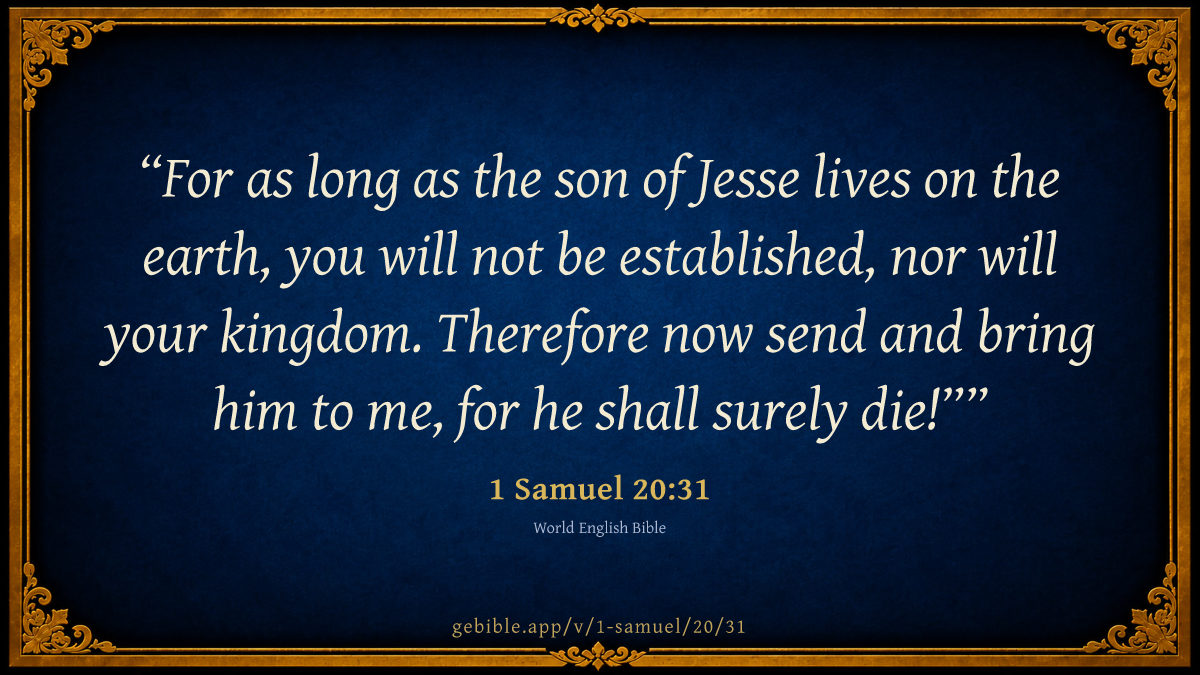
For as long as the son of Jesse lives on the earth, you will not be established, nor will your kingdom. Therefore now send and bring him to me, for he shall surely die!”
Parallel Translations
-
For as long as the son of Jesse lives on the earth, you will not be established, nor will your kingdom. Therefore now send and bring him to me, for he shall surely die!”
-
For as long as the son of Jesse liveth upon the ground, thou shalt not be established, nor thy kingdom. Wherefore now send and fetch him unto me, for he shall surely die.
-
For as long as the son of Jesse liveth upon the earth, thou shalt not be established, nor thy kingdom. Wherefore now send and fetch him unto me, for he deserveth to die.'
Cross-references (6)
Passages linked to 1 Samuel 20:31 in the Treasury of Scripture Knowledge, ordered by reader-vote popularity; verse text shown in World English Bible.
- 1 Samuel 19:6 Saul listened to the voice of Jonathan: and Saul swore, “As Yahweh lives, he shall not be put to death.”
- 1 Samuel 20:8 Therefore deal kindly with your servant; for you have brought your servant into a covenant of Yahweh with you; but if there is iniquity in me, kill me yourself; for why should you bring me to your father?”
- 1 Samuel 19:11-15 Saul sent messengers to David’s house, to watch him, and to kill him in the morning. Michal, David’s wife, told him, saying, “If you don’t save your life tonight, tomorrow you will be killed.” So Michal let David down through the window. He went away, fled, and escaped. Michal took the teraphim, and laid it in the bed, and put a pillow of goats’ hair at its head, and covered it with clothes. When Saul sent messengers to take David, she said, “He is sick.” Saul sent the messengers to see David, saying, “Bring him up to me in the bed, that I may kill him.”
- 1 Samuel 26:16 This thing isn’t good that you have done. As Yahweh lives, you are worthy to die, because you have not kept watch over your lord, Yahweh’s anointed. Now see where the king’s spear is, and the jar of water that was at his head.”
- 2 Samuel 19:28 For all my father’s house were but dead men before my lord the king; yet you set your servant among those who ate at your own table. What right therefore have I yet that I should cry any more to the king?”
- Psalms 79:11 Let the sighing of the prisoner come before you. According to the greatness of your power, preserve those who are sentenced to death.
Cross-references from openbible.info (CC BY 4.0)
Explain this verse (9 sources)
Historical commentary, presented as a primary source — not an endorsement.
Private notes
Saved on this device only — never synced or sent anywhere.
Geneva Bible translators 1599 · Public Domain Hebrew, son of death.
Hebrew, son of death.
Geneva Bible (1599) marginal notes — public domain.
John Trapp 1656 · Public Domain 1Sa 20:31 For as long as the son of…
1Sa 20:31 For as long as the son of Jesse liveth upon the ground, thou shalt not be established, nor thy kingdom. Wherefore now send and fetch him unto me, for he shall surely die.
Ver. 31. For he shall surely die.] Yea, but stay: "Unto God the Lord belong the issues of death"; {Psa 68:20} and "My times are in thine hand," saith David, not in Saul’s, whatever he may think of the matter: "the counsel of the Lord, that shall stand."
John Trapp, A Commentary or Exposition upon All the Books of the Old and New Testament (1647–1656) — public domain. Text from a community e-Sword module.
Matthew Poole 1685 · Public Domain Thus he grossly mistakes the cause of Jonathan’s loss…
Thus he grossly mistakes the cause of Jonathan’s loss of the kingdom, which was not David’s art, but Saul’s sin; and vainly endeavours to prevent God’s irrevocable sentence.
Matthew Poole's English Annotations on the Holy Bible (1683–1685) — public domain. Text from a community e-Sword/MySword module.
John Gill 1763 · Public Domain For as long as the son of Jesse liveth…
For as long as the son of Jesse liveth upon the ground, thou shalt not be established, nor thy kingdom,.... He would not, though heir to the crown, be sure of it; it would be precarious to him, he would be in great danger of being deprived of it on the death of his father; and therefore it would be his highest wisdom to deliver David up to be slain, as it was his greatest folly to protect him, and provide for his satiety:
wherefore now send and fetch him unto me; send to Bethlehem for him to come to court directly:
Read full note →
for he shall surely die; or he is "the son of death" (g); guilty of death, as the Targum, deserves to die, and Saul was determined upon his death if possible.
(g) "filius mortis", V. L. Montanus, Vatablus, Piscator; "reus mortis", Junius & Tremellius.
John Gill's Exposition of the Whole Bible (1746–1763) — public domain (CC PDM 1.0). Text via the HelloAO Bible API.
Joseph Benson 1811 · Public Domain 1Sa 20:31. Thou shalt not be established, nor thy…
1Sa 20:31. Thou shalt not be established, nor thy kingdom — Though Samuel had long before this declared to Saul, in the name of the Lord, that the kingdom should not continue with him, nor descend to his posterity; yet he seems to have had hopes that he should be able to prevent this declaration from being verified by his policy and taking proper measures.
Joseph Benson's Commentary on the Old and New Testaments (1811–1818) — public domain. Text from a community e-Sword module.
Haydock's Catholic Bible Commentary 1859 · Public Domain The son of death. That is, one that deserveth…
The son of death. That is, one that deserveth death, and shall surely be put to death. (Challoner) --- So people are often styled sons of perdition, of hell, of light, &c., (Calmet) when they are worthy of such things. (Haydock) --- All the crime of David, was his too exalted merit, which, under a jealous prince, is often fatal. Nec minus periculum ex magna fama, quam ex mala. (Tacitus, Agricola.)
George Leo Haydock (1774–1849), Haydock's Catholic Family Bible and Commentary, 1859 edition — public domain. Excludes Psalms (Douay-Rheims chapter numbering differs from Protestant) and Deuterocanonical books (Catholic canon only).
Daniel D. Whedon 1874 · Public Domain 31. As long as the son of Jesse liveth……
31. As long as the son of Jesse liveth… thou shalt not be established — Here for the first time Saul reveals the reason of his wrath towards David; for though the probability of David’s attaining the throne may have been at other times talked over between himself and Jonathan, and others, (see note on 1Sa_20:13,) yet he seems to have been careful hitherto of expressing his own feelings on the subject.
Daniel D. Whedon (gen. ed.), Commentary on the Old and New Testaments (1874–1909) — public domain. Text from a community e-Sword module.
The Cambridge Bible for Schools and Colleges 1878 · Public Domain 31. he shall surely die] Lit. “he is a…
31. he shall surely die] Lit. “he is a son of death.” Cp. 2Sa_12:5; Psa_102:20; Mat_23:15; Joh_17:12.
The Cambridge Bible for Schools and Colleges (gen. ed. J. J. S. Perowne; Cambridge University Press, 1878–1918) — public domain. Text from a community e-Sword module.
Ellicott's Commentary for English Readers 1878 · Public Domain (31) Thou shalt not be established.—Here the king gives…
(31) Thou shalt not be established.—Here the king gives expression to the thought which was ever torturing that poor diseased brain of his—David, his own kind physician, his faithful soldier, and his son’s dearest friend and loved companion, was plotting basely against that master for whom he had done so much, and the son whom he loved so well.
Saul, in his blind fury, goes on to betray his fell purpose when he exclaims, “he shall surely die.” His command, “Send and fetch him unto me,” tells us that the murder had been pre-arranged to take place at the feast. Doubtless those rough soldier chiefs sitting round the royal table would be ready at any moment to carry into effect their master’s savage behest.
A Bible Commentary for English Readers, edited by Charles John Ellicott (1878–1897) — public domain. Text from a community e-Sword module.