
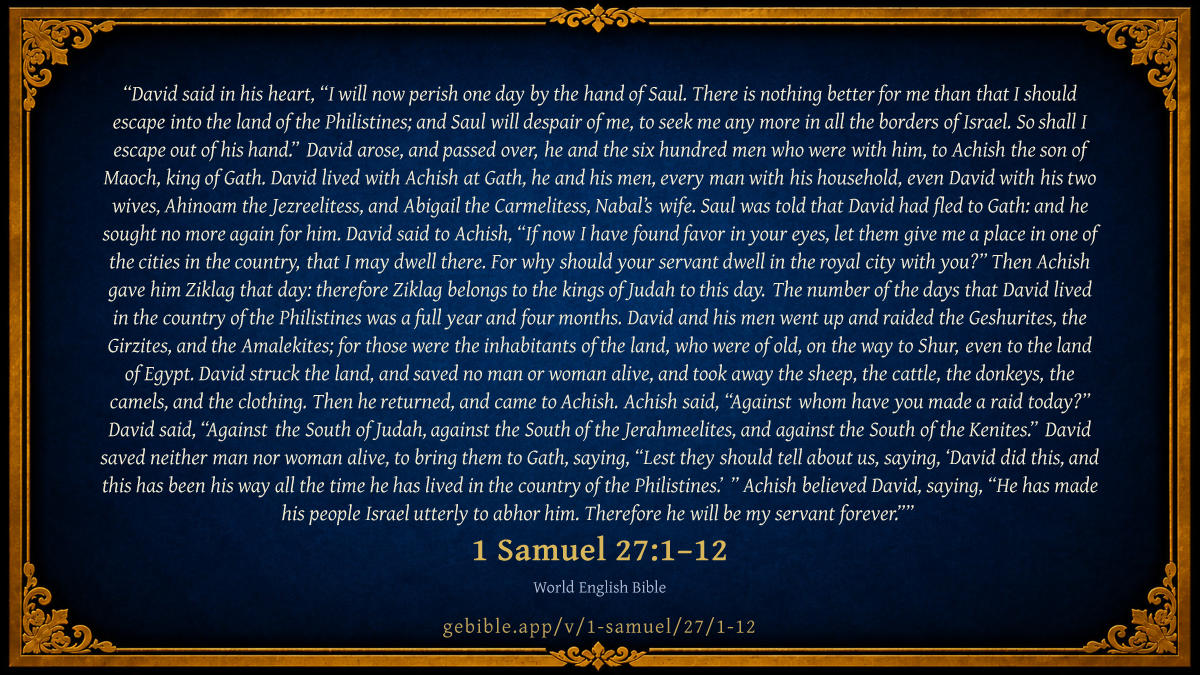
David said in his heart, “I will now perish one day by the hand of Saul. There is nothing better for me than that I should escape into the land of the Philistines; and Saul will despair of me, to seek me any more in all the borders of Israel. So shall I escape out of his hand.” David arose, and passed over, he and the six hundred men who were with him, to Achish the son of Maoch, king of Gath. David lived with Achish at Gath, he and his men, every man with his household, even David with his two wives, Ahinoam the Jezreelitess, and Abigail the Carmelitess, Nabal’s wife. Saul was told that David had fled to Gath: and he sought no more again for him. David said to Achish, “If now I have found favor in your eyes, let them give me a place in one of the cities in the country, that I may dwell there. For why should your servant dwell in the royal city with you?” Then Achish gave him Ziklag that day: therefore Ziklag belongs to the kings of Judah to this day. The number of the days that David lived in the country of the Philistines was a full year and four months. David and his men went up and raided the Geshurites, the Girzites, and the Amalekites; for those were the inhabitants of the land, who were of old, on the way to Shur, even to the land of Egypt. David struck the land, and saved no man or woman alive, and took away the sheep, the cattle, the donkeys, the camels, and the clothing. Then he returned, and came to Achish.
Achish said, “Against whom have you made a raid today?” David said, “Against the South of Judah, against the South of the Jerahmeelites, and against the South of the Kenites.”
David saved neither man nor woman alive, to bring them to Gath, saying, “Lest they should tell about us, saying, ‘David did this, and this has been his way all the time he has lived in the country of the Philistines.’ ”
Achish believed David, saying, “He has made his people Israel utterly to abhor him. Therefore he will be my servant forever.”
Geneva Bible translators 1599 · Public Domain On vv1, 3, 5, 7, 8, 10, 12 David distrusteth God’s protection, and therefore fleeth unto the…
David distrusteth God’s protection, and therefore fleeth unto the idolaters, who were enemies to God’s people.
Geneva Bible (1599) marginal notes — public domain.
John Trapp 1656 · Public Domain On vv1–12 1Sa 27:1 And David said in his heart, I…
1Sa 27:1 And David said in his heart, I shall now perish one day by the hand of Saul: [there is] nothing better for me than that I should speedily escape into the land of the Philistines; and Saul shall despair of me, to seek me any more in any coast of Israel: so shall I escape out of his hand.
Ver. 1. And David said in his heart] Not well ballasted with grace, but wherried about with unbelief, {Heb 13:9} whilst he consulted not with God as formerly, but with carnal reason, an evil counsellor, and with the rest of his company, as Josephus telleth us, to the scandal of the weak, and scorn of the wicked, besides his own singular disadvantage. For being now out of God’s precincts - who had commanded him to come out of Moab into Judea {1Sa 22:3; 1Sa 22:5} - how could he look for his protection? and if a man put himself amongst Philistines, as David now did, how can he promise himself to come forth innocent?
Read full note →
There is nothing better for me.] Indeed nothing worse; but his fear befooled and betrayed him to many inconveniences, as the sequel showeth. But it is hard for the best man to say how far he will be tempted.
John Trapp, A Commentary or Exposition upon All the Books of the Old and New Testament (1647–1656) — public domain. Text from a community e-Sword module.
Matthew Poole 1685 · Public Domain On vv1, 2, 4, 5, 6, 7, 8, 9, 10, 11, 12 I shall now perish one day by the hand…
I shall now perish one day by the hand of Saul; I see by this late experience his restless and implacable hatred against me, and how little heed is to be given to all his pretences of repentance or friendship.
There is nothing better for me than that I should speedily escape into the land of the Philistines: but this was certainly a very great mistake and fault in David; for,
Read full note →
1. This proceeded from gross distrust of God’s promise and providence; and that after such repeated demonstrations of God’s peculiar care over him, which gave hint cause to conclude quite contrary to what is here said.
2. He forsakes the place where God had settled him, 1Sa 22:5, and given him both assurance and experience of his protection there.
3. He voluntarily runs upon that rock which he cursed his enemies for throwing him upon, 1Sa 26:19, and upon many other snares and dangers, as the following history will show; and withal, deprives the people of the Lord of those succours which he might have given them, in case of a battle. But it pleased God to leave David to himself in this, as well as in other particulars, that these might be sensible demonstrations of the infirmities of the best men; and of the necessity of God’s grace, and daily direction and assistance; and of the freeness and richness of God’s mercy, in passing by such great offences. And besides, God hereby designed to accomplish his own counsel, to withdraw David from the Israelites, that Saul and they might fall by the hand of the Philistines, without any reproach or inconvenience to David, whom God had put into a safe place.
Matthew Poole's English Annotations on the Holy Bible (1683–1685) — public domain. Text from a community e-Sword/MySword module.
Matthew Henry 1710 · Public Domain On vv1, 8 Here is, I. The prevalency of David's fear, which…
Here is, I. The prevalency of David's fear, which was the effect of the weakness of his faith (Sa1 27:1): He said to his heart (so it may be read), in his communings with it concerning his present condition, I shall now perish one day by the hand of Saul. He represented to himself the restless rage and malice of Saul (who could not be wrought into a reconciliation) and the treachery of his own countrymen, witness that of the Ziphites, once and again; he looked upon his own forces, and observed how few they were, and that no recruits had come in to him for a great while, nor could he perceive that he got any ground; and hence, in a melancholy mood, he draws this dark conclusion: I shall one day perish by the hand of Saul. But, O thou of little faith! wherefore dost thou doubt? Was he not anointed to be king? Did not that imply an assurance that he should be preserved to the kingdom? Though he had no reason to trust Saul's promises, had he not all the reason in the world to trust the promises of God? His experience of the particular care Providence took of him ought to have encouraged him. He that has delivered does and will. But unbelief is a sin that easily besets even good men. When without are fightings, within are fears, and it is a hard matter to get over them. Lord, increase our faith!
II. The resolution he came to hereupon. Now that Saul had, for this time, returned to his place, he determined to take this opportunity of retiring into the Philistines' country. Consulting his own heart only, and not the ephod or the prophet, he concludes, There is nothing better for me than that I should speedily escape into the land of the Philistines. Long trials are in danger of tiring the faith and patience even of very good men. Now, 1. Saul was an enemy to himself and his kingdom in driving David to this extremity. He weakened his own interest when he expelled from his service, and forced into the service of his enemies, so great a general as David was, and so brave a regiment as he had the command of. 2. David was no friend to himself in taking this course. God had appointed him to set up his standard in the land of Judah, Sa1 22:5. There God had wonderfully preserved him, and employed him sometimes for the good of his country; why then should he think of deserting his post? How could he expect the protection of the God of Israel if he went out of the borders of the land of Israel? Could he expect to be safe among the Philistines, out of whose hands he had lately escaped so narrowly by feigning himself mad? Would he receive obligations from those now whom he knew he must not return kindness to when he should come to be king, but be under an obligation to make war upon? Hereby he would gratify his enemies, who bade him go and serve other gods that they might have wherewith to reproach him, and very much weaken the hands of his friends, who would not have wherewith to answer that reproach. See what need we have to pray, Lord, lead us not into temptation.
Read full note →
III. The kind reception he had at Gath. Achish bade him welcome, partly out of generosity, being proud of entertaining so brave a man, partly out of policy, hoping to engage him for ever to his service, and that his example would invite many more to desert and come over to him. No doubt he gave David a solemn promise of protection, which he could rely upon when he could not trust Saul's promises. We may blush to think that the word of a Philistine should go further than the word of an Israelite, who, if an Israelite indeed, would be without guile, and that the city of Gath should be a place of refuge for a good man when the cities of Israel refuse him a safe abode. David, 1. Brought his men with him (Sa1 27:2) that they might guard him, and might themselves be safe where he was, and to recommend himself the more to Achish, who hoped to have service out of him. 2. He brought his family with him, his wives and his household, so did all his men, Sa1 27:2, Sa1 27:3. Masters of families ought to take care of those that are committed to them, to protect and provide for those of their own house, and to dwell with them as men of knowledge.
IV. Saul's desisting from the further prosecution of him (Sa1 27:4): He sought no more again for him; this intimates that notwithstanding the professions of repentance he had lately made, if he had had David in his reach, he would have aimed another blow. But, because he dares not come where he is, he resolves to let him alone. Thus many seem to leave their sins, but really their sins leave them; they would persist in them if they could. Saul sought no more for him, contenting himself with his banishment, since he could not have his blood, and hoping, it may be (as he had done, Sa1 18:25), that he would, some time or other, fall by the hand of the Philistines; and, though he would rather have the pleasure of destroying him himself, yet, if they do it, he will be satisfied, so that it be done effectually.
V. David's removal from Gath to Ziklag.
1. David's request for leave to remove was prudent and very modest, Sa1 27:5. (1.) It was really prudent. David knew what it was to be envied in the court of Saul, and had much more reason to fear in the court of Achish, and therefore declines preferment there, and wishes for a settlement in the country, where he might be private, more within himself, and less in other people's way. In a town of his own he might have the more free exercise of his religion, and keep his men better to it, and not have his righteous soul vexed, as it was at Gath, with the idolatries of the Philistines. (2.) As it was presented to Achish it was very modest. He does not prescribe to him what place he should assign him, only begs it may be in some town in the country, where he pleased (beggars must not be choosers); but he gives this for a reason, "Why should thy servant dwell in the royal city, to crowd thee, and disoblige those about thee?" Note, Those that would stand fast must not covet to stand high; and humble souls aim not to dwell in royal cities.
2. The grant which Achish made to him, upon that request, was very generous and kind (Sa1 27:6, Sa1 27:7): Achish gave him Ziklag. Hereby, (1.) Israel recovered their ancient right; for Ziklag was in the lot of the tribe of Judah (Jos 15:31), and afterwards, out of that lot, was assigned, with some other cities, to Simeon, Jos 19:5. But either it was never subdued, or the Philistines had, in some struggle with Israel, made themselves masters of it. Perhaps they had got it unjustly, and Achish, being a man of sense and honour, took this occasion to restore it. The righteous God judgeth righteously. (2.) David gained a commodious settlement, not only at a distance from Gath, but bordering upon Israel, where he might keep up a correspondence with his own countrymen, and whither they might resort to him at the revolution that was now approaching. Though we do not find that he augmented his forces at all while Saul lived (for, Sa1 30:10, he had but his six hundred men), yet, immediately after Saul's death, that was the rendezvous of his friends. Nay, it should seem, while he kept himself close because of Saul, multitudes resorted to him, at least to assure him of their sincere intentions, 1 Chr. 12:1-22. And this further advantage David gained, that Ziklag was annexed to the crown, at least the royalty of it pertained to the kings of Judah, ever after, Sa1 27:6. Note, There is nothing lost by humility and modesty, and a willingness to retire. Real advantages follow those that flee from imaginary honours. Here David continued for some days, even four months, as it may very well be read (Sa1 27:7), or some days above four months: the Septuagint reads it, some months; so long he waited for the set time of his accession to the throne; for he that believeth shall not make haste.
Matthew Henry's Commentary on the Whole Bible (1708–1710) — public domain (CC PDM 1.0). Text via the HelloAO Bible API.
John Gill 1763 · Public Domain On vv1–12 And David said in his heart,.... Within himself, and…
And David said in his heart,.... Within himself, and to himself; while he was pondering things in his own mind, and considering the circumstances in which he was, and things appearing, very gloomy to him, he falls into a fit of unbelief and thus addresses himself:
I shall now one day perish by the hand of Saul; for though he was returned to his place, he knew he was restless and uneasy, very inconstant and unstable, and not at all to be depended on; yea, he might conclude that Saul, observing that God was with him in protecting and defending him, and by delivering him into his hands once and again, he would be the more jealous of him, and envious at him, and seek all opportunities and advantages against him; and he feared that one time or another such would offer, and would be taken, and so he should perish by him: this was a strange fit of unbelief he was sunk into, and very unaccountable and unreasonable it was, had he but considered his being anointed king by the Lord, the promise of God to him, which could not fail, and the providence of God that watched over him from time to time:
Read full note →
there is nothing better for me than that I should speedily escape into the land of the Philistines; which may seem strange, when he was advised by the Prophet Gad to depart from the land of Moab, and go into the land of Judah, Sa1 22:5, and where he had been so wonderfully preserved; and when he was in so much danger, when in the land of the Philistines before, insomuch that he was obliged to feign himself mad, Sa1 21:13; and seeing this also was the very thing he lately dreaded, and cursed the men that should be the cause of his going out of his own land into an idolatrous one:
and Saul shall despair of me, to seek me any more in any coast of Israel; hearing that he was gone into a foreign country, would seek for him no more in any part of the land of israel, and so despair of ever getting him into his hands, would lay aside all thoughts about him for the future:
so shall I escape out of his hand; and be for ever safe: these were the carnal reasonings of his mind, under the prevalence of unbelief; and shows what poor weak creatures the best of men are, and how low their graces may sink as to exercise, when left to themselves.
John Gill's Exposition of the Whole Bible (1746–1763) — public domain (CC PDM 1.0). Text via the HelloAO Bible API.
John Wesley 1765 · Public Domain On vv1, 2, 3, 4, 5, 6, 8, 9, 10 David retires to Gath, ver. 1-4. Achish gives him…
David retires to Gath, ver. 1-4. Achish gives him Ziklag, ver. 5-7. David destroys the Canaanites, ver. 8, 9. Persuades Achish he fought against Judah, ver. 10-12.
I shall perish - But this was certainly a very great fault in David: for
Read full note →
1. This proceeded from gross distrust of God's promise and providence; and that after such repeated demonstrations of God's peculiar care over him.
John Wesley, Explanatory Notes Upon the Whole Bible (1754–1765) — public domain. Text via the GEBible commentary corpus.
Adam Clarke 1810 · Public Domain On vv1, 2, 3, 5, 6, 9, 10, 12 David flies to Achish, king of Gath, who receives…
CHAPTER XXVII
David flies to Achish, king of Gath, who receives him kindly,
Read full note →
and gives him Ziklag to dwell in, where he continues a year
and four months, 1-7.
David invades the Geshurites and Amalekites, and leaves neither
man nor woman alive, 8, 9.
He returns to Achish, and pretends that he had been making
inroads on the Israelites, and Achish believes it, 10-12.
NOTES ON CHAP. XXVII
Verse 1. I shall now perish one day by the hand of Saul] This was a very hasty conclusion: God had so often interposed in behalf of his life, that he was authorized to believe the reverse. God had hitherto confounded all Saul's stratagems, and it was not at all likely that he would now abandon him: there was now no additional reason why he should withdraw from David his helping hand.
Adam Clarke's Commentary on the Bible (1810–1826) — public domain. Text from a community e-Sword/MySword module.
Joseph Benson 1811 · Public Domain On vv1, 2, 5, 6, 8, 9, 10, 11 1Sa 27:1. I shall perish one day by the…
1Sa 27:1. I shall perish one day by the hand of Saul — David, says Delaney, “weary of wandering, weary of struggling with Saul’s implacable spirit, weary of the unequal conflict between too dangerous generosity and too relentless malice, weary of subsisting by the spoils of his enemies, or bounty of his friends, resolves at last to quit his country, and throw himself once more under the protection of its enemies. This resolution is, I think, universally censured by commentators, on account of his neglecting to consult God, either by his priest or by his prophet, before he fixed upon it. God had commanded him to go into the land of Judah, 1Sa 22:5. And surely he should not have left that to go into a heathen country, without a like divine command, or at least permission. Therefore most writers ascribe this resolution to want of grace, and a proper confidence in the protection of that God who had so often and so signally delivered him in the greatest exigencies.” Add to this, that David not only showed, by forming and executing this resolution, great distrust of God’s promise and providence, and that after repeated demonstrations of God’s peculiar care over him; but he voluntarily run upon that rock, which he censured his enemies for throwing him upon, 1Sa 26:19, and upon many other snares and dangers, as the following history will show. And he also deprived the people of God of those succours which he might have given them in case of a battle. God, however, permitted him to be thus withdrawn from the Israelites, that they might fall by the hand of the Philistines, without any reproach or inconvenience to David.
Joseph Benson's Commentary on the Old and New Testaments (1811–1818) — public domain. Text from a community e-Sword module.
Albert Barnes 1834 · Public Domain On vv5, 6, 8, 10, 11 David, with characteristic Oriental subtlety (compare 1Sa 21:2), suggests…
David, with characteristic Oriental subtlety (compare 1Sa 21:2), suggests as a reason for leaving Gath that his presence was burdensome and expensive to the king. His real motive was to be more out of the way of observation and control, so as to act the part of an enemy of Saul, without really lifting up his hand against him and his own countrymen of Israel.
Albert Barnes' Notes on the Bible (1834–1885) — public domain. Text from a community e-Sword/MySword module.
Haydock's Catholic Bible Commentary 1859 · Public Domain On vv1, 2, 3, 5, 6, 7, 8, 9, 10, 12 Hands. God requires that we should act with prudence.…
Hands. God requires that we should act with prudence. (Du Hamel) --- David probably consulted the Lord, and sent ambassadors to Achis, before he went into his dominions, (Menochius) where he had been in such danger before. (Du Hamel)
George Leo Haydock (1774–1849), Haydock's Catholic Family Bible and Commentary, 1859 edition — public domain. Excludes Psalms (Douay-Rheims chapter numbering differs from Protestant) and Deuterocanonical books (Catholic canon only).
Lange's Commentary on the Holy Scriptures 1864 · Public Domain On v1 IX. David at Ziglag in the land of the…
IX. David at Ziglag in the land of the Philistines
1Sa_27:1-12
Read full note →
1And David said in his heart, I shall now perish one day by the hand of Saul; there is nothing better1 for me than that I should speedily escape into the land of the Philistines; and Saul shall despair2 of me to seek me any more in any 2coast of Israel; so shall I escape out of his hand. And David arose and he [om. he] passed over with [he and] the3 six hundred men that were with him unto Achish,4 3the son of Maoch, king of Gath. And David dwelt with Achish at Gath, he and his men; every man with his household, even [om. even] David with [and] his two wives, Ahinoam the Jezreelitess, and Abigail the Carmelitess,5 Nabal’s wife 4[Nabal’s wife, the Carmelitess]. And it was told Saul that David was fled to Gath; and he sought no more again for him.
5And David said unto Achish, If I have now found grace in thine eyes, let them give me a place in some town in the country [in one of the country-cities], that I may dwell there; for why should thy servant dwell in the royal city with thee? 6Then [And] Achish gave him Ziklag that day; wherefore Ziklag pertaineth unto 7[to] the kings of Judah unto this day. And the time that David dwelt in the country of the Philistines was a full [om. full] year and four months.
8And David and his men went up and invaded the Geshurites and the Gezrites6 and the Amalekites; for7 those nations were of old the inhabitants of the land, as 9thou goest to Shur, even [and] unto the land of Egypt. And David smote the land, and left [saved] neither man nor woman alive, and took away [om. away] the8 sheep and the oxen and the asses and the camels and the apparel, and returned 10and came to Achish. And Achish said, Whither9 have ye made a road [an inroad] to-day? And David said, Against the south of Judah and against the south of the 11Jerahmeelites and against the south of the Kenites. And David saved neither man nor woman alive to bring tidings [om. tidings] to Gath, saying, lest they should tell on us, saying, So did David, and so will be10 his manner all the while he dwelleth 12in the country of the Philistines. And Achish believed [confided in] David, saying, He hath made his people Israel utterly to abhor him, therefore [and] he shall be my servant forever.
EXEGETICAL AND CRITICAL
V. 1. David flees to Philistia to king Achish of Gath. That this is not the continuation of 1 Samuel 24:23 [1Sa_24:22], but of 1Sa_26:25, has already been established, against Thenius. In spite of Saul’s renewed assurances that he would desist from his hostility, David, on account of his repeatedly exhibited vacillation in feeling and purpose, could no longer remain in the land of Judah; the event which he hints at in 1Sa_26:19, which his increased suffering (the explanation of which is given in chap. 26) predicts, now occurs; he is obliged by Saul’s renewed machinations (comp. 1Sa_27:4) to leave the country, to go to Philistia.11 And David said to his heart=“thought, reflected”—thus dramatically is David introduced, taking counsel with himself what he is to do in respect to Saul’s continued hostility. The word “now” (עַתָּה) refers to his present dangerous position. I shall now be carried off into Saul’s hand—not: “by the hand” (Keil, De W., and others). This expression: “into the hand” (בְּיַד שׁ׳) has led the ancient versions to modify the proper meaning of the verb “snatch away” into “He delivered” (Sept.), “fall” (Vulg.). [Cahen and Philippson render “perish by the hand;” Bible Commentary: “fall into the hand.” The Niph. is used in the sense of “perish” in 1Sa_12:25 (so Erdmann) and 1Sa_26:10—and this sense suits here, though the others are also good.—Tr.] There is nothing good for me.—That is, here, or, if I remain here, as the connection suggests. On account of this negation the כִּי is to be rendered simply “but” (Chald., Syr.), not “yea, I will flee” (Maur., De W.), nor “is it not better that I flee?” (Vulg.), nor (supplying אִם with Sept.), “there is nothing good for me, unless” (Thenius).—His ground for this determination: Saul will desist from me …… and I shall escape him is borne out by the result (1Sa_27:4 referring expressly back to these words). [See “Text and Gram.”—Tr.]
1Sa_27:2. The number six hundred has remained unchanged—1Sa_25:13; 1Sa_23:13; 1Sa_22:2.—Achish is identical with the Achish of 1Sa_21:10 sq. As a man persecuted by Achish’s enemy, Saul, David might confidently hope to be received by him. The Philistine king Achish of 1Ki_2:39 may be the same person—though he would then have reigned about fifty years, and must have been very old. He is the son of Maachah, this Achish the “son of Maoch,” probably two forms of the same paternal name. Gath had been before conquered by the Israelites, (1Sa_7:14), but appears here and 1Sa_21:10 sq. as the residence of an independent king hostile to Saul. See 1Ch_18:1, which states that David afterwards conquered it. That the event here described is a different one from that in 1Sa_21:10 sq. has been already there shown by pointing out the difference in the circumstances. There he is a solitary deserter, feigning madness to procure safety, being recognized as Goliath’s conqueror. Here he appears in princely style with all his retinue, and so gains the confidence of Achish. Cler.: “The long enmity that Saul had shown him had made him acceptable to the enemies of the Hebrews and of Saul.”
1Sa_27:3. The formal settling of this emigrant colony. Each of the warriors had a family, as appears from the words: With his house.—The same statement is found in 2Sa_2:3. A little ambulant kingdom.—His two wives.—See 1Sa_25:42-44. [These facts are mentioned to prepare the way for the narrative in chap. 30. (Bib. Com.).—Tr.]
1Sa_27:4. See 1Sa_27:1. (Read Qeri יָסַף.) David gained his end by this immigration. [In Gath David seems to have studied music—see title of Psalms 8 (Ew.)—and may here have become acquainted with Ittai the Gittite, 2Sa_15:19 (Bible Com.).—Tr.]
1Sa_27:5-7. Achish gives David Ziklag as a residence.
1Sa_27:5. If I have found favor with thee.—This is presupposed as a fact in this request. Achish regarded David and his band as allies against Saul, because he sought refuge with him from Saul. He must indeed, as Ewald (III. 137) well remarks, “long since have seen his error as to this strange man, and the more bitterly he regretted it, the more disposed he would now be to receive the distinguished leader of a considerable armed band, who was so often and so sorely persecuted by Saul.” Grotius: “David’s fame and the expectation excited by him must have been great, that a city……should have been granted him for safety.” Give me one of the country-cities.—David asked such a city as property; in 1Sa_27:6 it is expressly said that Achish gave it him for a possession. David’s alleged reason for the request is that it was not suitable for him, Achish’s servant and subject to remain in the capital city with his large retinue. The words do not support the explanation (Then.): “it is not fitting that I, who am as thou, a prince, should reside here with thee.” The idea “to burden thee” (Buns.) is not contained in the expression “with thee,” but is involved in the situation. [David subtly suggests the expensiveness of his presence in Gath; his real motive was to be out of the way of observation, so as to play the part of Saul’s enemy without acting against him (Bib. Com.).—Tr.]
1Sa_27:6. Ziklag pertained first to Judah (Jos_15:31), then to Simeon (Jos_19:5), was afterwards taken by the Philistines, and perhaps remained uninhabited (Keil); according to 1Sa_30:1 it lay far south near the Amalekite border. Its position in the Negeb (South country) has not yet been determined. According to Ritter (Erdk. XVI. 133) it was perhaps the present Tel el Hasy north-east of Gaza, “whence one enjoys a wide view, westward to the sea, eastward to the mountains of Hebron, northward to the mountains of Ephraim, and southward to the plains of Egypt.” Comp. Raumer, §225. Knobel conjectures that it was south-west of Milh, in Gasluj [Asluj], on the way to Abdeh (Rob. III. 154, 862 [Am. ed. II. 201]). This would put it much farther south. [See “Ziklag” in Smith’s Bible Dictionary. Mr. Grove does not favor this identification.—Tr.] The remark that it consequently became the property of the kings of Judah confirms the view that the words and he gave him mean that the city was a present from Achish to David. Though the distinction between Judah and Israel appears already in the time of Saul and David (1Sa_11:8; 1Sa_17:52; 1Sa_18:16; 2Sa_2:9 sq.; 1Sa_3:10; 1Sa_5:1-5; 1Sa 19:41 sq.; 1Sa_20:24), yet the phrase “kings of Judah” indicates that the narrative supposes the division of Israel into two kingdoms and the existence of the kingdom of Judah [so that this Book was composed between Solomon and the Babylonian exile.—Tr.]
1Sa_27:7. A year and four months. The first expression (יָמִים) = “some time, a considerable time,” Gen. 4:40; 1Sa_29:3, then = “a year,” Lev_25:29; Jdg_17:10; 1Sa_1:3; 1Sa_2:19, etc.12 This exact statement of time attests the historical value of the narrative (Then., Keil).
1Sa_27:8-12. David makes incursions from Ziklag into the territory of the neighboring tribes on the south border of Palestine, returns with rich booty, and has the confidence of king Achish.
1Sa_27:8. And he went up, not “he went out” (De W., Keil); the tribes dwelt on higher ground than Ziklag, probably on the mountain-plateau of the northern portion of the wilderness of Paran. “Invaded” (פָּשַׁט), literally “spread themselves out;” the word is used especially of a hostile army (1Ch_14:9; 1Ch_14:13), and so means to attack a city or land. (Here with אֵל, as 1Sa_30:1; Jdg_20:37,=“to attack towards,” with עַלit=“fall on,” as 1Sa_23:27; Jdg_9:33; Jdg_9:44.)—The district of the Geshurites (to be distinguished from the little Aramæan kingdom of Geshur, 2Sa_15:8; comp. 2Sa_3:3; 2Sa_13:37; 2Sa_14:23, and from the northern Geshurites near Hermon on the border of Bashan (Gilead), Deu_3:14; Jos_12:5; Jos_13:13) lay south of Philistia near the district of the Amalekites, along with which it is here named.—[Comp. Jos_13:2-3.—Tr.]—The Gezrites (Qeri) or Girzites (Kethib), a tribe not elsewhere mentioned, who, since the scene of David’s incursions was the south of Philistia and Palestine, must not be identified (Grot., Ew.) with the inhabitants of Gezer (Jos_10:33) in the west of Ephraim. Nor can we think of the Gerrenni (2Ma_13:24), inhabitants of the city Gerra between Rhinocoloura and Pelusium (Cler.), since this would carry us beyond the Arabian desert, in which the Gezrites at any rate dwelt.—[In Smith’s Bib. Dict., Art. “Gerzites,” Mr. Grove, following Gesenius, Fürst, Stanley, suggests a connection between this people and the tribe which was connected with Mount Gerizim in central Palestine. This is an ingenious, though as yet unestablished conjecture.—Tr.]—Here, after Saul’s war of extermination against them (1Sa_15:7), the Amalekites had collected their scattered remnant and established themselves.—The13 safest rendering of the following (very difficult) clause seems to be: “David … invaded. … the Amalekites (for these were inhabitants of the land, who inhabited it of old) as far as Shur and Egypt.” The second verb “inhabited” is naturally to be supplied from the preceding participle [“inhabitants”]. David carried his incursions as far as Shur and the Egyptian border. That the Amalekites as nomads held this district is involved in 1Sa_15:7, where Saul is said to have smitten them “up to Shur, which is on the border of Egypt.” Their old seats in the south of Palestine stretched into Arabia Petræa (Exo_17:8 sq.; comp. Num_13:29). The narrator here, in accordance with 1Sa_15:7, assumes this in the remark that David extended his incursions to Shur and Egypt. Perhaps he describes them as the original inhabitants of these regions with reference to their opposition to Israel in the Exodus (Exo_17:8 sq.), and to their defeat by Saul (1Sa_15:7), which, however, did not prevent their re-collection and settlement here. “To make military expeditions from Ziklag, at the best mere incursions for booty, was at that time a necessity for David and his men” (Ew.).14
1Sa_27:9. As nomads these tribes had large herds.—He left neither man nor woman alive; the reason for this is given in 1Sa_27:11. He needed the rich booty partly for the support of himself and his men, partly to retain and increase the king’s favor. It was for this latter reason that, after his return from his expeditions, he went to Gath, instead of going immediately to Ziklag, in order to make report of his movements to Achish and deliver him a part of the spoil.
1Sa_27:10. The verb “said,” like the “went up” in 1Sa_27:8, here expresses customary, repeated acting. The meaning is: Achish used to say: “Against whom have ye made an incursion this time?”15 David’s answer: Against the south of Judah and against the south of the Jerahmeelites, comp. 1Sa_30:29, the posterity of Jerahmeel, the first-born of Hezron (2Ch_2:9, 25), and so “one of the three great families of Judah descended from Hezron who probably dwelt on the southernmost border of the Tribe of Judah” (Keil), and against the south of the Kenites,—who were under the protection of Judah (comp. 1Sa_15:5-6; Jdg_1:16), mentioned along with Amalek in Num_24:21, where it is said of them: “in rocks thou hast put thy rest,” referring to their dwellings in the rocks and caves south of Palestine, to which also their name points.16—All the tribes mentioned here and in 1Sa_27:8 dwelt near one another in the district bordering on the Negeb (south country) of Judah, and stretching between the hill country of Judah and the Arabian desert (see Jos_15:21). David’s expeditions were really against the tribes named in 1Sa_27:8, who extended close into the south of Judah. It was his interest, however, to make Achish believe that he had made an expedition against Saul, and consequently against the men of Judah. He therefore says nothing of his incursion against the tribes named in 1Sa_27:8, which were on friendly terms with Achish (1Sa_27:11), but declares that he has marched against the south of Judah, that is against the Israelites there and the tribes under their protection. This deception was made possible only by the fact that those tribes dwelt so near together that “that when the march began, no one could tell its destination” (Then.).
1Sa_27:11. Confirmation of David’s endeavor to deceive Achish as to the object of his attack. He spared neither man nor woman to bring them to Gath, though he was accustomed to carry thither the richest booty. The narrator thus resumes the statement in 1Sa_27:9 in order to add the explanation: “he did not, as was the custom in war, carry them to Gath, but slew them, that he might not be betrayed by them to Achish.” Contrary to the Masoretic accentuation a stronger punctuation mark is to be put after the words: saying, lest they tell on us, saying, So did David (Sept. Vulg., Maur., Then., Keil), since the following words: And so was his manner all the while he dwelt in the land of the Philistines, are naturally not a part of the preceding speech, but are the continuation of the narrator. מִשְׁפָּט = his constant, habitual conduct, as in 1Sa_27:8-9.
1Sa_27:12 refers back to 1Sa_27:10; David’s deception succeeded completely with Achish. From David’s reports (which he received for pure coin), Achish drew two favorable considerations: 1) To preserve my favor and friendship, he has made himself thoroughly hateful to his people, or better (from the literal meaning of the Heb. “stench,”) made himself “a loathing” (comp. 1Sa_13:12), and 2) completely alienated from his people, as their enemy, he will now be my servant forever. The word “forever” (עוֹלָם) refers to the present, when David already stood in the relation of vassal and dependent to Achish, who is now sure that he will always be subject to him.
HISTORICAL AND THEOLOGICAL
1. David’s removal to Philistia, regarded in the light of his previous divine guidance, was a self-willed act, which had its ground in little faith, and produced one sin after another. Though a prophet, David had received the divine command to take up his abode not in a foreign land, but at home, in the land of Judah (1Sa_22:5). He disobeyed this command under the conviction that there was no escape for him from Saul but in Philistia. Hitherto in important undertakings and difficult positions he had repeatedly sought the divine counsel and will through God’s word and through prayer to God. Here he proceeds in his own strength, and nothing is said of his inquiring of the Lord. He was certain of his divine calling as the Anointed of the Lord; he knew the divine promises, which could not lie; he had had most excellent experiences of the divine deliverance (1Sa_17:37) and the saving power of the Lord; and yet in the difficult position produced by Saul’s persistent hate, he becomes timid and faint-hearted; in littleness and weakness of faith he goes his own way.
2. But, along with God’s people’s experiences of His goodness and faithfulness, there are manifestations of His punitive, chastening righteousness, as a witness against the unbelief and disobedience (and the connected unfaithfulness) which are concealed behind their littleness and weakness of faith. David was to feel painfully removal from association with God’s people (1Sa_26:19); as “Anointed of the Lord” he was to feel in his conscience the punishment of dependence on a heathen king, which he had himself assumed, and which was only externally somewhat softened by the somewhat freer position which his residence in Ziklag gave him; yet he found himself obliged in order to preserve the king’s favor, to take a stand and maintain a conduct towards not only Saul but also his people, whereby he would appear to the heathen to be their enemy. Further, he saw himself forced into paths of untruthfulness and prevarication, and with king Achish to have recourse to trickery and lies.—F. W. Krummacher: “Was not David again guilty of open lying and denial of his people? In the eyes of God—undoubtedly. To himself David may indeed have attempted to justify himself by saying that his ambiguous language was only an allowable stratagem of war, and that it was a heathen to whom he veiled the truth. … But he will soon find out that God weighs those who will belong to Him in the scales of the Sanctuary, in which there is, among others, as weight-stone, the indestructible word: Thou shalt not bear false witness.”
HOMILETICAL AND PRACTICAL
[1Sa_27:1. Hall: The over-long continuance of a temptation may easily weary the best patience, and may attain that by protraction which it could never do by violence. David himself at last begins to bend under this trial. … The greatest saints upon earth are not always upon the same pitch of spiritual strength: he that some time said, “I will not be afraid of ten thousands,” now says, “I shall perish one day by the hand of Saul.”—Tr.]. 1Sa_27:1 sq. Schlier: We suppose that when one has attained to faith, then everything must go on straight and smooth, that there must always be progress from faith to faith; and if it turns out otherwise, we suppose the whole has been only an appearance. He who so thinks knows neither the human heart nor human life.—Starke: Even the heroic power of faith in the servants of God alternates with human weaknesses.—Hedinger [from Hall]: “The best faith is but like the twilight, mixed with some degrees of darkness and infidelity.
1Sa_27:5 sq. Schlier: We suppose that when one comes to be of little faith, and in weakness enters upon wrong ways, now God’s judgments would of necessity follow immediately, that now the Lord’s chastening hand will take hold and by punishments re-establish the old faith. And it is true that in a case of unbelief things often happen so. But little-faith is not unbelief; the Lord helps the little-faith of His people in other ways. … The Lord goes after His children with love alone; and when one becomes weak in faith He first heaps up benefits upon him, and when one loses heart, He lets him find out what a faithful and thoroughly kind God he has.
1Sa_27:10 sq. Hedinger [from Hall]: The infirmities of God’s children never appear but in their extremities. [Hall: It is hard for the best man to say, how far he will be tempted. If a man will put himself among Philistines, he cannot promise to come forth innocent.—Tr.].—Berl. B.: So one sin rises out of another; out of mistrust towards God comes fear of man, dissimulation and lying. [Taylor: Mark the prolific progeny that sprang from the one parent sin of unbelief in this dark chapter of David’s life; prayerlessness; desertion of the sphere of duty; theft; murder; falsehood. All these have germinated from the one innocent-looking seed, loss of confidence in God.—Tr.]
[1Sa_27:1. A good man in a season of dejection. He forgets past blessings and promises, ignores present mercies, exaggerates coming evils, forms unwise plans without consultation or prayer, and often involves himself in great difficulties, from which only some special providence can deliver.—Tr.]
Footnotes:
[1][1Sa_27:1. So the Vulg.; Chald. and Syr. have: “there is nothing good for me, but I will escape,” which is the rendering adopted by Erdmann. Very near this is the Sept. ἐὰν μή. It is more literally exact, but Eng. A. V. gives the sense.—It is not necessary to read כִּי אִם instead of כִּי.—Tr.]
[2][1Sa_27:1. Or, “desist from me.” The idea of the word is “to give a thing up as impossible or useless.”—Tr.]
[3][1Sa_27:2. The Art. is properly inserted as in Sept.; it is required by the connection and permitted by the Heb.—Tr.]
[4][1Sa_27:2. The origin and meaning of these names are uncertain; conjectures may be found in the lexicons of Gesenius and Fürst. Hitzig’s comparison of the Sept. form Ἀκχοῦς with Ἀγχἰσης is groundless.—Tr.]
[5][1Sa_27:3. Sept. has “wife of Nabal the Carmelite,” and so Arab.; Syr., Vulg., and Chald., are ambiguous. The Greek text is supported by 1Sa_30:5, and 2Sa_2:2, and is probably to be preferred here.—Tr.]
[6][1Sa_27:8. So the Qeri; Kethib is “Girzites,” both unknown names. Sept. has merely “Gesirites and Amalekites,” whence Wellhausen supposes the Heb. “Geshurites” and “Gezrites” to be a duplet or double reading (by clerical error) of the same name, of which there are many examples in the Sept., but very few in the Heb. As the Sept. might easily have omitted one name accidentally or from not understanding it, and as the other VSS. all give three names (Syr. and Arab. putting “Gedola” for the second) it is bettor to retain the Heb. text.—Tr.]
[7][1Sa_27:8. On this difficult clause see Erdmann in the Exposition. Instead of “as thou goest to,” we may render “unto,” “unto Shur and Egypt.” On the text (which the VSS. treat variously) it may be remarked 1) that the אֲשֶׁר refers to the הָאָרֶץ, and Erdmann’s translation “the land which they of old inhabited” is so far correct; 2) the sentence requires a name of a place instead of עוֹלָם, a terminus a quo to correspond to the terminus ad quem, and the parenthetic rendering of Erdmann “and David invaded … the Amalekites—for these were the inhabitants of the land, which (they inhabited) of old—as far as Shur and Egypt” is against the connection of the words, while the insertion of “they inhabited” after “which” is violent, and here not permissible.—If we provisionally read טֶלֶם (as some Grk. MSS. read and the Vat. MS. suggests), we may render: “David invaded … the Amalekites, for those inhabited the land which reached from Telem to Shur and to Egypt” (so Thenius and Wellhausen). By omitting אֲשֶׁר we get a simple sense: “for these inhabited the land of old, etc.” (so Syr. and Vulg., followed by Eng. A. V.); but, as Then. remarks, what is the propriety of referring here to the antiquity of these tribes?—Sept. (Vat.) hero has a duplet.—Tr.]
[8][1Sa_27:9. The Articles are here proper, because the Heb., though without the Art., supposes that all the animals and clothing were carried off.—Tr.]
[9][1Sa_27:10. Instead of אַל several MSS. of De Rossi read אָן, which is safer (so Eng. A. V.). The MSS. and Edd. in the succeeding words waver between עַל and אֵל (as in 1Sa_27:8).—Tr.]
[10][1Sa_27:11. Syr., Chald., Arab., and some MSS., regard this clause as the word of the narrator, not of the informers, and this is better, since the informers would not express an opinion as to David’s future conduct. Put a full stop after David, and render: “And this was his custom all the while he dwelt, etc.”—Tr.]
[11][The reason why David goes to Philistia rather than to friendly Moab is perhaps partly because he would be more secure with this strong military nation (being no longer able with his large band, in which were many women and children, to hide or subsist in mountain-caves), and partly because he wished to be near his country, to help his people, or to take advantage of whatever might happen.—Tr.]
[12][Rashi and others, on the assumed ground that Saul reigned only two years, render “some days” (Philippson).—Tr.]
[13][In the Germ. this paragraph follows the text-criticism below.—Tr.]
[14]Text-criticism of latter half of verse 8.—ישְׁבוֹת כִּי הֵנָּה is as to its gender (fem.) const. ad sensum, as if מִשְׁפְחוֹת, gentes, familiœ, preceded. Expositors have dealt variously with the words אֲשֶׁר, etc. (which are attached to הָאָרֶץ), on account of the difficulties in them which centre in אֲשֶׁר. Thenius regards the אֲשֶׁר in the present text as inexplicable, since it is without connections, and thinks it strange that no term. a quo accompanies the term. ad quem, as is usual (Gen_10:19; Gen_10:30; Num_13:21; Num_34:8; Jdg_11:33), and, supposing the error to be in מֵעוֹלם, he reads מִטֶּלֶם after the Sept. ἀπὸ Γελὰμ, the latter word being taken as miswritten for Τελάμ. This reading would certainly give a simple and natural explanation, as Telem = Telaim (1Sa_15:4) was on the south border of Palestine (Jos_15:24; 1Sa_15:4 sq.), not far from the Amalekite territory, which Saul thence invaded. But to read Telem we must suppose a clerical error in the Sept.; and then all the other VSS. presuppose our Hebrew text. Perhaps the Sept. read wrongly מֵעֵילָם, and rendered it ἀπὸ Γελάμ, though elsewhere, as Thenius rightly objects, this word “Elam” is rendered by them ’Ελάμ or Αἰλάμ. For the rest we find בּוֹאֲךָ without term. a quo in Gen_13:10 [where, however, a term. a quo is implied in the “garden of Egypt.”—Tr.] Resort has been had to the omission of אֲשֶׁר; so the ancient VSS. [and Eng. A. V.] and Bunsen, who translates: “for these were of old the inhabitants of this land as far as,” etc. But it is found in all codices, and its great difficulty makes a clerical error improbable. The example of the ancient VSS. is not authority for omitting it, since they often smooth down or go around difficulties. Seb. Schmid takes אֲשֶׁר מֵעוֹלָם as parenthesis: “they dwelt in the land, which was of old, as thou goest.” But there was no need to state the antiquity of the land in itself. Keil takes אֲשֶׁר as adverb and בּוֹאֲךָ as Inf., so that the literal rendering would be: “where of old thy coming is to Shur;” that is, where of old one travels to Shur up to Egypt. But בּוֹאֲךָ in such geographical and local statements is always used in the sense of “as far as.” Moreover, one does not see the reason for such a local statement here. If it means that of old the road to Shur or Egypt passed through this land, then the term. a quo, namely, Palestine, may easily be supplied from the context; but why this remark, when there was no other road to Egypt? And the suffix does not fit in with the “of old,” because it would necessarily refer to present going. It seems safest with Ewald to regard the words from כִּי to מֵעוֹלָם as parenthesis—and to take the following as stating how far southward David pushed his incursions. [On this reading see “Text. and Gram.”—Tr.]
[15]Text-criticism.—The אַל is difficult. To take it as particle of subjective negation, like μή =“ye went not out [seid nicht ausgezogen) to-day” (Gesenius, Keil), is unsatisfactory, since it cannot be supposed that Achish expected a negative answer (Then.). [Gesen. and Keil both take it as interrogative.—Tr.] De Wette’s rendering; “did ye not make an incursion to-day?” = Aben Ezra’s nonne irruistis? requires לֹא or הֲלֹא, for which אַל is never used. Maurer explains: nihil hodie invasistis? sc. nullam in regionem hodie invasistis! referring to 1Sa_30:14, where also the verb is construed first with the Acc., and then with עַל. But to connect such an accusatival relation with אַל is unsafe, and the difficulty from the constant meaning of the latter remains. The reading אָך, whither, has therefore been adopted by some (Chald., Syr., Arab., R. Jesh., Rashi, D. Kimchi, Bunsen, et al.). But if a text-error must be assumed, it is better (following the Sept. ἐπὶ τίνα, Vulg. im quem) to suppose that מִי has fallen out, and instead of אַל to read אֶל (as in 1Sa_27:8), or עַל, which latter is preferable because of the עַל in David’s answer (Then.) = עַל־מִי, “against whom?” So also R. Jonah and R. Levi.
[16][The name, of uncertain origin, is surmised by Gesen. to mean “smith.”—Tr.]
Lange's Commentary on the Holy Scriptures (Critical, Doctrinal, and Homiletical), ed. John Peter Lange, English translation edited by Philip Schaff (1864–1880) — public domain. Text from a community e-Sword module.
Robert Jamieson, A. R. Fausset & David Brown 1871 · Public Domain On vv2, 5, 6, 8, 10 Achish, the son of Maoch, king of Gath--The popular…
Achish, the son of Maoch, king of Gath--The popular description of this king's family creates a presumption that he was a different king from the reigning sovereign on David's first visit to Gath. Whether David had received a special invitation from him or a mere permission to enter his territories, cannot be determined. It is probable that the former was the case. From the universal notoriety given to the feud between Saul and David, which had now become irreconcilable, it might appear to Achish good policy to harbor him as a guest, and so the better pave the way for the hostile measures against Israel which the Philistines were at this time meditating.
Jamieson, Fausset & Brown — Commentary Critical and Explanatory on the Whole Bible (1871) — public domain (CC PDM 1.0). Text via the HelloAO Bible API.
Daniel D. Whedon 1874 · Public Domain On vv1, 2, 3, 5, 6, 7, 8, 9, 10, 11 DAVID AT GATH THE SECOND TIME, 1Sa_27:1-4.
DAVID AT GATH THE SECOND TIME, 1Sa_27:1-4.
David had now good reason to believe that his life would be in continual jeopardy as long as he remained in the land of Saul; and seeing in that monarch’s conduct so striking a display of human treachery and deceitfulness, he may have even felt that some of his own men might find occasion at some time to betray him into the hands of his enemy. But the method by which he sought to escape from danger was a very questionable one. Far better for him to have gone away into the wilds of Horeb, as did Elijah in the time of his persecution, and to have there awaited the death of his royal foe. Dr. A. Clarke’s comments on this wrong step in David’s life are not too strong. “There is not one circumstance in this transaction that is not blamable. David joins the enemies of his God and of his country; acts a most inhuman part against the Geshurites and Amalekites, without even the pretence of Divine authority; tells a most deliberate falsehood to Achish, his protector, relative to the people against whom he had perpetrated this cruel act, giving him to understand that he had been destroying the Israelites, his enemies. I undertake no defence of this conduct of David; it is all bad, all defenceless; God vindicates him not.” “This measure was calculated to alienate the affections of the Israelites, and to give credit to the slanders of his accusers; he thus ran himself and his men into the temptations to idolatry; and he laid himself under obligations to those whom he could never favour without betraying the cause of God.” — Scott.
Read full note →
1. I shall now perish — This was taking too dark a view of the case. Dangers, indeed, encompassed him; but he had received too many tokens of the Divine favour to allow himself to yield to such unworthy fears.
Daniel D. Whedon (gen. ed.), Commentary on the Old and New Testaments (1874–1909) — public domain. Text from a community e-Sword module.
The Cambridge Bible for Schools and Colleges 1878 · Public Domain On vv1, 2, 3, 5, 6, 7, 8, 9, 10, 11, 12 Ch. 1Sa_27:1-7. David’s flight to Achish, and residence at…
Ch. 1Sa_27:1-7. David’s flight to Achish, and residence at Ziklag
1. into the land of the Philistines] The result anticipated in 1Sa_26:19 has come to pass. David is forced to seek refuge in a heathen land. The circumstances of this flight are entirely different from those related in 1Sa_21:10 ff. Then the solitary fugitive, recognised as the slayer of Goliath, narrowly escaped losing his life; now the outlaw leader of a band of stalwart warriors is welcomed as an ally. He entered the king’s service as an independent chieftain, like an Italian Condottiere of the middle ages.
Read full note →
Traces of this residence at Gath may be observed in the attachment of Ittai the Gittite to David (2Sa_15:19); and possibly the Gittith, mentioned in the title to Psalms 8, was an instrument or a melody brought from Gath.
The Cambridge Bible for Schools and Colleges (gen. ed. J. J. S. Perowne; Cambridge University Press, 1878–1918) — public domain. Text from a community e-Sword module.
Ellicott's Commentary for English Readers 1878 · Public Domain On vv1–11 (1) And David said in his heart.—David’s position seems…
(1) And David said in his heart.—David’s position seems to have grown more and more untenable during the latter days of Saul’s reign. Probably the paroxysms of the king’s fatal malady grew sharper and more frequent, and his chieftains and favourites, whom, as we have already seen (1 Samuel 26), he had chosen mostly out of the one small tribe of Benjamin, feared—and with good reason—the advent of David to the throne, which they saw was imminent in the event of Saul’s dying or being permanently disqualified to rule. These men, whose bitter hostility to David is more than hinted at in several places, doubtless taking advantage of the king’s state of mind, incited him against David. The words and persuasions of such men as Cush the Benjamite (see Psalms 7), Doeg the Edomite, probably Abner the captain of the host, the men of Ziph, and others, quickly erased from the memory of Saul such scenes as we have witnessed in the En-gedi cave, and, still more recently, in the hill of Hachilah, and more than counterbalanced the devotion and powerful friendship of true warriors like Jonathan, who loved and admired David. In David’s words, after he had taken the spear and cruse from the side of the sleeping Saul, we see something of what was passing in his mind—his constant fear of a violent death; his knowledge that powerful and wicked men were constantly plotting against him; and his determination to seek a home in another land, where, however, he expected to find a grave far away from the chosen race, among the idolators and enemies of Jehovah of Israel. He now realises a part of these sorrowful forebodings. But in this determination of the son of Jesse we never hear of prayer, or of consultation with prophet or with priest. A dull despair seems to have at this time deprived David at once of faith and hope.
Into the land of the Philistines.—David chose to seek a refuge among these warlike people, for he believed he would be in greater security there than among his friendly kinsfolk, the Moabites, where, in former days, he had found such a kindly welcome for his family in the first period of Saul’s enmity. He probably doubted the power of Moab to protect him.
A Bible Commentary for English Readers, edited by Charles John Ellicott (1878–1897) — public domain. Text from a community e-Sword module.
The Pulpit Commentary 1880 · Public Domain On vv1, 2, 3, 5, 7, 8, 9, 11 DAVID AGAIN SEEKS PROTECTION AT GATH (vers. 1-4).
DAVID AGAIN SEEKS PROTECTION AT GATH (vers. 1-4).
David said in his heart. Hebrew, "to his heart," to himself. (see 1Sa_1:13) l shall perish by the hand. The verb is that used in 1Sa_12:25 1Sa_26:10, but instead of by the hand the Hebrew has into the hand. Hence the versions generally render it, "I shall some day fall into the hand." Really it is a proegnans constructio: "I shall perish by failing into the hand of Saul." It was the second treachery of the Ziphites which made David feel that, surrounded as he was by spies, there was no safety for him but in taking that course to which, as he so sorrowfully complained to Saul, his enemies were driving him. (1Sa_26:19) His words there show that the thought of quitting Judaea was already in his mind, so that this chapter follows naturally on ch. 26., and not, as some have argued, upon ch. 24.
Read full note →
Vers. 1-4.
Loss of faith.
The facts are
1. David, fearing lest he should fall by the hand of Saul, deems it better togo to the land of the Philistines.
2. He and his family and attendants are received by Achish at Gath.
3. Saul, hearing of this, seeks him no more. There is a latent thought inmany minds that the great and good men of whom the Bible speaks ought to figure in Scripture as only models of excellence, and hence a sense of disappointment is experienced when, in its fidelity to facts, the Bible relates their failings and Sins. Here we have David in despair of preserving his life by the means hitherto adopted; and in his evidently long and painful meditations on the path of prudence (1Sa_26:19; cf. 27:1) he comes to the conclusion to avoid collision with Saul by fleeing to an enemy"s country. This is not absolute despair, but despair of preserving life for the realising of one"s vocation by the means consistent with that vocation and the character suited to it. Loss of faith in righteous means is, so far, loss of faith in God.
I PROTRACTED AND PAINFUL CONFLICTS MAY BE INVOLVED IN ATTAINING TO THE HIGHEST PURPOSE IN LIFE. TO become king in Israel and bless the world with wise rulership was the high purpose revealed to David; and for moral reasons the long discipline of trial was inevitable. The position into which he was often brought seemed to render the accomplishment of life"s purpose impossible, and the nearer the goal the more severe the risks of life. The more numerous his men and able his captains, the greater difficulty in preventing collision with Saul, and the more impossible to find food apart from trespass on property. A righteous cause was therefore a suffering cause. This is the case with us. Often Christians have been evidently called to a work for God, and yet become so beset with perils that the end for which they live seems impossible of realisation. How the heart becomes pained and oppressed with incessant struggle with evils that stand in the way of a rise to perfect holiness! The enemy is ever upon us, and humanly speaking it seems as though we some day shall fall by his hand in spite of all endeavours of the past.
II THERE ARE RECOGNISED MEANS BY WHICH THE HIGHEST PURPOSE OF LIFE IS TO BE ATTAINED. David was to wait God"s time, and not force the hand of providence. To make such movements as to avoid collision with Saul, to look up to God for promised or implied help when, in spite of care, life is threatened, and to seize occasions for softening the heart of his foe, even if for a season only these means hitherto had been honoured with success, and, so far as we can see, were the only lawful means. In attaining to our ultimate position as Christians we have to follow the spiritual methods of the New Testament in humble dependence on God watchfulness, abstention from evil, evasion of deadly arrows and poison of adders, and whatever will keep the soul holy and true for Christ. In doing our work in the world we have to avoid falling into the power of the great enemy by severe simplicity, love of truth, spirituality of mind, and prayerful use of the gospel. So, in reference to any specific holy end in view, the means used are to be in harmony with the goodness of the end. We are not to do evil that good may come.
III UNDER THE PRESSURE AND PAIN OF LONG CONFLICT WE BECOME EXPOSED TO THE TEMPTATION TO SEEK RELIEF BY NEW METHODS. Probably some degree of mental and physical exhaustion, accompanied with increasing worries of providing for a large following, laid David open to the thought of fighting the battle with his difficulties on new ground. There is a risk to the cultivation of our spiritual life arising from the weariness consequent on long trial. The tension may seem to justify and necessitate diminished watchfulness and prayer virtually a departure to new ground. In work for Christ, good men, when oppressed and worn down, and not attaining to their goal, are induced to think of expedients hitherto not approved, and apparently more easy in application. This temptation gains force when, amidst the mental confusion incident to weakness and disappointment, the value of the securities given us by God is not duly assessed. More consideration on the part of David of what security was implied in his being the anointed, and in the repeated assurance of God"s intention to raise him to the throne, would have induced the conviction that, using ordinary means in Judah, he must be safe from Saul. Temptations gain power when we fail to consider that the promises of salvation and of blessing on our toil are yea and amen in Christ Jesus.
IV A SLIGHT DALLYING WITH TEMPTATION DURING A LONG CONFLICT MAY ISSUE IN A NEGLECT OF PRAYER FOR GUIDANCE AND SUPPORT. The fail of good men is seen, but the real causes are not. The probability is that during his absorption in details he may have lost the spirit of devotion which hitherto had distinguished him, and hence his decision in this case without seeking counsel by the Urim. The secret departure of the heart from God is fraught with mischief and trouble. We then devise means of our own and distrust those which God has blessed. Then it is that we become faint and despondent and impatient, and, while not renouncing our life"s calling of God, yet we pursue it in a manner inconsistent with our profession. Near to God in private life, humble dependence on his daily strength and guidance, this alone fosters faith in his wisdom and protection, and saves from recourse to expedients that reflect on his care.
General lessons:
1. Temporary ease in a righteous cause may mean loss of spiritual power and a beginning of disaster.
2. A course of duty hitherto successful for the specific purpose in view,though very painful, ought never to be exchanged for another line of conduct.
3. If we would endure hardness as good soldiers we must be one infellowship with the Captain of our salvation.
4. In the service of God the weight of evidence is in favour of confidenceand against fear, and we misread God"s word and discipline when fear prevails.
HOMILIES BY D. FRASER. Ver. 1.
Unbelief and its unworthy device.
This history metes out equal justice, and, having shown to us the perversity of Saul, immediately exposes to us the fault of David, for he also, though no fool, returned to folly. In both cases equity and charity allow some plea of extenuation. Saul"s hostility to David was due in some measure to an unsound brain, unable to shake off morbid suspicion. And David"s mistrust of the Divine protection was the result of a very sensitive temperament tried beyond measure, a chafed and weary spirit. How far such pleas may be considered in weighing actions is a question for the Divine justice rather than for our sentence. Enough for us to recognise them, that we may the better understand how Saul could renew a pursuit which he had abandoned with tears, and how David could return to the land of the Philistines, from which he had formerly escaped only by simulating madness.
I THE FAULT OF DAVID WAS UNBELIEF. It was not his habit; but it came upon him as a fit or mood, and, while it lasted, led him into actions unworthy and umwise.
1. He broke down at a strong point, as men often do. His faith rose to a heroic pitch in the valley of Elah, when the stripling, as a believer, encountered the blaspheming giant. But when he was put among princes his faith failed under apprehensions of mortal peril, and he fled to Nob, and thence to the Philistine town of Gath. He recovered his faith in God, and, assured of Divine protection, refused to injure Saul when the king on two occasions was within his power. But again his faith failed, and he was afraid. There is no mention of his having prayed, or consulted God through the priest as at other times. In his unworthy fear he took counsel with himself, and "said in his heart" that he would surely perish. Such is man. He falls at a strong point. Noah stood in his integrity against a whole world of sinners, but when he had no world to stand against he fell, and disgraced himself by intemperance. Moses was the meekest of men and most observant of the word of the Lord, and yet he erred at Kadesh in respect of self-control and fidelity to the Divine command, so forfeiting his entrance into Canaan. Hezekiah was eminent for prayerfulness and humility, and yet he fell in not spreading a matter before the Lord, but giving way to vain boasting. Simon Peter was all ardour and devotion to his Master, and yet, just after honest protestations of attachment, he lost courage, and denied his Lord. In like manner strong believers may fall into a fit of unbelief, in which past blessings are forgotten, promises are doubted or let slip, dangers are exaggerated, and the heart, instead of asking counsel of the Lord, takes counsel with itself, and suggests all sorts of folly.
2. Unbelief seems to have been the sin to which David was most tempted in his youth. We infer this both from this history and from the Psalter. The former tells how he more than once despaired of his life, and how Jonathan exerted himself to reassure his desponding mind. The latter reveals to us with touching candour the apprehensions of his youth in those psalms which plainly refer to his wanderings and hairbreadth escapes. The sorrows of death had compassed him, and the floods of the ungodly made him afraid, lie saw his enemies ready to swallow him up. And though he was naturally brave, unbelief enfeebled and distracted him, so that. his "heart was sore pained" within him. Indeed David"s cries to God in the Psalms, and his way of repeating to himself that God was on his side, and was able to defend and deliver him, indicate not obscurely his inward struggle. If he had felt no fear he would not have thought of writing, "I will not fear what man can do to me." If he had known no failure of faith he would not have said so much as he has of crying after God and putting his trust in him. We read of Abraham simply that he believed. He fell on his face and listened to the voice of God; then he acted, journeyed, obeyed in faith; but we do not find him speak of his believing. David had a struggle to hold fast his confidence, and therefore has he given so much expression to the life of faith and its conflict with doubt and fear.
II UNBELIEF LEADS A SERVANT OF GOD TO UNWORTHY DEVICES. "Nothing better for me than that I should escape to the land of the Philistines." Now we know that God did order and overrule this flight for the good of David and of Israel; but none the less was it, on the part of his servant, an unworthy action springing from unbelief. Better surely to have lived by faith in the forests and caves of Judaea than live by sight and behave like a freebooter in the land of the heathen Philistines. His stay at Ziklag, the town assigned to him by the king Achish, marks a bad period in the life of David. His incursion into the territory of certain southern tribes was most unjust and cruel. The injustice, indeed, may not have been apparent to his mind; for David and his men had, of course, been educated in the ideas of their own age and country, and had no scruple about invading and laying waste any territory of the heathen. They had also little, if any, respect for the lives of the heathen. Yet David must have sinned against his conscience in the cruel massacre of the southern tribes. One sin leads to another. And the son of Jesse added deceit to cruelty, and exulted in covering the first sin by the second, leaving no man or woman alive to contradict the tale he told to the Philistine king. Lord, what is man? When thou didst not hold up the goings of thy servant, into what miry places did he stray, into what a ditch did he fall! When his faith failed, what a breakdown of his character and conduct! Restraint of prayer, self-direction, then rapine, bloodshedding, and falsehood! What are we that we should have immunity from similar deterioration of character, if we give way to unbelief? A Christian in good repute takes some course that we should have thought incredible and impossible. We ask in amazement, What infatuation seized him? or, Can it be that he was always insincere; and wicked at heart under a cloak of seeming goodness? The real clue to his misconduct lies here that he lost hold of God and fell through unbelief, allowed himself to doubt whether God would or could keep him in some strait, and took to trusting and keeping himself. So he fell into unworthy company, or betook himself to unworthy devices; and the end is what you see dishonesty, duplicity, prevarication. Remember that nothing is so hard to be extirpated from the heart as unbelief. In his book of the Holy War Bunyan shows that when the town of Mansoul was in the devil"s power, Incredulity was first made alderman, then lord mayor. When Immanuel took the town, Incredulity (unbelief) was doomed to execution, but managed to break out of prison, and lurked in hiding places where he could not be found. When the devil assaulted the town in hopes to retake it, "Old Incredulity" reappeared, and was made general of the army. After the assailing army was defeated, and many of the officers and soldiers in it were put to death, Unbelief still evaded capture. He did yet dwell in Mansoul, though he "hid in dens and holes.
Application:
1. Let believers beware. It is easy to slip off the way of faith, and it may seem to answer well for a time. You may get your Ziklag to dwell in, and find it more comfortable than the hold at Engedi or the hill of Hachilah, but you are in a state of declension from God, and on the way, as David was, to commit presumptuous sin. Matthew Henry remarks in his sententious way, "Unbelief is a sin that easily besets even good men. When without are fightings and within are fears, it is a hard matter to get over them. Lord, increase our faith!
2. Let unbelievers be warned. If unbelief be so damaging when it prevailseven temporarily over a servant of God, what ruin must it work in those who lie always under its power! "He that believeth not in the Son of God shall not see Life; but the wrath of God abideth on him. F.
HOMILIES BY B. DALE Vers. 1, 2. (THE WILDERNESS OF ZIPH.)
Despondency.
"I shall now perish one day by the hand of Saul" (ver. 1). It is seldom (at least in a climate like ours) that a day passes in sunshine without clouds. And human life is as varied as the aspects of the sky. The best of men are liable not only to adversity as well as prosperity, but also to seasons of spiritual depression as well as of spiritual elation; and the one often follows the other very closely. These seasons of depression ought not, indeed, to be attributed to a Divine, sovereign, and uncontrollable influence. They are due to certain causes in men themselves which ought to be watched against. Yet who resists them constantly, effectually, and completely? Here is David, who recently said, "Let the Lord deliver me out of all tribulation," and heard Saul say, "Blessed be thou, my son David," etc., (1Sa_26:24, 1Sa_26:25) talking to himself in a desponding mood, and coming to the conclusion that there is nothing better for him than to flee into the land of the Philistines. It may be preferable for a man to "commune with his own heart" of his fears and doubts, rather than pour them indiscriminately into the ears of other people; but his proper course is not to continue brooding over them, or surrender himself to their power, but to" inquire of the Lord," and "hope in God". (Psa_42:11) "More of these no man hath known than myself, which I confess I conquered not in a martial posture, but on my knees" (Sir T. Browne). Concerning the state of mind which this language expresses, consider
I WHEREIN IT CONSISTS.
1. Fear of approaching danger. Saul bad renewed his persecution, and David thought that he should be "consumed." There was apparently no more reason why he should think so now than there had been before; but the desponding mind projects its shadow over all things, and magnifies ordinary into extraordinary peril. Imaginary evils are often occasions of greater trouble and temptation than real evils, and more difficult to overcome.
2. Distrust of Divine care. This is its chief element. If his faith had been in vigorous exercise he would have said, "Whom shall I fear?". (Psa_27:1) But it seems to have completely failed, leaving him a prey to overwhelming anxiety and fear. "My way is hid from the Lord, and my judgment is passed over from my God". (Isa_40:27) "Our bones are dried, and our hope is lost". (Eze_37:11)
3. Depression of personal energy. He has lost heart, and thinks it impossible to continue safely in the land of Judah, to which the prophet had formerly recalled him, and where Divine providence has appointed his lot. The fearful and faithless shrink from difficulties which in a better state of mind they encountered boldly.
II WHEREBY IT IS OCCASIONED. The influences productive of it are partly
1. External add physical. Numerous perils, long hardship, constant watchfulness, great exertions, bodily exhaustion and suffering. "There are hours in which physical derangement darkens the windows of the soul; days in which shattered nerves make life simply endurance." Much of this may be removed by the adoption of proper methods, and where its removal is impossible, special grace should be sought that it may be borne cheerfully and patiently.
2. Mental and emotional. Perplexing thoughts, conflicting arguments, unjust and ungenerous treatment, want of sympathy, deferred hope, reaction from excited feeling. "Something of it might be due to those alternations of emotion which seem to be incidental to our human constitution. We have ebbings and fiowings within us like the tides; and just as in nature the lowest ebb is after the highest spring tide, so you frequently see, even in the best of men, after some lofty experience of spiritual elevation and noble self-command, an ebbing down to the lowest depth of fear and flight" (W.M. Taylor).
3. Moral and spiritual. Omission of duty, parleying with temptation, contemplating doubtful expedients, (1Sa_26:19) intimate association with persons of little or no piety, self-confidence, bedimmed spiritual vision, loss of spiritual fervour, "restraining prayer before God." It is significant that nothing is said about David"s asking counsel of the Lord concerning the step which he was contemplating, as he did on other occasions. "Josephus tells us that he advised with his friends, but no writer informs us that he advised with God" (Delany). His state of mind appears to have been unfavourable to his doing so; and it is probable that if he had done so the course on which he had half resolved would have been forbidden. Communion with God prevents or cures despondency and averts many a disastrous step.
III WHEREFORE IT IS BLAMEWORTHY. For that it is so there can be no doubt. In it
1. Past deliverances effected by God are ungratefully forgotten. Of these David had experienced many; they were assurances of continued help, and in better hours he regarded them as such. (1Sa_17:37) But now his remembrance of them is clouded with "fear, and produces neither thankfulness nor confidence. He speaks to his heart, but says not, "Bless the Lord, O my soul, and forget not all his benefits.
2. The faithful promises of God are faithlessly ignored. He who doubts them despises the Giver, deprives himself of the treasures of wisdom, strength, and blessedness which they contain, and "forsakes his own mercy.
3. The great name of God is greatly dishonoured. It is a "strong tower," and not to "run into it," but to continue in despondency, as if it were inaccessible or incapable of affording adequate protection, is to oppose the purpose for which it is made known, to act unworthily of the knowledge of it, and to incur just reproach. "Who art thou, that thou shouldst be afraid of a man that shall die, and forgettest the Lord thy Maker?" (Isa_51:13). Surely nothing dishonours him more.
IV WHERETO IT LEADS. "And David arose," etc. (ver. 2). He thought nothing could be better for him; but, in reality, nothing could be worse. "For by this step he would alienate the affections of the Israelites from him, justify the reproaches of the enemy, deprive himself of the means of grace and the ordinances of religion, grieve his soul with the vice and idolatry of the heathen, put himself out of the warrant of Divine protection, and lay himself under peculiar obligation to those whom he could not serve without betraying the cause of God." He escaped from one danger only to rush into another and much greater. Unbelieving and desponding fears commonly
1. Incite to unwise and foolish courses of action.
2. Conduce to temptation and transgression (ver. 10).
3. Involve in embarrassment and great distress. (1Sa_28:1 1Sa_30:1-5)
Beware of desperate steps. The darkest day, Live till tomorrow, will have passed away. (Cowper, "The Needless Alarm. )
Exhortation:
1. Guard against the causes of despondency.
2. At its first approach turn instantly to God in faith and prayer.
3. Take no new step under its influence, nor until the will of God isclearly seen.
4. "Be strong in the Lord and in the power of his might. D.
The Pulpit Commentary (1880–1919), ed. H.D.M. Spence-Jones & Joseph S. Exell — public domain. Text from a community e-Sword module.
The Biblical Illustrator 1887 · Public Domain On vv1, 6 And David said in his heart, I shall now…
1Sa_27:1
And David said in his heart, I shall now perish one day by the hand of Saul.
Read full note →
Despondency: Its causes and cure
I. The gloom and despondency of Davids heart. How variable is the Christians experience! Few pass on long without changes; the more equable Christians are generally those of the slightest attainment. The little tree is but moved by the breeze, the ponderous oak with its outstretching branches feels ice full weight; the tiny lake then only presents a small surface is but rippled, the sea is heaved and lashed into a fury. The powerful passion is generally allied to the corresponding intellect and acts as a counterbalancing power. David was a large-souled and large-hearted man, his experience is ever-varying, the slightest circumstance stirs him to the depths.
II. The causes of this despondency. God never willeth that we should be cast down; it is attributable to ourselves. Some men exclude themselves from the rays of the sun; it shines nevertheless.
1. The first cause here is his regarding man as a primary instead of a secondary agent. I shall one day perish by the hand of Saul. Why? Is there anything in Saul that came not from God? Is he a man? God made him. A king? God appointed him. Has he power? It also belongs to God, and when His arm is removed, Saul at once becomes the helpless child. Another cause is found:--
2. In communing with his heart instead of with God. Cursed be the man that trusteth in man, is as much true of ourselves as others. The earth kept by the centripetal and centrifugal forces never wanders too far from, or goes too near, the sun; let them cease but for one moment and we should with lightning speed rush into collision, or be lost in endless space. So mans heart under Heavenly guidance is, and must be right. Die by the enemy, go into the land of the Philistines. The enemy within suggested it.
III. David erred in comparing his own with his enemys forces. Compare the suggestions of sense and faith. Sense says, what can six hundred with a valiant captain do against the army of Saul? Sense sees the host of Satans emissaries encamped before the solitary soul and says, Fly, for thy life fly, ere they overtake. Faith goes beyond, stoops not to count the opposing forces, and gives assurance of the victory. Sense says, I shall one day fetish by the hand of Saul. Faith says, Greater is be that is for me titan all that can be against me. Stand still and see the salvation of God.
IV. Another cause of his despondency was his forgetfulness of the Divine promises. Had not Samuel, the prophet of the Lord, visited his fathers house and anointed him king? Had not this choice again and again been ratified? Had not Saul, his enemy, been forced to acknowledge him as his successor? Yet Saul is to kill him.
V. See the consequence of acting on such convictions. It may be that some of us have found our way into the land of the Philistines, have gone for peace and found war, gone for safety and have been more exposed. Why? Because we have acted against the Spirit and the Word. Take Davids experience as confirmatory of such results. Listen no more to such misleading assertions. Die! yes, you will, as far as a separation of the body from the spirit is concerned; but by the hand of the enemy, never, no, neverse (J. H. Snell.)
Sins arising from discouragement
1. This incident in Davids life is most instructive. It shows us the folly of endeavouring to remove evils under which we labour, by unlawful means; and especially of resorting to such expedients in our moments of discouragement; and may further teach us, that under all circumstances, the path of duty is the path of safety.
2. This lesson is one which we greatly need. Under the pressure of trials we naturally seek relief; and if no lawful means present themselves, we are tempted to use those which are unlawful; and by a delusive reasoning satisfy ourselves that that is right, which under other circumstances we should ourselves condemn as wrong. We often have cause to repent of resolutions taken, like Davids, under the pressure of trials and the influence of discouraged feeling. The fact is that despondency borders on insanity. It makes a man his own executioner, and leads to suicidal acts. Everything, therefore, we do under the influence of such feeling will be pretty sure to be wrong, and to give us work for after repentance.
3. Again, our subject may be applied to another class of hearers. There are those who have made many efforts to gain the hope of the Christian, but have failed in all. They say, that they have sought most earnestly to believe and feel as the people of God do: that they have prayed, inquired, and done all that they knew ought to be done, but still do not enjoy a hope of acceptance; and now they are discouraged, and that discouragement leads them into a very sinful resolution. This is a very common case, and one with which ministers and Christians do not sympathize as they ought! We are disposed, when we see one lingering in neglect of religion, to condemn him as if nothing but obstinacy and rebellion prevented his surrender of himself to God. We bear down harshly upon him with the terrors of the law, when the man needs encouragement. Such severity only tends to exasperate and harden. The Jews in Jeremiahs time said There is no hope, and added, we will walk after our own devices. The beggar will sometimes knock at a door until he finds that no notice is likely to be taken of his application, and then rail at those who live within; and so let the sinner fear that Gods heart is hardened against him, and his own heart will soon be hardened against God. Let Christians, then, beware of taking away hope from the inquiring soul, by condemning all delay as obstinacy and obduracy, for it may arise from discouraged feeling; and the sinner may lie in the mire of sin, because be has made many efforts to get out, only to fall back again into the ditch.
4. And let the inquirer beware of yielding to discouragement, and thence to sin. He may say, I have sought, and prayed so many times, and found no relief; must I still continue to seek? Even so, for what better can you do? If you finally and entirely cease from all effort, you are certainly lost; if you persevere you may be saved, and certainly will be in the end. Rise, discouraged soul, renew thy prayers, and if a lifetime of blind perplexed inquiries and in thine everlasting salvation, count the blessing cheaply won.
5. The same advice may apply to the backslidden Christian or to those who sometimes hope they are accepted in Christ, but lack the clear evidence of it. (W. H. Lewis, D. D.)
Davids fear and folly
I. Observe his fear. It was the language, not, of his lips, but of his feelings--he said in his heart, I shall now one day perish by the hand of Saul. If a man hawks about his trouble from door to door, we may be assured be will never die of grief. Profound sorrow, like the deep river, flows noiseless; the man wounded at heart, like the smitten deer, leaves the herd for the shade. I shall one day perish by the hand of Saul. And suppose be had? This was all the injury he could have done him: and we are forbidden to fear those that kill the body, and after that have no more that they can do. He must have died, according to the course of nature, in a few years: and what is death, in any form, to a good man, but falling asleep or going home? He ought then, you say, to have risen above the fear of death. But David was in no danger of perishing by the hand of Saul. Saul was indeed a malicious and powerful enemy; but he was chained, and could do nothing against him except it was given him from above. And the Lord was on Davids side: And he had the promise of the throne, which implied his preservation. And he had already experienced many wonderful deliverances. You would do well to take the advice of an old writer. Never, says he, converse with your difficulties alone.
II. Reminded Of Davids Folly. There is nothing better for me than that I should speedily escape into the land of the Philistines. But nothing could have been worse. For by this step--he would alienate the affections of the Israelites from him--be would justify the reproaches of the enemy--he would deprive himself of the means of grace and the ordinances of religion--he would grieve his soul with the vice and idolatry of the heathen--he would put himself out of the warrant of Divine protection--and lay himself under peculiar obligation to those whom he could not serve without betraying the cause of God.
1. How much depends on one improper step. The effects may be remediless, and give a complexion to all our future days. Our reputation, our comfort, our usefulness, our religion, our very salvation, may binge upon it.
2. Let us learn how incompetent we are to judge for ourselves. (W. Jay.)
A fit of mistrust
The Psalms, which, with more or less probability, may be assigned to this period of Davids life, are marked with growing sadness and depression. Amongst them may be reckoned the 10, 12, 17, 22, 25, 64, and perhaps 11 and 69.
I. Let us examine this sudden resolution.
1. It was the suggestion of worldly policy. David said in his heart. Never act in a panic; nor allow man to dictate to thee; calm thyself and be still; force thyself into the quiet of thy closet until the pulse beats normally and the scare has ceased to perturb. When thou art most eager to act is the time when thou wilt make the most pitiable mistakes.
2. It was very dishonouring to God. Surely, then, it, was unworthy of David to say, in effect: I am beginning to fear that God has undertaken more than He can carry through. True, He has kept me hitherto; but I question if He can make me surmount the growing difficulties of my situation. Saul will, sooner or later, accomplish his designs against me; it is a mistake to attempt the impossible. I have waited till I am tired; it is time to use my own wits, and extricate myself while I can from the nets that are being drawn over my path. How much easier it is to indicate a true course to others in hours of comparative security, than to stand to it under a squall of wind!
3. It was highly injurious. Philistia was full of idol temples and idolatrous priests (2Sa_5:21). What fellowship could David look for with the Divine Spirit who had chosen Israel for his people and Jacob for the lot of his inheritance? How could he sing the Lords songs in a strange land?
4. It was the entrance on a course that demanded the perpetual practice of deceit. The whole behaviour of David at this time was utterly unworthy of his high character as Gods anointed servant.
5. It was also a barren time in his religious experience. No psalms are credited to this period. The sweet singer was mute. (F. B. Meyer, B. A.)
The danger of doubting
I. The thought of Davids heart was false. He said, I shall now perish one day by the hand of Saul.
1. We might conclude it to be false upon the very face of it, because there certainly was no evidence to prove it. On no one occasion had the Lord deserted his servant. Now, mark. When you and I doubt Gods Word there is this to be said of it, we mistrust it without a cause.
2. But, again, what David said in his heart was not only without evidence, but it was contrary to evidence. What reason had he to believe that God would leave him? Rather, how many evidences had he to conclude that the Lord neither could nor would leave him?
3. This exclamation of David was contrary to Gods promises. Samuel had poured the anointing oil on Davids head--Gods earnest and promise that David should be king. Let David die by the hand of Saul, how can the promise be fulfilled?
4. But further, this wicked exclamation of David was contrary to what he himself had often said. Yet once more, this exclamation of David was contrary to the facts. I mean not merely contrary to the facts that were in evidence, but contrary to the facts that were transpiring at that very moment. Where was Saul?
II. How was it that David came to think thus of his God?
1. The first answer I give is, because he was a man. The best of men are men at the best; and man at the best, is such a creature that well might David himself say, Lord, what is man?
2. But again, you must consider that David had been exposed to a very long trial; not for one week, but for month after month, he had been hunted like a partridge upon the mountains. Now, a man could bear one trial, but a perpetuity of tribulation is very hard to bear.
3. Then again, you must remember, David had passed through some strong excitements of mind.
III. What were the ill-effects of Davids unbelief?
1. It made him do a foolish thing, the same foolish thing which he had rued once before. He goes to the same Achish again! Yes, and mark ye, although you and I know the bitterness of sin, yet if we are left to our own unbelief, we shall fall into the same sin again.
2. But next: for the beginning of sin is like the letting out of water, and we go from bad to worse, he went over to the Lords enemies. He that killed Goliath sought a refuge in Goliaths land; he who smote the Philistines trusts in the Philistines; nay, more, he who was Israels champion, becomes the chamberlain to Achish.
3. That not only thus did David become numbered with Gods enemies, but that he actually went into open sin. David did two very evil things. He acted the part of a liar and deceiverse He went out and slew the Geshurites, and sundry other tribes, and this he did often. When he came back, Achish asked him where he had been, and he said he had been to the south of Judah--that is to say, he made Achish believe that his incursions were made against his own people, instead of being made against the allies of Philistia. This he kept up for a long time; and then, as one sin never goes without a companion, for the devils hounds always hunt in couples, he was guilty of bloodshed, for into whatsoever town he went he put all the inhabitants to death; he spared neither man, nor woman, nor child, lest they should tell the king of Philistia where he had been. So that one sin led him on to another. And this is a very sorrowful part of Davids life. He that believes God, and acts in faith, acts with dignity, and other men will stoop before him and pay him reverence; but he who disbelieves his God, and begins to act in his own carnal wisdom, will soon be this, and that, and the other, and the enemy will say, Aha, aha, so would we have it, while the godly will say, How are the mighty fallen! how hath the strong man been given up unto his adversary!
4. Furthermore, not only was David guilty of all this, but he was on the verge of being guilty of still worse sin--of covert acts of warfare against the Lords people; for David having become the friend of Achish, when Achish went to the battle against Israel, David professed his willingness to go. We believe it was only a feigned willingness; but then, you see, we convict him again of falsehood.
5. The last effect of Davids sin--and here it blessedly came to close--was this: it brought him into great trial. While David was away with king Achish, the Amalekites invaded the south, and attacked Ziklag, which was Davids town. For some reason or other they did not put to death any of the inhabitants, but they took away the whole of the men, the few who were left, the women and children, all their household goods, and stuff, and treasures; and when David came back to Ziklag, there were the bare walls and empty houses, and Ahinoam and Abigail, his two wives, were gone, and all the mighty men who were with him had lost their wives and little ones; and as soon as they saw it, they lifted up their voice and wept. It was not that they had lost their gold and silver, but they had lost everything. That exiled band had lost their own flesh and blood, the partners of their lives. Then they mutinied against their captain, and they said, Let us stone David. And here is David, a penniless beggar, a leader deserted by his own men, suspected by them probably of having traitorously given up the town to the foe. And then it is written--and O how blessed is that line!--And David encouraged himself in the Lord his God. Ah! now David is right; now he has come back to his proper anchorage. Sin and smart go together; the child of God cannot sin with impunity. Other men may. Ye that fear not God may go add sin as ye like, and often meet with very little trouble in this world as the consequence of it; but a child of God cannot do that. (C. H. Spurgeon.)
The Biblical Illustrator, edited by Joseph S. Exell (c. 1880s–1900s) — public domain. Text from a community e-Sword module.
The Expositor's Bible 1887 · Public Domain On v1 1Sa_27:1-12; 1Sa_28:1-2; 1Sa_29:1-11.
CHAPTER X X X I I I
DAVID'S SECOND FLIGHT TO GATH.
Read full note →
1Sa_27:1-12; 1Sa_28:1-2; 1Sa_29:1-11.
WE are not prepared for the sad decline in the spirit of trust which is recorded in the beginning of the twenty-seventh chapter. The victory gained by David over the carnal spirit of revenge, shown so signally in his sparing the life of Saul a second time, would have led us to expect that he would never again fall under the influence of carnal fear. But there are strange ebbs and flows in the spiritual life, and sometimes a victory brings its dangers, as well as its glory. Perhaps this very conquest excited in David the spirit of self-confidence; he may have had less sense of his need of daily strength from above; and he may have fallen into the state of mind against which the Apostle warns us, ''Let him that thinketh he standeth take heed lest he fall."
In his collision with Nabal we saw him fail in what seemed one of his strong points - the very spirit of self-control which he had exercised so remarkably toward Saul; and now we see him fail in another of his strong points - the spirit of trust toward God. Could anything show more clearly that even the most eminent graces of the saints spring from no native fountain of goodness within them, but depend on the continuance of their vital fellowship with Him of whom the Psalmist said, "All my springs are in Thee"? (Psa_87:7). Carelessness and prayerlessness interrupt that fellowship; the supply of daily strength ceases to come; temptation arises, and they become weak like other men. ''Abide in Me," said our Lord, with special emphasis on the need of permanence in the relation; and the prophet says, ''They that wait on the Lord," as a habitual exercise, ''shall renew their strength; they shall mount up with wings as eagles; they shall run and not be weary, and they shall walk and not faint."
The most strange thing about David's new decline is, that it led him to try a device which he had tried before, and which had proved a great failure. We see him retreating before an enemy he had often conquered; retreating, too, by a path every foot of which he had traversed, and with whose bitter ending he was already familiar. Just as before, his declension begins with distrust; and just as before, dissimulation is the product of the distrustful spirit. He is brought into the most painful dilemma, and into experience of the most grievous disaster; but God, in His infinite mercy, extricates him from the one and enables him to retrieve the other. It is affliction that brings him to his senses and drives him to God; it is the returning spirit of prayer and trust that sustains him in his difficulties, and at last brings to him, from the hand of God, a merciful deliverance from them all.
Our first point of interest is the growth and manifestation of the spirit of distrust. "David said in his heart, I shall now perish one day by the hand of Saul; there is nothing better for me than that I should speedily escape into the land of the Philistines." We find it difficult to account for the sudden triumph of this very despondent feeling. It is hardly enough to say that David could have had no confidence in Saul's expressions of regret and declared purposes of amendment. That was no new feature of the case. Perhaps one element of the explanation may be, that Saul, with his three thousand men, had not only become familiar with all David's hiding-places, but had stationed troops in various parts of the district that would so hamper his movements as to hem him in as in a prison. Then also there may have been some new outbreak of the malignant fury of Cush the Benjamite, and other enemies who were about Saul, rousing the king to even more earnest efforts than ever to apprehend him. There is yet another circumstance in David's situation, that has not, we think, obtained the notice it deserves, but which may have had a very material influence on his decision. David had now two wives with him, Abigail the widow of Nabal, and Ahinoam the Jezreelitess. He would naturally be desirous to provide them with the comforts of a settled home. A band of young men might put up with the risks and discomforts of a roaming life, which it would not be possible for women to bear. The rougher sex might think nothing of midnight removals, and attacks in the dark, and scampers over wild passes and rugged mountains at all hours of the day and night, and snatches of food at irregular times, and all the other experiences which David and his men had borne patiently and cheerfully in the earlier stages of their outlaw history. But for women this was unsuitable. It is true that this alone would not have led David to say, "I shall one day perish by the hand of Saul." But it would increase his sense of difficulty; it would make him feel more keenly the embarrassments of his situation; it would help to overwhelm him. And when he was thus at his wit's end, the sense of danger from Saul would become more and more serious. The tension of a mind thus pressed on every side is something terrible. Pressed and tortured by invincible difficulties, David gives way to despair - "I shall one day perish by the hand of Saul."
Let us observe the manner in which this feeling grew to such strength as to give rise to a new line of conduct. It got entrance into his heart. It hovered about him in a somewhat loose form, before he took hold of it, and resolved to act upon it. It approached him in the same manner in which temptation approaches many a one, first presenting itself to the imagination and the feelings, trying to get hold of them, and then getting possession of the will, and turning the whole man in the desired direction. Like a skilful adversary who first attacks an outpost, apparently of little value, but when he has got it erects on it a battery by which he is able to conquer a nearer position, and thus gradually approaches, till at last the very citadel is in his hands, - so sin at first hovers about the outposts of the soul. Often it seems at first just to play with the imagination; one fancies this thing and the other, this sensual indulgence or that act of dishonesty; and then, having become familiar with it there, one admits it to the inner chambers of the soul, and ere long the lust bringeth forth sin. The lesson not to let sin play even with the imagination, but drive it thence the moment one becomes conscious of its presence, cannot be pressed too strongly. Have you ever studied the language of the Lord's Prayer? - "Lead us not into temptation." You are being led into temptation whenever you are led to think, with interest and half longing, of any sinful indulgence. Wisdom demands of you that the moment you are conscious of such a feeling you resolutely exclaim, "Get thee behind me, Satan!" It is the tempter trying to establish a foothold in the outworks, meaning, when he has done so, to advance nearer and nearer to the citadel, till at last you shall find him in strong possession, and your soul entangled in the meshes of perdition.
The conclusion to which David came, under the influence of distrust, as to the best course for him to follow shows what opposite decisions may be arrived at, according to the point of view at which men take their stand. "There is nothing better for me than that I should escape speedily into the land of the Philistines." From a more correct point of view, nothing could have been worse. Had Moses thought of his prospects from the same position, he would have said, "There is nothing better for me than to remain the son of Pharaoh's daughter, and enjoy all the good things to which Providence has so remarkably called me;" but standing on the ground of faith, his conclusion was precisely the opposite. Looking abroad over the world with the eye of sense, the young man may say, "There is nothing better for me than that I should rejoice in my youth, and that my heart should cheer me in the days of my youth, and that I should walk in the ways of mine heart and in the sight of mine eyes." But the eye of faith sees ominous clouds and gathering storms in the distance, which show that there could be nothing worse. As usual, David's error was connected with the omission of prayer. We find no clause in this chapter, "Bring hither the ephod." He asked no counsel of God; he did not even sit down to deliberate calmly on the matter. The impulse to which he yielded required him to decide at once. The word "speedily" indicates the presence of panic, the action of a tumultuous force on his mind, inducing him to act as promptly as one does in raising one's arm to ward off a threatened blow. Possibly he had the feeling that, if God's mind were consulted, it would be contrary to his desire, and on that ground, like too many persons, he may have shrunk from honest prayer. How different from the spirit of the psalm - ''Show me Thy ways, O Lord, teach me Thy paths; lead me in Thy truth and teach me, for Thou art the God of my salvation; on Thee do I wait all the day." Dost thou imagine, David, that the Lord's arm is shortened that it cannot save, and His ear heavy that it cannot hear? Would not He who delivered you in six troubles cause that in seven no evil should touch thee? Has He not promised that thou shalt be hid from the scourge of the tongue, neither shalt thou be afraid of destruction when it Cometh? Dost thou not know that thy seed shall be great and thine offspring as the grass of the earth? Thou shalt come to thy grave in a full age, like as a shock of corn cometh in his season.
So ''David arose, and he passed over with the six hundred men that were with him, unto Achish the son of Maoch, king of Gath." It is thought by some that this was a different king from the former, the name Achish like the name Pharaoh being used by all the kings. At first the arrangement seemed to succeed. Achish appears to have received him kindly. "David dwelt with Achish at Gath, he and his men, every man with his household, even David with his two wives." The emphasis laid on the household and the wives shows how difficult it had been to provide for them before. And Saul, at last, gave up the chase, and sought for him no more. Of course, in giving him a friendly reception, Achish must have had a view to his own interest. He would calculate on making use of him in his battles with Saul, and very probably give an incredulous smile if he heard anything of the scruples he had shown to lift up his hand against the Lord's anointed.
Availing himself of the favourable impression made on Achish, David now begs to have a country town allotted to him as his residence, so as to avoid what appeared the unseemliness of his dwelling in the royal city with him. There was much common sense in the demand, and Achish could not but feel it. Gath was but a little place, and Achish, if he was but lord of Gath, was not a very powerful king. The presence in such a place of a foreign prince, with a retinue of soldiers six hundred strong, was hardly becoming. Possibly Achish's own body guard did not come up in number and in prowess to the troop of David. The request for a separate residence was therefore granted readily, and Ziklag was assigned to David. It lay near the southern border of the Philistines, close to the southern desert. At Ziklag he was away from the eye of the lords of the Philistines that had always viewed him with such jealousy; he was far away from the still greater jealousy of Saul; and with Geshurites, and Gezrites, and Amalekites in his neighbourhood, the natural enemies of his country, he had opportunities of using his troop so as at once to improve their discipline and promote the welfare of his native land.
There was another favourable occurrence in David's experience at this time. From a parallel passage (l Chron. 12) we learn that during his residence among the Philistines he was constantly receiving important accessions to his troop. One set of men who came to him, Benjamites, of the tribe of Saul, were remarkably skilful in the use of the bow and the sling, able to use either right hand or left with equal ease. The men that came to him were not from one tribe only, but from many. A very important section were from Benjamin and Judah. At first David seemed to have some suspicion of their sincerity. Going out to meet them he said to them, ''If ye become peaceably to me to help me, my heart shall be knit unto you; but if ye be come to betray me to my enemies, seeing there is no wrong in my hands, the God of our fathers look thereon and rebuke it." The answer was given by Amasai, in the spirit and rhythmical language of prophecy: "Thine are we, David, and on thy side, thou son of Jesse; peace, peace be unto thee, and peace be to thine helpers; for thy God helpeth thee." Thus he was continually receiving evidence of the favour in which he was held by his people, and his band was continually increasing, ''until it was a great host, like the host of God." It seemed, up to this point, as if Providence had favoured his removal to the land of the Philistines, and brought to him the security and the prosperity which he could not find in the land of Judah. But it was ill-gained security and only mock-prosperity; the day of his troubles drew on.
The use which, as we have seen, he made of his troop was to invade the Geshurites, the Gezrites, and the Amalekites. In taking this step David had a sinister purpose. It would not have been so agreeable to the Philistines to learn that the arms of David had been turned against these tribes as against his own countrymen. When therefore he was asked by Achish where he had gone that day, he returned an answer fitted, and indeed intended, to deceive. Without saying in words, ''I have been fighting against my own people in the south of Judah," he led Achish to believe that he had, and he was pleased when his words were taken in that sense. Achish, we are told, believed David, believed that he had been in arms against his countrymen. "He hath made his people Israel utterly to abhor him; therefore he shall be my servant forever." Could there have been a more lamentable spectacle? one of the noblest of men stained by the meanness of a false insinuation; David, the anointed of the God of Israel, ranged with the common herd of liars!
Nor was this the only error into which his crooked policy now led him. To cover his deceitful course he had recourse to an act of terrible carnage. It was deemed by him important that no one should be able to carry to Achish a faithful report of what he had been doing. To prevent this he made a complete massacre, put to death every man, woman, child of the Amalekites and other tribes whom he now attacked. Such massacres were indeed quite common in Eastern warfare. The Bulgarian and other massacres of which we have heard in our own day show that even yet, after an interval of nearly three thousand years, they are not foreign to the practice of Eastern nations. In point of fact, they were not thought more of, or worse of, than any of the other incidents of war. War was held to bind up into one bundle the whole lives and property of the enemy, and give to the conqueror supreme control over it. To destroy the whole was just the same in principle as to destroy a part. If the destruction of the whole was necessary in order to carry out the objects of the campaign, it was not more wicked to perpetrate such destruction than to destroy a part.
True, according to our modern view, there is something mean in falling on helpless, defenseless women and children, and slaughtering them in cold blood. And yet our modern ideas allow the bombardment or the besieging of great cities, and the bringing of the more slow but terrible process of starvation to bear against women and children and all, in order to compel a surrender. Much though modern civilization has done to lessen the horrors of war, if we approve of all its methods we cannot afford to hold up our hands in horror at those which were judged allowable in the days of David. Yet surely, you may say, we might have expected better things of David. We might have expected him to break away from the common sentiment, and to show more humanity. But this would not have been reasonable. For it is very seldom that the individual conscience, even in the case of the best men, becomes sensible at once of the vices of its age. How many good men in this country, in the early part of this century, were zealous defenders of slavery, and in America down to a much later time! There is nothing more needful for us in studying history, even Old Testament history, than to remember that very remarkable individual excellence may be found in connection with a great amount of the vices of the age. We cannot attempt to show that David was not guilty of a horrible carnage in his treatment of the Amalekites. All we can say is, he shared in the belief of the time that such carnage was a lawful incident of war. We cannot but feel that in the whole circumstances it left a stain upon his character; and yet he may have engaged in it without any consciousness of barbarity, without any idea that the day would come when his friends would blush for the deed.
The Philistines were now preparing a new campaign under Achish against Saul and his kingdom, and Achish determined that David should go with him; further, that he should go in the capacity of "keeper of his head," or captain of his body guard, and that this should not be a temporary arrangement, but permanent - ''forever." It is difficult for us to conceive the depth of the embarrassment into which this intimation must have plunged David. We must bear in mind how scrupulous and sensitive his conscience was as to raising his hand against the Lord's anointed; and we must take into account the horror he must have felt at the thought of rushing in deadly array against his own dear countrymen, with most of whom he had had no quarrel, and who had never done him any harm. When Achish made him head of his body guard he paid a great compliment to his fidelity and bravery; but in proportion as the post was honourable it was disagreeable and embarrassing. For David and his men would have to fight close to Achish, under his very eye; and any symptoms of holding back from the fray - any inclination to be off, or to spare the foe, which natural feeling might have dictated in the hour of battle, must be resisted in presence of the king. Perhaps David reckoned that if the Israelites were defeated by the Philistines he might be able to make better terms for them - might even be of use to Saul himself, and thus render such services as would atone for his hostile attitude. But this was a wretched consolation. David was entangled so that he could neither advance nor retreat. Before him was God, closing His path in front; behind him was man, closing it in rear; and we may well believe he would have willingly given all he possessed if only his feet could have been clear and his conscience upright as before.
Still, he does not appear to have returned to a candid frame of mind, but rather to have continued the dissimulation. He had gone with Achish as far as the battlefield, when it pleased God, in great mercy, to extricate him from his difficulty by using the jealousy of the lords of the Philistines as the means of his dismissal from the active service of King Achish. But instead of gladly retiring when he received intimation that his services were dispensed with, we find him (1Sa_29:8) remonstrating with Achish, speaking as if it were a disappointment not to be allowed to go with him, and as if he thirsted for an opportunity of chastising his countrymen. It is sad to find him continuing in this strain. We are told that the time during which he abode in the country of the Philistines was a full year and four months. It was to all appearance a time of spiritual declension; and as distrust ruled his heart, so dissimulation ruled his conduct. It could hardly have been other than a time of merely formal prayers and comfortless spiritual experience. If he would but have allowed himself to believe it, he was far happier in the cave of Adullam or the wilderness of Engedi, when the candle ot the Lord shone upon his head, than he was afterwards amid the splendour of the palace of Achish, or the princely independence of Ziklag.
The only bright spot in this transaction was the very cordial testimony borne by Achish to the faultless way in which David had uniformly served him. It is seldom indeed that such language as Achish employed can be used of any servant - "I know that thou art good in my sight, as an angel of God." Achish must have been struck with the utter absence of treachery and of all self-seeking in David. David had shown that singular, unblemished trustworthiness that earned such golden opinions for Joseph in the house of Potiphar and from the keeper of the prison. In this respect he had kept his light shining before men with a clear, unclouded lustre. Even amid his spiritual backsliding and sad distrust of God, he had never stained his hands with greed or theft, he had in all these respects kept himself unspotted of the world.
The chapter of David's history which we have now been pursuing is a very painful one, but the circumstances in which he was placed were extremely difficult and trying. It is impossible to justify the course he took. By-and-bye we shall see how God chastised him for it, and by chastising him brought him to Himself. But to those who are disposed to be very severe on him we might well say, He that is without sin among you, let him first cast a stone at him. Who among you have not been induced at times to try carnal and unworthy expedients for extricating yourselves from difficulty? Who, in days of boyhood or girlhood, never told a falsehood to cover a fault? Who of you have been uniformly accustomed to carry to God every difficulty and trial, with the honest, immovable determination to do simply and solely what might seem to be agreeable to God's will? Have we not all cause to mourn over conduct that has dishonoured God and distressed our consciences? May He give all of us light to see wherein we have come short in the past, or wherein we are coming short in the present. And from the bottom of our hearts may we be taught to raise our prayer, From all the craft and cunning of Satan; from all the devices of the carnal mind; from all that blinds us to the pure and perfect will of God - good Lord, deliver us.
William Robertson Nicoll, ed., The Expositor's Bible (London: Hodder & Stoughton, 1887–1910) — public domain. 65 of 66 books (1 Corinthians is not separately keyed, as that volume carries no machine-parseable verse references); section-level commentary keyed to the opening verse. Introductory and overview sections not keyed to a specific passage are excluded.
The Preacher's Complete Homiletical Commentary 1892 · Public Domain On v1 1Sa_27:1. “Saul shall despair,” or “desist from me.” “The…
CRITICAL AND EXPOSITORY NOTES—
1Sa_27:1. “Saul shall despair,” or “desist from me.” “The idea of the word is, to give a thing up as impossible or useless.” (Erdmann.)
Read full note →
1Sa_27:2. “Achish, son of Maoch.” The particular description of the family of Achish have led some to suppose that he is not the person mentioned in 1Sa_21:10, but that Achish was a common name for the Philistine kings. If he is identical with the monarch mentioned in 1Ki_2:39 as the son of Maachah, he must have reigned more than fifty years, which, of course, is not impossible. “Gath had been before conquered by the Israelites (1Sa_7:14), but appears here, and at 1Sa_21:10 sq., as the residence of an independent king hostile to Saul. See 1Ch_18:1, which states that David afterwards conquered it.” (Erdmann.)
1Sa_27:3. “Every man with his household.” This expression forcibly marks the difference in David’s circumstances now and on his former visit to Gath. Then he was alone and feared for his safety, now he is the leader of a large retinue who bring their families and settle down in the country. “Perhaps at this time he formed the friendship with Ittai the Gittite which appears in 2Sa_15:19.” (Biblical Commentary.)
1Sa_27:5. “Give me a place,” etc. “David asked such a city as property; in 1Sa_27:6 it is expressly stated that Achish gave it to him for a possession. David’s alleged reason for the request is that it was not suitable for him, Achish’s servant and subject, to remain in the capital city with his large retinue.” (Erdmann.) “David subtly suggests the expensiveness of his residence in Gath; his real motive was to be out of the way of observation, so as to play the part of Saul’s enemy without acting against him.” (Biblical Commentary.)
1Sa_27:6. “Ziklag.” This city was in the territory originally assigned to Judah, but aftewards taken from them and allotted to Simeon (see Jos_19:5-9), but it is uncertain whether it had ever been really possessed by the people of Israel. It must have been in the south, and 1Sa_30:1 seems to favour the opinion that it was close to the Amalekite border. But it is difficult to reconcile this with the fact which Mr. Grove remarks follows from 1Sa_27:9-10; 1Sa_27:12 in chap. 30 that it was north of the brook Besor, and travellers and biblical scholars are divided in their conclusions respecting its site. Some have suggested that there were two places of the same name.
1Sa_27:7. “The country of the Philistines.” “The word rendered country is peculiar. It is not has-Shefelah, as it must have been had Ziklag stood on the ordinary lowland of Philistia, but has-Sâdeh, which Dean Stanley renders the field. The only conclusion seems to be that Ziklag was in the south or Negeb country, with a portion of which the Philistines had a connection which may have lasted from the times of their residence there in the days of Abraham and Isaac.” (Smith’s Bib. Dictionary.)
1Sa_27:7. “A full year,” etc. Or a year of days. Although this word is sometimes rendered “a considerable time, it signifies,” says Keil, “strictly speaking, a term of days which amounted to a full year (as in Lev_25:29; see also 1Sa_1:3; 1Sa_1:20; 1Sa_2:19).
1Sa_27:8. “The Geshurites,” etc. “The district of the Geshurites (to be distinguished from the little Aramæan kingdom of Geshur, 2Sa_15:8, etc.; and from the northern Geshurites, near Hermon on the border of Bashan, Deu_3:14, etc.) lay south of Philistia near the district of the Amalekites.” (Erdmann.) The Gerzites cannot be identified, and are not the same as the inhabitants of Gerzer (Jos_10:33) who dwelt in the west of Ephraim. “As thou goest to Shur,” literally, where from old thy coming is to Shur. “Shur is the desert of Jifar, which is situated in front of Egypt.” (Keil.) The clause is very difficult to render, and Erdmann reads, “David invaded the Amalekites (for these were the inhabitants of the land who inhabited of old) as far as Shur and Egypt.” “The object of this attack is not mentioned, as being a matter of indifference to the chief object of the history; but it is no doubt to be sought for in plundering incursions made by these tribes into the land of Israel. For David would hardly have entered upon a war in the situation in which he was placed at that time without some such occasion, seeing that it would be almost sure to bring him into suspicion with Achish and endanger his safety.” (Keil.)
1Sa_27:9. “And came to Achish.” Probably, “to deliver him a portion of the spoil” (Erdmann), and “to deceive him as to the true character of the enterprise.” (Keil.)
1Sa_27:10. “The verb said, like the ‘went up’ in 1Sa_27:8, here expresses customary, repeated acting. The meaning is, Achish used to say: Against whom, have ye made an incursion this time?” (Erdmann.) “David said, against the south of Judah,” etc. “All the tribes mentioned here, and in 1Sa_27:8, dwelt near one another in the district bordering on the Negeb (south country) of Judah, and stretching between the hill country of Judah and the Arabian desert. (See Jos_15:21.) David’s expeditions were really against the tribes named in 1Sa_27:8, who extended close into the south of Judah. It was his interest, however, to make Achish believe that he had made an expedition against Saul, and consequently against the men of Judah.… This deception was made possible only by the fact that those tribes dwelt so near together.” (Erdmann.)
1Sa_27:11. “So did David.” These words conclude the sentence, and ought to be entirely separated from what follows—the next clause not being a part of the preceding speech, but the words of the historian. “So will be,” rather “So (was) his manner.”
MAIN HOMILETICS OF THE CHAPTER
THE CONSEQUENCES OF DISTRUST
I. Present circumstances of trial may lead men entirely to ignore past tokens of Divine favour. The conduct of David at this time is a remarkable illustration that this is true not only of men of ordinary faith and courage, but of those also who generally rise far above the level. We can but regard David, with all his faults, as a man of eminent faith in the character and word of God, and yet we find him here for the second time (see chap. 21) as full of distrust, not to say despair, as the weakest servant of God could ever be. Looking at all the deliverances of the past, and remembering all the signal tokens of the Divine favour which had been granted to him, we should have expected to hear him exclaim, “Because thou hast been my help, therefore in the shadow of thy wings will I make my refuge, until these calamities be overpast” (Psa_63:7; Psa_57:1). But when we consider how strong is the influence of the present and the seen upon the human spirit—how much more real seems the danger of to-day than the word spoken perhaps long ago—we do not wonder so much to hear him say, “I shall now perish one day by the hand of Saul.” The remedy for such an error is to be found in reflection. By the use of memory we can recall the past, and assure ourselves that it is as much a part of our lives as the present, and by reason we can become convinced that any promise of God is as worthy of confidence now as when it was uttered. If David had considered who it was that had elected him from the midst of his brethren and caused him to be anointed by Samuel, and how signal had been the deliverances which he had since experienced, he would have brought his memory and his reason to the aid of his faith, and so have saved himself from the moral failure recorded in this chapter.
II. Faith in the heart is closely connected with integrity in the life. It is doubtless true that there are men in the world who have no hold upon the invisible God and are yet honest and honourable in their dealings with their fellow men. But however much a man may love goodness for its own sake, and however keen may be his perception between right and wrong, he will have special seasons in his life in which he will find it very hard to discern the right and to hold fast to it if he have no power stronger than his own to rely upon. There are times in the history of every life when nothing but a confidence that One stronger than ourselves is on our side will keep us from giving up the struggle to do right as hopeless and worthless, and make us proof against the suggestion of the tempter that we can gain something by taking our cause into our own hands. As soon as David lost his conviction that God had him in His care and keeping, he naturally ceased to seek direction from Him, and becoming a law to himself, entered upon a course of cruelty and deception. (On this subject see also on chap. 21 page 214).
OUTLINES AND SUGGESTIVE COMMENTS
As a punishment for his transgression, he, who had hitherto been an object of fear and hatred to King Saul, must now be the object only of his contempt. Briefly but significantly the history records, “And it was told Saul that David was fled to Gath; and he sought no more again for him.” It is plainly indicated by these words that Saul believed he had henceforth to regard the coward as in no way an object of fear to him. Moreover, David appeared now as a friend of the Philistines, and, consequently, as a traitor to his country; and without doubt Saul flattered himself with the hope that he would be acknowledged as such by the whole of Israel, and would be forced to renounce for ever the prospect of the throne of Israel. “Saul sought no more again for him,” but yet he thought about him with scornful contempt. Hitherto his satellites had seen him vomiting forth fire and flame against David; now they heard from his lips perhaps only such mocking words as these: “The deserter assigned to himself once the right name when he designated himself as only a flea before me, and as a timid partridge on the mountains.” O, the disgrace which fastened itself to the heels of our friend in this course now pursued by him! Perhaps he was many a time ashamed of himself, when it came into his consciousness how he, when he was only the terrified prey in the wilderness, against which horse and horseman were sent out, was yet an altogether different man from what he was now in his supposed hiding-place among the Philistines. Some such stratagem, however, is almost always practised when believers become suitors for the favour and help of the children of this world. That they should, when distress comes, make “flesh their arm” at all, will give their enemies cause to triumph. And too frequently, indeed, do the malevolent find occasion for rejoicing over such conduct. Quickly do they discern that, in order to gain their favour, the “pious” change their language in their presence, that they carefully abstain from the mode of speech in common use among the “brotherhood,” and that they even accommodate themselves to many of the views of their opponents, which directly contradict the Word of God; and take refuge in ambiguous phraseology and so-called mental reservation, that they might not be guilty of an open and complete rejection of the faith. O, the contemptible treachery which Christians, by such conduct, are guilty of towards the Gospel!—Krummacher.
If Achish were a Philistine, yet he was David’s friend, yea, his patron; and if he had been neither, it had not become David to be false. The infirmities of God’s children never appear but in their extremities. It is hard for the best man to say how far he will be tempted. If a man will put himself among Philistines, he cannot promise to come forth innocent.—Bishop Hall.
From this section of the history we are also taught how the very highest attainments of believers are no security against a speedy fall. Seldom has grace been more triumphant than when David refrained from lifting his hand against Saul—yet his declension at Gath is the very next incident that the Spirit has recorded.—Blaikie.
We cannot blame David because he made expeditions against Canaanitish races and Amalekites, neither are we justified in at once accusing him of cruelty towards the conquered. The accusation would have had some foundation if he had been actuated merely by the prudential motives given in 1Sa_27:11. But this was certainly not the case. The principal reason is rather to be sought in the Mosaic law, which declares these races to be under the curse. But it is impossible to justify his equivocation.—Hengstenberg.
The Preacher's Complete Homiletical Commentary (gen. ed. Joseph S. Exell; Funk & Wagnalls, c. 1892) — public domain (pre-1929). A full-Bible homiletical/sermon-outline anthology covering 65 of 66 books (2 John is absent from the source module). Text from a community e-Sword module.
J. R. Dummelow 1909 · Public Domain On v1 David flees to Gath, and obtains Ziklag from Achish
David flees to Gath, and obtains Ziklag from Achish
2. David's position now as the captain of 600 men was quite different from what it was in 1Sa_21:10.
Read full note →
7. A full year and four months] The phrase probably means 'about four months,' lit. 'days and four months.'
8 The Geshurites] were the inhabitants of a district in the S. of Philistia: see Jos_13:2. They must not be confused with the Geshurites who lived E. of the Jordan. The tribes mentioned here were constant enemies of Israel whom David took the opportunity to exterminate.
9. Left] The tense of the verb denotes David's habitual practice. He never left any one alive to tell the tale.
10. Made a road] RV 'made a raid.' The south of the Jerahmeelites] Jerahmeel was one of the divisions of the tribe of Judah (1Ch_2:9). The barren south was naturally named after the fertile lands on which it bordered: the' south of Judah,' 'of Jerahmeel,' and so on. The deception was that Achish understood that David had smitten the Hebrew inhabitants of the lands bordering on the desert, whereas he had smitten the nomad tribes who dwelt in the actual desert.
11. To bring tidings to Gath] RV 'to bring them to Gath' in order to sell them as slaves.' So will he his manner] RV 'so hath been his manner all the while he hath dwelt.'
J. R. Dummelow, A Commentary on the Holy Bible (Macmillan, 1909) — public domain. Text from a community e-Sword module.
Arno C. Gaebelein 1922 · Public Domain On v1 1. David’s unbelief (1Sa 27:1-2)
CHAPTER 27
1. David’s unbelief (1Sa 27:1-2)
Read full note →
2. With Achish, King of Gath (1Sa 27:3-7)
3. His slaughter and deception 27:8-12)
David became despondent. After all the gracious evidences that the Lord was with him, shielded him and guarded his very footsteps, he relapses in unbelief. Such is the heart of man! He fears for his life and then takes once more his case out of the Lord’s hands and flees to Achish the king of Gath. He had been there before and at that former visit he feigned insanity and the Philistinian Ahimelech Achish of Gath had driven him away. Now he is welcomed by Achish, for he brings a small army of 600 young men with him and receives Ziklag to dwell in with his two wives and his household. And Saul after this sought him no more.
David abode there one year and four months; a long time to be away from the Lord. And at the same time he made raids upon the enemies of God and His people. He invaded the Geshurites, the Girzites and the Amalekites. It was not a real work for God, but the result of a self-centered heart and its aim was selfishness. It shows how a person whose heart is out of touch with God may outwardly be engaged in fighting evil for selfish reasons. David shared in the spoils, yet he deceived the King of the Philistines. And the road leads down. Unbelief drags down, lower and lower. David, as we learn from the beginning of the next chapter, became the body guard of Achish and with his men is to fight Israel. A sad record it is. How often God’s people followed the same road.
Arno C. Gaebelein, The Annotated Bible (1913–1922) — public domain. Text from a community e-Sword module.
Paul E. Kretzmann 1924 · Public Domain On vv1, 8 David in Gath and Ziklag
David in Gath and Ziklag
v. 1. And David said in his heart, taking counsel with himself, expressing the inmost conviction of his heart, I shall now perish, be cut down, snatched away, swept off, one day by the hand of Saul; there is nothing better for me, literally, "There is nothing good for me," there was no advantage, no sense in his staying in the territory of Israel, than that I should speedily escape into the land of the Philistines, that was his one place of refuge; and Saul shall despair of me to seek me any more in any coast of Israel, desist from the pursuit as a hopeless undertaking; so shall I escape out of his hand.
Read full note →
v. 2. And David arose, and he passed over with the six hundred men that were with him, whose number had remained unchanged in recent years, unto Achish, the son of Maoch, king of Gath, evidently the same man with whom he sought refuge a number of years before, 1Sa 21:10, who by this time, however, must have been convinced that David was no longer an ally of Saul.
v. 3. And David dwelt with Achish at Gath, he and his men, every man with his household, with his family, even David with his two wives, Ahinoam, the Jezreelitess, and Abigail, the Carmelitess, Nabal’s wife, 1Sa 25:42-43.
v. 4. And it was told Saul that David was fled to Gath, where the latter had some leisure to devote to music and poetry, Psalms 8; and he sought no more again for him, David thus gaining his object.
v. 5. And David said unto Achish, If I have now found grace in thine eyes, let them give me a place in some town in the country, one of the suburbs or country-cities, that I may dwell there; for why should thy servant dwell in the royal city with thee? David’s plea and suggestion was that his men were overcrowding the city and that their expenses were very large, but his real motive undoubtedly was to get away from the idolatrous customs of the Philistines, which surely must have brought him, as the guest of the king, into unpleasant situations at times.
v. 6. Then Achish gave him Ziklag that day, a city which had been apportioned to the tribe of Simeon, Jos 19:5, but had evidently been taken by the Philistines only recently and was still deserted; wherefore Ziklag pertaineth unto the kings of Judah unto this day, having been given to David as an outright present.
v. 7. And the time that David dwelt in the country of the Philistines was a full year and four months. It was undoubtedly weakness of faith which caused David to leave the territory of Judah, for he had expressly been told by the Prophet Gad to remain there. It happens time and again that even staunch servants of the Lord become weak under continued suffering, forgetting entirely that God’s merciful power is able to keep them in all dangers. But the Lord has compassion with the weakness of His children.
Paul E. Kretzmann, Popular Commentary of the Bible (1921–1924) — public domain. Text from a community e-Sword module.
unfoldingWord translationNotes 2017 · CC BY-SA 4.0 On vv1, 2, 5, 8, 10, 11 David said in his heart
David said in his heart
Here "his heart" is a metonym that means to himself. AT: "David thought to himself" (See: Synecdoche)
Read full note →
escape out of his hand
The word "hand" is a synecdoche for the person. AT: "escape from him" (See: Synecdoche)
translationWords
David
heart
perish
Saul (OT)
hand
Philistines
Israel
unfoldingWord translationNotes — © Distant Shores Media and the Door43 World Missions Community, licensed CC BY-SA 4.0. Source: git.door43.org/Door43/en_tn.
Tyndale Open Study Notes 2022 · CC BY-SA 4.0 On vv1, 2, 6, 8, 9, 10 27:1-12 David fled to the Philistines to get away…
27:1-12 David fled to the Philistines to get away from Saul for good. Rather than killing Saul, David chose the dangerous life of a fugitive.
Tyndale Open Study Notes — © Tyndale Open Resources, licensed CC BY-SA 4.0. Text via the HelloAO Bible API.