
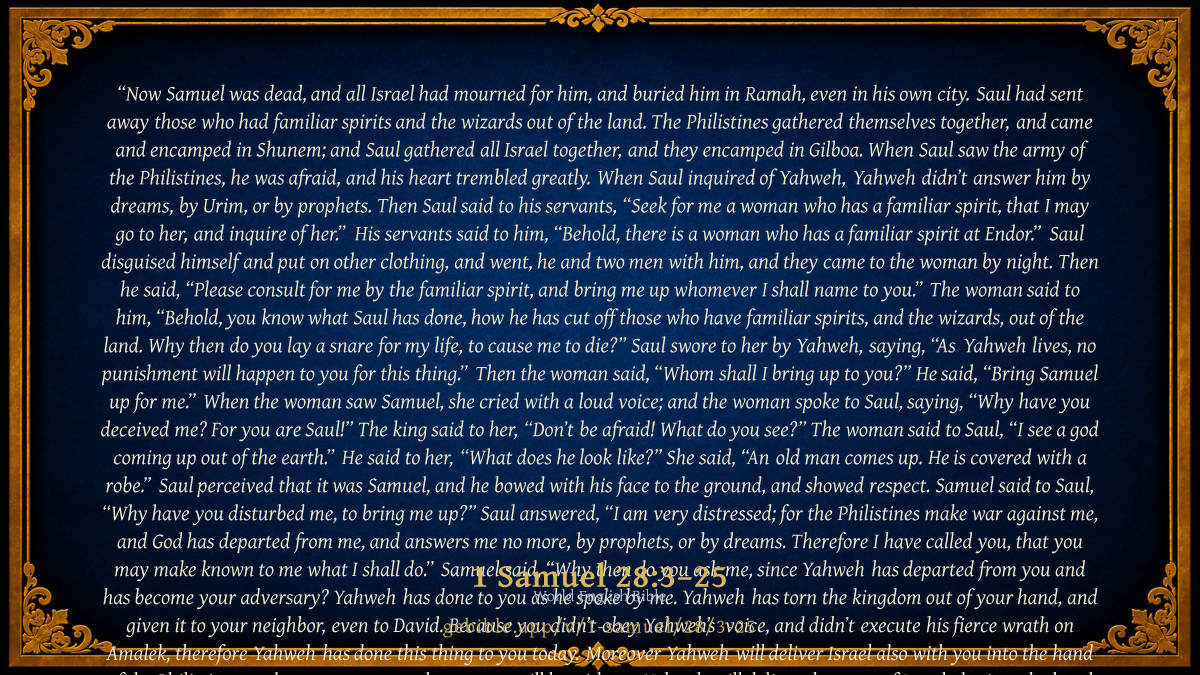
Now Samuel was dead, and all Israel had mourned for him, and buried him in Ramah, even in his own city. Saul had sent away those who had familiar spirits and the wizards out of the land. The Philistines gathered themselves together, and came and encamped in Shunem; and Saul gathered all Israel together, and they encamped in Gilboa. When Saul saw the army of the Philistines, he was afraid, and his heart trembled greatly. When Saul inquired of Yahweh, Yahweh didn’t answer him by dreams, by Urim, or by prophets. Then Saul said to his servants, “Seek for me a woman who has a familiar spirit, that I may go to her, and inquire of her.” His servants said to him, “Behold, there is a woman who has a familiar spirit at Endor.”
Saul disguised himself and put on other clothing, and went, he and two men with him, and they came to the woman by night. Then he said, “Please consult for me by the familiar spirit, and bring me up whomever I shall name to you.”
The woman said to him, “Behold, you know what Saul has done, how he has cut off those who have familiar spirits, and the wizards, out of the land. Why then do you lay a snare for my life, to cause me to die?”
Saul swore to her by Yahweh, saying, “As Yahweh lives, no punishment will happen to you for this thing.”
Then the woman said, “Whom shall I bring up to you?” He said, “Bring Samuel up for me.”
When the woman saw Samuel, she cried with a loud voice; and the woman spoke to Saul, saying, “Why have you deceived me? For you are Saul!”
The king said to her, “Don’t be afraid! What do you see?” The woman said to Saul, “I see a god coming up out of the earth.”
He said to her, “What does he look like?” She said, “An old man comes up. He is covered with a robe.” Saul perceived that it was Samuel, and he bowed with his face to the ground, and showed respect.
Samuel said to Saul, “Why have you disturbed me, to bring me up?” Saul answered, “I am very distressed; for the Philistines make war against me, and God has departed from me, and answers me no more, by prophets, or by dreams. Therefore I have called you, that you may make known to me what I shall do.”
Samuel said, “Why then do you ask me, since Yahweh has departed from you and has become your adversary? Yahweh has done to you as he spoke by me. Yahweh has torn the kingdom out of your hand, and given it to your neighbor, even to David. Because you didn’t obey Yahweh’s voice, and didn’t execute his fierce wrath on Amalek, therefore Yahweh has done this thing to you today. Moreover Yahweh will deliver Israel also with you into the hand of the Philistines; and tomorrow you and your sons will be with me. Yahweh will deliver the army of Israel also into the hand of the Philistines.”
Then Saul fell immediately his full length on the earth, and was terrified, because of Samuel’s words. There was no strength in him; for he had eaten no bread all day long or all night long.
The woman came to Saul, and saw that he was very troubled, and said to him, “Behold, your servant has listened to your voice, and I have put my life in my hand, and have listened to your words which you spoke to me. Now therefore, please listen also to the voice of your servant, and let me set a morsel of bread before you. Eat, that you may have strength, when you go on your way.”
But he refused, and said, “I will not eat.” But his servants, together with the woman, constrained him; and he listened to their voice. So he arose from the earth and sat on the bed. The woman had a fattened calf in the house. She hurried and killed it; and she took flour, and kneaded it, and baked unleavened bread of it. She brought it before Saul, and before his servants; and they ate. Then they rose up, and went away that night.
Geneva Bible translators 1599 · Public Domain On vv3, 6, 8, 10, 11, 13, 14, 15, 17, 19, 20, 21, 24 According to the commandment of God, Exod. 22:18 and…
According to the commandment of God, Exod. 22:18 and Deut. 18:10, 11.
Geneva Bible (1599) marginal notes — public domain.
John Trapp 1656 · Public Domain On vv3–24 1Sa 28:3 Now Samuel was dead, and all Israel…
1Sa 28:3 Now Samuel was dead, and all Israel had lamented him, and buried him in Ramah, even in his own city. And Saul had put away those that had familiar spirits, and the wizards, out of the land.
Ver. 3. Now Samuel was dead.] See 1Sa 25:1.
Read full note →
And all Israel had lamented him.] This is one of the dues of the dead - viz., to be sowed in the earth, and watered with tears. Mors mea ne careat lachrymis.
And buried him in Ramah.] The bodies of the saints, being the temples of the Holy Ghost, should with reverence be commended and committed unto Christian sepulture, in hope of the resurrection.
And Saul had put away those that had familiar spirits.] This he had done, according to Lev 19:31 Lev 20:6; Lev 20:27, at the beginning of his reign, say some, or else when for a show of his great zeal he slew the Gibeonites, {2Sa 21:1} as others hold. His seeking to these kind of creatures again therefore in his extremity, was a sin against conscience; it was point blank against verity, equity, and piety, as Junius observeth.
John Trapp, A Commentary or Exposition upon All the Books of the Old and New Testament (1647–1656) — public domain. Text from a community e-Sword module.
Matthew Poole 1685 · Public Domain On vv3, 4, 5, 6, 7, 8, 9, 11, 12, 13, 14, 15, 17, 18, 19, 20, 21, 22, 23, 24, 25 Samuel was dead: this is mentioned here as the…
Samuel was dead: this is mentioned here as the reason why Saul did not inquire of Samuel; which, if he had now been alive, he would have done.
In his own city, where he had his birth and education, and most settled habitation, 1Sa 19:18.
Read full note →
Saul had put away those that had familiar spirits, and the wizards; according to God’s command, Lev 19:31; 20:6,27; Deu 18:11. This he did, either by Samuel’s instigation; or from a conceit that the evil spirit came upon him by some of their means; or that he might gain the repute of a religious prince, which was very useful to him; or that he might quiet his troubled conscience, and please God as far as his interest would give him leave. And this is here related, partly to show that a hypocrite and wicked man may obey some of God’s commands, and principally to bring in the following history.
Out of the land of Israel.
Matthew Poole's English Annotations on the Holy Bible (1683–1685) — public domain. Text from a community e-Sword/MySword module.
Matthew Henry 1710 · Public Domain On vv7, 15, 20 Here, I. Saul seeks for a witch, Sa1 28:7.…
Here, I. Saul seeks for a witch, Sa1 28:7. When God answered him not, if he had humbled himself by repentance and persevered in seeking God, who knows but that at length he might have been entreated for him? but, since he can discern no comfort either from heaven or earth (Isa 8:21, Isa 8:22), he resolves to knock at the gates of hell, and to see if any there will befriend him and give him advice: Seek me a woman that has a familiar spirit, Sa1 28:7. And his servants were too officious to serve him in this evil affair; they presently recommended one to him at Endor (a city not far off) who had escaped the execution of Saul's edict. To her he resolves to apply. Herein he is chargeable, 1. With contempt of the God of Israel; as if any creature could do him a kindness when God had left him and frowned upon him. 2. With contradiction to himself. He knew the heinousness of the sin of witchcraft, else he would not have cut off those that had familiar spirits; yet now he had recourse to that as an oracle which he had before condemned as an abomination. It is common for men to inveigh severely against those sins which they are in no temptation to, but afterwards to be themselves overcome by them. Had one told Saul, when he was destroying the witches, that he himself would, ere long, consult with one, he would have said, as Hazael did, What? Is thy servant a dog? But who knows what mischiefs those will run into that forsake God and are forsaken of him?
II. Hearing of one he hastens to her, but goes by night, and in disguise, only with two servants, and probably on foot, Sa1 28:8. See how those that are led captive by Satan are forced, 1. To disparage themselves. Never did Saul look so mean as when he went sneaking to a sorry witch to know his fortune. 2. To dissemble. Evil works are works of darkness, and they hate the light, neither care for coming to it. Saul went to the witch, not in his robes, but in the habit of a common soldier, not only lest the witch herself, if she had known him, should decline to serve him, either fearing he came to trepan her or resolving to be avenged on him for his edict against those of her profession, but lest his own people should know it and abhor him for it. Such is the power of natural conscience that even those who do evil blush and are ashamed to do it.
Read full note →
III. He tells her his errand and promises her impunity. 1. All he desires of her is to bring up one from the dead, whom he had a mind to discourse with. It was necromancy or divination by the dead, that he hoped to serve his purpose by. This was expressly forbidden by the law (Deu 18:11), seeking for the living to the dead, Isa 8:19. Bring me up him whom I shall name, Sa1 28:8. This supposes that it was generally taken for granted that souls exist after death, and that when men die there is not an end of them: it supposes too that great knowledge was attributed to separate souls. But to think that any good souls would come up at the beck of an evil spirit, or that God, who had denied a man the benefit of his own institutions, would suffer him to reap any real advantage by a cursed diabolical invention, was very absurd. 2. She signifies her fear of the law, and her suspicion that this stranger came to draw her into a snare (Sa1 28:9): Thou knowest what Saul has done. Providence ordered it so that Saul should be told to his face of his edict against witches, at this very time when he was consulting one, for the greater aggravation of his sin. She insists upon the peril of the law, perhaps to raise her price; for, though no mention is made of her fee, no doubt she demanded and had a large one. Observe how sensible she is of danger from the edict of Saul, and what care she is in to guard against it; but not at all apprehensive of the obligations off God's law and the terrors of his wrath. She considered what Saul had done, not what God had done, against such practices, and feared a snare laid for her life more than a snare laid for her soul. It is common for sinners to be more afraid of punishment from men than of God's righteous judgment. But, 3. Saul promises with an oath not to betray her, Sa1 28:10. It was his duty as a king to punish her and he knew it, yet he swears no to do it; as if he could by his own oath bind himself from doing that which, by the divine command, he was bound to do. But he promised more than he could perform when he said, There shall no punishment happen to thee; for he that could not secure himself could much less secure her from divine vengeance.
IV. Samuel, who was lately dead, is the person whom Saul desired to have some talk with; and the witch, with her enchantments, gratifies his desire, and brings them together. 1. As soon as Saul had given the witch the assurance she desired (that he would not discover her) she applied to her witchcrafts, and asked very confidently, Whom shall I bring up to thee? Sa1 28:11. Note, Hopes of impunity embolden sinners in their evil ways and harden their hearts. 2. Saul desires to speak with Samuel: Bring me up Samuel. Samuel had anointed him to the kingdom and had formerly been his faithful friend and counsellor, and therefore with him he wished to advise. While Samuel was living at Ramah, not far from Gibeah of Saul, and presided there in the school of the prophets, we never read of Saul's going to him to consult him in any of the difficulties he was in (it would have been well for him if he had); then he slighted him, and perhaps hated him, looking upon him to be in David's interest. But now that he is dead, "O for Samuel again! By all means, bring me up Samuel." Note, Many that despise and persecute God's saints and ministers when they are living would be glad to have them again when they are gone. Send Lazarus to me, and send Lazarus to my father's house, Luk 16:24-27. The sepulchres of the righteous are garnished. 3. Here is a seeming defector chasm in the story. Saul said, Bring me up Samuel, and the very next words are, When the woman saw Samuel, (Sa1 28:12), whereas one would have expected to be told how she performed the operation, what spells and charms she used, or that some little intimation would be given of what she said or did; but the profound silence of the scripture concerning it forbids our coveting to know the depths of Satan (Rev 2:24) or to have our curiosity gratified with an account of the mysteries of iniquity. It has been said of the books of some of the popish confessors that, by their descriptions of sin, they have taught men to commit it; but the scripture conceals sinful art, that we may be simple concerning evil, Rom 16:19. 4. The witch, upon sight of the apparition, was aware that her client was Saul, her familiar spirit, it is likely, informing her of it (Sa1 28:12): "Why hast thou deceived me with a disguise; for thou art Saul, the very man that I am afraid of above any man?" Thus she gave Saul to understand the power of her art, in that she could discover him through his disguise; and yet she feared lest, hereafter, at least, he should take advantage against her for what she was now doing. Had she believed that it was really Samuel whom she saw, she would have had more reason to be afraid of him, who was a good prophet, than of Saul, who was a wicked king. But the wrath of earthly princes is feared by most more than the wrath of the King of kings. 5. Saul (who, we may suppose, was kept at a distance in the next room) bade her not to be afraid of him, but go on with the operation, and enquired what she saw? Sa1 28:13. O, says the woman, I saw gods (that is, a spirit) ascending out of the earth; they called angels gods, because spiritual beings. Poor gods that ascend out of the earth! But she speaks the language of the heathen, who had their infernal deities and had them in veneration. If Saul had thought it necessary to his conversation with Samuel that the body of Samuel should be called out of the grave, he would have taken the witch with him to Ramah, where his sepulchre was; but the design was wholly upon his soul, which yet, if it became visible, was expected to appear in the usual resemblance of the body; and God permitted the devil, to answer the design, to put on Samuel's shape, that those who would not receive the love of the truth might be given up to strong delusions and believe a lie. That it could not be the soul of Samuel himself they might easily apprehend when it ascended out of the earth, for the spirit of a man, much more of a good man, goes upward, Ecc 3:21. But, if people will be deceived, it is just with God to say, "Let them be deceived." That the devil, by the divine permission, should be able to personate Samuel is not strange, since he can transform himself into an angel of light! nor is it strange that he should be permitted to do it upon this occasion, that Saul might be driven to despair, by enquiring of the devil, since he would not, in a right manner, enquire of the Lord, by which he might have had comfort. Saul, being told of gods ascending, was eager to know what was the form of this deity, and in what shape he appeared, so far was he from conceiving any horror at it, his heart being wretchedly hardened by the deceitfulness of sin. Saul, it seems, was not permitted to see any manner of similitude himself, but he must take the woman's word for it, that she saw an old man covered with a mantle, or robe, the habit of a judge, which Samuel had sometimes worn, and some think it was for the sake of that, and the majesty of its aspect, that she called this apparition Elohim, a god or gods; for so magistrates are styled, Psa 82:1. 6. Saul, perceiving, by the woman's description, that it was Samuel, stooped with his face to the ground, either, as it is generally taken, in reverence to Samuel, though he saw him not, or perhaps to listen to that soft and muttering voice which he now expected to hear (for those that had familiar spirits peeped and muttered, Isa 8:19); and it should seem Saul bowed himself (probably by the witch's direction) that he might hear what was whispered and listen carefully to it; for the voice of one that has a familiar spirit is said to come out of the ground, and whisper out of the dust, Isa 29:4. He would stoop to that who would not stoop to the word of God.
Matthew Henry's Commentary on the Whole Bible (1708–1710) — public domain (CC PDM 1.0). Text via the HelloAO Bible API.
John Gill 1763 · Public Domain On vv3–25 Now Samuel was dead,.... Had been so for some…
Now Samuel was dead,.... Had been so for some time; which is mentioned before, Sa1 25:1; and here repeated, partly to observe the reason of the Philistines renewing the war, and partly to account for the conduct of Saul, in seeking to a witch to raise Samuel, and for the sake of that story:
and all Israel lamented him; as they had great reason to do; See Gill on Sa1 25:1; and buried him in Ramah, even his own city; there being two Ramahs, as Kimchi observes, it is added, "in his own city", to show that he was buried in that Ramah which was his native place, and where his constant residence was; though, as he says, it may mean that he was buried within the city, and not without it; but the Targum gives a different sense,"and they buried him in Ramah, and mourned for him every man in his city:"
Read full note →
and Saul had put away those that had familiar spirits, and the wizards,
out of the land: out of the land of Israel; had by an edict banished them, or had given orders that neither witches nor wizards should abide in the land; but should be taken up, and prosecuted according to the law of God; which he had done either at the instigation of Samuel; or, as some think, from a conceit that the evil spirit he had been troubled with was owing to them; or to make some appearance of a zeal for religion, and the honour and glory of God: this is observed to show the inconstancy of Saul, and his folly in applying after this to a person of such a character, and to account for the fears of the woman when applied to, and afterwards when she was engaged, when she found it was by Saul; see Sa1 28:7.
John Gill's Exposition of the Whole Bible (1746–1763) — public domain (CC PDM 1.0). Text via the HelloAO Bible API.
John Wesley 1765 · Public Domain On vv5, 7, 8, 11, 12, 13, 14, 15, 17, 19, 20, 21, 24 He trembled - Had he kept close to God,…
He trembled - Had he kept close to God, he needed not fear all the armies of the Philistines.
John Wesley, Explanatory Notes Upon the Whole Bible (1754–1765) — public domain. Text via the GEBible commentary corpus.
Adam Clarke 1810 · Public Domain On vv3, 5, 6, 7, 8, 11, 12, 13, 14, 15, 16, 17, 18, 19, 20, 23, 24, 25 Verse 3. Samuel was dead] And there was no…
Verse 3. Samuel was dead] And there was no longer a public accredited prophet to consult.
Those that had familiar spirits, and the wizards] See Clarke on Le 19:31, and "Ex 22:18".
Adam Clarke's Commentary on the Bible (1810–1826) — public domain. Text from a community e-Sword/MySword module.
Joseph Benson 1811 · Public Domain On vv3, 5, 6, 7, 8, 11, 12, 13, 14, 15, 17, 19, 20, 25 1Sa 28:3. Now Samuel was dead, &c. — This…
1Sa 28:3. Now Samuel was dead, &c. — This was observed before, 1Sa 25:1, but is repeated here again to show that Saul was now sensible of his loss, wanting his advice in a time of great distress. Saul had put away those that had familiar spirits — According to the divine command, Lev 20:27, which perhaps he had executed in the beginning of his reign, when he was directed by Samuel.
Joseph Benson's Commentary on the Old and New Testaments (1811–1818) — public domain. Text from a community e-Sword module.
Albert Barnes 1834 · Public Domain On vv3, 4, 6, 7, 8, 11, 12, 13, 17, 19, 23 It does not appear when Saul had suppressed witchcraft;…
It does not appear when Saul had suppressed witchcraft; it was probably in the early part of his reign.
Familiar spirits ... wizards - i. e. ventriloquists ... wise or cunning men. See Lev 19:31 note.
Albert Barnes' Notes on the Bible (1834–1885) — public domain. Text from a community e-Sword/MySword module.
Haydock's Catholic Bible Commentary 1859 · Public Domain On vv3, 4, 5, 6, 7, 8, 10, 11, 12, 13, 14, 15, 16, 17, 19, 20, 21, 24 Samuel. His death is here recorded, as well as…
Samuel. His death is here recorded, as well as the abolition of magic, to explain what follows, when Saul, not being able to obtain an answer from God, as his prophet had been withdrawn in anger, had recourse to the devil. (Haydock) --- Land, while he reigned virtuously, (Menochius) according to the law, Leviticus xix 31., and Deuteronomy xviii. 11.
George Leo Haydock (1774–1849), Haydock's Catholic Family Bible and Commentary, 1859 edition — public domain. Excludes Psalms (Douay-Rheims chapter numbering differs from Protestant) and Deuterocanonical books (Catholic canon only).
Robert Jamieson, A. R. Fausset & David Brown 1871 · Public Domain On vv3, 4, 7, 8, 24, 25 Now Samuel is dead, &c.--This event is here alluded…
Now Samuel is dead, &c.--This event is here alluded to as affording an explanation of the secret and improper methods by which Saul sought information and direction in the present crisis of his affairs. Overwhelmed in perplexity and fear, he yet found the common and legitimate channels of communication with Heaven shut against him. And so, under the impulse of that dark, distempered, superstitious spirit which had overmastered him, he resolved, in desperation, to seek the aid of one of those fortune telling impostors whom, in accordance with the divine command (Lev 19:31; Lev 20:6, Lev 20:27; Deu 18:11), he had set himself formerly to exterminate from his kingdom.
Jamieson, Fausset & Brown — Commentary Critical and Explanatory on the Whole Bible (1871) — public domain (CC PDM 1.0). Text via the HelloAO Bible API.
Daniel D. Whedon 1874 · Public Domain On vv3, 4, 5, 6, 7, 8, 9, 11, 12, 13, 14, 15, 16, 17, 19, 20, 21, 22, 23, 24, 25 SAUL’S DISTRESS, AND INTERVIEW WITH THE WITCH OF ENDOR,…
SAUL’S DISTRESS, AND INTERVIEW WITH THE WITCH OF ENDOR, 1Sa_28:3-25.
Saul’s interview with the witch of Endor has ever been regarded as a subject beset with peculiar difficulties, and variously has it been explained.
Read full note →
Justin Martyr and Origen held that by the incantations of the witch the spirit of Samuel actually appeared and conversed with Saul. Modern spiritism also affirms that the witch was a medium through whom the king of Israel received communications from the spirit of Samuel. But the majority of the older expositors, and some few moderns, believing it absurd for a holy prophet to be raised from the dead by the arts of witchcraft, regard the supposed apparition of Samuel as Satan personating that prophet. This opinion, however, has not been generally received by later commentators; and the present prevailing opinion seems to be, that not by the arts of the witch, but contrary to her expectations, and by the express permission and command of God, the deceased Samuel actually appeared and spoke to Saul.
It is usually assumed that the expressions, “The woman saw Samuel,” 1Sa_28:12; “Saul perceived that it was Samuel,” 1Sa_28:14; “Samuel said to Saul,” 1Sa_28:15-16; “the words of Samuel,” 1Sa_28:20 — necessarily imply the actual presence of the deceased prophet. And this conclusion cannot well be avoided if we take this narrative of Saul’s interview with the witch to be an actual communication of the Holy Spirit to the writer of the books of Samuel. But was it thus divinely communicated to the sacred writer? or is it the report of the two men (1Sa_28:8) who accompanied Saul to Endor? Inasmuch as the greater portion of these books is a compilation from pre-existing documents — often the reports of eye-witnesses of the events recorded, (see Introduction,) — we are perfectly safe in taking the ground that this narrative originated with those who were eye and ear witnesses of the interview, and who reported the matter just as it appeared to them. Perhaps one of them was the king’s scribe. See note on 2Sa_8:17. It is, therefore, a most natural supposition that Saul and his two attendants believed that the witch had really brought up Samuel from the dead, and, so believing, they would naturally report the matter just as it is here recorded. Hence such expressions as “Samuel said to Saul,” may be legitimately explained in this case as the manner in which the witnesses understood and reported what they heard. See, further, the notes on 1Sa_28:14-15.
We are driven to this view of the subject by the insuperable difficulties that attend the belief that Samuel actually appeared. Admitting this belief, we are forced to admit, also, not only that he was at least apparently brought up by the instrumentality of the witch, but also, according to 1Sa_28:15, that he was disturbed, and forced up against his will. For, assuming the real appearance of the prophet, it is idle to say, as some do, that the witch did not bring Samuel up, but that he appeared, to her great surprise and terror, before she had yet resorted to her incantations. 1Sa_28:11-12 most clearly imply that she was instrumental in causing Samuel to appear, and the alarm of the witch, as her own words show, (1Sa_28:12,) was not at suddenly seeing the prophet, but at recognising Saul. Here, then, appears an insuperable difficulty — we might well say, an utter absurdity — to suppose that after Jehovah had refused to answer Saul by urim, by prophets, and by dreams, and had also, in his law, denounced the heaviest punishments against all forms of witchcraft, and had forbidden all resort to such as had familiar spirits, he would yet send Samuel from heaven to communicate with Saul through the agency of a miserable witch!
Another difficulty is the character of the communication which is pretended to come from Samuel. It contains nothing worth sending a sainted prophet from heaven to tell; nothing which the witch might not, under the circumstances, have naturally and easily devised to awe and terrify the king. Its language, too, savours more of the spirit of witchcraft than of the spirit of divine revelation. See notes on vers. 15 to 19.
The manner of Samuel’s appearance is also of a strange and suspicious character. He comes up out of the earth, not as one from heaven; he bears the marks of decrepitude and age, and apparently wears the cast-off garments of his earthly life. All this agrees well enough with the superstitions of ancient necromancy, but is hardly in keeping with that lofty conception of the glorious appearing of a sainted spirit which other parts of the Scriptures suggest. How different from Moses and Elijah, who appeared “in glory!” Luk_9:31. This is the more noticeable when we observe that the witch is the only one who sees Samuel. She alone sees the gods ascending; she alone sees the old man with the mantle; and it is not until after she tells her pretended vision that Saul understands and is convinced that it is Samuel. See note on 1Sa_28:14. So, then, Saul did not see Samuel; he only heard, as he supposed, the words of the angry prophet.
In view of all these difficulties we feel obliged to reject that interpretation which assumes an actual appearance of Samuel.
There are two other methods of explaining this subject, either of which is beset with fewer difficulties. According to one theory the witch of Endor had known Samuel in life, had often seen him, and had heard some of his oracles. His venerable form and mantle were familiar to all Israel. His last words to Saul, predicting the ruin of his house and the transfer of the kingdom to David, were also known throughout the land, and would be particularly remembered by one who was devoted to the arts of divination. The witch, also, knew Saul, and had reason to believe that the hour of his ruin was at hand, for the field of his last battle was near her home, and she may have known the position, plans, and prospects of both armies. She not only recognised the king as soon as he came into her presence, but at a glance discerned the anxiety of his soul, and the real object of his coming; and all her words and actions on the occasion were in perfect keeping with the arts of witchcraft, and designed to awe and overwhelm him.
It is impossible successfully to controvert the above suppositions, for they are not only possible but probable; and if any one has doubts of the ability of a professional witch to apprehend a person’s thoughts and feelings, and utter some surprising oracles, he will do well to ponder the following observations of a distinguished medical writer:
“A person of close observation and great shrewdness can acquire a degree of skill in furnishing communications purporting to be spiritual, which can hardly be appreciated by one who has not given much thought to the subject. This is a kind of acquirement not sought for, except by those who mean to use it for deception, and therefore by most persons is but little understood. Let an individual of proper capacity make it a business to study the significance of every slight movement, intonation of voice, and expression of countenance, as criteria of concealed thoughts, and let this pursuit be prosecuted for years, under the incentives afforded by the love of gain or applause, or the fear of detection, and the tact thus acquired will be likely to develop results that appear almost incredible.” — Dr. Austin Flint, (in Quart. Jour. of Psychological Medicine, July, 1869.)
There is another, and, to our mind, more complete exposition of this subject, which we present in these notes. It assumes that the woman of Endor was a superior clairvoyant. All the parts of the narrative are so happily explained on this hypothesis as to evidence its probable correctness and worth. Careful and continued investigations in clairvoyance have, within the last century, shed much light on the mysteries of magic. We know that men have charmed serpents and serpents have charmed men. Man, too, can charm man; and it has been shown beyond successful contradiction that, in accordance with certain occult laws of our being, one person can so fascinate another, and place himself in such sympathetic rapport with his soul, as to become sensible of what he feels or imagines. This power, however, exists in different persons in different degrees. Some persons it seems impossible to mesmerize at all, while others are highly susceptible to mesmeric operations, and are easily thrown into a clairvoyant state. Others, again, have the unusual power of spontaneously inducing upon themselves the clairvoyant state, and, by coming into contact or association with the soul of another, the superior clairvoyant becomes cognizant of the feelings and emotions of that soul. By the power of an inner vision he appears to see in that soul the thoughts and impressions that are deeply fixed in the imagination or the memory.
We assume, then, that the witch of Endor was a clairvoyant who could spontaneously place herself in mesmeric intercourse with the souls of those who came to inquire of her; and that with this power she united the practice of lying and deceit as she found occasion to serve her own dark purposes. We hope to show, by fair and worthy criticism, that upon this hypothesis the narrative before us is capable of a happy and consistent interpretation, and is relieved of the difficulties which attend the assumption of the actual appearance of Samuel.
3. Samuel was dead — This fact had been already recorded, (1Sa_25:1,) but is repeated here for the purpose of introducing the narrative that follows.
Saul had put away — Of this act of Saul’s reign we have no record elsewhere, but it was probably done soon after he received the kingdom, and by the advice of Samuel. It was required by the law. Exo_22:18; Lev_20:27.
Familiar spirits — The primary sense of the Hebrew word אוב is a skin bottle. Compare Job_32:19. Furst defines the word as “the hollow belly of conjurers, in which the conjuring spirit resides, and speaks hollow, as if out of the earth.” Persons of this craft were supposed to possess a divinity or spirit within them by which they were enabled to hold intercourse with the realm of the dead. The Septuagint renders the word by εγγαστριμυθος, a ventriloquist; in reference, probably, to the manner in which some of these conjurers uttered their responses.
Wizards — See on Deu_18:10-12.
Daniel D. Whedon (gen. ed.), Commentary on the Old and New Testaments (1874–1909) — public domain. Text from a community e-Sword module.
The Cambridge Bible for Schools and Colleges 1878 · Public Domain On vv3, 4, 5, 6, 7, 8, 11, 12, 13, 14, 15, 16, 17, 18, 19, 20, 21, 22, 23, 24 3–14. Saul resorts to the witch of Endor
3–14. Saul resorts to the witch of Endor
3. Now Samuel, &c.] From 1Sa_28:3 to the end of the chapter is an independent narrative. 1Sa_28:3 states by way of introduction certain facts as the key to the incidents about to be related: (1) the death and burial of Samuel (1Sa_25:1); (2) Saul’s expulsion of the soothsayers. This he probably did in the early part of his reign. An allusion to it may be traced in 1Sa_15:23. It was In accordance with the Law. See Lev_19:31; Lev_20:27; Deu_18:10 ff.
Read full note →
those that had familiar spirits] The Hebrew word Ob signifies (1) the demon or spirit supposed to speak through the necromancer; (2) the possessor of such a spirit. It is generally rendered by the Sept. “ventriloquist” (ἐγγαστρίμυθος), probably because the spirit was supposed to speak from the necromancer’s belly, not as some suppose, because ventriloquists abused their powers for imposing upon the credulous.
the wizards] Wizard, connected with wit and wise, is an exact equivalent of the Heb. word, which means “a knowing one:” one who is supposed to possess a knowledge of the future by mysterious means.
The Cambridge Bible for Schools and Colleges (gen. ed. J. J. S. Perowne; Cambridge University Press, 1878–1918) — public domain. Text from a community e-Sword module.
Ellicott's Commentary for English Readers 1878 · Public Domain On vv3, 4, 5, 6, 7, 8, 9, 11, 12, 13, 14, 15, 16, 17, 19, 20, 21, 23, 24, 25 (3) Now Samuel was dead.—A statement here repeated to…
(3) Now Samuel was dead.—A statement here repeated to introduce the strange, sad story which follows. The LXX., followed by the Vulg. and Syriac Versions, omitted it, not understanding the reason for its repetition.
And Saul had put away those that had familiar spirits, and the wizards, out of the land.—This statement is also inserted explanatory of what follows. In other words, the compiler says: “Now Samuel, whom Saul was so anxious to see, was dead and buried, and the possessors of familiar spirits, whose aid Saul was about to invoke to carry out his purpose, had long since been put out, by his own order, from the land.” “Those that had familiar spirits”—those that had at their command ôboth, rendered “familiar spirits,” the plural form of ôb, a word which has never been explained with any certainty. Scholars think they can connect it with ôb, to be hollow, and ôb is then “the hollow thing,” or “bag;” and so it came to signify, “one who speaks in a hollow voice.” It hence appears to mean the distended belly of the ventriloquist, a word by which the LXX. always render ôb. It thus is used to designate the male or female ventriloquist, as in 1Sa_27:3; 1Sa_27:9, and Deu_18:11, &c., and also the spirit which was supposed to speak from the belly of the ventriloquist; in this sense it is so used in 1Sa_27:8-9, and Isa_29:4. This is the explanation given by Erdmann in Lange, and the Bishop of Bath and Wells in the Speaker’s Commentary.
Read full note →
The wizards.—Literally, the wise people. These are ever connected with the ôboth, “those that had familiar spirits.” The name seems to have been given in irony to these dealers in occult and forbidden arts. The Mosaic command respecting these people was clear and decisive: “Thou shalt not suffer a witch.(or wizard) to live” (Exo_22:18; Lev_20:27). Saul, in his early zeal, we read, had actively put in force these edicts of Moses, which apparently, in the lax state of things which had long prevailed in Israel, had been suffered to lie in abeyance.
A Bible Commentary for English Readers, edited by Charles John Ellicott (1878–1897) — public domain. Text from a community e-Sword module.
The Pulpit Commentary 1880 · Public Domain On vv3, 4, 5, 6, 7, 9, 11, 12, 13, 14, 15, 17, 20 SAUL AND THE WITCH OF ENDOR (vers. 3-25).
SAUL AND THE WITCH OF ENDOR (vers. 3-25).
Samuel was dead. A repetition of 1Sa_25:1, inserted to explain Saul"s conduct, as is the other fact, that Saul had put away those that had familiar spirits, etc. We are not told when Saul did this; but at the commencement of his reign, when he brought the ark to Nob, he was probably earnest generally in his observance of the precepts of the Mosaic law. Familiar spirits. Hebrew, oboth, the plural of ob, a leathern bottle. It is generally taken to refer to the distended belly of the conjurer, into which the summoned spirit of the dead was supposed to enter, and thence speak; for which reason the Septuagint renders the word" ventriloquist," and is followed by most modern commentators. Wizards. Hebrew, "knowing ones," from the verb to know; just as wizard comes from the old verb to wiss. With ignorant people unusual knowledge is always looked upon with suspicion; but these supposed magicians professed a knowledge to which they bad no claim.
The Pulpit Commentary (1880–1919), ed. H.D.M. Spence-Jones & Joseph S. Exell — public domain. Text from a community e-Sword module.
The Biblical Illustrator 1887 · Public Domain On vv6, 7, 11, 14, 15 The Lord answered him not.
1Sa_28:6
The Lord answered him not.
Read full note →
Gods silence
I. A frequent experience of those who seek God. It is neither an universal nor invariable one, else prayer would become impossible. But it is sufficiently frequent to occasion grave spiritual difficulty.
1. In apparent contradiction of Divine promise. Of Israel, even in Egypt, it was said, I will surely hear their cry (Exo_22:23). (Zec_10:1.) (Psa_86:7.) How strong are the assurances of Christ. (Mat_7:7-11.)
2. Disastrous in its effect upon the life of the soul. If it be true that where there is no vision the people perish, equally so is it that when no Divine voice speaks to the soul it must cease to live. As the plant withers in the gloom of the cellar, the soul that knows not the sunshine of the Fathers smile cannot be healthy or vigorous.
3. A source of uneasiness and sorrow. It is not only right but in the best sense natural that man should seek God; there is no deeper source of dissatisfaction and restlessness than a baffled instinct.
II. An experience to be interpreted. Even the silence of God has a meaning. Rightly interrogated it may prove a precious revelation. In any case the possibilities are too grave for the sign to be neglected.
1. God is sometimes supposed to be silent when He is not. Answers to prayer are not always at once or easily apparent.
2. His silence is not always a token of displeasure. It may be simply
(1) directive; our request unwise, etc. Or it may be
(2) stimulative; as when the Syro-phoenician woman grew importunate when He answered her nothing.
3. Yet it is often expressive of Divine wrath.
It must not be regarded as a light thing.
1. It may be intended to invite to inward examination and repentance. Some unfaithfulness; a falling from grace; it may be direct disobedience. The Holy One is saying, by His silence, Come up higher. I cannot speak to you there!
2. It sometimes occurs, as in the case of Saul, in token of doom. The gracious lips of Christ were silent before a Pilate and a Herod. (A. F. Muir, M. A.)
A silent god
1.Calamity may be borne. We can oppose it to our manhood and our constancy. Menaced by shipwreck, we can breast the storm. To be defeated in battle, to be superseded in power, to see popularity crumbling into indifference--all this and more Saul had to bear, and all this may be borne. If God be on my side, anyone may say to all the world, I care nothing for all the rest. Did not great Martin Luther cry: Oh! my God, punish me rather with pestilence, with all the terrible sicknesses on earth, with war, with anything, rather than Thou be silent to me? And when Saul inquired of the Lord, the Lord answered him not. Ah! that is to be desolate indeed!
2. There are some whom God does not answer because they do not care to inquire of Him at all. The earth suffices them. Life is their feeding trough, and they care nothing for more. They never care to look beyond the narrow horizon of themselves.
3. When Saul inquired of the Lord, we are told that the Lord answered him not, neither by dreams, nor by Urim, nor by prophets. Dreams were the lowest form of revelation: yet we have so many closer modes of communion with God, in His Christ and by His Spirit, that of dreams we need not speak. Have no messages of Scripture ever seemed suddenly to burn their revelation upon your souls? Yes, God does speak to us by Urim still, and He also speaks to us by His prophets. And can you wonder that, if this be so, God, whom you have despised, and whose laws you have deliberately and habitually violated, should not only be silent to you at last? God never turns from the cry of the penitent, however bad he may have been. Distinguish between Gods apparent silences for His children, and the self-created silence of your own to those who utterly refuse Him. Oh, let us beware lest we feel the awful silence which is not Gods, but arises from our own obstinate and determined wickedness, that it may not overwhelm us. (Dean Farrar.)
Communications threatened
During a heavy snowstorm the warning was sent out that in a few hours the wet, heavy snow would break down the telephone and telegraph wires, and cut off communication with the outside world. Instantly there was a great rush to the telephones and the telegraph offices to get messages off before it was too late. What if we knew that very soon God would refuse to hear any more prayers; would there not be a great rush to the throne of grace to send our petitions heavenward before we were cut off foreverse (Christian Endeavour Times.)
The Biblical Illustrator, edited by Joseph S. Exell (c. 1880s–1900s) — public domain. Text from a community e-Sword module.
The Expositor's Bible 1887 · Public Domain On v3
CHAPTER X X X I V.
SAUL AT ENDOR.
Read full note →
1Sa_28:3-25.
FOR a considerable time Saul had been drifting along like a crippled vessel at sea, a melancholy example of a man forsaken of God. But as his decisive encounter with the Philistines drew on, the state of helplessness to which he had been reduced became more apparent than ever. He had sagacity enough to perceive that the expedition which the Philistines were now leading against him was the most formidable that had ever taken place in his day. It was no ordinary battle that was to be fought; it was one that would decide the fate of the country. The magnitude of the expedition on his part is apparent from an expression in the fourth verse - ''Saul gathered all Israel together." The place of encounter was not any of the old battle- fields with the Philistines. Usually the engagements had taken place in some of the valleys that ran down from the territories of Dan, or Benjamin, or Judah into the Philistine plain, or on the heights above these. But such places were comparatively contracted, and did not afford scope for great bodies of troops. This time the Philistines chose a wider and more commanding battle-field. Advancing northwards along their own maritime plain, and beyond it along the plain of Sharon, they turned eastwards into the great plain of Esdraelon or Jezreel, and occupied the northern side of the plain. The troops of Saul were encamped on the southern side, occupying the northern slope of Mount Gilboa. There the two armies faced each other, the wide plain stretching between.
It was a painful moment for Saul when he got his first view of the Philistine host, for the sight of it filled him with consternation. It would appear to have surpassed that of Israel very greatly in numbers, in resources, as it certainly did in its confident spirit. Yet, if Saul had been a man of faith, none of these things would have moved him. Was it not in that very neighbourhood that Barak, with his hasty levies, had inflicted a signal defeat on the Canaanites? And was it not in that very plain that the hosts of Midian lay encamped in the days of Gideon, when the barley cake rolling into their camp overturned and terrified the host, and a complete discomfiture followed? Why should not the Lord work as great a deliverance now? If God was with them. He was more than all that could be against them. Might not this be another of the days foretold by Moses, when one should chase a thousand, and two put ten thousand to flight?
Yes, if God was with them. All turned upon that if. And Saul felt that God was not with them, and that they could not count on any such deliverance as, in better times, had been vouchsafed to their fathers.
And why, O Saul, when you felt thus, did you not humble yourself before God, confess all your sins, and implore Him to show you mercy? Why did you not cry, "Return, O Lord, how long? And let it repent Thee concerning Thy servants"? Would you have found God inexorable? Would His ear have been heavy that it could not hear? Don't you remember how Moses said that when Israel, in sore bondage, should cry humbly to God, the Lord would hear his cry, and have mercy on him? Why, O Saul, do you not fall in the dust before Him?
Somehow Saul felt that he could not. Among other effects of sin and rebellion, one of the worst is a stiffening of the soul, making it hard and rigid, so that it cannot bend, it cannot melt, it cannot change its course. The long career of willfulness that Saul had followed had produced in him this stiffening effect; his spirit was hardened in its own ways, and incapable of all exercise of contrition or humiliation, or anything essentially different from the course he had been following. There are times in the life of a deeply afflicted woman when the best thing she could do would be to weep, but that is just the thing she cannot do. There are times when the best thing an inveterate sinner could do would be to fling himself before God and sob for mercy, but fling himself before God and sob he cannot. Saul was incapable of that exercise of soul which would have saved him and his people. Most terrible effect of cherished sin! It dries up the fountains of contrition and they will not flow. It stiffens the knees and they will not bend. It paralyses the voice and it will not cry. It blinds the eyes and they see not the Saviour. It closes the ears and the voice of mercy is unheard. It drives the distressed one to wells without water, to refuges of lies, to trees twice dead, to physicians who have no medicines, to gods who have no salvation; all he feels is that his case is desperate, and yet somewhere or other he must have help!
Saul did not neglect the outward means by which in other days God had been accustomed to direct the nation. He tried every authorized way he could think of for getting guidance from above. He believed in a heavenly power, and he asked its guidance and its help But God took no notice of him. He answered him neither by dreams, nor by Urim, nor by prophets. Men, though in heart rebellious against God's will, will go through a great deal of mechanical service in the hope of securing His favour. It is not their muscles that get stiffened, but their souls. What a strange conception they must have of God when they fancy that mere external services will please Him! How little Saul knew of God when he supposed that, overlooking all the rebellion of his heart, God would respond to a mechanical effort or efforts to communicate with Him! Don't you know, O Saul, that your iniquities have separated between you and your God, and your sins have hid His face from you that He will not hear? Nothing will have the least effect on Him till you own your sin. "I will go and return unto My place, until they acknowledge their offence and seek My face." And this is just what you will not, cannot do I How infinitely precious would one tear of genuine repentance have been in that dark hour! It would have saved thousands of the Israelites from a bloody death; it would have saved the nation from defeat and humiliation; it would have removed the obstacle to fellowship with the Hope of Israel, who would have stood true to His ancient character, - "the Saviour thereof in time of trouble."
But Saul's day of grace was over, and accordingly we find him driven to the most humbling expedient to which a man can stoop - seeking counsel from a quarter against which, in his more prosperous days, he had directed his special energies, as a superstitious, demoralizing agency. He had been most zealous in exterminating a class of persons, abounding in Eastern countries, who pretend to know the secrets of the future, and to have access to the inhabitants of the unseen world. Little could he have dreamt in those days of fiery zeal that a time would come when he would rejoice to learn that one poor wretch had escaped the vigilance of his officers, and still carried on, or pretended to carry on, a nefarious traffic with the realms of the departed! It shows how little man is acquainted with the inner feelings of other men - how little he knows even himself. Doubtless he thought, in the days of exterminating zeal, that it was sheer folly and driveling superstition that encouraged these sorcerers, and that by clearing them away he would be ridding the land of a mass of rubbish that could be of service to no one. He did not consider that there are times of wretchedness and despair when the soul that knows not God will seek counsel even of men with a familiar spirit - he little dreamt that such would be the case with himself. "Is thy servant a dog that he should do this thing?" he would have asked with great indignation in those early days, if it had been insinuated that he would ever be tempted to resort to such counselors. "What better could I ever be of anything they could tell me? Surely it would be wiser to meet any conceivable danger full in the face than to seek after such counsel as they could give!" He did not consider that when man's spirit is overwhelmed within him, and his craving for help is like the passion of a madman, he will clutch like a drowning man at a straw, he will even resort to a woman with a familiar spirit, if, peradventure, some hint can be got to extricate him from his misery.
But to this complexion it came at last. With dreadful sacrifice of self-respect, Saul had to ask his advisers to seek out for him a woman of this description. They were able to tell him of such a woman residing at Endor, about ten miles from where they were. With two attendants he set out after nightfall, disguised, and found her. Naturally, she was afraid to do anything in the way of business in the face of such measures as the king had taken against all of her craft, nor would she stir until she had got a solemn promise that she would not be molested in any way. Then, when all was ready, she asked whom she should call up. "Call up Samuel," said Saul. To the great astonishment of the woman herself, she sees Samuel rising up. A shriek from her indicates that she is as much astonished and for the moment frightened as anyone can be. Evidently she did not expect such an apparition. The effect was much too great for the cause. She sees that in this apparition a power is concerned much beyond what she can wield. Instinctively she apprehends that the only man of importance enough to receive such a supernatural visit must be the head of the nation. "Why did you deceive me?" she said, ''for thou art Saul." "Nevermind that," is virtually Saul's reply; "but tell me what you have seen." The Revised Version gives her answer better than the older one "I saw a god arise out of the earth." "What is his appearance?" earnestly asks Saul. "He is an old man, and he is covered with a mantle." And Saul sees that it is really Samuel.
But what was it that really happened, and how did it come about? That the woman was able, even if she really had the aid of evil spirits, to bring Samuel into Saul's presence were cannot believe. Nor could she believe it herself. If Samuel really appeared - and the narrative assumes that he did - it must have been by a direct miracle, God supernaturally clothing his spirit in something like its old form, and bringing him back to earth to speak to Saul. In judgment it seemed good to God to let Saul have his desire, and to give him a real interview with Samuel. "He gave him his request, but sent leanness to his soul." So far from having his fears allayed and his burden removed, Saul was made to see from Samuel's communication that there was nothing but ruin before him; and he must have gone back to the painful duty of the morrow staggering under a load heavier than before.
Samuel begins the conversation; and he does so by reproaching Saul for having disquieted him, and brought him back from his peaceful home above to mingle again in the strife and turmoil of human things. Nothing can exceed the haggard and weird desolation of Saul's answer. "I am sore distressed; for the Philistines make war against me, and God is departed from me and answereth me no more, neither by prophets nor by dreams: therefore I have called thee, that thou mayest make known unto me what I shall do." Was ever a king in such a plight? Who would have thought, when Samuel and Saul first came together, and Saul listened so respectfully to the prophet counseling him concerning the kingdom, that their last meeting should be like this? In all Saul's statement there is no word that carries such a load of meaning and of despair as this - "God is departed from me." It is the token of universal confusion and calamity. And Saul felt it, and as no one understood these things like Samuel, he had sought Samuel to counsel his wayward son, to tell him what to do.
It is not every sinner that makes the discovery in this life what awful results follow when God is departed from him. But if the discovery does not dawn on one in this life, it will come on him with overwhelming force in the life to come. Men little think what they are preparing for themselves when they say to God, "Depart from us, for we desire not the knowledge of Thy ways." The service of God is irksome; the restraints of God's law are distressing; they like a free life, freedom to please themselves. And so they part company with God. The form of Divine service may be kept up or it may not: but God is not their God, and God's will is not their rule. They have left God's ways, they have followed their own. And when conscience has sometimes given them a twinge, when God has reminded them by the silent monitor of His claims, their answer has been, Let us alone, what have we to do with Thee? Depart from us, leave us in peace. Ah! how little have you considered that the most awful thing that could happen to you is just for God to depart from you! If we could conceive the earth a sensitive being, and somehow to get a dislike for the sun, and to pray the sun to depart from her, how awful would be the fulfillment! Losing all the genial influences that brighten her surface, that cover her face with beauty and enrich her soil with abundance, all the foul and slimy creatures of darkness would creep out, all the noxious influences of dissolution and death would riot in their terrible freedom! And is not this but a poor faint picture of man forsaken by God! O sinner, if ever thy wish should be fulfilled, how wilt thou curse the day in which thou didst utter it! When vile lusts rise to uncontrollable authority- when those whom you love turn hopelessly wicked, when you find yourselves joyless, helpless, hopeless, when you try to repent and cannot repent, when you try to pray and cannot pray, when you try to be pure and cannot be pure - what a terrible calamity you will then feel it that God is departed from you! Trifle not, O man, with thy relation to God; and let not thy history be such that it shall have to be written in the words of the prophet - "But they rebelled and vexed His Holy Spirit; therefore He was turned to be their enemy and He fought against them" (Isa_63:10).
There was no comfort for Saul in Samuel's reply, but much the contrary. Why should he have asked advice of the Lord's servant, when he owned that he was forsaken by the Lord Himself? What could the servant do for him if the Master was become his enemy? What can a priest or a minister do for any man if God has turned His face away from him? Can he make God deny Himself, and become favourable to one who has scorned or sinned away His Holy Spirit? Saul was experiencing no more than he had just reason to expect since that fatal day when he had first deliberately set up his own will above God's will in the affair of Amalek. In the course which he began then, he had persistently continued, and God was now just executing the threatenings which Saul had braved. And next day would witness the last of his sad history. The Lord would deliver Israel into the hands of the Philistines; in the collision of the armies he and his sons would be slain; disaster to his arms, death to himself, and destruction to his dynasty would all come together on that miserable day.
It is no wonder that Saul was utterly prostrated: "He fell straightway all along on the earth, and was sore afraid, because of the words of Samuel; and there was no strength in him; for he had eaten no bread all the day, nor all the night." He could not have expected that the interview with Samuel would be a pleasant one, but he never imagined that it would announce such awful calamities. Have you not known sometimes the terrible sensation when you had heard there was something wrong with some of your friends, and on going to inquire, discovered that the calamity was infinitely worse than you had ever dreamt of? A momentary paralysis comes over one; you are stunned and made helpless by the tidings. We may even be tempted to think that surely Samuel was too hard on Saul; might he not have tempered his awful message by some qualifying word of hope and mercy? The answer is, Samuel spoke the truth, the whole truth, and nothing but the truth. We are all prone to the thought that when evil men get their doom there will surely be something to modify or mitigate its rigour. Samuel's words to Saul indicate no such relaxation. Moral law will vindicate itself as natural law vindicates itself - "Whatsoever a man soweth, that shall he also reap."
The last incident in the chapter is interesting and pleasing. We might have thought that such a calling as that followed by the witch of Endor would have destroyed all the humanities in her nature; that she would have looked on the king's distress with a cold, stoical eye, and that her only concern would be to obtain for herself a fee adapted to the occasion. But she shows much of the woman left in her after all. When she rehearses her service, and the peril of her life at which it has been rendered, to prepare the way for her asking a favour, the favour which she does ask is not for herself at all, - it is on Saul's own behalf, that she might be permitted the honour of preparing for him a meal. Saul's mind is too much occupied and too much agitated to care for anything of the kind. Still prostrate on the ground he says, "I will not eat." Men overwhelmed by calamity hate to eat, they are too excited to experience hunger. It was only when his servants, thinking how much he had gone through already, how much more he had to go through on the morrow, and how utterly unfit his exhausted body was for the strain - it was then only that he yielded to the request of the woman. And the woman showed that, for all her sinister business, she was equal to the occasion of entertaining a king. The "fat calf in the house" corresponded to the "fatted calf" in the parable of the prodigal son. It was not the custom even in families of the richer class to eat meat at ordinary meals; it was reserved for feasts and extraordinary occasions; and in order to be ready for any emergency a calf was kept close to the house, whose flesh, from the delicate way in which it was reared and fed, was tender enough to be served even at so hasty a meal. With cakes of unleavened bread, this dish could be presented very rapidly, and, unlike the hasty meals which are common among us, was really a more substantial and nourishing entertainment than ordinary. It is touching to mark these traces of womanly feeling in this unhappy being, reminding us of the redeeming features of Rahab the harlot. What effect the whole transaction had on the woman we are not told, and it would be vain to conjecture.
And now Saul retraces his dark and dreary way southward to the heights of Gilboa, We can hardly exaggerate his miserable condition. He had much to think of, and he would have needed a clear, unclouded mind. We can think of him only as miserably distracted, and unable to let his mind settle on anything. It would have needed his utmost resources to arrange for the battle of to-morrow, a battle in which he knew that defeat was coming, but which he might endeavour, nevertheless, to make as little disastrous as possible. Moreover, he knew it was to be the last day of his life, and troubled thoughts could not but steal in on him as to what should happen when he stood before God. No doubt, too, there were many sad thoughts about his sons, who were to be involved in the same fate as himself. Was there no way of saving any of them? The arrangement of his temporal effects, too, would claim attention, for, restless and excitable as he had been, it was not likely that his private affairs would be in very good order. Anon his thoughts might wander back to his first interview with Samuel, and bitter remorse would send its pang through him as he thought how differently he might have left the kingdom if he had faithfully followed the counsels of the prophet. Possibly amid all these gloomy thoughts one thought of a brighter order might steal into his mind - how thoroughly David, who would come to the throne after him, would retrieve his errors and restore prosperity, and make the kingdom what it had never been under him, a model kingdom, worthy to shadow forth the glories of Messiah's coming reign. Poor distracted man, he was little fitted either to fight a battle with the Philistines or to encounter the last enemy on his own account. What a lesson to be prepared beforehand! On a deathbed, especially a sudden one, distractions can hardly fail to visit us - this thing and the ether thing needing to be arranged and thought of. Happy they who at such a moment can say, "I am now ready to depart." "Into Thy hands I commend my spirit, for Thou hast redeemed me, O Lord God of truth."
William Robertson Nicoll, ed., The Expositor's Bible (London: Hodder & Stoughton, 1887–1910) — public domain. 65 of 66 books (1 Corinthians is not separately keyed, as that volume carries no machine-parseable verse references); section-level commentary keyed to the opening verse. Introductory and overview sections not keyed to a specific passage are excluded.
Alexander MacLaren 1905 · Public Domain On v15 1 Samuel
1 Samuel
SAUL
Read full note →
1Sa 28:15.
Among all the persons of Scripture who are represented as having fallen away from God and wrecked their lives, perhaps there is none so impressive as the giant form of the first king of Israel. Huge and black, seamed and scarred with lightning marks of passions, moody and suspicious, devil-ridden and lonely, doubting his truest friends, and even his son, striking blindly in his fury at the gracious, sunny poet-warrior who shows so bright, so full of resource, so nimble, so generous, by contrast with the heavy strength of the moody giant, and ever escapes the javelin that quivers harmlessly in the wall, with an inevitable destiny hanging over his head, and at last creeping to ‘wizards that peep and mutter,’ and dying a suicide, with his army in full flight and his son dead at his feet-what a course and what an end for the chosen of the Lord, on whom the Spirit of the Lord came with the anointing oil, and gave him a new heart for his kingly office.
I know not anywhere a sadder story: and I know not where human lips ever poured out a more awful wail-like a Titan in his rage of pain- than these words of our text. Bright hopes and fair promise, and much that was good and true in performance-all came to this. A few hours more and the ‘battle went sore against Saul, and the archers hit him, and he was greatly distressed by reason of the archers.’ Madness, despair, defeat, death, all were the sequel of, ‘Because thou hast rejected the commandment of the Lord, the Lord hath also rejected thee from being king.’ A true soul’s tragedy! Let us look together at its course, and gather the lessons that lie on the surface. We have neither space nor wish here to enter upon the many points of minute interest and curiosity which are in the story. We have to be contented with large outlines.
Look then
I. At the bright dawn.
The early story gives us many traits of beauty in Saul’s character. Not only physical strength but a winning personality are apparent. His modesty and humility when Samuel salutes him are made plain. And we are distinctly told that as he turned away from Samuel, ‘God gave him another heart,’ by which we are to understand not ‘regeneration’ but an inspiration, that equipped him for his office.
How many a man finds that sudden elevation ruins him! But often it evokes what is good, brings an entire change of disposition, as with ‘Harry of Mon-mouth.’ But it was not only his new responsibility which brought into action powers that had previously been dormant. New circumstances, no doubt, did something, but Saul’s ‘new’ heart was God’s gift.
The story of the beginning of his reign reveals a very noble and lovable character. We can but mention his modesty in hiding among the stuff, his disregard of the murmurs of those who would not do homage {‘made as though he had been deaf’}, his return, as it would seem, to his home-life and farm-work, his chivalrous boldness and warlike energy, which sprung at once to activity on the call of a great exigency in Jabesh-Gilead, his humane and sweet repression of the people’s desire, in their first flush of pride in their soldier king, to slay his enemies, and his devout acknowledgment that not he but God has wrought this salvation.
So for the first year of his reign all went well.
How much of divine influence a man may have and yet fling it all away! How unreliable a thing mere natural goodness is! How much apparent goodness may coexist with deep-seated evil! How bright a beginning may darken into a tempestuous day! How seeds of evil may lurk in the fairest character! How little one can be judged by part of his life! How it is not the possession, but the retention, of goodness and devout impressions that makes a man good.
II. The gathering clouds.
The acts recorded as darkening the fair dawn of Saul’s reign may seem too trivial to deserve the stern retribution that followed them, but small acts may be great sins. The first of them was his offering sacrifices without authority, an act which Samuel stigmatised as wanton, deliberate disobedience to ‘the commandment of the Lord thy God.’ Next came his rash and absurd laying of a curse on any soldier who should eat food before evening, and his consequent mad determination to kill Jonathan, for ‘taking a little honey’ on the end of his rod. Next came his flagrant disobedience to the divine command transmitted to him through Samuel, to ‘smite Amalek, and utterly destroy all that they have, and spare them not,’ We shudder at such ferocious extermination, but we are to remember that Saul was moved by no pity, but by mere lust for loot, and tried to deceive God, in the person of His representative Samuel, by the lie that the people had coerced him, and that the motive for preserving the best of the cattle was to sacrifice them to the Lord. Samuel’s blaze of indignation gave the world the great word: ‘Behold, to obey is better than sacrifice.’
Putting all these acts together, we have the sad picture of a character steadily deteriorating. He is growing daily more self-willed and impatient of the restraint of God’s commanding will. He is chafing at his position as a viceroy, not an absolute sovereign. He is becoming tyrannical, careless of his subjects’ lives, intolerant of opposition, remonstrance, or advice. The tragedy of his decadence is summed up in Samuel’s stern word: ‘Because thou hast rejected the word of the Lord, He hath also rejected thee from being king.’
Trivial acts may show great and deep-seated evil. A small swelling under the arm-pit is the sign of the plague and the precursor of swift death.
The master-sin is disobedience, self-willed departure from God. That disobedience may be as virulently active in a trifle as in a deed that men call great. Self-will is the tap root of all sin, however labyrinthine the outgrowth from it.
Disobedience honeycombs a soul. The attractive early traits in Saul’s character slowly perhaps but steadily, disappeared. The fair morning sky was heavy with thunder-clouds by midday, and they all began with a light fleecy film that none noticed at first.
III. The long eclipse.
‘An evil spirit from the Lord troubled him, and the Spirit of God departed from him.’
Modern psychologists would call Saul’s case an instance of insanity brought about by indulgence in passion and self-will. Is there any reason why the deeper, more religious explanation should not be united with the scientific one? Does not God work in the working of ‘natural’ phenomena?
What we nowadays call insanity is not very far off from a man who habitually indulges in passionate self will, and spurns God from any authority over his life. What were Saul’s characteristics now? The story tells of bursts of ungovernable fury, of unslumbering and universal suspicions, of utter misery, seeing enemies everywhere and complaining, ‘None of you hath pity upon me,’ of ferocious cruelty and gloomy despair, of paroxysms of agonising but transient remorse.
It is an awful picture, and it grimly teaches lessons that we shall be wise to write deeply on our hearts.
What a ruin a man makes of himself!
How hideous a godless soul is!
What unhappiness is certain if we dismiss God from ruling our lives!
How useless remorse is unless it leads to repentance!
IV. The stormy sunset.
The scene at Endor makes one’s flesh creep. No more tragic picture of failure and despair was ever painted. The greatest dramatists, whose creations move the terror and pity of the world, have imagined no more heart-touching figure.
It matters very little-nothing at all in fact-either for the dramatic force or for the religious impressiveness of the scene, whether the woman ‘brought up’ Samuel, or whether she was as much awed as Saul was, by the coming up of ‘an old man’ covered with the well-known ‘mantle.’ The boding prophecy of to-morrow’s defeat and death filled yet fuller the cup that had seemed to be already full of all misery. And that collapse of strength in the huddled figure, prostrate in the witch’s den, may well stand for a prophecy of what will be the upshot at the last of a self-will that boasts of its own power, and tries to shake off dependence on God.
Alexander MacLaren, Expositions of Holy Scripture (1904–1910) — public domain. Text from a community e-Sword module.
C. I. Scofield 1917 · Public Domain On v6 (See Scofield "Exo 28:30").
Urim
(See Scofield "Exo 28:30").
The Scofield Reference Bible (1917 edition), notes by C. I. Scofield — public domain. Text from a community e-Sword module.
Paul E. Kretzmann 1924 · Public Domain On v15 The Answer Received by Saul
The Answer Received by Saul
v. 15. And Samuel, the apparition of the evil spirit which had the form of Samuel, said to Saul, Why hast thou disquieted me, to bring me up? And Saul answered, I am sore distressed, in great straits; for the Philistines make war against me, and God is departed from me, and answereth me no more, neither by prophets nor by dreams; therefore I have called thee, have caused thee to be called, that thou mayest make known unto me what I shall do. There was a contradiction in Saul’s appeal, which shows that he knew himself to be asking counsel of the devil, for if God would not answer him by the living prophets, what satisfaction could he have gotten from the dead? This is also brought out by the spirit.
Read full note →
v. 16. Then said Samuel, Wherefore, then, dost thou ask of me, seeing the Lord is departed from thee and is become thine enemy? And now the apparition, evidently even now invisible to the eyes of Saul, announces his fate to him.
v. 17. And the Lord bath done to Him, for Himself, according to His own counsel, as He spake by me; for the Lord hath rent the kingdom out of thine hand, and given it to thy neighbor, even to David. So the complete realization and definite fulfillment of the divine sentence of rejection was now at hand.
v. 18. Because thou obeyedst not the voice of the Lord, nor executedst His fierce wrath upon Amalek, therefore hath the Lord done this thing unto thee this day, His judgment would now be carried out.
v. 19. Moreover, the Lord will also deliver Israel with thee into the hand of the Philistines, for the people were guilty with their king; and tomorrow shalt thou and thy sons be with me, in the kingdom of death; the Lord also shall deliver the host of Israel into the hand of the Philistines. The defeat of Israel, the death of Saul and his sons, and the complete destruction of the camp of Israel were the three decisive blows which would fall on Saul.
v. 20. Then Saul, overcome by the horror of the Revelation fell straightway all along on the earth, he suddenly, from his kneeling position, pitched forward at full length on the floor, and was sore afraid because of the words of Samuel; and there was no strength in him, for he had eaten no bread, partaken of no food, all the day nor all the night.
v. 21. And the woman came unto Saul, hurried to his side, and saw that he was sore troubled, greatly terrified, and said unto him, Behold, thine handmaid hath obeyed thy voice, and I have put my life in my hand, in exercising her powers of conjuring against the Law of Jehovah and the land, and have hearkened unto thy words which thou spakest unto me. She exhibited natural sympathy with the king, worn out by excitement and abstinence from food as he was, this being the consideration which prompted her to offer him her hospitality.
v. 22. Now, therefore, I pray thee, hearken thou also unto the voice of thine handmaid, and let me set a morsel of bread before thee, urging him, as we would say, to have at least a bite; and eat that thou mayest have strength when thou goeston thy way.
v. 23. But he, still lying on the floor, refused and said, I will not eat. But his servants, together with the woman, compelled him, they urged him so long until he was persuaded; and he hearkened unto their voice. So he arose from the earth, and sat upon the bed, the divan, or sofa.
v. 24. And the woman had a fat calf in the house; and she hasted and killed it, and took fiour, and kneaded it, and did bake unleavened bread thereof, for there was no time to set yeast;
v. 25. and she brought it before Saul and before his servants; and they did eat. Then they rose up and went away that night. Thus Saul, in dull despair, ran into his destruction, an example of warning to all who harden their hearts to the influence of the Lord.
Paul E. Kretzmann, Popular Commentary of the Bible (1921–1924) — public domain. Text from a community e-Sword module.
unfoldingWord translationNotes 2017 · CC BY-SA 4.0 On vv3, 5, 8, 11, 13, 15, 16, 18, 20, 22, 24 Now Samuel ... with spirits
Now Samuel ... with spirits
The writer provides background information to prepare the reader for the events that follow. (See: Background Information)
Read full note →
banned from the land
officially removed from the country or region, or prevented from entering AT: "expel from Israel"
those who talked with the dead or with spirits
The words "those who talked with the dead" translate as one word in the original language, and the words "those who ... talked with spirits" also translate as one word in the original language. If your language has one word for those who talk with the dead and one word for those who talk with spirits, or if your language has only one word for those who talk with the dead and with spirits, you should use those words here.
Then the Philistines gathered
after David and Achish spoke (1 Samuel 28:02)
gathered all Israel together
"gathered all his armies in Israel together"
Shunem ... Gilboa
these are names of places (See: How to Translate Names)
translationWords
Samuel
die
Israel
lament
bury
Ramah
Saul (OT)
spirit
Philistines
unfoldingWord translationNotes — © Distant Shores Media and the Door43 World Missions Community, licensed CC BY-SA 4.0. Source: git.door43.org/Door43/en_tn.
Tyndale Open Study Notes 2022 · CC BY-SA 4.0 On vv3, 4, 6, 7, 9, 12, 13, 15, 16, 17, 18, 19, 24 28:3-14 Saul consulted the dead, a practice forbidden by…
28:3-14 Saul consulted the dead, a practice forbidden by God’s law (see Lev 20:27; Deut 18:9-11).
28:3 banned from the land: Saul had either expelled or killed most mediums, or he had merely outlawed the practice of necromancy (see study note on 28:9).
Tyndale Open Study Notes — © Tyndale Open Resources, licensed CC BY-SA 4.0. Text via the HelloAO Bible API.