
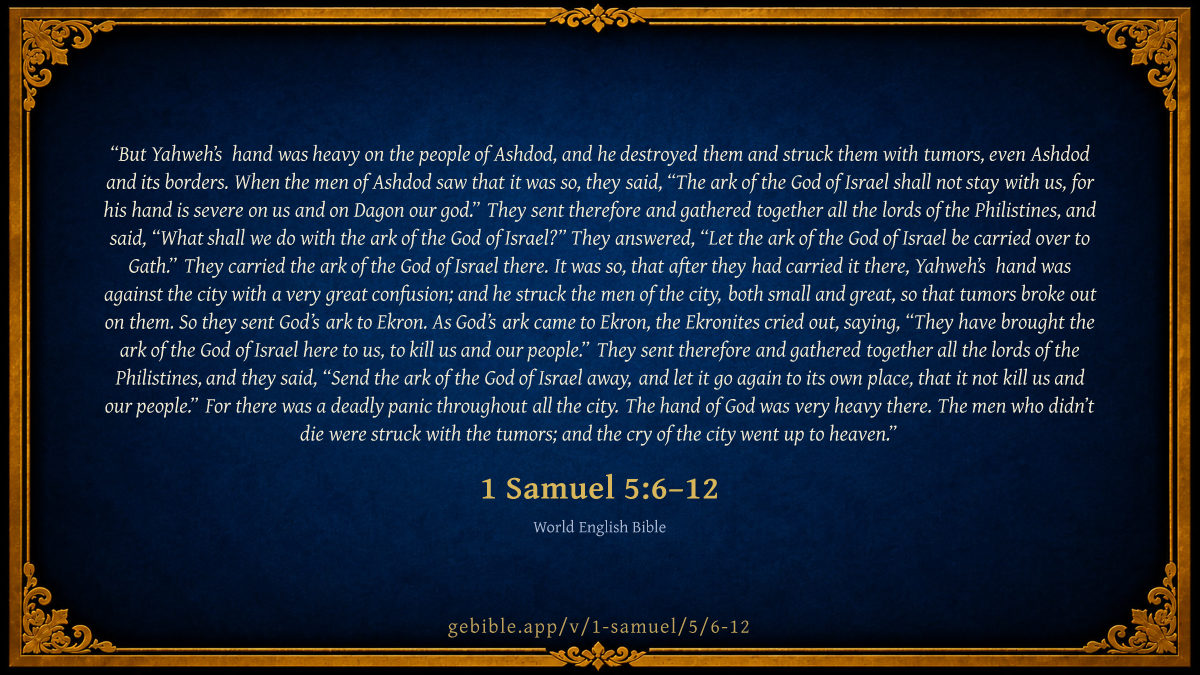
But Yahweh’s hand was heavy on the people of Ashdod, and he destroyed them and struck them with tumors, even Ashdod and its borders.
When the men of Ashdod saw that it was so, they said, “The ark of the God of Israel shall not stay with us, for his hand is severe on us and on Dagon our god.” They sent therefore and gathered together all the lords of the Philistines, and said, “What shall we do with the ark of the God of Israel?” They answered, “Let the ark of the God of Israel be carried over to Gath.” They carried the ark of the God of Israel there.
It was so, that after they had carried it there, Yahweh’s hand was against the city with a very great confusion; and he struck the men of the city, both small and great, so that tumors broke out on them. So they sent God’s ark to Ekron. As God’s ark came to Ekron, the Ekronites cried out, saying, “They have brought the ark of the God of Israel here to us, to kill us and our people.”
They sent therefore and gathered together all the lords of the Philistines, and they said, “Send the ark of the God of Israel away, and let it go again to its own place, that it not kill us and our people.” For there was a deadly panic throughout all the city. The hand of God was very heavy there. The men who didn’t die were struck with the tumors; and the cry of the city went up to heaven.
Geneva Bible translators 1599 · Public Domain On vv8, 11 Though they had felt God’s power, and were afraid…
Though they had felt God’s power, and were afraid thereof, yet they would further try him, which thing God turned to their destruction and his glory.
Geneva Bible (1599) marginal notes — public domain.
John Trapp 1656 · Public Domain On vv6–12 1Sa 5:6 But the hand of the LORD was…
1Sa 5:6 But the hand of the LORD was heavy upon them of Ashdod, and he destroyed them, and smote them with emerods, [even] Ashdod and the coasts thereof.
Ver. 6. But the hand of the Lord was heavy upon them of Ashdod.] For he will not always serve men for a sinning stock, though he oft bear long with them. Patientia laesa sit furor. These men hardened their hearts; God therefore hardeneth his hand, and hasteneth their destruction.
Read full note →
And he destroyed them.] With mice, say some, from 1Sa 6:4; with some other mortal disease, say others, besides that next mentioned; but that might give them their passport, and set them going.
And smote them with emerods.] In podicibus, so Vatablus rendereth it, which some understand de lue Venerea: others, {a} of a cancer or fistula: {A long, narrow, suppurating canal of morbid origin in some part of the body; a long, sinuous pipe-like ulcer with a narrow orifice.} others, of the dysentery or bloody flux: but most, of the emerods or piles, called Mariscae or Ficus, Obscaenus turgenti podice morbus. Let such belly gods, quorum non alia est cura quam cibum ingerere, digerere, egerere, that are good for nothing else but to fill privies, take heed of God’s hand in this kind: as one well warneth shag haired ruffians to beware of the Plica Polonica, that dreadful disease.
{a} Josephus. Sidonius. Bernard.
John Trapp, A Commentary or Exposition upon All the Books of the Old and New Testament (1647–1656) — public domain. Text from a community e-Sword module.
Matthew Poole 1685 · Public Domain On vv6, 8, 9, 10, 11, 12 The hand of the Lord was heavy upon them…
The hand of the Lord was heavy upon them of Ashdod, for their incorrigibleness by the foregoing documents.
He destroyed them; partly by wasting their land, 1Sa 6:5; and partly by killing many of their persons, as is sufficiently implied here, 1Sa 5:10.
Read full note →
Emerods; a disease mentioned only here and Deu 28:27; it was in the hinder parts. It is needless to inquire into the nature of it. It may suffice to know that it was a very sore disease, and not only very vexatious and tormenting, but also pernicious and mortal.
Matthew Poole's English Annotations on the Holy Bible (1683–1685) — public domain. Text from a community e-Sword/MySword module.
Matthew Henry 1710 · Public Domain On v6 The downfall of Dagon (if the people had made…
The downfall of Dagon (if the people had made a good use of it, and had been brought by it to repent of their idolatries and to humble themselves before the God of Israel and seek his face) might have prevented the vengeance which God here proceeds to take upon them for the indignities done to his ark, and their obstinate adherence to their idol, in defiance of the plainest conviction. Lord, when thy hand is lifted up they will not see, but they shall see, Isa 26:11. And, if they will not see the glory, they shall feel the weight, of God's hand, for so the Philistines did. The hand of the Lord was heavy upon them (Sa1 5:6), and he not only convinced them of their folly, but severely chastised their insolence. 1. He destroyed them, that is, cut many of them off by sudden death, those, we may suppose, that had most triumphed in the captivity of the ark. This is distinguished from the disease with which others were smitten. At Gath it is called a great destruction (Sa1 5:9), a deadly destruction, Sa1 5:11. And it is expressly said (Sa1 5:12) that those who were smitten with the emerods were the men that died not by the other destruction, which probably was the pestilence. They boasted of the great slaughter which their sword had made among the Israelites, Sa1 4:10. But God lets them know that though he does not see fit to draw Israel's sword against them (they were unworthy to be employed), yet God had a sword of his own, with which he could make a no less dreadful execution among them, which if he whet, and his hand take hold on judgment, he will render vengeance to his enemies, Deu 32:41, Deu 32:42. Note, Those that contend with God, his ark, and his Israel, will infallibly be ruined at last. If conviction conquer not, destruction shall. 2. Those that were not destroyed he smote with emerods (Sa1 5:6), in their secret parts (Sa1 5:9), so grievous that (Sa1 5:12) the cry went up to heaven, that is, it might be heard a great way off, and perhaps, in the extremity of their pain and misery, they cried, not to Dagon, but to the God of heaven. The Psalmist, speaking of this sore judgment upon the Philistines, describes it thus: God smote his enemies in the hinder parts, and put them to a perpetual reproach, Psa 78:66. The emerods (which we call the piles, and perhaps it was then a more grievous disease than it is now) is threatened among the judgments that would be the fruit of the curse, Deu 28:27. It was both a painful and shameful disease; a vile disease for vile deserts. By it God would humble their pride, and put contempt upon them, as they had done upon his ark. The disease was epidemical, and perhaps, among them, a new disease. Ashdod was smitten, and the coasts thereof, the country round. For contempt of God's ordinances, many are weak and sick, and many sleep, Co1 11:30. 3. The men of Ashdod were soon aware that it was the hand of God, the God of Israel, Sa1 5:7. Thus they were constrained to acknowledge his power and dominion, and confess themselves within his jurisdiction, and yet they would not renounce Dagon and submit to Jehovah; but rather, now that he touched their bone and their flesh, and in a tender part, they were ready to curse him to his face, and instead of making their peace with him, and courting the stay of his ark upon better terms, they desired to get clear of it, as the Gadarenes, who, when they had lost their swine, desired Christ to depart out of their coasts. Carnal hearts, when they smart under the judgments of God, would rather, if it were possible, put him far from them than enter into covenant and communion with him, and make him their friend. Thus the men of Ashdod resolve, The ark of the God of Israel shall not abide with us. 4. It is resolved to change the place of its imprisonment. A great council was called, and the question proposed to all the lords was, "What shall be we with the ark?" And at last it was agreed that it should be carried to Gath, Sa1 5:8. Some superstitious conceit they had that the fault was in the place, and that the ark would be better pleased with another lodging, further off from Dagon's temple; and therefore, instead of returning it, as they should have done, to its own place, they contrive to send it to another place. Gath is pitched upon, a place famed for a race of giants, but their strength and stature are no fence against the pestilence and the emerods: the men of that city were smitten, both great and small (Sa1 5:9), both dwarfs and giants, all alike to God's judgments; none so great as to over-top them, none so small as to be over-looked by them. 5. They were all at last weary of the ark, and very willing to get rid of it. It was sent from Gath to Ekron, and, coming by order of council, the Ekronites could not refuse it, but were much exasperated against their great men for sending them such a fatal present (Sa1 5:10): They have sent it to us to slay us and our people. The ark had the tables of the law in it; and nothing more welcome to faithful Israelites than the word of God (to them it is a savour of life unto life), but to uncircumcised Philistines, that persist in enmity to God, nothing more dreadful nor unwelcome: to them it is a savour of death unto death. A general assembly is instantly called, to advise about sending the ark again to its place, Sa1 5:11. While they are consulting about it, the hand of God is doing execution; and their contrivances to evade the judgment do but spread it. Many drop down dead among them. Many more are raging ill of the emerods, Sa1 5:12. What shall they do? Their triumphs in the captivity of the ark are soon turned into lamentations, and they are as eager to quit it as ever they had been to seize it. Note, God can easily make Jerusalem a burdensome stone to all that heave at it, Zac 12:3. Those that fight against God will soon have enough of it, and, first or last, will be made to know that none ever hardened their hearts against him and prospered. The wealth that is got by fraud and injustice, especially that which is got by sacrilege and robbing God, though swallowed greedily, and rolled under the tongue as a sweet morsel, must be vomited up again; for, till it be, the sinner shall not feel quietness in his belly, Job 20:15-20.
Matthew Henry's Commentary on the Whole Bible (1708–1710) — public domain (CC PDM 1.0). Text via the HelloAO Bible API.
John Gill 1763 · Public Domain On vv6–12 But the hand of the Lord was heavy on…
But the hand of the Lord was heavy on them of Ashdod,.... Not only on their idol, but on themselves; it had crushed him to pieces, and now it fell heavy on them to their destruction:
and he destroyed them; either by the disease after mentioned they were smitten with, or rather with some other, since that seems not to be mortal, though painful; it may be with the pestilence:
Read full note →
and smote them with emerods; more properly haemorrhoids, which, as Kimchi says, was the name of a disease, but he says not what; Ben Gersom calls it a very painful disease, from whence comes a great quantity of blood. Josephus (u) takes it to be the dysentery or bloody flux; it seems to be what we commonly call the piles, and has its name in Hebrew from the height of them, rising up sometimes into high large tumours:
even Ashdod and the coasts thereof; not only the inhabitants of the city were afflicted with this disease, but those of the villages round about.
(u) Antiqu. l. 6. c. 1. sect. 1.
John Gill's Exposition of the Whole Bible (1746–1763) — public domain (CC PDM 1.0). Text via the HelloAO Bible API.
John Wesley 1765 · Public Domain On vv6, 8, 9, 11 Emerods - The piles.
Emerods - The piles.
John Wesley, Explanatory Notes Upon the Whole Bible (1754–1765) — public domain. Text via the GEBible commentary corpus.
Adam Clarke 1810 · Public Domain On vv6, 7, 8, 9, 11, 12 Verse 6. Smote them with emerods] The word עפלים…
Verse 6. Smote them with emerods] The word עפלים apholim, from עפל aphal, to be elevated, probably means the disease called the bleeding piles, which appears to have been accompanied with dysentery, bloody flux, and ulcerated anus.
The Vulgate says, Et percussit in secretiori parte natium; "And he smote them in the more secret parts of their posteriors." To this the psalmist is supposed to refer, Ps 78:66, He smote all his enemies in the HINDER PARTS; he put them to a perpetual reproach. Some copies of the Septuagint have εξεζεσεν αυτοις εις τας ναυς, "he inflamed them in their ships:" other copies have εις τας ἑδρας, "in their posteriors." The Syriac is the same. The Arabic enlarges: "He smote them in their posteriors, so that they were affected with a dysenteria." I suppose them to have been affected with enlargements of the haemorrhoidal veins, from which there came frequent discharges of blood.
Read full note →
The Septuagint and Vulgate make a very material addition to this verse: Και μεσον της χωρας αυτης ανεφυεσιν μυες· και εγενετο συγχυσις θανατου μεγαλη εν τη πολει; Et ebullierunt villae et agri in medio regionis illius; et nati sunt mures, et facta est confusio mortis magnae in civitate: "And the cities and fields of all that region burst up, and mice were produced, and there was the confusion of a great death in the city." This addition Houbigant contends was originally in the Hebrew text; and this gives us the reason why golden mice were sent, as well as the images of the emerods, (1Sa 6:4), when the ark was restored.
Adam Clarke's Commentary on the Bible (1810–1826) — public domain. Text from a community e-Sword/MySword module.
Joseph Benson 1811 · Public Domain On vv6, 7, 9, 11 1Sa 5:6. The hand of the Lord was heavy…
1Sa 5:6. The hand of the Lord was heavy upon them of Ashdod — Since they were so blind as not to see his hand in throwing down their god, he smote them with such sore plagues in their own bodies as made them sensible of his power, by destroying great numbers of them. With emerods — The piles, a most painful and distressing disorder. Ashdod, and the coasts thereof — Not only the people of the city, but of the villages belonging to it, were smitten with this plague.
Joseph Benson's Commentary on the Old and New Testaments (1811–1818) — public domain. Text from a community e-Sword module.
Albert Barnes 1834 · Public Domain On vv6, 8 Emerods - A corruption of “hemorrhoids.” It is mentioned…
Emerods - A corruption of “hemorrhoids.” It is mentioned Deu 28:27 among the diseases with which God threatened to punish the Israelites for disobedience.
Albert Barnes' Notes on the Bible (1834–1885) — public domain. Text from a community e-Sword/MySword module.
Haydock's Catholic Bible Commentary 1859 · Public Domain On vv6, 7, 8, 9, 12 Emerods. The particular disorder which attacked them, (Psalm lxxvii.…
Emerods. The particular disorder which attacked them, (Psalm lxxvii. 66,) is very uncertain. Some say it was the dysentery, or the fistula, or the venereal disease, &c. Eusebius believes that it was in punishment of their incontinency. It was very painful, and sometimes proved mortal, ver. 12. Aristophanes assures us that the Athenians were punished with a shameful disorder, because they had not received the mysteries of Bacchus with due respect; and they were ordered, by the oracle, to make and carry aloft some obscene figures, before they could obtain a cure. (Acharn. ii. 6.) --- And in, &c. The remainder of this verse is not found in Hebrew, Chaldean, Syriac, Arabic, &c., nor in many Greek and Latin copies. But it is conformable to the truth of history, since we read that figures of these animals were placed beside the ark, in memory of this event, chap. vi. 6. --- Mice, or rats. Such vermin have often obliged people to abandon their country. (Pliny, [Natural History?] viii. 28.) --- Bellon. (ii. 78,) testifies that he saw, near Gaza, such multitudes, as to depopulate whole fields; and, if Providence had not caused the birds, called boudres, to destroy them, the people could nav had no harvest.
George Leo Haydock (1774–1849), Haydock's Catholic Family Bible and Commentary, 1859 edition — public domain. Excludes Psalms (Douay-Rheims chapter numbering differs from Protestant) and Deuterocanonical books (Catholic canon only).
Robert Jamieson, A. R. Fausset & David Brown 1871 · Public Domain On vv6, 7, 11, 12 THE PHILISTINES ARE SMITTEN WITH EMERODS. (Sa1 5:6-12)
THE PHILISTINES ARE SMITTEN WITH EMERODS. (Sa1 5:6-12)
the hand of the Lord was heavy upon them of Ashdod--The presumption of the Ashdodites was punished by a severe judgment that overtook them in the form of a pestilence.
Read full note →
smote them with emerods--bleeding piles, hemorrhoids (Psa 78:66), in a very aggravated form. As the heathens generally regarded diseases affecting the secret parts of the body as punishments from the gods for trespasses committed against themselves, the Ashdodites would be the more ready to look upon the prevailing epidemic as demonstrating the anger of God, already shown against their idol.
Jamieson, Fausset & Brown — Commentary Critical and Explanatory on the Whole Bible (1871) — public domain (CC PDM 1.0). Text via the HelloAO Bible API.
Daniel D. Whedon 1874 · Public Domain On vv6–11 6. Hand of the Lord was heavy upon them…
6. Hand of the Lord was heavy upon them of Ashdod — Not only did Dagon suffer shame, but the persons and lands of his worshippers were visited with plagues.
Destroyed them — Made them desolate and terror-stricken by fearful diseases on their bodies, and wasting devastation in their fields. The Hebrew word may be rendered, He caused them to be amazed, that is, by the fearful judgments with which he afflicted them.
Read full note →
Emerods — There is some uncertainty as to the nature of the disease here indicated. The more proper English word is hemorrhoids, from the Greek αιμορροος, a flow of blood. Accordingly, Josephus and some English commentators understand it here to mean dysentery. Josephus says: “God sent a very destructive disease upon the city and country of Ashdod, for they died of the dysentery and flux, a sore distemper, that brought death upon them very suddenly; for before the soul could, as usual in easy deaths, be well loosed from the body, they brought up their entrails, and vomited up what they had eaten, and what was entirely corrupted by the disease.” But 1Sa_5:12 clearly shows that the disease was not necessarily fatal. A more plausible explanation is, that which makes the word mean bleeding piles, and this is favoured by the English and several ancient versions of 1Sa_5:9, where see note. The Hebrew word is the plural of עפל, a hill, and, used to designate some disease of the body, it would most naturally mean some rising or swelling of the flesh. Hence Gesenius, Furst, and Keil appropriately render the word by tumours or boils. In 1Sa_6:11; 1Sa_6:17, the word שׂחורים is used, whose root, according to Furst, means to glow, to burn, to kindle, and may therefore be properly rendered inflammatory tumours. The Masoretes have substituted this latter word in the keri for עפלים, perhaps, as some suggest, to make the reading more euphemistical. In 1Sa_5:9 the disease is spoken of as a breaking out, (נשׂתר,) an expression most naturally used of boils or tumours. We may safely conclude, therefore, that the word has essentially this sense. See further on 1Sa_5:9.
Ashdod and the coasts thereof — These words are grammatically in apposition with them, and are added to indicate the extent of the plague. The Septuagint, evidently in anticipation of what is said in 1Sa_6:5, adds the following: “And in the midst of that region were produced mice, and there was a great confusion of death in the city.” Besides this, the Vulgate also has, “The villas and fields in the midst of that region burst up.” These are doubtless interpolations from other passages, though Thenius takes them as evidences of corruption in the Hebrew text.
Daniel D. Whedon (gen. ed.), Commentary on the Old and New Testaments (1874–1909) — public domain. Text from a community e-Sword module.
The Cambridge Bible for Schools and Colleges 1878 · Public Domain On vv6–12 6. But the hand of the Lord] Rather, And.…
6. But the hand of the Lord] Rather, And. “The hand of the Lord” = the putting forth of His might. Chastisement now overtook the people as well as the god.
he destroyed them, and smote them with emerods] A double calamity fell upon them (1) Their land was ravaged by a plague of mice. The present Heb. text leaves this to be inferred from ch. 1Sa_6:5, but the Sept. inserts here “And mice sprang up in the midst of their land, and there was a very deadly destruction in the city.” This may be merely an inference from 1Sa_5:11 and 1Sa_6:5, but the numerous divergences of the Sept. from the existing Heb. text in chaps, 5 and 6 (making full allowance for obvious glosses and errors of transcription) seem to shew that the Greek translators employed a text which had not been subjected to the final revision which fixed our present Heb. text.
Read full note →
(2) Their bodies were attacked by a loathsome and painful disease, either (a) emerods = haemorrhoids or bleeding piles; or more probably (b) boils, which are a characteristic symptom of the oriental plague. The latter explanation agrees better with the infectiousness and fatality of the scourge.
the coasts thereof] = the borders thereof. Coast is derived from costa, a rib, or side, and originally meant any border or frontier-line, not the sea-line only, cp. Jos_1:4.
The Cambridge Bible for Schools and Colleges (gen. ed. J. J. S. Perowne; Cambridge University Press, 1878–1918) — public domain. Text from a community e-Sword module.
Ellicott's Commentary for English Readers 1878 · Public Domain On vv6, 8, 11 (6) But the hand of the Lord was heavy…
(6) But the hand of the Lord was heavy upon them of Ashdod.—A painful and distressing sickness, in the form, perhaps, of tumours—(the word emerods should be spelt hemorrhoids)—broke out among the inhabitants of the Philistine city in which was situated the idol temple, where was placed the Ark of the Covenant. The LXX. has an addition to the Hebrew text here which speaks of a terrible land plague which, apparently from subsequent notices, visited Philistia in addition to the bodily sufferings here spoken of. The Greek Version adds to 1Sa_5:6 these words: “and mice were produced in the land, and there arose a great and deadly confusion in the city.” In 1Sa_6:4, &c, among the expiatory offerings sent by the idolators to Israel to appease what they imagined the offended Hebrew God, “golden mice” are mentioned: “images of the mice that mar the land.” The mouse, according to Herodotus and the testimony of hieroglyphics, was an old symbol of pestilence. The Greek translators, however, failing to understand the meaning of the offering of golden mice, added the words—apparently in accordance with a received tradition—by way of explanation.
A Bible Commentary for English Readers, edited by Charles John Ellicott (1878–1897) — public domain. Text from a community e-Sword module.
The Pulpit Commentary 1880 · Public Domain On vv6, 7, 8, 9, 10, 12 But the hand of Jehovah was heavy upon them…
But the hand of Jehovah was heavy upon them of Ashdod. i.e. his power and might were exercised in smiting them with severe plagues. A question here arises whether, as the Septuagint affirms, besides the scourge of emerods, their land was desolated by swarms of field mice. It is certain that they sent as votive offerings golden images of "the mice that mar the land" (1Sa_6:5) but the translators of the Septuagint too often attempt to make all things easy by unauthorised additions, suggested by the context; and so probably here it was the wish to explain why mice were sent which made them add, "and mice were produced in the land." Really the mouse was a symbol of pestilence (Herod., 2:141), and appears as such in hieroglyphics; and by sending golden mice with golden emerods the lords of the Philistines expressed very clearly that the emerods had been epidemic. This word, more correctly spelt haemorrhoids, has this in its favour, that the noun used here, ophalim, is never read in the synagogue. Wherever the word occurs the reader was instructed to say tehorim, the vowels of which are actually attached to the consonants of ophalim in the text of our Hebrew Bibles. In Deu_28:9:7 tehorim is mentioned as one of the loathsome skin diseases of Egypt, and though rendered "emerods" in the A.V, is possibly, as translated by Aquila, "an eating ulcer." Ophalim need only mean turnouts, swellings, its original signification being "a hill"; (2Ch_27:3) yet as the word was not thought fit for public reading in the synagogue, we may feel sure that it means some such tumours as the A.V describes.
Vers. 6-12.
Read full note →
Coercive providences.
The facts given are
1. God visits the men of Ashdod with severe affliction.
2. In their perplexity they remove the ark to another locality.
3. The device proving a failure, and the men of Ekron refusing to receive the unwelcome symbol, a council of authorities decides to return it to Israel. Providence had so ordered events for high moral ends as to bring the ark into captivity. The influences were at work in Israel to issue in the result desired. Hence there arose a need for a turn in the course of Providence.
I The NEED FOR COERCIVE PROVIDENCES ARISES CHIEFLY FROM TWO CAUSES.
1. Imperfect acquaintance with the Divine will. These men had some knowledge of the Divine power in the ark, but could not learn the precise will of the strange god. One of the first things, therefore, is to prompt to an inquiry as to what is desired. But man, especially when grossly ignorant, is indisposed to search for light, and cannot bear very clear light. If men will not act because they do not know, they must be aroused to learn, or to do without knowing; for God"s great ways must not be barred and blocked by man.
2. Unwillingness to be convinced of the Divine will. The fall of Dagon on the first night aroused the thought of a superior power, and the danger of keeping it from its natural place. This first gleam of light was extinguished by a new trial of Dagon"s power to stand. A second failure brought more light, but the expedient of change of abode was adopted to evade the new and clearer suggestion. Men often do not like to know the path of duty. There is much ingenuity spent in evading the force of Divine teaching. If they will not follow increasing light when their doing so is necessary to the realisation of a Divine purpose, pressure must be brought to bear. Pharaoh, Balaam, and Jonah are instances of this.
II The KIND OF COERCION EMPLOYED WILL DEPEND ON THE MENTAL AND SOCIAL CONDITION OF THE PEOPLE. Men are influenced strongly by events which touch their interests, and which come in such shape as to be adapted to their ordinary modes of thought and views of things. The people of Ashdod were highly susceptible to religious impressions, and their religious associations were entirely with the honour of their god. Philosophical arguments and high-toned reasons suited to pure Hebraism or Christianity would not have touched them. Moreover, by education and inheritance they were governed by the habit of associating bodily sufferings, when great, with a positive Divine purpose. Now, God governs men according to their capabilities, and reveals his will in ways conformable to their ruling ideas. Whether by miracle or natural coincidences, there is always adaptation to the minds to be influenced. This principle solves many events in Old Testament history, and shows the perfect reasonableness and even propriety of the pressure brought to bear on the benighted Philistines. God fits every rod to the back of the fools he smites, and speaks to every ear in accents suited to its delicacy or obtuseness.
III The COERCION IS PROGRESSIVE IN INTENSITY. The select body of priests of Dagon first feel the hand of God, then the people as individuals, and then the entire community as such. Also, there was first a rude blow to the religious prejudices of the priestly body, and through them of the people; then an assault on the physical condition of multitudes; and finally a disastrous blow on the prosperity of the state. Men will answer religious arguments by religious arguments, and evade truth if possible; but touch their bodies and their fields, and some earnest inquiry as to the cause and intent will be evoked. Especially does material disaster induce effort to learn the truth when authorities are compelled to deliberate on possible remedies. In national providences the pressure at last reaches the rulers.
General lessons:
1. God uses pressure on each of us when our inclination runs against our true interest and his glory. Lot was led urgently out of Sodom.
2. The pressure used never crushes the will, but develops thought, andopens out lines of conduct for adoption.
3. It is important to study the meaning of events in our lives which areinevitable and disagreeable.
4. The coercive action of Providence will become less or more accordingas we turn from sin or harden our hearts. "The way of transgressors is hard."
The Pulpit Commentary (1880–1919), ed. H.D.M. Spence-Jones & Joseph S. Exell — public domain. Text from a community e-Sword module.
The Biblical Illustrator 1887 · Public Domain On vv8, 12 What shall we do with the ark of the…
1Sa_5:8
What shall we do with the ark of the God of Israel.
Read full note →
The ark of God
It often happens that when a person has at last obtained that which he most desired he does not know what to do with it. This may be said of money after a life of economy and strict attention to business; of repose after a life of toil; and of many other aims and objects in life. Now in the passage quoted you find the Philistines in a similar difficulty: they had obtained possession of that which they considered the greatest prize of warfare. It was a mighty spoil; it caused no little joy to the Philistines; but his loss was a terrible and crushing blow to Israel. The ark had changed hands. The Philistines had now in their custody the Ark of God. It was a sore trouble to them. That material construction is now long ago broken up and destroyed: the wood and gold have perished; but the Divine Presence still lives on. The Church preserves her identity under all adverse circumstances: the Ark remained the same sacred witness to Gods Truth wherever carried. (2Co_2:15-16.) It is wonderful to notice how Gods Spirit forces this fact upon the world. The world is compelled to recognise the presence of religion, however it may recoil from the claims of religion. The history of the world ever since the Christian era commenced is a proof of this: what would become of any record of the first three centuries which failed to take account of the religious element? The history of the Roman Empire at that time is, in fact, the history of the Church. History tells you how Christianity springing up in the Roman provinces perplexed the authorities; how at last it spread; how outbreaks of persecution only tended to strengthen and deepen its roots; but yet all proves how the world had begun to ask this question as to the religion of the day: What shall we do with the Ark of God? Then, again: how much more attentively the action of the Church is now watched by the public, than used to be the case formerly. Whatever it be which relates to religion, there is the same watchfulness from without. Again and again the world enquires, at moments the most trivial, at social parties, at merry meetings, just for the sake of saying something, or to start a subject, What shall we do with the Ark of God? And see only how religion is employed to puff literature. Some periodical or magazine is started: it will not sell unless there be an element of religion in it. It is only one other instance of the editor eyeing religion, considering what he can get out of the religious element which will find him readers: he only says, What shall we do with the Ark of God? And further. Consider the prejudices of the present day. Mark the obvious success of attempts which at first were regarded cynically or coldly. The world has been convinced that Church principles cannot easily be laughed out of court, and that conscientious convictions are worthy of respect; that blameless lives conduce to the welfare of society. So gradually the world tempers its opposition; it wishes to moderate religious enthusiasm; it desires to reduce the Church to its own level; it would like to enjoy all successes which the Church achieves in fashioning well-ordered citizens; but at the same time the world would tie down the action of the Church to the limits of the popular will. What shall we do to these men? For that a notable miracle hath been done by them is manifest to all those that dwell in Jerusalem. What shall we do with the Ark of God? But with regard to your own relation to holy things; does not this perplexity of the Philistines find an answer in your own hearts? You have lived many years with the light of truth burning brightly before you, God has cast your lot in a Christian land, not in a land of idols. God has blessed you with a religious home, with serious parents. How have you regarded holy things? Have not you sometimes felt them irksome? as if you did not quite know what to do with religion; as if the things of God stood in your way; as if they shackled you; as if they dwarfed the development of your life, and paralysed somewhat the hopes of your career? And yet you did not like to send the Ark away; you would not give up religion; you recognised its value too highly; you were afraid to east off God and to disown Him; yet a secret wish sprang up that you had never known so much of truth; you almost deemed the heathen happy, because you fancied that he could have no embarrassing scruples. What were you to do with the Ark of God! It so often came across your path; every now and then disputing the way; telling you that you must not do this or that. At such moments did not religion seem unwelcome? somewhat as an intruder? For thus it is that religious scruples do harass men when they least like it. Gods mercy sends the Angel to bar the way: and such is Gods love, the Angel moves further and further into narrow places, where there is no way to turn either to the right hand or to the left; narrow places where the choice more directly confronts the sinner; where he may see more evidently the blackness of sin in contrast with the pure white light of holiness. There is nothing more contemptible, or more miserable, than shifting about between two opinions. The Philistines were never more wretched than when they were employed in passing on the Ark from one city to another. Shame and disease marked that period of seven months indecision. It was far better when they sent the Ark back to its rightful owners. At least it was a decided step; there was no halting between two opinions if you want to insult God, then, use religion as a tool for your own convenience and not as a principle of life. The sin of the world has lain chiefly in this prostitution of religion. It has proved the curse and downfall of nations; the deterioration and ruin of man. Heathen ignorance is better than Christian indifference; depend upon it, nothing is so prolific of infidelity as indecision. Balaam tampering with the commands of God; Ahab sending for, but not obeying, Micaiah; Herod hearing John gladly, but persisting in his adultery; Judas following Jesus, but selling Him for silver; Demas beginning well, but falling away to self-indulgence; these are the emissaries which the devil employs to deceive mankind. Rather learn by Gods grace to regard religion and truths claims not as a moral intrusion, but as affording a principle on which to rule your life. Religion is not a subject to be handled at our will; it is not just now and then to serve our turn, and then to be laid aside for some possible future use; but it is a principle to enter into all our ways. (C. A. Raymond, M. A.)
The Biblical Illustrator, edited by Joseph S. Exell (c. 1880s–1900s) — public domain. Text from a community e-Sword module.
The Preacher's Complete Homiletical Commentary 1892 · Public Domain On v6 1Sa_5:6. “He destroyed them.” From 1Sa_6:4-5; 1Sa_6:11; 1Sa_6:18, where,…
CRITICAL AND EXPOSITORY NOTES—
1Sa_5:6. “He destroyed them.” From 1Sa_6:4-5; 1Sa_6:11; 1Sa_6:18, where, besides the votive offering referring to the bodily disease, a second, the golden mice, is expressly mentioned, it is clear that, in addition to the corporal plague, another, a land-plague, had fallen on the Philistines. “He destroyed them” (like “destruction” or “desolation,” in Mic_6:13, used of persons) denotes a wasting of the land, that is, of the produce of the fields, as the support of human life, by mice which “destroy the land” (1Sa_6:5). (Erdmann.) “We must go to the East for parallels to these ancient plagues. A parallel to this plague of mice is furnished in the recent history of Ceylon. In 1848, the coffee-crop of that fertile island was utterly destroyed by mice, and the people, losing their staple harvest, were reduced to the most terrible misery and want.” (S. Cox.) “Emerods.” “The disease we call bleeding piles,” a disease very common in Eastern lands, where the extreme heat induces indisposition to exercise, and the liver is very apt to grow sluggish and weak. The word is vernacular English for the Greek compound from which we derive the technical medical terms, “hemorrhoids, hemorrhage,” which designate a flow of blood. (S. Cox.) “The heathen generally regarded diseases affecting the secret parts of the body as punishments from the gods for trespasses committed against themselves.” (Jamieson.)
Read full note →
1Sa_5:8. “Let the ark of the God of Israel,” etc. The princes of the Philistines probably imagined that the calamity which the Ashdodites attributed to the ark of God, either did not proceed from the ark, i.e., from the God of Israel, or if actually connected with its presence, simply arose from the fact that the city itself was hateful to the God of the Israelites, or that the Dagon of Ashdod was weaker than the Jehovah of Israel; they therefore resolved to let the ark be taken to Gath in order to pacify the Ashdodites.” (Keil.) “Gath.” Also one of the five Philistian satrapies. Its site is not accurately known, but it is generally identified with the modern Tell-es-Sâfieh, 10 miles east of Ashdod, and about the same distance S. by E. of Ekron. (See Smith’s Biblical Dictionary.)
1Sa_5:10. “Ekron.” Another of the princely cities, now Akir.
1Sa_5:12. “The cry of the city went up to heaven.” “The disease is attended with acute pain” (Jamieson).
Note.—This chapter, with the following, strikingly illustrates the non-missionary character of the old dispensation. For centuries the Israelites were near neighbours of the Philistines, and had some acquaintance with their political and religious institutions. Yet the Philistines had at this time only a garbled and distorted account (1Sa_4:8) of the history of the Israelites, derived probably from tradition, and seemingly no particular knowledge of their religion, nor did the Israelites ever attempt, though they were in the times of Samson and David in close connection with Philistia, to carry thither a knowledge of what they yet believed to be the only true religion. This religious isolation was no doubt a part of the Divine plan for the development of the theocratic kingdom, guarding it against the taints of idolatry, and permitting the chosen people thoroughly to apprehend and appropriate the truth which was then to go from them to all the world. But if we look for the natural causes which produced this isolation in ancient times, we shall find one in the narrowness of civilisation of ancient times, where the absence of means of social and literary communication fostered mutual ignorance and made sympathy almost impossible, and another in the peculiarly national local nature of the religion of Israel, with its central sanctuary and its whole system grounded in the past history of the nation, presenting thus great obstacles to a foreigner who wished to become a worshipper of Jehovah. (Amer. Tranr. of Lange’s Commentary).
MAIN HOMILETICS OF THE PARAGRAPH.—1Sa_5:6-12
THE JUDGMENTS UPON THE PHILISTINES
I. When judgment begins with the people of God it is certain to extend to the ungodly. If a human king is just he will visit his own family with punishment if they break the laws of his kingdom. But the very fact that he does so is a pledge that he will not spare the rest of his subjects if they are found guilty. Judgment will begin where transgression ought, least of all, to appear, and where, if it appear, it ought to be least tolerated; but should the same sins be committed by others, it may be regarded as certain that it will extend to them also. God deals with men as a good king and father deals with his children. He will certainly inflict chastisement upon those who are most nearly related to Him by moral character, but He will not spare those who are utterly ungodly. God’s ancient people, at this period in their history, needed chastisement, and they had it. He avenged the dishonour which had been done to His name by those whom He “had nourished and brought up” as His children (Isa_1:2) by a heavy visitation. But He did not spare the more guilty Canaanites. When judgment “begins at the house of God,” the question forces itself upon the mind, “Where shall the ungodly and the sinner appear?” (1Pe_4:17-18).
II. When the ungodly have been used as instruments of Divine chastisement, they are chastened themselves to teach them that they were not chosen for their moral excellence. Sometimes delay takes place in the execution of a criminal, not because there is any reason to show him favour, but that he may be used to bring others to justice. When he has been used for this purpose he finds that the same law which convicts them punishes him also. It is often so in the righteous government of God. He selected Nebuchadnezzar to be His battle-axe when Israel needed chastisement, but he was but a reprieved criminal, and when he had fulfilled the Divine purpose he was made to feel that it was so. Here the Philistines were made the instruments of God’s judgment upon His people, but they soon found that they had not been selected for this work because they were held in favour by Jehovah. The hand of God upon them soon taught them that they also were under His displeasure—that God had, in the language of the prophet, taken “the cup of trembling, even the dregs of the cup of His fury, and put it into the hand of them that afflicted Israel” (Isa_51:22-23).
III. There may be an admission that God has smitten without true repentance. The Philistines confessed that the hand of Jehovah was sore upon them, and upon their god, but it led to no investigation into His claims to their homage—to no change in their disposition towards Him. Pharaoh acknowledged that “the Lord was righteous, and that he and his people were wicked” (Exo_9:27), but his admission had no effect upon his conduct. Saul admitted that God had forsaken him, and was visiting him for his sin, but he turned not to Him who had smitten him, but, in direct opposition to the Divine command, sought counsel of a witch. Many men in every age are compelled to acknowledge that God is visiting them, yet they will not turn to Him in repentance. They may cry to God in their despair, but they give evidence that it is not sin that troubles them, but the punishment of sin. Like the Philistines, they would be rid of their suffering, but they are not willing to give up their Dagons, and to give glory and render obedience to the Lord of hosts.
OUTLINES AND SUGGESTIVE COMMENTS
1Sa_5:6. The hand of the Almighty, which moved them not in falling on their god, falls now nearer on their persons, and strikes them in their bodies which would not feel themselves stricken in their idol. Pain shall humble them, when shame cannot.—Bp. Hall.
1Sa_5:7. They should have rather parted with their sins than with the ark, and have said unto their sins “Get thee hence,” as Isa_30:22. What have we to do any more with Dagon who cannot save himself, much less us, from the Divine vengeance? Wicked men are glad upon all occasions to be rid of God and His ark, His ordinances, which they, Philistine-like, have rather as prisoners than as privileges.—Trapp.
The emerods were not a disease beyond the compass of natural causes; neither was it hard for the wiser sort to give a reason of their complaint; yet they ascribe it to the hand of God: the knowledge and operation of secondary causes should be no prejudice to the first. They are worse than the Philistines who, when they see the means, do not acknowledge their first Mover, whose active just power is no less seen in employing ordinary means than in raising up extraordinary; neither doth He less smite by a common fever, than by an avenging angel.—Bp. Hall.
1Sa_5:10. The struggles of the Philistines against Jehovah tended only to bring the ark nearer to its own home, and to bring more evils on its enemies. The sufferings of Ekron were worse than those of Ashdod, and the sufferings of Gath were more grievous than those of Ekron. So all the assaults of the enemies of the faith against the ark of Christ’s church will serve only to bring her nearer to her heavenly and eternal home.—Wordsworth.
Thus they send the plague of God up and down to their neighbours. Wicked men use to draw others into partnership of their condemnation.—Trapp.
1Sa_5:11. When man’s heart will not give up its worthless idols, though God’s hand draw it to Himself by affliction and suffering, then the distance between him and the God that offers to be with him becomes greater in proportion to the severity and painfulness of the suffering felt by the soul alienated from God and devoted to idolatry. We shall at last desire to be entirely away from God, as the Philistines at last resolved to carry the ark over the border, that they might have nothing more to do with the God of Israel, while, on the contrary, the ark should have warned them to give glory to the God of Israel, who had so unmistakably and gloriously revealed Himself to them.—Lange’s Commentary.
God knows how to bring the stubbornest enemy on his knees, and make him do that out of fear which His best child would do out of love or duty … It is happy that God hath such store of plagues and thunderbolts for the wicked: if He had not a fire of judgment, wherewith iron hearts might be made flexible, He would want obedience, and the world peace.—Bp. Hall.
1Sa_5:12. The cry that ascends to heaven over sufferings and afflictions that are the consequences of wickedness, is by no means a sign that need teaches prayer; it may be made wholly from a heathen point of view. The cry that penetrates into heaven is “Against thee have I sinned,” and is the expression of an upright, earnest penitence, which is awakened in the heart by the chastisement of God’s hand.—Lange’s Commentary.
The Preacher's Complete Homiletical Commentary (gen. ed. Joseph S. Exell; Funk & Wagnalls, c. 1892) — public domain (pre-1929). A full-Bible homiletical/sermon-outline anthology covering 65 of 66 books (2 John is absent from the source module). Text from a community e-Sword module.
Paul E. Kretzmann 1924 · Public Domain On v8 The Ark in Gath and Ekron
The Ark in Gath and Ekron
v. 8. They sent, therefore, and gathered all the lords of the Philistines, the heads of their five city-states, unto them and said, What shall we do with the ark of the God of Israel? As eager as they were to have the ark in their city as a trophy of their great victory, so eager were they now to get rid of the unlucky piece of furniture. And they answered, Let the ark of the God of Israel be carried about unto Gath. The princes of the Philistines intended to make an experiment, in order to determine whether the misfortunes which struck Ashdod were really to be attributed to the ark or were the result of chance. And they carried the ark of the God of Israel about thither, farther to the east.
Read full note →
v. 9. And it was so that, after they had carried it about, caused it to be taken in the indicated direction, to this second city, the hand of the Lord was against the city with a very great destruction, disquietude, consternation taking hold upon all the inhabitants, a feeling of impending disaster; and He smote the men of the city, both small and great, and they had emerods in their secret parts, they were plagued with the same eruption of boils as the people of Ashdod had been, and the boils apparently broke open, causing painful ulcers.
v. 10. Therefore they sent the ark of God to Ekron, the chief city in the northwestern part of the Philistine country. And it came to pass, as the ark of God came to Ekron, by the command of the Philistine chiefs, that the Ekronites cried out, for they had been informed of the plague which had struck Ashdod and Gath, saying, They have brought about the ark of the God of Israel to us to slay us and our people. But their protest was ignored, and the ark was brought into their city.
v. 11. So they sent and gathered together all the lords of the Philistines, for a second conference, and said, Send away the ark of the God of Israel, and let it go again to his own place, that it slay us not and our people. The plague was not only generally prevalent, but also especially malignant, the effects being exceptionally deadly; for there was a deadly destruction, a consternation of terror on account of the sudden death of so many people, throughout all the city; the hand of God was very heavy there, the severity of the plague here reached its greatest height.
v. 12. And the men that died not were smitten with the emerods, being extremely ill with the boil-sickness; and the cry of the city went up to heaven, for the Philistines were forced to acknowledge that in this place the almighty hand of the God of Israel was revealed. Thus the Lord revenged the sacrilege of the heathen in laying their hands upon the ark consecrated to Him. When unbelievers presume to attack the Word of God, to blaspheme and persecute the Word of Salvation, and, in addition, refuse to bow under the chastening hand of God, He often visits them with very severe plagues and terrors.
Paul E. Kretzmann, Popular Commentary of the Bible (1921–1924) — public domain. Text from a community e-Sword module.
unfoldingWord translationNotes 2017 · CC BY-SA 4.0 On vv6, 8, 10, 11 Yahweh's hand was heavy upon
Yahweh's hand was heavy upon
This is an idiom. "Yahweh severely judged" (See: Idiom)
Read full note →
tumors
Possible meanings are 1) painful swelling under the skin or 2) hemorrhoids.
both Ashdod and its territories
The name of the town is a metonym for the people living in the town. "both the people of Ashdod and the people in the land surrounding Ashdod" (See: Metonymy)
the men of Ashdod realized
"the men of Ashdod understood"
ark of the God of Israel
See how you translated this in 1 Samuel 3:3. This is the a same as the "ark of the covenant of God" in 1 Samuel 4:3-4.
translationWords
Yahweh
hand
people group
afflicted
ark of the covenant
Israel
false god
unfoldingWord translationNotes — © Distant Shores Media and the Door43 World Missions Community, licensed CC BY-SA 4.0. Source: git.door43.org/Door43/en_tn.
Tyndale Open Study Notes 2022 · CC BY-SA 4.0 On vv6, 8, 9, 10 5:6 tumors: The Hebrew term can mean simply “swellings.”…
5:6 tumors: The Hebrew term can mean simply “swellings.” A possible alternative translation is “hemorrhoids.” They were possibly the fatal buboes of bubonic plague, which attack the lower body, especially the rectal area. Rats are known carriers of the plague.
Tyndale Open Study Notes — © Tyndale Open Resources, licensed CC BY-SA 4.0. Text via the HelloAO Bible API.