
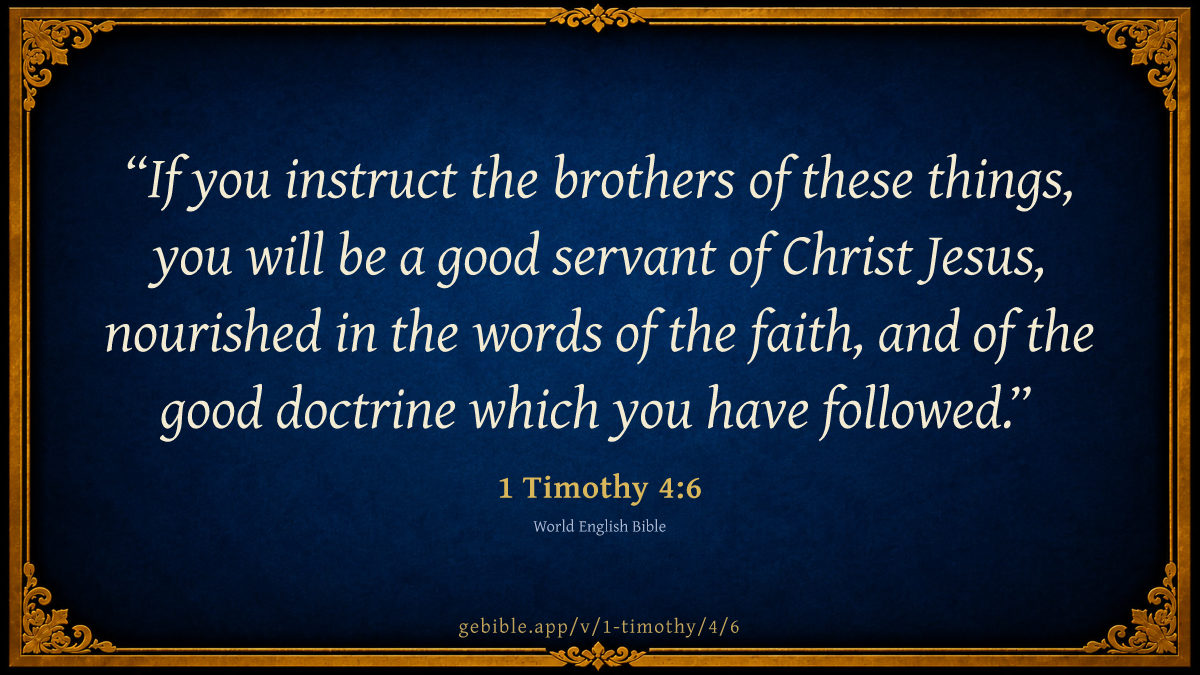
If you instruct the brothers of these things, you will be a good servant of Christ Jesus, nourished in the words of the faith, and of the good doctrine which you have followed.
Parallel Translations
-
If you instruct the brothers of these things, you will be a good servant of Christ Jesus, nourished in the words of the faith, and of the good doctrine which you have followed.
-
Yf thou shalt put the brethren in remembraunce of these thynges thou shalt be a good minister of Iesu Christ which hast bene norisshed vp in the wordes of the fayth and good doctryne which doctryne thou hast continually followed.
-
If thou put the brethren in remembrance of these things, thou shalt be a good minister of Iesus Christ, which hast bene nourished vp in the wordes of faith, and of good doctrine, which thou hast continually followed.
Cross-references (34)
Passages linked to 1 Timothy 4:6 in the Treasury of Scripture Knowledge, ordered by reader-vote popularity; verse text shown in World English Bible.
- Titus 2:7-10 In all things be showing yourself an example of good works. In your teaching, be showing integrity, seriousness, incorruptibility, and soundness of speech that can’t be condemned, that he who opposes you may be ashamed, having no evil thing to say about us. Exhort servants to be in subjection to their own masters and to be well-pleasing in all things, not contradicting, not stealing, but showing all good fidelity, that they may adorn the doctrine of God, our Savior, in all things.
- Colossians 3:16 Let the word of Christ dwell in you richly; in all wisdom teaching and admonishing one another with psalms, hymns, and spiritual songs, singing with grace in your heart to the Lord.
- Matthew 13:52 He said to them, “Therefore every scribe who has been made a disciple in the Kingdom of Heaven is like a man who is a householder, who brings out of his treasure new and old things.”
- Colossians 4:7 All my affairs will be made known to you by Tychicus, the beloved brother, faithful servant, and fellow bondservant in the Lord.
- 2 Timothy 3:14-17 But you remain in the things which you have learned and have been assured of, knowing from whom you have learned them. From infancy, you have known the holy Scriptures which are able to make you wise for salvation through faith, which is in Christ Jesus. Every Scripture is God-breathed and profitable for teaching, for reproof, for correction, and for instruction in righteousness, that each person who belongs to God may be complete, thoroughly equipped for every good work.
- Titus 2:1 But say the things which fit sound doctrine,
- 2 Peter 3:1-2 This is now, beloved, the second letter that I have written to you; and in both of them I stir up your sincere mind by reminding you, that you should remember the words which were spoken before by the holy prophets, and the commandment of us, the apostles of the Lord and Savior:
- Psalms 19:7 Yahweh’s law is perfect, restoring the soul. Yahweh’s covenant is sure, making wise the simple.
- Proverbs 4:2 for I give you sound learning. Don’t forsake my law.
- Jeremiah 15:16 Your words were found, and I ate them. Your words were to me a joy and the rejoicing of my heart, for I am called by your name, Yahweh, God of Armies.
- John 7:16-17 Jesus therefore answered them, “My teaching is not mine, but his who sent me. If anyone desires to do his will, he will know about the teaching, whether it is from God, or if I am speaking from myself.
- Acts 20:31 Therefore watch, remembering that for a period of three years I didn’t cease to admonish everyone night and day with tears.
- Acts 20:35 In all things I gave you an example, that so laboring you ought to help the weak, and to remember the words of the Lord Jesus, that he himself said, ‘It is more blessed to give than to receive.’”
- Romans 15:15 But I write the more boldly to you in part, as reminding you, because of the grace that was given to me by God,
- 1 Corinthians 4:1-2 So let a man think of us as Christ’s servants, and stewards of God’s mysteries. Here, moreover, it is required of stewards that they be found faithful.
- 1 Corinthians 4:17 Because of this I have sent Timothy to you, who is my beloved and faithful child in the Lord, who will remind you of my ways which are in Christ, even as I teach everywhere in every assembly.
- 2 Corinthians 3:6 who also made us sufficient as servants of a new covenant, not of the letter, but of the Spirit. For the letter kills, but the Spirit gives life.
- 2 Corinthians 6:4 but in everything commending ourselves, as servants of God, in great endurance, in afflictions, in hardships, in distresses,
- Ephesians 4:15-16 but speaking truth in love, we may grow up in all things into him who is the head, Christ, from whom all the body, being fitted and knit together through that which every joint supplies, according to the working in measure of each individual part, makes the body increase to the building up of itself in love.
- Ephesians 6:21 But that you also may know my affairs, how I am doing, Tychicus, the beloved brother and faithful servant in the Lord, will make known to you all things.
- Philippians 3:16 Nevertheless, to the extent that we have already attained, let’s walk by the same rule. Let’s be of the same mind.
- Colossians 2:19 and not holding firmly to the Head, from whom all the body, being supplied and knit together through the joints and ligaments, grows with God’s growth.
- 1 Thessalonians 3:2 and sent Timothy, our brother and God’s servant in the Good News of Christ, to establish you, and to comfort you concerning your faith,
- 1 Timothy 1:10 for the sexually immoral, for homosexuals, for slave-traders, for liars, for perjurers, and for any other thing contrary to the sound doctrine,
- 1 Timothy 4:16 Pay attention to yourself and to your teaching. Continue in these things, for in doing this you will save both yourself and those who hear you.
- 1 Timothy 6:3 If anyone teaches a different doctrine, and doesn’t consent to sound words, the words of our Lord Jesus Christ, and to the doctrine which is according to godliness,
- 2 Timothy 1:6 For this cause, I remind you that you should stir up the gift of God which is in you through the laying on of my hands.
- 2 Timothy 2:14-15 Remind them of these things, charging them in the sight of the Lord, that they don’t argue about words, to no profit, to the subverting of those who hear. Give diligence to present yourself approved by God, a workman who doesn’t need to be ashamed, properly handling the Word of Truth.
- 2 Timothy 3:10 But you followed my teaching, conduct, purpose, faith, patience, love, steadfastness,
- 2 Timothy 4:3 For the time will come when they will not listen to the sound doctrine, but having itching ears, will heap up for themselves teachers after their own lusts,
- 2 Peter 1:12-15 Therefore I will not be negligent to remind you of these things, though you know them, and are established in the present truth. I think it right, as long as I am in this tent, to stir you up by reminding you, knowing that the putting off of my tent comes swiftly, even as our Lord Jesus Christ made clear to me. Yes, I will make every effort that you may always be able to remember these things even after my departure.
- 2 John 1:9 Whoever transgresses and doesn’t remain in the teaching of Christ, doesn’t have God. He who remains in the teaching has both the Father and the Son.
- Jude 1:5 Now I desire to remind you, though you already know this, that the Lord, having saved a people out of the land of Egypt, afterward destroyed those who didn’t believe.
- 1 Peter 2:2 as newborn babies, long for the pure milk of the Word, that with it you may grow,
Cross-references from openbible.info (CC BY 4.0)
Explain this verse (22 sources)
Historical commentary, presented as a primary source — not an endorsement.
Private notes
Saved on this device only — never synced or sent anywhere.
John Calvin 1540 · Public Domain 6 Exhibiting these things to the brethren By this…
6 Exhibiting these things to the brethren By this expression he exhorts Timothy to mention those things frequently; and he afterwards repeats this a second and a third time; for they are things of such a nature as it is proper to call frequently to remembrance. And we ought to make the contrast which is implied; for the doctrine which he commends is here contrasted by him not with false or wicked doctrines, but with useless trifles which do not edify. He wishes that those trifles may be entirely buried in forgetfulness, when he enjoins Timothy to be earnest in exhibiting other things.
Thou shalt be a good minister Men frequently aim at something else than to approve themselves to Christ; and consequently many are desirous of being applauded for genius, eloquence, and profound knowledge. And that is the very reason why they pay less attention to necessary things, which do not tend to procure the admiration of the common people. But Paul enjoins Timothy to be satisfied with this alone, to be a faithful minister of Christ. And certainly we ought to look on this as a far more honorable title than to be a thousand times called seraphic and subtle doctors. Let us, therefore, remember, that as it is the highest honor of a godly pastor to be reckoned a good servant of Christ, so he ought to aim at nothing else during his whole ministry; for whoever has any other object in view, will have it in his power to obtain applause from men, but will not please God. Accordingly, that we may not be deprived of so great a blessing, let us learn to seek nothing else, and to account nothing so valuable, and to treat everything as worthless in comparison of this single object.
Read full note →
Nourished The Greek word ἐντρεφόμενος being a participle in the Middle Voice, might also have been translated in an active signification, nourishing; but as there is no noun governed by the verb, I think that this would be rather a forced construction; and, therefore, I prefer to take it in a passive sense, as confirming the preceding exhortation by the education of Timothy. As if he had said, “As thou hast been, from thy infancy, properly instructed in the faith, and, so to speak, hast sucked along with the milk sound doctrine, and hast made continual progress in it hitherto, endeavor, by faithful ministration, to prove that thou art such.” This meaning agrees also with the composition of the word ἐντρεφόμενος
In the words of faith and of good doctrine. Faith is here taken for the sum of Christian doctrine; and what he immediately adds, about good doctrine, is for the sake of explanation; for he means, that all other doctrines, how plausible so ever they may be, are not at all profitable.
Which thou hast followed This clause denotes perseverance; for many who, from their childhood, had purely learned Christ, afterwards degenerate in process of time; and the Apostle says, that Timothy was very unlike these persons.
John Calvin's Commentaries (1540-1563) — public domain. Text from the Calvin Translation Society English edition (1840s-50s) via the Christian Classics Ethereal Library (ccel.org). Calvin's coverage is partial (roughly two-thirds of the Bible); uncommented books and verses are honest gaps, never fabricated. The 19th-century editor's footnotes and remarks are omitted so the notes are faithfully Calvin's own voice.
Geneva Bible translators 1599 · Public Domain Never departing from the side of it.
Never departing from the side of it.
The conclusion with an exhortation to Timothy, to propound these things diligently to the Churches, which he had sucked of the Apostle, even in a manner from the teat.
Geneva Bible (1599) marginal notes — public domain.
John Trapp 1656 · Public Domain 6 If thou put the brethren in remembrance of…
6 If thou put the brethren in remembrance of these things, thou shalt be a good minister of Jesus Christ, nourished up in the words of faith and of good doctrine, whereunto thou hast attained.
Ver. 6. Nourished up in the words] Such are fittest to be made ministers as have been well bred, and inured to the reading of the Scriptures; as have sucked in holy learning together with their mother’s milk. Quintilian adviseth that the child that is intended for an orator, should from two or three years old be accustomed to hear and babble out good language, the best words and best pronounced. Quanto id in Theologo futuro expetendum curandumque magis, &c.? saith Amama; how much more needeth such care and pains be taken with the child that is dedicated to the ministry, that he may become (as Quintilian saith an orator should be) vir bonus dicendi peritus, a good man and well able to deliver himself in good terms. I have known some (saith Peach) for their judgment in arts and tongues very sufficient; yet to have heard their discourse (so defective were they in their own tongue) you would have thought you had heard Loy talking to his pigs, or Johannes de Indagine declaiming in the praise of wild geese. Of Matthew Doringus, a Popish commentator, Steuchus (a Papist too) saith truly, that he is not worthy to be named ob universam V. T. scripturam foedissima barbarie conspurcatam, for defiling all the Old Testament with his base barbarisms, as the harpies did the good meat they seized on.
Read full note →
{a} Gr. and Lat. Myth. A fabulous monster, rapacious and filthy, having a woman’s face and body and a bird’s wings and claws, and supposed to act as a minister of divine vengeance. A type of eagle. ŒD
John Trapp, A Commentary or Exposition upon All the Books of the Old and New Testament (1647–1656) — public domain. Text from a community e-Sword module.
Matthew Poole 1685 · Public Domain If thou put the brethren in remembrance of these…
If thou put the brethren in remembrance of these things; if by thy preaching publicly, and by thy more private instructions of Christians at Ephesus, thou teachest them these things.
Thou shalt be a good minister of Jesus Christ; thou shalt faithfully discharge the office of him who is a servant of Jesus Christ, not of men merely. The ministers of the gospel are in the first place ministers or servants to Christ. Secondarily, ministers (that is, servants) of the church; as a nobleman’s servant employed to distribute wages or meat to inferior servants, is a minister to those to whom he so distributeth food or wages, but in the first place a servant to his lord.
Read full note →
Nourished up in the words of faith and of good doctrine; such a minister of the gospel ought to be one bred up in the true faith, and persevering in it.
Whereunto thou hast attained; whereto thou art not a stranger, only I would have thee go on and persevere in it.
Matthew Poole's English Annotations on the Holy Bible (1683–1685) — public domain. Text from a community e-Sword/MySword module.
William Burkitt 1703 · Public Domain Our apostle proceeds from this verse to the end…
Our apostle proceeds from this verse to the end of the chapter, to lay several directions before Timothy with reference to his ministerial office.
The first of which is that he suggest unto, or put the brethern in remembrance of, those things which the apostle had taught him, in order to their preservation from the peril and poison of these imposters; thus doing, he would approve himself a good minister of Jesus Christ, and one nourished up with the sincere doctrine of the gospel.
Read full note →
Here note, That the ministers of the gospel are in the first place ministers or servants of Jesus Christ; secondarily, and in subserviency, they are ministers of the church; as a nobleman’s servant employed by him to distribute wages, or appoint work to the inferior servants, is secondarily a minister to the servants, but primarily a servant to the lord.
The second duty that Timothy is exhorted to, is the avoiding and rejecting the doctrines of abstinence from meats and marriage, and to regard them no more than an old woman’s tale and to exercise himself unto real godliness.
Note here, Something that Timothy must forbear, and something that he must follow after: he must forbear and refuse profane old wives’ fables; if thou wilt not swim down the tide of these apostatizing times, take heed of steering thy course by profane, though ancient, customs, refuse them with scorn, and reject them with anger; one way to prevent apostasy, is to refuse ungrounded antiquity; that which Timothy is exhorted to follow after, is real godliness; this is his duty, both as a minister, and as a member of Jesus Christ: real godliness ought to be minded as every man’s especially every minister’s, chief and principal business; religion must be our chief occupation.
William Burkitt's Expository Notes on the New Testament (1700–1703) — public domain. Text from a community e-Sword module.
Matthew Henry 1710 · Public Domain The apostle would have Timothy to instil into the…
The apostle would have Timothy to instil into the minds of Christians such sentiments as might prevent their being seduced by the judaizing teachers. Observe, Those are good ministers of Jesus Christ who are diligent in their work; not that study to advance new notions, but that put the brethren in remembrance of those things which they have received and heard. Wherefore I will not be negligent to put you always in remembrance of these things, though you knew them, Pe2 1:12. And elsewhere, I stir up your pure minds by way of remembrance, Pe2 3:1. And, says the apostle Jude, I will therefore put you in remembrance, Jde 1:5. You see that the apostles and apostolical men reckoned it a main part of their work to put their hearers in remembrance; for we are apt to forget, and slow to learn and remember, the things of God. - Nourished up in the words of faith and good doctrine, whereunto thou hast attained. Observe, 1. Even ministers themselves have need to be growing and increasing in the knowledge of Christ and his doctrine: they must be nourished up in the words of faith. 2. The best way for ministers to grow in knowledge and faith is to put the brethren in remembrance; while we teach others, we teach ourselves. 3. Those whom ministers teach are brethren, and are to be treated like brethren; for ministers are not lords of God's heritage.
I. Godliness is here pressed upon him and others: Refuse profane and old wives' sayings, Ti1 4:7, Ti1 4:8, The Jewish traditions, which some people fill their heads with, have nothing to do with them. But exercise thyself rather unto godliness; that is, mind practical religion. Those who would be godly must exercise themselves unto godliness; it requires a constant exercise. The reason is taken from the fain of godliness; bodily exercise profits little, or for a little time. Abstinence from meats and marriage, and the like, though they pass for acts of mortification and self-denial, yet profit little, they turn to little account. What will it avail us to mortify the body if we do not mortify sin? Observe, 1. There is a great deal to be got by godliness; it will be of use to us in the whole of our life, for it has the promise of the life that now is, and of that which is to come. 2. The gain of godliness lies much in the promise: and the promises made to godly people relate to the life that now is, but especially they relate to the life that is to come. Under the Old Testament the promises were mostly of temporal blessings, but under the New Testament of spiritual and eternal blessings. If godly people have but little of the good things of the life that now is, yet it shall be made up to them in the good things of the life that is to come. 3. There were profane and old wives' fables in the days of the apostles; and Timothy, though an excellent man, was not above such a word of advice, Refuse profane, etc. 4. It is not enough that we refuse profane and old wives' fables, but we must exercise ourselves to godliness; we must not only cease to do evil, but we must learn to do well (Isa 1:16, Isa 1:17), and we must make a practice of exercising ourselves to godliness. And, 5. Those who are truly godly shall not be losers at last, whatever becomes of those who content themselves with bodily exercise, for godliness has the promise, etc.
Read full note →
II. The encouragement which we have to proceed in the ways of godliness, and to exercise ourselves to it, notwithstanding the difficulties and discouragements that we meet with in it. He had said (Ti1 4:8) that it is profitable for all things, having the promise of the life which now is. But the question is, Will the profit balance the loss? For, if it will not, it is not profit. Yes, we are sure it will. Here is another of Paul's faithful sayings, worthy of all acceptation - that all our labours and losses in the service of God and the work of religion will be abundantly recompensed, so that though we lose for Christ we shall not lose by him. Therefore we labour and suffer reproach, because we trust in the living God, Ti1 4:10. Observe,
1. Godly people must labour and expect reproach; they must do well, and yet expect at the same time to suffer ill: toil and trouble are to be expected by us in this world, not only as men, but as saints.
2. Those who labour and suffer reproach in the service of God and the work of religion may depend upon the living God that they shall not lose by it. Let this encourage them, We trust in the living God. The consideration of this, that the God who has undertaken to be our pay-master is the living God, who does himself live for ever and is the fountain of life to all who serve him, should encourage us in all our services and in all our sufferings for him, especially considering that he is the Saviour of all men. (1.) By his providences he protects the persons, and prolongs the lives, of the children of men. (2.) He has a general good-will to the eternal salvation of all men thus far that he is not willing that any should perish, but that all should come to repentance. He desires not the death of sinners; he is thus far the Saviour of all men that none are left in the same desperate condition that fallen angels are in. Now, if he be thus the Saviour of all men, we may hence infer that much more he will be the rewarder of those who seek and serve him; if he has such a good-will for all his creatures, much more will he provide well for those who are new creatures, who are born again. He is the Saviour of all men, but especially of those that believe; and the salvation he has in store for those that believe is sufficient to recompense them for all their services and sufferings. Here we see, [1.] The life of a Christian is a life of labour and suffering: We labour and suffer. [2.] The best we can expect to suffer in the present life is reproach for our well-doing, for our work of faith and labour of love. [3.] True Christians trust in the living God; for cursed is the man that trusts in man, or in any but the living God; and those that trust in him shall never be ashamed. Trust in him at all times. [4.] God is the general Saviour of all men, as he has put them into a salvable state; but he is in a particular manner the Saviour of true believers; there is then a general and a special redemption.
III. He concludes the chapter with an exhortation to Timothy,
1. To command and teach these things that he had now been teaching him. "Command them to exercise themselves unto godliness, teach them the profit of it, and that if they serve God they serve one who will be sure to bear them out."
2. To conduct himself with that gravity and prudence which might gain him respect, notwithstanding his youth: "Let no man despise thy youth; that is, give no man an occasion to despise thy youth." Men's youth will not be despised if they do not by youthful vanities and follies make themselves despicable; and this men may do who are old, who may therefore thank themselves if they be despised.
3. To confirm his doctrine by a good example: Be thou an example of the believers, etc. Observe, Those who teach by their doctrine must teach by their live, else they pull down with one hand what they build up with the other: they must be examples both in word and conversation. Their discourse must be edifying, and this will be a good example: their conversation must be strict, and this will be a good example: they must be examples in charity, or love to God and all good men, examples in spirit, that is, in spiritual-mindedness, in spiritual worship, - in faith, that is, in the profession of Christian faith, - and in purity or chastity.
4. He charges him to study hard: Till I come, give attendance to reading, to exhortation, to doctrine, to meditation upon these things, Ti1 4:13. Though Timothy had extraordinary gifts, yet he must use ordinary means. Or it may be meant of the public reading of the scriptures; he must read and exhort, that is, read and expound, read and press what he read upon them; he must expound it both by way of exhortation and by way of doctrine; he must teach them both what to do and what to believe. Observe, (1.) Ministers must teach and command the things that they are themselves taught and commanded to do; they must teach people to observe all things whatsoever Christ has commanded, Mat 28:20. (2.) The best way for ministers to avoid being despised is to teach and practise the things that are given them in charge. No wonder if ministers are despised who do not teach these things, or who, instead of being examples of good to believers, act directly contrary to the doctrines they preach; for ministers are to be ensamples of their flock. (3.) Those ministers that are the best accomplished for their work must yet mind their studies, that they may be improving in knowledge; and they must mind also their work; they are to give attendance to reading, to exhortation, to doctrine.
5. He charges him to beware of negligence: Neglect not the gift that is in thee, Ti1 4:14. The gifts of God will wither if they be neglected. It may be understood either of the office to which he was advanced, or of his qualifications for that office; if of the former, it was ordination in an ordinary way; if of the latter, it was extraordinary. It seems to be the former, for it was by laying on of hands, etc. Here see the scripture-way of ordination: it was by the laying on of hands, and the laying on of the hands of the presbytery. Observe, Timothy was ordained by men in office. It was an extraordinary gift that we read of elsewhere as being conferred on him by the laying on of Paul's hands, but he was invested in the office of the ministry by the laying on of the hands of the presbytery. (1.) We may note, The office of the ministry is a gift, it is the gift of Christ; when he ascended on high, he received gifts for men, and he gave some apostles, and some pastors and teachers (Eph 4:8, Eph 4:11), and this was a very kind gift to his church. (2.) Ministers ought not to neglect the gift bestowed upon them, whether by gift we are here to understand the office of the ministry or the qualifications for the office; neither the one nor the other must be neglected. (3.) Though there was a prophecy in the case of Timothy (the gift was given by prophecy), yet this was accompanied by the laying on of the hands of the presbytery, that is, a number of presbyters; the office was conveyed to him this way; and I should think here is a sufficient warrant for ordination by presbyters, since it does not appear that Paul was concerned in Timothy's ordination. It is true, extraordinary gifts were conferred on him by the laying on of the apostle's hands (Ti2 1:6), but, if he was concerned in his ordination, the presbytery was not excluded, for that is particularly mentioned, whence it seems pretty evident that the presbytery have the inherent power of ordination.
6. Having this work committed to him, he must give himself wholly to it: "Be wholly in those things, that thy profiting may appear." He was a wise knowing man, and yet must still be profiting, and make it appear that he improved in knowledge. Observe, (1.) Ministers are to be much in meditation. They are to consider beforehand how and what they must speak. They are to meditate on the great trust committed to them, on the worth and value of immortal souls, and on the account they must give at the last. (2.) Ministers must be wholly in these things, they must mind these things as their principal work and business: Give thyself wholly to them. (3.) By this means their profiting will appear in all things, as well a to all persons; this is the way for them to profit in knowledge and grace, and also to profit others.
7. He presses it upon him to be very cautious: "Take heed to thyself and to the doctrine, consider what thou preachest; continue in them, in the truths that thou hast received; and this will be the way to save thyself, and those that hear thee." Observe, (1.) Ministers are engaged in saving work, which makes it a good work. (2.) The care of ministers should be in the first place to save themselves: "Save thyself in the first place, so shalt thou be instrumental to save those that hear thee." (3.) Ministers in preaching should aim at the salvation of those that hear them, next to the salvation of their own souls. (4.) The best way to answer both these ends is to take heed to ourselves, etc.
Matthew Henry's Commentary on the Whole Bible (1708–1710) — public domain (CC PDM 1.0). Text via the HelloAO Bible API.
John Gill 1763 · Public Domain If thou put the brethren in remembrance of these…
If thou put the brethren in remembrance of these things,.... Either of all the main and principal things already mentioned in the preceding chapters; as that the end of the commandment is love; that Christ's coming into the world to save the chief of sinners is a faithful saying, and worthy of acceptation; that prayers should be made for all sorts of men, for the reasons given; and that there is salvation for men and women through the incarnate Son of God; that such and such are the qualifications of elders and deacons; and that the incarnation of Christ is, without controversy, the great mystery of godliness: or of the things which are particularly hinted at in the prophecy delivered in the beginning of this chapter; as that there should be a falling off from the doctrine of faith in the latter days; that this should come to pass through attending to erroneous spirits, and doctrines of "demons", and through the lies of hypocritical, hardened, and infamous men; whose particular dogmas, by which they might be known, would be, to forbid marriage to certain persons, which is of divine institution and honourable, and to order an abstinence from meats at certain times, contrary to the will and providence of God. These the apostle would have Timothy propose, and subject to consideration, and from time to time refresh the memories of the saints with, who are apt, through negligence and inattention, and the weakness of the natural faculty, to be forgetful hearers of the word; that whenever such persons should arise, they might be on their guard against them. It is one part of the business of Gospel ministers to put the churches in mind of what they have received and known, and are established in. By "the brethren" are meant the members of the church at Ephesus; whom the apostle accounted as brethren, being of the same family and household, and would have Timothy reckon and use as such, and not as subjects and servants, to be lorded over.
Thou shalt be a good minister of Jesus Christ; a minister of Jesus Christ is one of his making, qualifying, calling, and sending; and who makes Christ, the doctrines respecting his person and offices, his grace, righteousness, and salvation, the subject of his ministry; and he is a good one, who, besides having a good work of grace wrought in him, has good gifts and abilities from Christ, and who makes a good use of them, and freely and fully imparts them for the good of others; and being employed in a good work, he abides in it, and nothing can deter or remove him from it; and such an one was Timothy, and so would it be manifest by doing what the apostle hints unto him; as well as he would appear to be
Read full note →
nourished up in the words of faith, and of good doctrine: by which are meant the truths of the Gospel, called the words of faith, because they are things to be believed, hold forth the object of faith, Christ, and are the means by which faith comes, and is increased: and good doctrine, being the doctrine of the Scriptures, and of Christ, and of his apostles, and according to godliness; and contain good things, which make for the glory of the grace of God, and the comfort and welfare of immortal souls. These are of a nourishing nature; they are the wholesome and salutary words of Christ; they have in them milk for babes, and meat for strong men; by which both grow and thrive, when error eats as does a canker. So Philo the Jew (k) speaks of the soul, being "nourished with sciences", and not with food and drink, which the body needs; and a little after he says, you see the food of the soul what it is, it is the continual word of God. Now Timothy, by discharging his work aright, would show to the brethren, that as he had been nourished and trained up, first under his religious parents, and then under the Apostle Paul; so he still continued in the same truths, and to live and feed upon them, and to be nourished by them: or the words may be rendered actively,
nourishing; that is, either himself, as the Syriac version renders it, or others; for though all nourishment comes from Christ the head, yet it is ministered by joints and bands to the members; it is conveyed by the means of the word and ordinances, ministered by the preachers of the Gospel, who feed the church with knowledge, and with understanding; and none but those who are nourished themselves are fit to be the nourishers of others; and such an one was this evangelist: for it follows,
whereunto thou hast attained; he had arrived to a considerable degree of knowledge of Gospel truths, and was still pursuing and following on to know more of them, and was exhorted to continue in them, knowing of whom he had learned them. All this is said by way of encouragement to him to do as the apostle directs.
(k) Allegor. l. 2. p. 90, 92.
John Gill's Exposition of the Whole Bible (1746–1763) — public domain (CC PDM 1.0). Text via the HelloAO Bible API.
Adam Clarke 1810 · Public Domain Verse 6. If thou put the brethren in remembrance…
Verse 6. If thou put the brethren in remembrance of these things] Show the Church that, even now, there is danger of this apostasy; put them on their guard against it; for the forewarned are half armed. Schoettgen supposes from this verse that what is spoken above refers to the Jews alone; and that there is no reference here to a Church which in after ages might apostatize from, or corrupt, the true doctrine of our Lord and Saviour. Bishop Newton and others are of a different opinion. See at the end of this chapter.
Nourished up in the words of faith] By acting as I command thee, thou wilt show that thou art a good minister of Jesus Christ, and that thou hast been nourished from thy youth upon the doctrines of faith. The apostle seems to allude here to Timothy's Christian education. See the preface to this epistle.
Read full note →
Whereunto thou hast attained.] Ἡ παρηκολουθηκας· Which thou hast thoroughly understood. For the meaning of this word, See Clarke on Lu 1:3.
Adam Clarke's Commentary on the Bible (1810–1826) — public domain. Text from a community e-Sword/MySword module.
Joseph Benson 1811 · Public Domain 1Ti 4:6-7. If thou put the brethren in remembrance,…
1Ti 4:6-7. If thou put the brethren in remembrance, &c. — Ταυτα υποτιθεμενος τοις αδελφοις, suggesting these things to the brethren, concerning the lawfulness of all sorts of meats, and concerning the corrupt doctrines and practices which are to arise in the church; thou shalt be a good minister of Jesus Christ — And shalt act as may be expected from one who has been nourished up — From his very childhood; in the words of faith — Words laying a foundation for faith, and the means of producing it in men’s hearts; and good doctrine — True, genuine, gospel doctrine; whereunto — That is, to the knowledge of which, thou hast attained — So η παρηκολουθηκας may be properly translated. See Luk 1:3, where the same verb is rendered, having perfect understanding. It is a just remark of Macknight here, that, “If any prejudices, with respect to the distinction of meats, remained in Timothy’s mind, through the strictness of his education in the Jewish religion, the clear and express manner in which the apostle here asserted the lawfulness of eating all kinds of meats, must have entirely freed him from these pre-possessions.” But refuse profane and old wives’ fables — This, says Dr. Doddridge, “undoubtedly signifies Jewish traditions; and if they were such as those with which the rabbinical writers abound, nothing ever better deserved the name, they being not only the most incredible, but the most insipid and senseless tales anywhere to be met with.” In Bishop Newton’s opinion, however, the apostle intended here to signify, that all the things which the lying teachers would preach, during the above-mentioned apostacy, concerning the worship of angels, abstinence from meats, and the miracles said to be performed by the saints and their relics, in confirmation of the superstitions which they inculcated, are no better than profane and old wives’ fables, told to amuse children. And exercise thyself (the word γυμναζε, so rendered, is used in allusion to the exercises by which the contenders prepared themselves for the combats in the Grecian games) unto godliness — Train thyself up in holiness of heart and life with the utmost vigour and diligence.
Joseph Benson's Commentary on the Old and New Testaments (1811–1818) — public domain. Text from a community e-Sword module.
Albert Barnes 1834 · Public Domain If thou put the brethren in remembrance of these…
If thou put the brethren in remembrance of these things - Of the truths just stated. They are, therefore, proper subjects to preach upon. It is the duty of the ministry to show to the people of their charge what “is” error and where it may be apprehended, and to caution them to avoid it.
Nourished up in the words of faith - That is, you will be then “a good minister of Jesus Christ, as becomes one who has been nourished up in the words of faith, or trained up in the doctrines of religion.” The apostle evidently designs to remind Timothy of the manner in which he had been trained, and to show him how he might act in accordance with that. From one who had been thus educated, it was reasonable to expect that he would be a faithful and exemplary minister of the gospel.
Read full note →
Whereunto thou hast attained - The word used here means, properly, to accompany side by side; to follow closely; to follow out, trace, or examine. It is rendered “shall follow,” in Mat 16:17; “having had understanding,” in Luk 1:3; and “hast fully known,” in 2Ti 3:10. It does not elsewhere occur in the New Testament. The meaning here seems to be, that Timothy had followed out the doctrines in which he had been trained to their legitimate results; he had accurately seen and understood their bearing, as leading him to embrace the Christian religion. His early training in the Scriptures of the Old Testament 2Ti 1:5; 2Ti 3:15, he had now fully carried out, by embracing the Lord Jesus as the Messiah, and by evincing the proper results of the early teaching which he had received in connection with that religion. If he now followed the directions of the apostle, he would be a minister of the Lord Jesus, worthy of the attainments in religious knowledge which he had made, and of the expectations which had been formed of him. No young man should, by neglect, indolence, or folly, disappoint the reasonable expectations of his friends. Their cherished hopes are a proper ground of appeal to him, and it may be properly demanded of every one that he shall carry out to their legitimate results all the principles of his early training, and that he shall be in his profession all that his early advantages make it reasonable to “expect” that he will be.
Albert Barnes' Notes on the Bible (1834–1885) — public domain. Text from a community e-Sword/MySword module.
Lange's Commentary on the Holy Scriptures 1864 · Public Domain Stirring exhortation for Timothy to genuine steadfastness in his…
X
Stirring exhortation for Timothy to genuine steadfastness in his Christian calling, and to continuous growth in it
Read full note →
1Ti_4:6-16
6If thou put the brethren in remembrance of these things, thou shalt be a good minister of Jesus Christ2 [Christ Jesus], nourished up in the words of [the] faith and of good doctrine, whereunto thou hast attained [which thou hast followed]. 7But refuse profane and old wives’ fables, and exercise thyself rather unto godliness. 8For bodily exercise profiteth little:3 but godliness is profitable unto all things, having promise of the life that now is, and of that which is to come. 9This is a faithful saying [Faithful is the word], and worthy of all4 10acceptation. For therefore [To this end] we both labor and suffer reproach5 [strive = ἀγωνιζόμεθα], because we trust in the living God who is the Saviour of all men, especially of those that believe. 11These things command and teach. 12Let no man despise thy youth; [,] but be thou an example of the believers, in word, in conversation, in charity, in spirit,6; in faith, in purity. 13Till I come, give attendance to reading, to exhortation, to doctrine [instruction]. 14Neglect not the gift that is in thee, which was given thee by prophecy, with the laying on of the hands of the presbytery. 15Meditate upon these things [Care for, &c.]; [,] give thyself wholly to them;7 [,] that thy profiting may appear to all.8 16Take heed unto thyself, and unto the doctrine [instruction];9 continue in them: for in doing this thou shalt both save thyself, and them that hear thee.
EXEGETICAL AND CRITICAL
1Ti_4:6. If thou put the brethren in remembrance of these things. These things, ταῦτα, that is, the same which he has spoken of in 1Ti_4:3-5, in refutation of the heretics, whose errors, at least in germ, had already sprung up here and there in the neighborhood of Timothy. It is, however, possible that the word looks back to the whole pericope (1Ti_3:14; 1Ti_4:5); for the error here is the entire opposite of the main truths of the gospel which Paul had stated in the preceding verses.—Putting in remembrance, ὑποτιθέμενος. Literally, to put under foot; hence, to suggest, to recommend, or (Luther) to hold before. If Timothy does this, he will be a good minister of Jesus Christ; he will fulfil rightly the διακονία (2Ti_4:5) entrusted to him. The more exact description follows of the character of a deacon, which Timothy would thus manifest; nourished in the words of faith and of good doctrine, whereunto thou hast attained. The λόγοι τῆς πίστεως are here represented as the constant means of growth and nurture for the inward life of Timothy (comp. 1Pe_2:2); and the present, as Bengel here rightly remarked, is used “cum respectu præteriti.” The Christian education of Timothy is not here represented as incomplete (De Wette), but as still capable of development. The Christian, or the Christian teacher, may be complete so far as his present point of view extends; yet he may be called to strive after a higher one (comp. 2Ti_2:15).—Good doctrine, ὑγιαίνουσα διδασκαλία (1Ti_1:10), in contrast to the μῦθοι, γενεαλογίαι, &c., of the heretics.
1Ti_4:7. Refuse profane and old wives’ fables. Timothy is thus alike bound to a conflict with the heretics, and to the maintenance of the truth. Paul calls the opinions of these heretics μύθους, mere abstract speculations, without any connection with the historical realities and practical tendencies of Christianity, for the origin of which see 1Ti_4:1. Timothy must reject all these, and not only in his public capacity as a teacher, but, as is clear from what follows, in his personal conduct. The exact description of these fables is noticeable; Paul calls them βεβήλους (unspiritual; Luther), profanos, the opposite of ὁσίους (comp. 2Ti_2:16) and γραώδεις (ἅπαξ λεγόμ.), from γραῦς, vetula s. anus; the custom of old women; silly, foolish (comp. 2Ti_2:23). The first epithet denotes the character of the μῦθοι as to their matter, the latter as to their formal statement.—Exercise thyself rather unto godliness, πρὸς εὐσέβειαν; that is, that thou mayest become truly godly. Without doubt Timothy had been such already from his youth (2Ti_1:5); but the development of the Christian life is, according to the words and example of Paul, unending (Php_3:12-14). As regards the subject itself, we have here a similar exhortation to that literally expressed in the last chapter of this Epistle (1Ti_6:11), and figuratively in 1Ti_4:12. As to its form, it should, however, be observed, that the figure, γυμνάζειν, forcibly denoted the effort which is necessary to the exercise of godliness. The Apostle was perhaps led by the preceding ἐντρέφεσθαι to the use of imagery drawn from the gymnasium: “Paulus coram solitus erat Timotheum exercere, nunc jubet, ut Timotheus sibi ipse Paulus sit;” Bengel.
1Ti_4:8. For bodily exercise, σωματικὴ γυμνασία. According to many, the physical abstinence from certain food, from marriage, &c.—a discipline which the heretics (see 1Ti_4:1-3) commended, but Paul condemned. According to others, he means the gymnastic exercises so much in vogue with the Greeks, especially the Olympic games. The latter view seems preferable, since the Apostle surely would not attach the slightest use to the first named, which he had declared a doctrine of the devil; he had, besides, said nothing further of it in the verses just before, and probably used this substantive simply on account of the preceding γυμνάζειν. It is possible, indeed (Bengel), that Timothy had practised some bodily asceticism (1Ti_5:23), which Paul did not condemn in itself, but regarded as merely outward, far below the εὐσέβεια. The first had indeed its use, yet only πρὸς οʼλίγον; i. e., not, for a short time, as Jam_4:14, but, as follows from the antithesis to πρὸς πἁντα, in a slight degree. It might serve for the increase of bodily strength, for rescue from danger, for gaining a crown of honor; yet these were in any case temporal. It is otherwise with the εὐσέβεια; it is profitable for all things, in the full force of the word; even for that ὀλίγον toward which the σωματικὴ γυμνασία serves, but beyond this, for an infinitely higher end. It has the promise of life, both present and future; that is, God has given promises to a godly life, which concern as well this world as that which is to come. Salvianus, De gubernatione Dei: “Religion et sancti viri et præsentis fidei oblectamenta capiunt et beatitudinis futuræ præmia consequuntur.” Calvin: “Qui pietatem habet, illi nihil deest, etiamsi careat istis adminiculis. Nam pietas se sola contenta est ad solidam perfectionem.”—[Perhaps a prominent idea of St. Paul, in drawing his imagery from the Greek gymnastic, is the contrast of a manly, Christian athlete to the false ascetic. The true exercise begins with the inner man, with the εὐσέβεια, not with the σῶμα.—W.]—Promise of the life. Genitiv. objecti, so that the present and the future life are contained in the promise. The life on earth (comp. Eph_6:2) and the life hereafter is promised to the godly, as the natural result of grace.
1Ti_4:9. Faithful is the saying. See 1Ti_1:15; where, however, this expression refers to what immediately follows, as here to what immediately precedes. Paul here removes possible objections, which perhaps might arise with Timothy against this statement (1Ti_4:8).
1Ti_4:10. For therefore we both labor, &c. Εἰς τοῦτο, sc., ad hoc consequendum. This promise, especially that of eternal life, rises before the soul of the Apostle as the end for which he gladly undergoes the severest toil and suffering (comp. Col_1:29). Instead of the ὀνειδιζόμεθα of the Recepta, A. C. F. G. and others have ἀγωνιζόμεθα, which is accepted by Lachmann, but rejected by Tischendorf as not fully authenticated. Κοπιάω, a fit phrase for the toilsome labor of the Apostle, as well in action as in suffering.—Because we trust in the living God. This clause is not to be referred to both the preceding verbs, but only to the last ὀνειδ. There rises now to the view of the Apostle, with the image of his work, the image of the trials inseparably connected with it. Perhaps while writing this letter, he had in his own experience a special motive, unknown to us, which leads him so expressly to speak of this trust. He will not say that his enemies designedly reviled him because he trusted in the living God; but he only names the real ground of all their hostility. Yet at the same time this is his comfort, for he has trusted in the living God; no dead abstraction, as so many spun from the brains of these Ephesian heretics, but a God who Himself lives, and will bestow the hoped-for life on us (1Ti_4:8).—Who is the Saviour of all men. Not a relative clause without any connection (De Wette), but of this logical force, that God could not fulfil the hope resting upon Him if He were not likewise σωτήρ in the full sense of the word. And, again, in so unconstrained a letter as this, it was a necessity for the heart of the Apostle to give this chief place to the sound and precious doctrine to which he had already alluded (1Ti_2:4). In respect to God as the σωτήρ, see 1Ti_1:1. The abuse of this universal proposition is easily met, if we only draw the just distinction between those who are the object of the yearning love of God, and those who through faith already enjoy its fruits. The example of a true gospel tenderness, without a surrender of its right principle, is given by Calvin on this passage: “Intelligit, Dei beneficentiam ad omnes homines pervinire. Quod si nemo est mortalium, qui non sentiat Dei erga se bonitatem ejusque sit particeps, quanta magis eam experientur pii, qui in eum sperant? An non peculiarem ipsorum gerat curam, an non multo liberalius se in eos effundet? An non denique omni ex parte salvos ad finem præstabit?”
1Ti_4:11. These things command and teach. Ταῦτα. “Hæc, missis cæteris;” Bengel. The Apostle here refers directly to all that he has said in 1Ti_4:8-10, not exclusively to the representation of God as σωτήρ. Between command and teach (gebieten und lehren, German), this distinction may perhaps be drawn, that the one regards rather the practical, the other the theoretical side of the subjects of which Timothy is to remind his hearers.
1Ti_4:12. Let no man despise thy youth (comp. Tit_2:15). Not an express exhortation to the church (Huther), that it show due respect to Timothy as its teacher, in spite of his youth; for the following ἀλλὰ τύπος γίνου shows clearly that the exhortation is designed directly and only for Timothy himself. He must not allow any one to despise his youth (σου depends on νεότητος, and not on καταφρονείτω, which would give a hard and forced construction), but must also so conduct himself that no one can rightly despise it. In so far Bengel says rightly: “Talem te gere, quem nemo possit tanquam juvenem contemnere.” It is the negative side of the rules of conduct which are positively given in the following verses. As to the youth of Timothy, we must infer, from Act_16:1-3, that he was quite young when he first met Paul; and after this period, ten or twelve years at least must have elapsed, so that Timothy now was perhaps a man of thirty-two or thirty-four years. Thus, in comparison with the presbyters, widows, deaconesses, &c., with whom he must so largely associate, he might be called young. Perhaps we may infer from 1Ti_5:23, and 1Co_16:11, that Timothy was not very imposing in his external appearance.—But be thou an example of the believers in purity. A like exhortation is addressed to Titus, 1Ti_2:7. The Apostle names five things (not six; see the Critical notes) in which Timothy should give an example. First, in word, ἐν λόγῳ, not exclusively in public teaching, but as well in daily conversation; in behavior, ἐν ἀναστροφῆ̣, which must be in full harmony with his words; in love, in faith—the two chief elements of the inner Christian life of which language and behavior are the outward signs; in purity, last of all; ἐν ἁγνείᾳ, including the chastity becoming the youthful Timothy; but this is not here exclusively denoted. This, like other kindred words, is often used of the moral purity which embraces as a fruit of faith and love the whole outer and inner life. In view of the ascetic rigor of the heretics, Timothy should avoid all that might give even apparent reason for the suspicion that he preached a lax morality.
1Ti_4:13. Till I come, give attendance to reading, &c. (comp. 1Ti_1:3; 1Ti_3:14). During the absence of the Apostle, no changes should take place in the wonted order of things. All must remain continuous with the old. Πρόσεχε; Da operam et curam.—Give attendance to—Reading, ἀναγνώσει. The public reading of the holy Scriptures, which with the Jews was taken out of the Law and the Prophets (Luk_4:16; Act_13:15); but in following this custom, the Christians read at first from the Old, and afterwards from the New Testament writings (comp. Col_4:16; Rev_1:3). A description of this custom in the early Christian church is found in Justin., Apol. 1, p. 67, edit. Oberth.—To exhortation, to doctrine. Here, as in Rom_12:7-8, placed together. The former was necessary for special cases, the latter daily for all.
1Ti_4:14. Neglect not, &c. The same precept in another form, as in 2Ti_1:6. At his entrance on the office of teacher, Timothy received by the Holy Ghost a special gift, of high value in the exercise of his office. The office itself is not here denoted, but his Divine qualification for the office, which was given through (διά) prophecy, with the laying on of hands of the elders. The brevity of this allusion gives large room for conjecture. It is possible that at this solemnity there were Christian prophets, who foretold a specially noble career for Timothy; that these prophets belonged to the fellowship of the elders (πρεσβυτερίου), here regarded as a college; and that Paul himself, or one of his companions in travel, had uttered this prediction. But whatever the fact, this prediction was joined with the laying on, of hands, first by Paul himself (2Ti_1:5), and again by the other presbyters.—Laying on of hands. This was of old a symbol of the communication of the Holy Ghost (Act_8:17; Act_19:6; Heb_6:2). Already in the Old Testament it was usual at the ordination of a priest (Exo_29:10; Num_8:10), or even in case of promotion to a high dignity (Num_27:18; Deu_34:9), and later, in the days of the New Covenant, in the healing of the sick (Mat_9:18) and the raising of the dead (Mar_5:23). This laying on of hands was without doubt connected with solemn prayer; and it still continued in the Christian Church in the case of ordination to the office of teacher and presbyter. Apart from the supernatural influence which may have been joined with this act in the apostolic age, it is clear that the personal effect must have been very deep and beneficial. To keep alive this impression, Timothy must constantly renew its remembrance, and not allow the gifts entrusted to him to slumber. But in what particular church this act had taken place, remains uncertain. The church tradition names Ephesus as then the sphere of Timothy’s labors; and to this there can be no material objection. [This passage has been often cited as a proof of the power of presbyterial ordination. It doubtless refers to the setting apart of Timothy for the ministry; yet it may be not to his higher office as St. Paul’s successor, but as a presbyter at Lystra. See Ellicott, in loco. In that case, it proves only that the presbytery shared in the laying on of hands—a custom which from the first, till now, has continued in cases of persbyterial ordination. See Bingham, Antiq., B. 2, 1Tim 19. It must be fully admitted, however, that the later hierarchical changes greatly lowered the rank of the presbyter-bishop of the primitive day.—W.]
1Ti_4:15. Meditate upon these things. A general concluding exhortation. Ταῦτα specially reverts to 1Ti_4:12-16. It must be Timothy’s careful endeavor to learn by heart the Apostle’s precepts.—Give thyself to them. Ἐν τούτοις ἴσθι, lotus in his esto; heart and head, soul and body. It is not enough for Paul that Timothy should follow his calling with the fidelity of a slave; he must live wholly in and for it. Compare the Horatian maxim: Quid verum atque decens, curo et rogo, et omnis in hoc sum.—That thy profiting may appear to all. Progress, προκοπή; a word which only occurs here and in Php_1:12; Php_1:25, and is in each case genuinely Pauline. This προκοπή would be more and more manifest to all Christians (πᾶσιν), if he truly and heartily obeyed the precepts given in 1Ti_4:12-14 Timothy must not be content with the height he had now attained, but always strive after a higher and higher development.
1Ti_4:16. Take heed unto thyself. A comprehensive exhortation at the close of this whole chapter, in which Timothy is charged with a twofold duty, each in its order, of watching as well over himself as over the doctrine. Calvin: “Duo sunt curanda bono pastori: ut docendo invigilet, ac se ipsum purum custodiat. Neque enim satis est, si vitam suam componat ad omnem honestatem, sibique caveat, ne quod edat malum exemplum, nisi assiduum quoque docendi studium adjungat sanctæ vitæ. Et parum valebit doctrina, si non respondeat vitæ honestas et sanctitas. Non ergo abs re Paulus Timotheum incitat, ut tam privatim sibi attendat, quam doctrinæ in communem Ecclesiæ usum.”—Continue in them. Ἐπίμενε αὐτοῖς, i. e., in all the duties mentioned. The connection with the following, so as to understand the audientes by αὐτοῖς, is less natural.—For in doing this. The sense of the σωτηρία is positive as well as negative. As to the former, Paul probably meant the saving of Timothy himself, and of those that heard him, from false doctrine and its unhappy effects. But with this is joined the gaining of the salvation promised through the gospel to all that believe, the blessedness of which Timothy and his hearers would thus more and more partake. A twofold and most alluring reward is thus assured to his fidelity.
DOCTRINAL AND ETHICAL
1. Personal growth in godliness is the chief requisite of the pastor and teacher, not only for his own sake, but for his flock and for the preaching of the gospel. His discourse would be sounding brass and a tinkling cymbal, were it not the revelation and the outpouring of the inward spiritual life, which he must cherish with the utmost care. As there is a sickly asceticism, so there is also a sound discipline, which is needed specially for the practical theologian and pastor. The saying of an old Strasburg divine is brief, but full of deep truth: “I would rather make one soul blessed, than a hundred learned” (Lütkemann).
2. That godliness is profitable for all things, and thus the most practical thing in the world, cannot be too strongly enforced against an abstract idealism on one side, and an irreligious materialism on the other. How many there are who know indeed that godliness is good for a peaceful death, but do not hold it necessary for a happy life; how many others who think faith very beautiful for the poor, the weak, the suffering, the dying, but not to make real, able, practical men. It must always, therefore, be remembered that the gospel is a power which grasps the whole man; and the true Christian is not only the happiest person, but the bravest citizen, the best patriot, the most obedient soldier, the greatest chief; in one word, in all relations, a co-worker with God, and an honor to Christ. An excellent example of this is found in the English General Havelock.
3. That this life, as well as the future, may have a great reward, does not at all conflict with the doctrine of God’s free grace, and the justification of the sinner by it (see “Heidelberg Catechism,” Answer 63, and the essay of Weiss, The Christian Doctrine of Reward, Stud. und Krit., 1852).
4. The χαρίσματα of the apostolic age were partly extraordinary, fitted to that early period; partly ordinary, and designed to remain for all ages. To the former belonged the gift of prophecy, which was exercised at the ordination of Timothy, and on other occasions (see, for instance, Act_21:9); and which, to all who had it, was a μαρτυρία τοῦ Ἰησοῦ (Rev_19:10)—a witness given by the Lord Himself that they were not only His real, but His best and most approved disciples. If the χάρισμα in this form has now ceased, yet the apostolic counsel of 1Co_14:1 is as true for all believers; and the New Covenant has no other aim than to realize more and more the ideal of Moses; Num_11:29.
5. No office requires so much the whole man, the surrender of all our personal powers, as that of the ministry; the active hand is always with the single and steadfast heart. The man who exercises his office without living entirely for it, is no shepherd, but a hireling. Bengel thus illustrates 1Ti_4:15 : “In his qui est, minus erit in sodalitatibus mundanis, in studiis alienis, in colligendis libris, conchis, nummis, in quibus mutti pastores notabilem ætatis partem inscientes conterunt.” Weighty examples of the blessing joined with this conscientious fidelity, may be found, among others, in Tholuck’s excellent book, “Living Witnesses from all ranks in the Lutheran Church;” Berlin, 1839. The name of Chalmers, McCheyne, and other ornaments of British Christianity, may here be cited with high honor. And who will soon forget the noble Adolph Monod? Ave pia anima!
6. On 1Ti_4:13 : “Monet etiam Paulus hic, Ecclesiam alligatam esse ad certos libros, sicut sæpe alias præcipitur (Isa_8:20). Necesse est igitur, rejici doctrinas et illuminationes pugnantes cum his libris. Item opiniones et cultus extra hos libros;” Melanchthon.
7. “Take heed to thyself, and to the doctrine.” Comp. Act_20:28. An excellent essay on this subject is found in the little golden book of Richard Baxter, “The Reformed Pastor,” translated from the English, Berlin, 1833; which expressly shows that there should be as little defect in the one as in the other, and what belongs to each. “The pastor who takes heed to himself, must take heed that the work of grace be truly accomplished in him; that he grow more and more in it; that his conduct do not stand opposed to his doctrine; that he do not live in any sin which he condemns in another; that none of the qualities requisite for his office be lacking in him. Whoso has to care for his flock, must give heed that no other than pure doctrine is preached; and he will watch, likewise, that greater stress be not laid on true faith than on true faith.”
HOMILETICAL AND PRACTICAL
There is no higher title of honor, than justly to be called a good minister of Jesus Christ.—The word of faith the best food by which the pastor is sustained.—How much must the true minister of the gospel daily learn and teach.—The Christian discipline.—Bodily exercise not to be wholly despised, but far less to be overvalued.—Exercise in godliness must be practised: (1) By every Christian; (2) every pastor; (3) especially every young pastor.—Godliness a business, which (1) requires; (2) deserves; (3) rewards daily exercise.—Not only eternal, but temporal life and success, the blessing of a true devotion.—No preaching of the gospel without work; no work without offence; no work and offence without reward.—To the true preacher all things must preach.—The youthful overseer of the flock must see that he be in advance of his years.—The Lord also says, as does His apostles: “Until I come, give heed to reading, to exhortation, to doctrine.”—Spiritual gifts must be most heedfully cherished.—Whoso hath, to him shall be given; Mat_13:12.—The great expectations which the teacher of a flock has early called forth, impose on him a double duty.—To stand still in the spiritual life, is to go back. “Studiis profici, moribus vero defici, non est profici, sed defici.”—The twofold calling of the minister of the gospel: (1) Take heed to thyself; (2). take heed to the doctrine; (3) take heed to thyself no less than the doctrine, and to the doctrine not without constant heed to thyself.—We must look to it, that, while we preach to others, we ourselves be not castaways (1Co_9:27).—“The wise shall shine as the brightness of the firmament, and they who turn many to righteousness as the stars forever and ever” (Dan_12:3).—The minister of Christ may save others, yet himself be lost.—Starke: Froward minds, that always love to dispute and quarrel, and think little of love and godliness, God mend them!—Bodily exercise is only an attendant on spiritual exercise.—Watching, fasting, toiling, self-restraint, help thee in this, that thy flesh rule not over the spirit, and so hinder godliness (1Co_7:5).—Anton: Godliness is not dead. Hast thou godliness? It matters little whether thou hast bodily exercise. But if thou hast not godliness, thy bodily exercise is only hypocrisy.—Disciplined feelings are found in ripe Christians, old in gifts, wisdom, and strength, not in years (Pro_4:9).—Samuel, the youthful, was a faithful prophet before Eli the aged (1Sa_3:10). But so also was Samuel, the aged, before his youthful sons (1Sa_8:3).—Lange’s Opus: Nothing brings a young man, especially in his official intercourse with others, more respect, than wise, prudent, exemplary action.—God’s grace and our toil must ever go together. For without grace, no toil avails; and without toil, no grace is rightly used and kept unimpaired, far less increased (1Co_15:10).—Cramer: We should stir up the gift of God which He has enkindled in us, as a man stirs up a fire in the ashes, piles on wood, and increases the flame (2Ti_1:6).—The church authorities should care for the preacher, that he be not drawn away from his study (Sir_38:25).—One cannot exist without the other; he who has no care for his own salvation, will have far less for the salvation of his flock (1Ti_3:5).
Heubner: Much bodily exercise may cause spiritual harm, may excite a coarse, brutal spirit, the opposite of self-restraint and self-denial.—Religion awakens all our spiritual powers; the same man, formed by religion, will do infinitely more than without religion.—Man can never profit himself save by godliness.—He who searches Scripture aright, can exhort and teach.—It is a fearful sorrow to have had good gifts, and not to have used them.—The pastor who does not grow perceptibly, must, more than all men, become immoral.—Care for our own souls, and the souls of others, is very closely connected.
Lisco: How is a good minister of Jesus Christ formed? (1) By his inner life; (2) by his outward activity.—Godliness is profitable for all things.
Von Gerlach: The capacity for the office of a true pastor, as it proceeds out of a life with God in his heart, must ever draw him back to his own life; his whole attention must be always equally given to himself and to the doctrine, to his own and his hearers’ salvation.—How can a man think to form the kingdom of God in another, if he has not given heed to form it in himself? And, again, how great is the reward of those who, without losing sight of themselves, sacrifice self for the salvation of others.
Baxter: It is the great, widespread evil of the Church, that it has unrenewed and inexperienced pastors; that so many become preachers before they become Christians, and are consecrated as priests at the altar of God before they are made holy to Christ by the offering of the heart to Him; and thus they worship an unknown God, and proclaim an unknown Christ, and pray through an unknown Spirit, and preach of a state of holiness, and fellowship with Christ, and a glory and a blessedness, which are wholly unknown to them, and perhaps will remain unknown through all eternity! He must be indeed a heartless preacher, who has not himself in his own heart the Christ and the grace which he declares. Alas, that all scholars in our universities might well ponder this!
Saurin, “A Sermon on the Profit of Godliness” (1Ti_4:8), in his Sermons, vi. p. 1Tim 377: The influence of the fear of God on our health; our good name; our wealth; on the rest of the heart; the peace of conscience; and what concerns the future life: all this becomes manifest in its power, when we consider the devout man in his daily conduct, in his retirement, at the Supper of the Lord, at the approach of death.
Very rich in thought and clear in argument.
Footnotes:
[2]1Ti_4:6.—The received text has “Jesus Christ;” see Tischendorf. The Sinaiticus also confirms the omission, [I think there is some slip here; the question is of the proper order of the words. The Recepta reads, Ἰησοῦ Χριστοῦ; all the authorities, and modern, critical editors, transpose, and read, Χριστοῦ Ἰησοῦ.—E. H.]
[3]1Ti_4:8.—[The Sinaiticus omits πρὸς before ὀλίγον.—E. H.]
[4]1Ti_4:9.—[The Sinaiticus omits πάσης before ἀποδοχῆς.—E. H.]
[5]1Ti_4:10.—[Recepta, ὀνειδιζόμεθα; Lachmann, on the authority of A. C., has ἀγωνιζόμεθα; so Griesbach; so also Sinaiticus.—E. H.]
[6]1Ti_4:12.—ἐν πνεύματι in the Recepta. Omitted by Lachmann and Tischendorf. [Neither are they in the Sinaiticus.—E. H.]
[7]1Ti_4:15.—[Vulg. is striking here, “in his esto.”—E. H.]
[8]1Ti_4:15.—Ἐν to be left out. See Tischendorf on the place.
[9]1Ti_4:16.—[σου. Not in the Sinaiticus.—E. H.]
Lange's Commentary on the Holy Scriptures (Critical, Doctrinal, and Homiletical), ed. John Peter Lange, English translation edited by Philip Schaff (1864–1880) — public domain. Text from a community e-Sword module.
Robert Jamieson, A. R. Fausset & David Brown 1871 · Public Domain If thou put . . . in remembrance--rather as…
If thou put . . . in remembrance--rather as Greek, "If thou suggest to (bring under the notice of) the brethren," &c.
these things--namely, the truths stated in Ti1 4:4-5, in opposition to the errors foretold, Ti1 4:1-3.
Read full note →
minister--"servant."
nourished up--The Greek is present, not past: "continually being nourished in" (Ti2 1:5; Ti2 3:14-15).
the words of faith--rather, "the words of the faith" (compare Ti1 4:12).
good doctrine--"the good teaching." Explanatory of "the faith," in opposition to the "teachings of demons" (English Version, "doctrines of devils," Ti1 4:1) which Timothy was to counteract. Compare "sound doctrine" (Ti1 1:10; Ti1 6:3; Tit 1:9; Tit 2:1).
whereunto thou hast attained--"the course of which thou hast followed"; hast followed along by tracing its course and accompanying it [ALFORD]. Thou hast begun to follow up [BENGEL]. The same Greek occurs, "thou hast fully known" (Ti2 3:10), "having had perfect understanding" (Luk 1:3). It is an undesigned coincidence that the Greek verb is used only by Paul and Paul's companion, Luke.
Jamieson, Fausset & Brown — Commentary Critical and Explanatory on the Whole Bible (1871) — public domain (CC PDM 1.0). Text via the HelloAO Bible API.
Daniel D. Whedon 1874 · Public Domain 6-10. A personal impressing of the charge upon Timothy.
6-10. A personal impressing of the charge upon Timothy.
6. These things—Specially of the paragraph beginning with 1Ti_3:14, which forms a unity herewith.
Read full note →
Nourished—In middle voice, nourishing thyself.
Words of faith—Such as compose this paragraph: rehearsing the positive doctrine of Christ, 1Ti_3:14-16, and repelling the formulas of heresy, 1-5.
Attained—Which thou hast thoroughly followed up.
Daniel D. Whedon (gen. ed.), Commentary on the Old and New Testaments (1874–1909) — public domain. Text from a community e-Sword module.
The Cambridge Bible for Schools and Colleges 1878 · Public Domain 6–16. Timothy’s own hold of right doctrine and right…
6–16. Timothy’s own hold of right doctrine and right discipline
6. in remembrance] R.V. has in mind, the Greek not so strongly implying a re-presentation of these points as a ‘representation’ in our modern sense; Chrysostom, ‘as one giving counsel let him present these things.’
Read full note →
these things] Taking up 1Ti_4:15 of ch. 3 which introduced the statement following (1Ti_3:15 to 1Ti_4:5) of the faith and the good doctrine. Observe the articles in this latter clause.
Jesus Christ] Again with mss. transpose, Christ Jesus.
nourished] Compare the Prayer-Book Collect for 2nd Sun. in Advent, ‘Grant that we may in such wise hear (all Holy Scriptures), read, mark, learn, and inwardly digest.’ Alford, ‘to grow up amongst or be trained in,’ comparing Eur. Phoen. 368, ‘the gymnasia, in which I was brought up.’
whereunto thou hast attained] Rather, which thou hast always closely followed: ‘hast always’ rendering the idea of the perfect, the settled permanent state, better than ‘until now’ of the R.V.; ‘closely’ rendering the preposition in the compound verb as in the preface of St Luke’s Gospel, 1Ti_1:3, ‘having traced the course;’ cf. 2Ti_3:10.
The Cambridge Bible for Schools and Colleges (gen. ed. J. J. S. Perowne; Cambridge University Press, 1878–1918) — public domain. Text from a community e-Sword module.
Ellicott's Commentary for English Readers 1878 · Public Domain (6) If thou put the brethren in remembrance of…
(6) If thou put the brethren in remembrance of these things.—The “things” of which he was to put the brethren in mind were those practices connected with that foolish, false asceticism alluded to in 1Ti_4:3-5. Not a few, probably, in that Ephesian flock had been won over by the persuasive words of the false teachers to attribute a peculiar virtue to such practices—practices which, if persevered in, St. Paul well knew would tend to set up for imitation in the Church an unreal, unhealthy standard of life.
Thou shalt be a good minister of Jesus Christ.—A high title to honour, this, “a good minister of Jesus Christ,” and one Timothy would well earn if he would set himself in all earnestness to oppose and discredit the sickly teaching of the Ascetic school.
Read full note →
He would by such opposition, indeed, earn the “title to honour,” for St. Paul well knew how great was the danger of a comparatively young and ardent disciple like Timothy being attracted by such mistaken teachings of perfection. But “the good minister of Jesus Christ” must teach “a life” which may be led by all, not by a select few merely, of the believers on his Master. Asceticism is too often a winning and attractive school of teaching to ministers, as, at a comparatively easy price, they win a great, but at the same time thoroughly unhealthy, power over the souls of men and women who practise these austerities, which tend necessarily to remove them out of the stream of active life.
Nourished up in the words of faith and of good doctrine.—The Greek present participle rendered here “nourished up in,” marks a continuous and permanent process of self-education. It might be translated “ever training thyself”—a wise and never-to-be-forgotten precept of St. Paul’s, this reminder to his own dear son in the faith, Timothy—and through Timothy to all Christian ministers of every age—never to relax their efforts for self-improvement. The education of the good minister of Jesus Christ is never to be considered finished. He—the teacher of others—must ever be striving himself after a higher and a yet higher knowledge in things spiritual.
Whereunto thou hast attained.—More accurately translated, which thou hast closely followed. In the teaching respecting faith and practice which Timothy, as a disciple, has diligently followed out step by step—in that teaching he is to study to advance yet farther, so as to gain deeper and ever deeper knowledge of the mysteries of the kingdom.
A Bible Commentary for English Readers, edited by Charles John Ellicott (1878–1897) — public domain. Text from a community e-Sword module.
The Pulpit Commentary 1880 · Public Domain Mind for remembrance, A.V; Christ Jesus for Jesus Christ,…
Mind for remembrance, A.V; Christ Jesus for Jesus Christ, A.V and T.R.; nourished for nourished up, A.V; the faith for faith, A.V; the good for good, A.V; which thou hast followed until now for whereunto thou hast attained, A.V If thou put the brethren in mind of these things (pauta uJpotiqemenov toiv ajdelfoiv); if thou suggest these things to the brethren, lay them down as principles upon which their conduct is to be based; or, enjoin them (Liddell and Scott). It only occurs in this metaphorical sense here in the New Testament, but is very common in classical Greek, and not infrequent in the LXX It has often the meaning of "to advise" or" counsel." Of course, "hypothesis," the assumed basis from which you start, is the same root. The brethren (toiv ajdelfoiv). The distinctive name for the members of Christ"s Church, throughout the Acts of the Apostles and the Epistles. The whole body is called hJ ajdelfothv "the brotherhood". (1Pe_2:17 1Pe_5:9) A good minister (diakonov). The application of this term to Timothy, like that of ejpiskopov to presbyters, (1Ti_3:2) is an indication of the early date of the Epistle, before the distinctive names of the Church officers had quite hardened down into a technical meaning. Nourished (ajntrefomenov); here only in the New Testament, and not used in the LXX; but in classical Greek not uncommon in the sense of "brought up in," "trained in from childhood." In Latin, innutritus. The phrase, "nourished in the words of the faith," etc., explains the kalokonov, and shows what a man must be to deserve the appellation one, viz., who is nourished in the words of the faith, etc. The faith; here again objective, as in ver. 6 (see note). The good doctrine, etc. In opposition to the "doctrines of devils" in ver. 1. The different epithets of this true Christian doctrine are hJ kalh (as here); uJgiainousa (1Ti_1:10; Tit_1:9 Tit_2:1) hJ kat eujsebeian didaskalia; (1Ti_6:3) and in 1Ti 6. I we have simply hdidaskalia, without any epithet. In like manner, hJ pistiv hJ, ajlhqeia hJ eujsebeia, severally denote the Christian religion. Which thou hast followed until now (h parhkolouqhkav). This is a rather more faithful rendering than that of the A.V; it is, literally, which thou hast kept close to, either for the purpose of imitating it, or, as 2Ti_3:10, for the purpose of observing it. Or, to put it differently, in one case so as to teach it identically, and in the other so as to know it perfectly. In this last aspect it is also used in Luk_1:3. The classical use is "to follow closely any one"s steps," or "the course of events," when used literally; or, metaphorically, "to follow with one"s thoughts," "to understand.
Vers. 6, 7.
Read full note →
The due equipment and duties of a minister of Christ.
I THE MINISTER MUST BE ALWAYS TEACHING. "By setting forth these things to the brethren, thou shalt be a good minister of Jesus Christ." It was the duty of Timothy to counsel the brethren at Ephesus concerning the present signs of the coming apostasy, and to instruct them how they should counteract its mischiefs. It is probable that some at Ephesus had already been betrayed by ascetic seductions into an unhealthy mode of life. Timothy was to be mindful of the present truth and the present error.
II THE MINISTER MUST BE ALWAYS LEARNING. "Nourishing thyself up in the words of the faith and of the good instruction which thou hast diligently followed.
1. There must be a continuous and permanent process of self-instruction, as the tense of the participle signifies. The minister must never cease to learn, because he has to set the truth in new lights, and to counteract error out of the large storehouse of Divine truth.
2. The ministers armory is the Word of faith and good instruction thoroughly mastered.
(1) Nothing but God"s Word received by faith will enable Timothy to fight the battle of truth. He is not to overcome in the wisdom of men, but in the power of God.
(2) He is to adhere faithfully to the truth already attained. Progress in knowledge does not imply a constant changing of opinions.
III THE MINISTER MUST BE ALWAYS WORKING TOWARD A PROFITABLE RESULT. "But the profane and old wives" fables avoid, and rather exercise thyself unto godliness.
1. Negatively, the minister is to avoid foolish and unprofitable studies. The apostle referred to fables familiarily known, Jewish in origin, perhaps with a mixture of Gentile theosophy, which were morally unfruitful, but practically dangerous as preparing the way for the apostasy of the future. The minister must himself stand free from all sympathy with such injurious formalism as was embodied in the rabbinical studies, as leading to the neglect of the weightier matters of the Law.
2. Positively, the minister is to exercise himself unto godliness.
(1) This implies that godliness is a pursuit that demands the strenuous application of all our energies of mind, body, and spirit.
(2) It implies that godliness must be the chief business of a minister as well as the chief aim of his life to promote it among the members of his flock.
(a) It has its inner seat in the heart.
(b) It works outward into the life.
(c) It is a progressive state.
(d) It was the one chief concern of the apostle himself. "One thing I do. T.C.
A wise reminder.
thou put the brethren in remembrance." We cannot create truth, any more than the artist can create nature. Revelation is not imagination. A teacher can combine, harmonize, reproduce, and call to remembrance. Timothy cannot add to the gospel. In the eleventh verse of the first chapter it is called "the glorious gospel, which was committed to my trust." A trustee does not alter the will, neither does he add to it. All that he has to do is sacredly to carry out the last wishes of the testator. And when Christ had finished the gospel by his ascension, then he sent them into all the world to preach it.
I THE CHURCH A BROTHERHOOD. "Put the brethren." Here is no priestly domination, no hierarchical pretension.
1. Brotherhood in service. We may have different functions, but we are all servants. We have it in type in the great Servant, "who came not to be ministered unto, but to minister." We ought never to be ashamed of service. The old guilds in England were beautiful things. It is a pity now that retirement is thought more honorable than service.
2. Brotherhood in sympathy. The most precious element in life is the sentiment of pity. Some men despise sentiment; but without it you take away the atmosphere of life, as in nature atmosphere is the drapery of the hills and the haze of the mountains. This sympathy is subtle, not merely spoken, but breathed in tones and glances at us in looks of thoughtful love. It is an angel of help, always swift to help, and ready to fly to sorrow. Shakespeare calls it "Heaven"s cherubim horsed.
3. Brotherhood in pilgrimage. In Church life there will be absence of mere etiquette and ceremony. It will be a contrast to the world. It will not be easy to come and go from a true pilgrim Church. Pride may not care for it; fashion, in its novelistic literature, may laugh at it; but the Christian knows that there is something strengthening in the fellowship of the saints.
II THE GOSPEL A REMEMBRANCE. "Put them in remembrance;" because of their preoccupation. Business life, the cares of home, make us forget the heavenly Word. Too often the angels of God stand outside the heart. In a busy age like the present there is nothing men so much need as quiet hours for the quickening of memory. "Remembrance;" because of familiarity. As the Swiss mountaineer thinks little of the beauty which the traveler goes miles upon miles to see, so the gospel has been round about our childhood and youth, and there is a danger lest we make light of that which is so familiar to our thought. "Remembrance;" because of pride. We forget that we need the gospel, and once felt ourself to be chief of sinners; forget that we were slaves, and can now go back and take up the broken chains of old sins. "Remembrance;" because we may seek to make a new religion for ourselves. Earnestness may take the forms of Pharisaism and asceticism; we may try Emersonian self-dependence. We are to remember that the gospel of the grace of God is what we all need unto the end. W.M.S.
Ministerial vocation.
shalt be a good minister of Jesus Christ, nourished up in the words of faith and of good doctrine, whereunto thou hast attained." Taking your own medicines. Eating the bread you recommend. A good horticulturist will show you his own garden. The test, therefore, of Christian faith and good doctrine is being nourished up.
I IT MAKES MEN STRONG TO ENDURE. Ministers are men of like passions with others; as Shakespeare says
We are all men! In our own nature, frail, incapable. Of our flesh, few are angels.
Paul realized all this himself, and said, "We are men of like passions with yourselves." In the daily conflict, the soul that is nourished up and made strong in Christ can "endure as seeing him who is invisible.
II MADE STRONG TO ENJOY. Full of deep and quiet joy. It is a poor strength that can merely show self-denial! There must be self-exercise the ability to show that life in God leads to a ministry of service that shall be full of heart and hope.
III MADE STRONG TO TESTIFY. "Nourished up in the words of faith," so as not merely to expound them or to give elaborate exegesis of doctrine, but to live out the heavenly truths. Timothy was to attain unto this, and to let no man despise his youth, because age alone is not wisdom, and Paul speaks of him as having "attained. W.M.S.
Vers. 6-10.
Guidance of Timothy.
I AS TO THE TRUE FAITH.
1. Positively. "If thou put the brethren in mind of those things, thou shalt be a good minister of Christ Jesus, nourished in the words of the faith, and of the good doctrine which thou hast followed until now." The apostle has been referring more immediately to the principles of asceticism which were
2. to have their development in subsequent times. That Timothy should put the brethren (not excluding holders of office like himself) in mind of these things, was the condition of his being a good minister of Christ Jesus. Whereupon Paul takes occasion to give his idea of "the good minister," under a particular aspect. He is one who makes the Divine words his continual nourishment. As there are foods which are nutritive for the body, so what is nutritive for the soul is what God says to us, especially about himself and his feelings toward us. These Divine words are words of faith, or words which require faith for their apprehension. They are also words of good doctrine, or words in which instruction is given. It is well that there are infallible words for faith, and that we are not left to the unreliable guidance of reason. It is upon these that teaching must be founded, if it can be called good. The good minister is one who has his own soul nourished in words which he cordially believes, and in which he is well instructed. Paul had been the instructor of Timothy, and he testifies that his instructions had hitherto been followed by him.
3. Negatively. "But refuse profane and old wives" fables." The apostle, we may understand, refers to such doctrines of the current philosophy (mystic in its character) as, mingling with Christianity, would form what was known as Gnosticism. These doctrines, such as that of emanations (endless genealogies), were myths, or what had no foundation in reality. They were profane, or fitted to shock religious feeling. They were also anile, or only fit for mindless and credulous old women. Timothy was to resist all tendency to incorporate Eastern mysticism with Christianity. And, when we consider the danger that arose to the Church from this quarter, we must recognize the wisdom of the apostolic advice.
II AS TO THE HIGHER GYMNASTIC. "And exercise thyself unto godliness." There was a straining in connection with ascetical exercises. Timothy was also to strain himself, but in such exercises as prayer and meditation, which lead to godliness, or the cherishing of right feelings toward God and the practice that is pleasing to him.
1. Bodily gymnastic. "For bodily exercise is profitable for a little." The apostle apparently has in his eye such bodily exercise as was associated with asceticism; but it is as separated from asceticism, not as part of asceticism, that he says it is profitable to a small extent. Of asceticism in this century the most notable example is Lacordaire. "Once in the convent at Chalais, after having delivered an affecting sermon on humility, he felt irresistibly impelled to follow up precept by example. He came down from
2. the pulpit, begged the assembled brethren to treat him with the severity he deserved, and, uncovering his shoulders, received from each of them twenty-five strokes." "The chapter-room of the convent at Flavigny was supported by a wooden pillar; he made of it a column of flagellation, to which, after confession, he would cause himself to be bound." "In the ancient church of the Carmelites at Paris, there is a certain crypt or subterranean chapel, in which, one Good Friday, he raised a cross, and, bound to it with cords, remained upon it three hours." The apostle views asceticism in respect of bodily exercise. For, although it may not always exalt it into a religion, yet it lays great stress on it as a means of suppressing the corruption of the heart, of entering into sympathy with the crucified Savior, and of making atonement for the sins of men. The apostle lays hold upon this, and says that it is profitable to a small extent. It is profitable for the health of the body, for the improvement of its powers, for the obtaining of a living. It may even be allowed to have a bearing, not by itself, but in connection with right principle, on holy living. (1Co_9:27)
3. The gymnastic that is universally profitable. "But godliness is profitable far all things." The apostle regards it as recommended by its profitableness. "It is that which will exceedingly turn to account, and bring in gains unto us exceedingly vast; in comparison whereto all other designs, which men with so much care and toil do pursue, are very unprofitable or detrimental, yielding but shadows of profit or bringing real damage to us. Godliness enables a man to judge of things in their true nature and proportions, and to fulfill his duties in all his relations. It enables him to act uniformly, so that he understands what he is doing, and can make himself understood. It enables a man to act in his own best interest." "If we mark what preserveth the body sound and lusty, what keepeth the mind vigorous and brisk, what saveth and improveth the estate, what upholdeth the good name, what guardeth and graceth a man"s whole life it is nothing else but proceeding in our demeanor and dealings according to the honest and wise rules of piety." It fits a man for all conditions, makes him humble, grateful, and faithful in prosperity, makes a man trustful, and full of comfort in adversity. It furnishes us with fit employment, alone fasteneth our thoughts, affections, and endeavors upon occupations worthy the dignity of our nature, suiting the excellency of our natural capacities and endowments, tending to the perfection and advancement of our reason, to the enriching and ennobling of our souls." It furnishes us with the best friendships. It is said even, "Thou shalt be in league with the stones of the field, and the beasts of the field shall be at peace with thee." It unites us to good men in holy communion. It makes our friends doubly precious to us.
(1) Its profitableness for this life. "Having promise of the life which now is." Godliness has a tendency to promote a man"s earthly good, in making him industrious, temperate, prudent. On the other hand, there are respects in which it may be said to hinder his earthly good. It keeps him back from that greed which would lead him to devote his whole time to worldly business, which would forbid him to work for others. It debars him from seeking gain by unworthy means. It may call upon him to make liberal contributions from his income for benevolent objects. It may bring him into a position in which his health is injured. It may call upon him to give up all his goods, and even life itself. Yet it is true that it has the promise of this life. "Although God hath not promised to load the godly man with affluence of worldly things; not to put him into a splendid and pompous garb; not to dispense to him that which may serve for pampering the flesh or gratifying wanton fancy; not to exempt him from all the inconveniences to which human nature and the worldly state are subject; yet hath he promised to furnish him with whatever is needful or convenient for him, in due measure and season, the which he doth best understand. His care will not be wanting to feed us and clothe us comfortably, to protect us from evil, to prosper our good undertakings." He has promised that, if we seek first the kingdom of God, all things that pertain to this life shall be added thereto. With Christ, he has promised to give us all things. He has promised that all things will work together for good to those that love God. It is the godly who stand in a right relation to this life. They put the right value upon it. They regard all that they receive as a gift from God, as what they are unworthy of, as what may be taken away from them, as what they ought to be grateful for, as what they are faithfully to use for God.
(2) Its profitableness for the life to come. "And of that which is to come." If the godly man has the true enjoyment even of this life, to him especially belongs the life to come with its incomparably greater blessings. He has the inheritance uncorruptible, undefiled, never-fading. He has an exceeding, even an eternal, weight of glory. He has the beatific vision of God, the satisfaction of awaking with God"s likeness. Formula of confirmation. "Faithful is the saying, and worthy of all acceptation." This calls attention to what has gone before as deserving of our best consideration.
III UPBEARING HOPE. "For to this end we labor and strive, because we have our hope set on the living God, who is the Savior of all men, specially of them that believe." With a view especially to the promised life to come, the apostle placed himself at worldly disadvantage. Instead of consulting his ease, he toiled. Instead of consulting his popularity, he suffered reproach, as the true reading is. Under this he was borne up by hope, which was set, not on a dead idol which could do nothing, but on the living God who could do all things for him. He who was able to fulfill his promise was also disposed. He is designated "the Savior of all men." There is a universality in his benevolence. He willeth that all should be saved. And what he has performed in Christ has been for all men. He has provided satisfaction for the sin of all men. He has entered into a covenant on behalf of all men. He has procured competent aids for all men. He has thus made all men salvabiles, capable of salvation, and salvandos, that should be saved, though all men are not in effect saved. "As he that freely offers a rich boon is no less to be accounted a benefactor and liberal, although his gift be refused, than if it were accepted; as he that opens a prison is to be styled a deliverer, although the captive will not go forth; as he that ministers an effectual remedy, although the patient will not use it, deserves the honor and thanks due to a physician; so is God, in respect of what he has performed for men and offered to them, to be worthily deemed and thankfully acknowledged Savior, although not all men, yea, although not one man, should receive the designed benefit." While this is true, he is the Savior specially of them that believe. He is our Savior before we believe, but it is when we believe that we realize in our personal experience all that he is and has done for us. It is by hoping in him as our Savior, peculiarly, that we are borne up under toils and reproaches. R.F.
The Pulpit Commentary (1880–1919), ed. H.D.M. Spence-Jones & Joseph S. Exell — public domain. Text from a community e-Sword module.
The Biblical Illustrator 1887 · Public Domain If thou put the brethren in remembrance of these…
1Ti_4:6-10
If thou put the brethren in remembrance of these things.
Read full note →
Counsels to Gods servants
The wise counsels given here to Timothy have their value in every age, and in every land, for those who are called upon to teach and warn their fellows.
I. Make known the truth, and the truth will strengthen you.
If thou put the brethren in remembrance of these things, thou shalt be nourished. The verb used by Paul does not signify, as our translation of it does, the reminding people of what they knew already but had forgotten; it simply means that the doctrine unfolded in the previous verses was to be presented in a suitable way to the minds of others.
1. It is to be noted that neither here nor elsewhere was Timothy called upon to be a dictator, but a teacher, he was to give counsels rather than commands. Religious truth demands the willing assent of mind and of conscience, and is valueless if it is imposed as a creed by force or fraud. Like the germ of life in a seed of corn it must be received into a kindly soil; for only when soil and seed work together is a harvest possible. You may build a wall or a house on any soil--clay, or rock, or chalk--delving away till a smooth surface is prepared to receive the bricks and mortar superimposed upon it, and the stability of your building will not be much affected by the nature of the ground. But it is not thus you can get a harvest. A harvest cannot be had on every soil, because it is the product of life, and life needs to be in contact with certain forces before it can multiply itself. So in the higher sphere. You can make a child learn a creed and repeat it without fault, but that mental structure is only like the dead work of the builder. Truth needs to be welcomed by love, and thought, and will, as the seed must be received into good soil, and then the increase comes.
2. Observe also the reflex action of such teaching. If you put others in mind of these things you will yourself be nourished. This is but throwing into another form the familiar truths, There is that scattereth, and yet increaseth; Give and it shall be given you. How true this is, especially in mental and spiritual experience. We give our sympathy, without stint, to some one in trouble, and our tenderness of feeling is thereby intensified. We use what little knowledge we have of Gods Word, or of Christian experience, and our knowledge grows.
II. Reject the false and trivial for the true and real.
1. Timothy is warned against profane and old wives fables, or in modern parlance, against stories which are the veriest chatter of old women. Probably Paul alludes to the fables and endless genealogies of which he elsewhere speaks. Foolish and trivial discussions and fanciful theories have often been allowed to overlay the truth of God, to its complete hiding, or at least to its sad enfeeblement. They are like a heap of decaying refuse covering the verdant grass, whose pale and enfeebled shoots show what its effect has been even after it has been cleared away. Let the truth about sin, and about Christ the Saviour from sin, be kept in the light; and beware lest it be covered over and forgotten under oratorical prettinesses, or philosophical speculations.
2. The man of God has something better to do than amuse his imagination or the imagination of others, and must exercise himself rather unto godliness. God does not ask us to give up pleasures or even follies for the mere sake of cultivating an ascetic temper, but in order that we may be the more free for higher pursuits and a nobler service, knowing that those who would attain unto godliness must exercise themselves thereunto. To spend the week in thoughtlessness and triviality, and then to sit with inert mind under the preaching of the truth on Sunday, with an occasional spasm of repentance, or a feeble attempt at the repetition of a prayer, is only to mock God with unreality.
III. Keep the body in its true place as subordinate to the spiritual life. The Revised Version is to be preferred to the Authorized in its rendering of the eighth verse, bodily exercise is profitable for a little, but godliness is profitable for all things. The apostles reference is not to the asceticism which by flagellations and vigils kept the body under, but to the gymnastic exercises of the athlete, of which he had been reminded by the verb used in the preceding verse.
IV. Let hope in the living god be your inspiration in labour and suffering. For therefore we both labour and suffer reproach, because we trust in the living God, who is the Saviour of all men, especially of those that believe. This verse explains what Paul meant by living a life of godliness. Life is not mere existence, however prolonged, nor mere enjoyment of existence; but existence used for others, in the strength and under the blessing of God. The true saint labours and suffers reproach--or rather, toils and strives--in the service of his God; and he is not troubled when ill-requited, nor disheartened by seeming failure, because he trusts in the living God, in whom he has an endless heritage of peaceful and most blessed life. (A. Rowland, LL. B.)
A good minister of Jesus Christ
I. A mans goodness as a minister of Christ is disclosed in the faithfulness of his subordination to the authority of Christ.
II. A mans goodness as a minister of Christ is disclosed in the persistency of his adherence to the doctrine of Christ.
III. A mans goodness as a minister of Christ is disclosed in the steadfastness of his imitation of the example of christ.
IV. Lastly, a mans goodness as a minister of Christ is disclosed IN THE devoutness of his dependence on the grace of Christ. (J. Brock, D. D.)
Nourished in the words of faith
MCheyne seems invariably to have applied for his personal benefit what he gave out to his people. To do so was a fundamental rule with him; and all pastors will feel that, if they are to prosper in their own souls, they must so use the Word--sternly refusing to admit the idea of feeding others until satiated themselves. And for similar ends, it is needful that we let the truth we hear preached sink down into our own souls. We, as well as our people, must drink in the falling showers. Mr. MCheyne did so. It is common to find him speaking thus, July 31, Sabbath Afternoon, won Judas betraying Christ: much more tenderness than ever I felt before. Oh, that I might abide in the bosom of Him who washed Judas feet, and dipped His hand in the same dish with him, and warned him, and grieved over him--that I might catch the infection of His love, of His tenderness, so wonderful, so unfathomable! (Memoir of MCheyne.)
Soul food
A great man had a camel that was wasting away, until it seemed at the point of death. See, cried he, to the simple son of the desert, here is my camel: I have tried cordials and elixir, balsams and lotions. Alas! all are in vain. The plain man looked at the hollow sides, the staring bones, the projecting ribs. Oh, most learned philosopher, said he, thy camel needeth but one thing! What is it, my son? asked the old, wise man, eagerly. Food, sir--good food, and plenty of it. Dear me, cried the philosopher, I never thought of that! Friend, are you in low spirits? Theres your cure. You dont want pity, dont deserve it. Give your starved soul more prayer, more communion with God, more meditation on the Word. Then go and try to do good to somebody about you. Thats the sure cure for your misery.
The Biblical Illustrator, edited by Joseph S. Exell (c. 1880s–1900s) — public domain. Text from a community e-Sword module.
B. W. Johnson 1891 · Public Domain 6–9. If thou put the brethren in remembrance. Impress…
6–9. If thou put the brethren in remembrance. Impress upon them what has just been written. A good minister. Thus shall Timothy well discharge his office, and prove himself a faithful minister.
B. W. Johnson's The People's New Testament with Notes (1889–1891) — public domain. Electronic text from the Christian Classics Ethereal Library (CCEL) ThML edition.
The Preacher's Complete Homiletical Commentary 1892 · Public Domain 1Ti_4:7. But refuse profane and old wives’ fables.—Have nothing…
CRITICAL AND EXPLANATORY NOTES
1Ti_4:7. But refuse profane and old wives’ fables.—Have nothing whatever to do with those irreligious and pitiable myths. What some reputed as wisdom St. Paul calls grandmotherly mumblings. Exercise thyself rather unto godliness.—He who had Himself fought the good fight would not have his well-beloved Timothy a credulous weakling, but strong through the gymnastic exercise of faith.
Read full note →
MAIN HOMILETICS OF THE PARAGRAPH.—1Ti_4:6-7
The True Minister of Christ—
I. Is faithful in instructing others.—“If thou put the brethren in remembrance of these things, thou shalt be a good minister of Jesus Christ” (1Ti_4:6). Light is given to the minister that he may shed it upon others. All his studies are not simply for his own mental enjoyment—to the minister often a most seductive pleasure—but should be used in storing up a magazine of truth to be imparted to his people. Everything he reads should be turned into sermon. It is a poor book that does not yield something useful for the pulpit, and it is a waste of time to read anything that does not add to his homiletic store. All true preaching is a setting forth of Christ, and the deepest learning and most varied knowledge should be coveted for that end. A minister being one week-day evening in London, asked a friend where he could hear a good sermon. Two places were mentioned. “Well,” said he, “tell me the characters of the preachers, that I may choose.” “Mr. D——,” said his friend, “exhibits the orator, and is much admired for his pulpit eloquence.” “And what is the other?” “Why, I hardly know what to say of Mr. C——; he always throws himself into the background, and you see his Master only.” “That’s the man for me then; let us go and hear him.”
II. Finds his own spiritual nourishment in the truth he is commissioned to preach.—“Nourished up in the words of faith and of good doctrine, whereunto thou hast attained” (1Ti_4:6). The minister not only needs themes for the pulpit, but also food for his own soul. His Bible studies are therefore not simply critical and homiletical, but devotional. To teach others he must be instructed himself; to influence others he must himself be powerfully moved by the truth. Success in preaching will largely depend upon his own personal growth in piety. Spurgeon one day sitting at a window in Cologne noticed a man with a yoke and two buckets coming and going to a pump in the square for water, and at once thought to himself: “Ah, you do not fetch water to your own house, I am persuaded: you are a water-carrier; you fetch water for lots of people, and that is why you come oftener than anybody else. Now there was a meaning in that to my soul—that inasmuch as I had not only to go to Christ for myself, but had been made a water-carrier to carry the water of everlasting life to others, I must come a great deal oftener than anybody else.”
III. Ignores the profitless theories of the enemies of the truth.—“But refuse profane and old wives’ fables” (1Ti_4:7). It would have been a waste of time to occupy the mind on the fables and foolish traditions of the Jewish deceivers; their folly and emptiness were apparent on the surface. The minister must be rigidly discriminative in his studies, and soon detects what is profitless and profane, leading away from piety and from the great vital themes of his ministry. Passing through the china works at Sèvres, we observed an artist drawing a picture on a vase. We watched him for some minutes: other visitors came and went, glancing at the work and passing remarks; but the man took not the slightest heed of any, but was wholly absorbed in his work. A suggestive lesson. After this fashion should we devote our heart and soul to the ministry we have received. This one thing I do. To imprint the image of Jesus on a human soul demands whole-hearted devotion on the part of the most gifted minister.
IV. Is ever striving after practical piety.—“And exercise thyself rather unto godliness” (1Ti_4:7). The fable-mongers enforced certain ascetic rules as to eating and drinking and the treatment of the body—practices both unnecessary and injurious. The apostle teaches a nobler discipline. As the gymnast trains his body to develop physical strength and alertness, so the minister should exercise all his mental and spiritual powers with a view of invigorating his own personal piety. Godliness is a moral state, and demands the most strenuous employment of moral energies and the constant use of moral agencies. Daily study and meditation must be directed to increase in personal godliness.
Lessons.—
1. The minister of the gospel should be apt to teach. 2. Should avoid profitless controversies.
3. Should diligently cultivate personal religion.
GERM NOTES ON THE VERSES
1Ti_4:6. A Good Minister of Jesus Christ.
I. His goodness as a minister of Christ is disclosed in the faithfulness of his subordination to the authority of Christ.
II. In the persistency of his adherence to the doctrine of Christ.
III. In the steadfastness of his imitation of the example of Christ.
IV. In the devoutness of his dependence on the grace of Christ.—Dr. Brock.
1Ti_4:7. Spiritual Growth.
I. Seasons of devout solitude are necessary to higher culture.
II. Spiritual communion with good men.
III. Close communion with Christ.
IV. Communion with and prayer to God.—Homiletic Monthly.
The Preacher's Complete Homiletical Commentary (gen. ed. Joseph S. Exell; Funk & Wagnalls, c. 1892) — public domain (pre-1929). A full-Bible homiletical/sermon-outline anthology covering 65 of 66 books (2 John is absent from the source module). Text from a community e-Sword module.
Paul E. Kretzmann 1924 · Public Domain The Personal Conduct of Timothy.
The Personal Conduct of Timothy.
Timothy as a good teacher:
Read full note →
v. 6. if thou put the brethren in remembrance of these things, thou shalt be a good minister of Jesus Christ, nourished up in the words of faith and of good doctrine, whereunto thou hast attained.
v. 7. But refuse profane and old wives’ fables, and exercise thyself rather unto godliness.
v. 8 For bodily exercise profiteth little; but godliness is profitable unto all things, having promise of the life that now is, and of that which is to come.
v. 9. This is a faithful saying and worthy of all acceptation.
v. 10. for therefore we both labor and suffer reproach, because we trust in the living God, who is the Savior of all men, specially of those that believe.
v. 11. These things command and teach.
In the first part of his letter Paul had summarized the doctrine of the Gospel, reaching the climax of his exposition in the burst of poetry with which he closed the third chapter. Timothy is now to pass the information on: in laying this before the brethren, thou wilt be an excellent minister of Christ Jesus, nourished in the words of the faith and of the good doctrine which thou hast followed till now. Herein the office of Timothy consisted, and herein the office of all true pastors consists, that they teach the brethren, all the Christians entrusted to their care, the fundamental doctrines of Christianity, the Catechism truths. The subsidiary doctrines must indeed be treated also, but only in so far as they serve the fundamentals. By teaching first things first, by keeping the basic doctrines of the Bible before the Christians at all times, pastors prove themselves excellent servants of Christ Jesus, whose ministry accords with the precepts of the Lord of the Church. The Lord takes pleasure in their work and blesses it accordingly. Such a minister, furthermore, is nourished in the words of faith and of good doctrine. The words of faith, the words of Holy Scripture that teach faith, the doctrine of the Gospel, that is the daily spiritual food of every true pastor, in the use of which he must apply untiring diligence. The matter really should require little urging, since the words of the Gospel are those of a fine, excellent doctrine, which assures all sinners of the full and free forgiveness of all their sins through the atonement of Jesus. Only he that unceasingly receives the comfort and the strength of this doctrine is able to impart some of it to others. Timothy had followed the course of this doctrine, he had yielded a ready obedience to its instruction, he had made his whole conduct and life agree with its precepts. Thus he had a firm foundation in faith and love, and could therefore preach the doctrine of faith with conviction.
The apostle, in this connection, finds it profitable to repeat his warning of chap. 1:4 in a slightly different form: But the profane and old women’s fables avoid. Fables, or myths, are not only stories that were invented, but especially doctrines and expositions, additions and traditions, that were the product of the false teachers. The Judaizing errorists were so firmly addicted to fantastic ideas and useless argumentation after the manner of the Talmud that they seemed to find it impossible to break away from their influence. But the introduction of such subject-matter into the Church invariably reacts upon the proclamation of the divine truth as contained in the Gospel, thus profaning its holy content. Besides, the employment of a minister of God with such trifles, with such old women’s talk, as the apostle designates the speculations of the false teachers, is unworthy of the Christian pastor’s calling. Therefore Timothy should avoid them, refuse to discuss them at all. In all cases of human doctrines and speculation it is the best plan to ignore their foolishness, and to give the errorists the good advice that they study the Bible as the inspired Word of God. Timothy could spend his time and strength to better advantage: Rather exercise thyself unto godliness. Just as he took care to obtain the proper strength through daily use of the spiritual food offered in the Word of God, so he should be careful to train his spiritual ability by such exercises as tended to confirm and to deepen true piety in his heart, Php 2:12. The word used by the apostle implies a ceaseless activity in self-denial, in self-command, exercise in the various Christian virtues. If all these are practiced without self-righteous enthusiasm, the chances are that a proper reverence of God, as shown in a holy life, will result.
In connection with this admonition the apostle continues: For bodily exercise is of little value; godliness, on the other hand, has value for all things, having the promise of the present life and of that to come. Training of the body indeed has its value, it may be of great assistance in the exercise of many virtues, since the old maxim of a sound mind in a sound body holds good also in the life of the Christians. But in comparison with that other training which the apostle here urges, its secondary position must at all times be emphasized; for godliness, true piety, is of value at all times and under all circumstances. The strengthening of faith, of love, of hope, of patience, of all Christian virtues takes place at the same rate as its growth. Real contentment, true happiness, can be found only where piety is at home. This value, which follows the exercise of godliness, is so great for the reason, as St. Paul writes, that the promise which the Lord has given it includes the present life as well as that which is still in the future. We have the promise of God in His Word that He will give eternal life, with all the blessings included in this life, also in this world, as a reward of grace to the believers. To those that love Him God has promised all the things which they need for the present life; but the greatest and most glorious blessing is that which Christ has earned for all men through His vicarious suffering and death—salvation, eternal life, with joy in His presence forevermore. And lest Timothy and the Christians of all time overlook the emphasis of this admonition, the apostle adds: Trustworthy is this word and worthy of all acceptance. His urgent exhortation should be heeded at all times, should serve as a spur to all disciples of Christ to make progress in true holiness.
But there is another reason which the apostle urges in order to bring about a faithful observance of all the duties of the Christian ministry on the part of Timothy: To this end, namely, we toil and strive, because we have placed our hope in the living God, who is the Savior of all men, especially of the believers. Command these things and teach them. With perfection in godliness as the goal before their eyes at all times, the apostle, Timothy, and all ministers of the Gospel are most seriously concerned about the welfare of their souls Paul wants no gap to be found in his training, he wants to be ready to throw every ounce of his strength into the battle for Christ and the Gospel at the proper time. And this he does because his hope rests in the living God, 1Co 15:19; 2Co 1:10, who is the Source of all life. He thus has a firm and immovable foundation for the hope of his faith. Every believer whose confidence rests in the Lord, who receives life and strength from Him, will also have courage to meet all the conditions which may offer themselves in his life, and strength to overcome all attacks of his enemies. His faith rests in the Lord, who is the Savior of all men, who wants all men to be saved, whose gracious will extends over all mankind. If the apostle is obliged to add: "Above all of the believers," it is not because God does not desire the salvation of the unbelievers just as seriously as that of the believers, but because the latter deliberately and maliciously reject the offered grace of God. This is the reason why the gracious will of God for the salvation of all men is actually realized only in the case of the believers, and He is thus chiefly the Savior of the believers. This entire doctrine of justification and sanctification Timothy was to transmit to the souls entrusted to his care, and that with all emphasis; he should command and teach. Only by constant teaching, repetition, admonition, and application is it possible to gain a satisfactory knowledge of the Christian doctrine and to make a perfect use of it in life.
Paul E. Kretzmann, Popular Commentary of the Bible (1921–1924) — public domain. Text from a community e-Sword module.
unfoldingWord translationNotes 2017 · CC BY-SA 4.0 If you place these things before the brothers
If you place these things before the brothers
Paul speaks of his instructions as if they were objects that could be physically presented to the believers. Here, to place before means to instruct or to remind. AT: "If you help the believers remember these things" (See: Metaphor)
Read full note →
these things
This refers to the teaching that started in 1 Timothy 3:16.
the brothers
This refers to all believers whether male or female. (See: When Masculine Words Include Women)
you are being nourished by the words of faith and by the good teaching that you have followed
Paul speaks of God's word and its teaching as if it could physically feed Timothy and make him strong. This can be stated in active form. AT: "the words of faith and the good teaching that you have followed are causing you to trust more strongly in Christ" (See: Metaphor and Active or Passive)
words of faith
"words that cause people to believe"
worldly stories loved by old women
"profane stories and old wives' tales." The word for "stories" is the same as for "myths" in 1 Timothy 1:4, so you should translate it the same here.
loved by old women
This is probably an expression that means "silly" or "absurd." Paul is not purposely insulting women in his reference to "old women." Instead, he and his audience knew that men die younger than women, so there are more women than men whose minds have become feeble due to old age. (See: Metaphor)
train yourself in godliness
"train yourself to honor God" or "train yourself to act in ways that please God"
bodily training
"physical exercise"
holds promise for this life
"is beneficial to this life"
translationWords
servant
Jesus
word
faith
reject
world
godly
life
unfoldingWord translationNotes — © Distant Shores Media and the Door43 World Missions Community, licensed CC BY-SA 4.0. Source: git.door43.org/Door43/en_tn.
Tyndale Open Study Notes 2022 · CC BY-SA 4.0 4:6-16 Timothy must respond to the false teachers (cp.…
4:6-16 Timothy must respond to the false teachers (cp. 2 Tim 3:1–4:5).
4:6 brothers and sisters: Greek adelphoi, a generic term that refers to members of the same family, both male and female. • The training of the worthy servant involves a whole pattern of conduct, modeled by Paul and based on sound doctrine. Good teaching unifies word and deed, belief and behavior (cp. 3:10, 14-15; Phil 4:9).
Tyndale Open Study Notes — © Tyndale Open Resources, licensed CC BY-SA 4.0. Text via the HelloAO Bible API.