
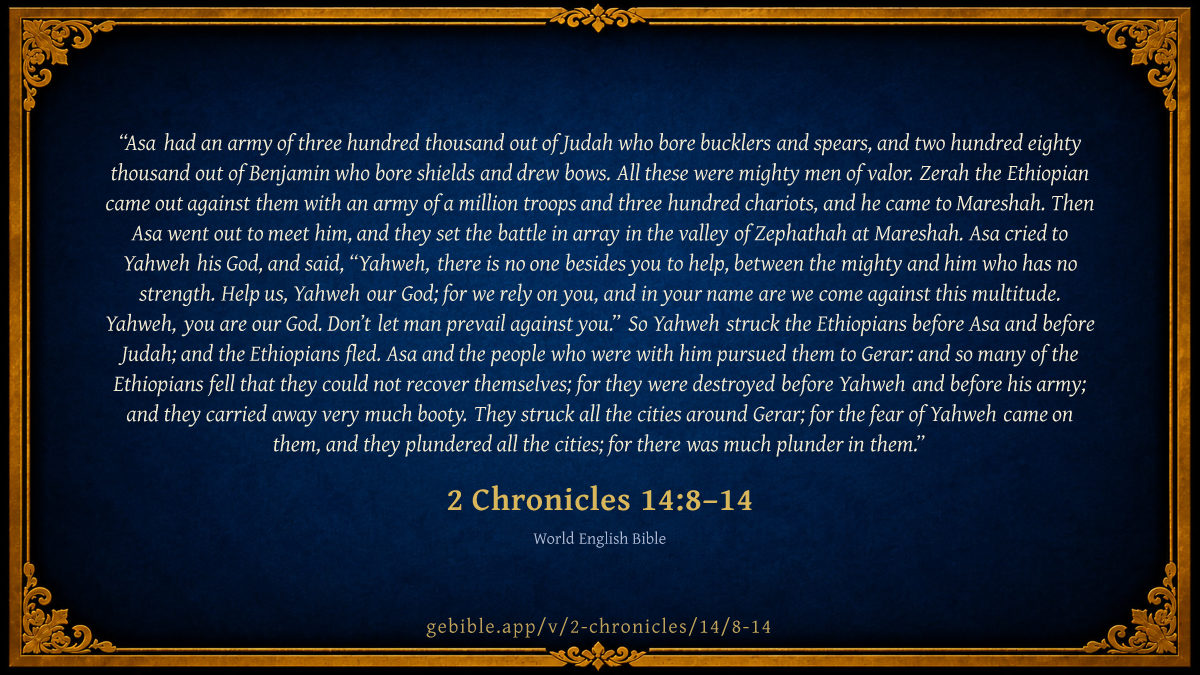
Asa had an army of three hundred thousand out of Judah who bore bucklers and spears, and two hundred eighty thousand out of Benjamin who bore shields and drew bows. All these were mighty men of valor.
Zerah the Ethiopian came out against them with an army of a million troops and three hundred chariots, and he came to Mareshah. Then Asa went out to meet him, and they set the battle in array in the valley of Zephathah at Mareshah. Asa cried to Yahweh his God, and said, “Yahweh, there is no one besides you to help, between the mighty and him who has no strength. Help us, Yahweh our God; for we rely on you, and in your name are we come against this multitude. Yahweh, you are our God. Don’t let man prevail against you.”
So Yahweh struck the Ethiopians before Asa and before Judah; and the Ethiopians fled. Asa and the people who were with him pursued them to Gerar: and so many of the Ethiopians fell that they could not recover themselves; for they were destroyed before Yahweh and before his army; and they carried away very much booty. They struck all the cities around Gerar; for the fear of Yahweh came on them, and they plundered all the cities; for there was much plunder in them.
Geneva Bible translators 1599 · Public Domain On vv9, 11, 14 Which was a city in Judah, Josh. 15:44, where…
Which was a city in Judah, Josh. 15:44, where Michaiah the Prophet was born.
The king of Ethiopia, or Egypt.
Geneva Bible (1599) marginal notes — public domain.
John Trapp 1656 · Public Domain On vv8–14 2Ch 14:8 And Asa had an army [of men]…
2Ch 14:8 And Asa had an army [of men] that bare targets and spears, out of Judah three hundred thousand; and out of Benjamin, that bare shields and drew bows, two hundred and fourscore thousand: all these [were] mighty men of valour.
Ver. 8. Two hundred and fourscore thousand.] "Little Benjamin" was grown very numerous and potent.
John Trapp, A Commentary or Exposition upon All the Books of the Old and New Testament (1647–1656) — public domain. Text from a community e-Sword module.
Matthew Poole 1685 · Public Domain On vv8, 9, 11, 13, 14 Asa had an army; which, as it seems, he…
Asa had an army; which, as it seems, he had now gathered together upon the information of Zerah’s design against him.
Matthew Poole's English Annotations on the Holy Bible (1683–1685) — public domain. Text from a community e-Sword/MySword module.
Matthew Henry 1710 · Public Domain On v9 Here is, I. Disturbance given to the peace of…
Here is, I. Disturbance given to the peace of Asa's kingdom by a formidable army of Ethiopians that invaded them, Ch2 14:9, Ch2 14:10. Though still they sought God, yet this fear came upon them, that their faith in God might be tried, and that God might have an opportunity of doing great things for them. It was a vast number that the Ethiopians brought against him: 1,000,000 men; and now he found the benefit of having an army ready raised against such a time of need. That provision which we thought needless may soon appear to be of great advantage.
II. The application Asa made to God on occasion of the threatening cloud which now hung over his head, Ch2 14:11. He that sought God in the day of his peace and prosperity could with holy boldness cry to God in the day of his trouble, and call him his God. His prayer is short, but has much in it. 1. He gives to God the glory of his infinite power and sovereignty: It is nothing with thee to help and save by many or few, by those that are mighty or by those that have no power. See Sa1 14:6. God works in his own strength, not in the strength of instruments (Psa 21:13), nay, it is his glory to help the weakest and to perfect strength out of the mouth of babes and sucklings. "We do not say, Lord, take our part, for we have a good army for thee to work by; but, take our part, for without thee we have no power." 2. He takes hold of their covenant-relation to God as theirs. O Lord, our God! and again, "Thou art our God, whom we have chosen and cleave to as ours, and who hast promised to be ours." 3. He pleads their dependence upon God, and the eye they had to him in this expedition. he was well prepared for it, yet trusted not to his preparations; but, "Lord, we rest on thee, and in thy name we go against this multitude, by warrant from thee, aiming at thy glory, and trusting to thy strength." 4. He interests God in their cause: "Let not man" (mortal man, so the word is) "prevail against thee. If he prevail against us, it will be said that he prevails against thee, because thou art our God, and we rest on thee and go forth in thy name, which thou hast encouraged us to do. The enemy is a mortal man; make it to appear what an unequal match he is for an immortal God. Lord, maintain thy own honour; hallowed by thy name."
Read full note →
III. The glorious victory God gave him over his enemies. 1. God defeated the enemy, and put their forces into disorder (Ch2 14:12): The Lord smote the Ethiopians, smote them with terror, and an unaccountable consternation, so that they fled, and knew neither why nor whither. 2. Asa and his soldiers took the advantage God gave them against the enemy. (1.) They destroyed them. They fell before the Lord (for who can stand before him?) and before his host, either an invisible host of angels that were employed to destroy them or the host of Israel, called God's host because owned by him. (2.) They took the plunder of their camp, carried away very much spoil from the slain and from the baggage. (3.) They smote the cities that were in league with them, to which they fled for shelter, and carried off the spoil of them (Ch2 14:14); and they were not able to make any resistance, for the fear of the Lord came upon them, that is, a fear which God struck them with to such a degree that they had no heart to withstand the conquerors. (4.) They fetched away the cattle out of the enemy's country, in vast numbers, Ch2 14:15. Thus the wealth of the sinner is laid up for the just.
Matthew Henry's Commentary on the Whole Bible (1708–1710) — public domain (CC PDM 1.0). Text via the HelloAO Bible API.
John Gill 1763 · Public Domain On vv8–14 And there came out against them Zerah the Ethiopian,…
And there came out against them Zerah the Ethiopian, with an host of thousand thousand, and three hundred chariots,.... According to Josephus (b), this army consisted of 900,000 foot, and 100,000 horsemen, and certain it is there were horsemen among them, Ch2 16:8 some say these were not the Ethiopians in Africa, beyond Egypt, being, as is said, too far off for such an army to travel, and it would be hard to say what should induce them to it; and besides it is urged, the king of Egypt would never have suffered them to pass through his dominions, as they must to come to Judea; but that they were the Cushite Arabs, that inhabited Midian, part of Arabia Petraea, and Arabia Felix, near Judaea; see Gill on Num 12:1, but since this great host consisted of Lubim or Libyans, inhabitants of Africa, as well as of Ethiopians, Ch2 16:8, these Ethiopians seem to be rather those in Africa, who were masters of Egypt and Libya, as well as Ethiopia, quickly after the death of Shishak, or Sesostris, see Ch2 12:2, which accounts for the size of this army, and their passage through Egypt: that there were two sorts of Ethiopians, the western and eastern ones, the one that dwelt in Africa, the other in Asia, appears clearly from Homer (c), Herodotus (d), and Heliodorus (e), the former of which seem here meant; nor need this army be thought incredible, especially since they were joined by the Lubim or Libyans, and assisted by the Philistines, as appears by what follows; besides, the two armies of Israel and Judah we read of in the preceding chapter, when put together, exceed this; see also Ch2 17:14, so the armies of Tamerlane and Bajazet, that of the former being 1,600,000, and that of the latter 1,400,000 (f):
and came unto Mareshah; a city in the tribe of Judah, on the borders of it, Ch2 11:8.
Read full note →
(b) Antiqu. l. 8. c. 12. sect. 1. (c) Odyss. 1. ver. 23, 24. (d) Polymnia, sive, l. 7. c. 69, 70. (e) Ethiopic. l. 9. c. 6. (f) Laonic. Chalcocond. de rebus Turc. l. 3. p. 98, 102.
John Gill's Exposition of the Whole Bible (1746–1763) — public domain (CC PDM 1.0). Text via the HelloAO Bible API.
John Wesley 1765 · Public Domain On vv9, 11, 12, 14 Ethiopian - Or, the Arabian, as the Hebrew word…
Ethiopian - Or, the Arabian, as the Hebrew word Cush is commonly used: these being much nearer to Asa than the Ethiopians.
John Wesley, Explanatory Notes Upon the Whole Bible (1754–1765) — public domain. Text via the GEBible commentary corpus.
Adam Clarke 1810 · Public Domain On vv8, 9, 11, 14 Verse 8. Targets and spears] Probably targets with the…
Verse 8. Targets and spears] Probably targets with the dagger in the centre, and javelins for distant fight.
Bare shields and drew bows] They were not only archers, but had shield and sword for close fight.
Adam Clarke's Commentary on the Bible (1810–1826) — public domain. Text from a community e-Sword/MySword module.
Joseph Benson 1811 · Public Domain On vv9, 11, 12, 14 2Ch 14:9. There came out against them Zerah the…
2Ch 14:9. There came out against them Zerah the Ethiopian — Or, the Arabian, as the Hebrew word Cush is frequently used, and must necessarily be understood, 2Ch 21:16, and 2Ki 19:9. The Arabians were much nearer to Asa than the Ethiopians, who could not have come to attack him but through Egypt, which probably the king of Egypt would not have permitted them to do. And came unto Mareshah — A city upon and within the borders of Judah, Jos 15:44. Though Asa and his people still sought the Lord, yet he suffered this immense force of a thousand thousand men, to come against them, that their faith in him might be tried, and that he might have an opportunity of doing great things for them.
Joseph Benson's Commentary on the Old and New Testaments (1811–1818) — public domain. Text from a community e-Sword module.
Albert Barnes 1834 · Public Domain On vv8, 9, 10, 11, 12, 14 The men of Judah served as heavy-armed troops, while…
The men of Judah served as heavy-armed troops, while the Benjamites were light-armed. Their numbers accord well with those of 2Ch 13:3. As the boundaries of Judah had been enlarged 2Ch 13:19, and as for ten years at least there had been no war 2Ch 14:1, the effective force had naturally increased. It was 400, 000; it is now 580, 000.
Albert Barnes' Notes on the Bible (1834–1885) — public domain. Text from a community e-Sword/MySword module.
Haydock's Catholic Bible Commentary 1859 · Public Domain On vv9–14 Ethiopian. Some think Zara was a successor of Sesac;…
Ethiopian. Some think Zara was a successor of Sesac; and the Rabbins say, that he "restored the spoils which the latter had taken." (Seder. xvi.) --- He at least, made the Jews some compensation for that loss. Perhaps he had been present in the expedition of Sesac, and was now animated with the same ambition. (Tirinus) --- It would be difficult for a foreign king to traverse Egypt with so large an army, (Calmet) unless he had conquered or intimidated the king of the country. (Haydock) --- Hence some believe that the Ethiopia here in question, was a part of Arabia. (Calmet) (Torniel.) --- But it is more probable that it lay south of Egypt, as the troops of Zara are joined with the Lybians, chap. xvi. 8. (Salien, the year of the world 3094.) (Tirinus) --- A king of Arabia would hardly have had so many subjects. (Calmet) --- Three. Some would read thirteen, as Anai takes notice of the great number of chariots, chap. xvi. 8. (Junius) (Malvenda) (Calmet) --- But surely the number here specified is sufficient. The minds of men are very different. In the former chapter we find them complaining of the too great numbers! (Haydock)
George Leo Haydock (1774–1849), Haydock's Catholic Family Bible and Commentary, 1859 edition — public domain. Excludes Psalms (Douay-Rheims chapter numbering differs from Protestant) and Deuterocanonical books (Catholic canon only).
Robert Jamieson, A. R. Fausset & David Brown 1871 · Public Domain On vv9–11 HE OVERCOMES ZERAH, AND SPOILS THE ETHIOPIANS. (Ch2 14:9-15)
HE OVERCOMES ZERAH, AND SPOILS THE ETHIOPIANS. (Ch2 14:9-15)
there came out against them Zerah the Ethiopian--This could not have been from Ethiopia south of the cataracts of the Nile, for in the reign of Osorkon I, successor of Shishak, no foreign army would have been allowed a free passage through Egypt. Zerah must, therefore, have been chief of the Cushites, or Ethiopians of Arabia, as they were evidently a nomad horde who had a settlement of tents and cattle in the neighborhood of Gerar.
Read full note →
a thousand thousand, and three hundred chariots--"Twenty camels employed to carry couriers upon them might have procured that number of men to meet in a short time. As Zerah was the aggressor, he had time to choose when he would summon these men and attack the enemy. Every one of these Cushite shepherds, carrying with them their own provisions of flour and water, as is their invariable custom, might have fought with Asa without eating a loaf of Zerah's bread or drinking a pint of his water" [BRUCE, Travels].
Jamieson, Fausset & Brown — Commentary Critical and Explanatory on the Whole Bible (1871) — public domain (CC PDM 1.0). Text via the HelloAO Bible API.
Daniel D. Whedon 1874 · Public Domain On vv9–14 WAR WITH ZERAH THE ETHIOPIAN, 2Ch_14:9-15.
WAR WITH ZERAH THE ETHIOPIAN, 2Ch_14:9-15.
9. Zerah the Ethiopian belonged, probably, to the same dynasty as Shishak, (see note on 1Ki_11:40; 1Ki_14:25,) for the composition of his army of “the Ethiopians and the Lubims,” (2Ch_16:8,) the same nations as composed the army of Shishak, (2Ch_12:3,) proves him to have been an Egyptian, not, as some have thought, an Asiatic or Arabian king. He was known as the Ethiopian, doubtless, because he was such by birth, being, as Rawlinson says, the son-in-law, not the son, of his predecessor on the throne of Egypt. Hence he is most probably to be identified with Usarken II., (written also Osarchon,) the third king of the twenty-second dynasty, and the second after Shishak. His object in invading Judah was doubtless to recover to Egypt the cities which Asa had been fortifying, (2Ch_14:6, note,) for Asa’s procedure had been virtually a rebellion against Egypt.
Read full note →
A thousand thousand — An enormous army, but not larger than other Oriental monarchs have been known to bring into the field.
Came unto Mareshah — This was one of the cities which Rehoboam had fortified, (2Ch_11:8,) and which Shishak had probably captured. It lay, according to Robinson, (see note on Jos_15:44,) on a hill a mile and a half south of Eleutheropolis, a spot admirably adapted for a fortress. Here the hill country of Judah borders on the great Philistine plain, and the vast Egyptian army might easily have advanced along the coast, and across the plain as far as Mareshah, without meeting much opposition.
Daniel D. Whedon (gen. ed.), Commentary on the Old and New Testaments (1874–1909) — public domain. Text from a community e-Sword module.
The Cambridge Bible for Schools and Colleges 1878 · Public Domain On vv8–14 8. that bare targets and spears … that bare…
8. that bare targets and spears … that bare shields and drew bows] LXX., δύναμις ὁπλοφόρων (= ὁπλιτῶν) αἰρόντων θυρεοὺς καὶ δόρατα … πελτασταὶ καὶ τοξόται. The Chronicler divides Asa’s army into the heavy-armed men belonging to Judah and the light-armed bowmen belonging to Benjamin. Asa apparently had no chariots, “targets” and “shields” should be transposed as in 2Ch_9:15.
of Judah three hundred thousand … of Benjamin … two hundred and fourscore thousand] The total is 580,000. Under Asa’s successor, Jehoshaphat, the numbers are (2Ch_17:14-18), Judah 780,000, Benjamin 380,000, making a total of 1,160,000, i.e. the double of the total given above. Whether the Chronicler drew these numbers from any ancient document is not known, but his main point seems to be that Judah was strong in the early days of Asa, while Asa shewed faith in God, and that Judah became still stronger under his really religious successor, Jehoshaphat. It is to be noted that it is not said that Asa brought these 580,000 men into the field against the Ethiopians; cp. note on 2Ch_13:3.
The Cambridge Bible for Schools and Colleges (gen. ed. J. J. S. Perowne; Cambridge University Press, 1878–1918) — public domain. Text from a community e-Sword module.
Ellicott's Commentary for English Readers 1878 · Public Domain On vv8–14 (8) Targets and spears.—Shield (or buckler) and lance. The…
(8) Targets and spears.—Shield (or buckler) and lance. The large shield is meant (see 2Ch_9:15). The same phrase is used to describe the warriors of Judah. (1Ch_12:24.)
That bare shields—i.e., the short or round shield (2Ch_9:16).
Read full note →
Drew bows.—(1Ch_8:40; 1Ch_12:2.) The Judæans were the hoplites, or heavy-armed; the Benjaminites the light-armed, or peltasts, as a Greek writer would have said.
Three hundred thousand . . . two hundred and fourscore thousand.—A total of 580,000, warriors. (Comp. Abijah’s 400,000, 2Ch_13:3.) The entire male population capable of bearing arms must be included in these high figures. Of course, such a thing as a standing army of this strength is not to be thought of.
The proportion of Benjamin relatively to Judah appears much too high. It must, however, be remembered that Benjamin was always famous as a tribe of warriors. (See Gen_49:27; 1Ch_7:6-11.)
(b) INVASION OF THE CUSHITE ZERAH, AND HIS SIGNAL OVERTHROW (2Ch_14:9-15)—This Section has no Parallel in Kings.
A Bible Commentary for English Readers, edited by Charles John Ellicott (1878–1897) — public domain. Text from a community e-Sword module.
The Pulpit Commentary 1880 · Public Domain On vv8–14 The "ten years" quiet" (ver. 1) begins to see…
The "ten years" quiet" (ver. 1) begins to see its end. Targets; (2Ch_9:15) spears; (2Ch_11:12) for both, see 1Ch_12:24. Out of Benjamin shields and bows. The minuter coincidences of the history are very observable and very interesting; for see 1Ch_8:40 1Ch_12:2; and much earlier, Gen_49:27; Jud_1:20:16, 17.
Vers. 8-15.
Read full note →
The secret and the spirit of true defence.
We may learn from this narrative of unprovoked attack and triumphant defence
I THAT OUR UPMOST PREPARATION WILL NOT SECURE US FROM ATTACK. Asa endeavoured to make his little kingdom impregnable to assault by
(1) fortifying the outposts, and
(2) training and equipping a large army (vers. 7, 8).
Nevertheless, the Ethiopians came up against him with an army far stronger than his. The military and naval preparations of one country usually incite to greater preparations in another, and instead of war becoming impossible because each nation is invulnerable, it becomes probable because the combative spirit has been developed; one nation considers itself challenged by another, and because a large number of professional men are eager to exert their power and improve their position. But not only does "history repeat itself" thus; we have here an illustration of a wider truth that whatever efforts we may make to guard ourselves against the inroad of evils, we shall surely fail. Sickness of some kind will attack us; disappointment and disillusion will find their way to our heart; sorrow will surprise us; loss and separation will befall us; death will knock at our door. There are no fortifications we can construct, there are no forces we can raise, Be we never so vigilant and alert, which will keep all enemies from the gate. Spite of fenced cities and many thousands of Jewish spears and Benjamite bows, the Ethiopian army comes up against Jerusalem.
II THAT IN THE PATH OF MORAL AND SPIRITUAL RECTITUDE WE ARE IN THE WAY OF SAFETY. Asa had no need to be alarmed. Had he wickedly departed from the Lord he might well have been in the greatest consternation, for then the severe warnings of sacred Scripture would have been as a knell in his ears; but as it was, his fidelity to Jehovah was an assurance of safety. He was God"s servant; he was in a position to "cry unto the Lord his God" (ver. 11); to say, "O Lord our God;" to claim that the Ethiopian"s triumph would be a prevailing against the Lord himself: "Let not man prevail against thee." The king could hide in the cleft of the rock; he could fall back on almighty power; he was safe Before a blow was struck. He did the right thing on the occasion.
(1) He brought his army into the field, well equipped and well arrayed (ver. 10); and then
(2) he made his earnest, Believing appeal to the Lord his God. This is the path of safety, the place of wisdom. Let us, in days of peace and plenty, in the time of joy and honour, seek and serve the Lord our God, and then, when the darkness falls, when the enemy appears, when such power is needed as goes far beyond our small resources, we can turn with a holy confidence and with Christian calmness tot he sucoour of the faithful and the mighty Friend. We shall indeed do as Asa did; we shall summon all our own powers and wisdom to confront the danger, to meet the difficulty; but, like the King of Judah, we shall feel that our true hope is in the living God, and we shall hide in him, our Refuge and our Strength. "In his Name" we shall "go against this multitude.
III THAT AS THOSE WHO FIGHT FOR GOD WE HAVE A POWERFUL PLEA. As those who are enlisted and engaged in the great campaign against moral evil in this world, we have a strong plea to urge when we draw nigh to God in prayer and seek his conquering power.
1. God is our God; the God of our choice and of his own faithful Word.
2. God is able to give us the victory even against the greatest odds: "It isnothing with thee to help" (ver. 11). "If thou wilt, thou canst." "All things are possible" with him,
3. We do all that we do in his Name, for the extension of his kingdom.
The work is thine, not mine, O Lord, It is thy race we run.
"Let not man prevail against thee.
IV THAT, GOD WITH US, ANXIOUS FEAR WILL CHANGE TO JOYOUS VICTORY. "The Lord smote the Ethiopians and Asa and the people pursued them," etc. (vers. 12-15). The king and the people of Judah went out of Jerusalem with the most grave concern in their hearts; they reentered the royal city with their souls full of joy and their arms full of spoil. Their courage and, more especially, their fidelity were crowned with a true and a great success. So in due time will ours also. It is true that our fight with wrong and woe is not (like this one of Asa"s) a short sharp battle; it is a long campaign; it is a campaign in which fortune wavers, or seems to waver, from side to side; in which many good soldiers of Christ are seen to fall. But there can be no doubt about the issue. The Lord is on our side. Victorious Love is our great Captain, and the time will come when we too shall "return to Jerusalem," with songs of joy and triumph on our lips. C.
The Pulpit Commentary (1880–1919), ed. H.D.M. Spence-Jones & Joseph S. Exell — public domain. Text from a community e-Sword module.
The Biblical Illustrator 1887 · Public Domain On v11 And Asa, cried unto the Lord his God.
2Ch_14:11-12
And Asa, cried unto the Lord his God.
Read full note →
Victories over superior numbers
These victories over superior numbers may easily be paralleled or surpassed by numerous striking examples from secular history. The odds were greater at Agincourt, where at least sixty thousand French were defeated by not more than twenty thousand Englishmen; at Marathon the Greeks routed a Persian army ten times as numerous as their own; in India English generals have defeated innumerable hordes of native warriors. For the most part victorious generals have been ready to acknowledge the succouring arm of the God of battles. Shakespeares Henry V, after Agincourt, speaks altogether in the spirit of Asas prayer: O God, Thy arm was here; and not to us, but to Thy arm alone, ascribe we all. When Elizabeths fleet defeated the Spanish Armada, the grateful piety of Protestant England felt that its foes had been destroyed by the breath of the Lord: Afflavit Deus et dissipantur. (W. H. Bennett, M.A.)
The superiority of moral to material force
Characteristic instances are to be found in the wider movements of international polities. Italy in the eighteenth century seemed as hopelessly divided as Israel under the judges, and Greece as completely enslaved to the unspeakable Turk as the Jews to Nebuchadnezzar; and yet, destitute as they were of any material resources, these nations had at their disposal great moral forces: the memory of ancient greatness and the sentiment of nationality; and to-day Italy can count hundreds of thousands like the chroniclers Jewish kings, and Greece builds her fortresses by land and her ironclads to command the sea. The Lord has fought for Israel. But the principle has a wider application. The English and American pioneers of the movements for the abolition of slavery had to face what seemed an impenetrable phalanx of powerful interests and influences. It may be objected that if victory were to be secured by Divine intervention, there was no need to muster five hundred and eighty thousand men, or indeed any army at all. We have no right to look for Divine co-operation till we have done our best; we are to work out our own salvation, for it is God that worketh in us. (W. H. Bennett, M. A.)
King Asas prayer on the eve of battle
I. Our text is a prater--the surest weapon in war as in all other emergencies.
II. It is the prayer of a king on the eve of battle, and therefore partakes of a national character.
III. It is a prayer of faith, exhibiting reliance on the Divine arm for help, and therefore implying humiliation, together with a distinct conviction that no human force, however vast, can prevail, except under the recognised championship of the Almighty. (The Penny Pulpit.)
The all-sufficiency of Gods help
I. Asa acted promptly and energetically as the occasion required. Only one purpose moved him, and that was to bring out all the military strength of his kingdom, and at once, with no unnecessary delay, strike the foe, every soldier realising that the crown of victory was the prize to be won or lost, according as he should be faithful or unfaithful in his particular duty. Having acted thus promptly and energetically, then--
II. Asa called on God for help. He did not ask God to work a miracle on his behalf. Whoever calls upon God for help without first helping himself, without first putting forth his own efforts to secure that for which he invokes the Divine aid, will call upon God in vain. There are other elements of strength in war besides those which are merely physical. God is a moral and spiritual force which will make an army of inferior numbers more than adequate to encounter and overcome the mere physical force which inheres in superiority of numbers. Hence the wisdom and virtue of prayer.
III. What was the issue? The Lord smote the Ethiopians before Asa, etc. (W. T. Tindley, D.D.)
Asas prayer
This King Asa, Rehoboams grandson, had had a long reign of peace, which the writer of the Book of Chronicles traces to the fact that he had rooted out idolatry from Judah. The land had rest, and he had no war . . . because the Lord had given him rest. But their came a time when the war-cloud began to roll threateningly over the land, and a great army came up against him. Like a wise man he made his military dispositions first, and prayed next. This prayer contains the very essence of what ought to be the Christian attitude in reference to all the conditions and threatening dangers and conflicts of life.
I. The wholesome consciousness of our own impotence. It did not take much to convince Asa that he had no power. His army, according to the numbers given of the two hosts, was outnumbered two to one. If we look fairly in the face our duties, our tasks, our dangers, the possibilities of life and its certainties, the more humbly we think of our own capacity, the more wisely we shall think about God, and the more truly we shall estimate ourselves. The world says Self-reliance is the conquering virtue. Jesus says to us, Self-distrust is the condition of all victory. And that does not mean any mere shuffling off of responsibility from our own shoulders, but it means looking the facts of our lives, and of our own characters, in the face. And if we will do that, however apparently easy may be our course, and however richly endowed in mind, body, or estate we may be, we shall find that we each are like the man with ten thousand that has to meet the King that comes against him with twenty thousand; and we shaft not desire conditions of peace with our enemy, for that is not what in this ease we have to do, but we shall look about us, and not keep our eyes on the horizon, and on the levels of earth, but look up to see if there is not there an ally that we can bring into the field to redress the balance, and to make our ten as strong as the opposing twenty. Now all that is true about the disproportion between the foes we have to face and fight and our own strength. It is eminently true about us Christian people, if we are doing any work for our Master. You hear people say, Look at the small number of professing Christians in this country, as compared with the numbers on the other side. What is the use of their trying to convert the world? If the Christian Church had to undertake the task of Christianising the world with its own strength, we might well threw up the sponge and stop altogether. We have no might. But we are not only numerically weak. A multitude of non-effectives, mere camp-followers, loosely attached, nominal Christians have to be deducted from the muster-roll. So a profound self-distrust is our wisdom. But it is not to paralyse us, but to lead to something better, as it led Asa.
II. Summoning God into the world should follow wholesome self-distrust. Asa uses a remarkable expression, which is, perhaps, scarcely reproduced adequately in another verse, It is nothing with Thee to help, whether with many or with them that have no power. It is a strange phrase, but it seems most probable that the suggested rendering in the Revised Version is nearer the writers meaning, which says, Lord! there is none beside Thee to help between the mighty and them that have no power, which to our ears is a somewhat cumbrous way of saying that God, and God only, can adjust the difference between the mighty and the weak. Asa turns to God and says, Thou only canst trim the scales and make the heavy one the lighter of the two by casting Thy might into it. So help us, O Lord, our God. One man with God at his back is always in the majority. There is encouragement for people who have to fight unpopular causes in the world. The consciousness of weakness may unnerve a man; and that is why people in the world are always patting each other on the back and saying, Be of good cheer, and rely upon yourself. But the self-distrust that turns to God becomes the parent of a far more reliable self-reliance than that which trusts to men. My consciousness of need is my opening the door for God to come in. Just as you always find the lakes in the hollows, so you will always find the grace of God coming into mens hearts to strengthen them and make them victorious, when there has been the preparation of the lowered estimate of ones self. Hollow out your heart by self-distrust, and God will fill it with the flashing waters of His strength bestowed. The way by which we summon God into the field: Asa prays, Help us, O Lord, our God, for we rest on Thee; and the word that he employs for rest is not a very frequent one. It carries with it a very striking picture. It is used in that tragical story of the death of Saul, when the man that saw the last of him came to David and drew in a sentence the pathetic picture of the wearied, wounded, broken-hearted, discrowned, desperate monarch leaning on his spear. You can understand how hard he leaned, with what a grip he held it, and how heavily his whole, languid, powerless weight pressed upon it. And that is the word that is used here. We lean on Thee as the wounded Saul leaned upon his spear. Is that a picture of your faith?
III. Courageous advance should follow self-distrust and summoning god by faith. It is well when self-distrust leads to confidence. But that is not enough. It is better when self-distrust and confidence in God lead to courage. And as Asa goes on, Help us, for we rely on Thee, and in Thy name we go against this multitude. Never mind though it is two to one. What does that matter? Prudence and calculation are well enough, but there is a great deal of very rank cowardice and want of faith in Christian people, both in regard to their own lives and in regard to Christian work in the world, which goes masquerading under much too respectable a name, and calls itself judicious caution and prudence. If we have God with us, let us be bold in fronting the dangers and difficulties that beset us, and be sure that He will help us.
IV. The all-powerful plea which God will answer. Thou art my God, let not man prevail against Thee. That prayer covers two things. You may be quite sure that if God is your God you will not be beaten; and you may be quite sure that if you have made Gods cause yours He will make your cause His, and again you will not be beaten. Thou art our God. It takes two to make a bargain, and God and we have both to act before He is truly ours. He gives Himself to us, but there is an act of ours required, too, and you must take the God that is given to you, and make Him yours because you make yourselves His. And when I have taken Him for mine, and not unless I have, He is mine, to all intents of strength-giving and blessedness. (A. Maclaren, D.D.)
The name of God written in life
Our whole life ought to be filled with His name. You can write it anywhere. It does not need a gold plate to carve His name upon. It does not need to be set in jewels and diamonds. The poorest scrap of brown paper, and the bluntest little bit of pencil, and the shakiest hand will do to write the name of Christ; and all life, the trivialities as well as the crises, may be flashing and bright with the sacred syllables. Mohammedans decorate their palaces and mosques with no pictures, but with the name of Allah in gilded arabesques. Everywhere, on walls and roof, and windows and cornices, and pillars and furniture, the name is written. There is no such decoration for a life as that Christs name should be inscribed thereon. (A. Maclaren, D. D.)
.
The Biblical Illustrator, edited by Joseph S. Exell (c. 1880s–1900s) — public domain. Text from a community e-Sword module.
Alexander MacLaren 1905 · Public Domain On v11 2 Chronicles
2 Chronicles
ASA’S PRAYER
Read full note →
2Ch 14:11.
This King Asa, Rehoboam’s grandson, had had a long reign of peace, which the writer of the Book of Chronicles traces to the fact that he had rooted out idolatry from Judah, ‘The land had rest, and he no war . . . because the Lord had given him rest.’
But there came a time when the war-cloud began to roll threateningly over the land, and a great army-the numbers of which, from their immense magnitude, seem to be erroneously given-came up against him. Like a wise man he made his military dispositions first, and prayed next. He set his troops in order, and then he fell down on his knees, and spoke to God.
Now, it seems to me that this prayer contains the very essence of what ought to be the Christian attitude in reference to all the conditions and threatening dangers and conflicts of life; and so I wish to run over it, and bring out the salient points of it, as typical of what ought to be our disposition.
I. The wholesome consciousness of our own impotence.
It did not take much to convince Asa that he had ‘no power.’ His army, according to the numbers given of the two hosts, was outnumbered two to one; and so it did not require much reflection to say, ‘We have no might.’ But although perhaps not so sufficiently obvious to us, as truly as in the case in our text, if we look fairly in the face our duties, our tasks, our dangers, the possibilities of life and its certainties, the more humbly we think of our own capacity, the more wisely we shall think about God, and the more truly we shall estimate ourselves. The world says, ‘Self-reliance is the conquering virtue’; Jesus says to us, ‘Self-distrust is the condition of all victory.’ And that does not mean any mere shuffling off of responsibility from our own shoulders, but it means looking the facts of our lives, and of our own characters, in the face. And if we will do that, however apparently easy may be our course, and however richly endowed in mind, body, or estate we may be, if we all do that honestly, we shall find that we each are like ‘the man with ten thousand’ that has to meet ‘the King that comes against him with twenty thousand’; and we shall not ‘desire conditions of peace’ with our enemy, for that is not what in this case we have to do, but we shall look about us, and not keep our eyes on the horizon, and on the levels of earth, but look up to see if there is not there an Ally that we can bring into the field to redress the balance, and to make our ten as strong as the opposing twenty. Zerah the Ethiopian, who was coming down on Asa, is said to have had a million fighting-men at his back, but that is probably an erroneous figure, because Old Testament numbers are necessarily often unreliable. Asa had only half the number; so he said, ‘What can I do?’ And what could he do? He did the only thing possible, he ‘grasped at God’s skirts, and prayed,’ and that made all the difference.
Now all that is true about the disproportion between the foes we have to face and fight and our own strength. It is eminently true about us Christian people, if we are doing any work for our Master. You hear people say, ‘Look at the small number of professing Christians in this country, as compared with the numbers on the other side. What is the use of their trying to convert the world?’ Well, think of the assembled Christian people, for instance, of Manchester, on the most charitable supposition, and the shallowest interpretation of that word ‘Christian.’ What are they among so many? A mere handful. If the Christian Church had to undertake the task of Christianising the world by its own strength, we might well despair of success and stop altogether. ‘We have no might.’ The disproportion both numerically and in all things that the world estimates as strength {which are many of them good things}, is so great that we are in a worse case than Asa was. It is not two to one; it is twenty to one, or an even greater disproportion. But we are not only numerically weak. A multitude of non-effectives, mere camp followers, loosely attached, nominal Christians, have to be deducted from the muster-roll, and the few who are left are so feeble as well as few that they have more than enough to do in holding their own, to say nothing of dreaming of charging the wide-stretching lines of the enemy. So a profound self-distrust is our wisdom. But that should not paralyse us, but lead to something better, as it led Asa.
II. Summoning God into the field should follow wholesome self-distrust.
Asa uses a remarkable expression, which is, perhaps, scarcely reproduced adequately in our Authorised Version: ‘It is nothing with Thee to help, whether with many or with them that have no power.’ It is a strange phrase, but it seems most probable that the suggested rendering in the Revised Version is nearer the writer’s meaning, which says, ‘Lord! there is none beside Thee to help between the mighty and them that have no power,’ which to our ears is a somewhat cumbrous way of saying that God, and God only, can adjust the difference between the mighty and the weak; can redress the balance, and by the laying of His hand upon the feeble hand can make it strong as the mailed fist to which it is opposed. If we know ourselves to be hopelessly outnumbered, and send to God for reinforcements, He will clash His sword into the scale, and make it go down. Asa turns to God and says, ‘Thou only canst trim the scales and make the lighter of the two the heavier one by casting Thy might into it. So help us, O Lord our God!’
One man with God at his back is always in the majority; and, however many there may be on the other side, ‘there are more that be with us than they that be with them.’ There is encouragement for people who have to fight unpopular causes in the world, who have been accustomed to be in minorities all their days, in the midst of a wicked and perverse generation. Never mind about the numbers; bring God into the field, and the little band, which is compared in another place in these historical Books to ‘two flocks of kids’ fronting the enemy, that had flowed all over the land, is in the majority. ‘God with us’; then we are strong.
The consciousness of weakness may unnerve a man; and that is why people in the world are always patting each other on the back and saying ‘Be of good cheer, and rely upon yourself.’ But the self-distrust that turns to God becomes the parent of a far more reliable self-reliance than that which trusts to men. My consciousness of need is my opening the door for God to come in. Just as you always find the lakes in the hollows, so you will always find the grace of God coming into men’s hearts to strengthen them and make them victorious, when there has been the preparation of the lowered estimate of one’s self. Hollow out your heart by self-distrust, and God will fill it with the flashing waters of His strength bestowed. The more I feel myself weak, the more I am meant not to fold my hands and say, ‘I never can do that thing; it is of no use my trying to attempt it, I may as well give it up’; but to say, ‘Lord I there is none beside Thee that can set the balance right between the mighty and him that hath no strength.’ ‘Help me, O Lord my God!’ Just as those little hermit-crabs that you see upon the seashore, with soft bodies unprotected, make for the first empty shell they can find, and house in that and make it their fortress, our exposed natures, our unarmoured characters, our sense of weakness, ought to drive us to Him. As the unarmed population of a land invaded by the enemy pack their goods and hurry to the nearest fortified place, so when I say to myself I have no strength, let me say, ‘Thou art my Rock, my Strength, my Fortress, and my Deliverer. My God, in whom I trust, my Buckler, and the Horn of my Salvation, and my high Tower.’
Now, there is one more word about this matter, and that is, the way by which we summon God into the field. Asa prays, ‘Help us, O Lord our God! for we rest on Thee’; and the word that he employs for ‘rest’ is not a very frequent one. It carries with it a very striking picture. Let me illustrate it by a reference to another case where it is employed. It is used in that tragical story of the death of Saul, when the man that saw the last of him came to David and drew in a sentence the pathetic picture of the wearied, wounded, broken-hearted, discrowned, desperate monarch, leaning on his spear. You can understand how hard he leaned, with what a grip he held it, and how heavily his whole languid, powerless weight pressed upon it. And that is the word that is used here. ‘We lean on Thee’ as the wounded Saul leaned upon his spear. Is that a picture of your faith, my friend? Do you lean upon God like that, laying your hand upon Him till every vein on your hand stands out with the force and tension of the grasp? Or do you lean lightly, as a man that does not feel much the need of a support? Lean hard if you wish God to come quickly. ‘We rest on Thee; help us, O Lord!’
III. Courageous advance should follow self-distrust and summoning God by faith.
It is well when self-distrust leads to confidence, when, as Charles Wesley has it in his great hymn:
‘. . . I am weak,
But confident in self-despair.’
But that is not enough. It is better when self-distrust and confidence in God lead to courage, and as Asa goes on, ‘Help us, for we rely on Thee, and in Thy name we go against this multitude.’ Never mind though it is two to one. What does that matter? Prudence and calculation are well enough, but there is a great deal of very rank cowardice and want of faith in Christian people, both in regard to their own lives and in regard to Christian work in the world, which goes masquerading under much too respectable a name, and calls itself ‘judicious caution’ and ‘prudence.’ There is little ever done by that, especially in the Christian course; and the old motto of one of the French republicans holds good; ‘Dare! dare! always dare!’ You have more on your side than you have against you, and creeping prudence of calculation is not the temper in which the battle is won. ‘Dash’ is not always precipitate and presumptuous. If we have God with us, let us be bold in fronting the dangers and difficulties that beset us, and be sure that He will help us.
IV. And now the last point that I would notice is this-the all-powerful plea which God will answer.
‘Thou art my God, let not man prevail against Thee.’ That prayer covers two things. You may be quite sure that if God is your God you will not be beaten; and you may be quite sure that if you have made God’s cause yours He will make your cause His, and again you will not be beaten.
‘Thou art our God.’ ‘It takes two to make a bargain,’ and God and we have both to act before He is truly ours. He gives Himself to us, but there is an act of ours required too, and you must take the God that is given to you, and make Him yours because you make yourselves His. And when I have taken Him for mine, and not unless I have, He is mine, to all intents of strength-giving and blessedness. When I can say, ‘Thou art my God, and it is impossible that Thou wilt deny Thyself,’ then nothing can snap that bond; and ‘neither life nor death, nor angels, nor principalities, nor powers, nor things present, nor things to come, nor height, nor depth, nor any other creature’ can do it. But there is a creature that can, and that is I. For I can separate myself from the love and the guardianship of God, and He can say to a man, ‘I am thy God,’ and the man not answer, ‘Thou art my God.’
And then there is another plea here. ‘Let not man prevail against Thee.’ What business had Asa to identify his little kingdom and his victory with God’s cause and God’s conquest? Only this, that he had flung himself into God’s arms, and because he had, and was trying to do what God would have him do, he was quite sure that it was not Asa but Jehovah that the million of Ethiopians were fighting against. People warn us against the fanaticism of taking for granted that our cause is God’s cause. Well, we need the warning sometimes, but we may be quite sure of this, that if we have made God’s cause ours, He will make our cause His, down to the minutest point in our daily lives.
And then, if thus we say in the depths of our hearts, and live accordingly, ‘There is none other that fighteth for us, but only Thou, O God!’ it will be with us as it was with Asa in the story before us, ‘the enemy fled, and could not recover themselves, for they were destroyed before the Lord and before His hosts.’
Alexander MacLaren, Expositions of Holy Scripture (1904–1910) — public domain. Text from a community e-Sword module.
C. I. Scofield 1917 · Public Domain On v8 three hundred thousand
three hundred thousand
(See Scofield "1Co 10:8").
The Scofield Reference Bible (1917 edition), notes by C. I. Scofield — public domain. Text from a community e-Sword module.
Paul E. Kretzmann 1924 · Public Domain On v9 The Defeat of the Ethiopians
The Defeat of the Ethiopians
v. 9. And there came out against them Zerah the Ethiopian, either a Cushite king of Arabia or a mighty Ethiopian king, who, as history relates, invaded the southwest of Egypt and of Asia, with an host of a thousand thousand and three hundred chariots, an immense army, filled with the lust of conquest; and came unto Mareshah, a fortified town in the lowlands of Judah.
Read full note →
v. 10. Then Asa went out against him, and they set the battle in array in the Valley of Zephathah, between Hebron and Ashdod, at Mareshah.
v. 11. And Asa cried unto the Lord, his God, and said, Lord, it is nothing with Thee to help, whether with many, or with them that have no power, he had the firm confidence that the almighty power of God was independent of the armed forces of man, no matter what their number was. Help us, O Lord, our God; for we rest on Thee, and in Thy name we go against this multitude, which outnumbered his whole army almost two to one. O Lord, Thou art our God; let not man prevail against Thee, mere mortal man, in this case, being represented by the horde which threatened to overwhelm the army of Judah.
v. 12. So the Lord, in answer to Asa’s prayer, smote the Ethiopians before Asa and before Judah; and the Ethiopians fled.
v. 13. And Asa and the people that were with him pursued them unto Gerar, the ancient Philistine city southeast of Gaza; and the Ethiopians were overthrown that they could not recover themselves, they fell beyond the hope of rallying their forces; for they were destroyed before the Lord, broken like a piece of glass or fragile pottery. and before His host, for so Asa’s army is called as the instrument of the divine justice and wrath against the enemy, and they, the soldiers of Judah, carried away very much spoil.
v. 14. And they smote all the cities round about Gerar, the Philistines, as usual, probably having made common cause with the Cushites; for the fear of the Lord came upon them, the inhabitants of this entire region. And they spoiled all the cities; for there was exceeding much spoil in them.
v. 15. They smote also the tents of cattle, the herds of the nomad tribes in the northwestern part of Paran, bordering upon the Philistine country, and carried away sheep and camels in abundance, and returned to Jerusalem. Those who trust in the Lord with all their heart shall never be ashamed, for His blessing and protection is always near them.
Paul E. Kretzmann, Popular Commentary of the Bible (1921–1924) — public domain. Text from a community e-Sword module.
unfoldingWord translationNotes 2017 · CC BY-SA 4.0 On vv9, 12, 14 This is the name of a man. (See: How…
Zerah
This is the name of a man. (See: How to Translate Names)
Read full note →
one million soldiers and three hundred chariots
"1,000,000 soldiers and 300 chariots" (See: Numbers)
Mareshah ... the Valley of Zephathah
These are the names of places. (See: How to Translate Names)
Asa went out to meet him
Here "Asa" represents both the king and the army that he led into battle. It is implicit that he went out to meet him in battle. AT: "Asa led his army out to meet him in battle" (See: Metonymy and Assumed Knowledge and Implicit Information)
in your name
Here "name" represents Yahweh's authority. AT: "on your behalf" or "by your authority" (See: Metonymy)
do not let man defeat you
Since the army of Judah is fighting in Yahweh's name, Asa speaks of Zerah defeating Judah as if Zerah were to defeat Yahweh himself. AT: "do not let man defeat your people" (See: Assumed Knowledge and Implicit Information)
translationWords
Ethiopia
chariot
name
unfoldingWord translationNotes — © Distant Shores Media and the Door43 World Missions Community, licensed CC BY-SA 4.0. Source: git.door43.org/Door43/en_tn.