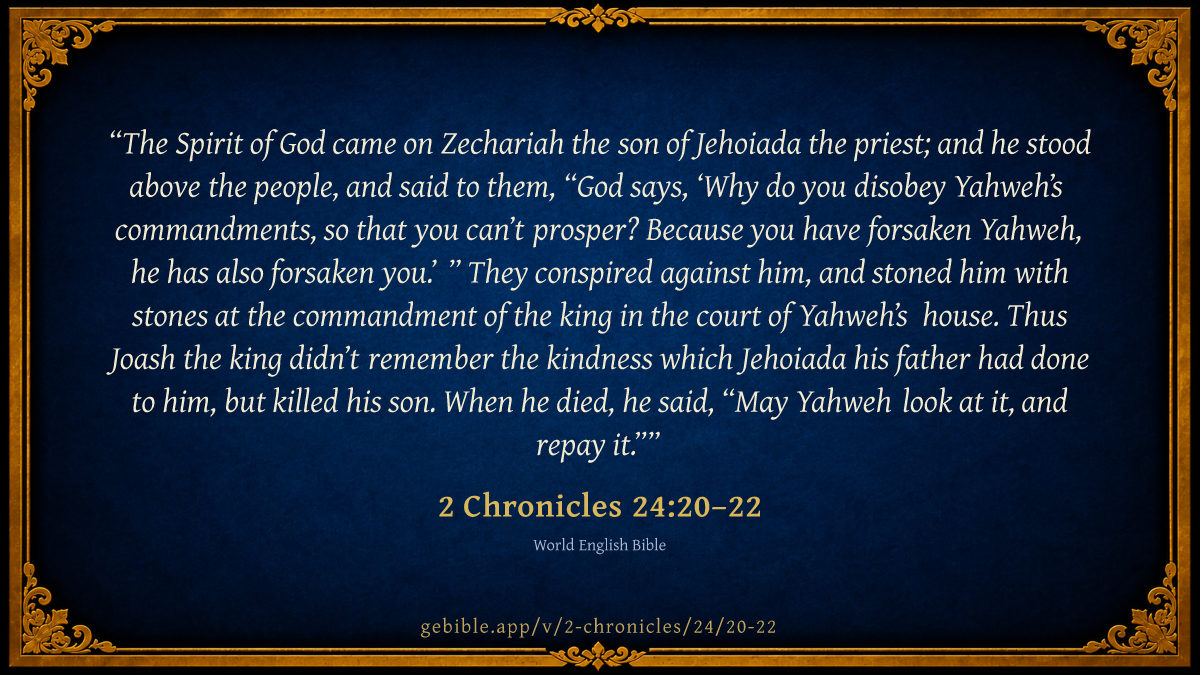
20The Spirit of God came on Zechariah the son of Jehoiada the priest; and he stood above the people, and said to them, “God says, ‘Why do you disobey Yahweh’s commandments, so that you can’t prosper? Because you have forsaken Yahweh, he has also forsaken you.’ ”
21They conspired against him, and stoned him with stones at the commandment of the king in the court of Yahweh’s house.22Thus Joash the king didn’t remember the kindness which Jehoiada his father had done to him, but killed his son. When he died, he said, “May Yahweh look at it, and repay it.”
20 The Spirit of God came on Zechariah the son of Jehoiada the priest; and he stood above the people, and said to them, “God says, ‘Why do you disobey Yahweh’s commandments, so that you can’t prosper? Because you have forsaken Yahweh, he has also forsaken you.’ ”
21 They conspired against him, and stoned him with stones at the commandment of the king in the court of Yahweh’s house.
22 Thus Joash the king didn’t remember the kindness which Jehoiada his father had done to him, but killed his son. When he died, he said, “May Yahweh look at it, and repay it.”
KJVKing James Version
20 And the Spirit of God came upon Zechariah the son of Jehoiada the priest, which stood above the people, and said unto them, Thus saith God, Why transgress ye the commandments of the LORD, that ye cannot prosper? because ye have forsaken the LORD, he hath also forsaken you.
21 And they conspired against him, and stoned him with stones at the commandment of the king in the court of the house of the LORD.
22 Thus Joash the king remembered not the kindness which Jehoiada his father had done to him, but slew his son. And when he died, he said, The LORD look upon it, and require it.
Show all 3 translations
JPSJPS Tanakh (1917)
20 And the spirit of God clothed Zechariah the son of Jehoiada the priest; and he stood above the people, and said unto them: 'Thus saith God: Why transgress ye the commandments of the LORD, that ye cannot prosper? because ye have forsaken the LORD, He hath also forsaken you.'
21 And they conspired against him, and stoned him with stones at the commandment of the king in the court of the house of the LORD.
22 Thus Joash the king remembered not the kindness which Jehoiada his father had done to him, but slew his son. And when he died, he said: 'The LORD look upon it, and require it.'
Questions where the Bible appears to say two different things, with the passages on each side set together.
Who was Zechariah's father?2 Chronicles 24:20-21 narrates the stoning of Zechariah son of Jehoiada "in the court of the house of the Lord" — exactly the death scenario Jesus references i…
Numbers 14:41(v20)Moses said, “Why now do you disobey the commandment of Yahweh, since it shall not prosper?
Genesis 9:5(v22)I will surely require accounting for your life’s blood. At the hand of every animal I will require it. At the hand of man, even at the hand…
Jeremiah 5:25(v20)“Your iniquities have turned away these things, and your sins have withheld good from you.
Luke 11:51(v22)from the blood of Abel to the blood of Zachariah, who perished between the altar and the sanctuary.’ Yes, I tell you, it will be required…
2 Chronicles 15:1-2(v20)The Spirit of God came on Azariah the son of Oded: and he went out to meet Asa, and said to him, “Hear me, Asa, and all Judah and Benjamin!…
Show all 38 cross-references
2 Chronicles 20:14(v20)Then Yahweh’s Spirit came on Jahaziel the son of Zechariah, the son of Benaiah, the son of Jeiel, the son of Mattaniah, the Levite, of the…
John 10:32(v22)Jesus answered them, “I have shown you many good works from my Father. For which of those works do you stone me?”
Revelation 6:9-11(v22)When he opened the fifth seal, I saw underneath the altar the souls of those who had been killed for the Word of God, and for the testimony…
Revelation 19:2(v22)for his judgments are true and righteous. For he has judged the great prostitute, who corrupted the earth with her sexual immorality, and…
1 Chronicles 12:18(v20)Then the Spirit came on Amasai, who was chief of the thirty, and he said, “We are yours, David, and on your side, you son of Jesse. Peace,…
Nehemiah 9:26(v21)“Nevertheless they were disobedient, and rebelled against you, cast your law behind their back, killed your prophets that testified against…
Psalms 10:14(v22)But you do see trouble and grief. You consider it to take it into your hand. You help the victim and the fatherless.
Matthew 23:35(v20)that on you may come all the righteous blood shed on the earth, from the blood of righteous Abel to the blood of Zachariah son of…
Acts 7:58-59(v21)They threw him out of the city and stoned him. The witnesses placed their garments at the feet of a young man named Saul. They stoned…
Deuteronomy 29:25-26(v20)Then men will say, “Because they abandoned the covenant of Yahweh, the God of their fathers, which he made with them when he brought them…
Judges 6:34(v20)But Yahweh’s Spirit came on Gideon, and he blew a trumpet; and Abiezer was gathered together to follow him.
1 Samuel 13:13-14(v20)Samuel said to Saul, “You have done foolishly. You have not kept the commandment of Yahweh your God, which he commanded you; for now Yahweh…
2 Samuel 12:9-10(v20)Why have you despised Yahweh’s word, to do that which is evil in his sight? You have struck Uriah the Hittite with the sword, and have…
1 Chronicles 28:9(v20)You, Solomon my son, know the God of your father, and serve him with a perfect heart and with a willing mind; for Yahweh searches all…
2 Chronicles 23:11(v20)Then they brought out the king’s son, and put the crown on him, and gave him the covenant, and made him king. Jehoiada and his sons…
Psalms 109:4(v22)In return for my love, they are my adversaries; but I am in prayer.
Proverbs 17:13(v22)Whoever rewards evil for good, evil shall not depart from his house.
Jeremiah 2:19(v20)“Your own wickedness will correct you, and your backsliding will rebuke you. Know therefore and see that it is an evil and bitter thing,…
Jeremiah 4:18(v20)“Your way and your doings have brought these things to you. This is your wickedness; for it is bitter, for it reaches to your heart.”
Jeremiah 5:19(v20)It will happen when you say, ‘Why has Yahweh our God done all these things to us?’ Then you shall say to them, ‘Just as you have forsaken…
Jeremiah 11:19(v21)But I was like a gentle lamb that is led to the slaughter. I didn’t know that they had devised plans against me, saying, “Let’s destroy the…
Jeremiah 11:20(v22)But, Yahweh of Armies, who judges righteously, who tests the heart and the mind, I will see your vengeance on them; for to you I have…
Jeremiah 18:18(v21)Then they said, “Come! Let’s devise plans against Jeremiah; for the law won’t perish from the priest, nor counsel from the wise, nor the…
Jeremiah 26:14-15(v22)But as for me, behold, I am in your hand. Do with me what is good and right in your eyes. Only know for certain that, if you put me to…
Jeremiah 38:4-6(v21)Then the princes said to the king, “Please let this man be put to death; because he weakens the hands of the men of war who remain in this…
Jeremiah 51:56(v22)For the destroyer has come on her, even on Babylon. Her mighty men are taken. Their bows are broken in pieces, for Yahweh is a God of…
Zechariah 7:11-14(v20)But they refused to listen, and turned their backs, and stopped their ears, that they might not hear. Yes, they made their hearts as hard…
Matthew 21:35(v21)The farmers took his servants, beat one, killed another, and stoned another.
Matthew 23:34-37(v21)Therefore behold, I send to you prophets, wise men, and scribes. Some of them you will kill and crucify; and some of them you will scourge…
Luke 17:15-18(v22)One of them, when he saw that he was healed, turned back, glorifying God with a loud voice. He fell on his face at Jesus’ feet, giving him…
2 Timothy 4:14(v22)Alexander, the coppersmith, did much evil to me. The Lord will repay him according to his deeds,
2 Timothy 4:16(v22)At my first defense, no one came to help me, but all left me. May it not be held against them.
Revelation 18:20(v22)“Rejoice over her, O heaven, you saints, apostles, and prophets; for God has judged your judgment on her.”
Cross-references from openbible.info (CC BY 4.0)
Explain this passage (17 sources)
Historical commentary, presented as a primary source — not an endorsement.
Geneva Bible translators1599 · Public DomainOn vv20–22In a place above the people, to the intent…
In a place above the people, to the intent that he might be heard.
Geneva Bible (1599) marginal notes — public domain.
John Trapp1656 · Public DomainOn vv20–222Ch 24:20 And the Spirit of God came upon…
2Ch 24:20 And the Spirit of God came upon Zechariah the son of Jehoiada the priest, which stood above the people, and said unto them, Thus saith God, Why transgress ye the commandments of the LORD, that ye cannot prosper? because ye have forsaken the LORD, he hath also forsaken you.
Ver. 20. Zechariah the son of Jehoiada.] Called, say some, elsewhere Barachias, that is, the blessed of the Lord; which title he might have given him, as Jedediah was to Solomon, for honour’s sake.
Read full note →
Which stood above the people.] And earnestly inveighed against the evil manners of king, princes, and people, who thereupon taxed him as a traitor, likely, and a trumpet of rebellion, as the Papists did Luther, and gave him his passport out of the world.
John Trapp, A Commentary or Exposition upon All the Books of the Old and New Testament (1647–1656) — public domain. Text from a community e-Sword module.
Matthew Poole1685 · Public DomainOn vv20–22Above the people; in a higher place, that his…
Above the people; in a higher place, that his voice and message might be the better heard.
Matthew Poole's English Annotations on the Holy Bible (1683–1685) — public domain. Text from a community e-Sword/MySword module.
John Gill1763 · Public DomainOn vv20–22Thus Joash the king remembered not the kindness which…
Thus Joash the king remembered not the kindness which Jehoiada his father had done to him,.... In preserving him in his infancy, and nourishing him; in settling him on the throne, and assisting him with his advice and counsel:
but slew his son; who also assisted at his coronation, and with his father and brethren anointed him king, as is probable, Ch2 23:11,
Read full note →
and when he died, he said, the Lord look upon it, and requite it; meaning his blood; this he said, not from a private spirit of revenge, but with a view to the glory of divine justice, and which he delivered not as a wish, or by way of imprecation, that so it might be, but as a prophecy that so it would be.
John Gill's Exposition of the Whole Bible (1746–1763) — public domain (CC PDM 1.0). Text via the HelloAO Bible API.
John Wesley1765 · Public DomainOn vv20–22Who stood - The people were assembled in the…
Who stood - The people were assembled in the court of the temple, which they had not quite forsook, when Zechariah stood up in some of the desks that were in the court of the priests, and plainly told them their sin, and the consequences of it.
John Wesley, Explanatory Notes Upon the Whole Bible (1754–1765) — public domain. Text via the GEBible commentary corpus.
Adam Clarke1810 · Public DomainOn vv20–22Verse 20. And the Spirit of God came upon…
Verse 20. And the Spirit of God came upon Zechariah] "When he saw the transgression of the king and of the people, burning incense to an idol in the house of the sanctuary of the Lord, on the day of expiation; and preventing the priests of the Lord from offering the burnt-offerings, sacrifices, daily oblations, and services, as written in the book of the law of Moses; he stood above the people, and said." - Targum.
Adam Clarke's Commentary on the Bible (1810–1826) — public domain. Text from a community e-Sword/MySword module.
Joseph Benson1811 · Public DomainOn vv20–222Ch 24:20. The Spirit of God came upon Zechariah,…
2Ch 24:20. The Spirit of God came upon Zechariah, who stood above the people — He was moved by the Holy Spirit to address the people publicly, and to reprove them for their idolatries, and their departure from the worship of God, which that he might do, so as to be heard by all, he stood upon a high place, where they might both see and hear him, and from thence both testified against their sin, and warned them of the consequences of it. And said, Why transgress ye, &c. — It is remarkable, that, though he spake by the spirit of prophecy, yet he only applied the general prediction of Moses, Deu 31:16-17, unto the present time; that they might all learn to pay a greater regard to Moses, and to make themselves better acquainted with his law; unto which, if they had attended, they would have easily discerned who were true prophets and who were false. Because ye have forsaken the Lord, he also hath forsaken you — This, it is likely, he spake with great vehemence, and even enlarged upon the subject so long, that it raised their indignation.
Joseph Benson's Commentary on the Old and New Testaments (1811–1818) — public domain. Text from a community e-Sword module.
Albert Barnes1834 · Public DomainOn vv20–22Stood above the people - Zechariah, the high priest,…
Stood above the people - Zechariah, the high priest, took up an elevated position, perhaps on the steps of the inner court, which was elevated above the outer court, where the people would be.
Albert Barnes' Notes on the Bible (1834–1885) — public domain. Text from a community e-Sword/MySword module.
Haydock's Catholic Bible Commentary1859 · Public DomainOn vv20, 22Priest, refers to Zacharias. Sept. "Azarias." H. --- It…
CHAPTER XXIV.
Priest, refers to Zacharias. Sept. "Azarias." H. --- It is not certain whether this was the person whom Jesus Christ speaks, (Matthew xxiii. 35.; C.) as S. Jerom believes; (Matthew xxiii. 35.) or our Saviour alludes to one of the minor prophets, (T.) or to the father of John the Baptist. Baronius) H. --- Sight. Heb. "above," perhaps on the steps between the two courts. C. --- To make. Heb. "therefore hath he forsaken you."
George Leo Haydock (1774–1849), Haydock's Catholic Family Bible and Commentary, 1859 edition — public domain. Excludes Psalms (Douay-Rheims chapter numbering differs from Protestant) and Deuterocanonical books (Catholic canon only).
Robert Jamieson, A. R. Fausset & David Brown1871 · Public DomainOn vv20, 22the Spirit of God came upon Zechariah the son…
the Spirit of God came upon Zechariah the son of Jehoiada--probably a younger son, for his name does not occur in the list of Aaron's successors (1Ch. 6:4-47).
stood above the people--Being of the priestly order, he spoke from the inner court, which was considerably higher than that of the people.
Read full note →
and said unto them, Thus saith God, Why transgress ye the commandments of the Lord, that ye cannot prosper, &c.--His near relationship to the king might have created a feeling of delicacy and reluctance to interfere; but at length he, too, was prompted by an irresistible impulse to protest against the prevailing impiety. The bold freedom and energy of [Zechariah's] remonstrance, as well as his denunciation of the national calamities that would certainly follow, were most unpalatable to the king; while they so roused the fierce passions of the multitude that a band of miscreants, at the secret instigation of Joash, stoned him to death. This deed of violence involved complicated criminality on the part of the king. It was a horrid outrage on a prophet of the Lord--base ingratitude to a family who had preserved his life--atrocious treatment of a true Hebrew patriot--an illegal and unrighteous exercise of his power and authority as a king.
Jamieson, Fausset & Brown — Commentary Critical and Explanatory on the Whole Bible (1871) — public domain (CC PDM 1.0). Text via the HelloAO Bible API.
Daniel D. Whedon1874 · Public DomainOn v2020. Zechariah the son of Jehoiada — The son…
20. Zechariah the son of Jehoiada — The son and successor of the aged priest nobly stood above the people, (that is, took a bold and elevated position before them,) and rebuked their evil ways, and so became a martyr. The memory of this dark crime became fixed in Jewish tradition, and according to the Talmud, the martyrs’ blood continued to bubble, like blood yet warm, upon the pavement of the court, until the temple was destroyed by Nebuzaradan, who, it is said, slew eighty thousand young priests to avenge the blood of Zechariah. This legend shows what a hold the martyrdom of the high priest took upon the Jewish mind. The “Zacharias, son of Barachias,” to whom our Lord referred, is to be identified with this Zechariah. See Mat_23:35, note. His blood, crying from the ground like that of Abel, was heard yet in Messiah’s day, as if repeating, “The Lord look upon it, and require it.” 2Ch_24:22.
The writer proceeds to show that Joash and his people were speedily punished for their sins by the Syrian invasion, and the king himself soon after fell by the hand of assassins. The remainder of the chapter is to be compared with 2Ki_12:17-21. One writer supplements the other, though both accounts are brief. The difference in the names of the conspirators (2Ch_24:26) is doubtless owing to a corruption of the text.
Daniel D. Whedon (gen. ed.), Commentary on the Old and New Testaments (1874–1909) — public domain. Text from a community e-Sword module.
The Cambridge Bible for Schools and Colleges1878 · Public DomainOn vv20, 2220. came upon] Heb. “clothed itself with”; cp. Jdg_6:34;…
20. came upon] Heb. “clothed itself with”; cp. Jdg_6:34; 1Ch_12:18.
stood above the people] Cp. Jer_36:10 (Baruch reads Jeremiah’s words from the window of an upper chamber to the people assembled in the court below); Neh_8:4 (Ezra reads the Law from a pulpit of wood).
Read full note →
they conspired against him] Perhaps the proceedings were the same as in the case of Naboth (1Ki_21:9-10), viz., a mock trial and a formal execution (“at the commandment of the king”).
in the court] An aggravation of the murder; cp. 2Ch_23:14. The altar of burnt-offering stood in the court (cp. 2Ch_8:12) and the execution (Luk_11:51) took place between this altar and the Temple itself.
20–22 (no parallel in 2 Kin.). The Martyrdom of Zechariah
This martyrdom is referred to by our Lord in Luk_11:51, “from the blood of Abel unto the blood of Zachariah who perished between the altar and the house,” i.e. “the temple” (cp. Mat_23:35). As Chronicles is reckoned last in the Jewish Canon, “From Abel to Zachariah” practically includes the whole Old Testament. In the text of Matt. Zachariah is called “son of Barachiah” by a confusion with Zechariah the contemporary of Haggai.
The Cambridge Bible for Schools and Colleges (gen. ed. J. J. S. Perowne; Cambridge University Press, 1878–1918) — public domain. Text from a community e-Sword module.
Ellicott's Commentary for English Readers1878 · Public DomainOn vv20–22(20) And the Spirit of God came upon.—Literally, clothed,…
(20) And the Spirit of God came upon.—Literally, clothed, invested. (See Note on 1Ch_12:18.)
Zechariah the son of Jehoiada the priest.—“The priest,” i.e., the high priest, is an epithet of Jehoiada, not of Zechariah.
Read full note →
Which stood above the people.—Probably on the steps of the inner court of the Temple, facing the people who were assembled in the outer court.
Why transgress.—Wherefore are ye transgressing?
That ye cannot prosper.—Literally, and will not prosper.
Because ye have forsaken . . .—Rather, for ye have forsaken the Lord, and He hath forsaken you. (Comp. the similar language ascribed to the prophets Shemaiah and Azariah ben Oded, 2Ch_12:5; 2Ch_15:2).
A Bible Commentary for English Readers, edited by Charles John Ellicott (1878–1897) — public domain. Text from a community e-Sword module.
The Pulpit Commentary1880 · Public DomainOn vv20–22Came upon; margin, clothed; Revised Version margin, clothed itself…
Came upon; margin, clothed; Revised Version margin, clothed itself with. (1Ch_12:18) Compare the beautiful expression of Rev_1:10, I was in the Spirit;" it was not merely that the Spirit deigned to visit St. John in Patmos, but so possessed him that he was in the Spirit. The son of Jehoiada; i.e. very possibly grandson of Jehoiada (Jehoiada"s great age the rather countenancing this interpretation) and son of Barachias". (Mat_23:35) That ye cannot prosper. The Hebrew text says, "and ye will not prosper." This clause may read all the more forcibly if kept under the dominance of the why of the former, reminding us of such appeals as "Why will ye die?" etc. (2Ch_15:2 De 18, throughout) Reading these two clauses in the preterite or present tense will make them neither less forcible nor less correct, so indicating that they, the princes and the nation, were already beginning to eat the fruit of their ways, and "rumours of war," if not war itself, were on them.
The Pulpit Commentary (1880–1919), ed. H.D.M. Spence-Jones & Joseph S. Exell — public domain. Text from a community e-Sword module.
The Biblical Illustrator1887 · Public DomainOn v22But slew his son.
2Ch_24:22
But slew his son.
Read full note →
Joash and Jehoiada
The picture here drawn of the failure of the best of tutors and governors is unfortunately only too typical. Julian the Apostate was educated by a distinguished Christian prelate, Eusebius of Nicomedia, and was trained in a strict routine of religious observances; yet he repudiated Christianity at the earliest safe opportunity. His apostasy, like that of Joash, was probably characterised by base ingratitude. At Constantines death the troops in Constantinople massacred nearly all the princes of the imperial family, and Julian, then only six years old, is said to have been saved and concealed in a church by Mark, Bishop of Arethusa. When Julian became emperor, he repaid this obligation by subjecting his benefactor to cruel tortures because he had destroyed a heathen temple and refused to make any compensation. (W. H. Bennett, M.A.)
The Biblical Illustrator, edited by Joseph S. Exell (c. 1880s–1900s) — public domain. Text from a community e-Sword module.
unfoldingWord translationNotes2017 · CC BY-SA 4.0On v20The Spirit of God came on Zechariah
The Spirit of God came on Zechariah
This is an idiom which means that the Spirit of God influenced Zechariah and enabled him to prophesy. See how you translated a similar phrase in 2 Chronicles 15:1. (See: Idiom)
Read full note →
Zechariah son of Jehoiada
This was not the same man as Zechariah son of Berechiah who wrote the Book of Zechariah.
Why do you transgress the commandments of Yahweh, so that you cannot prosper?
Zechariah asked this rhetorical question to rebuke the people. It can be translated as a statement. AT: "You are transgressing the commandments of Yahweh, so that is why you cannot prosper." (See: Rhetorical Question)
ignored the kindness that Jehoiada, Zechariah's father, had done to him
Joash did not pay attention to the way that Jehoiada, Zechariah's father, had been kind to Joash.
Tyndale Open Study Notes2022 · CC BY-SA 4.0On v2024:20-22 Jehoiada had scrupulously preserved the courtyard of the…
24:20-22 Jehoiada had scrupulously preserved the courtyard of the Lord’s Temple from bloodshed and the dynasty of David from extinction. Yet ironically, Zechariah his son was murdered in the very place and by the very king, Joash, who was protected during the coup. Jesus made reference to this murder when he was criticizing the religious leaders (Matt 23:35; Luke 11:51). • “May the Lord . . . avenge my death!” This prayer for vengeance was similar to those that King David himself had prayed against the injustices done to him by Saul (cp. Pss 5:10; 7:9; 9:19-20; 28:4; 56:7; 139:19; see also “Prayers for Vengeance” Theme Note).

Geneva Bible translators 1599 · Public Domain On vv20–22 In a place above the people, to the intent…
In a place above the people, to the intent that he might be heard.
Geneva Bible (1599) marginal notes — public domain.
John Trapp 1656 · Public Domain On vv20–22 2Ch 24:20 And the Spirit of God came upon…
2Ch 24:20 And the Spirit of God came upon Zechariah the son of Jehoiada the priest, which stood above the people, and said unto them, Thus saith God, Why transgress ye the commandments of the LORD, that ye cannot prosper? because ye have forsaken the LORD, he hath also forsaken you.
Ver. 20. Zechariah the son of Jehoiada.] Called, say some, elsewhere Barachias, that is, the blessed of the Lord; which title he might have given him, as Jedediah was to Solomon, for honour’s sake.
Read full note →
Which stood above the people.] And earnestly inveighed against the evil manners of king, princes, and people, who thereupon taxed him as a traitor, likely, and a trumpet of rebellion, as the Papists did Luther, and gave him his passport out of the world.
John Trapp, A Commentary or Exposition upon All the Books of the Old and New Testament (1647–1656) — public domain. Text from a community e-Sword module.
Matthew Poole 1685 · Public Domain On vv20–22 Above the people; in a higher place, that his…
Above the people; in a higher place, that his voice and message might be the better heard.
Matthew Poole's English Annotations on the Holy Bible (1683–1685) — public domain. Text from a community e-Sword/MySword module.
John Gill 1763 · Public Domain On vv20–22 Thus Joash the king remembered not the kindness which…
Thus Joash the king remembered not the kindness which Jehoiada his father had done to him,.... In preserving him in his infancy, and nourishing him; in settling him on the throne, and assisting him with his advice and counsel:
but slew his son; who also assisted at his coronation, and with his father and brethren anointed him king, as is probable, Ch2 23:11,
Read full note →
and when he died, he said, the Lord look upon it, and requite it; meaning his blood; this he said, not from a private spirit of revenge, but with a view to the glory of divine justice, and which he delivered not as a wish, or by way of imprecation, that so it might be, but as a prophecy that so it would be.
John Gill's Exposition of the Whole Bible (1746–1763) — public domain (CC PDM 1.0). Text via the HelloAO Bible API.
John Wesley 1765 · Public Domain On vv20–22 Who stood - The people were assembled in the…
Who stood - The people were assembled in the court of the temple, which they had not quite forsook, when Zechariah stood up in some of the desks that were in the court of the priests, and plainly told them their sin, and the consequences of it.
John Wesley, Explanatory Notes Upon the Whole Bible (1754–1765) — public domain. Text via the GEBible commentary corpus.
Adam Clarke 1810 · Public Domain On vv20–22 Verse 20. And the Spirit of God came upon…
Verse 20. And the Spirit of God came upon Zechariah] "When he saw the transgression of the king and of the people, burning incense to an idol in the house of the sanctuary of the Lord, on the day of expiation; and preventing the priests of the Lord from offering the burnt-offerings, sacrifices, daily oblations, and services, as written in the book of the law of Moses; he stood above the people, and said." - Targum.
Adam Clarke's Commentary on the Bible (1810–1826) — public domain. Text from a community e-Sword/MySword module.
Joseph Benson 1811 · Public Domain On vv20–22 2Ch 24:20. The Spirit of God came upon Zechariah,…
2Ch 24:20. The Spirit of God came upon Zechariah, who stood above the people — He was moved by the Holy Spirit to address the people publicly, and to reprove them for their idolatries, and their departure from the worship of God, which that he might do, so as to be heard by all, he stood upon a high place, where they might both see and hear him, and from thence both testified against their sin, and warned them of the consequences of it. And said, Why transgress ye, &c. — It is remarkable, that, though he spake by the spirit of prophecy, yet he only applied the general prediction of Moses, Deu 31:16-17, unto the present time; that they might all learn to pay a greater regard to Moses, and to make themselves better acquainted with his law; unto which, if they had attended, they would have easily discerned who were true prophets and who were false. Because ye have forsaken the Lord, he also hath forsaken you — This, it is likely, he spake with great vehemence, and even enlarged upon the subject so long, that it raised their indignation.
Joseph Benson's Commentary on the Old and New Testaments (1811–1818) — public domain. Text from a community e-Sword module.
Albert Barnes 1834 · Public Domain On vv20–22 Stood above the people - Zechariah, the high priest,…
Stood above the people - Zechariah, the high priest, took up an elevated position, perhaps on the steps of the inner court, which was elevated above the outer court, where the people would be.
Albert Barnes' Notes on the Bible (1834–1885) — public domain. Text from a community e-Sword/MySword module.
Haydock's Catholic Bible Commentary 1859 · Public Domain On vv20, 22 Priest, refers to Zacharias. Sept. "Azarias." H. --- It…
CHAPTER XXIV.
Priest, refers to Zacharias. Sept. "Azarias." H. --- It is not certain whether this was the person whom Jesus Christ speaks, (Matthew xxiii. 35.; C.) as S. Jerom believes; (Matthew xxiii. 35.) or our Saviour alludes to one of the minor prophets, (T.) or to the father of John the Baptist. Baronius) H. --- Sight. Heb. "above," perhaps on the steps between the two courts. C. --- To make. Heb. "therefore hath he forsaken you."
George Leo Haydock (1774–1849), Haydock's Catholic Family Bible and Commentary, 1859 edition — public domain. Excludes Psalms (Douay-Rheims chapter numbering differs from Protestant) and Deuterocanonical books (Catholic canon only).
Robert Jamieson, A. R. Fausset & David Brown 1871 · Public Domain On vv20, 22 the Spirit of God came upon Zechariah the son…
the Spirit of God came upon Zechariah the son of Jehoiada--probably a younger son, for his name does not occur in the list of Aaron's successors (1Ch. 6:4-47).
stood above the people--Being of the priestly order, he spoke from the inner court, which was considerably higher than that of the people.
Read full note →
and said unto them, Thus saith God, Why transgress ye the commandments of the Lord, that ye cannot prosper, &c.--His near relationship to the king might have created a feeling of delicacy and reluctance to interfere; but at length he, too, was prompted by an irresistible impulse to protest against the prevailing impiety. The bold freedom and energy of [Zechariah's] remonstrance, as well as his denunciation of the national calamities that would certainly follow, were most unpalatable to the king; while they so roused the fierce passions of the multitude that a band of miscreants, at the secret instigation of Joash, stoned him to death. This deed of violence involved complicated criminality on the part of the king. It was a horrid outrage on a prophet of the Lord--base ingratitude to a family who had preserved his life--atrocious treatment of a true Hebrew patriot--an illegal and unrighteous exercise of his power and authority as a king.
Jamieson, Fausset & Brown — Commentary Critical and Explanatory on the Whole Bible (1871) — public domain (CC PDM 1.0). Text via the HelloAO Bible API.
Daniel D. Whedon 1874 · Public Domain On v20 20. Zechariah the son of Jehoiada — The son…
20. Zechariah the son of Jehoiada — The son and successor of the aged priest nobly stood above the people, (that is, took a bold and elevated position before them,) and rebuked their evil ways, and so became a martyr. The memory of this dark crime became fixed in Jewish tradition, and according to the Talmud, the martyrs’ blood continued to bubble, like blood yet warm, upon the pavement of the court, until the temple was destroyed by Nebuzaradan, who, it is said, slew eighty thousand young priests to avenge the blood of Zechariah. This legend shows what a hold the martyrdom of the high priest took upon the Jewish mind. The “Zacharias, son of Barachias,” to whom our Lord referred, is to be identified with this Zechariah. See Mat_23:35, note. His blood, crying from the ground like that of Abel, was heard yet in Messiah’s day, as if repeating, “The Lord look upon it, and require it.” 2Ch_24:22.
The writer proceeds to show that Joash and his people were speedily punished for their sins by the Syrian invasion, and the king himself soon after fell by the hand of assassins. The remainder of the chapter is to be compared with 2Ki_12:17-21. One writer supplements the other, though both accounts are brief. The difference in the names of the conspirators (2Ch_24:26) is doubtless owing to a corruption of the text.
Daniel D. Whedon (gen. ed.), Commentary on the Old and New Testaments (1874–1909) — public domain. Text from a community e-Sword module.
The Cambridge Bible for Schools and Colleges 1878 · Public Domain On vv20, 22 20. came upon] Heb. “clothed itself with”; cp. Jdg_6:34;…
20. came upon] Heb. “clothed itself with”; cp. Jdg_6:34; 1Ch_12:18.
stood above the people] Cp. Jer_36:10 (Baruch reads Jeremiah’s words from the window of an upper chamber to the people assembled in the court below); Neh_8:4 (Ezra reads the Law from a pulpit of wood).
Read full note →
they conspired against him] Perhaps the proceedings were the same as in the case of Naboth (1Ki_21:9-10), viz., a mock trial and a formal execution (“at the commandment of the king”).
in the court] An aggravation of the murder; cp. 2Ch_23:14. The altar of burnt-offering stood in the court (cp. 2Ch_8:12) and the execution (Luk_11:51) took place between this altar and the Temple itself.
20–22 (no parallel in 2 Kin.). The Martyrdom of Zechariah
This martyrdom is referred to by our Lord in Luk_11:51, “from the blood of Abel unto the blood of Zachariah who perished between the altar and the house,” i.e. “the temple” (cp. Mat_23:35). As Chronicles is reckoned last in the Jewish Canon, “From Abel to Zachariah” practically includes the whole Old Testament. In the text of Matt. Zachariah is called “son of Barachiah” by a confusion with Zechariah the contemporary of Haggai.
The Cambridge Bible for Schools and Colleges (gen. ed. J. J. S. Perowne; Cambridge University Press, 1878–1918) — public domain. Text from a community e-Sword module.
Ellicott's Commentary for English Readers 1878 · Public Domain On vv20–22 (20) And the Spirit of God came upon.—Literally, clothed,…
(20) And the Spirit of God came upon.—Literally, clothed, invested. (See Note on 1Ch_12:18.)
Zechariah the son of Jehoiada the priest.—“The priest,” i.e., the high priest, is an epithet of Jehoiada, not of Zechariah.
Read full note →
Which stood above the people.—Probably on the steps of the inner court of the Temple, facing the people who were assembled in the outer court.
Why transgress.—Wherefore are ye transgressing?
That ye cannot prosper.—Literally, and will not prosper.
Because ye have forsaken . . .—Rather, for ye have forsaken the Lord, and He hath forsaken you. (Comp. the similar language ascribed to the prophets Shemaiah and Azariah ben Oded, 2Ch_12:5; 2Ch_15:2).
A Bible Commentary for English Readers, edited by Charles John Ellicott (1878–1897) — public domain. Text from a community e-Sword module.
The Pulpit Commentary 1880 · Public Domain On vv20–22 Came upon; margin, clothed; Revised Version margin, clothed itself…
Came upon; margin, clothed; Revised Version margin, clothed itself with. (1Ch_12:18) Compare the beautiful expression of Rev_1:10, I was in the Spirit;" it was not merely that the Spirit deigned to visit St. John in Patmos, but so possessed him that he was in the Spirit. The son of Jehoiada; i.e. very possibly grandson of Jehoiada (Jehoiada"s great age the rather countenancing this interpretation) and son of Barachias". (Mat_23:35) That ye cannot prosper. The Hebrew text says, "and ye will not prosper." This clause may read all the more forcibly if kept under the dominance of the why of the former, reminding us of such appeals as "Why will ye die?" etc. (2Ch_15:2 De 18, throughout) Reading these two clauses in the preterite or present tense will make them neither less forcible nor less correct, so indicating that they, the princes and the nation, were already beginning to eat the fruit of their ways, and "rumours of war," if not war itself, were on them.
The Pulpit Commentary (1880–1919), ed. H.D.M. Spence-Jones & Joseph S. Exell — public domain. Text from a community e-Sword module.
The Biblical Illustrator 1887 · Public Domain On v22 But slew his son.
2Ch_24:22
But slew his son.
Read full note →
Joash and Jehoiada
The picture here drawn of the failure of the best of tutors and governors is unfortunately only too typical. Julian the Apostate was educated by a distinguished Christian prelate, Eusebius of Nicomedia, and was trained in a strict routine of religious observances; yet he repudiated Christianity at the earliest safe opportunity. His apostasy, like that of Joash, was probably characterised by base ingratitude. At Constantines death the troops in Constantinople massacred nearly all the princes of the imperial family, and Julian, then only six years old, is said to have been saved and concealed in a church by Mark, Bishop of Arethusa. When Julian became emperor, he repaid this obligation by subjecting his benefactor to cruel tortures because he had destroyed a heathen temple and refused to make any compensation. (W. H. Bennett, M.A.)
The Biblical Illustrator, edited by Joseph S. Exell (c. 1880s–1900s) — public domain. Text from a community e-Sword module.
unfoldingWord translationNotes 2017 · CC BY-SA 4.0 On v20 The Spirit of God came on Zechariah
The Spirit of God came on Zechariah
This is an idiom which means that the Spirit of God influenced Zechariah and enabled him to prophesy. See how you translated a similar phrase in 2 Chronicles 15:1. (See: Idiom)
Read full note →
Zechariah son of Jehoiada
This was not the same man as Zechariah son of Berechiah who wrote the Book of Zechariah.
Why do you transgress the commandments of Yahweh, so that you cannot prosper?
Zechariah asked this rhetorical question to rebuke the people. It can be translated as a statement. AT: "You are transgressing the commandments of Yahweh, so that is why you cannot prosper." (See: Rhetorical Question)
ignored the kindness that Jehoiada, Zechariah's father, had done to him
Joash did not pay attention to the way that Jehoiada, Zechariah's father, had been kind to Joash.
call you to account
"make you pay for the wrong you have done"
translationWords
Holy Spirit
transgress
command
forsake
stone
court
Joash
unfoldingWord translationNotes — © Distant Shores Media and the Door43 World Missions Community, licensed CC BY-SA 4.0. Source: git.door43.org/Door43/en_tn.
Tyndale Open Study Notes 2022 · CC BY-SA 4.0 On v20 24:20-22 Jehoiada had scrupulously preserved the courtyard of the…
24:20-22 Jehoiada had scrupulously preserved the courtyard of the Lord’s Temple from bloodshed and the dynasty of David from extinction. Yet ironically, Zechariah his son was murdered in the very place and by the very king, Joash, who was protected during the coup. Jesus made reference to this murder when he was criticizing the religious leaders (Matt 23:35; Luke 11:51). • “May the Lord . . . avenge my death!” This prayer for vengeance was similar to those that King David himself had prayed against the injustices done to him by Saul (cp. Pss 5:10; 7:9; 9:19-20; 28:4; 56:7; 139:19; see also “Prayers for Vengeance” Theme Note).
Tyndale Open Study Notes — © Tyndale Open Resources, licensed CC BY-SA 4.0. Text via the HelloAO Bible API.