
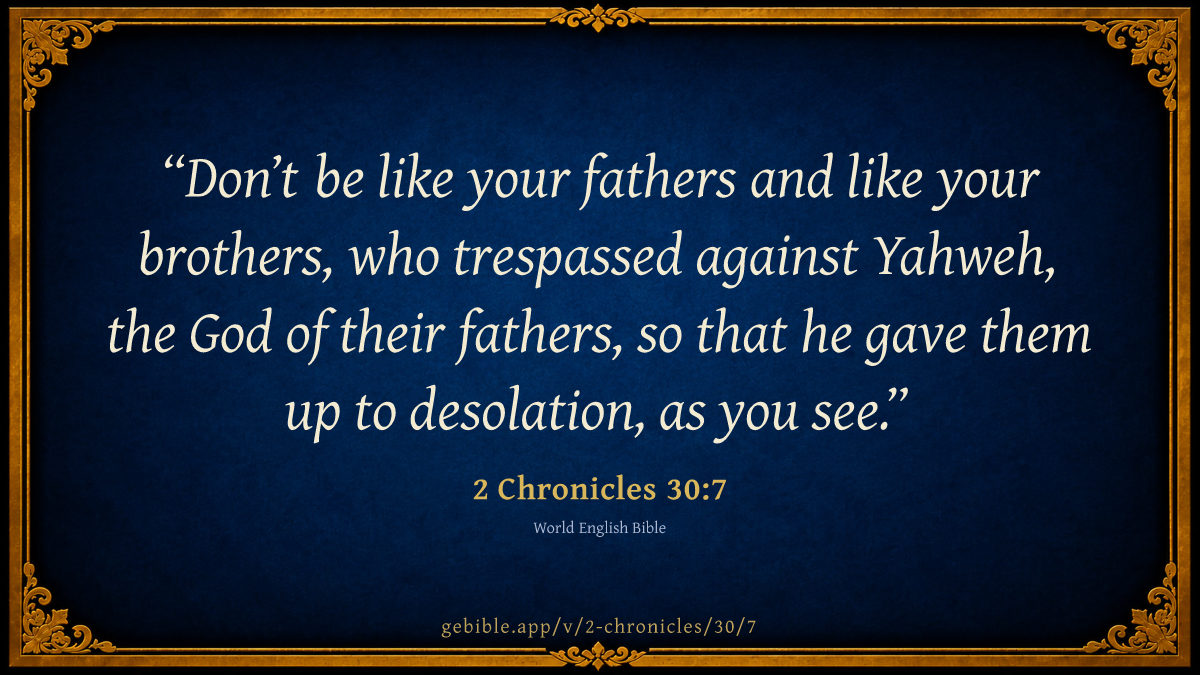
Don’t be like your fathers and like your brothers, who trespassed against Yahweh, the God of their fathers, so that he gave them up to desolation, as you see.
Parallel Translations
-
Don’t be like your fathers and like your brothers, who trespassed against Yahweh, the God of their fathers, so that he gave them up to desolation, as you see.
-
And be not ye like your fathers, and like your brethren, which trespassed against the LORD God of their fathers, who therefore gave them up to desolation, as ye see.
-
And be not ye like your fathers, and like your brethren, who acted treacherously against the LORD, the God of their fathers, so that He delivered them to be an astonishment, as ye see.
Cross-references (3)
Passages linked to 2 Chronicles 30:7 in the Treasury of Scripture Knowledge, ordered by reader-vote popularity; verse text shown in World English Bible.
- 2 Chronicles 29:8 Therefore Yahweh’s wrath was on Judah and Jerusalem, and he has delivered them to be tossed back and forth, to be an astonishment, and a hissing, as you see with your eyes.
- Ezekiel 20:13-18 “ ‘ “But the house of Israel rebelled against me in the wilderness. They didn’t walk in my statutes, and they rejected my ordinances, which if a man keeps, he shall live in them. They greatly profaned my Sabbaths. Then I said I would pour out my wrath on them in the wilderness, to consume them. But I worked for my name’s sake, that it should not be profaned in the sight of the nations, in whose sight I brought them out. Moreover also I swore to them in the wilderness, that I would not bring them into the land which I had given them, flowing with milk and honey, which is the glory of all lands; because they rejected my ordinances, and didn’t walk in my statutes, and profaned my Sabbaths; for their heart went after their idols. Nevertheless my eye spared them, and I didn’t destroy them. I didn’t make a full end of them in the wilderness. I said to their children in the wilderness, ‘Don’t walk in the statutes of your fathers. Don’t observe their ordinances or defile yourselves with their idols.
- Zechariah 1:3-4 Therefore tell them: Yahweh of Armies says: ‘Return to me,’ says Yahweh of Armies, ‘and I will return to you,’ says Yahweh of Armies. Don’t you be like your fathers, to whom the former prophets proclaimed, saying: Yahweh of Armies says, ‘Return now from your evil ways, and from your evil doings;’ but they didn’t hear, nor listen to me, says Yahweh.
Cross-references from openbible.info (CC BY 4.0)
Explain this verse (8 sources)
Historical commentary, presented as a primary source — not an endorsement.
Private notes
Saved on this device only — never synced or sent anywhere.
John Trapp 1656 · Public Domain 2Ch 30:7 And be not ye like your fathers,…
2Ch 30:7 And be not ye like your fathers, and like your brethren, which trespassed against the LORD God of their fathers, [who] therefore gave them up to desolation, as ye see.
Ver. 7. Who gave them up to desolation.] Heb., To astonishment: fecit ut omnes mirarentur, ac misererentur.
Read full note →
As ye see.] For it is to be hoped that your afflictions - those pillulae lucis - have cleared up your eyesight.
John Trapp, A Commentary or Exposition upon All the Books of the Old and New Testament (1647–1656) — public domain. Text from a community e-Sword module.
John Gill 1763 · Public Domain Now be ye not stiffnecked, as your fathers were,....…
Now be ye not stiffnecked, as your fathers were,.... Obstinate and refractory, like heifers unaccustomed to the yoke, which draw back from it, and will not submit to it:
but yield yourselves unto the Lord; be subject unto him, or "give the hand" (q) to him, as a token of subjection and homage, or of entering into covenant with him, promising for the future to serve and obey him:
Read full note →
and enter into his sanctuary, which he hath sanctified for ever; set apart for worship and service, until the Messiah should come:
and serve the Lord your God; there, in the temple, according to his prescribed will:
that the fierceness of his wrath may turn away from you; which had already broke out, in suffering the Assyrians to invade their land, and distress them.
(q) "date manum", Pagninus, Montanus, &c.
John Gill's Exposition of the Whole Bible (1746–1763) — public domain (CC PDM 1.0). Text via the HelloAO Bible API.
Haydock's Catholic Bible Commentary 1859 · Public Domain Destruction. Sept. "solitude." Prot. "desolation."
Destruction. Sept. "solitude." Prot. "desolation."
George Leo Haydock (1774–1849), Haydock's Catholic Family Bible and Commentary, 1859 edition — public domain. Excludes Psalms (Douay-Rheims chapter numbering differs from Protestant) and Deuterocanonical books (Catholic canon only).
The Cambridge Bible for Schools and Colleges 1878 · Public Domain 7. who therefore gave them up to desolation] Render,…
7. who therefore gave them up to desolation] Render, so that he gave them up to be an astonishment (so R.V. mg.); cp. 2Ch_29:8 (same Heb. word).
The Cambridge Bible for Schools and Colleges (gen. ed. J. J. S. Perowne; Cambridge University Press, 1878–1918) — public domain. Text from a community e-Sword module.
Ellicott's Commentary for English Readers 1878 · Public Domain (7) And be not ye like your fathers.—From the…
(7) And be not ye like your fathers.—From the days of Jeroboam downwards.
And like your brethren.—Of Naphtali and the Trans-Jordan, whom Tiglath-pileser carried captive.
Read full note →
Trespassed.—Were unfaithful to Jehovah.
Who therefore gave them up to desolation.—And He made them an astonishment (2Ch_29:8).
A Bible Commentary for English Readers, edited by Charles John Ellicott (1878–1897) — public domain. Text from a community e-Sword module.
The Pulpit Commentary 1880 · Public Domain A strange and significant snatch of corroborating history is…
A strange and significant snatch of corroborating history is to be found in 1Ch_5:23-26.
The Pulpit Commentary (1880–1919), ed. H.D.M. Spence-Jones & Joseph S. Exell — public domain. Text from a community e-Sword module.
The Biblical Illustrator 1887 · Public Domain That the fierceness of His wrath may turn away.
2Ch_30:7-8
That the fierceness of His wrath may turn away.
Read full note →
Mercy turned to penalty
The fire that cheers, refines, and purifies, also bums and tortures. It all depends on our relation to the fire, whether it be our friend or foe. In Retschs illustration of Goethes Faust, there is one plate where angels are seen dropping roses upon the demons who are contending for the soul of Faust. But every rose falls like molten metal wherever it touches. God rains roses down, but our sinful hearts meeting Divine love with wilful disobedience turn His love into wrath. (Christian Age.)
The duty of yielding ourselves to the Lord
I. A blessed season of grace marked for all israel. Now were the doors of the house of the Lord opened (2Ch_29:3).
II. Their duty in that blessed season of grace.
1. Negative. Be not stiff-necked. It is a metaphor taken from bullocks unaccustomed to the yoke, who make great difficulty and resistance about taking it on.
2. Positive.
(1) Yielding themselves to the Lord. Hebrew, give ye the hand to the Lord.
(2) Entering into His sanctuary.
(3) Serving Him.
(a) In His ordinances.
(b) In their daily walk. (T. Boston, D.D.)
A season of grace
In a season of grace, in which God is offering to lay His yoke on sinners, they should beware of being stiff-necked, or refusing to take it on.
I. What is that yoke which the Lord is offering to lay on sinners. It is the Soft and easy yoke for the salvation and welfare of penitent sinners. Take My yoke upon you, saith Jesus, and learn of Me: For My yoke is easy. This is the yoke of kindly willing subjection to God in Christ.
1. The yoke of subjection to the will of His commandments.
2. The yoke of His providential will. He claims to dispose of you, as seems good to Him.
II. This obedience of the sinner to God is called a yoke, because--
1. Coming under it, we are in a state of subjection as those under a yoke.
2. It is laid on us for labour or work.
3. By it we are not only kept at work, but kept in order at our work. They who truly bear the yoke, are uniform and orderly in their obedience. They have respect unto all Gods commandments.
4. Of its uneasiness to the flesh.
5. It fixes subjection upon us. The bonds of obligation are sweet and agreeable to His willing people.
III. Motives.
1. God is the party with whom we have to do.
2. There will be nothing gained by stiff-neckedness to the yoke of God.
3. God has waited long on you, but will not wait always (Pro_29:1). Now, while a season of grace is afforded to sinners, it is their duty to fall in with it speedily, to give the hand and yield themselves to the Lord. Here We shall--
I. Show how sinners have a season of grace afforded them
1. By their being continued in life.
2. By the call of the Gospel so directed to them. Behold now is the accepted time; behold now is the day of salvation.
3. By solemn sacramental occasions afforded to a people. This is the case in the text. These make a precious now not to be slighted. At ordinary occasions of the gospel, the blessed bargain is offered; but now the seal of heaven is ready to confirm it.
4. By some inward motions felt within ones own soul, pressing them to comply and yield at length.
II. Inquire what is supposed in this gracious call to sinners. It supposes--
1. That sinners are naturally in a state of rebellion against the Lord.
2. That though the Lord can break the sinner in pieces for his rebellion, yet He would rather that the sinner yield (Eze_33:11).
3. That Gods hand is stretched out to receive the sinner yielding himself (Isa_65:2).
4. That forced work will not be acceptable here.
6. That the sinner willingly yielding shall be kindly received and accepted.
III. Show what it is to give the hand or yield ouselves to the Lord.
1. In general, it comprehends--
(1) The work of conviction.
(2) The work of illumination in the knowledge of Christ, in receiving the discovery of a Savour.
(3) The work of humiliation, in becoming pliable to the Divine propose in the Gospel; leading them to say, Lord, what wilt Thou have me to do? The iron sinew in the sinners neck is broken. The outer door of the mind, and the inner door of the will, are both cast open to the Lord Christ.
(4) The work of faith in the sinners believing on, and so closing with Christ, as his Saviour from sin and wrath, renouncing all others.
(6) The work of repentance from dead works, in putting off the body of the sins of the flesh (Col_2:11). Faith and repentance are inseparable. That faith which produceth not evangelical repentance, is but dead faith.
(6) The work of entire resignation.
2. In particular.
(1) Yielding the soul, or inner man--mind--conscience--will--to the Lord.
(2) Yielding the body or outward man to the Lord.
(3) Yielding up all lusts and idols to Him as traitors which you can no more harbour.
(4) Yielding all lawful enjoyments to Him, so as to be at His disposal, and never to break with Him for any of them.
(5) Yielding, your lot and your all to Him; saying, He shall choose our inheritance for us. Improvement
Use 1: Of conviction and humiliation, in respect of the sad bias which mans nature has got.
Use 2: Of exhortation.
(1) You must yield yourselves to one or other, for you are not self-sufficient.
(2) The Lord hath the best right to you.
(3) Consider what the Lord has yielded for you (Rom_8:32; Rom_5:8).
(4) The Saviour is very desirous of your yielding.
(5) He is not seeking your yielding yourselves for nothing (Hos_3:3).
(6) You must yield or die, bow or break.
(7) Yield and all your former rebellions shall be forgiven.
(8) Yield or the Lord Will have war with you for ever. How will you bear His coming? (2Th_1:7; 2Th_1:9). (T. Boston, D. D.)
The manner in which the soul should yield itself to the Lord
I. As in a marriage covenant (Hos_2:19).
1. Wholly.
2. For ever.
II. As to a conqueror.
III. As to your king and sovereign Lord. At discretion and not by capitulation.
IV. As filial servants to a fatherly master (T. Boston, D. D.)
The Biblical Illustrator, edited by Joseph S. Exell (c. 1880s–1900s) — public domain. Text from a community e-Sword module.
unfoldingWord translationNotes 2017 · CC BY-SA 4.0 Connecting Statement:
Connecting Statement:
This is a continuation of King Hezekiah's message to the people of Israel.
Read full note →
your brothers
Here "brothers" represents other people of Israel. AT: "your people" (See: Metaphor)
he made them an object of horror
The abstract noun "horror" can be expressed with the words "horrified" or "horrible." The author writes of what God did to their ancestors in terms of how other people would react when the saw what God did. AT: "he made them something that people would be horrified to see" or "he punished them horribly" (See: Abstract Nouns and Metonymy)
give yourselves to Yahweh
This represents submitting to Yahweh. AT: "submit to Yahweh" or "dedicate yourselves to Yahweh" (See: Metaphor)
come into his holy place
Here "his holy place" refers to God's temple in Jerusalem. AT: "come to his temple in Jerusalem for it is holy" or "come to his temple in Jerusalem" (See: Metonymy)
so that his fierce anger may turn away from you
The author writes of anger as if it were a person that can turn away from people. God's anger turning away from them represents him no longer being angry with them. AT: "so that he will no longer be angry with you" (See: Personification)
if you turn back to Yahweh
Here "turn back to Yahweh" represents submitting to him again. AT: "if you submit again to Yahweh" (See: Metaphor)
your brothers and children will find compassion before those who led them away as prisoners
Here "find compassion" is a metaphor for experiencing compassion. Finding it "before those who led them" means those who led them away will show them compassion. AT: "your brothers and children will experience compassion from those who led them away as prisoners" or "those who led your brothers and children away as prisoners will be kind to them" (See: Metaphor)
will not turn his face away from you
Here "turn his face away from you" represents rejecting them and refusing to protect them. AT: "will not reject you" (See: Metaphor)
if you return to him
Here "return to him" represents submitting to God again. AT: "if you submit again to him" (See: Metaphor)
translationWords
brother
trespass
holy place
eternity
worship
compassion
prison
grace
mercy
face
unfoldingWord translationNotes — © Distant Shores Media and the Door43 World Missions Community, licensed CC BY-SA 4.0. Source: git.door43.org/Door43/en_tn.