
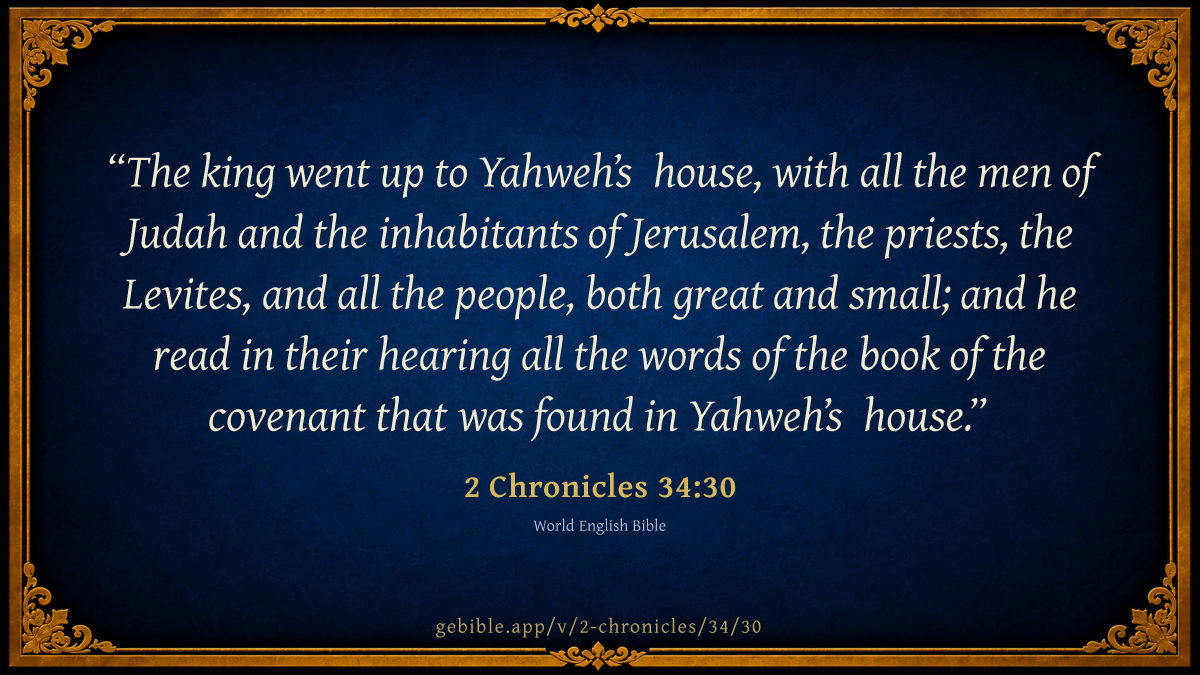
The king went up to Yahweh’s house, with all the men of Judah and the inhabitants of Jerusalem, the priests, the Levites, and all the people, both great and small; and he read in their hearing all the words of the book of the covenant that was found in Yahweh’s house.
Parallel Translations
-
The king went up to Yahweh’s house, with all the men of Judah and the inhabitants of Jerusalem, the priests, the Levites, and all the people, both great and small; and he read in their hearing all the words of the book of the covenant that was found in Yahweh’s house.
-
And the king went up into the house of the LORD, and all the men of Judah, and the inhabitants of Jerusalem, and the priests, and the Levites, and all the people, great and small: and he read in their ears all the words of the book of the covenant that was found in the house of the LORD.
-
And the king went up to the house of the LORD, and all the men of Judah and the inhabitants of Jerusalem, and the priests, and the Levites, and all the people, both great and small; and he read in their ears all the words of the book of the covenant that was found in the house of the LORD.
Cross-references (17)
Passages linked to 2 Chronicles 34:30 in the Treasury of Scripture Knowledge, ordered by reader-vote popularity; verse text shown in World English Bible.
- Exodus 24:7 He took the book of the covenant and read it in the hearing of the people, and they said, “We will do all that Yahweh has said, and be obedient.”
- 2 Kings 23:2 The king went up to Yahweh’s house, and all the men of Judah and all the inhabitants of Jerusalem with him, with the priests, the prophets, and all the people, both small and great; and he read in their hearing all the words of the book of the covenant which was found in Yahweh’s house.
- Deuteronomy 1:17 You shall not show partiality in judgment; you shall hear the small and the great alike. You shall not be afraid of the face of man, for the judgment is God’s. The case that is too hard for you, you shall bring to me, and I will hear it.”
- Deuteronomy 17:18-20 It shall be, when he sits on the throne of his kingdom, that he shall write himself a copy of this law in a book, out of that which is before the Levitical priests. It shall be with him, and he shall read from it all the days of his life, that he may learn to fear Yahweh his God, to keep all the words of this law and these statutes, to do them; that his heart not be lifted up above his brothers, and that he not turn away from the commandment to the right hand, or to the left, to the end that he may prolong his days in his kingdom, he and his children, in the middle of Israel.
- 2 Kings 23:21 The king commanded all the people, saying, “Keep the Passover to Yahweh your God, as it is written in this book of the covenant.”
- 2 Chronicles 6:1-11 Then Solomon said, “Yahweh has said that he would dwell in the thick darkness. But I have built you a house and home, a place for you to dwell in forever.” The king turned his face, and blessed all the assembly of Israel: and all the assembly of Israel stood. He said, “Blessed be Yahweh, the God of Israel, who spoke with his mouth to David my father, and has with his hands fulfilled it, saying, ‘Since the day that I brought my people out of the land of Egypt, I chose no city out of all the tribes of Israel to build a house in, that my name might be there and I chose no man to be prince over my people Israel; but now I have chosen Jerusalem, that my name might be there; and I have chosen David to be over my people Israel.’ Now it was in the heart of David my father to build a house for the name of Yahweh, the God of Israel. But Yahweh said to David my father, ‘Whereas it was in your heart to build a house for my name, you did well that it was in your heart; nevertheless you shall not build the house; but your son who will come out of your body, he shall build the house for my name.’ “Yahweh has performed his word that he spoke; for I have risen up in the place of David my father, and sit on the throne of Israel, as Yahweh promised, and have built the house for the name of Yahweh, the God of Israel. There I have set the ark, in which is Yahweh’s covenant, which he made with the children of Israel.”
- 2 Chronicles 15:12-13 They entered into the covenant to seek Yahweh, the God of their fathers, with all their heart and with all their soul; and that whoever would not seek Yahweh, the God of Israel, should be put to death, whether small or great, whether man or woman.
- 2 Chronicles 17:7-9 Also in the third year of his reign he sent his princes, even Ben Hail, Obadiah, Zechariah, Nethanel, and Micaiah, to teach in the cities of Judah; and with them the Levites, even Shemaiah, Nethaniah, Zebadiah, Asahel, Shemiramoth, Jehonathan, Adonijah, Tobijah, and Tobadonijah, the Levites; and with them Elishama and Jehoram, the priests. They taught in Judah, having the book of Yahweh’s law with them. They went about throughout all the cities of Judah and taught among the people.
- 2 Chronicles 18:30 Now the king of Syria had commanded the captains of his chariots, saying, “Don’t fight with small nor great, except only with the king of Israel.”
- 2 Chronicles 34:15 Hilkiah answered Shaphan the scribe, “I have found the book of the law in Yahweh’s house.” So Hilkiah delivered the book to Shaphan.
- 2 Chronicles 34:18-19 Shaphan the scribe told the king, saying, “Hilkiah the priest has delivered me a book.” Shaphan read from it to the king. When the king had heard the words of the law, he tore his clothes.
- 2 Chronicles 34:24 “Yahweh says, ‘Behold, I will bring evil on this place, and on its inhabitants, even all the curses that are written in the book which they have read before the king of Judah.
- Nehemiah 8:1-5 All the people gathered themselves together as one man into the wide place that was in front of the water gate; and they spoke to Ezra the scribe to bring the book of the law of Moses, which Yahweh had commanded to Israel. Ezra the priest brought the law before the assembly, both men and women, and all who could hear with understanding, on the first day of the seventh month. He read from it before the wide place that was in front of the water gate from early morning until midday, in the presence of the men and the women, and of those who could understand. The ears of all the people were attentive to the book of the law. Ezra the scribe stood on a pulpit of wood, which they had made for the purpose; and beside him stood Mattithiah, Shema, Anaiah, Uriah, Hilkiah, and Maaseiah, on his right hand; and on his left hand, Pedaiah, Mishael, Malchijah, Hashum, Hashbaddanah, Zechariah, and Meshullam. Ezra opened the book in the sight of all the people (for he was above all the people), and when he opened it, all the people stood up.
- Jeremiah 31:31-32 “Behold, the days come,” says Yahweh, “that I will make a new covenant with the house of Israel, and with the house of Judah: not according to the covenant that I made with their fathers in the day that I took them by the hand to bring them out of the land of Egypt; which covenant of mine they broke, although I was a husband to them,” says Yahweh.
- Job 3:19 The small and the great are there. The servant is free from his master.
- Ecclesiastes 1:12 I, the Preacher, was king over Israel in Jerusalem.
- Ecclesiastes 12:9-10 Further, because the Preacher was wise, he still taught the people knowledge. Yes, he pondered, sought out, and set in order many proverbs. The Preacher sought to find out acceptable words, and that which was written blamelessly, words of truth.
Cross-references from openbible.info (CC BY 4.0)
Explain this verse (6 sources)
Historical commentary, presented as a primary source — not an endorsement.
Private notes
Saved on this device only — never synced or sent anywhere.
Geneva Bible translators 1599 · Public Domain Forasmuch as neither young nor old could be exempted…
Forasmuch as neither young nor old could be exempted from the curses contained therein, if they did transgress, he knew it pertained to all, and was his duty to see it read to all sorts, that everyone might learn to avoid those punishments by serving God aright.
Geneva Bible (1599) marginal notes — public domain.
Adam Clarke 1810 · Public Domain Verse 30. The king went] See on 2Kg 23:1.
Verse 30. The king went] See on 2Kg 23:1.
Adam Clarke's Commentary on the Bible (1810–1826) — public domain. Text from a community e-Sword/MySword module.
Albert Barnes 1834 · Public Domain The writer has characteristically substituted “Levites” for the “prophets”…
The writer has characteristically substituted “Levites” for the “prophets” of 2Ki 23:2. No doubt Josiah was accompanied by priests, prophets, and Levites, but the writer of Kings thought it enough to mention the two former, and merged the Levites in the mass of the people. The writer of Chronicles, on the other hand, thinks the presence of Levites too important to he omitted, and as the prophets could be but few in number, passes them over.
Albert Barnes' Notes on the Bible (1834–1885) — public domain. Text from a community e-Sword/MySword module.
The Cambridge Bible for Schools and Colleges 1878 · Public Domain 30. the Levites] In 2 Kin. “the prophets.”
30. the Levites] In 2 Kin. “the prophets.”
The Cambridge Bible for Schools and Colleges (gen. ed. J. J. S. Perowne; Cambridge University Press, 1878–1918) — public domain. Text from a community e-Sword module.
Ellicott's Commentary for English Readers 1878 · Public Domain (30) The Levites.—The chronicler substituted this for “the prophets”…
(30) The Levites.—The chronicler substituted this for “the prophets” (Kings). It was a natural change to make, seeing that the prophetic order had long been extinct in his day. It may even be the result of an unconscious error, as the phrase “priests and Levites” is so frequent in his pages.
A Bible Commentary for English Readers, edited by Charles John Ellicott (1878–1897) — public domain. Text from a community e-Sword module.
The Pulpit Commentary 1880 · Public Domain The Levites. The parallel mentions "prophets" and omits "Levites,"…
The Levites. The parallel mentions "prophets" and omits "Levites," which latter our compiler is safe not to forget. When it is said in this verse, he read, the meaning, of course, is "the priests" read. (Deu_31:9)
The value of the Bible.
Read full note →
I THE BIBLE LOST. An unspeakable calamity.
1. To literature. Remark on the indebtedness of modern literature to the Bible.
2. To religion. Without the support and quickening derived from Scripture religion would speedily become languid.
3. To morality. Contrast in respect of morality countries possessing and countries lacking the Bible.
II THE BIBLE FOUND. A great mercy. More to be prized than the discovery of gold-mines, which can only contribute to man"s material wealth, or even of rare manuscripts by human authors, which enrich chiefly the intellect, the finding of the Bible by an individual or a nation for the first time, or the recovery of it after it has been for some time lost, is:
1. An occasion of great joy, and is usually felt to be such. Witness the gladness of Luther at finding the Bible in the convent at Erfurth. And ought to be:
2. A reason for special thankfulness, as it generally is to all who know its value as a revelation of Divine wisdom and love, and can appreciate its power to influence the hearts and lives of men.
III THE BIBLE READ. A blessed privilege.
1. Many might read the Bible who do not have it. A sad deprivation. This the case of the heathen generally and of numbers at home. An argument for missions.
2. Many have the Bible, yet do not read it. A grievous sin. This the case with thousands in Christendom to whom God"s Word is a strange book. An argument for preaching.
3. Many have the Bible, but cannot read it. A pitiful condition. This the case of those who through defective education or blindness are unable to read. An argument for Christian philanthropy.
4. Many have the Bible and read it. A happy experience. This the case of those who have learnt to recognize in the Bible God"s Word, and to appreciate its suitability to their soul"s needs. An argument for the inspiration of the Scriptures.
IV THE BIBLE OBEYED. An indispensable duty.
1. Obedience the end and aim of the Bible. The Bible not written for information merely, but for direction also. Designed not simply for the construction of creeds, but likewise for the regulation of conduct (Mat_6:24; Jam_1:22)
2. Obedience the only homage acceptable to the Bible. To read it, admire its literary beauty, study its theology, extol its excellences, circulate it, are good if these acts are accompanied by obedience, but if not they are comparatively worthless.
3. Obedience the best witness to the Divinity of the Bible. "If any man will do his will, he shall know of the doctrine, whether it be of God". (Joh_7:17) Those who know the Bible best, by giving practical obedience to its precepts are most fully convinced of its heavenly and supernatural origin.
4. Obedience the necessary means for obtaining the blessing of the Bible. Not the hearers of the Word, but the doers thereof, are justified before W. (Mat_7:21; Luk_11:28; (Rom_2:13)
The Pulpit Commentary (1880–1919), ed. H.D.M. Spence-Jones & Joseph S. Exell — public domain. Text from a community e-Sword module.