11When the priests had come out of the holy place (for all the priests who were present had sanctified themselves, and didn’t keep their divisions;12also the Levites who were the singers, all of them, even Asaph, Heman, Jeduthun, and their sons and their brothers, arrayed in fine linen, with cymbals and stringed instruments and harps, stood at the east end of the altar, and with them one hundred twenty priests sounding with trumpets);
13when the trumpeters and singers were as one, to make one sound to be heard in praising and thanking Yahweh; and when they lifted up their voice with the trumpets and cymbals and instruments of music, and praised Yahweh, saying, “For he is good; for his loving kindness endures forever!” then the house was filled with a cloud, even Yahweh’s house,
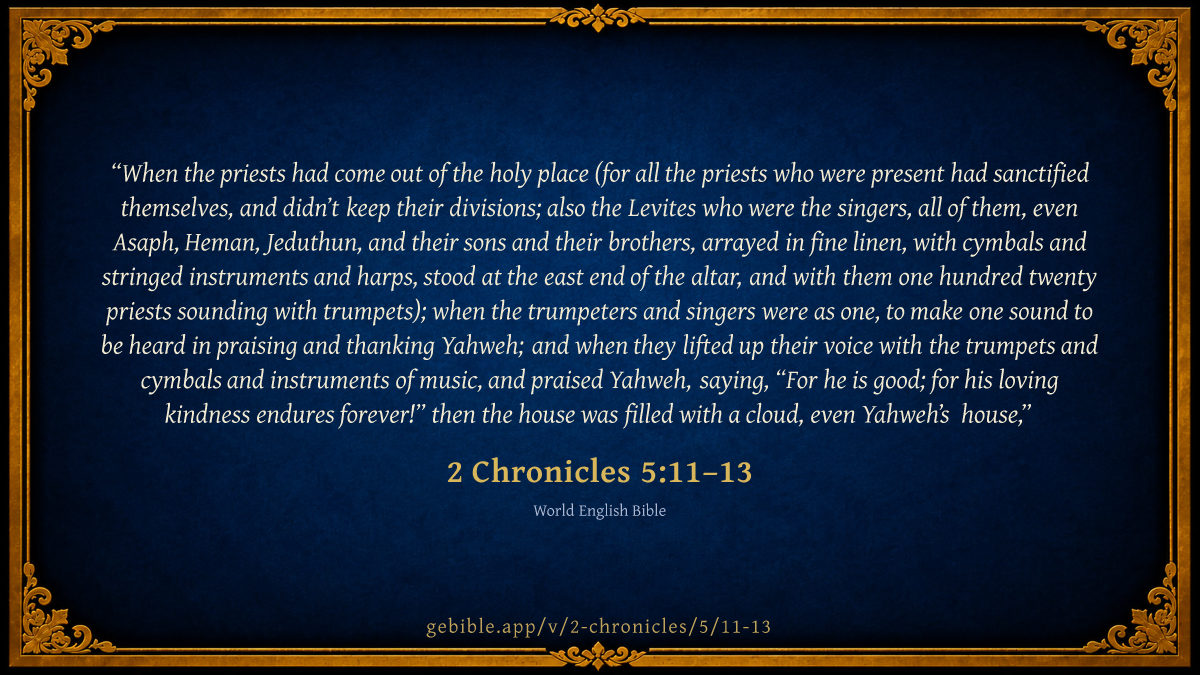
11 When the priests had come out of the holy place (for all the priests who were present had sanctified themselves, and didn’t keep their divisions;
12 also the Levites who were the singers, all of them, even Asaph, Heman, Jeduthun, and their sons and their brothers, arrayed in fine linen, with cymbals and stringed instruments and harps, stood at the east end of the altar, and with them one hundred twenty priests sounding with trumpets);
13 when the trumpeters and singers were as one, to make one sound to be heard in praising and thanking Yahweh; and when they lifted up their voice with the trumpets and cymbals and instruments of music, and praised Yahweh, saying, “For he is good; for his loving kindness endures forever!” then the house was filled with a cloud, even Yahweh’s house,
KJVKing James Version
11 And it came to pass, when the priests were come out of the holy place: (for all the priests that were present were sanctified, and did not then wait by course:
12 Also the Levites which were the singers, all of them of Asaph, of Heman, of Jeduthun, with their sons and their brethren, being arrayed in white linen, having cymbals and psalteries and harps, stood at the east end of the altar, and with them an hundred and twenty priests sounding with trumpets:)
13 It came even to pass, as the trumpeters and singers were as one, to make one sound to be heard in praising and thanking the LORD; and when they lifted up their voice with the trumpets and cymbals and instruments of musick, and praised the LORD, saying, For he is good; for his mercy endureth for ever: that then the house was filled with a cloud, even the house of the LORD;
Show all 3 translations
JPSJPS Tanakh (1917)
11 And it came to pass, when the priests were come out of the holy place — for all the priests that were present had sanctified themselves, and did not keep their courses;
12 also the Levites who were the singers, all of them, even Asaph, Heman, Jeduthun, and their sons and their brethren, arrayed in fine linen, with cymbals and psalteries and harps, stood at the east end of the altar, and with them a hundred and twenty priests sounding with trumpets —
13 it came even to pass, when the trumpeters and singers were as one, to make one sound to be heard in praising and thanking the LORD; and when they lifted up their voice with the trumpets and cymbals and instruments of music, and praised the LORD: 'for He is good, for His mercy endureth for ever'; that then the house was filled with a cloud, even the house of the LORD,
Ezra 3:11(v13)They sang to one another in praising and giving thanks to Yahweh, “For he is good, for his loving kindness endures forever toward Israel.”…
2 Chronicles 7:3(v13)All the children of Israel looked on, when the fire came down, and Yahweh’s glory was on the house. They bowed themselves with their faces…
Jeremiah 33:11(v13)the voice of joy and the voice of gladness, the voice of the bridegroom and the voice of the bride, the voice of those who say, ‘Give…
1 Chronicles 15:24(v12)Shebaniah, Joshaphat, Nethanel, Amasai, Zechariah, Benaiah, and Eliezer, the priests, blew the trumpets before God’s ark; and Obed-Edom and…
Isaiah 52:8(v13)Your watchmen lift up their voice. Together they sing; for they shall see eye to eye when Yahweh returns to Zion.
Show all 51 cross-references
Revelation 5:8-14(v13)Now when he had taken the book, the four living creatures and the twenty-four elders fell down before the Lamb, each one having a harp, and…
Psalms 100:5(v13)For Yahweh is good. His loving kindness endures forever, his faithfulness to all generations.
Psalms 136:1-26(v13)Give thanks to Yahweh, for he is good; for his loving kindness endures forever. Give thanks to the God of gods; for his loving kindness…
2 Chronicles 20:21(v13)When he had taken counsel with the people, he appointed those who were to sing to Yahweh, and give praise in holy array, as they go out…
Psalms 95:1-2(v13)Oh come, let’s sing to Yahweh. Let’s shout aloud to the rock of our salvation! Let’s come before his presence with thanksgiving. Let’s…
Exodus 40:34-35(v13)Then the cloud covered the Tent of Meeting, and Yahweh’s glory filled the tabernacle. Moses wasn’t able to enter into the Tent of Meeting,…
1 Chronicles 6:33(v12)These are those who served, and their sons. Of the sons of the Kohathites: Heman the singer, the son of Joel, the son of Samuel,
1 Chronicles 6:39(v12)His brother Asaph, who stood on his right hand, even Asaph the son of Berechiah, the son of Shimea,
1 Chronicles 16:34-42(v13)Oh give thanks to Yahweh, for he is good, for his loving kindness endures forever. Say, “Save us, God of our salvation! Gather us together…
1 Chronicles 23:5(v12)four thousand were doorkeepers, and four thousand praised Yahweh with the instruments which I made for giving praise.”
2 Chronicles 7:6(v12)The priests stood, according to their positions; the Levites also with instruments of music of Yahweh, which David the king had made to…
2 Chronicles 29:5(v11)and said to them, “Listen to me, you Levites! Now sanctify yourselves, and sanctify Yahweh, the God of your fathers’ house, and carry the…
2 Chronicles 29:25(v12)He set the Levites in Yahweh’s house with cymbals, with stringed instruments, and with harps, according to the commandment of David, of Gad…
2 Chronicles 30:17-20(v11)For there were many in the assembly who had not sanctified themselves: therefore the Levites were in charge of killing the Passovers for…
2 Chronicles 35:4(v11)Prepare yourselves after your fathers’ houses by your divisions, according to the writing of David king of Israel, and according to the…
Job 1:5(v11)It was so, when the days of their feasting had run their course, that Job sent and sanctified them, and rose up early in the morning, and…
Psalms 68:25(v12)The singers went before, the minstrels followed after, among the ladies playing with tambourines,
Psalms 68:25-26(v13)The singers went before, the minstrels followed after, among the ladies playing with tambourines, “Bless God in the congregations, even the…
Psalms 150:3-5(v12)Praise him with the sounding of the trumpet! Praise him with harp and lyre! Praise him with tambourine and dancing! Praise him with…
Jeremiah 32:39(v13)I will give them one heart and one way, that they may fear me forever, for their good, and the good of their children after them.
Acts 4:32(v13)The multitude of those who believed were of one heart and soul. Not one of them claimed that anything of the things which he possessed was…
Romans 15:6(v13)that with one accord you may with one mouth glorify the God and Father of our Lord Jesus Christ.
Exodus 19:10(v11)Yahweh said to Moses, “Go to the people, and sanctify them today and tomorrow, and let them wash their garments,
Exodus 19:14-15(v11)Moses went down from the mountain to the people, and sanctified the people; and they washed their clothes. He said to the people, “Be ready…
Numbers 10:1-5(v12)Yahweh spoke to Moses, saying, “Make two trumpets of silver. You shall make them of beaten work. You shall use them for the calling of the…
Joshua 6:6-20(v12)Joshua the son of Nun called the priests, and said to them, “Take up the ark of the covenant, and let seven priests bear seven trumpets of…
1 Chronicles 13:8(v12)David and all Israel played before God with all their might, even with songs, with harps, with stringed instruments, with tambourines, with…
1 Chronicles 15:16-22(v12)David spoke to the chief of the Levites to appoint their brothers as singers with instruments of music, stringed instruments, harps, and…
1 Chronicles 15:27(v12)David was clothed with a robe of fine linen, as were all the Levites who bore the ark, the singers, and Chenaniah the choir master with the…
1 Chronicles 16:4-6(v12)He appointed some of the Levites to minister before Yahweh’s ark, and to commemorate, to thank, and to praise Yahweh, the God of Israel:…
1 Chronicles 16:41-42(v12)and with them Heman and Jeduthun, and the rest who were chosen, who were mentioned by name, to give thanks to Yahweh, because his loving…
1 Chronicles 23:30(v12)and to stand every morning to thank and praise Yahweh, and likewise in the evening;
1 Chronicles 24:1-31(v11)These were the divisions of the sons of Aaron. The sons of Aaron: Nadab, Abihu, Eleazar, and Ithamar. But Nadab and Abihu died before their…
1 Chronicles 25:1-7(v12)Moreover, David and the captains of the army set apart for the service certain of the sons of Asaph, and of Heman, and of Jeduthun, who…
2 Chronicles 29:15(v11)They gathered their brothers, sanctified themselves, and went in, according to the commandment of the king by Yahweh’s words, to cleanse…
2 Chronicles 29:34(v11)But the priests were too few, so that they could not skin all the burnt offerings. Therefore their brothers the Levites helped them, until…
2 Chronicles 30:15(v11)Then they killed the Passover on the fourteenth day of the second month. The priests and the Levites were ashamed, and sanctified…
Ezra 3:10-11(v12)When the builders laid the foundation of Yahweh’s temple, they set the priests in their clothing with trumpets, with the Levites the sons…
Psalms 50:1(v12)The Mighty One, God, Yahweh, speaks, and calls the earth from sunrise to sunset.
Psalms 62:1(v12)My soul rests in God alone. My salvation is from him.
Psalms 88:1(v12)Yahweh, the God of my salvation, I have cried day and night before you.
Psalms 92:3(v12)with the ten-stringed lute, with the harp, and with the melody of the lyre.
Psalms 100:1-2(v13)Shout for joy to Yahweh, all you lands! Serve Yahweh with gladness. Come before his presence with singing.
Psalms 149:3(v12)Let them praise his name in the dance! Let them sing praises to him with tambourine and harp!
Revelation 15:6(v12)The seven angels who had the seven plagues came out, clothed with pure, bright linen, and wearing golden sashes around their breasts.
Revelation 19:8(v12)It was given to her that she would array herself in bright, pure, fine linen: for the fine linen is the righteous acts of the saints.
Cross-references from openbible.info (CC BY 4.0)
Explain this passage (17 sources)
Historical commentary, presented as a primary source — not an endorsement.
Geneva Bible translators1599 · Public DomainOn vv11, 13Were prepared to serve the Lord.
Were prepared to serve the Lord.
Geneva Bible (1599) marginal notes — public domain.
John Trapp1656 · Public DomainOn vv11–132Ch 5:11 And it came to pass, when the…
2Ch 5:11 And it came to pass, when the priests were come out of the holy [place]: (for all the priests [that were] present were sanctified, [and] did not [then] wait by course:
Ver. 11. And did not then wait by course.] Because the work was extraordinary.
John Trapp, A Commentary or Exposition upon All the Books of the Old and New Testament (1647–1656) — public domain. Text from a community e-Sword module.
Matthew Poole1685 · Public DomainOn v11According to David’s appointment, 1Ch 24; 1Ch 25, which…
According to David’s appointment, 1Ch 24; 1Ch 25, which was only for the ordinary service; but in extraordinary solemnities, such as this eminently was they all came together.
Matthew Poole's English Annotations on the Holy Bible (1683–1685) — public domain. Text from a community e-Sword/MySword module.
Matthew Henry1710 · Public DomainOn v11Solomon, and the elders of Israel, had done what…
Solomon, and the elders of Israel, had done what they could to grace the solemnity of the introduction of the ark; but God, by testifying his acceptance of what they did, put the greatest honour upon it. The cloud of glory that filled the house beautified it more than all the gold with which it was overlaid or the precious stones with which it was garnished; and yet that was no glory in comparison with the glory of the gospel dispensation, Co2 3:8-10. Observe,
I. How God took possession of the temple: He filled it with a cloud, Ch2 5:13. 1. Thus he signified his acceptance of this temple to be the same to him that the tabernacle of Moses was, and assured them that he would be the same in it; for it was by a cloud that he made his public entry into that, Exo 40:34. 2. Thus he considered the weakness and infirmity of those to whom he manifested himself, who could not bear the dazzling lustre of the divine light: it would have overpowered them; he therefore spread his cloud upon it, Job 26:9. Christ revealed things unto his disciples as they were able to bear them, and in parables, which wrapped up divine things as in a cloud. 3. Thus he would affect all that worshipped in his courts with holy reverence and fear. Christ's disciples were afraid when they entered into a cloud, Luk 9:34. 4. Thus he would intimate the darkness of that dispensation, by reason of which they could not stedfastly look to the end of those things which were now abolished, Co2 3:13.
Read full note →
II. When he took possession of it. 1. When the priests had come out of the holy place, Ch2 5:11. This is the way of giving possession. All must come out, that the rightful owner may come in. Would we have God dwell in our hearts? We must leave room for him; let every thing else give way. We are here told that upon this occasion the whole family of the priests attended, and not any one particular course: All the priests that were present were sanctified (Ch2 5:11), because there was work enough for them all, when such a multitude of sacrifices were to be offered, and because it was fit that they should all be eye-witnesses of this solemnity and receive the impressions of it. 2. When the singers and musicians praised God, then the house was filled with a cloud. This is very observable; it was not when they offered sacrifices, but when they sang the praises of God, that God gave them this token of his favour; for the sacrifice of praise pleaseth the Lord better than that of an ox or bullock, Psa 69:31. All the singers and musicians were employed, those of all the three families; and, to complete the concert, 120 priests, with their trumpets, joined with them, all standing at the east end of the altar, on that side of the court which lay outmost towards the people, Ch2 5:12. And, when this part of the service began, the glory of God appeared. Observe, (1.) It was when they were unanimous, when they were as one, to make one sound. The Holy God descended on the apostles when they met with one accord, Act 2:1-4. Where unity is the Lord commands the blessing. (2.) It was when they were lively and hearty, and lifted up their voice to praise the Lord. Then we serve God acceptably when we are fervent in spirit serving him. (3.) It was when they were, in their praises, celebrating the everlasting mercy and goodness of God. As there is one saying oftener repeated in scripture than this, his mercy endureth for ever (twenty-six times in one psalm, Ps. 136, and often elsewhere), so there is none more signally owned from heaven; for it was not the expression of some rapturous flights that the priests were singing when the glory of God appeared, but this plain song, He is good, and his mercy endureth for ever. God's goodness is his glory, and he is pleased when we give him the glory of it.
III. What was the effect of it. The priests themselves could not stand to minister, by reason of the cloud (Ch2 5:14), which, as it was an evidence that the law made men priests that had infirmity, so (as bishop Patrick observes) it was a plain intimation that the Levitical priesthood should cease, and stand no longer to minister, when the Messiah should come, in whom the fulness of the godhead should dwell bodily. In him the glory of God dwelt among us, but covered with a cloud. The Word was made flesh; and when he comes to his temple, like a refiner's fire, who may abide the day of his coming? And who shall stand when he appeareth? Mal 3:1, Mal 3:2.
Matthew Henry's Commentary on the Whole Bible (1708–1710) — public domain (CC PDM 1.0). Text via the HelloAO Bible API.
John Wesley1765 · Public DomainOn v11By course - According to David's appointment, 1 Chron.…
By course - According to David's appointment, 1 Chron. xxiv, 1-31, xxv, 1-22, which was only for the ordinary service, but in extraordinary solemnities, such as this, they all came together.
John Wesley, Explanatory Notes Upon the Whole Bible (1754–1765) — public domain. Text via the GEBible commentary corpus.
Adam Clarke1810 · Public DomainOn vv11–13Verse 11. When the priests were come out] After…
Verse 11. When the priests were come out] After having carried the ark into the holy of holies, before the sacred service had commenced.
Adam Clarke's Commentary on the Bible (1810–1826) — public domain. Text from a community e-Sword/MySword module.
Albert Barnes1834 · Public DomainOn v13Even the house of the Lord - Or, according…
Even the house of the Lord - Or, according to another reading (Septuagint), which removes the superfluousness of these words - “The house was filled with a cloud of the glory of the Lord.”
Albert Barnes' Notes on the Bible (1834–1885) — public domain. Text from a community e-Sword/MySword module.
Haydock's Catholic Bible Commentary1859 · Public DomainOn vv11–12Sanctified; free from all legal impediments to offer sacrifice.…
Sanctified; free from all legal impediments to offer sacrifice. (Haydock) --- Divided. Hebrew, "observed." (Tirinus) --- Protestants, "and they did not then wait by course," which was the case also with the singers, &c., on this solemn occasion; as the number regulated by David for each week, would not have been sufficient. (Haydock) --- The regulation had not yet been reduced to practice. (Menochius) (Calmet) --- As yet (Du Hamel) at that time, is omitted (Haydock) by the Septuagint (Du Hamel) and Hebrew.
George Leo Haydock (1774–1849), Haydock's Catholic Family Bible and Commentary, 1859 edition — public domain. Excludes Psalms (Douay-Rheims chapter numbering differs from Protestant) and Deuterocanonical books (Catholic canon only).
Robert Jamieson, A. R. Fausset & David Brown1871 · Public DomainOn vv11–13all the priests that were present . . .…
all the priests that were present . . . did not then wait by course--The rotation system of weekly service introduced by David was intended for the ordinary duties of the priesthood; on extraordinary occasions, or when more than wonted solemnity attached to them, the priests attended in a body.
Jamieson, Fausset & Brown — Commentary Critical and Explanatory on the Whole Bible (1871) — public domain (CC PDM 1.0). Text via the HelloAO Bible API.
The Cambridge Bible for Schools and Colleges1878 · Public DomainOn vv11–1311–14 (= 1Ki_8:10-11). The Descent of the Glory of…
11–14 (= 1Ki_8:10-11). The Descent of the Glory of the Lord
11. out of the holy place] The priests could remain neither in the Holy of Holies where they had deposited the ark, nor even in the holy place, but were driven altogether out of the Temple building into the Temple court (cp. 2Ch_5:14).
Read full note →
and did not then wait by course] R.V. and did not keep their courses. Cp. 1Ch_24:1-19.
The Cambridge Bible for Schools and Colleges (gen. ed. J. J. S. Perowne; Cambridge University Press, 1878–1918) — public domain. Text from a community e-Sword module.
Ellicott's Commentary for English Readers1878 · Public DomainOn vv11–13(11) For all the priests.—From this point to “for…
(11) For all the priests.—From this point to “for his mercy endureth for ever,” 2Ch_5:13, the narrative is peculiar to the chronicler. He has characteristically inserted between the two halves of the short verse (1Ki_8:10) a long parenthesis, dwelling upon the Levitical ministrations.
That were present.—That could be found. So Vulg. (Comp. 2Ki_19:4.)
Read full note →
Were sanctified.—Had sanctified (or purified) themselves, for the purpose of taking part in the ceremony (1Ch_15:12).
And did not then wait by course.—They had not to observe courses (1 Chronicles 24). Not merely the class of priests then on duty, but all the classes indiscriminately took part in the solemnity.
A Bible Commentary for English Readers, edited by Charles John Ellicott (1878–1897) — public domain. Text from a community e-Sword module.
The Pulpit Commentary1880 · Public DomainOn vv11–13The parallel (1Ki_8:10) shows the first half of this…
The parallel (1Ki_8:10) shows the first half of this verse and the last sentence of ver. 13 to make its tenth verse. All between these two is special to the present passage and to Chronicles. All the priests not by course; i.e. all of all the courses, twenty-four in number, instead of only the one course on daily duty at the time. (1Ch_23:6-32 1Ch_24:1-31) Present; or, found more literally; that is to say, all who were not for one cause or another out of reach (1Ch_29:17; Ezr_8:25) The Hebrew word is the familiar
The Pulpit Commentary (1880–1919), ed. H.D.M. Spence-Jones & Joseph S. Exell — public domain. Text from a community e-Sword module.
The Biblical Illustrator1887 · Public DomainOn v12Also the the Levites, which were the singers.
2Ch_5:12-13
Also the the Levites, which were the singers.
Read full note →
The temple choir
I. Music and revelation from God. There is no fuller revelation of God in Nature than is found in these laws of sound, by which He comes into the very heart of man, even to its inmost recesses of love and adoration; and it requires only a sensitive, child-like heart to interpret this speechless music locked within Nature as the voice of God pleading to be let out into music, and praise through the heart of man, for so only can His works praise Him.
II. Music as a science to cultivate.
III. Music consecrated to its highest use in the worship of God. (J. Wolfendale.)
Music in the churches
I propose to speak about sacred music.
I. Its importance. This is apparent--
1. From the fact that God commanded it. Through Paul He tells us to admonish one another in psalms and hymns and spiritual songs, and through David He cries out, Sing ye to God, all ye kingdoms of the earth. I think there are more commands in the Bible to sing than there are to pray.
2. From the impressiveness of the exercise. You know something of what secular music has achieved. One inspiriting national air is worth thirty thousand men as a standing army. In the earlier part of the late war the Government proposed to economise in bands of music, and many of them were sent home; but the generals in the army sent word to Washington: You are making a great mistake. We are falling back and falling back. We have not enough music. Then the Government changed its mind: more bands of music were sent to the field, and the day of shameful defeat terminated. Many of you are illustrations of what sacred song can do. Through it you were brought into the kingdom of Jesus Christ.
3. From its power to soothe perturbation.
4. From its power to arouse to action.
II. Some of the obstacles in the way of its advancement.
1. It has been impressed into the service of superstition.
2. An inordinate fear of criticism.
3. There has been so much angry discussion on the subject.
4. The erroneous notion that this part of the service could be conducted by delegation. (T. De Witt Talmage.)
United praise as a means of grace
I. That the glory of the Lord began to appear when the assembly were employed in praise and thanksgiving. Praise is the most acceptable service we can be engaged in: Whoso offereth praise giorifieth Me. Prayer is an expression of our indigence and weakness. Thanksgiving expresseth our relish of the sweetness of benefits received; but praise rises above all selfish regards, and directly terminates on the greatness and amiableness of God Himself. The habitations of the blessed continually resound with the high praises of God. Did we praise God more, He would give us greater cause to praise Him. It is suggestive that the Lords Prayer both begins and ends with adoration.
II. The subject of praise, which God honoured with this token of His acceptance, was His own goodness and everlasting mercy. God is best pleased with our praises when we adore and celebrate those perfections of His nature which dispose Him to pity the miserable, and have the kindest aspect towards the children of men.
III. The seriousness and fervour of this devout assembly. They devoted their whole strength and activity, as if they were ambitious to spend themselves in this heavenly employment. The devotion of the soul is the soul of devotion.
IV. The harmony and unanimity of these ancient worshippers. They were all as one, and made one sound to be heard in praising and thanking the Lord (Act_2:1-2; Psa_133:1-3.; Mat_5:23-24). (R. Walker.)
On psalmody
I. Why or for what end music is used in religious worship. By the constitution of our nature music, by a mysterious and potent agency, awakens the heart, concentrates the thoughts, and elevates the soul, and the end of music in religious worship is to assist our devotions, by an application to our affections of that which has upon them a powerful action to excite and direct them; by engaging us in an exercise in which sympathy has large scope, and every one acts upon the rest, to enable us to animate each other; to pour forth our praises and adorations in a way that is significant and edifying, delightsome and impressive. Hence--
1. The absurdity of making music in our religious services a mere matter of entertainment.
2. All kinds of music which have no tendency to aid and gratify devotion ought to be banished from the house of God.
II. Some of the examples and authorities for making music a handmaid to religion (Job_38:7; Gen_4:21; Exo_15:20; Psa_47:6; Psa_98:7; Eph_5:19; Mat_26:30).
III. After what manner the first Christians performed this service. The nearer we come to the model of the primitive Church in this, the nearer we shall approach to perfection. The psalmody of the first Christians was plain, simple, and solemn. Their tunes were, probably, easy and few, and the character of them such as expressed humility and love, and was calculated rather to melt than to capture the heart. Afterwards, as piety declined, it became necessary to re-excite and re-animate it by more striking music; and the whole congregation was divided into two parts, which sang responsive to each other.
IV. Some brief suggestions how we may use this part of divine service to our own benefit and the glory of god. (Bp. Dehon.)
Advantages of music in public worship
I. they lifted up their voice. Those whom nature has gifted with a voice ought to lift it up not only in making responses but also in singing the praises of their Creator and Redeemer. The choir should not be deputed by the congregation to praise God in their stead. Its office is rather to lead their united praises.
II. In acceptable worship the praise of the heart must accompany the praise of the lips: They were as one to make one sound to be heard in praising and thanking the Lord. Their hearts were all at one with the trumpets and cymbals and instruments of music. Those who sing loudly the praises of God should let heart, lips, and life be a well-tuned instrument devoted to the service of the sanctuary. The man who sings beautiful words with an angels tongue, and leads an unholy life, pronounces his own condemnation.
III. Those who are anxious that the praise of the heart should accompany the praise of the lips will find themselves greatly aided by instruments of music: They lifted up their voice with the trumpets and cymbals and instruments of music. Instrumental music unites voices which would otherwise be discordant, and removes the diffidence of those who might otherwise be silent in the service of the sanctuary. Instrumental music removes weariness from the mind, banishes wandering thoughts, and enables us to mount above the world and the things of the world, and to hold high converse with the adorable Trinity. It also conveys to us a lively image of the worship and services of the heavenly sanctuary. (Rev_14:2; Rev_14:8). We must learn to distinguish between the natural effect of music on the senses and the spiritual effect of Divine truths on the soul.
IV. The subject-matter of praise: Gods goodness in creation and redemption.
V. Gods testimony of approbation: the cloud filled the house. This was designed to impress their senses with an awful reverence of God.
VI. The time when God gave them this remarkable token of His approbation: When they lifted up their voice. Conclusion: So that the priests could not stand to minister by reason of the cloud. These show that, when Christ should come, the priests should not minister in their former manner. We are now called upon to renounce every altar but the Cross, and every sacrifice but the Victim which bled on Calvary. As s spiritual priesthood, we have to present our bodies a living sacrifice. (Canon Arthur R. Pennington.)
That then the house was filled with a cloud (with 2Ch_7:1-8).--
Temple glories
The two passages of Scripture which I have read to you give you two pictures. In the first you have the cloud, in the second you have the fire; and in these two together you have the sacred mystic symbols of the presence of the Eternal God in the midst of His people.
I. The first of these passages affords me the first head of my discourse. Let us note--
1. The occupation in which the people were engaged. They were praising God--
(1) Unanimously.
(2) Heartily.
(3) Scripturally.
They sung that old psalm, His mercy endureth for ever.
2. While thus engaged the cloud filled the sacred places.
3. Then a solemn awe fell on all that were gathered that day.
4. The suppliants felt they might pray more earnestly because they prayed surely.
II. The first text has had reference to the past. The next dwells specially upon the future. After praise, joined with solemn prayer and sacrifice, the fire came down.
1. How much the preacher wants this fire! Oh! I have heard a man preach a sermon to which an angel might have listened for its faultless truthfulness, but it lacked fire; but I have known another whose ministry was faulty in many respects, but yet he spoke like a man that meant what he said, with his heart boiling over at his eyes, and men were moved and many souls were saved.
2. But we need this fire upon the hearers too. How well people listen when they come to hear something! What a noble effect is produced when once the fire comes upon a congregation! (C. H. Spurgeon.)
.
The Biblical Illustrator, edited by Joseph S. Exell (c. 1880s–1900s) — public domain. Text from a community e-Sword module.
C. I. Scofield1917 · Public DomainOn v13See 2Ch 5:11-13. (See Scofield "Exo 40:34").
cloud
See 2Ch 5:11-13. (See Scofield "Exo 40:34").
The Scofield Reference Bible (1917 edition), notes by C. I. Scofield — public domain. Text from a community e-Sword module.
Paul E. Kretzmann1924 · Public DomainOn v11The Glory of the Lord in the Temple
The Glory of the Lord in the Temple
v. 11. And it came to pass, when the priests were come out of the Holy Place; (for all the priests that were present were sanctified and did not then wait by course; on account of the greatness of the festival and the unusual number of sacrifices all the priests were required, and so they all, without regard to any courses, were sanctified for the work;
Read full note →
v. 12. also the Levites which were the singers, all of them of Asaph, of Heman, of Jeduthun, in the companies as fixed by the order of David, 1Ch 25:1, with their sons and their brethren, being arrayed in white linen, having cymbals and psalteries and harps, stood at the east end of the altar, near the entrance to the Court of the Priests, and with them an hundred and twenty priests sounding with trumpets, Cf 1Ch 15:17-28;)
v. 13. it came even to pass, as the trumpeters and singers were as one, voices and instruments rising in one wonderful sound of rejoicing, to make one sound to be heard in praising and thanking the Lord. And when they lifted up their voice with the trumpets and cymbals and instruments of music and praised the Lord, saying, For He is good, for His mercy endureth forever, that then, when this climax in the celebration was reached, the house was filled with a cloud, even the house of the Lord, the entire Sanctuary,
v. 14. so that the priests could not stand to minister by reason of the cloud, this being the well-known light cloud (shechinah) dwelling in the Tabernacle since the time of Moses; for the glory of the Lord, manifesting His gracious presence in this wonderful cloud, had filled the house of God. In the New Testament we have a much more wonderful manifestation of the gracious presence of God, since the eternal Word was made flesh and dwelt among men, revealing to them His glory, a glory as of the Only-begotten of the Father, full of grace and truth.
Paul E. Kretzmann, Popular Commentary of the Bible (1921–1924) — public domain. Text from a community e-Sword module.
unfoldingWord translationNotes2017 · CC BY-SA 4.0On vv11, 13It came about that
It came about that
This phrase is used here to mark an important event in the story. If your language has a way of doing this, you could consider using it here.
Read full note →
Asaph, Heman, Jeduthun
These are names of men. (See: How to Translate Names)
sons and brothers
"sons and other relatives"
cymbals
two thin, round metal plates that are hit together to make a loud sound (See: Translate Unknowns)
Tyndale Open Study Notes2022 · CC BY-SA 4.0On v115:11-14 The Chronicler complements the dedication of the Temple…
5:11-14 The Chronicler complements the dedication of the Temple with a detailed description of a great celebration. He names the three specific orders of singers and all their kinsmen. The 120 . . . trumpeters apparently included five priests from each of the 24 divisions (1 Chr 24:3-19). The sanctified priests, their standard apparel of fine linen robes, the musical instruments, the singers, and the trumpeters were all correctly positioned. When the priests exited, the musicians raised their song, and the cloud of the glorious presence of the Lord filled the Temple.
Geneva Bible translators 1599 · Public Domain On vv11, 13 Were prepared to serve the Lord.
Were prepared to serve the Lord.
Geneva Bible (1599) marginal notes — public domain.
John Trapp 1656 · Public Domain On vv11–13 2Ch 5:11 And it came to pass, when the…
2Ch 5:11 And it came to pass, when the priests were come out of the holy [place]: (for all the priests [that were] present were sanctified, [and] did not [then] wait by course:
Ver. 11. And did not then wait by course.] Because the work was extraordinary.
John Trapp, A Commentary or Exposition upon All the Books of the Old and New Testament (1647–1656) — public domain. Text from a community e-Sword module.
Matthew Poole 1685 · Public Domain On v11 According to David’s appointment, 1Ch 24; 1Ch 25, which…
According to David’s appointment, 1Ch 24; 1Ch 25, which was only for the ordinary service; but in extraordinary solemnities, such as this eminently was they all came together.
Matthew Poole's English Annotations on the Holy Bible (1683–1685) — public domain. Text from a community e-Sword/MySword module.
Matthew Henry 1710 · Public Domain On v11 Solomon, and the elders of Israel, had done what…
Solomon, and the elders of Israel, had done what they could to grace the solemnity of the introduction of the ark; but God, by testifying his acceptance of what they did, put the greatest honour upon it. The cloud of glory that filled the house beautified it more than all the gold with which it was overlaid or the precious stones with which it was garnished; and yet that was no glory in comparison with the glory of the gospel dispensation, Co2 3:8-10. Observe,
I. How God took possession of the temple: He filled it with a cloud, Ch2 5:13. 1. Thus he signified his acceptance of this temple to be the same to him that the tabernacle of Moses was, and assured them that he would be the same in it; for it was by a cloud that he made his public entry into that, Exo 40:34. 2. Thus he considered the weakness and infirmity of those to whom he manifested himself, who could not bear the dazzling lustre of the divine light: it would have overpowered them; he therefore spread his cloud upon it, Job 26:9. Christ revealed things unto his disciples as they were able to bear them, and in parables, which wrapped up divine things as in a cloud. 3. Thus he would affect all that worshipped in his courts with holy reverence and fear. Christ's disciples were afraid when they entered into a cloud, Luk 9:34. 4. Thus he would intimate the darkness of that dispensation, by reason of which they could not stedfastly look to the end of those things which were now abolished, Co2 3:13.
Read full note →
II. When he took possession of it. 1. When the priests had come out of the holy place, Ch2 5:11. This is the way of giving possession. All must come out, that the rightful owner may come in. Would we have God dwell in our hearts? We must leave room for him; let every thing else give way. We are here told that upon this occasion the whole family of the priests attended, and not any one particular course: All the priests that were present were sanctified (Ch2 5:11), because there was work enough for them all, when such a multitude of sacrifices were to be offered, and because it was fit that they should all be eye-witnesses of this solemnity and receive the impressions of it. 2. When the singers and musicians praised God, then the house was filled with a cloud. This is very observable; it was not when they offered sacrifices, but when they sang the praises of God, that God gave them this token of his favour; for the sacrifice of praise pleaseth the Lord better than that of an ox or bullock, Psa 69:31. All the singers and musicians were employed, those of all the three families; and, to complete the concert, 120 priests, with their trumpets, joined with them, all standing at the east end of the altar, on that side of the court which lay outmost towards the people, Ch2 5:12. And, when this part of the service began, the glory of God appeared. Observe, (1.) It was when they were unanimous, when they were as one, to make one sound. The Holy God descended on the apostles when they met with one accord, Act 2:1-4. Where unity is the Lord commands the blessing. (2.) It was when they were lively and hearty, and lifted up their voice to praise the Lord. Then we serve God acceptably when we are fervent in spirit serving him. (3.) It was when they were, in their praises, celebrating the everlasting mercy and goodness of God. As there is one saying oftener repeated in scripture than this, his mercy endureth for ever (twenty-six times in one psalm, Ps. 136, and often elsewhere), so there is none more signally owned from heaven; for it was not the expression of some rapturous flights that the priests were singing when the glory of God appeared, but this plain song, He is good, and his mercy endureth for ever. God's goodness is his glory, and he is pleased when we give him the glory of it.
III. What was the effect of it. The priests themselves could not stand to minister, by reason of the cloud (Ch2 5:14), which, as it was an evidence that the law made men priests that had infirmity, so (as bishop Patrick observes) it was a plain intimation that the Levitical priesthood should cease, and stand no longer to minister, when the Messiah should come, in whom the fulness of the godhead should dwell bodily. In him the glory of God dwelt among us, but covered with a cloud. The Word was made flesh; and when he comes to his temple, like a refiner's fire, who may abide the day of his coming? And who shall stand when he appeareth? Mal 3:1, Mal 3:2.
Matthew Henry's Commentary on the Whole Bible (1708–1710) — public domain (CC PDM 1.0). Text via the HelloAO Bible API.
John Wesley 1765 · Public Domain On v11 By course - According to David's appointment, 1 Chron.…
By course - According to David's appointment, 1 Chron. xxiv, 1-31, xxv, 1-22, which was only for the ordinary service, but in extraordinary solemnities, such as this, they all came together.
John Wesley, Explanatory Notes Upon the Whole Bible (1754–1765) — public domain. Text via the GEBible commentary corpus.
Adam Clarke 1810 · Public Domain On vv11–13 Verse 11. When the priests were come out] After…
Verse 11. When the priests were come out] After having carried the ark into the holy of holies, before the sacred service had commenced.
Adam Clarke's Commentary on the Bible (1810–1826) — public domain. Text from a community e-Sword/MySword module.
Albert Barnes 1834 · Public Domain On v13 Even the house of the Lord - Or, according…
Even the house of the Lord - Or, according to another reading (Septuagint), which removes the superfluousness of these words - “The house was filled with a cloud of the glory of the Lord.”
Albert Barnes' Notes on the Bible (1834–1885) — public domain. Text from a community e-Sword/MySword module.
Haydock's Catholic Bible Commentary 1859 · Public Domain On vv11–12 Sanctified; free from all legal impediments to offer sacrifice.…
Sanctified; free from all legal impediments to offer sacrifice. (Haydock) --- Divided. Hebrew, "observed." (Tirinus) --- Protestants, "and they did not then wait by course," which was the case also with the singers, &c., on this solemn occasion; as the number regulated by David for each week, would not have been sufficient. (Haydock) --- The regulation had not yet been reduced to practice. (Menochius) (Calmet) --- As yet (Du Hamel) at that time, is omitted (Haydock) by the Septuagint (Du Hamel) and Hebrew.
George Leo Haydock (1774–1849), Haydock's Catholic Family Bible and Commentary, 1859 edition — public domain. Excludes Psalms (Douay-Rheims chapter numbering differs from Protestant) and Deuterocanonical books (Catholic canon only).
Robert Jamieson, A. R. Fausset & David Brown 1871 · Public Domain On vv11–13 all the priests that were present . . .…
all the priests that were present . . . did not then wait by course--The rotation system of weekly service introduced by David was intended for the ordinary duties of the priesthood; on extraordinary occasions, or when more than wonted solemnity attached to them, the priests attended in a body.
Jamieson, Fausset & Brown — Commentary Critical and Explanatory on the Whole Bible (1871) — public domain (CC PDM 1.0). Text via the HelloAO Bible API.
The Cambridge Bible for Schools and Colleges 1878 · Public Domain On vv11–13 11–14 (= 1Ki_8:10-11). The Descent of the Glory of…
11–14 (= 1Ki_8:10-11). The Descent of the Glory of the Lord
11. out of the holy place] The priests could remain neither in the Holy of Holies where they had deposited the ark, nor even in the holy place, but were driven altogether out of the Temple building into the Temple court (cp. 2Ch_5:14).
Read full note →
and did not then wait by course] R.V. and did not keep their courses. Cp. 1Ch_24:1-19.
The Cambridge Bible for Schools and Colleges (gen. ed. J. J. S. Perowne; Cambridge University Press, 1878–1918) — public domain. Text from a community e-Sword module.
Ellicott's Commentary for English Readers 1878 · Public Domain On vv11–13 (11) For all the priests.—From this point to “for…
(11) For all the priests.—From this point to “for his mercy endureth for ever,” 2Ch_5:13, the narrative is peculiar to the chronicler. He has characteristically inserted between the two halves of the short verse (1Ki_8:10) a long parenthesis, dwelling upon the Levitical ministrations.
That were present.—That could be found. So Vulg. (Comp. 2Ki_19:4.)
Read full note →
Were sanctified.—Had sanctified (or purified) themselves, for the purpose of taking part in the ceremony (1Ch_15:12).
And did not then wait by course.—They had not to observe courses (1 Chronicles 24). Not merely the class of priests then on duty, but all the classes indiscriminately took part in the solemnity.
A Bible Commentary for English Readers, edited by Charles John Ellicott (1878–1897) — public domain. Text from a community e-Sword module.
The Pulpit Commentary 1880 · Public Domain On vv11–13 The parallel (1Ki_8:10) shows the first half of this…
The parallel (1Ki_8:10) shows the first half of this verse and the last sentence of ver. 13 to make its tenth verse. All between these two is special to the present passage and to Chronicles. All the priests not by course; i.e. all of all the courses, twenty-four in number, instead of only the one course on daily duty at the time. (1Ch_23:6-32 1Ch_24:1-31) Present; or, found more literally; that is to say, all who were not for one cause or another out of reach (1Ch_29:17; Ezr_8:25) The Hebrew word is the familiar
The Pulpit Commentary (1880–1919), ed. H.D.M. Spence-Jones & Joseph S. Exell — public domain. Text from a community e-Sword module.
The Biblical Illustrator 1887 · Public Domain On v12 Also the the Levites, which were the singers.
2Ch_5:12-13
Also the the Levites, which were the singers.
Read full note →
The temple choir
I. Music and revelation from God. There is no fuller revelation of God in Nature than is found in these laws of sound, by which He comes into the very heart of man, even to its inmost recesses of love and adoration; and it requires only a sensitive, child-like heart to interpret this speechless music locked within Nature as the voice of God pleading to be let out into music, and praise through the heart of man, for so only can His works praise Him.
II. Music as a science to cultivate.
III. Music consecrated to its highest use in the worship of God. (J. Wolfendale.)
Music in the churches
I propose to speak about sacred music.
I. Its importance. This is apparent--
1. From the fact that God commanded it. Through Paul He tells us to admonish one another in psalms and hymns and spiritual songs, and through David He cries out, Sing ye to God, all ye kingdoms of the earth. I think there are more commands in the Bible to sing than there are to pray.
2. From the impressiveness of the exercise. You know something of what secular music has achieved. One inspiriting national air is worth thirty thousand men as a standing army. In the earlier part of the late war the Government proposed to economise in bands of music, and many of them were sent home; but the generals in the army sent word to Washington: You are making a great mistake. We are falling back and falling back. We have not enough music. Then the Government changed its mind: more bands of music were sent to the field, and the day of shameful defeat terminated. Many of you are illustrations of what sacred song can do. Through it you were brought into the kingdom of Jesus Christ.
3. From its power to soothe perturbation.
4. From its power to arouse to action.
II. Some of the obstacles in the way of its advancement.
1. It has been impressed into the service of superstition.
2. An inordinate fear of criticism.
3. There has been so much angry discussion on the subject.
4. The erroneous notion that this part of the service could be conducted by delegation. (T. De Witt Talmage.)
United praise as a means of grace
I. That the glory of the Lord began to appear when the assembly were employed in praise and thanksgiving. Praise is the most acceptable service we can be engaged in: Whoso offereth praise giorifieth Me. Prayer is an expression of our indigence and weakness. Thanksgiving expresseth our relish of the sweetness of benefits received; but praise rises above all selfish regards, and directly terminates on the greatness and amiableness of God Himself. The habitations of the blessed continually resound with the high praises of God. Did we praise God more, He would give us greater cause to praise Him. It is suggestive that the Lords Prayer both begins and ends with adoration.
II. The subject of praise, which God honoured with this token of His acceptance, was His own goodness and everlasting mercy. God is best pleased with our praises when we adore and celebrate those perfections of His nature which dispose Him to pity the miserable, and have the kindest aspect towards the children of men.
III. The seriousness and fervour of this devout assembly. They devoted their whole strength and activity, as if they were ambitious to spend themselves in this heavenly employment. The devotion of the soul is the soul of devotion.
IV. The harmony and unanimity of these ancient worshippers. They were all as one, and made one sound to be heard in praising and thanking the Lord (Act_2:1-2; Psa_133:1-3.; Mat_5:23-24). (R. Walker.)
On psalmody
I. Why or for what end music is used in religious worship. By the constitution of our nature music, by a mysterious and potent agency, awakens the heart, concentrates the thoughts, and elevates the soul, and the end of music in religious worship is to assist our devotions, by an application to our affections of that which has upon them a powerful action to excite and direct them; by engaging us in an exercise in which sympathy has large scope, and every one acts upon the rest, to enable us to animate each other; to pour forth our praises and adorations in a way that is significant and edifying, delightsome and impressive. Hence--
1. The absurdity of making music in our religious services a mere matter of entertainment.
2. All kinds of music which have no tendency to aid and gratify devotion ought to be banished from the house of God.
II. Some of the examples and authorities for making music a handmaid to religion (Job_38:7; Gen_4:21; Exo_15:20; Psa_47:6; Psa_98:7; Eph_5:19; Mat_26:30).
III. After what manner the first Christians performed this service. The nearer we come to the model of the primitive Church in this, the nearer we shall approach to perfection. The psalmody of the first Christians was plain, simple, and solemn. Their tunes were, probably, easy and few, and the character of them such as expressed humility and love, and was calculated rather to melt than to capture the heart. Afterwards, as piety declined, it became necessary to re-excite and re-animate it by more striking music; and the whole congregation was divided into two parts, which sang responsive to each other.
IV. Some brief suggestions how we may use this part of divine service to our own benefit and the glory of god. (Bp. Dehon.)
Advantages of music in public worship
I. they lifted up their voice. Those whom nature has gifted with a voice ought to lift it up not only in making responses but also in singing the praises of their Creator and Redeemer. The choir should not be deputed by the congregation to praise God in their stead. Its office is rather to lead their united praises.
II. In acceptable worship the praise of the heart must accompany the praise of the lips: They were as one to make one sound to be heard in praising and thanking the Lord. Their hearts were all at one with the trumpets and cymbals and instruments of music. Those who sing loudly the praises of God should let heart, lips, and life be a well-tuned instrument devoted to the service of the sanctuary. The man who sings beautiful words with an angels tongue, and leads an unholy life, pronounces his own condemnation.
III. Those who are anxious that the praise of the heart should accompany the praise of the lips will find themselves greatly aided by instruments of music: They lifted up their voice with the trumpets and cymbals and instruments of music. Instrumental music unites voices which would otherwise be discordant, and removes the diffidence of those who might otherwise be silent in the service of the sanctuary. Instrumental music removes weariness from the mind, banishes wandering thoughts, and enables us to mount above the world and the things of the world, and to hold high converse with the adorable Trinity. It also conveys to us a lively image of the worship and services of the heavenly sanctuary. (Rev_14:2; Rev_14:8). We must learn to distinguish between the natural effect of music on the senses and the spiritual effect of Divine truths on the soul.
IV. The subject-matter of praise: Gods goodness in creation and redemption.
V. Gods testimony of approbation: the cloud filled the house. This was designed to impress their senses with an awful reverence of God.
VI. The time when God gave them this remarkable token of His approbation: When they lifted up their voice. Conclusion: So that the priests could not stand to minister by reason of the cloud. These show that, when Christ should come, the priests should not minister in their former manner. We are now called upon to renounce every altar but the Cross, and every sacrifice but the Victim which bled on Calvary. As s spiritual priesthood, we have to present our bodies a living sacrifice. (Canon Arthur R. Pennington.)
That then the house was filled with a cloud (with 2Ch_7:1-8).--
Temple glories
The two passages of Scripture which I have read to you give you two pictures. In the first you have the cloud, in the second you have the fire; and in these two together you have the sacred mystic symbols of the presence of the Eternal God in the midst of His people.
I. The first of these passages affords me the first head of my discourse. Let us note--
1. The occupation in which the people were engaged. They were praising God--
(1) Unanimously.
(2) Heartily.
(3) Scripturally.
They sung that old psalm, His mercy endureth for ever.
2. While thus engaged the cloud filled the sacred places.
3. Then a solemn awe fell on all that were gathered that day.
4. The suppliants felt they might pray more earnestly because they prayed surely.
II. The first text has had reference to the past. The next dwells specially upon the future. After praise, joined with solemn prayer and sacrifice, the fire came down.
1. How much the preacher wants this fire! Oh! I have heard a man preach a sermon to which an angel might have listened for its faultless truthfulness, but it lacked fire; but I have known another whose ministry was faulty in many respects, but yet he spoke like a man that meant what he said, with his heart boiling over at his eyes, and men were moved and many souls were saved.
2. But we need this fire upon the hearers too. How well people listen when they come to hear something! What a noble effect is produced when once the fire comes upon a congregation! (C. H. Spurgeon.)
.
The Biblical Illustrator, edited by Joseph S. Exell (c. 1880s–1900s) — public domain. Text from a community e-Sword module.
C. I. Scofield 1917 · Public Domain On v13 See 2Ch 5:11-13. (See Scofield "Exo 40:34").
cloud
See 2Ch 5:11-13. (See Scofield "Exo 40:34").
The Scofield Reference Bible (1917 edition), notes by C. I. Scofield — public domain. Text from a community e-Sword module.
Paul E. Kretzmann 1924 · Public Domain On v11 The Glory of the Lord in the Temple
The Glory of the Lord in the Temple
v. 11. And it came to pass, when the priests were come out of the Holy Place; (for all the priests that were present were sanctified and did not then wait by course; on account of the greatness of the festival and the unusual number of sacrifices all the priests were required, and so they all, without regard to any courses, were sanctified for the work;
Read full note →
v. 12. also the Levites which were the singers, all of them of Asaph, of Heman, of Jeduthun, in the companies as fixed by the order of David, 1Ch 25:1, with their sons and their brethren, being arrayed in white linen, having cymbals and psalteries and harps, stood at the east end of the altar, near the entrance to the Court of the Priests, and with them an hundred and twenty priests sounding with trumpets, Cf 1Ch 15:17-28;)
v. 13. it came even to pass, as the trumpeters and singers were as one, voices and instruments rising in one wonderful sound of rejoicing, to make one sound to be heard in praising and thanking the Lord. And when they lifted up their voice with the trumpets and cymbals and instruments of music and praised the Lord, saying, For He is good, for His mercy endureth forever, that then, when this climax in the celebration was reached, the house was filled with a cloud, even the house of the Lord, the entire Sanctuary,
v. 14. so that the priests could not stand to minister by reason of the cloud, this being the well-known light cloud (shechinah) dwelling in the Tabernacle since the time of Moses; for the glory of the Lord, manifesting His gracious presence in this wonderful cloud, had filled the house of God. In the New Testament we have a much more wonderful manifestation of the gracious presence of God, since the eternal Word was made flesh and dwelt among men, revealing to them His glory, a glory as of the Only-begotten of the Father, full of grace and truth.
Paul E. Kretzmann, Popular Commentary of the Bible (1921–1924) — public domain. Text from a community e-Sword module.
unfoldingWord translationNotes 2017 · CC BY-SA 4.0 On vv11, 13 It came about that
It came about that
This phrase is used here to mark an important event in the story. If your language has a way of doing this, you could consider using it here.
Read full note →
Asaph, Heman, Jeduthun
These are names of men. (See: How to Translate Names)
sons and brothers
"sons and other relatives"
cymbals
two thin, round metal plates that are hit together to make a loud sound (See: Translate Unknowns)
120 priests
"one hundred and twenty priests" (See: Numbers)
translationWords
priest
consecrate
brother
harp
lute
altar
trumpet
unfoldingWord translationNotes — © Distant Shores Media and the Door43 World Missions Community, licensed CC BY-SA 4.0. Source: git.door43.org/Door43/en_tn.
Tyndale Open Study Notes 2022 · CC BY-SA 4.0 On v11 5:11-14 The Chronicler complements the dedication of the Temple…
5:11-14 The Chronicler complements the dedication of the Temple with a detailed description of a great celebration. He names the three specific orders of singers and all their kinsmen. The 120 . . . trumpeters apparently included five priests from each of the 24 divisions (1 Chr 24:3-19). The sanctified priests, their standard apparel of fine linen robes, the musical instruments, the singers, and the trumpeters were all correctly positioned. When the priests exited, the musicians raised their song, and the cloud of the glorious presence of the Lord filled the Temple.
Tyndale Open Study Notes — © Tyndale Open Resources, licensed CC BY-SA 4.0. Text via the HelloAO Bible API.