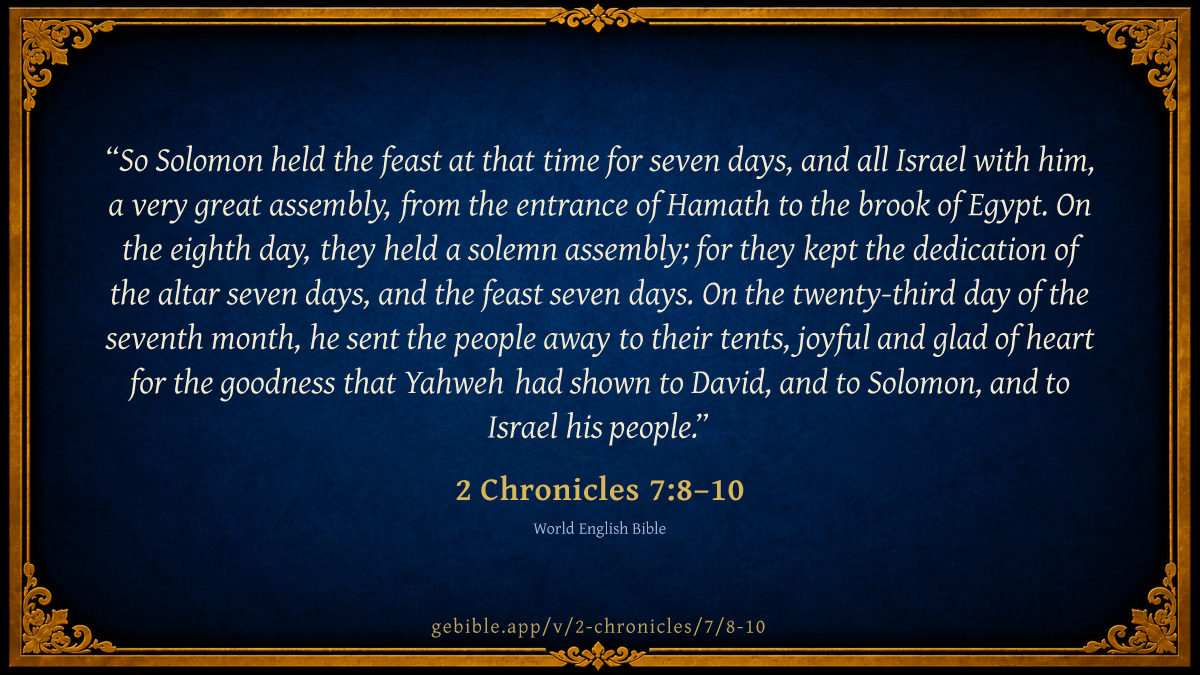
8So Solomon held the feast at that time for seven days, and all Israel with him, a very great assembly, from the entrance of Hamath to the brook of Egypt.
9On the eighth day, they held a solemn assembly; for they kept the dedication of the altar seven days, and the feast seven days.10On the twenty-third day of the seventh month, he sent the people away to their tents, joyful and glad of heart for the goodness that Yahweh had shown to David, and to Solomon, and to Israel his people.
8 So Solomon held the feast at that time for seven days, and all Israel with him, a very great assembly, from the entrance of Hamath to the brook of Egypt.
9 On the eighth day, they held a solemn assembly; for they kept the dedication of the altar seven days, and the feast seven days.
10 On the twenty-third day of the seventh month, he sent the people away to their tents, joyful and glad of heart for the goodness that Yahweh had shown to David, and to Solomon, and to Israel his people.
KJVKing James Version
8 Also at the same time Solomon kept the feast seven days, and all Israel with him, a very great congregation, from the entering in of Hamath unto the river of Egypt.
9 And in the eighth day they made a solemn assembly: for they kept the dedication of the altar seven days, and the feast seven days.
10 And on the three and twentieth day of the seventh month he sent the people away into their tents, glad and merry in heart for the goodness that the LORD had shewed unto David, and to Solomon, and to Israel his people.
Show all 3 translations
JPSJPS Tanakh (1917)
8 So Solomon held the feast at that time seven days, and all Israel with him, a very great congregation, from the entrance of Hamath unto the Brook of Egypt.
9 And on the eighth day they held a solemn assembly; for they kept the dedication of the altar seven days, and the feast seven days.
10 And on the three and twentieth day of the seventh month he sent the people away unto their tents, joyful and glad of heart for the goodness that the LORD had shown unto David, and to Solomon, and to Israel His people.
Genesis 15:18(v8)In that day Yahweh made a covenant with Abram, saying, “I have given this land to your offspring, from the river of Egypt to the great…
Leviticus 23:36(v9)Seven days you shall offer an offering made by fire to Yahweh. On the eighth day shall be a holy convocation to you. You shall offer an…
1 Kings 8:66(v10)On the eighth day he sent the people away; and they blessed the king, and went to their tents joyful and glad in their hearts for all the…
1 Kings 8:65(vv8–9)So Solomon held the feast at that time, and all Israel with him, a great assembly, from the entrance of Hamath to the brook of Egypt,…
Psalms 100:2(v10)Serve Yahweh with gladness. Come before his presence with singing.
Show all 38 cross-references
Exodus 18:1(v10)Now Jethro, the priest of Midian, Moses’ father-in-law, heard of all that God had done for Moses, and for Israel his people, how Yahweh had…
Leviticus 23:34-43(v8)“Speak to the children of Israel, and say, ‘On the fifteenth day of this seventh month is the feast of booths for seven days to Yahweh. On…
Numbers 29:12-38(v8)“ ‘On the fifteenth day of the seventh month you shall have a holy convocation. You shall do no regular work. You shall keep a feast to…
Numbers 34:5-8(v8)The border shall turn about from Azmon to the brook of Egypt, and it shall end at the sea. “ ‘For the western border, you shall have the…
Deuteronomy 12:7(v10)There you shall eat before Yahweh your God, and you shall rejoice in all that you put your hand to, you and your households, in which…
Deuteronomy 12:12(v10)You shall rejoice before Yahweh your God—you, and your sons, your daughters, your male servants, your female servants, and the Levite who…
Deuteronomy 12:18(v10)but you shall eat them before Yahweh your God in the place which Yahweh your God shall choose: you, your son, your daughter, your male…
Deuteronomy 16:8(v9)Six days you shall eat unleavened bread. On the seventh day shall be a solemn assembly to Yahweh your God. You shall do no work.
Deuteronomy 16:11(v10)You shall rejoice before Yahweh your God: you, your son, your daughter, your male servant, your female servant, the Levite who is within…
Deuteronomy 16:13-15(v8)You shall keep the feast of booths seven days, after you have gathered in from your threshing floor and from your wine press. You shall…
Deuteronomy 16:14(v10)You shall rejoice in your feast, you, your son, your daughter, your male servant, your female servant, the Levite, the foreigner, the…
Joshua 13:3-5(v8)from the Shihor, which is before Egypt, even to the border of Ekron northward, which is counted as Canaanite; the five lords of the…
1 Kings 4:21-25(v8)Solomon ruled over all the kingdoms from the River to the land of the Philistines, and to the border of Egypt. They brought tribute and…
2 Chronicles 6:41(v10)“Now therefore arise, Yahweh God, into your resting place, you, and the ark of your strength. Let your priests, Yahweh God, be clothed with…
2 Chronicles 29:36(v10)Hezekiah and all the people rejoiced, because of that which God had prepared for the people; for the thing was done suddenly.
2 Chronicles 30:13(v8)Many people assembled at Jerusalem to keep the feast of unleavened bread in the second month, a very great assembly.
2 Chronicles 30:23(v9)The whole assembly took counsel to keep another seven days, and they kept another seven days with gladness.
2 Chronicles 30:26(v10)So there was great joy in Jerusalem; for since the time of Solomon the son of David king of Israel there was nothing like this in Jerusalem.
Nehemiah 8:10(v10)Then he said to them, “Go your way. Eat the fat, drink the sweet, and send portions to him for whom nothing is prepared, for today is holy…
Nehemiah 8:13-18(v8)On the second day, the heads of fathers’ households of all the people, the priests, and the Levites were gathered together to Ezra the…
Nehemiah 8:18(v9)Also day by day, from the first day to the last day, he read in the book of the law of God. They kept the feast seven days; and on the…
Psalms 32:11–33:1(v10)Be glad in Yahweh, and rejoice, you righteous! Shout for joy, all you who are upright in heart! Rejoice in Yahweh, you righteous! Praise is…
Psalms 92:4(v10)For you, Yahweh, have made me glad through your work. I will triumph in the works of your hands.
Psalms 105:3(v10)Glory in his holy name. Let the heart of those who seek Yahweh rejoice.
Joel 1:14(v9)Sanctify a fast. Call a solemn assembly. Gather the elders, and all the inhabitants of the land, to the house of Yahweh, your God, and cry…
Amos 6:14(v8)For, behold, I will raise up against you a nation, house of Israel,” says Yahweh, the God of Armies; “and they will afflict you from the…
Zechariah 14:16-19(v8)It will happen that everyone who is left of all the nations that came against Jerusalem will go up from year to year to worship the King,…
John 7:2(v8)Now the feast of the Jews, the Feast of Booths, was at hand.
John 7:27-39(v8)However we know where this man comes from, but when the Christ comes, no one will know where he comes from.” Jesus therefore cried out in…
Acts 2:46(v10)Day by day, continuing steadfastly with one accord in the temple, and breaking bread at home, they took their food with gladness and…
Acts 16:34(v10)He brought them up into his house, and set food before them, and rejoiced greatly, with all his household, having believed in God.
Philippians 4:4(v10)Rejoice in the Lord always! Again I will say, “Rejoice!”
Psalms 106:5(v10)that I may see the prosperity of your chosen, that I may rejoice in the gladness of your nation, that I may glory with your inheritance.
38 distinct cross-references across this passage (39 total citations).
Cross-references from openbible.info (CC BY 4.0)
Explain this passage (13 sources)
Historical commentary, presented as a primary source — not an endorsement.
Geneva Bible translators1599 · Public DomainOn vv8–10The feast of the Tabernacles which was kept in…
The feast of the Tabernacles which was kept in the seventh month.
Geneva Bible (1599) marginal notes — public domain.
John Trapp1656 · Public DomainOn vv8, 102Ch 7:8 Also at the same time Solomon kept…
2Ch 7:8 Also at the same time Solomon kept the feast seven days, and all Israel with him, a very great congregation, from the entering in of Hamath unto the river of Egypt.
Ver. 8. Solomon kept the feast.] See 1Ki 8:65.
John Trapp, A Commentary or Exposition upon All the Books of the Old and New Testament (1647–1656) — public domain. Text from a community e-Sword module.
Adam Clarke1810 · Public DomainOn vv8, 10Verse 8. The entering in of Hamath] "From the…
Verse 8. The entering in of Hamath] "From the entrance of Antioch to the Nile of Egypt." - Targum.
Adam Clarke's Commentary on the Bible (1810–1826) — public domain. Text from a community e-Sword/MySword module.
Joseph Benson1811 · Public DomainOn v102Ch 7:10. On the three and twentieth day of…
2Ch 7:10. On the three and twentieth day of the seventh month, he sent the people away — They kept the feast of the dedication of the altar seven days, from the second to the ninth; the tenth day was the day of atonement, when they were to afflict their souls for sin, and that was not unseasonable in the midst of their rejoicings: then on the fifteenth began the feast of tabernacles, which continued to the twenty-second, and thus they continued to be employed in sacred services, and did not part till the twenty-third. We ought never to grudge the time that we spend in the worship of God, and in communion with him, nor think it long, or grow weary of it. Glad and merry in heart for the goodness, &c. — That is, according to the Targum, “for the goodness of the Lord shown unto David, in opening the doors of the sanctuary; and unto Solomon, whose prayer God had accepted, and had honoured with his presence in the house which he had built; and unto his people Israel, in his acceptance of their sacrifices, and sending down fire from heaven to consume them.”
Joseph Benson's Commentary on the Old and New Testaments (1811–1818) — public domain. Text from a community e-Sword module.
Albert Barnes1834 · Public DomainOn v8Solomon kept the feast - i. e., Solomon kept…
Solomon kept the feast - i. e., Solomon kept at this same time, not the Feast of the Dedication only, but also the Feast of tabernacles. The former lasted seven days, from the 8th of Tisri to the 15th, the latter also seven days, from the 15th to the 22nd. On the day following the people were dismissed 2Ch 7:10.
Albert Barnes' Notes on the Bible (1834–1885) — public domain. Text from a community e-Sword/MySword module.
Haydock's Catholic Bible Commentary1859 · Public DomainOn vv9–10Solemnity of tabernacles, (Menochius) which ensued after the dedication…
Solemnity of tabernacles, (Menochius) which ensued after the dedication was ended.
George Leo Haydock (1774–1849), Haydock's Catholic Family Bible and Commentary, 1859 edition — public domain. Excludes Psalms (Douay-Rheims chapter numbering differs from Protestant) and Deuterocanonical books (Catholic canon only).
Robert Jamieson, A. R. Fausset & David Brown1871 · Public DomainOn vv8, 10Solomon kept the feast seven days--The time chosen for…
Solomon kept the feast seven days--The time chosen for the dedication of the temple was immediately previous to the feast of tabernacles (see on Kg1 8:1-12). That season, which came after the harvest, corresponding to our September and October, lasted seven days, and during so prolonged a festival there was time afforded for the offering of the immense sacrifices enumerated. A large proportion of these were peace offerings, which afforded to the people the means of festive enjoyment.
all Israel . . . from the entering in of Hamath--that is, the defile at Lebanon.
Read full note →
unto the river of Egypt--that is, Rhinocorura, now El-Arish, the south boundary of Palestine.
Jamieson, Fausset & Brown — Commentary Critical and Explanatory on the Whole Bible (1871) — public domain (CC PDM 1.0). Text via the HelloAO Bible API.
The Cambridge Bible for Schools and Colleges1878 · Public DomainOn vv8–108. Also at the same time Solomon kept the…
8. Also at the same time Solomon kept the feast] R.V. So Solomon held the feast at that time.
from the entering in of Hamath] See note on 1Ch_13:5.
Read full note →
the river of Egypt] R.V. the book of Egypt, i.e. not the Nile, but the stream called Shihor of Egypt in 1Ch_13:5 (see note).
The Cambridge Bible for Schools and Colleges (gen. ed. J. J. S. Perowne; Cambridge University Press, 1878–1918) — public domain. Text from a community e-Sword module.
Ellicott's Commentary for English Readers1878 · Public DomainOn vv8–10(8) Also at the same time.—Literally, And Solomon made…
(8) Also at the same time.—Literally, And Solomon made the feast at that time seven days. “The feast” was the Feast of Tabernacles. (See Lev_23:34-36.)
Seven days.—The legal time. (See Lev. 50100) The days were counted from the 15th of the seventh month. (Comp. 1Ki_8:65.)
Read full note →
The river.—Torrent or wady. LXX., χειμάρρους. Kings adds, “before the Lord our God.” So Syriac.
A Bible Commentary for English Readers, edited by Charles John Ellicott (1878–1897) — public domain. Text from a community e-Sword module.
The Pulpit Commentary1880 · Public DomainOn vv8–9Also at the same time the feast; i.e. the…
Also at the same time the feast; i.e. the Feast of Tabernacles, which occupied the seven days from the fifteenth to the twenty-second of the month Tisri. (Lev_23:33) Thus fourteen dayswere (1Ki_8:65) occupied by the two feasts, that of the temple consecration and that of Tabernacles, while on the fifteenth day of feasting, viz. the twenty-third of the month Tisri, or Ethanim (the seventh month), the people went home. The entering in of Hamath unto the river of Egypt; i.e. from the extreme north to the extreme south of the land. The town Hamath was on the Orontes, through the valley of the Lebanon (Jos_13:3, Jos_13:5; also Num_13:21 Num_34:8; Jud_1:3:3; 2Ki_14:25; 1Ch_13:5; Amo_6:2, Amo_6:14) The river of Egypt; or, the river before Egypt, (Jos_13:3) was the Shihor, or Sihor, separating Egypt and Judaea.
Vers. 8-11.
Read full note →
Sunshine.
A very happy time it was when the temple was opened at Jerusalem. It may be said that the city of God and the people of God dwelt in the sunshine of his presence and his favour. It was a protracted period of sacred joy and gladdening prosperity.
I SOLEMNITIES AND FESTIVITIES ARE FITTINGLY ASSOCIATED. "At the same time" i.e. in close conjunction with the solemn rites that were observed within the temple, "Solomon kept the feast seven days, and all Israel with him." The slaying of the devoted animal on the altar and the spreading of the table for a common feast, sacrificial worship and festive delights, went hand in hand. This was quite in keeping with the provision of the Law. And it is in perfect accord with the spirit, the institutions, and the precepts of the gospel.
1. The spirit of the gospel enjoins humility before God, and then trust and joy in God.
2. The principal institution of the gospel is a common participation at a table a table at which the living, loving Host meets his friends, welcomes them with joy, and invites them to rejoice in him.
3. The precept of the gospel is, "Humble yourselves before God," and "Rejoice in the Lord alway." At our most solemn engagements and in our most sacred hours the note of holy joy should never be absent long; indeed, it should be the prevailing note in Christian service.
II SACRED JOY SHOULD BE UNSELFISH IN ITS CHARACTER. These men were glad at heart "for the goodness that the Lord had showed unto David, and to Solomon, and to Israel his people." They were filled with joy because their departed sovereign"s deepest desire was fulfilled, and because (they thought) if he were present his heart would be enlarged; they were gladdened because their present king was elated with an honourable pride and a profound satisfaction, and they made his joy their own. Moreover, their patriotism was stirred within them, and they rejoiced because they felt that their nation was now in the sunshine of the Divine favour. It is well to be able to say, "Surely goodness and mercy shall follow me ;" it is better to be able to sing, "Surely God is good to Israel. " Our piety rises to a higher altitude when concern for ourselves passes into solicitude for the welfare of our fellow-men, when gratitude for personal favours is lest in thankfulness to God for his mercy to our race.
III PIETY IS SURE TO FIND ITS WAY HOME. The people went back to "their tents" with this abounding exultation. They carried it home; they shared it with those with whom they dwelt; they communicated it to those who could not derive it from the temple-scenes themselves. This is a simple Christian obligation. All that we have from God we should carry home with us; and particularly those inspirations and exaltations which we gain in his house and from his worship we should impart to our kindred and our friends. We are closely related to one another for the express purpose that we may communicate to one another the best and highest that is within us our purest thoughts, our worthiest feelings, our highest aspirations, our most sacred joys.
IV PIETY AND PROSPERITY ARE VERY CLOSELY ALLIED. It was very right that the building of the king"s house (ver. 11) should follow the erection of the house of the Lord; it was quite natural that the one should lead to the other. We are not surprised to read that in all Solomon"s undertakings he "prospered effectively." He was living and labouring in the fear and the love of God; he was walking in the light Of God"s countenance. While the reward of piety is inward and spiritual rather than outward and material is in peace, hope, rectitude, Christ-likeness of spirit and character rather than in "riches and honour," yet is it true that "godliness has the promise of the life that now is;" it tends constantly to virtue, to prudence, to thrift, to comfort, to prosperity. C.
Vers. 8-11.
A great festival.
I THE OCCASION.
1. The dedication of the altar. Probably a part is here put for the whole. The writer means by the dedication of the altar the dedication of the whole temple. That this should have been followed by a feast was appropriate, since
(1) all labour carried to a successful termination, as the temple had been, is fitted to occasion joy; and
(2) the fact that sinful man is permitted to consecrate anything to Jehovah ought ever to excite within the heart glad emotions.
2. The Feast of Tabernacles. It would seem that the solemnities connected with the dedication were commenced seven days at least before the fifteenth of Tisri, the date of the Feast of Tabernacles, and that on the fifteenth this latter feast began, and was celebrated with unusual magnificence.
II THE GUESTS.
1. Solomon the king. So is Christ himself ever present at the banquets he provides for his people, whether on earth within the Church militant, or in heaven in the Church triumphant. With reference to the former Christ says, "I will sup with him"; (Rev_3:16) as regards the latter it is written, "The Lamb who is in the midst of the throne shall be their Shepherd"; (Rev_7:17) "I will drink it," the fruit of the vine, "new with you in my Father"s kingdom". (Mat_26:29)
2. All Israel with him, from the entering in of Hamath, the northen boundary of Palestine, to the river of Egypt, its southern limit. So will all the followers of God, the spiritual children and subjects of the heavenly King, be admitted to the banquet of salvation, both here and there with me". (Rev_3:16)
III THE DURATION. Seven days.
1. Preceded by a seven daysdedication service, during which the multitudes of victims were slain by the king and the people not by the priests, who were merely employed in sprinkling the blood upon the altar.
2. Followed by a solemn assembly on the eighth day, the last and the great day of the feast. (Joh_7:37) On the twenty-third day of the seventh month the assembly broke up, and the people returned to their homes.
IV THE GLADNESS.
1. Its character. The people"s joy was sincere, deep, and exhilarating. Not only at the termination of the festal season, but throughout its continuance, the celebrants were merry in their hearts.
2. Its cause. Different from the mirth which stirred the heart of Nabal, (1Sa_25:36) theirs proceeded from a contemplation of Jehovah"s goodness to David, who had been the originator of the temple-building scheme, to Solomon, who had carried it out, and to them who were to profit by it.
Learn:
1. That national feastings are as proper to religion as national lastings.
2. That sovereigns and their subjects should at times unite in publicexpressions of religious feeling.
3. That good rulers are often long remembered by their people.
4. That God"s goodness can be displayed to his saints long after they aredead.
5. That the greatest good a king or his people can receive from Heaven isreligion, and the means of sustaining and advancing it. W.
The Pulpit Commentary (1880–1919), ed. H.D.M. Spence-Jones & Joseph S. Exell — public domain. Text from a community e-Sword module.
C. I. Scofield1917 · Public DomainOn v10seventh month
seventh month
i.e. October.
The Scofield Reference Bible (1917 edition), notes by C. I. Scofield — public domain. Text from a community e-Sword module.
unfoldingWord translationNotes2017 · CC BY-SA 4.0On v8all Israel with him
all Israel with him
This generalization refers to those who were at the feast in Jerusalem, not necessarily to every person who lived in Israel. (See: Hyperbole and Generalization)
Read full note →
from Lebo Hamath to the brook of Egypt
Lebo Hamath was north of Israel, and the brook of Egypt was south of Israel. These are used together to emphasize that people from every part of Israel were at the festival. AT: "from Lebo Hamath in the north to the brook of Egypt in the south" (See: Assumed Knowledge and Implicit Information and Merism and How to Translate Names)
the eighth day
The word "eighth" is the ordinal form of "8." (See: Ordinal Numbers)
a solemn assembly
This was a special religious gathering.
they kept the dedication of the altar
Here "kept the dedication" is an idiom meaning "celebrated the dedication." (See: Idiom)
the twenty-third day of the seventh month
This is the seventh month of the Hebrew calendar. The twenty-third day is near the middle of October on Western calendars. (See: Hebrew Months and Ordinal Numbers)
with glad and joyful hearts
The words "glad" and "joyful" mean basically the same thing. Together they emphasize the intensity of joy. AT: "with very glad hearts" or "and they were very joyful" (See: Doublet)
because of the goodness that Yahweh had shown
"because Yahweh had shown wonderful goodness" or "because Yahweh had been so good"
Israel, his people
"Israel, God's people." The phrase "his people" emphasizes God's faithfulness to Israel. (See: Distinguishing versus Informing or Reminding)
Tyndale Open Study Notes2022 · CC BY-SA 4.0On v87:8-10 Lebo-hamath in the north and the Brook of…
7:8-10 Lebo-hamath in the north and the Brook of Egypt in the south marked the boundaries of Israel as promised to the patriarchs (Gen 15:18; Num 34:5, 8; Josh 15:4). The Temple dedication festival preceded the annual Festival of Shelters, which ended on the twenty-second day of the month.

Geneva Bible translators 1599 · Public Domain On vv8–10 The feast of the Tabernacles which was kept in…
The feast of the Tabernacles which was kept in the seventh month.
Geneva Bible (1599) marginal notes — public domain.
John Trapp 1656 · Public Domain On vv8, 10 2Ch 7:8 Also at the same time Solomon kept…
2Ch 7:8 Also at the same time Solomon kept the feast seven days, and all Israel with him, a very great congregation, from the entering in of Hamath unto the river of Egypt.
Ver. 8. Solomon kept the feast.] See 1Ki 8:65.
John Trapp, A Commentary or Exposition upon All the Books of the Old and New Testament (1647–1656) — public domain. Text from a community e-Sword module.
Adam Clarke 1810 · Public Domain On vv8, 10 Verse 8. The entering in of Hamath] "From the…
Verse 8. The entering in of Hamath] "From the entrance of Antioch to the Nile of Egypt." - Targum.
Adam Clarke's Commentary on the Bible (1810–1826) — public domain. Text from a community e-Sword/MySword module.
Joseph Benson 1811 · Public Domain On v10 2Ch 7:10. On the three and twentieth day of…
2Ch 7:10. On the three and twentieth day of the seventh month, he sent the people away — They kept the feast of the dedication of the altar seven days, from the second to the ninth; the tenth day was the day of atonement, when they were to afflict their souls for sin, and that was not unseasonable in the midst of their rejoicings: then on the fifteenth began the feast of tabernacles, which continued to the twenty-second, and thus they continued to be employed in sacred services, and did not part till the twenty-third. We ought never to grudge the time that we spend in the worship of God, and in communion with him, nor think it long, or grow weary of it. Glad and merry in heart for the goodness, &c. — That is, according to the Targum, “for the goodness of the Lord shown unto David, in opening the doors of the sanctuary; and unto Solomon, whose prayer God had accepted, and had honoured with his presence in the house which he had built; and unto his people Israel, in his acceptance of their sacrifices, and sending down fire from heaven to consume them.”
Joseph Benson's Commentary on the Old and New Testaments (1811–1818) — public domain. Text from a community e-Sword module.
Albert Barnes 1834 · Public Domain On v8 Solomon kept the feast - i. e., Solomon kept…
Solomon kept the feast - i. e., Solomon kept at this same time, not the Feast of the Dedication only, but also the Feast of tabernacles. The former lasted seven days, from the 8th of Tisri to the 15th, the latter also seven days, from the 15th to the 22nd. On the day following the people were dismissed 2Ch 7:10.
Albert Barnes' Notes on the Bible (1834–1885) — public domain. Text from a community e-Sword/MySword module.
Haydock's Catholic Bible Commentary 1859 · Public Domain On vv9–10 Solemnity of tabernacles, (Menochius) which ensued after the dedication…
Solemnity of tabernacles, (Menochius) which ensued after the dedication was ended.
George Leo Haydock (1774–1849), Haydock's Catholic Family Bible and Commentary, 1859 edition — public domain. Excludes Psalms (Douay-Rheims chapter numbering differs from Protestant) and Deuterocanonical books (Catholic canon only).
Robert Jamieson, A. R. Fausset & David Brown 1871 · Public Domain On vv8, 10 Solomon kept the feast seven days--The time chosen for…
Solomon kept the feast seven days--The time chosen for the dedication of the temple was immediately previous to the feast of tabernacles (see on Kg1 8:1-12). That season, which came after the harvest, corresponding to our September and October, lasted seven days, and during so prolonged a festival there was time afforded for the offering of the immense sacrifices enumerated. A large proportion of these were peace offerings, which afforded to the people the means of festive enjoyment.
all Israel . . . from the entering in of Hamath--that is, the defile at Lebanon.
Read full note →
unto the river of Egypt--that is, Rhinocorura, now El-Arish, the south boundary of Palestine.
Jamieson, Fausset & Brown — Commentary Critical and Explanatory on the Whole Bible (1871) — public domain (CC PDM 1.0). Text via the HelloAO Bible API.
The Cambridge Bible for Schools and Colleges 1878 · Public Domain On vv8–10 8. Also at the same time Solomon kept the…
8. Also at the same time Solomon kept the feast] R.V. So Solomon held the feast at that time.
from the entering in of Hamath] See note on 1Ch_13:5.
Read full note →
the river of Egypt] R.V. the book of Egypt, i.e. not the Nile, but the stream called Shihor of Egypt in 1Ch_13:5 (see note).
The Cambridge Bible for Schools and Colleges (gen. ed. J. J. S. Perowne; Cambridge University Press, 1878–1918) — public domain. Text from a community e-Sword module.
Ellicott's Commentary for English Readers 1878 · Public Domain On vv8–10 (8) Also at the same time.—Literally, And Solomon made…
(8) Also at the same time.—Literally, And Solomon made the feast at that time seven days. “The feast” was the Feast of Tabernacles. (See Lev_23:34-36.)
Seven days.—The legal time. (See Lev. 50100) The days were counted from the 15th of the seventh month. (Comp. 1Ki_8:65.)
Read full note →
The river.—Torrent or wady. LXX., χειμάρρους. Kings adds, “before the Lord our God.” So Syriac.
A Bible Commentary for English Readers, edited by Charles John Ellicott (1878–1897) — public domain. Text from a community e-Sword module.
The Pulpit Commentary 1880 · Public Domain On vv8–9 Also at the same time the feast; i.e. the…
Also at the same time the feast; i.e. the Feast of Tabernacles, which occupied the seven days from the fifteenth to the twenty-second of the month Tisri. (Lev_23:33) Thus fourteen dayswere (1Ki_8:65) occupied by the two feasts, that of the temple consecration and that of Tabernacles, while on the fifteenth day of feasting, viz. the twenty-third of the month Tisri, or Ethanim (the seventh month), the people went home. The entering in of Hamath unto the river of Egypt; i.e. from the extreme north to the extreme south of the land. The town Hamath was on the Orontes, through the valley of the Lebanon (Jos_13:3, Jos_13:5; also Num_13:21 Num_34:8; Jud_1:3:3; 2Ki_14:25; 1Ch_13:5; Amo_6:2, Amo_6:14) The river of Egypt; or, the river before Egypt, (Jos_13:3) was the Shihor, or Sihor, separating Egypt and Judaea.
Vers. 8-11.
Read full note →
Sunshine.
A very happy time it was when the temple was opened at Jerusalem. It may be said that the city of God and the people of God dwelt in the sunshine of his presence and his favour. It was a protracted period of sacred joy and gladdening prosperity.
I SOLEMNITIES AND FESTIVITIES ARE FITTINGLY ASSOCIATED. "At the same time" i.e. in close conjunction with the solemn rites that were observed within the temple, "Solomon kept the feast seven days, and all Israel with him." The slaying of the devoted animal on the altar and the spreading of the table for a common feast, sacrificial worship and festive delights, went hand in hand. This was quite in keeping with the provision of the Law. And it is in perfect accord with the spirit, the institutions, and the precepts of the gospel.
1. The spirit of the gospel enjoins humility before God, and then trust and joy in God.
2. The principal institution of the gospel is a common participation at a table a table at which the living, loving Host meets his friends, welcomes them with joy, and invites them to rejoice in him.
3. The precept of the gospel is, "Humble yourselves before God," and "Rejoice in the Lord alway." At our most solemn engagements and in our most sacred hours the note of holy joy should never be absent long; indeed, it should be the prevailing note in Christian service.
II SACRED JOY SHOULD BE UNSELFISH IN ITS CHARACTER. These men were glad at heart "for the goodness that the Lord had showed unto David, and to Solomon, and to Israel his people." They were filled with joy because their departed sovereign"s deepest desire was fulfilled, and because (they thought) if he were present his heart would be enlarged; they were gladdened because their present king was elated with an honourable pride and a profound satisfaction, and they made his joy their own. Moreover, their patriotism was stirred within them, and they rejoiced because they felt that their nation was now in the sunshine of the Divine favour. It is well to be able to say, "Surely goodness and mercy shall follow me ;" it is better to be able to sing, "Surely God is good to Israel. " Our piety rises to a higher altitude when concern for ourselves passes into solicitude for the welfare of our fellow-men, when gratitude for personal favours is lest in thankfulness to God for his mercy to our race.
III PIETY IS SURE TO FIND ITS WAY HOME. The people went back to "their tents" with this abounding exultation. They carried it home; they shared it with those with whom they dwelt; they communicated it to those who could not derive it from the temple-scenes themselves. This is a simple Christian obligation. All that we have from God we should carry home with us; and particularly those inspirations and exaltations which we gain in his house and from his worship we should impart to our kindred and our friends. We are closely related to one another for the express purpose that we may communicate to one another the best and highest that is within us our purest thoughts, our worthiest feelings, our highest aspirations, our most sacred joys.
IV PIETY AND PROSPERITY ARE VERY CLOSELY ALLIED. It was very right that the building of the king"s house (ver. 11) should follow the erection of the house of the Lord; it was quite natural that the one should lead to the other. We are not surprised to read that in all Solomon"s undertakings he "prospered effectively." He was living and labouring in the fear and the love of God; he was walking in the light Of God"s countenance. While the reward of piety is inward and spiritual rather than outward and material is in peace, hope, rectitude, Christ-likeness of spirit and character rather than in "riches and honour," yet is it true that "godliness has the promise of the life that now is;" it tends constantly to virtue, to prudence, to thrift, to comfort, to prosperity. C.
Vers. 8-11.
A great festival.
I THE OCCASION.
1. The dedication of the altar. Probably a part is here put for the whole. The writer means by the dedication of the altar the dedication of the whole temple. That this should have been followed by a feast was appropriate, since
(1) all labour carried to a successful termination, as the temple had been, is fitted to occasion joy; and
(2) the fact that sinful man is permitted to consecrate anything to Jehovah ought ever to excite within the heart glad emotions.
2. The Feast of Tabernacles. It would seem that the solemnities connected with the dedication were commenced seven days at least before the fifteenth of Tisri, the date of the Feast of Tabernacles, and that on the fifteenth this latter feast began, and was celebrated with unusual magnificence.
II THE GUESTS.
1. Solomon the king. So is Christ himself ever present at the banquets he provides for his people, whether on earth within the Church militant, or in heaven in the Church triumphant. With reference to the former Christ says, "I will sup with him"; (Rev_3:16) as regards the latter it is written, "The Lamb who is in the midst of the throne shall be their Shepherd"; (Rev_7:17) "I will drink it," the fruit of the vine, "new with you in my Father"s kingdom". (Mat_26:29)
2. All Israel with him, from the entering in of Hamath, the northen boundary of Palestine, to the river of Egypt, its southern limit. So will all the followers of God, the spiritual children and subjects of the heavenly King, be admitted to the banquet of salvation, both here and there with me". (Rev_3:16)
III THE DURATION. Seven days.
1. Preceded by a seven daysdedication service, during which the multitudes of victims were slain by the king and the people not by the priests, who were merely employed in sprinkling the blood upon the altar.
2. Followed by a solemn assembly on the eighth day, the last and the great day of the feast. (Joh_7:37) On the twenty-third day of the seventh month the assembly broke up, and the people returned to their homes.
IV THE GLADNESS.
1. Its character. The people"s joy was sincere, deep, and exhilarating. Not only at the termination of the festal season, but throughout its continuance, the celebrants were merry in their hearts.
2. Its cause. Different from the mirth which stirred the heart of Nabal, (1Sa_25:36) theirs proceeded from a contemplation of Jehovah"s goodness to David, who had been the originator of the temple-building scheme, to Solomon, who had carried it out, and to them who were to profit by it.
Learn:
1. That national feastings are as proper to religion as national lastings.
2. That sovereigns and their subjects should at times unite in publicexpressions of religious feeling.
3. That good rulers are often long remembered by their people.
4. That God"s goodness can be displayed to his saints long after they aredead.
5. That the greatest good a king or his people can receive from Heaven isreligion, and the means of sustaining and advancing it. W.
The Pulpit Commentary (1880–1919), ed. H.D.M. Spence-Jones & Joseph S. Exell — public domain. Text from a community e-Sword module.
C. I. Scofield 1917 · Public Domain On v10 seventh month
seventh month
i.e. October.
The Scofield Reference Bible (1917 edition), notes by C. I. Scofield — public domain. Text from a community e-Sword module.
unfoldingWord translationNotes 2017 · CC BY-SA 4.0 On v8 all Israel with him
all Israel with him
This generalization refers to those who were at the feast in Jerusalem, not necessarily to every person who lived in Israel. (See: Hyperbole and Generalization)
Read full note →
from Lebo Hamath to the brook of Egypt
Lebo Hamath was north of Israel, and the brook of Egypt was south of Israel. These are used together to emphasize that people from every part of Israel were at the festival. AT: "from Lebo Hamath in the north to the brook of Egypt in the south" (See: Assumed Knowledge and Implicit Information and Merism and How to Translate Names)
the eighth day
The word "eighth" is the ordinal form of "8." (See: Ordinal Numbers)
a solemn assembly
This was a special religious gathering.
they kept the dedication of the altar
Here "kept the dedication" is an idiom meaning "celebrated the dedication." (See: Idiom)
the twenty-third day of the seventh month
This is the seventh month of the Hebrew calendar. The twenty-third day is near the middle of October on Western calendars. (See: Hebrew Months and Ordinal Numbers)
with glad and joyful hearts
The words "glad" and "joyful" mean basically the same thing. Together they emphasize the intensity of joy. AT: "with very glad hearts" or "and they were very joyful" (See: Doublet)
because of the goodness that Yahweh had shown
"because Yahweh had shown wonderful goodness" or "because Yahweh had been so good"
Israel, his people
"Israel, God's people." The phrase "his people" emphasizes God's faithfulness to Israel. (See: Distinguishing versus Informing or Reminding)
translationWords
festival
Israel
assembly
Hamath
Egypt
altar
feast
good
David
Solomon
unfoldingWord translationNotes — © Distant Shores Media and the Door43 World Missions Community, licensed CC BY-SA 4.0. Source: git.door43.org/Door43/en_tn.
Tyndale Open Study Notes 2022 · CC BY-SA 4.0 On v8 7:8-10 Lebo-hamath in the north and the Brook of…
7:8-10 Lebo-hamath in the north and the Brook of Egypt in the south marked the boundaries of Israel as promised to the patriarchs (Gen 15:18; Num 34:5, 8; Josh 15:4). The Temple dedication festival preceded the annual Festival of Shelters, which ended on the twenty-second day of the month.
Tyndale Open Study Notes — © Tyndale Open Resources, licensed CC BY-SA 4.0. Text via the HelloAO Bible API.