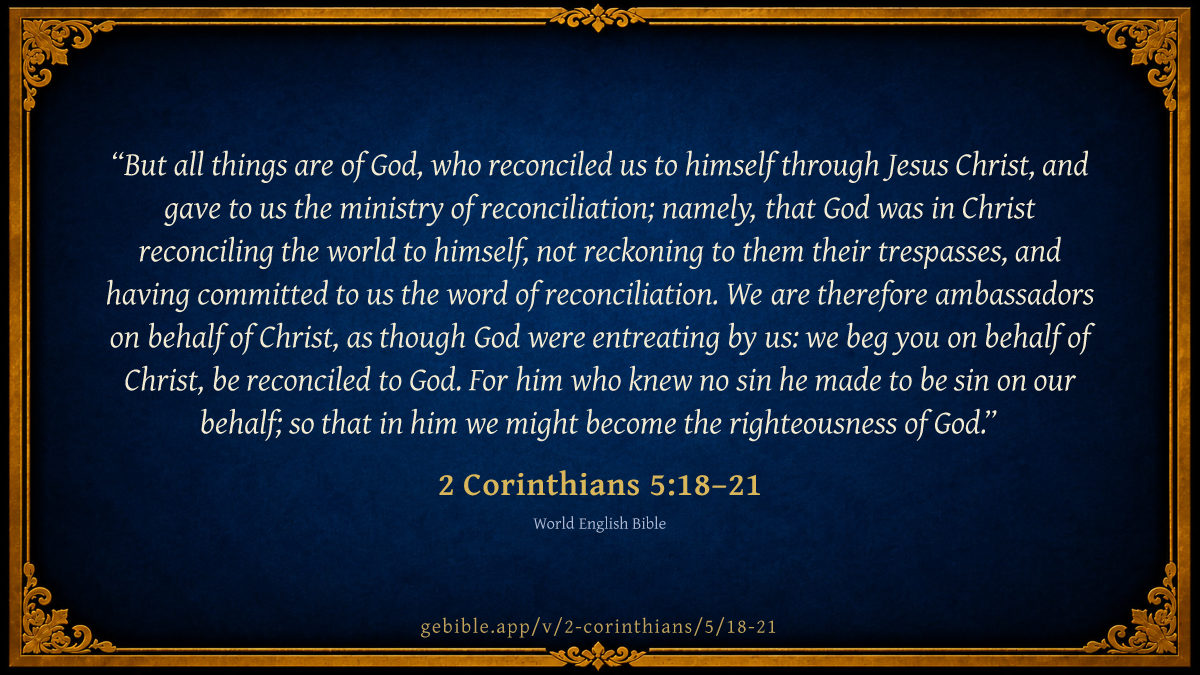
2 Corinthians 5:18-21 sits inside this longer paragraph.
11Knowing therefore the fear of the Lord, we persuade men, but we are revealed to God, and I hope that we are revealed also in your consciences. 12For we are not commending ourselves to you again, but speak as giving you occasion of boasting on our behalf, that you may have something to answer those who boast in appearance, and not in heart. 13For if we are beside ourselves, it is for God. Or if we are of sober mind, it is for you. 14For the love of Christ constrains us; because we judge thus, that one died for all, therefore all died. 15He died for all, that those who live should no longer live to themselves, but to him who for their sakes died and rose again. 16Therefore we know no one after the flesh from now on. Even though we have known Christ after the flesh, yet now we know him so no more. 17Therefore if anyone is in Christ, he is a new creation. The old things have passed away. Behold, all things have become new. 18But all things are of God, who reconciled us to himself through Jesus Christ, and gave to us the ministry of reconciliation; 19namely, that God was in Christ reconciling the world to himself, not reckoning to them their trespasses, and having committed to us the word of reconciliation.
20We are therefore ambassadors on behalf of Christ, as though God were entreating by us: we beg you on behalf of Christ, be reconciled to God. 21For him who knew no sin he made to be sin on our behalf; so that in him we might become the righteousness of God.

John Calvin 1540 · Public Domain On vv18–21 18. All things are of God. He means, all…
18. All things are of God. He means, all things that belong to Christ’s kingdom. “If we would be Christ’s, we must be regenerated by God. Now that is no ordinary gift.” He does not, therefore, speak here of creation generally; but of the grace of regeneration, which God confers peculiarly upon his elect, and he affirms that it is of God — not on the ground of his being the Creator and Artificer of heaven and earth, but inasmuch as he is the new Creator of the Church, by fashioning his people anew, according to his own image. Thus all flesh is abased, and believers are admonished that they must now live to God, inasmuch as they are a new creature. (2 Corinthians 5:17.) This they cannot do, unless they forget the world, as they are also no longer of the world, (John 17:16,) because they are of God
Who hath reconciled us Here there are two leading points — the one relating to the reconciliation of men with God; and the other, to the way in which we may enjoy the benefit of this reconciliation. Now these things correspond admirably with what goes before, for as the Apostle had given the preference to a good conscience above every kind of distinction, (2 Corinthians 5:11,) he now shows that the whole of the gospel tends to this. He shows, however, at the same time, the dignity of the Apostolical office, that the Corinthians may be instructed as to what they ought to seek in him, whereas they could not distinguish between true and false ministers, for this reason, that nothing but show delighted them. Accordingly, by making mention of this, he stirs them up to make greater proficiency in the doctrine of the gospel. For an absurd admiration of profane persons, who serve their own ambition rather than Christ, originates in our not knowing, what the office of the preaching of the gospel includes, or imports.
Read full note →
I now return to those two leading points that are here touched upon. The first is — that God hath reconciled us to himself by Christ This is immediately followed by the declaration — Because God was in Christ, and has in his person accomplished reconciliation. The manner is subjoined — By not imputing unto men their trespasses Again, there is annexed a second declaration — Because Christ having been made a sin-offering for our sins, has procured righteousness for us. The second part of the statement is — that the grace of reconciliation is applied to us by the gospel, that we may become partakers of it. Here we have a remarkable passage, if there be any such in any part of Paul’s writings. Hence it is proper, that we should carefully examine the words one by one.
The ministry of reconciliation Here we have an illustrious designation of the gospel, as being an embassy for reconciling men to God. It is also a singular dignity of ministers — that they are sent to us by God with this commission, so as to be messengers, and in a manner sureties. This, however, is not said so much for the purpose of commending ministers, as with a view to the consolation of the pious, that as often as they hear the gospel, they may know that God treats with them, and, as it were, stipulates with them as to a return to his grace. Than this blessing what could be more desirable? Let us therefore bear in mind, that this is the main design of the gospel — that whereas we are by nature children of wrath, (Ephesians 2:3,) we may, by the breaking up of the quarrel between God and us, be received by him into favor. Ministers are furnished with this commission, that they may bring us intelligence of so great a benefit, nay more, may assure us of God’s fatherly love towards us. Any other person, it is true, might also be a witness to us of the grace of God, but Paul teaches, that this office is specially intrusted to ministers. When, therefore, a duly ordained minister proclaims in the gospel, that God has been made propitious to us, he is to be listened to just as an ambassador of God, and sustaining, as they speak, a public character, and furnished with rightful authority for assuring us of this.
John Calvin's Commentaries (1540-1563) — public domain. Text from the Calvin Translation Society English edition (1840s-50s) via the Christian Classics Ethereal Library (ccel.org). Calvin's coverage is partial (roughly two-thirds of the Bible); uncommented books and verses are honest gaps, never fabricated. The 19th-century editor's footnotes and remarks are omitted so the notes are faithfully Calvin's own voice.
Geneva Bible translators 1599 · Public Domain On vv18, 19, 21 He commendeth the excellency of the ministry of the…
He commendeth the excellency of the ministry of the Gospel, both by the authority of God himself, who is the author of that ministry, and also by the excellency of the doctrine of it: for it announceth atonement with God, by free forgiveness of our sins, and justification offered unto us in Christ, and that so lovingly and liberally, that God himself doth after a sort pray men by the mouth of his ministers, to have consideration of themselves, and not to despise so great a benefit. And when he so saith, he plainly reprehendeth them which falsely challenged to themselves the name of pastors.
Geneva Bible (1599) marginal notes — public domain.
John Trapp 1656 · Public Domain On vv18–21 18 And all things are of God, who hath…
18 And all things are of God, who hath reconciled us to himself by Jesus Christ, and hath given to us the ministry of reconciliation;
Ver. 18. And all things are of God] He is both author and finisher of our faith, the God of all grace, the Father of all lights, &c.
Read full note →
And hath given us the ministry] He hath taken this office from the angels, those first preachers of peace, Luk 2:10; Luk 2:14. The angel told Cornelius his prayers were heard in heaven; but for the doctrine of reconciliation he refers him to Peter, Act 10:36.
John Trapp, A Commentary or Exposition upon All the Books of the Old and New Testament (1647–1656) — public domain. Text from a community e-Sword module.
Matthew Poole 1685 · Public Domain On vv18–21 And all things are of God; this change, which…
And all things are of God; this change, which is wrought in our hearts, is not of ourselves, but wrought in us by the great and mighty power of God: so Joh 1:13; Which were born, not of blood, nor of the will of the flesh, nor of the will of man, but of God; of God, as the principal efficient Cause.
Who hath reconciled its to himself by Jesus Christ; who, by the blood of his Son Jesus Christ, meritoriously, and by the Spirit of Christ, actually, hath reconciled us unto himself; of enemies hath made us friends.
Read full note →
And hath given to us the ministry of reconciliation; hath intrusted us with the preaching of the gospel. It is God that hath reconciled us; it is Christ by whom we are reconciled, his blood is the price of our reconciliation; but he committed to his apostles, and so to the successive ministers of the gospel,
the ministry of reconciliation, that is, the ministry of the gospel, by which this reconciliation is published to such as are yet enemies to God. They have but a ministration in it; God hath appointed them to publish and to declare it, and to entreat men to be reconciled unto him.
Matthew Poole's English Annotations on the Holy Bible (1683–1685) — public domain. Text from a community e-Sword/MySword module.
William Burkitt 1703 · Public Domain On vv18–21 That is, all those things forementioned belonging to this…
That is, all those things forementioned belonging to this new spiritual creation, are of God, as the author and efficient cause of them.
Learn, That God is the original author of the new creature, and of all things belonging thereunto. This appears partly from the nature of the work, ’tis a new creation; and partly from the objects of the work, the persons wrought upon. They are averse from God, in enmity to him, and rebellion against him, dead in sin, under the dominion of Satan. Well therefore might the apostle say, All these things are of God.
William Burkitt's Expository Notes on the New Testament (1700–1703) — public domain. Text from a community e-Sword module.
John Gill 1763 · Public Domain On vv18–20 To wit, that God was in Christ reconciling the…
To wit, that God was in Christ reconciling the world unto himself,.... This expresses and explains the subject matter of the ministration of the Gospel, especially that part of it which concerns our reconciliation with God; and declares the scheme, the author, the subjects, the way, and means, and consequence of it. The phrase, "in Christ", may be either joined with the word "God", as in our version, "God was in Christ reconciling"; that is, he was in Christ drawing the scheme, fixing the method of reconciliation; his thoughts were employed about it, which were thoughts of peace; he called a council of peace, and entered into a covenant of peace with Christ, who was appointed and agreed to, to be the peacemaker. Or with the word "reconciling", thus, God "was reconciling in Christ"; that is, by Christ; and so it denotes, as before, actual reconciliation by Christ. God, in pursuance of his purposes, council, and covenant, sent his Son to make peace; and laid our sins, and the chastisement of our peace upon him; this is the punishment of sin, whereby satisfaction was made for it, and so peace with God: or with the word "world", thus, "God was reconciling the world in Christ"; by whom are meant, not all the individuals of mankind, for these are not all in Christ, nor all reconciled to God, multitudes dying in enmity to him, nor all interested in the blessing of non-imputation of sin; whereas each of these is said of the world: but the elect of God, who are chosen in Christ, whose peace Christ is, whose sins are not imputed to them, and against whom no charge of any avail can be laid; and particularly the people of God among the Gentiles are here designed, who are frequently called "the world" in Scripture; being the world which God loved, for whose sins Christ is the propitiation, and of the reconciling of which mention is particularly made, Joh 3:16. And this sense well agrees with the context, which signifies, that no man is regarded for his natural descent; it is no matter whether he is a Jew or a Gentile, provided he is but a new creature: for Gospel reconciliation, and the ministry of it, concern one as well as another. Moreover, this reconciliation must be considered, either as intentional, or actual, or as a publication of it in the ministry of the word; and taken either way it cannot be thought to extend to every individual person in the world: if it is to be understood intentionally, that God intended the reconciliation of the world to himself by Christ, and drew the scheme of it in him, his intentions cannot be frustrated; his counsel shall stand, and he will do all his pleasure; a scheme so wisely laid by him in his Son, cannot come to nothing, or only in part be executed; and yet this must be the case, if it was his design to reconcile every individual of mankind to himself, since a large number of them are not reconciled to him: and if the words are to be understood of an actual reconciliation of the world unto God by Christ, which sense agrees with the preceding verse, then it is out of all question, that the word "world" cannot be taken in so large a sense as to take in every man and woman in the world; since it is certain that there are many who are not reconciled to God, who die in their sins, whose peace is not made with him, nor are they reconciled to the way of salvation by Christ: and should it be admitted that the ministry of reconciliation is here designed, which is not an offer of reconciliation to the world, but a proclamation or declaration of peace and reconciliation made by the death of Christ; this is not sent to all men; multitudes were dead before the word of reconciliation was committed to the apostles; and since, there have been great numbers who have never so much as heard of it; and even in the times of the apostles it did not reach to everyone then living: besides, the text does not speak of what God did by the ministry of his apostles, but of what he himself had been doing in his Son, and which was antecedent, and gave rise unto and was the foundation of their ministry. There was a scheme of reconciliation drawn in the counsels of God before the world began, and an actual reconciliation by the death of Christ, which is published in the Gospel, which these words contain the sum and substance of: and this reconciliation, as before, is said to be "unto himself"; to his offended justice, and for the glory of his perfections, and the reconciling of them together in the affair of salvation:
not imputing their trespasses. This was what he resolved upon from all eternity, that inasmuch as Christ was become the surety and substitute of his people, he would not impute their sins to them, or look for satisfaction for them from them; but would reckon and place them to the account of their surety, and expect satisfaction from him; and accordingly he did, and accordingly he had it. And this will, not to impute sin to his people, or not to punish for it, which existed in God from everlasting, is no other than a justification of them; for to whom the Lord does not impute sin, he imputes righteousness, and such are properly justified.
Read full note →
And hath committed unto us the word of reconciliation; or put it in us, as a rich and valuable treasure; for such the doctrine of peace and reconciliation, by the blood of Christ, is; a sacred deposition, committed to the trust of faithful men, to be dispensed and disposed of for the use and purpose for which it is given them.
John Gill's Exposition of the Whole Bible (1746–1763) — public domain (CC PDM 1.0). Text via the HelloAO Bible API.
John Wesley 1765 · Public Domain On vv18–21 And all these new things are from God, considered…
And all these new things are from God, considered under this very notion, as reconciling us - The world, 2 Cor. v, 19, to himself.
John Wesley, Explanatory Notes Upon the Whole Bible (1754–1765) — public domain. Text via the GEBible commentary corpus.
Adam Clarke 1810 · Public Domain On vv18–21 Verse 18. And all things are of God] As…
Verse 18. And all things are of God] As the thorough conversion of the soul is compared to a new creation, and creation is the proper work of an all-wise, almighty Being; then this total change of heart, soul, and life, which takes place under the preaching of the Gospel, is effected by the power and grace of God: this is salvation, and salvation must ever be of the Lord; and therefore men should apply to him, who alone can work this wondrous change.
Who hath reconciled us to himself by Jesus Christ] Having given Jesus Christ to die for sinners, they have through him access unto God; for his sake and on his account God can receive them; and it is only by the grace and Spirit of Christ that the proud, fierce, and diabolic nature of men can be changed and reconciled to God, and by and through this sacrifice God can be propitious to them. There is an enmity in the heart of man against sacred things; the grace of Christ alone can remove this enmity.
Read full note →
The ministry of reconciliation] Διακονιαν της καταλλαγης· The OFFICE or function of this reconciliation called, 2Co 5:19, the word; τον λογον της καταλλαγης. the DOCTRINE of this reconciliation. Καταλλαγη, reconciliation, comes from καταλλασσω, to change thoroughly; and the grand object of the Gospel is to make a complete change in men's minds and manners; but the first object is the removal of enmity from the heart of man, that he may be disposed to accept of the salvation God has provided for him, on the terms which God has promised. The enmity in the heart of man is the grand hinderance to his salvation.
Adam Clarke's Commentary on the Bible (1810–1826) — public domain. Text from a community e-Sword/MySword module.
Joseph Benson 1811 · Public Domain On vv18, 21 2Co 5:18-20. And all things, &c. — These new…
2Co 5:18-20. And all things, &c. — These new things are all of God, the author of them, considered in this view as reconciling us to himself — Removing our carnal mind, which was enmity against him, and taking us into his favour; by Jesus Christ — Through whose sacrifice and intercession, merits and Spirit, these blessings are obtained. And hath given to us — His ministers, and especially to his apostles; the ministry of reconciliation — The gospel ministry, offering reconciliation and peace with God to all mankind, and ensuring these privileges to all the truly penitent that believe in Jesus. To wit — The sum of which is; that God was in Christ — United to him and manifesting himself by him; reconciling the world — Which was before at enmity with God; to himself — So taking away that enmity which could no otherwise be removed, than by the mediation and grace of the Son of God: not imputing their trespasses unto them — Freely forgiving all their sins, Eph 1:7; and hath committed unto us — As a trust of the highest importance; the word, the message, of reconciliation. We then are ambassadors for Christ — Divinely commissioned and sent to treat with you in his name and stead, on a matter of infinite importance to you. As though God did beseech you by us — By whom he speaks to you. We pray you in Christ’s stead — Υπερ Χριστου, or, for Christ’s sake; be ye reconciled to God — Who is now ready to be reconciled to you, on terms which, if you apply to him, he will enable you to comply with, and thankfully to accept that friendship and protection which he graciously vouchsafes to offer you. Herein the apostle might appear to some transported beyond himself: for in general he uses a more calm, sedate kind of exhortation, as in the beginning of the next chapter. What unparalleled condescension and divinely tender mercies are displayed in this verse! Did the judge ever beseech a condemned criminal to accept of pardon? Does the creditor ever beseech a ruined debtor to receive an acquittance in full? Yet our almighty Lord, and our eternal Judge, not only vouchsafes to offer these blessings, but invites us, entreats us, and with the most tender importunity solicits us not to reject them!
Joseph Benson's Commentary on the Old and New Testaments (1811–1818) — public domain. Text from a community e-Sword module.
Albert Barnes 1834 · Public Domain On vv18–21 And all things are of God - This refers…
And all things are of God - This refers particularly to the things in question, the renewing of the heart, and the influences by which Paul had been brought to a state of willingness to forsake all, and to devote his life to the self-denying labors involved in the purpose of making the Saviour known. He makes the statement general, however, showing his belief that not only these things were produced by God, but that all things were under his direction, and subject to his control. Nothing that he had done was to be traced to his own agency or power, but God was to be acknowledged everywhere. This great truth Paul never forgot; and he never suffered himself to lose sight of it. It was in his view a cardinal and glorious truth; and he kept its influence always before his mind and his heart. In the important statement which follows, therefore, about the ministry of reconciliation, he deeply feels that the whole plan, and all the success which has attended the plan, was to be traced not to his zeal, or fidelity, or skill, but to the agency of God; see the note on 1Co 3:6-7.
Who hath reconciled us to himself - The word “us” here includes, doubtless, all who were Christians - whether Jews or Gentiles, or whatever was their rank. They had all been brought into a state of reconciliation, or agreement with God through the Lord Jesus Christ. Before they were opposed to God. They had violated His laws. They were his enemies. But by the means of the plan of salvation they had been brought into a state of agreement, or harmony, and were united in feeling and in aim with him. Two people who have been alienated by prejudice, by passion, or by interest, are reconciled when the cause of the alienation is removed, on whichever side it may have existed, or if on both sides, and when they lay aside their enmity and become friends. Thenceforward they are agreed, and live together without alienation, heart-burnings, jealousies, and strife. So between God and man. There was a variance; there was an alienation.
Read full note →
Man was alienated from God. He had no love for Him. He disliked His government and laws. He was unwilling to be restrained. He sought his own pleasure. He was proud, vain, self-confident. He was not pleased with the character of God, or with his claims, or his plans. And in like manner, God was displeased with the pride, the sensuality, the rebellion, the haughtiness of man. He was displeased that His Law had been violated, and that man had cast off his government. Now reconciliation could take place only when these causes of alienation should be laid aside, and when God and man should be brought to harmony; when man should lay aside his love of sin, and should be pardoned, and when, therefore, God could consistently treat him as a friend. The Greek word which is used here (καταλλάσσω katallassō) means properly to change against anything; to exchange for anything, for money, or for any article - Robinson. In the New Testament it means to change one person toward another; that is, to reconcile to anyone; see the note on Rom 5:10.
It conveys the idea of producing a change so that one who is alienated should be brought to friendship. Of course, all the change which takes place must be on the part of man, for God will not change, and the purpose of the plan of reconciliation is to effect such a change in man as to make him in fact reconciled to God, and at agreement with him. There were indeed obstacles to reconciliation on the part of God, but they did not arise from any unwillingness to be reconciled; from any reluctance to treat his creature as his friend; but they arose from the fact that man had sinned, and that God was just; that such is the perfection of God that He cannot treat the good and evil alike; and that, therefore, if He should treat man as His friend, it was necessary that in some proper way He should maintain the honor of His Law, and show His hatred of sin, and should secure the conversion and future obedience of the offender.
All this God proposed to secure by the atonement made by the Redeemer, rendering it consistent for him to exercise the benevolence of his nature, and to pardon the offender. But God is not changed. The plan of reconciliation has made no change in his character. It has not made him a different being from what he was before. There is often a mistake on this subject; and people seem to suppose that God was originally stern, and unmerciful, and inexorable, and that he has been made mild and forgiving by the atonement. But it is not so. No change has been made in God; none needed to be made; none could be made. He was always mild, and merciful, and good; and the gift of a Saviour and the plan of reconciliation is just an expression of his original willingness to pardon. When a father sees a child struggling in the stream, and in danger of drowning, the peril and the cries of the child make no change in the character of the father, but such was his former love for the child that he would plunge into the stream at the hazard of his own life to save him. So it is with God. Such was his original love for man, and his disposition to show mercy, that he would submit to any sacrifice, except that of truth and justice, in order that he might save him. Hence, he sent his only Son to die - not to change his own character; not to make himself a different being from what he was, but in order to show his love and his readiness to forgive when it could be consistently done. “God so loved the world that he sent his only begotten Son,” Joh 3:16.
By Jesus Christ - By the agency, or medium of Jesus Christ. He was the mediator to interpose in the work of reconciliation. And he was abundantly qualified for this work, and was the only being that has lived in this world who was qualified for it. Because:
(1) He was endowed with a divine and human nature - the nature of both the parties at issue - God and man, and thus, in the language of Job, could “lay his hand upon both,” Job 9:33.
(2) He was intimately acquainted with both the parties, and knew what was needful to be done. He knew God the Father so well that he could say, “No man knoweth the Father but the Son,” Mat 11:27. And he knew man so well that it could be said of him, he “needed not that any should testify of man, for he knew what was in man,” Joh 2:25. No one can be a mediator who is not acquainted with the feelings, views, desires, claims, or prejudices of both the parties at issue.
(3) He was the friend of both the parties. He loved God. No man ever doubted this, or had any reason to call it in question, and he was always desirous of securing all that God claimed, and of vindicating him, and he never abandoned anything that God had a right to claim. And he loved man. He showed this in all his life. He sought his welfare in every way possible, and gave himself for him. Yet no one is qualified to act the mediator’s part who is not the common friend of both the parties at issue, and who will not seek the welfare, the right, or the honor of both.
(4) He was willing to suffer anything from either party in order to produce reconciliation. From the hand of God he was willing to endure all that he deemed to be necessary, in order to show his hatred of sin by his vicarious sufferings, and to make an atonement; and from the hand of man he was willing to endure all the reproach, and contumely, and scorn which could be possibly involved in the work of inducing man to be reconciled to God. And,
(5) He has removed all the obstacles which existed to a reconciliation. On the part of God, he has made it consistent for him to pardon. He has made an atonement, so that God can be just while he justifies the sinner. He has maintained His truth, and justice, and secured the stability of His moral government while He admits offenders to His favor. And on the part of man, He, by the agency of His Spirit, overcomes the unwillingness of the sinner to be reconciled, humbles his pride, shows him his sin, changes his heart, subdues his enmity against God, and secures in fact a harmony of feeling and purpose between God and man, so that they shall be reconciled forever.
And hath given to us - To us the apostles and our fellow-laborers.
The ministry of reconciliation - That is, of announcing to people the nature and the conditions of this plan of being reconciled. We have been appointed to make this known, and to press its acceptation on people; see 2Co 5:20.
Albert Barnes' Notes on the Bible (1834–1885) — public domain. Text from a community e-Sword/MySword module.
Haydock's Catholic Bible Commentary 1859 · Public Domain On vv18–21 But all things (all these blessings of grace and…
But all things (all these blessings of grace and glory) are of God, who hath sent his only divine Son, by whom he hath reconciled us to himself, by his incarnation and death for our redemption. (Witham)
George Leo Haydock (1774–1849), Haydock's Catholic Family Bible and Commentary, 1859 edition — public domain. Excludes Psalms (Douay-Rheims chapter numbering differs from Protestant) and Deuterocanonical books (Catholic canon only).
Robert Jamieson, A. R. Fausset & David Brown 1871 · Public Domain On vv18–21 all--Greek, "THE."
all--Greek, "THE."
things--all our privileges in this new creation (Co2 5:14-15).
Read full note →
reconciled us--that is, restored us ("the world," Co2 5:19) to His favor by satisfying the claims of justice against us. Our position judicially considered in the eye of the law is altered, not as though the mediation of Christ had made a change in God's character, nor as if the love of God was produced by the mediation of Christ; nay, the mediation and sacrifice of Christ was the provision of God's love, not its moving cause (Rom 8:32). Christ's blood was the price paid at the expense of God Himself, and was required to reconcile the exercise of mercy with justice, not as separate, but as the eternally harmonious attributes in the one and the same God (Rom 3:25-26). The Greek "reconcile" is reciprocally used as in the Hebrew Hithpahel conjugation, appease, obtain the favor of. Mat 5:24, "Be reconciled to thy brother"; that is, take measures that he be reconciled to thee, as well as thou to him, as the context proves. Diallagethi, however (Mat 5:24), implying mutual reconciliation, is distinct from Katallagethi here, the latter referring to the change of status wrought in one of the two parties. The manner of God reconciling the world to Himself is implied (Co2 5:19), namely, by His "not imputing their trespasses to them." God not merely, as subsequently, reconciles the world by inducing them to lay aside their enmity, but in the first instance, does so by satisfying His own justice and righteous enmity against sin (Psa 7:11). Compare Sa1 29:4, "Reconcile himself unto his master"; not remove his own anger against his master, but his master's against him [ARCHBISHOP MAGEE, Atonement]. The reconciling of men to God by their laying aside their enmity is the consequence of God laying aside His just enmity against their sin, and follows at Co2 5:20.
to us--ministers (Co2 5:19-20).
Jamieson, Fausset & Brown — Commentary Critical and Explanatory on the Whole Bible (1871) — public domain (CC PDM 1.0). Text via the HelloAO Bible API.
Daniel D. Whedon 1874 · Public Domain On vv18–21 18. Of God—See note, 2Co_5:5. Know, O ye late…
18. Of God—See note, 2Co_5:5. Know, O ye late polytheistic Corinthians, that this whole system of Christian regeneration is firmly fastened to the throne of God.
Hath reconciled us—Conditionally. For in 2Co_5:19 that reconciling is a process still in progress, and in 2Co_5:20, it depends upon the will of the transgressor whether he will be reconciled or not. It is the divine side, therefore, which St. Paul here designates; none the less implying the human side as condition to completion. And this reconciliation, when completed, is same with the renovation of 2Co_5:16-17, and fruit of the substitutional death of 2Co_5:14-15.
Read full note →
Ministry—Same Greek word as applied to deaconship, Act_6:1, note. We are the ministers, and in 2Co_5:20 the ambassadors, of the reconciliation. The us, twice used in this verse, designates St. Paul himself, yet is inclusive of the apostles by implication. Yet no permanent limitation is implied, for the world is included as being reconciled. 2Co_5:19.
Daniel D. Whedon (gen. ed.), Commentary on the Old and New Testaments (1874–1909) — public domain. Text from a community e-Sword module.
The Cambridge Bible for Schools and Colleges 1878 · Public Domain On vv18–21 18. all things are of God] Whether natural or…
18. all things are of God] Whether natural or spiritual. He is the Creator of heaven and earth, Gen_1:1, as well as of the work of redemption and of the new heart of man. Cf. chap. 2Co_1:21, 2Co_5:5; 1Co_3:23; 1Co_15:28; also Joh_3:16; Rom_5:8; Rom_8:32. Christ came only to fulfil His Fathers Will (Joh_4:34; Joh_5:30; Joh_6:39-40). The Father and He were one in love to the human race as in everything else, Joh_17:21-23. “All the life of God is a flow of this Divine self-giving charity. Creation itself is sacrifice, the self-impartation of the Divine being.” Robertson.
who hath reconciled us to himself by Jesus Christ] We have to observe here that not only was man estranged from God, but God from man. “We cannot imagine that God, Who is essentially just, should not abominate iniquity, yet there is no incongruity in this—that a father should be offended with that son which he loveth, and at that time offended with him when he loveth him.” Bp Pearson. “God is angry with the wicked. For Christ was the representative of God under the name of Humanity. Now Christ was angry. That therefore which God feels”—or rather the relation in which He stands towards sin—“corresponds with that which in pure Humanity is the emotion of anger. No other word then will adequately represent God’s feeling” (or rather attitude). Robertson. But the reconciliation was God’s work of love, carried out by Jesus Christ, Who came to reveal His Nature and beneficial purposes to mankind, and to accomplish them by taking our mortal flesh, by His pure and stainless life, by His mysterious Death upon the Cross for our sakes, by His Resurrection from the dead, as well as by His sending His Spirit to work out His blessed Will in us. This is ‘reconciliation by Jesus Christ.’ The words reconcile, reconciliation, are deliberately preferred by the translators of the A. V. to the word atone, atonement, which is only to be found as an equivalent for the Greek word here used in Rom_5:11. Cf. Rom_5:10; Rom_11:15; 1Co_7:11, as well as a similar word occurring in Eph_2:16; Col_1:20-21. See also notes below.
Read full note →
the ministry of reconciliation] Literally, the reconciliation, i.e. that which has just been mentioned. Cf. ch. 2Co_3:3, where St Paul describes the Corinthians as an Epistle of Christ ministered by him with the Spirit of the living God. The word ministry signifies service rendered freely, not of compulsion. It carries with it the idea of diligence, whatever derivation of the Greek word we take. It was the Apostles’ task, voluntarily undertaken by themselves, to proclaim the good tidings of reconciliation through Christ throughout the world, and thus to put it in men’s power to accept and act upon it. Tyndale, followed by Cranmer and the Geneva Version, render and hath given unto us the office to preach the atonement.
The Cambridge Bible for Schools and Colleges (gen. ed. J. J. S. Perowne; Cambridge University Press, 1878–1918) — public domain. Text from a community e-Sword module.
Ellicott's Commentary for English Readers 1878 · Public Domain On vv18–21 (18) And all things are of God.—The presence of…
(18) And all things are of God.—The presence of the article in the Greek indicates that he is speaking, not of the universe at large, but of the new things belonging to the new creation of which he had spoken in the previous verse. The line of thought on which he has now entered raises him for the time above all that is personal and temporary, and leads him to one of his fullest and noblest utterances as to God’s redeeming work.
Who hath reconciled us to himself. . . . and hath given to us the ministry of reconciliation.—It is worthy of note that this is the first occurrence, in order of time, in St. Paul’s Epistles, of this word “reconcile” as describing God’s work in Christ, and that so applied it occurs only in this Epistle and in Rom_5:10, written shortly afterwards. The idea involved is that man had been at enmity and was now atoned (at-oned) and brought into concord with God. It will be noted that the work is described as originating with the Father and accomplished by the mediation of the Son. It is obvious that the personal pronoun is used with a different extent in the two clauses: the first embracing, as the context shows, the whole race of mankind; the last limited to those who, like the Apostles, were preachers of the Word. More accurately, the verbs should run: who reconciled. . . . and gave. The word translated “reconciliation” is, it should be noted, the same as that rendered “atonement” in Rom_5:11.
A Bible Commentary for English Readers, edited by Charles John Ellicott (1878–1897) — public domain. Text from a community e-Sword module.
The Pulpit Commentary 1880 · Public Domain On vv18–21 And all things are of God; literally, but all…
And all things are of God; literally, but all things (in this "new creation") are from God. Who hath reconciled us; rather, who (by Christ"s one offering of himself) reconciled us to himself . We were his enemies, (Rom_5:10 Rom_11:28) but, because he was still our Friend and Father, he brought us back to himself by Christ. The ministry of reconciliation. The ministry which teaches the reconciliation which he has effected for us.
The ministry of reconciliation.
Read full note →
Every good man is a peacemaker. Both unconsciously by his character and disposition, and consciously and actively by his efforts, he composes differences and promotes concord and amity among his fellow men. The Christian minister, however, goes deeper when he aims at securing harmony between God and man. And he purposes to effect this reconciliation, not by the use of ordinary persuasion, but by the presentation of the gospel of Christ.
I THE CHRISTIAN MINISTRY PRESUMES THE NEED OF RECONCILIATION.
1. There is a moral Ruler and a moral law, righteous and authoritative.
2. Against this Ruler men have rebelled, they have broken the law, and thusintroduced enmity and conflict.
3. Divine displeasure has thus been incurred, and Divine penalties, bywhich just displeasure is expressed.
II THE CHRISTIAN MINISTRY IS AUTHORIZED BY HIM WHO ALONE CAN INTRODUCE RECONCILIATION. God is the greater, and not only so, he is the wronged, offended party. If any overtures for reconciliation are to be made, they must proceed from him. He must provide the basis of peace and he must commission the heralds of peace.
III THE CHRISTIAN MINISTRY PROCLAIMS THE MEDIATOR OF RECONCILIATION. The Lord Jesus has every qualification which can be desired in an efficient Mediator. He partakes the nature of God and of man; he is appointed and accepted by the Divine Sovereign; he has effected by his sacrifice a work of atonement or reconciliation; his Spirit is a Spirit of peace. And in fact he has "made peace," removing all obstacles on God"s side and providing for the removal of all on man"s.
IV THE CHRISTIAN MINISTRY CONSISTS IN THE OFFER OF RECONCILIATION. It is a moral and not a sacerdotal ministry; it is experimental, being entrusted to those who are themselves reconciled; it is a ministry accompanied with supernatural power, even the energy of the Spirit of God; it is an authoritative ministry, which men are not at liberty to disregard or despise; it is an effectual ministry, for those who discharge it faithfully are unto many the "savour of life unto life. T.
Vers. 18-21.
Reconciliation.
Great truths hang together. When the Lord Jesus had told Nicodemus of regeneration, he immediately proceeded to teach him salvation through a Redeemer. So when the Apostle Paul has spoken of new creation in Christ (ver. 17), he instantly follows it with the doctrine of reconciliation through Christ.
I THE NEED OF RECONCILIATION. The world is not in harmony or at peace with God. Sin has done it. On the one hand, God"s displeasure is declared against the workers of iniquity; on the other, those workers are afraid of God and alienated from him. A great gulf yawns between God and man; and the need of reconciliation is the need of a bridge across that chasm. Or, a great mountain is cast up between God and man; and the need of reconciliation is the need of that mountain becoming a plain, so that God and man may not merely approach, but unite and be at peace. "What can be the difficulty," some exclaim, "if God desires it? Is he not omnipotent, and can he not accomplish whatever he pleases?" But we speak of a moral obstacle, not a physical. And, while God can certainly do what he pleases, he cannot please to do anything but what is perfectly righteous. So there is a difficulty. It is twofold: there is a sentence of condemnation in heaven against the transgressors of the law of righteousness; and there is an enmity to God or a cowering dread of him in the hearts of those transgressors on earth.
II THE AUTHOR OF RECONCILIATION. "All things i.e. all the things of the new creation are of God, who has reconciled us to himself." Man, the creature and the sinner, should have been the first to seek the healing of the breach, by suing for pardon and imploring mercy from God. But it has not been so. The initiative has been taken by God, who is rich in mercy, and, loving the world, has provided for its reconciliation by Jesus Christ.
III THE METHOD OF RECONCILIATION. Messages sent from a distant heaven or throne of God could not suffice. There was need of an authorized Messenger. So God sent his only begotten Son. For so great a work was constituted a unique and wonderful personality. The Son of God became man and yet continued Divine. So, in the very constitution of his person, he brought the Divine and the human together. And thus his relation to both parties was such as perfectly fitted him to be the Reconciler. He loved God, and therefore was faithful to all Divine claims and prerogatives; while at the same time he loved man and was intent on securing his salvation.
1. He dealt with the difficulty on the side of eternal righteousness. He didso by taking the room and the responsibility of the transgressors and making atonement for them. And the hand of God was in this. "He hath made him," etc. (ver. 21). "Made sin," though he never was a sinner, and laden with it as a burden, enveloped in it as a mantle of shame. "Jehovah laid upon him the iniquity of us all." The issue is that we "become the righteousness of God in him." And in this is nothing illusive or fictitious. There was a real laying of our sins on the Lamb of God, that there may be a real laying or conferring of Divine righteousness on us who believe in his Name.
2. He deals with the difficulty of alienated feeling. No change is needed inthe mind or disposition of God. He does not need to be persuaded to love the world. All the salvation in Christ.proceeds from his love. But the enmity of men to God must be removed, and this is effected by the revelation of God as gracious and propitious to sinners in Christ Jesus. When this is known and believed, the heart turns to God and actual reconciliation is made.
IV THE WORD OF RECONCILIATION. (Vers. 19, 20.) When St. Paul preached the gospel it was as though God entreated or exhorted the people through his servant"s lips. He was an ambassador, not a plenipotentiary with powers to discuss and negotiate terms of peace, but a King"s messenger sent to proclaim terms of free grace and to press the acceptance of them on the enemies of the King. This embassy continues. Do not meet it with excuses and delays. F.
The Pulpit Commentary (1880–1919), ed. H.D.M. Spence-Jones & Joseph S. Exell — public domain. Text from a community e-Sword module.
The Biblical Illustrator 1887 · Public Domain On vv18, 20, 21 And all things are of God who hath reconciled…
2Co_5:18-21
And all things are of God who hath reconciled us to Himself by Jesus Christ.
Read full note →
High doctrine
Whatsoever the Christian can desire is to be found in the all things. But lest even that should not be comprehensive enough, our summary contains a still greater word, God. If we be thirsty, here are streams that never can be exhausted. If we be poor, here are riches inexhaustible.
I. The doctrine itself.
1. What is meant here by the term, all things? Do we call that man an infidel who should teach that some things of the old creation were of man? What name shall I give to him who will say that anything in the new creation of grace is of man? This is of God as to--
(1) Its first implanting. If thou hast but one good thought in thy heart it is of God; for all things are of God.
(2) Its subsequent outworking. Has the believer strength--it is of God. Is he preserved in the midst of temptation--his integrity is of God.
(3) Its privileges, pardon, justification, sanctification, adoption, communion. Who will dare to think of these things apart from the unspeakable grace of the Most High?
(4) Its actions. See yonder missionary venturing even unto death? Let us give him his raced of tribute; he hath done valiantly. But let us remember that everything in him that was good, was of God. Does the martyr burn at the stake? Is there a Christian, generous, thoughtful of the woes of others, mighty in prayer and diligent in service? All these things are of God. Set down no virtue to man. Good things are exotics in the human heart.
2. How and in what respect are all things of God?
(1) In the planning. Nay, in all the work of salvation God is the sole designer.
(2) In the purchase and procuring. One price hath bought His people.
(3) In the applying and bringing of it home to each individual conscience. God Will make moll willing in the day of His power.
(4) In the maintaining. Leave the Christian to himself to maintain the grade already begun, and he is gone.
(5) In the completing. The last steps shall be of God as much as the first.
3. Why is it that all things are of God? Because--
(1) There cannot be anything of man. What can a dead man do towards his own resurrection? Till the stone shall of itself fly upwards, till the sea shall beget fire, and until fire distil the shower, then and not till then shall depraved humanity breathe goodness within itself.
(2) It is expressly told us not that some good gifts, and some perfect gifts are from above, but every one. God were only in part the worlds benefactor, if there were other fountains out of which the world could draw.
(3) All the glory is Gods. Now if that be so the work must have been His; for where the work is, there must be the merit.
(4) You as Christians are compelled to feel Thou hast wrought all our works in us.
II. The excellent tendencies of this doctrine.
1. It compels men to think.
2. It rouses enthusiasm in the minds of those who believe it.
3. It humbles men.
4. It affords consolation for the troubled heart. If all things be of God, let not thy spirit be ruffled and affrighted by the tempest.
5. It encourages the sinner. You are naked; the robe in which you shall be dressed is of God. You are filthy; the washing is of God. You are unworthy; your worthiness must be of God. You are guilty; your pardon is of God. All you are bidden to do is simply to be a receiver. Come with your empty pitcher, and hold it now to the flowing fountain. (C. H. Spurgeon.)
God the new Creator
I. God is the original author of the new creature, and all things which belong thereunto. That will appear--
1. From the state of the person to be renewed. Can a stony heart of itself become tender? (Eze_36:26), or a dead heart quicken itself? (Eph_2:5.)
2. From the nature of this work. Creation is a work of omnipotency, and proper to God.
3. From its connection with reconciliation. We can no more convert ourselves than reconcile ourselves to God. Renewing and reconciling grace are often spoken of together, as in the text. There must be a supernatural work upon us, to cure our unholiness, as well as a supernatural work without us, to overcome our guiltiness,
4. From the effect of this renovation, which is the implantation of the graces of faith, hope, and love, which are our light, life, and power.
5. From the fact that all things belonging to the new creature the Scripture ascribeth to God (Php_2:13).
6. What is the true use to be made of this doctrine?
(1) To make us sensible that it is a hard task to get the change of the new creature.
(2) To check despair. He that can turn water into wine can also turn lions into Iambs.
(3) To keep us humble--All things are of God (1Co_4:7).
(4) To make us thankful Give God the praise of changing thy nature, if from a bad man thou art become good.
(5) To inflame our love to God in Christ.
(6) To encourage a cheerful and continual dependence upon God for that grace which is necessary. If we did keep the stock ourselves the throne of grace would be neglected.
II. God is the author of the new creature, as reconciled to us is Christ.
1. He would not give this benefit till justice be satisfied; not set up man with a new stock till there was satisfaction made for the breach of the old. All grace floweth from this, that God is become a God of peace to us (Heb_13:20; 1Th_5:23).
2. God is never actually reconciled to us, nor we to Him, till He give us the regenerating Spirit; that is receiving the atonement (Rom_5:11). Nothing but the new creature will evidence His special favour (Rom_5:5). Other things may be given us during His anger, but the regenerating Spirit is never given in anger.
3. Apply all this.
(1) Let us seek after this reconciliation with God by Christ; then we may comfortably look to obtain every good thing at His hands.
(2) It showeth us how much we are obliged to Christ, who by His death hath satisfied Gods justice and merited all the mercies promised.
(3) Let no breach fall out between God and you, lest it stop grace; the continual sanctification and perfection of man once regenerate dependeth upon this reconciliation, as well as the first renovation, Gods sanctifying power, and the abode of His Spirit, is still necessary to renew us more and more. (T. Manton, D. D.)
God the author of reconciliation
I. What reconciliation is.
1. It implies that there was a former friendship. There were once good terms between God and man.
2. It implies an enmity on one or both sides. On mans part this enmity is by sin; on the part of God--
(1) From the righteousness of His nature (Hab_1:13; Psa_5:5-6).
(2) From the righteousness of His law made against sin, whereby He cannot but according to His veracity punish it.
3. It implies that God is the prime Author of this reconciliation, yet no man is actually reconciled to God till he complies with those conditions whereupon God offers it. God was in Christ when He was reconciling the world; we must be in Christ if we be reconciled to God. We must distinguish between reconciliation designed by God, obtained by Christ, offered by the gospel, received by the soul.
4. This reconciliation is--
(1) Very congruous for the honour of God.
(a) For the honour of this wisdom. Had not a mediator been appointed, mankind had been destroyed at the beginning, and God had lost the glory of His present works.
(b) For the honour of His truth and justice.
(2) Necessary for us.
II. God the father must needs be, and is, the author of this reconciliation. If God be the first cause in all things, He is the first cause in the highest of His works. No creature could originate this work.
1. All human nature could not. Man was so depraved that he knew not how to desire it, and had no mind to cherish any thoughts of it (Rom_1:29-30; 1Co_1:21).
2. Nor the unblemished wisdom of angels (1Pe_1:12).
III. Wherein the agency of the Father in this affair doth appear. God was in Christ reconciling the world.
1. As choosing and appointing Christ (Isa_42:1; Isa_43:10; Heb_3:2).
(1) He was appointed by the Father to this end (Psa_40:6-7; Rom_3:25).
(2) God appointed Him to every office in order to this: as a priest, to offer sacrifices; a prophet, to declare His mercy; a king, to bring men to the terms of reconciliation.
(3) God chose Him to this work with a high delight, as one fully fit for the work, in whom He could confide.
2. God the Father solemnly called Him (Joh_10:36).
3. God gave Him a particular command concerning our reconciliation (Joh_10:18; Php_2:8; Rom_5:19).
4. The Father did fit Christ for this great undertaking.
(1) He is fitted with a body.
(a) This was necessary. Man, as constituted of soul and body, had violated the articles of the first covenant; therefore man, as constituted of soul and body, must answer the violations of it. It was also necessary that He might be nearly related to us in all things (sin excepted), and redeem us by His passion. Yet He was to have a whole body, free from any taint of moral imperfection, fit for the service He was devoted to, for which the least speck upon His humanity had rendered Him unfit.
(b) Therefore the Holy Ghost frames the body of Christ of this seed of the woman (Gen_3:15), and makes the union between the Divine and human nature (Luk_1:35).
(2). He is filled with His Spirit by the Father, i.e., with all the gifts and graces of the Spirit necessary to this work (Joh_3:34).
(a) Habitual holiness. This was necessary. It became Him and us, as our High Priest, to be undefiled (Heb_7:26).
(b) Wisdom and knowledge (Isa_11:2-4).
(c) Tenderness to man.
(d) Mighty power to go through this undertaking. He had a spirit of might (Act_10:38).
5. God commissioned Christ to this work of reconciliation. He gave Him a fulness of authority as well as a fulness of ability. He is therefore said to be sealed, as having His commission under the great seal of heaven (Joh_6:27). The end of this commission was the reconciliation and redemption of man.
(1) Satisfaction for our sins (Gal_1:4).
(2) Testification of the love of God (Isa_43:10-11).
(3) Final and perfect salvation (Gal_1:4) (S. Charnock, B. D.)
The ministry of reconciliation
I. Christs work--the reconciliation of God to Man. Reconciliation is identical with atonement. In Rom_5:11 the word atonement is the same word which is here translated reconciliation.
1. God needed a reconciliation.
(1) The Unitarian view is that God is reconciled already, that there is no wrath in God towards sinners. Nothing can be more unphilosophical and unscriptural. First of all, take Gal_4:9, which is decisive. St. Paul declares that the being recognised of God is more characteristic of the gospel state than recognising God. Know God: here is man reconciled to God. Are known of Him: here is God reconciled to man. Next, it is perilous to explain away those passages which speak of God as angry with sin. We feel that God is angry; and if that be but figurative, then it is only figurative to say that God is pleased. Then, again, Christ was the representative of God. Now Christ was angry. That, therefore, which God feels corresponds with that which in pure humanity is the emotion of anger. If we explain away such words, we lose the distinction between right and wrong; and you will end in believing there is no God at all, if you begin with explaining away His feelings.
(2) It is said that God needs no reconciliation, because He is immutable. But remember that, God remaining immutable, and the sinner changing, Gods relation to the sinner changes. God is love, but love to good is hatred to evil. If you are evil, then God is your enemy. Draw nigh to God, and He will draw nigh to you.
2. The way in which the text speaks of the reconciliation of God to us is, Not imputing their trespasses; for the atonement is made when God no longer reckons the sinner guilty. God is reconciled to humanity in Christ; then to us through Him; God was in Christ. It was a Divine humanity. To that humanity God is reconciled: there could be no enmity between God and Christ: I and My Father are one. To all those in whom Christs Spirit is God imputes the righteousness which is as yet only seminal, germinal--a spring, not a river; a righteousness in faith, not a righteousness in works.
II. The work of the Christian ministry--the reconciliation of man to God. Distinguish Christs position from ours. It was Christs work to reconcile God to man. That is done for ever; we cannot add anything to it. That is a priestly power; and it is at our peril that we claim such a power. Ours is ministerial. We can offer no sacrifice. By one offering He hath perfected for ever them that are sanctified. Therefore the whole work of the Christian ministry consists in declaring God as reconciled to man, and in beseeching, with every variety of illustration, and every degree of earnestness, men to become reconciled to God. All are Gods children by right; all are not Gods children in fact. All are sons of God; but all have not the Spirit of sons, whereby they cry, Abba, Father. All are redeemed, all are not yet sanctified. (F. W. Robertson, M. A.)
God was in Christ, reconciling the world unto Himself.--
Reconciliation
Christianity is eminently a remedial dispensation; it supposes disorder and confusion, and it seeks to introduce order and harmony. Now, it is this peculiar feature of the gospel as the religion of sinners that the apostle adverts to in this passage.
I. Consider the necessity of reconciliation. Sin has broken the friendship between God and man. When God created man at first, He created him holy and happy. Adam was the friend of God. Ever since the Fall man has vainly endeavoured to hide himself from God, and to widen the distance between him and his Maker. Hence the fear of death, the terrors of an accusing conscience, the various bloody sacrifices among heathen nations. And this breach of friendship is mutual. On the one hand, God is justly offended with the sinner; He hates all the workers of iniquity; His justice, His holiness, and His truth, are directed against the transgressors of His law. Your iniquities have separated between you and your God, and your sins have hid His face from you, that He will not hear. And, on the other hand, the sinner is filled with enmity against God--he is averse to the spirituality and strictness of the Divine law. It is very true that God is a God of infinite mercy, and that the sinner is the object of His compassion; but He cannot possibly be merciful at the expense of His justice. But, behold, there may be reconciliation; the offended Majesty of heaven is willing to be reconciled. He who is the offended and injured party is the first to make the overtures of reconciliation. From the depths of His mercy proceeds a plan by which His justice might be satisfied, and yet the sinner saved.
II. Consider the nature of the reconciliation. The great ground upon which the reconciliation rests is the atonement of the Lord Jesus Christ. God has reconciled us unto Himself by Jesus Christ; for He hath made Him to be sin for us who knew no sin, that we might be made the righteousness of God in Him. Christ is the Mediator of reconciliation; He comes in between the two parties; He is the Days-man betwixt us, who can lay His hand upon both. And it must ever be remembered that it is on the ground of His atonement that the reconciliation rests. The atonement of Christ has reconciled these opposing claims of justice and mercy. Here, in the words of the Psalmist, Mercy and truth have met together: righteousness and peace have kissed each other. The death of Christ has satisfied the claims of justice. The grand effect of the atonement of Christ is the non-imputation of sins to all who believe. God, says the apostle, is in Christ reconciling the world unto Himself, not imputing their trespasses unto them. This, of course, arises directly from the substitution of Christ; it is its immediate effect: we and He, as it were, change places; our sins are imputed unto Him, and His righteousness is imputed unto us. Further still, God hath given us the gospel as the word of reconciliation. He hath committed to us the word of reconciliation.
III. Consider the message of reconciliation. We are ambassadors for Christ. Christ is the chief ambassador; but we are the delegated messengers of this peace--we are in Christs stead. God might have sent angels as His ambassadors; they would be more worthy of so great a King and of so important a message. But, in condescension to human weakness, He has sent us weak and fallible men. He would rather allure us with love than terrify us by His greatness. Oh! how high and how responsible is our office! But what is the message? It is to treat with sinners on peace and reconciliation. The embassy is one of infinite grace. God promises that He is ready to receive sinners into His favour. And can it be that such a gracious message should be rejected? There are two motives which we would present before you--motives which the apostle uses in this very chapter: the one of fear, arising from a consideration of Christ on the throne of judgment; the other of love, arising from a consideration of love on the Cross of suffering. (P. J. Gloag, D. D.)
Reconciliation
I. Premise three things in general.
1. That to reconcile is to bring into favour and friendship after some breach made and offence taken (Luk_23:12; Mat_5:23-24)
2. That the reconciliation is mutual; God is reconciled to us, and we to God. The alienation was mutual, and therefore the reconciliation must be so. The Scripture speaketh not only of an enmity and hatred on mans part (Rom_5:10), but also of wrath on Gods part, not only against sin, but the sinner (Eph_2:3; Psa_7:11).
3. That reconciliation is sometimes ascribed to God, to Christ, and to believers.
(1) To God the Father, as in the text and verse 18, and Col_1:20.
(2) To Christ (Eph_2:16; Col_1:21).
(3) To believers (2Co_5:20).
II. More particularly note three things.
1. The foregoing breach.
(1) God and man were once near friends (Gen_1:26-27.)
(2) Man got out of Gods favour by conspiring with Gods grand enemy.
(3) Man fallen drew all his posterity along with him; for God dealt not with him as a single, but as a public person (Rom_5:13; 1Co_15:47).
(4) The condition of every man by nature is to be a stranger and an enemy to God (Col_1:21; Rom_8:7).
2. The nature of this reconciliation.
(1) As the enmity is mutual, so is the reconciliation; God is reconciled to us, and we to God. His justice is satisfied in Christ, and He is willing to forgive. Our wicked disposition, too, is done away, and our hearts are converted and turned to the Lord. God offereth pardon, and requireth repentance. When we accept the offer, and submit to the conditions, and give the hand to the Lord, to walk with Him in obedience, then are we reconciled.
(2) This reconciliation is as firm and strong as our estate in innocency, and in some considerations better (Isa_57:4). A bone well set is strongest where broken.
(3) This active reconciliation draweth many blessings along with it.
(a) Peace with God (Rom_5:1).
(b) Access to God with boldness and free trade into heaven (Rom_5:2; Eph_2:18). When peace is made between two warring nations, trade revives.
(c) Acceptance both of our persons and performances (Eph_1:6).
(d) All the graces of the Spirit.
(e) The sanctification of all outward blessings (1Co_3:23; Rom_8:28).
(f) A pledge of heaven (Rom_5:10).
3. How far Christ is concerned in it, and why.
(1) God was resolved to lose no honour by the fall of man, but to keep up a sense of--
(a) His justice.
(b) His holiness.
(c) His truth.
(2) Christ was a fit Mediator.
(a) Because of His mutual interest in God and us (Job_9:33). He is beloved of the Father, and hath a brotherly compassion to us.
(b) He is able to satisfy. (T. Manton, D. D.)
The word of reconciliation
We owe the word reconciliation and the conception of the gospel as a reconciliation to the Apostle Paul. Whether it was that the circumstances of his own conversion so coloured all his thought that henceforth there was nothing more wonderful in the gospel than the new relation it created between God and man, and between man and God, we cannot, perhaps, tell. In this chapter, for example, five times over he dwells on the word, as if it were some sweet memory from which he was loth to part. Nor is this conception of the gospel confined to the earlier period of St. Pauls ministry. In the two great Epistles written when he had reached the fullest revelation of the glory of Christ, the Epistles to the Ephesians and the Colossians, he still loves to dwell on the reconciling work of Christ. For He is our peace who made both one, and brake down the middle wall of partition, having abolished in His flesh the enmity, even the law of commandments contained in ordinances, that He might create in Himself of the twain one new man, so making peace.
I. The word of reconciliation. It has been maintained by some theologians that the word of reconciliation concerns only man in his relation to God, and has no meaning for God in His relation to man. The blew Testament--it is said--never once speaks of God as being reconciled to man, or as needing to be reconciled: it does speak of man being reconciled to God, and the reason is clear. On the side of God there was no enmity, no alienation: these were all on our side; we were enemies by reason of wicked works, and the word of reconciliation is therefore a message to man. On the other hand, it is said--and in this many of the profoundest Evangelical theologians are agreed--that this purely subjective view of reconciliation unduly narrows the message we have to bear; that the sin of man not only affected his relation to God, but necessarily altered Gods relation to man; that the death of Christ has a Divine significance as well as a human meaning; that it has made peace between God and man, as well as between man and God: God was in Christ reconciling the world unto Himself--And how? By that great objective reconciliation involved in the forgiveness of sins, not imputing their trespasses unto them. There are four great positions underlying the message in the word of reconciliation, on which all men who believe in the gospel of Christ will be agreed.
1. It is a word, first, concerning God. In the address delivered by Dr. Dale, at the opening of the International Council, he said, In Christ God is the Father of all men. This is the glorious discovery of the Christian gospel, and although he went on to warn us that the universal Fatherhood of God did not involve the universal sonship of man, he did not hesitate to say it was the very foundation of the order of the world and of human life. And to those words of Dr. Dale let me add one word more, that this eternal Fatherhood of God is not only the foundation of the order of the world and of human life, but it is the foundation of the gospel of Christ: the first word in the message of reconciliation we are sent to proclaim. The Fatherhood of God is a greater thing than even His sovereignty, for it contains in it all that sovereignty means. The Father must be a ruler, but the ruler need not be a father; and the eternal fatherhood is as awful in its justice as it is tender in its pity; as infinite in the wonder of its holiness as it is in the wonder of its love. And yet Love is its chief word, its all-embracing word. The Love of God for all men, even for the worst, is the first word in the message we have to proclaim. It is even before the Cross of Christ; for if there had been no love there would have been no Cross.
2. It is a word about Christ. And that word is contained in the chapter from which I take my text, He died for all.
3. The word of reconciliation is a word concerning the Holy Spirit. There is a gospel of the Spirit as well as of the Cross. Pentecost had a meaning for the world as well as for the Church.
4. It is a word concerning man: Be ye reconciled to God. And this word is as sad as the former words were glorious. His alienation from God, that alienation that is at once the result of sin and the punishment of sin, his guilty fear of God, his inward hostility to God--all are here, or men would not need to be reconciled to God. It is the human side of our message, the word of reconciliation so far as it concerns man; but I ask you to remember all the power of this appeal to man depends on our first uttering the word concerning God. One word about God has more power over the human heart than all the words one can speak concerning man. The tides which swept around the shores of this earth are all moved by attraction far up in the heavens, and the great tides of emotion which carry the soul back to God are all lifted by the Cross of Christ. I, if I be lifted up from the earth, will draw all men unto Me.
II. The greatness of the trust committed to us. All work that is the service of man is honourable work, and all true service of man is work for God. The artist who fixes on canvas the dream of beauty; the scientific man who spells out letter by letter the secrets of nature; the philosopher who discovers to us the mysteries of our own minds--nay, the humblest toiler at the bench or in the shop--all of them just so far as they make the will of God the law of their life are fellow-labourers with God; and all may share the honours of a Divine reward. But this is not all the truth. There are degrees of glory even in Divine work, there is some work that lies nearer the heart of God, that touches Christ more than any other work; and of all work done for God on this earth there is none so dear to God, none that confers such unspeakable honour on the servant who does it, none that will receive so glorious a reward at last as the work of saving men. And our responsibility is as great as the honour laid upon us.
1. We must be faithful to the word committed to us. We have a message from God to deliver, not a science of religion to discover.
2. And, finally, it is not enough for us to be ourselves faithful to the word of reconciliation; we are responsible also for speaking that word to others. (G. S. Barrett, B. A.)
The incarnation; Gods work in Christ
God is a great worker. He is the mainspring of all activity in the universe but that of sin. There are at least four organs through which he works: material laws, animal instincts, moral mind, and Jesus Christ. By the first He carries on the great revolutions of inanimate nature; by the second He preserves, guides, and controls all the sentient tribes that populate the earth, the air and sea; by the third, through the laws of reason and the dictates of conscience, He governs the vast empire of mind; and by the fourth, namely, Christ, He works out the redemption of sinners in our world. There is no more difficulty in regarding Him in the one person--Christ, for a certain work--than there is in regarding Him as being in material nature, animal instinct, or moral mind. The text leads us to two remarks concerning Gods work in Christ:--
I. It is a work of reconciling humanity to himself. He is reconciling the world unto Himself;
1. The work implies--
(1) Enmity on mans part; and the existence of this enmity is patent to all. The carnal mind, etc.
(2) A change of mind in one of the parties.
2. Paul speaks of the human world as being reconciled to God in contradistinction--
(1) To fallen angels. Hell hates God, but He does not work for its reconciliation.
(2) To any particular class of the human family. Some would limit the redeeming work to the few; but it is not so restricted. He is a propitiation, not for our sins only, etc.
II. It is a work involving the remission of sins. Not imputing their trespasses unto them. Three facts will throw light on this.
1. A state of enmity against God is a state of sin. There may be virtue in disliking some persons, but it is evermore a sin to dislike God; He is infinitely good.
2. A state of sin is a state exposed to punishment.
3. In reconciliation the enmity is removed, and therefore the punishment obviated. What is pardon? A remitting of just punishment--a separating of man from his sins and their consequences. This God does through Christ.
III. From this subject four things may be considered in regard to this work of God in Christ.
1. It is a work of unbounded mercy. Who ever heard of the offended party seeking the friendship of the offender, especially if the offender was sovereign and the other subject? But this is what the Infinite God is doing in Christ, and doing earnestly every hour.
2. It is a work essential to the well-being of humanity. It is impossible that the creature can be happy whose thoughts, feelings, and purposes are directly opposed to the being, purposes, and procedure of the Absolute.
3. It is a work exclusively of benign moral influence. No coercion on the one hand, no angry denunciations on the other, can produce reconciliation; it is the work of loving logic.
4. It is a work which must be gradual in its progress. You cannot force mind; it must have time to reflect, repent, and resolve. (G. S. Barrett, B. A.)
Not imputing their trespasses to them.--
The non-imputation of sin
The pardon or non-imputation of sin.
I. The nature and worth of the privilege--not imputing (Rom_4:8).
1. It is a metaphor taken from those who cast up their accounts; and so it implies--
(1) That sin is a debt (Mat_6:12).
(2) That God will one day call sinners to an account, and charge such and such debts upon them (Mat_25:19).
(3) That in this day of accounts God will not impute the trespasses of those who are reconciled to Him by Christ (Psa_32:2).
2. Now this is--
(1) An act of great grace and favour on Gods part, because--
(a) Every one is become guilty before God, and obnoxious to the process of His righteous judgment (Rom_3:19). There is sin enough to impute, and the reason of this non-imputation is not our innocency, but Gods mercy.
(b) He would not prosecute His right against us, calling us to a strict account, and punishing us according to our demerits, which would have been our utter undoing (Psa_130:3; Psa_143:1-12.).
(c) He found out the way how to recompense the wrong done by sin unto His Majesty, and sent His Son to make this recompense for us (verse 21; Psa_53:4; Rom_4:2).
(d) He did this out of His mere love, which set-a-work all the causes which concurred in the business of our redemption (Joh_3:16). And this love was not excited by any love on our parts (Rom_3:24).
3. This negative or non-imputation is heightened by the positive imputation of Christs merits.
(1) A matter of great privilege and blessedness to the creature. This will appear if we consider--
(a) The evil we are freed from; guilt is an obligation to punishment, and pardon is the dissolving this obligation.
(b) The good depending upon it in this life and the next.
II. The manner how this privilege is brought about and applied to us.
1. The first stone in this building was laid in Gods eternal decree and purpose to reconcile sinners to Himself by Christ, not imputing their trespasses to them.
2. The second step was when Christ was actually exhibited in the flesh, and paid our ransom for us (1Jn_3:5; Joh_1:29; Heb_10:14).
3. The next step was when Christ rose from the dead; for then we had a visible evidence of the sufficiency of the ransom, sacrifice, and satisfaction which He made for us (Rom_5:25; Rom_8:34).
4. We are actually justified, pardoned, and reconciled when we repent and believe.
5. We are sensibly pardoned, as well as actually, when the Lord giveth peace and joy in believing, and sheddeth abroad His love in our hearts by the Spirit.
6. The last step is when we have a complete and full absolution of sin--that is, at the day of judgment (Act_3:19).
III. It is a branch and fruit of our reconciliation with God.
1. Because when God releaseth us from the punishment of sin, it is a sign His anger is appeased and now over.
2. That which is the ground of reconciliation is the ground of pardon of sin (Eph_1:7).
3. That which is the fruit of reconciliation is obtained and promoted by pardon of sin, and that is fellowship with God and delightful communion with Him in a course of obedience and subjection to Him (Heb_10:22; 1Jn_1:7). (T. Manton, D. D.)
The Biblical Illustrator, edited by Joseph S. Exell (c. 1880s–1900s) — public domain. Text from a community e-Sword module.
The Expositor's Bible 1887 · Public Domain On v18 Chapter 16
Chapter 16
RECONCILIATION.- 2Co_5:18-21 (R.V)
Read full note →
"IF any man be in Christ," Paul has said, "there is a new creation; he is another man and lives in another world. But the new creation has the same Author as the original one: it is all of God, who reconciled us to Himself by Jesus Christ, and gave to us the ministry of reconciliation." It is plain from these last words that "us" does not mean Christians in general, but in the first instance Paul himself. He is a typical example of what it is to be in Christ; he understands what his own words mean-"the old things passed away; behold, they have become new"; he understands also how this stupendous change has been brought about. "It is due to God," he says, "who reconciled us to Himself through Christ."
The great interest of this passage is its bearing upon the Christian doctrine of reconciliation, and before we go further it is necessary to explain precisely what this word means. It presupposes a state of estrangement. Now, a state of estrangement may be of two kinds: the feeling of alienation and hostility may exist upon one side only, or it may exist upon both. What, then, is the character of that state of estrangement which subsists between God and man independently of the Gospel, and which the Gospel, as a ministry of reconciliation, is designed to overcome? Is it one-sided, or two-sided? Is there something to be put away in man only, or something to be put away in God as well, before reconciliation is effected?
These questions have been answered very confidently in different ways. Many, especially in modern times, assert with passionate eagerness that the estrangement is merely one-sided. Man is alienated from God by sin, fear, and unbelief, and God reconciles him to Himself when He prevails with him to lay aside these evil dispositions, and trust Him as his Father and his Friend. "All things are of God, who reconciled us to Himself through Christ," would mean in this case, "All things are of God, who has won our friendship through His Son." That this describes in part the effect of the Gospel, no one will deny. It is one of its blessed results that fear and distrust of God are taken away, and that we learn to trust and love Him. Nevertheless, this is not what the New Testament means by reconciliation, though it is one of its fruits.
To St. Paul the estrangement which the Christian reconciliation has to overcome is indubitably two-sided; there is something in God as well as something in man which has to be dealt with before there can be peace. Nay, the something on Gods side is so incomparably more serious that in comparison with it the something on mans side simply passes out of view. It is Gods earnest dealing with the obstacle on His own side to peace with man which prevails on man to believe in the seriousness of His love, and to lay aside distrust. It is Gods earnest dealing with the obstacle on His own side which constitutes the reconciliation; the story of it is "the word of reconciliation"; when men receive it they receive {Rom_5:10} the reconciliation. "Reconciliation" in the New Testament sense is not something which we accomplish when we lay aside our enmity with God; it is something which God accomplished when in the death of Christ He put away everything that on His side meant estrangement, so that He might come and preach peace. To deny this is to take St. Pauls Gospel away root and branch. He always conceives the Gospel as the revelation of Gods wisdom and love in view of a certain state of affairs as subsisting between God and man. Now, what is the really serious element in this situation? What is it that makes a Gospel necessary? What is it that the wisdom and love of God undertake to deal with, and do deal with, in. that marvelous way which constitutes the Gospel? Is it mans distrust of God? is it mans dislike, fear, antipathy, spiritual alienation? Not if we accept the Apostles teaching. The serious thing which makes the Gospel necessary, and the putting away of which constitutes the Gospel, is Gods condemnation of the world and its sin; it is Gods wrath, "revealed from heaven against all ungodliness and unrighteousness of men". {Rom_1:16-18} The putting away of this is "reconciliation": the preaching of this reconciliation is the preaching of the Gospel.
Much impatience has been shown in the criticism of this conception. Clever men have exhibited their talent and courage by calling it "heathenish"; and others have undertaken to apologize for St. Paul by describing this objection as "modern." I cannot understand how any one should feel entitled either to flout the Apostle on this matter, or to take him under his patronage. If any one ever had the sense to distinguish between what is real and unreal in regard to God, between what is true and false spiritually, it was he; even with Ritschl on one side and Schmiedel on the other he is not dwarfed, and may be permitted to speak for himself. The wrath of God, the condemnation of God resting on the sinful world, are not, whatever speculative theologians may think, unreal things: neither do they belong only to ancient times. They are the most real things of which human nature has any knowledge till it receives the reconciliation. They are as real as a bad conscience; as real as misery, impotence, and despair. And it is the glory of the Gospel, as St. Paul understood it, that it deals with them as real. It does not tell men that they are illusions, and that only their own groundless fear and distrust have ever stood between them and God. It tells them that God has dealt seriously with these serious things for their removal, that awful as they are He has put them away by an awful demonstration of His love; it tells them that God has made peace at an infinite cost, and that the priceless peace is now freely offered to them.
When St. Paul says that God has given him the ministry of reconciliation, he means that he is a preacher of this peace. He ministers reconciliation to the world. His work has no doubt a hortatory side, as we shall see, but that side is secondary. It is not the main part of his vocation to tell men to make their peace with God, but to tell them that "God has made peace with the world." At bottom, the Gospel is not good advice, but good news. All the good advice it gives is summed up in this-Receive the good news. But if the good news be taken away; if we cannot say, God has made peace, God has dealt seriously with His condemnation of sin, so that it no longer stands in the way of your return to Him; if we cannot say, Here is the reconciliation, receive it, -then for mans actual state we have no Gospel at all.
In the nineteenth verse {2Co_5:19} St. Paul explains more fully the way in which he is looking at the subject: "to wit, that God was in Christ reconciling the world to Himself, not reckoning unto them their trespasses, and having committed unto us the word of reconciliation." The English Authorized Version puts a comma at Christ: "God was in Christ, reconciling the world to Himself." It is safe to say that "God was in Christ" is a sentence which neither St. Paul nor any other New Testament writer could have conceived; the "was" and the "reconciling" must be taken together, and "in Christ" is practically equivalent to "through Christ" in the previous verse-God was by means of Christ reconciling the world to Himself. "Reconciling," of course, must be taken in the sense already explained. The sentence does not mean that God was trying to convert men, or to prevail with them to lay aside their enmity, but that He was disposing of everything that on His part made peace impossible. When Christs work was done, the reconciliation of the world was accomplished. When men were called to receive it, they were called to a relation to God, not in which they would no more be against Him-though that is included-but in which they would no more have Him against them (Hofmann). There would be no condemnation thenceforth to those who were in Christ Jesus.
The connection of the words "not reckoning unto them their trespasses, and having committed unto us the word of reconciliation," is rather difficult. The last clause certainly refers to something which took place after the work of reconciliation had been wrought: Paul was commissioned to tell the story of it. It seems most probable that the other is co-ordinate with this, so that both are in a sense the evidence for the main proposition. It is as if he had said: "God was by means of Christ establishing friendly relations between the world and Himself, as appears from this, that He does not reckon their trespasses unto them, and has made us preachers of His grace." The very universality of the expression-reconciling a world to Himself-is consistent only with an objective reconciliation. It cannot mean that God was overcoming the worlds enmity (though that is the ulterior object); it means that God was putting away His own condemnation and wrath. When this was done, He could send, and did send, men to declare that it was done; and among these men, none had a profounder appreciation of what God had wrought, and what he himself had to declare as Gods glad tidings, than the Apostle Paul.
This is the point we reach in 2Co_5:20 : "We are ambassadors therefore on behalf of Christ, as though God were entreating you by us; we beseech you, oft behalf of Christ, be ye reconciled to God." The Apostle has just told us that all is of God, but all is at the same time "in Christ," or "through Christ." Hence it is on Christs behalf he comes forward; it is the furtherance of Christs interests he has at heart. Nay, it is that same interest which is at the heart of the Father, who desires now to glorify the Son; so that when Paul appeals to men on Christs behalf it is as though God Himself entreated them. Most expositors notice the amazing contrast between πρεσβευομεν ("we are ambassadors") and δεομεθα ("we beseech you"). The ambassador, as a rule, stands upon his dignity; he maintains the greatness of the person whom he represents. But Paul in this lowly, passionate entreaty is not false to his Master; he is preaching the Gospel in the spirit of the Gospel; he shows that he has really learned of Christ; the very conception of the ambassador descending to entreaty is, as Calvin says, an incomparable commendation of the grace of Christ. One can imagine how Saul the Pharisee would have spoken on Gods behalf; with what rigor, what austerity, what unbending, uncompromising assurance. But old things have passed away; behold, they have become new. This simple verse illumines, as by a lightning flash, the new world into which the Gospel has translated Paul, the new man it has made of him. The fire that burned in Christs heart has caught hold in his; his soul is tremulous with passion; he is conscious of the grandeur of his calling, yet there is nothing that he would not do to win men for his message. It would go to his heart like a sword if he had to take up the old lament, "Who hath believed our report?" In his dignity as Christs ambassador and as the mouthpiece of God, in his humility, in his passionate earnestness, in the urgency and directness of his appeal, St. Paul is the supreme type and example of the Christian minister. In the passage before us he presents the appeal of the Gospel in its simplest form: wherever he stands before men on Christs behalf his prayer is, "Be ye reconciled unto God." And once more we must insist on the apostolic import of these words. It is the misleading nuance of "reconcile" in English that makes so many take them as if they meant, "Lay aside your enmity to God; cease to regard Him with distrust, hatred, and fear": in other words, "Show yourselves His friends." In St. Pauls lips they cannot possibly mean anything but, "Accept His offered friendship: enter, into that peace which He has made for the world through the death of His Son; believe that He has at infinite cost put away all that on His part stood between you and peace; receive the reconciliation."
The Received Text and the Authorized Version attach the twenty-first verse to this exhortation by γαρ ("for"): "For Him who knew no sin He made to be sin on our behalf." The "for" is spurious, and though it is not inept the sentence gains greatly in impressiveness by its omission. The Apostle does not point out the connection for us: in simply declaring the manner in which God reconciled the world to Himself-the process by which, the cost at which, He made peace-he leaves us to feel how vast is the boon which is offered to us in the Gospel, how tremendous the responsibility of rejecting it. To refuse "the reconciliation" is to contemn the death in which the Sinless One was made sin on our behalf.
This wonderful sentence is the inspired commentary on the statement of 2Co_5:15 -"One died for all." It takes us into the very heart of the Apostolic Gospel. Just because it does so, it has always been felt to be of critical importance, alike by those who welcome and by those who reject it; it condenses and concentrates in itself the attraction of Christ and the offence of Christ. It is a counsel of despair to evade it. It is not the puzzle of the New Testament, but the ultimate solution of all puzzles; it is not an irrational quantity that has to be eliminated or explained away, but the keystone of the whole system of apostolic thought. It is not a blank obscurity in revelation, a spot of impenetrable blackness; it is the focus in which the reconciling love of God burns with the purest and in-tensest flame; it is the fountain light of all day, the master light of all seeing, in the Christian revelation. Let us look at it more closely.
God, we must observe in the first place, is the subject. "All" is of Him in the work of reconciliation, and this above all, that He made the Sinless One to be sin. I have read a book on the Atonement which quoted this sentence three times, or rather misquoted it, never once recognizing that an action of God is involved.
But without this, there is no coherence in the Apostles thoughts at all. Without this, there would be no explanation of reconciliation as Gods work. God reconciled the world to Himself-made peace into which the world might enter-in making Christ sin on its behalf. What precisely this means we shall inquire further on; but it is essential to remember, whatever it mean, that God is the doer of it.
Observe next the description of Christ-"Him that knew no sin." The Greek negative (μη), as Schmiedel remarks, implies that this is regarded as the verdict of some one else than the writer. It was Christs own verdict upon Himself. He whose words search our very hearts, and bring to light unsuspected seeds of badness, never Himself betrays the faintest consciousness of guilt. He challenges His enemies directly: "Which of you convinceth Me of sin?" It is the verdict of all sincere human souls, as uttered by the soldier who watched His cross-"Truly this was a righteous man." It is the verdict even of the great enemy who assailed Him again and again, and found nothing in Him, and whose agents recognized Him as the Holy One of God. Above all, it is the verdict of God. He was the beloved Son, in whom the Father was well pleased. For three-and-thirty years, in daily contact with the world and its sins, Christ lived and yet knew no sin. To His will and conscience it was a foreign thing. What infinite worth that sinless life possessed in Gods sight! When He looked down to earth it was the one absolutely precious thing. Filled full of righteousness, absolutely well-pleasing in His eyes, it was worth more to God than all the world beside.
Now, God reconciled the world to Himself-He made a peace which could be proclaimed and offered to the world-when, all sinless as Christ was, He made Him to be sin on our behalf. What does this mean? Not, exactly, that He made Him a sin-offering on our behalf. The expression for a sin-offering is distinct (περὶ ἁμαρτὶας), and the parallelism with δικαιοσυνη in the next clause forbids that reference here. The sin-offering of the Old Testament can at most have pointed towards and dimly suggested so tremendous an utterance as this; and the profoundest word of the New Testament cannot be adequately interpreted by anything in the Old. When St. Paul says, "Him that knew no sin God made sin," he must mean that in Christ on His cross, by divine appointment, the extremest opposites met and became one-incarnate righteousness and the sin of the world. The sin is laid by God on the Sinless One; its doom is laid on Him; His death is the execution of the divine sentence upon it. When He dies, He has put away sin; it no longer stands, as it once stood, between God and the world. On the contrary, God has made peace by this great transaction; He has wrought out reconciliation; and its ministers can go everywhere with this awful appeal: "Receive the reconciliation; Him who knew no sin God hath made sin on our behalf, and there is henceforth no condemnation to them that are in Christ."
No one who has felt the power of this appeal will be very anxious to defend the Apostolic Gospel from the charges which are sometimes made against it. When he is told that it is impossible for the doom of sin to fall on the Sinless One, and that even if it were conceivable it would be frightfully immoral, he is not disquieted. He recognizes in the moral contra dictions of this text the surest sign that the secret of the Atonement is revealed in it: he feels that Gods work of reconciliation necessarily involves such an identification of sinlessness and sin. He knows that there is an appalling side to sin, and he is ready to believe that there is an appalling side to redemption also-a side the most distant sight of which makes the proudest heart quail, and stops every mouth be fore God. He knows that the salvation which he needs must be one in which Gods mercy comes through, and not over, His judgment; and this is the redemption which is in Christ Jesus. But without becoming controversial on a subject on which more than on any other the tem per of controversy is unseemly, reference may be made to the commonest form of objection to the apostolic doctrine, in the sincere hope that some one who has stumbled at that doctrine may see it more truly. The objection I refer to discredits propitiation in the alleged interest of the love of God. "We do not need," the objectors say, "to propitiate an angry God. This is a piece of heathenism, of which a Christian ought to be ashamed. It is a libel on the God and Father of our Lord Jesus Christ, whose name is love, and who waits to be gracious." What are we to say to such words, which are uttered as boldly as if there were no possible reply, or rather as if the Apostles had never written, or had been narrow-minded unreceptive souls, who had not only failed to understand their Master, but had taught with amazing perversity the very opposite of what He taught on the most essential of all points-the nature of God and His relation to sinful men? We must say this. It is quite true that we have not to propitiate an offended God: the very fact upon which the Gospel proceeds is that we can not do any such thing. But it is not true that no propitiation is needed. As truly as guilt is a real thing, as truly as Gods condemnation of sin is a real thing, a propitiation is needed. And it is here, I think, that those who make the objection referred to part company, not only with St. Paul, but with all the Apostles. God is love, they say, and therefore He does not require a propitiation. God is love, say the Apostles, and therefore He provides a propitiation. Which of these doctrines appeals best to the conscience? Which of them gives reality, and contents, and substance, to the love of God? Is it not the apostolic doctrine? Does not the other cut out and cast away that very thing which made the soul of Gods love to Paul and John? "Herein is love, not that we loved God, but that He loved us, and sent His Son to be the propitiation for our sins." "God commendeth His love toward us, in that, while we were yet sinners, Christ died for us, Him that knew no sin He made to be sin on our behalf." That is how they spoke in the beginning of the Gospel, and so let us speak. Nobody has any right to borrow the words "God is love" from an apostle, and then to put them in circulation after carefully emptying them of their apostolic import. Still less has any one a right to use them as an argument against the very thing in which the Apostles placed their meaning. But this is what they do who appeal to love against propitiation. To take the condemnation out of the Cross is to take the nerve out of the Gospel; it will cease to hold mens hearts with its original power when the reconciliation which is preached through it contains the mercy, but not the judgment of God. Its whole virtue, its consistency with Gods character, its aptness to mans need, its real dimensions as a revelation of love, depend ultimately on this, that mercy comes to us in it through judgment.
In the last words of the passage the Apostle tells us the object of this great interposition of God: "He made Christ to be sin on our behalf, that we might become the righteousness of God in Him." Our condemnation is made His; it is accepted, exhausted, annihilated, on His cross; and when we receive the reconciliation when we humble ourselves to be forgiven and restored at this infinite cost-there is no longer condemnation for us: we are justified by our faith, and have peace with God through our Lord Jesus Christ. This is what is meant by becoming the righteousness of God in Him. It is not, as the very next sentence suggests, all that is included in the Christian salvation, but it is all that the words themselves contain. "In Him" has all promise in it, as well as the present possession of reconciliation, with which the Christian life begins; but it is this present possession, and not the promise involved in it, which St. Paul describes as the righteousness of God. In Christ, that Christ who died for us, and in Him in virtue of that death which by exhausting condemnation put away sin, we are accepted in Gods sight.
William Robertson Nicoll, ed., The Expositor's Bible (London: Hodder & Stoughton, 1887–1910) — public domain. 65 of 66 books (1 Corinthians is not separately keyed, as that volume carries no machine-parseable verse references); section-level commentary keyed to the opening verse. Introductory and overview sections not keyed to a specific passage are excluded.
B. W. Johnson 1891 · Public Domain On vv18–21 18. And all things are of God. These have…
18. And all things are of God. These have all come from God through the gospel, who hath reconciled us to himself by Jesus Christ. Before we were at variance with God, and disobedient. Through Christ we have been brought to love God, to love his will, and hence to obey him. We have been changed, are new creatures. The ministry of reconciliation. The gospel, the object of which is to transform men, and to bring them to peace with God.
B. W. Johnson's The People's New Testament with Notes (1889–1891) — public domain. Electronic text from the Christian Classics Ethereal Library (CCEL) ThML edition.
William B. Godbey 1900 · Public Domain On vv18, 21 18-20. “All things are from God, who reconciled us…
RECONCILIATION
18-20. “All things are from God, who reconciled us to Himself through Christ, and gave us the ministry of reconciliation.
Read full note →
19. “As that God was in Christ, reconciling the world to Himself, not imputing their transgressions to them, and having placed in us the word of reconciliation.” Christ is both God and man, hence perfectly qualified for the mediatorial office between the two. God is already fully reconciled to all the world through the vicarious atonement of Christ. So fully and completely is He reconciled that there is not the slightest legal necessity for the death of any sinner in all the world. Hence the work of the ministry is all on the human side, i. e., to get man reconciled to God.
20. “Therefore we are ambassadors for Christ, as God entreating you through us: we pray you in behalf of Christ, be ye reconciled to God.” Hence you see the Christian ministry are sent into all the world as ambassadors from Christ to prevail over the people to be reconciled to God. It is an old maxim, “Facit qua per alium, quis facit per se” — What one does through another he does through himself. Hence we are sent into the world to do the very work of Christ Himself, i. e., to reconcile this wicked, lost world to God. It is a deplorable pity to see multiplied millions rushing into Hell, lost to all eternity as heir gratuity. This appalling reflection on themselves methinks will prove the hottest fire-brand with which infuriated devils will lash the lost soul through all eternity. “I might as well have gone up to Heaven as down to Hell. God sent His only beloved Son to die in my place to keep me out of this awful doom. He prepared for me a sweet home in Heaven, but I would not have it. Verily, I die as the fool dieth, without a solitary reason to palliate my awful fate.” All we have to do is to get the people to be reconciled to God, as He is already reconciled to them.
William B. Godbey, Commentary on the New Testament (1896–1900) — public domain. Text from a community e-Sword module.
Alexander MacLaren 1905 · Public Domain On v20 2 Corinthians
2 Corinthians
THE ENTREATIES OF GOD
Read full note →
2Co 5:20.
These are wonderful and bold words, not so much because of what they claim for the servants as because of what they reveal of the Lord. That thought, ‘as though God did beseech,’ seems to me to be the one deserving of our attention now, far rather than any inferences which may be drawn from the words as to the relation of preachers of the Gospel to man and to God. I wish, therefore, to try to set forth the wonderfulness of this mystery of a beseeching God, and to put by the side of it the other wonder and mystery of men refusing the divine beseechings.
Before doing so, however, I remark that the supplement which stands in our Authorised Version in this text is a misleading and unfortunate one. ‘As though God did beseech you’ and ‘we pray you’ unduly narrow the scope of the Apostolic message, and confuse the whole course of the Apostolic reasoning here. For he has been speaking of a world which is reconciled to God, and he finds a consequence of that reconciliation of the world in the fact that he and his fellow-preachers are entrusted with the word of reconciliation. The scope of their message, then, can be no narrower than the scope of the reconciliation; and inasmuch as that is world-wide the beseeching must be co-extensive therewith, and must cover the whole ground of humanity. It is a universal message that is set forth here. The Corinthians, to whom Paul was speaking, are, by his hypothesis, already reconciled to God, and the message which he has in trust for them is given in the subsequent words: ‘We then, as workers together with God, beseech you also that ye receive not the grace of God in vain.’ But the message, the pleading of the divine heart, ‘be ye reconciled to God,’ is a pleading that reaches over the whole range of a reconciled world. I take then, just these two thoughts, God beseeching man, and man refusing God.
I. God beseeching man.
Now notice how, in my text, there alternates, as if substantially the same idea, the thoughts that Christ and that God pray men to be reconciled. ‘We are ambassadors on Christ’s behalf, as though God did beseech you by us, we pray on Christ’s behalf.’ So you see, first, Christ the Pleader, then God beseeching, then Christ again entreating and praying. Could any man have so spoken, passing instinctively from the one thought to the other, unless he had believed that whatsoever things the Father doeth, these also doeth the Son likewise; and that Jesus Christ is the Representative of the whole Deity for mankind, so as that when He pleads God pleads, and God pleads through Him. I do not dwell upon this, but I simply wish to mark it in passing as one of the innumerable strong and irrefragable testimonies to the familiarity and firmness with which that thought of the divinity of Jesus Christ, and the full revelation of the Father by Him, was grasped by the Apostle, and was believed by the people to whom he spoke. God pleads, therefore Christ pleads, Christ pleads, therefore God pleads; and these Two are One in their beseechings, and the voice of the Father echoes to us in the tenderness of the Son.
So, then, let us think of that pleading. To sue for love, to beg that an enemy will put away his enmity is the part of the inferior rather than of the superior; is the part of the offender rather than of the offended; is the part of the vanquished rather than of the victor; is the part surely not of the king but of the rebel. And yet here, in the sublime transcending of all human precedent and pattern which characterises the divine dealing, we have the place of the suppliant and of the supplicated inverted, and Love upon the Throne bends down to ask of the rebel that lies powerless and sullen at His feet, and yet is not conquered until his heart be won, though his limbs be manacled, that he would put away all the bitterness out of his heart, and come back to the love and the grace which are ready to pour over him. ‘He that might the vengeance best have taken, finds out the remedy.’ He against whom we have transgressed prays us to be reconciled; and the Infinite Love lowers Himself in that lowering which is, in another aspect, the climax of His exaltation, to pray the rebels to accept His amnesty.
Oh, dear brethren! this is no mere piece of rhetoric. What facts in the divine heart does it represent? What facts in the divine conduct does it represent? It represents these facts in the divine heart, that there is in it an infinite longing for the creature’s love, an infinite desire for unity between Him and us.
There are wonderful significance and beauty in the language of my text which are lost in the Authorised Version; but are preserved in the Revised. ‘We are ambassadors’ not only ‘for Christ,’ but ‘on Christ’s behalf.’ And the same proposition is repeated in the subsequent clause. ‘We pray you,’ not merely ‘in Christ’s stead,’ though that is much, but ‘on His account,’ which is more-as if it lay very near His heart that we should put away our enmity; and as if in some transcendent and wonderful manner the all-perfect, self-sufficing God was made glad, and the Master, who is His image for us, ‘saw of the travail of His soul, and,’ in regard to one man, ‘was satisfied,’ when the man lets the warmth of God’s love in Christ thaw away the coldness out of his heart, and kindle there an answering flame. An old divine says, ‘We cannot do God a greater pleasure or more oblige His very heart, than to trust in Him as a God of love.’ He is ready to stoop to any humiliation to effect that purpose. So intense is the divine desire to win the world to His love, that He will stoop to sue for it rather than lose it. Such is at least part of the fact in the divine heart, which is shadowed forth for us by that wonderful thought of the beseeching God.
And what facts in the divine conduct does this great word represent? A God that beseeches. Well, think of the tears of imploring love which fell from Christ’s eyes as He looked across the valley from Olivet, and saw the Temple glittering in the early sunshine. Think of ‘O Jerusalem! Jerusalem! . . . how often would I have gathered thy children together . . . and ye would not.’ And are we not to see in the Christ who wept in the earnestness of His desire, and in the pain of its disappointment, the very revelation of the Father’s heart and the very action of the Father’s arm? ‘Come unto me, all ye that labour, and are heavy laden, and I will give you rest.’ That is Christ beseeching and God beseeching in Him. Need I quote other words, gentle, winning, loving? Do we not feel, when looking upon Christ, as if the secret of His whole life was the stretching out imploring and welcoming hands to men, and praying them to grasp His hands, and be saved? But, oh, brethren! the fact that towers above all others, which explains the whole procedure of divinity, and is the keystone of the whole arch of revelation; the fact which reveals in one triple beam of light, God, man, and sin in the clearest illumination, is the Cross of Jesus Christ. And if that be not the very sublime of entreaty; and if any voice can be conceived, human or divine, that shall reach men’s hearts with a more piercing note of pathetic invitation than sounds from that Cross, I know not where it is. Christ that dies, in His dying breath calls to us, and ‘the blood of sprinkling speaketh better things than that of Abel’; inasmuch as its voice is, ‘Come unto Me, and be ye saved, all the ends of the earth.’
Not only in the divine facts of the life and death of Jesus Christ, but in all the appeals of that great revelation which lies before us in Scripture; and may I say, in the poor, broken utterances of men whose harsh, thin voices try to set themselves, in some measure, to the sweetness and the fulness of His beseeching tones-does God call upon you to draw close to Him, and put away your enmity. And not only by His Word written or ministered from human lips, but also by the patient providences of His love He calls and prays you to come. A mother will sometimes, in foolish fondness, coax her sullen child by injudicious kindness, or, in wise patience, will seek to draw the little heart away from the faults that she desires not to notice, by redoubled ingenuity of tenderness and of care. And so God does with us. When you and I, who deserve-oh! so different treatment-get, as we do get, daily care and providential blessings from Him, is not that His saying to us, ‘I beseech you to cherish no alienation, enmity, indifference, but to come back and live in the love’ ? When He draws near to us in these outward gifts of His mercy, is He not doing Himself what He has bid us to do; and what He never could have bid us to do, nor our hearts have recognised to be the highest strain of human virtue to do, unless He Himself were doing it first? ‘If thine enemy hunger, feed him. If he thirst, give him drink; for in so doing thou shalt heap coals of fire upon his head.’
Not only by the great demonstration of His stooping and infinite desire for our love which lies in the life and death of Jesus Christ, nor only by His outward work, nor by His providence, but by many an inward touch on our spirits, by many a prick of conscience, by many a strange longing that has swept across our souls, sudden as some perfumed air in the scentless atmosphere; by many an inward voice, coming we know not whence, that has spoken to us of Him, of His love, of our duty; by many a drawing which has brought us nearer to the Cross of Jesus Christ, only, alas! in some cases that we might recoil further from it,-has He been beseeching, beseeching us all.
Brethren! God pleads with you. He pleads with you because there is nothing in His heart to any of you but love, and a desire to bless you; He pleads with you because, unless you will let Him, He cannot lavish upon you His richest gifts and His highest blessings. He pleads with you, bowing to the level, and beneath the level, of your alienation and reluctance. And the sum and substance of all His dealings with every soul is, ‘My son! give Me thy heart.’ ‘Be ye reconciled to God.’
II. And now turn, very briefly, to the next suggestion arising from this text, the terrible obverse, so to speak, of the coin: Man refusing a beseeching God.
That is the great paradox and mystery. Nobody has ever fathomed that yet, and nobody will. How it comes, how it is possible, there is no need for us to inquire. It is an awful and a solemn power that every poor little speck of humanity has, to lift itself up in God’s face, and say, in answer to all His pleadings, ‘I will not!’ as if the dwellers in some little island, a mere pin-point of black, barren rock, jutting up at sea, were to declare war against a kingdom that stretched through twenty degrees of longitude on the mainland. So we, on our little bit of island, our pin-point of rock in the great waste ocean, we can separate ourselves from the great Continent; or, rather, God has, in a fashion, made us separate in order that we may either unite ourselves with Him, by our willing yielding, or wrench ourselves away from Him by our antagonism and rebellion. God beseeches because God has so settled the relations between Him and us, that that is what He has to do in order to get men to love Him. He cannot force them. He cannot prise open a man’s heart with a crowbar, as it were, and force Himself inside. The door opens from within. ‘Behold! I stand at the door and knock.’ There is an ‘if.’ ‘If any man open I will come in.’ Hence the beseeching, hence the wail of wisdom that cries aloud and no man regards it; of love that stands at the entering in of the city, and pleads in vain, and says, ‘I have called, and ye have refused. . .. How often would I have gathered . . . and ye would not.’ Oh, brethren! it is an awful responsibility, a mysterious prerogative, which each one of us, whether consciously or no, has to exercise, to accept or to refuse the pleadings of an entreating Christ.
And let me remind you that the act of refusal is a very simple one. Not to accept is to reject; not to yield is to rebel. You have only to do nothing, to do it all. There are dozens of people in our churches and chapels listening with self-satisfied unconcern, who have all their lives been refusing a beseeching God. And they do not know that they ever did it! They say, ‘Oh! I will be a Christian some time or other.’ They cherish vague ideas that, somehow or other, they are so already. They have done nothing at all, they have simply been absolutely indifferent and passive. Some of you have heard sermons like this so often that they produce no effect. ‘It is the right kind of thing to say. It is the thing we have heard a hundred times.’ Perhaps you wonder why I should be so much in earnest about the matter, and then you go outside, and discuss me or the weather, and forget all about the sermon.
And thus, once more, you reject Christ. It is done without knowing it; done simply by doing nothing. My brother! do not stop your ears any more against that tender, imploring love.
Then let me remind you that this refusing the beseeching of God is the climax of all folly. For consider what it is,-a man refusing his highest good and choosing his certain ruin. I am afraid that people have been arguing and fighting so much of late years over disputable points in reference to the doctrine of future retribution that the indisputable fact of such retribution has lost much of its solemn power.
I pray you, brethren, to ask yourselves one question: Is there anything, in the present or in the future condition of a man that is not reconciled to God, which explains God’s beseeching urgency? Why this energy and intensity of divine desire? Why this which, if it were human only, would be called passionate entreaty? Why was it needful for Jesus Christ to die? Why was it worth His while to bear the punishment of man’s sin? Why should God and Christ, through all the ages, plead with unintermittent voice? There must be some explanation of it all, and here is the explanation, ‘They that hate Me love death.’ ‘Be ye reconciled to God,’ for enmity is ruin and destruction.
And finally, dear friends, this turning away from Him that speaketh from Heaven, of which some of you have all your lives been guilty, is not only supreme folly, but it is the climax of all guilt. For there can be nothing worse, darker, arguing a nature more averse or indifferent to the highest good, than that God should plead, and I should steel my heart and deafen mine ear against His voice. The crown of a man’s sin, because it is the disclosure of the secrets of his deepest heart as loving darkness rather than light, is turning away from the divine voice that woos us to love and to God.
Oh! there are some of you that have heard that Voice too often to be much touched by it. There are some of you too busy to attend to it, who hear it not because of the clatter of the streets and the whir of the spindles. There are some of you that are seeking to drown it in the shouts of mirth and revelry. There are some of you to whom it comes muffled in the mists of doubt; but I beseech you all, look at the Cross, look at the Cross! and hear Him that hangs there pleading with you.
Before the battle there comes out the captain of the twenty thousand to the King with the ten thousand, who in His loftiness is not afraid to stoop to sue for peace from the weaker power. My brother! the moment is precious; the white flag may never be waved before your eyes again. Do not; do not refuse! or the next instant the clarion of the assault may sound, and where will you be then?
It is vain for thee to rush against the thick bosses of the Almighty buckler. ‘We beseech, in Christ’s behalf, be ye reconciled with God.’
Alexander MacLaren, Expositions of Holy Scripture (1904–1910) — public domain. Text from a community e-Sword module.
J. W. McGarvey 1914 · Public Domain On vv18–21 But all things are of God, who reconciled us…
But all things are of God, who reconciled us to himself through Christ, and gave unto us the ministry of reconciliation ;
J. W. McGarvey (with Philip Y. Pendleton), Commentaries on the New Testament (The Fourfold Gospel, 1914; Acts; and the epistles) — public domain. Text from a community e-Sword/MySword module.
C. I. Scofield 1917 · Public Domain On vv19, 21 world kosmos = mankind. (See Scofield "Mat 4:8").
world kosmos = mankind. (See Scofield "Mat 4:8").
tresspasses Sin. (See Scofield "Rom 3:23").
The Scofield Reference Bible (1917 edition), notes by C. I. Scofield — public domain. Text from a community e-Sword module.
unfoldingWord translationNotes 2017 · CC BY-SA 4.0 On vv18, 20 All these things
All these things
"God has done all these things." This refers to what Paul has just said in the previous verse about new things replacing old things.
Read full note →
the ministry of reconciliation
This can be translated with a verbal phrase. AT: "the ministry of reconciling people to him" (See: Abstract Nouns)
That is
"This means"
in Christ God is reconciling the world to himself
Here the word "world" refers to people in the world. AT: "in Christ, God is reconciling mankind to himself" (See: Metonymy)
He is entrusting to us the message of reconciliation
God has given Paul the responsibility to spread the message that God is reconciling people to himself.
the message of reconciliation
"the message about reconciliation"
translationWords
God
reconcile
Christ
to minister
world
trespass
unfoldingWord translationNotes — © Distant Shores Media and the Door43 World Missions Community, licensed CC BY-SA 4.0. Source: git.door43.org/Door43/en_tn.
Tyndale Open Study Notes 2022 · CC BY-SA 4.0 On vv18, 20, 21 5:18-21 God entrusts to his servants the message and…
5:18-21 God entrusts to his servants the message and ministry of reconciliation through Christ. • God has given us this task of reconciling people: Paul is speaking of his own ministry, but sharing this wonderful message is the responsibility of all believers. Christ’s ambassadors call people to accept what God has done so they can be made right with God through Christ. • Christ paid the penalty for people’s sins—to take away all that stood between God and humans and to make us right with God.
Tyndale Open Study Notes — © Tyndale Open Resources, licensed CC BY-SA 4.0. Text via the HelloAO Bible API.