
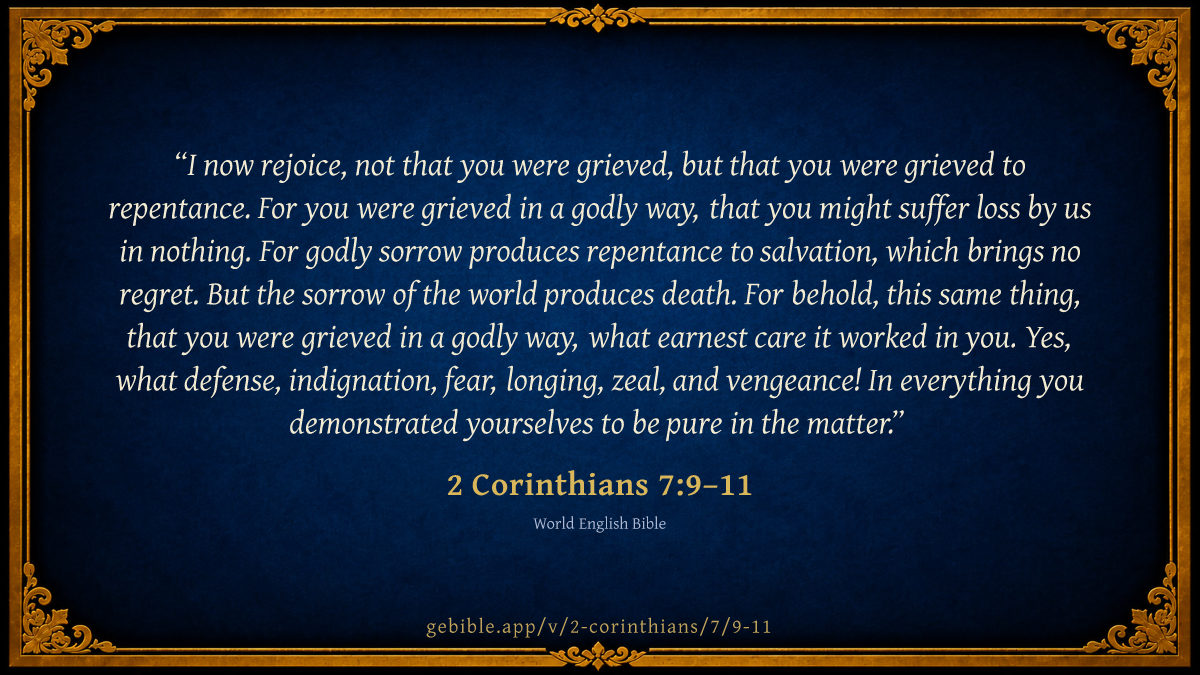
I now rejoice, not that you were grieved, but that you were grieved to repentance. For you were grieved in a godly way, that you might suffer loss by us in nothing. For godly sorrow produces repentance to salvation, which brings no regret. But the sorrow of the world produces death. For behold, this same thing, that you were grieved in a godly way, what earnest care it worked in you. Yes, what defense, indignation, fear, longing, zeal, and vengeance! In everything you demonstrated yourselves to be pure in the matter.
Show the surrounding paragraph
2 Corinthians 7:9-11 sits inside this longer paragraph.
For though I grieved you with my letter, I do not regret it, though I did regret it. For I see that my letter made you grieve, though just for a while. I now rejoice, not that you were grieved, but that you were grieved to repentance. For you were grieved in a godly way, that you might suffer loss by us in nothing. For godly sorrow produces repentance to salvation, which brings no regret. But the sorrow of the world produces death. For behold, this same thing, that you were grieved in a godly way, what earnest care it worked in you. Yes, what defense, indignation, fear, longing, zeal, and vengeance! In everything you demonstrated yourselves to be pure in the matter. So although I wrote to you, I wrote not for his cause that did the wrong, nor for his cause that suffered the wrong, but that your earnest care for us might be revealed in you in the sight of God. Therefore we have been comforted. In our comfort we rejoiced the more exceedingly for the joy of Titus, because his spirit has been refreshed by you all. For if in anything I have boasted to him on your behalf, I was not disappointed. But as we spoke all things to you in truth, so our glorying also which I made before Titus was found to be truth. His affection is more abundantly toward you, while he remembers all of your obedience, how with fear and trembling you received him. I rejoice that in everything I am confident concerning you.
Parallel Translations
-
I now rejoice, not that you were grieved, but that you were grieved to repentance. For you were grieved in a godly way, that you might suffer loss by us in nothing.
For godly sorrow produces repentance to salvation, which brings no regret. But the sorrow of the world produces death.
For behold, this same thing, that you were grieved in a godly way, what earnest care it worked in you. Yes, what defense, indignation, fear, longing, zeal, and vengeance! In everything you demonstrated yourselves to be pure in the matter.
-
But I now reioyce not that ye were sory but that ye so sorowed that ye repented. For ye sorowed godly: so that in nothynge ye were hurte by vs.
For godly sorowe causeth repentaunce vnto salvacion not to be repented of: when worldly sorow causeth deeth.
Beholde what diligence this godly sorowe that ye toke hath wrought in you: yee it caused you to cleare youre selves. It caused indignacion it caused feare that caused desyre it caused a fervent mynde it caused punysshment. For in all thynges ye have shewed youreselues that ye were cleare in that matter.
Show all 3 translations
-
I nowe reioyce, not that ye were sorie, but that ye sorowed to repentance: for ye sorowed godly, so that in nothing ye were hurt by vs.
For godly sorowe causeth repentance vnto saluation, not to be repented of: but the worldly sorowe causeth death.
For beholde, this thing that ye haue bene godly sory, what great care it hath wrought in you: yea, what clearing of yourselues: yea, what indignation: yea, what feare: yea, howe great desire: yea, what a zeale: yea, what reuenge: in all things ye haue shewed your selues, that ye are pure in this matter.
Cross-references (95)
- Acts 3:19 (v10) “Repent therefore, and turn again, that your sins may be blotted out, so that there may come times of refreshing from the presence of the…
- Acts 11:18 (v10) When they heard these things, they held their peace, and glorified God, saying, “Then God has also granted to the Gentiles repentance to…
- 2 Timothy 2:25-26 (v10) in gentleness correcting those who oppose him: perhaps God may give them repentance leading to a full knowledge of the truth, and they may…
- 2 Samuel 12:13 (v10) David said to Nathan, “I have sinned against Yahweh.” Nathan said to David, “Yahweh also has put away your sin. You will not die.
- Luke 18:13 (v10) But the tax collector, standing far away, wouldn’t even lift up his eyes to heaven, but beat his breast, saying, ‘God, be merciful to me, a…
Show all 93 cross-references
- Luke 15:10 (vv9–10) Even so, I tell you, there is joy in the presence of the angels of God over one sinner repenting.”
- 1 Kings 8:47-50 (v10) yet if they repent in the land where they are carried captive, and turn again, and make supplication to you in the land of those who…
- Jonah 3:10 (v10) God saw their works, that they turned from their evil way. God relented of the disaster which he said he would do to them, and he didn’t do…
- Hebrews 12:17 (v10) For you know that even when he afterward desired to inherit the blessing, he was rejected, for he found no place for a change of mind…
- Romans 14:18 (v11) For he who serves Christ in these things is acceptable to God and approved by men.
- Job 33:27-28 (v10) He sings before men, and says, ‘I have sinned, and perverted that which was right, and it didn’t profit me. He has redeemed my soul from…
- 1 Timothy 5:21-22 (v11) I command you in the sight of God, and the Lord Jesus Christ, and the chosen angels, that you observe these things without prejudice, doing…
- Proverbs 17:22 (v10) A cheerful heart makes good medicine, but a crushed spirit dries up the bones.
- Matthew 21:28-32 (v10) But what do you think? A man had two sons, and he came to the first, and said, ‘Son, go work today in my vineyard.’ He answered, ‘I will…
- Luke 15:7 (v9) I tell you that even so there will be more joy in heaven over one sinner who repents, than over ninety-nine righteous people who need no…
- 2 Timothy 2:15 (v11) Give diligence to present yourself approved by God, a workman who doesn’t need to be ashamed, properly handling the Word of Truth.
- Ezekiel 18:27-30 (v10) Again, when the wicked man turns away from his wickedness that he has committed, and does that which is lawful and right, he will save his…
- Jeremiah 31:18-20 (vv9, 11) “I have surely heard Ephraim grieving thus, ‘You have chastised me, and I was chastised, as an untrained calf. Turn me, and I will be…
- Psalms 2:11 (v11) Serve Yahweh with fear, and rejoice with trembling.
- Proverbs 15:15 (v10) All the days of the afflicted are wretched, but one who has a cheerful heart enjoys a continual feast.
- Jonah 4:9 (v10) God said to Jonah, “Is it right for you to be angry about the vine?” He said, “I am right to be angry, even to death.”
- Matthew 26:75 (v10) Peter remembered the word which Jesus had said to him, “Before the rooster crows, you will deny me three times.” Then he went out and wept…
- Ephesians 5:11 (v11) Have no fellowship with the unfruitful deeds of darkness, but rather even reprove them.
- Genesis 4:13-15 (v10) Cain said to Yahweh, “My punishment is greater than I can bear. Behold, you have driven me out today from the surface of the ground. I will…
- 1 Samuel 30:6 (v10) David was greatly distressed; for the people spoke of stoning him, because the souls of all the people were grieved, every man for his sons…
- 2 Samuel 13:4 (v10) He said to him, “Why, son of the king, are you so sad from day to day? Won’t you tell me?” Amnon said to him, “I love Tamar, my brother…
- Psalms 38:18 (v9) For I will declare my iniquity. I will be sorry for my sin.
- Proverbs 15:13 (v10) A glad heart makes a cheerful face, but an aching heart breaks the spirit.
- Proverbs 18:14 (v10) A man’s spirit will sustain him in sickness, but a crushed spirit, who can bear?
- Ecclesiastes 7:3 (v9) Sorrow is better than laughter; for by the sadness of the face the heart is made good.
- Jeremiah 31:9 (v10) They will come with weeping. I will lead them with petitions. I will cause them to walk by rivers of waters, in a straight way in which…
- Ezekiel 7:16 (v10) But those of those who escape, they will escape and will be on the mountains like doves of the valleys, all of them moaning, everyone in…
- Jonah 3:8 (v10) but let them be covered with sackcloth, both man and animal, and let them cry mightily to God. Yes, let them turn everyone from his evil…
- 1 Corinthians 5:13 (v11) But those who are outside, God judges. “Put away the wicked man from among yourselves.”
- 2 Corinthians 7:7 (v11) and not by his coming only, but also by the comfort with which he was comforted in you while he told us of your longing, your mourning, and…
- 2 Corinthians 7:10-11 (v9) For godly sorrow produces repentance to salvation, which brings no regret. But the sorrow of the world produces death. For behold, this…
- 2 Corinthians 13:8-10 (v9) For we can do nothing against the truth, but for the truth. For we rejoice when we are weak and you are strong. We also pray for this: your…
- Ephesians 4:26 (v11) “Be angry, and don’t sin.” Don’t let the sun go down on your wrath,
- Hebrews 12:15-16 (v11) looking carefully lest there be any man who falls short of the grace of God, lest any root of bitterness springing up trouble you, and many…
- 1 Peter 2:2 (v11) as newborn babies, long for the pure milk of the Word, that with it you may grow,
- Jude 1:23 (v11) and some save, snatching them out of the fire with fear, hating even the clothing stained by the flesh.
- Revelation 3:19 (v11) As many as I love, I reprove and chasten. Be zealous therefore, and repent.
- Genesis 30:1 (v10) When Rachel saw that she bore Jacob no children, Rachel envied her sister. She said to Jacob, “Give me children, or else I will die.”
- 2 Samuel 17:23 (v10) When Ahithophel saw that his counsel was not followed, he saddled his donkey, arose, and went home, to his city, and set his house in…
- 1 Kings 21:4 (v10) Ahab came into his house sullen and angry because of the word which Naboth the Jezreelite had spoken to him; for he had said, “I will not…
- Psalms 35:13 (v11) But as for me, when they were sick, my clothing was sackcloth. I afflicted my soul with fasting. My prayer returned into my own bosom.
- Psalms 38:9 (v11) Lord, all my desire is before you. My groaning is not hidden from you.
- Psalms 42:1 (v11) As the deer pants for the water brooks, so my soul pants after you, God.
- Zechariah 12:10 (v9) I will pour on David’s house, and on the inhabitants of Jerusalem, the spirit of grace and of supplication; and they will look to me whom…
- Matthew 27:4-5 (v10) saying, “I have sinned in that I betrayed innocent blood.” But they said, “What is that to us? You see to it.” He threw down the pieces of…
- Acts 17:16 (v11) Now while Paul waited for them at Athens, his spirit was provoked within him as he saw the city full of idols.
- Romans 11:20 (v11) True; by their unbelief they were broken off, and you stand by your faith. Don’t be conceited, but fear;
- 1 Corinthians 5:2 (v11) You are arrogant, and didn’t mourn instead, that he who had done this deed might be removed from among you.
- 1 Corinthians 12:25 (v11) that there should be no division in the body, but that the members should have the same care for one another.
- 2 Corinthians 2:6 (v11) This punishment which was inflicted by the many is sufficient for such a one;
- 2 Corinthians 6:4 (v11) but in everything commending ourselves, as servants of God, in great endurance, in afflictions, in hardships, in distresses,
- 2 Corinthians 7:1 (v11) Having therefore these promises, beloved, let’s cleanse ourselves from all defilement of flesh and spirit, perfecting holiness in the fear…
- 2 Corinthians 9:2 (v11) for I know your readiness, of which I boast on your behalf to those of Macedonia, that Achaia has been prepared for the past year. Your…
- 2 Corinthians 10:8-10 (v9) For even if I boast somewhat abundantly concerning our authority, which the Lord gave for building you up, and not for casting you down, I…
- 2 Corinthians 12:21 (v10) that again when I come my God would humble me before you, and I would mourn for many of those who have sinned before now, and not repented…
- 2 Corinthians 13:7 (v11) Now I pray to God that you do no evil; not that we may appear approved, but that you may do that which is honorable, though we are as…
- Philippians 2:12 (v11) So then, my beloved, even as you have always obeyed, not only in my presence, but now much more in my absence, work out your own salvation…
- Titus 3:8 (v11) This saying is faithful, and concerning these things I desire that you affirm confidently, so that those who have believed God may be…
- Hebrews 4:1 (v11) Let’s fear therefore, lest perhaps anyone of you should seem to have come short of a promise of entering into his rest.
- 1 Peter 1:17 (v11) If you call on him as Father, who without respect of persons judges according to each man’s work, pass the time of your living as…
- Genesis 44:6-7 (v11) He overtook them, and he spoke these words to them. They said to him, “Why does my lord speak such words as these? Far be it from your…
- 2 Samuel 12:5-7 (v11) David’s anger burned hot against the man, and he said to Nathan, “As Yahweh lives, the man who has done this deserves to die! He must…
- Nehemiah 5:6-13 (v11) I was very angry when I heard their cry and these words. Then I consulted with myself, and contended with the nobles and the rulers, and…
- Nehemiah 13:25 (v11) I contended with them, and cursed them, and struck certain of them, and plucked off their hair, and made them swear by God, “You shall not…
- Psalms 69:9 (v11) For the zeal of your house consumes me. The reproaches of those who reproach you have fallen on me.
- Psalms 119:139 (v11) My zeal wears me out, because my enemies ignore your words.
- Psalms 130:6 (v11) My soul longs for the Lord more than watchmen long for the morning, more than watchmen for the morning.
- Psalms 145:19 (v11) He will fulfill the desire of those who fear him. He also will hear their cry, and will save them.
- Proverbs 14:16 (v11) A wise man fears and shuns evil, but the fool is hot headed and reckless.
- Proverbs 28:14 (v11) Blessed is the man who always fears; but one who hardens his heart falls into trouble.
- Song of Solomon 8:6 (v11) Set me as a seal on your heart, as a seal on your arm; for love is strong as death. Jealousy is as cruel as Sheol. Its flashes are flashes…
- Isaiah 6:9-11 (v9) He said, “Go, and tell this people, ‘You hear indeed, but don’t understand. You see indeed, but don’t perceive.’ Make the heart of this…
- Isaiah 26:8 (v11) Yes, in the way of your judgments, Yahweh, we have waited for you. Your name and your renown are the desire of our soul.
- Isaiah 66:2 (v11) For my hand has made all these things, and so all these things came to be,” says Yahweh: “but I will look to this man, even to he who is…
- Daniel 6:14 (v11) Then the king, when he heard these words, was very displeased, and set his heart on Daniel to deliver him; and he labored until the going…
- Zechariah 12:10-14 (v11) I will pour on David’s house, and on the inhabitants of Jerusalem, the spirit of grace and of supplication; and they will look to me whom…
- Matthew 5:29-30 (v11) If your right eye causes you to stumble, pluck it out and throw it away from you. For it is more profitable for you that one of your…
- Mark 3:5 (v11) When he had looked around at them with anger, being grieved at the hardening of their hearts, he said to the man, “Stretch out your hand.”…
- Mark 9:43-48 (v11) If your hand causes you to stumble, cut it off. It is better for you to enter into life maimed, rather than having your two hands to go…
- Luke 15:17-24 (v9) But when he came to himself he said, ‘How many hired servants of my father’s have bread enough to spare, and I’m dying with hunger! I will…
- John 2:17 (v11) His disciples remembered that it was written, “Zeal for your house will eat me up.”
- Acts 20:21 (v9) testifying both to Jews and to Greeks repentance toward God, and faith toward our Lord Jesus.
- 2 Corinthians 1:12 (v9) For our boasting is this: the testimony of our conscience, that in holiness and sincerity of God, not in fleshly wisdom but in the grace of…
- 2 Corinthians 7:6-7 (v9) Nevertheless, he who comforts the lowly, God, comforted us by the coming of Titus, and not by his coming only, but also by the comfort with…
- Job 42:6 (v11) Therefore I abhor myself, and repent in dust and ashes.”
- Luke 15:32 (v9) But it was appropriate to celebrate and be glad, for this, your brother, was dead, and is alive again. He was lost, and is found.’ ”
- 2 Corinthians 2:16 (v9) to the one a stench from death to death, to the other a sweet aroma from life to life. Who is sufficient for these things?
- 2 Corinthians 7:9 (v11) I now rejoice, not that you were grieved, but that you were grieved to repentance. For you were grieved in a godly way, that you might…
93 distinct cross-references across this passage (95 total citations).
Cross-references from openbible.info (CC BY 4.0)
Explain this passage (23 sources)
Historical commentary, presented as a primary source — not an endorsement.
Private notes
Saved on this device only — never synced or sent anywhere.
John Calvin 1540 · Public Domain On vv9–11 9. Not because you have been made sorry. He…
9. Not because you have been made sorry. He means, that he feels no pleasure whatever in their sorrow — nay more, had he his choice, he would endeavor to promote equally their welfare and their joy, by the same means; but that as he could not do otherwise, their welfare was of so much importance in his view, that he rejoiced that they had been made sorry unto repentance. For there are instances of physicians, who are, indeed, in other respects good and faithful, but are at the same time harsh, and do not spare their patients. Paul declares, that he is not of such a disposition as to employ harsh cures, when not constrained by necessity. As, however, it had turned out well, that he had made trial of that kind of cure, he congratulates himself on his success. He makes use of a similar form of expression in 2 Corinthians 5:4,
We in this tabernacle groan, being burdened, because we are desirous not to be unclothed, but clothed upon.
John Calvin's Commentaries (1540-1563) — public domain. Text from the Calvin Translation Society English edition (1840s-50s) via the Christian Classics Ethereal Library (ccel.org). Calvin's coverage is partial (roughly two-thirds of the Bible); uncommented books and verses are honest gaps, never fabricated. The 19th-century editor's footnotes and remarks are omitted so the notes are faithfully Calvin's own voice.
Geneva Bible translators 1599 · Public Domain On vv9–10 Insomuch that that sorrow did you much good toward…
Insomuch that that sorrow did you much good toward the amending of your lewdness and sins.
Geneva Bible (1599) marginal notes — public domain.
John Trapp 1656 · Public Domain On vv9–11 9 Now I rejoice, not that ye were made…
9 Now I rejoice, not that ye were made sorry, but that ye sorrowed to repentance: for ye were made sorry after a godly manner, that ye might receive damage by us in nothing.
Ver. 9. That ye sorrowed to repentance] Gr. εις μετανοιαν, to a transmentation, to a thorough change both of the mind and manners. Optima et aptissima poenitentia est nova vita, The best and most appropiate repentance is a new life, saith Luther. Which saying (though condemned by Pope Leo X) is certainly an excellent saying. Repentance for sin is nothing worth without repentance from sin. If thou repent with a contradiction (saith Tertullian) God will pardon thee with a contradiction. Thou repentest, and yet continuest in thy sin. God will pardon thee, and yet send thee to hell. There is a pardon with a contradiction.
Read full note →
Sorry after a godly manner] Gr. η κατα θεον λυπη, according to God. This is a sorrowing for sin, as it is offensivum Dei, aversivum a Deo. offensive to God and a turning away from God. This both comes from God and drives a man to God, as it did the Church in the Canticles, and the prodigal.
John Trapp, A Commentary or Exposition upon All the Books of the Old and New Testament (1647–1656) — public domain. Text from a community e-Sword module.
Matthew Poole 1685 · Public Domain On vv9–11 Now I rejoice, not that ye were made sorry,…
Now I rejoice, not that ye were made sorry, but that ye sorrowed to repentance: the apostle takes all advantages to insinuate himself into the good opinion and affections of the members of this famous church, and to obviate any misrepresentations of him to them from those false teachers that were crept in amongst them. Lest they should take some advantage from his saying, that he repented not that he had made them sorry, he here openeth himself, and tells them, he did not rejoice in their sorrow, but in the blessed product and effect of it; which was their reformation of those abuses and errors which he had reproved them for, the effect of which reproof was this their sorrow for a little season. And that they
were made sorry after a godly manner; they did but sow in tears, they reaped in joy; they had a wet seed time, but a fair harvest. They sorrowed with a sorrow according to God; the cause of their sorrow was their sin, the root of it a love to God, the manner of it such as was agreeable to the will of God.
Read full note →
That ye might receive damage by us in nothing; the wise God so governing things hy his providence, that nothing which the apostle spake or wrote should prove detrimental, but rather advantageous; to this church which he so loved.
Matthew Poole's English Annotations on the Holy Bible (1683–1685) — public domain. Text from a community e-Sword/MySword module.
William Burkitt 1703 · Public Domain On vv10–11 Note here, that sorrow for sin, will be of…
Note here, that sorrow for sin, will be of no advantage or avail upon us, if it be not godly sorrow, or a sorrow according to God, as it runs in the original. Now it may be called a sorrow according to God, when it is a sorrow wrought in us by the Spirit of God, in obedience to the command of God, and with an eye at the glory of God; when it has sin, and not wrath, for its object; sin, as a wrong to God, as a contempt of his sovereignty, and a contrariety to his holiness.
Again, It is then a godly sorrow, when it puts us upon an high prizing of Jesus Christ, who became a sacrifice for sin; and prompts us to a cordial and unfeigned forsaking of all sin to such a turning from it, as is resolved against all returning to it.
Read full note →
The sorrow of the world may be taken two ways, 1. For the sorrow of worldly men, whose sorrow for sin is only a vexing of their hearts, not a breaking or humbling of their hearts; which being separate from true faith, and without any purpose to leave sin, worketh death, by wearing out the natural life lingeringly, and sometimes destroying the natural life violently, as in the case of Judas.
2. By the sorrow of the world, may be understood a sorrow for worldly things, a sorrow for worldly losses and disappointments. This is sinful, when it is excessive; and as it is prejudicial to the soul, so doth it hurt the body, and it hasteneth death. Worldly sorrow is a killing sorrow: Godly sorrow worketh repentance: But the sorrow of the world worketh death.
William Burkitt's Expository Notes on the New Testament (1700–1703) — public domain. Text from a community e-Sword module.
John Gill 1763 · Public Domain On vv9–11 Now I rejoice, not that ye were made sorry,....…
Now I rejoice, not that ye were made sorry,.... Their grief and sorrow, as a natural passion, was no matter or cause of joy to him; nor was this what he sought after, being what he could take no real pleasure in; for so far as that was a pain to them, it was a pain to him:
but that ye sorrowed to repentance; their sorrow issued in true evangelical repentance, and this was the ground of his rejoicing; for as there is joy in heaven among the angels, at the repentance of a sinner, so there is joy in the church below, among the saints and ministers of the Gospel, when either sinners are brought in, or backsliders returned by repentance:
Read full note →
for ye were made sorry after a godly sort; what gave him so much joy and satisfaction was, that their sorrow was of the right sort; it was a godly sorrow, they sorrowed after; or according to God, according to the will of God, and for sin, as it was committed against him; it was a sorrow that God wrought in them:
that ye might receive damage by us in nothing; what added to his pleasure was, that his writing to them, and the effect it produced, had not been in the least detrimental to them; things had worked so kindly, and this sorrow had wrought in such a manner, that they were not hurt in their souls, but profited; nor in their church state, they had not lost one member by it; nay, the offender himself, which was the occasion of all this trouble, was recovered and restored by these means.
John Gill's Exposition of the Whole Bible (1746–1763) — public domain (CC PDM 1.0). Text via the HelloAO Bible API.
John Wesley 1765 · Public Domain On vv10–11 The sorrow of the world - Sorrow that arises…
The sorrow of the world - Sorrow that arises from worldly considerations. Worketh death - Naturally tends to work or occasion death, temporal, spiritual, and eternal.
John Wesley, Explanatory Notes Upon the Whole Bible (1754–1765) — public domain. Text via the GEBible commentary corpus.
Adam Clarke 1810 · Public Domain On vv9–11 Verse 9. Ye sorrowed to repentance] Ye had such…
Verse 9. Ye sorrowed to repentance] Ye had such a sorrow as produced a complete change of mind and conduct. We see that a man may sorrow, and yet not repent.
Made sorry after a godly manner] It was not a sorrow because ye were found out, and thus solemnly reprehended, but a sorrow because ye had sinned against God, and which consideration caused you to grieve more than the apprehension of any punishment.
Read full note →
Damage by us in nothing.] Your repentance prevented that exercise of my apostolic duty, which would have consigned your bodies to destruction, that your souls might be saved in the day of the Lord Jesus.
Adam Clarke's Commentary on the Bible (1810–1826) — public domain. Text from a community e-Sword/MySword module.
Albert Barnes 1834 · Public Domain On vv9–11 Now I rejoice, not that ye were made sorry…
Now I rejoice, not that ye were made sorry ... - I have no pleasure in giving pain to anyone, or in witnessing the distress of any. When people are brought to repentance under the preaching of the gospel, the ministers of the gospel do not find pleasure in their grief as such. They are not desirous of making people unhappy by calling them to repentance, and they have no pleasure in the deep distress of mind which is often produced by their preaching, in itself considered. It is only because such sorrow is an indication of their return to God, and will be followed by happiness and by the fruits of good living, that they find any pleasure in it, or that they seek to produce it.
But that ye sorrowed to repentance - It was not mere grief; it was not sorrow producing melancholy, gloom, or despair; it was not sorrow which led you to be angry at him who had reproved you for your errors - as is sometimes the case with the sorrow that is produced by reproof; but it was sorrow that led to a change and reformation. It was sorrow that was followed by a putting away of the evil for the existence of which there had been occasion to reprove you. The word rendered here as “repentance” (μετάνοιαν metanoian) is a different word from that which, in 2Co 7:8, is rendered “I did repent,” and indicates a different state of mind. It properly means a change of mind or purpose; compare Heb 12:7. It denotes a change for the better; a change of mind that is durable and productive in its consequences; a change which amounts to a permanent reformation; see Campbell’s Diss. ut supra. The sense here is, that it produced a change, a reformation. It was such sorrow for their sin as to lead them to reform and to put away the evils which had existed among them. It was this fact, and not that they had been made sorry, that led Paul to rejoice.
Read full note →
After a godly manner - Margin, “according to God;” see the note on the next verse.
That ye might receive damage by us in nothing - The Greek word rendered “receive damage” (ζημιωθῆτε zēmiōthēte) means properly to bring loss upon anyone; to receive loss or detriment; see the note on 1Co 3:15; compare Phi 3:8. The sense here seems to be, “So that on the whole no real injury was done you in any respect by me. You were indeed put to pain and grief by my reproof. You sorrowed. But it has done you no injury on the whole. It has been a benefit to you. If you had not reformed, if you had been pained without putting away the sins for which the reproof was administered, if it had been mere grief without any proper fruit, you might have said that you would have suffered a loss of happiness, or you might have given me occasion to inflict severer discipline. But now you are gainers in happiness by all the sorrow which I have caused.” Sinners are gainers in happiness in the end by all the pain of repentance produced by the preaching of the gospel. No man suffers loss by being told of his faults if he repents; and people are under the highest obligations to those faithful ministers and other friends who tell them of their errors, and who are the means of bringing them to true repentance.
Albert Barnes' Notes on the Bible (1834–1885) — public domain. Text from a community e-Sword/MySword module.
Haydock's Catholic Bible Commentary 1859 · Public Domain On vv9–10 Now I rejoice, &c. I should have been inconsolable,…
Now I rejoice, &c. I should have been inconsolable, had my letter made you sad, without producing the salutary effect intended by it; but I now rejoice that it caused a sorrow and sadness productive of the great advantages you have reaped from it. Thus in every sentence St. Paul shews the solicitude of a father, seeking nothing but the advancement of his spiritual children. (Calmet)
George Leo Haydock (1774–1849), Haydock's Catholic Family Bible and Commentary, 1859 edition — public domain. Excludes Psalms (Douay-Rheims chapter numbering differs from Protestant) and Deuterocanonical books (Catholic canon only).
Robert Jamieson, A. R. Fausset & David Brown 1871 · Public Domain On vv9–11 Now I rejoice--Whereas "I did repent" or regret having…
Now I rejoice--Whereas "I did repent" or regret having made you sorry by my letter, I rejoice NOW, not that ye were caused sorrow, but that your sorrow resulted in your repentance.
ye sorrowed--rather, as before, "ye were made sorry."
Read full note →
after a godly manner--literally, "according to God," that is, your sorrow having regard to God, and rendering your mind conformable to God (Rom 14:22; Pe1 4:6).
that--Translate in Greek order, "to the end that (compare Co2 11:9) ye might in nothing receive damage from us," which ye would have received, had your sorrow been other than that "after a godly manner" (Co2 7:10).
Jamieson, Fausset & Brown — Commentary Critical and Explanatory on the Whole Bible (1871) — public domain (CC PDM 1.0). Text via the HelloAO Bible API.
Daniel D. Whedon 1874 · Public Domain On vv9–11 9. To repentance—Over their sorrow alone he could not…
9. To repentance—Over their sorrow alone he could not rejoice: but over a sorrow merging into repentance he could rejoice.
Sorry after a godly manner—Literally, sorry according to God. A sorrow that has reference to God in contradistinction from a sorrow that regards the world.
Daniel D. Whedon (gen. ed.), Commentary on the Old and New Testaments (1874–1909) — public domain. Text from a community e-Sword module.
The Cambridge Bible for Schools and Colleges 1878 · Public Domain On vv9–11 9. Now I rejoice, not that ye were made…
9. Now I rejoice, not that ye were made sorry] Another instance of the tender consideration of St Paul (see note on 2Co_7:3). He will not run the risk of being supposed, even for a moment, to have taken pleasure in others’ pain.
repentance] It cannot be too strongly insisted upon that the Greek word translated repentance (penaunce, Wiclif and the Rhemish Version) contains neither the idea of sorrow nor of penitential discipline. The word means change of mind or purpose. Sorrow may or may not accompany it. In most cases, as in this, it will do so. But the essence of Gospel repentance is not the sorrow it produces, but the change it works. The word translated repent in 2Co_7:8 is a different word, and has precisely the meaning usually in our days attached to the word repentance. It, or its cognate verb, only occurs here and in Mat_21:29; Mat_21:32; Mat_27:3, and Heb_7:21. It is a misfortune that the A. V. has employed the same word to express two very different ideas.
Read full note →
after a godly manner] The original is stronger, according to God, i.e. in such a manner as He had commanded or would approve. Cf. Rom_8:27.
receive damage] The word signifies to suffer injury or loss. See Mat_16:26, where it is translated lose; Luk_9:25, where it is translated cast away. See also 1Co_3:15. Wiclif renders here suffer pairement; Tyndale, ye were hurte; the Rhemish, well, suffer detriment.
The Cambridge Bible for Schools and Colleges (gen. ed. J. J. S. Perowne; Cambridge University Press, 1878–1918) — public domain. Text from a community e-Sword module.
Ellicott's Commentary for English Readers 1878 · Public Domain On vv9–11 (9) That ye sorrowed to repentance.—Here the true word…
(9) That ye sorrowed to repentance.—Here the true word for “repentance” is used in all the fulness of its meaning. (See Notes on Mat_3:2; Mat_3:8.) There is nothing in the Greek corresponding to the variation “ye sorrowed” and “were made sorry,” the same word being used in both clauses.
After a godly manner.—The English is but a feeble equivalent for the Greek. Literally, according to God—i.e. (as may be seen by comparing the sense of the same or like phrases in Rom_8:27; Eph_4:24; Col_2:8), after His will and purpose. “God allowed you,” he tells them, “to be grieved in order that you might sustain no loss, as you might have done had we held our peace.”
A Bible Commentary for English Readers, edited by Charles John Ellicott (1878–1897) — public domain. Text from a community e-Sword module.
The Pulpit Commentary 1880 · Public Domain On vv9–11 Not that ye were made sorry. They might have…
Not that ye were made sorry. They might have drawn this mistaken conclusion from his remark that he "rejoiced" when he heard of their "lamentation" (ver. 7). After a godly sort; literally, according to God; i.e. in a way which he would approve. (Rom_8:27) In nothing. Not even when we rebuked you, and caused you pain.
Vers. 9-11.
Read full note →
Two kinds of sorrow.
Reproof works well when it induces sorrow toward God and issues in repentance. But of sorrow there are two kinds.
I THE SORROW OF THE WORLD.
1. Its nature. It is regret for worldly loss, or, if for faults and sins, it is for them as bringing worldly discredit. It is vexation, not for wrong done, so much as for damage incurred, credit spoilt, advantage missed, pride wounded.
2. Its issues. It works death. It wears the mind, sours the temper, fills the breast with discontent, takes away all zest of exertion, chokes the heart with resentment and chagrin. It actually kills; a rankling annoyance or shame tends both to embitter and to shorten life. There are more than is commonly believed dying of vexation; as Spenser has it
Dying each day with inward wounds of Dolour"s dart.
II SORROW ACCORDING TO GOD.
1. Its nature. It springs from a sense of sin in the light of God, and in relation to his Name, Law, and glory. It is the grief of a mind that has learnt to honour, observe, and follow the Lord, and therefore mourns for sin as committed against heaven and in his sight. See the sorrow of the world in King Saul, who, when he was reproved by the prophet, admitted, "I have sinned;" but immediately added this request to Samuel, "Yet honour me now." See the sorrow according to God in King David, who, when he was reproved by a prophet, said. "I have sinned against Jehovah," and then prayed the fifty-first psalm, saying, "Hide thy face from my sins.
2. Its result. It works "repentance to salvation," otherwise described as "repentance toward God" and "repentance unto life." The sorrow does not exhaust itself in emotion, but induces a change of mind, a turning from sin to God, and so from death to life. And such repentance will never be regretted. St. Paul had regretted his first letter, but now did not regret it, since he learned the good effect it had produced. A minister of Christ may have to speak sharply to men about their sins. He may have to regret that he evaded such duty or spoke smooth things, but not that he brought trouble to the consciences of sinners or godly sorrow to their hearts. And many a hearer of the Word may have to grieve that he was deaf to reproof, but none that he listened to it and mourned for his sin. No one will ever regret that he repented toward God.
3. Its further issues and evidences. The moral earnestness which was connected with sorrow according to and repentance toward God showed itself thus at Corinth. "What carefulness it wrought in you!" What diligence! Blessed is the reproof, healthy is the sorrow, which puts a stop to trifling, and makes us face the reality and feel the seriousness of living in God"s sight. We must not then excuse our faults or count them unavoidable, but set about the correction of them with all diligence. "Yea, what a clearing of yourselves!" What solicitude to be right with God! "Yea, what indignation!" What lively abhorrence of evil! "Yea, what fear! yea, what longing desire!" What anxiety to satisfy the apostle, or any servant of God who has brought our sins home to our conscience, that we are and mean to be what he would approve! Thus the effect of godly sorrow is to make the heart tender and affectionate as well as pure. "Yea, what zeal" in reformation! "Yea, what revenge!" What holy severity against sin! When a sinner, charged with his offences against God, stands on his defence, he is fertile in excuses. The sin was a little one; or the motive was not bad; or the provocation or temptation was great; or the circumstances almost compelled him; or he did it without thought; or he did as others do. But when he is convinced of the Holy Ghost and moved with godly sorrow, he has no plea, and does not wish to have any excuse pleaded for him. He wants rather to have revenge upon his sin, and abhors himself on account of it, repenting in dust and ashes. There is no peace for his conscience but in the sin-purging blood of Jesus Christ. When the believer (and this rather than the other is the case which this text suggests) is reproved for grave inconsistency, moral earnestness is roused within him. Not that he is bound to accept the strictures and rebukes of ill-natured and censorious persons who call it Faithfulness to find fault freely with their neighbours. But let a righteous man smite him, and he takes it as an excellent oil. As his fault is shown to his conscience, he scorns to excuse it. He breaks off the sin by righteousness, and that with a sort of sacred indignation, not against the reprover, but against the thing reproved. Indeed, a sorrow God-ward for one fault works a repentance for all sin. As Gurnal says, One spot occasions the whole garment to be washed. A careful man, when he findeth it rain in at one place, sends forth the workmen to look over all the roof. So should the discovery of one fault lead to a general renewal of self-examination and repentance; and sorrow for one sin should rend the heart for all sins. F.
Vers. 9, 10.
Godly sorrow; or, the sorrow that is after the will of God.
Reference is to the distress which the more spiritual members of the Corinthian Church felt on the receipt of St. Paul"s first letter. He had written severely, and, after sending his letter, almost regretted that he had expressed himself so strongly; but he now felt thankful to hoar that they had so well responded to his appeals, and sorrowed unto repentance and putting away of the evil in a manner that would be so certainly approved by God. "The series of emotional words in ver. 11 represent the apostle"s estimate of what he had heard from Titus. There was
(1) earnestness where there had been indifference to evil, and even approval of it; (1Co_5:2) and this was shown
(2) in the vindication of their conduct which they had sent through Titus; and
(3) in their stern "indignation" against the offender;
(4) in their fear, partly of the supernatural chastisement which St. Paul had threatened, partly of the judgment of God which was against such things;
(5) in the longing to have him once more among them, which mingled with their fear;
(6) in their new zeal for the law of purity;
(7) in their actual vengeance, i.e. their sentence of condemnation passed upon the offender." "The apostle rejoiced, not that the Corinthians sorrowed, but that they sorrowed unto repentance. Sorrow has two results it may end in spiritual life or in spiritual death; and in themselves one ofthese is as natural as the other. Sorrow may produce two kinds of reformation: a transient or a permanent one; an alteration in habits, which, originating in emotion, will last so long as that emotion continues, and then, after a few fruitless efforts, be given up; a repentance which will be repented of; or again, a permanent change which will be reversed by no after thought a repentance not to be repented of." Beza says, "The "sorrow of the world" is the certain way to desperation, unless God prevent it, as appears from the horrid examples of Cain, Saul, Ahithophel, and Judas; but the written tears of David give the clearest example of the other kind of sorrow.
I THE DISTINCTION BETWEEN REMORSE AND REPENTANCE. The word "remorse" has in it the figure of "biting back," and it means going over our sins in thought, with a keen gnawing regret at having done them, but without any softened feelings such as belong to the penitent. Remorse is exactly that "sorrow of the world" which worketh death. Repentance is that humble, regretful spirit which sets a man ready to receive and to value the Divine forgiveness.
II THE TESTS OF GENUINE REPENTANCE IN THE INDIVIDUAL. They are:
Mental distress.
Humility and self-abasement.
Confession without attempt at excuses.
Earnest seeking of Divine forgiveness.
Resolute putting away of the evil.
Keen watchfulness over the circumstances that involve temptation to the sin.
And an attitude of simple and unquestioning obedience to the will ofGod, and submission to whatever judgments on the sin it may please him to appoint. "Sorrow has done its work when it deters from evil. In the sorrow of the world the obliquity of the heart towards evil is not cured; it seems as if nothing cured it; heartache and trials come in vain; the history of life at last is what it was at first. Sorrow avails only when the past is converted into experience, and from failure lessons are learned which never are to be forgotten.
III THE TESTS OF GENUINE REPENTANCE IN A CHURCH. These more especially are dealt with in the passage before us. Bengel says that the six results mentioned by the apostle fall into pairs. The first two relate to their feelings towards themselves, the next to their feelings towards the apostle, the last to their feelings towards the offender and his offence. The tests we notice are
(1) clearings, earnest efforts to put away the wrong, and to show that they had no complicity in it, and would make no excuses for it;
(2) anxiety for each other, that the membership may be quite purified, and no brother cherish even a secret sympathy with the wrong;
(3) discipline on the wrong doer, by at least a temporary removal of him from the Church fellowship. The penitence of a Church will also find expression in united acts of confession and humiliation, and in prayer for Divine forgiveness and restoration. Perhaps much too little is made in these days of the united acts of the corporate Church life. There is a befitting Church penitence, a proper godly sorrow of a community, when, by any evil of its members, such a community has become defiled. R.T.
The Pulpit Commentary (1880–1919), ed. H.D.M. Spence-Jones & Joseph S. Exell — public domain. Text from a community e-Sword module.
The Biblical Illustrator 1887 · Public Domain On v11 For … ye sorrowed after a godly sort.
2Co_7:11
For … ye sorrowed after a godly sort.
Read full note →
The internal workings of genuine repentance
The Bible says a deal about repentance.
1. Its nature (Job_42:5; Psa_51:1-19.; Eze_36:35; Mat_26:24; Luk_15:35; Luk_18:13; 2Co_7:9).
2. Its necessity (Eze_14:6; Mat_3:1; Mat_4:17; Luk_13:13; Act_3:19; Rev_2:5, &c.).
3. Its internal working as here.
I. Solicitude. What carefulness! Men who have repented are no longer unconcerned about spiritual matters, but are cautious, careful, diligent. The necessity of carefulness may be argued from--
1. The corrupting influences of social life.
2. The agency of tempting spirits.
3. The remaining depravity of our own nature. This is tinder for the devils fire, a fulcrum for the devils lever. Hence be careful.
II. Deprecation. What clearing of yourselves--how anxious to show your disapproval of the evil of which you have been guilty. Thus genuine repentance ever works.
III. Anger. What indignation! Repentance generates a deadly hatred to evil. We have little faith in the moral excellency of those who cannot go into flames of indignation whenever the wrong appears before them: Strong love for the thing loved necessitates strong hatred for the thing hated. Dante, who loved well because he hated, hated wickedness because he loved. When a repentant soul muses not only on the sins of others, but on his own, the fires of indignation kindle into a blaze.
IV. Dread. What fear! Fear, not of suffering but of sin. This fear is the highest courage, and also love dreading to displease the object of its affection.
V. Earnestness. What vehement desire!--what longing for a higher life! What zeal!--what intense desire to eschew the wrong and to pursue the right! What revenge! What a craving to crush the wrong! All these expressions mean intense earnestness about spiritual matters which is rare and praiseworthy. Genuine repentance is antagonistic to indifferentism. (D. Thomas, D. D.)
The Biblical Illustrator, edited by Joseph S. Exell (c. 1880s–1900s) — public domain. Text from a community e-Sword module.
B. W. Johnson 1891 · Public Domain On vv9–11 9. Now I rejoice. Not because they were made…
9. Now I rejoice. Not because they were made sorry, but that their sorrow brought repentance. Observe, (1) that regret is not repentance; (2) that sorrow is not repentance; (3) that godly sorrow (verse 10) works repentance, or, in other words, repentance results from godly sorrow, or sorrowing in a way pleasing to God.
B. W. Johnson's The People's New Testament with Notes (1889–1891) — public domain. Electronic text from the Christian Classics Ethereal Library (CCEL) ThML edition.
Alexander MacLaren 1905 · Public Domain On v10 2 Corinthians
2 Corinthians
SORROW ACCORDING TO GOD
Read full note →
2Co 7:10.
Very near the close of his missionary career the Apostle Paul summed up his preaching as being all directed to enforcing two points, ‘Repentance towards God, and faith in our Lord Jesus Christ.’ These two, repentance and faith, ought never to be separated in thought, as they are inseparable in fact. True repentance is impossible without faith, true faith cannot exist without repentance.
Yet the two are separated very often, even by earnest Christian teachers. The tendency of this day is to say a great deal about faith, and not nearly enough in proportion about repentance; and the effect is to obscure the very idea of faith, and not seldom to preach ‘Peace! peace! when there is no peace.’ A gospel which is always talking about faith, and scarcely ever talking about sin and repentance, is denuded, indeed, of some of its most unwelcome characteristics, but is also deprived of most of its power, and it may very easily become an ally of unrighteousness, and an indulgence to sin. The reproach that the Christian doctrine of salvation through faith is immoral in its substance derives most of its force from forgetting that ‘repentance towards God’ is as real a condition of salvation as is ‘faith in our Lord Jesus Christ.’ We have here the Apostle’s deliverance about one of these twin thoughts. We have three stages--the root, the stem, the fruit; sorrow, repentance, salvation. But there is a right and a wrong kind of sorrow for sin. The right kind breeds repentance, and thence reaches salvation; the wrong kind breeds nothing, and so ends in death.
Let us then trace these stages, not forgetting that this is not a complete statement of the case, and needs to be supplemented in the spirit of the words which I have already quoted, by the other part of the inseparable whole, ‘faith towards our Lord Jesus Christ.’
I. First, then, consider the true and the false sorrow for sin.
The Apostle takes it for granted that a recognition of our own evil, and a consequent penitent regretfulness, lie at the foundation of all true Christianity. Now I do not insist upon any uniformity of experience in people, any more than I should insist that all their bodies should be of one shape or of one proportion. Human lives are infinitely different, human dispositions are subtly varied, and because neither the one nor the other are ever reproduced exactly in any two people, therefore the religious experience of no two souls can ever be precisely alike.
We have no right to ask--and much harm has been done by asking--for an impossible uniformity of religious experience, any more than we have a right to expect that all voices shall be pitched in one key, or all plants flower in the same month, or after the same fashion. You can print off as many copies as you like, for instance, of a drawing of a flower on a printing-press, and they shall all be alike, petal for petal, leaf for leaf, shade for shade; but no two hand-drawn copies will be so precisely alike, still less will any two of the real buds that blow on the bush. Life produces resemblance with differences; it is machinery that makes facsimiles.
So we insist on no pedantic or unreal uniformity; and yet, whilst leaving the widest scope for divergencies of individual character and experience, and not asking that a man all diseased and blotched with the leprosy of sin for half a lifetime, and a little child that has grown up at its mother’s knee, ‘in the nurture and admonition of the Lord,’ and so has been kept ‘innocent of much transgression,’ shall have the same experience; yet Scripture, as it seems to me, and the nature of the case do unite in asserting that there are certain elements which, in varying proportions indeed, will be found in all true Christian experience, and of these an indispensable one--and in a very large number, if not in the majority of cases, a fundamental one--is this which my text calls ‘godly sorrow.’
Dear brethren, surely a reasonable consideration of the facts of our conduct and character point to that as the attitude that becomes us. Does it not? I do not charge you with crimes in the eye of the law. I do not suppose that many of you are living in flagrant disregard of the elementary principles of common every-day morality. Some are, no doubt. There are, no doubt, unclean men here; there are some who eat and drink more than is good for them, habitually; there are, no doubt, men and women who are living in avarice and worldliness, and doing things which the ordinary conscience of the populace points to as faults and blemishes. But I come to you respectable people that can say: ‘I am not as other men are, unjust, adulterers, or even as this publican’; and pray you, dear friends, to look at your character all round, in the light of the righteousness and love of God, and to plead to the indictment which charges you with neglect of many a duty and with sin against Him. How do you plead, ‘guilty or not guilty, sinful or not sinful?’ Be honest with yourselves, and the answer will not be far to seek.
Notice how my text draws a broad distinction between the right and the wrong kind of sorrow for sin. ‘Godly sorrow’ is, literally rendered,’sorrow according to God,’ which may either mean sorrow which has reference to God, or sorrow which is in accordance with His will; that is to say, which is pleasing to Him. If it is the former, it will be the latter. I prefer to suppose that it is the former--that is, sorrow which has reference to God. And then, there is another kind of sorrow, which the Apostle calls the ‘sorrow of the world,’ which is devoid of that reference to God. Here we have the characteristic difference between the Christian way of looking at our own faults and shortcomings, and the sorrow of the world, which has got no blessing in it, and will never lead to anything like righteousness and peace. It is just this--one has reference to God, puts its sin by His side, sees its blackness relieved against the ‘fierce light’ of the Great White Throne, and the other has not that reference.
To expand that for a moment,--there are plenty of us who, when our sin is behind us, and its bitter fruits are in our hands, are sorry enough for our faults. A man that is lying in the hospital a wreck, with the sins of his youth gnawing the flesh off his bones, is often enough sorry that he did not live more soberly and chastely and temperately in the past days. That fraudulent bankrupt who has not got his discharge and has lost his reputation, and can get nobody to lend him money enough to start him in business again, as he hangs about the streets, slouching in his rags, is sorry enough that he did not keep the straight road. The ‘sorrow of the world’ has no thought about God in it at all. The consequences of sin set many a man’s teeth on edge who does not feel any compunction for the wrong that he did. My brethren, is that the position of any that are listening to me now?
Again, men are often sorry for their conduct without thinking of it as sin against God. Crime means the transgression of man’s law, wrong means the transgression of conscience’s law, sin is the transgression of God’s law. Some of us would perhaps have to say--’I have done crime.’ We are all of us quite ready to say: ‘I have done wrong many a time’; but there are some of us who hesitate to take the other step, and say: ‘I have done sin.’ Sin has, for its correlative, God. If there is no God there is no sin. There may be faults, there may be failures, there may be transgressions, breaches of the moral law, things done inconsistent with man’s nature and constitution, and so on; but if there be a God, then we have personal relations to that Person and His law; and when we break His law it is more than crime; it is more than fault; it is more than transgression; it is more than wrong; it is sin. It is when you lift the shutter off conscience, and let the light of God rush in upon your hearts and consciences, that you have the wholesome sorrow that worketh repentance and salvation and life.
Oh, dear friends, I do beseech you to lay these simple thoughts to heart. Remember, I urge no rigid uniformity of experience or character, but I do say that unless a man has learned to see his sin in the light of God, and in the light of God to weep over it, he has yet to know ‘the strait gate that leadeth unto life.’
I believe that a very large amount of the superficiality and easy-goingness of the Christianity of to-day comes just from this, that so many who call themselves Christians have never once got a glimpse of themselves as they really are. I remember once peering over the edge of the crater of Vesuvius, and looking down into the pit, all swirling with sulphurous fumes. Have you ever looked into your hearts, in that fashion, and seen the wreathing smoke and the flashing fire there? If you have, you will cleave to that Christ, who is your sole deliverance from sin.
But, remember, there is no prescription about depth or amount or length of time during which this sorrow shall be felt. If, on the one hand, it is essential, on the other hand there are a great many people who ought to be walking in the light and the liberty of God’s Gospel who bring darkness and clouds over themselves by the anxious scrutinising question: ‘Is my sorrow deep enough?’ Deep enough! What for? What is the use of sorrow for sin? To lead a man to repentance and to faith. If you have as much sorrow as leads you to penitence and trust you have enough. It is not your sorrow that is going to wash away your sin, it is Christ’s blood. So let no man trouble himself about the question, Have I sorrow enough? The one question is: ‘Has my sorrow led me to cast myself on Christ?’
II. Still further, look now for a moment at the next stage here. ‘Godly sorrow worketh repentance.’
What is repentance? No doubt many of you would answer that it is ‘sorrow for sin,’ but clearly this text of ours draws a distinction between the two. There are very few of the great key-words of Christianity that have suffered more violent and unkind treatment, and have been more obscured by misunderstandings, than this great word. It has been weakened down into penitence, which in the ordinary acceptation, means simply the emotion that I have already been speaking about, viz., a regretful sense of my own evil. And it has been still further docked and degraded, both in its syllables and in its substance, into _penance_. But the ‘repentance’ of the New Testament and of the Old Testament--one of the twin conditions of salvation--is neither sorrow for sin nor works of restitution and satisfaction, but it is, as the word distinctly expresses, a change of purpose in regard to the sin for which a man mourns. I cannot now expand and elaborate this idea as I should like, but let me remind you of one or two passages in Scripture which may show that the right notion of the word is not sorrow but changed attitude and purpose in regard to my sin.
We find passages, some of which ascribe and some deny repentance to the Divine nature. But if there be a repentance which is possible for the Divine nature, it obviously cannot mean sorrow for sin, but must signify a change of purpose. In the Epistle to the Romans we read, ‘The gifts and calling of God are without repentance,’ which clearly means without change of purpose on His part. And I read in the story of the mission of the Prophet Jonah, that ‘the Lord repented of the evil which He had said He would do unto them, and He did it not.’ Here, again, the idea of repentance is clearly and distinctly that of a change of purpose. So fix this on your minds, and lay it on your hearts, dear friends, that the repentance of the New Testament is not idle tears nor the twitchings of a vain regret, but the resolute turning away of the sinful heart from its sins. It is ‘repentance toward God,’ the turning from the sin to the Father, and that is what leads to salvation. The sorrow is separated from the repentance in idea, however closely they may be intertwined in fact. The sorrow is one thing, and the repentance which it works is another.
Then notice that this change of purpose and breaking off from sin is produced by the sorrow for sin, of which I have been speaking; and that the production of this repentance is the main characteristic difference between the godly sorrow and the sorrow of the world. A man may have his paroxysms of regret, but the question is: Does it make any difference in his attitude? Is he standing, after the tempest of sorrow has swept over him, with his face in the same direction as before; or has it whirled him clean round, and set him in the other direction? The one kind of sorrow, which measures my sin by the side of the brightness and purity of God, vindicates itself as true, because it makes me hate my evil and turn away from it. The other, which is of the world, passes over me like the empty wind through an archway, it whistles for a moment and is gone, and there is nothing left to show that it was ever there. The one comes like one of those brooks in tropical countries, dry and white for half the year, and then there is a rush of muddy waters, fierce but transient, and leaving no results behind. My brother! when your conscience pricks, which of these two things does it do? After the prick, is the word of command that your Will issues ‘Right about face!’ or is it ‘As you were’? Godly sorrow worketh a change of attitude, purpose, mind; the sorrow of the world leaves a man standing where he was. Ask yourselves the question: Which of the two are you familiar with?
Again, the true means of evoking true repentance is the contemplation of the Cross. Law and the fear of hell may startle into sorrow, and even lead to some kind of repentance. But it is the great power of Christ’s love and sacrifice which will really melt the heart into true repentance. You may hammer ice to pieces, but it is ice still. You may bray a fool in a mortar, and his folly will not depart from him. Dread of punishment may pulverise the heart, but not change it; and each fragment, like the smallest bits of a magnet, will have the same characteristics as the whole mass. But ‘the goodness of God leads to repentance’ as the prodigal is conquered and sees the true hideousness of the swine’s trough, when he bethinks himself of the father’s love. I beseech you to put yourselves under the influence of that great love, and look on that Cross till your hearts melt.
III. We come to the last stage here. Salvation is the issue of repentance. ‘Godly sorrow worketh repentance unto salvation not to be repented of.’
What is the connection between repentance and salvation? Two sentences will answer the question. You cannot get salvation without repentance. You do not get salvation by repentance.
You cannot get the salvation of God unless you shake off your sin. It is no use preaching to a man, ‘Faith, Faith, Faith!’ unless you preach along with it,’Break off your iniquities.’ ‘Let the wicked forsake his way and the unrighteous man his thoughts, and let him turn unto the Lord.’ The nature of the case forbids it. It is a clear contradiction in terms, and an absolute impossibility in fact, that God should save a man with the salvation which consists in the deliverance from sin, whilst that man is holding to his sin. Unless, therefore, you have not merely sorrow, but repentance, which is turning away from sin with resolute purpose, as a man would turn from a serpent, you cannot enter into the Kingdom of Heaven.
But you do not get salvation for your repentance. It is no case of barter, it is no case of salvation by works, that work being repentance:
‘Could my zeal no respite know,
Could my tears for ever flow,
All for sin could not atone,
Thou must save, and Thou alone.’
Not my penitence, but Christ’s death, is the ground of the salvation of every one that is saved at all. Yet repentance is an indispensable condition of salvation.
What is the connection between repentance and faith? There can be no true repentance without trust in Christ. There can be no true trust in Christ without the forsaking of my sin. Repentance without faith, in so far as it is possible, is one long misery; like the pains of those poor Hindoo devotees that will go all the way from Cape Comorin to the shrine of Juggernaut, and measure every foot of the road with the length of their own bodies in the dust. Men will do anything, and willingly make any sacrifice, rather than open their eyes to see this,--that repentance, clasped hand in hand with Faith, leads the guiltiest soul into the forgiving presence of the crucified Christ, from whom peace flows into the darkest heart.
On the other hand, faith without repentance is not possible, in any deep sense. But in so far as it is possible, it produces a superficial Christianity which vaguely trusts to Christ without knowing exactly what it is trusting Him for, or why it needs Him; and which has a great deal to say about what I may call the less important parts of the Christian system, and nothing to say about its vital centre; which preaches a morality which is not a living power to create; which practises a religion which is neither a joy nor a security. The old word of the Master has a deep truth in it: ‘These are they which heard the word, and anon with joy received it.’ Having no sorrow, no penitence, no deep consciousness of sin, ‘they have no root in themselves, and in time of temptation they fall away.’ If there is to be a profound, an all-pervading, life-transforming-sin, and devil-conquering faith, it must be a faith rooted deep in penitence and sorrow for sin.
Dear brethren, if, by God’s grace, my poor words have touched your consciences at all, I beseech you, do not trifle with the budding conviction! Do not seek to have the wound skinned over. Take care that you do not let it all pass in idle sorrow or impotent regret. If you do, you will be hardened, and the worse for it, and come nearer to that condition which the sorrow of the world worketh, the awful death of the soul. Do not wince from the knife before the roots of the cancer are cut out. The pain is merciful. Better the wound than the malignant growth. Yield yourselves to the Spirit that would convince you of sin, and listen to the voice that calls to you to forsake your unrighteous ways and thoughts. But do not trust to any tears, do not trust to any resolves, do not trust to any reformation. Trust only to the Lord who died on the Cross for you, whose death for you, whose life in you, will be deliverance from your sin. Then you will have a salvation which, in the striking language of my text, ‘is not to be repented of,’ which will leave no regrets in your hearts in the day when all else shall have faded, and the sinful sweets of this world shall have turned to ashes and bitterness on the lips of the men that feed on them.
‘The sorrow of the world works death.’ There are men and women listening to me now who are half conscious of their sin, and are resisting the pleading voice that comes to them, who at the last will open their eyes upon the realities of their lives, and in a wild passion of remorse, exclaim: ‘I have played the fool, and have erred exceedingly.’ Better to make thorough work of the sorrow, and by it to be led to repentance toward God and faith in Christ, and so secure for our own that salvation for which no man will ever regret having given even the whole world, since he gains his own soul.
Alexander MacLaren, Expositions of Holy Scripture (1904–1910) — public domain. Text from a community e-Sword module.
J. W. McGarvey 1914 · Public Domain On vv9–11 I now rejoice, not that ye were made sorry,…
I now rejoice, not that ye were made sorry, but that ye were made sorry unto repentance; for ye were made sorry after a godly sort, that ye might suffer loss by us in nothing . [In his first epistle to the Corinthians Paul had sternly rebuked them. Though recognizing that the rebuke was well deserved, the apostle regretted that he had written so sternly and uncompromisingly, fearing lest his letter might not work the results which he wished, for speaking what is right does not always lead to happy results ( Joh_6:60-68 ). His words were calculated to cause them the sorrow of vexation or hurt vanity, or the sorrow of mortified pride, etc. But when he learned from Titus that it had caused them to sorrow as being culpable in the sight of God, and so caused them to repent as he desired, the apostle was glad that he had written as he had, for they hall lost nothing by reason of his timidity or tenderheartedness. He had made them sorry but for a season, and could now make them glad by this second epistle which contained the consolation of his approval.]
J. W. McGarvey (with Philip Y. Pendleton), Commentaries on the New Testament (The Fourfold Gospel, 1914; Acts; and the epistles) — public domain. Text from a community e-Sword/MySword module.
C. I. Scofield 1917 · Public Domain On v10 salvation (See Scofield "Rom 1:16")
salvation (See Scofield "Rom 1:16")
world kosmos = world-system. Gal 6:14; Joh 7:7. (See Scofield "Rev 13:8").
The Scofield Reference Bible (1917 edition), notes by C. I. Scofield — public domain. Text from a community e-Sword module.
Paul E. Kretzmann 1924 · Public Domain On v9 Paul’s rejoicing over the result of his measures:
Paul’s rejoicing over the result of his measures:
v. 9. Now I rejoice, not that ye were made sorry, but that ye sorrowed to repentance; for ye were made sorry after a godly manner that ye might receive damage by us in nothing.
Read full note →
v. 10. For godly sorrow worketh repentance to salvation not to be repented of; but the sorrow of the world worketh death.
v. 11. For, behold, this selfsame thing, that ye sorrowed after a godly sort, what carefulness it wrought in you, ye a, what clearing of yourselves, ye a, what indignation, yea, what fear, yea, what vehement desire, yea, what zeal, ye a, what revenge! In all things ye have approved yourselves to be clear in this matter.
v. 12. Wherefore, though I wrote unto you, I did it not for his cause that had done the wrong, nor for his cause that suffered wrong, but that our care for you in the sight of God might appear unto you.
The apostle here develops his second thought more fully, that he was exceeding joyful in spite of all tribulation, v. 4. He had shaken off the uneasiness which he had felt on account of his tenderness for them, and openly stated that he now rejoiced, not on account of the fact of their having been made sorry, for the case required such severe measures, but on account of the fact of their grief’s having led them to repentance. When Paul wrote his letter, there had been no sign of a change of heart on their part, and the danger was that they might have become stubborn. But now that they have accepted the rebuke and repented, lie sees his desire fulfilled, his object attained, and can therefore sap: For you were made sorry according to God, in the manner which God wants to see in the sinner and which He Himself works, so that you might suffer damage from us in nothing. Far from being affected to their hurt, the Corinthian Christians rather had reason for congratulating themselves on account of the benefit which had come to them as a result of the apostle’s measures. Sorrow and grief, in this case, is in itself a blessing, and the entire process is salutary. Mark that it is God that works repentance, and that His aim is the conversion and therefore also the salvation of the sinner.
This thought is brought out in the next verse, where a reason is assigned for this statement: For the sorrow which is according to God, which is wrought by God, which feels grief on account of sin as an offense against God, works out a repentance unto salvation not to be repented of. True sorrow over sins does not exist on account of the apprehension of punishment, but is essentially a feeling of misery and dejectedness on account of the insult which was offered to God by the transgression. Such a repentance sets the sinner on the way to salvation, since such a sinner will he prepared to receive the message of redemption. Therefore this proper repentance brings no regrets. The sorrow of the world, on the other hand, pictures to the eyes of the horrified sinner the terrible consequence:’ of his transgression in the matter of temporal and eternal punishments. When this feeling comes upon the sinner, there is nothing but the blackness of death and destruction before him: he is led to despair, as we see in the case of Cain, and still more in that of Judas. "And lest repentance or the terrors of the Law turn into despair, the preaching of the Gospel must be added, that it may be a repentance unto salvation."
The Corinthians themselves offer an example of the value of godly sorrow: For behold this same thing, your being made sorry after a godly sort. Their own case was an excellent illustration of the point which the apostle was trying to make: What diligence it worked in you; how quickly their previous inactivity and slothfulness had given way to activity, especially as to the case of the discipline then in hand! And not only so, but also defense; how they had hurried to clear themselves of the fault found in their midst, to justify themselves before Titus, and thus before the apostle! What indignation; how angry they were at themselves for having ignored and tolerated this matter in their midst for so long a time! What fear; how they had dreaded the coming of the apostle with a rod, 1Co 4:21! What longing desire; how they had felt the need of him and of his apostolic counsel as soon as they had realized their condition! What zeal; how jealous they had become on behalf of God and His honor in their congregation! What avenging, or, infliction of punishment; how they had hastened to make good their wrong by inflicting upon the offender the punishment demanded by Paul! Thus had the Corinthians given evidence of the godliness of their sorrow; thus had they given proof, approved themselves to be pure in this matter, by clearing themselves from the guilt of this affair.
But the very fact that they had acted so promptly upon all his suggestions, that his admonitions had brought forth such rich fruits in their midst, would cause the Corinthians also to acknowledge the loving purpose of the writer: Accordingly, although I wrote to you, I did it not for his sake that did the wrong, nor for his sake that suffered the wrong, but in order that your zeal in our behalf might be made manifest to yourselves before God. The sin to which Paul referred had indeed been one of abominable wickedness, the son living with his stepmother in a relation permitted only in marriage, and that, apparently, while his father was still living! But though Paul also had in mind the putting away of the sin of the one and the repairing of the injury done to the other, his chief reason for writing was to stimulate the Corinthian congregation to a realization of what was due to its founder, the apostle, and to its Lord. He had not been wrong in his estimate of them; the discipline employed by them had strengthened the feeling of fellowship among themselves and had bound them more closely to the apostle. They had vindicated themselves in their own eyes and in his. And it had not been a vain, empty form, a mere pretense, since their deliberations and resolutions had taken place in the sight, in the presence, of God. Note: This last point should be remembered in all cases of church discipline.
Paul E. Kretzmann, Popular Commentary of the Bible (1921–1924) — public domain. Text from a community e-Sword module.
unfoldingWord translationNotes 2017 · CC BY-SA 4.0 On v11 See what great determination
See what great determination
"Look and see for yourselves what great determination"
Read full note →
How great was the determination in you to prove you were innocent.
Here the word "How" makes this statement an exclamation. AT: "Your determination to prove you were innocent was very great!" (See: Exclamations)
your indignation
"your anger"
that justice should be done
This can be stated in active form. AT: "that someone should carry out justice" (See: Active or Passive)
the wrongdoer
"the one who did wrong"
your good will toward us should be made known to you in the sight of God
This can be stated in active form. AT: "so that you would know that your good will toward us is sincere" (See: Active or Passive)
in the sight of God
This refers to God's presence. God's understanding and approval of Paul's truthfulness is referred to as God being able to see them. See how you translated this in 2 Corinthians 4:2. AT: "before God" or "with God as witness" (See: Metaphor)
translationWords
godly
innocent
fear
zeal
just
suffer
wrong
God
unfoldingWord translationNotes — © Distant Shores Media and the Door43 World Missions Community, licensed CC BY-SA 4.0. Source: git.door43.org/Door43/en_tn.
Tyndale Open Study Notes 2022 · CC BY-SA 4.0 On v9 7:9-10 Two kinds of sorrow are mentioned: (1) Worldly…
7:9-10 Two kinds of sorrow are mentioned: (1) Worldly sorrow that lacks repentance leads to spiritual death (e.g., see Matt 27:3-6; Heb 12:16-17). (2) Sorrow that leads us away from sin leads to salvation, as it did when the church in Corinth responded positively to Paul’s rebuke.
Tyndale Open Study Notes — © Tyndale Open Resources, licensed CC BY-SA 4.0. Text via the HelloAO Bible API.