
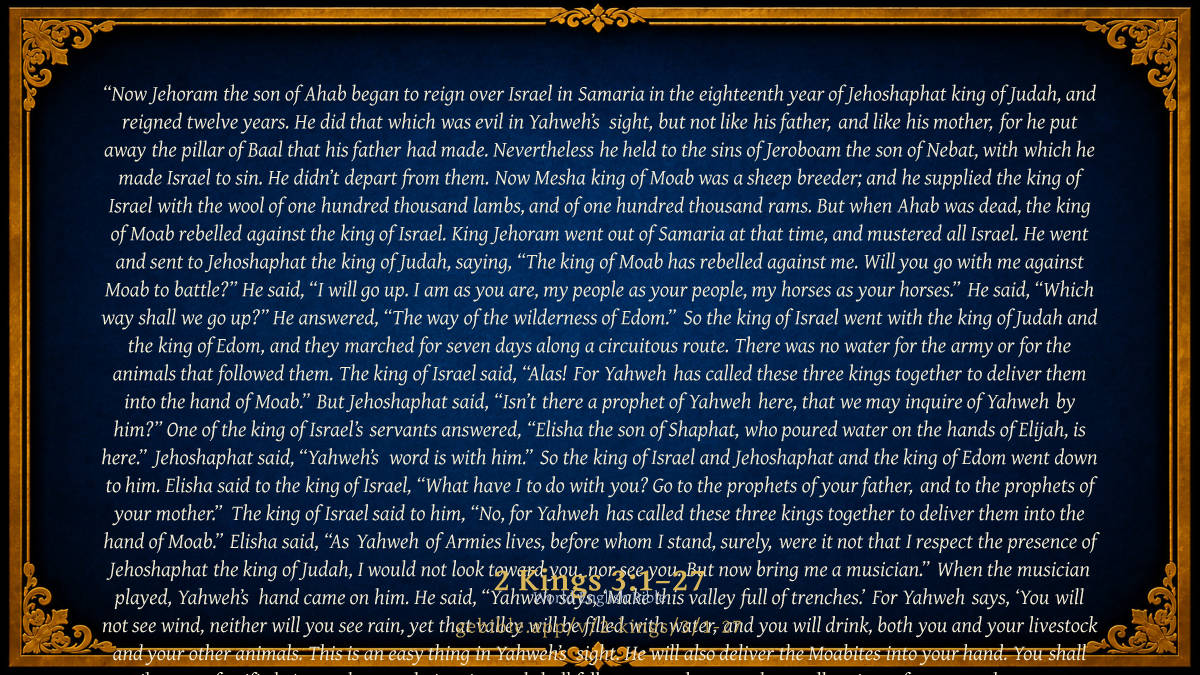
Now Jehoram the son of Ahab began to reign over Israel in Samaria in the eighteenth year of Jehoshaphat king of Judah, and reigned twelve years. He did that which was evil in Yahweh’s sight, but not like his father, and like his mother, for he put away the pillar of Baal that his father had made. Nevertheless he held to the sins of Jeroboam the son of Nebat, with which he made Israel to sin. He didn’t depart from them. Now Mesha king of Moab was a sheep breeder; and he supplied the king of Israel with the wool of one hundred thousand lambs, and of one hundred thousand rams. But when Ahab was dead, the king of Moab rebelled against the king of Israel. King Jehoram went out of Samaria at that time, and mustered all Israel. He went and sent to Jehoshaphat the king of Judah, saying, “The king of Moab has rebelled against me. Will you go with me against Moab to battle?” He said, “I will go up. I am as you are, my people as your people, my horses as your horses.”
He said, “Which way shall we go up?” He answered, “The way of the wilderness of Edom.”
So the king of Israel went with the king of Judah and the king of Edom, and they marched for seven days along a circuitous route. There was no water for the army or for the animals that followed them. The king of Israel said, “Alas! For Yahweh has called these three kings together to deliver them into the hand of Moab.”
But Jehoshaphat said, “Isn’t there a prophet of Yahweh here, that we may inquire of Yahweh by him?” One of the king of Israel’s servants answered, “Elisha the son of Shaphat, who poured water on the hands of Elijah, is here.”
Jehoshaphat said, “Yahweh’s word is with him.” So the king of Israel and Jehoshaphat and the king of Edom went down to him.
Elisha said to the king of Israel, “What have I to do with you? Go to the prophets of your father, and to the prophets of your mother.” The king of Israel said to him, “No, for Yahweh has called these three kings together to deliver them into the hand of Moab.”
Elisha said, “As Yahweh of Armies lives, before whom I stand, surely, were it not that I respect the presence of Jehoshaphat the king of Judah, I would not look toward you, nor see you. But now bring me a musician.” When the musician played, Yahweh’s hand came on him. He said, “Yahweh says, ‘Make this valley full of trenches.’ For Yahweh says, ‘You will not see wind, neither will you see rain, yet that valley will be filled with water, and you will drink, both you and your livestock and your other animals. This is an easy thing in Yahweh’s sight. He will also deliver the Moabites into your hand. You shall strike every fortified city, and every choice city, and shall fell every good tree, and stop all springs of water, and mar every good piece of land with stones.’ ”
In the morning, about the time of offering the sacrifice, behold, water came by the way of Edom, and the country was filled with water.
Now when all the Moabites heard that the kings had come up to fight against them, they gathered themselves together, all who were able to put on armor, young and old, and stood on the border. They rose up early in the morning, and the sun shone on the water, and the Moabites saw the water opposite them as red as blood. They said, “This is blood. The kings are surely destroyed, and they have struck each other. Now therefore, Moab, to the plunder!”
When they came to the camp of Israel, the Israelites rose up and struck the Moabites, so that they fled before them; and they went forward into the land attacking the Moabites. They beat down the cities; and on every good piece of land each man cast his stone, and filled it. They also stopped all the springs of water, and cut down all the good trees, until in Kir Hareseth all they left was its stones; however the men armed with slings went around it, and attacked it. When the king of Moab saw that the battle was too severe for him, he took with him seven hundred men who drew a sword, to break through to the king of Edom; but they could not. Then he took his oldest son who would have reigned in his place, and offered him for a burnt offering on the wall. There was great wrath against Israel; and they departed from him, and returned to their own land.
Geneva Bible translators 1599 · Public Domain On vv1, 3, 4, 7, 9, 11, 12, 13, 14, 15, 18, 19, 21, 23, 24, 25, 27 Read the annotation in the first chapter and seventh…
Read the annotation in the first chapter and seventh verse.
Geneva Bible (1599) marginal notes — public domain.
John Trapp 1656 · Public Domain On vv1–27 2Ki 3:1 Now Jehoram the son of Ahab began…
2Ki 3:1 Now Jehoram the son of Ahab began to reign over Israel in Samaria the eighteenth year of Jehoshaphat king of Judah, and reigned twelve years.
Ver. 1. In the eighteenth year of Jehoshaphat.] But in the second year of Jehoram, {2Ki 1:17} whom his father Jehoshaphat had made viceroy; but misliking his son’s evil practices, as it is probable, he resumed the sceptre.
John Trapp, A Commentary or Exposition upon All the Books of the Old and New Testament (1647–1656) — public domain. Text from a community e-Sword module.
Matthew Poole 1685 · Public Domain On vv1–27 The eighteenth year of Jehoshaphat.
The eighteenth year of Jehoshaphat.
Quest. How can this be true, when Ahaziah, Jehoram’s predecessor, who reigned two years, began his reign in Jehoshaphat’s seventeenth year, 1Ki 22:51?
Read full note →
Answ. Either Ahaziah reigned the greatest part of two years, to wit, of the seventeenth and eighteenth years of Jehoshaphat, (parts of years being oft called years in the computation of times, both in Scripture and other authors,) and Jehoram began his reign towards the end of his eighteenth year; or Ahaziah reigned part of this two years with his father, and the rest after him.
Matthew Poole's English Annotations on the Holy Bible (1683–1685) — public domain. Text from a community e-Sword/MySword module.
Matthew Henry 1710 · Public Domain On vv1, 6, 20 Jehoram, the son of Ahab, and brother of Ahaziah,…
Jehoram, the son of Ahab, and brother of Ahaziah, is here upon the throne of Israel; and, though he was but a bad man, yet two commendable things are here recorded of him: -
I. That he removed his father's idols. He did evil in many things, but not like his father Ahab or his mother Jezebel, Kg2 3:2. Bad he was, but not so bad, so overmuch wicked, as Solomon speaks, Ecc 7:17. Perhaps Jehoshaphat, though by his alliance with the house of Ahab he made his own family worse, did something towards making Ahab's better. Jehoram saw his father and brother cut off for worshipping Baal, and wisely took warning by God's judgments on them, and put away the image of Baal, resolving to worship the God of Israel only, and consult none but his prophets. So far was well, yet it did not prevent the destruction of Ahab's family, nay, that destruction came in his days, and fell immediately upon him (Kg2 9:24), though he was one of the best of the family, for then the measure of its iniquity was full. Jehoram's reformation was next to none; for, 1. He only put away the image of Baal which his father had made, and this probably in compliment to Jehoshaphat, who otherwise would not have come into confederacy with him, any more than with his brother, Kg1 22:49. But he did not destroy the worship of Baal among the people, for Jehu found it prevalent, Kg2 10:19. It was well to reform his family, but it was not enough; he ought to have used his power for the reforming of his kingdom. 2. When he put away the image of Baal, he adhered to the worship of the calves, that politic sin of Jeroboam, Kg2 3:3. He departed not therefrom, because that was the state engine by which the division between the two tribes was supported. Those do not truly, nor acceptably, repent or reform, who only part with the sins that they lose by, but continue their affection to the sins that they get by. 3. He only put away the image of Baal, he did not break it in pieces, as he ought to have done. He laid it aside for the present, yet not knowing but he might have occasion for it another time; and Jezebel, for reasons of state, was content to worship her Baal in private.
Read full note →
II. That he did what he could to recover his brother's losses. As he had something more of the religion of an Israelite than his father, so he had something more of the spirit of a king than his brother. Moab rebelled against Israel, immediately upon the death of Ahab, Kg2 1:1. And we do not find that Ahaziah made any attempt to chastise or reduce them, but tamely let go his interest in them, rather than entertain the cares, undergo the fatigues, and run the hazards, of a war with them. His folly and pusillanimity herein, and his indifference to the public good, were the more aggravated because the tribute which the king of Moab paid was a very considerable branch of the revenue of the crown of Israel: 100,000 lambs, and 100,000 wethers, Kg2 3:4. The riches of kings then lay more in cattle than coin, and they thought it not below them to know the state of their flocks and herds themselves, because, as Solomon observes, the crown doth not endure to every generation, Pro 27:23, Pro 27:24. Taxes were then paid not so much in money as in the commodities of the country, which was an ease to the subject, whether it was an advantage to the prince or no. The revolt of Moab was a great loss to Israel, yet Ahaziah sat still in sloth and ease. But an upper chamber in his house proved as fatal to him as the high places of the field could have been (Kg2 1:2), and the breaking of his lattice let into his throne a man of the more active genius, that would not lose the dominion of Moab without making at least one push for its preservation.
Matthew Henry's Commentary on the Whole Bible (1708–1710) — public domain (CC PDM 1.0). Text via the HelloAO Bible API.
John Gill 1763 · Public Domain On vv1–24 Now Jehoram the son of Ahab began to reign…
Now Jehoram the son of Ahab began to reign over Israel in Samaria the eighteenth year of Jehoshaphat king of Judah,.... So that the two years of the reign of his brother Ahaziah were not complete, only part of the seventeenth and part of the eighteenth of Jehoshaphat, since he began to reign in his seventeenth year, at the beginning of that, and died towards the close of the eighteenth, when Jehoram succeeded him, see Kg1 22:51, and reigned twelve years.
, and reigned twelve years.
Read full note →
2 Kings 3:2
kg2 3:2
kg2 3:2
kg2 3:2And he wrought evil in the sight of the Lord,.... Was guilty of idolatry:
but not like his father, and like his mother; his father Ahab, and his mother Jezebel:
for he put away the image of Baal that his father had made; he did not destroy it, only removed it from the temple of Baal where it was set, that it might not be worshipped, at least publicly, see Kg1 16:31 this he did, either moved to it by his own conscience, observing the sudden deaths of his father and brother, which he might suppose was for their idolatry; or in order to obtain success in his war with Moab he was entering into; or being instigated by Jehoshaphat to do it, or otherwise he might refuse to join him.
John Gill's Exposition of the Whole Bible (1746–1763) — public domain (CC PDM 1.0). Text via the HelloAO Bible API.
John Wesley 1765 · Public Domain On vv1, 3, 4, 7, 9, 11, 12, 13, 14, 15, 19, 20, 21, 25, 26, 27 The character of Jehoram, ver. 1-3. He and his…
The character of Jehoram, ver. 1-3. He and his allies invade Moab, ver. 4-8. Their distress and relief, ver. 9-20. Their success, ver. 21-25. The king of Moab sacrifices his son, and they retire, ver. 26, 27.
John Wesley, Explanatory Notes Upon the Whole Bible (1754–1765) — public domain. Text via the GEBible commentary corpus.
Adam Clarke 1810 · Public Domain On vv1, 2, 4, 7, 8, 9, 10, 11, 12, 13, 14, 15, 16, 17, 19, 20, 22, 23, 25, 26, 27 The reign and idolatry of Jehoram, king of Israel,…
CHAPTER III
The reign and idolatry of Jehoram, king of Israel, 1-3.
Read full note →
Mesha, king of Moab, rebels against Israel, 4, 5.
Jehoram, Jehoshaphat, and the king of Edom join against the
Moabites, and are brought into great distress for want of
water, 6-10.
The three kings go to Elisha to inquire of the Lord; who
promises them water, and a complete victory, 11-19.
Water comes the next morning, and fills the trenches which
these kings had made in the valley, 20.
The Moabites arm against them; and suppose, when they see the
sun shining upon the waters, which look like blood, that the
confederate kings have fallen out, and slain each other; and
that they have nothing to do but take the spool, 21-23.
The Israelites attack and completely rout then, beat down their
cities, and mar their land, 24, 25.
The king of Moab, having made an unsuccessful attack on the
king of Edom, takes his eldest son, and of offers him for a
burnt-offering upon the wall; and there is great indignation
against Israel, 26, 27.
NOTES ON CHAP. III
Adam Clarke's Commentary on the Bible (1810–1826) — public domain. Text from a community e-Sword/MySword module.
Joseph Benson 1811 · Public Domain On vv2, 4, 6, 9, 10, 12, 13, 14, 15, 16, 18, 19, 20, 21, 22, 24, 25, 26, 27 2Ki 3:2-3. He put away the image of Baal…
2Ki 3:2-3. He put away the image of Baal — It was much that his mother, who had brought this worship with her from the Zidonians, should suffer him to remove this image; but she was probably a little daunted at the many disasters which had befallen their family, and was contented with worshipping Baal in private. Nevertheless, he cleaved unto the sins of Jeroboam — Though he put away the image and worship of Baal, resolving to worship Jehovah only, yet he continued to worship him under the representation of a calf, which was idolatry, though in a less degree. This kind of worship all the kings of Israel kept up, as a wall of partition between their subjects and those of Judah. They intended hereby to keep their people from going up to worship at Jerusalem, lest, if they did so, they might, by degrees, be brought to submit again to the kings of Judah. Thus Jehoram: he had a little religion, such as it was, but not enough to overrule his policy.
Joseph Benson's Commentary on the Old and New Testaments (1811–1818) — public domain. Text from a community e-Sword module.
Albert Barnes 1834 · Public Domain On vv1, 2, 4, 7, 8, 9, 11, 13, 15, 16, 17, 19, 20, 21, 23, 25, 26, 27 In the eighteenth year of Jehoshaphat - This date…
In the eighteenth year of Jehoshaphat - This date agrees exactly with the statements that Jehoshaphat began to reign in the fourth year of Ahab 1Ki 22:41, and Ahaziah in the 17th year of Jehoshaphat 1Ki 22:51.
Albert Barnes' Notes on the Bible (1834–1885) — public domain. Text from a community e-Sword/MySword module.
Haydock's Catholic Bible Commentary 1859 · Public Domain On vv1, 2, 4, 7, 8, 11, 12, 13, 14, 15, 16, 19, 20, 21, 22, 24, 25, 26, 27 Achab. Joram succeeded his brother, chap. i. 17.
Achab. Joram succeeded his brother, chap. i. 17.
George Leo Haydock (1774–1849), Haydock's Catholic Family Bible and Commentary, 1859 edition — public domain. Excludes Psalms (Douay-Rheims chapter numbering differs from Protestant) and Deuterocanonical books (Catholic canon only).
Lange's Commentary on the Holy Scriptures 1864 · Public Domain On v1 C. The Reign of Jehoram, and his Expedition against…
C. The Reign of Jehoram, and his Expedition against the Moabites
2Ki_3:1-27
Read full note →
1Now Jehoram the son of Ahab began to reign over Israel in Samaria in the eighteenth year of Jehoshaphat king of Judah, and reigned twelve years. 2And he wrought evil in the sight of the Lord; but not like his father, and like his mother: for he put away the image of Baal that his father had made. 3Nevertheless he cleaved unto the sins of Jeroboam the son of Nebat, which made Israel to sin; he departed not therefrom.1 4And Mesha king of Moab was a sheepmaster,2 and rendered unto the king of Israel a hundred thousand lambs, and a hundred thousand rams, with the wool [the wool of a hundred thousand rams].3 5But it came to pass, when Ahab was dead, that the king of Moab rebelled against the king of Israel. 6And king Jehoram went out of Samaria the same time [at that time], and numbered all Israel. 7And he went and sent to Jehoshaphat the King of Judah, saying, The king of Moab hath rebelled against me: wilt thou go with me against Moab to battle? And he said, I will go up: I am as thou art, my people as thy people, and my horses as thy horses. 8And he said, Which way shall we go up? And he answered, The way through the wilderness of Edom. 9So the king of Israel went, and the king of Judah, and the king of Edom: and they fetched a compass of seven days’ journey: and there was no water for the host, and for the cattle that followed them. 10And the king of Israel said, Alas! that the Lord hath called these three kings together, to deliver them into the hands of Moab! 11But Jehoshaphat said, Is there not here a prophet of the Lord, that we may inquire of the Lord by him? And one of the king of Israel’s servants answered and said, Here is Elisha the son of Shaphat, which poured water on the hands of Elijah. 12And Jehoshaphat said, The word of the Lord is with him. So the King of Israel and Jehoshaphat and the king of Edom went down to him. 13And Elisha said unto the king of Israel, What have I to do with thee? get thee to the prophets of thy father, and to the prophets of thy mother. And the king of Israel said unto him, Nay:4 for the Lord hath called these three kings together, to deliver them into the hand of Moab. 14And Elisha said, As the Lord of hosts liveth, before whom I stand, surely, were it not that I regard the presence of Jehoshaphat the king of Judah, I would not look toward thee, nor see thee. 15But now bring me a minstrel. And it came to pass, when the minstrel played, that the hand of the Lord came upon him. 16And he said, Thus saith the Lord, Make5 this valley full of ditches. 17For thus saith the Lord, Ye shall not see wind, neither shall ye see rain; yet that valley shall be filled with water, that ye may drink, both ye, and your cattle, and your beasts. 18And this is but a light thing in the sight of the Lord: he will deliver the Moabites also into your hand. 19And ye shall smite every fenced city, and every choice city, and shall fell every good tree, and stop all wells of water, and mar every good piece of land with stones. 20And it came to pass in the morning, when the meat-offering was offered [at the time of offering sacrifice], that, behold, there came water by the way of Edom, and the country was filled with water. 21And when all the Moabites [had] heard that the kings were come up to fight against them, they [had] gathered all that were able to put on armour, and upward, and stood in the border [had stationed themselves on the boundary]. 22And they rose up early in the morning, and the sun shone [rose] upon the water, and the Moabites saw the water on the other side [opposite them] as red as blood: 23And they said, This is blood: the kings are surely slain [have fought, to their own destruction],6 and they have smitten one another: now therefore, Moab, to the spoil. 24And when they came to the camp at Israel, the Israelites rose up and smote the Moabites, so that they fled before them: but they went forward smitting7 the Moabites, even in their country. 25And they beat down the cities, and on every good piece of land cast every man his stone, and filled it; and they stopped all the wells of water, and felled all the good trees [until there were left]8 only in Kir-haraseth left they [omit left they] the stones thereof; howbeit the slingers went about it, and smote it. 26And when the king of Moab saw that the battle was too sore for him, he took with him seven hundred men that drew swords, to break through even unto the king of Edom: but they could not. 27Then he took his eldest son that should have reigned in his stead, and offered him for a burnt-offering upon the wall. And there was great indignation against [in] Israel: and they departed from him [Mesha], and returned to their own land.
EXEGETICAL AND CRITICAL
2Ki_3:1. Jehoram the son of Ahab, &c. In regard to the chronological statements see notes on 2Ki_8:16.—In 2Ki_3:2 the Sept. and Vulg. read מַצְּבֹת for מַצְּבַת, which Thenius wrongly declares to be better. According to 2Ki_10:26 sq., when the temple of Baal, which had been built by Ahab (1Ki_16:32), was destroyed, in the first place the (wooden) מַצְּבוֹת were burned, and then the (stone or metal) מַצְּבַת הַבָּעַל was broken in pieces. It is clear that this last was the principal statue, and we have to think here of the same or a similar one, which stood before the royal palace, and not in the temple. It is to be noticed that Jehoram only removed and did not destroy it. It is not entirely certain whether he did it immediately after his accession, or after the expedition against Moab.
2Ki_3:4. Mesha king of Moab, &c. The fruitful and well-watered land of Moab was especially fitted for the pasturage of flocks (Winer, R.-W.-B. i. s. 99). The wealth of the king seems, as he is himself called נֹקֵד [shepherd or sheep-master], to have consisted in flocks, hence he paid the tribute in these. Michaelis, Maurer, and others, refer צָמֶר [wool], at the end of 2Ki_3:4, to both lambs and rams, so that Mesha would have had to pay only the wool from both; in that case, however, the rams must certainly have had a different wool from the sheep, which cannot be proved. Ewald and Thenius make it only refer to the אֵילִים, mentioned last before it, so that the sense is, since כַּר is used especially for a fatted lamb, that the lambs were given alive for food, but that from the rams only the wool or the fleeces were given up. The tribute was, in any case, a very considerable one; but this does not justify the conclusion that it was paid only on every change of government (Clericus). There is no doubt that we have to regard it as a regular annual tribute (cf. Isa_16:1). At the division of the kingdom, Judah took Edom and Israel Moab. As early as the time of Ahaziah the Moabites had declared their independence of Israel (2Ki_1:1); as he, however, soon fell sick, and did not reign for even two full years, it remained for Jehoram to try to resubjugate the rebels, and to retain them in tributary subjection. [In the year 1869 a basalt column, three feet high by one and a half feet wide, and one and a half feet thick, was discovered near Dibon, in Moab, on which was an inscription running in the name of Mesha and detailing his acts, especially the conquests made, and the temples built, by him. It was broken, through the jealousy and suspicion of the Arabs, before it could be removed, or a copy taken of it. Nothing remains but fragments. There are, therefore, several gaps in the inscription as we now possess it. It refers to the oppression of Moab by Israel. Omri is the king mentioned as having afflicted Moab, “because Chemosh was angry with the king [of Moab].” A gap destroys the names of kings of Israel who reigned “for forty years.” The reference which is thus lost would be of the highest value for determining the date of the inscription. It goes on to say that Chemosh became gracious again in the days of Mesha, so that the king gained victories over Israel. Chemosh told him to take Nebo. He took it, and sacrificed seven thousand of its inhabitants to Ashtor-Chemosh, and took the vessels of Jehovah and offered them to Chemosh. The last part of the inscription is so fragmentary as to be hardly intelligible. As usual in such inscriptions, only the king’s victories, and not his defeats, are mentioned. Cf. Art. “Writing;” Smith’s Dict. Bib., Am. ed.—W. G. S.]
2Ki_3:6. And king Jehoram went out of Samaria the same time, &c. That is, at the time when he became king, and Mesha refused him the tribute.—He numbered, or mustered, i.e., he brought together, a large army, by a levy of men throughout all Israel who were capable of bearing arms; but he addressed himself to Jehoshaphat at the same time, in order to be so much the more certain of attaining his object, and the latter then entered into an alliance with him. Cf. on 2Ki_3:7, the remarks on 1Ki_22:4. The combined army could advance by the “way” (2Ki_3:8) over the Jordan, and then along the eastern side of the Dead Sea, and so fall upon Moab from the north; or it could march down on this side of the Jordan and the Dead Sea, as far as the southern extremity of the latter, and then force its way into Moab from the south through a portion of the land of Edom. Jehoshaphat decided in favor of the latter road, although it was longer and beset with more difficulties than the other, chiefly, we may well believe, because they could then call the king of Edom with his army to their assistance, and make sure that he did not profit by the opportunity and make war upon them himself. Perhaps they also thought that Moab could be more easily surprised from the south. [The fortifications of the Moabites were on their northern boundary. On the south they relied upon the natural obstacles to the advance of a hostile army. On the northern route, moreover, the armies of Israel would have been exposed to an attack from the Syrians, who were in a disposition to seize eagerly upon any such opportunity.—W. G. S.] Edom had at this time no king of its own, but a governor appointed by Jehoshaphat (1Ki_22:48). The seven days’ journey (2Ki_3:9) cannot be understood of the distance from Jerusalem, which is only about sixty miles, for the king of Edom had already joined the two other kings with his army [i.e., it is said that the three kings wandered seven days’ journey, so that the time must be reckoned after their junction; but the king of Edom would not go to Jerusalem to meet them, and then march back again. He joined them at the borders of Edom, a very short distance from the scene of the distress for want of water.—W. G. S.]. More probably “they suffered for seven days from want of water in the desert-region to the south of the Dead Sea” (Ewald). For a more particular description of this region, see Keil on the passage. כִּי in 2Ki_3:10 is not equivalent to “for;” but it serves either to intensify the assertion: “Alas! for Jehovah,” &c. (Keil, De Wette), or its only use is to introduce the assertion, and it is not to be translated (Luther, Thenius), as in Isa_15:1.
2Ki_3:11. But Jehoshaphat said, &c. Cf. 1Ki_22:5-7. As in that case, Jehoshaphat desires to hear a prophet of Jehovah, i.e., a true prophet, not a pretended one, a prophet of Ahab. That which Jehoram himself did not know was known by one of his servants, i.e., no doubt one of his chief officers, who was, perhaps, like Obadiah (1Ki_18:3), secretly a friend of the prophet.—Which poured water, &c, i.e., who “was about Elijah daily as his servant, and who is certainly the most reliable prophet since he is gone” (Thenius).—It is clear from the definite declaration of Jehoshaphat (2Ki_3:12), that the reputation of Elisha had extended already to Judah. It is very significant that the three kings did not summon him to them, but themselves went down to him. Probably “the tents of the kings were set upon an eminence so as to overlook the encampment” (Thenius). The inference which Josephus affirms, that the prophet had his tent outside the encampment, and at some distance from it, is not justified by the words.
2Ki_3:13. And Elisha said unto the king of Israel, &c. The prophet addresses himself to Jehoram because he is the principal person here, through whom the others have been brought into these straits. The question: What have I to do with thee? means: Why dost thou desire to come to me, the prophet of the God whom thou hast abandoned? The prophets of his father were, no doubt, those court-prophets, at whose head Zedekiah once stood (1Ki_22:6; 1Ki_22:11); the prophets of his mother Jezebel can have been only Baal-prophets (1Ki_18:19). We see from this that Jehoram, although he had removed the statue of Baal, still allowed the priests of Baal to perform their functions, as they had done before, without molestation. This is also clear from 2Ki_10:19. Jehoram does not mean by the curt expression אַל: it cannot help me to go to the prophets of Baal (Rabbis), but (cf. Rth_1:13): Do not repel me, I am not alone at stake; shall three kings with their armies perish?—On the words: Before whom I stand, see notes on 1Ki_17:1; 1Ki_18:15.—Elisha demands (2Ki_3:15) a “minstrel” or harp-player, certainly not “that he might chant the reply of God to the accompaniment of the harp” (J. D. Michaelis), nor “in order to pronounce his directions with a sufficiently solemn tone” (Knobel). Bleek observes: “The recitations of the prophets were, in early times, very lively, in a lyrical form of composition, and, as is generally the case with respect to the recitation of lyrical poetry, accompanied by music;” the accompaniment in this case, then, was most probably “the mode of prophetic recitation, which was not unusual at the time.” But there is no mention in any other place of any such method, and it is impossible to appeal to 1Sa_10:5, according to which an entire band of the prophets came out with drum and flute and harp. That only proves that music was practised in the prophet-communities. It is also certain that Elisha’s master, Elijah, did not cause his recitations or speeches to be accompanied by music. The extraordinary means, which does not occur again in the story of Elisha, presupposes an extraordinary occasion therefor. In ancient times harp-music was often employed as a means of withdrawing the soul from the outer world, and of collecting, quieting, and elevating it. Among the numerous places which Bochart (Hieroz. i. 2. 44) collected upon this point, it may suffice to quote here only one. Cicero (Tusc. 4.) says that the Pythagoreans were accustomed mentes suas a cogitationum intentione cantu fidibusque ad tranquillitatem tråducere. Cf. also 1Sa_16:16, and Clericus’ remarks on the place. Elisha’s dissatisfaction, which he expresses in 2Ki_3:13-14, although it was natural and just, was, nevertheless, not the disposition of soul which is demanded if one is to hear the voice of God within. The situation, the encampment, and the entire surroundings were unadapted for composure and elevation of soul for we find that the prophets usually received their revelations in retirement and quiet, not in the noise and bustle of the world. In order that he may be brought into the right disposition, may direct his inner self entirely towards the Lord, and may be able to surrender himself to the higher influence, Elisha makes use of the usual means, probably the one which was regularly employed for this purpose in the schools of the prophets, and indeed not without success, for during the playing upon the harp, “the hand of the Lord came upon him.” Cf. notes on 1Ki_18:46 (Jer_1:9).
2Ki_3:17. For thus saith the Lord, &c. According to Thenius we must identify the valley where they were to dig ditches in order to collect the water, which otherwise would have run quickly away, with what is to-day called Wady el Ahsy, which is the natural boundary of Moab on the south (Isa_15:7), and from which several ravines run up into the mountain region of Moab [Robinson 2:112, 157]. The prophecy itself, 2Ki_3:17-19, contains a climax in its two members: The Lord will not only save you out of the present need, but he will also grant you glorious victory over Moab. The words in the 19th verse are not a command, as 2Ki_3:16 is: they only declare what will occur. For this reason, in the first place, it is impossible to charge the prophet with commanding what Deu_20:19 sq. forbids; but, besides that, the place in Deut. refers to the conquest of Canaan, during which no fruit-tree was to be used for palisades or fortifications in sieges. To mar every good piece of land with stones, means to throw so many stones upon it that it would no longer be available for cultivation (Sept.: ἁχρειώσετε).—מִנְחָה (2Ki_3:20) has the same meaning as in 1Ki_18:29; 1Ki_18:36. The interpretation which Von Gerlach and Keil give to this statement, that on account of the morning sacrifice offered in the temple at Jerusalem, according to the Law, God turned His favor once more upon the people, goes too far. The statement can scarcely be more than a mere designation of time, i.e., as it became light. Before the exile time was not defined by hours. Nevertheless, a reference may lie in it to the fact that help came just at the moment of time sacred to Jehovah. The express mention that there came water by way of Edom, makes the supposition inadmissible that, in digging the ditches (2Ki_3:16), “the fresh springs bubbled up under the feet of the laborers” (Krummacher), or that we must think of “subterranean cisterns” (Richter). A much more probable explanation is that “a great shower fell at some distance from the Israelitish encampment” (Josephus even asserts: three days’ journey from it), “or a kind of a cloud-burst (water-spout) took place, by which the wady was filled all at once, although the Israelites did not notice the wind, which always arises before a rain-storm, in the Orient, nor see the rain itself” (Keil).
2Ki_3:21. And when all the Moabites heard, &c. In order to await the attack on their own mountains—that is, in an excellent position—the Moabites had stationed themselves, with all their military force, on the frontier. The morning sun arising with a red light, caused the water to appear red, besides which the water itself was reddened by the red earth of Edom (Ewald). That they took it for blood was not, as the older interpreters supposed, a mistake which was brought about by God in a miraculous manner, but a perfectly natural error, into which they would fall all the more readily as they knew very well that there was no water in that desert. The supposition also, which they express in the 23d verse, is not by any means far-fetched, since similar events often occurred (2Ch_20:23; Jdg_7:22); and they well knew what jealousy existed between Israel and Judah, and the inclination of Edom to throw off the yoke of the latter (Gerlach). This supposition rose to a certainty in their eagerness for booty. The sentence in 2Ki_3:25 from עַד to חֲרָשֶׂת is “to be joined with the commencement of the verse: ‘and they beat down the cities.’ (What comes between describes the devastation of the land, which also had an influence on the cities.) Accordingly אֲבָנֶיהָ can only be understood in its real sense of actual wall-stones, and not of cliffs or rock, and the suffix on this word-refers to קִיר חֲרָשֶׂת and not to Moab” (Thenius). The city Kir Hareseth is the same which is called Kir Moab, קִיר מוֹאָב (Isa_15:1), and Kir Heres, קִיר חֶרֶשׂ [Isa_16:1; cf. Jer_48:31; Jer_48:36). It was the capital city, “the most important, perhaps the only fortification in the country, built upon a high, steep, chalk-cliff” (Keil), now called Kerak, and provided with a fort [see Robinson, ii. 66], (Winer, R.-W.-B., i. s. 658 sq.). The קַלָּעִים are not those who applied siege-engines (Grotius: tormentarii), but slingers, in the common meaning of the word, funditores, who shot at the garrison upon the walls.—Unto the king of Edom, i.e., toward the side where the king was with his subjects, either because this seemed to be the weakest part of the besieging force (Thenius), or because they hoped that they could most easily draw away the Edomite contingent from the allied army (Ewald).
2Ki_3:27. Then he took his eldest son, &c. Many take these words with the Rabbis, thus: During the sortie against the king of Edom, Mesha captured his son and offered him as a sacrifice. This occasioned such bitterness among the Edomites that they refused to continue the fight, and thereby compelled Israel to give up the war altogether and withdraw. This interpretation is decidedly false. The passage, Amo_2:1, to which reference is made to support it, refers to an entirely different event, which is not known to us more particularly. Amos, who lived, moreover, one hundred years later, there announces to the Moabites the avenging judgment of God, because they had “burned the bones of the king of Edom into lime.” In this case, however, the question is in regard to a son of the king, who was offered as a living sacrifice. The bones of the dead were never burned as a sacrifice, and captive kings or their sons, although they were sometimes executed out of revenge, were never sacrificed to the gods. Even in the darkest heathenism, sacrifice was always an offering of that which was nearest and dearest, and it was considered efficient only in so far as it was such. This is the case especially in respect to the child-offerings of western Asia. It was a custom among the ancients, says Philo, in the Phœnician History (Euseb. Prep. Evang. iv. 16) ἐν ταῖς μεγάλαις συμφοραῖς τῶν κινδύνων ἀντὶ τῆς πάντων φθορᾶς τὸ ἠγαπημένον τῶν τέκνων τοὺς κρατοῦντας ἢ πόλεως ἢ ἒθνους εἰς σφαγὴν ἐπιδιδόναι λύτρον τοῖς τιμωροῖς δαίμοσι. So also, in this case, Mesha sacrificed, in order to avert the threatening destruction, his first-born son, who should have succeeded him upon the throne; i.e., the dearest and most precious thing which he had, not to the God of Israel (Josephus and Grotius), but to the Moabitish War-god, Chemosh (cf. on 1Ki_11:7). (Cf. on human sacrifices, Symbol. des Mos. Cultus, ii. s. 241; Movers, Die Relig. der Phœniz. s. 299, sq.) That the son also, “for his part, willingly yielded himself to death for his fatherland” (Ewald), is not in the text, and is in itself very improbable. The sacrifice was offered upon the wall, in order that the besiegers might see it, and fear the divinity, who might now be supposed to be appeased.
2Ki_3:27. And there was great indignation in Israel, &c. This sentence, on account of its curt-ness and brevity, is quite obscure and difficult Its meaning has been taken in different ways Most of the expositors, citing the same phrase Num_1:53; Num_18:5 (comp. with Lev_17:11); Jos_9:20; Jos_22:20; 2Ch_19:10; 2Ch_24:18, think of divine wrath or a divine judgment, and give as the meaning: As a result of this abominable action, which is so strictly forbidden in the Law (Lev_18:21; Lev_20:3), and to which the allied army had compelled the king of Moab, there came a divine judgment upon Israel, so that they withdrew without subjugating Moab (Keil). There is no objection to this in the usage of the language; but the context is decidedly opposed to it. The divine קֶצֶף [wrath] is, in all the places mentioned above, the result of a definite guilt on the part of Israel; in this case, however, there is not a word to the effect that Israel had incurred guilt. That which had been brought about by the allied army, had taken place as the prophet had foretold (2Ki_3:18 sq.), and he had represented it as an especially great assistance of God. When, then, the king of Moab did something of his own accord which the Law strenuously forbade, that was his guilt and not Israel’s. On the hypothesis proposed, the withdrawal of the army, which was a piece of good fortune for him, would have been even a reward for his abominable crime, instead of being the punishment which he deserved, whereas the punishment would have fallen upon guiltless Israel. Moreover, in what did the heavy judgment of God against Israel consist? The text contains not a syllable in regard to any plague or calamity. These expositors are therefore compelled to take קֶצֶף as meaning human anger (dissatisfaction, resentment, bitterness), in which sense it occurs, Ecc_5:17 [Hbr. text, 16]; Est_1:18, and as קָצַף is so often found (Gen_40:2; Gen_41:10; Exo_16:20; Lev_10:16;Num_31:14). Many expositors, then, give to the words this sense, that on account of this shocking crime, there sprang up, in the kings of Judah and Edom, a great wrath or resentment against Israel and its king, as original cause of the war, and therefore of the crime, so that they would not fight any longer with and for Israel, but withdrew, and so compelled Israel to do the same (Dereser). It is not right, however, to fill out the text in this manner; and nothing justifies us in understanding under יִשֶׂרָאֵל here, simply the army of Jehoram. We therefore follow the old translations, according to which עַל־יִשְׂרָאֵל is not, as it is generally understood, a designation of the object, but of the subject of the anger. The Sept. have: καὶ ἐγένετο μετάμελος μέγας ἐπὶ ’Ισραήλ; the Vulgata has: et facta est indignatio magna in Israel; so also the Syr. and Arab., and Luther in like manner: “da ward Israel sehr zornig” (Grotius, Clericus, Thenius). עַל stands in a similar use 2Ki_3:15; Jer_8:18; Jon_2:7 [Hbr. text, 8], and often. According to Psa_106:37-39, by the sacrifice of sons and daughters the whole land was covered with blood-guilt, and was rendered impure and accursed. In the present instance this took place by the sacrifice of the first-born son of the king, which the ruler of the land himself offered. They did not wish to remain any longer in such a country, on account of their horror at this deed; they preferred to renounce further possession of it. The words: They departed from him and returned to their own land, certainly do hot mean to say: “The end of the expedition was attained, and the land was forced back under the sceptre of the king of Israel again” (Krummacher); on the contrary, they gave up the attempt to subjugate Moab by force.
HISTORICAL AND ETHICAL
1. The brief and general description of the reign of Jehoram brings out into prominence, as characteristic of it, two points. In the first place, that this king removed the statue of Baal, which had been erected by his father Ahab, then, however, that he clung all the more decidedly to the Calf-worship of Jeroboam. From the first statement it does not by any means follow, as has often been assumed, that he “abolished the Baal-worship” altogether (Winer, R.-W.-B. i. s., 599), for, according to chap 10, this worship endured yet throughout his entire reign, and Jehu was the first who put an end to it. It appears, therefore, that he only broke with the worship of Baal for himself, asking, and meant to declare publicly, by the removal of the statue, that the worship of Baal was not the prevailing state-religion. This was, at all events, a step towards improvement, yet without especial value; for, if the fear of the living God of Israel, and the conviction of the absolute repulsiveness of idol-worship had led him to this course, then he could not possibly have allowed idolatry to continue in its complete development. That he persevered so firmly in maintaining the institutions of Jeroboam, was brought about by the same cause as in the case of all his predecessors: the existence of the kingdom, separate from Judah, was conditioned upon these institutions (see 1 Kings 12. Hist. § 1). It is therefore very probable that they were rather political motives and considerations than anything else which prompted him to the removal of the statue. By means of Elijah and the schools of the prophets, a large portion, and that, too, the best portion, of the people had already been won over to a disposition hostile to the worship of Baal, so that from that side danger might arise for the house of Ahab, which had introduced this worship of idols, as, in fact, at a later time, this danger became a reality through Jehu (chap. 9). Jehoram, therefore, for his own part, renounced the worship of Baal, and desisted from all persecutions of the opponents of the same; but he still tolerated it for the sake of his mother, the fanatically idolatrous Jezebel, if for no other reason. His policy of government was therefore a half-way one, and for that reason an ineffective one. Indecision, want of firmness, and a disposition to do everything only half-way, are the characteristics which present themselves prominently, in many ways, throughout his entire behavior, as will be shown still further, below.
2. King Jehoshaphat appears here just as in 1 Kings 22. He yielded to the request of Jehoram, in spite of the unsuccessful results of his undertakings with Ahab and Ahaziah, and in spite of the warning of the prophet Jehu not to help the apostates (2Ch_19:2), probably influenced by the conviction that the war against rebellious Moab was a necessary and just one, and was also in the interest of Judah. The restless Moabites had always had a disposition hostile to all the people of Israel (Deu_23:4-6). They had already once entered into an alliance with the Ammonites against Jehoshaphat (2 Chronicles 20), and were, therefore, dangerous neighbors for Judah: to permit them to become independent would have been only to make this danger greater. It was in the highest degree important for both kingdoms, on general principles, to hold the different kings who had been tributary since David’s time in subjection, since every defection or rebellion which succeeded would only have encouraged and stimulated to another. The restoration of the ancient greatness and glory of the united kingdom, which Jehoshaphat was striving for (see above on 1Ki_22:41 sq.), would have become more and more improbable. His behavior during the expedition stands in strong contrast with that of Jehoram. The latter does not know what to do in the time of need; he mourns and complains despairingly, while Jehoshaphat, the god-fearing, does not lose dignity and composure; he desires that the Lord should be inquired of, and he relies upon His help and counsel. The old expositors thought that he ought to have inquired of the Lord before the expedition, and that it was because he did not do this that he too came into so great distress. But Elisha is so far from giving utterance to any blame against him, that he declares, on the other hand, that it is only on his account that he is willing to, and will, answer and give counsel. The tendency of the whole story is to show how Jehovah, for the sake of the one king who is faithful to Him, saves the two others, in order that both they and the entire army may see that this God alone is mighty, and that victory comes from Him (Psa_62:11 [Hebrews 12]; Pro_21:31).
3. We see Elisha here, for the first time, step out face to face with kings, and interfere in the fortunes of the entire nation. Here too he maintains himself as one on whom Elijah’s spirit rests (2Ki_2:15), and not alone as the one who had poured water on his hands. Without the orders or the knowledge of the king, he joins the toilsome expedition, and shares all the dangers of the army, by no means from soldier like passion for war, or from compulsion, but from prophetical zeal, in order that he may bear witness, by word and deed, to the God of Israel, His power and faithfulness, wherever and however circumstances might demand. Now, when need and distress occur, and the three kings and their train, Jehoram at the head, come to him, he knows nothing of fear, he neither allows himself to be overawed or terrified, nor does he feel himself honored and flattered; but he steps forth to meet the wavering king firmly and independently, as Elijah had once gone to meet Ahab (1Ki_18:18), and rebukes his sins, so that the king stands before him, as it were, with fettered hands, feels himself smitten, and begs that the prophet will not repel him, at least for the sake of the two other kings. Köster (Die Propheten des Alt. Test. s. 86) asserts that “the prophet appears here, under the control of unspiritual pride and anger, to profit by the distress of the king, in order to hurt his feelings deeply,” and that his conduct “cannot be entirely justified;” but he mistakes entirely the nature and position of the prophetical calling in Israel, in regard to which that holds true, which was said to Jerem. (2Ki_1:9 sq.): “Behold, I have put my words in thy mouth. See, I have this day set thee over the nations and over the kingdoms, to root out and to pull down, and to destroy and to throw down, to build and to plant,” and to Ezekiel (2Ki_3:17): “Son of man, I have made thee a watchman unto the house of Israel; therefore hear the warning from my mouth and give them warning from me.” It is just on account of this directly divine calling that the prophecy of the Israelites stands as unparalleled in the world as the chosen people itself. Not of their own will or power did the holy men speak, but moved by the Holy Ghost (2Pe_1:21). In the case of Elisha it would have been impossible ever to say that the spirit of his master Elijah rested upon him, if he had fulfilled the desire of that king who clung firmly to the calf-worship, and at the same time tolerated idolatry, without saying to him a single word of rebuke. The reproof of Elisha deserves besides to be considered in another aspect. Ewald (Geschichte des V. Isr. iii. s. 487, 3d ed. s. 525) asserts: “There is not a single sign from which it appears that Elijah and his school made war upon this image-worship (i.e., that introduced by Jeroboam) in any such powerful manner as Hosea did at a later time. On the contrary, the opposite of this appears true, in the case where this school reaches its final aim, namely, at the re-establishment of the constitution of the kingdom by Jehu” (2Ki_10:31). He also goes on to say that, even if Elijah himself was not favorable to the image-worship, yet in his time there was no controversy about it in the kingdom of the ten tribes, but that it was allowed to endure among the people. Duncker (Gesch. des Alterthums, i. s. 404) goes still further. He perceives in the worship of Jeroboam’s calf-image “a national reaction against the foreign worships which Solomon had introduced,” nay, even “the establishment of the Jehovah-worship,” and then says: “That those images did not shock the feelings of the people at that time, and did not give offence to the then existing measure of religious culture, is proved by the circumstance that such honored prophets as Elijah and Elisha had no objection to make to them.” These assertions find their direct contradiction in this reproof of Elisha to Jehoram. Jehoram was no idolater, he had even removed the statue of Baal which his father had set up. All the more firmly, however, did he cling to the cultus which had been introduced by Jeroboam (2Ki_3:2-3). In like manner the prophets of Ahab, whom Elisha here definitely distinguishes from the prophets of Jezebel, were no idol-worshippers, as 1 Kings 22. shows, but they were false prophets of Jehovah (belonging to Jeroboam’s cultus). “When now Elisha, nevertheless, assails the king so severely, when he then declares solemnly, in answer to the prayer of the king, that he will not repulse him, that he will respond to this prayer, not for the king of Israel’s sake, but for the sake of Jehoshaphat, who was not addicted to the image-worship, then nothing is clearer than that he “made war mightily” not only upon the Baal-worship, but also upon the worship of the calf-image. How could Elijah, the re-establisher of the organic law of Israel, the second Moses, and his successor Elisha, have been so zealous against the transgression of one Mosaic commandment: “Thou shalt have no other gods before me,” and then, on the other hand, have overlooked and allowed to pass without rebuke that other commandment which stands beside it and is most closely connected with it: “Thou shalt not make unto thee any graven image” (see 1 Kings 12. Hist. § 1)? [It is a very remarkable fact that Elijah and Elisha say nothing about the Jehovah-calf-worship. The nation may have been so devoted to Baal-worship at this time that the calf-worship did not deserve attention. If there is any reference to that worship in this rebuke of Jehoram, which is very doubtful indeed, then, to say the least, it is a very indirect and indifferent reference, not by any means in the style of Elijah or Elisha. When they had anything to condemn we find that they did it without circumlocution or innuendo. Even if we recognised in this rebuke a reference to the calf-worship, the difficulty would scarcely be lessened: Why did he not explicitly condemn this worship? Why do we find no direct reference to it in his recorded words?—W. G. S.]
4. The prophecy of Elisha forms the central point of the whole story; by the fulfilment of it he is confirmed, before the three kings of the entire army, as man of God and prophet. Although the fulfilment of this prophecy did not induce Jehoram to desist from his course (2Ki_3:3), yet it seems to have accomplished this much in his case, that he abstained from all persecution of the prophet—did not dare to behave towards him as Ahab had done towards Elijah, but took up a friendly disposition towards him (cf. 2Ki_4:13), and from that time on allowed him to reside at Samaria in peace (2Ki_5:24). To reduce this prophecy to a mere foreboding or presentiment, would be to make of the prophet a dreamer and a hero of mere thoughtless daring, and to cut out the nerve of the entire narrative, which even Thenius reckons among the purely historical portions of these books; for it is evidently incorporated in the historical record before us, for the sake of this prophecy. Elisha needed for a mere supposition or presentiment no harp-player, who should raise him into a higher state of mind, and yet no one can call this feature of the story legendary or unhistorical; it is described rather as “in the highest degree characteristic of the more ancient Israelite prophecy” (Eisenlohr). He intended, then, to prophesy and to have his promises regarded, not as his own opinion but as divine revelation. This circumstance by itself contradicts the rationalistic explanation, which is again repeated by Knobel (Der Prophet, der Hebä. ii. s. 95): “Elisha was a distinguished master in the knowledge of nature, for the times in which he lived. In this character he appears when he commands the soldiers, who are suffering for want of water, to dig ditches upon ditches, and thus procures them a rich supply. He seems to have recognised in the district the signs that it contained water, while these signs escaped the notice of those who were less instructed.” In order to perceive that the locality contained water, or, in general, in order to make use of his remarkable knowledge of nature, he did not need harp-music; he could do all that without music. If he, however, demanded music when he really relied upon his knowledge of nature, he sinks to the level of a mere wizard. It has been inferred, not without justice, from this passage in connection with 1Sa_10:5, that, as was remarked above, music was practised in the schools of the prophets. It must, therefore, have been regarded as an essential means for withdrawing the soul from the external world, and for disposing it to divine things, so that they ascribed to it, as a gift of God, great value. This reminds us involuntarily of Luther’s declaration (Luth. Werke, von Walch, xxii. s. 2062, 2248 sq.): “One of the finest and noblest gifts of God is music. This is very hostile to Satan, and with it we may drive off many temptations and evil thoughts.….
After theology, I give the next place and highest honor to music.…. It has often aroused and moved me, so that. I have won a desire to preach.…. I have always loved music. He who is master of this art is always well disposed and ready for anything which may arise. Music must necessarily be retained in the schools (N. B. in the higher, so-called Latin schools, exist). A schoolmaster must be able to sing, or not in the common schools, which did not then else I do not esteem him. We ought not to ordain young men to the office of preacher if they have not trained themselves and practised [singing] in the schools.”
5. The salvation of the Israelitish army from the destruction which threatened it “did not consist in a miracle which overruled the laws of nature, but only in this, that God caused the powers of nature, which He had prepared, to work in the manner which He had foreordained. As the abundance of water which suddenly presented itself was brought about in a natural way by a sudden flood of rain at a distance, so the illusion also, which was so ruinous to the Moabites, is to be explained in the natural manner which is stated in the text” (Keil). [The inference would be more just to say that, as the Moabites’ mistake is explained in a natural way in the text, so we are justified in adopting a natural explanation of the supply of water.—W. G. S.] Nevertheless this salvation of the army belongs to that series of extraordinary events which have their foundation in the selection of the Israelites to be the chosen people, and which bear witness to their especial, divine direction and guidance. The Old Testament knows nothing whatever of the difference between absolute and relative, or direct and indirect miracles. Every act of God in which there is revealed an especial, divine guidance and providence, especially a helping and saving might and grace of God, is called a miracle (Psa_9:1 [Hebrews 2]; Psa_71:17; Psa_72:18; Psa_77:11 [Hebrews 12]; Psa_136:4). In this sense the action before us is also a miracle, which had for its object not only to confirm Elisha as prophet, but also to serve the end that all Israel, and especially its king, who was tolerating idolatry, should perceive that Jehovah alone is God, and should confess, with the psalmist: “Thou art the God that doest wonders; thou hast declared thy strength among the people” (Psa_77:14). This act of God is great enough in itself, and does not need to be made greater, as it is by Krummacher: “Without delay they follow the counsel of the prophet and dig out the trenches. Hardly, however, is the sand penetrated when, oh! marvel to relate! the fresh springs of water bubble forth beneath the feet of the laborers,” or as it was by the old expositors, who assumed that God had miraculously influenced the eyes and imaginations of the Moabites (Menochius, Tostatus, and others).
6. The departure of the Israelitish army in consequence of the human sacrifice of the king of Moab, whether we understand by קֶצֶף, ver 21, human or divine anger and dissatisfaction, is a very remarkable sign of the difference between the fundamental opinions of the Israelites and of the heathen. Whereas, among almost all heathen peoples, sacrifice culminates in human sacrifice, and this is considered the most holy and most effective, in the Mosaic system, on the other hand, it is regarded as the greatest and most detestable abomination in the sight of God. It is forbidden, not merely from considerations of humanity, but also because, as the Law declares with especial emphasis, the sanctuary of the Lord is thereby defiled, and His holy name (see notes on 1 Kings 6). is profaned (Lev_20:1-5; Lev_18:21). Human sacrifice stands in the most glaring contradiction to the revelation of God as the Holy One, in which character he was known in Israel alone; hence it was to be punished, without respite, by death (cf. Symb. d. Mos. Kult. ii. s. 333). From the preceding narrative we see how deep roots the detestation of human sacrifice had struck in the conscience of the people. Neither the cultus founded by Jeroboam, nor that of Baal, which Ahab had imported, with all its barbarism, had been able even to weaken this detestation. It was still so strong that a victorious army allowed itself to be led thereby to withdraw again from a land it had already subdued. Von Gerlach remarks, with justice: “This occurrence serves at the same time as a strong proof that Jephthah’s sacrifice of his daughter (Judges 11) cannot be understood literally.” On the contrary, Ewald infers (Gesch. iii. p. 518, 3d ed. 558) from this very narrative that “Israel at that time yet, for a great part, in its views of the subject of sacrifice, did not reach above or beyond the heathen conceptions,” for the ancient Canaanitic sacrifice still had the intended effect upon the people, “as if Jehovah himself were angry with the Israelites for having forced the king to this bold and horrible deed,” so that “the army, impelled by dumb horror, abandoned the fortress and commenced a retreat.” But, apart from, the fact that the text does not in the least force us to take קֶצֶף of the wrath of God, this acceptation is opposed to the promise of the prophet, 2Ki_3:18-19. For, according to that, it was Jehovah himself who helped Israel to take possession of the whole country, and to pursue the king to his capital. How then could they come to the opinion that the same Jehovah was now full of hard bitterness against Israel, which, after all, had only done what He himself had caused His prophet to promise them as His own act? It was not the supposed exasperation of Jehovah at the great victory of Israel which incited the army to return, but the conviction that the conquest and possession of the city over which so heavy blood-guilt and, at the same time, so severe a curse, was hanging, could not be either good-fortune or blessing for Israel. As for the act of Mesha itself, it does not indeed belong to the “most memorable signs of what a king can dare for his people, which has only just won its freedom” (Ewald, l. c.); it is rather a sign of a barbarism which violated all feeling of humanity, which was more than brutal, and in the highest degree detestable, on the part of a king who is so cowardly that, instead of fighting to the last as a brave soldier, and risking his own life for the sake of his first-born son, the future leader of his people, he puts him to death, rather than continue to pay as a tribute sheep and wool of rams (2Ki_3:4) from his great wealth of flocks. In his case, the thing at stake was not so much the “freedom” of his people as his own freedom from a yearly tax, payable in kind. [See note under Homilet. and Pract. on 2Ki_3:21-25.]
HOMILETICAL AND PRACTICAL
2Ki_3:1-3. Berleb. Bib.: He did that which was evil in the eyes of the Lord, and many thousands do that with him, who nevertheless sing: “God has pleasure in us.” If we do not remain in the footsteps of our fathers and ancestors, yet we do not, at best, go far from them. If we perceive that a reformation or an improvement is necessary, then we are glad to let it rest at the first stage. We satisfy ourselves so easily, if we are only like father or mother, or a wicked elder brother, and do not disregard all scruples quite so much as others. Whether God is satisfied with that, however, or not, and whether He gives us the testimony of a good conscience in regard to it, about that we do not trouble ourselves.… If we do in truth tear down a statue of Baal or two, and adhere nevertheless to the sins of Jeroboam and to his calf-images, [i.e.] to those ordinances which, for political reasons, have been introduced and established in the Church, contrary to the will of the Lord, what will it help us?—J. Lange: Those are also to be accounted godless rulers, who do indeed ordain something good here and there, or abolish something bad, and perceive still more which their duty would require them to remove, but cannot bring themselves to do it, from motives of policy which are not pure, or pleasing to God. He who, for himself, abstains from that which is opposed to God’s word and commandment, but continues to tolerate it in those who are connected with him, or subject to him, shows thereby that he is not in earnest in his own obedience to God, and that his principles are deduced only from external considerations and relations.
2Ki_3:4-27. The War of Israel with the Moabites. (a) The cause of it, and the preparation for it; (b) the danger of perishing; (c) the result.
2Ki_3:4. Cramer: When kings and lords fall away from God, then their subjects must fall away from them; and when the fathers are disobedient to God, the children and servants must also be disobedient to them, for their punishment, for with the froward, God shows himself froward [perverse]. (Psa_18:26 [Hbr. 27]).
2Ki_3:5. It was not on account of poverty and need and oppressive subjection that Mesha threw off his obligations (he was very rich) and rebelled, but from avarice and arrogance. Those are still the ordinary motives to insurrection and rebellion in individual instances, or among entire nations. The very ones who have much are often most inclined to divest themselves of their obligations.
2Ki_3:6-8, cf. above, under Hom. and Pract. on 1Ki_22:4. Osiander: When the unbelieving and wicked need the help of the pious, they tempt them with friendly words: secretly, however, they behave in a hostile manner towards them.—Cramer: Covenants between believers and unbelievers are dangerous.
2Ki_3:8. “A man’s heart deviseth his way; but the Lord directeth his steps” (Pro_16:9). Therefore, “Trust in the Lord with all thine heart; and lean not unto thine own understanding. In all thy ways acknowledge Him, and He shall direct thy paths” (Pro_3:5-6; cf. Jam_4:13-15).—By which way shall we go up? Only the narrow way leads upward, only upon this is the Lord with us (Mat_7:13-14).
2Ki_3:9-12. Krummacher: The Expedition against Moab. (a) The distress of the kings; (b) the seek refuge with the prophet.
2Ki_3:9. Cramer: If God did not let us sometimes fall into necessity and want, we should not often think of His word and His servants (Psa_67:2-3 [Hebrews 3, 4]).
2Ki_3:10-11. In need and distress the state of a man’s heart is brought to light. Jehoram falls into despair, he does not know what counsel to take, nor how to help himself; instead of seeking the Lord and calling to Him for help, he accuses Him, and casts the reproach upon Him that He means to destroy three kings at once. In prosperity and in days of good fortune, resisting, and building upon human wisdom and power: in time of need, forthwith despairing and helpless—that is the disposition of the heart of the natural man who does not know the living God, or, at least, knows Him only by name. Jehoshaphat, who had always bent his heart to seek God (2Ch_19:3), does not wring his hands in despair, but is quiet and composed. He thinks within himself: The Lord has neither now, nor ever, withdrawn himself from His people. Therefore he trusts, and asks: Is there no prophet of the Lord here? “He that dwelleth in the secret place,” &c. (Psa_91:1-2).—Krummacher: Jehoshaphat falls into the same calamity with Jehoram. He who goes hand in hand with the godless, and makes common cause with them, must be contented if he is cast to the earth at the same time with them, when the lightning strikes their house.—Servants often know more and better where and with whom God’s word, consolation, and counsel are to be found than their masters, who, however, ought to inquire into this before all others.
2Ki_3:12. “The word of the Lord is with him.” It is the right testimony and the best one, when it can be said of a servant of God: He does not preach himself, his own, or other men’s wisdom; his words are not sounding brass nor tinkling cymbal, but a hammer which breaks rocks in pieces, and an ointment which heals wounds.—Würt. Summ.: So long as men are free from distress and danger, they ask nothing about the poor ministers of the Gospel, they take no notice of them, they wish to have nothing to do with them, they throw their faithful warning to the winds; but when an accident or a death occurs, then they are glad to see the despised preacher, and they desire to make use of his services and of his prayers.—Three kings descend from their elevation and come humbly and with petitions to the man who once was a servant of Elijah, and poured water over his hands, of whom they had not even known so much as that he had joined the expedition. Him who is proud He can humble (Dan_4:34). He raiseth up the lowly from the dust, that He may seat him by the side of princes (1Sa_2:4; 1Sa_2:7). So now emperors and kings bow the knee before Him, who came to His own and His own received Him not, who did not have a place to lay His head, who was so despised that people covered their faces before Him, and they confess, to the glory of God, that He is the Lord.
2Ki_3:13-19. Krummacher: The Miraculous Assistance. (a) Elisha’s address to the three Kings; (b) the minstrel; (c) the prophet’s counsel.—Elisha before the three Kings as the one who stands in the Presence of the Lord. (a) His zeal for the Lord; (b) his independence and fearlessness; (c) his prophecy. (See Historical, § 3.)
2Ki_3:13. Starke: Upright servants of God have an unterrified independence, and speak the truth distinctly to the face of the great as well as of the humble (1Ki_18:18).—Elisha stood before the Lord, the living God; Jehoram before the calf-god. That was not only a difference in religious views and opinions, but also an entirely different stand-point in life. Where there is a life in God, there there can be no fellowship with those who have denied and abandoned the living God; the two ways diverge directly and decidedly (2Co_6:15). The relation in which a man stands to God is decisive for his relation to other men; it divides him from some by a separation which is just as wide as the communion into which it brings him with others is close.—The children of this world have their prophets, whom they gladly hear because they speak just what the ears of their hearers are itching to hear. These prophets are to be found not only in the priestly class, but also among civilians, among poets, and learned men, in professorial chairs, and on the lecturer’s platform. It is true of them to-day: “Thy friends have set thee on and have prevailed against thee: thy feet are sunk in the mire, and they are turned away back” (Jer_38:22; Isa_3:12). When thy conscience awakes and thy sin torments thee, go to them and ask them, they have no consolation but that of the high-priest, Mat_27:4. When thy soul is saddened, even unto death, go and ask them; that which belongs to thy peace in time and in eternity they cannot give thee, for they themselves have not peace.
2Ki_3:14. He who has renounced God and His word can make no claim to esteem, even though he be a king; fidelity to God and holding fast to His word are what make a man truly estimable, even though he were the poorest and lowliest.—God does not let the righteous perish with the unrighteous and godless (Gen_18:25); it rather comes to pass that, for the sake of a single righteous man, many godless persons are saved and preserved (Gen_39:5), in order that they may give up their habits and may turn to that God who is rich in compassion and grace, and who wishes, by kindness, to lead sinners to repentance.
2Ki_3:15. Since a prophet like Elisha called for harp-music, and was thereby brought into a state of mind which was fitted to receive divine revelations, therefore we may and ought to regard music as a gift of God, which is given to us that we may thereby elevate our hearts and bring them into a holy disposition. It is lack of understanding and lack of gratitude to exclude it from the Church. The Scriptures say: “Praise the Lord with harp,” &c. (Psa_33:2-3). Whoever sings and makes melody unto the Lord in his heart will do it also with his mouth and with his hands.—Like every other gift of God which is given us for our salvation and blessing, music also can be abused: “It is a dangerous art, this mover of souls, when it is employed in the service of the world, of vanity, and of sin” (Krummacher).—The world also often exclaims: “Bring me a minstrel!” not, however, in order to lift up the heart (sursum corda) and to soothe the soul, but rather to fan the fire of the smouldering passions into a flame, and to awaken the fleshly lusts that war against the soul.
2Ki_3:16-19. The great Promise of Elisha. (a) Its contents; (b) its aim and object.—The Lord gives beyond what we pray for, beyond what we understand; He not only saves from need and danger, but He also gives the victory besides, out of pure, undeserved grace. That is the fundamental feature of all divine promises. The Lord not only does not deal with us according to our sins, but He gives us, besides that, the victory, through Him in whom all promises are yea! and amen! (2Co_1:20).
2Ki_3:21-25. The Fall of Moab a divine Vengeance upon fleshly Secureness and Pride, upon Avarice and Covetousness. This is written for the warning of individuals as well as of peoples. [This interpretation of the rebellion of Moab, as the result of avarice, or perhaps, more strictly speaking, of niggardliness, is not justified by the text, and could not fairly be presented in a homiletical treatment of the passage. We have not far to search for the cause of revolt. A nation which is tributary to another may well have other and nobler reasons for rebellion than to save the amount of the tribute. We have no reason for imputing any baser motivest to the Moabites. They may have been influenced by baser ones, but, so long as that is not even hinted at in the text, it is not a legitimate subject for homiletical treatment. The inscription referred to in the Exeg. notes on 2Ki_3:4 is very valuable as giving a glimpse of the relations between Moab and Israel at this time “from the other side.”—W. G. S.]—Cramer: When God is about to punish any one He first causes him to become secure, proud, bold, and arrogant, then He takes away from him cunning, sense, and understanding, and strikes him with blindness.
2Ki_3:26-27. The disgraceful act of the king of Moab shows how low man can sink and fall when he does not know the living God. By the most abominable crime he thinks that he will do God a service and save himself (Rom_1:28). Even yet human sacrifices occur among the heathen; how much we have to thank the Lord that He has saved us from the power of darkness, and has caused His holy word to enlighten us. Where this light shines, there the night of superstition flees, with all its abominations.—Men often offer the hardest outward sacrifice more willingly than they do the inner sacrifice, which alone God demands, and which pleases him (Psa_51:17).
2Ki_3:27. Würt. Summ.: When we see an abominable crime going on, or hear of it, we ought not to laugh at it, or to feel a pleasure in it, but we ought to loathe it, and turn away from it, that we may not be involved in the punishment, which will certainly come.—We must renounce an object or a possession which is stained by bloodguilt and curses, although ever so great temporal advantage may be connected with it. We must renounce it for the sake of God and conscience.
Footnotes:
[1]2Ki_3:3.—[מִמֶּנָּה, sing-fem. suff. referring to a plural noun, when separated from it by a considerable interval, as in 2Ki_10:26; 2Ki_17:22.
[2]2Ki_3:4.—[נֹקֵד is well translated by sheep-master. The word was unintelligible to the Sept., who reproduce it in Greek letters. They add ἐν τῆ ἐπαναστάσει, “after the insurrection,” a detail which does not seem to be well founded.
[3]2Ki_3:4.—[אֵילִים צָמֶר. The words are best understood as suggested above. So the Sept. (ἐπὶ πόκων, either, in lanam, or in tonsuram, Schl.), Thenius, Bunsen, Bähr, and Ewald (Widder, i.e., Vliesze, Wollc). Keil undecided between this and “wool of lambs or rams.”
[4]2Ki_3:13.—[אַל כִּי. The Sept. and Vulg. take this as a question; so also Ewald, § 324, b: the same as μὴ ὅτι—a question implying fear, and expecting an answer confirmatory of the fear. Keil, Bunsen, Bähr, Thenius, all take it as in the E. V.
[5]2Ki_3:16.—[Ew. § 328, c, takes עָשׂה as standing for the first person, and compares 1Ki_22:30.
[6]2Ki_3:23.—[נֶחֶרְבוּ, they have fought. The hof. inf. abs. הָחֳרֵב is joined with it in the adverbial usage, to be destroyed.—W. G. S.]
[7]2Ki_3:24.—The keri וַיַּכּוּ is no improvement. We can read וַיָּבוֹ, as in 1Ki_12:12, where it stands for וַיָּבוֹא (Bähr). [The Sept. read וַיָּבֹאוּ בוֹא, “And they went in farther and farther, and smote Moab more and more.” Thenius and Bunsen adopt this, and it makes the best sense. הַכּוֹת is the const. used for the abs.—W. G. S.]
[8]2Ki_3:25.—[הִשְׁאִיר is infin. as הִשְׁמִיד in 1Ki_15:29; cf. also 2Ki_10:11; 2Ki_10:17. Ew. § 238, d. (Keil). Fürst, in the concordance, takes it as perf. עַד must then be taken for עַד־אֲשֶׁר.—W. G. S.]
Lange's Commentary on the Holy Scriptures (Critical, Doctrinal, and Homiletical), ed. John Peter Lange, English translation edited by Philip Schaff (1864–1880) — public domain. Text from a community e-Sword module.
Robert Jamieson, A. R. Fausset & David Brown 1871 · Public Domain On vv4, 5, 6, 8, 11, 13, 15, 16, 17, 20, 25, 27 MESHA, KING OF MOAB, REBELS. (Kg2 3:4-5)
MESHA, KING OF MOAB, REBELS. (Kg2 3:4-5)
Mesha king of Moab, &c.--As his dominions embraced an extensive pasture country, he paid, as annual tribute, the wool of a hundred thousand lambs and a hundred thousand rams. It is still common in the East to pay custom and taxes in the fruits or natural produce of the land.
Jamieson, Fausset & Brown — Commentary Critical and Explanatory on the Whole Bible (1871) — public domain (CC PDM 1.0). Text via the HelloAO Bible API.
Daniel D. Whedon 1874 · Public Domain On vv1, 2, 3, 4, 5, 7, 8, 9, 11, 12, 13, 15, 16, 17, 19, 20, 22, 23, 25, 26, 27 BEGINNING OF JEHORAM’S REIGN, 2Ki_3:1-3.
BEGINNING OF JEHORAM’S REIGN, 2Ki_3:1-3.
The chronology of Jehoram’s reign is exceedingly involved and obscure. Some of the incidents recorded in the following chapters seem clearly out of their chronological order, and the miracles of Elisha, which were mostly wrought during this reign, appear to have been written with reference to their moral suggestions, and their inner relation to one another, rather than with reference to the order in which they actually occurred. Accordingly in our notes on these chapters we have made no attempt to discuss or decide these questions of chronology.
Read full note →
1. Jehoram the son of Ahab — And brother of Ahaziah, who died prematurely from a fall from his upper chamber. 2Ki_1:2; 2Ki_1:17. With this Jehoram, or Joram, as he is often called, the dynasty of Omri came to an end.
Eighteenth year of Jehoshaphat — See note on 2Ki_1:17.
Daniel D. Whedon (gen. ed.), Commentary on the Old and New Testaments (1874–1909) — public domain. Text from a community e-Sword module.
The Cambridge Bible for Schools and Colleges 1878 · Public Domain On vv1–27 Ch. 2Ki_3:1-20. Jehoram king of Israel and Jehoshaphat king…
Ch. 2Ki_3:1-20. Jehoram king of Israel and Jehoshaphat king of Judah march against Moab. In the desert they obtain water through Elisha, who also promises them victory (Not in Chronicles)
1. the eighteenth year of Jehoshaphat] How this year may be identified with ‘the second year of Jehoram the son of Jehoshaphat’, which in 2Ki_1:17 is the date assigned to Jehoram’s accession, is not clear. But see above on that passage.
The Cambridge Bible for Schools and Colleges (gen. ed. J. J. S. Perowne; Cambridge University Press, 1878–1918) — public domain. Text from a community e-Sword module.
Ellicott's Commentary for English Readers 1878 · Public Domain On vv1–27 (1) Began to reign.—Literally, reigned.
III.
THE REIGN OF JEHORAM OF ISRAEL, AND HIS EXPEDITION AGAINST MOAB, IN WHICH JEHOSHAPHAT OF JUDAH TAKES PART.
Read full note →
(1) Began to reign.—Literally, reigned.
The eighteenth year.—Comp. Note on 2Ki_1:17; 2Ki_8:16.
A Bible Commentary for English Readers, edited by Charles John Ellicott (1878–1897) — public domain. Text from a community e-Sword module.
The Pulpit Commentary 1880 · Public Domain On vv1, 2, 3, 4, 6, 7, 8, 9, 10, 11, 12, 13, 14, 15, 16, 17, 18, 19, 20, 21, 22, 23, 24, 25, 26, 27 Vers. 1-27. THE GENERAL CHARACTER OF JEHORAM"S REIGN OVER…
Vers. 1-27. THE GENERAL CHARACTER OF JEHORAM"S REIGN OVER ISRAEL; HIS WAR WITH MOAB.
Now Jehoram the son of Ahab began to reign over Israel in Samaria the eighteenth year of Jehoshaphat King of Judah. This note of time is not quite in accordance with the chronology of 1 Kings, which gives Jehoshaphat a reign of twenty-five years, (1Ki_22:42) Ahab one of twenty-two years, (1Ki_16:29) and Ahaziah one of two, (1Ki_22:51) and makes Jehoshaphat"s first year run parallel with Ahab"s fourth, (1Ki_22:41) since thus Ahab"s death-year would be Jehoshaphat"s nineteenth, and Jehoram"s accession-year, at the earliest, Jehoshaphat"s twentieth. The difficulty may be removed by assigning to Ahab a reign of twenty instead of twenty-two years. On the mode of reconciling the statement of this place with that of 2Ki_1:17, that Jehoram of Israel began to reign in the second year of Jehoram of Judah, see the comment upon that passage. And reigned twelve years.
Read full note →
Vers. 1-3.
Half-repentances not accepted by God.
Jehoram was better than his father and his mother, very considerably better than his brother. (1Ki_22:52, 1Ki_22:53) He "put away the image of Baal that his father had made," lowered the Baal-worship from the position of the state religion to that of (at the most) a tolerated cult, and professed himself a worshipper of Jehovah. But his heart was not whole with God. He "cleaved unto the sins of Jeroboam the son of Nebat; and departed not therefrom." At Dan and Bethel the golden calves still received the homage of both king and people; priests, not of the blood of Aaron, offered the sacrifices of unrighteousness before the insensible images; and ritual practices were maintained which had no Divine sanction. Jehoram"s reformation stopped half-way. He repented of what Ahab and Jezebel and Ahaziah had done, but not of what Jeroboam had done. His was a halfhearted repentance.
I HALF-HEARTEDNESS IS FROM FIRST TO LAST CONDEMNED BY SCRIPTURE. "How long halt ye between two opinions? if the Lord be God, follow him: but if Baal, then follow him"; (1Ki_18:21) "Oh that there were such an heart in them, that they would fear me, and keep all my commandments always!"; (Deu_5:29) "I call heaven and earth to record this day against you, that I have set before you life and death, blessing and cursing: therefore choose life"; (Deu_30:19) "No man can serve two masters... ye cannot serve God and mammon"; (Mat_6:24) "Whosoever shall keep the whole Law, and yet offend in one point, he is guilty of all"; (Jam_2:10) "I know thy works, that thou art neither cold nor hot: I would that thou wert cold or hot. So then because thou art lukewarm, and neither cold nor hot, I will spew thee out of my mouth". (Rev_3:15, Rev_3:16) God"s true servants are those whose heart is whole with him, (Psa_78:37) who are "faithful in all his house", (Num_12:7) who "fear him, and walk in all his ways, and love him, and serve him with all their heart and all their. (Deu_10:12)
II HALF-HEARTEDNESS CONTAINS WITHIN ITSELF THE GERMS OF WEAKNESS AND OF FAILURE. "A double-minded man is unstable in all his ways". (Jam_1:8) Changefulness, vacillation, infirmity of purpose, inconsistency, half-repentances, half-resolves, are sure to result in failure and inability to effect anything. No policy is successful unless it is thorough. No character is calculated to impress others, or carry through any important work, or leave its mark on the world, but one that is firm, strong, sincere, consistent, thorough-going. Haft-measures are of little service. Half-resolves are almost worse than absence of all resolve. Half-repentances stand in the way of real change of heart and amendment of life. Haft-hearted rulers are apt to "ordain something good here and there, or abolish something bad, while they perceive still more which their duty would require them to remove, but they cannot bring themselves to do it, from motives of policy which are not pure, or pleasing to God" (Lange). Such halt-heartedness, while it angers God, is not even expedient, with reject to men, in the long run.
HOMILIES BY C.H. IRWIN. Vers. 1-3.
The continuity of evil.
How hard it is to get rid of the power of evil! Ahaziah had sought after strange gods. He had served Baal with all his corruptions. Jehoram his brother, who succeeds him, is a little better. He put away the image of Baal which his father had made." Perhaps he was frightened by Ahaziah"s fate as the consequence of his sin, and by the fire from heaven which had consumed the two captains and their fifties for their defiance of the Most High. But still he cleaved unto the sins of Jeroboam the son of Nebat, who made Israel to sin." Both Ahaziah and Jehoram had been trained in evil by their father and mother. The whole land had been contaminated by the influence of Ahab and Jezebel. How true are the poet"s words, "The evil that men do lives after them!" Beware of leaving evil influences behind you. C.H.I.
HOMILIES BY D. THOMAS Vers. 1-5.
Evil the same in principle, though not in form.
Jehoram the son of Ahab began to reign over Israel," etc. Two subjects are here illustrated.
I THAT WHILST THE FORMS OF EVIL MAY CHANGE, THE PRINCIPLE MAY CONTINUE RAMPANT. "And he that is, Jehoram wrought evil in the sight of the Lord; but not like his father, and like his mother." His father and mother worshipped Baal, but the very "image" of the idol "that his father had made he put away." But notwithstanding that "he cleaved unto the sins of Jeroboam." Observe:
1. Though the existing generation sins not in the form of the preceding, their sin is not less sin on that account. The forms in which barbarians and our uncivilized ancestors sinned appear gross and revolting to us; nevertheless, our sins are not the less real and heinous in the sight of God. Our civilization hides the revolting hideousness, but leaves its spirit perhaps more active than ever. Your father"s prominent sin, perhaps, was that of drunkenness, but though you touch not the inebriating cup, you sin in other forms the forms, perhaps, of vanity, avarice, ambition, etc.
2. That mere external reformations may leave the spirit of evil as rampant as ever. Jehoram "put away the image of Baal," but the spirit of idolatry remained in him in all its wonted force. "He cleaved unto the sins of Jeroboam the son of Nebat, which made Israel to sin; he departed not therefrom." This is ever true. Religiously, you may destroy a superstitious organization, and yet leave the spirit of religious superstition, intolerance, and pride, even more vigorous than ever, to assume other forms. So of political institutions. You may destroy this form of government or that, monarchical or democratic, and yet leave the spirit in which these forms work, vital and vigorous to manifest itself in other forms.
II THAT WHILST SIN MAY ONLY BE IN THE FORM OF NEGLECT OF DUTY, IT MAY IN THE CASE OF ONE MAN ENTAIL SERIOUS EVILS ON POSTERITY. "And Mesha King of Moab was a sheep master, and rendered unto the King of Israel a hundred thousand lambs, and a hundred thousand rams, with the wool. But it came to pass, when Ahab was dead, that the King of Moab rebelled against the King of Israel." Moab was a tributary to the kingdom of Israel, and contributed largely to its revenue, not in cash, but in cattle, or in wool, but not the less valuable on that account. But now a rebellion had broken out, and a serious revolt was threatened. Why was this? Matthew Henry ascribes it to the neglect of Ahaziah, the former king, the brother of Jehoram. lie made no attempt to avoid such a catastrophe. Ah! sins of omission entail serious evils. The neglect of one generation brings miseries on another. The neglect of parents often brings ruin on the children. Negative sins are curses. "We have left undone the things we ought to have done;" and who shall tell the result on all future times? D.T.
HOMILIES BY J. ORR
Vers. 1-3.
Jehoram; or, qualified evil.
The successor of Ahaziah was Jehoram, another son of Ahab and Jezebel. It is said, however, concerning him, that, though he did evil, it was not like his father and mother, for he removed from its place the image of Baal which they had impiously set up. Nevertheless, he upheld the worship of the calves the distinguishing sin of the northern kingdom.
I THERE ARE DEGREES IN SIN. Some go greater lengths in transgression than others. It is fight and dutiful to note even distinctions of this kind, and give every one his due. We may be thankful when even a less form of evil is substituted for a worse one. The impartiality and discrimination of the Bible, even among those whose actions it must condemn, is a proof of its fidelity.
II PARTIAL REFORMS ARE POSSIBLE WHICH DO NOT TOUCH THE ROOT OF SIN. Jehoram so far profited by the experience of his predecessors that he withdrew his countenance from the Baal-worship. This was a real reform, and he gets credit for it. So, many men take certain steps in the direction of reform breaking off particular evil habits, intemperance, perhaps, or profane swearing who yet get no further. They are able to do this. It is gratifying to see them do it. But it leaves the root of the matter untouched.
III QUALIFIED EVIL IS EVIL STILL. The foundation of Jehoram"s character was still evil he wrought evil in the sight of the Lord." This is the great fact which God looks at, and in the light of which he judges us. Herod "did many things" to please John the Baptist, but his bad heart remained unchanged. (Mar_5:20) The cardinal necessity of the heart is renewal regeneration the founding of the life on a spiritual basis. J.O.
The Pulpit Commentary (1880–1919), ed. H.D.M. Spence-Jones & Joseph S. Exell — public domain. Text from a community e-Sword module.
The Biblical Illustrator 1887 · Public Domain On vv1, 11, 13, 16, 20, 27 Now Jehoram the son of Ahab began to reign.
2Ki_3:1-3
Now Jehoram the son of Ahab began to reign.
Read full note →
Evil-the same in principle though not in form
Two subjects are here illustrated--
I. That whilst the forms of evil may change, the principle may continue rampant. His father and mother worshipped Baal, but the very image of the idol that his father had made he put away. But notwithstanding that, he cleaved unto the sins of Jeroboam. Observe:
1. Though the existing generation sins not in the form of the preceding, their sin is not less sin on that account. The forms in which barbarians and our uncivilised ancestors sinned, appear gross and revolting to us; nevertheless, our sins are not the less real and heinous in the sight of God. Our civilisation hides the revolting hideousness, but leaves its spirit perhaps more active than ever.
2. That mere external reformations may leave the spirit of evil as rampant as ever. Jehoram put away the image of Baal, but the spirit of idolatry remained in him in all its wonted force. He cleaved unto the sins of Jeroboam, the son of Nebat, which made Israel to sin: he departed not therefrom. This is ever true. You may destroy this form of government or that, monarchical or democratic, and yet leave the spirit in which these forms work, vital and vigorous to manifest itself in other forms. Another subject illustrated here is--
II. That whilst sin may only be in the form of neglect of duty it may in the case of one man entail serious evils on posterity. (Homilist.)
Manipulation of evil
A remarkable character is given of Jehoram. He was not an imitator of the evil of his father as to its precise form, but he had his own method of serving the devil. We should have thought that Ahab and Jezebel had exhausted all the arts of wickedness, but it turns out that Jehoram had found a way of his own of living an evil life. There is room in wickedness for the exercise of genius of a certain limited kind. The limitation is imposed by wickedness itself, for, after all, wickedness is made up of but few elements. Many persons suppose that if they do not sin according to the prevailing fashion they are not sinning at all They imagine that by varying the form of the evil they have mitigated the evil itself. A good deal of virtue is supposed to consist in reprobating certain forms of vice. Jehoram made a kind of trick of wickedness; he knew how to give a twist to old forms, or a turn to old ways, so as to escape part of their vulgarity, and yet to retain all their iniquity. A most alarming thought it is to the really spiritual mind that men may become adepts in wickedness, experts in evil-doing, and may be able so to manage their corrupt designs as to deceive many observers by a mere change of surface or appearance. We do not amend the idolatry by altering the shape of the altar. We do not destroy the mischievous power of unbelief by throwing our scepticism into metaphysical phrases, and making verbal mysteries where we might have spiritual illumination. We are deceived by things simply because we ourselves live a superficial life and read only the history of appearances. What is the cure for all this manipulation of evil, this changing of complexion of form, and this consequent imagining that the age is improving because certain phenomena which used to be so patent are no longer discernible on the face of things? We come back to the sublime doctrine of regeneration, as the answer to the great inquiry, What is the cure for this heart-disease? Marvel not that I said unto thee, Ye must be born again. We may change either the language or the manners of wickedness, or the times and seasons for doing wicked things; we may decorate our wickedness with many beautiful colours but, so long as the heart itself is unchanged, decoration is useless; yea, worse than useless, for it is a vain attempt to make that look true which is false--an endeavour even to deceive Omniscience itself. (J. Parker, D. D.)
The Biblical Illustrator, edited by Joseph S. Exell (c. 1880s–1900s) — public domain. Text from a community e-Sword module.
The Expositor's Bible 1887 · Public Domain On v4 "What reinforcement we may gain from hope, If not,…
THE INVASION OF MOAB
2Ki_3:4-27
Read full note →
"What reinforcement we may gain from hope, If not, what resolution from despair."
-MILTON, "Paradise Lost, " 1:190
AHAZIAH, as Elijah had warned him, never recovered from the injuries received in his fall through the lattice, and after his brief and luckless reign died without a child. He was succeeded by his brother Jehoram ("Jehovah is exalted"), who reigned for twelve years.
Jehoram began well. Though it is said that he did that which was evil in the sight of the Lord, we are told that he was not so guilty as his father or his mother. He did not, of course, abolish the worship of Jehovah under the cherubic symbol of the calves; no king of Israel thought of doing that, and so far as we know neither Elijah, nor Elisha, nor Jonah, nor Micaiah, nor any genuine prophet of Israel before Hosea, ever protested against that worship, which was chiefly disparaged by prophets of Judah like Amos and the nameless seer. But Jehoram at least removed the Matstsebah or stone obelisk which had been reared in Baals honor in front of his temple by Ahab, or by Jezebel in his name. In this direction, however, his reformation must have been exceedingly partial, for until the sweeping measures taken by Jehu the temple and images of Baal still continued to exist in Samaria under his very eyes, and must have been connived at if not approved.
The first great measure which occupied the thoughts of Jehoram was to subdue the kingdom of Moab, which had been restored to independence by the bravery of the great pastoral-king Mesha; or at any rate to avenge the series of humiliating defeats which Mesha had inflicted on his brother Ahaziah. A war of forty years duration had ended in the complete success of Moab. The loss of a tribute of the fleeces of one hundred thousand lambs and one hundred thousand rams was too serious to be lightly faced. Jehoram laid his plans well. First he ordered a muster of all the men of war throughout his kingdom, and then appealed for the cooperation of Jehoshaphat and his vassal-king of Edom. Both kings consented to join him. Jehoshaphat had already been the victim of a powerful and wanton aggression on the part of King Mesha, {2Ch_20:1-30} froth which he had been delivered by the panic of his foes in the Valley of Salt. Though the king of Edom had, on that occasion, been an ally of Mesha, the forces of Edom had fallen the first victims of that internecine panic. Both Judah and Edom, therefore, had grave wrongs to avenge, and eagerly seized the opportunity to humble the growing pride of the people of Chemosh. The attack was wisely arranged. It was determined to advance against Moab from the south, through the territory of Edom, by a rough and mountainous track, and, as far as possible, to take the nation by surprise. The combined host took a seven days circuit round the south of the Dead Sea, hoping to find an abundant supply of water in the stream which flows through the Wady-el-Ahsa, which separates Edom from Moab. But owing to recent droughts the wady was waterless, and the armies, with their horses, suffered all the agonies of thirst. Jehoram gave way to despair, bewailing that Jehovah should have brought together these three kings to deliver them a helpless prey into the hands of Moab. But the pious Jehoshaphat at once thinks of "inquiring of the Lord" by some true prophet, and one of Jehorams courtiers informs him that no less a person than Elisha, the son of Shaphat, who had been the attendant of Elijah, is with the host: We are surprised to find that his presence in the camp had excited so little attention as to be unknown to the king; but Jehoshaphat, on hearing his name, instantly acknowledged his prophetic inspiration. So urgent was the need, and so deep the sense of Elishas greatness, that the three kings in person went on an embassy "to the servant of him who ran before the chariot of Ahab." Their humble appeal to him produced so little elation in his mind that, addressing Jehoram, who was the most powerful, he exclaimed, with rough indignation: "What have I to do with thee? Get thee to the prophets of thy father,"-nominal prophets of Jehovah who will say to thee smooth things and prophesy deceits, as four hundred of them did to Ahab" and to the Baal-prophets of thy mother." Instead of resenting this scant respect Jehoram, in utmost distress, deprecated the prophets anger, and appealed to his pity for the peril of the three armies. But Elisha is not mollified. He tells Jehoram that but for the presence of Jehoshaphat he would not so much as look at him: so completely was the destiny of the people mixed up with the character of their kings! Out of respect for Jehoshaphat Elisha will do what he can. But all his soul is in a tumult of emotion. For the moment he can do nothing. He needs to be calmed from his agitation by the spell of music, and bids them send a minstrel to him. The harper came, and as Elisha listened his soul was composed, and "the hand of the Lord came upon him" to illuminate and inspire his thoughts. The result was that he bade them dig trenches in the dry wady, and promised that, though they should see neither wind nor rain, the valley should be filled with water to quench the thirst of the fainting armies, their horses and their cattle. After this God would also deliver the Moabites into their hand; and they were bidden to smite the cities, fell the trees, stop the wells, and mar the smiling pasture lands, which constituted the wealth of Moab, with stones. That the hosts of Judah and Israel and jealous Edom should be prone to afflict this awfully devastating vengeance on a power by which they had been so severely defeated on past occasions, and on which they had so many wrongs and blood-feuds to avenge, was natural; but it is surprising to find a prophet of the Lord giving the commission to ruin the gifts of God and spoil the innocent labors of man, and thus to inflict misery on generations yet unborn. The behest is directly contrary to rules of international war which have prevailed even between non-Christian nations, among whom the stopping or poisoning of wells and the cutting down of fruit trees, has been expressly forbidden. It is also against the rules of war laid down in Deuteronomy. {Deu_20:19-20} Such, however, was the command attributed to Elisha; and, as we shall see, it was fulfilled, and seems to have led to disastrous consequences.
Cheered by the promise of Divine aid which the prophet had given them, the host retired to rest. The next morning at day-dawn, when the minchah of fine flour, oil, and frankincense was offered, {Lev_2:1. Comp. 1Ki_18:36} water, which, according to the tradition of Josephus, had fallen at three days distance on the hills of Edom, came flowing from the south and filled the wady with its refreshing streams.
The incident itself is highly instructive. It throws light both upon the general accuracy of the ancient narrative, and on the fact that events to which a directly supernatural coloring is given are in many instances not so much supernatural as providential. The deliverance of Israel was due, not to a portent wrought by Elisha, but to the pure wisdom which he derived from the inspiration of God. When the counsels of princes were of none effect, and for lack of the spirit of counsel the people were perishing, his mind alone, illuminated by a wisdom from on high, saw what was the right step to take. He bade the soldiers dig trenches in the dry torrent bed, -which was the very step most likely to ensure their deliverance from the torment of thirst, and which would be done under similar circumstances to this day. They saw neither wind nor rain; but there had been a storm among the farther hills, and the swollen watercourses discharged their overflow into the trenches of the wady which were ready prepared for them, and offered the path of least resistance.
Moab, meanwhile, had heard of the advance of the three kings through the territories of Edom. The whole military population had mustered in arms, and stood on the frontier, on the other side of the dry wady, to oppose the invasion. For they knew this would be a struggle of life and death, and that if defeated they would have no mercy to expect. When the sun rose, and its first rays burned on the wady, which had been dry on the previous evening, the water which, unknown to the Moabites, had filled the trenches in the night looked red as blood. Doubtless it may have been stained, as Ewald says, by the red soil which gave its name to the red land of the "red king, Edom"; but as it gleamed under the dawn the Moabites thought that those seemingly crimson pools had been filled with the blood of their enemies, who had fallen by each others swords. Their own recent experience when Jehoshaphat met them in the Valley of Salt showed them how easy it was for temporary allies to be seized by panic, and to fight among themselves.
The army of their invaders was composed of heterogeneous and mutually conflicting elements. Between Israel and Judah there had been nearly a century of war, and only a brief reunion; and Edom, recently the willing and natural ally of Moab, was not likely to fight very zealously for Judah, which had reduced her to vassalage. So the Moabites said to one another, as they pointed to the unexpected apparition of those red pools: "This is blood. The kings are surely destroyed, and they have smitten each man his fellow. Moab to the spoil!" They rushed down tumultuously on the camp of Israel, and found the soldiers of Jehoram ready to receive them. Taken by surprise, for they had expected no resistance, they were hurled back in utter confusion and with immense slaughter. The three kings pushed their advantage to the utmost. They went forward into the land, driving and smiting the Moabites before them, and ruthlessly carrying out the command attributed to Elisha. They beat down the cities-most of which in a land of flocks and herds were little more than pastoral villages; they rendered the green fields useless with stones; they filled up all the wells with earth; they felled every fruit-bearing tree of any value. At last only one stronghold, Kirharaseth, the chief fenced town of Moab, held out against them. Even this fortress was sore bested. The slingers, for which Israel, and specially the tribe of Benjamin, was so famous, advanced to drive its defenders from the battlements. King Mesha fought with undaunted heroism. He decided to take the seven hundred warriors who were left to him, and cut his way through the besieging host to the king of Edom. He thought that even now he might persuade the Edomites to abandon this new and unnatural alliance, and turn the battle against their common enemies. But the numbers against him were too strong, and he found the plan impossible. Then he formed a dreadful resolution, dictated to him by the extremity of his despair. His inscription at Karcha shows that he was a profound and even fanatical believer in Chemosh, his god. Chemosh could still deliver him. If Chemosh was, as Mesha says in his inscription, "angry with his land"-if, even for a time, he allowed his faithful people and his devoted king to be afflicted-it could not be for any lack of power on his part, but only because they had in some way offended him, so that he was wroth, or because he had gone on a journey, or was asleep, or deaf. {1Ki_18:27. Comp. Psa_35:23; Psa_44:23; Psa_83:1, etc.} How could he be appeased? Only by the offering of the most precious of all the kings possessions; only by the self-devotion of the crown-prince, on whom were centered all the nations hopes. Mesha would force Chemosh to help him for very shame. He would offer to Chemosh a human sacrifice, the sacrifice of his eldest son that should have reigned in his stead. Doubtless the young prince gave himself up as a willing offering, for that was essential to the holocaust being valid and acceptable.
So upon the wall of Kirharaseth, in the sight of all the Moabites, and of the three invading armies, the brave and desperate hero of a hundred fights, who had inflicted so many reverses upon these enemies, and received so many at their hands, but who, having liberated his country, now saw all the efforts of his life ruined at one blow-took his eldest son, kindled the sacrificial fire, and then and there solemnly offered that horrible burnt-offering.
And it proved effectual, though far otherwise than Mesha had expected. He was delivered; and, doubtless, if ever he reared, at Kirharaseth or elsewhere, another memorial stone, he would have attributed his deliverance to his national god. But here, in the annals of Elisha, the result is hurried over, and a veil is, so to speak, dropped upon the dreadful scene with the one ambiguous expression, "And there was great wrath against Israel: and they departed from him, and returned to their own land."
The phrase awakens but does not satisfy our curiosity. We are not certain of the translation or of the meaning. It may be, as in the margin of the Revised Version, "there came great wrath upon Israel." But wrath from whom? and on what account? The word "wrath" all but invariably denotes divine wrath; but we cannot imagine (as some critics do) that any Israelite of the schools of the prophets would sanction the notion that the chosen people were allowed to suffer from the kindled wrath of Chemosh. Can we then suppose that the desperate act of King Mesha was a proof that Israel, who was no doubt the most interested and the most remorseless of the invaders, had pressed the Moabites too hard, and carried his vengeance much too far? That is by no means impossible. The prophet Amos denounces upon Moab in after years the doom that fire should devour the palaces of Kirioth, and that Moab should perish with shoutings, and all his royal line be cut off, for the far less offence of having burned into lime the bones of the king of Edom. {Amo_2:1-3} The command of Elisha did not exempt the Israelites from their share of moral responsibility. Jehu was commissioned to be an executioner of vengeance upon the house of Ahab. Yet Jehu is expressly condemned by the prophet Hosea for the tiger-like ferocity and horrible thoroughness with which he had carried out his destined work. Only one other explanation is possible. If "wrath" here has the unusual sense of human indignation, the clause can only imply that the armies of Judah and Edom were roused to anger by the unpitying spirit which Israel had displayed. The horrible tragedy enacted upon the wall of Kirharaseth awoke their consciences to the sense of human compassion. These, after all, were fellow-men-fellow-men of kindred blood to their own-whom they had driven to straits so frightful as to cause a king to burn his own heir alive as a mute appeal to his god in the hour of overwhelming ruin. They had done enough:
"Sunt laerimae rerum et mentem mortalia tangunt."
They hastily broke up the league, dissolved the alliance, returned horror-stricken to their own land. They left Moab indeed in possession of his last fortress, but they had reduced his territory to a wilderness before they retired and called it peace.
William Robertson Nicoll, ed., The Expositor's Bible (London: Hodder & Stoughton, 1887–1910) — public domain. 65 of 66 books (1 Corinthians is not separately keyed, as that volume carries no machine-parseable verse references); section-level commentary keyed to the opening verse. Introductory and overview sections not keyed to a specific passage are excluded.
The Preacher's Complete Homiletical Commentary 1892 · Public Domain On vv1, 4, 21 2Ki_3:1. Jehoram, the son of Ahab—See on chap. 2Ki_1:17.…
THE REVOLT AND DEFEAT OF MOAB
CRITICAL AND EXPLANATORY NOTES.—
Read full note →
2Ki_3:1. Jehoram, the son of Ahab—See on chap. 2Ki_1:17. The more distinctive name of this king, together with a helpful chronological statement, will be found in chap. 2Ki_8:16. In character and conduct he was only comparatively better than his parents: bad, but not so bad as they.
2Ki_3:2. He put away the image of Baal—There were “images” (chap. 2Ki_10:26) in the house of Baal, which Ahab erected (1Ki_16:32) in Samaria; but there was one distinctive (probably very vast) statue, called here, and in chap 2Ki_10:27, “the image.” Probably those מצְּבוֹת were wooden images; whereas this מַצְּבַת הַבָּעַל was a statue in stone or metal.
HOMILETICS OF 2Ki_3:1-3
PARTIAL REFORMATION
I. That partial reformation is brought about by association with the good (2Ki_3:1). This verse reminds us of the intimacy existing between Jehoram, the son of the idolatrous Ahab, and the God-fearing Jehoshaphat. It was by the mediation of the latter monarch that the war-like rancour so long cherished between Israel and Judah was subdued, and more friendly intercourse encouraged (1Ki_22:44). The company of the good, if it does not change the character of the wicked, greatly modifies their conduct. The influence of a holy life makes itself felt in the most abandoned society. Example is more potent than precept. The power of Jesus when on earth consisted more in what He did than in what He said—more in the significance of His conduct than in the fulness of His argument. “Far more of God was revealed in what He was, in what He did, and in what He suffered, than in what He taught.” If all the good withdrew from society, one of the most powerful moral restraints would be removed from the wicked, and the world would soon become a very Tophet of unbearable suffering.
II. That partial reformation is seen in the abolition of the grosser forms of sin. “He put away the image of Baal that his father had made” (2Ki_3:2). The worship of the Tyrian Baal was encouraged by Ahab and Jezebel to such an extent as at once to degrade and disgust the people. It was a national scandal. Jehoram did his best to wipe out that disgrace, and to dry up that fountain of popular pollution. So far good. It is a gain to the community when vice is prevented from flaunting itself before the public gaze. If it cannot be at once abolished, let it be narrowed to the smallest space and reduced to the minimum of mischief. Partial reformation of abuses is better than leaving things as they are. The vice in our large cities, notwithstanding all attempts to hide and circumscribe it, is something appalling. It is said that there are in London 10,000 prostitutes—a procession a mile long, walking double file—all somebody’s daughters; and there are 20,000 thieves, making two more miles of that dread procession. What would be the effect on public morality if all these criminals were allowed unchecked and unrestricted scope?
III. That partial reformation does not deliver from sins which have become established by a generation of wicked examples. “Nevertheless he cleaved unto the sins of Jeroboam” (2Ki_3:3). How prolifie is the progeny of a single sin—how tenacious the effects of one evil example! It requires more than ordinary courage to break away from sins that are hereditary and that have been fastened on a nation by long usage and enforced by kingly example and authority. No partial and half-hearted efforts will avail. “Men do less than they ought, unless they do all that they can.” Only by Divine help can a thorough and lasting reformation be effected.
LESSONS:—
1. Any efforts after sincere reformation are commendable.
2. Nothing short of a thorough reformation can be acceptable to God.
3. The evil of a bad example may be counteracted by a good one.
GERM NOTES ON THE VERSES
2Ki_3:2-3. If we do in truth tear down a statue of Baal or two, and adhere nevertheless to the sins of Jeroboam, and to his calf images—to those ordinances which for political reasons have been introduced and established in the church contrary to the will of the Lord—what will it help us? He who, for himself, abstains from that which is opposed to God’s word and commandment, but continues to tolerate it in those who are connected with him, or subject to him, shows thereby that he is not in earnest in his own obedience to God, and that his principles are deduced only from external considerations and relations.—Lange.
2Ki_3:2. A vacillating spirit. I. Weakens kingly authority. II. Is easily discouraged in a work of religious reform. III. Is hampered by the influence of evil parental example. IV. Never accomplishes anything great
—Even into the most wicked families it pleases God to cast His powerful restraints, that all are not equally vicious. It is no news to see lewd men make scruple of some sins. The world were not to live in, if all sins were affected by all. It is no thanks to Ahab and Jezebel that their son is no Baalite. As no good is traduced from parents, so not all evil; there is an Almighty Hand that stops the foul current of nature at His pleasure. No idolater can say that his child shall not be a convert.—Bp. Hall.
The Preacher's Complete Homiletical Commentary (gen. ed. Joseph S. Exell; Funk & Wagnalls, c. 1892) — public domain (pre-1929). A full-Bible homiletical/sermon-outline anthology covering 65 of 66 books (2 John is absent from the source module). Text from a community e-Sword module.
The Sermon Bible 1900 · Public Domain On v1 2Ki 3:15
2Ki 3:15
On this occasion Elisha was ruffled or heated; and he felt that he was in no fit frame to receive Divine communications and impressions. The angry heart shuts out the gracious Spirit of God. So the prophet felt he must be soothed, and he called for a minstrel to play before him. The gentle strains calmed nerves and heart, soul and spirit, and he was able to receive God’s message and explain it to others.
Read full note →
I. This story teaches us that it is fit we seek by natural means to soothe and calm ourselves into a favourable mood to welcome the influence of that Spirit without whom we can neither pray nor praise aright. There is no natural means like music.
II. The text teaches that we should try to have all natural surroundings favourable to us, so that we may start fair when we seek to rise to what is above mere nature. "Music," says the most influential American preacher, "is the preacher’s prime minister." It is the function of music to begin at the point where the sermon ends. "Music takes up and renders substantial the same truths which may have been expressed dogmatically." The grandest music is essentially sacred; it is an expression of faith and hope; it is vitally prayer and praise in every pure and upward-looking human spirit.
A. K. H. B., The Graver Thoughts of a Country Parson, 3rd series, p. 16.
References: 2Ki 3:15.—Bishop Woodford, Sermons on Subjects from the Old Testament, p. 92; Spurgeon, Sermons, vol. xxvii., No. 1612. 2Ki 3:16.—Congregationalist, vol. iv., p. 332. 2Ki 3:16, 2Ki 3:17.—S. Cox, The Bird’s Nest, p. 47; J. M. Neale, Sermons for the Church Year, vol. ii., p. 41; Spurgeon, Evening by Evening, p. 137. 2Ki 3:16-18.—Ibid., Sermons, vol. xiii., No. 747. 2Ki 3—Parker, vol. viii., p. 101. 2Ki 4:1-7.—Ibid., Fountain, March 15th, 1877; J. M. Neale, Sermons in Sackville College, vol. iii., p. 69; A. Edersheim, Elisha the Prophet, p. 81. 2Ki 4:1-8.—H. Macmillan, Two Worlds are Ours. p. 253.
The Sermon Bible, ed. William Robertson Nicoll (1888–1900) — public domain. Text from a community e-Sword module.
J. R. Dummelow 1909 · Public Domain On v1 Jehoram and Elisha. Victory over Moab
Jehoram and Elisha. Victory over Moab
1. The eighteenth year of Jehoshaphat] according to 2Ki_1:17, 'in the second year of Jehoram son of Jehoshaphat.'
Read full note →
2. The image of Baal] RV 'the pillar of Baal.' No mention is made of this in the account of Ahab's reign; but it is stated that Ahab erected an altar for Baal (1Ki_16:32), beside which the pillar here alluded to was doubtless raised. For the significance of such pillars see on 1Ki_7:15. That Jehoram's religious reformation was not very complete is plain from 1Ki_10:19-28 : cp. chapter 13.
4. Mesha] see on Num_21:29. This king, in his inscription on the Moabite Stone, refers to the affliction which his country suffered from Israel, and to the war which put an end to it, though he places the latter in the time of Ahab. Lambs.. rams] For a tribute, or present, of sheep from Moab cp. Isal Num_6:1.
7. Sent to Jehoshaphat] see on 1Ki_22:2; Jehoshaphat himself had been attacked by the Moabites (2Ch_20:1). 8. Which way shall we go?] The usual route from Israel would be across the fords of the Jordan near Jericho, Moab being then invaded from the north.
Through the wilderness of Edom] i.e. S. of the Dead Sea. Edom, though it had a king, was at this time under the control of Judah (1Ki_22:47), and additional forces could be obtained from thence in the course of the march.
9. Fetched a compass] RV 'made a circuit.'
11. Poured water on the hands of] i.e. acted as his attendant. In the East water is still poured over the hands after eating, since the fingers generally serve as forks.
14. I would not look toward thee] Jehoram was not only the son of the idolatrous Ahab, but is described in 2Ki_3:2 as having done evil in the sight of the Lord. At a later date, however, Elisha's attitude towards him changed: cp. chapter 6.
15. Bring me a minstrel] For the connexion of music with prophecy cp. 1Sa_10:5. The hand of the Lord] cp. Eze_33:22.
16. Valley] The Heb. means a ravine or water-course which was then dry—possibly the Wady el Ahsa. Ditches] RV 'trenches'.: to retain the promised water for drinking purposes.
17. Neither shall ye see rain] It is not implied that the water would be produced by any other means than rain, but the rain would fall at a distance: cp. 2Ki_3:20.
20. When the meat offering was offered] i.e. the daily morning sacrifice at Jerusalem: cp. 1Ki_18:29.
22. As red as blood] Coloured by the red soil of Edom (Edom meaning 'red'), or reflecting the red tints of the morning sky.
25. Filled it] thereby rendering it useless for tillage or pasture. Kir-haraseth] probably the Kir of Isa_15:1 and the Kir-heres of Jer_48:31, Jer_48:36.
26. The king of Edom] probably in the hope that he, as a discontented vassal of Judah, would connive at his escape.
27. For a burnt offering] presumably to Chemosh, the Moabite deity. Human sacrifices in ancient times prevailed amongst most Semitic nations; but the offering of a son or daughter must generally have been confined to occasions when some great offence had to be atoned for (cp. Mic_6:7) or some great calamity averted. Such sacrifices at one time were not unknown in Israel (Genesis 22; Jdg_11:30.); but the higher religious consciousness of the Hebrews led them to realise much earlier than other races how alien they were to the divine character. There was great indignation] RM 'there came great wrath upon Israel.' Probably the combined forces of the invaders met with some signal disaster which was attributed to divine anger against them, stimulated by the king's sacrifice. From him] i.e. from the king of Moab. On the Moabite Stone Mesha relates his capture of various towns (Nebo, Jahaz) and the fortifications of others (Baal-Meon, Kiri-athaim, Bezer, Dibon, Medeba, Beth-dib-lathaim), which were all N. of the Arnon, and some of which are expressly enumerated in the Bible among the cities of Reuben and Gad; so not only must the Israelites have retired from Moab, but the Moabites must have made themselves masters of what had previously been Israelite territory.
J. R. Dummelow, A Commentary on the Holy Bible (Macmillan, 1909) — public domain. Text from a community e-Sword module.
Arno C. Gaebelein 1922 · Public Domain On v1 2. Jehoram, Moab, and Elisha
2. Jehoram, Moab, and Elisha
CHAPTER 3
Read full note →
1. Jehoram, King of Israel (2Ki 3:1-3)
2. Moab’s rebellion (2Ki 3:4-9)
3. Elisha’s message and prediction (2Ki 3:10-20)
4. The defeat of Moab (2Ki 3:21-27)
In chapter 1:17 we read, “And Jehoram reigned in his stead (Ahaziah) in the second year of Jehoram, the son of Jehoshaphat, King of Judah.” (He was associated with his father in the government of the kingdom. See 2Ki 8:27; 2Ch 21:6.) There was, therefore, a Jehoram, king over Judah, as well as a king of Israel by the same name. They are also known by the name Joram. Joram and Jehoram are used interchangeably. In 2Ki 1:17 and 2Ch 22:6 both kings are called Jehoram; in 2Ki 9:15; 2Ki 9:17, the King of Israel is called Joram; in 2Ki 8:21, etc., the King of Judah is called Joram; comparing 2Ki 8:16 and verse 29 we find these two names inverted. We mention this to clear up a possible difficulty some may find here. Jehoram was another son of Ahab, the brother of Ahaziah. A partial reformation was attempted by him, but he continued in the sins of Jeroboam, the son of Nebat (1Ki 12:25-33).
The full record of Moab’s rebellion is now given. Jehoram formed an alliance with Jehoshaphat, the King of Judah and the King of Edom. Jehoshaphat had been in league with Ahab (1 Kings 22) and now we see him in a similar alliance with Ahab’s second son. It was an alliance displeasing to the LORD and Jehoshaphat was troubled in his conscience about it. The same question he had put to Ahab, he now puts to Ahab’s son, “Is there not here a prophet of the LORD, that we may inquire of the LORD by him?” (cf. 1Ki 22:7). Jehoshaphat knew the LORD, but was in evil company. When the three kings met in Elisha’s tent, the prophet manifests the boldness of Elijah in rebuking the wicked King of Israel. But he honors the King of Judah. “As the LORD of hosts liveth, before whom I stand, surely, were it not that I regard the presence of Jehoshaphat the King of Judah, I would not look toward thee, nor see thee.” But there was also a rebuke for the good King of Judah. The Spirit of God was grieved and Elisha had not the power of prophecy. He needed a minstrel first to calm his own agitated spirit and get into the condition of soul to utter the needed message. How it should have humbled the king, who served Jehovah, that after calling for a prophet of the LORD, the divine mouthpiece was unable to prophesy at once! Unholy alliances hindered the manifestation of the Spirit of God. Such is the case almost everywhere in our days of departure from the truth of God.
Then the ditches which had been made in obedience to the command given through Elisha were miraculously filled with water. On the next morning the Moabites saw the water and imagined that it was blood, on account of the reflection from the rising sun. “And they said, This is blood; the kings are surely slain, and they have smitten one another, now therefore Moab to the spoil.” The onrushing Moabites were met by the Israelites and Elisha’s prediction was fulfilled in the defeat of the Moabites and the devastation of their own land. It was the supernatural gift of water “when the meal-offering was offered” which led to the defeat of the enemy and the victory for Israel. And God has supplied the water of life through Him who is the true meal offering.
Kir-hareseth alone was left intact, all other cities were razed, all wells stopped up and every good tree cut down. (Kir-hareseth is repeatedly mentioned as the stronghold of Moab. See Isa 16:7.) On the devastation of Moab remarks a commentator, that the spirit of the times must be considered and that the half barbaric nations of that time all did this. But could the devastation of Moab hundreds of years before Christ have been any worse than the devastation of Belgium, Poland and Galicia in the twentieth century after Christ?
Then in despair the King of Moab did the horrible thing of sacrificing his eldest son, the one to reign after him. He offered him upon the wall, in plain sight of Israel, as a burnt offering, to conciliate his god Chemosh, who is mentioned on the Moabite stone. (See Appendix.)
Arno C. Gaebelein, The Annotated Bible (1913–1922) — public domain. Text from a community e-Sword module.
Paul E. Kretzmann 1924 · Public Domain On vv1, 9, 21 The Campaign Undertaken
The Campaign Undertaken
v. 1. Now Jehoram, the son of Ahab, began to reign ever Israel in Samaria the eighteenth year of Jehoshaphat, king of Judah, who had evidently made his son Jehoram coregent the year before, 2Ki 1:17, and reigned twelve years.
Read full note →
v. 2. And he wrought evil in the sight of the Lord, but not like his father and like his mother, Jezebel, the idolater and tyrant; for he put away the image of Baal that his father had made, 1Ki 16:3 l. 32. His object was evidently to make the worship of the golden calves the only national religion.
v. 3. Nevertheless he cleaved unto the sins of Jeroboam, the son of Nebat, which made Israel to sin; he departed not therefrom No matter what the original intention of the calf-statues had been, their worship had degenerated to the lowest form of idolatry.
v. 4. And Mesha, king of Moab, was a sheepmaster, his well-watered country being particularly fitted for purposes of pasturage and his own wealth consisting largely of flocks, and rendered unto the king of Israel an hundred thousand lambs, these probably being delivered alive for food, and an hundred thousand rams with the wool, the fleeces alone being included in the tribute in this case. The payment was a very considerable one, even for a wealthy country.
v. 5. But it came to pass, when Ahab was dead, that the king of Moab rebelled against the king of Israel, as noted above, 2Ki 1:1.
v. 6. And King Jehoram went out of Samaria the same time and numbered all Israel, he mustered all his forces for the purpose of overthrowing the rebellion of Moab.
v. 7. And he went and sent to Jehoshaphat, the king of Judah, saying, The king of Moab hath rebelled against me, a fact which endangered the welfare of Judah as well; wilt thou go with me against Moab to battle? And he said, agreeing to the alliance, I will go up; I am as thou art, my people as thy people, and my horses as thy horses, 1Ki 22:4, thus pledging himself and all his resources for the assistance of Israel.
v. 8. And he, Jehoram, said, Which way shall we go up? They could either cross the Jordan and move against the country from the north, or march down on the western side of the Dead Sea and attack from the east and south. And he answered, The way through the wilderness of Edom. On this side the Moabites had no strong fortifications, the attacking army would not be exposed to a possible assault by the Syrians, and the two kings might count on the help of the Edomites. As our Lord also advises, it is always a safe matter to count the cost before attempting any serious matter.
Paul E. Kretzmann, Popular Commentary of the Bible (1921–1924) — public domain. Text from a community e-Sword module.
unfoldingWord translationNotes 2017 · CC BY-SA 4.0 On vv1, 4, 7, 9, 11, 13, 15, 18, 20, 21, 24, 26 in the eighteenth year of Jehoshaphat king of Judah
in the eighteenth year of Jehoshaphat king of Judah
This describes the time that Joram began to reign by stating how long the current king of Judah had reigned. The meaning of this statement can be made clear. AT: "in the eighteenth year that Jehoshaphat was king of Judah" (See: Assumed Knowledge and Implicit Information)
Read full note →
the eighteenth year
"year 18" (See: Ordinal Numbers)
Joram son of Ahab
Sometimes this man is referred to as "Jehoram." This is not the same person as the man mentioned in 2 Kings 1:17 named "Jehoram."
what was evil in the sight of Yahweh
Here "sight" refers to Yahweh's thoughts or opinion. AT: "what Yahweh considers to be evil" or "what is evil in Yahweh's judgement" (See: Metaphor)
but not like his father and his mother
This compares how much evil he did to being less that the amount that his parents did. AT: "but he did not do as much evil as his father and mother had done" (See: Simile)
the sacred stone pillar of Baal
This pillar was used in the worship of Baal, though it is unknown what the pillar looked like. AT: "the sacred stone pillar for worshiping Baal" (See: Possession)
he held on to the sins
This is an idiom. Here "holding on" to something means to continue doing it. AT: "he continued to commit the sins" (See: Idiom)
Nebat
This is the name of a man. (See: How to Translate Names)
he did not turn away from them
"Turning away" from something is an idiom which means to stop doing it. AT: "he did not stop committing those sins" or "he continued committing those sins" (See: Idiom)
translationWords
Jehoshaphat
king
kingdom of Judah
Joram
Ahab
reign
kingdom of Israel
Samaria
evil
Yahweh
holy
column
Baal
sin
Jeroboam
unfoldingWord translationNotes — © Distant Shores Media and the Door43 World Missions Community, licensed CC BY-SA 4.0. Source: git.door43.org/Door43/en_tn.
Tyndale Open Study Notes 2022 · CC BY-SA 4.0 On vv2, 4, 6, 8, 11, 13, 15, 18, 24, 26, 27 3:2 Ahab apparently erected the sacred pillar (or stela)…
3:2 Ahab apparently erected the sacred pillar (or stela) of Baal when instituting Baal worship (see 1 Kgs 16:32-33). Similar stones were also erected to pagan deities in Judah (1 Kgs 14:23); such pillars were later purged by Jehu (2 Kgs 10:26-27) and Josiah (23:13-15).
Tyndale Open Study Notes — © Tyndale Open Resources, licensed CC BY-SA 4.0. Text via the HelloAO Bible API.