
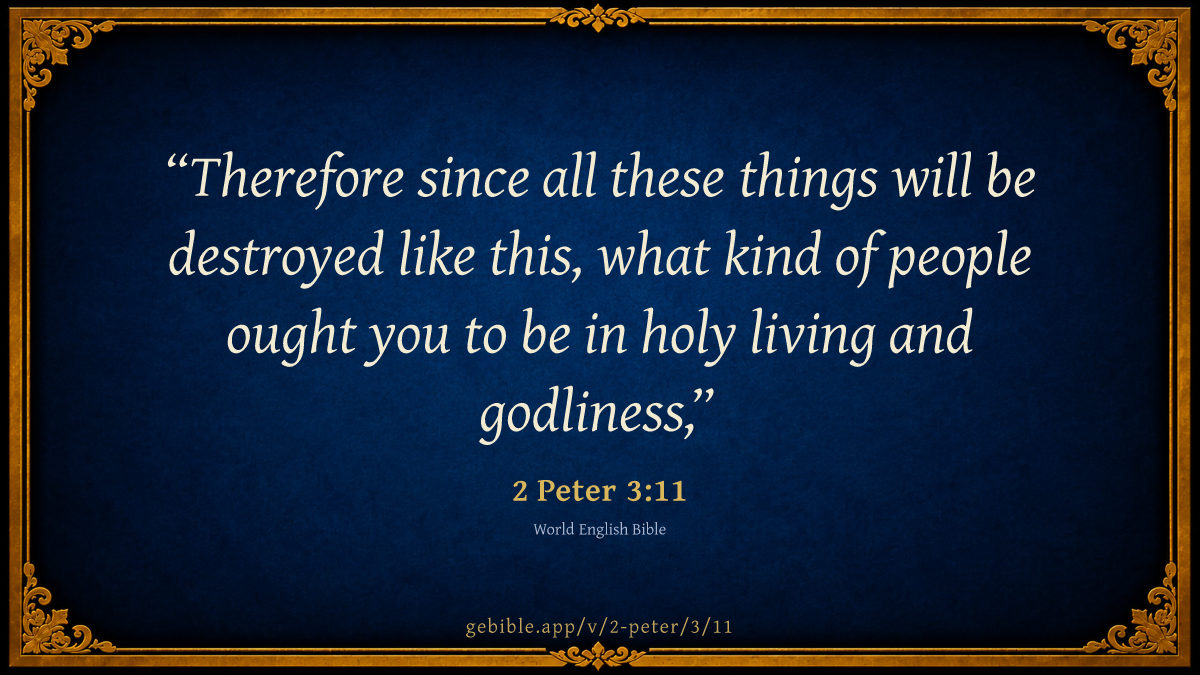
Therefore since all these things will be destroyed like this, what kind of people ought you to be in holy living and godliness,
Parallel Translations
-
Therefore since all these things will be destroyed like this, what kind of people ought you to be in holy living and godliness,
-
Yf all these thinges shall perisshe what maner persons ought ye to be in holy conversacion and godlynes:
-
Seeing therefore that all these thinges must be dissolued, what maner persons ought ye to be in holy conuersation and godlinesse,
Cross-references (22)
Passages linked to 2 Peter 3:11 in the Treasury of Scripture Knowledge, ordered by reader-vote popularity; verse text shown in World English Bible.
- 1 Peter 1:15 but just as he who called you is holy, you yourselves also be holy in all of your behavior;
- Philippians 1:27 Only let your way of life be worthy of the Good News of Christ, that whether I come and see you or am absent, I may hear of your state, that you stand firm in one spirit, with one soul striving for the faith of the Good News;
- 1 Peter 2:12 having good behavior among the nations, so in that of which they speak against you as evildoers, they may by your good works, which they see, glorify God in the day of visitation.
- 1 Timothy 6:11 But you, man of God, flee these things, and follow after righteousness, godliness, faith, love, perseverance, and gentleness.
- 2 Peter 3:12 looking for and earnestly desiring the coming of the day of God, which will cause the burning heavens to be dissolved, and the elements will melt with fervent heat?
- James 3:13 Who is wise and understanding among you? Let him show by his good conduct that his deeds are done in gentleness of wisdom.
- Isaiah 34:4 All of the army of the sky will be dissolved. The sky will be rolled up like a scroll, and all its armies will fade away, as a leaf fades from off a vine or a fig tree.
- Philippians 3:20 For our citizenship is in heaven, from where we also wait for a Savior, the Lord Jesus Christ,
- Isaiah 14:31 Howl, gate! Cry, city! You are melted away, Philistia, all of you; for smoke comes out of the north, and there is no straggler in his ranks.
- 1 Timothy 6:3 If anyone teaches a different doctrine, and doesn’t consent to sound words, the words of our Lord Jesus Christ, and to the doctrine which is according to godliness,
- 2 Peter 1:3 seeing that his divine power has granted to us all things that pertain to life and godliness, through the knowledge of him who called us by his own glory and virtue,
- Psalms 50:23 Whoever offers the sacrifice of thanksgiving glorifies me, and prepares his way so that I will show God’s salvation to him.”
- Psalms 75:3 The earth and all its inhabitants quake. I firmly hold its pillars.
- Matthew 8:27 The men marveled, saying, “What kind of man is this, that even the wind and the sea obey him?”
- 1 Timothy 4:12 Let no man despise your youth; but be an example to those who believe, in word, in your way of life, in love, in spirit, in faith, and in purity.
- 1 Thessalonians 1:5 and that our Good News came to you not in word only, but also in power, and in the Holy Spirit, and with much assurance. You know what kind of men we showed ourselves to be among you for your sake.
- 1 Timothy 3:16 Without controversy, the mystery of godliness is great: God was revealed in the flesh, justified in the spirit, seen by angels, preached among the nations, believed on in the world, and received up in glory.
- James 1:24 for he sees himself, and goes away, and immediately forgets what kind of man he was.
- Isaiah 24:19 The earth is utterly broken. The earth is torn apart. The earth is shaken violently.
- 1 Timothy 6:6 But godliness with contentment is great gain.
- Hebrews 13:5 Be free from the love of money, content with such things as you have, for he has said, “I will in no way leave you, neither will I in any way forsake you.”
- 2 Peter 1:6 and in knowledge, self-control; and in self-control perseverance; and in perseverance godliness;
Cross-references from openbible.info (CC BY 4.0)
Explain this verse (21 sources)
Historical commentary, presented as a primary source — not an endorsement.
Private notes
Saved on this device only — never synced or sent anywhere.
John Calvin 1540 · Public Domain Heaven and earth, he says, shall pass away for…
Heaven and earth, he says, shall pass away for our sakes; is it meet, then, for us to be engrossed with the things of earth, and not, on the contrary, to attend to a holy and godly life? The corruptions of heaven and earth will be purged by fire, while yet as the creatures of God they are pure; what then ought to be done by us who are full of so many pollutions? As to the word godlinesses (pietatibus,) the plural number is used for the singular, except you take it as meaning the duties of godliness. Of the elements of the world I shall only say this one thing, that they are to be consumed, only that they may be renovated, their substance still remaining the same, as it may be easily gathered from Romans 8:21, and from other passages.
John Calvin's Commentaries (1540-1563) — public domain. Text from the Calvin Translation Society English edition (1840s-50s) via the Christian Classics Ethereal Library (ccel.org). Calvin's coverage is partial (roughly two-thirds of the Bible); uncommented books and verses are honest gaps, never fabricated. The 19th-century editor's footnotes and remarks are omitted so the notes are faithfully Calvin's own voice.
Geneva Bible translators 1599 · Public Domain An exhortation to purity of life, setting before us…
An exhortation to purity of life, setting before us that horrible judgment of God both to bridle our wantonness, and also to comfort us, so that we be found watching and ready to meet him at his coming.
Geneva Bible (1599) marginal notes — public domain.
John Trapp 1656 · Public Domain 11 Seeing then that all these things shall be…
11 Seeing then that all these things shall be dissolved, what manner of persons ought ye to be in all holy conversation and godliness,
Ver. 11. What manner of men] ποταπους, even to admiration, quales et quanti, as the word signifies, Mar 13:1. How accurate, and how elevated above the ordinary strain!
Read full note →
In all holy conversation and godliness] Gr. εν αγιαις αναστροφαις και ευσεβειαις, in holy conversations and godlinesses, in the plural; to show that godliness should run through our whole conversation, as the warp runs through the woof.
John Trapp, A Commentary or Exposition upon All the Books of the Old and New Testament (1647–1656) — public domain. Text from a community e-Sword module.
Matthew Poole 1685 · Public Domain Seeing then that all these things shall be dissolved;…
Seeing then that all these things shall be dissolved; seeing the coming of the Lord will be so terrible, as to bring with it the consumption of the world, and the destruction of these things here below, upon which we are so apt to set our affections.
What manner of persons ought ye to be; how prudent, accurate, diligent, zealous, and every way excellent persons! The Greek word is often used by way of admiration of some singular excellency in persons or things, Mat 8:27; Mar 13:1; Luk 1:29.
Read full note →
In all holy conversation and godliness: the words in the Greek are both in the plural number, and may imply not only a continued course of holy walking throughout our whole time, but likewise diligence in the performance of all sorts of duties, and exercise of all those various graces wherewith the Spirit of God furnisheth believers in order thereto.
Matthew Poole's English Annotations on the Holy Bible (1683–1685) — public domain. Text from a community e-Sword/MySword module.
William Burkitt 1703 · Public Domain These words are St. Peter’s practical improvement of the…
These words are St. Peter’s practical improvement of the foregoing doctrine, concerning the certain, sudden and terrible judgment of Christ to come. If the whole frame of heaven and earth shall be so wonderfully changed, and a new world made, how holy should they be, and how great a degree of purity should they labour to attain unto, who expect to live in this new world?
Learn hence, That the firm belief of Christ’s coming to judgment, and the dissolution of this sinful world by fire, should convince all Christians of the necessity of, and engage them in their pursuits and endeavours after, a life of universal holiness, and that with the utmost care and possible diligence: Seeing all these things, what manner of persons ought ye to be? - Heaven is an holy place, has holy company, holy employments, holy enjoyments; we must be qualified for it, before we can be admitted into it, and begin that life of holiness upon earth which will never end in heaven; without a present meetness for heaven, we must never expect to be admitted into it, Col 1:12
William Burkitt's Expository Notes on the New Testament (1700–1703) — public domain. Text from a community e-Sword module.
Matthew Henry 1710 · Public Domain The apostle, having instructed them in the doctrine of…
The apostle, having instructed them in the doctrine of Christ's second coming,
I. Takes occasion thence to exhort them to purity and godliness in their whole conversation: all the truths which are revealed in scripture should be improved for our advancement in practical godliness: this is the effect that knowledge must produce, or we are never the better for it. If you know these things, happy are you if you do them. Seeing all these things must be dissolved, how holy should we be, that are assured of it, departing from and dying to sin, that has so corrupted and defiled all the visible creation that there is an absolute need of its dissolution! All that was made for man's use is subject to vanity by man's sin: and if the sin of man has brought the visible heavens, and the elements and earth, under a curse, from which they cannot be freed without being dissolved, what an abominable evil is sin, and how much to be hated by us! And, inasmuch as this dissolution is in order to their being restored to their primitive beauty and excellency, how pure and holy should we be, in order to our being fit for the new heaven and new earth, wherein dwelleth righteousness! It is a very exact and universal holiness that he exhorts to, not resting in any lower measure or degree, but labouring to be eminent beyond what is commonly attained - holy in God's house and in our own, holy in our worshipping of God and in our conversing with men. All our conversation, whether with high or low, rich or poor, good or bad, friends or enemies, must be holy. We must keep ourselves unspotted from the world in all our converses with it. We must be perfecting holiness in the fear of God, and in the love of God too. We must exercise ourselves unto godliness of all sorts, in all its parts, trusting in God and delighting in God only, who continues the same when the whole visible creation shall be dissolved, devoting ourselves to the service of God, and designing the glorifying and enjoyment of God, who endures for ever; whereas what worldly men delight in and follow after must all be dissolved. Those things which we now see must in a little while pass away, and be no more as they now are: let us look therefore at what shall abide and continue, which, though it be not present, is certain and not far off. This looking for the day of God is one of the directions the apostle gives us, in order to our being eminently holy and godly in all manner of conversation. "Look for the day of God as what you firmly believe shall come, and what you earnestly long for." The coming of the day of God is what every Christian must hope for and earnestly expect; for it is a day when Christ shall appear in the glory of the Father, and evidence his divinity and Godhead even to those who counted him a mere man. The first coming of our Lord Jesus Christ, when he appeared in the form of a servant, was what the people of God earnestly waited and looked for: that coming was for the consolation of Israel, Luk 2:25. How much more should they wait with expectation and earnestness for his second coming, which will be the day of their complete redemption, and of his most glorious manifestation! Then he shall come to be admired in his saints, and glorified in all those that believe. For though it cannot but terrify and affright the ungodly to see the visible heavens all in a flame, and the elements melting, yet the believer, whose faith is the evidence of things not seen, can rejoice in hope of more glorious heavens after these have been melted and refined by that dreadful fire which shall burn up all the dross of this visible creation. Here we must take notice, 1. What true Christians look for: new heavens and a new earth, in which a great deal more of the wisdom, power and goodness of our great God and Saviour Jesus Christ will be clearly discerned than we are able to discover in what we now see; for in these new heavens and earth, freed from the vanity the former were subject to, and the sin they were polluted with, only righteousness shall dwell; this is to be the habitation of such righteous persons as do righteousness, and are free from the power and pollution of sin; all the wicked shall be turned into hell; those only who are clothed with a righteousness of Christ, and sanctified by the Holy Ghost, shall be admitted to dwell in this holy place. 2. What is the ground and foundation of this expectation and hope - the promise of God. To look for any thing which God has not promised is presumption; but if our expectations are according to the promise, both as to the things we look for and the time and way of their being brought about, we cannot meet with a disappointment; for he is faithful who has promised. "See therefore that you raise and regulate your expectations of all the great things that are to come according to the word of God; and, as to the new heaven and new earth, look for them as God has allowed and directed by the passages we have in this portion of scripture how before you, and in Isa 65:17; Isa 66:22, to which the apostle may be thought to allude."
Read full note →
II. As in Pe2 3:11 he exhorts to holiness from the consideration that the heavens and the earth shall be dissolved, so in Pe2 3:14 he resumes his exhortation from the consideration that they shall be again renewed. "Seeing you expect the day of God, when our Lord Jesus Christ will appear in his glorious majesty, and these heavens and earth shall be dissolved and melted down, and, being purified and refined, shall be erected and rebuilt, prepare to meet him. It nearly concerns you to see in what state you will be when the Judge of all the world shall come to pass sentence upon men, and to determine how it shall be with them to all eternity. This is the court of judicature whence there lies no appeal; whatever sentence is here passed by this great Judge is irreversible; therefore get ready to appear before the judgment-seat of Christ: and see to it,"
1. "That you be found of him in peace, in a state of peace and reconciliation with God through Christ, in whom alone God is reconciling the world to himself. All that are out of Christ are in a state of enmity, and reject and oppose the Lord and his anointed, and shall therefore be punished with everlasting destruction from the presence of the Lord, and the glory of his power. Those whose sins are pardoned and their peace made with God are the only safe and happy people; therefore follow after peace, and that with all." (1.) Peace with God through our Lord Jesus Christ. (2.) Peace in our own consciences, through the Spirit of grace witnessing with our spirits that we are the children of God. (3.) Peace with men, by having a calm and peaceable disposition wrought in us, resembling that of our blessed Lord.
2. That you be found of Christ without spot, and blameless. Follow after holiness as well as peace: and even spotless and perfect; we must not only take heed of all spots which are not the spots of God's children (this only prevents our being found of men without spot), we must be pressing towards spotless purity, absolute perfection. Christians must be perfecting holiness, that they may be not only blameless before men, but also in the sight of God; and all this deserves and needs the greatest diligence; he who does this work negligently can never do it successfully. "Never expect to be found at that day of God in peace, if you are lazy and idle in this your day, in which we must finish the work that is given us to do. It is only the diligent Christian who will be the happy Christian in the day of the Lord. Our Lord will suddenly come to us, or shortly call us to him; and would you have him find you idle?" Remember there is a curse denounced against him who does the work of the Lord negligently, Marg. Jer 48:10. Heaven will be a sufficient recompence for all our diligence and industry; therefore let us labour and take pains in the work of the Lord; he will certainly reward us if we be diligent in the work he has allotted us; now, that you may be diligent, account the long-suffering of our Lord to be salvation. "Does your Lord delay his coming? Do not think this is to give more time to make provision for your lusts, to gratify them; it is so much space to repent and work out your salvation. It proceeds not from a want of concern or compassion for his suffering servants, nor is it designed to give countenance and encouragement to the world of the ungodly, but that men may have time to prepare for eternity. Learn then to make a right use of the patience of our Lord, who does as yet delay his coming. Follow after peace and holiness, or else his coming will be dreadful to you." And inasmuch as it is difficult to prevent men's abuse of God's patience, and engage them in the right improvement thereof, our apostle quotes St. Paul as directing men to make the same good use of the divine forbearance, that in the mouth, or from the pen, of two apostles the truth might be confirmed. And we may here observe with what esteem and affection he speaks of him who had formerly publicly withstood and sharply reproved Peter. If a righteous man smite one who is truly religious, it shall be received as a kindness; and let him reprove, it shall be as an excellent oil, which shall soften and sweeten the good man that is reproved when he does amiss. What an honourable mention does this apostle of the circumcision make of that very man who had openly, before all, reproved him, as not walking uprightly according to the truth of the gospel! (1.) He calls him brother, whereby he means not only that he is a fellow-christian (in which sense the word brethren is used Th1 5:27), or a fellow-preacher (in which sense Paul calls Timothy the evangelist a brother, Col 1:1), but a fellow-apostle, one who had the same extraordinary commission, immediately from Christ himself, to preach the gospel in every place, and to disciple all nations. Though many seducing teachers denied Paul's apostleship, yet Peter owns him to be an apostle. (2.) He calls him beloved; and they being both alike commissioned, and both united in the same service of the same Lord, it would have been very unseemly if they had not been united in affection to one another, for the strengthening of one another's hands, mutually desirous of, and rejoicing in, one another's success. (3.) He mentions Paul as one who had an uncommon measure of wisdom given unto him. He was a person of eminent knowledge in the mysteries of the gospel, and did neither in that nor any other qualification come behind any of all the other apostles. How desirable is it that those who preach the same gospel should treat one another according to the pattern Peter here sets them! It is surely their duty to endeavour, by proper methods, to prevent or remove all prejudices that hinder ministers' usefulness, and to beget and improve the esteem and respect in the minds of people towards their ministers that may promote the success of their labours. And let us also here observe, [1.] The excellent wisdom that was in Paul is said to be given him. The understanding and knowledge that qualify men to preach the gospel are the gift of God. We must seek for knowledge, and labour to get understanding, in hopes that it shall be given us from above, while we are diligent in using proper means to attain it. [2.] The apostle imparts to men according as he had received from God. He endeavours to lead others as far as he himself was led into the knowledge of the mysteries of the gospel. He is not an intruder into the things he had not seen or been fully assured of, and yet he does not fail to declare the whole counsel of God, Act 20:27. [3.] The epistles which were written by the apostle of the Gentiles, and directed to those Gentiles who believed in Christ, are designed for the instruction and edification of those who from among the Jews were brought to believe in Christ; for it is generally thought that what is here alluded to is contained in the epistle to the Romans (Rom 2:4), though in all his epistles there are some things that refer to one or other of the subjects treated of in this and the foregoing chapter; and it cannot seem strange that those who were pursuing the same general design should in their epistles insist upon the same things. But the apostle Peter proceeds to tell us that in those things which are to be met with in Paul's epistles there are some things hard to be understood. Among the variety of subjects treated of in scripture, some are not easy to be understood because of their own obscurity, such are prophecies; others cannot be so easily understood because of their excellency and sublimity, as the mysterious doctrines; and others are with difficulty taken in because of the weakness of men's minds, such are the things of the Spirit of God, mentioned Co1 2:14. And here the unlearned and unstable make wretched work; for they wrest and torture the scriptures, to make them speak what the Holy Ghost did not intend. Those who are not well instructed and well established in the truth are in great danger of perverting the word of God. Those who have heard and learned of the Father are best secured from misunderstanding and misapplying any part of the word of God; and, where there is a divine power to establish as well as to instruct men in divine truth, persons are effectually secured from falling into errors. How great a blessing this is we learn by observing what is the pernicious consequence of the errors that ignorant and unstable men fall into - even their own destruction. Errors in particular concerning the holiness and justice of God are the utter ruin of multitudes of men. Let us therefore earnestly pray for the Spirit of God to instruct us in the truth, that we may know it as it is in Jesus, and have our hearts established with grace, that we may stand firm and unshaken, even in the most stormy times, when others are tossed to and fro with every wind of doctrine.
III. The apostle gives them a word of caution, Pe2 3:17, Pe2 3:18, where,
1. He intimates that the knowledge we have of these things should make us very wary and watchful, inasmuch as there is a twofold danger, Pe2 3:17. (1.) We are in great danger of being seduced, and turned away from the truth. The unlearned and unstable, and they are very numerous, do generally wrest the scripture. Many who have the scriptures and read them do not understand what they read; and too many of those who have a right understanding of the sense and meaning of the word are not established in the belief of the truth, and all these are liable to fall into error. Few attain to the knowledge and acknowledgment of doctrinal Christianity; and fewer find, so as to keep in the way of practical godliness, which is the narrow way, which only leadeth unto life. There must be a great deal of self-denial and suspicion of ourselves, and submitting to the authority of Christ Jesus our great prophet, before we can heartily receive all the truths of the gospel, and therefore we are in great danger of rejecting the truth. (2.) We are in great danger by being seduced; for, [1.] So far as we are turned from the truth so far are we turned out of the way to true blessedness, into the path which leads to destruction. If men corrupt the word of God, it tends to their own utter ruin. [2.] When men wrest the word of God, they fall into the error of the wicked, men without law, who keep to no rules, set no bounds to themselves, a sort of free-thinkers, which the psalmist detests. Psa 119:113, I hate vain thoughts, but thy law do I love. Whatever opinions and thoughts of men are not conformable to the law of God, and warranted by it, the good man disclaims and abhors; they are the conceits and counsels of the ungodly, who have forsaken God's law, and, if we imbibe their opinions, we shall too soon imitate their practices. [3.] Those who are led away by error fall from their own stedfastness. They are wholly unhinged and unsettled, and know not where to rest, but are at the greatest uncertainty, like a wave of the sea, driven with the wind and tossed. It nearly concerns us therefore to be upon our guard, seeing the danger is so great.
2. That we may the better avoid being led away, the apostle directs us what to do, Pe2 3:18. And, (1.) We must grow in grace. He had in the beginning of the epistle exhorted us to add one grace to another, and here he advises us to grow in all grace, in faith, and virtue, and knowledge. By how much the stronger grace is in us, by so much the more stedfast shall we be in the truth. (2.) We must grow in the knowledge of our Lord Jesus Christ. "Follow on to know the Lord. Labour to know him more clearly and more fully, to know more of Christ and to know him to better purpose, so as to be more like him and to love him better." This is the knowledge of Christ the apostle Paul reached after and desired to attain, Phi 3:10. Such a knowledge of Christ as conforms us more to him, and endears him more to us, must needs be of great use to us, to preserve us from falling off in times of general apostasy; and those who experience this effect of the knowledge of the Lord and Saviour Jesus Christ will, upon receiving such grace from him, give thanks and praise to him, and join with our apostle in saying, To him be glory both now and for ever. Amen.
Matthew Henry's Commentary on the Whole Bible (1708–1710) — public domain (CC PDM 1.0). Text via the HelloAO Bible API.
John Gill 1763 · Public Domain Seeing then that all these things shall be dissolved,....…
Seeing then that all these things shall be dissolved,.... By fire; the heaven with all its host, sun, moon, and stars, clouds, meteors, and fowls of the air; the earth, and all that is upon it, whether of nature, or art; and, since nothing is more certain than such a dissolution of all things,
what manner of persons ought ye to be in all holy conversation and godliness? not as the scoffers and profane sinners, who put away this evil day far from them, but as men, who have their loins girt, and their lights burning, waiting for their Lord's coming; being continually in the exercise of grace, and in the discharge of their religious duties, watching, praying, hearing, reading; living soberly, righteously, and godly; guarding against intemperance and worldly mindedness, and every worldly and hurtful lust.
John Gill's Exposition of the Whole Bible (1746–1763) — public domain (CC PDM 1.0). Text via the HelloAO Bible API.
John Wesley 1765 · Public Domain Seeing then that all these things are dissolved -…
Seeing then that all these things are dissolved - To the eye of faith it appears as done already. All these things - Mentioned before; all that are included in that scriptural expression, "the heavens and the earth;" that is, the universe. On the fourth day God made the stars, Gen. i, 16, which will be dissolved together with the earth. They are deceived, therefore, who restrain either the history of the creation, or this description of the destruction, of the world to the earth and lower heavens; imagining the stars to be more ancient than the earth, and to survive it. Both the dissolution and renovation are ascribed, not to the one heaven which surrounds the earth, but to the heavens in general, ver. 10, 13, without any restriction or limitation. What persons ought ye to be in all holy conversation - With men. And godliness - Toward your Creator.
John Wesley, Explanatory Notes Upon the Whole Bible (1754–1765) — public domain. Text via the GEBible commentary corpus.
Adam Clarke 1810 · Public Domain Verse 11. All these things shall be dissolved] They…
Verse 11. All these things shall be dissolved] They will all be separated, all decomposed; but none of them destroyed. And as they are the original matter out of which God formed the terraqueous globe, consequently they may enter again into the composition of a new system; and therefore the apostle says, 2Pe 3:13: we look for new heavens and a new earth-the others being decomposed, a new system is to be formed out of their materials. There is a wonderful philosophic propriety in the words of the apostle in describing this most awful event.
What manner of persons ought ye to be] Some put the note of interrogation at the end of this clause, and join the remaining part with the 12th verse, 2Pe 3:12 thus: Seeing then that all these things shall be dissolved, what manner of persons ought ye to be? By holy conversation and godliness, expecting and earnestly desiring the coming of the day of God, c. Only those who walk in holiness, who live a godly and useful life, can contemplate this most awful time with joy.
Read full note →
The word σπευδοντας, which we translate hasting unto, should be tendered earnestly desiring, or wishing for which is a frequent meaning of the word in the best Greek writers.
Adam Clarke's Commentary on the Bible (1810–1826) — public domain. Text from a community e-Sword/MySword module.
Joseph Benson 1811 · Public Domain 2Pe 3:11-12. Seeing then that all these things —…
2Pe 3:11-12. Seeing then that all these things — Which our eyes behold; shall be dissolved — And we shall be spectators of their dissolution, being raised from the dead before, or at the time of, its taking place; what manner of persons ought ye to be — How serious, how watchful, how free from levity and folly, how disengaged from, and dead to, this lower world, with all it contains; how unmoved by the trifling changes which are now continually occurring, the comparatively insignificant losses and gains, honour and reproach, pleasure and pain! How heavenly-minded, having our thoughts and affections set upon that world, with its riches, glories, and joys, which is durable and eternal; in all holy conversation — With men; and godliness — Toward God. Looking for — Earnestly desiring; and hasting unto — Or hasting on, (as σπευδοντας may signify,) namely, by your earnest desires and fervent prayers; the coming of the day of God — Fitly so called, because God will then make such a display of his glorious perfections as was never made before; of his power, in raising all the dead, and transforming all the living in a moment, in the twinkling of an eye, and in destroying the present world, and preparing for his people a new heaven and a new earth; of his wisdom, in showing that he knew, and will now bring into judgment, all the thoughts, desires, and designs, the dispositions, words, and actions of all the thousands of millions of human beings that had lived on earth in the different ages of the world; of his justice, in rendering unto every man, with infinite exactness, according to his works, and recompensing tribulation to those that troubled his saints and servants; of his mercy and love in justifying, at his judgment-seat, his believing and obedient people, and in conferring upon them an incorruptible and eternal inheritance; and of his truth, in punctually fulfilling all his promises and threatenings, and making good all his declarations. Wherein the heavens being on fire, &c. — The apostle repeats his former testimony, because of its great importance. Macknight, however, thinks that, by the elements, in this verse, we are not to understand, as in 2Pe 3:10, the heavens or atmosphere, but the elements of which this terraqueous globe is composed; namely, earth and water, and every thing which enters into the composition of these substances, and on which their constitution and form depend. Hence, 1st, In speaking of them, he uses an expression which he did not use in 2Pe 3:10. There his words were, The elements, burning, λυθησονται, shall be dissolved; here he says, The elements, burning, τηκεται, (for τακησεται,) shall melt; a “word which is applied to the melting of metals by fire. Wherefore, as the elements signify the constituent parts of any thing, the expression, shall melt, applied to the constituent parts of the terraqueous globe, intimates that the whole, by the intense heat of the conflagration, is to be reduced into one homogeneous fluid mass of burning matter. Consequently, that it is not the surface of the earth, with all the things thereon, which is to be burned, as some have imagined, but the whole globe of the earth.” And that he is here speaking of these elements, and consequently of the destruction of this earth, appears still further by the promise made in the next verse.
Joseph Benson's Commentary on the Old and New Testaments (1811–1818) — public domain. Text from a community e-Sword module.
Albert Barnes 1834 · Public Domain Seeing then that all these things shall be dissolved…
Seeing then that all these things shall be dissolved - Since this is an undoubted truth.
What manner of persons ought ye to be in all holy conversation and godliness - In holy conduct and piety. That is, this fact ought to be allowed to exert a deep and abiding influence on us, to induce us to lead holy lives. We should feel that there is nothing permanent on the earth that this is not our abiding home; and that our great interests are in another world. We should be serious, humble, and prayerful; and should make it our great object to be prepared for the solemn scenes through which we are soon to pass. An habitual contemplation of the truth, that all that we see is soon to pass away, would produce a most salutary effect on the mind. It would make us serious. It would repress ambition. It would lead us not to desire to accumulate what must so soon be destroyed. It would prompt us to lay up our treasures in heaven. It would cause us to ask with deep earnestness whether we are prepared for these amazing scenes, should they suddenly burst upon us.
Albert Barnes' Notes on the Bible (1834–1885) — public domain. Text from a community e-Sword/MySword module.
Haydock's Catholic Bible Commentary 1859 · Public Domain Seeing then that all these things are to be…
Seeing then that all these things are to be dissolved, that the world, and all things in the world, shall pass in a short time, set not your affections upon them: let your life and conversation be holy. According to the divine promises, look for new heavens, and a new earth, where justice is to dwell, whither sinners shall not enter, but the just only, in a new state of never-ending happiness. Make it then your endeavour to be found in the sight of God spotless and blameless; and look upon the long forbearance of God, who defers to punish sinners as they deserve, to be an effect of his mercy, and for your salvation. (Witham)
George Leo Haydock (1774–1849), Haydock's Catholic Family Bible and Commentary, 1859 edition — public domain. Excludes Psalms (Douay-Rheims chapter numbering differs from Protestant) and Deuterocanonical books (Catholic canon only).
Robert Jamieson, A. R. Fausset & David Brown 1871 · Public Domain Your duty, seeing that this is so, is to…
Your duty, seeing that this is so, is to be ever eagerly expecting the day of God.
then--Some oldest manuscripts substitute "thus" for "then": a happy refutation of the "thus" of the scoffers, Pe2 3:4 (English Version, "As they were," Greek, "thus").
Read full note →
shall be--Greek, "are being (in God's appointment, soon to be fulfilled) dissolved"; the present tense implying the certainty as though it were actually present.
what manner of men--exclamatory. How watchful, prayerful, zealous!
to be--not the mere Greek substantive verb of existence (einai), but (huparchein) denoting a state or condition in which one is supposed to be [TITTMANN]. What holy men ye ought to be found to be, when the event comes! This is "the holy commandment" mentioned in Pe2 3:2.
conversation . . . godliness--Greek, plural: behaviors (towards men), godlinesses (or pieties towards God) in their manifold modes of manifestation.
Jamieson, Fausset & Brown — Commentary Critical and Explanatory on the Whole Bible (1871) — public domain (CC PDM 1.0). Text via the HelloAO Bible API.
Daniel D. Whedon 1874 · Public Domain 11. Two verses our apostle now interposes to warn…
11. Two verses our apostle now interposes to warn his readers of the personal holiness they ought to maintain in view of so great a destruction.
Conversation—Conduct.
Daniel D. Whedon (gen. ed.), Commentary on the Old and New Testaments (1874–1909) — public domain. Text from a community e-Sword module.
The Cambridge Bible for Schools and Colleges 1878 · Public Domain 11. Seeing then that all these things shall be…
11. Seeing then that all these things shall be dissolved] Literally, Seeing therefore that all these things are being dissolved. The Greek participle is in the present tense, and is probably used to convey the thought that even now the fabric of the earth is on its way to the final dissolution. If with some of the better MSS. we read “shall thus be dissolved,” instead of “then,” the participle must be taken as more definitely future, being coupled, as in that case it must be, with the manner as well as the fact of the dissolution.
ought ye to be in all holy conversation and godliness] It should be noted, though it cannot well be expressed in English, that both the Greek nouns are in the plural, as expressing all the manifold forms in which holy living (see note on 1Pe_1:15) and “godliness” shew themselves. The verb for “be” is that which emphatically expresses a permanent and continuous state. The thought implied is that the belief in the transitoriness of all that seems most enduring upon earth should lead, as a necessary consequence, to a life resting on the eternal realities of truth and holiness.
The Cambridge Bible for Schools and Colleges (gen. ed. J. J. S. Perowne; Cambridge University Press, 1878–1918) — public domain. Text from a community e-Sword module.
Ellicott's Commentary for English Readers 1878 · Public Domain (11) Seeing then that all these things shall be…
(11) Seeing then that all these things shall be dissolved.—For “then” we ought probably to read “thus,” seeing that all these things are thus to be dissolved. The original is present in form, but rightly translated by the future, being the prophetic present, i.e., the future prophetically regarded as present.
What manner of persons.—Not so much a question as an exclamation. In any case, the sentence should run on to the end of 2Pe_3:12. To put an interrogation at “to be” or at “godliness,” and make what follows an answer to the question, would be stiff and frigid, and very unlike the fervour of this Epistle.
Read full note →
Ought ye to be.—We might fairly translate, ought ye to be found. The Greek implies that the state is one that has continued for some time before the day comes.
In all holy conversation and godliness.—Literally, in holy behaviours and godlinesses. (See Notes on 2Pe_1:3 and 2Pe_2:7.) The plurals indicate a variety of acts. They occur in this passage only.
A Bible Commentary for English Readers, edited by Charles John Ellicott (1878–1897) — public domain. Text from a community e-Sword module.
The Pulpit Commentary 1880 · Public Domain Seeing then that all these things shall be dissolved;…
Seeing then that all these things shall be dissolved; rather, seeing that all these things are being dissolved. The participle is present, and implies the certainty of the event foretold, and, perhaps, also that the germs of that coming dissolution are already in being, that the forces which are ultimately to bring about the final catastrophe are even now at work. Some of the better manuscripts read, instead of ou+n, then, outwv, thus: "seeing that all these things are thus being dissolved." What manner of persons ought ye to be in all holy conversation and godliness? The Greek word for "what manner of persons" means literally, "of what country;" it seems to point to the great truth that God"s people are fellow-citizens of the saints, that the commonwealth of which they are citizens is in heaven. The word for "to be" is the emphatic uJparcein, which denotes original, essential, continuous being. (On the word for "conversation" (ajnastrofaiv, behaviour, conduct), see note on (1Pe_1:15) Both this noun and the following are plural in the Greek, and therefore mean "in all aspects and forms of holy conduct and godliness." Some commentators connect these last words, "in all holy conversation and godliness," with the next verse: "looking in all holy conversation," etc. Some, again, understand this verse as asking a question, which is answered in the next; but the Greek word for "what manner of persons" (potapov) seems to be used in the New Testament as an exclamation only, not interrogatively.
Vers. 11-18.
Read full note →
Exhortations.
I THE DUTY OF PREPARATION.
1. Christians should look for the city that hath foundations. The cities of this world have no sure foundation, for the earth on which they are built must pass away; it has within itself the element which is to cause its dissolution; the germs of that dissolution are working even now. Then wise men must not lay up for themselves treasures upon earth; they must not live as if this changeful, dying world was to be their home for ever; they must set their affections on things above; they must remember that Christian men are citizens of the heavenly country, fellow-citizens with the saints. Therefore they must adopt the modes of life which are characteristic of that heavenly country; their conduct as they move about among men must be holy in all the relations of life; they must live in the habitual pursuit of godliness in all its aspects. These things are of true, lasting moment. The prizes of this world, even those which seem to us the greatest and most to be desired, are but vanity, vanity of vanities, compared with the great realities of the spiritual life.
1. They must live in the expectation of the Lord"s coming. They must daily look for the presence of the great day, and by thus looking for it, and making ready for it, they must (St. Peter says, in the condescending language which Holy Scripture sometimes uses) hasten its coming. For that day cometh not till the chosen of God are safe. "Haste thee, escape thither," said the destroying angel to Lot; "for I cannot do anything till thou be come thither." So now "the lightnings of the judgment-day pause yet a while," stored in the armoury of God ("Christian Year: All Saints" Day"), till God"s elect are numbered, till they are ready, not one of them lost, for their eternal home. Then there is a sense in which, very strange and awful though it may seem, Christians may hasten the coming of the day of God. When the bride hath made herself ready, when the work of repentance is wrought out in the hearts of God"s people, when they have washed their robes, and made them white in the blood of the Lamb, then the day of God shall come. Now the long-suffering of God waiteth, as it waited in the days of Noah. It is a holy and a blessed truth he waits for us in his tender mercy; he is long-suffering, not willing that any should perish; his wrath does not strike at once the sinner in his sin. He is waiting now, giving us time; but that gracious waiting cannot be protracted for ever; the day of the Lord will come. It is our duty to do what lieth in us to hasten its coming, by the preparation of our own hearts, by stirring up others to repentance, and by our prayers. "Thy kingdom come," is our daily prayer, the prayer which the Lord himself puts into our mouths. "The kingdom of God" has more senses than one in Holy Scripture; but certainly one thing to which the Lord directs our prayers in those words is the
2. coming of the day of God, when the kingdoms of this world shall become the kingdoms of our Lord and of his Christ; and he shall reign for ever and ever. This is to be our daily prayer; if we use it in thoughtful faith, it will fix our hearts upon our eternal home. The Church on earth prays, "Thy kingdom come;" in Paradise the souls under the altar cry with a loud voice, "How long, O Lord, holy and true?". (Rev_6:9, Rev_6:10) He will hear the prayer that goeth up to him day and night; he will avenge his own elect; the great day must come.
3. That day will be a day of terrors. Because of its presence the visible heavens will be on fire; they shall be dissolved. The earth and the heaven, in the vision of judgment that was revealed to St. John, fled away from the face of him who sat on the great white throne, and there was found no place for them. St. Peter, too, saw the awful scene presented to the eye of his mind he uses the prophetic present the elements are melting, wasting away, with fervent heat. Those startling words suggest thoughts of exceeding awe and terror: "Take ye heed; watch and pray.
1. But there will be a new home for the righteous. St. John heard the voice of him that sat on the throne saying, "Behold, I make all things new." God had promised this long ago by the mouth of his prophet Isaiah. He will surely fulfill his word. He will not leave his people desolate and homeless. He provided a city of refuge for Lot, when his old abode was destroyed by the fire of the wrath of God. So, out of the appalling conflagration of the dreadful day there will arise a new and blessed home for his elect. We look for new heavens and a new earth; and they shall abide for ever. As once the promise came to Noah that there should not be any more a flood to destroy the earth, so God hath promised that "the new heavens and the new earth, which I will make, shall remain before me, saith the Lord." Heaven and earth shall then be very near, the one to the other; for the holy city, new Jerusalem, shall come down from God out of heaven; and the tabernacle of God shall be with men, and he will dwell with them. The commonwealth that is in heaven shall be established (so Holy Scripture seems to teach us) upon the new earth. It shall come down from heaven, having the glory of God; the throne of God and of the Lamb shall be in it; there his servants shall serve him. Heaven will come down to earth; and so the new earth will become a part of heaven, very closely joined with heaven. God will dwell there with men, and they shall see him face to face, and live in that new earth the life of heaven; for it is the unveiled presence of God which makes heaven what it is, the abode of joy, and love, and holiness, and entranced contemplation of the Divine beauty. Into that city entereth nothing that defileth; righteousness dwelleth there.
2. The earth that now is hath been defiled with many sins; it has been stained with blood, devastated by war and cruelty, polluted with sensuality and uncleanness. But the new earth shall be all holy. The refining fires of judgment will work a complete and everlasting change. The Deluge cleansed the old world, but only for a time; sin soon began to reassert itself. The fires of the great day will purely purge away all the dross, and leave only the refined gold. Righteousness shall dwell for ever in that new earth. The people of the holy city shall be all righteous; for they shall abide in the presence of him who is the Sun of Righteousness, and shall be made like unto him, for they shall see him as he is.
3. The need of earnest diligence. St. Peter has been warning us of the solemn future which lies before us the most tremendous judgment, the destruction of the present order of things in the fires of the last day, the new heavens and the new earth which will be the eternal home of the blessed. These thoughts, he says, enforce upon us the necessity of diligence in the religious life. Men who really believe that after death cometh the judgment cannot live listlessly and idly. Many professing Christians, alas! live careless lives; but that carelessness evinces a practical unbelief. The momentous issues of the great day must stir the believer to earnest effort. St. Peter had urged the necessity of diligence in the first chapter; he urges it again in the last. Then he appealed to the grace of God, his gifts, his promises; the love of God, the blessed hope set before us, ought to arouse us to love and zeal. Now he appeals to the awful future, the judgment that is coming. Carelessness in the prospect of the judgment is nothing short of madness. Those whose faith is real must be diligent. "That day cometh as a thief:" how will it find us? What will be the state of those who are surprised in sin? Our hearts sicken in shuddering dread at the fearful thought. Then let us give diligence to make our calling and election sure. God"s elect must be conformed to the image of his Son. His Son, the holy Lamb of God, was without blemish and without spot; so must his servants be. They must wash their robes, and make them white in the blood of the Lamb. "The blood of Jesus Christ cleanseth from all sin;" but it cleanseth only those who "walk in the light." Therefore let us be diligent to walk always in the consciousness of God"s presence, in the light that streams from the cross. That light will show each spot and blemish that rests upon the soul; it will bring us to repentance and confession; and then God "is faithful and just to forgive us our sins, and to cleanse us from all unrighteousness." Those who "follow the Lamb whithersoever he goeth" are without fault before the throne of God, (Rev_14:5) for every fault has been washed away in the precious blood. Their sins once were like crimson, but now they are whiter than snow; they are clothed with the wedding garment, the white robe of righteousness; therefore they are found in peace. Christ is their Peace; he bath made peace through the blood of his cross. Those who abide in Christ have peace with God now, in the hour of death, and in the day of judgment. Such men account that the long-suffering of our Lord is salvation. They know that life is a sacred trust, that the time of probation is precious; and they will strive by God"s gracious help to work out their own salvation with fear and trembling, knowing that the night cometh, in which no man can work.
II THE DUTY OF LISTENING TO THE WARNINGS OF HOLY SCRIPTURE,
1. St. Paul had warned them. St. Paul had, by himself or by his companions, founded most of the Churches of Asia Minor. He had written Epistles to the Galatians, Colossians, and Ephesians, the last being probably a circular letter intended to be read in several Churches. At the date of St. Peter"s Second Epistle many of St. Paul"s writings must have become the common property of the whole Church, and thus the Christians of Asia Minor probably knew and read some of the Epistles which had been addressed to European Churches. St. Peter calls St. Paul his beloved brother; he recognizes the wisdom which had been given unto him. The two holy apostles had once differed from one another; now they were united in one faith and one love. St. Peter had overcome his old impetuosity, his old desire to be first; he had learned that precious grace of humility, which in his First Epistle he so earnestly inculcates. He does not remember that he had once been reproved by St. Paul; he thinks only of St. Paul"s holiness and inspired wisdom; he is wholly above petty jealousies and resentments. Christians ought never to take offence, especially at well-intentioned rebukes; they ought to be thankful for them. Christians ought to rejoice at the graces vouchsafed to others at their zeal, energy, love, at the success of their religious efforts. Envy, especially among Christians, is a hateful vice, a deadly sin. St. Peter, the first of the apostles, appeals to St. Paul, who was called last of all; he is an example of Christian humility. The two holy apostles taught the same great truths. St. Paul and St. Peter both press earnestly upon us the great danger of spiritual sloth; both warn us that the day of the Lord cometh suddenly, like a thief; both urge us to be watchful. Let us listen to those two holy men as they echo the solemn teaching of the great Master.
2. There are difficulties in St. Paul"s writings. Men misrepresented the great apostle even from the beginning; they represented him as teaching, "Let us do evil, that good may come". (Rom_3:8) They distorted his doctrine of justification, and perverted it into antinomianism; though he himself had taught that the faith by which we are saved is "faith which worketh by love," and that faith which could remove mountains is nothing if it be alone, without charity. The false teachers, against whom St. Peter has been warning his readers, were probably among these perverters of the apostle"s meaning. It is no wonder: "The letter killeth, but the Spirit giveth life." There will always be in the visible Church men unlearned and unstable, untaught by the Holy Spirit of God who alone can guide us to the truth, and therefore without steadfastness, carried away with every blast of vain doctrine. Such men wrest to their own destruction, not only the "things hard to be understood" in St. Paul"s Epistles, but Holy Scripture generally. For it is not the written Word that in the fullest sense saves the soul, but the Word of life, the Word that is living and powerful, the Lord Jesus Christ himself manifested to the believer. We may find him in the thoughtful, devout study of God"s holy Word; but to find Christ, to win Christ, we must count all else as loss; we must forsake selfish aims, self-exaltation, self-indulgence, and follow in humility and earnest prayer the leading of the blessed Spirit. The written Word is a most precious gift; but no outward privilege can save us. Nay, awful as it seems, men may wrest it, and do wrest it, to their own destruction. Receive it in simplicity and faith, and it will save the soul. God reveals its deep holy meaning to babes in Christ. But if men with perverse ingenuity will use it as the weapon of party strife, and twist its sacred words to suit their selfish purposes, then it may alas! that it should be so increase their condemnation. "The letter killeth." Corruptio optimi pessima.
3. There is need of thoughtful watchfulness. False teachers distort the meaning of Holy Scripture; they wander far from the truth; they are self-willed, lawless, disobedient to the Law of God written in the heart, revealed in his Word. Therefore Christians must be on their guard; they must "not believe every spirit, but try the spirits, whether they be of God: because many false prophets are gone out into the world." This conflict of opinions sometimes produces painful doubts and uncertainties; it is one of the trials of the Christian life.
4. And of growth in grace. God will reveal the truth to the babes in Christ. He will not leave the humble, faithful soul in darkness and perplexity. Only let a man earnestly pray for the grace of God; only let him strive daily to draw nearer to Christ, and to gain that inner knowledge of Christ Jesus the Lord, in comparison with which all things else are dross; and the light of the presence of Christ will surely dawn upon him, and in that light he will find a Guide to bring him to eternal life. For his is the glory now and to the day of eternity, and he is "able to save to the uttermost all who come to God by him.
LESSONS.
1. "The fashion of this world passeth away." What country shall we belong to? this dying world, or the eternal city?
2. The great day is at hand; we must look forward to it. We must preparethe way of the Lord; we must pray, "Thy kingdom come.
3. In the new earth righteousness dwelleth. Let us follow afterrighteousness; let us be diligent, "that we may be found in peace, blameless in his sight.
4. Let us study the Scriptures in faith and prayer, that we may grow ingrace.
Vers. 11-18.
Duty in view of second coming.
I REFERENCE TO GOD IN OUR CONDUCT. "Seeing that these things are thus all to be dissolved, what manner of persons ought ye to be in all holy living and godliness?" The catastrophe that is to accompany the second coming is here put down in time present in the original, to raise an impression of its certainty: "Seeing that these things are thus all dissolved." If the conclusions of some scientific men are to be accepted, this is literally true, inasmuch as they say that there are processes going on which must end in the material fabric being worn out. It is in the condition of a clock that, if not wound up, must run out. The catastrophe thus vividly presented is here made a reason for our attending to ourselves. "What manner of persons," Peter exclaims, "ought ye to be in all holy living and godliness?" Holy living is the living of those who are set apart to the service of a holy God. Godliness points to this living as based on our relation to God. By the use of the plural in the original there is brought out the manifold workings and forms of a godly life. There is the feeling of dependence on God and of fear toward him, desire for the blessing from God and trust in him for the blessing, the feeling of love toward God for what he is and of gratitude toward him for his mercies, knowledge of God"s will and the resolution to do his will, all this finding expression in worship, self-command, and sacrifice for others.
II ATTITUDE TOWARD THE SECOND COMING. "Looking for and earnestly desiring the coming of the day of God." This is the only instance of the day being called "the day of God. We must think of the Father ordering the day and its events, that the Son after his mysterious Passion may be magnified. "As the Father raiseth the dead and quickeneth them, even so the Son also quickeneth whom he will. For neither doth the Father judge any man, but he hath given all judgment unto the Son; that all may honour the Son, even as they honour the Father." Our attitude to the day of God is to be that of expectancy. We are to look for its coming or presence. We are to allow it to dwell in our minds, so as to call forth our earnest desire after it. The first Christians looked for it to come in their day. They were nearer the Divine intention than those who, because it may not be for thousands of years, do not think of it at all. But our attitude is also to be that of active preparation. The proper translation is neither "haste unto" nor "earnestly desire," but "hasten on." The idea of hastening on the coming is unusual; but it is remarkable that it is elsewhere expressed by Peter. "Repent ye therefore," he said to the assembly in Solomon"s porch, "and turn again, that your sins may be blotted out, that so there may come seasons of refreshing from the presence of the Lord; and that he may send the Christ who hath been appointed for you, even Jesus: whom the heaven must receive until the times of restoration of all things." It is thus Petrine and scriptural to think of the coming as an event which may be accelerated by our repentance and prayers and efforts for the diffusion of the gospel.
III WHAT IS NECESSITATED BY THE SECOND COMING OUTWARDLY. "By reason of which the heavens being on fire shall be dissolved, and the elements shall melt with fervent heat." It is said that the heavens are not clean in God"s sight. The idea here is that even the heavens have been defiled, by reason of those who have lived under them, and upon the earth. Once Christ did not shrink from dwelling on this earth, being on his saving mission; but when he is to come in his judicial character, he is to be a consuming fire, at his approach, even to material things. It is said in Rev_20:11, that from the face of him that sat upon the great white throne the earth and the heaven fled away, and there was found no place for them. So here it is taught that even the heavenly world is to be subjected to fire, not merely to the breaking up of its order, but even to the melting of its elements.
IV WHAT IS LOOKED FOR AT THE SECOND COMING OUTWARDLY. "But, according to his promise, we look for new heavens and a new earth, wherein dwelleth righteousness." This is in accordance Rev_21:1, "And I saw a new heaven and a new earth: for the first heaven and the first earth were passed away." The most striking promise is in Isa_65:17, "For, behold, I create new heavens and a new earth: and the former shall not be remembered." The newness does not necessarily refer to the materials of which the present heavens and earth are Composed; these may be transformed so as to constitute new heavens and earth, just as our bodies are to be transformed so as to constitute new bodies. The new heavens and new earth are to correspond to newness of character a correspondence of the outward to the inward never to be disturbed. It is said in Isa_66:22, "For as the newheavens and the new earth, which I shall make, shall remain before me, saith the Lord, so shall your seed and your name remain." The expression of the idea here is, "wherein dwelleth righteousness has its permanent abode, from which it will never take flight. It will be a world where there is no superstition or infidelity, where there is a correct, bright conception of what God is, and a due appreciation of the work of Christ. It will be a world where there is nothing to interfere with social well-being, where jealousies and antipathies are unknown. "The wolf and the lamb shall feed together, and the lion shall eat straw like the bullock: and dust shall be the serpent"s meat. They shall not hurt nor destroy in all my holy mountain, saith the Lord! Is not, then, the institution of this order of things to be much thought of by us, and to be earnestly desired? We may regret that much that is beautiful in the present order of things is to vanish. Shall we never again look upon that beautiful sky, those beautiful landscapes, the beautiful flowers? But there is ample compensation in the higher beauty to which the present is to give place. When we have got the glorious resurrection-body, there will be no regret that we have left the present body behind. So when we see the new heavens and the new earth, there will be no regret that the former things have passed away. In their higher forms they will have a greater power of lifting the soul to God. The teaching of Peter regarding the heavens and earth agrees with what Paul teaches in the eighth of Romans, "For the creation was subjected to vanity, not of its own will, but by reason of him who subjected it, in hope that the creation itself shall be delivered from the bondage of corruption into the liberty of the glory of the children of God." Peter emphasizes fire as the liberating element; Paul simply notes the liberation. Peter, again, thinks of a fit abode for righteousness; Paul thinks of an abode that shadows forth the liberty of the glory of the children of God. There is use in looking forward to new heavens and a new earth. We feel that the present arrangement is not independent of God. He made it, and he can alter it. He can make a world suitable to a probationary state, and a world suitable to a state of attained righteousness, He can make a world suitable for his people in their present imperfect state, and a world suitable to them when he puts glory on them.
V PERSONAL CONCERNS AT THE SECOND COMING. "Wherefore, beloved, seeing that ye look for these things, give diligence that ye may be found in peace, without spot and blameless in his sight." We look for a great catastrophe at the end of time as that which has been certainly foretold. We do not look for that alone, but for that as introducing a great reconstruction in the production of new heavens and earth. This is connected with our seeing God on the day formerly referred to. Our personal anxiety must be to be found in peace on that occasion to have God as our Friend, so that the catastrophe shall not reach us, and so that the new heavens and new earth shall be for our blessed and eternal abode.
We can only expect this consummation by our being without spot and blameless. Spots and blemishes attract the fire of Divine judgment. This very earth and even the heavens have to be subjected to fire because they have been connected with man"s sin. Let us not think, then, that we can stand in God"s sight with hearts defiled. We must give diligence to have all spots and blemishes removed from us, in the use of the means of grace, in a constant recourse to the blood of Christ, in a constant endeavour to conform our life to the Divine will.
VI INTERPRETATION OF PRESENT DELAY. "And account that the long-suffering of our Lord is salvation." In explanation of the delay of the second coming, it was said formerly that "the Lord is not slack concerning his promise, but is long-suffering." Here long-suffering is asserted of our Lord, apparently the Lord Jesus Christ, as the absolute Manifestation of the disposition of the Father. Here also there is connected with long-suffering its end, viz. salvation. Christ makes to us the offer of salvation; but he does not reject us so soon as we refuse his offer. He would teach us even from our experience of the bitterness of sin, he would disabuse our minds of false ideas of life, he would make us tired of a life of sin, he would make us turn in desire to a life of holiness. He has no quarter for sin; but he has patience for the sinner, he heaps mercies upon him; there is the continual mercy that he is not treated according to his desert. Thus by his continual goodness would he lead us to repentance, by his long-suffering he would compass our salvation, by his gentleness he would make us great. But for patience extended over years, Paul would never have lived to be a preacher of righteousness, and John Bunyan would never have lived to write the "Pilgrim"s Progress." And so it is with the race as a whole. The offer of salvation has yet to be made to all. And even when the offer has been made, means have to be used to secure the acceptance of salvation. Therefore it is that the coming is delayed. Let us not, then, misinterpret the delay; let us not mistake what is long-suffering for slackness in promising, or indifference to sin.
VII REFERENCE TO THE WRITINGS OF PAUL. "Even as our beloved brother Paul also, according to the wisdom given to him, wrote unto you; as also in all his Epistles, speaking in them of these things; wherein are some things hard to be understood, which the ignorant and unsteadfast wrest, as they do also the other Scriptures, unto their own destruction." Peter refers to Paul by whom, on one occasion, he had been withstood, as his beloved brother, i.e., not ministerial associate, but brother to the readers and to himself alike, and alike dear to them. He also recognizes him as possessing a wisdom which was not his own. Paul had written to the same circle on the subject of the coming. If we think of the Asiatic circle, we turn to the Epistle to the Ephesians. In it the nearest approach to what Peter has been saying is to be found in chapter 5:27, "That he might present the Church to himself a glorious Church, not having spot, or wrinkle, or any such thing; but that it should be holy and without blemish." When Peter passes to other Epistles, we at once think of the Epistles to the Thessalonians. In these Paul expressly treats of delay in the second coming, and points out the attitude to be taken up. And this naturally suggests "some things hard to be understood." What he had in his mind was probably the revelation of the man of sin. Of other things hard to be understood in Paul"s Epistles we may particularize the gathering up of all things in Christ, the doctrine of election especially as set forth in the ninth chapter of Romans, and the filling up of that which is lacking in the sufferings of Christ in Colossians. Peter notes the bad use made of these things hard to be understood, in common with other Scriptures, by the ignorant and unsteadfast, i.e., those who had not the essentials of Christian instruction, and did not hold to the Christian position once taken up by them. They "wrested them" as by a hand-screw, i.e., from their natural meaning to their own destruction. There is no support here to the Roman Catholic idea of withholding the Bible from the people. Because Scriptures, especially difficult Scriptures, are abused by the ignorant and unsteadfast, that is no argument against the good use of them by those who are exhorted in this same chapter to "remember the words spoken before by the holy prophets, and the commandment of the Lord and Saviour through the apostles." Let us, even when we (in company with Peter) do not thoroughly understand, humbly seek to get profit.
VIII CAUTION. "Ye therefore, beloved, knowing these things beforehand, beware lest, being carried away with the error of the wicked, ye fall from your own steadfastness." What they knew beforehand was what Paul and Peter said about the second coming. The conclusion of the verse points especially to the foretold appearance of errorists before the coming. These were condemned by their lawless conduct. Let them not, then, as they valued his love in the gospel, be carried away with their error. They had firm footing; let them not be carried off their feet. Let them not be like Barnabas, the companion of Paul, who, when at the coming of some from James to Antioch, the Jews dissembled with Peter, he also was carried off his feet with their dissimulation. (Gal_2:13)
IX PARTING COUNSEL. "But grow in the grace and knowledge of our Lord and Saviour Jesus Christ." A tree is not a complete reality at once; but from a beginning there is progress toward an end. So we are not complete beings at once; but from a beginning there is a progress intended for us toward the end of our being. There may be growth in a wrong direction: what we are here exhorted to grow in is what of Divine assistance as sinners we need in order to come to the goal of our being. "Grow in grace," which is to be taken as an independent conception. If we are not growing under gracious influence, then we have only a name to live. Our faith grows as it becomes more ample and conquering. Our love grows as it becomes more fervent and diffusive. Our hope grows as it becomes more calm and bright. We are to grow in self-abasement, in power of work, in power of concentrating the mind on the truth, in power to bear hardships and injuries. We are to grow especially in that in which we find ourselves to be deficient. We are further exhorted to grow in "the knowledge of our Lord and Saviour Jesus Christ." This is in keeping with the great importance which is attached to knowledge in this Epistle. It is that by which we grow. The knowledge which is thus nutritive is knowledge of Christ as opening up and dispensing the treasures of Divine grace, and as showing in his own life what grace would bring out in ours. Let us, then, have a worthy conception of Christ in our minds; it is upon this that our growth in grace depends.
X DOXOLOGY. "To him be the glory both now and for ever. Amen." It is to Christ that the adoration is offered. To him be glory now; for it is to the knowledge of him that we owe all of grace that we have. To him be glory for ever, literally, "to the day of the age the day on which eternity, as contrasted with time, begins, and which is never to be broken up, but is to be one long day. To him we are indebted, as for all that we have now, so for all that we hope to have hereafter. Thus does the Epistle end without the customary salutations, simply with the carrying forward of Christ into our eternal life. It becomes every one who has followed out the thought of the Epistle to add his devout "Amen. R.F. Seeing then that all these things shall be dissolved; rather, seeing that all these things are being dissolved. The participle is present, and implies the certainty of the event foretold, and, perhaps, also that the germs of that coming dissolution are already in being, that the forces which are ultimately to bring about the final catastrophe are even now at work. Some of the better manuscripts read, instead of oun, then, outwv, thus: "seeing that all these things are thus being dissolved." What manner of persons ought ye to be in all holy conversation and godliness? The Greek word for "what manner of persons" means literally, "of what country;" it seems to point to the great truth that God"s people are fellow-citizens of the saints, that the commonwealth of which they are citizens is in heaven. The word for "to be" is the emphatic uJparcein, which denotes original, essential, continuous being. (On the word for "conversation" (ajnastrofaiv, behaviour, conduct), see note on (1Pe_1:15) Both this noun and the following are plural in the Greek, and therefore mean "in all aspects and forms of holy conduct and godliness." Some commentators connect these last words, "in all holy conversation and godliness," with the next verse: "looking in all holy conversation," etc. Some, again, understand this verse as asking a question, which is answered in the next; but the Greek word for "what manner of persons" (potapov) seems to be used in the New Testament as an exclamation only, not interrogatively.
Vers. 11-18.
Exhortations.
I THE DUTY OF PREPARATION.
1. Christians should look for the city that hath foundations. The cities of this world have no sure foundation, for the earth on which they are built must pass away; it has within itself the element which is to cause its dissolution; the germs of that dissolution are working even now. Then wise men must not lay up for themselves treasures upon earth; they must not live as if this changeful, dying world was to be their home for ever; they must set their affections on things above; they must remember that Christian men are citizens of the heavenly country, fellow-citizens with the saints. Therefore they must adopt the modes of life which are characteristic of that heavenly country; their conduct as they move about among men must be holy in all the relations of life; they must live in the habitual pursuit of godliness in all its aspects. These things are of true, lasting moment. The prizes of this world, even those which seem to us the greatest and most to be desired, are but vanity, vanity of vanities, compared with the great realities of the spiritual life.
1. They must live in the expectation of the Lord"s coming. They must daily look for the presence of the great day, and by thus looking for it, and making ready for it, they must (St. Peter says, in the condescending language which Holy Scripture sometimes uses) hasten its coming. For that day cometh not till the chosen of God are safe. "Haste thee, escape thither," said the destroying angel to Lot; "for I cannot do anything till thou be come thither." So now "the lightnings of the judgment-day pause yet a while," stored in the armoury of God ("Christian Year: All Saints" Day"), till God"s elect are numbered, till they are ready, not one of them lost, for their eternal home. Then there is a sense in which, very strange and awful though it may seem, Christians may hasten the coming of the day of God. When the bride hath made herself ready, when the work of repentance is wrought out in the hearts of God"s people, when they have washed their robes, and made them white in the blood of the Lamb, then the day of God shall come. Now the long-suffering of God waiteth, as it waited in the days of Noah. It is a holy and a blessed truth he waits for us in his tender mercy; he is long-suffering, not willing that any should perish; his wrath does not strike at once the sinner in his sin. He is waiting now, giving us time; but that gracious waiting cannot be protracted for ever; the day of the Lord will come. It is our duty to do what lieth in us to hasten its coming, by the preparation of our own hearts, by stirring up others to repentance, and by our prayers. "Thy kingdom come," is our daily prayer, the prayer which the Lord himself puts into our mouths. "The kingdom of God" has more senses than one in Holy Scripture; but certainly one thing to which the Lord directs our prayers in those words is the
2. coming of the day of God, when the kingdoms of this world shall become the kingdoms of our Lord and of his Christ; and he shall reign for ever and ever. This is to be our daily prayer; if we use it in thoughtful faith, it will fix our hearts upon our eternal home. The Church on earth prays, "Thy kingdom come;" in Paradise the souls under the altar cry with a loud voice, "How long, O Lord, holy and true?". (Rev_6:9, Rev_6:10) He will hear the prayer that goeth up to him day and night; he will avenge his own elect; the great day must come.
3. That day will be a day of terrors. Because of its presence the visible heavens will be on fire; they shall be dissolved. The earth and the heaven, in the vision of judgment that was revealed to St. John, fled away from the face of him who sat on the great white throne, and there was found no place for them. St. Peter, too, saw the awful scene presented to the eye of his mind he uses the prophetic present the elements are melting, wasting away, with fervent heat. Those startling words suggest thoughts of exceeding awe and terror: "Take ye heed; watch and pray.
1. But there will be a new home for the righteous. St. John heard the voice of him that sat on the throne saying, "Behold, I make all things new." God had promised this long ago by the mouth of his prophet Isaiah. He will surely fulfill his word. He will not leave his people desolate and homeless. He provided a city of refuge for Lot, when his old abode was destroyed by the fire of the wrath of God. So, out of the appalling conflagration of the dreadful day there will arise a new and blessed home for his elect. We look for new heavens and a new earth; and they shall abide for ever. As once the promise came to Noah that there should not be any more a flood to destroy the earth, so God hath promised that "the new heavens and the new earth, which I will make, shall remain before me, saith the Lord." Heaven and earth shall then be very near, the one to the other; for the holy city, new Jerusalem, shall come down from God out of heaven; and the tabernacle of God shall be with men, and he will dwell with them. The commonwealth that is in heaven shall be established (so Holy Scripture seems to teach us) upon the new earth. It shall come down from heaven, having the glory of God; the throne of God and of the Lamb shall be in it; there his servants shall serve him. Heaven will come down to earth; and so the new earth will become a part of heaven, very closely joined with heaven. God will dwell there with men, and they shall see him face to face, and live in that new earth the life of heaven; for it is the unveiled presence of God which makes heaven what it is, the abode of joy, and love, and holiness, and entranced contemplation of the Divine beauty. Into that city entereth nothing that defileth; righteousness dwelleth there.
2. The earth that now is hath been defiled with many sins; it has been stained with blood, devastated by war and cruelty, polluted with sensuality and uncleanness. But the new earth shall be all holy. The refining fires of judgment will work a complete and everlasting change. The Deluge cleansed the old world, but only for a time; sin soon began to reassert itself. The fires of the great day will purely purge away all the dross, and leave only the refined gold. Righteousness shall dwell for ever in that new earth. The people of the holy city shall be all righteous; for they shall abide in the presence of him who is the Sun of Righteousness, and shall be made like unto him, for they shall see him as he is.
3. The need of earnest diligence. St. Peter has been warning us of the solemn future which lies before us the most tremendous judgment, the destruction of the present order of things in the fires of the last day, the new heavens and the new earth which will be the eternal home of the blessed. These thoughts, he says, enforce upon us the necessity of diligence in the religious life. Men who really believe that after death cometh the judgment cannot live listlessly and idly. Many professing Christians, alas! live careless lives; but that carelessness evinces a practical unbelief. The momentous issues of the great day must stir the believer to earnest effort. St. Peter had urged the necessity of diligence in the first chapter; he urges it again in the last. Then he appealed to the grace of God, his gifts, his promises; the love of God, the blessed hope set before us, ought to arouse us to love and zeal. Now he appeals to the awful future, the judgment that is coming. Carelessness in the prospect of the judgment is nothing short of madness. Those whose faith is real must be diligent. "That day cometh as a thief:" how will it find us? What will be the state of those who are surprised in sin? Our hearts sicken in shuddering dread at the fearful thought. Then let us give diligence to make our calling and election sure. God"s elect must be conformed to the image of his Son. His Son, the holy Lamb of God, was without blemish and without spot; so must his servants be. They must wash their robes, and make them white in the blood of the Lamb. "The blood of Jesus Christ cleanseth from all sin;" but it cleanseth only those who "walk in the light." Therefore let us be diligent to walk always in the consciousness of God"s presence, in the light that streams from the cross. That light will show each spot and blemish that rests upon the soul; it will bring us to repentance and confession; and then God "is faithful and just to forgive us our sins, and to cleanse us from all unrighteousness." Those who "follow the Lamb whithersoever he goeth" are without fault before the throne of God, (Rev_14:5) for every fault has been washed away in the precious blood. Their sins once were like crimson, but now they are whiter than snow; they are clothed with the wedding garment, the white robe of righteousness; therefore they are found in peace. Christ is their Peace; he bath made peace through the blood of his cross. Those who abide in Christ have peace with God now, in the hour of death, and in the day of judgment. Such men account that the long-suffering of our Lord is salvation. They know that life is a sacred trust, that the time of probation is precious; and they will strive by God"s gracious help to work out their own salvation with fear and trembling, knowing that the night cometh, in which no man can work.
II THE DUTY OF LISTENING TO THE WARNINGS OF HOLY SCRIPTURE,
1. St. Paul had warned them. St. Paul had, by himself or by his companions, founded most of the Churches of Asia Minor. He had written Epistles to the Galatians, Colossians, and Ephesians, the last being probably a circular letter intended to be read in several Churches. At the date of St. Peter"s Second Epistle many of St. Paul"s writings must have become the common property of the whole Church, and thus the Christians of Asia Minor probably knew and read some of the Epistles which had been addressed to European Churches. St. Peter calls St. Paul his beloved brother; he recognizes the wisdom which had been given unto him. The two holy apostles had once differed from one another; now they were united in one faith and one love. St. Peter had overcome his old impetuosity, his old desire to be first; he had learned that precious grace of humility, which in his First Epistle he so earnestly inculcates. He does not remember that he had once been reproved by St. Paul; he thinks only of St. Paul"s holiness and inspired wisdom; he is wholly above petty jealousies and resentments. Christians ought never to take offence, especially at well-intentioned rebukes; they ought to be thankful for them. Christians ought to rejoice at the graces vouchsafed to others at their zeal, energy, love, at the success of their religious efforts. Envy, especially among Christians, is a hateful vice, a deadly sin. St. Peter, the first of the apostles, appeals to St. Paul, who was called last of all; he is an example of Christian humility. The two holy apostles taught the same great truths. St. Paul and St. Peter both press earnestly upon us the great danger of spiritual sloth; both warn us that the day of the Lord cometh suddenly, like a thief; both urge us to be watchful. Let us listen to those two holy men as they echo the solemn teaching of the great Master.
2. There are difficulties in St. Paul"s writings. Men misrepresented the great apostle even from the beginning; they represented him as teaching, "Let us do evil, that good may come". (Rom_3:8) They distorted his doctrine of justification, and perverted it into antinomianism; though he himself had taught that the faith by which we are saved is "faith which worketh by love," and that faith which could remove mountains is nothing if it be alone, without charity. The false teachers, against whom St. Peter has been warning his readers, were probably among these perverters of the apostle"s meaning. It is no wonder: "The letter killeth, but the Spirit giveth life." There will always be in the visible Church men unlearned and unstable, untaught by the Holy Spirit of God who alone can guide us to the truth, and therefore without steadfastness, carried away with every blast of vain doctrine. Such men wrest to their own destruction, not only the "things hard to be understood" in St. Paul"s Epistles, but Holy Scripture generally. For it is not the written Word that in the fullest sense saves the soul, but the Word of life, the Word that is living and powerful, the Lord Jesus Christ himself manifested to the believer. We may find him in the thoughtful, devout study of God"s holy Word; but to find Christ, to win Christ, we must count all else as loss; we must forsake selfish aims, self-exaltation, self-indulgence, and follow in humility and earnest prayer the leading of the blessed Spirit. The written Word is a most precious gift; but no outward privilege can save us. Nay, awful as it seems, men may wrest it, and do wrest it, to their own destruction. Receive it in simplicity and faith, and it will save the soul. God reveals its deep holy meaning to babes in Christ. But if men with perverse ingenuity will use it as the weapon of party strife, and twist its sacred words to suit their selfish purposes, then it may alas! that it should be so increase their condemnation. "The letter killeth." Corruptio optimi pessima.
3. There is need of thoughtful watchfulness. False teachers distort the meaning of Holy Scripture; they wander far from the truth; they are self-willed, lawless, disobedient to the Law of God written in the heart, revealed in his Word. Therefore Christians must be on their guard; they must "not believe every spirit, but try the spirits, whether they be of God: because many false prophets are gone out into the world." This conflict of opinions sometimes produces painful doubts and uncertainties; it is one of the trials of the Christian life.
4. And of growth in grace. God will reveal the truth to the babes in Christ. He will not leave the humble, faithful soul in darkness and perplexity. Only let a man earnestly pray for the grace of God; only let him strive daily to draw nearer to Christ, and to gain that inner knowledge of Christ Jesus the Lord, in comparison with which all things else are dross; and the light of the presence of Christ will surely dawn upon him, and in that light he will find a Guide to bring him to eternal life. For his is the glory now and to the day of eternity, and he is "able to save to the uttermost all who come to God by him.
LESSONS.
1. "The fashion of this world passeth away." What country shall we belong to? this dying world, or the eternal city?
2. The great day is at hand; we must look forward to it. We must preparethe way of the Lord; we must pray, "Thy kingdom come.
3. In the new earth righteousness dwelleth. Let us follow afterrighteousness; let us be diligent, "that we may be found in peace, blameless in his sight.
4. Let us study the Scriptures in faith and prayer, that we may grow ingrace.
Vers. 11-18.
Duty in view of second coming.
I REFERENCE TO GOD IN OUR CONDUCT. "Seeing that these things are thus all to be dissolved, what manner of persons ought ye to be in all holy living and godliness?" The catastrophe that is to accompany the second coming is here put down in time present in the original, to raise an impression of its certainty: "Seeing that these things are thus all dissolved." If the conclusions of some scientific men are to be accepted, this is literally true, inasmuch as they say that there are processes going on which must end in the material fabric being worn out. It is in the condition of a clock that, if not wound up, must run out. The catastrophe thus vividly presented is here made a reason for our attending to ourselves. "What manner of persons," Peter exclaims, "ought ye to be in all holy living and godliness?" Holy living is the living of those who are set apart to the service of a holy God. Godliness points to this living as based on our relation to God. By the use of the plural in the original there is brought out the manifold workings and forms of a godly life. There is the feeling of dependence on God and of fear toward him, desire for the blessing from God and trust in him for the blessing, the feeling of love toward God for what he is and of gratitude toward him for his mercies, knowledge of God"s will and the resolution to do his will, all this finding expression in worship, self-command, and sacrifice for others.
II ATTITUDE TOWARD THE SECOND COMING. "Looking for and earnestly desiring the coming of the day of God." This is the only instance of the day being called "the day of God. We must think of the Father ordering the day and its events, that the Son after his mysterious Passion may be magnified. "As the Father raiseth the dead and quickeneth them, even so the Son also quickeneth whom he will. For neither doth the Father judge any man, but he hath given all judgment unto the Son; that all may honour the Son, even as they honour the Father." Our attitude to the day of God is to be that of expectancy. We are to look for its coming or presence. We are to allow it to dwell in our minds, so as to call forth our earnest desire after it. The first Christians looked for it to come in their day. They were nearer the Divine intention than those who, because it may not be for thousands of years, do not think of it at all. But our attitude is also to be that of active preparation. The proper translation is neither "haste unto" nor "earnestly desire," but "hasten on." The idea of hastening on the coming is unusual; but it is remarkable that it is elsewhere expressed by Peter. "Repent ye therefore," he said to the assembly in Solomon"s porch, "and turn again, that your sins may be blotted out, that so there may come seasons of refreshing from the presence of the Lord; and that he may send the Christ who hath been appointed for you, even Jesus: whom the heaven must receive until the times of restoration of all things." It is thus Petrine and scriptural to think of the coming as an event which may be accelerated by our repentance and prayers and efforts for the diffusion of the gospel.
III WHAT IS NECESSITATED BY THE SECOND COMING OUTWARDLY. "By reason of which the heavens being on fire shall be dissolved, and the elements shall melt with fervent heat." It is said that the heavens are not clean in God"s sight. The idea here is that even the heavens have been defiled, by reason of those who have lived under them, and upon the earth. Once Christ did not shrink from dwelling on this earth, being on his saving mission; but when he is to come in his judicial character, he is to be a consuming fire, at his approach, even to material things. It is said in Rev_20:11, that from the face of him that sat upon the great white throne the earth and the heaven fled away, and there was found no place for them. So here it is taught that even the heavenly world is to be subjected to fire, not merely to the breaking up of its order, but even to the melting of its elements.
IV WHAT IS LOOKED FOR AT THE SECOND COMING OUTWARDLY. "But, according to his promise, we look for new heavens and a new earth, wherein dwelleth righteousness." This is in accordance Rev_21:1, "And I saw a new heaven and a new earth: for the first heaven and the first earth were passed away." The most striking promise is in Isa_65:17, "For, behold, I create new heavens and a new earth: and the former shall not be remembered." The newness does not necessarily refer to the materials of which the present heavens and earth are Composed; these may be transformed so as to constitute new heavens and earth, just as our bodies are to be transformed so as to constitute new bodies. The new heavens and new earth are to correspond to newness of character a correspondence of the outward to the inward never to be disturbed. It is said in Isa_66:22, "For as the newheavens and the new earth, which I shall make, shall remain before me, saith the Lord, so shall your seed and your name remain." The expression of the idea here is, "wherein dwelleth righteousness has its permanent abode, from which it will never take flight. It will be a world where there is no superstition or infidelity, where there is a correct, bright conception of what God is, and a due appreciation of the work of Christ. It will be a world where there is nothing to interfere with social well-being, where jealousies and antipathies are unknown. "The wolf and the lamb shall feed together, and the lion shall eat straw like the bullock: and dust shall be the serpent"s meat. They shall not hurt nor destroy in all my holy mountain, saith the Lord! Is not, then, the institution of this order of things to be much thought of by us, and to be earnestly desired? We may regret that much that is beautiful in the present order of things is to vanish. Shall we never again look upon that beautiful sky, those beautiful landscapes, the beautiful flowers? But there is ample compensation in the higher beauty to which the present is to give place. When we have got the glorious resurrection-body, there will be no regret that we have left the present body behind. So when we see the new heavens and the new earth, there will be no regret that the former things have passed away. In their higher forms they will have a greater power of lifting the soul to God. The teaching of Peter regarding the heavens and earth agrees with what Paul teaches in the eighth of Romans, "For the creation was subjected to vanity, not of its own will, but by reason of him who subjected it, in hope that the creation itself shall be delivered from the bondage of corruption into the liberty of the glory of the children of God." Peter emphasizes fire as the liberating element; Paul simply notes the liberation. Peter, again, thinks of a fit abode for righteousness; Paul thinks of an abode that shadows forth the liberty of the glory of the children of God. There is use in looking forward to new heavens and a new earth. We feel that the present arrangement is not independent of God. He made it, and he can alter it. He can make a world suitable to a probationary state, and a world suitable to a state of attained righteousness, He can make a world suitable for his people in their present imperfect state, and a world suitable to them when he puts glory on them.
V PERSONAL CONCERNS AT THE SECOND COMING. "Wherefore, beloved, seeing that ye look for these things, give diligence that ye may be found in peace, without spot and blameless in his sight." We look for a great catastrophe at the end of time as that which has been certainly foretold. We do not look for that alone, but for that as introducing a great reconstruction in the production of new heavens and earth. This is connected with our seeing God on the day formerly referred to. Our personal anxiety must be to be found in peace on that occasion to have God as our Friend, so that the catastrophe shall not reach us, and so that the new heavens and new earth shall be for our blessed and eternal abode.
We can only expect this consummation by our being without spot and blameless. Spots and blemishes attract the fire of Divine judgment. This very earth and even the heavens have to be subjected to fire because they have been connected with man"s sin. Let us not think, then, that we can stand in God"s sight with hearts defiled. We must give diligence to have all spots and blemishes removed from us, in the use of the means of grace, in a constant recourse to the blood of Christ, in a constant endeavour to conform our life to the Divine will.
VI INTERPRETATION OF PRESENT DELAY. "And account that the long-suffering of our Lord is salvation." In explanation of the delay of the second coming, it was said formerly that "the Lord is not slack concerning his promise, but is long-suffering." Here long-suffering is asserted of our Lord, apparently the Lord Jesus Christ, as the absolute Manifestation of the disposition of the Father. Here also there is connected with long-suffering its end, viz. salvation. Christ makes to us the offer of salvation; but he does not reject us so soon as we refuse his offer. He would teach us even from our experience of the bitterness of sin, he would disabuse our minds of false ideas of life, he would make us tired of a life of sin, he would make us turn in desire to a life of holiness. He has no quarter for sin; but he has patience for the sinner, he heaps mercies upon him; there is the continual mercy that he is not treated according to his desert. Thus by his continual goodness would he lead us to repentance, by his long-suffering he would compass our salvation, by his gentleness he would make us great. But for patience extended over years, Paul would never have lived to be a preacher of righteousness, and John Bunyan would never have lived to write the "Pilgrim"s Progress." And so it is with the race as a whole. The offer of salvation has yet to be made to all. And even when the offer has been made, means have to be used to secure the acceptance of salvation. Therefore it is that the coming is delayed. Let us not, then, misinterpret the delay; let us not mistake what is long-suffering for slackness in promising, or indifference to sin.
VII REFERENCE TO THE WRITINGS OF PAUL. "Even as our beloved brother Paul also, according to the wisdom given to him, wrote unto you; as also in all his Epistles, speaking in them of these things; wherein are some things hard to be understood, which the ignorant and unsteadfast wrest, as they do also the other Scriptures, unto their own destruction." Peter refers to Paul by whom, on one occasion, he had been withstood, as his beloved brother, i.e., not ministerial associate, but brother to the readers and to himself alike, and alike dear to them. He also recognizes him as possessing a wisdom which was not his own. Paul had written to the same circle on the subject of the coming. If we think of the Asiatic circle, we turn to the Epistle to the Ephesians. In it the nearest approach to what Peter has been saying is to be found in chapter 5:27, "That he might present the Church to himself a glorious Church, not having spot, or wrinkle, or any such thing; but that it should be holy and without blemish." When Peter passes to other Epistles, we at once think of the Epistles to the Thessalonians. In these Paul expressly treats of delay in the second coming, and points out the attitude to be taken up. And this naturally suggests "some things hard to be understood." What he had in his mind was probably the revelation of the man of sin. Of other things hard to be understood in Paul"s Epistles we may particularize the gathering up of all things in Christ, the doctrine of election especially as set forth in the ninth chapter of Romans, and the filling up of that which is lacking in the sufferings of Christ in Colossians. Peter notes the bad use made of these things hard to be understood, in common with other Scriptures, by the ignorant and unsteadfast, i.e., those who had not the essentials of Christian instruction, and did not hold to the Christian position once taken up by them. They "wrested them" as by a hand-screw, i.e., from their natural meaning to their own destruction. There is no support here to the Roman Catholic idea of withholding the Bible from the people. Because Scriptures, especially difficult Scriptures, are abused by the ignorant and unsteadfast, that is no argument against the good use of them by those who are exhorted in this same chapter to "remember the words spoken before by the holy prophets, and the commandment of the Lord and Saviour through the apostles." Let us, even when we (in company with Peter) do not thoroughly understand, humbly seek to get profit.
VIII CAUTION. "Ye therefore, beloved, knowing these things beforehand, beware lest, being carried away with the error of the wicked, ye fall from your own steadfastness." What they knew beforehand was what Paul and Peter said about the second coming. The conclusion of the verse points especially to the foretold appearance of errorists before the coming. These were condemned by their lawless conduct. Let them not, then, as they valued his love in the gospel, be carried away with their error. They had firm footing; let them not be carried off their feet. Let them not be like Barnabas, the companion of Paul, who, when at the coming of some from James to Antioch, the Jews dissembled with Peter, he also was carried off his feet with their dissimulation. (Gal_2:13)
IX PARTING COUNSEL. "But grow in the grace and knowledge of our Lord and Saviour Jesus Christ." A tree is not a complete reality at once; but from a beginning there is progress toward an end. So we are not complete beings at once; but from a beginning there is a progress intended for us toward the end of our being. There may be growth in a wrong direction: what we are here exhorted to grow in is what of Divine assistance as sinners we need in order to come to the goal of our being. "Grow in grace," which is to be taken as an independent conception. If we are not growing under gracious influence, then we have only a name to live. Our faith grows as it becomes more ample and conquering. Our love grows as it becomes more fervent and diffusive. Our hope grows as it becomes more calm and bright. We are to grow in self-abasement, in power of work, in power of concentrating the mind on the truth, in power to bear hardships and injuries. We are to grow especially in that in which we find ourselves to be deficient. We are further exhorted to grow in "the knowledge of our Lord and Saviour Jesus Christ." This is in keeping with the great importance which is attached to knowledge in this Epistle. It is that by which we grow. The knowledge which is thus nutritive is knowledge of Christ as opening up and dispensing the treasures of Divine grace, and as showing in his own life what grace would bring out in ours. Let us, then, have a worthy conception of Christ in our minds; it is upon this that our growth in grace depends.
X DOXOLOGY. "To him be the glory both now and for ever. Amen." It is to Christ that the adoration is offered. To him be glory now; for it is to the knowledge of him that we owe all of grace that we have. To him be glory for ever, literally, "to the day of the age the day on which eternity, as contrasted with time, begins, and which is never to be broken up, but is to be one long day. To him we are indebted, as for all that we have now, so for all that we hope to have hereafter. Thus does the Epistle end without the customary salutations, simply with the carrying forward of Christ into our eternal life. It becomes every one who has followed out the thought of the Epistle to add his devout "Amen. R.F.
The Pulpit Commentary (1880–1919), ed. H.D.M. Spence-Jones & Joseph S. Exell — public domain. Text from a community e-Sword module.
The Biblical Illustrator 1887 · Public Domain Seeing then that all these things shall be dissolved.
2Pe_3:11-18
Seeing then that all these things shall be dissolved.
Read full note →
Immortality and science
It is a singular fact that these words have far more probability of truth than they had a generation ago. Then, the stability of the physical universe was held to be a settled fact of science; it is not so regarded now. If this world and the universe of worlds are to undergo at times such catastrophes as science and Scripture indicate, even to possible destruction, where shall immortal man abide? Physical science chiefly touches human destiny at two points of what is technically known as the principle of continuity; namely, the resolution of thought and feeling into molecular changes, and the development of man from preceding lower orders of life. The principle is thought to militate against immortality, as it implies that all the potency of life is within matter, and that all mental and moral activities are but the operation of organised matter. Under this hypothesis thought and feeling are resolved into the whirl of molecules and the formation and destruction of tissue, a wholly material process, necessary in its character and admitting of no permanent personality. To find anything outside of this all-comprehending law of which immortality can be predicated, anything that survives when the bond breaks that holds the whirling atoms together, is an impossibility under this conception. On the contrary, its analogies seem to point to an opposite result. It is not strange that the dreariness of such conclusions repels the mind towards some better hope, and that physicists are working other veins of truth if for no other end than to escape the horror of desolation their own triumphs have compelled them to face. Mr. Fiske says: There is little that is even intellectually satisfying in the awful picture which science shows us of giant worlds concentrating out of nebulous vapour, developing with prodigious waste of energy into theatres of all that is grand and sacred in spiritual endeavour, clashing and exploding again into dead vapour balls, only to renew the same toilsome process without end a senseless bubble-play of Titan forces, with life, love, and aspiration brought forth only to be extinguished. Such sentiments characterise the ablest physicists of the age. We reach at last either nothingness, or a cinder, or a ceaseless clash and repulsion of vapour-balls called worlds, with possible moments of life amidst vast cycles of lifeless ages. We reach the end of a road, but find nothing to tell us why it exists. The question forces itself upon us, if by looking in other directions we cannot; reverse this process and find some worthy end of creation, something instead of nothing, the play of mind instead of the whirl of molecules, life instead of death. The recent verdict of science as to the fate of the material universe drives us with irresistible force to belief in an unseen, spiritual world--not the belief of religious faith, but of cold, hard reason. The other main point at which physical science touches human destiny is in connection with that part of the doctrine of physical evolution which holds that all forms of life are developed from preceding forms under the impulse of some unknown force--a theory not yet exactly defined, and far from being fully proved. Take the extremest form of evolution--matter having all the potency of life within itself--it does not necessarily exclude future existence. If matter can attain to mind that longs for immortality, may not its potentiality be able to achieve it? If it can develop the conception, may it not be able to develop the fact? If the question still recurs, at what point in the process of evolution, granting its truth for the moment, the principle of immortality is inserted, or gets possession?--a question of great pungency under the principle of continuity, we answer it by instancing an analogy. At what point of its growth does a plant acquire the power of self-perpetuation? As a shoot it utterly perishes if cut down; the lusty after-growth of stem and branches also withers into nothingness; the flower is not a self-reviving thing of power; but the flower, gathering light and dew into its glowing bosom, intermingles with them its own life essence and so bears a seed around which it folds its faded petals as a shroud, and falls into the dust, no longer to perish, but to live again. This is more than illustration, it is an argument. A living thing under the law of development comes to have a power of self-perpetuation that it did not have at first; why should it not be so with the life that has culminated in man? He is the flower of life, and in his heart alone may there be found the seed of eternal existence. But this phase of the subject is unsatisfactory; it is not necessary to consider it under these suppositions, and we turn to another. We want not mere continuance, but some solid ground for belief in personality after death. Evolution cannot impair the fact of personality here or hereafter, simply because man transcends nature, which is the field of evolution. Man may comprise all that has gone before him in nature, but he is not summed up by it. As the grand proof of this, we adduce the fact of the moral nature with its prime characteristic of freedom. Mr. Darwin himself admits that free-will is a mystery insoluble to the naturalist. Necessity, which is the equivalent of law, never could evolve freedom. But choice, or freedom, is the constituting characteristic of man, upon which is built the whole fabric of his life and moral nature. It makes him a person; it is the basis of his history. It puts him above the order and on-going of nature. Professor Tyndall says that the chasm between brain-action and consciousness is impassable, that here is a rock upon which materialism must split whenever it pretends to be a complete philosophy of the human mind. The admission is valuable, not merely because of its origin, but for its impregnable truth. With such a chasm between the two parts of mans nature--molecular processes and perpetual flux on one side, and conscious identity, moral sense, and freedom on the other side--we need not feel troubled at anything physical evolution may assert of man: it simply cannot touch him. We may now build our argument as to his destiny, unhindered by any clamour that may reach us from the other side of this chasm--a chasm that science itself recognises in our composite nature. But other difficulties may arise, such as the thought that this sense of personal identity may be temporary, that as our life was drawn out into separateness from the great ocean of being, so, having some cycle within itself, it will sink back into it, as a star rises and sets. Age and infancy are very like, especially when each is normal; sleep and unconsciousness mark both. As there is no identity before infancy, is there any after age? The fact that, notwithstanding the extreme plausibility of this familiar analogy, the human mind has never accepted the suggestion, has great significance; it has instinctively felt that this resemblance does not indicate a reality. Descartes argued: I think, therefore I am. Had he continued, I am, therefore I shall continue to be, he would have uttered as cogent logic. Granted the consciousness of personality, and it is impossible to conceive of non-existence. If self is a unit, and not a conglomerate of atoms, how is it to be got out of existence? But it may be said, if there is another life, there must be another world. Where is it? Of what composed? If it is within the limits, or under the laws of matter, it can have no endurance. The soul must have a sphere like itself, permanent, unfluctuating. Surely if philosophy may create a universe in which to float the worlds, and convey those quiverings of burning suns that we call heat and light, it will not withhold a fit sphere for the soul when it breaks away from the bonds of matter. We base our proof, however, not on mere analogy, but on the simple ground that the nature of the soul demands a proper and answering sphere, as wings demand air, and fins water. Otherwise, creation is without order and coherence. Were we to search for this sphere of the soul, we would not look for it in any refinement of matter, nor in any orb beyond the flaming walls of the world, but rather in an order over against this visible order, as mind stands over against the body. If, however, it be said that the mind must always have a body, or something like it, to hold it up, a sub-sto--a something like quicksilver upon a mirror, to take up and turn back its operations, something to sustain reaction and perhaps necessary to yield consciousness--we may follow a hint dropped by science in its latest suggestions. Physicists of the highest rank hold to the existence of a pure or non-atomic fluid filling all space, in which the worlds swim, a sort of first thing to which atomic matter is a second thing. But while science thus acknowledges a non-atomic fluid filling the inter-stellar spaces as a basis upon which the universe is a cosmos, or a united whole, it cannot impugn the analogy of a non-atomic soul fluid, or ether, as the basis or body upholding the mind, if we care to claim it. As we can imagine all the worlds from Blue-eyed Lyras topmost star to the smallest asteroid, swept together into some far-off corner of space--a not improbable result--and leave it clear of atomic matter yet filled with ether ready to float and unite another universe, so the material atomic body may be swept away and gathered to its original dust, leaving the immaterial body intact, a basis for the mind and its action as it had been before. Science and Revelation here draw very near to each other, science demanding a non-atomic substance as the only possible basis of conscious identity, and Revelation asserting there is a spiritual body, and God giveth it a body even as it pleased Him. (T. T. Munger, D. D.)
Disturbances in nature an argument for holy living
Nothing preaches to us such a sermon of the vanity of man, his works, his ambition, his art, his fashion, his pleasures, his proud over-weening science, as the instability of earth and of its final dissolution. But these extraordinary movements of Nature have for us a vastly higher argument than this.
1. In these terrific convulsions of the natural world there are found motives of unusual moment for highest, holy living. The force of this argument will perhaps be most felt when we consider, first, the vital relation which exists between this dissolution of nature and the sin of man. The fatal effects of sin were not limited to the boundaries of human nature, but they reach out into all the boundaries of creation, everywhere bringing blight and derangement. The imperfect and abnormal growths in tree and plant; the pains, diseases, death, which riot among these mute, inanimate things; the distempers and sorrows of the inferior animals; the drear waste of deserts, the thawless regions of ice, the fierce and fitful agitations in nature, the internal fires and ferments, ocean tempests and distractions, are palpable symptoms of organic difficulty and incurable sickness throughout the whole natural world. Ought we not to find in this exhibition of natures unrest and discord an irresistible argument for holiness of life? How can we delay to forsake that against which nature from the first rebels, against whose influence the very earth protests in her volcanic thunders and her profound shudderings.
2. Again we find an argument for holy living when we consider the vital relation which exists between this dissolution of nature and the restoration of man. Dissolution is not annihilation, it is simply transformation. These are not the death-pangs, but the birth-throes of nature. They clearly foretell a new creation, in which all that so terribly blights and mars the present one shall be absent. Does not the thought of all this come at last to press home upon us as with a tremendous argument to live in all godliness of life? No man of impure habits or misshapen character and deformed repulsive life shall range through that fair region, for there the river of life flows pure from the eternal throne, and instead of the thorn there is the fir tree, and instead of the brier there is the myrtle tree. (G. B. Spalding, LL. D.)
The dissolution of the world
I. The certainty of the dissolution of the world. That all these things shall be dissolved is a doctrine expressly delivered in Scripture, and by many impressive allusions brought home to the human heart. The day no sooner dawns and gains its meridian splendour than it begins to decline and ends in night. Spring no sooner introduces the bloom of summer than autumn assumes its reign, and then the devastations of winter desolate all the beauties of the year. Around us all things continually change, and life itself is ever passing away; grey hair and the faded look soon remind us that old age is at hand. Nothing is stable on earth. Cities, states, and empires have their period set. The labours of men perish; the monuments of art moulder into dust; even the works of nature wax old and decay. The world was created for the pleasure of God; and, when its destined course is fulfilled, He commands its destruction. He saw it meet that when the probationary course of the generations of men was finished, their present habitation should pass away. Of the seasonableness of that period He alone can judge. But amidst this great revolution of nature our comfort is that it is a revolution conducted by Him, the measures of whose government are all founded on goodness. Over the shock of the elements and the wreck of nature eternal wisdom presides. It is the day of the Lord, and from the terrors His faithful subjects shall have nothing to dread.
II. The sudden and unexpected coming of this great event. How miserable they whom it shall overtake in the midst of dark conspiracies, criminal deeds, or profligate pleasures!
III. The consequences of the dissolution of the world to man.
IV. The influence which the dissolution of all things ought to produce upon our lives. It ought to produce a seriousness of thought, at all times, upon the mind. (D. Malcolm, LL. D.)
The end of all things
We think it quite unnecessary to travel into the question whether these words mark an annihilation of matter, or only its purification preparatory to its re-appearance in some better form; it is sufficient for our purpose that the effect shall be the same as if the whole were taken down, and star after star and system after system departed from the vast fields of space.
I. There are two ways in which the assertion as to the dissolution of all material things may be considered and applied; we may speak of them as to be dissolved, either as they are in themselves, or as they are possessed by us.
1. And first as to the fact, literally taken, that all these things shall be dissolved. We must pause to note the sublimity and augustness of the fact that the Almighty is to remain unchanged and unchangeable, whilst the very heavens and suns and stars are dim with age. We find His eternity before the series commenced, and we find it when the series shall have passed. Who amongst us does not feel rebuked by the truth now presented to his attention, if indeed he be living in the preference of the objects of sight? Man of pleasure! go on delighting thyself with things which gratify the senses; man of learning! continue to neglect the wisdom which is from above; man of avarice! persist in digging for gold, and consume thy days and nights in heaping up riches; man of ambition! still toil for distinction, and spare no sacrifice which may gain the honour of this world. But now, all ye worshippers of visible things, that immortal yourselves ye choose for your portion what is infinite and perishable. Appointed yourselves to an endless duration, ye place your happiness in objects that are to last for a time and then wholly disappear. All, yea all these things shall be dissolved.
2. But we observed to you-that there was another sense in which this declaration might be taken--regard being had to the shortness of our own lives, rather than finite duration of all visible things. Even if there were never to come an appointed change over the visible universe, if the sun were never to be extinguished nor the earth consumed, ye cannot deny that so far as ye yourselves are concerned all these things would have to be dissolved. We will not argue with the sensualist in the midst of the fascinating objects wherein he delights; we will not argue with the miser whilst the gold glitters and sparkles before him; we will not argue with the philosopher as the broad arch of the heavens fixes his study; but we will argue with them amidst the graves of a churchyard, and our reasoning shall be its inhabitants of all ages and all ranks. We need not continue our progress through the melancholy spot; but will any of you go away from the churchyard unimpressed with the feeling that all created good can be enjoyed but for a short time, and therefore that it is not the good which should engage the affections of creatures appointed for immortality?
II. But let us endeavour to place before you this inference in a somewhat clearer point of view. The apostle argues that forasmuch as all visible things are to be dissolved they ought not to engage our affections; in other words, he argues from the transitoriness of all that earth can give to the folly of making it our chief good; and we wish to prove to you that the argument is in every way sound and logical. You must admit in the general that the worth or the value and possession depends in great measure on the length of time for which it is to be enjoyed. The objects of human pursuit are for the most part precious in mens eyes in proportion to their probable duration, and you take the most effectual way of depreciating them by proving them transitory in respect to themselves, or transitory in respect to their possessor. And if this be true, there ought to be needed nothing but an actual consciousness of the shortness and uncertainty of life, in order to our estimating at their true worth the riches and honours and pleasures of the world. It would cause the gold that ye covet to look dim, and the honours that ye envy to fade in your estimation, and the knowledge for which ye toil to seem of little worth, and the pleasures which ye crave to appear to you insipid, were ye indeed in the habit of expecting your decease, and were ye really to count yourselves strangers and pilgrims upon earth. It is only because there is no such feeling, and practically no such computation that ye are yet so fascinated and engrossed with what the world can bestow on its votaries.
III. If there be one effect which more than another this consideration of the dissolution of all visible things is adapted to produce, it is a willingness to do good and to communicate. Shall we, if indeed it be only for a brief time that we can have possession of earthly things--shall we either selfishly hoard them or squander them on our own gratification, when we may make to ourselves friends of the mammon of unrighteousness, and secure, by our acting as stewards rather than proprietors, unfading riches in that day when the earth and heavens shall flee from the face of Him that sitteth upon the throne. (H. Melvill, B. D.)
What manner of persons ought ye to be.--
Things and persons, here and hereafter
I. An important classification: Things and persons.
1. Things. We call the visible universe the great system of things. We need sometimes to remember that they are things only. The uplifted mountains which awe us with their sublimity are simply things. The animal and vegetable creations belong to the same category. There are endless varieties of life, instinct, structure, and form; but all are things. The possessions on which men so much pride themselves, and which attract such consideration from their fellows, are things, and nothing more. Our very bodies, so closely related to ourselves--inseparably united with us for this life--are yet not ourselves. They are but things. Youthfulness, elasticity, and bloom; age, debility, and decay, are not ourselves, nor our friends; they are things only--frail and changing things.
2. Persons. Persons are endowed with intelligence and will; they discern both right and wrong; they love and loathe. What a tremendous prerogative, to be a person! What high fellowship! God is a Person. So are angels. Man is the image of his Maker. What a pinnacle of danger is this! What a fall is possible from hence! Things exist for persons, not persons for things. Creation is for God, not God for creation. Nature, like the Sabbath, is for man, not man for nature, not man for the Sabbath. The popular philosophy of our day reverses this order. Its practical teaching is, that persons exist for things. As long as you court men, not for what they are, but for what they have, you put things above persons. In the Divine intention things are subordinate to persons. Business, riches, competence, poverty, are tests of men. They are instruments of education and discipline. None of these things are for themselves; they are ordained for persons--for the development of the mind and conscience and heart of man. The solemn question about every one is--ought to be now--will be hereafter--not, What has the man made by business? but, What has business made the man? The worlds creed is--Man exists for business, not business for man. The same perversion is visible in the misuse of the human body. One needs sometimes to ask, Which is the man, the body or the soul? The outer man is designed to be the hourly test of the inner man. The end of the thing is answered, when the intellectual, moral, and spiritual habits of the person inhabiting and using it are expanded and perfected. The husk is shed when stem and leaf appear.
II. An instructive contrast: Things shall be dissolved; persons must continue to be.
1. Things shall be dissolved. The globe is but our larger habitation, and, like the body which we occupy, it will not survive its uses. It is not shall be dissolved. It is, are being dissolved. Future events are close to the vision of the seer. There is something of the remotest future in every immediate present. We all do fade as the leaf. The elements of death, to which we must succumb at the last, work in us through childhood, youth, and maturity. So, too, the seeds of the final ruin are sown in the world now, and grow from hour to hour.
2. Persons continue to be. Persons cannot dissolve. The consciousness of existence and the sense of responsibility are indestructible. They may be bedimmed, but not extinguished. The intellectual and moral energies of the soul are a fire which may be buried, and, for a while, be constrained to smoulder; but, uncovered to the air, it will break forth once more into dazzling flame. Ah! what changes persons can pass through, and still remain the same! What differences there are between childhood and age, and yet the individual continues as before! A man may so alter his earthly condition that the past may become a dream, and will no more be realised in the present. He may modify and even cancel all the judgments which he ever held, and may reverse all his moral principles and religious hopes. But not even a suspicion will ever cross his mind to confuse the unquestioned conviction that, as a person, he is unaltered and the same. Life and death, the grave and judgment, heaven and hell, immortal activity and endless years will never bedim the individuality of a single soul. Personality in every deathless spirit shall stretch in a line of unwavering light to all eternity.
III. A solemn inference: Seeing then that all these things shall be dissolved, what manner of persons ought ye to be.
1. Ye ought to live in the hallowed discharge of all duty towards God and man.
(1) In all holy conversation. The word is plural, conversations. As usual in our version, conversation means conduct. The plural indicates no particular conduct, but all conduct without exception.
(2) And godliness. The plural occurs here also, godlinesses. Godliness is all thought, feeling, and conduct which are possible to a man towards God. This is mans action towards heaven, as the former is mans action towards earth. Penitence for sin; faith in Christ, whose blood was shed; the eager pursuit of the Holy Spirits grace, that godliness with you may be likeness to God; these and all emotions, resolutions, and actions which can cleanse the conscience, pacify the heart, and refine the character, are to distinguish men who recognise that all things are dissolving, that persons are immortal, and may be for ever blessed.
2. In the holy fulfilment of all duty to man, and in the sacred enjoyment of all hallowed privilege from God, ye are to expect the grand consummation, and by the same conduct to hasten it on.
(1) Looking for the coming of the day of God. The word means watching and waiting. It is looking, not doubtfully, but in expectancy. This state of mind is the fruit of all holy conversations and godlinesses. It cannot be projected by a wish. It can no more be extemporised in the Christian life than can an elaborate Corinthian capital or an ethereal group of sculpture be flung off and finished with a blow. Languishing piety and increasing worldliness will not attain it. If you would reap the harvest, you must sow the seed, and protect the rising growth from all blight and injury.
(2) And hasting the coming of the day of God. All holy conversations and godlinesses, not only create the state of expectancy, but in the design of the Almighty they bring on the day. The great system of things is passing to dissolution, let holy persons, who will mount above the ruin and live for ever, hasten the blissful hour. (H. Batchelor.)
What manner of persons Christian professors ought to be
I. zealous and in earnest as to the concerns of religion. What shall it profit a man, if, etc.
II. Penitent and broken-hearted (Psa_51:17).
III. Believing on Christ as set forth in the word (Joh_6:27-29).
IV. Patient and resigned. Because--
1. Their sufferings less than they deserve.
2. Christ suffered more for them.
3. They suffer for their profit.
V. Benevolent, condescending, and merciful. Because Christ has been so to them (2Co_8:9; 1Jn_3:16-17),
VI. Circumspect. Because their danger is great.
VII. Grateful. Because all their blessings are undeserved.
VIII. Hopeful. Because what God has done for them ensures everything.
IX. Ready for the dissolution of their present state, and the commencement of that to come. Learning hence-
1. Christianity, when reduced to practice, is beneficial to others as well as to our selves.
2. Christianity at a low ebb amongst us.
3. God will help those who are seeking to be what they should be (Php_4:13).
4. The consideration of what we should be teaches us our need of Christ in everything (Gal_2:19-20). (H. Foster, M. A.)
Looking for and hasting unto the coming of the day of God.--
Desire for the day of God
I. The privilege and duty enjoined. Christians should live and walk as on the borders of eternity, dying daily. This looking for the coming of Christ is similar to that of the watchman who waits with earnest solicitude for the dawn of day. It is the look of desire, not of regret; of hope, not of fear; and hence it is added, hasting to the coming of the day of God. The Christian ought to do this in two ways--
1. In desire. As he approaches the heavenly country he ought to breathe more of its atmosphere; to become more and more engrossed with those foretastes which faith gives him of its blessedness.
2. In preparation.
II. The means by which we may attain to the exercise of this duty and the enjoyment of this privilege.
III. The blessed consequences which would result from our habitually looking for and hastening unto the coming of the day of God.
1. It would make us watchful and circumspect.
2. It would support us under the trials of life.
3. It would make us bold in our Masters cause.
4. It would lead us to form proper notions of worldly things.
5. It would cause our light to shine brighter amongst men. (W. C. Wilson, M. A.)
Advancing the Second Advent
From the Bibles that have marginal readings it will appear that these words admit of a different construction--Looking for and hasting the coming of the day of God. Practically it comes to the same, whether we hasten to Christ or cause Christ to hasten to us. But the intention is that we should do both--Hasting unto, and ourselves hastening, the coming of the clay of God. But now the question presents itself--Can anything which a man does really hasten, by a single moment, the Second Coming of Christ? It is a question which, in fact, loses itself in a far greater one--Can the acts of the Almighty, which are all pre-determined from all eternity, be affected by anything which His creatures do? In every age Christians are to be praying and labouring for the extension of the gospel over the whole earth. And so labouring and so praying they may command results. The Church shall grow, souls shall be saved, God shall be glorified. But, nevertheless, all this is only the earnest of a better dispensation--the falling drops which tell that the shower is coming. But can mortal wishes, or mortal feelings, accelerate that day of God? Assuredly. God has oftentimes, in His mercy, changed His times for His peoples sake. Many things have gone back. Death has retired for fifteen years. The destruction of a city has been postponed indefinitely. Great calamities, threatening a king and his people, have been handed down to the third and fourth generations. But, has anything, with God, gone forward? In those days shall be affliction, such as was not from the beginning of the creation which God created unto this time, neither shall be. And except that the Lord had shortened those days. What does that shortening mean? That the day of deliverance was put forward for the elects sake. Then here is a great and happy event hastening on for man! What, then, must we do to hasten the day of God?
1. Pray for it. What is the promise, ought always to be, emphatically, the prayer of the dispensation.
2. Let the Church live in love and union, in order that a united Church may attract her Lord to come.
3. Make great efforts for the evangelisation of the world.
4. Cultivate personal holiness. Will He come until His Bride has put on her jewels? And when she is decked, and when she is meet indeed, can He stay away? (J. Vaughan, M. A.)
The day of God
Can it be that God has left large tracts of present time to themselves; that He has retreated into some distant future, when He will exert a jurisdiction that does not now belong to Him? Certainly not. This were irreconcileable with any true idea of the Omnipresent and the Eternal. All days most assuredly are His, who is the Lord of time. Each hour, each minute, as it passes by, is passed beneath His eye, or rather within His encompassing presence.
I. By the day of God is meant a day which will not merely be his, as all days are His, but which will be felt to be His--a day in which His true relation to time and life, which is, in the case of the majority of men, only dimly perceived, will be unreservedly acknowledged; a day which will belong to Him, because in the thoughts of every reasonable creature of His hand, whether it will be for weal or for woe, He will have no rival.
II. The day of God means, again, a time when all human things will be rated at their true value; when mans life, and all that belongs to it, will be seen in the light of the infinite and the eternal, and therefore in its relative insignificance. The day of God thus tacitly implies a contrast; it means that the days of mans earthly life and all that concerns it will have passed away (Isa_2:12-17). Most men who have lived until middle life have experienced something that will enable them in part to understand this. You have gone on for years without any shock to the even tenour of life. You may have fallen under the empire of nature and the empire of your bodily senses, and everything belonging to this world may have come to be seen in exaggerated proportions, because you have lost sight of a higher. Now, a state of mind like this is abruptly broken in upon by a great trouble, by a loss of income, by a loss of reputation, by the death of a dearly loved relative, by a break-up of your health. He finds that he has made too much of it, both in detail and as a whole, and he wakes up to see that there is another world beyond it, compared with which, at its very best, it is poor and worthless indeed. This is for him a true day of the Lord; and in the light of that day he learns this truth, that all flesh is grass, and all the goodliness of man as the flower of the field, and that while the grass withereth, and the flower fadeth, the Word of our God shall abide for ever. And every such experience in life is a preparation for the awful day, when we shall learn, as never before, the insignificance of all that only belongs to time.
III. The day of God means the day of universal judgment. Certainly God is always judging us. Moment by moment we live beneath His all-seeing eye; He registers each act, each word, each thought, each movement of passion, each truancy of the will, each struggle by His grace to live for Him, each victory over the craft and subtlety of the devil or man. Yes, He is always on His throne of judgment, but this does not prove that no time is coming when He will judge as never before. The predicted day of judgment will differ from the continuous judgment that always is exercised by the Divine Mind as it gazes upon a moral world in two respects--in its method and in its finality. It will be carried out, that last judgment, by the Man Christ Jesus in person. And as the last judgment will be administered by a visible judge, by our dear Lord, who was crucified for us, and who rose from the grave, and who ascended into heaven, so it will be final. There will be no appeal, no rehearing, no reversal possible. Every grace responded to, or neglected, will be taken into account. Every thought, word, act, habit, all that has gone to make up our final self--and everything from the cradle to the dying hour, most assuredly, contributes something--all will be taken fully, unerringly into the reckoning. And thus, in the Epistle to the Hebrews, it is called an Eternal Judgment, meaning a judgment from which there is no appeal, in the new and everlasting age. We cannot picture to ourselves this judgment; but that does not prove that it will not take place. (Canon Liddon.)
The influence of belief in tire coming of the day of God
I. The expectation of a coming day of God affects Christian thought, in the first place, by reminding us of what human life really is and means. Springing, as it does, out of the very idea of duty, being, as it is, the inseparable concomitant of a reasoned conception of right and wrong as the law planted within us by some moral being, who must have the will and the power to enforce it, the expectation of a coming judgment at once raises man into his true place as the first of created beings here below; and yet, withal, it keeps him there. In short, the knowledge that we have to be judged at once guarantees our dignity and defines our subordination. It is only as moral beings having free-will that we are capable of undergoing judgment at all; and, as having to undergo it, we are necessarily and infinitely below Him whose right and whose duty it is to judge us.
II. A second way in which the expectation of the coming of the day of God powerfully affects Christian thought is that which illuminates the sense of responsibility. The sense of responsibility is as wide as the moral sense of man; that is to say, it is as wide as the human race. This primal idea, rooted in our first instinctive perceptions of moral truth, that we are responsible beings, necessarily implies that some one exists to whom this responsibility is due. Who is it? We look around us, and we see, most of us, some fellow creatures to whom we have to answer for our conduct. The child knows that he must answer for it to his parents--to his mother in early, to his father in later years. The schoolboy thinks of his master, the clerk of his employer, the soldier of his commanding officer. As we get higher in the scale of society, it may seem at a distance that there are personages so exalted as to be subject to no human masters to whom their responsibility is due; but in reality it is quite otherwise. Those who govern us are answerable to what is called public opinion for their conduct of public affairs. That is to say, they have to give an account, not to one, but to many millions of their countrymen. But if conscience speaks to us at all with clearness and honesty, it tells every one of us one thing about such responsibilities we owe to our fellow-creatures, and that is that such responsibility covers only a very small part indeed of our actual conduct. A great deal goes on in every life which is either right or wrong, yet for which a man feels in no way accountable to any human critic or authority whatever. Is he, therefore, not accountable for such acts and words as do not fall within human jurisdiction? And this knowledge obliges us to look often and beyond this human world to One to whom our responsibility is really due. As He only can take account of that which is withdrawn from the eyes of our fellow-men, so He assuredly does take account of all in which others may have a right to do so. We are responsible to God--yes, all who seriously believe that He exists as the moral Governor of this world which He has made must admit this responsibility. But, then, the question arises: When is the account to be rendered? That God keeps His eye upon it day by day in the case of every one of us is as certain as that He exists. It is faith in a future judgment which makes the sense of responsibility living and operative, by making the prospect of a real reckoning definite and concrete.
III. Belief in a coming day of God affects our whole view of human history and of human life. When we take up a volume of ancient history, or of the history of our own country, of what does it mainly consist? It describes royal and noble personages succeeding one another--their birth, their training, their coronations, their deaths. It describes the varying fortunes of multitudes of human beings associated together as what is called a nation, their privations, their conquests, their gradual improvement, the crimes for which they are collectively responsible. In short, we read history too often as though it told us all that was to be said about man, as though when man had done with this earthly life there was really an end. Ah! we forget the truth which makes history so inexpressibly pathetic, that all is not really over with those whom it describes, that they have only ceased to be visible, that the most important part of their career yet awaits them, viz., the account they have to give of it. Our Saxon forefathers, and the Britons whom they so ruthlessly exterminated, and Alfred, and Edward the Confessor, and William the Conqueror, and Rufus, and Coeur de Lion, and John, and the great Plantagenets, the Edwards and the Henrys, and Elizabeth, and Mary Stuart, and Charles, and Cromwell, and the Georges, and the Pretenders, and the great statesmen who fill the canvas of the first half of this century, and the men of the first Revolution, and the Napoleons, down to those who left us but yesterday--depend upon it they are no mere names; they are still living beings; and this is the fact, the pathetic fact, common to all of them, that they are waiting for the final judgment, and they already know enough to know what it will mean to each one of themselves. This view of history, considered in the light of a coming day of judgment, extends itself at once and inevitably to human life in our own day and immediately around us. Our first and, so to call it, our natural view of human beings around us takes note of their positions in this world, and of the points wherein they differ from or resemble ourselves. We think of them as better or worse off, as more or less educated, as friendly or as distant acquaintances, as belonging to a past or to a younger generation, or to our own, as standing in this or in that relation to the public life of the country, as belonging to this or to that profession, as occupying this or that or a third position in the social scale; but once let us have steadily thought out the truth that, like ourselves, every human being is certainly on his trial and his judgment before Him, and how insignificant do all those considerations about our fellow-creatures appear in the light of this tremendous fact! Yes, those possessors of vast influence, which they use, if at all, for selfish ends; those owners of accumulated wealth, which they spend so largely, if not altogether, upon themselves; those men of cultivated minds, who regard cultivation as an end in itself, and without a thought of what it may be made to do for others or for the glory of God; yes, the consideration that all, all will be judged, and that every hour that passes brings them nearer to the judgment, makes us think of human life around us in quite a new light. (Canon Liddon.)
The day of God
I. The solemn event we should anticipate. The day of God, wherein, etc.
1. The day of His glory.
2. The day of His power.
3. The day of His wrath.
II. The practical influence it should produce. Looking for and hasting unto, etc.
1. It should duly interest our minds.
2. It should duly influence our conduct. Looking for and hasting unto the day of God comprehends earnest desire and diligent preparation.
III. The important reflections it should suggest.
1. The awful nature and effects of sin.
2. The emptiness and vanity of the world.
3. The necessity of seeking an interest in Christ. (Sketches of Four Hundred Sermons.)
The Biblical Illustrator, edited by Joseph S. Exell (c. 1880s–1900s) — public domain. Text from a community e-Sword module.
B. W. Johnson 1891 · Public Domain 11. What manner of persons ought ye to be.…
11. What manner of persons ought ye to be. Since we have no abiding home on this earth and seek one beyond, we should live in a state of preparation.
B. W. Johnson's The People's New Testament with Notes (1889–1891) — public domain. Electronic text from the Christian Classics Ethereal Library (CCEL) ThML edition.
Paul E. Kretzmann 1924 · Public Domain The attitude of the Christians:
The attitude of the Christians:
v. 11. Seeing, then, that all these things shall be dissolved, what manner of persons ought ye to be in all holy conversation and godliness,
Read full note →
v. 12. looking for, and hasting unto, the coming of the day of God, wherein the heavens, being on fire, shall be dissolved and the elements shall melt with fervent heat?
v. 13. Nevertheless we, according to His promise, look for new heavens and a new earth, wherein dwelleth righteousness.
The apostle here applies the lesson of the facts adduced by him to the situation of the believers: Since, then, all these things are to be dissolved, what kind of people ought you to be in holy conduct and godliness, waiting for, and hastening toward, the coming of God’s day, in which the heavens will be dissolved with fire and the elements in burning will melt. The thoughts and minds of the Christians are under no circumstances to cling to the things of this world, to the riches of this earth, for they know that this world with all it contains will not remain forever, but will certainly be destroyed. In view of this certainty the minds of the Christians are, on the other hand, ever busy with the question as to what effect their knowledge of the coming catastrophe should have on their whole moral and religious life. The apostle gives the answer, telling us that our conduct should be holy and unblamable, that our behavior at all times should express true godliness and reverence of His holy will. In this state of mind we should eagerly await the coming of God’s great day, be concerned about being acceptable to the Lord in His Judgment, bend every effort to keep the simple faith and trust in Jesus in our hearts and to show the fruits of this faith in a life of love toward Him and our neighbor. Ever and again we Christians repeat to ourselves the fact that this world is not our home, that all the things in which men trust at the present time will be dissolved in fire and reduced to a condition where the elements themselves will be in a fluid state, having not the slightest resemblance to their present form. The present heavens and the present earth will pass away, not in utter destruction, but to be changed into a new form of existence.
That is what the apostle now proceeds to show for our consolation: But new heavens and a new earth we expect according to His promises, in which righteousness will have its abode. After this old earth has passed away according to the apostle’s description, there will be new heavens and a new earth. That is not a vain hope, a mere day-dream on the part of the Christians, but our faith is based upon God’s promises, Isa 65:17; Isa 66:22. Since our expectation is founded on the Word of God, therefore we shall not be ashamed. This old earth is filled with sin and unrighteousness, the very creatures, the dumb animals groaning with the pain of the curse of sin, Rom 8:22. But after the last day there will be no more sin; in the new earth there will live only righteousness and joy and peace. That is our hope, our comfort and consolation. We know that the sufferings of this present time are not worthy to be compared with the glory which shall be revealed in us and to us, Rom 8:18.
Paul E. Kretzmann, Popular Commentary of the Bible (1921–1924) — public domain. Text from a community e-Sword module.
unfoldingWord translationNotes 2017 · CC BY-SA 4.0 Connecting Statement:
Connecting Statement:
Peter begins to tell the believers how they should live as they wait for the day of the Lord.
Read full note →
Since all these things will be destroyed in this way
This can be stated in active form. AT: "Since God will destroy all these things in this way" (See: Active or Passive)
what kind of people should you be?
Peter uses this rhetorical question to emphasize what he will say next, that they "should live holy and godly lives." AT: "you know what kind of people you should be." (See: Rhetorical Question)
the heavens will be destroyed by fire, and the elements will be melted in great heat
This can be stated in active form. AT: "God will destroy the heavens by fire, and he will melt the elements in great heat" (See: Active or Passive)
the elements
Possible meanings are 1) the heavenly bodies, such as the sun, moon, and stars or 2) the things that make up heaven and earth, such as soil, air, fire, and water. See how you translated this in 2 Peter 3:10.
where righteousness will dwell
Peter speaks of "righteousness" as if it were a person. This is a metonym for people who are righteous. AT: "where righteous people will dwell" or "where people will live righteously" (See: Personification and Metonymy)
translationWords
holy
godly
life
day of the Lord
heaven
fire
promise
righteous
unfoldingWord translationNotes — © Distant Shores Media and the Door43 World Missions Community, licensed CC BY-SA 4.0. Source: git.door43.org/Door43/en_tn.