2 Samuel 2:14-17 sits inside this longer paragraph.
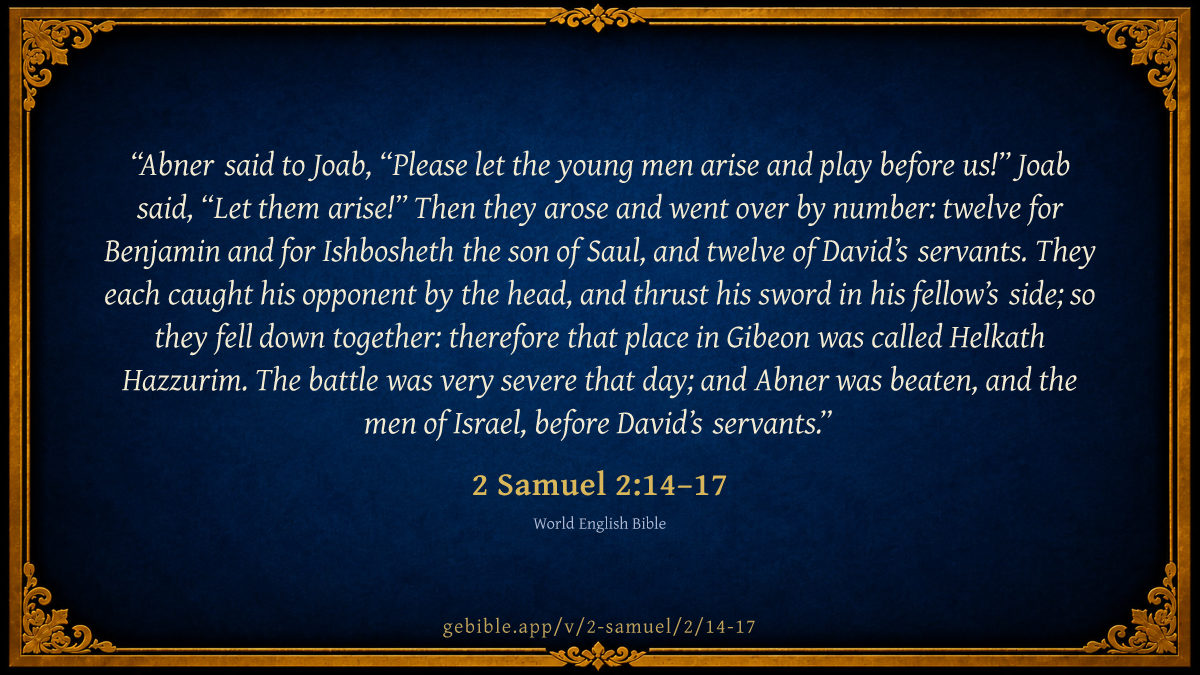
8Now Abner the son of Ner, captain of Saul’s army, had taken Ishbosheth the son of Saul, and brought him over to Mahanaim; 9and he made him king over Gilead, and over the Ashurites, and over Jezreel, and over Ephraim, and over Benjamin, and over all Israel. 10Ishbosheth, Saul’s son, was forty years old when he began to reign over Israel, and he reigned two years. But the house of Judah followed David. 11The time that David was king in Hebron over the house of Judah was seven years and six months. 12Abner the son of Ner, and the servants of Ishbosheth the son of Saul, went out from Mahanaim to Gibeon. 13Joab the son of Zeruiah and David’s servants went out, and met them by the pool of Gibeon; and they sat down, the one on the one side of the pool, and the other on the other side of the pool. 14Abner said to Joab, “Please let the young men arise and play before us!” Joab said, “Let them arise!”
15Then they arose and went over by number: twelve for Benjamin and for Ishbosheth the son of Saul, and twelve of David’s servants. 16They each caught his opponent by the head, and thrust his sword in his fellow’s side; so they fell down together: therefore that place in Gibeon was called Helkath Hazzurim. 17The battle was very severe that day; and Abner was beaten, and the men of Israel, before David’s servants. 18The three sons of Zeruiah were there, Joab, and Abishai, and Asahel: and Asahel was as light of foot as a wild gazelle. 19Asahel pursued Abner; and in going he didn’t turn to the right hand or to the left from following Abner. 20Then Abner looked behind him, and said, “Is that you, Asahel?” He answered, “It is.”

Geneva Bible translators 1599 · Public Domain On vv14, 16, 17 Let us see how they can handle their Weapons.
Let us see how they can handle their Weapons.
Geneva Bible (1599) marginal notes — public domain.
John Trapp 1656 · Public Domain On vv14–17 2Sa 2:14 And Abner said to Joab, Let the…
2Sa 2:14 And Abner said to Joab, Let the young men now arise, and play before us. And Joab said, Let them arise.
Ver. 14. Let the young men now arise, and play before us,] i.e., Spectaculi causa pugnent, let them hack and hew one another, to make us sport; as the sword players did among the Romans, till good Theodosius forbade that bloody pastime, as hateful to God, and abhorred of all good men. At the taking of Tripolis in Barbary, the Turks, having in their hands one John de Chabis, a Frenchman, brought him into the town, and when they had cut off his hands and his nose, put him quick into the ground to the waist, and there, for their pleasure, shot at him with their arrows; and afterwards cut his throat. {a} The Spaniards day by day, for their pleasure, whip the poor Indians with cords, and drop their naked bodies with burning bacon; this being one of the least cruelties they exercise upon those wretches, to make themselves merry in the others’ misery.
Read full note →
Let them arise.] Joab was true touch, as they call it, and soon accepted the challenge: but better he had not; for the issue was bloody. Many martialists, fleshed with such horrid acts and aspects, make little reckoning of bloodshed. O formosum spectaculum! Oh, brave sight! said Hannibal, when he saw a pit full of men’s blood. O rem regiam! Oh, kingly act! said Valesus, when he had slain three hundred men.
{a} Turk. Hist., p. 756.
John Trapp, A Commentary or Exposition upon All the Books of the Old and New Testament (1647–1656) — public domain. Text from a community e-Sword module.
Matthew Poole 1685 · Public Domain On vv14–16 Abner trusting to his greater numbers, offers battle.
Abner trusting to his greater numbers, offers battle.
Play before us, i.e. show their prowess and dexterity in managing their weapons, and fighting together. He speaks like a vain-glorious and cruel man, and a soldier of fortune, that esteemed it a sport to see men wounding and killing one another. So this he designed, partly for their mutual recreation, and trial of skill and valour; and partly that by this occasion they might be engaged in a battle.
Matthew Poole's English Annotations on the Holy Bible (1683–1685) — public domain. Text from a community e-Sword/MySword module.
John Gill 1763 · Public Domain On vv14–17 And Abner said to Joab,.... Perceiving he made no…
And Abner said to Joab,.... Perceiving he made no motion towards an engagement with him, his orders from David being only to act on the defensive, and avoid as much as possible the effusion of blood:
let the young men now arise, and play before us; with their swords after the manner of gladiators or duellers; that it might appear who were best skilled in the use of the sword, and who were the bravest, stoutest, and most courageous; and this he proposed in a way of bravado, and in order to bring on a battle, or to decide the quarrel between them; and this bloody barbarous exercise Abner calls play, as if it was a diversion and pastime to see men wounding and killing one another:
Read full note →
and Joab said, let them arise; he accepted the challenge, not caring to be hectored and bullied by Abner.
John Gill's Exposition of the Whole Bible (1746–1763) — public domain (CC PDM 1.0). Text via the HelloAO Bible API.
John Wesley 1765 · Public Domain On vv14, 16 And play - That is, shew their prowess and…
And play - That is, shew their prowess and dexterity in fighting together. He speaks like a vain-glorious and cruel man, and a soldier of fortune, that esteemed it a sport to see men wounding and killing one another. So this he designed, partly for their mutual recreation and trial of skill; and partly, that by this occasion they might be engaged in a battle. But he is unworthy the name of a man, who is thus prodigal of human blood.
John Wesley, Explanatory Notes Upon the Whole Bible (1754–1765) — public domain. Text via the GEBible commentary corpus.
Adam Clarke 1810 · Public Domain On vv14, 16 Verse 14. Let the young men - play before…
Verse 14. Let the young men - play before us.] This was diabolical play, where each man thrust his sword into the body of the other, so that the twenty-four (twelve on each side) fell down dead together! But this was the signal for that sanguinary skirmish which immediately took place.
Adam Clarke's Commentary on the Bible (1810–1826) — public domain. Text from a community e-Sword/MySword module.
Joseph Benson 1811 · Public Domain On vv14–15 2Sa 2:14. Abner said, Let the young men now…
2Sa 2:14. Abner said, Let the young men now arise, and play before us — That is, show their prowess and dexterity in fighting together, or make trial of their courage and strength, that we may see which of us has the braver soldiers. He speaks like a vain-glorious and cruel man, and a soldier of fortune, that esteemed it a sport to see men wounding and killing one another. So this he designed, partly for their mutual recreation, and trial of skill; and partly, that by this occasion they might be engaged in a battle. But he is unworthy the name of a man who is thus prodigal of human blood.
Joseph Benson's Commentary on the Old and New Testaments (1811–1818) — public domain. Text from a community e-Sword module.
Albert Barnes 1834 · Public Domain On vv14, 16, 17 Play - (Compare Jdg 16:25; 1Sa 18:7). Here, the…
Play - (Compare Jdg 16:25; 1Sa 18:7). Here, the word is applied to the serious game of war, to be played by twelve combatants on each side, with the two armies for spectators.
Albert Barnes' Notes on the Bible (1834–1885) — public domain. Text from a community e-Sword/MySword module.
Haydock's Catholic Bible Commentary 1859 · Public Domain On vv14, 16 Play, like the gladiators with drawn swords, which formed…
Play, like the gladiators with drawn swords, which formed one of the principal diversions at Rome, (Calmet) while it was pagan. This might be considered as a prelude to the ensuing engagement; or like a detachment of twelve on each side, fighting to shew the prowess of their respective armies; as the three Horatii and Curiatii did afterwards, to spare the effusion of blood. But there is no mention that Abner and Joab had authority to agree that these champions should decide the fate of the two kingdoms, (Haydock) whence they are generally accused of ostentation; though the soldiers, not being acquainted with their motives, were obliged to obey. (Tirinus; Menochius)
George Leo Haydock (1774–1849), Haydock's Catholic Family Bible and Commentary, 1859 edition — public domain. Excludes Psalms (Douay-Rheims chapter numbering differs from Protestant) and Deuterocanonical books (Catholic canon only).
Robert Jamieson, A. R. Fausset & David Brown 1871 · Public Domain On v14 Abner said to Joab, Let the young men now…
Abner said to Joab, Let the young men now arise, and play before us--Some think that the proposal was only for an exhibition of a little tilting match for diversion. Others suppose that, both parties being reluctant to commence a civil war, Abner proposed to leave the contest to the decision of twelve picked men on either side. This fight by championship instead of terminating the matter, inflamed the fiercest passions of the two rival parties; a general engagement ensued, in which Abner and his forces were defeated and put to flight.
Jamieson, Fausset & Brown — Commentary Critical and Explanatory on the Whole Bible (1871) — public domain (CC PDM 1.0). Text via the HelloAO Bible API.
Daniel D. Whedon 1874 · Public Domain On vv14, 16, 17 14. Let the young men now arise, and play…
14. Let the young men now arise, and play before us — Implying that the contest between the house of Saul and the house of David should be decided by this action of the young warriors. This would save a needless effusion of blood, and Joab accepted the challenge. שׂחק, to play, would thus mean the war play of single combat, and the bloody consequences showed that this was the understanding of the contending parties.
Daniel D. Whedon (gen. ed.), Commentary on the Old and New Testaments (1874–1909) — public domain. Text from a community e-Sword module.
The Cambridge Bible for Schools and Colleges 1878 · Public Domain On vv14–17 14. Let the young men now arise] “Young men”…
14. Let the young men now arise] “Young men” here means “servants” or “soldiers.” Cp. ch. 2Sa_4:12. Desirous to avoid the horrors of a civil war, which would weaken the whole nation in the face of its common enemy the Philistines, perhaps also prompted by friendly relations with Joab, Abner proposes to decide the day by a combat between two bodies of picked men. The combat of the Horatii and Curiatii, which decided the war between Alba and Rome, affords a parallel in classical story. Livy represents the Alban dictator, Mettius Fuffetius, as urging this plan of ending the war, lest both nations, weakened by the losses of a general battle, should fall into the hands of their common enemy the Etruscans. See Livy I. 23–25.
and play before us] The word “play” is used euphemistically in reference to fighting. There is no indication that a bloodless tournament was intended. Livy calls the combat above referred to “minime gratum spectaculum,” “an exhibition which was by no means an amusement.”
The Cambridge Bible for Schools and Colleges (gen. ed. J. J. S. Perowne; Cambridge University Press, 1878–1918) — public domain. Text from a community e-Sword module.
Ellicott's Commentary for English Readers 1878 · Public Domain On vv14, 16, 17 (14) Let the young men.—To avoid unnecessary bloodshed between…
(14) Let the young men.—To avoid unnecessary bloodshed between the tribes of a common parentage, and also, perhaps, to prevent the weakening of the nation in the face of their common Philistine foe, Abner proposes that the struggle should be decided by a combat between a few champions chosen on either side, and Joab immediately accepts the proposal. Hervey (Speaker’s Commentary) aptly compares this combat to that of the Horatii and Curiatii, under strikingly similar circumstances and with similar results, as described by Livy (I., 100 10:25).
A Bible Commentary for English Readers, edited by Charles John Ellicott (1878–1897) — public domain. Text from a community e-Sword module.
The Pulpit Commentary 1880 · Public Domain On vv14, 16, 17 Let the young men now arise. "Now" is not…
Let the young men now arise. "Now" is not an adverb of time, but is hortative, and therefore rightly translated in the Revised Version, "I pray thee." It is by no means certain that Abner meant that this single combat should decide the war; for similar preludes before a battle are not uncommon among the Arabians, and serve, as this did, to put an end to the mutual unwillingness to begin the onslaught. So, too, games often preceded outbreaks of Scandinavian blood feuds. And this was probably Abner"s object. He was the assailant, but now found that his men shrank from mortal combat with their brethren. There is thus no comparison between this combat and that of the Curiatii and Horatii described in Livy, 1. 10:25. Let them play. The word is grim enough, though intended to gloss over the cruel reality. On each side twelve of the most skilful champions were to be selected, who were to fight in stern earnest with one another, while the rest gazed upon the fierce spectacle. The sight of the conflict would whet their appetite for blood, and their reluctance would give place to thirst for revenge. The request was too thoroughly in accordance with Joab"s temper for him to refuse, and his immediate answer was, Let them arise.
The Pulpit Commentary (1880–1919), ed. H.D.M. Spence-Jones & Joseph S. Exell — public domain. Text from a community e-Sword module.
C. I. Scofield 1917 · Public Domain On v16 i.e. Field of Swords.
Helkathhazzurim
i.e. Field of Swords.
The Scofield Reference Bible (1917 edition), notes by C. I. Scofield — public domain. Text from a community e-Sword module.
unfoldingWord translationNotes 2017 · CC BY-SA 4.0 On vv14, 16
translationWords
Abner
Read full note →
raise
Benjamin
unfoldingWord translationNotes — © Distant Shores Media and the Door43 World Missions Community, licensed CC BY-SA 4.0. Source: git.door43.org/Door43/en_tn.
Tyndale Open Study Notes 2022 · CC BY-SA 4.0 On vv14, 17 2:14 a few of our warriors: In the ancient…
2:14 a few of our warriors: In the ancient world, enemy armies would sometimes choose individuals or small groups to fight each other as representative gladiators—a custom often referred to as champion warfare (see also 1 Sam 17). • fight hand to hand: The Hebrew term usually includes a component of play. A contest of champions might have been seen as a type of high-stakes game. In this instance, it settled nothing; the fighting expanded into a much wider confrontation with heavier casualties (2 Sam 2:17-32).
Tyndale Open Study Notes — © Tyndale Open Resources, licensed CC BY-SA 4.0. Text via the HelloAO Bible API.