
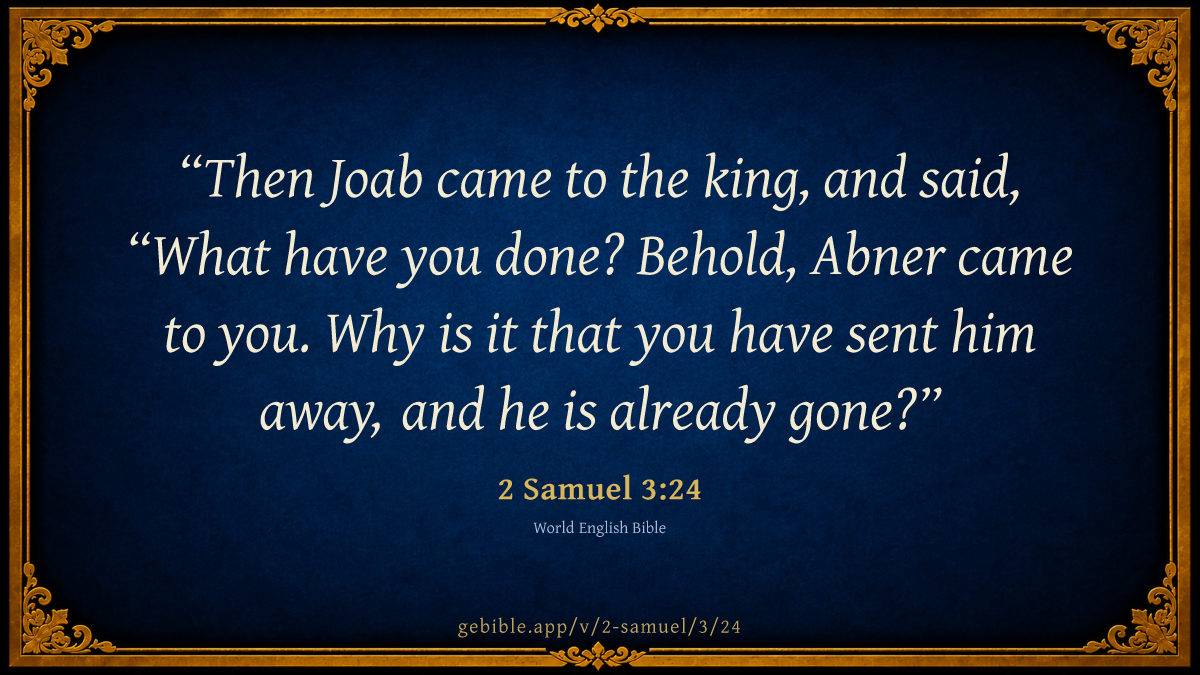
Then Joab came to the king, and said, “What have you done? Behold, Abner came to you. Why is it that you have sent him away, and he is already gone?
Parallel Translations
-
Then Joab came to the king, and said, “What have you done? Behold, Abner came to you. Why is it that you have sent him away, and he is already gone?
-
Then Joab came to the king, and said, What hast thou done? behold, Abner came unto thee; why is it that thou hast sent him away, and he is quite gone?
-
Then Joab came to the king, and said: 'What hast thou done? behold, Abner came unto thee; why is it that thou hast sent him away, and he is quite gone?
Cross-references (5)
Passages linked to 2 Samuel 3:24 in the Treasury of Scripture Knowledge, ordered by reader-vote popularity; verse text shown in World English Bible.
- Numbers 23:11 Balak said to Balaam, “What have you done to me? I took you to curse my enemies, and behold, you have blessed them altogether.”
- 2 Samuel 3:8 Then Abner was very angry about Ishbosheth’s words, and said, “Am I a dog’s head that belongs to Judah? Today I show kindness to Saul’s house your father, to his brothers, and to his friends, and have not delivered you into the hand of David; and yet you charge me today with a fault concerning this woman!
- 2 Samuel 3:39 I am weak today, though anointed king. These men, the sons of Zeruiah are too hard for me. May Yahweh reward the evildoer according to his wickedness.”
- 2 Samuel 19:5-7 Joab came into the house to the king, and said, “Today you have shamed the faces of all your servants, who today have saved your life, and the lives of your sons and of your daughters, and the lives of your wives, and the lives of your concubines; in that you love those who hate you, and hate those who love you. For you have declared today that princes and servants are nothing to you. For today I perceive that if Absalom had lived, and all we had died today, then it would have pleased you well. Now therefore arise, go out, and speak to comfort your servants; for I swear by Yahweh, if you don’t go out, not a man will stay with you this night. That would be worse to you than all the evil that has happened to you from your youth until now.”
- John 18:35 Pilate answered, “I’m not a Jew, am I? Your own nation and the chief priests delivered you to me. What have you done?”
Cross-references from openbible.info (CC BY 4.0)
Explain this verse (12 sources)
Historical commentary, presented as a primary source — not an endorsement.
Private notes
Saved on this device only — never synced or sent anywhere.
Geneva Bible translators 1599 · Public Domain Here appeareth the malicious mind of Joab, who would…
Here appeareth the malicious mind of Joab, who would have had the King to slay Abner for his private grudge.
Geneva Bible (1599) marginal notes — public domain.
John Trapp 1656 · Public Domain 2Sa 3:24 Then Joab came to the king, and…
2Sa 3:24 Then Joab came to the king, and said, What hast thou done? behold, Abner came unto thee; why [is] it [that] thou hast sent him away, and he is quite gone?
Ver. 24. What hast thou done?] q.d., Thou hast done indiscreetly. Joab was ever too bold, blunt, and boisterous with David, which cost him at length the loss of his place. {2Sa 19:13}
John Trapp, A Commentary or Exposition upon All the Books of the Old and New Testament (1647–1656) — public domain. Text from a community e-Sword module.
Matthew Poole 1685 · Public Domain What hast thou done? thou hast committed a great…
What hast thou done? thou hast committed a great oversight, to dismiss so dangerous and mischievous a person when he was in thy hands.
Matthew Poole's English Annotations on the Holy Bible (1683–1685) — public domain. Text from a community e-Sword/MySword module.
John Gill 1763 · Public Domain Then Joab came to the king,.... To the apartment…
Then Joab came to the king,.... To the apartment where he was; perhaps he was told the above at his first entering into the king's palace, by some in waiting, before he came to the king, which filled him with wrath, so that he came to him in a passion:
and said to him, what hast thou done? which was very insolent in a subject to say to his prince:
Read full note →
behold, Abner came unto thee; I have been credibly informed of it, and am assured it is a fact which cannot be denied; he represents it as if he had done a wrong thing to admit him to come to him; but perhaps the great fault was that he had let him go:
why is it that thou hast sent him away, and he is quite gone? or "going, is gone" (e); is clean gone off, when he ought to have been laid hold on as a traitor, and put in irons.
(e) "et abiit eundo", Pagninus, Montanus.
John Gill's Exposition of the Whole Bible (1746–1763) — public domain (CC PDM 1.0). Text via the HelloAO Bible API.
Joseph Benson 1811 · Public Domain 2Sa 3:24. Then Joab came to the king, and…
2Sa 3:24. Then Joab came to the king, and said, What hast thou done? — Upon hearing what had passed, he immediately went to David, in the pride of his success, and of the great spoil he had taken, to expostulate with him upon the folly of receiving Abner in the manner he had done, and placing any confidence in a man who, he signified, had come thither only to betray him. This presumption and insolence David was constrained to endure, because of Joab’s great power with the army and military men.
Joseph Benson's Commentary on the Old and New Testaments (1811–1818) — public domain. Text from a community e-Sword module.
Albert Barnes 1834 · Public Domain Joab saw that if Abner was reconciled to David,…
Joab saw that if Abner was reconciled to David, his own post as second in the state would be forfeited; and then with characteristic unscrupulosity he proceeded to take Abner’s life.
Albert Barnes' Notes on the Bible (1834–1885) — public domain. Text from a community e-Sword/MySword module.
Robert Jamieson, A. R. Fausset & David Brown 1871 · Public Domain JOAB KILLS ABNER. (Sa2 3:22-30)
JOAB KILLS ABNER. (Sa2 3:22-30)
Joab came to the king, and said, What hast thou done?--Joab's knowledge of Abner's wily character might have led him to doubt the sincerity of that person's proposals and to disapprove the policy of relying on his fidelity. But undoubtedly there were other reasons of a private and personal nature which made Joab displeased and alarmed by the reception given to Abner. The military talents of that general, his popularity with the army, his influence throughout the nation, rendered him a formidable rival. In the event of his overtures being carried out, the important service of bringing over all the other tribes to the king of Judah would establish so strong a claim on the gratitude of David, that his accession would inevitably raise a serious obstacle to the ambition of Joab. To these considerations was added the remembrance of the blood feud that existed between them since the death of his brother Asahel (Sa2 2:23). Determined, therefore, to get Abner out of the way, Joab feigned some reason, probably in the king's name, for recalling him, and, going out to meet him, stabbed him unawares; not within Hebron, for it was a city of refuge, but at a noted well in the neighborhood.
Jamieson, Fausset & Brown — Commentary Critical and Explanatory on the Whole Bible (1871) — public domain (CC PDM 1.0). Text via the HelloAO Bible API.
Daniel D. Whedon 1874 · Public Domain 24. What hast thou done — Words of astonishment…
24. What hast thou done — Words of astonishment and rebuke that David should have lost from his grasp the man who had done so much against him.
Daniel D. Whedon (gen. ed.), Commentary on the Old and New Testaments (1874–1909) — public domain. Text from a community e-Sword module.
The Cambridge Bible for Schools and Colleges 1878 · Public Domain 24. he is quite gone] The Sept. reads “and…
24. he is quite gone] The Sept. reads “and he is gone in peace? Dost thou not know the wickedness of Abner,” &c.
The Cambridge Bible for Schools and Colleges (gen. ed. J. J. S. Perowne; Cambridge University Press, 1878–1918) — public domain. Text from a community e-Sword module.
Ellicott's Commentary for English Readers 1878 · Public Domain (24) What hast thou done?—Joab’s somewhat rough remonstrance with…
(24) What hast thou done?—Joab’s somewhat rough remonstrance with David may have been supported by an honest suspicion of Abner, for which there was some ground in Abner’s long opposition to the known Divine will and his present revolt from Ish-bosheth; but there was also a personal enmity, due partly to the fear of being himself supplanted by an older and famous warrior, and partly to the desire to revenge the death of his brother Asahel. Joab seeks to poison David’s mind against Abner, that he may better carry out his revenge.
A Bible Commentary for English Readers, edited by Charles John Ellicott (1878–1897) — public domain. Text from a community e-Sword module.
The Pulpit Commentary 1880 · Public Domain Vers. 24, 25. What hast thou done? David"s secret…
Vers. 24, 25. What hast thou done? David"s secret dealing makes Joab see a personal wrong to himself in the negotiation with Abner. There could be no room, he feels, for both of them in David"s army, and David meant, he supposes, to sacrifice himself. In hot haste, therefore, he rushes into the king"s presence, and reproaches him for what he has done, but covers his personal feelings with professed zeal for his master"s interests. Abner is a mere spy, who has come on a false pretext, and with the real intention of learning David"s going out and coming in, that is, his present manner of life and undertakings. All that thou doest; literally, all that thou art doing; all that is now going on, and thy plans and purposes. Abner would not only judge by what he saw, but in his interview with David would lead him on to talk of his hopes and prospects. David had little time to explain the real object of Abner"s coming, nor was Joab in a mood to listen to anything he said. He had detected his master in secret negotiations, and would regard his excuses as tainted with deceit. And after giving vent to his auger in reproaches, he hurried away to thwart David"s plans by a deed of most base villainy. Had David acted openly, all would have been done with Joab"s consent and approval.
The Pulpit Commentary (1880–1919), ed. H.D.M. Spence-Jones & Joseph S. Exell — public domain. Text from a community e-Sword module.
unfoldingWord translationNotes 2017 · CC BY-SA 4.0 What have you done?
What have you done?
Joab asks this question to rebuke David for letting Abner go in peace. AT: "You should not have done this!" (See: Rhetorical Question)
Read full note →
Why have you sent him away, and he is gone?
Joab asks this question to rebuke David for letting Abner escape. This can be translated as a statement. AT: "Abner was here and you let him leave!" (See: Rhetorical Question)
Do you not know ... everything you are doing?
Joab asks this question to convince David that Abner is plotting against David. AT: "Surely you know ... everything you are doing." (See: Rhetorical Question)
well of Sirah
"Sirah" is the name of a place where the well was located. (See: How to Translate Names)
translationWords
king
know
deceive
messenger
unfoldingWord translationNotes — © Distant Shores Media and the Door43 World Missions Community, licensed CC BY-SA 4.0. Source: git.door43.org/Door43/en_tn.