
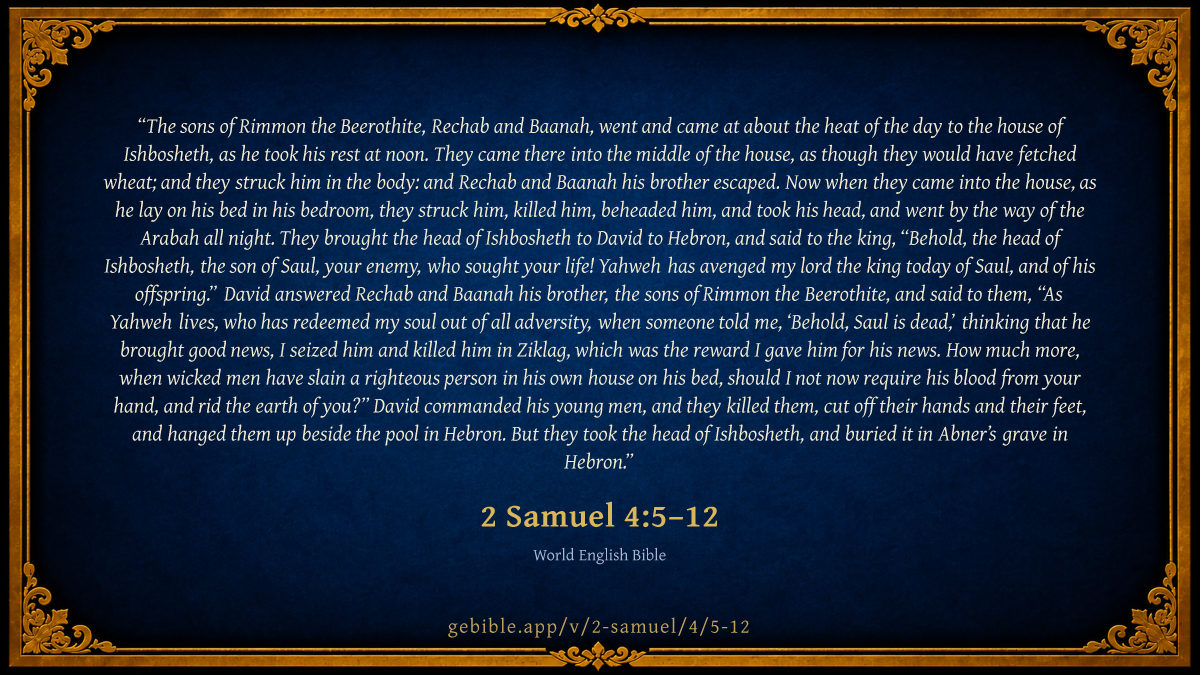
The sons of Rimmon the Beerothite, Rechab and Baanah, went and came at about the heat of the day to the house of Ishbosheth, as he took his rest at noon. They came there into the middle of the house, as though they would have fetched wheat; and they struck him in the body: and Rechab and Baanah his brother escaped. Now when they came into the house, as he lay on his bed in his bedroom, they struck him, killed him, beheaded him, and took his head, and went by the way of the Arabah all night. They brought the head of Ishbosheth to David to Hebron, and said to the king, “Behold, the head of Ishbosheth, the son of Saul, your enemy, who sought your life! Yahweh has avenged my lord the king today of Saul, and of his offspring.”
David answered Rechab and Baanah his brother, the sons of Rimmon the Beerothite, and said to them, “As Yahweh lives, who has redeemed my soul out of all adversity, when someone told me, ‘Behold, Saul is dead,’ thinking that he brought good news, I seized him and killed him in Ziklag, which was the reward I gave him for his news. How much more, when wicked men have slain a righteous person in his own house on his bed, should I not now require his blood from your hand, and rid the earth of you?” David commanded his young men, and they killed them, cut off their hands and their feet, and hanged them up beside the pool in Hebron. But they took the head of Ishbosheth, and buried it in Abner’s grave in Hebron.
Geneva Bible translators 1599 · Public Domain On vv6, 7, 11 They disguised themselves as merchants, which came to buy…
They disguised themselves as merchants, which came to buy wheat.
There is nothing so vile and dangerous, which the wicked will not enterprise in hope of lucre and favor.
Geneva Bible (1599) marginal notes — public domain.
John Trapp 1656 · Public Domain On vv5–12 2Sa 4:5 And the sons of Rimmon the Beerothite,…
2Sa 4:5 And the sons of Rimmon the Beerothite, Rechab and Baanah, went, and came about the heat of the day to the house of Ishbosheth, who lay on a bed at noon.
Ver. 5. Who lay on a bed at noon.] And on his bed was slain sleeping: so true is that
Read full note →
“ Per quod quis peccat, per idem punitur et ipse. ”
It was much he could sleep at all, having so lately lost his Antipater, his Abner; but to sleep at noon, and without a guard, speaketh him both sluggish and secure. He dieth therefore in his sloth, who had lived slothfully all his days: Qualis vita finis ira. {a} Some hold that these two were captains of Ishbosheth’s guard, and thereby had so easy an access unto his person. Queen Elizabeth complained that in trust she had found treason. And Augustus Caesar was wont to say of his own guard, Metuendum est esse sine custode, sed multo magis a custode metuendum est. {b} It is dangerous to be without a guard, and yet more dangerous to have one.
{a} Salian.
{b} Dion., in August.
John Trapp, A Commentary or Exposition upon All the Books of the Old and New Testament (1647–1656) — public domain. Text from a community e-Sword module.
Matthew Poole 1685 · Public Domain On vv5, 6, 7, 8, 9, 11, 12 Either from discontent of mind, as Ahab did, 1Ki…
Either from discontent of mind, as Ahab did, 1Ki 21:4; or from sloth and sensuality, as David seems to have done, 2Sa 11:2.
Matthew Poole's English Annotations on the Holy Bible (1683–1685) — public domain. Text from a community e-Sword/MySword module.
Matthew Henry 1710 · Public Domain On v9 We have here justice done upon the murderers of…
We have here justice done upon the murderers of Ish-bosheth.
I. Sentence passed upon them. There needed no evidence, their own tongues witnessed against them; they were so far from denying the fact that they gloried in it. David therefore shows them the heinousness of the crime, and that blood called for blood from his hand, who was now the chief magistrate, and was by office the avenger of blood. And, perhaps, he was the more vigorous in the prosecution because for reasons of state he had spared Joab: "Shall I not require the blood of the slain at the hand of the slayers, and, since they cannot make restitution, take theirs instead of it?" Observe, 1. How he aggravates the crime, Sa2 4:11. Ish-bosheth was a righteous person, he had done them no wrong, nor designed them any. As to himself, David was satisfied that what opposition he gave him was not from malice, but mistake, from an idea he had of his own title to the crown, and the influence of others upon him, who urged him to put in for it. Note, Charity teaches us to make the best, not only of our friends, but of our enemies, and to think those may be righteous persons who yet, in some instances, do us wrong. I must not presently judge a man a bad man because I think him so to me. David owns Ish-bosheth an honest man, though he had created him a great deal of trouble unjustly. The manner of it much aggravated the crime. To slay him in his own house, which should have been his castle, and upon his bed, when he was in no capacity of making any opposition, this is treacherous and barbarous, and all that is base, and that which the heart of every man who is not perfectly lost to all honour and humanity will rise with indignation at the thought of. Assassinating is confessedly the most odious and villainous way of murdering. Cursed is he that smiteth his neighbour secretly. 2. He quotes a precedent (Sa2 4:10): he had put him to death who had brought him the tidings of the death of Saul, because he thought it would be good tidings to David. Nothing is here said of that Amalekite's helping Saul to kill himself, only of his bringing the tidings of his death, by which it should seem that the story he told was upon enquiry found to be false, and that he lied against his own head. "Now" (says David) "did I treat him as a criminal, and not a favourite" (as he expected), "who brought me Saul's crown, and shall those be held guiltless that bring me Ish-bosheth's head?" 3. He ratifies the sentence with an oath (Sa2 4:9): As the Lord liveth, who hath redeemed my soul out of all adversity. He expresses himself thus resolutely, to prevent the making of any intercession for the criminals by those about him, and thus piously to intimate that his dependence was upon God for the putting of him in possession of the promised throne, and that he would not be beholden to any man to help him to it by any indirect or unlawful practices. God had redeemed him from all adversity hitherto, helped him over many a difficulty and through many a danger, and therefore he would depend upon him to crown and complete his own work. He speaks of his redemption from all adversity as a thing done, though he had many a storm yet before him, because he knew that he who had delivered would deliver. 4. Hereupon he signs a warrant for the execution of these men, Sa2 4:12. This may seem severe, when they intended him a kindness in what they did; but, (1.) He would thus show his detestation of the villany. When he heard that the Lord smote Nabal, he gave thanks (Sa1 25:38, Sa1 25:39), for he is the God to whom vengeance belongeth; but, if wicked men smite Ish-bosheth, they deserve to die for taking God's work out of his hand. (2.) He would thus show his resentment of the great affront they put upon him in expecting that he should patronize and reward it; they could scarcely have done him a greater injury than thus to think him altogether such a one as themselves, one that cared not what blood he waded through to the crown.
Read full note →
II. Execution done. The murderers were put to death according to law, and their hands and feet were hung up; not their whole bodies, the law forbade that; but only their hands and feet, in terrorem - to frighten others, to be monuments of David's justice, and to make that to be taken notice of which would recommend him to the esteem of the people, as a man fit to rule, and that aimed not at his own preferment, nor had any enmity to the house of Saul, but only and sincerely designed the public welfare. But what a confusion was this to the two murderers! What a horrid disappointment! And such those will meet with who think to serve the interests of the Son of David by any immoral practices, by war and persecution, fraud and rapine, who, under colour of religion, murder princes, break solemn contracts, lay countries waste, hate their brethren, and cast them out, and say, Let the Lord be glorified, kill them, and think they do God good service. However men may canonize such methods of serving the church and the catholic cause, Christ will let them know, another day, that Christianity was not intended to destroy humanity; and those who thus think to merit heaven shall not escape the damnation of hell.
Matthew Henry's Commentary on the Whole Bible (1708–1710) — public domain (CC PDM 1.0). Text via the HelloAO Bible API.
John Gill 1763 · Public Domain On vv5–11 And they came thither into the midst of the…
And they came thither into the midst of the house,.... They not only came unto it, but entered into it, and went into the inmost part of it; the guards being asleep also perhaps, or not on duty, so that there were none to obstruct them; or if there were, they deceived them, since they went in
as though they would have fetched wheat; out of the king's granaries, for the payment and support of the soldiers under them, who in those days were paid in corn, as were the Roman soldiers (y) in later times; and these granaries might not only be in the king's house, but near his bedchamber; for in those ancient ages of simplicity there was not such grandeur in the courts of princes as now; the Targum is,"as sellers of wheat,''
Read full note →
in the guise and habit of such persons, pretending they came to sell wheat to the king's purveyors, who were at the granaries; or, as others interpret it, they went in along with the wheat merchants as if they belonged to them, and so found their way to the king's bedchamber:
and smote him under the fifth rib; See Gill on Sa2 2:23,
and Rechab and Baanah his brother escaped; they got out of the palace after they had committed the murder undiscovered and unsuspected.
(y) Vid. Valtrinum de re militar. Roman. l. 3. c. 15. p. 236.
John Gill's Exposition of the Whole Bible (1746–1763) — public domain (CC PDM 1.0). Text via the HelloAO Bible API.
John Wesley 1765 · Public Domain On vv6, 12 Fetched wheat - Which was laid up in publick…
Fetched wheat - Which was laid up in publick granaries in the king's house, and was fetched thence by the captains and commanders of the army for the pay of their soldiers, who, in those ancient times were not paid in money, but in corn. Upon this pretense they were admitted into the house, and so went from room to room, to the place where the king lay.
John Wesley, Explanatory Notes Upon the Whole Bible (1754–1765) — public domain. Text via the GEBible commentary corpus.
Adam Clarke 1810 · Public Domain On vv5, 6, 8, 9, 10, 11, 12 Verse 5. Lay on a bed at noon.] It…
Verse 5. Lay on a bed at noon.] It is a custom in all hot countries to travel or work very early and very late, and rest at noonday, in which the heat chiefly prevails.
Adam Clarke's Commentary on the Bible (1810–1826) — public domain. Text from a community e-Sword/MySword module.
Joseph Benson 1811 · Public Domain On vv5, 7, 9, 11, 12 2Sa 4:5-6. Who lay on a bed at noon…
2Sa 4:5-6. Who lay on a bed at noon — As the manner was, and still continues to be, in hot countries. As though they would have fetched wheat — Which was laid up in public granaries in the king’s house, and was fetched thence by the captains and commanders of the army for the pay of their soldiers, who, in those ancient times, were not paid in money, but in corn. Upon this pretence they were admitted into the house, and so went from room to room to the place where the king lay.
Joseph Benson's Commentary on the Old and New Testaments (1811–1818) — public domain. Text from a community e-Sword module.
Albert Barnes 1834 · Public Domain On vv5, 6, 12 Lay on a bed at noon - Render, “was…
Lay on a bed at noon - Render, “was taking his midday rest,” according to the custom of hot countries.
Albert Barnes' Notes on the Bible (1834–1885) — public domain. Text from a community e-Sword/MySword module.
Haydock's Catholic Bible Commentary 1859 · Public Domain On vv5, 6, 7, 8, 11, 12 At noon, "to divide the day," as Varro (iii.…
At noon, "to divide the day," as Varro (iii. 2,) writes. This custom is very prevalent in hot countries. --- And the, &c., is all omitted in Hebrew and in most ancient manuscripts of St. Jerome’s version. It is taken from the Septuagint, (Calmet) who do not notice any farther the taking ears of corn, ver. 6. (Haydock) --- Probably the Hebrew had this sentence formerly. (Du Hamel) --- It was customary to have women to keep the doors; (Matthew xxvi. 69,) and they were often employed in cleansing wheat. Petronius says, in lance argentea pisum purgabat. (Calmet) --- The ears of corn, hardly ripe, were cleansed, and used as a delicious food. (Tirinus) (1 Kings xvii. 17.) (Sanctius)
George Leo Haydock (1774–1849), Haydock's Catholic Family Bible and Commentary, 1859 edition — public domain. Excludes Psalms (Douay-Rheims chapter numbering differs from Protestant) and Deuterocanonical books (Catholic canon only).
Robert Jamieson, A. R. Fausset & David Brown 1871 · Public Domain On vv5, 7, 8, 12 Rechab and Baanah went and came about the heat…
Rechab and Baanah went and came about the heat of the day to the house of Ish-bosheth, &c.--It is still a custom in the East to allow their soldiers a certain quantity of corn, together with some pay; and these two captains very naturally went to the palace the day before to fetch wheat, in order to distribute it to the soldiers, that it might be sent to the mill at the accustomed hour in the morning.
Jamieson, Fausset & Brown — Commentary Critical and Explanatory on the Whole Bible (1871) — public domain (CC PDM 1.0). Text via the HelloAO Bible API.
Daniel D. Whedon 1874 · Public Domain On vv5, 6, 7, 8, 11, 12 5. Lay on a bed at noon — A…
5. Lay on a bed at noon — A common custom in the East. “In Arabia it is so hot in July and in August, that, except in a case of pressing necessity, nobody goes out from eleven in the morning till three in the afternoon. The Arabs seldom work during this time; they employ it commonly in sleeping in a vault into which the air is let from above.” — Harmer’s Observations.
Daniel D. Whedon (gen. ed.), Commentary on the Old and New Testaments (1874–1909) — public domain. Text from a community e-Sword module.
The Cambridge Bible for Schools and Colleges 1878 · Public Domain On vv5–12 5. to the house of Ish-bosheth] At Mahanaim (ch.…
5. to the house of Ish-bosheth] At Mahanaim (ch. 2Sa_2:8).
who lay on a bed at noon] Or, as he was taking his midday sleep, or siesta, according to the usual custom of hot countries. They chose an hour when Ish-bosheth would be alone and defenceless.
The Cambridge Bible for Schools and Colleges (gen. ed. J. J. S. Perowne; Cambridge University Press, 1878–1918) — public domain. Text from a community e-Sword module.
Ellicott's Commentary for English Readers 1878 · Public Domain On vv5–12 (5) Who lay on a bed at noon—according to…
(5) Who lay on a bed at noon—according to the custom in hot countries of taking a siesta at midday. Ish-bosheth’s bed was, of course, in the coolest and most retired part of the house.
A Bible Commentary for English Readers, edited by Charles John Ellicott (1878–1897) — public domain. Text from a community e-Sword module.
The Pulpit Commentary 1880 · Public Domain On vv5, 6, 8, 9, 11, 12 Vers. 5-8. (MAHANAIM.)
Vers. 5-8. (MAHANAIM.)
Assassins.
Read full note →
they brought the head of Ishbosheth unto David to Hebron" (ver. 8).
1. What useful purpose can the record of the atrocious deeds of such men serve? To throw light upon the condition of the age in which they occurred. To confirm inspired testimony concerning human depravity. (Ps 14) To exhibit the tendency of the evil principles and passions by which these men were actuated, and incite hatred and abhorrence of them. To show that the wickedness of the wicked is subject to restraint and returns upon their own heads in significant punishment. To make us grateful for our preservation from crime and from calamity; thankful for the improved condition of society, and zealous for its farther advancement.
2. The crime of the two brothers, Baanah and Rechab, which has given them an infamous immortality, was not an ordinary murder. What their former course had been, and whether they were influenced by any other motive besides the love of gain, we know not. But in taking away the life of the head of their tribe, the ruler under whom they held their position, and in their subsequent conduct, they acted disloyally, ungratefully, deceitfully, basely. Notice their
I DELIBERATE TREASON. Having lost the feeling of reverence and obligation, they marked the helplessness of Ishbosheth, and resolved to take advantage of it; consulted together as to the time and means of effecting their design; "went, and came about the heat of the day," etc. (ver. 5); "and behold, the woman who kept the door of the house winnowed wheat, and she slumbered and slept. And the brothers Rechab and Baanah got through unobserved," etc. (LXX).
1. In proportion to the duty of men to do good to others is their guilt indoing them evil.
2. Premeditated sin greatly aggravates its guilt.
3. Those whose hearts are set on crime are lured on by circumstances to itscommission.
II HEARTLESS CRUELTY. "He lay on his bed in his bed chamber," taking his midday siesta, "and they smote him" etc. (ver. 7). Men of violence, with more than the ordinary fierceness of their tribe, they "murdered sleep, the innocent sleep," without pity and without compunction, being "past feeling;" escaped with their ghastly trophy; and "gat them away through the plain of the Jordan all night" to Hebron (a distance of sixty miles), knowing not that they were swiftly pursued by nemesis with unerring aim, and hurrying to their doom. (Act_28:4)
III HYPOCRITICAL MEANNESS. "Behold the head of Ishbosheth thine enemy," etc. (ver. 8). In order to gain the favour of David they hesitated not to blacken the character of their former master by attributing to him feelings of personal revenge; called him their lord the king; and represented their crime as an act of judgment performed by them under the sanction of Jehovah. How often do ungodly men profanely and hypocritically use the name of God when it suits their purpose; and even paint their shameful villainies as praiseworthy virtues! "Hypocrisy is the homage which vice pays to virtue.
IV MERCENARY SELFISHNESS. Like the Amalekite, (2Sa_1:2) they sought, not David"s welfare, but their own interest (ver. 10). Hence "their feet were swift to shed blood" (Isa_59:7; Rom_3:9-18) and "their mouth was fall of deceit". (Psa_10:3-10) "Cursed be he that taketh reward to slay an innocent person". (Deu_27:26) For thirty pieces of silver Judas betrayed the Lord.
V SELF-BLINDED MISJUDGMENT. They were probably acquainted with the manner in which Abner had been treated (2Sa_3:20) and with the impunity of his murderer; and not unnaturally supposed that whatever promoted the interests of David would be pleasing to him. The nature of the wicked is ever to measure others by themselves. Their ruling motive gives its colouring to their views of everything, and leads them to attribute to the same motive actions which are due to one entirely different. Their delusion is sometimes suddenly dispelled, and they fall into the pit which they have digged. (Psa_7:15 Psa_37:15) "Hell is truth discovered too late.
VI JUSTLY DESERVED DOOM. (Ver. 12.) "David acted with strict justice in this case also, not only to prove to the people that he had neither commanded nor approved the murder, but from heartfelt abhorrence of such crimes and to keep his conscience void of offence toward God and toward man" (Keil). "Indeed, in a war of five years" continuance, which followed upon Saul"s death, David never lifted up his sword against a subject; and at the end of it he punished no rebel; he remembered no offence but the murder of his rival." "Though Mephibosheth (the next avenger of blood) was lame and could not overtake them, yet God"s justice followed and punished them when they little expected" (Wordsworth). D.
The Pulpit Commentary (1880–1919), ed. H.D.M. Spence-Jones & Joseph S. Exell — public domain. Text from a community e-Sword module.
The Biblical Illustrator 1887 · Public Domain On vv5, 9 And the sons of Rimmon the Beerothite, Rechab, and…
2Sa_4:5-12
And the sons of Rimmon the Beerothite, Rechab, and Baanah.
Read full note →
The death of Ishbosheth
I. The motives that induced those two traitors to murder Ishbosheth were:
1. Abners death had disabled him for any royal duty.
2. All the tribes were in a confusion to hear their peacemaker was slain; hereupon they now doubted of obtaining Davids favour.
3. None of Sauls house (beside concubine sons incapable of the crown) were alive to revenge Ishbosheths murder, save only Mephibosheth.
4. These two traitors, therefore, thought that by their removing useless Ishbosheth out of Davids way the Crown of the whole kingdom must needs come to him without any contradiction.
II. What reception these two traitors found with David when they presented Ishbosheths head to him.
1. David abhors the villany, and resolves with an oath to execute the villains.
2. Hereupon David justly commanded their execution, and cut off their hands that had done the deed, and their feet that carried them away with this present. (C. Ness.)
Assassination of Ishbosheth
The Septuagint has the following entirely different rendering, which is found also in some MSS. of the Vulgate, in addition to the rendering of the present Hebrews text, but apparently was not retained by Jerome himself. And behold the portress of the house was cleaning wheat, and she slumbered and slept; and the brothers Rechab and Baanah came unobserved into the house. Now Ishbosheth was sleeping on the bed in his chamber: and they smote him, etc. This also explains how the murderers entered unobserved. The female slave who watched the door (Joh_18:16, Act_12:13) had fallen asleep over her task of sifting the wheat, and there was no one to give the alarm. (A. F. Kirkpatrick, M. A.)
The end of weakling
Here lies what was once a bar of iron, but the joint action of air and water has reduced it to a bar of rust. It has now no strength, and consequently no value. To how many varied and useful purposes it might have been put some years ago, and in its work have found its strength, beauty and preservation; but it is too late now; it will soon be blended with the earth upon which it passively lies, a striking emblem of the man who refuses to face the hammer and anvil of active life and honest work; who flies from the purifying fire of lifes adversities, and who will fight no battle for truth and the higher interests of his soul. Gifted only with powers which properly cultivated and employed would have blessed myriads, and opportunities for good which an angel might have envied, be allows the former to run waste and the latter to pass unheeded away, until corroded and worn down by his own inanition he sinks by degrees into that grave of mental and physical imbecility which has swallowed up its myriads, and which is too:frequently but the dark passage to a more terrible death.
The Biblical Illustrator, edited by Joseph S. Exell (c. 1880s–1900s) — public domain. Text from a community e-Sword module.
C. I. Scofield 1917 · Public Domain On v9 (See Scofield "Isa 59:20") See Scofield "Exo 14:30".
redeemed
(See Scofield "Isa 59:20") See Scofield "Exo 14:30".
The Scofield Reference Bible (1917 edition), notes by C. I. Scofield — public domain. Text from a community e-Sword module.
Paul E. Kretzmann 1924 · Public Domain On v9 The Murder Avenged
The Murder Avenged
v. 9. And David answered Rechab and Baanah, his brother, the sons of Rimmon, the Beerothite, and said unto them, As the Lord liveth, who hath redeemed my soul out of all adversity, from all the suffering with which he had been afflicted, thus putting him beyond the necessity of freeing himself from his enemies by crime,
Read full note →
v. 10. when one told me, saying, Behold, Saul is dead, namely, the Amalekite who came to Ziklag, 2Sa 1:2, thinking to have brought good tidings, literally, "and he was as a bringer of good tidings in his own eyes," I took hold of him and slew him in Ziklag, who thought that I would have given him a reward for his tidings, or, in order to give him the reward, to inflict on him the punishment which he deserved;
v. 11. how much more, when wicked men have slain a righteous person in his own house upon his bed? Ishbosheth, although connected with a wrong cause, was himself without falsehood and blameless; he was not out on a raiding expedition or engaged in anything wrong, but was at home, doing no one any harm. Shall I not, therefore, now require his blood of your hand, God Himself being the chief avenger of blood and the king His instrument in carrying out justice upon the murderers, and take you away from the earth?
v. 12. And David commanded his young men, and they slew them, and cut off their hands, which had committed the murder, and their feet, which had hurried after the reward, and hanged them up over the pool in Hebron, a public place visited by many people, as a testimony to David’s just severity against criminals of this kind. But they took the head of Ishbosheth, which the murderers had brought along as a trophy of their deed, and buried it in the sepulcher of Abner in Hebron. Note: As David finally subdued all his enemies who challenged his right to be king over Israel, so Christ, the Son of David, having conquered all enemies of mankind, will finally obtain the eternal victory.
Paul E. Kretzmann, Popular Commentary of the Bible (1921–1924) — public domain. Text from a community e-Sword module.
unfoldingWord translationNotes 2017 · CC BY-SA 4.0 On vv5, 8, 11 General Information:
General Information:
The story returns to the actions of Rechab and Baanah who were introduced in 2 Samuel 4:2.
Read full note →
the heat of the day
the middle of the day, the part of the day when it is the hottest
sifting wheat
"cleaning chaff from wheat"
translationWords
son
Rimmon
rest
wheat
cut off
Arabah
unfoldingWord translationNotes — © Distant Shores Media and the Door43 World Missions Community, licensed CC BY-SA 4.0. Source: git.door43.org/Door43/en_tn.
Tyndale Open Study Notes 2022 · CC BY-SA 4.0 On vv6, 8, 9, 12 4:6 Recab and Baanah believed they would gain David’s…
4:6 Recab and Baanah believed they would gain David’s favor by committing this treacherous act.
Tyndale Open Study Notes — © Tyndale Open Resources, licensed CC BY-SA 4.0. Text via the HelloAO Bible API.