
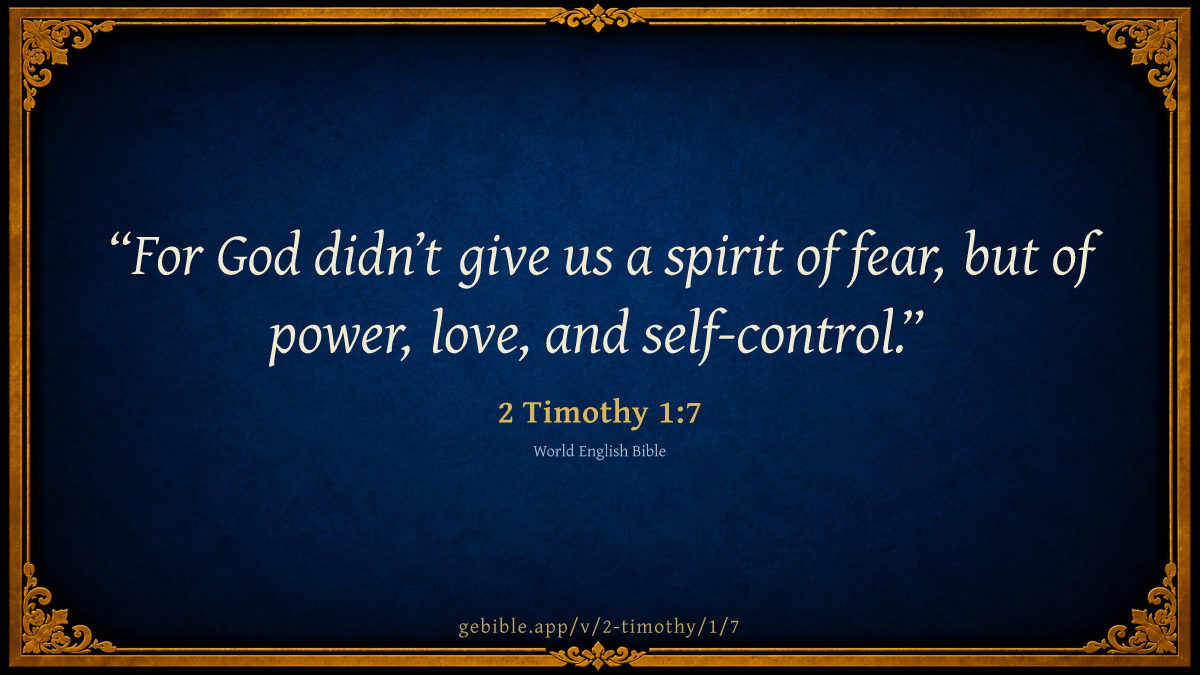
For God didn’t give us a spirit of fear, but of power, love, and self-control.
Parallel Translations
-
For God didn’t give us a spirit of fear, but of power, love, and self-control.
-
For god hath not geven to vs the sprete of feare: but of power and of love and of sobrenes of mynde.
-
For God hath not giuen to vs the Spirite of feare, but of power, and of loue, and of a sound minde.
Examined in Scripture Analysis
Contradictions (1)
Questions where the Bible appears to say two different things, with the passages on each side set together.
Cross-references (27)
Passages linked to 2 Timothy 1:7 in the Treasury of Scripture Knowledge, ordered by reader-vote popularity; verse text shown in World English Bible.
- Romans 8:15 For you didn’t receive the spirit of bondage again to fear, but you received the Spirit of adoption, by whom we cry, “Abba! Father!”
- 1 John 4:18 There is no fear in love; but perfect love casts out fear, because fear has punishment. He who fears is not made perfect in love.
- John 14:27 Peace I leave with you. My peace I give to you; not as the world gives, I give to you. Don’t let your heart be troubled, neither let it be fearful.
- Galatians 5:22 But the fruit of the Spirit is love, joy, peace, patience, kindness, goodness, faith,
- Luke 10:19 Behold, I give you authority to tread on serpents and scorpions, and over all the power of the enemy. Nothing will in any way hurt you.
- Acts 1:8 But you will receive power when the Holy Spirit has come upon you. You will be witnesses to me in Jerusalem, in all Judea and Samaria, and to the uttermost parts of the earth.”
- Zechariah 4:6 Then he answered and spoke to me, saying, “This is Yahweh’s word to Zerubbabel, saying, ‘Not by might, nor by power, but by my Spirit,’ says Yahweh of Armies.
- Proverbs 2:7 He lays up sound wisdom for the upright. He is a shield to those who walk in integrity,
- Proverbs 8:14 Counsel and sound knowledge are mine. I have understanding and power.
- Romans 5:5 and hope doesn’t disappoint us, because God’s love has been poured into our hearts through the Holy Spirit who was given to us.
- Hebrews 2:15 and might deliver all of them who through fear of death were all their lifetime subject to bondage.
- Acts 20:24 But these things don’t count; nor do I hold my life dear to myself, so that I may finish my race with joy, and the ministry which I received from the Lord Jesus, to fully testify to the Good News of the grace of God.
- 1 Corinthians 2:4 My speech and my preaching were not in persuasive words of human wisdom, but in demonstration of the Spirit and of power,
- Micah 3:8 But as for me, I am full of power by Yahweh’s Spirit, and of judgment, and of might, to declare to Jacob his disobedience, and to Israel his sin.
- Luke 24:49 Behold, I send out the promise of my Father on you. But wait in the city of Jerusalem until you are clothed with power from on high.”
- Psalms 119:80 Let my heart be blameless toward your decrees, that I may not be disappointed.
- Acts 10:38 even Jesus of Nazareth, how God anointed him with the Holy Spirit and with power, who went about doing good and healing all who were oppressed by the devil, for God was with him.
- Acts 21:13 Then Paul answered, “What are you doing, weeping and breaking my heart? For I am ready not only to be bound, but also to die at Jerusalem for the name of the Lord Jesus.”
- 1 Peter 1:22 Seeing you have purified your souls in your obedience to the truth through the Spirit in sincere brotherly affection, love one another from the heart fervently,
- 2 Corinthians 5:13-14 For if we are beside ourselves, it is for God. Or if we are of sober mind, it is for you. For the love of Christ constrains us; because we judge thus, that one died for all, therefore all died.
- Acts 6:8 Stephen, full of faith and power, performed great wonders and signs among the people.
- Acts 9:22 But Saul increased more in strength, and confounded the Jews who lived at Damascus, proving that this is the Christ.
- Colossians 1:8 who also declared to us your love in the Spirit.
- Luke 8:35 People went out to see what had happened. They came to Jesus and found the man from whom the demons had gone out, sitting at Jesus’ feet, clothed and in his right mind; and they were afraid.
- Acts 26:25 But he said, “I am not crazy, most excellent Festus, but boldly declare words of truth and reasonableness.
- Luke 15:17 But when he came to himself he said, ‘How many hired servants of my father’s have bread enough to spare, and I’m dying with hunger!
- Acts 26:11 Punishing them often in all the synagogues, I tried to make them blaspheme. Being exceedingly enraged against them, I persecuted them even to foreign cities.
Cross-references from openbible.info (CC BY 4.0)
Explain this verse (18 sources)
Historical commentary, presented as a primary source — not an endorsement.
Private notes
Saved on this device only — never synced or sent anywhere.
John Calvin 1540 · Public Domain 7 For God hath not given to us a…
7 For God hath not given to us a spirit of cowardice It is a confirmation of what he had said immediately before; and thus he continues to urge Timothy to display the power of the gifts which he had received. He makes use of this argument, that God governs his ministers by the Spirit of power, which is the opposite of cowardice. Hence it follows, that they ought not to lie down through slothfulness, but, sustained by great confidence and cheerfulness, should exhibit and display, by visible effects, that power of the Spirit.
The following passage occurs in the Epistle to the Romans:
Read full note →
“For we have not received a spirit of bondage, to be again in terror; but we have received the spirit of adoption, by which we cry, Abba, Father.” (Romans 8:15.)
That passage is, at first sight, nearly similar to this; but yet the context shews that the meaning is different. There he treats of the confidence of adoption which all believers have; but here he speaks particularly about ministers, and exhorts them, in the person of Timothy, to arouse themselves actively to deeds of valor; because God does not wish them to perform their office in a cold and lifeless manner, but to press forward powerfully, relying on the efficacy of the Spirit.
But of power, and of love, and of soberness Hence we are taught, first, that not one of us possesses that firmness and unshaken constancy of the Spirit, which is requisite for fulfilling our ministry, until we are endued from heaven with a new power. And indeed the obstructions are so many and so great, that no courage of man will be able to overcome them. It is God, therefore, who endues us with “the spirit of power;” for they who, in other respects, give tokens of much strength, fall down in a moment, when they are not upheld by the power of the Divine Spirit.
Secondly, we gather from it, that they who have slavish meanness and cowardice, so that they do not venture to do anything in defense of the truth, when it is necessary, are not governed by that Spirit by whom the servants of Christ are guided. Hence it follows, that there are very few of those who bear the title of ministers, in the present day, who have the mark of sincerity impressed upon them; for, amongst a vast number, where do we find one who, relying on the power of the Spirit, boldly despises all the loftiness which exalts itself against Christ? Do not almost all seek their own interest and their leisure? Do they not sink down dumb as soon as any noise breaks out? The consequence is, that no majesty of God is seen in their ministry. The word Spirit is here employed figuratively, as in many other passages.
But why did he afterwards add love and soberness? In my opinion, it was for the purpose of distinguishing that power of the Spirit from the fury and rage of fanatics, who while they rush forward with reckless impulse, fiercely boast of having the Spirit of God. For that reason he expressly states that this powerful energy is moderated by “soberness and love,” that is, by a calm desire of edifying. Yet Paul does not deny that prophets and teachers were endued with the same Spirit before the publication of the gospel; but he declares that this grace ought now to be especially powerful and conspicuous under the reign of Christ.
John Calvin's Commentaries (1540-1563) — public domain. Text from the Calvin Translation Society English edition (1840s-50s) via the Christian Classics Ethereal Library (ccel.org). Calvin's coverage is partial (roughly two-thirds of the Bible); uncommented books and verses are honest gaps, never fabricated. The 19th-century editor's footnotes and remarks are omitted so the notes are faithfully Calvin's own voice.
Geneva Bible translators 1599 · Public Domain To pierce us through, and terrify us, as men…
To pierce us through, and terrify us, as men whom the Lord will destroy.
Geneva Bible (1599) marginal notes — public domain.
John Trapp 1656 · Public Domain 7 For God hath not given us the spirit…
7 For God hath not given us the spirit of fear; but of power, and of love, and of a sound mind.
Ver. 7. The spirit of fear] δειλειας, called elsewhere the spirit of bondage, δουλειας, Rom 8:15. The law will convince the judgment; but it is the gospel that convinceth the lust and the affection.
Read full note →
Of power and of a sound mind] These two fitly stand together. Sin unrepented of, lies rotting at the heart, and by rotting weakeneth it, as a rotten rag hath no strength.
John Trapp, A Commentary or Exposition upon All the Books of the Old and New Testament (1647–1656) — public domain. Text from a community e-Sword module.
Matthew Poole 1685 · Public Domain For God hath not given us the spirit of…
For God hath not given us the spirit of fear: fear in this place signifieth fearfuluess, or cowardice, or poorness of spirit, in opposition to that holy fortitude which becomes ministers; this, he saith, is none of the gifts of the Holy Spirit, and proceedeth not from God.
But of power: by power he means Christian courage and fortitude, not declining duty because of danger threatening us in the performance, but enabling us to encounter the greatest dangers and difficulties.
Read full note →
And of love; love to God, and to the souls of his people; love so strong as to constrain us to be willing to lay down our lives for Christ, and for his church and people.
And of a sound mind; swfronismou we translate it a sound mind; others, sobriety; others, a calm and quiet mind. A sound mind, in the ordinary notion of it, for a judgment sound in the faith, is requisite to it minister of the gospel. Sobriety is the gift of the Spirit: sobriety is a very general term, and signifies the moderation and government of our passions; that which seems to be here meant is such a govermnent, and composure of spirit, that nothing shall deter us from the discharge of our duty; and the term sound mind, opposed to a meak and sickly mind, staggering at every danger, may well enough express the apostle’s sense.
Matthew Poole's English Annotations on the Holy Bible (1683–1685) — public domain. Text from a community e-Sword/MySword module.
William Burkitt 1703 · Public Domain Here our apostle exhorts Timothy to an holy courage…
Here our apostle exhorts Timothy to an holy courage and undaunted resolution in the execution of his office. As if he had said, "Be not discouraged by persection: for God hath not given us, his messengers, the spirit of fear, but of courage and fortitude; fearless we are of the frowns of men: Also the spirit of love, love to God and the souls of men, which will make the ministers of God indefatigable in their endeavours for the good of souls; Likewise the spirit of a sound mind, which enables God’s ministers to curb their passions, inordinate lusts, desires, and perturbations of mind; an admirable spirit to know when to be angry and severe, and when to be mild and gentle."
Learn hence, That love is the genuine principle of obedience, and ought to be that frame of spirit, that inward affection of mind, from whence all our services to God and our neighbour do proceed.
Read full note →
Thus having fortified Timothy against fear, in the seventh verse, he next fortifies him against shame, in the eighth verse: "Be not thou ashamed of the testimony of our Lord; that is, of giving testimony of the gospel of our Lord, whether by preaching of it, or suffering for it; Nor be ashamed of me his prisoner: for I do not suffer as a malefactor; nay, be thou a cheerful partaker of the same sufferings as myself, and for the same cause with myself, according to the power of God; that is, being strengthened with the almighty power of God."
Learn hence, That the ministers of the gospel are to take great care that they be always ready to suffer reproach for the gospel, but that they never be a reproach unto the gospel. Suffering for Christ will be sweet, if it be not imbittered by sinning against Christ.
William Burkitt's Expository Notes on the New Testament (1700–1703) — public domain. Text from a community e-Sword module.
John Gill 1763 · Public Domain For God hath not given us the spirit of…
For God hath not given us the spirit of fear,.... A pusillanimous, cowardly spirit, so as to be afraid of men or devils, of what they will say or do; and so as to be discouraged in, sink under, or be deterred from the work of the Lord, the preaching of the Gospel, opposing the errors of false teachers, and reproving men for their sins, and doing other parts of the ministerial function; such a spirit is not from God, and such a fear brings a snare:
but of power, and such is the Spirit of God, who is called "power from high"; Luk 24:49 by which the minds of Christ's servants are fortified against reproaches and persecutions for his sake, and are strengthened to resist Satan's temptations, to endure hardness as good soldiers of Christ, to quit themselves like men, in opposition to false teachers, and to do the will and work of God:
Read full note →
and of love; to God, and Christ, and his church, and which is a fruit of the Holy Spirit; and such who have it seek not their own ease and credit, but the glory of God, the interest of Christ, and the good of souls; and having such a spirit, and fired with such love, they are not easily intimidated by the adversary;
and of a sound mind: in the principles and doctrines of the Gospel; and which shows itself in a prudent conduct and behaviour; in sobriety, moderation, temperance, purity, and honesty; all which may be signified by the word here used: and these who have such dispositions and qualities from God, will not easily give way to the enemies of religion, or decline their duty for fear of them.
John Gill's Exposition of the Whole Bible (1746–1763) — public domain (CC PDM 1.0). Text via the HelloAO Bible API.
John Wesley 1765 · Public Domain And let nothing discourage thee, for God hath not…
And let nothing discourage thee, for God hath not given us - That is, the spirit which God hath given us Christians, is not the spirit of fear - Or cowardice. But of power - Banishing fear. And love and sobriety - These animate us in our duties to God, our brethren, and ourselves. Power and sobriety are two good extremes. Love is between, the tie and temperament of both; preventing the two bad extremes of fearfulness and rashness. More is said concerning power, ver. 8; concerning love, chap. ii, 14, &c.; concerning sobriety, chap. iii, 1, &c.
John Wesley, Explanatory Notes Upon the Whole Bible (1754–1765) — public domain. Text via the GEBible commentary corpus.
Adam Clarke 1810 · Public Domain Verse 7. God hath not given us the spirit…
Verse 7. God hath not given us the spirit of fear] Here is an allusion to the giving of the law on mount Sinai. This was communicated with such terrible majesty as to engender fear in all the Israelites: even Moses, on the occasion, did exceedingly fear and tremble. The Gospel was ushered in, in a much milder manner; every thing was placed on a level with the human intellect; and within reach of every human spirit. Nothing was terrific, nothing forbidding; but all was inviting. The very spirit and genius of it was a spirit of power, of love, and of a sound mind.
Instead of δειλιας, fear, some MSS. and versions have δουλειας, servitude or bondage; God hath not given unto us the spirit of BONDAGE-but of power, δυναμεως, to work miracles, to confound enemies, to support us in trials, and enable us to do that which is lawful and right in his sight. And of love, which enables us to hear, believe, hope, and endure all things; and is the incentive to all obedience. Of a sound mind, σωφρονισμου, of self-possession and government, according to some. But a sound mind implies much more; it means a clear understanding, a sound judgment, a rectified will, holy passions, heavenly tempers; in a word, the whole soul harmonized in all its powers and faculties; and completely regulated and influenced so as to think, speak, and act aright in all things. The apostle says, God hath given the spirit of these things; they are not factitious; they are not assumed for times and circumstances; they are radical powers and tempers; each produced by its proper principle.
Adam Clarke's Commentary on the Bible (1810–1826) — public domain. Text from a community e-Sword/MySword module.
Albert Barnes 1834 · Public Domain For God hath not given us the spirit of…
For God hath not given us the spirit of fear - A timorous and servile spirit. This is said in order to encourage Timothy, who was not improbably modest and diffident.
But of power - Power to encounter foes and dangers; power to bear up under trials; power to triumph in persecutions. That is, it is the nature of the gospel to inspire the mind with holy courage; compare, however, Luk 24:49.
Read full note →
And of love - Love to God and to the souls of men. The tendency of This, also, is to “cast out fear” 1Jo 4:18, and to make the mind bold and constant. Nothing will do more to inspire courage, to make a man fearless of danger, or ready to endure privation and persecution, than “love.” The love of country, and wife, and children, and home, makes the most timid bold when they are assailed; and the love of Christ and of a dying world nerves the soul to great enterprises, and sustains it in the deepest sorrows.
And of a sound mind - The Greek word denotes one of sober mind; a man of prudence and discretion. The state referred to here is that in which the mind is well balanced, and under right influences; in which it sees things in their just proportions and relations; in which it is not feverish and excited, but when everything is in its proper place. It was this state of mind which Timothy was exhorted to cultivate; this which Paul regarded as so necessary to the performance of the duties of his office. It is as needful now for the minister of religion as it was then.
Albert Barnes' Notes on the Bible (1834–1885) — public domain. Text from a community e-Sword/MySword module.
Haydock's Catholic Bible Commentary 1859 · Public Domain Of fear.[3] Of a cowardly fear, and want of…
Of fear.[3] Of a cowardly fear, and want of courage. --- Of sobriety.[4] Though the Protestants here translate of a sound mind, yet they translate the same Greek word by sobriety in divers other places, as Acts xxvi. 25; 1 Timothy ii. 9 and 15 and chap. iii. 2; Titus i. 8. &c. (Witham)
===============================
Read full note →
[BIBLIOGRAPHY]
Timoris, Greek: deilias, timiditatis, it is not Greek: phobou.
===============================
[BIBLIOGRAPHY]
Et sobrietatis, Greek: kai sophronismou.
George Leo Haydock (1774–1849), Haydock's Catholic Family Bible and Commentary, 1859 edition — public domain. Excludes Psalms (Douay-Rheims chapter numbering differs from Protestant) and Deuterocanonical books (Catholic canon only).
Robert Jamieson, A. R. Fausset & David Brown 1871 · Public Domain For, &c.--implying that Timothy needed the exhortation "to stir…
For, &c.--implying that Timothy needed the exhortation "to stir up the gift of God in him," being constitutionally "timid": "For God did not give us (so the Greek, namely, at our ordination or consecration) the spirit of fear." The spirit which He gave us, was not the spirit of timidity (literally, "cowardice," which is weakness), but of "power" (exhibited in a fearless "testimony" for Christ, Ti2 1:8). "Power is the invariable accompaniment of the gift of the Holy Ghost. Luk 24:49; Act 1:8; compare Act 6:6, "full of faith and of the Holy Ghost," with Ti2 1:8, "full of faith and power." Fear is the result of "the spirit of bondage" (Rom 8:15). Fear within exaggerates the causes of fear without. "The spirit of power" is the spirit of man dwelt in by the Spirit of God imparting power; this power "casteth out fear" from ourselves, and stimulates us to try to cast it out of others (Jo1 4:18).
love--which moves the believer while "speaking the truth" with power, when giving his testimony for Christ (Ti2 1:8), at the same time to do so "in love" (Eph 4:15).
Read full note →
a sound mind--The Greek, is rather, "the bringing of men to a sound mind" [WAHL]. BENGEL supports English Version, "a sound mind," or "sober-mindedness"; a duty to which a young man like Timothy especially needed to be exhorted (Ti2 2:22; Ti1 4:12; Tit 2:4, Tit 2:6). So Paul urges him, in Ti2 2:4, to give up worldly entanglements, which as thorns (Luk 8:14) choke the word. These three gifts are preferable to any miraculous powers whatever.
Jamieson, Fausset & Brown — Commentary Critical and Explanatory on the Whole Bible (1871) — public domain (CC PDM 1.0). Text via the HelloAO Bible API.
Daniel D. Whedon 1874 · Public Domain 7. For—Reason for arousing his gift; that bestowed spirit…
7. For—Reason for arousing his gift; that bestowed spirit is not the spirit of fear, with which the deserters from Paul and Christ are in these trying times dismayed. It is rather the spirit of power, by which dangers and foes are encountered and overcome. Of love—Which is the true inspirer and regulator of power.
Sound mind—Rather, of admonition or corrective reproof of others, the result at which Timothy’s ordination to the ministry aims.
Daniel D. Whedon (gen. ed.), Commentary on the Old and New Testaments (1874–1909) — public domain. Text from a community e-Sword module.
The Cambridge Bible for Schools and Colleges 1878 · Public Domain 7. For God hath not given us] Rather, gave…
7. For God hath not given us] Rather, gave us; i.e. both St Paul and Timothy, at the time of their ‘setting apart’ for the ministry; this gift is of special grace for special work, more particularly the proper temper and character formed in them by the Holy Spirit; and this not a spirit of cowardice, ‘a spirit’ being preferable to ‘the spirit’ of A.V. as more plainly indicating this character, the spirit we are of in regard to ministerial work, than ‘the spirit,’ which though written with s, not S, is still liable to be mistaken by the listener or reader as though the Holy Spirit were meant. This indeed Bp Ellicott wishes, needlessly making two classes of passages, one like Eph_1:17, and this, where the reference to the gift from God is very near, and one like Gal_6:1, where it is not. But all the passages in effect suppose the working of the Holy Spirit on our human spirit so that we have a certain spirit, temper, character, resulting.
Some mss. and Versions (and so Clement and Chrysostom) have confused this verse with Rom_8:15 and read instead of deilias, ‘cowardice,’ the word that is used there in the totally different connexion, douleias, ‘slavery.’ And similarly we have there the variant deilias, ‘cowardice.’ It is quite natural that the new phrases coined for the new needs should echo the very ring of the older at times, and at times be (as we have seen) fresh-minted altogether. The noun ‘cowardice’ occurs only here in N.T.; the verb and adjective belonging to it occur only as used by our Lord Himself, Joh_14:27,’ let not your heart turn coward’; Mat_8:26, ‘why are ye cowards, O ye of little faith’ (so Mar_4:40); Rev_21:8, ‘for the cowards and unbelieving … their part shall be in the lake that burneth with fire.’ This striking usage emphasises the warning that follows not to be ‘ashamed of the testimony of our Lord.’
Read full note →
but of power, of love, and of a sound mind] ‘power—yes, for surely not in vain is spoken over us the consecrating word; not in vain do we go forth bearing authority from Christ … We “preach Christ crucified,”—“the power of God.” ‘Bp How, Pastoral Work, c. vi; who also well describes the ‘love’ as ‘a simple, self-forgetting, self-sacrificing love’ that can lay itself out to win even ‘the uninteresting, the hard, cold, rude, ignorant, degraded’; but for ‘sound mind’ gives a less convincing quotation from Keble’s preface to the Christian Year, ‘a sober standard of feeling in matters of practical religion.’ The R.V. gives ‘discipline,’ and in the margin as the exact rendering of the Greek, ‘sobering,’ sôphronismos differing from sôphrosynê ‘soberness,’ as logismos, ‘reasoning,’ differs from logos, ‘reason.’ But as the word is the noun of the verb rendered Tit_2:4 ‘train in purity,’ and its root is the word sôphrôn rendered 1Ti_3:2 and elsewhere in these epistles ‘pure’ (see notes), ‘training in purity’ would seem the exact force here. And though the verb (note on Tit_2:4) and therefore its noun seems in general usage to mean only ‘train,’ ‘discipline,’ yet here too, thinking of the keywords in these epistles, we shall believe that St Paul is raising the word back to its proper level of ‘moral discipline.’ So St Gregory treating of the life of the Pastor (Pastoral Charge, Pt. ii. c. 2) makes this the first qualification; ‘Rector semper cogitatione sit mundus—quia necesse est ut esse munda debeat manus quae diluere sordes curat.’ Then we find, as we should expect, that these three brief notes of the ministerial character of Timothy are expanded through the next chapter: power, 2Ti_2:14-19, moral discipline, 2Ti_2:20-22, love, 2Ti_2:23-26.
The Cambridge Bible for Schools and Colleges (gen. ed. J. J. S. Perowne; Cambridge University Press, 1878–1918) — public domain. Text from a community e-Sword module.
Ellicott's Commentary for English Readers 1878 · Public Domain (7) For God hath not given us the spirit…
(7) For God hath not given us the spirit of fear.—Or better, perhaps, the spirit of cowardice—that cowardice which manifests itself by a timidity and shrinking in the daily difficulties which the Christian meets with in the warfare for the kingdom of God. (Comp. Joh_14:27, and Rev_21:8.) “Hath not given us,” in this particular case, refers to the time when Timothy and St. Paul were admitted into the ministry. The Holy Spirit is no Spirit, be it remembered, which works cowardice in men. But the reference is also a far broader one than merely to the Holy Spirit conferred on ministers of the Lord at ordination. It is a grave reminder to Christians of every age and degree that all cowardice, all dread of danger, all shrinking from doing one’s duty for fear of man’s displeasure, proceeds not from the Spirit of God.
But of power, and of love, and of a sound mind.—Instead of rendering the Greek word by “a sound mind,” it were better to substitute the translation, self-control. The Holy Spirit works, in those to whom it is given, power, or strength, to fight the fight of God, power, not only patiently to endure, but also to strike good blows for Christ—the power, for instance, of steadfastness in resisting temptation, the strong will which guides other weaker ones along the narrow way “of love.” It works, too, in those to whom God gives the blessed gift, that strange, sweet love for others which leads to noble deeds of self-surrender—that love which never shrinks from a sacrifice which may benefit the friend or even the neighbour. And lastly, the Spirit works in us “self-control”—selbst-beherrschung—that power which, in the man or woman living in and mixing with the world, and exposed to its varied temptations and pleasures, is able to regulate and to keep in a wise subjection, passions, desires, impulses.
A Bible Commentary for English Readers, edited by Charles John Ellicott (1878–1897) — public domain. Text from a community e-Sword module.
The Pulpit Commentary 1880 · Public Domain Gave us not for hath not given us, A.V;…
Gave us not for hath not given us, A.V; a spirit of fearfulness for the spirit of fear, A.V; and for of, A.V; discipline for of a sound mind, A.V A spirit of fearfulness; or, cowardice, as the word deilia exactly means in classical Greek, where it is very common, though it only occurs here in the New Testament. Deilov also has a reproachful sense, both in classical Greek, and also in the LXX, and in the New Testament (Mat_8:26; Mar_4:40; Rev_21:8) It seems certain, therefore, that St. Paul thought that Timothy"s gentle spirit was in danger of being cowed by the adversaries of the gospel. The whole tenor of his exhortation, combined as it was with words of warm affection, is in harmony with this thought. Compare with the phrase, pneuma deiliav, the pneuma douleiav eijv fobon ofnamiv) Rom_8:15. Of power and love. Power (du) is emphatically the attribute of the Holy Spirit (Luk_4:14; Act_10:38; Rom_15:13; 1Co_2:4, etc.) and that which he specially imparts to the servants of Christ (Act_1:8 Act_6:8; Eph_3:16, etc.) Love is added, as showing that the servant of Christ always uses power in conjunction with love, and only as the means of executing what love requires. Discipline (swfronismou); only here in the New Testament; swfronizein is found inv: Tit_2:4, "to teach," A.V; "to train," R.V "Discipline" is not a very happy rendering, though it gives the meaning; "correction," or "sound instruction," is perhaps nearer. It would seem that Timothy had shown some signs of weakness, and had not boldly reproved and instructed in their duty certain offenders, as true love for souls required him to do. The phrase from Plutarch"s "Life of Cato," quoted by Alford, exactly gives the force of swfronismo) jEpisai kai swfronismw twn allwn, "For the amendment and correction of the rest.
The Divine equipment for arduous service in the Church.
Read full note →
The apostle here adds a reason for the injunction just given.
I NEGATIVELY. "For God did not give us the spirit of cowardice.
1. This refers to the time of the ordination of Timothy and of the apostle. Courage is an essential qualification for ministers of the gospel.
1. Cowardice is unworthy of those who have received the gospel in trust. The fear of man has a very wide dominion, but those who fear God ought to know no other fear.
1. This fear tends to unworthy compliances.
2. Trust in God is a preservation from fear. (Psa_27:1)
3. Our Lord exhorts us strongly against such fear. (Joh_14:27)
II POSITIVELY. "But of power, and of love, and of self-control.
1. The spirit of power, as opposed to the weakness of cowardice; for the servants of Christ are fortified against persecutions and reproaches, are enabled to endure hardness as good soldiers of Christ, and to quit themselves like men.
2. The spirit of love. This will make them earnest in their care for souls, indefatigable in labours, fearless in the midst of trying exigencies, and self-sacrificing in love.
3. The spirit of self-control. This will enable the servant of Christ to keep his whole being in subjection to the Lord, apart from all the solicitations of the world, and to regulate life with a due regard to its duties, its labours, and its cares. T.C.
The Pulpit Commentary (1880–1919), ed. H.D.M. Spence-Jones & Joseph S. Exell — public domain. Text from a community e-Sword module.
The Biblical Illustrator 1887 · Public Domain For God hath not given us the spirit of…
2Ti_1:7
For God hath not given us the spirit of fear, but of power, and of love, and of a sound mind.
Read full note →
Energy within right limits
The first characteristic stands opposed to faint-heartedness: the two other qualities are added, apparently, by the apostle, so that it may be distinctly manifest that he recommends no wild, rough exhibitions of force, but only such as were confined within legal limits. The ἀγαπή renders us capable for the offering of the greatest sacrifice for the cause of the Lord; the σωφρονισμός is that Christian self-control which imparts power to a wise bearing in action, and in all things knows how to keep within true bounds. (Dr. Van Oosterzee.)
Self-control
A sound mind, rather self-control, which keeps a constant rein on all the passions and desires (Trench), and would thus keep in check timidity and undue despondency. Some take sound mind to signify here correction of others, Church discipline, a meaning which the word will bear, but which is out of harmony with the other two elements of the special gift here enumerated, both of which are personal graces, not official powers. (Speakers Commentary.)
Self-mastery
The Spirit of God, by supplying us with power and love, launches within us forces which are capable, if they are not well adjusted, of producing either arrogance or laxity; and which need, therefore, the central controlling energy of true self-mastery to harmonise them and save them from mutual destruction. We do not desiderate a neutral, colourless result, but a higher perfection, one in which both these forces have full play. (H. R. Reynolds, D. D.)
The spirit of discipline
If it be asked whether the discipline be that which Timothy is to enforce in ruling others, or that which he is to practice in schooling himself, we may answer Both. The termination of the word which is here used (σωφρονισμός) seems to require a transitive meaning; and slackness in correcting others may easily have been one of the ways in which the despondency of Timothy showed itself. On the other hand the whole context here speaks of Timothys treatment of himself. To take a more lively interest in the conduct of others would be discipline for himself and for them also. There may be as much pride as humility in indulging the thought that the lives of other people are so utterly bad that it is quite out of the power of such persons as ourselves to effect a reformation. This is a subtle way of shirking responsibility. Strong in the spirit of power, glowing with the spirit of love, we can turn the faults of others, together with all the troubles which may befall us in this life into instruments of discipline. (A. Plummer, D. D.)
Christian courage
These words, though originally addressed to a bishop, and with reference to the ministerial office, yet need not be limited in their application. For of all who are duly baptized into the faith of the Lord Jesus, it is unquestionably required that they manfully fight under His banner against sin, the world, and the devil, and continue His faithful soldiers and servants unto their lives end; wherein is implied, to say the least, that we strive earnestly and habitually to get rid of all mean cowardly fears, and go on in the path marked out for us by our Heavenly Guide, with all energy of conduct, and charity of heart, with such caution, too, and self-possession, as become persons who know what they are about. First of all, says St. Paul, God has not given us the spirit of cowardice--for that is the proper meaning of the word, which in the original is not the same with that which is generally translated fear, but quite different. It is used also, in a few other places, in the New Testament; as, e.g. (St. Mar_4:40), when, after repeated demonstrations of the Almighty power and infinite compassion of the holy Jesus, His disciples were still weak and wavering, and alarmed at apparent danger, His gentle yet solemn rebuke was, Why are ye so fearful [cowardly]? how is it that ye have no faith? Whence we learn that this spirit of cowardice is so inconsistent with the character, as even to prove a want of faith, so far as it influences the heart. Again, on another occasion (Joh_14:27), when our blessed Lord was encouraging and cheering the fainting spirits of His disciples, perplexed and alarmed: at the prospect of His leaving them: Let not your heart be troubled, said He to them; neither let it be afraid (cowardly).
Ye believe in God, believe also in Me. And again, in the description of those who shall be judged liable to the second death, the first-mentioned are (in our translation fearful, but originally) the cowardly, and then next, the unbelieving (Rev_21:8). These are all the places where the word is used in the New Testament. The spirit of cowardice, then, is opposed to the spirit of faith. But, says the inspired apostle, God hath not given us--us Christians--this spirit of cowardice--this base unworthy disposition is not from Him, nor among the fruits of His blessed Spirit. Rather we are taught to expect from that heavenly source a spirit most opposite to that of cowardice--A spirit of energy, charity, prudence; enabling us to proceed and go forward in our Christian course under every circumstance, to serve the Lord without distraction, to oppose mens errors without enmity to their persons, to walk warily as in days of danger and perplexity. That the word here translated power has this meaning, viz., of inspired energy and courage, we may know as from other passages in the New Testament, so from these two. In Act_6:1-15. it is said of the holy martyr--Stephen, fall of faith and power--as far as possible from any distrust or apprehension as to the holy cause of the gospel which he had undertaken. And in the Revelation of St. John, the Divine message to the Bishop of the Philadelphian Church, was, Thou hast a little strength, and hast kept My word, and hast not denied My name; a little strength, energy, or power--as not having like some others, altogether fallen away through indolence, or faint-hearted cowardly fear. Hence, we infer, that the spirit by which the faithful Christian is actuated is one of energy, resolution, and steady perseverance; and inferring this, we are hound to put it closely to our consciences, as follows:--Whether our life is one of diligence and activity, and this diligence and activity, not limited to this world, but actually in the cause and service of Almighty God. Whether we avoid, as much as possible, mixing in idle company, reading vain and trifling books, or other publications, indulging in useless, idle, unprofitable thoughts. Whether we try to knew, and feel, the value of our precious, irreparable time. Whether we endeavour, from day to day, in that state of life to which it has pleased God to call us, to do our duty--i.e., what in Gods sight is expected of us; for very often much less will satisfy the world, and our own easy consciences. Whether we pray habitually, to be enabled to accomplish these our respective duties with resolution, steadiness, and perseverance; neither alarmed by danger, if it should happen, nor moved by scorn and contempt; but expecting such trials as part of Gods discipline, to bring our hearts into a fit state for our admission into the everlasting habitations. We may further observe that the mean spirit of cowardice is always found in effect (in whatever way it is to be accounted for), a great hindrance to the growth of true charity, love for God and man. The fear of man bringeth a snare--even so great a snare as to withdraw the heart from loving and trusting Almighty God. Cowardice is a selfish feeling, makes men think only of themselves, their own present interests and comforts--A state of mind quite repulsive of true charity and love. Hence (says St. Paul), God gives not His servants the spirit of cowardice, but of power, and also of love, leads them both to be zealous and earnest in fulfilling their high duties, and at the same time tempers their zeal with meekness and love. If we would then know, whether we are such in heart and life as Christians ought to be, we must ask ourselves, not merely whether we are earnest in our religion, but also whether all our things are done with charity, love to God and man. Again, you will observe that St. Paul intimates to us in the passage now considered, that it is not enough for the Christian to be zealous in his duty, even though his zeal be tempered and guided by love; unless also he be cautious and on his guard, so as in every emergency to retain his presence of mind, and always (as every person should who has any important matter in hand) to know what he is about. This, I say, is the spirit and disposition which as Christians we are still to labour and pray for, nor shall we seek it in vain--for to His faithful servants God gives, not only the spirit of power, and of love, but also of a sound mind; whilst by His grace He enables them to be harmless as doves, He would have them also wise as serpents, ever on their guard; on their guard, i.e., not so much against their earthly as their spiritual foes. (Plain Sermons by Contributors to Tracts for the Times.)
The threefold gift
Our text presents to our view a striking contrast between that which constitutes the religion of a worldling, and that which constitutes the religion of a Christian. The religion of a worldling is a religion of slavish fear, but the religion of a Christian consists of a threefold gift, as specified in the language of my text. If you go to Pagan lands you will find all the Pagan tribes in possession of a religion of slavish fear; they fear their priests, and therefore they bow down to them as ii they were a superior race of beings to themselves. They fear the devil, and, therefore, they worship him lest he should do them hurt, for theirs is a religion of slavish fear altogether. There are three words, or three features, of our subject, so distinctly marked that I want your attention to them separately. God hath given us the spirit of power--there is efficiency. God hath given us the spirit of love--there is attraction. God hath given us the spirit of a sound mind--that is a treasure in our vessels of infinite value.
I. God hath given us the spirit of power. I would have every person who is moved with the idea that God sends him to preach, tarry at Jerusalem, until he has been endued with power from on high.
II. Now a word or two about the attraction in the spirit of love. You will recollect reading that all the law is said by our blessed Lawgiver to be couched in this one word, love; and sure I am that all the gospel is couched in it, for God is love. Hence it is the grand principle insisted on all through the New Testament.
III. Now glance at the treasure in possession in earthen vessels, called a sound mind. It is one of the rarest things in existence--A sound mind. I can meet with puerile minds, I can meet with frantic minds, I can meet with enthusiastic minds, I can meet with fickle and varying minds, not a few, and some of these bad and sad qualities even among Christians; I lament over them. A sound mind--what is it There is not a child of Adam that possesses it until he gets it from above; it must be inspired. I grant that there are many men who have sound minds in temporal things; sound minds to judge rightly and consistently of worldly matters, so as seldom to make a mistake in matters of business; a sound mind to rule their house properly, to manage things with keenness and propriety, and with success; but, mark, I make a distinction between a sound mind, as the gift of God in a spiritual point of view, and a sound mind as existing in nature. A sound mind, as existing in nature, only regards natural things, and can rise no higher than its own level. I never knew a man of sound mind in spiritual things, until the Holy Ghost inspired it. (Jos. Irons.)
Christianity: what it is not and what it is
I. What genuine Christianity is not. It is not a spirit of fear. The spirit of fear is that of a criminal and a slave. It haunts the minds of the guilty, and is only a prelude to those awful feelings which harrow up the soul that dies in a state of final impenitence. Such is not the spirit by which Christians are actuated. The great end for which our Saviour came into the world was to deliver men from their awful situation of exposure to the Divine wrath, and the fear consequent upon a knowledge of this state. But how are we to reconcile this passage with others, in which the spirit of fear is highly spoken of? Such as, Blessed is the man that feareth always; I will put My fear in their hearts, etc. They are to be reconciled in this way. That spirit of fear which is not given to the people of God is a fear arising from a sense of guilt, a conviction that God is their enemy. But that fear which is implanted in the hearts of His people is a filial fear--A holy jealousy, lest by sin they should provoke the Lord to anger.
II. What is the nature of genuine Christianity?
1. Genuine Christianity is powerful and efficacious. God hath given us the spirit of power. In 1Co_4:20 this apostle says, The kingdom of God is not in word, but in power--it is not in anything external, but in the experience of all the powerful effects of the gospel. The gospel is powerful to the salvation of all that believe.
2. Genuine Christianity is benevolent and kind. God hath given us the spirit of love. This enters most essentially into the system of Divine truth, and also into the experience of every child of God. This spirit is not natural to man. Whatever obtains the name of love is only a selfish principle. But by grace it is overcome, and a contrary spirit is bestowed. We love Him, because He first loved us. Where this love is felt in the heart, it is impossible but a reciprocal feeling of love to God must spring up within us. And not only love to God, but to all that bear His image--our brethren in Christ. But the love of the Christian is not confined to his brethren in the Lord; it extends to all mankind.
3. Genuine Christianity is in the highest degree rational, and peculiarly suited to the exigencies and circumstances of mankind. When a sinner is called out of darkness into light, he often becomes an object of derision; he is represented as an enthusiast, and beside himself. This was the case with Paul; but with respect and justice he repelled the charge; and this every child of God may do; for He has conferred upon him the spirit of a sound mind. What is enthusiasm? It is the power given to the mind by some sublime conceptions which have broken in upon it. We praise this in many things--we praise it in the artist; and one once said, when fault was found with him for having employed so much of his time, Art is a jealous thing, and requires the whole man. And is not eternity, is not religion a jealous thing? Does it not require the whole man? That the Christian is acting a most rational part is evident, if we consider what are the principles by which the prudent men of the world are guided; they are the same as those by which the Christian is guided, only changing the motives and the ends. These are indemnity for the past, enjoyment of the present, security and provision for the future. (J. Henderson, D. D.)
The spiritual endowment of the Christian Church
I. The Church of Christ is endowed with the spirit of courage.
1. In being a disciple at all courage was demanded.
2. In proclaiming the gospel of God courage was manifested.
3. In enduring hardness courage was developed,
II. The Church of Christ is endowed with the spirit of power.
1. The power of holy utterance is a spiritual gift.
2. The power of Christian legislation is a spiritual gift.
3. The power of righteous resolute volition is a spiritual gift.
III. The Church of Christ is endowed with the spirit of love.
1. Love Of kindred is a spiritual gift of the Inspirer.
2. Love of country--patriotism--is a Divine spiritual gift.
3. The love of Christ and of God is an endowment of the Spirit of God.
IV. The Church of Christ is endowed with the spirit of soundness of mind or of health.
1. The capacity and consequent appetite for knowledge are spiritual endowments.
2. The energy of habitual holy action is a spiritual endowment.
3. The restoring power of a righteous life is a spiritual endowment. (W. R. Percival.)
The great purpose of Christianity
Why was Christianity given? Why did Christ seal it with His blood? Why is it to be preached? What is the great happiness it confers? I read the answer to them in the text. There I learn the great good which God confers through Jesus Christ. He hath given us, not the spirit of fear, but of power and of love and of a sound mind. The glory of Christianity is, the pure and lofty action which it communicates to the human mind. It does not breathe a timid, abject spirit. If it did, it would deserve no praise. It gives power, energy, courage, constancy to the will; love, disinterestedness, enlarged affection to the heart; soundness, clearness, and vigour to the understanding. It rescues him who receives it from sin, from the sway of the passions; gives him the full and free use of his best powers; brings out and brightens the Divine image in which he was created; and in this way not only bestows the promise, but the beginning of heaven. This is the excellence of Christianity. In reading the New Testament I everywhere learn that Christ lived, taught, died, and rose again, to exert a purifying and ennobling influence on the human character; to make us victorious over sin, over ourselves, over peril and pain; to join us to God by filial love, and above all, by likeness of nature, by participation of His Spirit. This is plainly laid down in the New Testament as the supreme end of Christ. In the prophecies concerning Him in the Old Testament, no characteristic is so frequently named as that He should spread the knowledge of the true God. Now I ask, what constitutes the importance of such a revelation? Why has the Creator sent His Son to make Himself known? I answer, God is most worthy to be known, because He is the most quickening, purifying, and ennobling object for the mind; and His great purpose in revealing Himself is, that He may exalt and perfect human nature. God, as He is manifested by Christ, is another name for intellectual and moral excellence; and in the know ledge of Him our intellectual and moral powers find their element, nutriment, strength, expansion, and happiness. To know God is to attain to the sublimest conception in the universe. To love God is to bind oneself to a Being who is fitted, as no other being is, to penetrate and move our whole hearts; in loving whom we exalt ourselves; in loving whom we love the great, the good, the beautiful, and the infinite; and under whose influence the soul unfolds itself as a perennial plant under the cherishing sun. This constitutes the chief glory of religion. It ennobles the soul. In this its unrivalled dignity and happiness consist. I fear that the world at large think religion a very different thing from what has been now set forth. Too many think it a depressing, rather than an elevating service, that it breaks rather than ennobles the spirit, that it teaches us to cower before an almighty and irresistible being; and I must confess that religion, as it has been generally taught, is anything but an elevating principle. It has been used to scare the child and appal the adult. The main ground of the obligation of being religious, I fear, is not understood, among the multitude of Christians. Ask them, why they must know and worship God? and, I fear, that were the heart to speak, the answer would be, because He can do with us what He will, and consequently our first concern is to secure His favour. Religion is a calculation of interest, a means of safety. God is worshipped too often on the same principle on which flattering and personal attentions are lavished on human superiors, and the worshipper cares not how abjectly he bows, if he may win to his side the power which he cannot resist. I look with deep sorrow on this common perversion of the highest principle of the soul. I have endeavoured to show the great purpose of the Christian doctrine respecting God, or in what its importance and glory consist. Had I time, I might show that every other doctrine of our religion has the same end. I might particularly show how wonderfully fitted are the character, example, life, death, resurrection, and all the offices of Christ to cleanse the mind from moral evil, to quicken, soften, elevate, and transform it into the Divine image; and I might show that these are the influences which true faith derives from Him and through which He works out our salvation. Let me only say that I see everywhere in Christianity this great design of liberating and raising the human mind. (W. E. Channing, D. D.)
A Whit-Sunday Sermon
Many readers of this passage, I doubt not, place the emphasis on the word us. They suppose St. Paul to say, An ordinary man, who occupied the position which you occupy, the overseer of a society which is composed of various and contradictory elements, in which strange doctrines are appearing, which is exposed to all the influences of a commercial and corrupt city, would fear and tremble. It is your privilege to be as free from fightings and terrors as I, your spiritual father, am. What encouragement, then, could he give to Timothy? Precisely that which he had found necessary in his own case, precisely that to which he had been driven by the experience he has described to us. His spirit might be palsied with fear; but there was a Spirit near him and with him which was not a spirit of fear, to which he could turn as the Deliverer from fear, the Restorer of energy, the Quickener of hope. That Spirit had been given not to him (Paul), but to the Family of which he was a member;-if in any special sense to him, to him only because he was a servant of that Family, because he needed powers that were not his own, to make his ministries for it effectual.
I. I suppose we have all felt tempted, at times, to use language which is just the reverse of the apostles. We have read in records of the past--we have known on a larger or smaller scale among cur contemporaries--such instances of strange panic and cowardice, of counsel and heart failing just when the need for them was the greatest, that we have been ready to exclaim, Surely there is something Divine in this! We cannot attribute such a loss of nerve and energy to the pressure of outward circumstances; these often evoke the greatest courage when they are most appalling. We cannot attribute it merely to a natural want of courage; those same men, or bodies of men, at other crises, showed that they were capable of manly effort. Their fear is surely supernatural. God has given them this spirit of fear. Such a mode of speaking is not uncommon; it is not without strong excuse. But I think also that our consciences wilt tell us that we pervert such passages of Scripture if we set them in opposition to the doctrine of St. Paul in the one now before us. We need not study the records of the past, or the actions of our fellow-men, to learn what the spirit of fear or cowardice is. Each has, perhaps, known something of that cowardice which springs from self-distrust, from the apprehension of lions in his path, from doubtfulness, which of several paths he should choose, from the foretaste of coming evils.
II. The Spirit of God is said to be a Spirit of power. Consider the different kinds of power before which men bow, and those which they covet most to exercise. There is none more familiar or more wonderful than that of the orator. There is another power mixed frequently with this, but yet different in its direction and its nature, which also can be limited to no country, or circumstances, or stage of cultivation. The physician, the healer, is welcomed in all lands by different titles, but always for this reason, that he can in some way act on the life of men, can oppose the powers that are threatening life. In some regions his functions are hardly distinguished from those of the priest, because he too is conversant about life and death, a life or death that may continue when the resources of the ordinary physician are exhausted. The most simple, naked exhibition of human power is in that royal Will, which obtains supremacy by claiming it--which compels individuals and nations, they know not how, to own that it is meant to rule them, and that they must needs obey. That such a force as this exists, it is as idle to deny as to deny the force of sea or wind. We are certain that the most settled, organised tyranny is still a rebellion, and must end as rebellions end. What is the warrant for this conviction? Whit-Sunday says it is this, that the highest power, the all-ruling Will, was manifested in One who took upon Him the form of a Servant. It says that His noblest gift to men is His own Spirit of Power. It says that to that Spirit all spirits must at last bow; that any will which is mere arbitrary will--which does not seek to deliver and to raise those whom it rules--must be broken in pieces; that the only effectual power will be proved at last to be that which can give up itself.
III. If the world was to be instructed that nil power of speech, of imparting life and wisdom to men, of governing societies, is of God, and is tits gift to His creatures, certainly no teachers could be so suitable as those Galileans. And yet I know not whether there was not something even more wonderful in the selection of these men to show that all Love is of God; that His Spirit is the author of whatever love men are able to exhibit in acts or to feel within. For as Jews they had learnt to despise and hate all the uncircumcised; as Galileans they must often have been jealous of that more favoured part of their own race, which looked down upon them. They had been chosen, indeed, by a Teacher who bore all their narrowness and ignorance; who educated them by a careful and gracious discipline for the work to which He had destined them. Their affection had been drawn out towards Him; that affection had been a bond to each other, though interrupted by continual desires in each of them to be the chief in His kingdom. But their affection had been tried, and had broken down. It had failed towards the Master; what strength could there be in it towards any of their fellows? If love was their own, or had its springs in them, it must be utterly dried up. Then reflect how it burst forth, how it poured itself out first upon Jews, who scorned them; next upon Gentiles, whom it had been part of their religion to scorn; to see what it could endure. So they were trained to understand that there must be about them and with them a Spirit of over-living, long-suffering love, the heights and depths of which they could never measure--of which they could only say, It is the Spirit of Him who died upon the Cross, and who in that death manifested the very nature of His eternal Father and His purposes to men. What is the original falsehood of all who speak of their love to God and man? This: they take credit to themselves for a love which is moving them to noble thoughts and good deeds, but which has another source than their hearts; which is Divine, not earthly; universal, not partial.
IV. Finally, this Spirit is said to be the Spirit of a sound mind. You cannot make any estimate or guess of the wildness and madness into which man may be led. And therefore you cannot provide the remedy for this wildness and madness, or any adequate protection against it. Do you think you know of some adequate remedy or protection? Perhaps you will say it lies in the Church. May not this be, after all, the one security against these excesses? May not the Spirit of God keep better watch over those minds which He has taken into His guardianship, than you can keep? A Spirit who knows how all are tempted--who knows what temptation is strongest for each--who is seeking to unite them in a common fellowship--who is guiding them to the same haven--who will suffer none who would act rightly to be without the necessary aids to action, none that would seek truth to be lost in falsehood; who will continually assist the desire to do right in those who are conscious of the inclination to wrong--who will for ever kindle afresh the zeal for truth in those who feel that they are beginning to acquiesce in plausible lies? To tell men that such a guiding Spirit of Power, of Love, of a Sound Mind, has been given them, and is with them--this is not dangerous, but safe. (F. D. Maurice, M. A.)
On soundness of mind in religion
The expression, sobriety, or soundness of mind, is used in the Scriptures in various senses. Sometimes it is opposed to madness; as where the demoniac was found sitting at the feet of Jesus, clothed and in his right mind. Madness disposes men to act irregularly, furiously, and extravagantly. Soundness of mind, therefore, implies recollection, calmness, and discretion, the guidance and control of reason. In other places, soundness of mind is opposed to levity and impropriety, as where women are required to adorn themselves in modest apparel, with sobriety; or to intemperance and sensuality, as where young men are exhorted to be sober minded, and, denying ungodliness and worldly lusts, to live soberly. Sometimes it is contrasted with pride and self-conceit: thus the apostle forbids the Romans to think extravagantly of themselves, instead of thinking soberly, as they ought to do. In my text the same expression is used in a more general and comprehensive sense. The general characteristic of all unsoundness of mind may be said to be false perceptions. He whose mind is in this state dares not see things as they really are; they appear to him extravagantly magnified or diminished, distorted, or confounded with different objects. A sound mind, on the contrary, forms a just view of the subjects presented to it; it estimates correctly the relative value and importance of different subjects, and is not governed by prejudice, caprice, or idle imaginations.
I. Soundness of mind is opposed to credulity. Credulity arises from a misapprehension of the nature and value of evidence. The credulous man believes on insufficient authority. He does not perceive the proportion which different kinds of evidence bear to each other. How many in the Church at this day receive the doctrines of Christianity, not on account of the evidence by which they are supported, nor because they are plainly delivered in Scripture, but because this or that particular man has held them! A man of sound mind will not indeed despise human authority, and, in the spirit of innovation, doubt a tenet because it has been generally maintained; but he will be very careful to found his faith upon the truth of Scripture rather than upon the opinions of men.
II. Soundness of mind is opposed to superstition. A person in the dark sees nothing distinctly, and is therefore very apt to form confused and erroneous ideas of every object around him, his imagination giving to them what form and colour it pleases. Such is the situation of a superstitious man with respect to all objects of a spiritual or religious kind--he sees nothing in its proper form and proportion. A frequent and dangerous superstition is that which lays an undue stress on mere external religious observances. A man, therefore, of a sound mind, while he attributes to forms and ceremonies their true value, will not substitute them for more substantial good. He will manifest the soundness of his mind by preferring the substance to the form, and by endeavouring to possess the spirit of religion rather than the mere shadow of it.
III. Soundness of mind is opposed to enthusiasm. Enthusiasm consists in unwarranted ideas of the nature of the relation between us and our Creator, A man of sound mind will cherish no extravagant notions of Divine communications. An enthusiast entertains lofty notions of himself, and degrading conceptions of the Deity; he conceives that the course of nature is to be regulated with a view to his interest. The ordinary rules, even of morality, must yield to his convenience. He and his immediate connections have a peculiar dispensation: they are the particular favourites of God, and all things are to minister to their exclusive good.
IV. Soundness of mind is opposed to scepticism or infidelity. I am well aware that infidels arrogate to themselves the distinction of being the only sound reasoners, and charge believers with credulity and superficial views. But the charge may justly be retorted on themselves: they do not possess a sound mind; for the body of evidence by which Christianity is established is incomparably superior to that by which any historical fact, or any other tenets whatever, have been supported,
V. Soundness of mind is opposed to insensibility, or indifference to the great objects of religion. If you saw a man bartering his estate for a childish toy, or labouring to accomplish some object in its nature evidently unattainable, or using the greatest exertions and the most powerful means to effect some frivolous or contemptible purpose; or, on the other band, struggling to accomplish some end really important by means wholly inadequate, you would say, without hesitation, that such a man had not a sound mind. The great doctrines which religion teaches must be either false, or doubtful, or true. That they are false can never be positively proved. Surely, says Pascal, in a doubtful point of this most tremendous consequence, it is the duty of every rational person to endeavour, if possible, to obtain a solution of his doubts, and to remain no longer in suspense about a question of such immense consequence, in comparison of which all the sorrows or happiness of this life will not bear so much as a single moments comparison. Yet we see persons, professing, too, to be wise, and raised above the vulgar herd, who not only doubt upon these points, but appear to be easy and composed, nay, declare their doubts with perfect indifference, and perhaps gratify their vanity in professing them. What words can be found to fix a name for such unaccountable folly? Yet you see the same persons quite other men in all other respects. They fear the smallest inconveniences: they see them if they approach, and feel them if they arrive. They pass whole days and nights in chagrin and despair for the loss of their property, or for some imaginary blemish in their honour; and yet these very same persons suppose they may lose all by death, and remain without disquiet or emotion. This wonderful insensibility with respect to things of the most fatal consequence, and that, too, in a heart so nicely sensible of the meanest trifles, is an astonishing prodigy, an unintelligible enchantment, a supernatural blindness and infatuation. You believe the Scriptures; you believe that there is a future life, in comparison of which this is a mere point; sit down and contemplate the duration of it. Yet, O strange absurdity I we see everything reversed: persons not at all interested about these fleeting moments, on account of their relation to eternity, but very anxious about them in themselves! The Bible informs us of our danger, and must be our only guide how to escape it. Here, then, is folly and unsoundness of mind in the highest degree, that men will not search the Scriptures and be guided by the Word of God. (J. Venn, M. A.)
Power in the Christian
And here is condemned those, both preachers and people, who have it not themselves, neither can endure it in ethers. We commend the deep-mouthed hound, the shrill sound of the trumpet, the loud report of the piece; yet cannot away with, care not for the spirit of power and resolution in a Christian. Is not power appropriated to God? Did not Christ speak with authority and power, and not as the Scribes? For can a soldier be too strong? a traveller over-well limbed? then may a Christian be too well fenced, armed. Must he not wrestle with principalities and powers? combat with the sons of Anak? tread upon the lion and the ape? And who can tell what weight may be put on his shoulders for time to come? Will we not provander our beast for a long journey? rig our ships for a rough passage? build them strong for a long voyage? bead our staff before we leap? And shall we never fortify the inner man, repair the battered bark of our souls, nor try the truth of that stilt which must help us to heaven? Wherefore, gather spiritual greatness, strive for this strength, and purchase this power by all means possible, and that thou mayest do these things. (J. Barlow, D. D.)
Sinful fear of God
One of our poets gives a grim picture of a traveller on a lonesome road, who has caught a glimpse of a frightful shape close behind him--
And having once turned round walks on,
And turns no more his head.
The dreadful thing is there on his very heels, its breath hot on his check; he feels it though he does not see, but he dare not face round to it; he puts a strong compulsion on himself, and, with rigidly fixed face, strides on his way, a sickening horror busy with his heart. An awful image that, but a true one with regard to what many men do with their thoughts of God! They know that that thought is there, close behind them. They feel sometimes as if its hand were just coming out to be laid on their shoulders, and to stop them. And they will not turn their heads to see the Face that should be the love, the blessedness, the life of their spirits, but is--because they love it not--the terror and freezing dread of their souls. (A. Maclaren, D. D.)
A sound mind
Dr. Arnold, of Rugby, gives, in one of his letters, an account of a saintly sister. For twenty years, through some disease, she was confined to a kind of crib; never once could she change her position for all that time. And yet, said Dr. Arnold, and I think his words are very beautiful, I never saw a more perfect instance of the power of love and of a sound mind. Intense love, almost to annihilation of selfishness; a daily martyrdom for twenty years, during which she adhered to her early-formed resolution of never talking about herself; thoughtful about the very pins and ribbons of my wifes dress, about the making of a dolls cap for a child, but of herself--save as regarded her improvement in all goodness--wholly thoughtless; enjoying everything lovely, graceful, beautiful, high-minded, whether in Gods works or mans, with the keenest relish: inheriting the earth to the fulness of the promise; and preserved through the valley of the shadow of death from all fear of impatience, and from every cloud of impaired reason which might mar the beauty of Christs glorious work. May God grant that I might come within one hundred degrees of her place in glory! Such a life was true and beautiful. But the radiance of such a light never cheered this world by chance. A sunny patience, a bright-hearted self-forgetfulness, a sweet and winning interest in the little things of family intercourse, the Divine lustre of a Christian peace, are not fortuitous weeds carelessly flowering out of the life-garden. It is the internal which makes the external. It is the force residing in the atoms which shapes the pyramid. It is the beautiful soul which forms the crystal of the beautiful life without.
Latent power in churches
It is impossible to over estimate, or rather to estimate, the power that lies latent in our churches. We talk of the power that was latent in steam--latent till Watt evoked its spirit from the waters, and set the giant to turn the iron arms of machinery. We talk of the power that was latent in the skies till science climbed their heights, and, seizing the spirit of the thunder, chained it to our surface, abolishing distance, outstripping the wings of time, and flashing our thoughts across rolling seas to distant continents. Yet what are these to the moral power that lies asleep in the congregations of our country and of the Christian world? (T. Guthrie, D. D.)
True fearlessness
When young Nelson came home from a birds-nesting expedition, his aunt chided him for being out so far into the night, and remarked, I wonder fear did not make you come home. Fear, said Nelson, I dont know him. Fit speech for a believer when work ing for God. Fear? I do not know it! What does it mean? The Lord is on our side? Whom shall we fear? If God be for us, who can be against us? (C. H. Spurgeon.)
Unwarrantable fearlessness
When William Rufus heard of a rebellion at Le Mans, he flung himself, at the news of it, into the first boat, and crossed the channel in the teeth of a storm. When his followers remonstrated with him, he contemptuously replied, Kings never drown. (H. O. Mackey.)
Christian courage
Some of the Indian chiefs having become the open enemies of the gospel, Mr. Elliot--sometimes called the Apostle of the American Indians--when in the wilderness, without the company of any other Englishman, was at various times treated in a threatening and barbarous manner by some of those men; yet his Almighty Protector inspired him with such resolution, that he said, I am about the work of the great God, anal nay God is with me; so that I fear neither you nor all the sachims [or chiefs] in the country. I will go on, and do you touch me if you dare. They heard him and shrank away. (W. Baxendale.)
Intellectual virtues
1. Intelligence, which is that act of reason whereby we understand every particular concerning everything.
2. Science, which is that act of reason whereby we know all truth in all things.
3. Sapience, which is that act of reason whereby we understand and perceive what will follow from everything.
4. Prudence, which is that act of reason whereby we observe the fittest opportunities for the effecting of all things.
5. Art or skill, which is that act of reason whereby we know how to effect everything most skilfully. (J. Barlow, D. D.)
A sound mind not easily attained
We may perceive that sound minds are not easily come by, whatsoever the world may judge. Some think themselves wise with a little wit, as others do themselves rich with no great wealth. (J. Barlow, D. D.)
Power, love, and a sound mind are of absolute necessity for a resolute Christian, preacher, or private person
For power without love can work, but will not. Love without power would work, but cannot. And power and love can and will, but a sound mind is requisite to guide both. (J. Barlow, D. D.)
Contagion of fear
Speaking of his experiences in battle, a soldier-writer says, How infectious fear is; how it grows when yielded to; and how, when once you begin to run, it soon seems impossible to run fast enough; whereas, if you can manage to stand your ground, the alarm lessens, and sometimes disappears. (H. O. Mackey.)
Needless fear
A lady was wakened up one morning by a strange noise of pecking at the window, and when she got up she saw a butterfly flying backwards and forwards inside the window in a great fright, because outside there was a sparrow pecking at the glass, wanting to reach the butterfly. The butterfly did not see the glass, but it saw the sparrow, and evidently expected every moment to be caught. Neither did the sparrow see the glass, though it saw the butterfly, and made sure of catching it. Yet all the while the butterfly, because of that thin, invisible sheet of glass, was actually as safe as if it had been miles away from the sparrow. It is when we forget our Protector that our hearts fail us. Elishas servant was in great fear when he awoke in the morning and saw the city of Dothan eocompassed with horses and chariots and a great host; but when his eyes were opened at the prayer of the prophet, his fears vanished, for he beheld the mountains full of horses and chariots of fire. Thou wilt keep him in perfect peace whose mind is stayed on Thee, because he trusteth in Thee. The Lord shall preserve thy going out and thy coming in from this time forth and for evermore. (James Inglis.)
Love casting out fear
The love of God casts out all other fear! Every affection makes him who cherishes it in some degree braver than he would have been without it. It is not degrading to this subject to remind you of what we see away far down in the scale of living beings. Look at that strange maternal instinct that in the lowest animals out of weakness makes them strong, and causes them to forget all terror of the most terrible at the bidding of the mighty and conquering affection. Look at the same thing on the higher level of our own human life. It is not self-reliance that makes the hero. It is having the heart filled with passionate enthusiasm born of love for some person or for some thing. Love is gentle, but it is omnipotent, victor over all. It is the true hero, and martyr if need be, in the human heart! And when we rise to the highest form of it--namely, the love which is fixed upon God--oh I how that should, and if it be right, will, strengthen and brace, and make every man in whom it dwells frank, fearless, careless of personal consequences. (A. Maclaren, D. D.)
Power of love
Some time ago a poor fellow, who had been in penal servitude many years, came back to Manchester. He called on an old friend, a teacher of a ragged school, and in course of conversation said, Can you tell me where Mr. Wright lives? The teacher replied, Did you know Mr. Wright? The man answered Yes; after I was sent to prison I was hardened; I cursed God, and the judge and jury; I cursed myself, and I cursed the prison; and in my rage I tried to commit suicide; but that day Mr. Wright came into my cell, and knelt down and prayed for me. I would not kneel at first; but when I saw the old gentleman kneel down, and saw his tears trickling down his cheeks, I could not help myself, and I also knelt down and prayed; and that day I gave God my heart. When I came out of prison, I made up my mind to seek him and thank him for his kindness to me. The teacher said, Ah, my friend, Mr. Wright has been dead a long time. The converted thief exclaimed, Dead! Mr. Wright dead! The teacher said, Yes, he is dead; but the same Spirit which prompted him to kneel down in your cell is in a Person whom I know, who can bless you in every time of need. He exclaimed, Please tell me his name? The teacher said, is name is Jesus Christ. (W. Birch.)
The Biblical Illustrator, edited by Joseph S. Exell (c. 1880s–1900s) — public domain. Text from a community e-Sword module.
B. W. Johnson 1891 · Public Domain 7. God hath not given us the spirit of…
7. God hath not given us the spirit of fear. When the gifts of the Spirit were bestowed at the laying on of my hands, not a spirit of cowardice, but of power, miraculous power, and of love, and of a sound mind, of divine wisdom, was imparted.
B. W. Johnson's The People's New Testament with Notes (1889–1891) — public domain. Electronic text from the Christian Classics Ethereal Library (CCEL) ThML edition.
Alexander MacLaren 1905 · Public Domain 2 Timothy
2 Timothy
WHAT KIND OF MEN CHRIST MAKES
Read full note →
2Ti 1:7
THE parts which we should naturally have expected Paul and Timothy to fill are reversed in this letter. ‘Paul the aged,’ a prisoner, and soon to be a martyr, might have been expected to receive encouragement and consolation. But Timothy seems to have been of a somewhat weak and timid nature, and this letter of the dying man is one long trumpet-blast to stir his courage. My text is the first of the ‘soul-animating strains’ which he blows. In it the Apostle would have his down-hearted young companion and helper remember what God has given him by the laying on of Paul’s hands. Whether the word ‘spirit’ in my text be regarded as meaning the Divine Spirit which is given, or the human spirit in which that divine gift is received, the qualities enumerated in the text are those which that Divine Giver creates in that human recipient by His indwelling presence; or to put it into shorter words, my text tells us what sort of people Christianity has a tendency to make, and it tells us, too, how it sets about making them.
The enumeration is by no means intended to be either complete or scientific. It is meant to embrace, mainly, the points which Timothy wanted most. And so it dwells predominantly on the stronger, ‘manly virtues,’ as men complacently call them.’ ‘God hath not given us the spirit of cowardice, but of power, and of love, and of a sound mind,’ which last word does not stand precisely upon a level with the other three, hut rather expresses the notion of self-control.
I think I shall best, in the few remarks that I offer you, bring out the meaning of the words before us if I simply follow the Apostle’s rough and ready enumeration, and try to learn what he says about each of these points.
I. The first thing, then, that he would have us understand is that Christ makes fearless men.
‘God hath not given us the spirit of cowardice.’ Now, of course, courage or timidity are very largely matters of temperament. But then, you know, the very purpose of the gospel is to mend temperaments, to restrain, and to stimulate, so as that natural defects may become excellences, and
excellences may never run to seed and become defects. So whilst we have to admit that religion is not meant to obliterate natural distinctions in character, we must also remember that we insufficiently grasp the intention of the gospel which we say we believe unless we realise that it is meant to deal with the most deeply rooted defects in character, to make the crooked things straight, and the rough places plain.
So I venture to say that any man who lives in the realisation of the truths which the gospel reveals, and in the use of the gifts which the gospel communicates, will {whatever his natural disposition of apprehensiveness} be stiffened into a fearless man; and be no longer a reed shaken with the wind, but a brazen pillar, and an iron wall, amidst all dangers and enemies.
One sometimes feels as if nothing but clearsightedness were needed to drive men into insanity. When you think of the possibilities of every life, and of the certainties of every life, of what may come .to any of us, any time, and of what must come to all of us one time, the wonder is that men live without a perpetual tremor of heart, and do so largely manage to ignore the evils that ring them round. Think of our relation to God, think of what must be the result of the collision of the perfectly righteous will of His with our wayward rebellions; of what must be the consequence - if there be a God at all, and if there be such a thing as retributive acts on His part - when He sets us down to drink of the brewst that we have brewed, and to reap the harvest that we have sown. Surely, ‘he troubled, ye careless ones,’ is His exhortation of wisdom to men.
And then if we bring in all the other possibilities which to many of us have become in some measure past experiences, but still hang threatening on our horizon, like the half-emptied clouds of a thunderstorm, that is sure to come back again, dread seems to be wisdom. For what have we that we shall not have to part with? What do we that will not disappoint in the fruit? What dangers are there possible to humanity, concerning which you and I can say we know that ‘when the overflowing scourge passes by it will not reach us’? None! none!
You may remember having seen a gymnast that used to roll a ball up a spiral with the motion of his feet. That is how we are set to roll the ball of our fortunes and prosperities up the twisting ascent, and at every moment there is the possibility of its hurtling down in ruin, and one day it certainly will. So is there anything more empty and foolish than to say to a man whose relations with God are not right, whose command of the world is so
uncertain, as it-surely is, and who has frowning before him the grim certainties of loss and sorrow and broken ties, and empty houses and empty hearts, and disappointments, and pillow stuffed with thorns, and souls wounded to the very quick, and, last of all, a death which has a dim some. thing behind it that touches all consciences - to say to such a man ‘Don’t be afraid’? If he is not a fool he ought to be.
But then Paul comes in and says, ‘God hath not given us the spirit of cowardice.’ No, because He has given us the only thing that can exorcise that demon. He has given us the good news of Himself, whereby His name becomes our dearest hope instead of our ghastliest doubt. He has given us the assurance of forgiveness and acceptance and hallowing in Jesus Christ, whereby all the things whereof our consciences - which do ‘make cowards of us all’ - are afraid, are rectified, and some of them swept out of existence. He has given us truths which only need to be. grappled and laid upon our hearts and minds to make us brave. He has assured us that ‘all things work together for good,’ that He Himself will never leave us. And the Master who spoke on earth so often, and in so many connections, His meek and sovereign encouragement, ‘Fear not!’ speaks it from the heavens to all that trust Him. ‘He laid His hand upon me, and said, "Fear not!" I am the first and the last,’ from whom all changes originate, by whom all events are directed, unto whom all things tend. Therefore, whosoever is wedded to Him need fear no evil, for nothing that does not hurt Christ can ham Him,
II. Christ makes strong men.
‘He hath not given us the spirit of fear, but of power.’ Again we have to remember a previous remark as to temperament. There are differences among us in this respect. Some of us, of course, are naturally far more facile, sensitive and yielding than others; some of us have natural force denied to our brethren. These differences will remain, and yet ‘the weakest may be as David,’ and although the weakest shall be made strong, the strongest shall be stronger still, ‘as the angel of God.’ The difference between the hind and front ranks will remain, but the whole battalion, as it were, will be shifted forwards.
Let me remind you how a condition of all that is worth doing and being is the cultivation of strength of will and of moral nature. To be weak is to be wicked nine times out of ten. I believe that the bulk of men that go wrong, that ‘go to the devil,’ as you say, do it, not so much because of a bias towards evil as of a fatal feebleness that is incapable of resistance; and I know of nothing that is more needed to be dinned into the ears - especially of the young who have their chances before them yet - than this truth: the man that cannot say ‘No!’ is doomed to say ‘Yes!’ to all bad things that may solicit him. To be weak is to be wicked in such a world as we live in; and many of you know how fatally, facilely, and feebly you have yielded, for no other reason than because the temptation was there and you were not man enough to stop your ears to it, and let it hum past you without touching you. What is the reason why half the men in the world that are drunkards are so?
Pure weakness. And so you may go all round the circle of vices and you will find that weakness is ordinarily wickedness, and it is, always misery. As Milton’s Satan tells us, to be ‘weak is to be miserable, doing or suffering.’ And it is generally failure, as witness the experience of thousands of men who have come into this city and been beaten in the race.
How then is a man to get strength? Brethren, I do not want to exalt the gospel of Jesus Christ by depreciating other and lower means by which feeble natures may get a dose of steel into their system. There are such ways, and they do help men. But if you want to have a power within you that will enable you to ‘stand foursquare to every wind that blows,’ believe me the surest way of getting it is by faith in Jesus Christ, to open your hearts to the entrance into them of that ‘strong Son of God’ who sends His mighty Spirit into every spirit that will accept it, to be the source of uncreated and triumphant strength. If we would only keep near to Jesus Christ, and live with hearts open for the influx of His great communications, we should need nothing else to make us strong for all service, against all temptation, in the midst of all suffering. There is a gift offered to every one of us in the gospel of Jesus Christ which will make our weakness into strength. A piece of sponge put into a so-called petrifying well is turned into a mass solid as iron by the infiltration of stony particles. So our yielding softness may be converted into firmness which will resist every pressure if we receive into our hearts the grace which Christ gives. He who is strong in the Lord and in the power of His might, and he only, is truly strong. If then you want power learn where it is stored. -
‘His strength was as the strength of ten,
Because his heart was pure.’
There is part of the secret. But how is the heart to be made pure? By the entrance into it of the purifying Christ. Christ makes fearless and strong men.
III. Christ makes loving men.
‘Tis excellent to have a giant’s strength ‘Tis tyrannous to use it like a giant!’
And power ever tends to be tyrannous. The consciousness of strength is ever. apt to degenerate into insolence, uncharitableness, want of sympathy with, and contempt for, weakness. And so, very beautifully, side by side with power, Paul puts love. There are some great moral teachers of this generation, and of the last, whose whole teaching has been fatally vitiated, for this amongst other reasons, because they lost sight of the fact that the strongest thing in the universe is love. But Paul, not a philosopher, and not in the least degree trying to set forth scientifically the relations or the limitations of the virtues that he speaks about, like a skilful painter, instinctively knows what tint will best bring up the one that is laid beside it, or like some jeweller with an eye to effect, understands how to dispose the stones in his bracelet, that the cool green of the emerald may be set off by, and set off, the flashing red of the ruby and the deep blue of the sapphire. So he says, Christ makes strong men, but He makes loving men too. ‘Quit you like men, be strong. Let all your deeds be done in charity.’ And cultivate no strength for yourselves, nor admire any in others, in which power is divorced from pity and tenderness.
I need not remind you of the one sovereign way by which Jesus Christ in His gospel wins men from that self-centred absorption in which they live, and which is the root of all sin, into that love which is the child of faith and the parent’ of all virtue. There is only one thing that makes men loving, and that is that they should be loved. And Jesus Christ, the incarnate Love, and Lover of all our souls, comes to us and shows us His hands and His side, and says,’ God - I in Him and He in Me - so loved the world, as these wounds tell.’ We have known and believed the love that God hath to us. Christ makes us love Him because He assures us that we are loved by Him.
IV. And lastly, Jesus Christ makes self-governing men.
I need not trouble you with any vindication of the rendering which for ‘sound mind,’ substitutes ‘self-control.’ I need only, in a word, ask you to
consider how manifestly we are made so as to need the exercise continually of firm and resolute self-government. We have tastes and desires rooted in the flesh, and others, of which the gratification is perfectly legitimate, but which to make the guides of life, or to gratify without stint and without restraint, is ruinous. Blind passions are not meant to guide seeing reason; but if reason be the eye it is meant to guide the blind. And the men who live ‘by nature,’ which is a polite way of saying ‘live by the worst half of their nature, and their animal passions,’ are sure to land before long in the ditch.
We have only to look at ourselves and see how there are in us a whole clamorous mob of desires, like nine-days’ kittens, with their eyes shut and their mouths open, yelping for their sustenance; and, further, to mark how in each man there is a voice that says, ‘Thou shalt, thou shalt not; thou oughtest, thou oughtest not’ - we need only, I say, look at ourselves to know that he is meant to coerce and keep well down under hatches all these blind propensions and desires, and to set sovereign above them a will that cannot be bribed, a reason that will not be deceived, and a conscience that will be true to God. Govern yourselves, or you will come all to pieces.
Yes, and what is the use of saying that to men who cannot govern themselves, whose very disease is that they cannot; and who cry out often and often, sometimes before they have gone wrong and sometimes afterwards,’ Who shall deliver me from the body of this death?’ It is no use to tell a discrowned and deposed monarch to rule his kingdom. The mischief is that it is in full revolt, and he has no soldiers behind him. As Bishop Butler says, ‘If conscience had power, as it has authority, it would govern the world.’ But authority without power is but a jest. So it is no good for conscience to give forth proclamations that are worth no more than the paper that they are written on, when my will has been talked over or enfeebled, and my desires and passions have got the bit between their teeth, and are tearing down the road to the inevitable collision.
Brethren, there is only one thing that will give complete self-command. If you make trial, I will guarantee that it will not fail. Trust to Jesus Christ; ask Him to govern, and He will help you to control yourselves. That is the noblest conquest that any man can make. ‘Every man is a king, and crowns himself when he puts on his own hat,’ says our quaint moralist. Wherever you are master, be you master inside your own soul. And that you may, be the servant of Him who alone will make you master of yourself and of the
world. In Christ the most timid may ‘wax valiant in fight,’ the’ weakest may be made strong,’ the most self-centred heart be opened for love which is peace and joy, and the wildest revolt in the little kingdom within may be subdued. If we will only go to Him, and trust Him with ourselves, and live in true communion with Him, and in patient exercise of the gifts that He bestows, then He will say to us as of old, ‘Fear not! My strength is made perfect in weakness.’ His love will kindle answering flames in us; and He who brought the raging maniac, whom no chains could bind, to sit quietly at His feet, will give us authority over the one city which we have to govern, and will make the flesh the servant of the emancipated and enfranchised spirit.
Alexander MacLaren, Expositions of Holy Scripture (1904–1910) — public domain. Text from a community e-Sword module.