
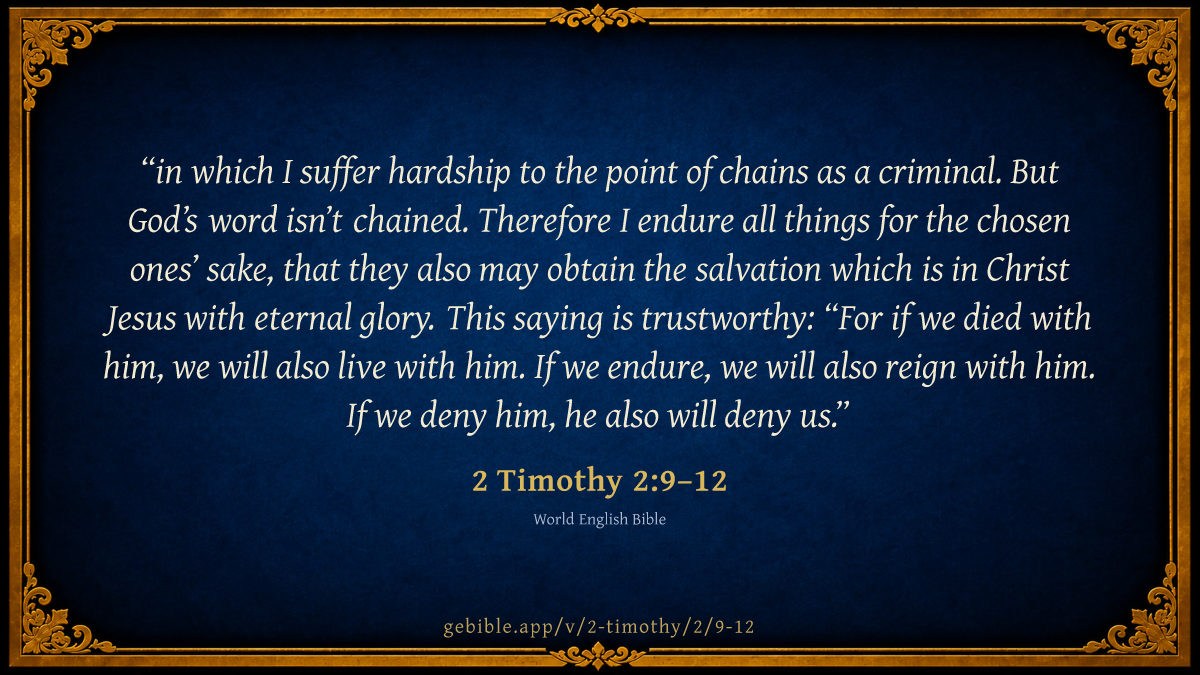
in which I suffer hardship to the point of chains as a criminal. But God’s word isn’t chained. Therefore I endure all things for the chosen ones’ sake, that they also may obtain the salvation which is in Christ Jesus with eternal glory.
This saying is trustworthy: “For if we died with him, we will also live with him.
If we endure, we will also reign with him. If we deny him, he also will deny us.
John Calvin 1540 · Public Domain On vv9–12 9 In which I am a sufferer This is…
9 In which I am a sufferer This is an anticipation, for his imprisonment lessened the credit due to his gospel in the eyes of ignorant people. He, therefore, acknowledges that, as to outward appearance, he was imprisoned like a criminal; but adds, that his imprisonment did not hinder the gospel from having free course; and not only so, but that what he suffers is advantageous to the elect, because it tends to confirm them. Such is the unshaken courage of the martyrs of Christ, when the consciousness of being engaged in a good cause lifts them up above the world; so that, from a lofty position, they look down with contempt, not only on bodily pains and agonies, but on every kind of disgrace.
Moreover, all godly persons ought to strengthen themselves with this consideration, when they see the ministers of the gospel attacked and outraged by adversaries, that they may not, on that account, cherish less reverence for doctrine, but may give glory to God, by whose power they see it burst through all the hindrances of the world. And, indeed, if we were not excessively devoted to the flesh, this consolation alone must have been sufficient for us in the midst of persecutions, that, if we are oppressed by the cruelty of the wicked, the gospel is nevertheless extended and more widely diffused; for, whatever they may attempt, so far are they from obscuring or extinguishing the light of the gospel, that it burns the more brightly. Let us therefore bear cheerfully, or at least patiently, to have both our body and our reputation shut up in prison, provided that the truth of God breaks through those fetters, and is spread far and wide.
John Calvin's Commentaries (1540-1563) — public domain. Text from the Calvin Translation Society English edition (1840s-50s) via the Christian Classics Ethereal Library (ccel.org). Calvin's coverage is partial (roughly two-thirds of the Bible); uncommented books and verses are honest gaps, never fabricated. The 19th-century editor's footnotes and remarks are omitted so the notes are faithfully Calvin's own voice.
Geneva Bible translators 1599 · Public Domain On vv9, 11 The taking away of an objection: Truth it is,…
The taking away of an objection: Truth it is, that he is kept in prison, as an evildoer, yet there is no cause, why therefore some should go about to derogate credit from his Gospel, seeing that notwithstanding God did bless his ministry, nay rather, that example of this his captivity and patience did sundry ways confirm the Church in the hope of a better life.
Geneva Bible (1599) marginal notes — public domain.
John Trapp 1656 · Public Domain On vv9–12 9 Wherein I suffer trouble, as an evil doer,…
9 Wherein I suffer trouble, as an evil doer, even unto bonds; but the word of God is not bound.
Ver. 9. But the word of God is not bound] It runs and is glorified, 2Th 3:1, being free and not fettered. I preach, though a prisoner, saith Paul; so did Bradford and other martyrs. Within a few days of Queen Mary’s reign, almost all the prisons in England were become right Christian schools and churches (saith Mr Fox), so that there was no greater comfort for Christian hearts than to come to the prisons to behold their virtuous conversation, and to hear their prayers, preachings, &c. The Earl of Derby’s accusation in the Parliament house against Mr Bradford was, that he did more hurt (so he called good evil) by letters and conferences in prison, than ever he did when he was abroad by preaching.
John Trapp, A Commentary or Exposition upon All the Books of the Old and New Testament (1647–1656) — public domain. Text from a community e-Sword module.
Matthew Poole 1685 · Public Domain On vv9–12 Wherein I suffer trouble, as an evil-doer, even unto…
Wherein I suffer trouble, as an evil-doer, even unto bonds; that is, for which I suffer affliction, as if I were an evil-doer, to that degree that I am put in chains.
But the word of God is not bound; but yet I preach the gospel, or the gospel is preached; though they have restrained me, they are not able to restrain that.
Matthew Poole's English Annotations on the Holy Bible (1683–1685) — public domain. Text from a community e-Sword/MySword module.
William Burkitt 1703 · Public Domain On v10 St. Paul having acquainted Timothy in the foregoing verses…
St. Paul having acquainted Timothy in the foregoing verses with his sufferings, even unto bonds, here he lets him understand and know, why, and for whose sake, he did so cheerfully endure all these things, namely, for the elects sake. Though the rest of the world rejected the gospel, yet the elect would be confirmed by his example, and obtain that salvation which in and through Jesus Christ was offered and tendered to them.
Here note, That there is a certain election of God, which hath infallibly chosen to salvation all those who make their calling and election sure, by perseverance in holiness and good works.
Read full note →
Note, 2. That the faithful ministers of Christ do think no sufferings to much, or too dear, for the sake of God’s elect, (for the sake of believing Christians, who are a chosen generation) so that their sufferings may but further their eternal glory, happiness and salvation.
To encourage yet again to a patient enduring of all sorts of afflictions, he assures Timothy, that if we be rendred comformable to Christ in his sufferings, we shall be also in his glory: If we suffer for him, we shall reign with him: if we be dead with him, dead to sin, and dead to the world, we shall also live with him, in conformity to his resurrection; but if for fear of suffering we disown him, he will also deny us; if we believe not, if we be unfaithful and forsake him, yet he will be true to his word, he will not forsake his own cause, but make good his threatenings, his own veracity stands firm, and is as much engaged to execute the threatening, as to fulfil the promise.
William Burkitt's Expository Notes on the New Testament (1700–1703) — public domain. Text from a community e-Sword module.
John Gill 1763 · Public Domain On vv9–12 Wherein I suffer trouble as an evildoer,.... As a…
Wherein I suffer trouble as an evildoer,.... As a malefactor, as if guilty of some capital crime; an enemy to the law of Moses, a pestilent fellow, a mover of sedition everywhere, and a ringleader of the sect of the Nazarenes, Act 24:5. The Ethiopic version renders it, "as a thief". The "trouble" he suffered were reproaches, persecutions, whipping, beating, stoning, imprisonment: for he adds,
even unto bonds; for he was now a prisoner, and in chains; nor was it the first time, he was in prisons frequent; and all this for the sake of the Gospel, which he preached, concerning the incarnation, death, and resurrection of Christ:
Read full note →
but the word of God is not bound; for the apostle, while a prisoner at Rome, had the liberty of dwelling by himself, in his own hired house, though held in chains, and guarded by a soldier, and of receiving his friends, and of preaching the Gospel to as many as would come to hear him, Act 28:16 as well as of sending letters to the churches; for several of his epistles were written by him when a prisoner, as those to the Ephesians, Philippians, and Colossians; and this to Timothy, and also that to Philemon: so that the Gospel was not restrained, or the apostle restrained from publishing it, both by word of mouth, and by writing; which was a great support to him under his troubles. Moreover, the Gospel was the more spread through the bonds of the apostle, and met with great success; it became known in Caesar's palace, and was the means of the conversion of some of his household; and many of the brethren, through his bonds, became bolder to preach the Gospel of Christ; so that it had a free course, and was glorified: and sometimes so it is, that persecution is a means of the greater spread of the Gospel; which was an effect that followed upon the persecution raised against the church at Jerusalem, upon the death of Stephen, Act 8:1. And indeed, when God opens an effectual door, none can shut it, though there be many adversaries; and when he gives the word a commission, there is no stopping it; when it comes in power, it bears down all before it; it cannot be fettered and bound by men, though men may be fettered and bound for the sake of it.
John Gill's Exposition of the Whole Bible (1746–1763) — public domain (CC PDM 1.0). Text via the HelloAO Bible API.
John Wesley 1765 · Public Domain On vv9–12 Is not bound - Not hindered in its course.
Is not bound - Not hindered in its course.
John Wesley, Explanatory Notes Upon the Whole Bible (1754–1765) — public domain. Text via the GEBible commentary corpus.
Adam Clarke 1810 · Public Domain On vv9–12 Verse 9. Wherein I suffer trouble, as an evil…
Verse 9. Wherein I suffer trouble, as an evil doer] This verse contains one of the proofs that this epistle was written while St. Paul was a prisoner the second time at Rome. See the preface, where this is particularly considered.
Adam Clarke's Commentary on the Bible (1810–1826) — public domain. Text from a community e-Sword/MySword module.
Joseph Benson 1811 · Public Domain On v11 2Ti 2:11-14. It is a faithful saying — A…
2Ti 2:11-14. It is a faithful saying — A saying as important as it is true. If we be dead — Greek, συναπεθανομεν, die, or have died, with him — To the world and sin, and be ready to die for him; we shall live with him — In that everlasting happiness which he hath prepared for all his people. If we suffer with him — Persecution, or whatever he may be pleased to appoint or permit to happen to us, with faith and patience becoming a Christian; we shall also reign with him — In heavenly glory: see on Rom 8:17; 1Pe 4:13. If — Intimidated with these transitory evils, we desert his cause, and deny him — Before men, that we may escape suffering for him; he also will deny us — In the great day, before his Father and the holy angels, Mat 10:33; Luk 12:9. If we believe not — That he will deny us, presuming upon his mercy; yet he abideth faithful — And will fulfil his threatenings on such as expose themselves to them; he cannot deny himself — Cannot falsify his word, or fail to make it good. Or the verse may be interpreted in a more general sense thus: If we believe not the truths and promises of his gospel, or if we are unfaithful, (as some render απιστουμεν, considering it as opposed to πιστος, faithful,) yet he abideth faithful, and will steadily adhere to those rules of judgment, and distribution of rewards and punishments, which he hath so solemnly laid down in his word: for it is certain he cannot deny himself, or frustrate his own public declarations. Therefore be diligent, as if the apostle had said, in the discharge of thy duty, and shrink not from it for fear of suffering. Of these things put them in remembrance — Remind those who are under thy charge of these powerful motives to persevere in patiently suffering ill, and diligently doing well; charging them before the Lord — As in his presence, and as they will answer it to him; not to strive — Greek, μη λογομαχειν, not to contend, or quarrel, about words — An evil to which they are prone; to no profit — Such a contention is altogether unprofitable, and even tends to the subverting of the hearers — The diverting their attention from true, vital religion, and the important truths on which it is built, and filling their minds with pride and passion, and numberless other disorders and vices. There is an awful solemnity, as Doddridge justly observes, in this charge, which plainly shows the great folly and mischief of striving about little controversies. Indeed, consequences such as those here referred to, are wont to flow from most religious disputes as they are commonly managed; so that they tend to nothing out to the subverting of the faith and morals of those who engage keenly in them. They ought therefore to be carefully avoided by all who desire to promote true piety and virtue, agreeably to the apostle’s direction.
Joseph Benson's Commentary on the Old and New Testaments (1811–1818) — public domain. Text from a community e-Sword module.
Albert Barnes 1834 · Public Domain On vv9–12 Wherein I suffer trouble, as an evil-doer - as…
Wherein I suffer trouble, as an evil-doer - as if I were a violator of the laws. That is, I am treated as if I were a criminal.
Even unto bonds - As if I were one of the words kind of malefactors; see the notes at Eph 6:20. During the apostle’s first imprisonment at Rome, he was permitted to “dwell in his own hired house,” though guarded by a soldier, and probably chained to him; see the notes at Act 28:16, Act 28:30. What was his condition in his second imprisonment, during which this Epistle was written, we have no means of knowing with certainty. It is probable, however, that he was subjected to much more rigid treatment than he had been in the first instance. The tradition is, that he and Peter were together in the Mamertine prison at Rome; and the place is still shown in which it is said that they were confined. The Mamertine prisons are of great antiquity. According to Livy, they were constructed by Ancus Martius, and enlarged by Servius Tullius. The lower prison is supposed to have been once a quarry, and to have been at one time occupied as a granary. These prisons are on the descent of the Capitoline Mount, toward the Forum. They consist of two apartments, one over the other, built with large, uncemented stones. There is no entrance to either, except by a small aperture in the roof, and by a small hole in the upper floor, leading to the cell below, without any staircase to either. The upper prison is twenty-seven feet long, by twenty wide; the lower one is elliptical, and measures twenty feet by ten. In the lower one is a small spring, which is said at Rome to have arisen at the command of Peter, to enable him to baptize his keepers, Processus and Martianus, with 47 companions, whom he converted. No certain reliance can be placed on any part of this tradition, though in itself there is no improbability in supposing that these prisons may have been used for confining Christians, and the apostle Paul among others. Dr. Burton says that a more horrible place for the confinement of a human being can scarcely be conceived.
Read full note →
But the word of God is not bound - This is one of Paul’s happy turns of thought; compare the notes at Act 26:29. The meaning is plain. The gospel was prospered. that could not be lettered and imprisoned. It circulated with freedom. even when he who was appointed to preach it was in chains; see Phi 1:13-14. As this was the great matter, his own imprisonment was of comparatively little consequence. What may befall us is of secondary importance. The grand thing is the triumph of truth on the earth; and well may we bear privations and sorrows, if the gospel moves on in triumph.
Albert Barnes' Notes on the Bible (1834–1885) — public domain. Text from a community e-Sword/MySword module.
Haydock's Catholic Bible Commentary 1859 · Public Domain On vv9–11 In which I labour, or suffer, by the Greek.…
In which I labour, or suffer, by the Greek. (Witham)
George Leo Haydock (1774–1849), Haydock's Catholic Family Bible and Commentary, 1859 edition — public domain. Excludes Psalms (Douay-Rheims chapter numbering differs from Protestant) and Deuterocanonical books (Catholic canon only).
Robert Jamieson, A. R. Fausset & David Brown 1871 · Public Domain On vv9–12 Wherein--in proclaiming which Gospel.
Wherein--in proclaiming which Gospel.
suffer trouble--literally, "evil." I am a sufferer of evil as though I were a doer of evil.
Read full note →
bonds-- (Ti2 1:16).
word . . . not bound--Though my person is bound, my tongue and my pen are not (Ti2 4:17; Act 28:31). Or he alludes not merely to his own proclamation of the Gospel, though in chains, but to the freedom of its circulation by others, even though his power of circulating it is now prescribed (Phi 1:18). He also hints to Timothy that he being free ought to be the more earnest in the service of it.
Jamieson, Fausset & Brown — Commentary Critical and Explanatory on the Whole Bible (1871) — public domain (CC PDM 1.0). Text via the HelloAO Bible API.
Daniel D. Whedon 1874 · Public Domain On vv9–11 9. Suffer trouble—Fair justification for calling it my gospel.
9. Suffer trouble—Fair justification for calling it my gospel.
Word—That same gospel.
Read full note →
Not bound—The apparent defeat of the preacher prevents not the triumph of his gospel.
Daniel D. Whedon (gen. ed.), Commentary on the Old and New Testaments (1874–1909) — public domain. Text from a community e-Sword module.
The Cambridge Bible for Schools and Colleges 1878 · Public Domain On vv9–12 9. wherein I suffer trouble, as an evil doer]…
9. wherein I suffer trouble, as an evil doer] Hardship rather than ‘trouble,’ the same word as in 2Ti_2:3; malefactor rather than ‘evil doer,’ the same word as of the thieves on the cross, Luk_23:32, these being the only N.T. occurrences.
even unto bonds] ‘Even’ need not have been italicised in A.V., much less omitted by R.V.; for the force of the preposition is more fully given with than without it. In the similar passage, Php_2:8, the ‘obedient unto death’ of A.V. has actually been altered by R.V. into ‘obedient even unto death.’ Vulg. ‘usque ad.’
Read full note →
‘Over the blackened ruins of the city (the firing of which had been falsely set down to the Christians) amid the squalid misery of its inhabitants, perhaps with many a fierce scowl turned on “the malefactor” he passed to his gloomy dungeon. There as the gate clanged upon him, he sat down, chained night and day, without further hope, a doomed man. His case was far more miserable than it had been in his first imprisonment, two or three years earlier. He was no longer permitted to reside “in his own hired room.” He was in the custody, not as before of an honourable soldier like Burrus, but of the foul Tigellinus, whose hands were still dripping with Christian blood.’ Farrar, Messages of the Books, p. 388.
but the word of God is not bound] Not his own preaching power, but the power of the Gospel at large. The Church is more than the individual, however eminent. The perfect passive tense here represents the state, ‘is not in a bound state,’ is not ‘cribbed, cabin’d and confined’; according to the proper force of the perfect, as in 1Ti_6:17, nor have their hope set on,’ 2Ti_4:8, ‘who have their love set on his appearing.’
The Cambridge Bible for Schools and Colleges (gen. ed. J. J. S. Perowne; Cambridge University Press, 1878–1918) — public domain. Text from a community e-Sword module.
Ellicott's Commentary for English Readers 1878 · Public Domain On vv9–12 (9) Wherein I suffer trouble.—Here St. Paul bids Timothy…
(9) Wherein I suffer trouble.—Here St. Paul bids Timothy take courage, by thinking of the brave, patient example he was setting him in his Roman prison, undaunted and full of hope. “Wherein I suffer:” in which, that is, discharging my office as a preacher of the gospel, I suffer trouble.
As an evil doer.—Better rendered, as a malefactor: the same word used in St. Luke’s Gospel for the two thieves crucified with Jesus Christ (Luk_23:32-33; Luk_23:39).
Read full note →
Even unto bonds; but the word of God is not bound.—A prisoner in chains and, as he tells us further on in the Epistle, expecting death, and yet he still could write and pray and speak from his narrow prison. Surely his disciple, still free, ought to work on with undiminished spirit and zeal. Though St. Paul was in bonds, his sufferings and imprisonment had in no way weakened the power of the gospel.
A Bible Commentary for English Readers, edited by Charles John Ellicott (1878–1897) — public domain. Text from a community e-Sword module.
The Pulpit Commentary 1880 · Public Domain On vv9–12 Hardship for trouble, A.V; unto for even unto, A.V;…
Hardship for trouble, A.V; unto for even unto, A.V; as a malefactor for as an evil doer, A.V; transposition of clause, unto bonds. Wherein (ejn w=); i.e. in which gospel, in the preaching of which. Suffer hardship (kakopaqw); as ver. 3, T.R. Unto bonds (mecri desmwn). So mecri qanatoucriv Php_2:8; me aimatov, Heb_12:4; but most frequently of time, "until," as Mat_11:23 Mat_13:30; Act_10:30, etc. A malefactor (kakourgov) as; Luk_23:32, Luk_23:33, Luk_23:39; common in classical Greek. Bonds (desmwn) as Act_26:29; Php_1:7, 13, etc.; smiov, Col_4:18. So St. Paul calls himself de in respect of these bonds Eph_3:1 Eph_4:1; 2 Timothy. (Phm_1:9) The Word of God is not bound. A beautiful reflection of an utterly unselfish mind! The thought of his own bonds, likely soon to be exchanged for the bonds of a martyr"s death, awakens the comforting thought, Though they bind me with an iron chain, they cannot bind the gospel. While I am here, shut up in prison, the Word of God, preached by a thousand tongues, is giving life and liberty to myriads of my brethren of the human race. The tyrant can silence my voice and confine it within the walls of my dungeon; but all the while the sound of the gospel is going through all the earth, its saving words to the ends of the world; and I therein rejoice, yea, and will rejoice; and not all the lemons of Rome can take this joy from me.
Vers. 9, 10.
Read full note →
The example of the apostle"s own sufferings their spiritual motive and design.
I TIMOTHY WAS TO BE ENCOURAGED BY THIS EXAMPLE. "Wherein I suffer hardship unto bonds as a malefacto." He was now a prisoner at Rome, because he preached the gospel of Jesus and the resurrection, and suffered as much as if he had been a breaker of all laws, human and Divine.
II THE APOSTLE"S IMPRISONMENT DID NOT IMPOSE FETTERS UPON THE GOSPEL, "But the Word of God is not bound." This was said for the encouragement of Timothy, who may have feared that the Roman imprisonment would be fatal to the progress of the gospel. The apostle, though a prisoner, had liberty to add many pages to that Word of God which Nero could not bind, for we have no less than three or four prison Epistles in the canon of inspiration. The imprisonment of John Huss in a fortress on the Rhine gave him leisure to write the truth he could no longer proclaim with fiery lips to the Bohemians. The Wartburg seclusion of a year gave Luther the leisure to translate the Scriptures for his German countrymen. Verily the Word of God is not bound.
III THE MOTIVE OR DESIGN OF THE APOSTLE"S SUFFERINGS. "Therefore I endure all things for the elect"s sake, that they also may obtain the salvation which is in Christ Jesus with eternal glory.
1. The zealous minister of Christ thinks no sufferings too great that are needed for the sake of Gods elect. The apostle"s life was one long career of labour and affliction on their behalf.
2. Ministers must labour for the salvation of the elect. Human instrumentality is clearly recognized and honoured in this great work. Paul, Apollos, and Cephas were "ministers by whom the Corinthians believed.
3. There is a salvation provided for the elect. They are "chosen in Christ" before the foundation of the world "unto holiness". (Eph_1:4)
4. The salvation is only to be obtained in and through Jesus Christ.
5. It is a salvation that finds its true termination in eternal glory. T.C.
The Pulpit Commentary (1880–1919), ed. H.D.M. Spence-Jones & Joseph S. Exell — public domain. Text from a community e-Sword module.
The Biblical Illustrator 1887 · Public Domain On vv9–11 Wherein I suffer trouble, as an evil doer, even…
2Ti_2:9
Wherein I suffer trouble, as an evil doer, even unto bonds; but the Word of God is not bound.
Read full note →
The Word of God is not bound
The apostle is imprisoned, but his tongue and his companions pen are free. He can still teach those who come to him; can still dictate letters for others to Luke and the faithful few who visit him. He has been able to influence those whom, but for his imprisonment, he would never have had an opportunity of reaching--Roman soldiers, and warders, and officials, and all who have to take cognisance of his trial before the imperial tribunal. The Word of God is not bound. While he is in prison Timothy and Titus and scores of other evangelists and preachers are free, Those who are left at large ought to labour all the more energetically and enthusiastically in order to supply whatever is lost by the apostles want of freedom, and in order to convince the world that this is no contest with a human organisation, or with human opinion, but with a Divine word and a Divine Person. The Word of God is not bound, because His Word is the truth, and it is the truth that makes men free. How can that of which the very essence is freedom, and of which the attribute is that it confers freedom, be itself kept in bondage? (A. Plummer, D. D.)
Gods Word free
He perhaps changes the expression from my gospel to the Word of God in order to indicate why it is that, although the preacher is in prison, yet his gospel is free, because the Word which he preaches is not his own, but Gods. (A. Plummer, D. D.)
Suffering furthers the gospel
The sufferings of the witnesses for Christ was, and is at all times, one of the most powerful agencies for the furtherance of the gospel (comp. Php_1:12-14; Col_1:24; 2Co_1:5-7). (Van Oosterzee.)
.
Suffering for the gospel
I. The gospel may occasion trouble.
1. For it bruiseth Satans head, discovereth his plots, overturneth his kingdoms.
2. Besides, it pulleth down the pride of man, provoketh to repentance, presseth him to deny himself, put confidence in Christ, and its worth is not known in the world.
II. The enemies of the church afflict the godly under a pretence of law.
1. For the conversation of the godly is holy, honest, harmless; that without such pretences they could have no seeming cause to afflict them.
2. The wicked, in their generation, are wise; therefore, to cover and cloak their mischiefs they must have some pretence of law.
III. Godly preachers may have great persecutions.
1. Because not many wise, mighty, or noble men are called neither to embrace the gospel nor preach it.
2. And godly preachers speak with power, curb mens raging corruptions, wound their rebellious spirits, and never prophesy of peace unto them.
IV. The liberty of Gods word is greatly to be regarded.
1. For it is the instrumental cause of mans conversion.
2. It increaseth grace, supports in trouble, and directeth to heaven.
3. And by the Word are not our adversaries foiled?
V. The persecution of preachers doth not always infringe the liberty of the Word.
1. Because then the Lord hath a special care to His own cause.
2. The example of some will embolden others. (J. Barlow, D. D.)
The Word of God not bound
1. The first idea suggested by the words in their original connection is, that Pauls incarceration did not hinder his own personal exertions as a preacher of the gospel. The practical lesson taught by Pauls example, in this view of it, is obvious. It is a reproof of our disposition to regard external disadvantages, restraints, and disabilities as either affording an immunity from blame if we neglect to use the power still left us, or discouraging the hope of any good effect from using it.
2. It was still true, however, that Pauls bonds diminished his efficiency. While he avoided the extreme of abandoning all hope, he equally avoided that of foolishly imagining that he could personally do as much for the diffusion of the gospel in his own hired house at Rome, as in the wide sweep of his itinerant apostleship. His work, though not yet at an end, was interrupted, and how should his lack of service be supplied? The answer is a plain one: By the labours of others. This was a large ingredient in the cup of the apostles consolation. He rejoiced not only in the labours of others during his comparative inaction, but in that inaction as the occasion, the exciting cause, of other mens exertions. Nay, he could even go so far as to consent to be wronged and dishonoured, if by that means his ruling passion might be gratified (see Php_1:12-21). What is the principle involved in this sublime profession of heroic devotion to the cause of Christ? Plainly this, that while Paul was ever ready to magnify his office as apostle to the Gentiles, and correctly appreciated both the honour and the difficulty of the work assigned to him, he never dreamed that it was meant to be entirely dependent upon his individual activity. It was not at himself, but at the word that he continually looked. Here, too, the lesson to ourselves is obvious. The apostles example ought to shame us out of all undue reliance upon certain human agencies and influences. Especially ought this to be the case in relation to our own share of the work to be performed for the honour of God and the salvation of the world.
3. One of the most important lessons, couched in this significant expression or deducible from it, would be lost upon us if we went no further. I refer to the doctrine that the truth of God is independent, not only of particular human agents, but of all human systems of opinion, organisations, and methods of procedure. The Word of God is not bound or restricted, in its salutary virtue, to the formal and appreciable power exerted upon Churches and Christian communities, or through the ordinary modes and channels of religious influence, however great this power may be, however indispensable to the completion of the work which God is working in our days. We may even admit that it is relatively almost all, but it is still not quite all; and the residuary power may be greater, vastly greater, than it seems to us before attentively considering the other less direct, less formal, less appreciable ways, in which the Word of God, the truth revealed in Scripture, is at this moment operating on the condition of society, apart from its constant and direct communication through the pulpit, the school, and the religious press. These are the agencies, indeed, by which sound doctrine is maintained in your Churches and impressed upon your youth; and this, in its perfection, is the highest end that can be wrought by the diffusion of the truth. But let us not forget that much may be effected even when this highest end is not attained. In many a heresy, for instance, how much truth maybe mingled, saving it from absolute corruption, and perhaps the souls of those who hold it, from perdition. Infidelity, in all its forms, affects to treat religion with contempt, as the offspring of ignorance; but its own discoveries are mere mutilations of the truths which it has stolen from its despised enemy. The attempt of infidelity to do away with the great doctrines of religion is the prowess of a dwarf mounting on a giants shoulders to put out his eyes. The same thing is true as to those slighter and more trivial, but for that very reason more effective, forms of unbelief, which are propagated, not in philosophical abstractions, but in poetry, romance, and other current literature. The novelist or journalist who, with a scorn of Christianity only to be equalled by his ignorance of what it teaches, undertakes to Show his readers a more excellent way, often brings them at last to some elementary truth, already wrought into the mind and stamped upon the memory of every child who reads the Bible. What a tribute is this to the pervading, penetrating force of truth, that it can find its way even into such dark places, and at least serve to make the darkness visible! Look, too, at the schemes of civil government and social order framed by irreligious men, or unbelievers in the Scriptures, and observe these two facts easily established: that every departure from the lessons of Gods Word is a demonstrable evil or defect in relation even to the lower object aimed at; and that everything conducive to a good end in the system is an adaptation of some Christian doctrine to a special purpose. It would be easy to pursue the same inquiry through every field of science and every walk of art, and to show that even there the Word of God has first been followed as a guide, and then expelled as an intruder; that its light has first been used to kindle others, and then vain attempts made to extinguish it for ever; in a word, that its enemies have first resorted to it in their time of need, and then ungratefully forgotten or unblushingly denied the obligation. If this be a correct view of the influence exerted even indirectly by the Word of God; if over and above its certain and complete results, it shines through the interstices of unknown caverns, and mitigates the darkness of unfathomed depths; if in fertilising one spot it sheds even a few scattered but refreshing drops upon a multitude of others; if in doing all for some, it incidentally does some for all, let me ask, in conclusion, What should be the practical effect of this belief?
1. We need not tremble for the truth itself.
2. There is some hope for the world itself, and even for those parts of it, and those things in it, which otherwise might seem to be confined to hopeless, irrecoverable ruin.
3. It may teach us a valuable lesson as to the true spirit of philanthropy, as being not a formal, rigid, mathematical attempt to save mens souls by certain rules, and in the use of certain ceremonial forms; but a generous, impulsive, and expansive zeal for the glory of God in the salvation of the lost. And as the surest way of gaining this end, let us flood the world with the pure and unadulterated Word of God. (J. A. Alexander, D. D.)
Not bound yet
I. In what sense is it true, that the Word of God is not bound?
1. It is not bound so that it cannot be preached. Paul could preach it even when in bonds, and he did preach it, so that the gospel was made known throughout Caesars palace, and there were saints in the imperial household. Nineteen centuries after Paul we have still an open Bible and a free pulpit. When Hamilton was burned in Scotland, there was such an impetus given to the gospel through his burning that the adversaries of the gospel were wont to say, Let us burn no more martyrs in public, for the smoke of Hamiltons burning has made many eyes to smart until they were opened. So, no doubt, it always was. Persecution is a red hand which scatters the white wheat far and wide.
2. The Word of God is not bound so as to be no longer a living, working power among men. Sometimes the enemies of truth have thought that they had silenced the last witness, and then there has been an unexpected outburst, and the old faith has been to the front again. The enemies of the gospel have attempted also to bind it by the burning of books. I have in my possession an early copy of Luthers sermons, and I was told how very rare it was, because at first the circulation was forbidden, and afterwards they were bought up and burned as soon as ever they were met with. And what did they do? They only put fire into Luther when they burned his sermons; they drove him to be more outspoken than he otherwise might have been, and so they helped the cause they thought to destroy. As the sun is not blown out by the tempest, nor the moon quenched by the night-damps, so is not the gospel destroyed by the sophistries of perverse minds.
3. The Word of God is not bound so that it cannel reach the heart. God has ways of reaching the hardest hearts and melting them, and He can do it at moments when such a work is least expected. Sometimes it happens to those whom we love that they are removed from the means of grace, but even then the Word of God is not bound. Had we not, a little while ago, an instance of one whom we were praying for at a prayer-meeting, and that night, while we were praying, it was a moonlight night, and as he was walking the deck of the ship, the Lord met with him? When no tongue was able to reach him, the memory of what he had heard at home came over his soul, and he was humbled before God. I was telling, just a little while ago, at our prayer-meeting, a very singular instance of how, just lately, three or four sermons on Sunday evenings have been made most useful to a young friend. He was going away to Australia unconverted, and without God. He went on board to depart, and when the vessel steamed out of dock, it ran into another ship, and he was obliged to wait and spend almost a month here, whilst the vessel was being repaired. The Lord met with him on those Sunday nights, and he has gone now, leaving in his mothers heart the sweet persuasion that he has found his mothers God. But sometimes we are apt to think a case is more hopeless still, when, in addition to natural depravity, and the absence of the means of grace, there springs up a scepticism, perhaps a downright derision of the Word of God, and of things sacred. I knew a man who had lived a life of carelessness and indifference, with occasional outbursts of drunkenness and other vices. This man happened one day, on Peckham Rye, to hear a preacher say that if any man would ask anything of God, He would give it to him. The assertion was much too broad, arid might have done harm; but this man accepted it as a test, and resolved that he would ask, and thus would see if there was a God. On the Saturday morning of that week, when he was going early to his work, the thought came upon him, Perhaps there is a God after all. He was ready to swoon as the possibility struck him, and there and then he offered the test petition, concerning a matter which concerned himself and his fellow-workmen. His prayer was granted in a remarkable manner, and he came then to be a believer in God. He is more than that now, and has found his way to be a believer in all that God has spoken, and has found peace through believing in Jesus Christ.
4. It is not bound as to its power to comfort the soul.
5. The Word of God is not bound in the sense that it cannot be fulfilled. I now allude principally to the promises and prophecies of Gods Word.
6. The Word of God is not bound so that it cannot endure and prevail unto the end.
II. What are the reasons why the word of God is not bound?
1. It is not bound, because it is the voice of the Almighty. If the gospel be indeed the gospel of God, and these truths be a revelation of God, omnipotence is in them.
2. Moreover, the Holy Ghost puts forth His power in connection with the Word of God, and as He is Divine He is unconquerable.
3. If you wanted another reason less strong than these two, I should say, How can it be bound while it is so needful to men? There are certain things which if men want they will have. I have heard say that in the old Bread Riots, when men were actually starving for bread, no word had such a terribly threatening and alarming power about it as the word Bread! when shouted by a starving crowd. I have read a description by one who once heard this cry: he said he had been startled at night by a cry of Fire! but when he beard the cry of Bread! Bread! from those that were hungry, it seemed to cut him like a sword. Whatever bread had been in his possession he must at once have handed it out. So it is with the gospel: when men are once aware of their need of it, there is no monopolising it. None can make a ring or a corner over the precious commodity of heavenly truth.
4. The Word of God is not bound, because, when once it gets into mens hearts, it works such an enthusiasm in them that you cannot bind it. There is Master Bunyan; they have put him in prison, and his family is nearly starving, and they bring him up, and they say, You shall go out of prison, John, if you wont preach. Go home, and tag your laces, that is what you have to do, and leave the gospel alone; what have you got to do with that? But honest John answers, I cannot help it. If you let me out of prison to-day, I will preach again to-morrow, by the help of God. I will lie here till the moss grows on my eyelids, but I will never promise to cease preaching the gospel.
III. One or two other facts run parallel to the text. Paul is bound, but the Word of God is not bound. Read it thus: the preacher has had a bad week, he is full of aches and pains, he feels ill: but the Word of God is not ill. What will become of the congregation when a certain minister dies? Well, he will be dead, but the Word of God is not dead. Oh, but the worker is so feeble! The Word of God is net feeble. But the worker feels so stupid. But the Word of God is not stupid. But the worker is so unfit. But the Word of God is not unfit. But you bitterly and truthfully lament that Christian men are nowadays very devoid of zeal. All hearts are cold in every place; the old fire burns low. But the Word of God is not cold, nor lukewarm, nor in any way losing its old fire. Yes, says one, but I am disgusted with the cases I have lately met with of false brethren. Yes, but the Word of God is not false. But they walk so inconsistently. I know they do, but the Word of God is not inconsistent. But they say they have disproved the faith. Yes, they have disproved their own faith, but they have not disproved the Word of God for all that. Oh, but, says one, it is an awful thing to think of the spiritual ruin of so many that are round about us, who bear the gospel, and yet after all wilfully refuse it, and die in their sins. Truly this is a grievous fact: they appear to be bound by their sins like beasts for the slaughter, but the Word of God is not bound or injured. It was said of old that it would be a sweet savour unto God in them that are saved, and in them that perish--in the one a savour of life unto life, and in the other a savour of death unto death. (C. H. Spurgeon.)
The Word of God not bound
Liberal Christianity may be defined, not as any belief, nor as any system of opinions, but as something going deeper. It is a habit of mind; a way of considering all opinions as of secondary importance; all outward statements, methods, operations, administrations, as not belonging to the essence of religion. Liberal Christianity comes from that spiritual insight which penetrates the shell and finds the kernel; sees what is the one thing needful, and discovers it to be not the form, but the substance; not the letter, but the spirit; not the body, but the soul; not the outward action, but the inward motive; net the profession, but the life. Liberal Christianity began when the first struggle began between the spirit and the letter, and that was the great battle which emancipated Christianity from Judaism. It was thought, at first, that the Word of God was bound to Judaism, and that no man could be a Christian unless he were also a Jew. Paul rooted that weed out of Christianity, and won for the whole Ethnic world--Greeks, Romans, Egyptians, Persians, Hindoos, Germans--the right of becoming Christians at once, just as they were, without first having to become Jews. But intolerance is the natural growth of strong soils. Out in the West, when the primeval forest is felled, there comes up in regular order, a whole succession of weeds, which are killed out, one after another, by culture. So it has been in the progress of Christian civilisation. This progress has killed off, one afar another, a similar series of weeds which came up in the Christian Church. The Jewish intolerance was the first weed. Paul weeded the Church of that so thoroughly that it never came up again. The next weed was the Church intolerance, which said, No man can be a Christian who is not a member of the Holy Roman Catholic Church, and partakes of its sacraments, and submits to its authority. Martin Luther weeded Christianity of this form of intolerance, and made it possible for man to be a Christian without being a Roman Catholic. But not being as liberal a Christian as Paul, he left another weed growing in its place--the weed of dogmatic intolerance. The dogmatists said, The Word of God is not bound to the Roman Catholic Church; but it is bound to certain essential doctrines--the Trinity, total depravity, the atonement, everlasting punishment. This weed has also been nearly eradicated in our time. The principle of liberal Christianity has pervaded all denominations. It has taken the shells and husks and outward coverings from the Word of God, and these are now seen to be like those envelopes which God puts around the fruits of the earth, until they are ripe, but which then are taken off and thrown away. Nothing abides, nothing is permanent in Christianity, says Paul, but faith, hope, and love. The Word of God is not bound to any Church or to any creed; it goes outside of all Churches and all creeds. The same cool breeze which fans the hot cheeks of the labourers on the plains of Hindostan, sweeps on across the Indian Ocean, gathering moisture as it goes, and pours it down in rain on the parched regions of Central Africa. So God sends His prophets and teachers of truth to every race, to help them according to their separate needs; sends some knowledge of Himself, some intuitions of duty, some hopes of immortality, to all the children of men. The Word of God is not bound to the Bible. It is not the prophecies of the Bible which are essential--for whether there be prophecies, they shall fail. It is not its verbal inspiration which gives to it its supreme importance--for whether there be tongues, they shall cease. Nor is its vitality even in the doctrinal truth it teaches--for whether there be knowledge, it shall vanish away. But it is the faith, the hope, the love which are in the Bible which will abide, and will cause the Bible to remain always a permanent blessing to mankind. Nor is the Word of God bound to any belief we may have about the outward history of Jesus--His miraculous birth, His own miracles, or any particular outward facts of His life. The essential thing, even in His resurrection, is not the outward part of it, but the inward part; not the particular way in which He arose, as that He did go up to a higher life; that He is now alive, and that death has no dominion over Him. Faith in Christ is not believing this or that fact about Him, but it is faith in Himself, faith in the truth and love, which are incarnate in Him, and which were breathed forth in all He said and did and was. Deny His miracles, if you please; you cannot deny the great miracle of His influence on mankind. Such a vast effect must have its cause. If we have faith in the spirit of Jesus, in the Divine piety which made Him the well-beloved Son, dwelling always in the bosom of the Father; in the Divine charity which made Him the Friend and the Helper of the humblest of Gods children; if we have faith in these as the true life to lead here and as salvation hereafter, then we have the real Word of God in our hearts, and believe in the real Christ. Finally, the Word of God is not bound to any particular religions experience. Men come to God in all sorts of ways--the important thing is to come to Him. Some are converted suddenly; others grow up, by an insensible process, into the love of God. God has a great many means of making men good. If a man find that formal and regular prayers help him, let him pray that way. If he finds that he comes nearer to God by endeavouring to live a pure and honest life, and leaning on Gods help to do it, let him pray that way. He who loves truly prays well. Here is a poor woman who is obliged to be away from her children all day, working hard for their support. When she comes home at night she finds that her oldest boy has been sawing the wood and bringing the water, and that the oldest girl has been taking care of the little children all the time she has been gone. That pleases her more than all the affectionate words they could say to her. That is the best proof of their love. If we take care of Gods poor, and His sick and His sorrowful children, that will be counted to us, I think, for faith and prayer and conversion and piety. (J. Freeman Clarke.)
The Word of God not bound
I. By any restrictions imposed by god. God may permit certain circumstances, but He has not imposed any restrictions. The Old Testament and New Testament, the voice of the prophets, and of Him who is greater than prophets, alike concur (Psa_67:5; Psa_98:3; Isa_49:6; Mar_16:5). The character of God, the end of the gospel, the state of man, confirm this.
II. By any artificial or conventional restraints imposed by man. Look at the history and progress of Christianity (Act_4:18; Act_5:28; Act_6:6; Act_12:24; Act_19:20); history of early Church--Reformation--of missionary labours.
III. By any degree of human guilt or depravity. Look again at first days of gospel (Luk_15:2; Luk_19:1-11; Luk_23:39-44; 1Co_6:9-12. St. Paul himself a witness (1Ti_1:12-17). But if the Word of God is not bound, why do not all men receive it, and live by it? Not because the gospel is bound, but because the natural heart is bound. (E. A. Eardley-Wilmot, M. A.)
The invincibility of the Divine Word
As a word expresses a thought, and so places one in a definite relation to another, so the Word of God is that by means of which He places Himself in a definite or thinkable relation to us. It is an expression of the purpose of God; that purpose in accordance with which He seeks to place Himself in a relation of abiding concord with the children of men, on the basis of which all men may be brought into the perfect knowledge and love of God. By the declaration that the Word of God is not bound, I understand the apostle to assert that this word, as a revelation of the purpose of God to bless and save men, must infallibly succeed in making that purpose known, and must also, from the very nature of the case, effect in some sense and way the realisation of the purpose itself. In so far as the Word of God is concerned, there is nothing to prevent the salvation and everlasting blessedness of every human being.
1. The Word of God is not bound by either of the two conditions of all created existence: the conditions of time and space. The Word of God is not bound as regards time, because it is the revelation of a purpose that runs through all time, originating in eternity and reaching unto eternity. It is true that the revelation is made in time. It moves in the line, works on the plane, and manifests itself through the sphere of the natural World; still its distinctive feature is this, that it is a revelation of that which exists in the supernatural: and, therefore, while existing in time, it also transcends time, and cannot, in the whole extent of its existence, be limited by time. And yet there are people who practically believe that the Word of God is bound as regards time. What is the error of all traditionalism, if it be not this, that nothing is good for us in the matter of religion, but that which has been handed down to us as a finished result from the past; and that, therefore, a new truth is necessarily not a truth at all, having no right to call itself a truth, except on the explicit understanding of its being the merest echo of an idea uttered long ago. Space, again, is that in which we have the notion of the comprehension of existence. It is that in which all things exist, and are held together, each in its own place. Space itself has no outline, but everything, as existing therein, has a Given outline, within which it exists. But the Word of God is not bound as regards space. And yet there are those who would confine the Word of God not merely to this earth, which is but a speck in the boundlessness of space, but would limit it still further to some particular spot of the earth. The people who believe in consecrated places, and make pilgrimages to them, in the hope of getting spiritual benefit thereby, are the unhappy dupes of the delusion that the Word of God is bound--bound as to place.
2. The Word of God is not bound by either of the two highest forms of supernatural existence, viz., Christ and the Church, It is in the person of Jesus Christ that God has placed Himself in a definite relation to us. Hence Christ is spoken of as the living or incarnate Word, God manifest in the flesh. Is not the Word of God, then, it may be said, as thus embodied in the person of Christ, in some sense limited or bound? It exists under the conditions of human nature; appears in a particular country; is spoken in a particular language; submits to the restrictions of a somewhat limited sphere, experience, and term of life; and have we not in all this that which fulfils, in the most complete sense, the notion of the conditioned or bound? In a word, is not the Incarnation at best a mere anthropomorphism, under which we have only a partial view of God? To this objection it may be answered in a general way that the supernatural is not necessarily bound when it moves in the line, works on the plane, and manifests its power through the sphere of the natural world, any more than a father is bound, when he freely stoops to take the hand of his child, and keeps pace, for a time, with the shorter step of the little one, in order that the child may ultimately be brought up, as nearly as possible, to the level of the father; and no more is God, as the self-existent One, bound when He reveals Himself under the forms of nature, or comes as Christ into a more definite relation to us, in order that we may be able thereby to think ourselves up to the ideas of God. At the same time, it must be admitted that if the supernatural came down into any form of permanent subordination to the natural, it would undoubtedly to that extent be bound. Accordingly, up to the time of the first advent, or prior to the ascension of our Saviour, to the right hand of God in heaven, there was a sense in which the supernatural was bound, to some extent, in its relation to the natural. That partial and temporary dispensation has given place to the dispensation of the Spirit, under which those former limitations and restrictions have passed away. If, then, the Word of God is no longer bound, even as it was by the circumstances of our Saviours life upon the earth, how can it be bound by any other individual, such as an infallible Head of the Church upon the earth, by an historical succession of apostles, or priestly caste of any kind, in whose hands alone that Word is supposed to reside, and by whom alone saving grace can be communicated to their fellow-men? The exaltation of Christ to the right hand of God in heaven and to the absolute supremacy of the whole world, puts an end for ever to all such pre tensions. But the objection may still be pursued under the form of the Church. We require to lay hold of some clear idea of the Church in its relation to the Word of God. Undoubtedly it is the Divinely-appointed expounder of that Word; but so long as the Church is broken up into so many little sects, and so long as spiritual matters are disposed of by the merest majority, it may be even of a sect, it is difficult to see how the whole truth of the Divine word ever can be brought out before the world, the only organ through which the Holy Spirit speaks in fullest form being a truly Catholic Church. In the existence, then, of such a body there is no restraint put upon the Word of God, because the creed of that Church would be the ever-growing and ever-brightening expression of the mind of God as contained in the sacred Scriptures.
3. The Word of God is not bound by either of the two essential qualities of personal being; viz., thought and speech. If every idea is the identity of a thinking subject and an object thought, the one absolute law of thought is the law of identification. No doubt thought in its course reveals a number of opposites or contradictories, but its last function is to unite the whole. There cannot be legitimately different schools or types of thought, any more than there can be different laws of thought in different individuals, or different principles of understanding and reason in different parts of the world. Therefore, we deem it a fallacy to say that men cannot attain to unanimity of sentiment in regard to the highest of all subjects; because they have only to be true to the deepest principles of their own intellectual being in order to come to the most perfect harmony in respect of all these important matters. If so, the Word of God is not bound when it comes under the conditions of human thought, seeing that, in its essential principles, it is one with the very laws of thought themselves. But it may still be objected--and this is the last point with which we have to deal--that if the Word is not bound by the limits and laws of thought, it is so by the limits and laws of speech. As regards the Bible there need not be much difficulty. It is simply a record of spiritual facts. It merely notes the different points in the historical development of the Divine purpose. It professes, indeed, to be a veritable history of the supernatural, as a phenomenon working itself out, in, and through the natural. And it is altogether to be tested from the point of what it claims to be. The letter of the Bible is no more a fetter on the living purpose of God than any word or letter is to the thought of which it is the free and adequate expression. It is not so evident, however, that the Word of God is not bound, when we come to the written creed of the Church; and on that account some sections of the Church dispense altogether with a written creed. It becomes, therefore, a question as to what the creed of the Church is, and what the relation of the Church to her creed. And the whole question seems to resolve itself into this--that on a basis of perfectly clear and immovable conviction, about which no one can have any real difficulty, who believes in God at all, and without which the Church, as a whole, can have no existence, every one ought to be free to carry out in detail, to the minutest and remotest ramifications of thought, those subordinate shades of spiritual life and conviction that belong to the experience of one individual as compared with another. In such a case the creed would only be an arrangement, in their simple and natural order, of the leading conceptions of Divine revelation; and thus the whole mind of the Church would be left perfectly free to explore the depths, to bring out the riches, and to reveal the glory of the Divine Word. (F. Ferguson.)
Gods Word not bound
Under the Church of Santa Maria via Lata, on the Corse, in Rome, is an ancient house which is said to have been St. Pauls hired house, where be dwelt daring the two years of his abode in the Imperial City; and where, as tradition says, he converted his keeper, a soldier named Marcellus. In this house is to be seen an antique marble pillar and a rusty chain, hundreds of years old, riveted into it, bearing the inscription: Sed verbum Dei non est alligatum--The Word of God is not bound. Our Divine Master Himself was bound to the accursed tree, but His gracious words are heard throughout the world. St. Pauls bonds turned out to the furtherance of the gospel; and Gods Word is set free by the endurance and sufferings of its preachers. The apostles manacled hand still pointed to the cross of his Divine Lord. When Admiral Ver Huce, a Protestant of whom Buonaparte entertained the highest opinion, went over to London, a few years after the battle of Waterloo, to represent the Bible Society of France, at the annual meeting of the British and Foreign Bible Society, he and Admiral Gambler met on the platform. The last time they had met was in deadly combat on the ocean; met as enemies, amidst the roar of cannon and all the accompaniments of a bloody conflict. Now they met, not simply as friends, but as brethren in the faith of a common Saviour, to advocate and help forward His glorious reign of righteousness and peace. As the two brave old men rushed into each others arms, and wept aloud, the immense assembly arose with one accord, profoundly moved by a spectacle so unlooked for and so touching. Although the Bible is the best book in the world, it has always had enemies who have tried to do away with its teachings, if they could not succeed in destroying it. For three hundred years after our Saviour lived upon earth, the emperors of Rome did their utmost to hinder the advance of the gospel, by shutting up its ministers in prison, or by putting them to death. They stirred up dreadful persecutions against Christians, some of which lasted ten years; and during one of these, more than a hundred and fifty thousand followers of Jesus were slain. Diocletian was so confident that he had accomplished his purpose that he caused a medal to be struck, bearing this inscription: The Christian religion is destroyed; and the worship of the gods restored. After the overthrow of the Roman empire, and the rise of the Papacy, stringent measures were inaugurated against the circulation of the Holy Scriptures. Fulgentio once preached in Venice from the text, Have ye not read? If Christ were now to ask you this question, said the bold friar, all the answer you could make would be, No, Lord, we are not suffered to do so. On another occasion, when preaching on Pilates question, What is truth? he told his hearers that he had been long searching for it, and had at last found it. Holding up the New Testament, he said, Here it is in my hand! Then, returning it to his pocket, he observed, with an arch look, The Book is prohibited! He was a little too venturesome in his zeal for the truth, and was burned alive. In 1553, when Pope Julius
III. asked some of his counsellors as to the best mode of strengthening the Church, several bishops gave him this advice--the original document being still in existence--We advise that as little as possible of the gospel be read in the countries subject to your jurisdiction. The little which is usually read at Mass is sufficient, and beyond that no one whatever must be permitted to read. While men were contented with that little, your interests prospered; but when they read more, they began to decay. A company of bigoted priests once met in Earl Street, Blackfriars, London, to consult together concerning an edition of the Bible which Wyclif had just published in the English tongue. As might be expected, they not only condemned this excellent clergyman as a bad man, but they passed this resolution: The Bible is a dangerous book. It shall not be circulated. These instances of the efforts made to suppress the Holy Scriptures might be indefinitely multiplied; but, instead of dwelling on so painful a subject, let us rather ask, how have such attempts succeeded? It is certainly a wonderful ordering of Providence, that on the very spot where those misguided priests met to destroy the Bible, the building erected for The British and Foreign Bible Society now rears its head. Aye, more than this, millions of copies of the Word of God are scattered abroad, every year, in all the languages of the earth. In Rome herself, where the Bible was so long a sealed book, it is now openly sold and distributed by colporteurs; and within a stones throw of the place where St. Paul was imprisoned, a large apartment has been fitted up, where multitudes of soldiers gather every night to listen to the reading of the Bible, and to learn to read it for themselves. These men come from every part of Italy, and are generally from the better classes of the peasantry. After staying in Rome for three years, they will be removed to other parts of the kingdom, or go back to their homes, carrying the Bible with them. M. Guizot, the famous French scholar and historian, on taking his seat as president of The French Bible Society, in Paris, truthfully and forcibly remarked, The more the Bible is contested, the greater the number of devoted defenders who arise to affirm it and to send it forth. The Bible renews itself through trials, and its battles lead only to new conquests. The Word of God is not bound to any person who preaches it. The weak and the unlearned often confound the wise and the mighty. In 1821, some wretched slaves were crowded into a Portuguese ship, on the coast of Guinea, and among them a boy of eleven, who, when the slaver was captured by a British cruiser, was carried to England. The boy manifested such excellent qualities of mind and heart that he was placed at school, where he occupied a high position in his class, and became a tutor, and then a clergyman. He returned as a missionary to his native land, and one of the first who heard the glad tidings of the gospel from his lips was his widowed mother. Converts multiplied, and a bishop was needed to govern and instruct this new community of Christians. All eyes were turned on Samuel Crowther; and on St. Peters day, 1864, in the grand old cathedral of Canterbury, the slave-boy was consecrated to the high office which St. Paul himself had filled.
2. The Word of God is not bound to any form in which it is preached.
3. The Word of God is not bound to any time, place, or circumstance. (J. N. Norton.)
The Word of God not bound
When I was cast into prison all knew that I was locked up because I had read the Gospel, said Ratushny, a Russian Christian. When I was locked up for the second time people wondered again, and began to search after the gospel with greater zeal, and to read it. That is how our doctrines have spread, and not, as some people think, through my having propagated it. (Sunday at Home.)
Fame through opposition
In 1834, there was a little book published by the Abbe de la Manuals, entitled, The Words of a Believer, which began to make some noise because of its Republican sentiments. The reigning Pope, however, went out of his way to condemn it in an Encyclical letter, which gave it an additional popularity, caused it to be widely read, and translated into the principal European languages. (H. O. Mackey.)
Useful though in prison
The Earl of Derbys accusation in the Parliament house against Mr. Bradford was that he did more hurt (so he called good evil) by letters and conferences in prison than ever he did when he was abroad by preaching. (J. Trapp.)
The Biblical Illustrator, edited by Joseph S. Exell (c. 1880s–1900s) — public domain. Text from a community e-Sword module.
B. W. Johnson 1891 · Public Domain On vv9–12 9. Wherein I suffer trouble. For this gospel. For…
9. Wherein I suffer trouble. For this gospel. For it I am now a prisoner as an evil doer. The word of God is not bound. Its great preacher was, but the Word could not be. It was being preached abroad by thousands of tongues.
B. W. Johnson's The People's New Testament with Notes (1889–1891) — public domain. Electronic text from the Christian Classics Ethereal Library (CCEL) ThML edition.
William B. Godbey 1900 · Public Domain On v10 10. “Therefore I suffer all things for the sake…
ARGUMENT 3
THE ELECT
Read full note →
10. “Therefore I suffer all things for the sake of the elect, in order that they indeed may receive the salvation which is in Christ Jesus with eternal glory.” The Greek, eklectoi, is really double election. It is from ek, out, and lego, to select. Hence, means “selected out of the select.” God chose the seed of Abraham in the old dispensation to be his holy peculiar people chosen out of all nations the honored custodians of the Divine oracles, to prepare the world to receive his Incarnate Son, and preach him to all nations. While they failed by unfaithfulness and missed their blessing, the elect few—e.g., old Simeon, Anna, Zacharias and Elisabeth, Joseph and Mary, and the shepherds on the plains—proved true, and received the blessing. So now the entire Christian Church are the chosen people of God, honored and blessed as the custodians and propagators of his truth, and the recipients of their returning King. But like their predecessors, they are proving unfaithful. But the sanctified, corresponding with the inspired Word, eklectoi, “the elect out of the elect,” are going to verify Paul’s prayer in this passage; i.e., “receive the salvation which is in Christ Jesus with eternal glory;” i.e., enter the glorified transfiguration, joining with angels and archangels in the coronation of their Lord, King of kings; i.e., King of the nations, Satan, their present king, having been taken out of the world.
William B. Godbey, Commentary on the New Testament (1896–1900) — public domain. Text from a community e-Sword module.
C. I. Scofield 1917 · Public Domain On v10 (See Scofield "Rom 1:16").
salvation
(See Scofield "Rom 1:16").
The Scofield Reference Bible (1917 edition), notes by C. I. Scofield — public domain. Text from a community e-Sword module.
unfoldingWord translationNotes 2017 · CC BY-SA 4.0 On v11 This is a trustworthy saying
This is a trustworthy saying
"These are words you can trust"
Read full note →
If we have died with him ... he cannot deny himself
This is most likely a song or poem that Paul is quoting. If your language has a way of indicating that this is poetry you could use it here. If not, you could translate this as regular prose rather than poetry. (See: Poetry)
died with him
Paul uses this expression to mean that people share in Christ's death when they trust in him, deny their own wants, and obey him.
if we are unfaithful
"even if we fail God" or "even if we do not do what we believe God wants us to do"
he cannot deny himself
"he must always act according to his character" or "he cannot act in ways that are the opposite of his real character"
translationWords
trust
die
life
endure
reign
faithful
faithful
unfoldingWord translationNotes — © Distant Shores Media and the Door43 World Missions Community, licensed CC BY-SA 4.0. Source: git.door43.org/Door43/en_tn.
Tyndale Open Study Notes 2022 · CC BY-SA 4.0 On vv9, 11 2:9 like a criminal: Paul was identifying with Jesus’…
2:9 like a criminal: Paul was identifying with Jesus’ death (2:11; Phil 3:10-11). • the word of God cannot be chained: Both Paul and the Good News would be victorious through the power of Christ’s resurrection (see 2 Tim 4:17-18; see also 2 Cor 12:8-10; Phil 1:12-14).
Tyndale Open Study Notes — © Tyndale Open Resources, licensed CC BY-SA 4.0. Text via the HelloAO Bible API.