
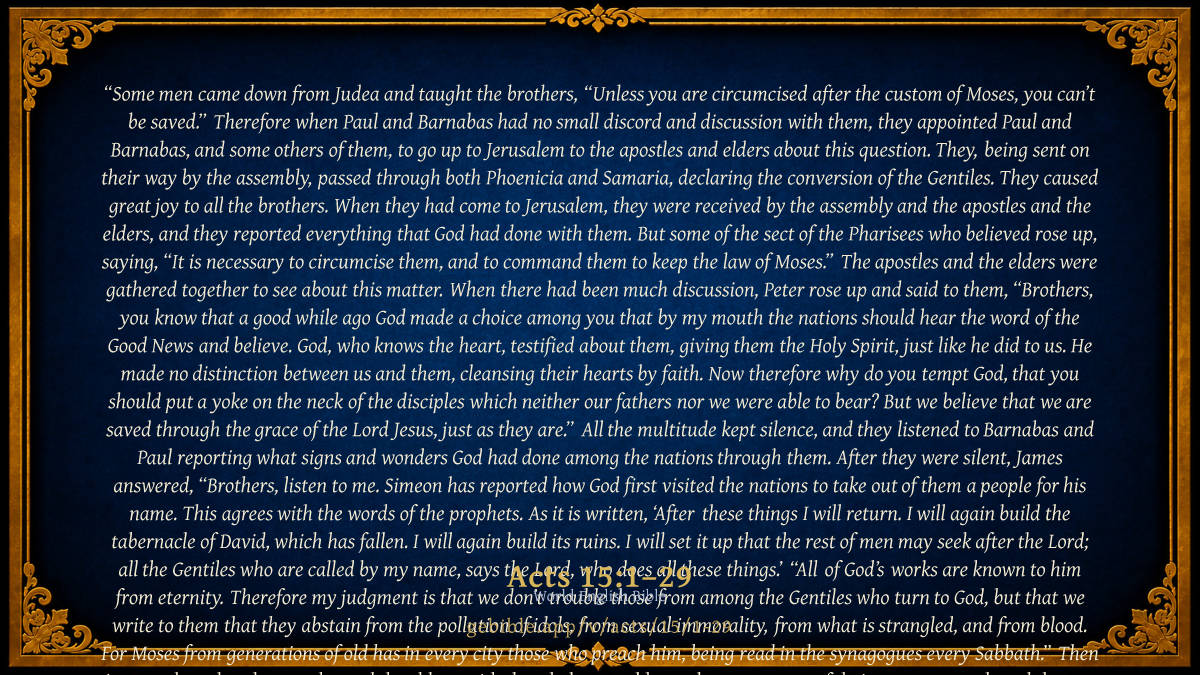
Some men came down from Judea and taught the brothers, “Unless you are circumcised after the custom of Moses, you can’t be saved.” Therefore when Paul and Barnabas had no small discord and discussion with them, they appointed Paul and Barnabas, and some others of them, to go up to Jerusalem to the apostles and elders about this question. They, being sent on their way by the assembly, passed through both Phoenicia and Samaria, declaring the conversion of the Gentiles. They caused great joy to all the brothers. When they had come to Jerusalem, they were received by the assembly and the apostles and the elders, and they reported everything that God had done with them.
But some of the sect of the Pharisees who believed rose up, saying, “It is necessary to circumcise them, and to command them to keep the law of Moses.”
The apostles and the elders were gathered together to see about this matter. When there had been much discussion, Peter rose up and said to them, “Brothers, you know that a good while ago God made a choice among you that by my mouth the nations should hear the word of the Good News and believe. God, who knows the heart, testified about them, giving them the Holy Spirit, just like he did to us. He made no distinction between us and them, cleansing their hearts by faith. Now therefore why do you tempt God, that you should put a yoke on the neck of the disciples which neither our fathers nor we were able to bear? But we believe that we are saved through the grace of the Lord Jesus, just as they are.”
All the multitude kept silence, and they listened to Barnabas and Paul reporting what signs and wonders God had done among the nations through them. After they were silent, James answered, “Brothers, listen to me. Simeon has reported how God first visited the nations to take out of them a people for his name.
This agrees with the words of the prophets. As it is written,
‘After these things I will return. I will again build the tabernacle of David, which has fallen. I will again build its ruins. I will set it up
that the rest of men may seek after the Lord; all the Gentiles who are called by my name, says the Lord, who does all these things.’
“All of God’s works are known to him from eternity. Therefore my judgment is that we don’t trouble those from among the Gentiles who turn to God, but that we write to them that they abstain from the pollution of idols, from sexual immorality, from what is strangled, and from blood. For Moses from generations of old has in every city those who preach him, being read in the synagogues every Sabbath.”
Then it seemed good to the apostles and the elders, with the whole assembly, to choose men out of their company, and send them to Antioch with Paul and Barnabas: Judas called Barsabbas, and Silas, chief men among the brothers. They wrote these things by their hand: “The apostles, the elders, and the brothers, to the brothers who are of the Gentiles in Antioch, Syria, and Cilicia: greetings.
Because we have heard that some who went out from us have troubled you with words, unsettling your souls, saying, ‘You must be circumcised and keep the law,’ to whom we gave no commandment; it seemed good to us, having come to one accord, to choose out men and send them to you with our beloved Barnabas and Paul, men who have risked their lives for the name of our Lord Jesus Christ. We have sent therefore Judas and Silas, who themselves will also tell you the same things by word of mouth. For it seemed good to the Holy Spirit, and to us, to lay no greater burden on you than these necessary things: that you abstain from things sacrificed to idols, from blood, from things strangled, and from sexual immorality, from which if you keep yourselves, it will be well with you. Farewell.”
John Calvin 1540 · Public Domain On vv1, 2, 3, 4, 5, 6, 7, 9, 10, 11, 12, 13, 15, 16, 17, 18, 19, 20, 21, 22, 24, 25, 28 1. When Paul and Barnabas had endured many combats…
1. When Paul and Barnabas had endured many combats against the professed enemies of the gospel, Luke doth now begin to declare that they were tried by domestic war; so that it was meet that their doctrine and ministry should be proved by all means, to the end it might the better appear that they were furnished by God, and armed against all the assaults of the world and Satan. For that was no small confirmation for their doctrine, in that being shaken and battered with so many engines, it stood nevertheless, neither could the course thereof be broken off by so many hindrances. Therefore, to this end doth Paul boast that he suffered fights without and terrors within, (2 Corinthians 7:5.) This history is most worthy the noting; for though we do naturally abhor the cross and all manner [of] persecution, yet civil and domestic discord is more dangerous, lest haply they discourage us. When tyrants bend their force and run violently upon men, flesh indeed is afraid; and all those who are not endued with the spirit of fortitude do tremble with all their heart; but then their consciences are not properly touched with any temptation. For this is known to be as it were the fatal estate of the Church. But when it falleth out so that the brethren go together by the ears, and that the Church is on an uproar within itself, it cannot be but that weak minds shall be troubled and also faint; and especially when the controversy is about doctrine, which alone is the holy bond of brotherly unity. Finally, there is nothing which doth more indamage the gospel than civil discord, because it doth not only pierce and wound weak conscience, but also minister occasion to the wicked to backbite.
Wherefore, we must diligently note this history, that we may know that it is no new example, if among those who profess the same gospel there arise some wranglings and strife about doctrine, when proud men can get them a name, (whereof they are so furiously desirous,) by no other means but by bringing in their own inventions. It is certain, that as there is but one God, so there is but one truth of this God. Therefore, when Paul goeth about to exhort the faithful unto mutual consent, he useth this argument, “One God, one faith, one baptism,” etc., (Ephesians 4:6.) But when we see wicked men arise, who go about to divide [rend] the Church by their factions, and also either to corrupt the gospel with their false and filthy [spurious] inventions, or else to bring the same in suspicion, we ought to know the subtlety [artifice] of Satan. Therefore, Paul saith elsewhere that heresies come abroad, that those who are tried may be made manifest, (1 Corinthians 11:19.) And, assuredly, the Lord doth wonderfully make void the subtlety of Satan, in that he trieth the faith of his by such trials, and doth beautify his word with worthy and excellent victory; and causeth the truth to shine more clearly which the wicked went about to darken. But it is very convenient to weigh all the circumstances of the history which Luke noteth.
Read full note →
Which came down from Judea. This cloak and color was very forcible to deceive even good men then. Jerusalem was honored not without cause among all churches, because they reverenced it even as their mother. For the gospel was deducted, as it were, by pipes and conduits from that fountain. These seducers come thence; they pretend the apostles; they boast that they bring nothing but that which they learned of them. They blind and blear the eyes of the unskillful with this smoke; and those who are light and wicked do greedily snatch at the color which is offered them. The perturbation of the Church doth, like a tempest, shake those who were otherwise good and moderate, so that they are enforced to stumble. Therefore, we must note this subtlety of Satan, that he abuseth the names of holy men that he may deceive the simple, who, being won with the reverence of the men, dare not inquire after the thing itself. Luke doth not express, indeed, with what affection these knaves were moved; yet it is likely that perverse zeal was the cause which moved them to set themselves against Paul and Barnabas; for there be certain churlish natures which nothing can please but that which is their own. They had seen that circumcision and other rites of the law were observed at Jerusalem; wheresoever they become, they can abide nothing which is not agreeable thereto, as if the example of one church did bind all the rest of the churches with a certain law. And though such be carried with a preposterous zeal to procure tumults, yet are they pricked inwardly with their ambition, and with a certain kind of stubbornness. Nevertheless, Satan hath that he would; for the minds of the godly have such a mist cast before them that they can scarce know black from white.
Therefore, we must beware first of this plague, that some prescribe not a law to other some after their manner, that the example of one church be not a prejudice of a common rule. Also, we must use another caution, that the persons of men do not hinder or darken the examination of the matter or cause. For if Satan transfigure himself into an angel of light, (2 Corinthians 11:14,) and if, by sacrilegious boldness, he usurp the holy name of God, what marvel is it if he do like wickedly deceive men under the names of holy men? The end shall at length declare that the apostles meant nothing less than to lay the yoke of the law upon the neck of the Gentiles; and yet Satan meant under this shift to get in. So it falleth out oftentimes that those who contrary [oppose] the doctrine of Christ, creep in under the title of his servants. Therefore, there is one only remedy, to come to search out the matter with sound judgments; also it behoveth us to prevent an offense, lest we think that the faithful servants of God do therefore strive among themselves, because Satan doth falsely abuse their names, that he may set certain shadows by the ears together to terrify the simple.
John Calvin's Commentaries (1540-1563) — public domain. Text from the Calvin Translation Society English edition (1840s-50s) via the Christian Classics Ethereal Library (ccel.org). Calvin's coverage is partial (roughly two-thirds of the Bible); uncommented books and verses are honest gaps, never fabricated. The 19th-century editor's footnotes and remarks are omitted so the notes are faithfully Calvin's own voice.
Geneva Bible translators 1599 · Public Domain On vv1, 2, 3, 6, 7, 9, 10, 12, 13, 14, 18, 19, 20, 22, 24, 26, 28, 29 Epiphanius is of opinion that this was Cerinthus.
Epiphanius is of opinion that this was Cerinthus.
The Church is at length troubled with dissension within itself, and the trouble riseth of the proud and stubborn wits of certain evil men: The first strife was concerning the office of Christ, whether we be saved by his only righteousness apprehended by faith, or we have need also to observe the Law.
Geneva Bible (1599) marginal notes — public domain.
John Trapp 1656 · Public Domain On vv1, 2, 3, 4, 5, 6, 7, 9, 10, 11, 12, 13, 14, 15, 16, 17, 18, 19, 20, 21, 22, 23, 24, 25, 26, 27, 28, 29 1 And certain men which came down from Judaea…
1 And certain men which came down from Judaea taught the brethren, and said, Except ye be circumcised after the manner of Moses, ye cannot be saved.
Ver. 1. And certain men, &c.] Cerinthus, the heretic, with his complices, saith Epiphanius. These are said to "subvert the gospel," Gal 1:7. A little thing untowardly mingled, mars all, saith Chrysostom.
John Trapp, A Commentary or Exposition upon All the Books of the Old and New Testament (1647–1656) — public domain. Text from a community e-Sword module.
Matthew Poole 1685 · Public Domain On vv1–29 Certain men; these were such as did pretend to…
Certain men; these were such as did pretend to believe, but were false brethren; some think Cerinthus to have been of them.
The brethren; the Gentiles who were converted unto the faith of Christ, or Proselytes of the gate (as they were called) who were not circumcised, and now professing the true faith. These the pharisaical professors would have excluded from any hopes of salvation, although circumcision was not commanded but unto the posterity of Abraham, Gen 17:10-13, and Abraham himself was justified before he was circumcised, Rom 4:10.
Read full note →
After the manner of Moses; according unto the law of Moses: for God by him did renew and establish that ordinance unto that people, although it was long before his time both commanded and practised, Joh 7:22.
Matthew Poole's English Annotations on the Holy Bible (1683–1685) — public domain. Text from a community e-Sword/MySword module.
William Burkitt 1703 · Public Domain On vv1, 3, 5, 7, 12, 13, 21 Observe here, 1. How very forward Satan and his…
Observe here, 1. How very forward Satan and his instruments were to sow the seeds of discord and dissension amongst the converted Christians at Antioch: he takes the first opportunity to break the church in pieces, before it is well settled.
O the restless malice of an envious devil against the gospel and kingdom of Jesus Christ!
Read full note →
Certain men came down from Judea, no doubt of the devil’s sending, to disquiet the brethern, and distress the church.
Observe, 2. The bone of contention thrown in by the false apostles, to disturb the disciples of Christ; and that was, the urging the necessity of circumcision, and imposing that part of the Mosaic yoke upon the neck of the converted Gentiles, excluding them from all hopes of salvation, unless they were circumcised; although circumcision was not commanded but only to the posterity of Abraham; and as to them also, had received its abolishment at the death of Christ.
Observe, 3. With what warmth of zeal the meek apostle, St. Paul, opposes this anti-Christian design of introducing circumcision into the Christian church: Paul and Barnabas had no small disputation with them; he that could become all things to all men, could not become sin to any man; he therefore enters into the lists with them, and earnestly contends for the faith of the gospel, urging, that by the death of Christ we are freed from the whole ceremonial law: and that if circumcision were retained, for the same reason all the other ceremonies ought to be restored; for the circumcised person was obliged to observe the whole ceremonial law.
Observe, 4. The prudential course which the disciples at Antioch took for the deciding of this controversy; they determined to send Paul and Barnabas up to Jerusalem, where, in a full and free synod of the apostles, the matter is debated, and finally decided.
Learn hence, That the use of synods, or general assemblies of the bishops and pastors of the church, for deciding of controversies, for determining matters of faith, and directing to matters of practice, as it has been of ancient authority in the church of Christ, so it is of singular benefit and advantage both to ministers and people. Here Paul and Barnabas go up to the first synod, or general council at Jeruaslem, to consult the apostles and elders about this question.
William Burkitt's Expository Notes on the New Testament (1700–1703) — public domain. Text from a community e-Sword module.
Matthew Henry 1710 · Public Domain On vv1, 6, 22 Even when things go on very smoothly and pleasantly…
Even when things go on very smoothly and pleasantly in a state or in a church, it is folly to be secure, and to think the mountain stands strong and cannot be moved; some uneasiness or other will arise, which is not foreseen, cannot be prevented, but must be prepared for. If ever there was a heaven upon earth, surely it was in the church at Antioch at this time, when there were so many excellent ministers there, and blessed Paul among them, building up that church in her most holy faith. But here we have their peace disturbed, and differences arising. Here is,
I. A new doctrine started among them, which occasioned this division, obliging the Gentile converts to submit to circumcision and the ceremonial law, Act 15:1. Many that had been proselytes to the Jewish religion became Christians; and they would have such as were proselyted to the Christian religion to become Jews.
Read full note →
1. The persons that urged this were certain men who came down from Judea; some think such as had been of the Pharisees (Act 15:5), or perhaps of those priests who were obedient to the faith, Act 6:7. They came from Judea, pretending perhaps to be sent by the apostles at Jerusalem, at least to be countenanced by them. Having a design to spread their notions, they came to Antioch, because that was the head-quarters of those that preached to the Gentiles, and the rendezvous of the Gentile converts; and, if they could but make an interest there, this leaven would soon be diffused to all the churches of the Gentiles. They insinuated themselves into an acquaintance with the brethren, pretended to be very glad that they had embraced the Christian faith, and congratulated them on their conversion; but tell them that yet one thing they lack, they must be circumcised. Note, Those that are ever so well taught have need to stand upon their guard that they be not untaught again, or ill taught.
2. The position they laid down, the thesis they gave, was this, that except the Gentiles who turned Christians were circumcised after the manner of Moses, and thereby bound themselves to all the observances of the ceremonial law, they could not be saved. As to this, (1.) Many of the Jews who embraced the faith of Christ, yet continued very zealous for the law, Act 21:20. They knew it was from God and its authority was sacred, valued it for its antiquity, had been bred up in the observance of it, and it is probable had been often devoutly affected in their attendance on these observances; they therefore kept them up after they were by baptism admitted into the Christian church, kept up the distinction of meats, and used the ceremonial purifyings from ceremonial pollutions, attend the temple service, and celebrated the feasts of the Jews. Herein they were connived at, because the prejudices of education are not to be overcome all at once, and in a few years the mistake would be effectually rectified by the destruction of the temple and the total dissolution of the Jewish church, by which the observance of the Mosaic ritual would become utterly impracticable. But it did not suffice them that they were herein indulged themselves, they must have the Gentile converts brought under the same obligations. Note, There is a strange proneness in us to make our opinion and practice a rule and a law to every body else, to judge of all about us by our standard, and to conclude that because we do well all do wrong that do not just as we do. (2.) Those Jews who believed that Christ was the Messiah, as they could not get clear of their affection to the law, so they could not get clear of the notions they had of the Messiah, that he should set up a temporal kingdom in favour of the Jewish nation, should make this illustrious and victorious; it was a disappointment to them that there was as yet nothing done towards this in the way they expected. But now that they hear the doctrine of Christ is received among the Gentiles, and his kingdom begins to be set up in the midst of them, if they can but persuade those that embrace Christ to embrace the law of Moses too they hope their point will be gained, the Jewish nation will be made as considerable as they can wish, though in another way; and "Therefore by all means let the brethren be pressed to be circumcised and keep the law, and then with our religion our dominion will be extended, and we shall in a little time be able to shake off the Roman yoke; and not only so, but to put it on the necks of our neighbours, and so shall have such a kingdom of the Messiah as we promised ourselves." Note, It is no wonder if those who have wrong notions of the kingdom of Christ take wrong measures for the advancement of it, and such as really tend to the destruction of it, as these do. (3.) The controversy about the circumcising of the Gentile proselytes had been on foot among the Jews long before this. This is observed by Dr. Whitby out of Josephus - Antiq. 20.38-45: "That when Izates, the son of Helen queen of Adiabene, embraced the Jews' religion, Ananias declared he might do it without circumcision; but Eleazar maintained that it was a great impiety to remain uncircumcised." And when two eminent Gentiles fled to Josephus (as he relates in the history of his own life) "the zealots among the Jews were urgent for their circumcision; but Josephus dissuaded them from insisting upon it." Such has been the difference in all ages between bigotry and moderation. (4.) It is observable what a mighty stress they laid upon it; they do not only say, "You ought to be circumcised after the manner of Moses, and it will be good service to the kingdom of the Messiah if you be; it will best accommodate matters between you and the Jewish converts, and we shall take it very kindly if you will, and shall converse the more familiarly with you;" but, "Except you be circumcised you cannot be saved. If you be not herein of our mind and way, you will never go to heaven, and therefore of course you must go to hell." Note, it is common for proud impostors to enforce their own inventions under pain of damnation; and to tell people that unless they believe just as they would have them believe, and do just as they would have them do, they cannot be saved, it is impossible they should; not only their case is hazardous, but it is desperate. Thus the Jews tell their brethren that except they be of their church, and come into their communion, and conform to the ceremonies of their worship, though otherwise good men and believers in Christ, yet they cannot be saved; salvation itself cannot save them. None are in Christ but those that are within their pale. We ought to see ourselves well warranted by the word of God before we say, "Except you do so and so, you cannot be saved."
II. The opposition which Paul and Barnabas gave to this schismatical notion, which engrossed salvation to the Jews, now that Christ has opened the door of salvation to the Gentiles (Act 15:2): They had no small dissension and disputation with them. They would by no means yield to this doctrine, but appeared and argued publicly against it. 1. As faithful servants of Christ, they would not see his truths betrayed. They knew that Christ came to free us from the yoke of the ceremonial law, and to take down that wall of partition between Jews and Gentiles and unite them both in himself; and therefore could not bear to hear of circumcising the Gentile converts, when their instructions were only to baptize them. The Jews would unite with the Gentiles, that is, they would have them to conform in every thing to their rites, and then, and not till then they will look upon them as their brethren; and no thanks to them. But, this not being the way in which Christ designed to unite them, it is not to be admitted. 2. As spiritual fathers to the Gentile converts, they would not see their liberties encroached upon. They had told the Gentiles that if they believed in Jesus Christ they should be saved; and now to be told that this was not enough to save them, except they were circumcised and kept the law of Moses, this was such a discouragement to them at setting out, and would be such a stumbling-block in their way, as might almost tempt them to think of returning into Egypt again; and therefore the apostles set themselves against it.
III. The expedient pitched upon for preventing the mischief of this dangerous notion, and silencing those that vented it, as well as quieting the minds of the people with reference to it. They determined that Paul and Barnabas, and some others of their number, should go to Jerusalem to the apostles and elders, concerning this doubt. Not that the church at Antioch had any doubt concerning it: they knew the liberty wherewith Christ had made them free; but they sent the case to Jerusalem, 1. Because those who taught this doctrine came from Jerusalem, and pretended to have directions from the apostles there to urge circumcision upon the Gentile converts; it was therefore very proper to send to Jerusalem about it, to know if they had any such direction from the church there. And it was soon found to be all wrong, which yet pretended to be of apostolical right. It was true that these went out from them (Act 15:24), but they never had any such orders from them. 2. Because those who were taught this doctrine would be the better confirmed in their opposition to it, and in the less danger of being shocked and disturbed by it, if they were sure that the apostles and elders at Jerusalem (which was the Christian church that of all others retained the most affection to the law of Moses) were against it; and, if they could but have this under their hands, it would be the likeliest means to silence and shame these incendiaries, who had pretended to have it from them. 3. Because the apostles at Jerusalem were fittest to be consulted in a point not yet fully settled; and being most eminent for an infallible spirit, peculiar to them as apostles, their decision would be likely to end the controversy. It was owing to the subtlety and malice of the great enemy of the church's peace (as it appears by Paul's frequent complaints of these judaizing teachers, these false apostles, these deceitful workers, these enemies of the cross of Christ), that it had not this effect.
IV. Their journey to Jerusalem upon this errand, Act 15:3. Where we find, 1. That they were honoured at parting: They were brought on their way by the church, which was then much used as a token of respect to useful men, and is directed to be done after a godly sort, Jo3 1:6. Thus the church showed their favour to those who witnessed against these encroachments on the liberties of the Gentile converts, and stood up for them. 2. That they did good as they went along. They were men that would not lose time, and therefore visited the churches by the way; they passed through Phenice and Samaria, and as they went declared the conversion of the Gentiles, and what wonderful success the gospel had had among them, which caused great joy to all the brethren. Note, The progress of the gospel is and ought to be a matter of great joy. All the brethren, the faithful brethren in Christ's family, rejoice when more are born into the family; for the family will be never the poorer for the multitude of its children. In Christ and heaven there is portion enough, and inheritance enough for them all.
V. Their hearty welcome at Jerusalem, Act 15:4. 1. The good entertainment their friends gave them: They were received of the church, and of the apostles and elders, were embraced as brethren, and had audience as messengers of the church at Antioch; they received them with all possible expressions of love and friendship. 2. The good entertainment they gave their friends: They declared all things that God had done with them, gave them an account of the success of their ministry among the Gentiles, not what they had done, but what God had done with them, what he had by his grace in them enabled them to do, and what he had by his grace in their hearers enabled them to receive. As they went they had planted, as they came back they had watered; but in both they were ready to own it was God that gave the increase. Note, It is a great honour to be employed for God, to be workers for him; for those that are so have him a worker with them, and he must have all the glory.
VI. The opposition they met with from the same party at Jerusalem, Act 15:5. When Barnabas and Paul gave an account of the multitude of the Gentiles, and of the great harvest of souls gathered in to Christ there, and all about them congratulated them upon it, there rose up certain of the sect of the Pharisees, who received the tidings very coldly, and, though they believed in Christ, yet were not satisfied in the admission of these converts, but thought it was needful to circumcise them. Observe here, 1. That those who have been most prejudiced against the gospel yet have been captivated by it; so mighty has it been through God to the pulling down of strong-holds. When Christ was here upon earth, few or none of the rulers and of the Pharisees believed on him; but now there are those of the sect of the Pharisees who believed, and many of them, we hope, in sincerity. 2. That it is very hard for men suddenly to get clear of their prejudices: those that had been Pharisees, even after they became Christians, retained some of the old leaven. All did not so, witness Paul, but some did; and they had such a jealousy for the ceremonial law, and such a dislike of the Gentiles, that they could not admit the Gentiles into communion with them, unless they would be circumcised, and thereby engage themselves to keep the law of Moses. This was, in their opinion, needful; and for their parts they would not converse with them unless they submitted to it.
Matthew Henry's Commentary on the Whole Bible (1708–1710) — public domain (CC PDM 1.0). Text via the HelloAO Bible API.
John Gill 1763 · Public Domain On vv2–29 When therefore Paul and Barnabas,.... Who were the ministers…
When therefore Paul and Barnabas,.... Who were the ministers of the uncircumcision, and were just returned from preaching the Gospel among the Gentiles, with success, and were advocates for them, being witnesses of the grace that was bestowed on them, and therefore opposed the sentiments of these men:
and had no small dissension and disputation with them; which was attended with much heat and sharpness, and continued some time, and occasioned much disturbance and uneasiness; nor could the affair be decided and issued: wherefore
Read full note →
they determined that Paul and Barnabas, and certain other of them; that is, the members of the church at Antioch, taking this matter into consideration, and finding that the difference could not be composed, for the peace of the church, wisely came to a resolution, and made an order, that Paul and Barnabas, with others, as Titus, who went with Paul at this time, as appears from Gal 2:1 and some others of the brethren, and it may be also certain, on, the other side of the question; that these
should go up to Jerusalem, unto the apostles and elders, about this question; concerning circumcision, and the necessity of it to salvation, that they might have the sense of James, and Peter, and John, who particularly were at Jerusalem at this time, as appears from Act 15:7 and other apostles that might be there; and also of other ministers of the word, who are called elders. And the church of Jerusalem being the most ancient church, and several of the apostles residing here, who had seen Christ in the flesh, and had received their mission and commission from him, and had been extraordinarily endowed with the Holy Ghost; and here being many other preachers of the Gospel, and there being in a multitude of counsellors safety, the church at Antioch judged it advisable to send to them for counsel and direction; and it becomes churches to assist each other in this way.
John Gill's Exposition of the Whole Bible (1746–1763) — public domain (CC PDM 1.0). Text via the HelloAO Bible API.
John Wesley 1765 · Public Domain On vv1, 2, 4, 5, 7, 8, 9, 10, 11, 12, 14, 15, 16, 17, 18, 20, 21, 22, 23, 24, 26, 27, 28, 29 Coming down from Judea - Perhaps to supply what…
Coming down from Judea - Perhaps to supply what they thought Paul and Barnabas had omitted.
John Wesley, Explanatory Notes Upon the Whole Bible (1754–1765) — public domain. Text via the GEBible commentary corpus.
Adam Clarke 1810 · Public Domain On vv1, 2, 3, 4, 5, 6, 7, 8, 9, 10, 11, 12, 13, 14, 15, 16, 17, 18, 19, 20, 21, 22, 23, 24, 26, 27, 28, 29 Certain teachers from Judea insist on the necessity of…
CHAPTER XV.
Certain teachers from Judea insist on the necessity of the
Read full note →
converted Gentiles being circumcised, 1.
Paul and Barnabas are sent to Jerusalem to consult the apostles
on this subject, 2.
They come to Jerusalem, and inform the apostles of the
conversion of the Gentiles; and of the trouble which certain
Pharisees had occasioned concerning circumcision, 3-5.
The apostles having assembled to consider the question, Peter
delivers his opinion, 6-11.
Barnabas and Paul relate their success among the Gentiles, 12.
James delivers his judgment, 13-21.
The apostles and elders agree to what he proposes, and send
Judas and Silas with Paul and Barnabas to the converted
Gentiles, 22;
and send an epistle containing their decree to the Churches of
Antioch, Syria, and Cilicia, 23-29.
Paul and his company return, and read the epistle to the
brethren at Antioch, which produces great joy; and Judas and
Silas preach to them, 30-32.
Judas returns to Jerusalem, but Silas continues with Paul and
Barnabas, teaching and preaching, 33-35.
Paul proposes to Barnabas to visit the Churches where they had
preached; and, on the latter determining to take John Mark
with them, Paul refuses, 36-38.
They disagree; and Barnabas, taking John Mark, sails to Cyprus,
39.
And Paul, taking Silas, goes through Syria and Cilicia,
confirming the Churches, 40, 41.
NOTES ON CHAP. XV.
Verse 1. Except ye be circumcised, c.] The persons who taught this doctrine appear to have been converts to Christianity but, supposing that the Christian religion was intended to perfect the Mosaic, and not to supersede it, they insisted on the necessity of circumcision, because, by that, a man was made debtor to the whole law, to observe all its rites and ceremonies. This question produced great disturbance in the apostolic Church; and, notwithstanding the decree mentioned in this chapter, the apostles were frequently obliged to interpose their authority in order to settle it; and we find a whole Church, that at Galatia, drawn aside from the simplicity of the Christian faith by the subtilty of Judaizing teachers among themselves, who insisted on the necessity of the converted Gentiles being circumcised.
Ye cannot be saved.] Ye can neither enjoy God's blessing in time, nor his glory in eternity. Such an assertion as this, from any reputable authority, must necessarily shake the confidence of young converts.
Adam Clarke's Commentary on the Bible (1810–1826) — public domain. Text from a community e-Sword/MySword module.
Joseph Benson 1811 · Public Domain On vv1, 3, 6, 12, 19, 22, 24, 28 Act 15:1. And certain men which came down from…
Act 15:1. And certain men which came down from Judea — Probably such as had been of the Pharisees, (Act 15:5,) or, perhaps, of those priests which were obedient to the faith, Act 6:7. As they came from Judea, it is likely they pretended to be sent by the apostles at Jerusalem, or, at least, to be countenanced by them. Designing to spread their notions among the Gentiles, they came to Antioch, because that city abounded with Gentile converts, and was the headquarters of those that preached to the Gentiles; and if they could but make an impression there, they supposed their leaven would soon be diffused to all the churches of the Gentiles. And said, Except ye be circumcised after the manner of Moses — That is, Except ye keep the law of Moses, (see Act 15:5; Gal 5:3,) ye cannot be saved — Can neither enjoy God’s favour here, nor his kingdom hereafter. Paul and Barnabas had no small dissension and disputation — They strenuously opposed this doctrine; 1st, Because its direct tendency was to subvert the gospel, which they had preached, and which they knew was of itself sufficient for the salvation of men, without the works of the Mosaic law. And, 2d, Because it was a betraying of the natural rights of mankind, who, by the gospel, are left free, both to obey the good laws of the countries where they live, and enjoy whatever rights accrue to them from those laws. Whereas, by receiving the law of Moses, the Gentiles really made themselves the subjects of a foreign power; for that law included, the civil or political law of Judea; and all who received it actually put themselves under the jurisdiction of the high-priest and council at Jerusalem. Hence Paul and Barnabas, as faithful servants of Christ, could not see his truth betrayed; they knew Christ came to free men from the yoke of the ceremonial law, to take down that wall of partition between Jews and Gentiles, and unite them both in himself, and therefore would not hear of circumcising the Gentile converts, when their instructions were only to baptize them. And, as spiritual fathers to them, they would not see their liberties encroached on. There being, therefore, much contention upon this account at Antioch, where there were several converts from among the Gentiles, to whom this doctrine could not but be very disagreeable, and, doubtless, many Jewish Christians, who approved of it; and the peace of the church and the unity of its members being in danger of being broken, to prevent this, if possible, it was judged advisable to get the best satisfaction they could, in an affair which affected the liberties and consciences of many. They determined, therefore, that Paul and Barnabas, and certain others, should go to Jerusalem, about this question — This is the journey to which Paul refers, (Gal 2:1-2,) when he says, he went up by revelation, which is very consistent with this; for the church, in sending them, might be directed by a revelation, made either immediately to Paul, or some other person, relating to so important an affair. Important indeed it was, and necessary that those Jewish impositions should be solemnly opposed in time, because multitudes of converts were still zealous for the law, and ready to contend for the observance of it. Indeed, many of the Christians at Antioch undoubtedly knew that Paul was under an extraordinary divine direction, and therefore would readily have acquiesced in his determination alone; but as others might have prejudices against him, on account of his having been so much concerned with the Gentiles, it was highly expedient to take the concurrent judgment of all the apostles on this occasion; since their authority was supreme in the church, and their decision alone could put an end to the controversy. It appears from Gal 2:1, that Titus was one of those who accompanied Paul and Barnabas to Jerusalem at this time. Him, it is probable, Paul had converted in the Lesser Asia: and, being a person of great piety and ability, he had taken him as his assistant in the room of John Mark, at Perga, and had brought him to Antioch; and he, being a Gentile, had consequently much interest in the determination of this question. See Doddridge and Macknight.
Joseph Benson's Commentary on the Old and New Testaments (1811–1818) — public domain. Text from a community e-Sword module.
Albert Barnes 1834 · Public Domain On vv1, 2, 3, 4, 5, 6, 7, 8, 9, 10, 11, 12, 13, 14, 15, 16, 17, 18, 19, 20, 21, 22, 23, 24, 26, 27, 28, 29 And certain men - These were undoubtedly men who…
And certain men - These were undoubtedly men who had been Jews, but who were now converted to Christianity. The fact that they were willing to refer the matter in dispute to the apostles and elders Act 15:2 shows that they had professedly embraced the Christian religion. The account which follows is a record of the first internal dissension which occurred in the Christian church. Hitherto the church had been struggling against external foes. Violent persecutions had raged, and had fully occupied the attention of Christians. But now the churches were at peace. They enjoyed great external prosperity in Antioch, and the great enemy of souls took occasion then, as he has often done in similar circumstances since, to excite contentions in the church itself, so that when external violence could not destroy it, an effort was made to secure the same object by internal dissension and strife. This history, therefore, is particularly important, as it is the record of the first unhappy debate which arose in the bosom of the church. It is further important, as it shows the manner in which such controversies were settled in apostolic times, and as it established some very important principles respecting the perpetuity of the religious rites of the Jews.
Came down from Judea - To Antioch, and to the regions adjacent, which had been visited by the apostles, Act 15:23. Judea was a high and hilly region, and going from that toward the level countries adjacent to the sea was represented to be descending, or going down.
Read full note →
Taught the brethren - That is, Christians. They endeavored to convince them of the necessity of keeping the laws of Moses.
Except ye be circumcised - This was the leading or principal rite of the Jewish religion. It was indispensable to the name and privileges of a Jew. Proselytes to their religion were circumcised as well as native-born Jews, and they held it to be indispensable to salvation. It is evident from this that Paul and Barnabas had dispensed with this rite in regard to the Gentile converts, and that they intended to found the Christian church on the principle that the Jewish ceremonies were to cease. When, however, it was necessary to conciliate the minds of the Jews and to prevent contention, Paul did not hesitate to practice circumcision, Act 16:3.
After the manner of Moses - According to the custom which Moses commanded; according to the Mosaic ritual.
Ye cannot be saved - The Jews regarded this as indispensable to salvation. The grounds on which they would press it on the attention of Gentile converts would be very plausible, and such as would produce much embarrassment. For:
(1) It would be maintained that the laws of Moses were the laws of God, and were therefore unchangeable; and,
(2) It would doubtless be maintained that the religion of the Messiah was only a completing and perfecting of the Jewish religion that it was designed simply to carry out its principles according to the promises, and not to subvert and destroy anything that had been established by divine authority. It is usually not difficult to perplex and embarrass young converts with questions of modes, and rites, and forms of religion; and it is not uncommon that a revival is followed by some contention just like this. Opposing sects urge the claims of their special rites, and seek to make proselytes, and introduce contention and strife into an otherwise peaceful and happy Christian community.
Albert Barnes' Notes on the Bible (1834–1885) — public domain. Text from a community e-Sword/MySword module.
Haydock's Catholic Bible Commentary 1859 · Public Domain On vv1, 2, 7, 10, 11, 18, 19, 20, 21, 23, 24, 28, 29 Unless you be circumcised. Many who had been converted…
Unless you be circumcised. Many who had been converted from Judaism, held that none, not even converted from paganism, could be saved, unless they were circumcised, and observed the other ceremonies of the law of Moses. (Witham) --- See Galatians v. 2.
George Leo Haydock (1774–1849), Haydock's Catholic Family Bible and Commentary, 1859 edition — public domain. Excludes Psalms (Douay-Rheims chapter numbering differs from Protestant) and Deuterocanonical books (Catholic canon only).
John Nelson Darby 1862 · Public Domain On v1 Acts Chapter 15
Acts Chapter 15
Chapter 15 contains the account of this. Certain persons come from Jerusalem, where all was still going on in connection with the requirements of the law; and they seek to impose these requirements on the Gentiles in this new centre and starting-point of the work which was formed at Antioch. It was the will of God that this matter should be settled, not by the apostolic authority of Paul, or by the action of His Spirit at Antioch only, which might have divided the church, but by means of conference at Jerusalem, so as to maintain union, whatever might be the prejudices of the Jews. The ways of Godin this respect are remarkable, shewing the way in which He has maintained sovereign care in grace over the church. In reading the Epistle to the Galatians, we see that in reality things were in question that touched Christianity to the quick, that affected its very foundations, the deep principles of grace, of the rights of God, of the sinful condition of man-principles on which the whole edifice of man’s eternal relations with God is founded. If any one was circumcised, he was under the law; he had given up grace, he had fallen away from Christ. Nevertheless Paul the apostle, Paul full of faith, of energy, of burning zeal, is obliged to go up to Jerusalem, whither he had not desired to go, in order to arrange this matter. Paul had laboured at Antioch; but the work in that city was not his work. He was not the apostle at Antioch as he was that of Iconium, of Lystra, and afterwards of Macedonia and of Greece. He went out from Antioch, from the bosom of the church already formed there. The question was to be settled for the church, apart from the apostolic authority of Paul. The apostle must yield before God and His ways.
Read full note →
Paul disputes with the men from Judea, but the end is not gained. It is determined to send some members of the church to Jerusalem, but with them Paul and Barnabas, so deeply interested in this question. Moreover Paul had a revelation that he should go up. God directed his steps. It is good however to be obliged to submit sometimes, although ever so right or so full of spiritual energy.
The question then is entered upon at Jerusalem. It was already a great thing that the subjecting of the Gentiles to the law should be resisted at Jerusalem, and still more that they should there decide not to do it. We see the wisdom of God in so ordering it, that such a resolution should have its origin at Jerusalem. Had there been no bigotry there, the question would not have been necessary; but alas! good has to be done in despite of all the weakness and all the traditions of men. A resolution made at Antioch would have been a very different thing from a resolution made at Jerusalem. The Jewish church would not have acknowledged the truth, the apostolic authority of the twelve would not have given its sanction to it. The course at Antioch and of the Gentiles would have been a course apart; and a continual struggle would have commenced, having (at least in appearance) the authority of the primitive and apostolic church on the one side, and the energy and liberty of the Spirit with Paul for its representative on the other. The Judaizing tendency of human nature is ever ready to abandon the high energy of the Spirit, and return into the ways and thoughts of the flesh. This tendency, nourished by the traditions of an ancient faith, had already given sorrow and difficulty enough to him who was specially labouring among the Gentiles according to the liberty of the Spirit, without the additional strength of having the course of the apostles and of the church at Jerusalem to countenance it.
After much discussion at Jerusalem, full liberty for which was given, Peter, taking the lead, relates the case of Cornelius. Afterwards Paul and Barnabas declare the wonderful manifestation of God through the power of the Holy Ghost which had taken place among the Gentiles. James then sums up the judgment of the assembly, which is assented to by all, that the Gentiles shall not be obliged to be circumcised, or to obey the law; but only to abstain from blood, from things strangled, from fornication, and from meat offered to idols. We shall do well to consider the nature and stipulations of this decree.
It is a direction which teaches, not that which is abstractedly good or evil, but that which was suitable to the case presented. It was “necessary,” not “righteous before God,” to avoid certain things. The things might be really evil, but they are not here looked at in that way. There were certain things to which the Gentiles were accustomed, which it was proper they should renounce, in order that the assembly might walk as it ought before God in peace. To the other ordinances of the law they were not to be subjected. Moses had those who preached him. That sufficed, without compelling the Gentiles to submit to his laws, when they joined themselves, not to the Jews, but to the Lord.
This decree therefore does not pronounce upon the nature of the things forbidden, but upon the opportuneness-the Gentiles having in fact been in the habit of doing all these things. We must observe that they were not things forbidden by the law only. It was that which was contrary to the order established by God as Creator, or to a prohibition given to Noah when he was told to eat flesh. Woman was only to be connected with man in the sanctity of marriage, and this is a very great blessing. Life belonged to God. All fellowship with idols was an outrage against the authority of the true God. Let Moses teach his own laws; these things were contrary to the intelligent knowledge of the true God. It is not therefore a new law imposed by Christianity, nor an accommodation to the prejudices of the Jews. It has not the same kind of validity as a moral ordinance that is obligatory in itself. It is the expression to Christian intelligence of the terms of man’s true relations with God in the things of nature, given by the goodness of God, through the leaders at Jerusalem, to ignorant Christians, setting them free from the law, and enlightening them with regard to the relations between God and man, and to that which was proper to man-things of which, as idolatrous Gentiles, they had been ignorant. I have said, addressed to Christian intelligence: accordingly there is nothing inconsistent in eating anything that is sold at the shambles; for I acknowledge God who gave it, and not an idol. But if the act implies communion with the idol, even to the conscience of another, it would be provoking God to jealousy; I sin against Him or against my neighbour. I do not know whether an animal is strangled or not, but if people act so as to imply that it is indifferent whether life belongs to God or not, I sin again; I am not defiled by the thing, but I fail in Christian intelligence with regard to the rights of God as Creator. With regard to fornication, this enters into the category of Christian purity, besides being contrary to the order of the Creator; so that it is a direct question of good and evil, and not only of the rights of God revealed to our intelligence. This was important as a general principle, more than in the detail of the things themselves.
In sum the principles established are these: purity by marriage according to God’s original institution; that life belongs to God; and the unity of God as one only true God-Godhead, life, and God’s original ordinance for man. The same thing is true of the foundations laid by the assembly at the basis of their decree, “It seemed good to the Holy Ghost and to us.”
The Holy Ghost had manifested Himself in the case of Cornelius and of the conversion of the Gentiles, of which Peter and Paul and Barnabas had given the account. On the other hand the apostles were the depositaries of the authority of Christ, those to whom the government of the assembly as founded in connection with the true Jewish faith had been committed. They represented the authority of Christ ascended on high, even as the power and will of the Holy Ghost had been shewn in the cases I have just mentioned. The authority was exercised in connection with that which, in a certain sense, was the continuation of a Judaism enlarged by fresh revelations, and which had its centre at Jerusalem, acknowledging as Messiah the ascended Jesus rejected by the people. Christ had committed to them the authority necessary to govern the assembly. They had also been sealed on the day of Pentecost in order to perform it.
The spirit of grace and wisdom is truly seen in their way of acting. They give their full sanction to Paul and Barnabas, and they send with them persons of note in the assembly at Jerusalem, who could not be suspected of bringing an answer in support of their own pretensions, as might have been supposed in the case of Paul and Barnabas.
The apostles and elders assemble for deliberation; but the whole flock acts in concert with them.
Thus Jerusalem has decided that the law was not binding on the Gentiles. These, sincere in their desire of walking with Christ, rejoice greatly at their freedom from this yoke. Judas and Silas, being prophets, exhort and confirm them, and afterwards are dismissed in peace. But Silas thinks it good to remain on his own account, influenced by the Spirit. He prefers the work among the Gentiles to Jerusalem. Judas returns from it to Jerusalem.
The work continues at Antioch by means of Paul and Barnabas and others. At Antioch we again see the full liberty of the Holy Ghost.
Paul proposes to Barnabas that they should go and visit the assemblies already formed by their means in Asia Minor. Barnabas consents, but he determines to take John who had formerly forsaken them. Paul wishes for some one who had not drawn back from the work, nor abandoned for his own home the place of a stranger for the work’s sake. Barnabas insists; and these two precious servants of God separate. Barnabas takes Mark and goes to Cyprus. Now Mark was his kinsman, and Cyprus his own country. Paul takes Silas, who had preferred the work to Jerusalem instead of Jerusalem to the work and departs. From his name we may believe that Silas was a Hellenist.
It is happy to find that, after this, Paul speaks of Barnabas with entire affection, and desires that Mark should come to him, having found him profitable for the ministry.
Moreover Paul is commended by the brethren to the grace of God in his work. The title given to Paul and Barnabas by the apostles shews the difference between the apostolic authority, established by Christ in person, and that which was constituted such by the power of the Holy Ghost-sent by Christ Himself, no doubt, but in point of fact going forth by the direction of the Holy Ghost, and their mission warranted by His power. With the apostles, Paul and Barnabas have no title except their work-”men that have hazarded their lives for the name of our Lord Jesus Christ.” They are that which the Holy Ghost has made them. The apostles are the twelve.
The liberty and the power of the Spirit characterise Paul He is that which the Spirit makes him. If Jesus had appeared to him, although Ananias can testify it, he must in reality prove it by the power of his ministry. The effects of this ministry are related as well as its character in chapters 16-20. The action and the liberty of the Holy Ghost are there displayed in a remarkable manner.
John Nelson Darby — Synopsis of the Books of the Bible: the New Testament (c. 1857–1862) — public domain. Text from a community e-Sword module.
Lange's Commentary on the Holy Scriptures 1864 · Public Domain On vv1, 6, 22
SECTION II
PAUL AND BARNABAS, THE APOSTLES OF THE GENTILES, ABE SENT FROM ANTIOCH TO JERUSALEM, FOR THE PURPOSE OF ARRANGING MATTERS THAT CONCERNED GENTILE-CHRISTIANS; THE PROCEEDINGS IN JERUSALEM, AND THEIR RESULTS
Read full note →
Act_15:1-35
A.—THE JUDAIZING DEMAND RESPECTING CIRCUMCISION PRODUCES AN EXCITEMENT IN ANTIOCH; PAUL AND BARNABAS ARE COMMISSIONED TO PROCEED TO JERUSALEM IN REFERENCE TO THIS SUBJECT; THEIR JOURNEY, AND THE OCCURRENCES WHICH FIRST TOOK PLACE ON THEIR ARRIVAL
Act_15:1-5
1And certain men which [who] came down from Judea taught the brethren, and said [om. and said,], Except ye [If ye do not suffer yourselves to] be circumcised1 after the manner [usage] of Moses, ye cannot be saved. 2When therefore Paul and Barnabas had no small dissension and disputation [contention]2 with them, they determined [arranged] that Paul and Barnabas, and certain other [some others] of them, should go up to Jerusalem unto the apostles and elders about this question [controversy]. 3And [So then] being brought [conducted] on their way by the church, they passed [journeyed] through Phenice and Samaria, declaring [relating] the conversion of the Gentiles: and they caused great joy unto all the brethren. 4And [But] when they were come to [arrived at] Jerusalem, they were received3 of [by] the church, and of [by] the apostles and elders, and they declared [announced to them] all things that [how much] God had done with them. 5But [Then, δέ] there rose up4 certain [some] of the sect of the Pharisees which believed [who had become believers], saying, That it was needful to circumcise them, and [saying, It is necessary to circumcise them, and] to command them to keep the law of Moses.
EXEGETICAL AND CRITICAL
Act_15:1. a. And certain men which came down.—The arrival of these men from Judea, and the declarations which they made in Antioch, plainly show that very serious difficulties had arisen, involving a principle of vast importance, which not only needed elucidation, but which it was indispensable that all should distinctly recognize and adopt. The men who created the confusion, which was now continually increasing, are described by Luke as τινές ἀπὸ τῆς Ἰουδαίας, that is, they belonged to Judea, or, they came from it. The words do not simply contain a geographical notice, but also allude to sentiments and modes of thought which were preëminently Jewish. The [later] Syriac version [in the margin], and Cod. 8 [named Stephani ιά, a cursive or minuscule ms. of an uncertain date, and also Cod. 137, named Ambrosianus 97, of the eleventh century, in the text (Alf.)—Tr.] insert after Ἰουδαίας the words: τῶν πεπιστευκότων ἀπὸ τῆς αἱρέσεως τῶν Φαρισαίων; they are, it is true, interpolated from Act_15:5, as an explanation, but no doubt correctly describe the facts. Several Christians of this class came to Antioch from Judea, and probably from the city of Jerusalem. The circumstances authorize us to assume that their arrival was not accidental, but in accordance with a settled plan, and possibly, too, after they had previously had an understanding with persons who entertained the same sentiments. And the fact that the apostles and elders directed their official letter not only to Gentile-Christians in Antioch, but also to the converted pagans in Syria and Cilicia, Act_15:23, allows us to infer, with some appearance of truth, that these Judaizing men did not restrict themselves in their operations to Antioch, but also attempted to influence the Gentile-Christians in Syria and Cilicia.
b. Except ye be circumcised.—When these intruders appeared, they proclaimed a certain doctrine in a distinct and formal manner; ἐδίδασκον, data opera, (Bengel); they set forth a certain proposition in a categorical form, expressed in very comprehensive terms, and with great confidence demanded a recognition and an adoption of it on the part of all. It is obvious that they did not merely express certain scruples, doubts, or apprehensions, although their first efforts may have assumed such a form. The principle which they avowed, was virtually the following: The Gentile-Christians cannot possibly be saved from destruction, and obtain salvation in Christ, unless they submit to circumcision according to the custom and usage of Moses, that is, according to the custom that was legally sanctioned by Moses. [“The doctrine in this form was nothing less than an utter subversion of the scheme of Christianity. It denied the sufficiency of faith in Christ as the only condition of pardon and reconciliation.” (Hackett).—Tr.]
Act_15:2. When therefore Paul and Barnabas had no small dissension, etc.—As a consequence of the proceedings of these men, a σ͂άσις or schism, as it may be easily imagined, occurred in the congregation in Antioch, which consisted principally of Gentile-Christians, and had hitherto been free from the Mosaic law. It may hence be inferred that the whole congregation did not unanimously oppose the innovators, but that their representations had produced an impression on the minds of certain individuals, and that certain members had, accordingly, united with them. At the same time, an animated ζήτησις, a debate, arose, during which Paul and Barnabas sustained the cause of Christian liberty, in opposition to the legalists. It may, however, be readily perceived, that a positive and absolute decision of the point in dispute, could not be effected in Antioch; the Judeans would not yield, by permitting themselves to be convinced that the Gentile-Christians were exempted, by a divine right, from the duty of observing the law, and Paul and Barnabas, on the other hand, could not abandon the cause of the evangelical Christians, and yield to the Judaists; the congregation in Antioch, besides, had a direct interest in the case, and could not act as judge in its own cause. It was therefore judiciously determined to transfer the decision to Jerusalem. The innovators who introduced such disturbing elements, had come from Judea, and, as we may easily conjecture, spoke in the name of many others, possibly, too, alleged that they represented the primitive congregation and the apostles themselves. It thus became necessary to submit the whole case to Jerusalem. The congregation (ἕταξαν, scil. οἱ ἀδελφοι, Act_15:1, the Antiochian Christians) accordingly resolved that Paul and Barnabas, together with some others of their own number (the former, as missionaries to the Gentiles, in an independent capacity, the latter, as representatives of the congregation) should proceed to Jerusalem, and there submit the point in dispute to the apostles and elders, in order to obtain, if possible, a definite decision. It is true that Antioch had already become the mother church of several newly formed Christian congregations; still, Jerusalem continued to be, at that period, the metropolis of all Christendom, principally because some of the apostles were yet established in that city, and the Christians knew of no higher authority in the visible world.—When the language in Act_15:1-2, is compared with that in Gal_2:1 ff., it will be perceived that the ἀποκάλυψις, in consequence of which Paul travelled to Jerusalem, is not inconsistent with the τάσσειν on the part of the Antiochian congregation, nor does the latter contradict the former. [“It maybe that Paul was instructed to propose the mission to Jerusalem; or, if the measure originated with the church, that he was instructed to approve of it, and to go as one of the delegates.” (Hackett).—Tr.]. It is certain that in both passages the difficulties are alike described as having originally proceeded from Judæo-Christians who were legalists in sentiment. And when Paul relates that he and Barnabas had taken Titus with them, his statement fully agrees with the remark in the present passage that καί τινες ἄλλοι ἐξ αὺτῶν went up with Paul and Barnabas.
Act_15:3. And being brought [conducted] on their way by the church.—IIροπέμπω may signify either to send on before; or, to accompany; the latter alone can be the meaning here: the Antiochian congregation attended them for some distance with great solemnity, thus demonstrating alike the affectionate interest with which the messengers were regarded, and also the great importance which was attached to their mission. During the journey, which conducted them through Phenice [Phenicia, see Exeg. note on Act_11:19. c.—Tr.] and Samaria, they visited the Christians, and created great joy among them all, partly by the visit itself, and partly by the communications which they made respecting the ἐπιστροφή τῶν ἐθνῶν, i.e., not the walk of the Gentiles (Luther), which the word never means, but their conversion; comp. Act_14:15; Act_15:19, ἐπιστρέφειν. The missionary journey in Asia Minor, (Acts 13 and Acts 14.) with its results, was evidently the chief subject of their ἐκδιηγήσεις comp. διήγησις, Luk_1:1.
Act_15:4-5. And when they were come to Jerusalem.—Their reception in this city like their departure from Antioch, was of a solemn and official character; ἀπεδέχθησαν, i.e., they were publicly and honorably received, as ambassadors of the congregation in Antioch, by the congregation in Jerusalem, as well as by the apostles and elders, in a solemn assembly, after having, as it is obvious, previously informed some individuals of the object of their mission. It was at this congregational meeting that Paul and Barnabas made a full report of the deeds which God had performed among the Gentiles through them, and with them (μετ̓ αὐτῶν, as in Act_14:27). In connection with these statements, but, at the same time, in a direct manner, they introduced the subject of the difference of opinions that had appeared at Antioch; and, at first, they avoided argument and discussion. But certain Judæo-Christians, who had, previously to their conversion, been Pharisees, instantly made objections to the reception of so many pagans into the Church of Christ without any reference to the Mosaic law. Ἐξανέστησαν, i.e., at this meeting; the narrative of Luke is here regularly continued, and the words ἐξανέστησαν δέ τινες, etc. are not pronounced by the messengers who came from Antioch (Beza; Heinrichs). [See above, note 4, appended to the text.—Tr.].—The assertions of the Christians who entertained Pharisaic views, although essentially the same as those made by the Judaizers in Antioch, nevertheless differ in the following particulars:—1. Those in Jerusalem demand the circumcision of the Gentiles as a duty which must be authoritatively prescribed to them, (δεῖ περιτ. αὐτούς—a duty which they must be compelled to perform. Those in Antioch, had simply taught that the Gentile-Christians ought to submit voluntarily to circumcision.—2. In Antioch the claims of the Mosaic law were advocated only in so far as it sanctioned their demand respecting circumcision, and required the observance of that rite as a custom and usage (τῷ ἔθει Μωϋσέως, Act_15:1); but here in Jerusalem, far more was expected; the demand was distinctly made, that the observance of the Mosaic law in general should be imposed on Gentile-Christians as a duty (παραγ λεγ. τε τηρεῖν τ. νόμον M.). It is plain that the party in Jerusalem felt that it there appeared on its own ground, and was conscious that it possessed more power there than elsewhere; hence, those who belonged to it, openly recognized even the extreme inferences to which their doctrine conducted, whereas the speakers in Antioch encountered different influences in that city, and deemed it necessary to express themselves with great caution and reserve.
DOCTRINAL AND ETHICAL
1. The difference of opinion which here assumes prominence, involves fundamental principles, and is radical in its nature. The point in dispute was this: Law, or Gospel? Evangelical liberty, or legal bondage? Moses, or Christ? The opponents undoubtedly had no intention to reject Jesus, for they would not, in that case, have been Christians in any sense of the word, whereas they were πεπιστευκότες, Act_15:5; we have, indeed, no reason to assume that they did not sincerely believe in Jesus as the Saviour, or that their Christianity was a mere pretence. But all their tendencies induced them to demand an unconditional observance of circumcision, the covenantal sign of the old covenant, and, consequently, to demand the observance of the old covenant itself, and of the law of Moses, as indispensably necessary to salvation. Now, whenever aught else, except Jesus Christ Himself, and a living communion with him, is assumed to be a ground of salvation, the Redeemer and his work suffer a loss of honor and dignity. The two are at first, united, and the same rank is assigned to each, that is,—the redemption of Christ, and the law of Moses; the grace of Christ, and our own works; (or else—Christ, and the saints; perhaps, too—Christ personally, and the true doctrine). And now, another step is unconsciously taken, and that which was, in the main, only coördinate, is advanced to the highest rank, and the truth is positively displaced. The point, therefore, which was really in dispute, although not expressly stated at this early period, was, the perfection or all-sufficiency of Christ—the principle that his divine-human Person had no equal.
2. The foregoing remarks present the case in one aspect: another point of view exhibits evangelical liberty as endangered. Paul himself distinctly refers to this circumstance in Gal_2:4. The evangelical liberty of the redeemed depends on the grace of God in Christ. When limits are assigned to grace, which is all-sufficient in itself, the liberty of the conscience will be circumscribed in the same degree by the yoke of the law. The points in dispute were, accordingly, these—the exclusive dignity, and the all-sufficient merit, of Christ, as well as the dignity and inward liberty of redeemed souls—the servile, or the childlike and happy, state of the conscience with respect to God.
3. Moreover, the universality of Christianity (—its design to become the sole religion of the world—) was involved in the dispute. The Judæo-Christians who entertained Pharisaic sentiments, would, no doubt, have consented that pagans should be received into the church of Jesus Christ; they could, certainly, have offered no objections, even if all the pagans had been converted, provided that the latter would submit to circumcision, and adopt the entire Mosaic law. They might regard such views as sufficiently liberal, and believe that they by no means restricted the influence of the Gospel, which was designed for the whole world. Nevertheless, they would have virtually erected a barrier that would, necessarily and essentially, have interfered with the vast and comprehensive design of salvation in Christ—a design which embraced the entire human race. The attempt to maintain the unconditional validity of the Mosaic law, and to establish the observance of it as necessary to salvation, was, in truth, an attempt to secure an absolute perpetuity for the old covenant, and to prevent the establishment of the new covenant—it was an attempt to maintain the distinction which had existed between Israel and the nations of the world, and to perpetuate a system of exclusiveness for the benefit of a single class of men.
4. It was for such reasons that Paul did not feel at liberty to connive at error by silence, or to yield. Peace is a blessing of very great value, and unity in the church is an important end. Yet it would be unwise to seek, or to maintain, peace at any price, and to regard unity as absolutely and unconditionally the sovereign good. Truth is higher than all things else. The pure word of the grace of God in Christ alone, must be maintained, or recovered, even with the loss of concord. This is the course which the apostles, and the Reformers of the church in their day, invariably pursued. But let us honestly endeavor to secure the kernel, not, merely the shell—to defend the true faith itself, not merely scientific and learned statements of it—to promote the glory of God and Christ, not merely human and party interests.
HOMILETICAL AND PRACTICAL
See below, Act_15:6-21.
Footnotes:
[1]Act_15:1. περιτμηθῆτε, instead of περιτέμνησθε [of text. rec., from E. G. H.], is sufficiently sustained [by A. B. C. D. Cod. Sin.], and has therefore been preferred by all the recent critics; the present tense, on the other hand, appears to be less exact, [τῶ not only, as in text. rec., precedes ἔθει , but is also inserted after it by Lach. and Tisch. from A. B. C. and also Cod. Sin.; it is omitted after ἔθει by D. E. G. H. and by Alf.—Tr.]
[2]Act_15:2. ζητήσεως, which with καὶ [before it], is entirely wanting in one MS. (E) [as well as in the Vulg.], is far better sustained [by A. B. C. D. G. H. Cod. Sin.] than σνζητήσεως [of text. rec.], which is not found in a single uncial MS. [The latter is a correction from Act_15:7. (Meyer).—Tr.]
[3]Act_15:4. παρεδέχθησαν is supported only by a minority of the MSS., it is true [A. B. D (corrected)., Cod. Sin., and adopted by Lach., Tisch., Born., and Alf.], but it is, nevertheless, the original reading; ἀπεδεχθ. [of text. rec.] was substituted only because the former word is unusual. [The latter is found in C. E. G. H., nearly all the minuscules, some fathers, etc., and is regarded by Meyer as the genuine reading.—Tr.]
[4]Act_15:5. [In the margin of the English Bible, the translators offer another interpretation, according to which Act_15:5 is not a part of Luke’s narrative, but a quotation which he gives from the report of Paul and Barnabas; hence, they insert in the margin in Italics the words “said they” between “rose up”. See the Exeg. Note on the passage, below.—Tr.]
Lange's Commentary on the Holy Scriptures (Critical, Doctrinal, and Homiletical), ed. John Peter Lange, English translation edited by Philip Schaff (1864–1880) — public domain. Text from a community e-Sword module.
Robert Jamieson, A. R. Fausset & David Brown 1871 · Public Domain On vv2, 3, 4, 6, 7, 8, 9, 10, 11, 12, 13, 14, 15, 18, 19, 20, 21, 22, 23, 24, 25, 26, 28 Paul and Barnabas--now the recognized heads of the Church…
Paul and Barnabas--now the recognized heads of the Church at Antioch.
had no small dissension and disputation with them, they determined--that is, the church did.
Read full note →
that Paul and Barnabas, and certain others of them--Titus was one (Gal 2:1); probably as an uncircumcised Gentile convert endowed with the gifts of the Spirit. He is not mentioned in the Acts, but only in Second Corinthians, Galatians, Second Timothy, and the Epistle addressed to him [ALFORD].
should go up to Jerusalem . . . about this question--That such a deputation should be formally despatched by the Church of Antioch was natural, as it might be called the mother church of Gentile Christianity.
Jamieson, Fausset & Brown — Commentary Critical and Explanatory on the Whole Bible (1871) — public domain (CC PDM 1.0). Text via the HelloAO Bible API.
Daniel D. Whedon 1874 · Public Domain On vv1, 2, 3, 4, 5, 6, 7, 9, 10, 11, 12, 14, 16, 18, 19, 20, 21, 22, 23, 24, 26, 28, 29 1. Preparations for Council, Act_15:1-5.
II. THE JERUSALEM COUNCIL ON CIRCUMCISION.
1. Preparations for Council, Act_15:1-5.
Read full note →
FOURTEEN years have elapsed since the conversion of the apostle of the Gentiles; and, as we learn by his own account in Gal_2:1-10, he now goes up from Gentile Antioch to Jerusalem, accompanied not only by Barnabas, but by Titus. The two accounts so complement each other with additional facts, yet so harmonize in the result, as to furnish a chapter of “undesigned coincidences.” Paul obtains from the Jerusalem Church the full concession in behalf of the Gentiles; that they can be admitted into the Christian Church without becoming circumcised Jews; but by conceding some delicate forbearances from unnecessarily offending the prejudices of the Jews.
1. Came down—As from a high metropolis. (See note on Act_11:2.) So go up in Act_15:2.
Judea—Probably, though not necessarily, from Jerusalem.
Taught—According to the Greek imperfect, were continuously teaching.
Daniel D. Whedon (gen. ed.), Commentary on the Old and New Testaments (1874–1909) — public domain. Text from a community e-Sword module.
The Cambridge Bible for Schools and Colleges 1878 · Public Domain On vv1, 2, 3, 4, 5, 6, 7, 8, 9, 10, 11, 12, 13, 14, 15, 16, 17, 19, 20, 21, 22, 23, 24, 25, 26, 27, 28, 29 1. which came down from Judea] The words of…
1. which came down from Judea] The words of the new comers would derive authority from this. They would be received as the latest ordinance of the heads of the church at Jerusalem. Thus the mission of enquiry to Jerusalem was rendered necessary.
taught the brethren] These were a mixed body, composed of Jews, proselytes and Gentiles (see Act_11:19-20 and the notes there). Thus it was precisely the place where such a question would arise. Gentile converts who had not passed into Christianity by the gate of Judaism would be sure to be regarded as wanting something, by the people in whose mouths “uncircumcised” had been from old times the bitterest term of reproach. (Cp. 1Sa_17:26 and Act_11:3.) The tense of the verb used implies that these men were persistent in their teaching, they kept constantly to this theme.
Read full note →
after the manner (custom) of Moses] The word is found before (Act_6:14) “the customs which Moses delivered” and signifies those rites and usages which had their foundation in the law (cp. Luk_1:9; Luk_2:42; Act_21:21) and so were more than a “manner” or “fashion.” Cp. also Joh_7:22, for circumcision as the ordinance given to the people by Moses.
ye cannot be saved] A statement likely to cause dissension and questioning among those who had just learnt (Act_14:27) that “God had opened the door of faith” (independent of the observance of the ceremonial law) “unto the Gentiles.”
Act_15:1-5. At Antioch some maintain that Gentile converts must be circumcised. A Mission to Jerusalem about the question. Reception of those who were sent
The history now approaches that subject of controversy which was certain to arise as soon as Christianity spread beyond the limits of Palestine. The first converts to the new faith were made among the Jews, but few of them were likely to cast aside those prejudices of religion in which they had long been educated. As soon as Gentiles who had not first become proselytes to Judaism joined the Christian Church, Jewish exclusiveness received a violent shock, and there was no small danger lest the new community should be rent asunder almost at its beginning. “The covenant,” by which expression the devout Jew specially meant “circumcision,” was constituted a cry by Judaizing agitators, and the opposition, first brought into prominence at Antioch, proved a continuous source of trial through the whole ministry of St Paul, and has left its traces on most of the writings both of the N. T. and of early Christian literature.
The Cambridge Bible for Schools and Colleges (gen. ed. J. J. S. Perowne; Cambridge University Press, 1878–1918) — public domain. Text from a community e-Sword module.
Ellicott's Commentary for English Readers 1878 · Public Domain On vv1, 2, 3, 4, 5, 6, 7, 8, 9, 10, 11, 12, 13, 14, 15, 16, 17, 18, 19, 20, 21, 22, 23, 24, 25, 26, 28, 29 (1) And certain men which came down from Judæa.—We…
XV.
(1) And certain men which came down from Judæa.—We enter on the history of the first great controversy in the records of the Christian Church. It might have seemed as if the conversion of Cornelius had been accepted as deciding the question which we now find raised again (Act_11:18). It would seem, however, that those who had raised objections to Peter’s conduct in that case were not content to accept the conclusion which he drew from it, and it is not difficult to represent to ourselves the train of thought which led them to take a different view. To them it may have seemed the exception that proved the rule. Where signs and wonders came in, they may have been content to accept an uncircumcised convert as a member of the Church, simply on the ground that God had dispensed in such cases with His own law; or they may have urged that though, in such cases, they did not require circumcision as a condition of admission, the continuance in the uncircumcised state after baptism was a wilful transgression, which shut men out from the “salvation” which they were seeking. Circumcision, they may have said, had been given as an “everlasting covenant” (Gen_17:13), and had never been formally abrogated. Who were the new teachers, that they should change what God had thus established? It is clear that they came, claiming to speak in the name of James, the Bishop of Jerusalem, and though he distinctly repudiates having authorised them (Act_15:24), yet if we suppose, as is probable, that his Epistle was written shortly before the Council, we can easily understand that they might rest their case on the words which he had used in it, that “whosoever shall keep the whole Law, and yet offend in one point, is guilty of all” (Jas_2:10). Here, they might say, is a point confessedly in the Law, and even prior to it; and they were not prepared to draw the distinctions which we have learned to draw between the positive and the moral, the transient and the permanent, obligations of that Law. And it is to be noted that they did not merely make circumcision a condition of church communion; they carried their principles to their logical conclusion—as mediaeval dogmatism did in the case of baptism—and excluded the uncircumcised from all hope of salvation. (Comp. the account of Ananias and Izates given in the Note on Act_9:10.)
A Bible Commentary for English Readers, edited by Charles John Ellicott (1878–1897) — public domain. Text from a community e-Sword module.
The Pulpit Commentary 1880 · Public Domain On vv1, 2, 3, 4, 5, 6, 7, 8, 9, 10, 11, 12, 13, 14, 16, 17, 18, 19, 20, 21, 22, 23, 24, 25, 26, 27, 28, 29 Came down and taught for which came down... taught,…
Came down and taught for which came down... taught, A.V.; saying for and said, A.V.; custom (eqov) for manner, A.V. Except ye be circumcised, etc. The question thus raised nearly effected the disruption of the Church, and was the most serious controversy that had yet arisen. If the views broached by these Judaean Christians had prevailed, the whole character of Christianity would have been changed, and its existence probably cut short. How great the danger was appears from even Peter and Barnabas having wavered in their opinion. (For St. Paul"s treatment of the subject, see Rom_2:25, etc.; 4.; Gal_5:2-6 Gal_6:12-15, etc.) The expression, Tinelqontev ajpoav, is so like that in Gal_2:11, Pro tou ejlqein tinav ajpobou as to suggest very strongly the consideration whether Peter was not at Antioch at this time, and whether the scene related in Gal_2:11, etc., did not precede, and in fact cause, the Council of Jerusalem. In this case the "dissension and disputation" spoken of in ver. 2 would include and directly point to the memorable rebuke given by Paul to Peter; and we should understand that Peter, accepting Paul"s rebuke, preceded him and Barnabas, and prepared the way at Jerusalem for the solution arrived at. And, indeed, Peter"s words at Jerusalem are almost an echo of Paul"s words addressed to him at Antioch. If Barnabas had shown a leaning towards the Judaizing party, he would the more readily have been accepted by them as one of the embassy. The chief objection to this hypothesis is that in Gal_2:11 Peter"s visit to Antioch seems to be spoken of as something subsequent to the journey of St. Paul and Barnabas to Jerusalem. But it is not in the least necessary so to understand it. St, Paul"s mention of his visit to Jerusalem might naturally recall the incident which had led to it, and which was another example of his own independence. Farrar places Peter"s visit to Antioch between the Council of Jerusalem and the quarrel with Barnabas, in the time indicated in ver. 35 of this chapter, (vol. 1: Ac 23) and so do Conybeare and Howson (vol. 1. p. 238), Meyer, and Alford. ("Proleg.," p. 24; note on Act_15:36, and Gal_2:11) Renan ("St. Paul," p. 290, etc.) and Lewin (vol. 1: Ac 13) place it after St. Paul"s return to Antioch, at the conclusion of his second missionary journey. (Act_18:22, Act_18:23) No absolute certainty can be arrived at, but see note to ver. 35. Custom; (see Act_16:21) ta eqh is the technical term for the Mosaic institutions, used by Josephus and Philo. (see too Act_6:14 Act_21:21, note)
Vers. 1-35. The controversy.
Read full note →
The apprehension of truth, full, pure, and unmixed with error, should be the desire of all good men. And it is a great help towards attaining truth when we are able to love it and to seek it absolutely for its own sake, without reference to its consequences, without regard to the wishes of others or undue submission to their opinions. It is also necessary for a man in pursuit of truth to divest himself of prejudices, and the influence of false opinions which he has adopted from habit, and without due consideration. The mind should approach the consideration of truth unwarped and uncolored by any subjective influences except the love of God and innocency of character. Divested of prejudices and of passions, and possessed of adequate knowledge, the mind would receive moral and religious truth with nearly as much certainty as it does mathematical problems. The object of controversy should be to clear away all prejudice, all ignorance, all passion, every groundless opinion and prepossession, which stand in the way of the acceptance of truth. And controversialists should be ready to admit the probalility that those who differ most widely from them may, for that very reason, see some side of truth which is hidden from their own eyes, and therefore should be ready to give a candid consideration to their arguments. The controversy which is described in its origin, progress, and settlement, in the passage before us, is an instructive one. We see on the side of the Judaizing party the types of the hindrances constantly existing to the reception of new truths. There was at first a blind and indiscriminate attachment to old opinions. They had been brought up in the belief that the Mosaic institutions were unchangeable. The very suggestion of a modification of them was treason against Moses and against God. They had been brought up in the belief that they were exclusively the people of God. All the pride and selfishness of their hearts rebelled against the idea of others being admitted to an equality of privileges with themselves. They had cherished a contempt and hatred for all other nations of the earth: how could they believe that those nations were as much objects of the love of God as they themselves were? Again, they had fattened in the opinion of their own righteousness, of their own moral superiority over other people: how could they be willing to accept a gospel which taught them that they could only be justified by grace, and that they must seek that grace on a level with all other sinners, through the merits of Jesus Christ? Again, their reverence for their rabbis and great men, and for their sayings and teaching, which they were accustomed to lean upon with a certain superstitious awe, and to quote with a proud fondness, was another hindrance to the reception of the gospel in its integrity by them. And all these influences, good and bad, concurred to close the eyes of their reason against all opposing evidence. They would, indeed, admit a Christianity which left the Law of Moses intact, and obliged all Christians to become Jews, so to speak. That exalted their nation, flattered their pride, increased their self-importance, left the prejudices of their childhood undisturbed. But the gospel as preached by Paul they could not and would not accept. The controversy on the other side was waged with fairness and firmness combined. St. Paul"s large experience, both of the prejudices of his opponents, which he had once felt himself in their full power, and of the grace of the Lord Jesus Christ, which had been manifested to him in so remarkable a manner, gave him an unrivalled command of the argument. He had as much reverence for Moses, as full a conviction of the Divine origin of the Law, of the inspiration of the prophets, and of the infallible authority of Holy Scripture, as his opponents had. But he had a deep insight into the doctrines of grace, borne witness to by the Law and the prophets, which they had not. He saw the harmony between the Old and New Testaments; how the Law was a schoolmaster to bring men to Christ; how Christ was the end of the Law for righteousness to every one that believes; and how in the gospel of God"s grace in Jesus Christ the Law was not destroyed, but fulfilled, tie had, therefore, a full certainty as to the main points of the controversy which others had not. And yet he was tender and considerate toward his opponents, (Gal_4:19) and brought, not abuse, but argument to bear against their errors; as in the two wonderful Epistles, to the Galatians and to the Romans. And in a similar spirit we find him here willing to refer the matters in dispute to the Church at Jerusalem, presided over as it was by James, who had the credit of leaning to the side of his antagonists. But combined with this gentleness we have to mark his unflinching firmness and boldness. It required no small courage and strength of conviction to withstand a person of such weight and authority as Peter, and to reprove him before the Church. It required no little heroism to go into the very stronghold of Judaism, and there, before James, and Peter, and the Pharisees, and the most Judaizing members of the Churches of Judaea, to proclaim the gospel of the free grace of God (Gal_2:2; Act_15:12) and the free admission of the Gentiles into the Church of Christ. And let us mark the result. All the true-hearted men were won by Paul"s way. Peter recovered from his weakness and openly sided with Paul; James threw his great weight unequivocally into the same scale; Barnabas shook off his momentary hesitation; the whole assembly gave a unanimous vote in favor of Paul"s view; and the Church was saved from disruption. In an age when the peace of the Church is so much disturbed by controversy, and when such violence, both of language and of action, is indulged in by those who wish to enforce their own views, it is important to study carefully the history of this first great and trying controversy, which threatened at one time to split the Church to its very foundations, but which was brought to such a happy issue, under the blessing of God, by the wisdom, charity, and firmness of the apostle to the Gentiles. God grant, of his tender mercy, a like spirit to the leaders of party in our own days, and a no less happy settlement of the questions which separate brother from brother, and impede the progress of Christian truth.
HOMILIES BY W. CLARKSON. Vers. 1-11. A grave crisis in the kingdom of God: more lessons.
The crisis of the kingdom will be found in the life of the Divine Leader of the faith. In those hours when all that was human in him shrank from the sufferings and sorrows which were before him, or from the agony which was upon him, or from the darkness which enshrouded him, then was "the crisis of the world" and of the kingdom of God on earth. But this also was a crisis, grave and serious. If the Church at Antioch had yielded to these "false brethren", (Gal_2:4) when they came to invade its liberty; or if a much greater peril the Church at Jerusalem had decided in favor of the Judaizers, and had passed a sentence that circumcision was necessary to salvation; and if Christian truth had thus been narrowed to the small dimensions of a mere adjunct to Judaism, where would Christianity have been to-day? From the incident here related we draw the lessons
I WHAT HARM ZEALOTRY MAY TRY TO DO. These men "who came down from Judaea" (ver. 1) were members of the Pharisaic party "which believed" (ver. 5); they were formal adherents of the Christian faith; they spake reverently of Christ, and believed themselves to be acting in the interests of his kingdom. Yet we know that they were taking a course which, if they had carried their point, would hove simply extinguished the faith in a few years. Often, since then, has blind zealotry done its best to bring about a condition which would have proved fatal to the cause of God and of redeemed humanity.
II IN WHAT UNINVITING LABORS FIDELITY MAY INVOLVE US. How different from evangelizing risks and toils, and from the fraternal intercourse which followed these, how much beneath both the one and the other, how much more uninviting this controversy with false brethren, narrow-minded, mistaking a rite whose significance was exhausted for an essential of salvation! How uncongenial, to the spirit of the apostle this "dissension and disputation" (ver. 2)! But it was necessary; it was as much a part of their bounden duty and their loyal obedience to their Lord as the preaching of the gospel or the indicting of an Epistle. The Christian workman cannot always choose his work. He must sometimes give up the congenial for the unpleasant, the inviting for the repellent.
III HOW WELL TO ENCOURAGE THE FAITHFUL IN THE HOUR OF THEIR ANXIETY. Those who constituted the deputation were "brought on their way.by the Church" (ver. 3). In the profound anxiety which must have filled the sagacious and earnest mind of Paul at this critical juncture, such gracious attention on the part of the Church must have been exceedingly refreshing. No "moral support" of tried and anxious leaders, in times of supreme solicitude, is thrown away; it is well-spent time and trouble.
IV THAT IT IS SOMETIMES OUR DUTY TO TAKE INTO CONSULTATION OUR BRETHREN IN A HIGHER POSITION. The Church at Antioch was not obliged to consult that at Jerusalem; the latter had no jurisdiction entitling it to decide the disputes of the former. But it was becoming and it was wise, and therefore it was right, to refer the matter in dispute to "the Church of Jerusalem and the apostles and the elders" (vers. 4, 6). Often when no written constitution obliges us to refer to authorities, it is a matter of practical wisdom, and therefore of rectitude, to go outside our own "body" and submit our case to those in high repute. We may gain far more than we lose thereby.
V THE TEACHING OF GOD"S PROVIDENCE. (Vers. 7-9.) Peter would not have taken the side he took now had not his eyes been opened by the event in which he had borne so large and so honorable a share. (Ac 10) We should grow more charitable and more large-minded as we grow in years.
VI THE FREEDOM OF THE GOSPEL FROM ALL BURDENSOME IMPOSTS. (Ver. 10.) Why tempt God by putting on the neck of the disciples an intolerable yoke? Why invite defeat? Why multiply difficulty and ensure disappointment by requiring of the whole Gentile world a conformity which they will not render and which God does not demand? Why make burdensome the yoke which the Master himself made easy? (Mat_11:30) The gospel of his grace was meant to be a source of blessedness and deliverance; how insensate the folly of tying to it any institutes which would make it become an insufferable vexation!
VII THE ESSENCE OF THE ORDINANCE. Circumcision was but the outward sign of admission to the privilege and obligation of the Law. The Law was but the schoolmaster to bring men to Christ. Those, then, who were saved by the grace of the Lord Jesus Christ (ver. 11) had the very essence and substance of which the old Jewish rite Was but the sign and symbol. (Php_3:3; Rom_2:28, Rom_2:29) C.
HOMILIES BY E. JOHNSON Vers. 1-5. The Judaizers at Antioch.
There must needs be heresies, that is, divisions and separations of opinion, in order that that which is approved may be made manifest. In conflicts of this kind, the chaff of falsehood is sifted from the genuine wheat of truth.
I THE POSITION OF THE JUDAIZERS.
1. It was a reactionary position. It aimed at the re-establishment of circumcision as the condition of salvation. This was going back from the "spirit" to the "flesh," from the principle of an internal to that of an external religion. It was substituting works for faith, doing for being, as the condition of salvation.
2. It was a revolutionary position. Such a claim convulses the very heart of the Christian Church. Wherever it has come up, a deep mark has been left in history. This was essentially the conflict of Isaiah and other prophets against the ceremonialists of the day. The question came up again at the Reformation. Law or gospel Moses or Christ? Behind this question lies a world. Is religion stationary and stagnant or ideal, Divine, and possessed of the power of an expansive and endless life?
II THE IMMEDIATE EFFECT OF THE RAISING OF THE QUESTION.
1. Private dissension. Alas! often is it so. The loving missionary comrades, Paul and Barnabas, are disunited. But we must remember, "Though Plato is my friend, truth is my friend still more." Paul felt that evangelical freedom was threatened. (Gal_2:4) And the gospel was dearer to him than life. Truth must not be compromised in the supposed interests of friendship. Indeed, the supposition is illusory. For if it be "a strong and habitual inclination in two persons to promote the good and happiness of each other," this cannot be at the expense of truth.
2. Public discussion. The difference between Paul and Barnabas could not be ignored. The topic must have been on the tongue of every one. See how good comes out of controversy as well as evil. Private pain is often the condition of public blessing. A cloud comes between two minds, but the truth shines presently the more brightly forth.
III THE ACTION OF THE CHURCH. They resolved to despatch Paul and Barnabas to consult the apostles and elders at Jerusalem. Note the appropriateness of this decision.
1. As to the men sent Paul representing the Gentiles and the missionary work, Barnabas the Church at Antioch. Besides, from Gal_2:1, et sqq., we see that St. Paul had a special inward direction to proceed thither.
2. The destination. Jerusalem, the mother city and the mother Church, and the seat of apostolic authority. Yet Antioch was probably not second to Jerusalem in numbers and influence. Without debating questions of Church government, the lesson may be drawn that no particular community should act for itself in important questions without consulting the general sense of the Christian Church.
IV THE JOURNEY AND ARRIVAL AT JERUSALEM.
1. They had a conduct from the Church of Antioch as they set forth an expression of confidence in the men, and of deer interest in the result. Said the electoral Prince of Brandenburg to his envoy, proceeding to a conference with the papists, "Bring me the little word sola, i.e." alone, faith only, back or come not back at all.
2. They told good news on the way. They told of the conversion of the heathen, and. the news was received with great joy. Here was a great argument for Paul, gathered on the way. So does God solve our disputes in words by the irresistible logic of his facts.
3. At Jerusalem they tell the great things God has done for them. The facts of the past are prophetic of the future. Divine mercy as an historical fact is the basis of sure hope and confidence. The temper of devout recollection and thanksgiving fits the mind for the view of present duties. J.
HOMILIES BY R.A. REDFORD Vers. 1-21. The first council: spiritual liberty established.
The controversy between a corrupt Judaism and the gospel of Christ certain to be brought to a crisis. The conversion of Saul, taken in connection with his special mission to the Gentiles, forced the matter on the attention of the Church. The scene of the controversy was Antioch, where Paul would have many supporters. But Jerusalem was the proper place for a settlement not because any authority was assigned to the spot, but because there could be gathered a more really representative assembly of the whole Church. Notice
I THE FACTS THEMSELVES are never questioned, but gladly acknowledged. The acceptance of the Gentiles, the blessing on the ministry of Paul and Barnabas, the gift of the Holy Spirit bestowed on others than the Jewish believers.
II THE POINT OF CONTENTION is the claim asserted by a small section of the Jewish Church, of Pharisaic spirit, to impose on the new Gentile converts the obligations of the Mosaic Law, particularly circumcision. This showed that they regarded Christ as only a Reformer of the Law, not as substituting the gospel for the Law.
III THE WHOLE CHURCH is the body of referees. The apostles and ciders are the speakers and leaders, but the multitude is present, and to them (ver. 22) the decision is referred.
IV THE TESTIMONY OF THE SPIRIT in the facts rehearsed, the signs and wonders wrought, is plainly the voice of God to the apostles. Both Peter and James stand firmly on that foundation God hath called them. Therefore we must obey his voice. The witness of the facts agrees with the witness of the word.
V THE RESTRICTIONS which were deemed necessary were simply the dictates of brotherly love. Stumbling-blocks should not be thrown in the way of weak brethren. Let the Gentiles use their liberty, only let them respect the feelings of Jews and the moral demands of the Law.
VI THE CONTENTIOUS PARTY must have been a mere handful of men. They are condemned by the letter sent to Antioch. The effect of the epistle was to silence them and produce a happy peace. Which representation entirely overthrows the statement of such critics as Baur, that there was a Pauline element in the Church opposed by the Petrine.
VII THE CAUSE OF STRIFE IS BURIED in the depth of zealous labor for Christ and souls. Judas and Silas, the messengers from Jerusalem, soon forgot the trouble in much higher topics and co-operation with the Church at Antioch in their evangelistic efforts. Thus this first occasion of ecclesiastical settlement shows the Church pervaded with the spirit of brotherly love and faith. They had no conception of Church authority apart from the voice of God"s Spirit. They came together in perfect equality. They reverenced age and spiritual distinction, and the mind of the brethren gathered together in conference, but their chief dependence was on the promise of the Holy Ghost and his guidance, so that they could say, "It seemed good to the Holy Ghost, and to us. R.
HOMILIES BY P.C. BARKER Vers. 1-35. A great dissension or, the threshold of the Gentile Church, and the apostolic management of it.
One subject knits together very firmly the contents of this paragraph. And the subject is one of the greatest importance. Its interest is all of the practical kind; and well had it been for the unconverted world had the Church through all these centuries abided by the suggested lessons that we have here. The one subject is the beginning of ecclesiastical dissension within the Church catholic itself; not on matter purely doctrinal, not on matter purely disciplinary, but on matter that may be for the time supposed to lie on the border-land between these two. For some will insist on making it mostly a question of veritable doctrine; others would stickle for it as a question at least of "decency and order" in discipline. Let us notice
I THE SIMPLE QUESTION ITSELF AT ISSUE. Gentiles have many great signs and wonders wrought amongst them, of which they are by no means simple beholders. They themselves are "a great part of them." They are believed in multitudes of cases to have become true converts to the new faith. The apostolic verdict and pronouncement have gone forth that "God had opened the door of faith" to them. And facts seem to speak for themselves, saying that they have received the gifts as well as the gift of the Holy Ghost. Must these Gentiles submit to the Jewish initiatory rite of circumcision?
II THE ORIGIN OF THE GREAT DISSENSION THAT AROSE UPON THIS SIMPLE QUESTION. Certain men, evidently of the Church in Judaea, came down to Antioch, and with volunteered assiduity (ver. 24) took upon them to teach the brethren at Antioch that circumcision was a rite necessary for them to submit to, if they would be saved. Of these men, before they are condemned as mere officious idlers or "busybodies," it shall be granted that they had a right to their own religious views, their own reading of the Law and prophets, and their own past history; that they also had a right to travel and to go and see the new Gentile converts, whose Church at Antioch must in itself have been such a sign; and that, arrived there, they were not bound to keep a perpetual silence. But from the very moment that these things are conceded to the members of any Christian society dates the solemn responsibility which rests upon them. One of the great facts of the "liberty" (ver. 10; Gal_5:1) of Christ"s Church is that individual character shall be called out and strictly tried by the vast increase of individual responsibility. But the liberty cannot be had and the responsibility left. And up to this point these things may be noted
(1) that from the very first "offences would come," even within the Church; but
(2) that it was no less "woe" to them by whom the offence should come; for that on them lay the responsibility (of which they should be aware and be ware), and not upon any laches on the part of the Church as a whole in not legislating, for instance, to suppress the freedom of individual thought and word. For to do this under the rule of Jesus would be to originate worse "offence." The very Worst affront to Jesus is to substitute letter for spirit, law for love. The origin of a dissension, then, that excited much disputation, consumed much precious time, is certain to have awakened some bitterness of word and of temper, as well as to have caused no slight anxiety and pain to those concerned, was the gratuitous work of men who had not correct knowledge, did not try to get it (ver. 24), and who went out of their way to "make a great stir.
III THE APOSTOLIC MANAGEMENT OF THIS DISSENSION. The somewhat indefinite phraseology of the second verse, compared with the words of the Apostle Paul in Gal_2:2, leaves us in very little uncertainty that we are to understand that Paul and Barnabas received special intimation from the Spirit that the question should be moved to Jerusalem; that the Church at Antioch heartily fell in with the rightness of this course, and rejoiced to attend the steps of the apostles and other delegates to the last, as well as to commend them in prayer to God.
1. If, then, the intimation of the Spirit showed the way for the apostles, it may be gathered
(1) what really important issues were at stake, not in the matter only, but in the manner of treating this dissension; and
(2) it may be assumed that many a time and anxiously and fervently did the two implore Divine guidance. The Spirit is the Ruler in the Church. How imperfectly is this vital fact remembered in modern days! And the Spirit"s guidance is sought and obtained when clouds and stormy weather were presaged. As to the practical uses to be gained by this reference of the question to Jerusalem and to the body of the apostles and elders, it goes by saying.
1. When Paul and Barnabas, and certain others of the Antioch Church with them, reach Jerusalem, they are, in the first instance, courteously received by the whole Church with "the apostles and elders." The meeting was a set, ice, and a happy, holy service. All hear what God has done (ver. 4), and the joy is great. And, finally, the question is opened, apparently as temperately as plainly (ver. 5).
2. The proper council shortly come together. It consists of "the apostles and elders." But the matter appears to have been argued in the presence of the whole assembly still (vers. 7, 12, 13, 22). Four leading speeches and arguments are recorded, and the order and the wisdom alike of the selection of speakers must be apparent. Who better to begin than Peter? His argument is plain, practical, and cannot be gainsaid. But the way in which he turns the tables on his brethren of the Jewish sticklers for circumcision (ver. 11) is most significant. There follow Barnabas and Paul with their missionary tidings. These carried volumes of conviction, and were well fitted to do so. Men listen still wonderfully in preached sermons to facts and reliable history. It is these which weigh, too, with the unsophisticated and the mass. And with what keenness of attention and almost sympathetic pride they listen to these recitals from the lips of men who had "hazarded their lives for the Name" of the Lord Jesus Christ (ver. 26) 1 And after these thrilling speeches James (probably "the brother of the Lord" and the writer of the Epistle general) renews argument, corroborating it by Old Testament Scripture quotation. Nor does he sit down without making definite proposals to meet the present case.
3. In harmony with those proposals, the apostles and elders and the whole Church agree. And they agree to write and to send what they write by the honored hands of Paul and Barnabas, and two others specially delegated from their own home communion to Antioch. Vers. 23-29 contain the words of a letter which, for kindly respect, for conciliatory tone toward all, for fidelity of truth (ver. 24), for "honor to whom honor" is due (ver. 26), for religious calling to witness of the one Ruler of the Church, "the Holy Ghost" (ver. 28), and for the word of exhortation (ver. 29), could not be surpassed. 5. The four peacemakers speed on their way to Antioch. They call "the multitude" (Act_4:32 Act_6:5) together, deliver their letter, and congratulate the Gentiles liberated from many a fear in its "consolation." This gentle touch at the end speaks much of what had been transpiring in the minds of those Gentile converts, and helps as practical comment upon ver. 10 of this chapter. The two visitors, Judas and Silas, also address the Antioch Church, the latter of whom finds such interest in place and people that he stays at Antioch, there a while assisting Paul and Barnabas in their ministry and in their pastorate of the flock.
IV SOME GENERAL LESSONS FOR CHURCH LIFE SUGGESTED BY THIS HISTORY. We should observe:
1. The sanction here given to the patient and faithful use of strictly moral forces in the government of the Church of Christ. The case had aspects that might well, on the one hand, try the forbearance of the large-hearted, and, on the other hand, tempt to high-handed dispatch. But a world of trouble is not grudged to keep well within the spirit of the Master, and to have compassion on the weak, and to consider others in their errors and their small-mindedness, lest they also be tempted," with whom confessedly may lie now the strength and the right and the goodness.
2. The honor done to courtesy and respect and to the observance of "duty towards equals," or those who for the time must be called so. Christianity often seems to offer us a very clear, very beautiful outline of the perfections possible to human society merely as such.
3. The kindest attention here paid to human feelings. It seems to shine out again and. again. Where a cold, despotic, hard-and-fast ecclesiasticism would have found its occasion for triumphing, the true order of Christ"s Church finds a chosen occasion for reverencing feeling. For upon and in addition to all the honor shown in the transactions recorded in this chapter to respect and courtesy, there is apparent the sympathy of true and heartfelt love. Amid great dangers the least possible damage was done to the reputation of young Christianity, and the comment might still be, "See how these Christians love one another. R.
HOMILIES BY R. TUCK Ver. 1. Circumcision and salvation,
Revised Version, "Except ye be circumcised after the custom of Moses, ye cannot be saved." It was inevitable that the claims of Judaism and of Christianity should presently come into conflict. The conflict, when it came, would be sure to rage round some one particular point of difference; not necessarily the most important point, but the one which would give most prominence to the essential differences. Circumcision was only a formal rite, and its importance might easily be exaggerated; but it sealed the exclusiveness of the Jewish system, and it illustrated its ceremonial character, so it formed a good ground on which to fight. The Jews had this vantage-ground. Circumcision was unquestionably a Divine institution; and the Christian could bring no proof whatever that it had been formally removed. The Christian teachers could only urge that the "life in Christ" no longer needed formal bonds, and that God"s grace in Christ Jesus was given to those who were not of the circumcision. St. Paul took very firm ground on the question. While prepared to go to the very limits of charitable concession in dealing with those who felt the helpfulness of rites and ceremonies, he was prepared to resist to the death any tampering with the gospel condition of salvation, or any attempt to declare that saving grace could be found in any formal ordinance or ceremony. "When the very foundations of Christianity were in danger of being undermined, it was not possible for St. Paul to "give place by subjection.
I MAN"S HIGHEST NEED CONCEIVED AS SALVATION. Not reformation; not religion; not material prosperities; not intellectual attainments; not culture; but distinctly salvation, which is a moral good, bears direct relation to personal sins and to a sinful state, and is conceivable only by some Divine intervention, and on revealed Divine terms. Man"s final cry is," What must I do to be saved?" "How can man be just with God?" Salvation, conceived as man"s reconciliation with God, was the idea of Judaism, and it was represented by man"s being brought into covenant relations, and kept in them by sacrifice and ceremonial. Judaism had a moral life within its ritual, and this finds expression in the Psalms and in the prophets. Salvation, as apprehended by Christianity, is man"s reconciliation to God, upon his penitence for sin, and faith in the Lord Jesus Christ, as the all-sufficient Sacrifice for sin and Savior entrusted with authority to forgive. The two systems are related, as a shadow is related to the figure that throws it; but the two cannot be combined; the shadow must pass altogether when the substance has come. The salvation man wants is a soul-salvation, and that no rite, no ceremonial, can touch.
II THE OLDER IDEA OF THE MEANS OF SALVATION. Salvation was a Divine favor granted to one particular race. The Abrahamic relations, standing, and rights were secured to all who adopted the appointed sign and seal of circumcision. In later years outsiders were admitted to share the "salvation," or with God," of the Abrahamic race, by submitting to the rite of circumcision. As spirituality faded from the Jewish life, increasing importance became attached to the mere rite, and zealots contended for it as if in it alone lay the hope of salvation. There is an important place for ritual, but it is ever perilous to spiritual truth if it is put out of its place. It is a useful handmaid; it is a tyrannous mistress.
III THE NEWER IDEA OF THE MEANS OF SALVATION AS REVEALED TO THE APOSTLES. Not works of righteousness, but "faith," which presupposes penitence. How is a sinner saved? Apart from all systems or ceremonies, he must accept the salvation freely offered to him by God in the person of his Son Jesus Christ. The act of acceptance is called "faith." We cannot wonder that this new and most gracious condition of salvation should have pushed the older idea altogether out of the apostles" minds. It seemed new; they would not even try to think how it fitted the old. Conscious of the new life and joy it brought, they would find themselves gradually being weaned from Jewish ceremonial, and the more advanced thinkers, such as St. Paul, would be even in some danger of exaggerating the contrasts between the old and the new.
IV THE EFFORT TO RESTORE AGAIN THE OLDER IDEA. Truths and practices which have long absorbed the interest of men do not die without a struggle. Some champions linger on, and show fight at every opportunity. A wealth of interests gather round every religious system, and generations must pass before these can be wholly changed. So we cannot wonder that the sterner Judaism showed fight against the apostles, or that paganism again and again made desperate efforts to resist advancing Christianity. The Jewish tethers seem on this occasion to have acted in an underhanded and unworthy way. The course they adopted, in the first instance, was not that of open antagonism to St. Paul, but rather of clandestine intrigue. They came as "spies" into an enemy"s camp, creeping in unawares, and gradually insinuating or openly inculcating their opinion that the observance of the Jewish Law was necessary to salvation. " Two things need to be considered.
1. Why their teaching had to be so vigorously resisted.
(1) Because it tended to confuse the minds of the disciples;
(2) because it was fundamentally opposed to the Christian teaching.
2. On what grounds the resistance could be made. These were
(1) the exclusiveness of the Christian condition of salvation by faith;
(2) the supreme claims of the teaching of Christ, who laid no such burden on his disciples;
(3) the fact that the Holy Ghost sealed believers from among the uncircumcised. This is enough, then and now. "Whosoever believeth on the Son of God hath everlasting life. R.T.
The Pulpit Commentary (1880–1919), ed. H.D.M. Spence-Jones & Joseph S. Exell — public domain. Text from a community e-Sword module.
The Biblical Illustrator 1887 · Public Domain On vv1, 3, 7, 8, 11, 12, 13, 23, 28 And certain men which came down from Judaea taught…
Act_15:1-29
And certain men which came down from Judaea taught the brethren, and said, Except ye be circumcised … ye cannot be saved.
Read full note →
Disturbers of the Church
I. Certain men came down from Judea.
1. Probably they were not appreciated at home.
2. They brought all their intolerance with them.
3. And the Church at Antioch had to suffer.
4. One bigot inside a Church can cause more dissension than two sceptics outside.
II. When certain men come down from Judea.
1. They may sometimes be profitably invited to go back again.
2. It is the wisest course to seek advice from the great Head of the Church. (S. S. Times.)
Controversies and contentions
We have had dissensions before with unbelieving Jews or unconverted Gentiles; but we have now to come to controversies within the Church. There are three of these here:--
I. A controversy that resolved itself ultimately into one of doctrine, though it began with ritualism.
1. In all great movements it is always found that for some time the new and the old overlap each other, and that more or less of collision takes place between them. Men with certain fixed habits of thought and feeling may be compelled to accept some great truth; but they may not be able to accept it with all its conditions, or with all its logical consequences. This was the case in the Church with respect to the relations between Jew and Gentile. Certain Pharisaic members of the Church in Jerusalem accepted the Messiah as the Saviour of the world on the condition of the other nations becoming Jews! They could not understand how that which had once been established by Divine authority could pass away. Certain of these men came down to Antioch and began to disseminate their opinions. Paul and Barnabas met the men by argument, but the Church became so disturbed, that it was judged expedient to get some settlement of the question from the apostles.
2. Paul and Barnabas accordingly went to Jerusalem, and the former refers to this visit in Gal_2:1-9. Nor is there any discrepancy between the two accounts. Paul might be deputed by the Church, and at the same time be moved by revelation. The deputation might have been in consequence of the Divine guidance which Paul had received, or it might have been in consequence of the deputation being appointed that the apostle was directed to avail himself of it for a kindred object. This probable double object of the journey is worth attention. During the journey from which Paul had just returned, the powers of an apostle had been displayed. When he returns to Antioch he does not put down the controversy by authority. He felt, perhaps, that, as the elder apostolic men had not heard what God had done by him, his position, as the commissioned apostle of the Gentiles, had by them yet to be recognised. This, then, was a personal matter, which might yet be important to his action and influence. It was in relation to this, as I apprehend, that he had the revelation he refers to. As deputed by the Church, he went for the settlement of the controversy; as Divinely directed, he went privately to them of reputation, that his authority might be recognised.
3. But there is another matter. Paul says he took Titus with him, while Luke does not mention Titus. Blot mere silence is no argument; while Titus may have been one of the certain other (verse 2). But, even if not, the apostle may have chosen to take Titus with him in connection with his own special object. He determined to have what was in dispute, not only as a matter of argument, but of fact. Hence he appeared with a converted Gentile, determined, as the apostle of such, to stand by the side of one confessedly uncircumcised, thus proclaiming his equality as a brother in the Lord.
4. The deputation was received by the whole Church and the apostles and elders. Paul and Barnabas gave a general account of their ministry, and immediately some of the Pharisees raised the question (verse 5). It was then determined that a day should be appointed when the elders and the apostles should consider the matter. Now, my idea is, that between this preliminary meeting and the day when they came together for the discussion, Paul and Barnabas had that private meeting with the apostles which he mentions in Galatians
2. It is very likely that the Pharisees at the first meeting, knowing that there was a Gentile with Paul, demanded that he should submit to their rite of initiation. The apostle was quite prepared for this, but gave way to it, no, not for an hour. He at once consulted with those who were of reputation, and communicated to them the gospel that he preached among the Gentiles. They received the communication, recognised Pauls apostolic character, and gave to him and Barnabas the right hand of fellowship.
5. Seeing how impossible it is to do public business in a great assembly unless you have the thing marked out beforehand, I think this private interview was used for coming to such an agreement as decided the leaders as to the course to adopt. When they came together, just as in our House of Commons a number of comparatively undistinguished men are allowed to spend their strength while the leaders reserve themselves to wind up the argument--a number of unnamed individuals opened the controversy. After the matter had been thoroughly ventilated, it became the duty of the leaders to interfere.
(1) Peter got up and referred to a matter of fact in which he was the principal actor--the conversion of Cornelius, which he regarded as proving the equality of Jew and Gentile in Christ. Then all the multitude kept silence, and gave audience to Barnabas and Paul. Just notice how little things may possess great significancy. On the journey Barnabas and Saul was changed to Paul and Barnabas; but here, where Barnabas was so well known, how natural it is that he should be made prominent! It is a stroke so fine that a fiction writer would hardly have thought of it.
(2) Barnabas and Paul then rose up, and they, too, referred to facts.
(3) Then James, the president, addressed the assembly. As the others had referred to what God had done, he referred to what God had said. He showed that the old prophecies were the basis of the new facts; that they had reference ultimately to the Gentiles being received into the Church. He suggested, therefore, that they should not trouble the Gentile converts by the impositions of the law, but should recommend them, as a matter of expediency, to abstain from certain things which were necessary for the preservation of social intercourse between them and their brethren. This suggestion was accepted. But something else was also recommended; and here you will observe what capital business men these apostles were. The suggestion of James was reduced to writing, and they elected some of their own body to go to Antioch, to confirm, by word of mouth, what was said in the letter. What an admirable arrangement this wast The men went down to Antioch and delivered the epistle. The Gentiles were glad, and rejoiced for the consolation.
II. A rebuke provoked by an outward act, but which sprang from loyalty to truth (Gal_2:11, etc.)
The conduct attributed to Peter was just like him. He was a man of impulse, an earnest, sincere man, but wanting in moral courage, and sensitive to others opinion. Besides, it is quite in keeping with human nature, that social feelings, custom, and prejudice should be practically stronger than a decision of the understanding. You may proclaim by law that the negro shall be recognised as a man and a brother; and yet you will find that white men shrink from the negro, though perfectly assenting to the righteousness of the law which would place him at their side. Some even of your eloquent orators, who talk largely about human equality, may be found to bow to a social prejudice. It is human nature, and it is constantly to be seen in respect to ecclesiastical parties. Peters pusillanimity was contagious. Others dissembled with him, and even Barnabas was for a season seduced. Paul, who looked at things in their principles and issues, saw in such conduct far more than Peter suspected. Hence his withstanding him to the face, etc. The error of the Judaisers and the error of Peter are the faults of human nature. Few are there, indeed, in any Church who do not need to be reminded that the kingdom of God is not meat and drink, etc.
III. A dispute arising out of personal feeling (verses 36-41). Barnabas, when he came back from Jerusalem, had most likely brought down his nephew Mark with him, or he might have accompanied Peter; and Barnabas wished, when the second journey was proposed, that he should go with them. Paul would not hear of it. There were no doubt faults on both sides. Barnabas might have been too lenient; Paul too severe. It is no use attempting to smooth over matters. The men were wrong, and evidently gave way to bad temper and strong words. The paroxysm was so sharp between them, that they departed asunder the one from the other, and the pious work of their joint apostolic visitation of the churches was given up! From the infirmity of the men, and the honesty of the historian, much may be learnt. In conclusion, take the three things in reverse order.
1. This schism between Paul and Barnabas was but temporary. We find that afterwards Mark was associated with Paul, and served with him in the gospel. Barnabas and Paul, too, were brought into friendly relations again. It was impossible for such good men, alike servants of the Most High God and fellow workers with Him, to keep their anger forever.
2. It was the same with respect to Paul and Peter. It was just like Peter--with his warm, loving, and honest soul, his tenderness of conscience, and genuine humility--to refer, in one of his Epistles, to those of his beloved brother Paul, though he probably knew that one of them contained the record of his weakness.
3. In regard to the council, we learn the evil of aggravating sectional differences, and insisting on them as terms of communion and salvation. Ritual peculiarities, matters of Church government, external and secondary things which are not of the essence of that faith which unites to Christ, and purifies the heart, are not to be raised into walls of separation. Circumcision is nothing, and uncircumcision is nothing, but the keeping of the commandments of God. (T. Binney, D. D.)
Church controversy
From this interesting chapter learn that -
I. controversies are unavoidable, and are a sign of life and activity. They are preferable to the peace of the graveyard. It is through controversy that truth is developed and error defeated. All the great doctrines, the Trinity, the Incarnation, justification, etc., have come out as pure gold from the furnace of theological dispute. Only, let controversy be conducted in a Christian spirit, and with a single eye to the cause of truth.
II. The best way to settle a controversy is by full discussion and personal conference. Even inspired apostles did not decide the question by mere authority, but travelled all the way to Jerusalem to secure a general understanding, after giving a full hearing to the opposition. It is good for Christians to come together, to think and talk together. In the multitude of counsellors there is safety. One man may be wiser than a whole multitude, but if he can convince the multitude, his judgment is all the more powerful.
III. Synodical conferences are clearly sanctioned by apostolic example and precedent. But the time and number are left to expediency. They may be annual, triennial, or occasional; local, diocesan, provincial, national, or oecuminical; advisory, or legislative; all depends upon the necessities of the Church, which vary in different periods and countries.
IV. The composition of a synod should be democratic. The apostles might have decided the controversy by their own personal weight and authority; but they preferred to confer with the brotherhood, and to allow a free and open discussion. The council of Jerusalem consisted of the whole Church (Act_15:6-22). It is therefore a departure from apostolic practice if synods have become purely clerical and hierarchical. This is contrary to the principle of the general priesthood of the laity, which gives every believer the right to take an active part in the government and all the general interests of the Church. (P. Schaff, D. D.)
Controversy, frequently the result of misunderstanding
Some time ago I went down to the Lookout Mountain, and an old resident said to me, Our soldiers fought bravely up there above the clouds; but sometimes the mists were so heavy that they could not distinguish friends from foes, and struck at each other. (J. M. Buckley, D. D.)
Controversialists
Its a great pity we cant agree better. They are small, insignificant beings who quarrel oftenest. Theres a magnificent breed of cattle in the Vale of Clwyd--the most beautiful vale in Wales. They have scarcely any horns, but an abundance of meat; yet if you ascend the hills on every side, there, on the heights, you find a breed which grows scarcely anything but horns, and from morning to night all you hear is the constant din of clashing weapons. So there are many Christians who live on the heights--but on very cold and barren ones. Everything they eat grows into horns, the strength of which they are constantly testing. (J. Thomas.)
Controversy among Christians
I saw once a little incident in Scottish history. It was at the time when conflicts were being waged between two factions in Scotland. One of them was represented by the garrison in the old castle at Edinburgh and the townspeople were on the other side. They fell into a very serious fight about surrendering the town. It was the easiest thing in the world for the castle to subdue whatever force was brought against it. Those of you who have been there know how commanding a position it occupied. In a very little while they opened a terrific cannonade on the town. They were soon subdued. It was an easy victory. But they found that the explosions of their cannon had shaken the rock beneath them and opened the fissures so widely that the waters in the wells that the garrison lived upon had run away into nothing. I dont believe we can afford to be victorious over each other, and that Christian denomination that holds its own by the destruction of any other one will find that its fissures beneath will carry away the water of piety and grace on which it lives. (C. S. Robinson.)
A catholic platform
Dr. Duncan was in Leghorn, Italy, when two godly shipmasters came to the port--the one from Leith, the other from England--the one a Presbyterian, the other a Wesleyan. The Wesleyan came and asked him to preach in his ship. Oh, said he, I could not do that; for you see I am a Calvinist and you are an Arminian, and I might say something to injure your feelings. Sir, was the reply, what we wish you to do is to come and preach against the devil. That is certainly a catholic platform. Calvinist and Arminian should always be agreed to preach against the devil, and in the name of a common Master.
Controversies, after effects of
Old religious factions are volcanoes burned out, says Burke; on the lava and ashes and squalid scoriae of old eruptions grow the peaceful olive, the cheering vine, and the sustaining corn. Those who have seen the sides of Vesuvius can well appreciate the force of this image. There indeed may be seen tracts of desolation; bare, black, and lurid, beyond any other which earth can show. These are where the sulphur still lingers and repels every effort of vegetation. But there are also tracts, close adjoining to them, and even in the midst of them, where the green vineyard, the grey olive, the golden orange, and the springing herb mark that, out of the attrition and decomposition of the ancient streams of lava, the vital forces of nature can assert themselves with double vigour, and create a new life under the very ribs of death. So it is with extinct theological controversies. So far, indeed, as they retain the bitterness, the fire and brimstone, of personal rancour and malignity, they are, and will be to the end of time, the most barren and profitless of all the works of man. But if this can be eliminated or corrected, it is undeniable not only that truths of various kinds take root and spring up in the soil thus formed, but that there is a fruitful and useful result produced by the contemplation of the transitory character of the volcanic eruptions which once seemed to shake the world. (Dean Stanley.)
The gospel not a matter for controversy, but for use
A huge fragment of rock from an adjacent cliff fell upon a horizontal part of the hill below, which was occupied by the gardens and vineyards of two peasants. It covered part of the property of each; nor could it be easily decided to whom the unexpected visitor belonged; but the honest rustics, instead of troubling the gentlemen of the long robe with their dispute, wisely resolved to end it by each party excavating the half of the rock on his own grounds, and converting the whole into two useful cottages, with comfortable rooms and cellars for their little stock of wine, and there they now reside with their families. After such a sort will wise men deal with the great doctrines of the gospel; they will not make them the themes of angry controversy, but of profitable use. To fight over a doctrine is sorry waste of time, but to live in the quiet enjoyment of it is the truest wisdom. (C. H. Spurgeon.)
Christian liberty
I. Disputed. The Church at Antioch was made up of both Jews and Gentiles (Act_11:19-23), living in complete harmony. The Church was prosperous. When this is the case the devil tries to get in and break up its concord. Here--
1. There were those who affirmed that, Except ye be circumcised, etc. Note--
(1) The doctrine which meant that the law, with all its requirements and penalties, was still in force.
(2) The advocates of the doctrine. False brethren (Gal_2:4). They assumed an authority which they did not possess, and which was repudiated by the Church (verse 24).
2. Paul and Barnabas were their opposers (Galatians if. 5). It will be interesting to turn to Pauls indignant utterances against circumcision as a saving ordinance (Gal_5:2; Gal_6:12, etc.)
And yet this same Paul afterwards circumcised Timothy (Act_16:3). But not as necessary to salvation, only that he might preach salvation to the Jews more acceptably. Here he fought the doctrine without compromise, because it was declared to be essential to salvation.
3. The result (verse 2). Paul went up by revelation as well (Gal_2:2). Note--
(1) Those sent. Paul and Barnabas, who had the confidence of the Church, and who had been the opponents of the doctrine. Among the certain other of them was Titus (Gal_2:8), and probably some who believed in circumcision.
(2) The wisdom of sending. It sent the dispute where it would receive an authoritative answer. There is no need of a Church being torn asunder by any controversy when it acts in the manner and with the spirit of the Church at Antioch.
(3) The journey. To Paul and Barnabas it was almost a triumphal march (verse 3).
II. Denied.
1. The reception. Paul and Barnabas were accorded, seemingly, a formal and cordial welcome. To men of repute, such as James, Cephas, and John, Paul privately explained the gospel he had been proclaiming among the Gentiles (Gal_2:2); and in this public gathering he and Barnabas rehearsed all things that God had done with them.
2. The attack (verse 5). In the council, therefore, the question was sharply and clearly drawn as to whether faith in Christ was alone sufficient for salvation.
III. Proved. Observe--
1. The composition of the council (verse 22). There was no mere pontifical decision. Peter only argued the case, and voted like the rest. Nor did the apostles alone give judgment, but the whole Church.
2. The arguments before the council.
(1) Peters.
(a) God chose that by his mouth the Gentiles should hear the word of the gospel, and believe. It was not Peter that moved in the matter, but God. Peters scruples had to be overcome.
(b) The reception of the Holy Spirit was conclusive evidence, for God knows the heart, and He never would send the Holy Spirit to take possession of those that were alien.
(c) Their uncircumcision did not stand in the way of the cleansing of their hearts. His exhortation was short and to the point (verse 10). The difficulty of bearing the yoke of Moses is set forth in Rom_7:7-14. Christ, in contrast, says, My yoke is easy, and My burden is light. Peter ends by declaring, But we believe that we shall be saved through the grace of the Lord Jesus, in like manner as they. Not they in like manner with us, but we as they--without our circumcision!
(2) Paul and Barnabass. They simply declared the miracles and wonders that God had wrought among the Gentiles by them.
(3) James. He makes it manifest that the acceptance of the Gentiles is no new thought, but had been pre-indicated in the Word of God (Amo_9:11-12). This appeal to prophecy, together with the evidence that God was moving in the matter, settled the controversy. The threatened schism in the Church was avoided, and liberty in the faith became a perpetual birthright. So was it that the glorious liberty of the children of God was vindicated. (M. C. Hazard.)
Times in Church history
There is a time--
I. To build and a time to break down (Ecc_3:3).
1. To build the fence of the law of the Old Covenant.
2. To break down that fence in the New Testament.
II. Of contention and of peace (Ecc_3:8).
1. Brotherly contention in order to find the right.
2. Brotherly peace after it is found.
III. To speak and to be silent (Ecc_3:7).
1. To speak boldly when it concerns convictions.
2. To be silent when it concerns obedience to Gods will and brotherly unity. (K. Gerok.)
The first ecclesiastical council--the nature of the dispute
Science informs us that the fiercest hurricanes revolve around a perfect centre of calm. This chapter tells us of disturbance in the centre of the Church. A little examination of this dissension will show that it is, more or less, a type of all Church disputes. It was a conflict between--
I. The ritualistic and the spiritual (verse 1).
1. The names of these breakers of Church peace are not given, nor do we require them. They were not persons of any authority. Their religion had more to do with the senses than with the souls with the form than with the spirit. I can conceive of them urging--
(1) That the law of Moses was the law of God, and therefore immutable.
(2) That the religion of Messiah was to develop, and not abrogate, the Levitical economy.
2. The new religion was, on the other hand, preeminently spiritual; it taught that circumcision or uncircumcision availeth nothing, etc.
II. The traditional and the progressive.
1. For many ages the Gentile who sought religious light could only obtain it through the Jew. These Judaising teachers had felt that what had been must continue. They were institutional conservatives--they could not give up the past.
2. On the other hand, Christianity was preeminently progressive; it made the old a mere starting point. It left Palestine for the world, the Jew for the race, the temple of Jerusalem for the temple of the universe, teaching men everywhere that God is a Spirit, etc.
III. The fettering and the free. To bind the Gentile converts to this Jewish rite would be to enslave their souls; hence Peter exclaimed, Why tempt ye God to put a yoke on the necks of the disciples? To tie the soul to a ceremony is to enslave it, and this those bigots now sought to do. They would fetter the limbs of a new faith with the trammels of old ceremonies. Christianity is freedom; it invests the soul with the glorious liberty of the children of God. (D. Thomas, D. D.)
The first ecclesiastical council.
the settlement of the dispute
I. A deputation from the Church at Antioch and a full discussion of the subject at a general assembly of the Church (verses 4, etc.)
(1) It was a general synod, not a mere meeting of the apostles and elders. It is not necessary to believe that every Church member was present, but that all were represented.
(2) It was a popular assembly. Notice--
1. The speech of Peter. It is noteworthy that there is no assumption of superiority on Peters part. He speaks only as one of their number, strongly, but with deference to the common judgment. He shows that Jewish ritualism was--
(1) Unnecessary. He quotes his own experience in proof of this, and states that his ministry to the Gentiles was--
(a) By the appointment of God. God made choice among us.
(b) Divinely sanctioned. Giving them the Holy Ghost.
(c) Productive of the same spiritual results. Put no difference between us and them, purifying their hearts by faith. This work the gospel effects as well without Jewish ritualism as with it, and achieves it in connection with faith and the agency of the Holy Ghost.
(2) Inexpedient (verse 10).
(a) Ritualism is an intolerable yoke.
(b) Men, by their bigoted conduct, may tempt God to put this yoke upon people. Were England to renounce her Protestantism, she would tempt God to put the yoke of Popery upon this country.
(3) Contrary to his faith (verse 11). This is the last speech we have of Peter. Adieu, great apostle!
2. The speech of James. The speech of Peter produced such a deep impression, that, amidst breathless silence, Barnabas and Paul arose. Their speeches are not recorded; only so much is said about them as to show that they were historic. But the speech of James is given. He was chairman, summed up the matter, and gave his judgment. He accepts the position of Peter, and supports it by a prophetic quotation, which points to a great restoration--
(1) Among the Jewish people. The building up of that which was in ruins.
(2) That would lead the Gentiles to seek after the Lord.
(3) Effected by that God who sees the end from the beginning.
3. The decision contained four prohibitions. Against--
(1) Food which had been offered to idols.
(2) Fornication--mentioned in connection with idolatry, because horrible licentiousness mingled with the devotions of those heathens.
(3) Things strangled--things held in abomination among the Jews, and in high esteem among the heathens.
(4) Blood (Gen_9:4; Lev_10:14; Deu_12:23; 1Sa_14:34).
II. A deputation back to Antioch with the results of the deliberation (verses 22, etc.)
The apostolic letter may be regarded--
1. As a homage to the right of private judgment. It is not an enactment enforced by penalties, nor a mere moral appeal addressed to a corporate body; it is directed to the judgment of every member of the Church in Antioch, Syria, and Cilicia. The questions at issue were vital to every man, and to every man appeal is made. The whole Bible recognises this right.
2. As a condemnation of ecclesiastical decrees. Its benign and tender spirit, touching references, popular and advisory features, are in striking contrast to the deliverances of later councils. Little men, who claim to be the successors of these apostles, have issued decrees whose arrogance and intolerance insult the Christian name.
3. As a charter of the Churchs liberties. With this letter issuing from the great council of the mother Church at Jerusalem, the result of apostolic deliberation and heavenly guidance, we claim a liberty from the reign of ritualism.
III. The assembling of the Church at Antioch to receive the communication from the mother Church (verse 30). The whole Church is assembled. Paul and Barnabas, Barnabas and Silas, deliver the letter, which yields great consolation. The strangers exhort the brethren and confirm them, and after a little while return home. Conclusion: Such was the method of settling this first discussion in the Christian Church. How simple, wise, and successful! Would that more recent councils had imitated it. (D. Thomas, D. D.)
The assembly at Jerusalem
1. Previous apostolic speeches were for the most part statements or vindications of the gospel. The only one which prepares us for the present discussion is that of Peter in explanation of his conduct towards Cornelius, which for a time silenced the murmurers. But the question was not dead; it only slept awhile, and awoke with energy when the gospel was openly carried to the Gentiles in Syria and Asia Minor.
2. The apostles and elders were seated in order, as constituting a Christian Sanhedrim On the earlier occasion we read of the apostles and the brethren. In the interval, presbyters had been appointed. There is no mention of an institution of this order, as there is of that of deacons; and for this reason--that the latter was a new order; but the Jews had always had elders, and, as a matter of course, continued that order in the new Christian fellowship. Along with their acknowledged leaders were assembled many of the private Christians.
3. As battles have often begun with the skirmishing of light troops, that could decide nothing, but could search and clear the ground for the onset of the battalions that were to decide the fortune of the day, so in this assembly there was much informal discussion before the leaders spoke. At last it was evident that the much questioning was not moving the subject any nearer to solution, and so--
I. Peter rose up. It had always been his way to take the initiative; and the illustrious part he had played on and since the day of Pentecost entitled him to much honour and deference. He saw no need for lengthened discussion. He was guided to his conclusion by the knowledge of facts. The matter was in his view virtually settled by the case of Cornelius. It was not the bent of this apostles mind to plough his way through a deep or careful argument; but he knew how to grasp relevant facts, and make them tell. Why should the objectors tempt God by assuming that He would not save Gentiles elsewhere as He had saved them in the house of Cornelius? And for what end did they seek thus to restrict the mercy of God, and limit the range of the Christian Church? Was it to impose on the Gentiles a yoke which even Jews had been unable to bear? One thing was quite certain, that salvation for all men was through the grace of the Lord Jesus; and no ceremonial or traditional restriction on that grace could be allowed. We can imagine the satisfaction with which St. Paul, who understood the question better than anyone, listened to this clear evangelical statement. He remembered it, and was obliged to remind St. Peter of it on a future occasion at Antioch, when that apostle acted in a manner inconsistent with his speech. St. Peter always spoke with effect, and the whole assembly felt the force of his unanswerable words and kept silence. So far truth and charity had gained the day.
II. The silence was broken by the missionaries, perhaps by pre-arrangement with the leading apostles, perhaps on the happy inspiration of the moment. Barnabas seems to have spoken first--a judicious arrangement, because he had a stronger hold on the confidence of the Church at Jerusalem. Neither were likely to surrender any just claim of Judaism without good cause. Barnabas was a Levite, and Paul a carefully educated Pharisee, who even in youth had been a Sanhedrist. They did not so much argue as narrate what God had wrought, the logical deduction from which was that if God has not refused those Gentile converts on account of their uncircumcision, why should the Church refuse them? And if God gave to them His Holy Spirit, why should men hesitate to give them baptism?
III. St. James then moved the judgment of the court. This fell naturally to him on account of his position as president. His character gave great weight to his opinion, and he was not implicated in any personal intercourse with Gentiles, as Peter was. This is the only speech of St. James which has been preserved. It consists of four sentences:--
1. He recognised the importance and relevancy of the case referred to by his colleague, whom he characteristically styled in the Hebrew form Symeon.
2. He went to the Old Testament to find prophetic sanction. A mind like his craved some ground of Scripture, as well as of observation and reason. He found it in Amos (9:11, 12; LXX.)
The prophet had foretold that the fallen tabernacle of David would be rebuilt, and that a blessing would fall on the Gentiles. The erection of the Church of Christ, the Son of David, was a restoration of the tabernacle of David; and there came into prominent view those words which intimated that the Lords name would be called on by the Gentiles. Was not this being fulfilled in the conversion to Christ of a people whom God was now calling out of the heathen world for His name? And, if so, it certainly was not necessary for them to conform to the separate rites of the Jews.
3. In pursuance of this view, he proposed a decision of the case. The Gentile converts should not be harassed by the Jewish law. Enough that they should conform to certain rules of abstention which could not be called irksome, and which might in some degree conciliate those who were apt to regard all Gentiles alike as unclean.
4. In his last sentence he touched with soothing hand the susceptibilities of the more keen Jewish partisans, and his counsel became the unanimous resolution of the whole conclave. The Gentile liberty was secured, and, at the same time, the peace of the whole Church was promoted.
Conclusion: The whole discussion suggests--
1. The advantage of holding Christian assemblies for the adjustment of difficulties. The narrative is fatal to the Popish system of Church government; for there was open discussion, and the decision went out with concurrence of the whole Church. It is also incompatible with a bare system of independency, which leaves every local church to steer its own course. It is easy to point the finger at councils which have been bigoted and superstitious; but these were not constituted like this. Give us a council of the elders of the Church, as the trusted leaders, deliberating in presence of their brethren, and you furnish the best possible instrument for adjusting difficulties, allaying jealousies, maintaining truth and peace.
2. The debt of gratitude due to those men who settled what are now to us dead controversies. The questions that tormented early Christianity are nothing now but matters of remote history. Thanks to the men who refuted these heresies, and above all to the Spirit of Truth who enabled them to maintain sound doctrine l The question of circumcision which troubled the infancy of the Church so much is now quite dead. But we should remember that our liberty in Christ was won only by a hard struggle, and should honour the men, who broke down the claims of an arrogant Judaism, But oven this decision did not settle the question. St. Paul had still to fight it out in almost every Church. Thanks to him most of all, and then to other Jewish brethren who championed our freedom from a Jewish yoke! (D. Fraser, D. D.)
The assembly at Jerusalem: a model
I. Its occasion: a life question of the Church (verses 5, 11).
1. Not of faith, for concerning that there was no dispute, and that no assembly can finally decide.
2. But of life, of the practical application of the incontestable truths of faith to ecclesiastics ordinance and Christian practice.
II. Its spirit--truly evangelical. A spirit of--
1. Truth, depending on the Word of God and Christian experience.
2. Love, seeking not its own, but the good of the whole.
III. Its result--a blessing for the Church.
1. Progress by the decisive victory over antiquated external ordinances; but--
2. On the ground of steadfast Christian faith and love. (K. Gerok.)
The assembly at Jerusalem: its importance
I. The question that was discussed: a question concerning salvation.
II. The spirit in which it was discussed: a spirit of love and truth.
III. The rule according to which it was decided: Gods testimony in word and deed.
IV. The confession which lay at the foundation of the resolution determined on (verse 11). (K. Gerok.)
Law and gospel
God hath written a law and a gospel: the law to humble us, and the gospel to raise us up; the law to convince us of our misery, and the gospel to convince us of His mercy; the law to discover sin, and the gospel to discover faith and Christ (J. Mason, M. A.)
Essentials and non-essentials
A gentleman who was in company with the Rev. John Newton lamented the violent disputes that often take place among Christians respecting the nonessentials of Christianity, and particularly Church government. Many, he said, seem to give their chief attention to such topics, and take more pleasure in talking on these disputable points than on spiritual religion, the love of Christ, and the privileges of His people. Sir, said the venerable old man, did you ever see a whale ship? I am told that when the fish is struck with the harpoon, and feels the smart of the wound, it sometimes makes for the boat, and would probably dash it to pieces. To prevent this, they throw a cask overboard, and when it is staved to pieces they throw over another. Now, sir, added Mr. Newton, Church government is the tub which Satan has thrown over to the people of whom you speak.
The Biblical Illustrator, edited by Joseph S. Exell (c. 1880s–1900s) — public domain. Text from a community e-Sword module.
The Expositor's Bible 1887 · Public Domain On v1 Chapter 10
Chapter 10
THE FIRST CHRISTIAN COUNCIL.
Read full note →
Act_15:1-2; Act_15:6; Act_15:19
I HAVE headed this chapter, which treats of Acts 15 and its incidents, the First Christian Council, and that of set purpose and following eminent ecclesiastical example. People often hear the canons of the great Councils quoted, the canons of Nice, Constantinople, Ephesus, and Chalcedon, those great assemblies which threshed out the controversies concerning the person and nature of Jesus Christ and determined with marvellous precision the methods of expressing the true doctrine on these points, and they wonder where or how such ancient documents have been preserved. Well, the answer is simple enough. If any reader, curious about the doings of these ancient assemblies, desires to study the decrees which proceeded from them, and even the debates which occurred in them, he need only ask in any great library for a history of the Councils, edited either by Hardouin or Labbe and Cossart, or, best and latest of all, by Mansi. They are not externally very attractive volumes, being vast folios; nor are they light or interesting reading. The industrious student will learn much from them, however; and he will find that they all begin the history of the Christian Councils by placing at the very head and forefront thereof the history and acts of the Council of Jerusalem held about the year 48 or 49 A.D., wherein we find a typical example of a Church synod which set a fashion perpetuated throughout the ages in councils, conferences, and congresses down to the present time. Let us inquire then into the origin, the procedure, and the results of this Assembly, sure that a council conducted under such auspices, reported by such a divinely guided historian, and dealing with such burning questions, must have important lessons for the Church of every age.
I. The question, however, naturally meets us at the very threshold of our inquiry as to the date of this assembly, and the position which it holds in the process of development through which the Christian Church was passing. The decision of this Synod at Jerusalem did not finally settle the questions about the law and its obligatory character. The relations between the Jewish and Gentile sections of the Church continued in some places, especially in the East, more or less unsettled well into the second century; for the Jews found it very hard indeed to surrender all their cherished privileges and ancient national distinctions. But the decree of the Jerusalem Assembly, though only partial settlement, "mere articles of peace," as it has been well called, to tide over a pressing local controversy, formed in St. Pauls hands a powerful weapon whereby the freedom, the unity, and the catholicity of the Church were finally achieved. Where, then, do we locate this Synod in the story of St. Pauls labours?
The narrative of the Acts clearly enough places it between the first and second missionary tours in Asia Minor undertaken by that apostle. Paul and Barnabas laboured for the first time in Asia Minor probably from the autumn of 44 till the spring or summer of 46. Their work at that time must have extended over at least eighteen months or more. Their journeys on foot must alone have taken up no small time. They traversed from Perge, where they landed, to Derbe, whence they turned back upon their work, a space of at least two hundred and fifty miles. They made lengthened sojourns in large cities like Antioch and Iconium. They doubtless visited other places of which we are told nothing. Then, having completed their aggressive work, they retraced their steps along the same route, and began their work of consolidation and Church organisation, which must have occupied on their return journey almost as much, if not more, time than they had spent in aggressive labour upon their earlier journey. When we consider all this, and strive to realise the conditions of life and travel in Asia Minor at that time, eighteen months will not appear too long for the work which the apostles actually performed. After their return to Antioch they took up their abode in that city for a considerable period. "They tarried no little time with the disciples" are the exact words of St. Luke telling of their stay at Antioch. Then comes the tale of Jewish intrigues and insinuations, followed by debates, strife, and oppositions concerning the universally binding character of the Jewish law, terminating with the formal deputation from Antioch to Jerusalem. These latter events at Antioch may have happened in a few weeks or months, or they may have extended over a couple of years. But then, on the other hand, we note that St. Pauls second missionary journey began soon after the Synod of Jerusalem. That journey was very lengthened. It led St. Paul right through Asia Minor, and thence into Europe, where he must have made a stay of at least two years. He was at Corinth for eighteen months when Gallio arrived as proconsul about the middle of the year 53, and previously to that he had worked his way through Macedonia and Greece. St. Paul on his second tour must have been then at least four years absent from Antioch, which he must therefore have left about the year 49 or 50. The Synod of Jerusalem must therefore be assigned to the year 48 A.D. or therabouts; or, in other words, not quite twenty years after the Crucifixion.
II. And now this leads us to consider the occasion of the Synod. The time was not, as we have said, quite twenty years after the Crucifixion, yet that brief space had been quite sufficient to raise questions undreamt of in earlier days. The Church was at first completely homogeneous, its members being all Jews; but the admission of the Gentiles and the action of St. Peter in the matter of Cornelius had destroyed this characteristic so dear to the Jewish heart. The Divine revelation at Joppa to St. Peter and the gift of the Holy Ghost to Cornelius had for a time quenched the opposition to the admission of the Gentiles to baptism; but, as we have already said, the extreme Jewish party were only silenced for a time, they were not destroyed. They took up a new position. The case of Cornelius merely decided that a man might be baptised without having been previously circumcised; but it decided nothing in their opinion about the subsequent necessity for circumcision and admission into the ranks of the Jewish nation. Their view, in fact, was the same as of old. Salvation belonged exclusively to the Jewish nation, and therefore if the converted Gentiles were to be saved it must be by incorporation into that body to which salvation alone belonged. The strict Jewish section of the Church insisted the more upon this point, because they saw rising up in the Church of Antioch, and elsewhere among the Churches of Syria and Cilicia, a grave social danger threatening the existence of their nation as a separate people. There were just then two classes of disciples in these Churches. There were disciples who lived after the Jewish fashion., -abstaining from unlawful foods, using food slain by Jewish butchers, and scrupulous in washings and lustrations; and there were Gentiles who lived after the Gentile fashion, and in especial ate pork and things strangled. The strict Jews knew right well the tendency of a majority to swallow up a minority, specially when they were all members of the same religious community, enjoying the same privileges and partakers of the same hope. A majority does not indeed necessarily absorb a minority. Roman Catholicism is the religion of the majority in Ireland and France; yet it has not absorbed the small Protestant minority. The adherents of Judaism were scattered in St. Pauls day all over the world, yet Paganism had not swallowed them up. In these cases, however, the minority have been completely separated from the majority by a middle wall, a barrier of rigid discipline, and of strong, yea even violent religious repugnance. But the prospect now before the strict Jewish party was quite different. In the Syrian Church as they beheld it growing up Jew and Gentile would be closely linked together, professing the same faith, saying the same prayers, joining in the same sacraments, worshipping in the same buildings. All the advantages, too, would be on the side of the Gentile. He was freed from the troublesome restrictions-the more troublesome because so petty and minute-of the Levitical Law. He could eat what he liked, and join in social converse and general life without hesitation or fear. In a short time a Jewish disciple would come to ask himself, What do I gain by all these observances, this yoke of ordinances, which neither we nor our fathers have been able perfectly to bear? If a Gentile disciple can be saved without them, why should I trouble myself with. them? The Jewish party saw clearly enough that toleration of the presence of the Gentiles in the Church and their admission to full communion and complete Christian privileges simply involved the certain overthrow of Jewish customs, Jewish privileges, and Jewish national expectations. They saw that it was a case of war to the death, one party or the other must conquer, and therefore in self-defence they raised the cry, "Unless the Gentile converts be circumcised after the manner of Moses they cannot be saved."
Antioch was recognised at Jerusalem as the centre of Gentile Christianity. Certain, therefore, of the zealous, Judaising disciples of Jerusalem repaired to Antioch, joined the Church, and secretly proceeded to organise opposition to the dominant practice, using for that purpose all the authority connected with the name of James the Lords brother, who presided over the Mother Church of the Holy City.
Now let us see what position St. Paul took up with respect to these "false brethren privily brought in, who came in privily to spy out the liberty he enjoyed in Christ Jesus." Paul and Barnabas both set themselves undauntedly to fight against such teaching. They had seen and known the spiritual life which flourished free from all Jewish observances in the Church of the Gentiles. They had seen the gospel bringing forth the fruits of purity and faith, of joy and peace in the Holy Ghost; they knew that these things prepare the soul for the beatific vision of God, and confer a present salvation here below; and they could not tolerate the idea that a Jewish ceremony was necessary over and above the life which Christ confers if men are to gain final salvation.
Here, perhaps, is the proper place to set forth St. Pauls view of circumcision and of all external Jewish ordinances, as we gather it from a broad review of his writings. St. Paul vigorously opposed all those who taught the necessity of Jewish rites so far as salvation is concerned. This is evident from this chapter and from the Epistle to the Galatians. But on the other hand St. Paul had not the slightest objection to men observing the law and submitting to circumcision, if they only realised that these things were mere national customs and observed them as national customs, and even as religious rites, but not as necessary religious rites. If men took a right view of circumcision, St. Paul had not the slightest objection to it. It was not to circumcision St. Paul objected, but to the extreme stress laid upon it, the intolerant views connected with it. Circumcision as a voluntary practice, an interesting historical relic of ancient ideas and customs, he never rejected, -nay, further, he even practised it, as we shall see in the case of Timothy; circumcision as a compulsory practice binding upon all men St. Paul utterly abhorred. We may, perhaps, draw an illustration from a modern Church in this respect. The Coptic and Abyssinian Churches retain the ancient Jewish practice of circumcision. These Churches date back to the earliest Christian times, and retain doubtless in this respect the practice of the primitive Christian Church. The Copts circumcise their children on the eighth day and before they are baptised; but they regard this rite as a mere national custom, and treat it as absolutely devoid of any religious meaning, significance, or necessity. St. Paul would have had no objection to circumcision in this aspect any more than he would have objected to a Turk for wearing a fez, or a Chinaman for wearing a pigtail, or a Hindoo for wearing a turban. National customs as such were things absolutely indifferent in his view. But if Turkish or Chinese Christians were to insist upon all men wearing their peculiar dress and observing their peculiar national customs as being things absolutely necessary to salvation, St. Paul, were he alive, would denounce and oppose them as vigorously as he did the Judaisers of his own day.
This is the explanation of St. Pauls own conduct. Some have regarded him as at times inconsistent with his own principles with regard to the law of Moses. And yet if men will but look closer and think more deeply., they will see that St. Paul never violated the rules which he had imposed upon himself. He refused to circumcise Titus, for instance, because the Judaising party at Jerusalem were insisting upon the absolute necessity of circumcising the Gentiles if they were to be saved. Had St. Paul consented to the circumcision of Titus, he would have been yielding assent, or seeming to yield assent, to their contention. {see Gal_2:3} He circumcised Timothy at Lystra because of the Jews in that neighbourhood; not indeed because they thought it necessary to salvation that an uncircumcised man should be so treated, but because they knew that his mother was a Jewess, and the principle of the Jewish law, and of the Roman law too, was that a mans nationality and status followed that of his mother, not that of his father, so that the son of a Jewess must be incorporated with Israel. Timothy was circumcised in obedience to national law and custom, not upon any compromise of religious principle. St. Paul himself made a vow and cut off his hair and offered sacrifices in the Temple, as being the national customs of a Jew. These were things in themselves utterly meaningless and indifferent; but they pleased other people. They cost him a little time and trouble; but they helped on the great work he had in hand, and tended to make his opponents more willing to listen to him. St. Paul, therefore, with his great large mind, willing to please others for their good to edification, gratified them by doing what they thought became a Jew with a true national spirit beating within his breast. Mere externals mattered nothing in St. Pauls estimation. He would wear any vestments, or take any position, or use any ceremony, esteeming them all things indifferent, provided only they conciliated human prejudices and cleared difficulties out of the way of the truth. But if men insisted upon them as things necessary, then he opposed with all his might. This is the golden thread which will rule our footsteps wandering amid the mazes of this earliest Christian controversy. It will amply vindicate St. Pauls consistency, and show that he never violated the principles he had laid down for his own guidance. Had the spirit of St. Paul animated the Church of succeeding ages, how many a controversy and division would have been thereby escaped!
III. Now let us turn our attention to the actual history of the controversy and strife which raged at Antioch and Jerusalem, and endeavour to read the lessons the sacred narrative teaches. What a striking picture of early Church life is here presented! How full of teaching, of comfort, and of warning! How corrective of the false notions we are apt to cherish of the state of the primitive Church! There we behold the Church of Antioch rejoicing one day in the tidings of a gospel free to the world, and on the next day torn with dissension as to the points and qualifications necessary to salvation. For we must observe that the discussion started at Antioch touched no secondary question, and dealt with no mere point of ritual. It was a fundamental question which troubled the Church. And yet that Church had apostles and teachers abiding in it who could work miracles and speak with tongues, and who received from time to time direct revelations from heaven, and were endowed with the extraordinary presence of the Holy Ghost. Yet there it was that controversy with all its troubles raised its head and "Paul and Barnabas had no small dissension" with their opponents. What a necessary warning for every age, and specially for our own, we behold in this narrative! Has not this sacred Book a message in this passage specially applicable to our own time? A great Romeward movement has within the last seventy years, more powerful in the earlier portion of that period than in the latter, extended itself over Europe. English people think that they have themselves been the only persons who have experienced it. But this is a great mistake. Germany forty and fifty years ago felt it also to a large extent. And what was the great predisposing cause of that tendency? Men had simply become tired of the perpetual controversies which raged within the churches and communions outside the sway of Rome. They longed for the perpetual peace and rest which seemed to them to exist within the Papal domains, and they therefore flung themselves headlong into the arms of a Church which promised them relief from the exercise of that private judgment and personal responsibility which had become for them a crushing burden too heavy to be borne. And yet they forgot several things, the sudden discovery of which has sent many of these intellectual and spiritual cowards in various directions, some back to their original homes, some far away into the regions of scepticism and spiritual darkness. They forgot, for instance, to inquire how far the charmer who was alluring them from the land of their nativity by specious promises could satisfy the hopes she was raising. They hoped to get rid of dissension and controversy; but did they? When they had left their childhoods home and their fathers house and sought the house of the stranger, did they find there halcyon peace? Nay, rather, did they not find there as bitter strife, nay, far more bitter strife, on questions like the Immaculate Conception and Papal Infallibility, than ever raged at home? Did they not find, and do they not find still, that no man and no society can put a hook in the jaws of that Leviathan the right of private judgment, which none can tame or restrain, and which asserts itself still in the Roman Communion as vigorously as ever, even now when the decree of Papal infallibility has elevated that dogma into the rank of those necessary to salvation? Else whence come those dissensions and discussions between minimisers and maximisers of that decree? How is it that no two doctors or theologians will give precisely the same explanation of it, and that, as we in Ireland have seen, every curate fresh from Maynooth claims to be able to express his own private judgment and determination whether any special Papal decree or bull is binding or not? This is one important point forgotten by those who have sought the Roman Communion because of its promises of freedom from controversy. They forgot to ask, Can these promises be fulfilled? And many of them, in the perpetual unrest and strife in which they have found themselves involved as much in their new home as in their old, have proved the specious hopes held out to be the veriest mirage of the Sahara desert. But this was not the only omission of which such persons were guilty. They forgot that, suppose the Roman Church. could fulfil its promises and prove a religious home of perfect peace and freedom from diverging opinions, it would in that case have been very unlike the primitive Church. The Church of Antioch or of Jerusalem, enjoying the ministry of Peter and John and James and Paul, -these pillar-men, as St. Paul calls some of them, -was much more like the Church of England of fifty years ago than any society which offered perfect freedom from theological strife; for the Churches of ancient times in their earliest and purest days were swept by the winds of controversy and tossed by the tempests of intellectual and religious inquiry just like the Church of England, and they took exactly the same measures for the safety of the souls entrusted to them as she did. They depended upon the power of free debate, of unlimited discussion, of earnest prayer, of Christian charity to carry them on till they reached that haven of rest where every doubt and question shall be perfectly solved in the light of the unveiled vision of God.
Then, again, we learn another important lesson from a consideration of the persons who raised the trouble at Antioch. The opening words of the fifteenth chapter thus describes the authors of it: "Certain men came down from Judaea." It is just the same with the persons who a short time after compelled St. Peter to stagger in his course at the same Antioch: "When certain came from James, then St. Peter separated himself, fearing them of the circumcision." {Gal_2:12} Certain bigots, that is, of the Jewish party, came, pretending to teach with the authority of the Mother Church, and secretly disturbing weak minds. But they were only pretenders, as the apostolic Epistle expressly tells us: "Forasmuch as we have heard, that certain which went out from us have troubled you with words, subverting your-souls; to whom we gave no such commandment." These religious agitators, with their narrow views about life and ritual, displayed the characteristics of like-minded men ever since. They secretly crept into the Church. There was a want of manly honesty about them. Their pettiness of vision and of thought affected their whole nature, their entire conduct. They loved the by-ways of intrigue and fraud, and therefore they hesitated not to claim an authority which they had never received, invoking apostolic names on behalf of a doctrine which the apostles had never sanctioned. The characteristics thus displayed by these Judaisers have ever been seen in their legitimate descendants in every church and society, East and West alike. Narrowness of mind, pettiness and intolerance in thought, have ever brought their own penalty with them and have ever been connected with the same want of moral uprightness. The miserable conception, the wretched fragment of truth upon which such men seize, elevating it out of its due place and rank, seems to destroy their sense of proportion, and leads them to think it worth any lie which they may tell, any breach of Christian charity of which they may be guilty, any sacrifice of truth and honesty which they may make on behalf of their beloved idol. The Judaisers misrepresented religious truth, and in doing so they misrepresented themselves, and sacrificed the great interests of moral truth in order that they might gain their ends.
IV. The distractions and controversies of Antioch were overruled, however, by the Divine providence to the greater glory of God. As the Judaisers continually appealed to the authority of the Church of Jerusalem, the brethren at Antioch determined to send to that body and ask the opinions of the apostles and eiders upon this question. They therefore despatched "Paul and Barnabas and certain other of them," among whom was Titus, an uncircumcised Gentile convert, as a deputation to represent their own views. When they came to Jerusalem the Antiochene deputies held a series of private conferences with the leading men of Jerusalem. This we learn, not from the Acts of the Apostles, but from St. Pauls independent narrative in Gal. 2, identifying as we do the visit there recorded with the visit narrated in Acts 15. St. Paul here exhibits all that tact and prudence we ever trace in his character. He did not depend solely upon his own authority, his reputation, his success. He felt within himself the conscious guidance of the Divine Spirit aiding and guiding a singularly clear and powerful mind. Yet he disdained no legitimate precaution. He knew that the presence and guidance of the Spirit does not absolve a man anxious for the truth from using all the means in his power to ensure its success. He recognised that the truth, though it must finally triumph, might be eclipsed or defeated for a time through mans neglect and carelessness; and therefore he engaged in a series of private conferences, explaining difficulties, conciliating the support, and gaining the assistance of the most influential members of the Church, including, of course, "James, Cephas, and John, who were reputed to be pillars."
Is there not something very modern in the glimpse thus given us of the negotiations and private meetings which preceded the formal meeting of the Apostolic Council? Some persons may think that the presence and power of the Holy Ghost must have superseded all such human arrangements and forethought. But the simple testimony of the Bible dispels at once. all such objections, and shows us that as the primitive Church was just like the modern Church, torn with dissension, swept with the winds and storms of controversy, so too the divinely guided and inspired leaders of the Church then took precisely the same human means to attain their ends and carry out their views of truth as now find place in the meetings of synods and convocations and parliaments of the present time. The presence of the Holy Ghost did not dispense with the necessity of human exertions in the days of the apostles; and surely we may, on the other hand, believe that similar human exertions in our time may be quite consonant with the presence of the Spirit in our modern assemblies, overruling and guiding human plans and intrigues to the honour of God and the blessing of man. After these private conferences the apostles and elders came together to consider the difficult subject laid before them. And now many questions rise up which we can only very briefly consider. The composition of this Synod is one important point. Who sat in it, and who debated there? It is quite clear, from the text of the Acts, as to the persons who were present at this Synod. The sixth verse says, "The apostles and the elders were gathered together to consider of this matter"; the twelfth verse tells us that "all the multitude kept silence, and hearkened unto Barnabas and Paul rehearsing what signs and wonders God had wrought among the Gentiles by them"; - in the twenty-second verse we read, "Then it seemed good to the apostles and the elders, with the whole Church, to choose men out of their company, and to send them to Antioch"; while, finally, in the twenty-third verse. we read the superscription of the final decree of the Council, which ran thus, "The apostles and the elder brethren unto the brethren which are of the Gentiles in Antioch and Syria and Cilicia." It seems to me that any plain man reading these verses would come to the conclusion that the whole multitude, the great body of the Church in Jerusalem, were present and took part in this assembly. A great battle indeed has raged round the words of the Authorised Version of the twenty-third verse, "The apostles and elders and brethren send greeting unto the brethren which are of the Gentiles," which are otherwise rendered in the Revised Version. The presence or the absence of the "and" between elders and brethren has formed the battle-ground between two parties, the one upholding, the other opposing the right of the laity to take part in Church synods and councils.
Upon a broad review of the whole affair this Apostolic Assembly seems to me to have an important bearing upon this point. There are various views involved. Some persons think that none but bishops should take part in Church synods; others think that none but clergymen, spiritual persons, in the technical and legal sense of the word "spiritual," should enter these assemblies, specially when treating of questions touching doctrine and discipline. Looking at the subject from the standpoint of the Apostolic Council, we cannot agree with either party. We are certainly told of the speeches of four individuals merely, - Paul, Barnabas, Peter, and James - to whom may be conceded the position of bishops, and even more. But, then, it is evident that the whole multitude of the Church was present at this Synod, and took an active part in it. We are expressly told (Act_15:4-5): "When they were come to Jerusalem, they were received of the Church and the apostles and the elders" "But there rose up certain of the sect of the Pharisees who believed, saying, It is needful to circumcise them." This indeed happened at the first meeting of the Church held to receive the Antiochene deputation when they arrived. But there does not seem to have been any difference between the constitution and authority of the first and second meetings. Both were what we should call Ecclesiastical Assemblies. Laymen joined in the discussions of the first, and doubtless laymen joined in the discussions and much questioning of the second.
There is not indeed a hint which would lead us to conclude that the Pharisees, who rose up and argued on behalf of the binding character of the law of Moses, held any spiritual office whatsoever. So far as the sacred text puts it, they may have been laymen pure and simple, such as were the ordinary Pharisees. I cannot, indeed, see how any member of the Church of England can consistently maintain either from Holy Scripture, ancient ecclesiastical history, or the history of his own Church, that laymen are quite shut out from councils debating questions touching Christian faith, and that their consideration must be limited to bishops, or at least clergymen alone. The Apostolic Church seems to have admitted the freest discussion. The General Councils most certainly tolerated very considerable lay interference. The Emperor Constantine, though not even baptised, obtruded much of his presence and exercised much of his influence upon the great Nicene Council. Why, even down to the sixteenth century, till the Tridentine Council, the ambassadors of the great Christian Powers of Europe sat in Church synods as representing the laity; and it was only in the Council of the Vatican, which met in 1870, that even the Roman Catholic Church formally denied the right of the people to exercise a certain influence in the determination of questions touching faith and discipline by the expulsion of the ambassadors who had in every previous council held a certain defined place. While again, when we come to the history of the Church of England, we find that the celebrated Hooker, the vindicator of its Church polity, expressly defended the royal supremacy as exercised within that Church on the ground that the king represented by delegation the vast body of the laity, who through him exercised a real influence upon all questions, whether of doctrine or discipline. I feel a personal interest in this question, because one of the charges most freely hurled against the Church of Ireland is this, that she has admitted laymen to discussions and votes concerning such questions. I cannot see how, consistently with her past history as an established Church, she could have done otherwise. I cannot see how the Church of England, if she comes in the future to be disestablished, can do otherwise. That Church has always admitted a vast amount of lay interference, even prior to the Reformation, and still more since that. important event. Extreme men may scoff at those branches of their own Communion which have admitted laymen to vote in Church synods upon all questions whatsoever; but they forget when doing so that statements and decrees most dear to themselves bear manifest traces of far more extreme lay intervention. The Ornaments Rubric, standing before the order for Morning Prayer, is a striking evidence of this. It is dear to the hearts of many, because it orders the use of eucharistic vestments and the preservation of the chancels in the ancient style; but on what grounds does it do so? Let the precise words of the rubric be the answer: "Here it is to be noted that such ornaments of the Church and of the ministers thereof, at all times of their ministration, shall be retained, and be in use, as were in this Church of England, by the authority of Parliament, in the second year of the reign of King Edward the Sixth." Objections to the determinations, rules, and canons of the Irish Church Synod might have some weight did they profess, as this rubric does, to have been ordained and imposed by the order of laymen alone. But when the bishops of a. Church have an independent vote, the clergy an independent vote, the free and independent vote of the laity is totally powerless by itself to introduce any novelty, and is only powerful to prevent change in the ancient order. I do not feel bound to defend some ill-judged expressions and foolish speeches which some lay representatives may have made in the Irish Church Synod, as again no member of the Church of England need trouble himself to defend some rash speeches made in Parliament on Church topics. In the first moments of unaccustomed freedom Irish laymen did and said some rash things, and, overawing the clergy by their fierce expressions, may have caused the introduction of some hasty and ill-advised measures. But sure I am that every sincere member of the Church to which I belong will agree that the admission of the lay representatives to a free discussion and free vote upon every topic has had a marvellous influence in broadening their conceptions of Scripture truth and deepening their affections and attachment to their Mother Church which has treated and trusted them thus generously.
V. The proceedings of the Apostolic Synod next demand our attention. The account which has been handed down is doubtless a mere outline of what actually happened. We are not told anything concerning the opening of the Assembly or how the discussion was begun. St. Luke was intent merely on setting forth the main gist of affairs, and therefore he reports but two speeches and tells of two others. Some Christian Pharisee having put forward his objections to the position occupied by the Gentile converts, St. Peter arose, as was natural, he having been the person through whose action the present trouble and discussion had originated. St. Peters speech is marked on this occasion by the same want of assumption of any higher authority than belonged to his brethren which we have noted before when objections were taken to his dealings with Cornelius. His speech claims nothing for himself, does not even quote the Scriptures of the Old Testament, but simply repeats in a concise shape the story of the conversion of Cornelius, points out that God put no difference between Jew and Gentile, suggesting that if God had put no difference between them why should man dare to do so, and then ends with proclaiming the great doctrine of grace that men, whether Jews or Gentiles, are saved through faith in Christ alone, which purifies their hearts and lives. After Peters speech there arose James the Lords brother, who from ancient times has been regarded as the first bishop of Jerusalem, and who most certainly, from the various references to him both here and elsewhere in the Act_12:17; Act_21:18 and in the Epistle to the Galatians, seems to have occupied the supreme place in that Church. James was a striking figure. There is a long account of him left us by Hegesippus, a very ancient Church historian, who bordered on apostolic times, and now preserved tot us in the "Ecclesiastical History" of Eusebius, 2:23. There he is described as an ascetic and a Nazarite, like John the Baptist, from his earliest childhood. "He drank neither wine nor fermented liquors, and abstained from animal food. A razor never came upon his head, he never anointed with oil, and never used the bath. He alone was allowed to enter the sanctuary. He never wore woollen, but linen garments. He was in the habit of entering the Temple alone, and was often found upon his bended knees, and interceding for the forgiveness of the people; so that his knees became as hard as camels, in consequence of his habitual supplication and kneeling before God. And indeed on account of his exceeding great piety he was called the Just and Oblias, which signifies the Rampart of the People." This description is the explanation of the power and authority of James the Just in the Apostolic Assembly. He was a strict legalist himself. He desired no freedom for his own share, but rejoiced in observances and restrictions far beyond the common lot of the Jews. When such a man pronounced against the attempt made to impose circumcision and the law as a necessary condition of salvation, the Judaisers must have felt that their cause was lost. St. James expressed his views in no uncertain terms. He begins by referring to St. Peters speech and the conversion of Cornelius. He then proceeds to show how the prophets foretold the ingathering of the Gentiles, quoting a passage {Amo_9:11-12} which the Jewish expositors themselves applied to the Messiah. His method of Scriptural interpretation is exactly the same as that of St. Paul and St. Peter. It is very different from ours, but it was the universal method of his day; and when we wish to arrive at the meaning of the Scriptures, or for that matter of any work, we ought to strive and place ourselves at the standpoint and amid the circumstances of the writers and actors. The prophet Amos speaks of the tabernacle of David as fallen down. The rebuilding of it is then foretold, and James sees in the conversion of the Gentiles this predicted rebuilding. He then pronounces in the most decided language against "troubling those who from among the Gentiles are turned to God" in the matter of legal observances, laying down at the same time the concessions which should be demanded from the Gentiles so as not to cause offence to their Jewish brethren. The sentence thus authoritatively pronounced by the strictest Jewish Christian was naturally adopted by the Apostolic Synod, and they wrote a letter to the disciples in Syria and Cilicia, embodying their decision, which for a time settled the controversy which had been raised. This epistle begins by disclaiming utterly and at once the agitators who had gone forth to Antioch and had raised the disturbances. It declared that circumcision was unnecessary for the Gentile converts. This was the great point upon which St. Paul was most anxious. He had no objection, as we have already said, to the Jews observing their legal rites and ceremonies, but he was totally opposed to the Gentiles coming under any such rule as a thing necessary to salvation. The epistle then proceeds to lay down certain concessions which the Gentiles should in turn make. They should abstain from meats offered in sacrifice unto idols, from blood, from things strangled, and from fornication; all of them points upon which the public opinion of the Gentiles laid no stress, but which were most abhorrent to a true Jew. The decrees of the Synod of Jerusalem, as the inspired historian expressly terms them in Act_16:4, were mere temporary expedients. They determined indeed one important question, that circumcision should not be imposed on the Gentiles-that Judaism, in fact, was not in and by itself a saving dispensation; but left unsolved many other questions, even touching this very subject of circumcision and the Jewish law, which had afterwards to be debated and threshed out, as St. Pauls Epistle to the Galatians proves. But, turning our eyes from the obsolete controversy which evoked the Apostolic Epistle, and viewing the subject from a wider and a modern standpoint, we may say that the decrees of this primitive Synod narrated in this typical history bestow their sanction upon the great principles of prudence, wisdom, and growth in the Divine life and in Church work. It was with the apostles themselves as with the Church ever since. Apostles even must not make haste, but must be contented to wait upon the developments of Gods providence. Perfection is an excellent thing, but then perfection cannot be attained at once. Here a little and there a little is the Divine law under the New as under the Old Dispensation. Truth is the fairest and most excellent of all possessions, but the advocates of truth must not expect it to be grasped in all its bearings by all sorts and conditions of men at one and the same time. They must be content, as St. Paul was, if one step be taken at a time; if progress be in the right and not in the wrong direction; and must be willing to concede much to the feelings and long-descended prejudices of short-sighted human nature.
William Robertson Nicoll, ed., The Expositor's Bible (London: Hodder & Stoughton, 1887–1910) — public domain. 65 of 66 books (1 Corinthians is not separately keyed, as that volume carries no machine-parseable verse references); section-level commentary keyed to the opening verse. Introductory and overview sections not keyed to a specific passage are excluded.
B. W. Johnson 1891 · Public Domain On vv1, 2, 3, 5, 6, 7, 12, 13, 22 1. Certain men which came from Judea. This chapter…
1. Certain men which came from Judea. This chapter records the first intimation of the great controversy that agitated the apostolic church, and of which we find traces in many of Paul's letters, the question whether Christianity was merely a development and a sort of culmination of Judaism, or was a New Dispensation that had supplanted the Old and taken its place. At first the Christians of Jerusalem and Judea remained strict Jews, still keeping the ordinances of Moses. The Samaritans converted by Philip were a circumcised people. The idea of the apostles, at first, seems to have been that Gentiles might become Christians, but must first be circumcised. It was a matter of astonishment to Peter and the brethren that he was required to baptize the Gentile Cornelius and his friends without circumcision. Then came the formation of the Gentile church at Antioch and the successful labors of Paul and Barnabas in western Asia. The influx of the Gentiles to the church, and their acceptance on the same terms as the old covenanted people of Jehovah, stirred those Jewish brethren of the more bigoted type to bitter opposition, and they began to send their teachers abroad with the declaration, Except ye be circumcised.… ye cannot be saved. Thus they came to Antioch; thus, at a later period, they disturbed the churches of Galatia and called out the Galatian letter. In order to destroy their influence, it was needful at once to settle whether they spoke the sentiment of the apostles and elders at Jerusalem, and hence Paul and Barnabas were sent to lay this question before the great mother church. This caused the conference described in this chapter, spoken of in church history as The Council of Jerusalem. The reader should form some idea of the importance of this question. It was none other than whether Christendom should be Jewish Christian, or delivered from the bondage of the Jewish law into the liberty of the children of God. Paul (Gal. 2:4) calls these “certain men” “false brethren.”
B. W. Johnson's The People's New Testament with Notes (1889–1891) — public domain. Electronic text from the Christian Classics Ethereal Library (CCEL) ThML edition.
The Preacher's Complete Homiletical Commentary 1892 · Public Domain On vv1, 6, 22 HOMILETICAL ANALYSIS.—Act_15:1-5
HOMILETICAL ANALYSIS.—Act_15:1-5
Judaising Teachers at Antioch; or, the Circumcision Controversy Raised
Read full note →
I. The Judaising teachers and their doctrine.—
1. The teachers. Certain men from Judæa. Not those who afterwards came from James (Gal_2:12), but those who were brought in unawares (Gal_2:4). Possibly converts from the Pharisaic party in Jerusalem who had been invited by their co-religionists within the Church at Antioch. 2. Their doctrine. That salvation was impossible without circumcision. That the way into the Church of Christ led through the doorway of Judaism. That without submission to this carnal ordinance the spiritual blessing of the gospel could not be enjoyed.
3. Their activity. They taught the brethren. Not content with merely suggesting the doubt as to whether even Gentile Christians could disregard the Mosaic ritual—a doubt which would, at least, have been not unnatural in a narrow-minded and bigoted Pharisee—or with expressing their opinion that the Law God had given to Moses could not safely be set aside, they confidently laid down the dogma that circumcision was imperative: “Except ye be circumcised,” etc.
II. The Christian Church and its resolution—
1. The Church.—Was
(1) divided into factions. “There was no small dissension.” The word points to the rise of parties in the Church. Even had all the Gentile Christians remained upon the side of freedom, there remained still the Jewish Christians (Act_11:19), who espoused the doctrine of the false teachers; while it is possible that not a few of the Gentiles may have allowed themselves to be overawed by the seeming and perhaps assumed authority of the Judæan emissaries.
(2) Rent by disputation. Impossible that it could have been otherwise. To have admitted the tenet of the Judaisers would have been to subvert the gospel of Christ (Gal_5:2-4). Hence Paul and Barnabas felt themselves impelled to stand forth in defence of Christian liberty against those Pharisaic legalists who desired to bring the Gentiles into bondage. “To whom we gave place by subjection,” do you say? exclaims Paul. “No! not for an hour” (Gal_2:5).
2. Its resolution. To refer the controversy for decision to the Mother Church at Jerusalem. This determination was not necessary in the sense that the Church at Antioch possessed no authority to compose the quarrel had it been able. But it was clearly unable. Hence the reference to Jerusalem was a wise procedure, partly because the troublers had come from Jerusalem and may have represented that they spoke with the authority of the apostles and elders there, and partly because a decision by the mother Church would undoubtedly carry greater weight.
III. The delegates and their journey.—
1. The delegates. Paul and Barnabas, with certain others, not named, but most probably chosen from among the prophets and teachers that were in the Antioch Church (Act_13:1), and the men of Cyprus and Cyrene, whose labours had founded the Church (Act_11:20). Titus (Gal_2:3), most likely accompanied Paul as a representative and specimen of the sort of converts that had been made among the Greeks.
2. Their journey.
(1) Its object. Whilst the delegates had in view the execution of the Church’s commission which had been entrusted to them—viz., the submission of the disputed question to the apostolic tribunal—Paul informs us (Gal_2:2) that he went up by revelation; which may be harmonised with the statement of Luke by supposing that the revelation instructed Paul either to propose or to agree to the reference to Jerusalem; and indeed, without some such inward intimation of the will of his Divine Lord it would not have been surprising had Paul hesitated to submit the decision of this vital question to the mother Church, out of which the very parties had come who had attempted to fetch away from Gentile believers the liberty they enjoyed in Christ. “We need not be surprised if we find that Paul’s path was determined by two different causes: that he went up to Jerusalem partly because the Church deputed him, and partly because he was Divinely admonished. Such a combination and co-operation of the natural and supernatural we have observed in the case of that vision which induced Peter to go from Joppa to Cæsarea” (Conybeare and Howson); and, the same writers add, in Paul’s escape from Jerusalem to Tarsus, which was urged on him by the brethren (Act_9:30), and at the same time commanded by Christ, who appeared to him in a trance (Act_22:17-18).
(2) Its commencement. The delegates were accompanied a portion of their way by the Church, as a mark of honour to themselves and as an indication of the interest the Church took in their mission (compare Act_20:38, Act_21:5; 3Jn_1:6).
(3) Its progress. They passed through Phœnicia and Samaria (see on Act_11:19, and Act_8:5). As Galilee is not mentioned, it may be concluded that they travelled along the coast as far south as Ptolemais (Act_21:7), and then crossed the plain of Esdrælon into Samaria.
(4) Its accompaniments. The delegates, wherever they appeared, declared the conversion of the Gentiles, and caused great joy unto all the brethren.
(5) Its termination. They came to Jerusalem, within whose gates seldom had a more important embassy arrived.
IV. The mother Church and its procedure.—
1. The reception given to the envoys.
(1) By the whole Church, with the apostles and elders at its head, the various congregations having come together for this purpose.
(2) With the utmost cordiality: this implied in the verb used to express the ceremonial.
(3) In patient hearing of their story, when they rehearsed all things that God had done with them. That Paul laid not before the collective Church the gospel which he preached among the Gentiles, with its doctrine of salvation without “the works of the Law,” but reserved this for a private interview with the Church leaders, one naturally infers from Gal_2:2. Had he done so, instead of confining himself to a simple narration of his Gentile mission, he would most likely have prematurely kindled a conflagration. As it was, his address acted like a spark thrown into a heap of combustible material. It awoke the slumbering prejudices of his Judaising hearers.
2. The opposition developed against the envoys.
(1) This proceeded, in all probability, from the party that had despatched the emissaries to Antioch—viz., the sect of the Pharisees who believed, and who may have felt their doctrinal position to be in danger through the enthusiasm aroused by the orations of the missionaries.
(2) The form it assumed was a reassertion of the false and pernicious doctrine which had brought the delegates to Jerusalem—“that it was needful to circumcise the Gentiles and to command them to keep the Law of Moses.”
Learn—
1. The persistence of outworn creeds.
2. The celerity with which error intrudes itself into the Church. 3. The duty of Christian teachers to resist every attempt to corrupt the simplicity of the faith.
4. The function of the Church, as a whole, to guard the truth.
HINTS AND SUGGESTIONS
Act_15:1; Act_15:5. No Salvation without Circumcision.
I. An old-time truth.—Under the Mosaic dispensation it was true that no Israelite could be saved who, in unbelief and disobedience, repudiated circumcision, though, from the nature of the case, submission to the rite was not left in the hands of the individual. Hence it is doubtful if, even under the Old-Testament economy, circumcision was of universal obligation as an indispensable condition of salvation. Certainly submission to the bodily ceremonial was no absolute guarantee of the soul’s forgiveness and renewal, or of its future enjoyment of eternal life.
II. A plausible doctrine.—Like many another mistaken theory, it had some considerations to advance on its behalf. It was by no means surprising that a Jew should have argued that circumcision must have been designed to be of permanent and perhaps also universal obligation, considering that Jehovah Himself had imposed it on the fathers of Israel, that it had descended from a hoar antiquity, and that its value as a religious ordinance had been recognised by so many even of the Gentiles themselves.
III. A dangerous error.—To assert that circumcision was indispensable to salvation was
(1) directly to challenge the sufficiency of Christ’s sacrifice as an atonement for sin;
(2) virtually to impair the fulness of salvation as a gift of grace, by imposing an external condition of enjoying the same;
(3) practically to teach the doctrine of salvation by works, against which the gospel is a vigorous and uncompromising protest;
(4) certainly to destroy all hope of Christianity ever becoming a world-wide religion;
(5) absurdly to exalt a positive enactment to the same level, in respect of saving worth, as a spiritual precept;
(6) foolishly to maintain that a positive institution could never be abrogated or set aside by its founders;
(7) sinfully to corrupt the truth of God which had been revealed through the gospel of Jesus Christ.
IV. An exploded heresy.—Nobody now within the Church of Christ thinks of maintaining the necessity of circumcision; though unfortunately the same error survives in spirit among those who teach the doctrines of baptismal regeneration and sacramental grace, or the impossibility of being saved unless one has been baptised and partaken of the Lord’s Supper.
Act_15:2. How to Deal with Heretics.
I. Endeavour to convince them by reasoning (Tit_3:10).
II. Lay the matter in dispute before the courts of the Church (Mat_18:17).
III. Separate from such as refuse to obey the decision of the Church (1Ti_6:5; 2Jn_1:10).
Act_15:3. The Conversion of the Heathen a Source of Joy to the Church of Christ. (A Missionary Sermon.)
I. As a solid increase to the sum of human happiness.—Every sinner saved being a soul rescued from the guilt and power of sin.
II. As an irrefragable proof of the saving power of the gospel.—The progress of foreign missions the most powerful apologetic of to-day.
III. As a valuable extension of the Saviour’s kingdom.—Every convert won from heathenism becomes a subject of the empire of truth and love, of salvation and eternal life.
IV. As a delightful prophecy of the millennial era.—Each tribe and nation brought under the power of the gospel being a foreshadowing of that happy era when “the kingdoms of the world shall have become the kingdoms of our Lord and of His Christ.”
Act_15:3-4. Paul and Barnabas on the Way to Jerusalem; or, what all ministers ought to be.
I. Champions of orthodoxy.—i.e., of the truth. Certainly men who claim to be Church teachers should not war against the faith they profess, or propagate opinions contrary to the truth they have been appointed to expound.
II. Messengers of peace.—Constantly directing their endeavours towards maintaining the unity of the Spirit in the bonds of peace. As representatives of the Prince of Peace, they should themselves be lovers of peace.
III. Publishers of grace.—Heralds of the good news of salvation through the free grace of God in Christ—a theme so great and glorious that none other in the estimation of a true preacher should for a moment be suffered to dispute its claims on his attention.
IV. Dispensers of joy.—Such those preachers and ministers cannot fail to be who are mindful of their calling, and unwearied as well as hearty in its exercise.
Act_15:4. Paul’s Third Visit to Jerusalem.—Was this the visit recorded in Gal_2:1? An affirmative reply seems justified on the following grounds:—
I. The impossibility of synchronising the Galatian visit with any other alluded to in the Acts.—Either with that recorded in Act_11:30, which occurred before the famine predicted by Agabus, or that reported in Act_18:22, which happened at the close of Paul’s second missionary journey; all others being practically out of the question. Decisive against the latter of the above two is the circumstance that Barnabas was not then a travelling companion of Paul, as he was on the occasion of the visit spoken of in Galatians; while opposed to the former stand a number of considerations, as, e.g:
1. The different object of the Act_11:30 visit, which was to carry a benevolent contribution to Jerusalem; whereas the Galatian visit contemplated conversation with the Church leaders about Paul’s gospel to the Gentiles.
2. The date of the Act_11:30 visit which coincided with that of Herod’s death, not more than ten years after Saul’s conversion, whereas the Galatian visit fell at least seventeen years after that event.
3. The unlikelihood of an ecclesiastical council being convened in Jerusalem during, or so near, the time of the Herodian persecution.
4. The improbability of Paul having attained, in the course of one year’s labour at Antioch, to such preeminence over Peter as he appears in Galatians to have reached.
5. The almost certainty that, if Paul’s mission to the heathen had already been recognised at the visit of Act_11:30, there would have been no need to undertake a second journey to Jerusalem to obtain another decision thereupon; and
(6) the difficulty of harmonising this supposed commission of Paul to the Gentiles, received at the visit of Act_11:30, with the express statement of Act_8:1, that Paul’s mission was entrusted to him after that visit.
II. The obvious correspondence between the Galatian visit and this to the Jerusalem council.—
1. The two narratives assume that Paul and Barnabas had already conducted a gospel mission among the Gentiles.
2. In both journeys Paul is accompanied by Barnabas.
3. Both visits have the same end in view—to obtain a judicial settlement of the controversy which had broken out at Antioch, concerning the amount of liberty to be accorded to Gentile converts.
4. The settlement reported in both accounts is practically the same—that the Gentiles were not to be subjected to the yoke of circumcision.
5. In both narratives Peter and James appear as principal parties in bringing about the deliverance which restored peace to the Church.
The Preacher's Complete Homiletical Commentary (gen. ed. Joseph S. Exell; Funk & Wagnalls, c. 1892) — public domain (pre-1929). A full-Bible homiletical/sermon-outline anthology covering 65 of 66 books (2 John is absent from the source module). Text from a community e-Sword module.
William B. Godbey 1900 · Public Domain On vv1, 9, 10, 13, 14, 15, 16, 17, 19, 20, 21, 22 1-8. Peter certifies before the council that this question…
1-8. Peter certifies before the council that this question had been settled by the heavenly vision at Joppa and the descension of the Holy Ghost on the Gentiles at Caesarea, seven years ago, none of whom had ever received any of the Jewish ordinances, thus God Himself clearly confirming his acceptance of them, precisely as He had the Jews on the day of Pentecost.
William B. Godbey, Commentary on the New Testament (1896–1900) — public domain. Text from a community e-Sword module.
The Sermon Bible 1900 · Public Domain On v1 The three great outbreakings of selfishness in our unrenewed…
Act 15:9
The three great outbreakings of selfishness in our unrenewed nature are: (1) Pride—the inordinate valuing of ourselves; (2) Covetousness—the inordinate valuing of created objects; (3) Self-indulgence—the inordinate valuing of that which created objects can bring us. From each of these justifying faith in Christ purifies our hearts. Take
Read full note →
I. Pride. This is setting up the honour of self above the, honour of God. It is self-worship, and refuses to recognise any righteousness but self-righteousness. Now watch the effect of justifying faith on this sin. What is the very prime object of faith? What do I receive into my heart if I realise Christ’s work for me? Is it not this, that the mighty God, He who is higher than the highest, laid aside all His glory and came down into the depth of humiliation for me? If I love Christ, if I am changed into Christ, how can I be proud? how can I honour self, worship self? And accordingly we see that pride is the very first obstacle that must be cleared away before a man can believe on Christ. The life of faith is the death of pride.
II. Covetousness. The opposite of covetousness is the love which imparts to others. The very highest example of this love is He on whom justifying faith is fixed. If my inner regards are really fixed on Him who gave all He had, yea Himself, for me; if this blessed self-devotion of Christ be really apprehended in my heart; if I be really fused into and united with such a course as this, where is there room in me for covetous desires?
III. Self-indulgence. Has faith a charm to draw the eye from its desire—a gem before which the jewels of this earth are dull? Yes, for who is its object? Is it not He who has solemnly told us that none can be His disciple without daily self-denial? The Christian who lives by faith in Christ can and does enjoy in the best and highest sense the true delight of social intercourse, the true kindnesses of companionship; but the Christian who lives by faith in Christ cannot be a seeker of pleasure, cannot surrender his noble privilege of self-denial, in the bondage in which he sees the children of the world fettered. Faith is an enemy to self-indulgence no less than to pride and covetousness.
H. Alford, Quebec Chapel Sermons, vol. iv., p. 206.
References: Act 15:9.—Spurgeon, Sermons, vol. xxiii., No. 1350. Act 15:11.—Ibid., vol. xiii., No. 765; Preacher’s Monthly, vol. iv., p. 36. Act 15:28.—J. J. S. Perowne, Sermons, p. 134. Act 15:30, Act 15:31.—R. D. B. Rawnsley, Village Sermons, 4th series, p. 31. Act 15:36.—Homilist, vol. iv., p. 51; W. Adamson, Christian World Pulpit, vol. xxxii., p. 163. Act 16:1.—Preacher’s Monthly, vol. viii., p. 309.
The Sermon Bible, ed. William Robertson Nicoll (1888–1900) — public domain. Text from a community e-Sword module.
F. W. Grant 1903 · Public Domain On v1 Subdivision 2. (Act 15:1-35.)
Subdivision 2. (Act 15:1-35.)
Is the Law to be added to the Gospel?
Read full note →
We have already seen abundantly, and as emphasized in the Cross itself, that it is the men of law who are to be the special opponents of the way of grace. That which God gave for the cure of self-righteousness is that which the perversity of man uses in the interest of it. And this we are to find both outside and inside Christianity, adapting itself in various grades and modifications to what is its mere opposite; as a parasitic growth twines itself round and sustains itself upon that from which it draws the nutritive juices which are its life.
The law was given for the cure of legality; but its mode of dealing with this (perhaps the only, and thus the absolutely necessary way) being that of experiment, it seems at first sight, and on a superficial view, to favor it. God gave the law, say men, and think they need go no further. Would He say, "Do this," without meaning that you are to do it? That its real purpose should be to stop every one’s mouth, and bring all the world in guilty before God, -that is an intolerable thought. And when, convicted and undone, we must needs cast ourselves upon Christ entirely for the righteousness which in ourselves we cannot find, still, for most of us, if not all, the same weary round must be pursued in the interests of holiness and practical life; conscience goading us on a road which to the most conscientious is most impracticable, until we break down with the despairing groan, "O wretched man that I am! who shall deliver me?" The least conscientious get on best here; and they find provided for them all along the road certain helps for travelers -mere evasions of the truth, or opiates for the conscience -which enable them to tread it with apparent ease, or lead them off unwittingly upon a convenient bye-path. With these inventions we have not as yet to do; we are here at the beginning of the history of Christianity, and things meet us in their first and simplest forms. Here therefore, those of the sect of the Pharisees who believe have only in a straightforward manner to declare that it is needful to circumcise the Gentile converts, and to enjoin them to keep the law of Moses. And by this they mean, not certain moral essentials, but the law as a whole: what a Jew would call that. This question -already settled as it might seem, and indeed really was -comes up nevertheless again for settlement. It cannot be suffered to be decided in default merely of advocates for Moses; it must be taken up distinctly, raised and argued out; and this is accordingly what we find now.
1. Those who are the occasion of the question being raised do not themselves make a question of it. They preach boldly and without a doubt their legal doctrine, as is usual with men of their class. "Except ye be circumcised after the custom of Moses, ye cannot be saved." It need not, one would think, have raised much alarm; for they could quote neither scripture nor apostle for it; but the sheep of Christ are, alas, a timid folk, and a loud voice and a confident tone are apt to dismay, if not to carry them. A commotion thus is easily excited, which even Paul and Barnabas are unable to put an end to. Behind these persons from Judea looms the shadow of Jerusalem and the twelve, the primal seat of authority; and in fact it is of God that this matter shall be settled there, so that there may be no possibility of cavil any more. Jerusalem is to be the place of settlement, just because the Jewish yoke is to be finally and for ever taken off the necks of the Gentiles, and no other hands could do it so well. It is an act of abdication of supposed rights that is to be accomplished, and those must do this who are thought to have the rights. After all, the decision really is that God has settled the matter, and that they have nothing to do but to bow to what He has done.
It is in a very different interest that this first "council" is quoted and appealed to, namely to give sanction to a hierarchical government of the Church. The patriarchate of Jerusalem is thus made to have its beginning from the earliest times, with James as its head and oracle giving sentence, even in the presence of the whole conclave of the apostles themselves! A small foundation indeed, upon which to build the immense system that has been built upon it. The moral suitability of all here is as plain as the unsuitability for the purposes of ecclesiastical pretension which it is made to serve. And this will be more evident as we proceed to consider it.
The discordant voices that have been heard have come from Judea. There is the seat of what may be a growing and fatal heresy. The place for it to be met is there where it has had its origin, and with the full agreement of those who are leaders in the Jewish assemblies. Paul and Barnabas, with others from Antioch, it is arranged, shall go up there; and the assembly, in testimony of their fellowship with them, conduct them on the way. Everywhere, as they pass through Phenicia and Samaria, they carry with them the news of the Gentile work now fairly beginning, and of the wonderful power of God which has shown itself in this: a fitting introduction to bring hearts into accord with Him in the grace He has already manifested, and to make them fear to cloud it by the bringing in of a principle so contradictory to that first free action of the Spirit as that which men would now fain introduce.
So they come to Jerusalem, and in full assembly, before the apostles and elders, announce the same joyful news of the blessing that has been given, -the first-fruits of a great harvest to come in. God has wrought; will they dictate to Him the terms of continuance of that which without condition He has so begun? Here the Pharisees among the disciples echo the voice which has been heard at Antioch, and in the same positive way. We cannot be saved by the law, indeed, but can we he saved without the law? -a question existing today, apart from the crude form in which it is uttered here; and urged with the same heedlessness of the answer of God already fully given, as well as of the imperative needs that lie hid in their souls who ask it.
2. It is noticeable that not the apostles only come to consider the matter. Those set in the place of founders of Christianity -Christ’s special gifts to the Church for that purpose -do not assume on that account to sit in a conclave of their own, and simply let others know the decision they have arrived at. Just so much the more as the Lord has endowed them with special gift, so much the less need have they to fence themselves round with the claim of authority which after all is found in the word they bring, and must have its confirmation in the conscience and heart of those that listen to it. Those whose history we have before us here are evidently men who believe in full light and fresh air, -who allow discussion, and appeal themselves both to Scripture and reason. Reason is not a revelation, and must be subject to revelation; but which will enlighten, not contradict it. The more they were persuaded of the truth they had being indeed from God, the more freely could they take the ground of one of these apostles, "I speak as to wise men" -sensible men, as we speak commonly -"judge ye what I say" (1Co 10:15). The cry against the mind so often made by assumed spirituality is most contrary to God, who has made us altogether for Himself, and claims us altogether. Mind is not a product of the fall, though the fall has darkened and enfeebled it. We need God here as everywhere, to deliver from the power of sin which has enslaved naturally all our faculties; but a man without mind is simply an idiot, and the lack is one which no spiritual work that one ever hears of provides substitute for. Mind is a gift of creation, not of new creation. The new-creative work is spiritual, and not mental, however much the whole man is enlarged and blessed by it.
The naturalness of all here is refreshing. Debate goes on freely with the apostles in presence; the arguments of the law-advocates are allowed to have full hearing, although they are not recorded for us. At last Peter stands up and narrates the story we have listened to before, of how God had settled this matter a good while since, when by his mouth the Gentiles first heard the gospel and believed. God had testified in their behalf, putting the seal of His Spirit on them though uncircumcised, purifying them not by circumcision but by faith. Had He then spoken anything of any supplementary work to be effected in them by Moses? And what did their own experience tell them of the yoke of the law? Would they put that upon these fresh disciples, which they and their fathers too had found no ability to bear? It would be tempting God, not pleasing Him to impose that upon them which He in His ways had conspicuously left aside. And they themselves trusted for salvation, not to legal righteousness, but to the grace of the Lord Jesus.
The clear and sufficient argument goes further than they yet were able or disposed to carry it. Was God indeed freeing the Gentiles, necks from such an intolerable yoke, still to leave the Jewish believers under it? But they keep to the point in hand: God had certainly spoken with sufficient plainness as to it, and the silence following testifies to the effect produced. To have resisted would have been resisting Him. They are silent therefore, while Barnabas and Paul -we see how naturally here at Jerusalem Barnabas, best and longest known, returns to his old precedence -once more relate the signs and wonders with which it had pleased God to confirm their work among the nations. It was in fact Peter’s argument extended and amplified; and thus God had been bearing witness to what was in His heart: who should gainsay Him? It was a different -a strange work compared with anything that the law could show, the heart of God breaking through all barriers with its message of divine reconciliation and peace for all; -God the God of all His creatures once again; sin and its estrangements overcome for all who would have it so!
This story of grace ended, James adds a final word; not, surely, as president of the conference, any more than Patriarch of Jerusalem, but as led of the Spirit, who has the controlling place all through, and therefore just the most suitable person to show the complete harmony that prevailed. It is, no doubt, as commonly understood, not James the apostle, the son of Alphaeus, but James the brother of Jude, the writer of the epistle which we have under his name. Everything that we know of him shows him to have been himself one of the most zealous of the law, which indeed all the thousands of believing Jews could a good while afterwards still be claimed to be (Act 21:20). If James gives his judgment in agreement with Peter, then there is really no more to be said. In that sense his judgment is final; but Peter’s had already settled all. Rather, it was God who had done so; and James continues but his argument by an appeal to Scripture to show that the blessing of the Gentiles as Gentiles had been before announced by God Himself. For this purpose, while he refers generally to the prophets he is content to quote Amo 9:11-12, in proof that there would be nations upon whom God’s Name would be called. He does not at all say that the fulfilment of this was now taking place, or therefore, that the tabernacle of David was now being raised up. It is sufficient for him that such a thing as Gentiles being owned as God’s was in full accord with God’s ways announced. The prophecy clearly looks on to millennial times, and not to Christian; but that which God can do at one time cannot be in itself inconsistent for Him to do at another.*
{*The quotation here of the Septuagint version, where it so decidedly differs from the Hebrew, cannot but impress one. James does not seem the man to favor Hellenism, and the whole character of the proceedings shows the manifest guidance of the Spirit of God. A very slight change of the Hebrew letters would reproduce the text which the Alexandrian translators must have had before them. The meaning thus obtained seems also better than that of the present text.}
James concludes that those are not to be troubled who from the nations are turning to God. Whoever desires to know the law can hear it every sabbath in the synagogues. Let them only abstain from pollutions of idols, from fornication, and from things strangled, and from blood. And to this the whole assembly agree without further discussion.
We have no difficulty as to the first two things specified here. The last two are connected together, and go back beyond Moses to God’s covenant with Noah and his posterity, -therefore are not simply Jewish, though incorporated in the Jewish law, but apply to the whole present race of men. "The blood is the life," and life belongs to God: the recognition of this in so open a way as is here enjoined is surely seemly; and in a world of strife and bloodshed such as sin has made this, -where, too, the creatures subjected to man are in danger of ruthless extirpation at his hands, not even limited by his own interest in their preservation, is (or would be, if it were maintained) every way for good. Man has, of course, set it aside, and the world at large has forgotten it; but the good of that which is from God abides, and this it is the duty and privilege of the Church to maintain, -the rights of the Creator, as well as the grace of the Redeemer. Another has said with regard to this decree:
"It is a direction which teaches, not that which is abstractly good or evil, but that which was suitable to the case presented. It was necessary, not ’righteous before God’, to avoid certain things. The things might be really evil, but they are not here looked at in that way. There were certain things to which the Gentiles were accustomed, which it was proper they should renounce, in order that the assembly might walk as it ought before God in peace. To the other ordinances of the law they were not to be subjected. Moses had those who preached him. That sufficed, without compelling the Gentiles to submit to his laws, when they joined themselves, not to the Jews, but to the Lord.
"This decree therefore does not pronounce upon the nature of the things forbidden, but upon the opportuneness -the Gentiles having in fact been in the habit of doing all these things. We must observe that they were not things forbidden by the law only. It was that which was contrary to the order established by God as Creator, or to a prohibition given to Noah when he was told to eat flesh. Woman was only to be connected with man in the sanctity of marriage, and this is a very great blessing. Life belonged to God. All fellowship with idols was an outrage against the authority of the true God. Let Moses teach his own laws; these things were contrary to the intelligent knowledge of the true God. It is not therefore a new law imposed by Christianity, nor an accommodation to the prejudices of the Jews. It has not the same kind of validity as a moral ordinance that is obligatory in itself. It is the expression to Christian intelligence of the terms of man’s true relations with God in the things of nature, given by the goodness of God, through the leaders at Jerusalem, to ignorant Christians setting them free from the law, and enlightening them with regard to the relations between God and man, and to that which was proper to man, -things of which, as idolatrous Gentiles, they had been ignorant. I have said, addressed to Christian intelligence: accordingly there is nothing inconsistent in eating anything that is sold at the shambles; for I acknowledge God who gave it, and not an idol. But if the act implies communion with the idol, even to the conscience of another, it would be provoking God to jealousy; I sin against Him or against my neighbor. I do not know whether an animal is strangled or not, but if people act so as to imply that it is indifferent whether life belongs to God or not, I sin again; I am not defiled by the thing, but I fail in Christian intelligence with regard to the rights of God as Creator." (Synopsis.)
3. For the publication of the decree, the assembly choose out men from among them to send back as their representatives with Paul and Barnabas to Antioch, to confirm all by word of mouth that they were writing, that no suspicion should by any possibility arise; expressing also in their letter, in strong terms their thorough confidence in those who had, been the leaders in this work among the Gentiles. It is striking that in the letter the "elder brethren" (which is generally accepted now as the true reading) are associated with the apostles. It confirms what has been already said as to the character of eldership in the Jewish assemblies, while showing how little jealous as to their prerogatives as such were the genuine apostles. The place they had, and which was given them by the Lord, the Spirit of God maintained in the spiritual power which was theirs -the gift which they used to serve with. In seven out of fourteen of Paul’s epistles we find a similar association of others with himself; and such style is truly apostolic. The men of those days were yet in remembrance of the Lord’s pattern of greatness being a little child, and that He Himself had been among them as one that serveth.
When they say, "It seemed good to the Holy Spirit, and to us," it has to be remembered that the Spirit coming upon Cornelius and his company was indeed to Peter and to those with him the incontrovertible proof of God’s acceptance of men uncircumcised; and that thus we can easily see why they should speak of the Spirit first and apart from themselves. The same seal had everywhere been put upon the Gentile converts; how then could they do otherwise than obediently follow as the Spirit so manifestly led? Their decision had been called for: they declare themselves therefore, as they could not do otherwise, in obedient harmony with what the Spirit Himself, apart from them, had done. The witness of the prophets, to which James had appealed, was also His witness; and the command given to Noah was of course no new enactment, but what Scripture had handed down. Really there was the fullest reason, therefore, for the language which they use, which separates what the Spirit Himself had led in from their own following as thus led of Him.
Nor is it in the least probable that they would have thought it necessary in announcing a decision of this character, to assure men that they were acting by the Spirit in such terms as they use here. That they had the Spirit, no one questioned; their actual guidance would not be better proved by the assertion, if any were disposed to question that. The apostle Paul does indeed, on one occasion, when he had been giving a judgment as to what it would be happier for one to do, remind us that he had the Spirit of God (1Co 7:40). But that is just because he is not speaking authoritatively, but simply tendering advice. He is not, as it were, in this case, the apostle, but the man; and we might need to be reminded that he was yet a man endowed (in how singular a way) with the Spirit of God. But what is before us now is a very different thing from this; and the authority of their decree would not be enhanced by a claim which the fact of its emanation from the apostles of the Lord and Saviour rendered quite unnecessary. On the other hand it would not be out of place to point out, against those who were troubling that the Spirit had already decided the whole matter. The case of Cornelius could not be unknown to them; in which the lack of circumcision had been definitely a question, and at Jerusalem itself. They had been taking up again what had been before sufficiently threshed out. In fact it was the enemy’s work, however overruled of God for blessing; and in other and more subtle forms was to be again and again renewed.
For such need as all this implied, the testimony of Judas and Silas, prophets themselves, would be all-important; and thus in fact we hear of the comforting and establishment of the brethren by their means. Peace and unity were perfectly preserved; and as yet the adversary had gained no advantage. It is noted that, after they had tarried awhile, they are "let go in peace" to those who sent them; while the word of the Lord makes progress still in Antioch, and the number increases of those who labor in it.
F. W. Grant, The Numerical Bible (4th ed., 1903) — public domain. Text from a community e-Sword module.
Alexander MacLaren 1905 · Public Domain On vv1, 12 Act 15:1 - Act 15:6.
Acts
THE BREAKING OUT OF DISCORD
Read full note →
Act 15:1 - Act 15:6.
The question as to the conditions on which Gentiles could be received into Christian communion had already been raised by the case of Cornelius, but it became more acute after Paul’s missionary journey. The struggle between the narrower and broader views was bound to come to a head. Traces of the cleft between Palestinian and Hellenist believers had appeared as far back as the ‘murmuring’ about the unfair neglect of the Hellenist widows in the distribution of relief, and the whole drift of things since had been to widen the gap.
Whether the ‘certain men’ had a mission to the Church in Antioch or not, they had no mandate to lay down the law as they did. Luke delicately suggests this by saying that they ‘came down from Judaea,’ rather than from Jerusalem. We should be fair to these men, and remember how much they had to say in defence of their position. They did not question that Gentiles could be received into the Church, but ‘kept on teaching’ {as the word in the Greek implies} that the divinely appointed ordinance of circumcision was the ‘door’ of entrance. God had prescribed it, and through all the centuries since Moses, all who came into the fold of Israel had gone in by that gate. Where was the commandment to set it aside? Was not Paul teaching men to climb up some other way, and so blasphemously abrogating a divine law?
No wonder that honest believers in Jesus as Messiah shrank with horror from such a revolutionary procedure. The fact that they were Palestinian Jews, who had never had their exclusiveness rubbed off, as Hellenists like Paul and Barnabas had had, explains, and to some extent excuses, their position. And yet their contention struck a fatal blow at the faith, little as they meant it. Paul saw what they did not see-that if anything else than faith was brought in as necessary to knit men to Christ, and make them partakers of salvation, faith was deposed from its place, and Christianity sank back to be a religion of ‘works.’ Experience has proved that anything whatever introduced as associated with faith ejects faith from its place, and comes to be recognised as the means of salvation. It must be faith or circumcision, it cannot be faith and circumcision. The lesson is needed to-day as much as in Antioch. The controversy started then is a perennial one, and the Church of the present needs Paul’s exhortation, ‘Stand fast therefore in the liberty wherewith Christ hath made us free, and be not entangled again with the yoke of bondage.’
The obvious course of appealing to Jerusalem was taken, and it is noteworthy that in Act 15:2 the verb ‘appointed’ has no specified subject. Plainly, however, it was the Church which acted, and so natural did that seem to Luke that he felt it unnecessary to say so. No doubt Paul concurred, but the suggestion is not said to have come from him. He and Barnabas might have asserted their authority, and declined to submit what they had done by the Spirit’s guidance to the decision of the Apostles, but they seek the things that make for peace.
No doubt the other side was represented in the deputation. Jerusalem was the centre of unity, and remained so till its fall. The Apostles and elders were the recognised leaders of the Church. Elders here appear as holding a position of authority; the only previous mention of them is in Act 11:30, where they receive the alms sent from Antioch. It is significant that we do not hear of their first appointment. The organisation of the Church took shape as exigencies prescribed.
The deputation left Antioch, escorted lovingly for a little way by the Church, and, journeying by land, gladdened the groups of believers in ‘Phenicia and Samaria’ with the news that the Gentiles were turning to God. We note that they are not said to have spoken of the thorny question in these countries, and that it is not said that there was joy in Judaea. Perhaps the Christians in it were in sympathy with the narrower view.
The first step taken in Jerusalem was to call a meeting of the Church to welcome the deputation. It is significant that the latter did not broach the question in debate, but told the story of the success of their mission. That was the best argument for receiving Gentile converts without circumcision. God had received them; should not the Church do so? Facts are stronger than theories. It was Peter’s argument in the case of Cornelius: they ‘have received the Holy Ghost as well as we,’ ‘who was I, that I could withstand God?’ It is the argument which shatters all analogous narrowing of the conditions of Christian life. If men say, ‘Except ye be’ this or that ‘ye cannot be saved,’ it is enough to point to the fruits of Christian character, and say, ‘These show that the souls which bring them forth are saved, and you must widen your conceptions of the possibilities to include these actualities.’ It is vain to say ‘Ye cannot be’ when manifestly they are.
But the logic of facts does not convince obstinate theorists, and so the Judaising party persisted in their ‘It is needful to circumcise them.’ None are so blind as those to whom religion is mainly a matter of ritual. You may display the fairest graces of Christian character before them, and you get no answer but the reiteration of ‘It is needful to circumcise you.’ But on their own ground, in Jerusalem, the spokesmen of that party enlarged their demands. In Antioch they had insisted on circumcision, in Jerusalem they added the demand for entire conformity to the Mosaic law. They were quite logical; their principle demanded that extension of the requirement, and was thereby condemned as utterly unworkable. Now that the whole battery was unmasked the issue was clear-Is Christianity to be a Jewish sect or the universal religion? Clear as it was, few in that assembly saw it. But the parting of the ways had been reached.
Alexander MacLaren, Expositions of Holy Scripture (1904–1910) — public domain. Text from a community e-Sword module.
J. R. Dummelow 1909 · Public Domain On v1 The Question of Circumcision
The Question of Circumcision
1-35. The Council of Jerusalem, 49 a.d. The usual view is that Gal_2:1-10 describes the visit of St. Paul to Jerusalem on the occasion of this Council. Adopting this, the following was the course of events. The baptism of Gentiles by St. Paul on his First Missionary Journey, without requiring them to be circumcised or to keep the Law, was keenly criticised at Jerusalem by the Pharisaic party within the Church. Some of these malcontents even came to Antioch, teaching that 'except ye be circumcised after the manner of Moses, ye cannot be saved' (Act_15:1). They falsely professed to have the support of Peter and James, and St. Paul indignantly refers to them as 'false brethren privily brought in, who came in privily to spy out our liberty which we have in Christ Jesus' (Gal_2:4). They demanded that Paul and Barnabas should go up to Jerusalem, and submit the matter to the superior authority of the Twelve. At first St. Paul refused to go, regarding himself as possessing an independent and equal authority. But on receiving a special revelation (Gal_2:2) that the result would be favourable to his views, and would tend to the furtherance of the gospel, he consented to go, taking with him Barnabas, and Titus, one of his Gentile converts. Before the Council, private conferences were held between St. Paul and the heads of the Church of Jerusalem, with the object of reaching a settlement. As a step towards this, the circumcision of Titus was vehemently demanded by the Judaisers, and apparently recommended by the Twelve. As Titus was intended to be a fellow-worker of St. Paul, and would accordingly be brought into frequent close contact with Jews, much was to be said for this course. What happened is not quite clear. Most think that Titus was not circumcised; others that St. Paul, receiving an assurance that the main question, that of Gentile freedom, would be decided in his favour, gave way on the minor point, and circumcised Titus, not under compulsion, but as a spontaneous act of Christian charity (compare his conduct in the case of Timothy, Act_16:3). Before the Conference a complete settlement was reached. The Twelve acknowledged Paul's teaching as orthodox, recognised him as the Apostle of the Gentiles, conceded his demand that the Gentiles should be free from the observance of the Law, and gave him the right hand of fellowship. After this the result of the Council was a foregone conclusion.
Read full note →
Some scholars take an entirely different view of the historical situation. They think that the visit to Jerusalem described in Gal_2:1-10 is not that of Acts 15 at all, but that of Act_11:29, Act_11:30. They regard the Epistle to the Galatians as written before the Council, during the heat of the circumcision controversy, and they place Peter's visit to Antioch (Gal_2:11.) also before the Council. Much can be said in favour of this view, and the present writer is inclined to favour it.
1. Certain men] They falsely claimed to have been sent by James (see Act_15:24, Gal_2:12).
2. Barnabas] St. Luke passes over Peter's visit to Antioch, and Barnabas's temporary 'dissimulation '(Gal_2:12).
3. The journey to Jerusalem partook somewhat of the character of a triumphant progress, or demonstration in favour of Paul and Barnabas. Outside Jerusalem the Pauline party was clearly in the ascendant.
4. Even at Jerusalem the officials of the church, and its members as a whole, were favourably disposed towards St. Paul. The Judaisers were in a minority.
5. Pharisees] The only express mention of converted Pharisees. What attracted the Pharisees in Christianity was (1) the fulfilment in Christ of the Messianic hope which the devout Pharisees cherished, and (2) the doctrine of the Resurrection.
7-11. The speech of St. Peter endorses the opinions of St. Paul in every particular. He speaks of the Law as a yoke 'which neither we nor our fathers were able to bear' (cp. Gal_5:1, where St. Paul bids the Galatians not to be entangled again with the yoke of bondage), and emphasises the Pauline doctrine of salvation by grace and faith, and not by the works of the law: cp. Rom_3:24; Gal_2:16; Gal_3:6 etc. There is nothing incredible in this. It is plain from Galatians that Peter and even James were in complete agreement in principle with St. Paul (Gal_2:6.), and 1 Pet makes it evident that St. Peter was much attracted and influenced by St. Paul's theology.
13. James] James, the Lord's brother, presided at the Council, doubtless in the capacity of chief ruler of the local Church of Jerusalem. We should have expected Peter to preside.
14-21. St. James' speech proves him as decided an adherent of Gentile liberty as St. Peter. He approves St. Peter's conduct in baptising Cornelius, and quotes prophecies showing that the Messianic Church will embrace all nations. The Jews are to continue to keep the Law, but the Gentiles are only to be required to abstain from certain practices offensive to Jews.
14. Simeon] RV 'Symeon.' St. James uses the ancient Hebrew form of Peter's name, instead of the more usual 'Simon.' For his name] i.e. 'that his name might be glorified in them.'
16-18. St. James cites from memory, and not quite accurately, Amo_9:11-12; (LXX), of which nevertheless he preserves the true sense.
16. After this I will return] Amos simply has 'In that day,' i.e. in the day of the Messiah. The tabernacle of David] i.e. the royal family descended from David. David's family is compared to a fallen tent, because, when Amos wrote, the southern kingdom was quite insignificant compared with the northern.
17, 18. Who doeth all these things. Known unto God are all his works from the beginning of the world] There is nothing in Amos corresponding to these words. RV reads, 'who maketh these things known from the beginning of the world.' RM reads, 'who doeth these things which were known from the beginning of the world.'
20. St. James mentions four prohibitions: (1) pollutions of idols, (2) fornication, (3) eating the flesh of strangled animals, (4) eating blood. The object of these prohibitions was to render social intercourse between Jews and Gentiles, and particularly common meals, less difficult. Pollutions of idols] No Christian would directly worship an idol, but Gentile Christians might easily incur pollution according to Jewish ideas, (1) by buying flesh in a heathen market, (2) by attending a feast in a heathen house. In both cases there would be a danger of eating flesh offered in sacrifice to idols. Fornication] Most interpret this of ordinary fornication, but seeing this was already forbidden to all Christians, there is much to be said for J. Lightfoot's view, that what is really meant is marriage within the degrees forbidden in the book of Leviticus. Such marriages, common among the heathen, would be most distasteful to the Jews, and would be regarded by them as fornication: cp. 1Co_5:1.
Thing's strangled] This refers to Lev_17:13-14; Deu_12:16, Deu_12:23, according to which the blood was to be drained out of all animals before they were eaten. This prohibition, however, is entirely omitted by D and other ancient authorities both here and in Act_15:29. From blood] see Lev_3:17; Lev_7:26; Lev_17:10; Lev_19:26; Deu_12:16, Deu_12:23; Deu_15:23. D and other authorities add here this injunction: 'And that they should not do to others what they would not have done to themselves.'
21. Here St. James recognises that Jewish Christians are still to attend the synagogue services and to keep the Law.
22. This v. is evidence that the whole Church, and not merely the clergy, were consulted in matters of public policy. Judas surnamed Barsabas (Barsabbas)] probably the brother of the Joseph Barsabbas who was a candidate for the apostolate (Act_1:23). He was clearly a Hebrew. Silas, on the other hand, was probably a Hellenist, as his Latin name ('Silas' = 'Silvanus') indicates. He appears again, Act_15:40; Act_16:19; Act_17:4, Act_17:10, Act_17:14; Act_18:5; 2Co_1:19, as a companion of St. Paul. Later he was an associate of St. Peter (1Pe_5:12). Apparently he possessed the Roman citizenship (Act_16:37).
23. The apostles and elders and brethren] Recent editors read, 'the apostles and presbyters, brethren.' Apparently the apostles and presbyters describe themselves as 'brethren' to give the letter a fraternal and affectionate character. But the text is probably corrupt.
25. Being assembled with one accord] rather, 'having come to one accord.'
28. Observe the claim to inspiration.
34. This v. is omitted as an interpolation by many modern editors. It is contained in D, which adds, 'and Judas went alone.'
35. In Antioch] Here should be placed, according to the usual view, Peter's visit to Antioch, mentioned Gal_2:11. At first Peter ate publicly with the Gentiles, but on the arrival of 'certain from James,' he 'separated himself, fearing them that were of the circumcision.' The rest of the Jews, and even Barnabas, 'dissembled' with him. St. Paul then publicly rebuked him, and apparently St. Peter confessed himself in the wrong. According to the other view, which the present writer favours, Peter's visit to Antioch took place before the Council. It is easier to understand the refusal to eat with the Gentiles before than after the Council.
J. R. Dummelow, A Commentary on the Holy Bible (Macmillan, 1909) — public domain. Text from a community e-Sword module.
J. W. McGarvey 1914 · Public Domain On vv1–29 XV: 1. At this point in the narrative our…
XV: 1. At this point in the narrative our historian makes a sudden transition from the conflicts of the disciples with the unbelieving world to one almost as serious among themselves. There never was a national antipathy more intense than that felt by the Jews to the whole Gentile world. It was the more intense, from the fact that it was imbedded in their deepest religious sentiments, and was cultivated in all the devotions. In the hearts of the disciples this feeling had, by this time, been so far overcome, that they had admitted the propriety of receiving uncircumcised Gentiles into the Church. But they found it more difficult to convince themselves that Gentiles were to be admitted into social and domestic intimacy. Hence, when Peter returned from the house of Cornelius to Jerusalem, the chief objection urged against him was, not that he had immersed Gentiles, but “Thou didst go into the house of men uncircumcised, and didst eat with them.” This was the full extent to which the judaizing party in the Church were prepared, at that time, to push their objections. But when men take an unreasonable and obstinate stand against any cause, they frequently assume more extravagant ground as the cause they are opposing advances. While but a few Gentiles had come into the Church, the pharisaic party objected only to domestic association with them; but now that Paul and Barnabas had succeeded in opening a door of faith to the whole Gentile world, and it was likely that the Jews, who had hitherto constituted almost the whole body of the Church, were soon to become only a small element in its constituency, their fears were excited, and their demands became more exorbitant. Paul and Barnabas were still in Antioch. (1) “ And certain men came down from Judea, and taught the brethren, Unless you are circumcised according to the law of Moses, you can not be saved.” As we learn from a subsequent part of this chapter, they were not content with merely enjoining circumcision, but also exacted the observance of all the law of Moses, to which circumcision was only preliminary. The success of this party would have perpetuated Judaism, and forever have neutralized those philanthropic principles of the gospel which the experience of the world and the wisdom of God alike had shown to be necessary to the moral renovation of the human race.
J. W. McGarvey (with Philip Y. Pendleton), Commentaries on the New Testament (The Fourfold Gospel, 1914; Acts; and the epistles) — public domain. Text from a community e-Sword/MySword module.
C. I. Scofield 1917 · Public Domain On vv3, 7, 13, 14, 16, 17, 19
Phenice
Phoenicia.
The Scofield Reference Bible (1917 edition), notes by C. I. Scofield — public domain. Text from a community e-Sword module.
Arno C. Gaebelein 1922 · Public Domain On v1 1. The false teachers from Judea. Paul and Barnabas…
CHAPTER 15
1. The false teachers from Judea. Paul and Barnabas sent to Jerusalem (Act 15:1-5).
Read full note →
2. The Council in Jerusalem (Act 15:6-21).
3. The Result made known (Act 15:22-29).
4. The Consolation brought to Antioch (Act 15:30-35).
5. Paul and Barnabas separate (Act 15:36-41).
A very critical time had now arrived for the church. An important question had to be settled. That Gentiles can be saved and salvation must be extended to the Gentiles had been fully demonstrated. The Apostle of the circumcision, Peter, had been used to preach the Gospel to a company of God-fearing Gentiles. Evangelists had gone to Antioch and the great Gentile center had there been founded. Paul and Barnabas had completed their great missionary journey and numerous assemblies of Gentiles, saved by Grace, were formed. The question of the salvation of Gentiles could no longer be raised. But we remember from the eleventh chapter of this book, that when Peter returned to Jerusalem, they that were of the circumcision contended with him. They objected to Peter going to men uncircumcised and eating with them. But those of the circumcision had not been fully satisfied with the status of the believing Gentiles. What about circumcision in their case? Should they not also keep the Law? In other words, the question of the relation of the believing Gentile to the Law and to circumcision had to be determined.
These teachers which taught that Gentiles, in order to be saved, had to be circumcised after the manner of Moses, disturbed greatly the church in Antioch. Paul and Barnabas with others were therefore delegated to go with this question to Jerusalem. Gal 2:1-10 must be carefully read for interesting and additional information. The question was settled in favor of the Gospel Paul had preached. James declared: “Wherefore my sentence is, that we trouble not them, which from among the Gentiles are turned to God.” They were to abstain from pollution of idols, from fornication, from things strangled and from blood. Of great importance are the words which James uttered by inspiration at this occasion. It was the first church-council, and here the Holy Spirit revealed God’s gracious purposes concerning the age that is and the age to come.
Note in Act 15:14-18 the four important steps: 1. God visits the Gentiles, to take out of them a people for His Name. This is the purpose of the present age. The called people constitute the church, the body of Christ. 2. After this I will return. This means the second Coming of Christ. When the Church is completed and all the members added to that body, Christ comes again, first, as subsequently revealed, for His saints and then with them. 3. The Restoration of Israel follows after His Return. The Tabernacle of David will be built again and will be set up. 4. Then all the Gentiles will seek after the Lord. This is the world-conversion. How strange that this divinely revealed program should be entirely ignored by all church-councils at the present time.
Then after the results of the council and the decision concerning the Gentiles had been made known by a letter, Antioch received consolation.
The beginning of the second missionary journey of Paul is described in the closing paragraph of this chapter. We read nothing of prayer or waiting on God for guidance. Paul said to Barnabas, “Let us go again.” He wanted to go over the same territory. This was not the plan of the Spirit. Failure follows on account of self-will and self-choosing. Paul and Barnabas separate on account of John Mark. Barnabas took Mark and Paul chose Silas.
Arno C. Gaebelein, The Annotated Bible (1913–1922) — public domain. Text from a community e-Sword module.
Paul E. Kretzmann 1924 · Public Domain On vv1, 5, 13, 22 The Convention at Jerusalem.
The Convention at Jerusalem.
The question about circumcision:
Read full note →
v. 1. And certain men which came down from Judea taught the brethren and said, Except ye be circumcised after the manner of Moses, ye cannot be saved.
v. 2. When therefore Paul and Barnabas had no small dissension and disputation with them, they determined that Paul and Barnabas and certain other of them should go up to Jerusalem unto the apostles and elders about this question.
v. 3. And being brought on their way by the church, they passed through Phenice and Samaria, declaring the conversion of the Gentiles; and they caused great joy unto all the brethren.
v. 4. And when they were come to Jerusalem, they were received of the church, and of the apostles and elders, and they declared all things that God had done with them.
The Christian congregations of Palestine and Syria were now enjoying a season of external peace and prosperity, and therefore Satan, as a sower of discord, determined to create internal dissension, thus working a most severe form of harm. There had been some dissatisfaction among those of the circumcision in Jerusalem at the course of Peter in entering into the house of Cornelius, chap. 11:2-3. At that time the matter had been adjusted satisfactorily when Peter had narrated the facts pertaining to the case. But it seems that certain members of the Church had since grown restive once more, their Jewish prejudices being unable to feel satisfied concerning conditions. Some of these purposely, as it seems, made the journey down to Antioch in Syria, and not only expressed it as their opinion, but, began to teach, they made every effort to force their teaching on the brethren of the congregation, declaring that unless they received circumcision according to the usage of Moses, they could not he saved. They thus made circumcision, an Old Testament sacrament, a condition of salvation in the New Testament. Naturally the matter caused a very heated controversy and discussion, since Paul and Barnabas could not possibly keep silence at such an open attack of their work in Antioch, on Cyprus, and in Asia Minor. The Judaizing teachers, then, mere responsible for the threatening discord; they began the questioning and disputing. It is difficult to realize the distress and confusion which must have followed and racked the minds of the brethren while the controversy was in progress. With such bitter emphasis did the men from Judea insist upon their point that Paul and Barnabas did not succeed in silencing them. So the congregation finally resolved and determined that Paul and Barnabas and some other men out of their midst should make the trip up to Jerusalem to settle this question of dispute, if possible. Paul and Barnabas were thus commissioned by, they acted as delegates of, the congregation at Antioch. Among their companions was Titus, Gal 2:1; Gal 2:3. Note: This procedure of the northern congregation was not an appeal to a higher tribunal nor even to a representative body, but simply a mission or delegation of one congregation, in itself independent and autonomous, to another of the same rank. Having been sped on their journey by their congregation, very probably in this manner, that the members accompanied them out for some distance, an action which both emphasized the solemnity of the occasion and the interest which the brethren took in the matter, the little party slowly traveled down along the coast through Phoenicia, then cutting across Samaria toward the southeast. wherever they found brethren, they narrated to them in full the conversion of the Gentiles as they had witnessed and experienced it. And in all places they found sympathetic listeners, to whom their recital of the wonderful mercy of the Lord brought great gladness. As they neared Jerusalem, they left behind them a string of congregations where the hearts were uplifted to the Lord in pure joy over the wonder of His redemption to all men. Upon their arrival at Jerusalem, Paul and his companions were received by the entire congregation, as well as by the apostles then present in the capital and by the elders of the local body, and they rendered a complete report, telling how many and how great things God had done with them as His instruments of grace, and on their behalf, in giving testimony to the Word as it was preached by them.
Paul E. Kretzmann, Popular Commentary of the Bible (1921–1924) — public domain. Text from a community e-Sword module.
unfoldingWord translationNotes 2017 · CC BY-SA 4.0 On vv1, 3, 5, 7, 10, 12, 13, 15, 19, 22, 24, 27 Connecting Statement:
Connecting Statement:
Paul and Barnabas are still in Antioch when there is a dispute about the Gentiles and circumcision.
Read full note →
Some men
"Some men." You can make explicit that these men were Jews who believed in Christ. (See: Assumed Knowledge and Implicit Information)
came down from Judea
The phrase "came down" is used here because Judea is higher in elevation than Antioch.
taught the brothers
Here "brothers" stands for believers in Christ. It is implied that they were in Antioch. AT: "taught the believers at Antioch" or "were teaching the believers at Antioch" (See: Assumed Knowledge and Implicit Information)
Unless you are circumcised according to the custom of Moses, you cannot be saved
This can be stated in active form. AT: "Unless someone circumcises you according to the custom of Moses, God cannot save you" or "God will not save you from your sins unless you receive circumcision according to the law of Moses" (See: Active or Passive)
a sharp dispute and debate with them
The abstract nouns "sharp dispute" and "debate" can be stated as verbs and where the men came from can be made explicit. AT: "had confronted and debated with the men from Judea" (See: Abstract Nouns and Assumed Knowledge and Implicit Information)
go up to Jerusalem
Jerusalem was higher than almost any other place in Israel, so it was normal for Israelites to speak of going up to Jerusalem.
this question
"this issue"
translationWords
Judea
brother
circumcise
Moses
save
Paul
Barnabas
Jerusalem
apostle
elder
unfoldingWord translationNotes — © Distant Shores Media and the Door43 World Missions Community, licensed CC BY-SA 4.0. Source: git.door43.org/Door43/en_tn.
Tyndale Open Study Notes 2022 · CC BY-SA 4.0 On vv1, 2, 4, 5, 7, 13, 14, 15, 20, 22, 29 15:1 These men from Judea were Jewish Christians who…
15:1 These men from Judea were Jewish Christians who taught the necessity of circumcision (and with it, conversion to Judaism) in order to be saved. The central issue was how Gentiles were to be received into Christian fellowship. Paul wrote his letter to the Galatians about this time to counter the same teaching in Galatia (see Galatians Book Introduction, “Date of Writing”).
Tyndale Open Study Notes — © Tyndale Open Resources, licensed CC BY-SA 4.0. Text via the HelloAO Bible API.