
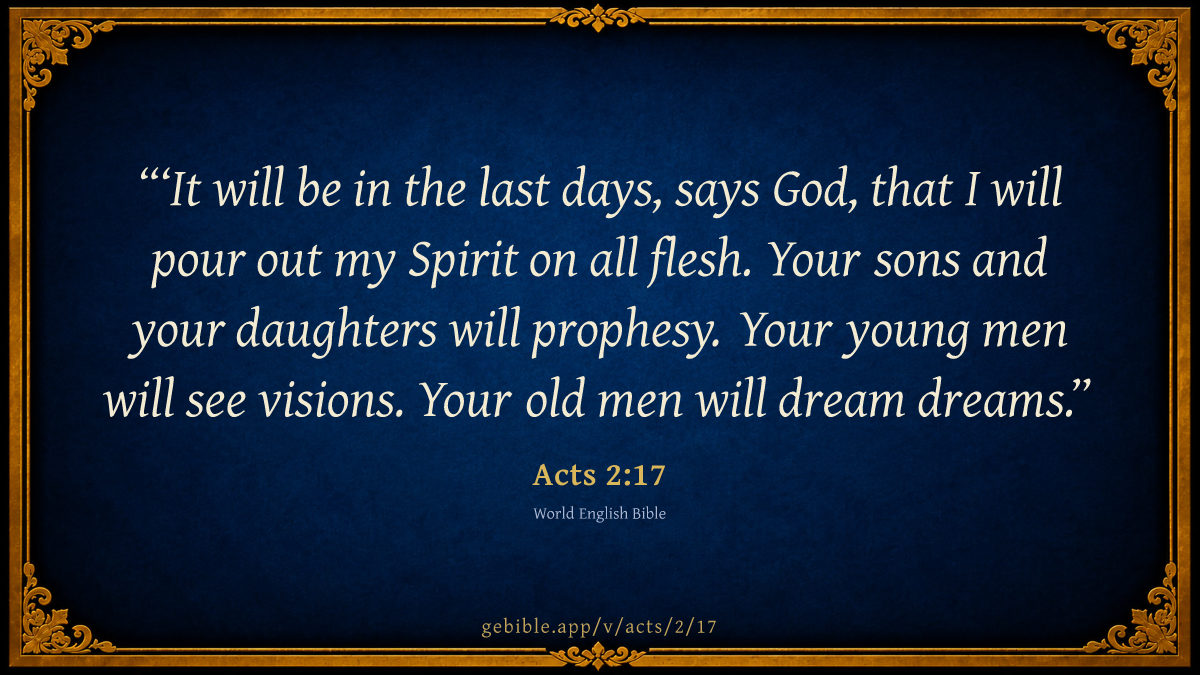
‘It will be in the last days, says God, that I will pour out my Spirit on all flesh. Your sons and your daughters will prophesy. Your young men will see visions. Your old men will dream dreams.
Parallel Translations
-
‘It will be in the last days, says God, that I will pour out my Spirit on all flesh. Your sons and your daughters will prophesy. Your young men will see visions. Your old men will dream dreams.
-
It shalbe in the last dayes sayth God: of my sprete I will powre out vpon all flesshe. And youre sonnes and youre doughters shall prophesy and youre yoge men shall se visions and youre olde me shall dreme dremes.
-
And it shalbe in the last daies, saith God, I wil powre out of my Spirite vpon al flesh, and your sonnes, and your daughters shall prophecie, and your yong men shall see visions, and your old men shall dreame dreames.
Cross-references (33)
Passages linked to Acts 2:17 in the Treasury of Scripture Knowledge, ordered by reader-vote popularity; verse text shown in World English Bible.
- Joel 2:28-32 “It will happen afterward, that I will pour out my Spirit on all flesh; and your sons and your daughters will prophesy. Your old men will dream dreams. Your young men will see visions. And also on the servants and on the handmaids in those days, I will pour out my Spirit. I will show wonders in the heavens and in the earth: blood, fire, and pillars of smoke. The sun will be turned into darkness, and the moon into blood, before the great and terrible day of Yahweh comes. It will happen that whoever will call on Yahweh’s name shall be saved; for in Mount Zion and in Jerusalem there will be those who escape, as Yahweh has said, and among the remnant, those whom Yahweh calls.
- Isaiah 44:3 For I will pour water on him who is thirsty, and streams on the dry ground. I will pour my Spirit on your descendants, and my blessing on your offspring:
- Titus 3:4-6 But when the kindness of God our Savior and his love toward mankind appeared, not by works of righteousness which we did ourselves, but according to his mercy, he saved us through the washing of regeneration and renewing by the Holy Spirit, whom he poured out on us richly, through Jesus Christ our Savior;
- Acts 10:45 They of the circumcision who believed were amazed, as many as came with Peter, because the gift of the Holy Spirit was also poured out on the Gentiles.
- John 7:39 But he said this about the Spirit, which those believing in him were to receive. For the Holy Spirit was not yet given, because Jesus wasn’t yet glorified.
- Zechariah 12:10 I will pour on David’s house, and on the inhabitants of Jerusalem, the spirit of grace and of supplication; and they will look to me whom they have pierced; and they shall mourn for him, as one mourns for his only son, and will grieve bitterly for him, as one grieves for his firstborn.
- Ezekiel 11:19 I will give them one heart, and I will put a new spirit within you. I will take the stony heart out of their flesh, and will give them a heart of flesh;
- Hebrews 1:2 has at the end of these days spoken to us by his Son, whom he appointed heir of all things, through whom also he made the worlds.
- Hosea 3:5 Afterward the children of Israel shall return, and seek Yahweh their God, and David their king, and shall come with trembling to Yahweh and to his blessings in the last days.
- 1 Corinthians 12:28 God has set some in the assembly: first apostles, second prophets, third teachers, then miracle workers, then gifts of healings, helps, governments, and various kinds of languages.
- Luke 3:6 All flesh will see God’s salvation.’ ”
- Isaiah 66:23 It shall happen that from one new moon to another, and from one Sabbath to another, all flesh will come to worship before me,” says Yahweh.
- Ezekiel 39:29 I won’t hide my face from them any more; for I have poured out my Spirit on the house of Israel,’ says the Lord Yahweh.”
- Zechariah 2:13 Be silent, all flesh, before Yahweh; for he has roused himself from his holy habitation!”
- Acts 21:9 Now this man had four virgin daughters who prophesied.
- Romans 5:5 and hope doesn’t disappoint us, because God’s love has been poured into our hearts through the Holy Spirit who was given to us.
- 1 Corinthians 12:10 and to another workings of miracles; and to another prophecy; and to another discerning of spirits; to another different kinds of languages; and to another the interpretation of languages.
- 2 Peter 3:3 knowing this first, that in the last days mockers will come, walking after their own lusts
- Isaiah 2:2 It shall happen in the latter days, that the mountain of Yahweh’s house shall be established on the top of the mountains, and shall be raised above the hills; and all nations shall flow to it.
- Isaiah 32:15-16 until the Spirit is poured on us from on high, and the wilderness becomes a fruitful field, and the fruitful field is considered a forest. Then justice will dwell in the wilderness; and righteousness will remain in the fruitful field.
- Psalms 72:6 He will come down like rain on the mown grass, as showers that water the earth.
- Proverbs 1:23 Turn at my reproof. Behold, I will pour out my spirit on you. I will make known my words to you.
- Genesis 49:1 Jacob called to his sons, and said: “Gather yourselves together, that I may tell you that which will happen to you in the days to come.
- Isaiah 40:5 Yahweh’s glory shall be revealed, and all flesh shall see it together; for the mouth of Yahweh has spoken it.”
- Micah 4:1 But in the latter days, it will happen that the mountain of Yahweh’s temple will be established on the top of the mountains, and it will be exalted above the hills; and peoples will stream to it.
- John 17:2 even as you gave him authority over all flesh, so he will give eternal life to all whom you have given him.
- Isaiah 49:26 I will feed those who oppress you with their own flesh; and they will be drunk on their own blood, as with sweet wine. Then all flesh shall know that I, Yahweh, am your Savior and your Redeemer, the Mighty One of Jacob.”
- 1 Corinthians 14:26-31 What is it then, brothers? When you come together, each one of you has a psalm, has a teaching, has a revelation, has another language, or has an interpretation. Let all things be done to build each other up. If any man speaks in another language, let it be two, or at the most three, and in turn; and let one interpret. But if there is no interpreter, let him keep silent in the assembly, and let him speak to himself, and to God. Let the prophets speak, two or three, and let the others discern. But if a revelation is made to another sitting by, let the first keep silent. For you all can prophesy one by one, that all may learn, and all may be exhorted.
- Genesis 6:12 God saw the earth, and saw that it was corrupt, for all flesh had corrupted their way on the earth.
- Ezekiel 36:25-27 I will sprinkle clean water on you, and you will be clean. I will cleanse you from all your filthiness, and from all your idols. I will also give you a new heart, and I will put a new spirit within you. I will take away the stony heart out of your flesh, and I will give you a heart of flesh. I will put my Spirit within you, and cause you to walk in my statutes. You will keep my ordinances and do them.
- Daniel 10:14 Now I have come to make you understand what will happen to your people in the latter days; for the vision is yet for many days.”
- James 5:3 Your gold and your silver are corroded, and their corrosion will be for a testimony against you and will eat your flesh like fire. You have laid up your treasure in the last days.
- Psalms 65:2 You who hear prayer, all men will come to you.
Cross-references from openbible.info (CC BY 4.0)
Explain this verse (20 sources)
Historical commentary, presented as a primary source — not an endorsement.
Private notes
Saved on this device only — never synced or sent anywhere.
John Calvin 1540 · Public Domain 17. It shall be in the last days By…
17. It shall be in the last days By this effect he proveth that the Messiah is already revealed. Joel, indeed, doth not express the last days, (Joel 2:29;) but for as much as he intreateth of the perfect restoring of the Church, it is not to be doubted but that that prophecy belongeth unto the last age alone. Wherefore, that which Peter bringeth doth no whit dissent from Joel’s meaning; but he doth only add this word for exposition sake, that the Jews might know that the Church could by no other means be restored, which was then decayed, but by being renewed by the Spirit of God. Again, because the repairing of the Church should be like unto a new world, therefore Peter saith that it shall be in the last days. And surely this was a common and familiar thing among the Jews, that all those great promises concerning the blessed and well-ordered state of the Church should not be fulfilled until Christ, by his coming, should restore all things. Wherefore, it was out of all doubt amongst them, that that which is cited out of Joel doth appertain unto the last time. Now, by the last days, or fullness of time, is meant the stable and firm condition of the Church, in the manifestation or revealing of Christ.
I will pour out my Spirit He intendeth to prove, (as we have already said,) that the Church can be repaired by no other means, saving only by the giving of the Holy Spirit. Therefore, forasmuch as they did all hope that the restoring drew near, he accuseth them of sluggishness, because they do not once think upon the way and means thereof. And when the prophet saith, “I will pour out,” it is, without all question, that he meant by this word to note the great abundance of the Spirit. And we must take I will pour out of my Spirit in the same sense, as if he had said simply, I will pour out my Spirit. For these latter words are the words of the prophet. But Peter followed the Grecians, who translate the Hebrew word ח, (cheth,) απο Therefore, some men do in vain more subtlely play the philosophers; because, howsoever the words be changed, yet must we still retain and keep the prophet’s meaning. Nevertheless, when God is said to pour out his Spirit, I confess it must be thus understood, that he maketh manifold variety and change of gifts to flow unto men from his Spirit, as it were out of the only fountain, the fountain which can never be drawn dry. For, as Paul doth testify, there be divers gifts, and yet but one Spirit, (1 Corinthians 12:4.) And hence do we gather a profitable doctrine, that we can have no more excellent thing given us of God than the grace of the Spirit; yea, that all other things are nothing worth if this be wanting. For, when God will briefly promise salvation to his people, he affirmeth that he will give them his Spirit. Hereupon it followeth that we can obtain no good things until we have the Spirit given us. And truly it is, as it were, the key which openeth unto us the door, that we may enter into all the treasures of spiritual good things; and that we may also have entrance into the kingdom of God.
Read full note →
Upon all flesh It appeareth, by that which followeth, of what force this generality is; for, first, it is set down generally, all flesh; after that the partition is added, whereby the prophet doth signify that there shall be no difference of age or kind, but that God admitteth all, one with another, unto the partaking of his grace. It is said, therefore, all flesh, because both young and old, men and women, are thereby signified; yet here may a question be moved, why Clod doth promise that unto his people, as some new and unwonted good thing, which he was wont to do for them from the beginning throughout all ages; for there was no age void of the grace of the Spirit. The answer of this question is set down in these two sentences: “I will pour out,” and, “Upon all flesh;” for we must here note a double contrariety, between the time of the Old and New Testament; for the pouring out (as I have said) doth signify great plenty, when as there was under the law a more scarce distribution; for which cause John also doth say that the Holy Ghost was not given until Christ ascended into heaven. All flesh cloth signify an infinite multitude, whereas God in times past did vouchsafe to bestow such plenty of his Spirit only upon a few.
Furthermore, in both comparisons we do not deny but that the fathers under the law were partakers of the self, same grace whereof we are partakers; but the Lord doth show that we are above them, as we are indeed. I say, that all godly men since the beginning of the world were endued with the same spirit of understanding, of righteousness, and sanctification, wherewith the Lord doth at this day illuminate and regenerate us; but there were but a few which had the light of knowledge given them then, if they be compared with the great multitude of the faithful, which Christ did suddenly gather together by his coming. Again, their knowledge was but obscure and slender, and, as it were, covered with a veil, if it be compared with that which we have at this day out of the gospel, where Christ, the Sun of righteousness, doth shine with perfect brightness, as it were at noon day. Neither doth that any whit hurt or hinder that a few had such an excellent faith, that peradventure they have no equal at this day. For their understanding did nevertheless smell or savor of the instruction and schoolmastership of the law. For that is always true, that godly kings and prophets have not seen nor heard those things which Christ hath revealed by his coming. Therefore, to the end the prophet Joel may commend the excellency of the New Testament, he affirmeth and foretelleth that the grace of the Spirit shall be more plentiful in time thereof; and, again, that it shall come unto more men, (Matthew 13:17; Luke 10:24.)
And your sons shall prophesy By the word prophesy he meant to note the rare and singular gift of understanding. And to the same purpose tendeth that partition which followeth afterwards, “your young men shall see visions, and your old men shall dream dreams;” for we gather out of the twelfth chapter of Numbers, that these were the two ordinary ways whereby God did reveal himself to the prophets. For in that place, when the Lord exempteth Moses from the common sort of prophets, he saith,
“I appear unto my servants by a vision, or by a dream; but I speak unto Moses face to face,” (Numbers 12:6.)
Therefore, we see that two kinds are put after the general word for a confirmation; yet this is the sum, that they shall all be prophets so soon as the Holy Ghost shall be poured out from heaven. But here it is objected, that there was no such thing, even in the apostles themselves, neither yet in the whole multitude of the faithful. I answer, that the prophets did commonly use to shadow under tropes most fit for their time, the kingdom of Christ. When they speak of the worship of God, they name the altar, the sacrifices, the offering of gold, silver, and frankincense. Notwithstanding, we know that the altars do cease, the sacrifices are abolished, whereof there was some use in time of the law; and that the Lord requireth some higher thing at our hands than earthly riches. That is true, indeed; but the prophets, whilst they apply their style unto the capacity of their time, comprehend under figures (wherewith the people were then well acquainted) those things which we see otherwise revealed and showed now, like as when he promiseth elsewhere that he will make priests of Levites, and Levites of the common sort of men, (Isaiah 66:21,) this is his meaning, that under the kingdom of Christ every base person shall be extolled unto an honorable estate; therefore, if we desire to have the true and natural meaning of this place, we must not urge the words which are taken out of the old order of the law; but we must only seek the truth without figures, and this is it, that the apostles, through the sudden inspiration of the Spirit, did intreat of the heavenly mysteries prophetically, that is to say, divinely, and above the common order.
Therefore, this word prophesy doth signify nothing else save only the rare and excellent gift of understanding, as if Joel should say, Under the kingdom of Christ there shall not be a few prophets only, unto whom God may reveal his secrets; but all men shall be endued with spiritual wisdom, even to the prophetical excellency. As it is also in Jeremiah,
“Every man shall no longer teach his neighbor; because they shall all know me, from the least unto the greatest,” (Jeremiah 31:34.)
And in these words Peter inviteth the Jews, unto whom he speaketh, to be partakers of the same grace. As if he should say, the Lord is ready to pour out that Spirit far and wide which he hath poured upon us. Therefore, unless you yourselves be the cause of let, ye shall receive with us of this fullness. And as for us, let us know that the same is spoken to us at this day which was then spoken to the Jews. For although those visible graces of the Spirit be ceased, yet God hath not withdrawn his Spirit from his Church. Wherefore he offereth him daily unto us all, by this same promise, without putting any difference. Wherefore we are poor and needy only through our own sluggishness; and also it appeareth manifestly, that those are wicked and sacrilegious enemies of the Spirit which keep back the Christian common people from the knowledge of God; and forasmuch as he himself doth not only admit, but also call by name unto himself, women and men, young and old.
John Calvin's Commentaries (1540-1563) — public domain. Text from the Calvin Translation Society English edition (1840s-50s) via the Christian Classics Ethereal Library (ccel.org). Calvin's coverage is partial (roughly two-thirds of the Bible); uncommented books and verses are honest gaps, never fabricated. The 19th-century editor's footnotes and remarks are omitted so the notes are faithfully Calvin's own voice.
Geneva Bible translators 1599 · Public Domain That is, men.
That is, men.
Peter setting the truth of God against the false accusations of men, showeth in himself and in his fellows, that that is fulfilled which Joel spake concerning the full giving of the holy Ghost in the latter days: which grace also is offered to the whole Church, to their certain and undoubted destruction, which do contemn it.
Read full note →
All without exception, both upon the Jews and Gentiles.
Geneva Bible (1599) marginal notes — public domain.
John Trapp 1656 · Public Domain 17 And it shall come to pass in the…
17 And it shall come to pass in the last days, saith God, I will pour out of my Spirit upon all flesh: and your sons and your daughters shall prophesy, and your young men shall see visions, and your old men shall dream dreams:
Ver. 17. In the last days] God keeps his best till last. Not so the devil.
Read full note →
I will pour out of my Spirit upon all flesh] The best thing upon the basest. Oh, wonderful goodness!
John Trapp, A Commentary or Exposition upon All the Books of the Old and New Testament (1647–1656) — public domain. Text from a community e-Sword module.
Matthew Poole 1685 · Public Domain In the last days; in the time of the…
In the last days; in the time of the Messiah, called the last days frequently, 2Ti 3:1; Heb 1:2; 2Pe 3:3; as also called the last time, 1Pe 1:5; 1Jo 2:18; Jud 1:18; because we are now under the last and most perfect dispensation of the things of God, and no other is to be looked for until the consummation of all things.
I will pour out of my Spirit; before the Spirit was given in lesser measures, and comparatively but by drops, here a little, and there a little; now more largely, even to overflow.
Read full note →
Upon all flesh; all sorts of men, as well Gentiles as Jews, contrary unto their proud conceit, that God dwelt in none out of the land of Israel.
Daughters shall prophesy; fulfilled in Anna the prophetess, Luk 2:36, and in the four daughters of Philip, Luk 21:9.
Visions; these were formerly either representations more inward to their mind, as Isaiah’s and Jeremiah’s were; or more outward, to their bodily eye, as Belshazzar’s was, Dan 5:5, and such as Peter had, Act 10:11.
Dreams; by dreams God sometimes manifested his will, as to Joseph; but this is by St. Peter accommodated to the gospel times. The prophets spake suitably to them unto whom they preached; and the apostle rightly understands by these expressions, the manifold and more clear revelation of the will of God in Christ.
Matthew Poole's English Annotations on the Holy Bible (1683–1685) — public domain. Text from a community e-Sword/MySword module.
John Gill 1763 · Public Domain And it shall come to pass in the last…
And it shall come to pass in the last days,.... In Joel it is, "afterwards"; instead of which Peter puts, "in the last days"; the sense is the same: and so R. David Kimchi, a celebrated commentator with the Jews, observes, that "afterwards" is the same "as in the last days", and which design the times of the Messiah; for according to a rule given by the same writer on Isa 2:2 wherever the last days are mentioned, the days of the Messiah are intended,
Saith God, or "the Lord", as the Vulgate Latin and Ethiopic versions read. This clause is added by Peter, and is not in Joel; and very rightly, since what follow are the words of God speaking in his own person:
Read full note →
I will pour out my Spirit upon all flesh; not "upon every animal", as the Ethiopic version renders it: this is extending the sense too far, as the interpretation the above named Jewish writer gives, limits it too much, restraining it to the people of Israel. It being a maxim with them, that the Shekinah does not dwell but in the land of Israel; and also that prophecy, or a spirit of prophecy, does not dwell on any but in the holy land (r). For though as it regards the first times of the Gospel, it may chiefly respect some persons among the Jews, yet not to the exclusion of the Gentiles; and it designs all sorts of persons of every age, sex, state, and condition, as the distribution afterwards shows. Jarchi's note upon it is,
"upon everyone whose heart is made as tender as flesh; as for example, "and I will give an heart of flesh", Eze 36:26.
By the Spirit is meant the gifts of the Spirit, the spirit of wisdom and knowledge, of understanding the mysteries of the Gospel, of explaining the Scriptures, and of speaking with tongues; and by the pouring of it out, is intended the abundance and great plenty of the gifts and graces of the Spirit bestowed; but yet not all of him, or all his gifts and grace in the large extent of them: therefore it is said, not "my Spirit", but "of my Spirit", or "out of it"; as out of an unfathomable, immeasurable, and inexhaustible fountain and fulness:
and your sons and your daughters shall prophesy: or foretell things to come, as Agabus, and the four daughters of Philip the Evangelist, Act 21:9.
and your young men shall see visions; as Ananias, Act 9:10, and Peter, Act 10:17 and Paul when a young man, Act 22:17 and John, the youngest of the apostles, Rev 1:10 though he was in years, when he saw the visions in the Revelations:
and your old men shall dream dreams; or shall have night visions, as Paul at Troas, Act 16:9 and in his voyage when at sea, Act 27:23. The order of the words is inverted, this last clause stands first in Joel; perhaps the change is made, because the apostles were young men, on whom the Spirit was poured; and the thing was the more wonderful that so it should be, than if they had been old men,
(r) Zohar in Gen. fol. 118. 4. & 128. 4.
John Gill's Exposition of the Whole Bible (1746–1763) — public domain (CC PDM 1.0). Text via the HelloAO Bible API.
John Wesley 1765 · Public Domain The times of the Messiah are frequently called the…
The times of the Messiah are frequently called the last days, the Gospel being the last dispensation of Divine grace. I will pour out of my Spirit - Not on the day of pentecost only, upon all flesh - On persons of every age, sex, and rank. And your young men shall see visions - In young men the outward sense, are most vigourous, and the bodily strength is entire, whereby they are best qualified to sustain the shock which usually attends the visions of God. In old men the internal senses are most vigourous, suited to divine dreams. Not that the old are wholly excluded from the former, nor the young from the latter.
John Wesley, Explanatory Notes Upon the Whole Bible (1754–1765) — public domain. Text via the GEBible commentary corpus.
Adam Clarke 1810 · Public Domain Verse 17. In the last days] The time of…
Verse 17. In the last days] The time of the Messiah; and so the phrase was understood among the Jews.
I will pour out of my Spirit upon all flesh] Rabbi Tanchum says, "When Moses laid his hands upon Joshua, the holy blessed God said, In the time of the old text, each individual prophet prophesied; but, in the times of the Messiah, all the Israelites shall be prophets." And this they build on the prophecy quoted in this place by Peter.
Read full note →
Your sons and your daughters shall prophesy] The word prophesy is not to be understood here as implying the knowledge and discovery of future events; but signifies to teach and proclaim the great truths of God, especially those which concerned redemption by Jesus Christ.
Your young men shall see visions, c.] These were two of the various ways in which God revealed himself under the Old Testament. Sometimes he revealed himself by a symbol, which was a sufficient proof of the Divine presence: fire was the most ordinary, as it was the most expressive, symbol. Thus he appeared to Moses on Mount Horeb, and afterwards at Sinai to Abraham, Ge 15:1-21; to Elijah, 1Kg 19:11, 1Kg 19:12. At other times he revealed himself by angelic ministry: this was frequent, especially in the days of the patriarchs, of which we find many instances in the book of Genesis.
By dreams he discovered his will in numerous instances: see the remarkable case of Joseph, Ge 37:5, Ge 37:9; of Jacob, Ge 28:1, c. Ge 46:2, c. of Pharaoh, Ge 41:1-7; of Nebuchadnezzar, Da 4:10-17. For the different ways in which God communicated the knowledge of his will to mankind, see the note on Ge 15:1.
Adam Clarke's Commentary on the Bible (1810–1826) — public domain. Text from a community e-Sword/MySword module.
Albert Barnes 1834 · Public Domain It shall come to pass - It shall happen,…
It shall come to pass - It shall happen, or shall occur.
In the last days - Hebrew, Chaldee, Syriac, and Arabic, after these things, or afterward. The expression the last days, however, occurs frequently in the Old Testament: Gen 49:1, Jacob called his sons, that he might tell them what should happen to them in the last days, that is, in future times - Heb. in after times; Mic 4:1, “In the last days (Hebrew: in later times) the mountain of the Lord’s house,” etc.; Isa 2:2, “in the last days the mountain of the Lord’s house shall be established in the tops of the mountains,” etc. The expression then properly denoted “the future times” in general. But, as the coming of the Messiah was to the eye of a Jew the most important event in the coming ages - the great, glorious, and crowning scene in all the vast futurity, the phrase came to be regarded as properly expressive of that. It stood in opposition to the usual denomination of earlier times.
Read full note →
It was a phrase in contrast with the days of the patriarchs, the kings, the prophets, etc. The last days, or the closing period of the world, were the days of the Messiah. It does not appear from this, and it certainly is not implied in the expression, that they supposed the world would then come to an end. Their views were just the contrary. They anticipated a long and glorious time under the dominion of the Messiah, and to this expectation they were led by the promise that his kingdom should be forever; that of the increase of his government there should be no end, etc. This expression was understood by the writers of the New Testament as referring undoubtedly to the times of the gospel. And hence they often used it as denoting that the time of the expected Messiah had come, but not to imply that the world was drawing near to an end: Heb 1:2, “God hath spoken in these last days by his Son”; 1Pe 1:20, “Was manifested in these last times for you”; 2Pe 3:3; 1Pe 1:5; 1Jo 2:18, “Little children, it is the last time,” etc.; Jud 1:18. The expression the last day is applied by our Saviour to the resurrection and the day of judgment, Joh 6:39-40, Joh 6:44-45; Joh 11:24; Joh 12:48. Here the expression means simply “in those future times, when the Messiah shall have come.”
I will pour out of my Spirit - The expression in Hebrew is, “I will pour out my Spirit.” The word “pour” is commonly applied to water or to blood, “to pour it out,” or “to shed it,” Isa 57:6; to tears, “to pour them out,” that is,” to weep, etc., Psa 42:4; 1Sa 1:15. It is applied to water, to wine, or to blood, in the New Testament, Mat 9:17; Rev 16:1; Act 22:20, “The blood of thy martyr Stephen was shed.” It conveys also the idea of “communicating largely or freely,” as water is poured freely from a fountain, Tit 3:5-6, “The renewing of the Holy Spirit, which he shed on us abundantly.” Thus, Job 36:27, “They (the clouds) pour down rain according to the vapor thereof”; Isa 44:3, “I will pour water on him that is thirsty”; Isa 45:8, “Let the skies pour down righteousness”; Mal 3:10, “I will pour you out a blessing.” It is also applied to fury and anger, when God intends to say that he will not spare, but will signally punish, Psa 69:24; Jer 10:25. It is not infrequently applied to the Spirit, Pro 1:23; Isa 44:3; Zec 12:10. As thus used it means that he will bestow large measures of spiritual influences. As the Spirit renews and sanctifies people, so to pour out the Spirit is to grant freely his influences to renew and sanctify the soul.
My Spirit - The Spirit here denotes the Third Person of the Trinity, promised by the Saviour, and sent to finish his work, and apply it to people. The Holy Spirit is regarded as the source or conveyer of all the blessings which Christians experience. Hence, he renews the heart, Joh 3:5-6. He is the source of all proper feelings and principles in Christians, or he produces the Christian graces, Gal 5:22-25; Tit 3:5-7. The spread and success of the gospel is attributed to him, Isa 32:15-16. Miraculous gifts are traced to him, especially the various gifts with which the early Christians were endowed, 1Co 12:4-10. The promise that he would pour out his Spirit means that he would, in the time of the Messiah, impart a large measure of those influences which it was his special province to communicate to people. A part of them were communicated on the day of Pentecost, in the miraculous endowment of the power of speaking foreign languages, in the wisdom of the apostles, and in the conversion of the three thousand,
Upon all flesh - The word “flesh” here means “persons,” or “people.” See the notes on Rom 1:3. The word “all” here does not mean every individual, but every class or rank of individuals. It is to be limited to the cases specified immediately. The influences were not to be confined to any one class, but were to be communicated to all kinds of persons - old men, youth, servants, etc. Compare 1Ti 2:1-4.
And your sons and your daughters - Your children. It would seem that females shared in the remarkable influences of the Holy Spirit. Philip the Evangelist had four daughters which did prophesy, Act 21:9. It is probable also that the females of the church of Corinth partook of this gift, though they were forbidden to exercise it in public, 1Co 14:34. The office of prophesying, whatever was meant by that, was not confined to the people among the Jews: Exo 15:20, “Miriam, the prophetess, took a timbrel,” etc.; Jdg 4:4, “Deborah, a prophetess, judged Israel”; 2Ki 22:14. See also Luk 2:36, “There was one Anna, a prophetess,” etc.
Shall prophesy - The word “prophesy” is used in a great variety of senses:
(1) It means to predict or foretell future events, Mat 11:13; Mat 15:7.
(2) To divine, to conjecture, to declare as a prophet might, Mat 26:68, “Prophesy who smote thee.”
(3) To celebrate the praises of God, being under a divine influence, Luk 1:67. This seems to have been a considerable part of the employment in the ancient schools of the prophet, 1Sa 10:5; 1Sa 19:20; 1Sa 30:15.
(4) To teach - as no small part of the office of the prophets was to teach the doctrines of religion, Mat 7:22, “Have we not prophesied in thy name?”
(5) It denotes, then, in general, “to speak under a divine influence,” whether in foretelling future events, in celebrating the praises of God, in instructing others in the duties of religion, or “in speaking foreign languages under that influence.” In this last sense the word is used in the New Testament, to denote those who were miraculously endowed with the power of speaking foreign languages, Act 19:6. The word is also used to denote “teaching, or speaking in intelligible language, in opposition to speaking a foreign tongue,” 1Co 14:1-5. In this place it means that they would speak under a divine influence, and is specially applied to the power of speaking in a foreign tongue.
Your young men shall see visions - The will of God in former times was communicated to the prophets in various ways. One was by visions, and hence one of the most usual names of the prophets was seers. The name seer was first given to that class of men, and was superseded by the name prophet, 1Sa 9:9, “He that is now called a prophet was beforetime called a seer”; 1Sa 9:11, 1Sa 9:18-19; 2Sa 24:11; 1Ch 29:29, etc. This name was given from the manner in which the divine will was communicated, which seems to have been by throwing the prophet into an ecstasy, and then by causing the vision, or the appearance of the objects or events to pass before the mind. The prophet looked upon the passing scene, the often splendid diorama as it actually occurred, and recorded it as it appeared to his mind. Hence, he recorded rather the succession of images than the times in which they would occur. These visions occurred sometimes when they were asleep, and sometimes during a prophetic ecstasy, Dan 2:28; Dan 7:1-2, Dan 7:15; Dan 8:2; Eze 11:24; Gen 15:1; Num 12:6; Job 4:13; Job 7:14; Eze 1:1; Eze 8:3.
Often the prophet seemed to be transferred or transported to another place from where he was, and the scene in a distant land or age passed before the mind, Eze 8:3; Eze 40:2; Eze 11:24; Dan 8:2. In this case the distant scene or time passed before the prophet, and he recorded it as it appeared to him. That this did not cease before the times of the gospel is evident: Act 9:10, “To Ananias said the Lord in a vision,” etc.; Act 9:12, “and hath seen in a vision a man named Ananias,” etc.; that is, Paul hath seen Ananias represented to him, though absent; he has had an image of him coming in to him; Act 10:3, Cornelius “saw in a vision evidently an angel of God coming to him,” etc. This was one of the modes by which in former times God made known his will; and the language of the Jews came to express a revelation in this manner. Though there were strictly no visions on the day of Pentecost, yet that was one scene under the great economy of the Messiah under which God would make known his will in a manner as clear as he did to the ancient Jews.
Your old men shall dream dreams - The will of God in former times was made known often in this manner; and there are several instances recorded in which it was done under the gospel. God informed Abimelech in a dream that Sarah was the wife of Abraham, Gen 20:3. He spoke to Jacob in a dream, Gen 31:11; to Laban, Gen 31:24; to Joseph, Gen 37:5; to the butler and baker, Gen 40:5; to Pharaoh, Gen 41:1-7; to Solomon, 1Ki 3:5; to Daniel, Dan 2:3; Dan 7:1. It was prophesied by Moses that in this way God would make known his will, Num 12:6. It occurred even in the times of the gospel. Joseph was warned in a dream, Mat 1:20; Mat 2:12-13, Mat 2:19, Mat 2:22. Pilate’s wife was also troubled in this manner about the conduct of the Jews to Christ, Mat 27:19. As this was one way in which the will of God was made known formerly to people, so the expression here denotes simply that His will would be made known; that it would be one characteristic of the times of the gospel that God would reveal Himself to mankind. The ancients probably had some mode of determining whether their dreams were divine communications, or whether they were, as they are now, the mere erratic wanderings of the mind when unrestrained and unchecked by the will. At present no confidence is to be put in dreams. Compare the introduction to Isaiah, section 7, 12.
Albert Barnes' Notes on the Bible (1834–1885) — public domain. Text from a community e-Sword/MySword module.
Haydock's Catholic Bible Commentary 1859 · Public Domain In the last days, or the latter days, meaning…
In the last days, or the latter days, meaning the time of the Messias, I will pour out my Spirit upon all flesh, that is, all persons. See Joel ii. 28. (Witham)
George Leo Haydock (1774–1849), Haydock's Catholic Family Bible and Commentary, 1859 edition — public domain. Excludes Psalms (Douay-Rheims chapter numbering differs from Protestant) and Deuterocanonical books (Catholic canon only).
Robert Jamieson, A. R. Fausset & David Brown 1871 · Public Domain in the last days--meaning, the days of the Messiah…
in the last days--meaning, the days of the Messiah (Isa 2:2); as closing all preparatory arrangements, and constituting the final dispensation of God's kingdom on earth.
pour out of my Spirit--in contrast with the mere drops of all preceding time.
Read full note →
upon all flesh--hitherto confined to the seed of Abraham.
sons . . . daughters . . . young men . . . old men . . . servants . . . handmaidens--without distinction of sex, age, or rank.
see visions . . . dream dreams--This is a mere accommodation to the ways in which the Spirit operated under the ancient economy, when the prediction was delivered; for in the New Testament, visions and dreams are rather the exception than the rule.
Jamieson, Fausset & Brown — Commentary Critical and Explanatory on the Whole Bible (1871) — public domain (CC PDM 1.0). Text via the HelloAO Bible API.
Daniel D. Whedon 1874 · Public Domain 17. The last days—This phrase occurs many times in…
17. The last days—This phrase occurs many times in both Testaments with somewhat different meanings. What the last days are somewhat depends upon what are the antithetical first days. In the Old Testament, the Old Testament dispensation being the first age or days, the last days were the days of the Messiah, or the Christian dispensation. Such is the meaning here.
All flesh—Not upon a few priests and prophets alone, but upon all ranks and classes; not for one race alone, but inherited by all nations.
Read full note →
Prophesy… visions… dreams—The Pentecostal Church inaugurated by this effusion was a charismatic Church. Yet the signs and gifts here predicted, being really attendants upon the person of Jesus, commenced at his approaching advent. Note on Mat_1:20.
After a long withdrawal of miracle and sign, the Baptist’s birth was announced by a vision of Zachariah’s. Our Saviour’s birth was heralded by the dreams of Joseph, the vision of Mary, and that of the shepherds. Simeon, Agabus the Apocalyptist, and others, prophesied. All these were in essence concentrated in the Spirit’s power bestowed at Pentecost.
Daniel D. Whedon (gen. ed.), Commentary on the Old and New Testaments (1874–1909) — public domain. Text from a community e-Sword module.
The Cambridge Bible for Schools and Colleges 1878 · Public Domain 17. in the last days] These words are an…
17. in the last days] These words are an interpretation of the afterwards of the Hebrew, and after these things of the LXX. The expression “the last days” is used in the Old Testament to signify the coming of the Messiah. (Cp. Isa_2:2; Mic_4:1.) The latter clauses of this verse are transposed in Joel.
The Cambridge Bible for Schools and Colleges (gen. ed. J. J. S. Perowne; Cambridge University Press, 1878–1918) — public domain. Text from a community e-Sword module.
Ellicott's Commentary for English Readers 1878 · Public Domain (17) It shall come to pass in the last…
(17) It shall come to pass in the last days.—The prophecy of Joel takes its place, with the exception, perhaps, of Hosea, as the oldest of the prophetic books of the Old Testament. The people were suffering from one of the locust-plagues of the East and its consequent famine. The prophet calls them to repentance, and promises this gift of the Spirit as the great blessing of a far-off future. He had been taught that no true knowledge of God comes but through that Spirit. So Elisha prayed that a double portion (i.e., the eldest son’s inheritance) of the Spirit which God had given to Elijah might rest upon him (2Ki_2:9).
Your sons and your daughters shall prophesy.—The Old Testament use of the word, in its wider generic sense, as, e.g., in the case of Saul, 1Sa_10:10; 1Sa_19:20-24, covered phenomena analogous to the gift of tongues as well as that of prophecy in the New Testament sense. The words imply that women as well as men had been filled with the Spirit, and had spoken with the “tongues.”
Read full note →
Your young men shall see visions.—The “visions,” implying the full activity of spiritual power, are thought of as belonging to the younger prophets. In the calmer state of more advanced age, wisdom came, as in the speech of Elihu, “in a dream, in visions of the night, when deep sleep falleth upon men” (Job_33:15).
A Bible Commentary for English Readers, edited by Charles John Ellicott (1878–1897) — public domain. Text from a community e-Sword module.
The Pulpit Commentary 1880 · Public Domain Be for come to pass, A.V.; pour forth for…
Be for come to pass, A.V.; pour forth for pour out, A.V. In the last days. This does not agree with either the Hebrew or the LXX in the existing texts, where we read merely afterwards (ke yreh meta tauta. The phrase, "in the last days," which occurs intyrij) Isa_2:2 andelsewhere, denotes the days of Messiah. St. Peter is perhaps expounding the passage as relating to the days of Messiah; or b may have been another reading. Saith God is no part of Joel"s prophecy, but Peter"s words. Your young men shall see visions, etc. The order of this and the following clause is inverted. In the Hebrew and LXX the old men are mentioned first.
The Pulpit Commentary (1880–1919), ed. H.D.M. Spence-Jones & Joseph S. Exell — public domain. Text from a community e-Sword module.
The Biblical Illustrator 1887 · Public Domain And it shall come to pass in the last…
Act_2:17-21
And it shall come to pass in the last days.
Read full note →
The gospel age
Four things taught here determine the gospel age.
I. It is connected with an extraordinary effusion of the Divine Spirit, I will pour out My Spirit.
II. It is connected with prodigious revolutions, I will show wonders, etc.
III. It is connected with an ultimate crisis, The notable day of the Lord.
IV. It is connected with the possibility of a universal salvation, Whosoever, etc. (Homilist.)
The pouring out of Gods Spirit
In this highly interesting chapter we find an account--
1. Of the Divine testimony borne to the truth of the gospel by the descent of the Holy Ghost on the day of Pentecost.
2. Of the different effects which this event produced on the different characters who witnessed it. In the devout it excited amazement, which led them to make serious inquiry respecting what was occurring (verse 5-12). In the careless it excited contempt. But the wrath of man turned to the praise of God; for in the sequel we find an account.
3. Of Peters discourse in reply to those aspersions thus east on the works of God by His wicked opposers.
I. Some observations on these words. Here we may notice--
1. The blessing promised: Gods Spirit. I will pour out of My Spirit, saith God. By the Spirit here promised is meant both His miraculous and saving influence.
2. The manner of its dispensation; it will be poured out. This indicates the prerogative of God; that the influences of His Spirit are at His disposal. The pouring out of Gods Spirit also indicates the special properties of the blessing promised. For instance, that it will be gratuitous, abundant, perpetual.
3. The extent of its influence upon all flesh. By all flesh is meant the whole human race, however distinguished, by descent, by circumstances, or by sex.
4. The season of its communication--the last days. By the last days are certainly meant the days in which we now live.
5. The certainty of its effusion. It shall come to pass, saith God, in the last days, I will pour out of My Spirit. This event is certain--for it is predicted, and it will be fulfilled. It is promised, and will be performed.
II. Some application of them.
1. The strong claims which this subject has on our attention. It claims attention by the importance of the blessing which it exhibits.
2. The duties to which this subject urges us. It particularly urges us to apply for the saving influences of Gods Spirit, as He requires us in His Word. By repentance (Act_2:38-39); by faith in Christ (Joh_7:39; Gal_3:14); and by earnest importunate prayer (Luk_11:13).
3. The hopes with which this subject inspires us. On engaging in the duties to which our text urges us, it encourages us to hope--for the saving influence of Gods Spirit in our own souls: for the general effusion of Gods Spirit on the human race. (Theological Sketch Book.)
The sending of the Holy Ghost
The occasion of Peters sermon was a lewd surmise touching the gift of tongues. As soon as God from heaven sent His fiery tongues upon His apostles, the devil from hell put his into the mouths of his apostles. Note--
I. The Spirits pouring.
1. The Spirit is here the author of prophecy.
(1) Prophecy can come from no nature not rational; so the Spirit is natura rationalis, i.e., a person.
(2) Effusion is a proceeding of that which is poured; as inspiration, in the very body of the word spirit. So the Spirit is a person proceeding.
(3) No person, angel or spirit, can be poured out, least of all upon all flesh. God only can be that: hence the Spirit is God.
(4) But Peter saith, of My spirit. The whole Spirit flesh could not hold, not even all flesh; and parts He hath none. The phrase, then, indicates the gifts and graces of the Spirit--beams of this light, streams of this pouring--here the gifts of prophecy and tongues.
2. The act: pour.
(1) The quality. That which is poured must be a liquid. But this seems improper to the occasion when we should have looked for fire. But Peter perhaps refers to their slander, that it was nothing but new wine, a liquor; and certainly the metaphor was frequently used by Christ (Joh_7:39; Act_1:5). Further, this quality falls well within the graces here given--
(a) Prophecy, likened by the great prophet (Deu_32:2) to the dew falling upon the herbs.
(b) Invocation, which is the pouring out of prayer, and of the very heart in prayer,
(2) The quantity. Pouring is a sign of plenty. The Spirit had been given before but never with such a largess; sprinkled but not poured.
(3) Pouring tells us that the Spirit came not of Himself, not till He was thus poured out; that so order might be kept in Him, and we by Him taught to keep it, i.e., not to start out till we be sent, not to leak or run over, but stay till we be poured out.
(4) Pouring is not as the running of a spout, but the voluntary act of a voluntary agent who has the vessel in his hand, and pours or not at will, and when he pours strikes not out the head of the vessel and let all go, bug moderates his pouring. So here the Spirit dispenses.
(a) To divers parties,
(b) divers gifts,
(c) in divers degrees.
3. On whom this pouring is.
(1) Flesh, i.e., men. But we are spirit as well as flesh. Yes, but to magnify His mercy the more that part is chosen which seems farthest removed (Isa_40:6; Rom_8:3).
(2) Upon this flesh. But had not into been better? The Spirit is given both ways. At Christs baptism the dove came upon Him; at His resurrection, He breathed into them. And so He has parted His sacraments--baptism is upon us, the Eucharist enters into us. But both come to one. If it be poured on it soaks in; if it be breathed in it works forth. But it is upon here--
(a) That we may know that the graces of the Spirit are from without, and grow not from our flesh; and not only from without but from above, from the Father of lights.
(b) Because upon is the preposition proper to initiation into any new office, as in the case of anointing, investing with a robe, imposition of hands, etc.
(c) To inure the apostles to the preposition, which so many hate. No super, no superiority; the right hands of fellowship, if you will, but no imposition of them; if super then sub follows; and no sub with those who submit neither head nor spirit to any.
(3) Upon all flesh. None is excluded--no sex, age, condition, nation. Yet not promiscuously; the text limits the promise to such as will be My servants, i.e., as will believe and be baptized. This gives them the capacity, makes them vessels meet to receive the effusion, all which effectually exclude unbelievers and counterfeit Christians.
II. The end whereto. The Spirit is given to many ends, but one last--the salvation of mankind. Mankind was on the point to perish, and the Spirit was poured as a precious balm to recover and save it.
1. Means to that end. That men may be saved they are to call on the name of the Lord; that they may call to purpose they are to be called on to it, and directed in it by prophesying.
(1) Prophecy stands first, for without that the people must needs perish (Pro_29:18; Isa_32:14-15). Not, however, in the sense of foretelling, but preaching (Rom_10:13-15), as Peter prophesied here. But is this gift poured upon all flesh? No! It is not promised that all Gods sons and servants shall prophesy; for there must be some to be prophesied to. All flesh may not be cut into tongues; some must be left for ears. Else a Cyclopean Church would grow upon us, where all were speakers and none hearers.
(2) How then shall the Spirit be poured out upon all flesh? The spirit of prophecy is not all Gods Spirit. If that be upon some, the spirit of grace and of supplication (Zec_12:10) is upon the rest.
2. The end itself--Salvation. (Bp. Andrewes.)
The dispensation of the Holy Ghost and its distinctive character
I. The commencement of the dispensation of the Holy Ghost. By the dispensation of the Holy Ghost we mean a certain period during which the operations of the Holy Ghost are vouchsafed in a peculiar manner, as contrasted with other ages. Now, that such a dispensation was to be looked for is perfectly clear from the passage before us. We are distinctly told that there shall be a particular time, called the last days, when God will pour out the Spirit upon all flesh. The Same truth is necessarily implied in the Lords own promise, It is expedient for you that I go away, etc. So again with the remarkable statement, The Holy Ghost was not yet given because Jesus was not yet glorified. Of this dispensation the Day of Pentecost was the commencement, for which there are two reasons.
1. The first is seen in the covenant transaction between the Father and the Sen. The Father covenanting to give the Son a people, and all that was needful for their salvation, on condition that the Son fulfilled the law of works. The law of works was never abrogated; it pressed completely and eternally on man, or on mans representative. Christ was that representative, and the condition was absolute that He should fulfil the law, or salvation never could visit mans lost race. But salvation is dependent on the gift of the Spirit of God. The first effect of the great covenant work, therefore, must be the gift of the Spirit. Till that was accomplished, Christ had no claim upon the Father for the gift of the Spirit. Hence we read, The Holy Ghost was not yet given because Jesus was not yet glorified.
2. It relates to the work that the Holy Ghost himself had to do. He shall glorify Me, said Jesus, for He shall take of Mine and shall show it unto you. Now, the things of Christ are the very things He accomplished on earth, whereby He purchased that Spirit. However the Holy Ghost might in olden times have given a sort of foretaste and instalment of what was to result from the finished work of Christ it was not until that work was accomplished, either that the Father was disposed to give, or Christ entitled to claim the Spirit, or that the Holy Spirit had the materials to work with, which He now employs for the enrichment of the soul, the introduction of it into union with Jesus, and its final exaltation into everlasting glory.
II. The character of the operations of the Holy Ghost.
1. In regard to the operations of the Holy Ghost during this dispensation generally, we have an illustration in our text, I will pour out My Spirit upon all flesh. Another illustration is, I will open rivers in dry places. Look at the pouring out of the streams from heaven when the rain comes down, how varied in its measure and its operation! Sometimes it comes down in a gentle, soft, tiny shower. Then again, the windows of heaven seemed to be opened, and we have a deluge. Or trace the course of a river through the valley. Now it is reduced to a small, silvery thread, and then it opens out, expands, overflows its banks, and irrigates the country all round. Then it narrows itself, and you have the silvery thread again; but the stream still runs on. The difference is in the measurement, degree, and expansion. Now what has been the fact in regard to the Holy Ghost under this dispensation? Has it not been precisely that which is illustrated by a river? Look back to the very commencement of it on the day of Pentecost. The Holy Ghost came down on the twelve, and three thousand were added to the Church. There the river was broad and expansive, the shower coming down from heaven copiously. Shortly after that we have two thousand more. Then we read no more of this kind of thing--the river narrows. Some believed the word spoken, and some believed not; some received the Holy Ghost, and some blasphemed. And so it went on for a considerable time, varying in degree and expanse, till the time of the Dark Ages. Then it ran like a little silvery thread; the mass of the world was overrun with darkness, and evil and superstition. Still, in some valleys and out-of-the-way places, we know that the work of the Spirit of God was progressing. The river never ceased to flow, however narrow it was. Thus it ran on for some centuries; and what followed? The great Reformation. The river then broke out into an immense expanse, overflowed the country all around, and irrigated the neighbourhood. Then again did the river condense, and then came the time of the Puritans; a mighty movement there was, and multitudes were gathered into the fold of Christ. Again did this genial shower apparently cease, or the river narrowed, and so it continued for some time. But once more did the gracious influence of the Holy Spirit break out in the days of Whitfield and Wesley, and Venn and Newton; there was a mighty outpouring of the grace of God, and multitudes were gathered into the Church. The river narrowed again, but it has gathered strength once more, and now we stand amazed at what the Lord is doing at home and abroad.
2. In regard to His particular operations as contrasted with those of former times; under this dispensation, and the legal dispensation. The dispensation of the law closed at the ascension. That lasted till Christ had fulfilled all its requirements when He said, It is finished, and brought in an everlasting righteousness, and made an end of transgression. Now, this being the case, we should expect to find that the experience of holy men up to that very time was exceedingly distinct from that of holy men after that time. So Paul forcibly contrasts the Spirit of adoption with the spirit of bondage, and says, But we have received the Spirit of adoption, whereby we cry, Abba, Father. Now, did any one under the Old Testament ever cry Abba, Father? There is no question that they knew God as God, as Jehovah, as Almighty; but they did not know God as Father. Until humanity had been consecrated by the indwelling of Deity--until the Son of God had taken to His nature humanity, and invested that humanity with power, and made it a son with Himself--no other human being could become a son. The sonship was dependent upon Christ coming into the world; and when He came and accomplished His great work the Spirit of God then came, and the Spirit of adoption with it. Hence, again, The Spirit bears witness with our spirit, that we are children of God. Where did they have that assurance under the Old Testament? Hence, again, The earnest of our inheritance; after we have believed, we are sealed by the Holy Spirit of promise. Where was that the case under the Old Testament? Did it never strike you, in examining the experience of Old Testament saints, what terror and alarm they displayed in regard to death? There is another point, viz., that blasphemy against the Holy Ghost is spoken of under this dispensation as a damning sin, because in proportion to the privileges is the responsibility and condemnation. A man sins against the Father, and blasphemes; there is the blood of Christ to blot it out: a man sins against the Son, and blasphemes; there is the work of the Holy Ghost to bring him to repentance: a man sins against the Holy ,Ghost, and he puts away the only power whereby the soul can be made penitent and brought back to Jesus.
III. The close of the dispensation. At the end of the prophecy we have the close of the dispensation, I will show wonders in the heavens and in the earth, blood, and fire, and pillars of smoke. These are the same signs that are spoken of by our Lord in Mat_24:1-51. and Luk_22:1-71. I do not mean to say that the Holy Ghosts operations will not continue through all eternity; they unquestionably will. All holiness in the creature for ever and ever must depend upon the sanctifying operations of the Holy Ghost. But as soon as the body of Jesus shall be quite complete, and the bride formed in her integrity, the work of the Holy Ghost will be done. But that runs on necessarily to the very advent of Christ, for we cannot exclude the glorification of the bodies of His people. Christ is glorified in His body, and every one of His mystical body must be like Him; but He changes them by the power of the Holy Ghost (Rom_8:1-39.). When that shall be done, that will be the end of the dispensation of the Holy Ghost. The Church will then be the monument of the eternal love of the Father, of the all-sufficient, perfect work of Jesus, and of the life-giving, sanctifying, and God-glorifying operations of the Holy Spirit. (Capel Molyneux, B. A.)
Features of the new dispensation
I. The period of the new dispensation.
In the last days, an expression which covers an indefinite length of time. It also marks a new departure in the worlds affairs. Up to this all had been preparatory, and the privileges of Gods people only partially apprehended. It is to end in the notable day of the Lord which will wind up one portion of Christs administration.
II. The universality of its privileges. The Spirit is given to all mankind. This discloses the rationale of Christian missions. He is already where missionaries desire to be. This also discloses the grounds of confidence for those who seek the salvation of the young, for the Spirit is already graciously working before they can grasp the simplest truths of the gospel. The text proceeds to apply this principle particularly to men and women, old and young, and all classes of society are thus reached again, and the great privileges of the gospel placed within the reach of every class. This universality is a great rebuke to the vanity which sets up castes and distinctions.
III. The spirtual equality which marks it. The gift of the spirit is bestowed--
1. On women as well as men. Your sons and your daughters, etc. In heathenism woman has generally been oppressed. Under Judaism she had but partial privileges. Miriam, Deborah, etc., were exceptions which with other things seemed to indicate that woman was on her way to her true position. But under Christianity she attains equality with man (Gal_3:28).
2. On the young as well as the old. Many forms of heathenism have neglected the aged, and ill-treated parents advanced in years; Christianity regards them with veneration. Equally distinctive of Christianity is the practical recognition of the piety of childhood.
3. On servants as well as on masters. In Christianity there is no difference between bond and free.
IV. It is a period of waiting. It is to continue till the notable day of the Lord. During this period the Church waits for the Lords craning, and for the final subjection of all. The end waited for will be marked by prodigies. There were wonders when Christ first came, there will be greater when He comes the second time.
V. It is distinguished by a glorious evangel. (verse 21). Here we have--
1. A recognition of mans great need.
2. An offer made on a condition which is natural. Whosoever shall call. Sin causes misery, and misery a cry for help.
3. A sure promise of salvation. (W. Hudson.)
The promise kept
The events of this chapter are the fulfilment of the promise of cur Saviour in Luk_24:49; Act_1:4. But Peter recognises here the fulfilment of an earlier promise (Act_1:16). The same Spirit which spake in the tongues of the apostles, and wrought effectually in the hearts of their hearers also spake by the prophets. The promise was thus fulfilled, but not exhausted; it was but the beginning of that work of preaching, and that mighty answering work in mens hearts of which the Holy Spirit was just as much the life and the secret as of the wonders of Pentecost.
I. The promise and its fulfilment.
1. Promise, is one of the most distinguished features of this Book; so that if you want to contrast in the strongest way the Scriptures with the sacred books of other nations you might pitch upon this and say, The Scriptures are the Book of Gods promises to men. And promise, you know also, is the main link of human life and society. I promise to pay--if the breath of suspicion could dim those words upon a thin strip of paper the whole fabric of commerce and social life would be shaken. The bride and the bridegroom stand side by side in Gods house, and when the manly I will has been echoed by the softer but not less earnest and serious I will what has happened? Two lives which a few minutes ago were separated are now bound together, until death do them part. The little child says, Promise father, promise mother, and when the father or the mother has promised the little child soon learns to know that it has a hold that cannot be broken. Well, then, when we say that the Bible is the Book of Gods promises, we mean that God has come down into the circle of human duty; that you can go and present a cheque payable at demand on the treasury of infinite mercy and almighty power; that the child of God can go to God and say, My Father, Thou hast promised, now, therefore, do as Thou hast said. There is a bond between the Eternal God and the feeblest soul that trusts Him, stronger than the bond which holds our world to its central sun. Heaven and earth shall pass away, but His word shall not pass away.
2. We cannot fix the exact date of this promise of Joel; but we gather from the fact that Amos, in the reign of King Uzziah, begins by a quotation from Joel that Joel was an older prophet. The substance of his prophecy had been, in a sense, anticipated perhaps eight hundred years or more by Moses, when he said, Would God that all the Lords people were prophets, and that the Lord would pour out His Spirit upon them; but to Joe! was given the high honour of announcing that so it should be, that God was going to answer that prayer. A generation later we find the promise beautifully and bountifully enlarged by Isaiah (Isa_44:3-5); but to Joel seems to have been given this signal honour to be the first to sound out sweet and clear this note of promise. Perhaps eight hundred years passed away, and that promise stood there upon the page in what was becoming a dead language, unfulfilled and unexplained--as long as from the days of William the Conqueror to the days of Queen Victoria--and the unbeliever could point to it and say, What do you make of that? What is the value of a promise that is never accomplished, a prophecy that the centuries bring no nearer to fulfilment? Generations came and went, and prophets greater than Joel rose up, fulfilled their course, and departed. Great religious revolutions, reforms, revivals took place, then they were followed by fresh outbursts of irreligion, fresh victories of unbelief and profligacy, and atheism. Alas! the whole structure seems to have broken down. But all this meant no delay, no unfaithfulness. In the fulness of time Peter was able to point to tiffs glorious fulfilment, and to say, Jesus, whom you have crucified, being by the right hand of God exalted, hath shed forth this which you now see and hear--this is that which was spoken by the prophet Joel.
3. And so, across the long ages God reaches out the closed hand of promise, filled with sealed-up blessings to keep faith from fainting, to encourage patience and hope. Then, just at the appointed moment, when the dial points, when the hour of His purpose strikes, He opens it, and gives a fresh starting point for new faith. Unfulfilled prophecy Peter compares to a light shining in a dark place, a light that tries our eyes almost as much as it enlightens them--we pore in vain over the dimly-illuminated truth. The fulfilled word the same apostle compares to the sunrise, the dawn of the day, and the rising of the day-star. Time and experience at the appointed hour set their seal to the declaration that God is true.
4. Let me say a word to my younger friends. Let me urge you to give great attention to this practiced evidence of the truth and inspiration of Gods Word, which you may find in the actual fulfilment of Gods promises. A distinct prediction pointing for hundreds of years to an event that could not be foreseen by mere human reasoning, and then the fulfilment in Gods providence of that prediction betokens a power above and behind and within man. Now is not this perfectly plain, that the Old Testament Scriptures did claim to pledge God to these two things--viz., the sending of a Saviour in whom all nations should be blessed, and the bestowment upon all flesh of His Holy Spirit? The New Testament is just the record of the fulfilment of those two promises; and so is the whole history of the Church.
II. God is fulfilling His promise to-day. Not that we see such proofs as we here read of; our senses are not amazed with the wonders like those of the days of Pentecost; but do not forget that one soul really converted to God is just as much the work of the Holy Spirit as one thousand or three thousand. To pray the prayer of faith; to understand Gods truth; to have in reality the temper of humility, penitence, and unreserved consecration; these are just as truly the gifts of the Holy Spirit as the tongues of fire and all the miracles that followed. I am sometimes afraid that we may offer prayers for the fulfilment of this very promise, which are rather the prayers of unbelief than the prayers of faith. Do we not err often in our expectations of the limits in which God will fulfil His promise? His promise is so wide, taking in the whole Church and all mankind; it is so far-reaching, running down the whole channel of human history, that we have no business to expect it to be exhausted in our time, in our nation, in our parish; and yet if it be not, do not we sometimes pray as if God were forgetting His promise, or were unfaithful to it? Thus we dishonour God and discourage our brethren and ourselves. I do not for a moment think we ought to shut our eyes to any of the facts that are around us, even the darkest, or our ears to the bitter cry that may rise from the great city, or from the lonely village; but do not let us shut our eyes, either, to what God is doing amongst us. If we look only at the tendencies of human nature, only at the set and tide and drift of events, it is pretty easy to make a dark forecast, easy to say that the signs of the times denote the prevalence and triumph of those masterly evils, superstition, atheism, anarchy--that is, if you leave out of sight Gods promise and Gods Spirit. But that is just what you must not do, and have no right to do. We are crying with the prophet, Oh, that Thou wouldst rend the heavens and come down, and that the mountains would flow down at Thy presence. But when He only touches the hills and they smoke--that is the finger of God. Perhaps we are looking for the earthquake, the fire, the tempest; but we fail, it may be, to hear the still, small voice; yet that is the voice of Gods Spirit. Whence comes the gentle, quiet, but yet mighty and irresistible outburst and continual growth of missionary zeal and missionary labour and missionary sacrifice, which is carrying the gospel from year to year more completely into the most central fortresses of heathenism? Zeal and labour, which have made the Bible already a known book in all the leading languages of the world--what is this? Is not this the very breath and presence of Gods Spirit? Then, in what we call the outside world, there are great waves of sympathy with this Christian work; and whence come they but from the contagion of Christian love and faith and hope, the very breath of Gods Spirit?
III. God will fulfil his promise. The last days are a wide margin. It is not for us to measure how far that season of fulfilment may stretch out, or grow weary or unbelieving because of its stretching out longer than we expect. When that morning broke over the waters of Galilee, and the disciples looked weary and sadly at one another and at their dripping and empty nets, supposing one had said to them, Friends, in less than half-an-hour that empty net will be so full that you wont be able to draw it on board--why, they would have said, If God would send an angel from heaven to be our fisherman perhaps it might be so. But who is that walking on the shore? A stranger? Hark! He speaks. Cast on the right side of the ship, and ye shall find. If it had not been for the night of toil, do you think there would have been any morning of joy? No. It is not for us, to say how long the night of toil is to be. We serve the same Master, our faith rests upon the same promise; we have the same work, and we are responsible for toil, for faithfulness, for prayer, for patience, not for results; the results are Gods. Can you say, I believe in the Holy Ghost? Why, then, fear not, doubt not. Let us bring to Gods treasury not the mere tithes of corn and wine and gold and silver, but that which will make all these seem just little gifts thrown in by the way--the tithes, the first-fruits of consecrated hearts, and hallowed lives, and affections aglow with the love of Christ, and then we may prove Him and see if He will not pour out a blessing so that there should not be room to contain. (E. B. Conder, D. D.)
The possibilities of life
There are two gifts or faculties which every one who would be a power among their fellows must do their utmost to cultivate. The first is the power of insight into the circumstances of their own time and place. The second is the power of foresight. After we have convinced ourselves of how and what things are, we shall then try to see what they may become; how and to what extent they may be changed for the better. To see the world as it is, is only to convince ourselves that it is very different from what it ought to be. To begin with ourselves. No true Christian can be contented with his present spiritual condition. Like St. Paul, the more we know of ourselves the more reason shall we have to confess that we have not already attained, neither are already made perfect. And if the fact is true of ourselves, it is no less true of the men and things around us. We learn that the lives and circumstances of others stand in need of more or less improvement. Let us notice how the text brings these thoughts before us. The apostles had been very intimate with Jesus. The standard of life inculcated by Him was an extremely lofty one; to have had that standard constantly before them must have shown the disciples how terribly everything around them fell short of it. But merely to see this great gulf, this awful difference, might lead them to despair. How was the chasm to be bridged? How was the actual to be made the ideal? It will help us to answer this question if we remember that St. Peter uttered the words of the text on the very day on which God poured out upon the apostles the great gift of His Holy Spirit. They had now received the promised gift, a new energy, a new life, the spirit of truth, the spirit of love. The spirit of truth put everything in its true light. They saw how dark, how sad, how imperfect, how sin-stained was life and conduct. Bat the spirit of love came with the spirit of truth, and impelled them at once to try to rectify what needed alteration. Notice, the method they employed was the same as that of their Master--first to teach, and then to put their teaching into practice. And with what sort of reception were they met? With very much the same kind that has generally fallen to the lot of the reformer. Men listened to them, and then derided them. They were regarded as idle visionaries, as wild and foolish dreamers. St. Peter steps forward as the apologist of his brethren. The present was but witnessing the fulfilment of an ancient Jewish prophets prediction. Drunk the apostles were not--mere dreamers, mere visionaries they were not. But they had dreamt a dream, and seen a vision. They saw things as they were, and as they might be. They saw that to the great majority of their fellow countrymen religion was little better than a hollow mockery; something almost wholly external, and having little connection with their lives and conduct. This they saw, but they also saw a vision and dreamt a dream of a better day, Of a brighter, holier, and happier, future, of a more real religious tone, of a higher and nobler morality. They were not mere dreamers, mere visionaries--the dream and the vision were useful only as revelations of an ideal which they must endeavour to realise. To receive a vision of better things was only a call to turn the vision into a reality. The gift of insight issued in the call to repentance; the gift of foresight was the summons to work. It may have been the lot of some of us to have seen a vision made a reality; we may even have had the blessing and privilege to have been in some small degree instrumental in its realisation. We may have known one who was formerly intemperate, now living a sober life; one formerly impure, now feeling from experience the truth of the words, Blessed--that is, happy--are the pure in heart; one formerly dishonest, now getting his or her living by hard and honest labour, and able to look the world in the face. Yet if some little has been done, the unaccomplished is almost beyond measure. We must try to realise what humanity was meant to be, what Jesus would have it to be. The words of the old prophet can never be too often in our ears, I will make a man more precious than fine gold, even a man than the golden wedge of Ophir. To have realised that that awful threat was becoming verily the promise of a blessing, is in itself to have seen a vision. Man is indeed precious; each human soul, each human heart and character is infinitely precious in Gods sight, for the Lord Jesus died to save it. (W. E. Chadwick, M. A.)
Your young men shall see visions.--
A young mans vision
(missionary sermon):--
1. Many visions have led to the most disastrous results. When ,Napoleon had a vision of a universal monarchy over which he should preside, he drenched the lands in blood. Many visions have been wretchedly delusive. Men have dreamed of finding the fairy pleasure in the dark forest of sin. Many dreams have been enervating. Many pass all their days building castles in the air. With fine capacities they have drivelled away existence: as their theory of life was born of smoke, so the result of their lives has been a cloud.
2. For all this, good and grand visions are not unknown which came from the excellent glory, and which, when young or old men have seen them, have filled them with wisdom, and grace, and holiness. Such visions are given to men whose eyes have been illumined by the Holy Spirit.
3. All Divine things, when they first come to men from the Lord, are as visions, because man is so little prepared to believe Gods thoughts and ways, that he cannot think them to be real. They appear to us to be too great, too good to be real. It must be so while Jehovahs ways are higher than oar ways, and his thoughts than our thoughts. We must take care that we do not neglect heavenly monitions through fear of being considered visionary; we must not be staggered even by the dread of being styled fanatical, for to stifle a thought from God is no mean sin.
4. How much of good in this world would have been lost if good men had quenched the first half-fashioned thoughts which have flitted before them. Suppose Luther had taken the advice of his teacher when he said to him, Go thy way, silly monk! and pray God, and if it be His will He will reform the abuses of this Church, but what hast thou to do with it? And George Fox, that most eminent of dreamers, where had been all the testimonies for a spiritual religion, all the holy influences for benevolence, for peace, for anti-slavery, which have streamed upon this world through the agency of the Society of Friends, if the wild Quaker had been content to let his impressions come and go and be forgotten? These things,which nowadays are ordinary Christian doctrines, were considered in his day to be but the prattle of fanatics; even as the reforms which some of us shall live to see are denounced as revolutionary, or ridiculed as Utopian.
5. Many suggestions which come from God to men, are not so much visions to them as they are to the outside world. And need we wonder at this? Why, men of science and art have to endure the same ordeal. Stephenson declares that he will make a machine which will run without horse-power, at the rate of twelve miles an hour--and how the Tory benches of the House of Commons roared at the man as a born fool!
6. It too, have seen a vision. I have seen missionary spirit in England, awakened, and revived. I have seen--the wish was father to the sight--the ardour of our first; missionary days return.
I. Let us justify our vision. That which we have dreamed of is--
1. Evidently needed. There is a general flagging in missionary interest; and albeit that the funds may not much have fallen off, yet the annual recurrence of a debt, together with other matters, goes to show that missionary zeal needs rekindling. This results partly from the fact that the novelty of the thing has gone off, and partly because we have had few very startling incidents of ]ate to evoke a display of enthusiasm. That the missionary fire exists is certain, for the heart of the Church is alive; but it is slumbering, somehow. If there be any one point in which the Christian Church ought to keep its fervour at a white heat, it is concerning missions. How can we expect in such an enterprise that we shall ever succeed if any of our strength be left unused? Depend upon it, that the flagging of zeal at home acts like a canker abroad, and when the heart of Christianity in England does not throb vigorously, every single limb of the missionary body feels the decline.
2. It is very possible that it may be realised. It is not a thing too hard to look for. It is far harder surely to establish missions than to revive them. If we will but inquire into the causes of decline we shall not find them, I think, to be very deep, nor to be difficult of remedy. Lovingly correcting errors, carefully removing excrescences, and boldly advancing, the stone shall be rolled away from the sepulchre before we reach it, or if not, in Gods name, and by His strength, we will roll it away ourselves.
3. It is very probable; for so it always has been. If ever Gods Church has declined for a little while, unexpectedly there has been yielded a season of refreshing from the presence of the Lord. He is great at surprises: His best wine last amazes us all. When the devil is most secure upon his throne, then God sprints a mine, and blows his empire into atoms.
4. It is solemnly required of us. What are our personal obligations to the Crucified? Did our Saviour slumber in His life-work? Was He tardy in His service for our redemption? Then might we grow lax. But He claims of us, according to our measure, the same steadfastness of resolve, and perseverance of purpose, and sacrifice of self.
II. Let us proceed to elaborate the vision. My dream seemed to take this shape.
1. In order that missionary work should be reformed, revived, and carried on with energy and with hope of success, it seemed necessary that especially among our young members there should be a revival of intense and earnest prayer, and anxious sympathy with the missionary work. The power of prayer can never be overrated. They who cannot serve God by preaching, need not regret it if they can be mighty in prayer. The true strength of the Church lies there. If a man can but pray, he can do anything. He that knows how to overcome the Lord in prayer, has heaven and earth at his disposal.
2. Next, if our young men who see visions will follow up their prayers with practical effort, then we shall see in our Churches a larger and more efficient staff of collectors and contributors. We should then find men who would give of their substance as a matter of principle, so that the kingdom of Christ should never have an empty exchequer.
3. Up till now my dream has been reasonable, you will say. I will now be more visionary. If we were all praying for missions, and all giving for their support, it might be very well asked of us, What do ye more than others? for what Romanist is there who is not zealous for the spread of his religion? What heathen is there who does not give quite as much as any of us give, ay, and a great deal more than we give, to his superstitions? But, supposing next to this, that there should be a number of young men who have been trained in the same sanctuary, nurtured in the same Church, who should meet together and say to one another, Now, we are in business, and God is prospering us, but still we trust we are never going to permit ourselves to be swallowed up in a mere worldly way of living; now, what ought we to do for missions? And suppose the inquiry should be put, Is there one amongst us who could devote himself to go and teach the heathen for us? As we, most of us, may not have the ability, or do not feel called to the work, is there one out of twelve of us young men who feels called to go? Let us make it a matter of prayer, and when the Holy Ghost saith, Separate So-and-So to the work, then we, the other eleven who remain, will say to him, Now, brother, you cannot stop at home to make your fortune; you are now giving yourself up to a very arduous enterprise, and we will support you; you go down into the pit, we will hold the rope, and bear the expense among ourselves. I wish we had such godly clubs as these. Why, on such a plan as that, I should think, they would give a hundred times as much as ever they are likely to give to an impersonal society, or to a man whose name they only know, but whose face they never saw.
4. Further, I have dreamed also that there would spring up in our Churches a very large number of young men who would count it to be the very highest ambition to give themselves up to the work of Jesus Christ abroad, and who will say, The missionary society is in debt, and cannot take us; very well, send me out, and let me exercise my faith in God, only having this for my comfort, that you will stand at my back and give me what you can, while I will only draw upon you for what I cannot get for myself. I set Paul before you, young men. He was a tent-maker, and he earned his own living. Are there no occupations in these days by which a man may earn his living, and yet preach the gospel? Are there not to be found physicians who, in China and in India, would not only procure a subsistence, but much more, and might proclaim the gospel at the same time? But are there no other occupations? I find men going out to India by scores, to make their fortunes, and ruin their constitutions. Have we no young men and women who will preach the gospel, intending to use their commercial pursuits as a means of introduction and support?
III. The realisation of this vision? It must be--
1. By each individuals own personal piety mounting to the very highest degree of elevation. If holy work be a mere diversion for your leisure moments, you will do nothing; you must make a solemn occupation of it. When the Christian Church glows in this fashion, it will swell with an intense heat like a volcano, whose tremendous furnaces cannot be contained within itself, but its sides begin to move and bulge, and then after a rumbling and a heaving, a mighty sheet of fire shoots right up to heaven, and afterwards streams of flaming lava run from its red lips down, burning their way along the plain beneath. Oh! to get such a fire for Gods cause into the heart of the Christian Church, till she began to heave and throb with unquenchable emotion, and then a mighty sheet of the fire-prayer should go up towards heaven, and afterwards the burning lava of her all-conquering zeal should flow over all lands.
2. By young men and young women feeding the flame of their zeal with greater information as to the condition of the world in reference to our mission-work. You may not have time to get through it all, but if you read some of it, I think you will feel a great accession to your zeal.
3. By keeping yourselves right in this matter by constant, energetic efforts in connection with works at home. Those who do not serve God at home, are of no use anywhere. It is all very well to talk about what you would do if you could speak to the Hindoos. You will be of no use whatever in Calcutta, unless you are of use in Poplar or Bermondsey. The human mind is the same everywhere. See what you can do for Jesus Christ in the shop, and in that little Bible-class of which you are a member. Rest assured that no missionary ardour really burns in the breast of that man who does not love the souls of those who live in the same house and neighbourhood.
4. But oh! do make sure that you are saved yourselves. Do make sure that you yourselves know the Christ whom you profess to teach. That missionary-box, what is it but an infamous sham if you put into it your offering, but withhold your heart? (C. H. Spurgeon.)
The visionary aspect of Christianity
(a sermon to young men):--There are two periods in human life to which dreams and visions belong--dreams and visions, at least, of any persistence and depth. Young men naturally see visions, and old men dream dreams. This visionary power is not to be neglected or thought lightly of. It is a beneficent power. It feeds practical efficiency. All the great enterprises we have were once visions in the brain of some man or men. It is the mighty dreamers who have become the great doers. In the listless, heavy eye of Chalmers there often seemed no power of volition. He was brooding over his visions; yet for all this brooding--nay, largely by virtue of it--he moved men, and swayed his time as no contemporary Scotchman did. It is the enthusiasm begotten in the region of visions that ultimately moves the machinery of the world.
I. Visions that do not come from Christ.
1. There are visions that sense brings us, very bright and seductive at times. They are often dangerous, but we do not know that they are so, because we love the strong colouring in which they are put before us. The force of youthful life tends to the outward and sensible, and the sensible sometimes lowers into the sensual. As you love your souls, as you love purity, as you fear God and your conscience, put these dreams of the flesh away from you in whatsoever form they come.
2. Mammon again paints visions for a young man, and, of course, with unusual clearness and persistence in a commercial community like this of ours. It is foolish to speak disparagingly of money. It is a power which, wisely wielded, has almost no limits in its beneficence. But it is a very dangerous thing. Therefore, if you feel tempted to dream of bank-notes and shares and big speculations, to make these your visions, I beseech you for the sake of your higher nature to beware. They say that money nowadays can command anything, can accomplish wonders. It is quite true; but the most wonderful thing that it does is to metallise a human soul.
3. Closely allied to the dreams which Mammon weaves for us are the visions of success in life. But they are distinct. There are men who are not avaricious, and yet are ambitious; and a young man insensible for the most part to bank-notes may long for distinction. He has brain force and nerve force, which give him a good hope of rising. Granting that such an ambition can be honourably pursued, is it fit to be our vision? What is the typical successful man generally like--tender, scrupulous, sympathetic? Is he true, large-hearted? I dont think so.
4. Many of us may have had visions of intellectual eminence, and these are sometimes very attractive. We dream of laying in stores of information, of mastering this subject or that. Or, it may be, we have become absorbed in social questions, in politics, in art. We feel our faculties expanding, and delight in their exercise. Well, those visions are high and fair, but again, are they the best? Have they power to lift our lives, to fill them to the very end? Do they bring light and healing in trouble or sorrow?
5. Then there are visions of domestic happiness. Such dreams rise before our minds if we have known what love and truth are. But is this sufficient? Are these best things of earth good enough for us? They are legitimate, of course, but not lasting.
II. The inspired visions.
1. Christ brings visions of purity. Until the world has blinded a young mans eyes so that he cannot see, there are now and then flitting before him images of unearthly purity. An unflecked garment in which to clothe the soul he feels is the most princely possession. Had he only singleness of eye, a nature true at the core, a mirror of thought from which the blots of foul fancy were all away, his heart would be strong. Christ comes to tell him that this purity which he sees glimpses of is no mere fancy, but a celestial vision which has had an embodiment on earth, one which may have it again.
2. Christ brings visions of strength and heroism. Nothing is fairer to dream of than the power to get out of ourselves and rise to higher ranges of courage and resolve. Christ brings before us a vision of exalted manhood, a dream of daring and doing what average men cannot do. Heroism is that quality of the soul by virtue of which a man can carry the movements of his thought and will away from the touch of mean, self-degrading motives, so that people cannot measure his actions by the standard of every-day life--by virtue of which a man can stand alone against the world, if need be, as Christ Himself stood alone against the world. This is a faculty Christ Himself gives to men.
3. But our better dreams have more than strength and manhood in them; they have self-conquest, self-denial. Amid the vulgar contentment and self-seeking of society, we sometimes envy a life like that of Livingstone, given for Africa and the slaves. But what will give to the faint outline of these dreams substance and shape? The approach of Christ will. He makes cross-bearing and the strain of the higher service an easy thing, so that those inspired by Him think it unnatural when they have not some difficulties for His sake to meet, some cross for His sake to bear.
4. Another vision that sometimes visits a young man is the vision of usefulness--the thought of exerting a wide, beneficent influence. When we do good we find we are blessed. But no man can rightly do good until Christ has taught him. Christ gives us ends, methods, power.
5. We dream of the future--not a future here merely, by beyond, elsewhere. We refuse to stop short at the barriers earth and time erect. Our visions project themselves past these. Such visions often get very faint as men grow older, and sometimes die away altogether. Thoughts that once soared towards the setting sun come down to earth like a bird grown weary of the wing. It is Christ alone who gives permanence to such visions. We get from Him sudden flashes of the glory of the new Jerusalem. He brings immortality to light in our hearts. (J. F. Ewing, M. A.)
Visions realised
The vision of a pure England, of a temperate England, of an England without grinding poverty, heartrending distress, and free from crimes; the very mention of which make ones blood run cold, is a noble vision, Need it remain altogether a vision? Was the vision of the abolition of slavery in North America allowed to remain a vision? Was the vision of a system of universal education for our own nation allowed to remain a vision? Think again of the visions of the reformer, the scientist, the engineer--how many of these visions have been realised! Faith, energy, patience, and perseverance have wrought wonders. Why should not our visions also be realised? What is required is that we claim for ourselves a fuller measure of Gods Holy Spirit--the spirit of love, hope, self-sacrifice, whereby we shall attain the substance of the things we hope for, and shall witness, possess, and enjoy the evidence of things as yet unseen by the natural man, but awaiting in all their glory to be revealed among us. (W. E. Chadwick, M. A.)
The Biblical Illustrator, edited by Joseph S. Exell (c. 1880s–1900s) — public domain. Text from a community e-Sword module.
B. W. Johnson 1891 · Public Domain 17. It shall come to pass in the last…
17. It shall come to pass in the last days. The phrase “Last days” was used by the Jews to denote the last dispensation, that of Christ. See Isa. 2:2. I will pour out of my Spirit. A figurative expression to indicate abundant gifts of the Spirit. On all flesh. On all races, not on the Jews alone. Your sons and your daughters shall prophesy. “To prophesy” in the New Testament means to communicate religious truth by divine authority, as well as to foretell the future. The prophecy was fulfilled in the inspired speaking on Pentecost and afterwards, as well as by the daughters of Philip (Acts 21:9). It will be seen that both sexes are included. See visions … dream dreams. Such visions as that of Peter at Joppa. Such dreams as that of Paul at Troas, where he saw the Macedonian asking him to “Come and help us.”
B. W. Johnson's The People's New Testament with Notes (1889–1891) — public domain. Electronic text from the Christian Classics Ethereal Library (CCEL) ThML edition.
Alexander MacLaren 1905 · Public Domain Act 2:2 - Act 2:3, Act 2:17. - 1Jn…
Acts
THE FOURFOLD SYMBOLS OF THE SPIRIT
Read full note →
Act 2:2 - Act 2:3, Act 2:17. - 1Jn 2:20.
Wind, fire, water, oil,-these four are constant Scriptural symbols for the Spirit of God. We have them all in these fragments of verses which I have taken for my text now, and which I have isolated from their context for the purpose of bringing out simply these symbolical references. I think that perhaps we may get some force and freshness to the thoughts proper to this day [Footnote: Whit Sunday.] by looking at these rather than by treating the subject in some more abstract form. We have then the Breath of the Spirit, the Fire of the Spirit, the Water of the Spirit, and the Anointing Oil of the Spirit. And the consideration of these four will bring out a great many of the principal Scriptural ideas about the gift of the Spirit of God which belongs to all Christian souls.
I. First, ‘a rushing mighty wind.’
Of course, the symbol is but the putting into picturesque form of the idea that lies in the name. ‘Spirit’ is ‘breath.’ Wind is but air in motion. Breath is the synonym for life. ‘Spirit’ and ‘life’ are two words for one thing. So then, in the symbol, the ‘rushing mighty wind,’ we have set forth the highest work of the Spirit-the communication of a new and supernatural life.
We are carried hack to that grand vision of the prophet who saw the bones lying, very many and very dry, sapless and disintegrated, a heap dead and ready to rot. The question comes to him: ‘Son of man! Can these bones live?’ The only possible answer, if he consult experience, is, ‘O Lord God! Thou knowest.’ Then follows the great invocation: ‘Come from the four winds, O Breath! and breathe upon these slain that they may live.’ And the Breath comes and ‘they stand up, an exceeding great army.’ ‘It is the Spirit that quickeneth.’ The Scripture treats us all as dead, being separated from God, unless we are united to Him by faith in Jesus Christ. According to the saying of the Evangelist, ‘They which believe on Him receive’ the Spirit, and thereby receive the life which He gives, or, as our Lord Himself speaks, are ‘born of the Spirit.’ The highest and most characteristic office of the Spirit of God is to enkindle this new life, and hence His noblest name, among the many by which He is called, is the Spirit of life.
Again, remember, ‘that which is born of the Spirit is spirit.’ If there be life given it must be kindred with the life which is its source. Reflect upon those profound words of our Lord: ‘The wind bloweth where it listeth, and thou hearest the sound thereof, but canst not tell whence it cometh nor whither it goeth. So is every one that is born of the Spirit.’ They describe first the operation of the life-giving Spirit, but they describe also the characteristics of the resulting life.
‘The wind bloweth where it listeth.’ That spiritual life, both in the divine source and in the human recipient, is its own law. Of course the wind has its laws, as every physical agent has; but these are so complicated and undiscovered that it has always been the very symbol of freedom, and poets have spoken of these ‘chartered libertines,’ the winds, and ‘free as the air’ has become a proverb. So that Divine Spirit is limited by no human conditions or laws, but dispenses His gifts in superb disregard of conventionalities and externalisms. Just as the lower gift of what we call ‘genius’ is above all limits of culture or education or position, and falls on a wool-stapler in Stratford-on-Avon, or on a ploughman in Ayrshire, so, in a similar manner, the altogether different gift of the divine, life-giving Spirit follows no lines that Churches or institutions draw. It falls upon an Augustinian monk in a convent, and he shakes Europe. It falls upon a tinker in Bedford gaol, and he writes Pilgrim’s Progress. It falls upon a cobbler in Kettering, and he founds modern Christian missions. It blows ‘where it listeth,’ sovereignly indifferent to the expectations and limitations and the externalisms, even of organised Christianity, and touching this man and that man, not arbitrarily but according to ‘the good pleasure’ that is a law to itself, because it is perfect in wisdom and in goodness.
And as thus the life-giving Spirit imparts Himself according to higher laws than we can grasp, so in like manner the life that is derived from it is a life which is its own law. The Christian conscience, touched by the Spirit of God, owes allegiance to no regulations or external commandments laid down by man. The Christian conscience, enlightened by the Spirit of God, at its peril will take its beliefs from any other than from that Divine Spirit. All authority over conduct, all authority over belief is burnt up and disappears in the presence of the grand democracy of the true Christian principle: ‘Ye are all the children of God by faith in Jesus Christ’; and every one of you possesses the Spirit which teaches, the Spirit which inspires, the Spirit which enlightens, the Spirit which is the guide to all truth. So ‘the wind bloweth where it listeth,’ and the voice of that Divine Quickener is,
‘Myself shall to My darling be
Both law and impulse.’
Under the impulse derived from the Divine Spirit, the human spirit ‘listeth’ what is right, and is bound to follow the promptings of its highest desires. Those men only are free as the air we breathe, who are vitalised by the Spirit of the Lord, for ‘where the Spirit of the Lord is, there,’ and there alone, ‘is liberty.’
In this symbol there lies not only the thought of a life derived, kindred with the life bestowed, and free like the life which is given, but there lies also the idea of power. The wind which filled the house was not only mighty but ‘borne onward’-fitting type of the strong impulse by which in olden times ‘holy men spake as they were “borne onward”‘ {the word is the same} ‘by the Holy Ghost.’ There are diversities of operations, but it is the same breath of God, which sometimes blows in the softest pianissimo that scarcely rustles the summer woods in the leafy month of June, and sometimes storms in wild tempest that dashes the seas against the rocks. So this mighty lif-giving Agent moves in gentleness and yet in power, and sometimes swells and rises almost to tempest, but is ever the impelling force of all that is strong and true and fair in Christian hearts and lives.
The history of the world, since that day of Pentecost, has been a commentary upon the words of my text. With viewless, impalpable energy, the mighty breath of God swept across the ancient world and ‘laid the lofty city’ of paganism ‘low; even to the ground, and brought it even to the dust.’ A breath passed over the whole civilised world, like the breath of the west wind upon the glaciers in the spring, melting the thick-ribbed ice, and wooing forth the flowers, and the world was made over again. In our own hearts and lives this is the one Power that will make us strong and good. The question is all-important for each of us, ‘Have I this life, and does it move me, as the ships are borne along by the wind?’ ‘As many as are impelled by the Spirit of God, they’-they-’are the sons of God.’ Is that the breath that swells all the sails of your lives, and drives you upon your course? If it be, you are Christians; if it be not, you are not.
II. And now a word as to the second of these symbols-’Cloven tongues as of fire’-the fire of the Spirit.
I need not do more than remind you how frequently that emblem is employed both in the Old and in the New Testament. John the Baptist contrasted the cold negative efficiency of his baptism, which at its best, was but a baptism of repentance, with the quickening power of the baptism of Him who was to follow him; when he said, ‘I indeed baptise you with water, but He that cometh after me is mightier than I. He shall baptise you with the Holy Ghost and with fire.’ The two words mean but one thing, the fire being the emblem of the Spirit.
You will remember, too, how our Lord Himself employs the same metaphor when He speaks about His coming to bring fire on the earth, and His longing to see it kindled into a beneficent blaze. In this connection the fire is a symbol of a quick, triumphant energy, which will transform us into its own likeness. There are two sides to that emblem: one destructive, one creative; one wrathful, one loving. There are the fire of love, and the fire of anger. There is the fire of the sunshine which is the condition of life, as well as the fire of the lightning which burns and consumes. The emblem of fire is selected to express the work of the Spirit of God, by reason of its leaping, triumphant, transforming energy. See, for instance, how, when you kindle a pile of dead green-wood, the tongues of fire spring from point to point until they have conquered the whole mass, and turned it all into a ruddy likeness of the parent flame. And so here, this fire of God, if it fall upon you, will burn up all your coldness, and will make you glow with enthusiasm, working your intellectual convictions in fire not in frost, making your creed a living power in your lives, and kindling you into a flame of earnest consecration.
The same idea is expressed by the common phrases of every language. We speak of the fervour of love, the warmth of affection, the blaze of enthusiasm, the fire of emotion, the coldness of indifference. Christians are to be set on fire of God. If the Spirit dwell in us, He will make us fiery like Himself, even as fire turns the wettest green-wood into fire. We have more than enough of cold Christians who are afraid of nothing so much as of being betrayed into warm emotion.
I believe, dear brethren, and I am bound to express the belief, that one of the chief wants of the Christian Church of this generation, the Christian Church of this city, the Christian Church of this chapel, is more of the fire of God! We are all icebergs compared with what we ought to be. Look at yourselves; never mind about your brethren. Let each of us look at his own heart, and say whether there is any trace in his Christianity of the power of that Spirit who is fire. Is our religion flame or ice? Where among us are to be found lives blazing with enthusiastic devotion and earnest love? Do not such words sound like mockery when applied to us? Have we not to listen to that solemn old warning that never loses its power, and, alas! seems never to lose its appropriateness: ‘Because thou art neither cold nor hot, I will spue thee out of My mouth.’ We ought to be like the burning beings before God’s throne, the seraphim, the spirits that blaze and serve. We ought to be like God Himself, all aflame with love. Let us seek penitently for that Spirit of fire who will dwell in us all if we will.
The metaphor of fire suggests also-purifying. ‘The Spirit of burning’ will burn the filth out of us. That is the only way by which a man can ever be made clean. You may wash and wash and wash with the cold water of moral reformation, you will never get the dirt out with it. No washing and no rubbing will ever cleanse sin. The way to purge a soul is to do with it as they do with foul clay-thrust it into the fire and that will burn all the blackness out of it. Get the love of God into your hearts, and the fire of His Divine Spirit into your spirits to melt you down, as it were, and then the scum and the dross will come to the top, and you can skim them off. Two powers conquer my sin: the one is the blood of Jesus Christ, which washes me from all the guilt of the past; the other is the fiery influence of that Divine Spirit which makes me pure and clean for all the time to come. Pray to be kindled with the fire of God.
III. Then once more, take that other metaphor, ‘I will pour out of My Spirit.’
That implies an emblem which is very frequently used, both in the Old and in the New Testament, viz., the Spirit as water. As our Lord said to Nicodemus: ‘Except a man be born of water and of the Spirit, he cannot enter into the kingdom of God.’ The ‘water’ stands in the same relation to the ‘Spirit’ as the ‘fire’ does in the saying of John the Baptist already referred to-that is to say, it is simply a symbol or material emblem of the Spirit. I suppose nobody would say that there were two baptisms spoken of by John, one of the Holy Ghost and one of fire,-and I suppose that just in the same way, there are not two agents of regeneration pointed at in our Lord’s words, nor even two conditions, but that the Spirit is the sole agent, and ‘water’ is but a figure to express some aspect of His operations. So that there is no reference to the water of baptism in the words, and to see such a reference is to be led astray by sound, and out of a metaphor to manufacture a miracle.
There are other passages where, in like manner, the Spirit is compared to a flowing stream, such as, for instance, when our Lord said, ‘He that believeth on Me, out of his belly shall flow rivers of living water,’ and when John saw a ‘river of water of life proceeding from the throne.’ The expressions, too, of ‘pouring out’ and ‘shedding forth’ the Spirit, point in the same direction, and are drawn from more than one passage of Old Testament prophecy. What, then, is the significance of comparing that Divine Spirit with a river of water? First, cleansing, of which I need not say any more, because I have dealt with It in the previous part of my sermon. Then, further, refreshing, and satisfying. Ah! dear brethren, there is only one thing that will slake the immortal thirst in your souls. The world will never do it; love or ambition gratified and wealth possessed, will never do it. You will be as thirsty after you have drunk of these streams as ever you were before. There is one spring ‘of which if a man drink, he shall never thirst’ with unsatisfied, painful longings, but shall never cease to thirst with the longing which is blessedness, because it is fruition. Our thirst can be slaked by the deep draught of ‘the river of the Water of Life, which proceeds from the Throne of God and the Lamb.’ The Spirit of God, drunk in by my spirit, will still and satisfy my whole nature, and with it I shall be glad. Drink of this. ‘Ho! every one that thirsteth, come ye to the waters!’
The Spirit is not only refreshing and satisfying, but also productive and fertilising. In Eastern lands a rill of water is all that is needed to make the wilderness rejoice. Turn that stream on to the barrenness of your hearts, and fair flowers will grow that would never grow without it. The one means of lofty and fruitful Christian living is a deep, inward possession of the Spirit of God. The one way to fertilise barren souls is to let that stream flood them all over, and then the flush of green will soon come, and that which is else a desert will ‘rejoice and blossom as the rose.’
So this water will cleanse, it will satisfy and refresh, it will be productive and will fertilise, and ‘everything shall live whithersoever that river cometh.’
IV. Then, lastly, we have the oil of the Spirit.
‘Ye have an unction,’ says St. John in our last text, ‘from the Holy One.’ I need not remind you, I suppose, of how in the old system, prophets, priests, and kings were anointed with consecrating oil, as a symbol of their calling, and of their fitness for their special offices. The reason for the use of such a symbol, I presume, would lie in the invigorating and in the supposed, and possibly real, health-giving effect of the use of oil in those climates. Whatever may have been the reason for the use of oil in official anointings, the meaning of the act was plain. It was a preparation for a specific and distinct service. And so, when we read of the oil of the Spirit, we are to think that it is that which fits us for being prophets, priests, and kings, and which calls us to, because it fits us for, these functions.
You are anointed to be prophets that you may make known Him who has loved and saved you, and may go about the world evidently inspired to show forth His praise, and make His name glorious. That anointing calls and fits you to be priests, mediators between God and man, bringing God to men, and by pleading and persuasion, and the presentation of the truth, drawing men to God. That unction calls and fits you to be kings, exercising authority over the little monarchy of your own natures, and over the men round you, who will bow in submission whenever they come in contact with a man all evidently aflame with the love of Jesus Christ, and filled with His Spirit. The world is hard and rude; the world is blind and stupid; the world often fails to know its best friends and its truest benefactors; but there is no crust of stupidity so crass and dense but that through it there will pass the penetrating shafts of light that ray from the face of a man who walks in fellowship with Jesus. The whole nation of old was honoured with these sacred names. They were a kingdom of priests; and the divine Voice said of the nation, ‘Touch not Mine anointed, and do My prophets no harm!’ How much more are all Christian men, by the anointing of the Holy Spirit, made prophets, priests, and kings to God! Alas for the difference between what they ought to be and what they are!
And then, do not forget also that when the Scriptures speak of Christian men as being anointed, it really speaks of them as being Messiahs. ‘Christ’ means anointed, does it not? ‘Messiah’ means anointed. And when we read in such a passage as that of my text, ‘Ye have an unction from the Holy One,’ we cannot but feel that the words point in the same direction as the great words of our Master Himself, ‘As My Father hath sent Me, even so send I you.’ By authority derived, no doubt, and in a subordinate and secondary sense, of course, we are Messiahs, anointed with that Spirit which was given to Him, not by measure, and which has passed from Him to us. ‘If any man have not the Spirit of Christ, he is none of His.’
So, dear brethren, all these things being certainly so, what are we to say about the present state of Christendom? What are we to say about the present state of English Christianity, Church and Dissent alike? Is Pentecost a vanished glory, then? Has that ‘rushing mighty wind’ blown itself out, and a dead calm followed? Has that leaping fire died down into grey ashes? Has the great river that burst out then, like the stream from the foot of the glaciers of Mont Blanc, full-grown in its birth, been all swallowed up in the sand, like some of those rivers in the East? Has the oil dried in the cruse? People tell us that Christianity is on its death-bed; and the aspect of a great many professing Christians seems to confirm the statement. But let us thankfully recognise that ‘we are not straitened in God, but in ourselves.’ To how many of us the question might be put: ‘Did you receive the Holy Ghost when you believed?’ And how many of us by our lives answer: ‘We have not so much as heard whether there be any Holy Ghost.’ Let us go where we can receive Him; and remember the blessed words: ‘If ye, being evil, know how to give good gifts to your children, how much more will your Heavenly Father give the Holy Spirit to them that ask Him’!
Alexander MacLaren, Expositions of Holy Scripture (1904–1910) — public domain. Text from a community e-Sword module.
J. W. McGarvey 1914 · Public Domain See notes on verse 16
See notes on verse 16
J. W. McGarvey (with Philip Y. Pendleton), Commentaries on the New Testament (The Fourfold Gospel, 1914; Acts; and the epistles) — public domain. Text from a community e-Sword/MySword module.
C. I. Scofield 1917 · Public Domain last days
last days
A distinction must be observed between "the last days" when the prediction relates to Israel, and the "last days" when the prediction relates to the church 1Ti 4:1-3; 2Ti 3:1-8; Heb 1:1; Heb 1:2; 1Pe 1:4; 1Pe 1:5; 2Pe 3:1-9; 1Jn 2:18; 1Jn 2:19; Jud 1:17-19. Also distinguish the expression the "last days" (plural) from "the last day" (singular); the latter expression referring to the resurrections and last judgment; Joh 6:39; Joh 6:40; Joh 6:44; Joh 6:54; Joh 11:24; Joh 12:48. The "last days" as related to the church began with the advent of Christ Heb 1:2 but have especial reference to the time of declension and apostasy at the end of this age; 2Ti 3:1; 2Ti 4:4. The "last days" as related to Israel are the days of Israel’s exaltation and blessing, and are synonymous with the kingdom-age; Isa 2:2-4; Mic 4:1-7. They are "last" not with reference to this dispensation, but with reference to the whole of Israel’s history.
The Scofield Reference Bible (1917 edition), notes by C. I. Scofield — public domain. Text from a community e-Sword module.
Tyndale Open Study Notes 2022 · CC BY-SA 4.0 2:17-21 This passage quotes Joel 2:28-32. The prophet Joel…
2:17-21 This passage quotes Joel 2:28-32. The prophet Joel predicted a wider exercise of the gifts of prophecy, including visions and dreams by both young and old, both men and women in the last days (Joel 2:28-29). In Acts, on the day of Pentecost, Peter declared that Joel’s prophecy was being fulfilled, signaling that “the last days” had arrived.
Tyndale Open Study Notes — © Tyndale Open Resources, licensed CC BY-SA 4.0. Text via the HelloAO Bible API.