
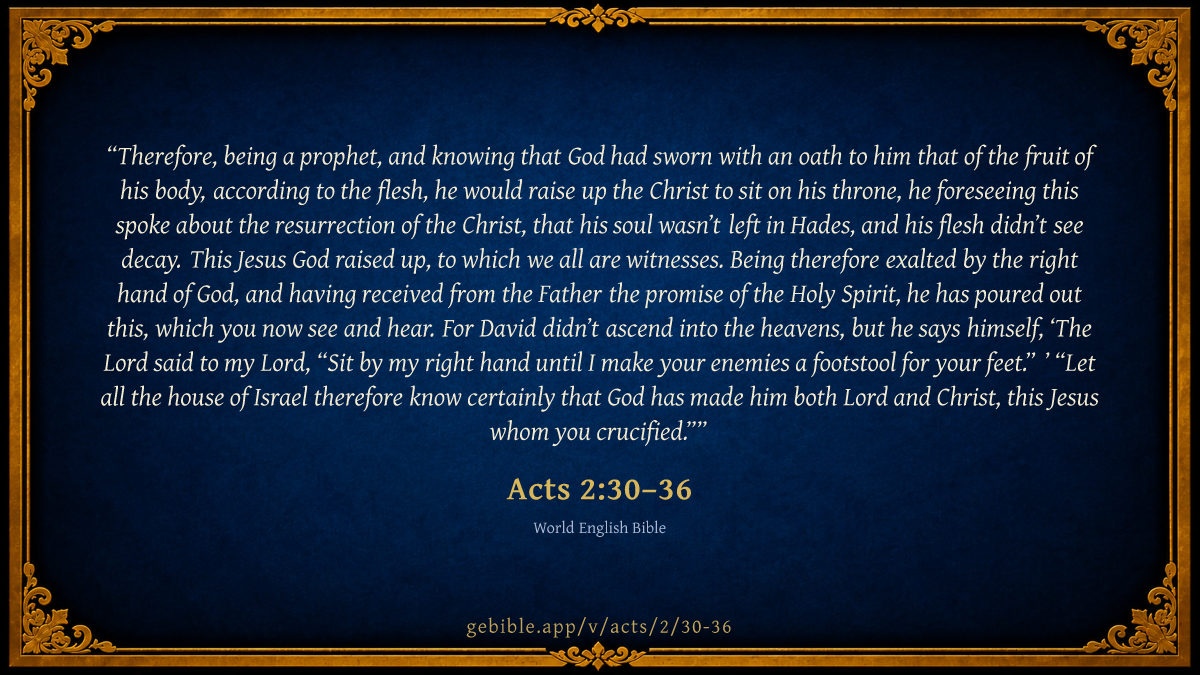
Therefore, being a prophet, and knowing that God had sworn with an oath to him that of the fruit of his body, according to the flesh, he would raise up the Christ to sit on his throne, he foreseeing this spoke about the resurrection of the Christ, that his soul wasn’t left in Hades, and his flesh didn’t see decay. This Jesus God raised up, to which we all are witnesses. Being therefore exalted by the right hand of God, and having received from the Father the promise of the Holy Spirit, he has poured out this, which you now see and hear.
For David didn’t ascend into the heavens, but he says himself, ‘The Lord said to my Lord, “Sit by my right hand
until I make your enemies a footstool for your feet.” ’
“Let all the house of Israel therefore know certainly that God has made him both Lord and Christ, this Jesus whom you crucified.”
John Calvin 1540 · Public Domain On vv30, 32, 33, 34, 36 30. Therefore, seeing he was a prophet He showeth,…
30. Therefore, seeing he was a prophet He showeth, by two reasons, that it is no marvel if David do speak of things that should come to pass long after his time; the former is, because he was a prophet. And we know that things to come, and such as are removed far from the knowledge of men, are revealed unto the prophets. Therefore, it were wickedness to measure their speeches according to the common manner and order which we use in measuring the speeches of other men, forasmuch as they go beyond the long courses of years, having the Spirit for their director. Whereupon they are also called seers; because being placed, as it were, upon an high tower, they see those things which, by reason of great distance, are hidden from other men. Another reason is, because Christ was promised to him peculiarly. This maxim was so common amongst the Jews, that they had ever now and then the son of David in their mouth, so often as there was any mention made of Christ. They be no such arguments, I confess, as do necessarily prove that this prophecy is to be expounded of Christ; neither was that Peter’s intent and purpose; but first he meant to prevent the contrary objection, whence David had such skill to foretell a thing which was unknown. Therefore he saith, That he knew Christ, both by prophetical revelation, and also by singular promise. Furthermore, this principle was of great (Romans 10:4) force amongst the better-minded sort which Paul setteth down, that Christ is the end of the law. No man, therefore, did doubt of this, but that this was the mark whereat all the prophets did aim, to lead the godly unto Christ as it were by the hand. Therefore, what notable or extraordinary thing soever they did utter, the Jews were commonly persuaded that it did agree with Christ. Furthermore, we must note, that Peter doth reason soundly, when he gathered that David was not ignorant of that which was the chiefest point of all revelations.
He had sworn with an oath God swore not only to the end he might make David believe his promise, but also that the thing promised might be had in greater estimation. And to this end, in my judgment, it is here repeated, that the Jews may think with themselves of what great weight the promise was, which God did make so notable (and so famous.) The same admonition is profitable for us also. For we need not to doubt of this, but that the Lord meant to set forth the excellency of the covenant by putting in a solemn oath. In the mean season, this is also a fit remedy for the infirmity of our faith, that the sacred name of God is set forth unto us, that his words may carry the greater credit. These words, “according to the flesh,” do declare that there was some more noble thing in Christ than the flesh. Therefore Christ did so come of the seed of David as he was man, that he doth nevertheless, retain his divinity; and so the distinction between the two natures is plainly expressed; when as Christ is called the Son of God, according to his eternal essence, in like sort as he is called the seed of David according to the flesh.
John Calvin's Commentaries (1540-1563) — public domain. Text from the Calvin Translation Society English edition (1840s-50s) via the Christian Classics Ethereal Library (ccel.org). Calvin's coverage is partial (roughly two-thirds of the Bible); uncommented books and verses are honest gaps, never fabricated. The 19th-century editor's footnotes and remarks are omitted so the notes are faithfully Calvin's own voice.
Geneva Bible translators 1599 · Public Domain On vv30, 32, 33, 36 Had sworn solemnly.
Had sworn solemnly.
Geneva Bible (1599) marginal notes — public domain.
John Trapp 1656 · Public Domain On vv30–36 30 Therefore being a prophet, and knowing that God…
30 Therefore being a prophet, and knowing that God had sworn with an oath to him, that of the fruit of his loins, according to the flesh, he would raise up Christ to sit on his throne;
Ver. 30. Out of the fruit of his loins] That is, out of the Virgin Mary; the son of whose womb Christ was, being hewn without hands out of that mountain, Dan 2:45.
John Trapp, A Commentary or Exposition upon All the Books of the Old and New Testament (1647–1656) — public domain. Text from a community e-Sword module.
Matthew Poole 1685 · Public Domain On vv30–36 Had sworn with an oath; not barely had sworn,…
Had sworn with an oath; not barely had sworn, which had been sufficient; but to show the excellency of the matter, and the necessity of our believing of it, as also the solemnity of the words, Psa 132:11.
Of the fruit of his loins; such as should descend from him, as the virgin Mary did.
Read full note →
According to the flesh; as to his human nature, which our Saviour did truly partake of, being in the form of a servant.
He would raise up Christ, by the power of the Holy Ghost in the womb of his virgin mother, as to his incarnation; and by the same power out of the grave, in his resurrection.
To sit on his throne; as Luk 1:32,33; not as a temporal king, for his kingdom is not of this world; but as David ruled over all the people of God, so does Christ, and shall do for ever.
Matthew Poole's English Annotations on the Holy Bible (1683–1685) — public domain. Text from a community e-Sword/MySword module.
William Burkitt 1703 · Public Domain On v36 That is, God the Father hath ordained and appointed…
That is, God the Father hath ordained and appointed this Jesus whom we have crucified, to be the head and Saviour of his church, he being the true and promised Messiah.
Learn hence, That the Lord Jesus Christ was constituted and appointed by his Father, to be the supreme Governor and only Saviour of his church. God had made Jesus both Lord, and Christ, both a prince and a Saviour.
Read full note →
Note farther, How very close and home the apostle is in applying what he had said to his auditors; he doth not rest in generals; but says plainly, Ye are the men; This is the same Jesus whom ye have crucified, whom ye with wicked hands have slain: Had not the application been so close, it is probable the success of the sermon had not been so considerable.
Thence learn, That the success and efficacy of the word preached, depends upon a particular and warm application of it to every man’s conscience: generals will not affect. See an instance of it in what follows.
That is, God the Father hath ordained and appointed this Jesus whom we have crucified, to be the head and Saviour of his church, he being the true and promised Messiah.
Learn hence, That the Lord Jesus Christ was constituted and appointed by his Father, to be the supreme Governor and only Saviour of his church. God had made Jesus both Lord, and Christ, both a prince and a Saviour.
Note farther, How very close and home the apostle is in applying what he had said to his auditors; he doth not rest in generals; but says plainly, Ye are the men; This is the same Jesus whom ye have crucified, whom ye with wicked hands have slain: Had not the application been so close, it is probable the success of the sermon had not been so considerable.
Thence learn, That the success and efficacy of the word preached, depends upon a particular and warm application of it to every man’s conscience: generals will not affect. See an instance of it in what follows.
William Burkitt's Expository Notes on the New Testament (1700–1703) — public domain. Text from a community e-Sword module.
John Gill 1763 · Public Domain On vv30–36 Therefore being a prophet,.... Who could foretell things to…
Therefore being a prophet,.... Who could foretell things to come, as he did many things concerning the sufferings and death of Christ, and the circumstances attending it, concerning his resurrection, ascension, and session at the right hand of God. So the title of his "Psalms", in the Syriac version, runs thus; the "Book of the Psalms of David, King and Prophet": and in the Arabic version, "the First Book of the Psalms of David the Prophet, King of the Children of Israel". Though the Jews (d) will not allow him, nor Solomon, nor Daniel, to be strictly and properly prophets, they make a difference between prophecy, and the Holy Spirit. They own, that the book of Psalms was written under the influence of the Holy Spirit, but not by prophecy; and therefore they place it among the Hagiographa, or holy writings, but not among the Prophets: though after all, Kimchi allows David to be a prophet, since he is called a man of God; for he says this name is not said of any but , "of a prophet" (e); and Peter is right in calling him so:
and knowing that God had sworn with an oath to him; as he did in Psa 132:11.
Read full note →
that of the fruit of his loins; of one that should be of his seed, that should spring from him, even the Virgin Mary, who was of the house and lineage of David:
according to the flesh, he would raise up Christ; would send him forth, according to the human nature; for this phrase respects not his resurrection from the dead, but his incarnation or exhibition in the flesh, as in Act 3:26. This clause is wanting in the Vulgate Latin, Syriac, and Ethiopic versions, and in the Alexandrian copy, and should be read in a parenthesis; since it is not in the text in Psa 132:11.
to sit on his throne; on the throne of David his father; see Gill on Luk 1:32.
(d) Maimon. More Nevochim, par. 2. c. 45. Vid. Procop. Gazaeum in Reg. l. 2. c. 23. sect. 2. (e) Kimchi Praefat. ad Psalm.
John Gill's Exposition of the Whole Bible (1746–1763) — public domain (CC PDM 1.0). Text via the HelloAO Bible API.
John Wesley 1765 · Public Domain On vv30, 32, 33, 34, 35, 36 Psalm lxxxix, 4, &c.
Psalm lxxxix, 4, &c.
John Wesley, Explanatory Notes Upon the Whole Bible (1754–1765) — public domain. Text via the GEBible commentary corpus.
Adam Clarke 1810 · Public Domain On vv30–36 Verse 30. According to the flesh, he would raise…
Verse 30. According to the flesh, he would raise up Christ] This whole clause is wanting in ACD, one of the Syriac, the Coptic, AEthiopic, Armenian, and Vulgate; and is variously entered in others. Griesbach rejects it from the text, and Professor White says of the words, "certissime delenda," they should doubtless be expunged. This is a gloss, says Schoettgen, that has crept into the text, which I prove thus:
1. The Syriac and Vulgate, the most ancient of the versions, have not these words.
Read full note →
2. The passage is consistent enough and intelligible without them.
3. They are superfluous, as the mind of the apostle concerning the resurrection of Christ follows immediately in the succeeding verse.
The passage therefore, according to Bp. Pearce, should be read thus: Therefore being a prophet, and knowing that God had sworn with an oath, of the fruit of his loins, to set on his throne; and foreseeing that he (God) would raise up Christ, he spake of the resurrection of Christ, c. "In this transition, the words which Peter quotes for David's are exactly the same with what we read in the psalm above mentioned and the circumstance of David's foreseeing that Christ was to be raised up, and was the person meant, is not represented as a part of the oath; but is only made to be Peter's assertion, that David, as a prophet, did foresee it, and meant it."
Adam Clarke's Commentary on the Bible (1810–1826) — public domain. Text from a community e-Sword/MySword module.
Joseph Benson 1811 · Public Domain On v32 Act 2:32-36. This Jesus — Whom we assert to…
Act 2:32-36. This Jesus — Whom we assert to be the true Messiah; hath God raised up — According to the tenor of his promise; whereof — Of which resurrection; we all are witnesses — On our personal and certain knowledge; having seen him with our eyes, and examined into the truth of the matter with all possible care. Therefore, being by the right hand of God — That is, by God’s almighty power, exalted from the grave to heaven; or, as some read the clause, Being exalted to the right hand of God, to supreme power, majesty, and glory; and having received of the Father — As the great anointed one of the Lord; the promise of the Holy Ghost — The Holy Ghost promised to his disciples; he hath — Agreeably to the notices he gave us before his ascension; shed forth this miraculous effusion of it, the effects of which ye now see and hear. For David himself — Who has not yet been raised from the dead; is not — With respect to his body; ascended into heaven — To be advanced there to the highest dignity and power: but he saith — In another Psalm, (where he plainly shows that he spoke of another person, and such another as was superior to himself, even his Lord;) The Lord — Namely, Jehovah, (the word here used;) said unto my Lord — That is, God the Father said unto the Messiah, (whom, though in one sense David’s son, he honoured as his Lord;) Sit thou on my right hand — Be thou invested with the highest power and glory; until I make thy foes — All that are so presumptuous as to persist in hostility to thee; thy footstool — Until I lay them prostrate at thy feet, so that thou mayest trample upon them at pleasure, as entirely subdued. See note on Psa 110:1. This text is here quoted with the greatest address, as suggesting, in the words of David, their great prophetic monarch, how certain their own ruin must be, if they went on to oppose Christ. It may be proper to observe here, that in these two verses there is an allusion to two ancient customs: one, to that of kings placing those persons on their right hands to whom they intended the highest honour; as Solomon did Bathsheba, when sitting on his throne, 1Ki 2:19; and the other, to the custom of conquerors, who used to tread on the necks of their vanquished enemies, as a token of their entire victory and triumph over them. Therefore — Upon the whole, from this concurrent evidence, both of prophecy and miracle, and from the testimony God has given to that Jesus whom we preach, not only by his resurrection from the dead, but by the effusion of the Holy Spirit on his followers; let all the house of Israel know assuredly — How contrary soever it may be to their former apprehensions and rooted prejudices; that God hath made that same Jesus, whom ye have rejected and crucified, both Lord and Christ — Hath demonstrated him to be the expected Messiah, and hath constituted him the King of his people, and Lord of all: let them know certainly that this truth has now received its full confirmation, and we our full commission to publish it. Thus Peter shows, in a striking light, what aggravated wickedness they had been guilty of, in that they had crucified one whom God designed to glorify, and had put him to death as a deceiver, who had given such pregnant proofs of a divine mission.
Joseph Benson's Commentary on the Old and New Testaments (1811–1818) — public domain. Text from a community e-Sword module.
Albert Barnes 1834 · Public Domain On vv30, 31, 32, 33, 34, 36 Therefore - As David was dead and buried, it…
Therefore - As David was dead and buried, it was clear that he could not have referred to himself in this remarkable declaration. It followed that he must have had reference to some other one.
Being a prophet - One who foretold future events. That David was inspired is clear, 2Sa 23:2. Many of the prophecies relating to the Messiah are found in the Psalms of David: Psa 22:1, compare Mat 27:46; Luk 24:44 - Psa 22:18, compare Mat 27:35 - Psa 69:21, compare Mat 27:34, Mat 27:48 - Psa 69:25, compare Act 1:20.
Read full note →
And knowing - Knowing by what God had said to him respecting his posterity.
Had sworn with an oath - The places which speak of God as having sworn to David are found in Psa 89:3-4, “I have made a covenant with my chosen, I have sworn unto David my servant, Thy seed will I establish,” etc.; and Psa 132:11, “The Lord hath sworn in truth unto David, he will not turn from it, Of the fruit of thy body will I set upon my throne”; Psa 89:35-36. The promise to which reference is made in all these places is in 2Sa 7:11-16.
Of the fruit of his loins - Of his descendants. See 2Sa 7:12; Gen 35:11; Gen 46:26; 1Ki 8:19, etc.
According to the flesh - That is, so far as the human nature of the Messiah was concerned, he would be descended from David. Expressions like these are very remarkable. If the Messiah was only a man, they would be unmeaning. They are never used in relation to a mere man; and they imply that the speaker or writer supposed that there pertained to the Messiah a nature which was not according to the flesh. See Rom 1:3-4.
He would raise up Christ - That is, the Messiah. To raise up seed, or descendants, is to give them to him. The promises made to David in all these places had immediate reference to Solomon and to his descendants. But it is clear that the New Testament writers understood them as referring also to the Messiah. And it is no less clear that the Jews understood that the Messiah was to be descended from David, Mat 12:23; Mat 21:9; Mat 22:42, Mat 22:45; Mar 11:10; Joh 7:42, etc. In what way these promises that were made to David were understood as applying to the Messiah, it may not be easy to determine. The fact, however, is clear. The following remarks may throw some light on the subject:
The kingdom which was promised to David was to have no end; it was to be established forever. Yet his descendants died, and all other kingdoms changed. The promise likewise stood by itself; it was not made to any other of the Jewish kings; nor were similar declarations made of surrounding kingdoms and nations. It came, therefore, gradually to be applied to that future king and kingdom which was the hope of the nation; and their eyes were anxiously fixed on the long-expected Messiah. At the time that he came it had become the settled doctrine of the Jews that he was to descend from David, and that his kingdom was to be perpetual.
On this belief of the prophecy the apostles argued; and the opinions of the Jews furnished a strong point by which they could convince them that Jesus was the Messiah. Peter affirms that David was aware of this, and that he so understood the promise as referring not only to Solomon, but in a far more important sense to the Messiah. Happily we have a commentary of David himself as expressing his own views of that promise. That commentary is found particularly in Psa 2:1-12; Ps. 22; Ps. 69; and Psa 16:1-11; In these Psalms there can be no doubt that David looked forward to the coming of the Messiah; and there can be as little that he regarded the promise made to him as extending to his coming and his reign.
It may be remarked that there are some important variations in the manuscripts in regard to this verse. The expression “according to the flesh” is omitted in many mss., and is now left out by Griesbach in his New Testament. It is omitted also by the ancient Syriac and Ethiopic versions, and by the Latin Vulgate.
To sit on his throne - To be his successor in his kingdom. Saul was the first of the kings of Israel. The kingdom was taken away from him and his posterity, and conferred on David and his descendants. It was determined that it should be continued in the family of David, and no more go out of his family, as it had from the family of Saul. The unique characteristic of David as king, or what distinguished him from the other kings of the earth, was that he reigned over the people of God. Israel was his chosen people, and the kingdom was over that nation. Hence, he that should reign over the people of God, though in a manner somewhat different from David, would be regarded as occupying his throne, and as being his successor. The form of the administration might be varied, but it would still retain its prime characteristic as being a reign over the people of God. In this sense the Messiah sits on the throne of David. He is his descendant and successor. He has an empire over all the friends of the Most High. And as that kingdom is destined to fill the earth, and to be eternal in the heavens, so it may be said that it is a kingdom which shall have no end. It is spiritual, but not the less real; defended not with carnal weapons, but not the less really defended; advanced not by the sword and the din of arms, but not the less really advanced against principalities, and powers, and spiritual wickedness in high places; not under a visible head and earthly monarch, but not less really under the Captain of salvation and the King of kings.
Albert Barnes' Notes on the Bible (1834–1885) — public domain. Text from a community e-Sword/MySword module.
Haydock's Catholic Bible Commentary 1859 · Public Domain On vv31, 33 Foreseeing he (David) spoke of the resurrection of Christ.…
Foreseeing he (David) spoke of the resurrection of Christ. St. Peter shews them that the prophetical words of the Psalm, agree not to David in person, he being dead, and his body having remained in the grave, without rising from the dead. (Witham)
George Leo Haydock (1774–1849), Haydock's Catholic Family Bible and Commentary, 1859 edition — public domain. Excludes Psalms (Douay-Rheims chapter numbering differs from Protestant) and Deuterocanonical books (Catholic canon only).
Robert Jamieson, A. R. Fausset & David Brown 1871 · Public Domain On v36 Therefore--that is, to sum up all.
Therefore--that is, to sum up all.
let all the house of Israel--for in this first discourse the appeal is formally made to the whole house of Israel, as the then existing Kingdom of God.
Read full note →
know assuredly--by indisputable facts, fulfilled predictions, and the seal of the Holy Ghost set upon all.
that God hath made--for Peter's object was to show them that, instead of interfering with the arrangements of the God of Israel, these events were His own high movements.
this same Jesus, whom ye have crucified--"The sting is at the close" [BENGEL]. To prove to them merely that Jesus was the Messiah might have left them all unchanged in heart. But to convince them that He whom they had crucified had been by the right hand of God exalted, and constituted the "LORD" whom David in spirit adored, to whom every knee shall bow, and the CHRIST of God, was to bring them to "look on Him whom they had pierced and mourn for Him."
Jamieson, Fausset & Brown — Commentary Critical and Explanatory on the Whole Bible (1871) — public domain (CC PDM 1.0). Text via the HelloAO Bible API.
Daniel D. Whedon 1874 · Public Domain On vv30–36 30. A prophet—In the sense both of speaking by…
30. A prophet—In the sense both of speaking by inspiration and of predicting the future.
An oath—In 2Sa_7:5-16, God promises to David a successorship on the throne forever; in <19D211>Psa_132:11, David affirms that God had so sworn; both in consequence of David’s determination to build a house for Jehovah.
Read full note →
Fruit of his loins—Peter speaks as if it was, as it were, through his line of descent that David was able to look prophetically as through a line of light. Thereby he identifies himself with his great descendant the Messiah, and speaks in Psalm xvi as Messiah himself. The best reading, instead of he would raise Christ to sit on his throne, would substitute, that of the fruit of his loins One should sit on his throne. With that future One Peter now (in Act_2:32) identifies Jesus.
Daniel D. Whedon (gen. ed.), Commentary on the Old and New Testaments (1874–1909) — public domain. Text from a community e-Sword module.
The Cambridge Bible for Schools and Colleges 1878 · Public Domain On vv30–36 30. knowing that God had sworn with an oath]…
30. knowing that God had sworn with an oath] See Psa_132:11, “of the fruit of thy body will I set upon thy throne.”
that of the fruit of his loins, according to the flesh, he would raise up Christ to sit on his throne] The words represented by “according … Christ” are omitted in the best MSS. The clause as corrected by them would be “of the fruit of his loins one should sit [or he would set one] on his throne.”
The Cambridge Bible for Schools and Colleges (gen. ed. J. J. S. Perowne; Cambridge University Press, 1878–1918) — public domain. Text from a community e-Sword module.
Ellicott's Commentary for English Readers 1878 · Public Domain On vv30, 31, 32, 33, 34, 36 (30) Therefore being a prophet.—The words “according to the…
(30) Therefore being a prophet.—The words “according to the flesh, He would raise up Christ,” are wanting in many of the best MSS. Without them the sentence, though somewhat incomplete, would run thus: “That God had sworn with an oath that from his loins one should sit upon his throne.” The words claim for the Psalmist a prophetic foresight of some kind, without defining its measure or clearness. His thoughts went beyond himself to the realisation of his hopes in a near or far-off future. As with most other prophets, the precise time, even the “manner of time,” was hidden from him (1Pe_1:11).
He would raise up Christ.—The Greek, by using the verb from which comes the word “resurrection,” gives to the verb the definite sense of “raising from the dead.”
A Bible Commentary for English Readers, edited by Charles John Ellicott (1878–1897) — public domain. Text from a community e-Sword module.
The Pulpit Commentary 1880 · Public Domain On vv30–36 Being therefore for therefore being, A.V. ; that of…
Being therefore for therefore being, A.V. ; that of the fruit of his loins he would set one upon for that of the fruit of his loins according to the flesh he would raise up Christ to sit on, A.V. and T.R. Had sworn, etc. The first record of God"s promise to David is in 2Sa_7:11-16: "The Lord telleth thee that he will make thee an house. And I will set up thy seed after thee, which shall proceed out of thy bowels, and will establish his kingdom Thy throne shall be established forever;" and in ver. 28, David speaks of it as God"s promise: "Thy words be true, and thou hast promised this goodness unto thy servant." But there is no mention there of an oath. But in Psalm 89, great stress is laid upon God having sworn to David: "I have made a covenant with my chosen, I have sworn unto David my servant, Thy seed will I establish for ever, and build up thy throne to all generations" (vers. 3, 4); and again, ver. 35, "Once have I sworn by my holiness that I will not lie unto David" 1Sa 7 and Psalm 89, should be read through carefully. (comp. also Isa_4:3; Act_13:23 For the phrase, "I have sworn by my holiness," see Amo_4:2)
The Pulpit Commentary (1880–1919), ed. H.D.M. Spence-Jones & Joseph S. Exell — public domain. Text from a community e-Sword module.
The Biblical Illustrator 1887 · Public Domain On v33 Therefore being by the right hand of God exalted.
Act_2:33-36
Therefore being by the right hand of God exalted.
Read full note →
The right hand of God
The phrase imports--
I. The unspeakable felicity into which Christs human nature--for it is of Christ incarnate that this is said, and as the reward of His sufferings as a man--had now entered; for in Thy presence is fulness of joy, etc. (Psa_16:11).
II. The glorious majesty to which He had reached (Heb_1:3; Heb_8:1).
III. The fulness of power with which He is invested who has declared, All power is given unto Me, etc. (Mat_28:18). (See Psa_20:6; Psa_89:13; Mat_26:64).
IV. The judicial throne on which He sits (Rom_14:9-10). (D. Whitby, D. D.)
The ascension and its meaning
Peter shows--
I. That it had taken place in fulfilment of prophecy. Again the particular prediction is taken from David. It is a passage applied by Jesus to Himself, to the confusion of the Pharisees, whose silence was a confession of its Messianic character (Mat_22:42-46). Its fulfilment was by the power of God. The hand is that part of the body by which man puts forth his strength, and the right hand is superior to the left; and God, condescending to human ways of speech, represents the exercise of His power as the work of His right hand. Creation was done by a word; but this concluding act of redemption demanded the putting forth of Jehovahs power.
II. That it had taken the Redeemer to His heavenly condition. He was exalted, that He might sit at the right hand of God (cf. Mat_26:64; Rom_8:34; Heb_1:3; Heb_8:1). This condition is marked by--
1. A continuous quiet dominion.
(1) He has dominion, being at the right hand of the Majesty on high, and that dominion involves all authority in heaven and in earth.
(2) But He rules in quietness and rest. Having finished His great work, He sits. Angels, being evermore on duty (Heb_1:14), stand about the throne. God says not to them, Sit on My right hand.
(3) This dominion will continue until its Mediatorship has answered its purpose.
2. Perfect happiness (Psa_16:11). The great joy had been set before Him, and had sustained Him in sorrow. Let His consummate blessedness show as the good placed within the reach of man.
3. The subduing of His foes. The allusion is to the ancient custom of conquerors to set their feet upon the necks of the vanquished.
Who are His foes?
1. The Jews, who were subdued when their nationality was destroyed.
2. The Romans, who were subdued when their empire was comprehended in Christendom.
3. The pagans, that still remain. These will be subdued when the gospel has been preached to all nations for a witness.
4. Men and women in Christendom who still reject Him. They also will see their folly and sin, and acknowledge Him either too soon or too late.
5. Sin and Satan, but these will be cast out.
6. Death. The last enemy that shall be destroyed is death.
III. That it was declared to have taken place by events now transpiring. He hath shed forth this, etc. These events--
1. Showed that the Holy Spirit had been given. This Peter does not tire of repeating. Its importance demanded its repetition, and does so still. But Jesus had said that unless He went to the Father the Holy Spirit would not come. Therefore His manifest presence proved the ascension.
2. Were a fulfilment of the Fathers promise. The promise made through the prophets had been repeated to Jesus, and by Him to the apostles; and He was now gone to receive what was promised. This was the simple, straightforward explanation of what was happening.
3. Were brought about by Jesus Himself. He hath shed. During His ministry He had wrought unnumbered miracles, every one of which displayed Divine power, and He was but continuing what He had begun (Eph_4:8).
4. Were in themselves wonderful. This which ye now see and hear. Explanation was not attempted. What was seen and heard was enough to work conviction.
IV. In the ascension Peter finds the concluding-point of his argument--viz., that Jesus was Lord and Christ. Then they had crucified the Messiah. No wonder they were pricked in the heart. In conclusion, see here--
1. The means to be employed by preachers: the facts M history and experience, with interpretations from the Word of God.
2. The end to be aimed at by preachers--that personal conviction which prepares sinners to accept Christ. (W. Hudson.)
The exaltation of Christ
He is there at the right hand of God, above all principality and power, and every name that is named. He is not there among the patriarchs; He is higher up. He is not there among the martyrs; He is higher up. He is not there among the prophets; He is higher up. He is not there among the four and twenty elders; He is higher up. He is not there with the four living beings that are immediately surrounding the throne; He is higher up. He is at the right hand, in the midst of the throne, literally over all, God-blessed for ever. That throne will never be called the throne of God and the patriarchs, or the throne of God and the prophets, or the throne of God and the angels, or the throne of God and the martyrs, but it will evermore be called the throne of God and of the Lamb; for He that giveth not His glory to another has taken Him unto that throne, and at that throne He stands as the Lamb that was slain, bearing upon Him in the central seat of glory and brightness the dark tokens of death: the dear tokens of His passion still His dazzling body bears, and from that centre of authority He hath poured out, He hath shed forth that which now ye do see and hear. (W. Arthur, M. A.)
He hath shed forth this, which ye now see and hear.--
The effusion of the Spirit
I. The promises of the spirit, under preceding dispensations. As the prophecies of Christ served to identify the Messiah on His manifestation in the flesh, and prove His Divine mission, so these predictions of the coming and agency of the Holy Ghost in the ancient Scriptures of the Jewish people, conspire, with the facts afterwards to be noticed as the accomplishment of them, to show that it is a Divine energy from on high which is now amongst us of a truth.
II. The communication of the Holy Ghost from the hands of the exalted Redeemer.
1. The work of the Holy Ghost is essentially connected with the work of Christ. Of old the Spirit was given to foretell it, but His greater province was to attest and apply it.
2. This communication of the Spirit from the hands of the exalted Saviour makes distinctly manifest what is everywhere implied in Scripture--that the gift of the Holy Ghost is a purely gratuitous and gracious bestowment.
III. What is stated to be the nature of the work of the Holy Ghost in the Church. What were those manifestations thus dispensed from the hands of the Redeemer, of which we read in Scripture, and some of which are matters of observation or of consciousness still?
1. There were those supernatural endowments, called in Scripture Spiritual gifts, which first proclaimed the presence of the Holy Ghost in the Church.
2. With this stands closely connected the inspiration of the apostles. The system of truth which the spiritual gifts were to attest was that of which they were the professed expositors; and it was in the train of their ministry that these manifestations appeared.
3. We have further to advert to that, to which all that we have been dwelling upon is but subservient, as means to the end--the manifestation of that new element of spiritual life which sprung up in connection with the exhibition of apostolic truth, and which is ascribed in Scripture to the application of that truth to the soul by the Holy Ghost. The first work of the Spirit, of which we have spoken, was chiefly for attestation; the second, for instruction; this third, for regeneration and salvation. And if the Spirit appears glorious in His gifts and diversities of miraculous working, and as the source of inspiration in the apostles and prophets, much more is it so when we view Him as the Spirit of life in Christ Jesus, and as establishing a law within the renewed soul, which makes it free from the law of sin and death. (E. T. Priest.)
Therefore let all the house of Israel know assuredly, that God hath made that same Jesus, whom ye have crucified, both Lord and Christ.
The Lordship of Christ
I. The apostle applies himself to his auditory in a fair, gentle manner. We have a word amongst us in familiar use--compliment; and for the most part in an ill sense, for the heart of a speaker does not always answer his tongue. But God forbid but a true heart and a fair tongue might very well consist together. He aggravates his condemnation who gives me fair words and means ill; but he gives me a rich jewel in a choice cabinet, precious wine in a clean glass, who intends and expresses his good intentions well.
II. So the apostle is civil here; but his civility does not amount to flattery; and therefore, though he gives his audience their titles, he puts home to them the crucifying of Christ. How honourably soever they were descended, he lays that murder close to their consciences. It is one thing to sew pillows under the elbows of kings, as flatterers do, and another to pull the chair from under them, as seditious men do. When inferiors insult over their superiors, we tell them they are the Lords anointed; and when such superiors insult over the Lord Himself, we must tell them, Though you be the Lords anointed, yet you crucify the anointed Lord; for this was Peters method, though his successor will not be bound by it.
III. When he hath carried the matter thus evenly between them, he announces a message. Let all the house of Israel know assuredly. Need the house of Israel know anything? Need the honourable to be instructed? Yes, for this knowledge is such that the house of Israel is without a foundation if it be without it. Let no Church or man think that he hath done enough or known enough. The wisest must know more, though they be the house of Israel; and then, though you have crucified Christ, you may know it. St. Paul says, If they had known it, they would not have crucified the Lord of Glory (1Co_2:8); but he never says they are excluded from the knowledge. The wisest have ever something to learn; they must not presume. The sinfullest have God ever ready to teach them; they must not despair. Now the universality of this mercy God has extended very far, in that He proposes it even to our knowledge: Let all know it. And therefore it is not enough for us to tell you except you believe all this you shall be damned, without we execute that commission before, Go and preach; and it is not enough for you to rest in imaginary faith and easiness of believing, except you know what, why, and how you believe. The implicit believer stands in an open field, and the enemy will ride over him easily; the understanding believer is a fenced town, and hath outworks to lose before the town be pressed--i.e., reasons to be answered before his faith be shaked. Let all men know--i.e., inform themselves and understand.
IV. The particular which all were to know was that this same Jesus whom they crucified was exalted. Suppose an impossibility: if we could have been in paradise, and seen God make of a clod a body fit for an immortal soul--fit for God the Son to dwell in, and fit for a temple of the Holy Ghost, should we not have wondered more than at the production of all other creatures? It is more that this same crucified Jesus should be exalted to the right hand of the glorious God. Let, then, sinners pass through their several sins, and remember with wonder and confusion that the Jesus whom they have crucified is exalted above all. How far exalted? Three steps carry Him above St. Pauls third heaven.
1. God made Him so, not nature. The contract between the Father and Him that all He did should be done so--this is what hath exalted Him, and us in Him.
2. God made Him Christ--i.e., anointed Him above His fellows.
3. God made Him Lord. But what kind of Lord, if He had no subjects? God hath given Him these too (Rom_14:9). (J. Donne, D. D.)
Jesus as Lord11
We are apt to let this idea slip. As soon as we have apprehended Christ as Saviour, we suppose sometimes that the work is done; whereas it is but just begun. Christ is Saviour in order that He may be King. He saves us first, because that is the only effective way of ruling over us. He cannot capture man and bring him into subjection, except by laying hold of mans heart. It is love that changes, and love that rules. One of our best story-tellers has taken us into a Californian camp. They were a hard, fighting, swearing set, those gold-diggers. But a baby was born into the camp, and these rough men were allowed to go and look at the little babe; and there was one man put his finger down, and the babys hand wound round it, and seemed to thrill his rough, coarse nature with a new love. The man was changed; the camp was changed. It was love that did it. Love is Christs method; rule His end. If Christ does not rule men, He has failed in the purpose that called Him here. All living things need a ruling force. The body is useless without the brain to direct its movements; the family fail when father and mother die; an army is powerless when there is no one to give orders; a state is the home of miserable factions when there is no recognised authority; and humanity itself is but a series of disjointed individuals, until Christ is crowned Lord of man and King of the world. Christian men are forgetting Christs world-wide Lordship and universal claims; and these claims must be pressed home on the hearts and consciences of men until they fully acknowledge Jesus as Lord.
I. Lord of man.
1. Ruling mans body, with its passions and inclinations.
2. Guiding mans mind, preserving the intellect from sophistry, the conscience from error, the heart from corruption.
II. Lord of woman.
1. Touching her tender heart with a deeper pathos for the sufferings of the world.
2. Making her mans helpmeet in all that is pure and ennobling.
3. Enabling her, with man, to deal with all that is evil in society and degrading in public sentiment.
III. Lord of the child.
1. Alluring the young life along paths of obedience and self-denial and thoughtfulness.
2. Yet filling the lap with buttercups and daises, and merriment and laughter. Suffer little children, etc.
IV. Lord of the home. Determining its--
1. Expenditure.
2. Giving.
3. Habits.
4. Prayers.
5. Purposes, and binding parents, children, servants, into one holy fellowship.
V. Lord of the Church. Giving--
1. Truth to feed the mind.
2. Grace to support the life.
3. Wisdom to guide the judgment.
4. Reverence to lift up the soul in worship.
5. Enthusiasm to inspire the work.
6. A peaceful spirit, binding all together by our golden chain of loving brotherhood.
VI. Lord of the state.
1. Decreeing justice to all.
2. Bringing law into harmony with Divine teaching.
3. Lifting up the poor and abasing the proud.
4. Rebuking the evil doers, and overturning all iniquity.
VII. Lord of the world.
1. Driving back the darkness.
2. Destroying false religion and bringing in the true.
3. Making the world like heaven.
Conclusion: That Lordship of Christ will not let us put on and put off religion with our Sunday clothes. It bids us take Christ with us, not merely to religious work, but so to take Him that all work should be religious. It calls upon Christians to be the subjects of Christ everywhere; to obey Christ in business, in the home, in politics, in reading, in talking, in laughing, in giving, in dying. There is a majesty about this name that men have not yet felt. (S. Pearson, M. A.)
The name above every name
These names, to us very little more than three proper names, were very different to these men who listened to Peter. It wanted some courage to proclaim on the housetop what he had spoken in the ear long ago. Thou art the Christ, the Son of the living God! To most of his listeners, to say, Jesus is the Christ was folly, and to say Jesus is the Lord was blasphemy.
I. The name Jesus is the name of the man, which tells us of a brother.
1. There were many who bore it in His day. We find that one of the early Christians had it (Col_4:11). Through reverence on the part of Christians, and horror on the part of Jews, the name ceased to be a common one. But none of all the crowds who knew Him supposed that in His name there was any greater significance than in those of the Simons, Johns, and Judahs in the circle of His disciples.
2. The use of Jesus as the proper name of our Lord is very noticeable. In the Gospels, as a rule, it stands alone hundreds of times, whilst in combination with any other of the titles it is rare. Jesus Christ only occurs twice in Matthew, once in Mark, twice in John. But in the later books, the proportions are reversed. There you have hundreds of such combinations as Jesus Christ, Christ Jesus, The Lord Jesus, Christ the Lord, and not frequently the full solemn title, The Lord Jesus Christ. But Jesus alone only occurs some thirty or forty times outside of the four evangelists; and in these the writers intention is to put strong emphasis on the Manhood of our Lord.
(1) We find phrases like this: Jesus died, the blood of Jesus, which emphasise His death as that of a man like ourselves, and bring us close to the reality of His human pains for us. Christ died makes the purpose and efficacy of His death more plain; but Jesus died shows us His death as the outcome of His human love. I know that a certain school dwells a great deal too much for reverence upon the mere physical aspect of Christs sufferings. But the temptation with most of us is to dwell too little upon it, to think about it as a matter of speculation, a mysterious power, an official act of the Messiah, and to forget that He bore a human life, which naturally shrank from the agony of death.
(2) When our Lord is set before us in His humanity as our example, this name is used--e.g., Looking unto Jesus, the Author and Perfecter of faith--i.e., a mighty stimulus to Christian nobleness lies in the realisation of the true manhood of our Lord, as the type of all goodness, as having Himself lived by faith, and that in a perfect degree and manner. Do not take poor human creatures for your ideal. Black veins are in the purest marble, and flaws in the most lustrous diamonds; but to imitate Jesus is freedom, and to be like Him is perfection. Our code of morals is His life. The secret of all progress is, Run, looking unto Jesus.
(3) We have His manhood emphasised when His sympathy is to be commended to our hearts. The great High Priest is Jesus… who was in all points tempted like as we are. To every sorrowing soul there comes the thought, Every ill that flesh is heir to He knows by experience, and in the man Jesus we find not only the pity of a God, but the sympathy of a Brother. The Prince of Wales once went for an afternoon into the slums, and everybody said deservedly, right and princely. This Prince has learned pity in the huts where poor men lie.
(4) And then you read such words as these: If we believe that Jesus died and rose again, even so them also which sleep in Jesus will God bring with Him. How very much closer to our hearts that consolation comes, Jesus rose again, than even the mighty word, Christ is risen from the dead. The one tells us of the risen Redeemer, the other tells us of the risen Brother. And wherever we follow our dear ones into the darkness with yearning hearts, there, too, the consolation comes; they lie down beside their Brother, and with their Brother they shall rise again.
(5) So again, most strikingly, in the words which paint most loftily the exaltation of the risen Saviour, it is the old human name that is used, as if to bind together the humiliation and the, exaltation, and proclaim that a Man had risen to the throne of the universe. What an emphasis and glow of hope there is in, We see not yet all things put under Him, but we see Jesus--the very Man that was here with us--crowned with glory and honour. So in the Book of the Revelation, the chosen name for Him that sits amidst the glories of the heavens, and settles the destinies of the universe, and orders the course of history, is Jesus. As if the apostle would assure us that the face which looked down upon him from amidst the blaze of the glory was indeed the face that he knew long ago upon earth, and the breast that was girded with a golden girdle was the breast upon which he so often had leaned his happy head.
3. So the ties that bind us to the Man Jesus should be the human bonds that knit us one to another, transferred to Him, and purified and strengthened. All that we have failed to find in men we can find in Him.
(1) Human wisdom has its limits; but here is a Man whose word is truth, who is Himself the truth.
(2) Human love is sometimes hollow, often impotent; it looks down upon us, as a great thinker has said, like the Venus of Milo, that lovely statue, smiling in pity, but it has no arms. But here is a love that is mighty to help, and on which we can rely without disappointment or loss.
(3) Human excellence is always limited and imperfect; but here is One whom we may imitate and be pure.
4. So let us do like that poor woman, bring the precious alabaster box of ointment--the love of these hearts of ours, which is the most precious thing we have to give. The box of ointment that we have so often squandered upon unworthy heads--let us come and pour it upon His, not unmingled with our tears, and anoint Him, our Beloved and our King.
II. The name Christ is the name of office, and brings to us a redeemer. It is the Greek rendering of the Hebrew Messias, both meaning the Anointed. I cannot see less in the contents of the prophetic idea of the Messias than these points: Divine inspiration or anointing; a sufferer who is to redeem; the fulfiller of all the rapturous visions of psalmist and of prophet in the past. And so, when Peter stood up amongst that congregation and said, The Man that died on the Cross, the Rabbi-peasant from half-heathen Galilee, is the Person whom all the generations have been looking forward to, no wonder that nobody believed him except those whose hearts were touched, for it is never possible for the common mind, at any epoch, to believe that the man that stands beside them is very much bigger than themselves. Great men have always to die, and get a halo of distance around them before their true stature can be seen. And now two remarks are all I can offer.
1. The hearty recognition of His Messiahship is the centre of all discipleship. The earliest and the simplest Christian creed, which yet--like the little brown roll in which the infant beech leaves lie folded up--contains in itself all the rest, was this: Jesus is Christ. He who contents himself with Jesus and does not grasp Christ, has cast away the most valuable and characteristic part of the Christianity which he professes. Surely the most simple inference is that a Christian is at least a man who recognises the Christship of Jesus. And it is not enough for the sustenance of your souls that men should admire, howsoever profoundly, the humanity of the Lord unless that humanity leads them on to see the office of the Messiah, to whom their whole hearts cleave. Jesus is the Christ is the minimum Christian creed.
2. The recognition of Jesus as Christ is essential to giving its full value to the facts of the manhood.
(1) Jesus died. Yes! What then? If that is simply a human death, like all the rest, I want to know what makes it a gospel? What more interest I have in it than I have in the death of any men or women whose names were in the obituary column of yesterdays newspaper? Jesus died. That is the fact. What is wanted to turn the fact into a gospel? That I shall know who it was that died, and why He died. I declare unto you the gospel which I preach, Paul says, how that Christ died for our sins, according to the Scriptures. The belief that the death of Jesus was the death of the Christ is needful to make that death the means of my deliverance from the burden of sin. If it be only the death of Jesus, it is beautiful, pathetic, as many another martyrs has been; but if it be the death of Christ, then my faith can lay her hand on that great sacrifice, and know her guilt was there.
(2) So in regard of His perfect example. To only see His manhood would be as paralysing as spectacles of supreme excellence usually are. But when we can say, Christ also suffered for us, leaving us an example, and so can deepen the thought of His Manhood into that of His Messiahship, and the conception of His work as example into that of His work as sacrifice, we can hope that His Divine power will dwell in us to mould our lives to the likeness of His human life of perfect obedience.
(3) So in regard to His resurrection and ascension. If it were only Jesus, those events might be as much to us as the raising of Lazarus, or the rapture of Elijah--namely, a demonstration that death did not destroy conscious being, and that a man could rise to heaven. But if Christ is risen from the dead, He is become the first-fruits of them that slept. If Jesus has gone up on high, it may show that manhood is not incapable of elevation to heaven, but it has no power to draw others up after it. But if Christ is gone up, He is gone to prepare a place for us, and His ascension is the assurance that He will lift us too to dwell with Him, and share His triumph over death and sin.
III. The Lord is the name of dignity, and brings before us the King. There are three grades of dignity expressed by this word in the New Testament. The lowest is that in which it is almost the equivalent of Sir; the second is that in which it expresses dignity and authority; the third is that in which it is the equivalent of the Old Testament Lord as a Divine name; and all are applied to Christ. The central one is the meaning of the word here.
1. Jesus is Lord--i.e., the manhood is exalted to supreme dignity. It is the teaching of the New Testament, that our nature in the Child of Mary sits on the throne of the universe and rules over all things. Trust His dominion and rejoice in His rule, and bow before His authority.
2. Christ is Lord--i.e., His sovereign authority and dominion are built upon the fact of His being Redeemer and Sacrifice. His kingdom rests upon His suffering. Wherefore God also hath exalted Him, and given Him a name that is above every name. It is because He bears a vesture dipped in blood, that on the vesture is the name written, King of kings, and Lord of lords. Because He has given His life for the world, He is Master of the world.
Conclusion: Do not content yourselves with a maimed Christ.
1. Do not tarry in the Manhood; do not be content with an adoring reverence for the nobility of His soul, the wisdom of His words, the beauty of His character, the tenderness of His compassion. All that will be of small help for your needs. There is more in His mission than that--even His death for you and for all men.
2. Take Him for your Christ, but do not lose the Person in the work, any more than you lose the work in the Person. And be not content with an intellectual recognition of Him, but bring Him the faith which cleaves to Him and His work as its only hope and peace, and the love which, because of His work as Christ, flows out to the beloved Person who has done it all.
3. Thus loving Jesus and trusting Christ, you will bring obedience to your Lord and homage to your King, and learn the sweetness and power of the name that is above every name--the name of the Lord Jesus Christ. (A. Maclaren, D. D)
The Biblical Illustrator, edited by Joseph S. Exell (c. 1880s–1900s) — public domain. Text from a community e-Sword module.
B. W. Johnson 1891 · Public Domain On vv30, 32, 33, 34, 35, 36 30. Knowing that God had sworn. God had promised…
30. Knowing that God had sworn. God had promised to David that Christ should sit on his throne. See 2 Sam. 7:11–16; Psa. 89:3, 4, 35, 37; 132:11.
B. W. Johnson's The People's New Testament with Notes (1889–1891) — public domain. Electronic text from the Christian Classics Ethereal Library (CCEL) ThML edition.
William B. Godbey 1900 · Public Domain On vv30, 33, 36 30. “Therefore being a prophet and knowing that God…
30. “Therefore being a prophet and knowing that God swore to him with an oath that one from the fruit of his loins should sit upon his throne.” Peter uses this testimony of David to prove the kingship of Christ. He was born King of the Jews. Paul says (Rom 2:28-29):
“He is not a Jew as one outwardly, neither is circumcision that it is outward in the flesh; but he is a Jew who is one inwardly and circumcision is that of the heart; in the spirit and not in the letter, whose praise is not of men but of God.”
Read full note →
Hence, you see that Jesus was born King of Saints. When Pilate wrote this superscription on His cross above His head in Hebrew, Greek and Latin, the language of religion, learning and law for everybody to read, “This is the King of the Jews,” he wrote an eternal truth. That was the reason why he could not change it afterwards at the request of the Jews. The word Inri, which you so frequently see above crosses at Roman Catholic grave-yards and other places, is a combination of initials and stands for Jesus Nazarenus, Rex Ioudiourum, — “Jesus of Nazareth, King of the Jews.”
David, the brightest type of Christ in the Bible, powerfully symbolizes Him in His regal capacity. As David had two coronations, — first, he was crowned king of his own tribe at Hebron, and seven and a half years afterward he was crowned king of all the tribes of Israel at Jerusalem, — so Christ in His first advent was crowned King of Saints when He ascended up to heaven, when He comes in His glory He will be crowned King of all the nations upon the face of the earth. David never occupied an earthly throne. His kingdom was the divine theocracy centralized in heaven and overlapping on the earth. God said: “I have found David, the son of Jesse, a man after my own heart, who will do all my wills.” The reason why David was a man after God’s own heart was not because he was infallible, for he was not, but because he had one fixed and settled policy and purpose in all his administrations, and that was not to do his own will but the will of God (Act 12:22). Much has been said about the perpetuity of David’s throne; great volumes written in an attempt to substitute other dynasties, even of other nations, in lieu of what is regarded as the forfeited throne of David, and thus fulfill the Scriptures. When we undertake to help out the Bible, we always make a mistake and get into trouble. The Bible, like God, does not need any help. If you will throw away your creeds and part company with the devil, the Bible will do its own talking. Here it is positively specified that Jesus, the lineal descendant of David, was born King of the Jews in David’s royal line. To be sure, He never reigned on earth. Instead of crowning Him King they killed Him, but here Peter proves demonstratively that he was crowned in heaven King of the Jews and successor of David to sit upon his throne. The Bible is clear in this succession of David and perpetuity of his kingdom on the mediatorial throne in heaven. As to David’s earthly throne, instead of all these efforts to find it perpetuated among the Gentiles, which is utterly chimerical, turn with me to the Jerusalem council of apostles, elders and brothers, highest authority this side of heaven, and you find the matter fully explained and the problem solved. Act 15:16 : “After these things [i.e., the preaching of the gospel to all the Gentiles in the present dispensation] I will return and build again the dynasty of David or the throne which hath fallen down, and will rebuild the ruins of the same and set it up again.” Here we see positively that the temporal wing of David’s throne had an interregnum at the time of Christ and the apostles, which is to continue until the King returns in His glory. Then He is going to rebuild the throne of David, restore his kingdom on the earth, destined, as the same Scripture goes on to say, “to encompass all the nations of the globe.” Hence, we see that David’s kingdom in the earth is to have this interregnum, which obtained in the former dispensation and continued to the end of the gospel age.
Therefore it is a great mistake to think we have to find David’s kingdom perpetuated in the earth, as this would preclude the interregnum which the Scriptures positively reveal. Hence the conclusion of the problem is the simple fact that Jesus Christ, the lineal Son, royal Heir and Successor of David, was born King, and, though prohibited and crucified on earth, He was crowned King when He ascended into heaven, and actually there sitteth on the throne of David, thus perpetuating his kingdom forever. Since David really had no earthly throne, but as king of the divine theocracy, his throne was in heaven, the capital of his kingdom, while it overlapped down in the earth and gave Israel a prelibation of the blessedness of the heavenly kingdom, of which Jerusalem, in the glory of David and Solomon, proximately symbolize heaven, and David’s earthly throne was but the temporal counterpart of the heavenly. Hence the temporary dilapidation of David’s earthly throne does not invalidate the eternal perpetuity of his kingdom, realized in the mediatorial administration of Christ in heaven and destined in the coming millennial age, adumbrated in the days of David, to reach down and girdle the globe in the glory of the heavenly kingdom. We find interregnums in many of the time-honored kingdoms of the earth, such as Rome and Britain; but these interregnums do not invalidate the perpetuity of these kingdoms. Neither does the interregnum of David’s throne on earth invalidate the eternal perpetuity of his kingdom, especially in view of the fact that the heavenly nucleus of that kingdom is literally perpetuated in the glorious reign of King Jesus. The very fact that God said to Jesus on His congratulation and coronation, “Sit thou on my right hand till I make thine enemies thy footstool,” involves the unequivocal promise on the part of the Father to shake down every rival potentate in all the earth, whether political or ecclesiastical. The incarnation of the Holy Ghost on the day of Pentecost was a positive confirmation of the coronation of Christ in heaven, as the law must be fully satisfied before the promised restitution can be consummated in the incarnation of the Holy Ghost, actually restoring the human to full spiritual freedom and ushering in the millennial victory. Of course, Luke here gives us but a brief epitome of Peter’s sermon, i. e., the salient points. God in the Abrahamic covenant promised the gift of the Holy Ghost. That covenant must be sealed with the blood of Christ before the Holy Ghost, the Restorer and Comforter, can be given.
William B. Godbey, Commentary on the New Testament (1896–1900) — public domain. Text from a community e-Sword module.
Alexander MacLaren 1905 · Public Domain On vv32, 36 Act 2:32 - Act 2:47.
Acts
PETER’S FIRST SERMON
Read full note →
Act 2:32 - Act 2:47.
This passage may best be dealt with as divided into three parts: the sharp spear-thrust of Peter’s closing words {Act 2:32 - Act 2:36}, the wounded and healed hearers {Act 2:37 - Act 2:41}, and the fair morning dawn of the Church {Act 2:42 - Act 2:47}.
I. Peter’s address begins with pointing out the fulfilment of prophecy in the gift of the Spirit {Act 2:14 - Act 2:21}.
It then declares the Resurrection of Jesus as foretold by prophecy, and witnessed to by the whole body of believers {Act 2:22 - Act 2:32}, and it ends by bringing together these two facts, the gift of the Spirit and the Resurrection and Ascension, as effect and cause, and as establishing beyond all doubt that Jesus is the Christ of prophecy, and the Lord on whom Joel had declared that whoever called should be saved. We now begin with the last verse of the second part of the address.
Observe the significant alternation of the names of ‘Christ’ and ‘Jesus’ in Act 2:31 - Act 2:32. The former verse establishes that prophecy had foretold the Resurrection of the Messiah, whoever he might be; the latter asserts that ‘this Jesus’ has fulfilled the prophetic conditions. That is not a thing to be argued about, but to be attested by competent witnesses. It was presented to the multitude on Pentecost, as it is to us, as a plain matter of fact, on which the whole fabric of Christianity is built, and which itself securely rests on the concordant testimony of those who knew Him alive, saw Him dead, and were familiar with Him risen.
There is a noble ring of certitude in Peter’s affirmation, and of confidence that the testimony producible was overwhelming. Unless Jesus had risen, there would neither have been a Pentecost nor a Church to receive the gift. The simple fact which Peter alleged in that first sermon, ‘whereof we all are witnesses,’ is still too strong for the deniers of the Resurrection, as their many devices to get over it prove.
But, a listener might ask, what has this witness of yours to do with Joel’s prophecy, or with this speaking with tongues? The answer follows in the last part of the sermon. The risen Jesus has ascended up; that is inseparable from the fact of resurrection, and is part of our testimony. He is ‘exalted by,’ or, perhaps, at, ‘the right hand of God.’ And that exaltation is to us the token that there He has received from the Father the Spirit, whom He promised to send when He left us. Therefore it is He-’this Jesus’-who has ‘poured forth this,’-this new strange gift, the tokens of which you see flaming on each head, and hear bursting in praise from every tongue.
What triumphant emphasis is in that ‘He’! Peter quotes Joel’s word ‘pour forth.’ The prophet had said, as the mouthpiece of God, ‘I will pour forth’; Peter unhesitatingly transfers the word to Jesus. We must not assume in him at this stage a fully-developed consciousness of our Lord’s divine nature, but neither must we blink the tremendous assumption which he feels warranted in making, that the exaltation of Jesus to the right hand of God meant His exercising the power which belonged to God Himself.
In Act 2:34, he stays for a moment to establish by prophecy that the Ascension, of which he had for the first time spoken in Act 2:33, is part of the prophetic characteristics of the Messiah. His demonstration runs parallel with his preceding one as to the Resurrection. He quotes Psa 110:1 - Psa 110:7, which he had learned to do from his Master, and just as he had argued about the prediction of Resurrection, that the dead Psalmist’s words could not apply to himself, and must therefore apply to the Messiah; so he concludes that it was not ‘David’ who was called by Jehovah to sit as ‘Lord’ on His right hand. If not David, it could only be the Messiah who was thus invested with Lordship, and exalted as participator of the throne of the Most High.
Then comes the final thrust of the spear, for which all the discourse has been preparing. The Apostle rises to the full height of his great commission, and sets the trumpet to his mouth, summoning ‘all the house of Israel,’ priests, rulers, and all the people, to acknowledge his Master. He proclaims his supreme dignity and Messiahship. He is the ‘Lord’ of whom the Psalmist sang, and the prophet declared that whoever called on His name should be saved; and He is the Christ for whom Israel looked.
Last of all, he sets in sharp contrast what God had done with Jesus, and what Israel had done, and the barb of his arrow lies in the last words, ‘whom ye crucified.’ And this bold champion of Jesus, this undaunted arraigner of a nation’s crimes, was the man who, a few weeks before, had quailed before a maid-servant’s saucy tongue! What made the change? Will anything but the Resurrection and Pentecost account for the psychological transformation effected in him and the other Apostles?
II. No wonder that ‘they were pricked in their heart’!
Such a thrust must have gone deep, even where the armour of prejudice was thick. The scene they had witnessed, and the fiery words of explanation, taken together, produced incipient conviction, and the conviction produced alarm. How surely does the first glimpse of Jesus as Christ and Lord set conscience to work! The question, ‘What shall we do?’ is the beginning of conversion. The acknowledgment of Jesus which does not lead to it is shallow and worthless. The most orthodox accepter, so far as intellect goes, of the gospel, who has not been driven by it to ask his own duty in regard to it, and what he is to do to receive its benefits, and to escape from his sins, has not accepted it at all.
Peter’s answer lays down two conditions: repentance and baptism. The former is often taken in too narrow a sense as meaning sorrow for sin, whereas it means a change of disposition or mind, which will be accompanied, no doubt, with ‘godly sorrow,’ but is in itself deeper than sorrow, and is the turning away of heart and will from past love and practice of evil. The second, baptism, is ‘in the name of Jesus Christ,’ or more accurately, ‘upon the name,’-that is, on the ground of the revealed character of Jesus. That necessarily implies faith in that Name; for, without such faith, the baptism would not be on the ground of the Name. The two things are regarded as inseparable, being the inside and the outside of the Christian discipleship. Repentance, faith, baptism, these three, are called for by Peter.
But ‘remission of sins’ is not attached to the immediately preceding clause, so as that baptism is said to secure remission, but to the whole of what goes before in the sentence. Obedience to the requirements would bring the same gift to the obedient as the disciples had received; for it would make them disciples also. But, while repentance and baptism which presupposed faith were the normal, precedent conditions of the Spirit’s bestowal, the case of Cornelius, where the Spirit was given before baptism, forbids the attempt to link the rite and the divine gift more closely together.
The Apostle was eager to share the gift. The more we have of the Spirit, the more shall we desire that others may have Him, and the more sure shall we be that He is meant for all. So Peter went on to base his assurance, that his hearers might all possess the Spirit, on the universal destination of the promise. Joel had said, ‘on all flesh’; Peter declares that word to point downwards through all generations, and outwards to all nations. How swiftly had he grown in grasp of the sweep of Christ’s work! How far beneath that moment of illumination some of his subsequent actions fell!
We have only a summary of his exhortations, the gist of which was earnest warning to separate from the fate of the nation by separating in will and mind from its sins. Swift conviction followed the Spiri-given words, as it ever will do when the speaker is filled with the Holy Spirit, and has therefore a tongue of fire. Three thousand new disciples were made that day, and though there must have been many superficial adherents, and none with much knowledge, it is perhaps not fanciful to see in Luke’s speaking of them as ‘souls’ a hint that, in general, the acceptance of Jesus as Messiah was deep and real. Not only were three thousand ‘names’ added to the hundred and twenty, but three thousand souls.
III. The fair picture of the morning brightness, so soon overclouded, so long lost, follows.
First, the narrative tells how the raw converts were incorporated in the community, and assimilated to its character. They, too, ‘continued steadfastly’ {Act 1:14}. Note the four points enumerated: ‘teaching,’ which would be principally instruction in the life of Jesus and His Messianic dignity, as proved by prophecy; ‘fellowship,’ which implies community of disposition and oneness of heart manifested in outward association; ‘breaking of bread,’-that is, the observance of the Lord’s Supper; and ‘the prayers,’ which were the very life-breath of the infant Church {Act 1:14}. Thus oneness in faith and in love, participation in the memorial feast and in devotional acts bound the new converts to the original believers, and trained them towards maturity. These are still the methods by which a sudden influx of converts is best dealt with, and babes in Christ nurtured to full growth. Alas! that so often churches do not know what to do with novices when they come in numbers.
A wider view of the state of the community as a whole closes the chapter. It is the first of several landing-places, as it were, on which Luke pauses to sum up an epoch. A reverent awe laid hold of the popular mind, which was increased by the miraculous powers of the Apostles. The Church will produce that impression on the world in proportion as it is manifestly filled with the Spirit. Do we? The s-called community of goods was not imposed by commandment, as is plain from Peter’s recognition of Ananias’ right to do as he chose with his property. The facts that Mark’s mother, Mary, had a house of her own, and that Barnabas, her relative, is specially signalised as having sold his property, prove that it was not universal. It was an irrepressible outcrop of the brotherly feeling that filled all hearts. Christ has not come to lay down laws, but to give impulses. Compelled communism is not the repetition of that oneness of sympathy which effloresced in the bright flower of this common possession of individual goods. But neither is the closed purse, closed because the heart is shut, which puts to shame so much profession of brotherhood, justified because the liberality of the primitive disciples was not by constraint nor of obligation, but willing and spontaneous.
Act 2:46 - Act 2:47 add an outline of the beautiful daily life of the community, which was, like their liberality, the outcome of the feeling of brotherhood, intensified by the sense of the gulf between them and the crooked generation from which they had separated themselves. Luke shows it on two sides. Though they had separated from the nation, they clung to the Temple services, as they continued to do till the end. They had not come to clear consciousness of all that was involved in their discipleship, It was not God’s will that the new spirit should violently break with the old letter. Convulsions are not His way, except as second-best. The disciples had to stay within the fold of Israel, if they were to influence Israel. The time of outward parting between the Temple and the Church was far ahead yet.
But the truest life of the infant Church was not nourished in the Temple, but in the privacy of their homes. They were one family, and lived as such. Their ‘breaking bread at home’ includes both their ordinary meals and the Lord’s Supper; for in these first days every meal, at least the evening meal of every day, was hallowed by having the Supper as a part of it. Each meal was thus a religious act, a token of brotherhood, and accompanied with praise. Surely then ‘men did eat angels’ food,’ and on platter and cup was written ‘Holiness to the Lord.’ The ideal of human fellowship was realised, though but for a moment, and on a small scale. It was inevitable that divergences should arise, but it was not inevitable that the Church should depart so far from the brief brightness of its dawn. Still the sweet concordant brotherhood of these morning hours witnesses what Christian love can do, and prophesies what shall yet be and shall not pass.
No wonder that such a Church won favour with all the people! We hear nothing of its evangelising activity, but its life was such that, without recorded speech, multitudes were drawn into so sweet a fellowship. If we were like the Pentecostal Christians, we should attract wearied souls out of the world’s Babel into the calm home where love and brotherhood reigned, and God would ‘add’ to us ‘day by day those that were being saved.’
Alexander MacLaren, Expositions of Holy Scripture (1904–1910) — public domain. Text from a community e-Sword module.
J. W. McGarvey 1914 · Public Domain On vv30–36 See notes on verse 29
See notes on verse 29
J. W. McGarvey (with Philip Y. Pendleton), Commentaries on the New Testament (The Fourfold Gospel, 1914; Acts; and the epistles) — public domain. Text from a community e-Sword/MySword module.
C. I. Scofield 1917 · Public Domain On v31 Hades. (See Scofield "Luk 16:23").
hell
Hades. (See Scofield "Luk 16:23").
The Scofield Reference Bible (1917 edition), notes by C. I. Scofield — public domain. Text from a community e-Sword module.
Paul E. Kretzmann 1924 · Public Domain On v33 The conclusion of Peter’s sermon:
The conclusion of Peter’s sermon:
v. 33. Therefore, being by the right hand of God exalted, and having received of the Father the promise of the Holy Ghost, He hath shed forth this which ye now see and hear.
Read full note →
v. 34. For David is not ascended into the heavens; but he saith himself, the Lord said unto my Lord, Sit Thou on My right hand,
v. 35. until I make Thy foes Thy footstool.
v. 36. Therefore let all the house of Israel know assuredly that God hath made that same Jesus whom ye have crucified both Lord and Christ.
A powerful peroration or conclusion! After his testimony concerning the resurrection of Jesus there was one more point which Peter was bound to make, namely, the proof of Christ’s exaltation into glory, with the attendant majesty and power. In this case he did not cite the testimony of the apostles’ personal witnessing, since this step of Christ’s glorification had been hidden from human eyes. But the ascension and exaltation was a necessary consequence of the resurrection. Jesus was by the right hand of God exalted, raised by the omnipotent power of God to the highest dignity in the realms of glory; Jesus received the promise of the Holy Spirit from. the Father; Jesus poured the Spirit out upon the disciples, as the Jews were now witnessing to their great astonishment, both with their eyes in seeing the tongues of fire and with their ears in hearing the unlearned fishermen declare the great wonders of God in more than a dozen languages and dialects. It was testimony of a kind which no sane man among the hearers would dream of calling into question. And this miracle of the exalted Christ was, in turn, predicted in the Old Testament, another fact which should convince them of the truth of Peter’s remarks. For David, as they well knew, had not ascended into heaven. The words therefore which he had written, Psa 110:1: The Lord said to my Lord, Sit at My right hand till I place Thine enemies as a footstool for Thy feet, could not apply to David. The passage, then, as even the Jews admitted, must refer to Christ; the words had found their fulfillment in the ascension of Jesus. Having therefore, by the soundest kind of evidence, brought proof for the statements which he made in his introduction, Peter was ready for the logical, powerful conclusion and application. With convincing confidence and startling directness he appeals not only to the present hearers, but to the whole house of Israel whom they represented, to have the correct understanding of the facts brought out by his sermon, namely, that God had made that same Jesus whom they had crucified both Lord and Christ. He had made Him Lord by exalting Him to the everlasting throne of majesty and power; and He had made Him Christ by thus establishing all the prophecies of old concerning the Messiah as referring to Jesus of Nazareth. Jesus and His entire ministry were vindicated in a most glorious and incontrovertible manner. Such is the preaching of Christ which should obtain in the Christian Church at all times. That is the content of all Christian preaching: Jesus Christ, true God and man, crucified and resurrected, our Lord and Savior.
Paul E. Kretzmann, Popular Commentary of the Bible (1921–1924) — public domain. Text from a community e-Sword module.
unfoldingWord translationNotes 2017 · CC BY-SA 4.0 On vv32, 34 General Information:
General Information:
The word "we" refers to the disciples and those that witnessed the risen Jesus after his death. (See: Exclusive and Inclusive "We")
Read full note →
General Information:
Here, the second word "this" refers to the disciples' speaking in other languages when they received the Holy Spirit.
God raised him up
This is an idiom. AT: "God caused him to live again" (See: Idiom)
having been exalted to the right hand of God
This can be stated in active form. AT: "because God has exalted Jesus up to his right hand" (See: Active or Passive)
having been exalted to the right hand of God
"Right hand of God" here is an idiom that means that Christ will rule as God, with God’s authority. AT: "Christ is in the position of God" (See: Idiom)
he has poured out what
Here the words "poured out" mean that Jesus, who is God, made these events to happen. It is implicit that he does this by giving the Holy Spirit to the believers. AT: "he has caused to happen these things that" (See: Idiom and Assumed Knowledge and Implicit Information)
poured out
Here the words "pour out" mean to give generously and abundantly. See how you translated a similar phrase in Acts 2:17. AT: "given abundantly" (See: Idiom)
translationWords
Jesus
God
raise
testimony
right hand
receive
promise
Holy Spirit
God the Father
unfoldingWord translationNotes — © Distant Shores Media and the Door43 World Missions Community, licensed CC BY-SA 4.0. Source: git.door43.org/Door43/en_tn.
Tyndale Open Study Notes 2022 · CC BY-SA 4.0 On vv32, 34 2:32-36 God raised Jesus from the dead, and we…
2:32-36 God raised Jesus from the dead, and we are all witnesses of this: The witness theme is often repeated in Acts (e.g., 3:15; 4:33; 5:32; 10:39-43). The capstone of this message is that God the Father, as he had promised, was now pouring out his Holy Spirit on the church through the risen Jesus. All Israel was called upon to recognize that God had acted decisively to make the crucified Jesus both Lord and Messiah!
Tyndale Open Study Notes — © Tyndale Open Resources, licensed CC BY-SA 4.0. Text via the HelloAO Bible API.