
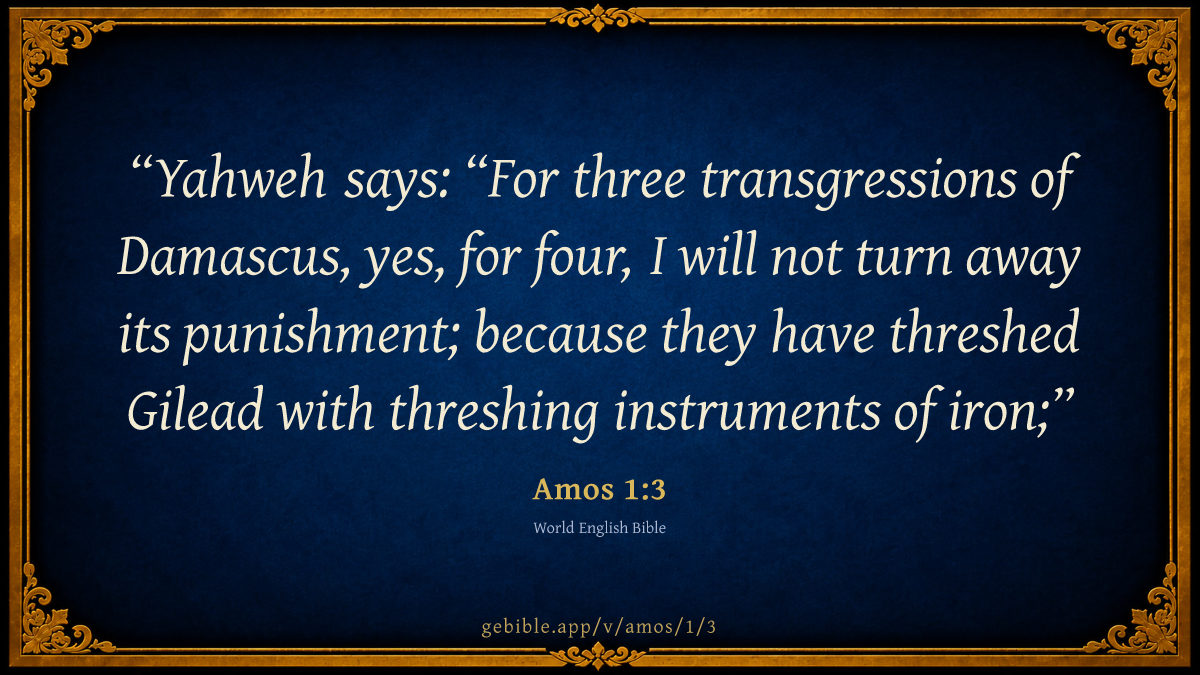
Yahweh says: “For three transgressions of Damascus, yes, for four, I will not turn away its punishment; because they have threshed Gilead with threshing instruments of iron;
Parallel Translations
-
Yahweh says: “For three transgressions of Damascus, yes, for four, I will not turn away its punishment; because they have threshed Gilead with threshing instruments of iron;
-
Thus saith the LORD; For three transgressions of Damascus, and for four, I will not turn away the punishment thereof; because they have threshed Gilead with threshing instruments of iron:
-
For thus saith the LORD: For three transgressions of Damascus, yea, for four, I will not reverse it: because they have threshed Gilead with sledges of iron.
Examined in Scripture Analysis
Contradictions (1)
Questions where the Bible appears to say two different things, with the passages on each side set together.
Cross-references (22)
Passages linked to Amos 1:3 in the Treasury of Scripture Knowledge, ordered by reader-vote popularity; verse text shown in World English Bible.
- 2 Kings 8:12 Hazael said, “Why do you weep, my lord?” He answered, “Because I know the evil that you will do to the children of Israel. You will set their strongholds on fire, and you will kill their young men with the sword, and will dash their little ones in pieces, and rip up their pregnant women.”
- 2 Kings 10:32-33 In those days Yahweh began to cut away parts of Israel; and Hazael struck them in all the borders of Israel; from the Jordan eastward, all the land of Gilead, the Gadites, and the Reubenites, and the Manassites, from Aroer, which is by the valley of the Arnon, even Gilead and Bashan.
- Isaiah 8:4 For before the child knows how to say, ‘My father,’ and, ‘My mother,’ the riches of Damascus and the plunder of Samaria will be carried away by the king of Assyria.”
- Amos 1:9 Yahweh says: “For three transgressions of Tyre, yes, for four, I will not turn away its punishment; because they delivered up the whole community to Edom, and didn’t remember the brotherly covenant;
- Amos 2:6 Yahweh says: “For three transgressions of Israel, yes, for four, I will not turn away its punishment; because they have sold the righteous for silver, and the needy for a pair of sandals;
- Jeremiah 49:23-27 Of Damascus: “Hamath is confounded, and Arpad; for they have heard evil news. They have melted away. There is sorrow on the sea. It can’t be quiet. Damascus has grown feeble, she turns herself to flee, and trembling has seized her. Anguish and sorrows have taken hold of her, as of a woman in travail. How is the city of praise not forsaken, the city of my joy? Therefore her young men will fall in her streets, and all the men of war will be brought to silence in that day,” says Yahweh of Armies. “I will kindle a fire in the wall of Damascus, and it will devour the palaces of Ben Hadad.”
- Amos 1:6 Yahweh says: “For three transgressions of Gaza, yes, for four, I will not turn away its punishment; because they carried away captive the whole community, to deliver them up to Edom;
- Amos 1:13 Yahweh says: “For three transgressions of the children of Ammon, yes, for four, I will not turn away its punishment; because they have ripped open the pregnant women of Gilead, that they may enlarge their border.
- Amos 2:1 Yahweh says: “For three transgressions of Moab, yes, for four, I will not turn away its punishment; because he burned the bones of the king of Edom into lime;
- Isaiah 17:1-3 The burden of Damascus. “Behold, Damascus is taken away from being a city, and it will be a ruinous heap. The cities of Aroer are forsaken. They will be for flocks, which shall lie down, and no one shall make them afraid. The fortress shall cease from Ephraim, and the kingdom from Damascus, and the remnant of Syria. They will be as the glory of the children of Israel,” says Yahweh of Armies.
- Amos 1:11 Yahweh says: “For three transgressions of Edom, yes, for four, I will not turn away its punishment; because he pursued his brother with the sword, and cast off all pity, and his anger raged continually, and he kept his wrath forever;
- Amos 2:4 Yahweh says: “For three transgressions of Judah, yes, for four, I will not turn away its punishment; because they have rejected Yahweh’s law, and have not kept his statutes, and their lies have led them astray, after which their fathers walked;
- Zechariah 9:1 A revelation. Yahweh’s word is against the land of Hadrach, and will rest upon Damascus; for the eye of man and of all the tribes of Israel is toward Yahweh;
- 1 Kings 19:17 He who escapes from the sword of Hazael, Jehu will kill; and he who escapes from the sword of Jehu, Elisha will kill.
- 2 Kings 13:3 Yahweh’s anger burned against Israel, and he delivered them into the hand of Hazael king of Syria, and into the hand of Benhadad the son of Hazael, continually.
- 2 Kings 13:7 For he didn’t leave to Jehoahaz of the people any more than fifty horsemen, and ten chariots, and ten thousand footmen; for the king of Syria destroyed them, and made them like the dust in threshing.
- Job 5:19 He will deliver you in six troubles; yes, in seven no evil will touch you.
- Job 19:3 You have reproached me ten times. You aren’t ashamed that you attack me.
- Proverbs 6:16 There are six things which Yahweh hates; yes, seven which are an abomination to him:
- Ecclesiastes 11:2 Give a portion to seven, yes, even to eight; for you don’t know what evil will be on the earth.
- Isaiah 7:8 For the head of Syria is Damascus, and the head of Damascus is Rezin. Within sixty-five years Ephraim shall be broken in pieces, so that it shall not be a people.
- Isaiah 41:15 Behold, I have made you into a new sharp threshing instrument with teeth. You will thresh the mountains, and beat them small, and will make the hills like chaff.
Cross-references from openbible.info (CC BY 4.0)
Explain this verse (21 sources)
Historical commentary, presented as a primary source — not an endorsement.
Private notes
Saved on this device only — never synced or sent anywhere.
John Calvin 1540 · Public Domain It is singular that Amos said that his words…
It is singular that Amos said that his words were concerning Israel, and that he should now turn to speak of Damascus and the country of Syria. This seems inconsistent; for why does he not perform the office committed to him? why does he not reprove the Israelites? why does he not threaten them? why does he not show their sins? and why does he speak of the destruction then nigh to the people of Syria? But it is right here to consider what his design was. He shows briefly, in the last verse, that ruin was nigh the Israelites; for God, who had hitherto spared them, was now resolved to ascend his tribunal. But now, that he might better prepare the Israelites, he shows that God, as a judge, would call all the neighboring nations to an account. For had the Prophet threatened the Israelites only, they might have thought that what they suffered was by chance, when they saw the like things happening to their neighbors: “How is it credible that these evils and calamities have flowed from God’s vengeance, since the Idumeans, the Moabites, the Ammonites, the Syrians, and the Sidonians, are implicated in these evils in common with ourselves? For if God’s hand pursues us, it is the same with them: and if it is fate, that with blind force exercises its rule over the Moabites, the Idumeans, and the Syrians, the same thing, doubtless, is to be thought of our case.” Thus all the authority of the Prophet must have lost its power, except the Israelites were made to know that God is the judge of all nations.
We must also bear in mind, that the kingdom of Israel was laid waste, together with other neighboring countries, as war had spread far and wide; for the Assyrian, like a violent storm, had extended through the whole of that part of the world. Not only, then, the Israelites were distressed by adversities at that time, but all the nations of which Amos prophesied. It was hence necessary to add the catalogue which we here find, that the Israelites might have as many confirmations respecting God’s vengeance, as the examples which were presented to their eyes, in the dire calamities which everywhere prevailed. This is to be borne in mind. And then the Prophet regarded another thing: If the Idumeans, the Moabites, the Syrians, and Ammonites, were to be treated so severely, and the Prophet had not connected the Israelites with them, they might have thought that they were to be exempted from the common punishments because God would be propitious to them; for hypocrites ever harden themselves the more, whenever God spares them: “See, the Ammonites and the Moabites are punished; the Idumeans, the Syrians, and other nations, are visited with judgment: God then is angry with all these; but we are his children, for he is indulgent to us.” But the Prophet puts here the Israelites in the same bundle with the Moabites, the Idumeans, and other heathen nations; as though he said, “God will not spare your neighbors; but think not that ye shall be exempt from his vengeance, when they shall be led to punishment; I now declare to you that God will be the judge of you all together.”
Read full note →
We now apprehend the design of the Prophet. He wished here to set before the eyes of the Israelites the punishment of others to awaken them, and also to induce them to examine themselves for we often see, that those who are intractable and refractory in their disposition, when directly addressed are not very attentive; but when they hear of the sins of others, and especially when they hear something of punishment, they will attend. The Prophet therefore designed by degrees to lead the Israelites to a teachable state of mind, for he knew them to be torpid in their indulgences, and also blinded by presumption, so that they could not be easily brought under the yoke: hence he sets before them the punishment which was soon to fall on neighboring nations.
We must yet observe that there was another reason I do not throw aside what I have already mentioned; but the Prophet no doubt had this also in view, — that God would punish the Syrians, because they cruelly raged against the Israelites especially against Gilead and its inhabitants. As God, then, would inflict so grievous a punishment on the Syrians, because they so cruelly treated the inhabitants of Gilead, what was to be expected by the Israelites themselves who had been insolent towards God, who had violated his worship who had robbed him of his honor, who had in their turn destroyed one another! For, as we shall hereafter see, there was among them no equity, no humanity; they had forgotten all reason. Since, then, the Israelites were such, how could they hope that so many and so detestable crimes should go unpunished, when they saw that the Syrians, though uncircumcised, were not to be spared, because they so cruelly treated professed enemies, on whom they lawfully made war?
I now come to the words of the Prophet: Thus saith Jehovah, For three transgressions of Damascus, and for four, will not be propitious to it; literally, I will not convert it : but I take this actively that God would not turn himself to mercy, or that he would not be propitious to Damascus. We know that Damascus was the capital of Syria; And the Prophet here, by mentioning a part for the whole, threatens the whole people, and summons all the Syrians to God’s tribunal, because they had inhumanely treated, as we shall see, the city of Gilead. But he says, God will not be propitious for three and four transgressions of Damascus. Some take this meaning, “For three transgressions I have been propitious, for four I will not be.” But there is no need of adding anything to the Prophet’s words; for the most suitable sense here is that for the many sins of Damascus God would not be propitious to it: and the Prophet, I have no doubt, intended by the two numbers to set forth the irreclaimable perverseness of the Syrians. Seven in Scripture is an indefinite number, and is taken, as it is well known, to express what is countless. By saying then, three and four transgressions, it is the same as if he had said seven: but the Prophet more strikingly intimates the progress the Syrians made in their transgressions, until they became so perverse that there was no hope of repentance. This then is the reason, that God declares that he would no more forgive the Syrians, inasmuch as without measure or limit they burst forth into transgressions and ceased not, though a time for change was given them. This is the true meaning. And the Prophet repeats the same form of speech in speaking of Gaza, of Amman, of Edom, and of other nations.
Let us learn from this place, that God, whom the world regards as too cruel, when he takes vengeance on sins, shows really and by sure proof the truth of what he declares so often of himself in Scripture, and that is, that he bears long and does not quickly take vengeance: though men are worthy to perish yet the Lord suspends his judgments. We have a remarkable proof of this in these prophecies; for the Prophet speaks not only of one people but of many. Hence God endured many transgressions not only in the Syrians, but also in other nations: there was not then a country in which a testimony to God’s forbearance did not exist. It hence appears, that the world unjustly complains of too much rigor, when God takes vengeance, for he ever waits till iniquity, as it was stated yesterday, reaches its highest point.
There is besides presented to us here a dreadful spectacle of sins among so many nations. At the same time, when we compare that age with ours, it is certain that greater integrity existed then: all kinds of evils so overflow at this day, that compared with the present, the time of Amos was the golden age; and yet we hear him declaring here, that the people of Judah and of Israel, and all the other nations, were monstrously wicked, so that God could not bring them to repentance. For he testifies not here in vain, that he would punish wickedness wholly obstinate since they had not turned to him, who had advanced to the number seven; that is, who had sinned, as it has been before stated, without measure or limits: and this ought also to be noticed in the Prophet’s words; but I cannot now proceed farther.
John Calvin's Commentaries (1540-1563) — public domain. Text from the Calvin Translation Society English edition (1840s-50s) via the Christian Classics Ethereal Library (ccel.org). Calvin's coverage is partial (roughly two-thirds of the Bible); uncommented books and verses are honest gaps, never fabricated. The 19th-century editor's footnotes and remarks are omitted so the notes are faithfully Calvin's own voice.
Geneva Bible translators 1599 · Public Domain He showeth first that all the people round about…
He showeth first that all the people round about should be destroyed for their manifold sins: which are meant by three and four, which make seven, because the Israelites should the more deeply consider God’s judgments toward them.
If the Syrians shall not be spared for committing this cruelty against one city, it is not possible that Israel should escape punishment which hath committed so many and grievous sins against God and man.
Geneva Bible (1599) marginal notes — public domain.
John Trapp 1656 · Public Domain Amo 1:3 Thus saith the LORD; For three transgressions…
Amo 1:3 Thus saith the LORD; For three transgressions of Damascus, and for four, I will not turn away [the punishment] thereof; because they have threshed Gilead with threshing instruments of iron:
Ver. 3. For three transgressions of Damascus and for four] For their seven, that is, several sins, not a few; for their many and bony provocations, for their progress in sin, without mean or measure. The Jews here note, that for three faults God will pardon a man, but let him beware of the fourth: God will not always serve man for a sinning stock, but break off his abused patience, and proceed to punishment. Lo, all these things worketh God twice and thrice with man, Job 33:29, but let him not thereupon grow overly bold, lest he pay for his presumption. Sin iterated is greatly aggravated; as ciphers added increase the sum; and though it may sleep a long time, yet it is but a sleeping debt, not called for of many years, required at length; as Saul’s sin in slaying the Gibeonites was not punished till forty years after; as Joab’s killing of Abner slept all David’s days. Now, lest Israel, looking upon Syria yet flourishing, should promise themselves like impunity, they are here thus threatened.
Read full note →
I will not turn away the punishment thereof] But pay them home for the new and the old; yea, for the old by occasion of the new; for their obstinate and incurable wickedness, I will punish them seven times more, and seven times more, and seven to that, Lev 26:24, and so hang them up, as it were, in gibbets, for a warning to Israel, that they may wash their feet in the blood of these heathens, and redeem their own sorrows.
Because they have threshed Gilead] i.e. the Gileadites whom they had taken captive, and thus cruelly intreated; see 2Ki 13:7; 2Ki 10:32, where it appeareth, that all this was done not without the Lord; which yet is no excuse to Hazael’s cruelty. That conquerors were wont to use this kind of torment and punishment, see 2Sa 12:31. But that David should do so, is some wonder: he was hardly recovered of his late foul fall; and thence, haply, so much harshness. Certain it is, that the merciful God abhorreth cruelty toward his creature, and severely punisheth it; such as was this of Hazael toward Israel, foretold by Elisha, 2Ki 8:12, and afterwards of Ptolemy Lathurus, king of Egypt, who slew 30,000 Jews at once; and forced the rest to eat up their dead carcases. (Joseph.) So that barbarous Duke of Alva roasted some of his prisoners to death, starved others, and that even after quarter, saying, though he promised to give them their lives, he did not promise to find them food. Dio telleth us of the Jews that dwelt about Cyrene in the days of Trajan; that they slaughtered a great sort of Romans and Greeks after a miserable manner; sawing them down the middle from the crown of the head, tearing their flesh with their teeth, smearing themselves with their blood, and wearing their skins for coverings, &c., so that 220,000 people perished there; and besides, in Egypt and Cyprus, 240,000, by the like abhorred cruelty, and about the same time, by the same hands. {Dio, In Vitae Trajan, l. 58. c. 75. 8:421,423} "Beware of men," Mat 10:17.
John Trapp, A Commentary or Exposition upon All the Books of the Old and New Testament (1647–1656) — public domain. Text from a community e-Sword module.
Matthew Poole 1685 · Public Domain Thus saith the Lord; Amos speaks not by conjecture,…
Thus saith the Lord; Amos speaks not by conjecture, or of his own head, but as he comes in the name of the Lord, so he assures us of it by this most solemn attestation.
Three transgressions: this certain number is put for an uncertain; three, i.e. many, especially when, as here, it is joined with four; their transgressions are so multiplied, grown to such height and number.
Read full note →
Damascus was the chief city of the kingdom of Syria, and very ancient; Abraham’s steward was of this city. It was north-east from Canaan; conquered by David, lost by Solomon, recovered by Jeroboam the Second, though soon after lost again, and was in Ahaz’s time the royal seat of Rezin, whom Tiglath-pileser slew, 2Ki 16:9. While it was in its power and greatness it mightily oppressed Israel. It is here by a synecdoche put for the whole kingdom of Syria.
I will not turn away the punishment thereof: some refer this to the suffering Damascus to be quiet, God threatens that she shall not have rest; others say it is a threat that God would not convert it, but leave the Syrians to their impenitent heart; but our version is full and plain, it is a threat of punishment which they should certainly fall under. God would no longer continue to be patient and gracious towards such sinners, nor divert the menaced punishment foretold by the prophet, deserved by the people, and which shall be executed by an impartial hand. Because they, the Syrians, comprised in the word Damascus, by a synecdoche, have threshed; first gathered, (as husbandmen gather sheafs into a floor,) next trod them under foot, beat them small, i.e. with utmost cruelty destroyed the persons, towns, and cities.
Gilead: of this name there was a great mountain fifty miles in length, saith my author; there was also a country of this name, and a city possessed by the Reubenites, Gadites, and Manassites; now the Gilead in this text is by a very usual figure put for the inhabitants of this country and city, whom Hazael king of Syria, as was foretold by Elisha, 2Ki 8:12, did most barbarously murder, as appears by the words of this text.
With threshing instruments of iron; rakes, or flails, or harrows, or saws, or heavy wheels of iron; whichsoever of these were the instruments intended, it is most certain it was a very barbarous and cruel manner of using them.
Matthew Poole's English Annotations on the Holy Bible (1683–1685) — public domain. Text from a community e-Sword/MySword module.
Matthew Henry 1710 · Public Domain What the Lord says here may be explained by…
What the Lord says here may be explained by what he says Jer 12:14, Thus said the Lord, against all my evil neighbours that touch the inheritance of my people Israel, Behold, I will pluck them out. Damascus was a near neighbour to Israel on the north, Tyre and Gaza on the west, Edom on the south, Ammon and (in the next chapter) Moab on the east; and all of them had been, one time, one way, or other, pricking briers and grieving thorns to Israel, evil neighbours to them; and, because God espouses his people's cause, he there calls them his evil neighbours, and here comes forth to reckon with them. The method is taken in dealing with each of them is, in part, the same, and therefore we put them together, and yet in each there is something peculiar.
I. Let us see what is repeated, both by way of charge and by way of sentence, concerning them all. The controversy God has with each of them is prefaced with, Thus said the Lord, Jehovah the God of Israel. Though those nations will not worship him as their God, yet they shall be made to know that they are accountable to him as their Judge. The God of Israel is the God of the whole earth, and has something to say to them that shall make them tremble. Against them the Lord roars out of Zion. And before God, by the prophet, threatens Israel and Judah, he denounces judgments against those nations whom he made use of as scourges to them for their being so, which might serve for a check to their pride and insolence and a relief to his people under their dejections; for hereby they might see that God had not quitted his interest in them, and therefore might hope they had not lost their interest in him. Now as to all these nations here arraigned,
Read full note →
1. The indictment drawn up against them all is thus far the same, (1.) That they are charged in general with three transgressions, and with four, that is, with many transgressions (as by one or two we mean a few, so by three or four we mean many, as in Latin a man that is very happy is said to be terque quarterque beatus - three and four times happy); or with three and four, that is, with seven transgressions, a number of perfection, intimating that they have filled up the measure of their iniquities, and are ripe for ruin; or with three (that is, a variety of sins) and with a fourth especially, which is specified concerning each of them, though the other three are not, as Pro 30:15, Pro 30:18, Pro 30:21, Pro 30:29, where we read of three things, yea, four, generally one seems to be more especially intended. (2.) That the particular sin which is fastened upon as the fourth, and which alone is specified, is the sin of persecution: it is some mischief or other done to the people of God that is particularly charged upon every one of them, for persecution is the measure-filling sin of any people, and it is this sin that will be particularly reckoned for - I was hungry, and you gave me no meat; much more if it may be said, I was hungry, and you took my meat from me.
2. The judgment given against them all is thus far the same, (1.) That, their sin having risen to such a height, God will not turn away the punishment thereof. Though he has granted them a long reprieve, and has often turned away their punishment, yet now he will turn it away no longer, but justice shall take its course. "I will not revoke it (so some read it); I will not recall the voice which has gone forth from Zion to Jerusalem (Amo 1:2), speaking death and terror to the sinful nations." It is an irrevocable sentence. God has spoken it, and he will not call it back. Note, Though God bear long, he will not bear always, with those that provoke him; and, when the decree brings forth, it will bring up. (2.) That God will kindle a fire among them; this is said concerning all these evil neighbours, Amo 1:4, Amo 1:7, Amo 1:10, Amo 1:12, Amo 1:14. God will send a fire into their cities. When fires are kindled that lay cities, towns, and houses in ashes, whether designedly or casually, God must be acknowledged in it; they are of his sending. Sin stirs up the fire of his jealousy, and that kindles other fires.
II. Let us see what is mentioned, both by way of charge and by way of sentence, that is peculiar to each of them, that every one may take his portion.
1. Concerning Damascus, the head-city of Syria, a kingdom that was often vexatious to Israel. (1.) The peculiar sin of Damascus was using the Gileadites barbarously: They threshed Gilead with threshing-instruments of iron (Amo 1:3), which may be understood literally of their putting to the torture, or to cruel deaths, the inhabitants of Gilead whom they got into their hands, as David put the Ammonites under saws and harrows Sa2 12:31. We read with what inhumanity Hazael king of Syria prosecuted his wars with Israel (Kg2 8:12); he dashed their children, and ripped up their women with child; and see what desolations he made in their land, Kg2 10:32, Kg2 10:33. Or it may be taken figuratively, for his laying the country waste, and this very similitude is used in the history of it. Kg2 13:7, He destroyed them, and made them like the dust by threshing. Note, Men often do that unjustly and wickedly, and shall be severely reckoned with for it, which yet God just permits them to do. The church is called God's threshing, and the corn of his floor (Isa 21:10); but if men make it their threshing, and the chaff of their floor, they shall be sure to hear of it. (2.) The peculiar punishment of Damascus is [1.] That the fire which shall be sent shall fasten upon the court in the first place, not on the chief city, nor the country towns, but on the house of Hazael, which he built; and it shall devour the palaces of Ben-hadad, the royal palaces inhabited by the kings of Syria, many of whom were of that name. Note, Even royal palaces are no defence against the judgments of God, though ever so richly furnished, though ever so strongly fortified. [2.] That the enemy shall force his way into the city (Amo 1:5): I will break the bar of Damascus, and then the gate flies open. Or it may be understood figuratively: all that which is depended upon as the strength and safety of that great city shall fail, and prove insufficient. When God's judgments come with commission it is in vain to think of turning them out. [3.] That the people shall be destroyed with the sword: I will cut off the inhabitant from the plain of Aven, the valley of idolatry, for the gods of the Syrians were gods of the valleys (Kg1 20:23), were worshipped in valleys; as the idols of Israel were worshipped on the hills; him also that holdeth the sceptre of power, some petty king or other that used to boast of the sceptre he held from Beth-Eden, the house of pleasure. Both those that were given to idolatry and those that were given to sensuality should be cut off together. [4.] That the body of the nation shall be carried off. The people shall go into captivity unto Kir, which was in the country of the Medes. We find this fulfilled (Kg2 16:9) about fifty years after this, when the king of Assyria went up against Damascus, and took it, and carried the people of it captive to Kir, and slew Rezin, at the instigation of Ahaz king of Judah.
2. Concerning Gaza, a city of the Philistines, and now the metropolis of that country. (1.) The peculiar sin of the Philistines was carrying away captive the whole captivity, either of Israel or Judah, which some think refers to that inroad made upon Jehoram when they took away all the king's sons and all his substance (Ch2 21:17), or, perhaps, it refers to their seizing those that fled to them for shelter when Sennacherib invaded Judah, and selling them to the Grecians (Joe 3:4-6), or (as here) to the Edomites, who were always sworn enemies to the people of God. They spared none, but carried off all they could lay their hands on, designing, if possible, to cut off the name of Israel, Psa 83:4-7. (2.) The peculiar punishment of the Philistines is that the fire which God will send shall devour the palaces of Gaza, and that the inhabitants of the other cities of the Philistines, Ashdod (or Azotus), Ashkelon, and Ekron, shall all be cut off, and God will make as thorough work with them in their ruin as they would have made with God's people when they carried away the whole captivity; for even the remnant of them shall perish, Amo 1:8. Note, God will make a full end of those that think to make a full end of his church and people.
3. Concerning Tyre, that famous city of wealth and strength, that was itself a kingdom, Amo 1:9. (1.) The peculiar sin of Tyre is delivering up the whole captivity to Edom, that is, selling to the Edomites those of Israel that fled to them for shelter, or in any way fell into their hands; not caring what hardships they put upon them, so that they could but make gain of them to themselves. Herein they forgot the brotherly covenant, the league that was between Solomon and Hiram king of Tyre (Kg1 5:12), which was intimate that Hiram called Solomon his brother, Kg1 9:13. Note, It is a great aggravation of enmity and malice when it is the violation of friendship and of a brotherly covenant. (2.) Here is nothing peculiar in the punishment of Tyrus but that the palaces thereof shall be devoured, which was done when Nebuchadnezzar took it after thirteen years' siege. Their merchants were all princes, and their private houses were as palaces; but the fire shall make no more of them than of cottages.
4. Concerning Edom, the posterity of Esau. (1.) Their peculiar sin was an unmerciful, unwearied, pursuit of the people of God, and their taking all advantages against them to do them a mischief, Amo 1:11. He did pursue his brother with the sword, not only of old, when the king of Edom took up arms to oppose the children of Israel's passage through his border (Num 20:18), but ever since upon all occasions; they had not strength and courage enough to face them in the field of battle, but, whenever any other enemy had put Judah or Israel to flight, then the Edomites set in with the pursuers, fell upon the rear, slew those that were half dead already, and (as is usual with cowards when they have an enemy at an advantage) they did cast off all pity. Those that are least courageous are commonly most cruel. Edom was so; his malice destroyed his compassion (so the word is); he stripped himself of the tenderness of a man, and put on the fierceness of a beast of prey; and, as such a one, he did tear, his anger did tear perpetually. His cruelty was insatiable, and he never knew when he had sucked enough of the blood of Israel, but, like the horse-leech, still cried, Give, give. Nay, he kept his wrath for ever; when he wanted objects of his wrath, and opportunity to show it, yet he kept it in reserve (it rested in his bosom), he rolled it under his tongue as a sweet morsel, and had it ready to spit in the face of Israel upon the next occasion. Cursed be such cruel wrath, and anger so fierce, so outrageous, which makes men like the devil, who continually seeks to devour, and unlike to God, who keeps not his anger for ever. Edom's malice was unnatural, for thus he pursued his brother, whom he ought to have protected: it was hereditary, as if it had been entailed upon the family ever since Esau hated Jacob, and time itself could not wear it out, no, nor the brotherly conduct of Israel towards them (Deu 2:4), and the express law given to Israel (Deu 23:7), Thou shalt not abhor an Edomite, for he is thy brother. (2.) Here is nothing peculiar in their punishment; but (Amo 1:12) a fire shall be sent to devour their palaces. Note, The fire of our anger against our brethren kindles the fire of God's anger against us.
5. Concerning the Ammonites, Amo 1:13-15. (1.) See how violently the fire of their anger turned against the people of God; they not only triumphed in their calamities (as we find, Eze 25:2, Eze 25:6), but they did themselves use them barbarously; they ripped up the women with child of Gilead, a piece of cruelty the very mention of which strikes a horror upon one's mind; one would think it is not possible that any of the human race should be so inhuman. Hazael was guilty of it, Kg2 8:12. It was done not only in a brutish rage, which falls without consideration upon all that comes before it, but with a devilish design to extirpate the race of Israel by killing not only all that were born, but all that were to be born, worse than Egyptian cruelty. It was that they might enlarge their border, that they might make the land of Gilead their own, and there might be none to lay claim to it or given them any disturbance in the possession of it. We find (Jer 49:1) that the Ammonites inherited Gad (that is, Gilead) under pretence that Israel had no sons, no heirs. We know how heavy the doom of those was, and how heinous their crime, who said, This is the heir; come, let us kill him, and the inheritance shall be ours by occupancy. See what cruelty covetousness is the cause of, and what horrid practices those are often put upon that are greedy to enlarge their own border. (2.) See how violently the fire of God's anger burned against them; shall not God visit for these things done to any of mankind, especially when they are done to his own people? Shall not his soul be avenged on such a nation as this? No doubt, it shall. The fire shall be kindled with shouting in the day of battle, that is, war shall kindle the fire; it shall be a fire accompanied with the sword, or a roaring fire, which shall make a noise like that of soldiers ready to engage, and it shall be as a tempest in the day of the whirlwind, which comes swiftly, furiously, and bears down all before it. Or this tempest and whirlwind shall be as bellows to the fire, to make it burn the stronger, and spread the further. It is particularly threatened that their king and his princes shall go together into captivity, carried away by the king of Babylon, not long after Judah was. See what changes God's providence often makes with men, or rather their own sin; kings become captives, and princes prisoners. Milchom shall go into captivity; some understand it of the god of the Ammonites, whom they called Moloch - a king. He, and his princes, and his priests that attended him, shall to into captivity; their idol shall be so far from protecting them that it shall itself go into captivity with them. Note, Those who by violence and fraud seek to enlarge their own border will justly be expelled and excluded their own border; nor is it strange if those who make no conscience of invading the rights of others be able to make no resistance against those who invade theirs.
Matthew Henry's Commentary on the Whole Bible (1708–1710) — public domain (CC PDM 1.0). Text via the HelloAO Bible API.
John Gill 1763 · Public Domain Thus saith the Lord,.... Lest it should be thought…
Thus saith the Lord,.... Lest it should be thought that the words that Amos spoke were his own, and he spake them of himself, this and the following prophecies are prefaced in this manner; and he begins with the nations near to the people of Israel and Judah, who had greatly afflicted them, and for that reason would be punished; which is foretold, to let Israel see that those judgments on them did not come by chance; and lest they should promise themselves impunity from the prosperity of these sinful nations; and to awaken them to a sense of their sin and danger, who might expect the visitation of God for their transgressions; as also to take off all offence at the prophet, who began not with them, but with their enemies:
for three transgressions of Damascus, and for four, I will not turn away the punishment thereof; Damascus was an ancient city; it was in the times of Abraham, Gen 15:2. It was the "metropolis" of Syria, Isa 7:8; and so Pliny calls it, "Damascus of Syria" (u). Of the situation of this place, and the delightfulness of it; see Gill on Jer 49:25; and of its founder, and the signification of its name; see Gill on Act 9:2; to which may be added, that though Justin (w) says it had its name from Damascus, a king of it before Abraham and Israel, whom he also makes kings of it; and Josephus (x) would have Uz the son of Aram the founder of it, to which Bochart (y) agrees; yet the Arabic writers ascribe the building of it to others; for the Arabs have a tradition, as Schultens (z) says, that there were Canaanites anciently in Syria; for they talk of Dimashc the son of Canaan, who built the famous city of Damascus, and so it should seem to be called after his name; and Abulpharagius (a) says, that Murkus or Murphus, as others call him, king of Palestine, built the city of Damascus twenty years before the birth of Abraham: from this place many things have their names, which continue with us to this day, as the "damask" rose, and the "damascene" plum, transplanted from the gardens that were about it, for which it was famous; and very probably the invention of the silk and linen called "damasks" owes its rise from hence. It is here put for the whole country of Syria, and the inhabitants of it, for whose numerous transgressions, signified by "three" and "four", the Lord would not turn away his fury from them, justly raised by their sins; or the decree which he had passed in his own mind, and now made a declaration of, he would not revoke; or not inflict the punishment they had deserved, and he had threatened. The sense is, that he would not spare them, or have mercy on them, or defer the execution of punishment any longer; he would not forgive their transgressions. So the Targum,
Read full note →
"I will not pardon them.''
De Dieu refers it to the earthquake before mentioned, that God would not turn away that, but cause it to come, as he had foretold, for the transgressions of these, and other nations after spoken of; but rather it refers to Damascus; and so some render it, "I will not turn", or "convert it" (b); to repentance, and so to my mercy; but leave it in its sins, and to my just judgments. Kimchi thinks that this respects four particular seasons, in which Damascus, or the Syrians, evilly treated and distressed the people of Israel; first in the times of Baasha; then in the times of Ahab; a third time in the days of Jehoahaz the son of Jehu; and the fourth in the times of Ahaz; and then they were punished for them all:
because they have threshed Gilead with threshing instruments of iron; that is,
"the inhabitants of the land of Gilead,''
as the Targum; this country lay beyond Jordan, and was inhabited by the Reubenites and Gadites and the half tribe of Manasseh; who were used in a very cruel manner, by Hazael king of Syria, as was foretold by Elisha, Kg2 7:12; not literally, as in Sa2 12:31; but by him they were beat, oppressed, and crushed, as the grain of the threshingfloor; which used to be threshed out by means of a wooden instrument stuck with iron teeth, the top of which was filled with stones to press it down, and so drawn to and fro over the sheaves of corn, by which means it was beaten out, to which the allusion is here; See Gill on Co1 9:9. This was done by Hazael king of Syria, who is said to destroy the people, and make them "like the dust by threshing", Kg2 10:32.
(u) Nat. Hist. l. 36. c. 8. (w) E Trogo, l. 36. c. 2. (x) Antiqu. l. 1. c. 6. sect. 4. (y) Phaleg. l. 2. c. 8. (z) Apud Universal History, vol. 2. p. 280. (a) Hist. Dynast. p. 13. (b) "non convertam eam", Montanus, Vatablus, Drusius.
John Gill's Exposition of the Whole Bible (1746–1763) — public domain (CC PDM 1.0). Text via the HelloAO Bible API.
John Wesley 1765 · Public Domain For three - This certain number is put for…
For three - This certain number is put for an uncertain: three, that is, many. Of Damascus - Here Damascus is put for the whole kingdom of Syria. Threshed - Treated it with the utmost cruelty. Gilead - There was a country of this name, and a city, possessed by the Reubenites, Gadites, and Manassites; Gilead here is put for the inhabitants of this country and city, whom Hazael, king of Syria most barbarously murdered.
John Wesley, Explanatory Notes Upon the Whole Bible (1754–1765) — public domain. Text via the GEBible commentary corpus.
Adam Clarke 1810 · Public Domain Verse 3. For three transgressions of Damascus, and for…
Verse 3. For three transgressions of Damascus, and for four] These expressions of three and four, so often repeated in this chapter, mean repetition, abundance, and any thing that goes towards excess. Very, very exceedingly; and so it was used among the ancient Greek and Latin poets. See the passionate exclamation of Ulysses, in the storm, Odyss., lib. v., ver. 306: -
Τρις μακαρες Δαναοι και τετρακις, οἱ τοτ' ολοντο
Read full note →
Τροιῃ εν ευρειῃ, χαριν Ατρειδῃσι φεροντες.
"Thrice happy Greeks! and four times who were slain
In Atreus' cause, upon the Trojan plain."
Which words Virgil translates, and puts in the mouth of his hero in similar circumstances, AEn. i. 93.
Extemplo AEneae solvuntur frigore membra:
Ingemit; et, duplicis tendens ad sidera palmas,
Talia voce refert: O terque quaterque beati!
Queis ante ora patrum Trojae sub moenibus altis
Contigit oppetere.
"Struck with unusual fright, the Trojan chief
With lifted hands and eyes invokes relief.
And thrice, and four times happy those, he cried,
That under Ilion's walls before their parents died."
DRYDEN.
On the words, O terque quaterque, SERVIUS makes this remark, "Hoc est saepias; finitus numerous pro infinito." "O thrice and four times, that is, very often, a finite number for an infinite." Other poets use the same form of expression. So SENECA in Hippolyt., Act. ii. 694.
O ter quaterque prospero fato dati,
Quos hausit, et peremit, et leto dedit
Odium dolusque!
"O thrice and four times happy were the men
Whom hate devoured, and fraud, hard pressing on,
Gave as a prey to death."
And so the ancient oracle quoted by Pausanias, Achaic., lib. vii., c. 6: Τρις μακαρες κεινοι και τετρακις ανδρες εσνται; "Those men shall be thrice and four times happy."
These quotations are sufficient to show that this form of speech is neither unfrequent nor inelegant, being employed by the most correct writers of antiquity.
Damascus was the capital of Syria.
Adam Clarke's Commentary on the Bible (1810–1826) — public domain. Text from a community e-Sword/MySword module.
Joseph Benson 1811 · Public Domain Amo 1:3. For three transgressions, &c. — The prophet…
Amo 1:3. For three transgressions, &c. — The prophet first denounces judgments against foreign countries, and afterward comes to Judah and Israel. He begins with Syria, the head or capital city of which was Damascus. By the expression, for three transgressions and for four, used here, and repeatedly afterward, he means, many or multiplied transgressions, a certain number being put, according to a very common way of speaking, for an uncertain. So we read, Job 5:19, He shall deliver thee in six troubles; yea, in seven no evil shall touch thee: see the like phrase, Pro 6:16; Ecc 11:2; Mic 5:5. Once and twice are used, Psa 62:11; twice and thrice, Job 33:29, (Hebrews) So that the meaning here is, that on account of the frequent transgressions of Damascus, God was now resolved no longer to spare it. Because they have thrashed Gilead, &c. — This alludes to the thrashing- drag, or thrashing-wain, used in the eastern countries, and described in the note on Isa 28:27, which see. These instruments, being drawn by horses, or oxen, over the corn-sheaves spread on the floor, were proper and significant emblems of the tyrannical power of Syria, which cruelly oppressed and crushed the weak Gileadites, and other Israelites. It is probable that the cruelties exercised on them by Hazael and Ben-hadad, kings of Syria, are chiefly intended. The fact is recorded 2Ki 10:32-33; 2Ki 13:3-7, where it is said that Hazael made them like the dust by thrashing.
Joseph Benson's Commentary on the Old and New Testaments (1811–1818) — public domain. Text from a community e-Sword module.
Albert Barnes 1834 · Public Domain The order of God’s threatenings seems to have been…
The order of God’s threatenings seems to have been addressed to gain the hearing of the people. The punishment is first denounced upon their enemies, and that, for their sins, directly or indirectly, against themselves, and God in them. Then, as to those enemies themselves, the order is not of place or time, but of their relation to God’s people. It begins with their most oppressive enemy, Syria; then Philistia, the old and ceaseless, although less powerful, enemy; then Tyre, not an oppressor, as these, yet violating a relation which they had not, the bonds of a former friendship and covenant; malicious also and hardhearted through covetousness. Then follow Edom, Ammon, Moab, who burst the bonds of blood also. Lastly and nearest of all, it falls on Judah, who had the true worship of the true God among them, but despised it. Every infliction on those like ourselves finds an echo in our own consciences. Israel heard and readily believed God’s judgments upon others. It was not tempted to set itself against believing them. How then could it refuse to believe of itself, what it believed of others like itself? “Change but the name, the tale is told of thee ,” was a pagan saying which has almost passed into a proverb. The course of the prophecy convicted “them,” as the things written in Holy Scripture “for our ensamples” convict Christians. “If they” who “sinned without law, perished without law” Rom 2:12, how much more should they who “have sinned in the law, be judged by the law.” God’s judgments rolled round like a thunder-cloud, passing from land to land, giving warning of their approach, at last to gather and center on Israel itself, except it repent. In the visitations of others, it was to read its own; and that, the more, the nearer God was to them. “Israel” is placed the last, because on it the destruction was to fall to the uttermost, and rest there.
For three transgressions and for four - These words express, not four transgressions added to the three, but an additional transgression beyond the former, the last sin, whereby the measure of sin, which before was full, overflows, and God’s wrath comes. So in other places, where the like form of words occurs, the added number is one beyond, and mostly relates to something greater than all the rest. So, “He shall deliver thee in six troubles; yea, in seven there shall no evil touch thee” Job 5:19. The word, “yea,” denotes, that the seventh is some heavier trouble, beyond all the rest, which would seem likely to break endurance. Again, “give a portion to seven, and also to eight” Ecc 11:2. Seven is used as a symbol of a whole, since “on the seventh day God rested from all which He had made,” and therefore the number seven entered so largely into the whole Jewish ritual. All time was measured by seven.
Read full note →
The rule then is; “give without bounds; when that whole is fulfilled, still give.” Again in that series of sayings in the book of Proverbs Prov. 30, the fourth is, in each, something greater than the three preceding. “There are three” things that “are never satisfied;” yea, “four” things “say not,” it is “enough” Pro 30:15-16. The other things cannot be satisfied; the fourth, fire, grows fiercer by being fed. Again, “There be three” things “which go well; yea, four are comely in going” Pro 30:29-31. The moral majesty of a king is obviously greater than the rest. So “the handmaid which displaceth her mistress” Pro 30:21-23 is more intolerable and overbearing than the others. The art and concealment of man in approaching a maiden is of a subtler kind than things in nature which leave no trace of themselves, the eagle in the air, the serpent on the rock, the ship in its pathway through the waves Pro 30:18-19. Again, “Sowing discord among brethren” Pro 6:16-19, has a special hatefulness, as not only being sin, but causing widewasting sin, and destroying in others the chief grace, love. Soul-murder is worse than physical murder, and requires more devilish art.
These things - Job says, “worketh God twice and thrice with man, to bring back his soul from the pit” Job 33:29. The last grace of God, whether sealing up the former graces of those who use them, or vouchsafed to those who have wasted them, is the crowning act of His love or forbearance.
In pagan poetry also, as a trace of a mystery which they had forgotten, three is a sacred whole; from where “thrice and fourfold blessed” stands among them for something exceeding even a full and perfect blessing, a super-abundance of blessings.
The fourth transgression of these pagan nations is alone mentioned. For the prophet had no mission to “them;” he only declares to Israel the ground of the visitation which was to come upon them. The three transgressions stand for a whole sum of sin, which had not yet brought down extreme punishment; the fourth was the crowning sin, after which God would no longer spare. But although the fourth drew down His judgment, God, at the last, punishes not the last sin only, but all which went before. In that the prophet says, not, “for the fourth,” but “for three transgressions and for four,” he expresses at once, that God did not punish until the last sin, by which “the iniquity” of the sinful nation became “full” Gen 15:16, and that, “then,” He punished for all, for the whole mass of sin described by the three, and for the fourth also. God is longsuffering and ready to forgive; but when the sinner finally becomes a “vessel of wrath” Rom 9:22, He punishes all the earlier sins, which, for the time, He passed by.
Sin adds to sin, out of which it grows; it does not overshadow the former sins, it does not obliterate them, but increases the mass of guilt, which God punishes. When the Jews killed the Son, there, “came on” them “all the righteous bloodshed upon the earth, from the blood of righteous Abel unto the blood of Zacharias, son of Barachias” Mat 23:35-36; Luk 11:50-51. All the blood of all the prophets and servants of God under the Old Testament came upon that generation. So each individual sinner, who dies impenitent, will be punished for all which, in his whole life, he did or became, contrary to the law of God. Deeper sins bring deeper damnation at the last. So Paul speaks of those who “treasure up to” themselves “wrath against the Day of wrath and revelation of the righteous judgment of God” Rom 2:5. As good people, by the grace of God, do, through each act done by aid of that grace, gain an addition to their everlasting reward, so the wicked, by each added sin, add to their damnation.
Of Damascus - Damascus was one of the oldest cities in the world, and one of the links of its contact. It lay in the midst of its plain, a high table-land of rich cultivation, whose breadth, from Anti-libanus eastward, was about half a degree. On the west and north its plain lay sheltered under the range of Anti-libanus; on the east, it was protected by the great desert which intervened between its oasis-territory and the Euphrates. Immediately, it was bounded by the three lakes which receive the surplus of the waters which enrich it. The Barada (the “cold”) having joined the Fijeh, (the traditional Pharpar” , a name which well designates its tumultuous course ), runs on the north of, and through the city, and then chiefly into the central of the three lakes, the Bahret-el-kibliyeh, (the “south” lake;) thence, it is supposed, but in part also directly, into the Bahret-esh-Shurkiyeh (the “east” lake ). The ‘Awaj (the “crooked”) (perhaps the old Amana, “the never-failing,” in contrast with the streams which are exhausted in irrigation) runs near the old south boundary of Damascus , separating it probably from the northern possessions of Israel beyond Jordan, Bashan (in its widest sense), and Jetur or Ituraea. The area has been calculated at 236 square geographical miles .
This space rather became the center of its dominions, than measured their extent. But it supported a population far beyond what that space would maintain in Europe. Taught by the face of creation around them, where the course of every tiny rivulet, as it burst from the rocks, was marked by a rich luxuriance , the Damascenes of old availed themselves of the continual supply from the snows of Hermon or the heights of Anti-libanus, with a systematic diligence , of which, in our northern clime, as we have no need, so we have no idea. “Without the Barada,” says Porter , “the city could not exist, and the plain would be a parched desert; but now aqueducts intersect every quarter, and fountains sparkle in almost every dwelling, while innumerable canals extend their ramifications over the vast plain, clothing it with verdure and beauty. Five of these canals are led off from the river at different elevations, before it enters the plain. They are carried along the precipitous banks of the ravine, being in some places tunnelled in the solid rock. The two on the northern side water Salahiyeh at the foot of the hills about a mile from the city, and then irrigate the higher portions of the plain to the distance of nearly twenty miles. Of the three on the south side, one is led to the populous village Daraya, five miles distant; the other two supply the city, its suburbs, and gardens.”
The like use was made of every fountain in every larger or lesser plain. Of old it was said , “the Chrysorrhoas (the Barada) “is nearly expended in artificial channels.” : “Damascus is fertile through drinking up the Chrysorrhoas by irrigation.” Fourteen names of its canals are still given ; and while it has been common to select 7 or 8 chief canals, the whole have been counted up even to 70 . No art or labor was thought too great. The waters of the Fijeh were carried by a great aqueduct tunnelled through the side of the perpendicular cliff . Yet this was as nothing. Its whole plain was intersected with canals, and tunneled below. : “The waters of the river were spread over the surface of the soil in the fields and gardens; underneath, other canals were tunnelled to collect the superfluous water which percolates the soil, or from little fountains and springs below. The stream thus collected is led off to a lower level, where it comes to the surface. : “The whole plain is filled with these singular aqueducts, some of them running for 2 or 3 miles underground. Where the water of one is diffusing life and verdure over the surface, another branch is collecting a new supply.” “In former days these extended over the whole plain to the lakes, thus irrigating the fields and gardens in every part of it.”
Damascus then was, of old, famed for its beauty. Its white buildings, embedded in the deep green of its engirdling orchards, were like diamonds encircled by emeralds. They reach nearly to Anti-libanus westward , “and extend on both sides of the Barada some miles eastward. They cover an area at last 25 (or 30) miles in circuit, and make the environs an earthly Paradise.” Whence the Arabs said , “If there is a garden of Eden on earth, it is Damascus; and if in heaven, Damascus is like it on earth.” But this its beauty was also its strength. “The river,” says William of Tyre , “having abundant water, supplies orchards on both banks, thick-set with fruit-trees, and flows eastward by the city wall. On the west and north the city was far and wide fenced by orchards, like thick dense woods, which stretched four or live miles toward Libanus. These orchards are a most exceeding defense; for from the density of the trees and the narrowness of the ways, it seemed difficult and almost impossible to approach the city on that side.” Even to this day it is said , “The true defense of Damascus consists in its gardens, which, forming a forest of fruit-trees and a labyrinth of hedges, walls and ditches, for more than 7 leagues in circumference, would present no small impediment to a Mussulman enemy.”
The advantage of its site doubtless occastoned its early choice. It lay on the best route from the interior of Asia to the Mediterranean, to Tyre, and even to Egypt. Chedorlaomer and the four kings with him, doubtless, came that way, since the first whom they smote were at Ashteroth Karnaim Gen 14:5-6 in Jaulan or Gaulonitis, and thence they swept on southward, along the west side of Jordan, smiting, as they went, first the “Zuzim,” (probably the same as the Zamzummim Deu 2:2 O) in Ammonitis; then “the Emim in the plain of Kiriathaim” in Moab Deut. 9, 11, then “the Horites in Mount Seir unto Elparan” (probably Elath on the Gulf called from it.) They returned that way, since Abraham overtook them at Hobah near Damascus Gen 14:15. Damascus was already the chief city, through its relation to which alone Hobah was known. It was on the route by which Abraham himself came at God’s command from Haran (Charrae of the Greeks) whether over Tiphsaeh (“the passage,” Thapsacus) or anymore northern passage over the Euphrates. The fact that his chief and confidential servant whom he entrusted to seek a wife for Isaac, and who was, at one time, his heir, was a Damascene Gen 15:2-3, implies some intimate connection of Abraham with Damascus. At the time of our era, the name of Abraham was still held in honor in the country of Damascus ; a village was named from him “Abraham’s dwelling;” and a native historian Nicolas said, that he reigned in Damascus on his way from the country beyond Babylon to Canaan. The name of his servant “Eliezer” “my God is help,” implies that at this time too the servant was a worshiper of the One God. The name Damascus probably betokened the strenuous , energetic character of its founder.
Like the other names connected with Aram in the Old Testament , it is, in conformity with the common descent from Aram, Aramaic. It was no part of the territory assigned to Israel, nor was it molested by them. Judging, probably, of David’s defensive conquests by its own policy, it joined the other Syrians who attacked David, was subdued, garrisoned, and became tributary 2Sa 8:5-6. It was at that time probably a subordinate power, whether on the ground of the personal eminence of Hadadezer king of Zobah, or any other. Certainly Hadadezer stands cut conspicuously; the Damascenes are mentioned only subordinately.
Consistently with this, the first mention of the kingdom of Damascus in Scripture is the dynasty of Rezon son of Eliada’s, a fugitive servant of Hadadezer, who formed a marauding band, then settled and reigned in Damascus 1Ki 11:23-24. Before this, Scripture speaks of the people only of Damascus, not of their kings. Its native historian admits that the Damascenes were, in the time of David, and continued to be, the aggressors, while he veils over their repeated defeats, and represents their kings, as having reigned successively from father to son, for ten generations, a thing unknown probably in any monarchy. : “A native, Adad, having gained great power, became king of Damascus and the rest of Syria, except Phoenicia. He, having carried war against David, king of Judaea, and disputed with him in many battles, and that finally at the Euaphrates where he was defeated, had the character of a most eminent king for prowess and valor. After his death, his descendants reigned for ten generations, each receiving from his father the name (Hadad) together with the kingdom, like the Ptolemies of Egypt. The third, having gained the greatest power of all, seeking to repair the defeat of his grandfather, warring against the Jews, wasted what is now callcd Samaritis.” They could not brook a defeat, which they had brought upon themselves.
Rezon renewed, throughout the later part of Solomon’s reign, the aggression of Hadad. On the schism of the ten tribes, the hostility of Damascus was concentrated against Israel who lay next to them. Abijam was in league with the father of Benhadad 1Ki 15:19. Benhadad at once broke his league with Baasha at the request of Asa in his later mistrustful days 1Ch 16:2-7, and turned against Baasha (1Ch 16:2-7 and 1Ki 15:20). From Omri also Benhadad I took cities and extorted “streets,” probably a Damascus quarter, in Samaria itself 1Ki 20:34. Benhadad II had “thirty-two” vassal “kings” 1Ki 20:1, 1Ki 20:24, (dependent kings like those of Canaan, each of his own city and little territory,) and led them against Samaria, intending to plunder it 1Ki 20:6-7, and, on occasion of the plundering, probably to make it his own or to destroy it. By God’s help they were twice defeated; the second time, when they directly challenged the power of God 1Ki 20:22-25, 1Ki 20:28, so signally that, had not Ahab been flattered by the appeal to his mercy 1Ki 20:31-32, Syria would no more have been in a condition to oppress Israel. Benhadad promised to restore the cities which his father had taken from Israel, and to make an Israel-quarter in Damascus 1Ki 20:34.
If this promise was fulfilled, Ramoth-Gilead must have been lost to Syria at an earlier period, since, three years afterward, Ahab perished in an attempt, by aid of Jehoshaphat, against the counsels of God, to recover it 1 Kings 22. Ramoth-Gilead being thus in the hands of Syria, all north of it, half of Dan and Manasseh beyond Jordan, must also have been conquered by Syria. Except the one great siege of Samaria, which brought it to extremities and which God dissipated by a panic which He infused into the Syrian army 2Ki 7:6. Benhadad and Hazael encouraged only marauding expeditions against Israel during the 14 years of Ahaziah and Jehoram. Benhadad was, according to Assyrian inscriptions defeated thrice, Hazael twice, by Shalmanubar king of Assyria . Benhadad appears to have acted on the offensive, in alliance with the kings of the Hittites, the Hamathites and Phoenicians ; Hazael was attacked alone, driven to take refuge in Anti-libanus, and probably became tributary .
Assyrian chronicles relate only Assyrian victories. The brief notice, that through Naaman “the Lord gave deliverance to Syria” 2Ki 5:1, probably refers to some signal check which Assyria received through him. For there was no other enemy, from whom Syria had to be “delivered.” Subsequently to that retreat from Samaria, he even lost Ramoth 2Ki 9:14-15 to Jehoram after a battle before it 2Ki 8:29, in which Jehoram was wounded. It is a probable conjecture that Jehu, by his political submission to Assyria, drew on himself the calamities which Elisha foretold. Hazael probably became the instrument of God in chastening Israel, while he was avenging Jehu’s submission to a power whom he dreaded and from whom he had suffered. Israel, having lost the help of Judah, became the easier prey. Hazael not only took from Israel all east of Jordan 2Ki 10:32-33, but made the whole open country unsafe for the Israelites to dwell in.
Not until God “gave Israel a saviour,” could they “dwell in their tents as beforetime” 2Ki 13:5. Hazael extended his conquests to Gath 2Ki 12:17, intending probably to open a connecting line with Egypt. “With a small company of men” he defeated a large army of Judah 2Ch 24:23-24. Joash, king of Judah, bought him off, when advancing against Jerusalem, with everything of gold, consecrated or civil, in the temple or in his own treasures 2Ki 12:18. Jehoash recovered from Benhadad III the cities this side Jordan 2Ki 13:25; Jeroboam II, all their lost territories and even Damascus and Hamath 2Ki 14:28. Yet after this, it was to recover its power under Rezin, to become formidable to Judah, and, through its aggressions on Judah, to bring destruction on itself. At this time, Damascus was probably, like ourselves, a rich, commercial, as well as warlike, but not as yet a manufacturing (see the note at Amo 3:12) nation. Its wealth, as a great emporium of transit-commerce, (as it is now) furnished it with sinews for war. The “white wool” Eze 27:18, in which it traded with Tyre, implies the possession of a large outlying tract in the desert, where the sheep yield the whitest wool. It had then doubtless, beside the population of its plain, large nomadic hordes dependent upon it.
I will not turn away the punishment thereof - Literally, “I will not turn it back.” What was this, which God would not turn back? Amos does not express it. Silence is often more emphatic than words. Not naming it, he leaves it the rather to be conceived of by the mind, as something which had been of old coming upon them to overwhelm them, which God had long stayed back, but which, since He would now stay it no longer, would burst in, with the more terrific and overwhelming might, because it had been restrained before. Sin and punishment are by a great law of God bound together. God’s mercy holds back the punishment long, allowing only some slight tokens of His displeasure to show themselves, that the sinful soul or people may not be unwarned. When He no longer withholds it, the law of His moral government holds its course. “Seldom,” said pagan experience , “hath punishment with lingering foot parted with the miscreant, advancing before.”
Because they have threshed Gilead with threshing instruments of iron - The instrument, Jerome relates here, was “a sort of wain, rolling on iron wheels beneath, set with teeth; so that it both threshed out the grain and bruised the straw and cut it in pieces, as food for the cattle, for lack of hay.” A similar instrument, called by nearly the same name, is still in use in Syria and Egypt. Elisha had foretold to Hazael his cruelty to Israel; “Their strong holds thou wilt set on fire, and their young men wilt thou slay with the sword, and wilt dash their children, and rip up their women with child” 2Ki 8:12. Hazael, like others gradually steeped in sin, thought it impossible, but did it. In the days of Jehu, “Hazael smote them in all the coasts of Israel from Jordan eastward; all the land of Gilead, the Gadites and the Reubenites and the Manassites, from Arorer which is by the River Arnon, even Gilead and Bashan” 2Ki 10:32-33; in those of Jehoahaz, Jehu’s son, “he oppressed them, neither did he leave of the people to Jehoahaz but fifty horsemen and ten chariots, and ten thousand footmen, for the king of Syria had destroyed them, and had made them like the dust by threshing” 2Ki 13:7. The death here spoken of, although more ghastly, was probably not more severe than many others; not nearly so severe as some which have been used by Christian Judicatures. It is mentioned in the Proverbs, as a capital punishment Pro 20:26; and is alluded to as such by Isaiah Isa 28:28. David had had, for some cause unexplained by Holy Scripture, to inflict it on the Ammonites 2Sa 12:31; 1Ch 20:3. Probably not the punishment in itself alone, but the attempt so to extirpate the people of God brought down this judgment on Damascus.
Theodoret supposes the horrible aggravation, that it was thus that the women with child were destroyed with their children, “casting the aforesaid women, as into a sort of threshing-floor, they savagely threshed them out like ears of grain with saw-armed wheels.”
Gilead is here doubtless to be taken in its widest sense, including all the possessions of Israel, east of Jordan, as, in the account of Hazael’s conquests, “all the land of Gilead” 2Ki 10:32-33 is explained to mean, all which was ever given to the two tribes and a half, and to include Gilead proper, as distinct from Basan. In like way Joshua relates, that “the children of Reuben and the children of Gad and the ha! f tribe of Manasseh returned to go into the country of Gilead, to the land of their possessions” Jos 22:9. Throughout that whole beautiful tract, including 2 12 degrees of latitude, Hazael had carried on his war of extermination into every peaceful village and home, sparing neither the living nor the unborn.
Albert Barnes' Notes on the Bible (1834–1885) — public domain. Text from a community e-Sword/MySword module.
Haydock's Catholic Bible Commentary 1859 · Public Domain Three---four. That is, for their many unrepented of crimes.…
Three---four. That is, for their many unrepented of crimes. (Challoner) --- three is the first number of which we can say "many or all." Four denotes excess. Thus God forgives many sins, yet punishes when they become excessive. (Worthington) --- Thus profane authors say, (Calmet) Terque quaterque pectus percussa decorum. (Virgil, Æneid iv.)
--- Convert it. That is, I will not spare them, nor turn away the punishments I design to inflict upon them. (Challoner) --- My decree is absolute. --- Wains, designed to make the corn come out, (Calmet) or to cut the straw. (St. Jerome) --- Such instruments were sometimes trailed over men. Septuagint, "they have sawed the pregnant women," &c. This circumstance is borrowed from 4 Kings viii. Damascus was often at war with Israel. But Jeroboam punished it as Theglathphalassar did afterwards, ver. 5., and 4 Kings xvi. 9. Amos might witness the ravages of the former. (Calmet) --- Azael, or Hazael, who slew his master, Benadad. (Haydock)
George Leo Haydock (1774–1849), Haydock's Catholic Family Bible and Commentary, 1859 edition — public domain. Excludes Psalms (Douay-Rheims chapter numbering differs from Protestant) and Deuterocanonical books (Catholic canon only).
Robert Jamieson, A. R. Fausset & David Brown 1871 · Public Domain Here begins a series of threatenings of vengeance against…
Here begins a series of threatenings of vengeance against six other states, followed by one against Judah, and ending with one against Israel, with whom the rest of the prophecy is occupied. The eight predictions are in symmetrical stanzas, each prefaced by "Thus saith the Lord." Beginning with the sin of others, which Israel would be ready enough to recognize, he proceeds to bring home to Israel her own guilt. Israel must not think hereafter, because she sees others visited similarly to herself, that such judgments are matters of chance; nay, they are divinely foreseen and foreordered, and are confirmations of the truth that God will not clear the guilty. If God spares not the nations that know not the truth, how much less Israel that sins wilfully (Luk 12:47-48; Jam 4:17)!
for three transgressions . . . and for four--If Damascus had only sinned once or twice, I would have spared them, but since, after having been so often pardoned, they still persevere so continually, I will no longer "turn away" their punishment. The Hebrew is simply, "I will not reverse it," namely, the sentence of punishment which follows; the negative expression implies more than it expresses; that is, "I will most surely execute it"; God's fulfilment of His threats being more awful than human language can express. "Three and four" imply sin multiplied on sin (compare Exo 20:5; Pro 30:15, Pro 30:18, Pro 30:21; "six and seven," Job 5:19; "once and twice," Job 33:14; "twice and thrice," Margin; "oftentimes," English Version, Job 33:29; "seven and also eight," Ecc 11:2). There may be also a reference to seven, the product of three and four added; seven expressing the full completion of the measure of their guilt (Lev 26:18, Lev 26:21, Lev 26:24; compare Mat 23:32).
Read full note →
threshed--the very term used of the Syrian king Hazael's oppression of Israel under Jehu and Jehoahaz (Kg2 10:32-33; Kg2 13:7). The victims were thrown before the threshing sledges, the teeth of which tore their bodies. So David to Ammon (Sa2 12:31; compare Isa 28:27).
Jamieson, Fausset & Brown — Commentary Critical and Explanatory on the Whole Bible (1871) — public domain (CC PDM 1.0). Text via the HelloAO Bible API.
Daniel D. Whedon 1874 · Public Domain 3-5. The sin and punishment of Damascus.
3-5. The sin and punishment of Damascus.
Thus saith Jehovah — A solemn formula repeated before each denunciation (Amo_1:6; Amo_1:9; Amo_1:11; Amo_1:13; Amo_2:1; Amo_2:4; Amo_2:6). The prophet desires to make it plain that in all he says he is the spokesman of Jehovah (compare Zec_1:3).
Read full note →
Three… four — There is no reason for thinking that Amos had in mind three or four specific transgressions which exhausted the patience of Jehovah, as Kimchi undertook to show: (1) the campaign against Baasha (1Ki_15:18 ff.), (2) against Ahab (1Ki_20:1 ff.), (3) against Jehoahaz (2Ki_13:3), (4) against Ahaz of Judah (2Ki_16:5-6). The last one took place about twenty-five years after this prophecy was delivered. The numbers must be explained as ascending enumeration (see on Hos_6:2); the prophet wants to say that the measure of their guilt is more than full.
Transgressions — More correctly, rebellions.
Damascus — The capital of Syria, here representing the whole country. The beginnings of the hostility between Israel and Syria may be traced to the days of Solomon, when Rezon established himself in Damascus and became “an adversary to Israel all the days of Solomon” (1Ki_11:23-25). The Syrian power increased steadily, until in the ninth century B.C. Syria became the most powerful nation in western Asia and seriously troubled Israel. In Amos’s days its prestige had begun to decline, Jeroboam II having waged successful war against Damascus (2Ki_14:25-26; compare 2Ki_13:25).
I will not turn away the punishment thereof — Literally, I will not turn it back. The object must be supplied from the context. Since it is left so indefinite there has been great difference of opinion with regard to it. The more important interpretations are, “I will not convert it,” that is, Damascus; “I will not revoke it,” that is, the wrath of Jehovah, or the resulting sentence of judgment, or a threat uttered at an earlier period and now recalled by Amos. The English translation gives a correct interpretation by adding “punishment.”
Because — Introduces a typical example of the transgressions of Damascus.
Threshed — Literally, tread down. One primitive method of threshing was to make animals tread out the grain with their feet (Mic_4:13; Deu_25:4). Even when other methods of threshing were adopted the term was retained.
With threshing instruments of iron — The threshing machines to which reference is here made are described by Thomson in The Land and the Book, ii, p. 315, as follows: “The most common mode of threshing is with the ordinary slab, called mowrej, which is drawn over the floor by a horse or yoke of oxen, until not only the grain is shelled out, but the straw itself is ground up into chaff. To facilitate this operation bits of rough lava (or iron teeth, Isa_41:15-16) are fastened into the bottom of the mowrej, and the driver sits or stands upon it.… The Egyptian mowrej is a little different from this, having rollers which revolve on the grain, and the driver has a seat upon it.… In the plains of Hamath I saw this machine improved by having circular saws attached to the rollers.” Whether the prophet means that the Syrians actually used these instruments to torture captives, or whether he simply uses the expressions to give a vivid description of cruelties of every sort is not certain (compare 2Ki_13:7; Pro_20:26).
Gilead — In the narrow sense, the east Jordan territory between the Yarmuk and the Arnon (Deu_3:13), in the broader sense, the whole Hebrew territory east of the Jordan; so here, equivalent to “inhabitants of Gilead.” Gilead, being nearest to Syria, would suffer first in the case of a Syrian invasion. The prophet may have in mind the invasion under Hazael during the latter half of the ninth century (compare 2 Kings 8-13).
Daniel D. Whedon (gen. ed.), Commentary on the Old and New Testaments (1874–1909) — public domain. Text from a community e-Sword module.
The Cambridge Bible for Schools and Colleges 1878 · Public Domain 3. For three transgressions of Damascus, and for four]…
3. For three transgressions of Damascus, and for four] Similarly Amo_1:6; Amo_1:9; Amo_1:11; Amo_1:13, Amo_2:1; Amo_2:4; Amo_2:6. The numbers are of course to be understood not literally, but typically, a concrete number being chosen for the sake of assisting the imagination: three would be a sufficient number, but they are augmented by a fourth, conceived implicitly as an aggravation of the three; the measure of guilt, in other words, is not merely full, it is more than full. “The three transgressions stand for a whole sum of sin, which had not yet brought down extreme punishment; the fourth was the crowning sin, after which God would no longer spare” (Pusey). For similar examples of “ascending enumeration,” in which the second number expresses usually something (as the case may be) more complete, or sufficient, or severe, than the first, see Psa_62:11, Job_33:14; Job_40:5 (once, twice); Job_33:29 (twice, thrice); Hos_6:2, Sir_23:16; Sir_26:28; Sir_50:25 (two and three); Pro_30:15; Pro_30:18; Pro_30:21; Pro_30:29, Sir_26:5 (three and four); Pro_6:16, Job_5:19 (six and seven); Mic_5:5, Ecc_11:2 (seven and eight); Sir_25:7 (nine and ten).
transgressions] in the English word, the metaphor is that of overstepping a line or law; in the Hebrew, as the use of the corresponding verb, in 1Ki_12:19, 2Ki_1:1 al. clearly shews, it is that of rebellion against authority. So always in this word. ‘Transgress’ represents etymologically ‘âbhar, to go beyond, overstep, in Deu_17:2; Jos_7:11; Num_22:18; Pro_8:29, and occasionally besides; but a subst. “transgression” (‘abhçrâh) is found first in post-Biblical Hebrew.
Read full note →
I will not turn away the punishment thereof] lit. I will not turn it back,—the object denoted by the pronoun being, as is sometimes the case in Hebrew poetry, understood from the context: comp. Num_23:20, Isa_43:13 (both with the same word), Isa_48:16. Here, the object to be supplied is the destined punishment, or doom.
because &c.] introducing a typical example of the “transgressions” of Damascus, sufficient to justify the penalty threatened.
threshed] trodden. Our modes of ‘threshing’ are so different from that alluded to here that the use of the same term conveys a very inaccurate idea of what is intended. The primitive method of threshing—still, indeed, in use in the East—was to tread out the corn by the feet of animals (Deu_25:4; Jer_50:11; Mic_4:13 “Arise, and thresh (tread), O daughter of Zion; for I will make thy horn iron, and thy hoofs I will make bronze”); and the same verb was still used, even when instruments, such as those described in the next note but one, came to be employed.
Gilead] the rough and rugged, but picturesque, hill-country, extending from the deep glen of the Jarmuk on the North, to the valley of Heshbon—or perhaps even to the Arnon—on the South. Lying, as it did, on the debateable border-line between Syria and Israel (cf. Gen_31:44-53), it was naturally the first to suffer in the Syrian incursions.
with sharp threshing-boards of iron (or of basalt)] boards some 7 ft. long by 3 ft. broad, armed underneath with jagged stones, and sometimes with knives as well, which, being weighted and drawn over the corn by oxen, chop up the ears, and separate the grain from the chaff. Iron may be meant literally; or (as in Deu_3:11) it may denote the hard black basalt which abounds in the volcanic region East of Jordan: this is even at the present day called ‘iron’ by the natives, and is also used for the teeth of threshing-boards. See further the Additional Note, p. 227. The reference is, no doubt, to cruelties perpetrated by Hazael, when he invaded Gilead during the reigns of Jehu and Jehoahaz, c. 842–802 b.c.: comp. 2Ki_8:12 (Elisha’s prediction to Hazael of the cruelties which he would perpetrate against Israel); 2Ki_10:32 f. (which states how, in the days of Jehu, Hazael smote “all the land of Gilead, the Gadites, the Reubenites, and the Manassites, from Aroer that is by the Wady of Arnon, and Gilead and Bashan”); and 2Ki_13:7 (where he is said to have left Jehoahaz only “fifty horsemen, and ten chariots, and ten thousand footmen; for the king of Syria had destroyed them, and made them like dust in respect of threshing (treading).” The Syrians (if the present passage is to be understood literally) had during these wars dragged instruments of torture, such as are here alluded to, over their Israelitish prisoners. But even if the expression be meant figuratively, cruel and inhuman conduct will still be denoted by it.
Additional Note on Chap. Amo_1:3 (the threshing-board)
Two principal forms of threshing-instrument are in use at present in the East. (1) A threshing-board (or -drag), usually about 7 ft. long by 3 ft. broad, consisting of two oblong planks, in Damascus generally of walnut-wood, fastened together by two wooden cross-pieces, slightly curved upwards in front (in the direction in which the instrument would be drawn), and set underneath crosswise with sharp pieces of hard
A Modern Syrian Threshing-board (from Nowack’s Hebräische Archäologie, 1894, i. p. 233).
stone or basalt (such as is common in the volcanic region E. of Jordan): the driver stands upon it; and being drawn round the threshing-floor[205] by a yoke of oxen it not only shells out the grain, but grinds the straw itself into chaff[206]. This is in use in Syria and Palestine: in Syria it is called el-lôaḥ, “the plank,” or el-lôaḥ el-muḥajjar, “the stoned plank”; in Jerusalem it is called nauraj[207], a name nearly the same as that borne by the Hebrew implement (môrâg) in Isa_41:15, 2Sa_24:22[208]. (2) A threshing-wagon, consisting of a low-built oblong wagon-frame, moving upon three parallel rollers, each armed with three or four circular iron blades with toothed edges; a seat upon the frame is arranged for the driver, and the instrument is drawn similarly by oxen. Jerome describes an instrument like this in his Comm. on Is. 25:20, “Sunt autem carpenta ferrata, rotis per medium in serrarum modum se volventibus, quae stipula conterunt, et comminuunt in paleas”; similarly on Isa_28:27, and on the present passage (“genus plaustri, quod rotis subter ferreis atque dentatis volvitur”). This is not used in Palestine, and is rare in Syria (except in the north); but it is the usual instrument in Egypt, where it is called by the same name that the threshing-board bears in Palestine, nauraj[209]. Both instruments are alluded to in the O.T.: the drag (or board), under the same name ḥârûtz (properly something sharpened) which it has in Amo_1:3, in Isa_28:27, “For not with a sharp threshing-board is Nigella-seed [Tristram, N. H. B. p. 444] trodden out; nor is the wheel of a (threshing-) wagon turned about upon cummin,” Job_41:30 (Heb. 22), “he (the crocodile) spreadeth a ḥârûtz upon the mire” (i.e. he leaves by his sharp scales an impression upon it, as though a sharp threshing-board had been there), 2Sa_12:31 (ḥârîtz[210]); and under the name môrâg in 2Sa_24:22, Isa_41:15 (where ḥârûtz qualifies it as an adj.), “Behold, I make thee (Israel) as a sharp new threshing-drag (מורנ חרוץ חדש), possessing edges[211]; thou shalt thresh (tread) mountains and beat them small, and shalt make the hills as chaff[212]”; the wagon in Isa_28:27 (just quoted), 28 (where read “the roller of his (threshing-) wagon” for the obscure “wheel of his cart” of the English Versions), Pro_20:26.
[205] This consists of a circular piece of ground, in which the earth has been firmly trodden down (הדררך, Jer_51:33) by the feet; in the centre the ears and stalks of corn are piled up in a large heap (kedís,—the Heb. גדיש, Exo_22:5 (6); Jdg_15:5; Job_5:26); at threshing-time the ears and stalks are pulled down from this heap, to form a ṭarḥa, or layer (the stratum of the Romans), round it, some 7 feet broad by 2 feet deep; over this the threshing-drag is drawn, and the mingled mass of corn chaff and straw which remains when the process is completed is thrown into a new heap to be ready for winnowing. See the illustration in Thomson, The Land and the Book, 1881 (South Pal.), p. 150 f.; Smith, D.B.2 I. 66.
[206] This was the Greek τρίβολα (2Sa_12:31, LXX.), the Lat. tribulum, or “rubber”; Vergil’s trahea, or “drag,” must have been a similar instrument: cf. G. 1.164 (“tribulaque traheaeque”).
[207] Among the common people mauraj (corresponding to the old Hebrew form) is also heard (P.E.F.Q.St. 1894, p. 114).
[208] The threshing-drag is still called by the same name (môräg) in the Ḳalamûn mountains about Ma‘lûlâ: but Wetzstein never heard this word in Syria, nor is noreg (or nauraj) in use there.
[209] Lane, Mod. Egyptians5, 11, 28; Arab. Lex. p. 2783. See more fully Wetzstein’s very instructive essay on “Die Syrische Dreschtafel”, in Bastian’s Zeitschrift für Ethnologie, 1873, p. 271 ff.; and Anderlind, “Ackerbau und Thierzucht in Syrien,” in the Ztsch. des Deutschen Palästina-Vereins, IX. (1886), pp. 41, 44.
[210] R.V. harrows. It is, however, uncertain whether the text here really imputes to David the cruelty implied by the English Versions: see R.V. marg., and the present writer’s Notes on the Hebrew Text of Samuel, ad loc.
[211] Lit. mouths (as of a sword, Psa_149:6).
[212] LXX. represent môrâg by τροχοὶ (in Isa_41:15; τροχὺς ἁμάξης ἀλοῶντας καινούς), thinking of the wheels of the threshing-wagon. The Syr. גרגרא (from gârar, to drag along) denotes both instruments: see the descriptions of the Syriac lexicographers quoted by Payne Smith, Thes. Syr. col. 767: it is mentioned as an instrument of torture by Bar Hebraeus, Chron. p. 142.
Amo_1:3 to Amo_2:5. The sins of Israel’s neighbours
3–5. Damascus. The first denunciation lights upon the Syrian kingdom of Damascus, the best-organized and most formidable of Israel’s neighbours, with whom, shortly before, during the 80 years of the ‘Syrian wars’ (c. 880–800 b.c.), the dynasties of Omri and Jehu had had many a severe struggle. The specific sin with which the Syrians are taxed is the cruelty practised by them in their wars with the trans-Jordanic Israelites. Damascus is situated in the midst of a broad and fertile plain, which stretches from the foot of Hermon far off towards Palmyra: it lies picturesquely embosomed in the deep green of encircling orchards and cornfields, fertilized by the cool waters of the Barada (the Pharpar of 2Ki_5:12), which descend in a copious volume from Hermon, and flow straight along the North of the city, till they lose themselves in an inland lake about 15 miles to the West. It owed its importance to the natural advantages of its site. Its soil was fertilized by the Barada; the surrounding orchards formed a defence difficult for an invader to penetrate: it lay on the best route from the interior of Asia to Palestine and the Mediterranean Sea. The Syrians of Damascus are first mentioned as an important military power in the time of David (2Sa_8:5-6), who made them tributary, and planted Israelite officers in their territory.
Under Solomon, Rĕzôn, who had been a subject of Hadadezer, king of Zobah, established himself in Damascus, and used his position for the purpose of harassing Israel (1Ki_11:23-25). Ben-hadad I., king of Damascus, was in alliance first with Baasha, king of Israel, then with Asa, king of Judah (1Ki_15:18-20): his successes against Israel, under Omri (b.c. 887–877), are alluded to in 1Ki_20:34. The more varied fortunes of his son Ben-hadad II., in his conflicts with Ahab (876–854), and Jehoram (853–842) are recounted in 1 Kings 20, 22; 2Ki_5:1-2; 2Ki_6:8 to 2Ki_7:20. Benhadad II. was assassinated by his general Hazael, who after he had established himself upon the throne, gained numerous victories over Israel, during the reigns of Jehu (842–815), and Jehoahaz (815–802), ravaged the whole Israelite territory East of Jordan, besieged and took Gath, and was only induced to abstain from attacking Jerusalem by the payment of a heavy ransom (2Ki_8:7-15; 2Ki_8:28-29; 2Ki_10:32-33; 2Ki_12:17-18; 2Ki_13:3; 2Ki_13:22; 2Ki_13:25). At this time, Israel was reduced to the lowest extremities (2Ki_13:4; 2Ki_13:7; cf. 2Ki_14:26-27), and continued in the same condition to the end of Hazael’s reign, as well as through the early years of his son and successor Ben-hadad III. (2Ki_13:3). In the course of Ben-hadad III.’s reign, Jehoash (802–790) recovered from Syria the cities which his father had lost (2Ki_13:14-19; 2Ki_13:25; cf. 2Ki_13:5; cf. 2Ki_13:23); and Jeroboam II. (790–749) not only restored the border of Israel to its old limits (2Ki_14:25), but even, as it seems (2Ki_14:28), re-established the authority of Israel over Damascus itself. (On the dates here, see above, p. 8.)
The Cambridge Bible for Schools and Colleges (gen. ed. J. J. S. Perowne; Cambridge University Press, 1878–1918) — public domain. Text from a community e-Sword module.
Ellicott's Commentary for English Readers 1878 · Public Domain (3) Three transgressions . . .—This form of transgression,…
CURSE ON DAMASCUS.
(3) Three transgressions . . .—This form of transgression, which occurs eight times in the prologue, is not an arithmetical, but a strongly idiomatic phrase, signifying “multiplied or repeated delinquencies” (Henderson).
Read full note →
Turn away . . .—Rather, will not turn it back—i.e., the sore judgment I have purposed. (Comp. 2Ki_10:32-33.)
A Bible Commentary for English Readers, edited by Charles John Ellicott (1878–1897) — public domain. Text from a community e-Sword module.
The Pulpit Commentary 1880 · Public Domain Vers. 3-5. Before announcing the judgment on Israel, Amos…
Vers. 3-5. Before announcing the judgment on Israel, Amos proclaims the punishment on neighbouring heathen nations for their injurious treatment of the chosen people, thus showing God"s care for his elect, and leading them to fear vengeance for their own greater sins towards him. The order observed in denouncing these nations is not geographical, but is regulated by the nature of each people"s relation to Israel, and the degree in which they have sinned against her. The denunciation begins with Syria, her hitherto most oppressive enemy, and the least akin.
For three transgressions of Damascus, and for four. This form of expression is repeated in each of the following strophes, and some critics have taken the terms literally, and have tried to identify that particular number of transgressions in each case; but this is trifling. The phrase and others similar to it are not uncommon, and are used to signify a great number, the last mentioned being supposed to fill up the measure and make it overflow. Thus Job_5:19, "He shall deliver thee in six troubles, yea, in seven there shall no evil touch thee" (comp. Job_33:29; Pro_30:15, Pro_30:18, Pro_30:21; Ecc_11:2) So Hom., "Od.," 5:306, Trismakarev Danaoi kaikis: and Virg., "AEn.," 1:94, "O terque quaterque beati;" comp. Hor., "Carm," 1:31, 13. Damascus had been an active enemy of Israel since the time that Rezon threw off his allegiance, (1Ki_11:23, etc.) and seized Damascus, which had been tributary to David. (2Sa_8:5) The history of the wars carried on by Syria against the Jews may be read in the sacred books. (see 1Ki_15:19, etc.; 2Ch_16:2, etc.; 1Ki_20:22 2Ki_7:9, etc.; 2Ki_10:32, etc.; 2Ki_12:18 2Ki_13:5, 2Ki_13:25; 2Ch_24:23, etc.; 2Ki_14:28) I will not turn away the punishment thereof. So in the following strophes. Literally, I will not reverse it. Amos does not expressly say what; but he means the sentence or judgment. comp. Num_23:20, "I cannot reverse it," where the same word is used) The Latin Vulgate gives, Non convertam eum, i.e. Damascum, which Knabenbauer explains, "I will not avert its destruction, will not turn it aside from its downward course." The LXX renders, Oujk ajpostrafhsomai aujton, "I will not turn away from it," i.e. , as explained by Theodoret, "I will no longer disregard its sins." Because they have threshed Gilead. This is the culminating offence of the Syrians. The word rendered "threshing instrument" (charutz) signifies a kind of corn drag made of heavy planks fastened together and armed beneath with sharp stones or iron points. This machine, weighted with the driver who sat or stood upon it, was drawn by oxen over the corn. (Isa_28:27 Isa_41:15) A representation of it is given by Smith, "Dict. of Bible," 1:31, and Kitto, "Cyclop.," 1:86. Such an instrument, set with sharp flints in rows, was to be seen in the Indian and Colonial Exhibition of the year 1886, in the Cyprus department. Another kind of instrmuent (moreg) is thus described by Jerome: "Est autem genus plaustri, quod rotis subter ferreis atque dentatis volvitur, ut excussis frumentis stipulam in areis conterat, et in cibos jumentorum propter foeni sterilitatem paleas comminuat." Such an implement was used in the infliction of capital punishment by David (2Sa_12:31; comp. Pro_20:26) Gilead is here put for all the country east of Jordan. (Jos_22:9) The cruel treatment referred to in the text occurred in the time of Hazael during the reign of Jehu. (2Ki_10:32, etc.; comp. 2Ki_13:7) The Septuagint has, "Because with iron saws they sawed asunder women with child." This is doubtless a reminiscence of Elisha"s words to Hazael. (2Ki_8:12)
Read full note →
Ver. 3-ch. Isa_45:7) the evil of calamitous events.
II IN EVERY CASE GOD"S JUDGMENT IS THE COMPLEMENT OF MAN"S SIN. "Because they have threshed;" "Because they carried away.
The connection between human sin and human suffering is original, constant, and necessary. They came together, dwell together, and will die together. And just as our common suffering is the abiding result of our common sinfulness, so special suffering connects itself somewhere with special sin. Its relation to the sin, whether as a punishment, a deterrent, or a chastisement, is often obscure. The particular sin, or even the particular sinner, can seldom be pointed to with certainty. There is a warning against judging harshly of the specially afflicted. (Luk_13:4, Luk_13:5) Yet the plain teaching of Scripture and experience and reason is that sin has "brought death into the world, and all our woe" (Rom_5:12; Job_4:7, Job_4:8)
III IN EVERY CASE THE SIN SELECTED FOR PUNISHMENT IS THAT COMMITTED AGAINST GOD"S PEOPLE. In five cases out of the six the sin was committed directly against Israel, and in the sixth case it was committed against their ally. God loves the world as a whole, but he loves his people best. (Joh_3:16 Joh_14:23) He gives to the wicked "life and breath and all things," but he gives to his saints the wicked, and all they (1Co_3:21, 1Co_3:22; Eph_1:22) He avenges the ill done even to the sinner, but he avenges more sternly, because he personally feels, the ill done to his people. (Zec_2:8, Zec_2:9) Their persons are more sacred than those of others, (Mat_10:30) and their lives more precious in his sight. (Psa_72:14 Psa_116:15) Accordingly, the worst form of murder is martyrdom, (Luk_18:7, Luk_18:8) and the worst form of theft is sacrilege. (Mal_3:8)
IV JUDGMENT IS PRECIPITATED BY PERSEVERANCE IN SIN. "For three, transgressions and for four" is the invariable formula. The expression (see Pro_30:15, Pro_30:18, Pro_30:21; Job_5:19; Ecc_11:2) means lot many transgressions, culminating in a final one. Persistent sin means cumulative guilt. Drop is added to drop till at last the cup is full. The tendency toward sin God warns; the first sin he rebukes; the second he threatens; the third he menaces with uplifted hand; the fourth he smites. God bears long with the wicked, but they may sin once too often. Your past offences have escaped, your next one may endanger the Divine forbearance, "Sin no more, lest a worse thing come upon you.
V IN EVERY CASE THE EXTREME OF GUILT INVOLVES THE EXTREME OF PUNISHMENT OR ENTIRE DESTRUCTION. This is inflicted by fire, the most destructive element in each case. God employed fire in many of his most startling miracles (Gen_19:24; Num_11:1 Num_16:35; Lev_10:2; 2Ki_1:10, 2Ki_1:12)
In the language of figure it is the ideal destructive agent. (Isa_4:4 Isa_9:5) In prophecy, too, fire is or symbolizes the agent that destroys the beast, the false prophet, and all the wicked (Dan_7:11; Rev_19:20 Rev_20:15) To the impenitent, fire will be a destroying, not a cleansing power. It points onward to the vengeance of eternal fire, which will be the fitting retribution of sin at last.
Vers. 3-5.
The woe against Damascus.
The kingdom of Syria is here named from its capital The crime charged against it had been foretold by Elisha to Hazael, and by him indignantly repudiated. (2Ki_8:12, 2Ki_8:13) But a man in one set of circumstances little knows what he would do under an entirely different set; especially a man beginning a sinful life, the magnitude of the crimes of which he may yet be capable. Accordingly, Hazael fulfilled one prophecy, and supplied the materials of another, by smiting Israel as the man of God had said. (2Ki_10:32, 2Ki_10:33)
I THE CRIMINAL. Damascus stands by metonymy for Syria, judging of whom by her representative we see that:
1. Riches do not prevent rapacity. Damascus was noted for wealth, the fertile neighbourhood being irrigated by numerous canals, and the city itself lying in the highway of commerce. Yet greed instigated the barbarous treatment described. The wars waged against Israel were wars of rapine and annexation. "The eye that loveth silver shall not be satisfied with silver." Rather does the lust of gain grow by what it feeds on. Whether it be culture, or power, or pleasure, or wealth, men tend to make a god of the thing they abound in. It was when Israel was richest that her oppression of the poor was most extreme. It was by her richest neighbours that she herself was most rapaciously despoiled. It is thus that the conditions leading men to sin are the guarantee of its punishment in kind.
2. Beautiful surroundings do not humanize. Writers speak in glowing terms of the unrivalled beauty of this ancient city. "Its white buildings, embedded in the deep green of its engirdling orchards, were like diamonds encircled by emeralds" (Pusey). Yet here, in scenes of ideal beauty, grew up the monsters of barbarity who took the women and children of Gilead, and, "casting them as into a sort of threshing floor, savagely threshed them out like ears of corn with saw-armed wheels". (see 2Ki_13:7) Physical scenery and moral character have no necessary connection. The fairest lands have often produced the coarsest and most cruel men. The determining element is the presence or absence of the gospel of Christ. It is not aesthetics, but Christianity, we must look to for the moral elevation of men.
3. The possession of strength is a temptation to violence. The beauty of Damascus was also its strength. The miles on miles of walled orchards in which it was set formed an admirable defence against an advancing enemy (see Pusey), and, thus entrenched, the legions of Syria were strong beyond their seeming. Now, just as the subtle choose diplomacy and the rich subsidy in the settlement of disputed matters, so do the strong choose force. It is the readiest and most effective weapon within their reach. How many wars, how much bloodshed and desolation and misery, are directly traceable to "the strong man glorying in his strength"!
II THE CRIME. Gilead, meaning the whole land given to the two tribes and a half is here put by metonymy for the inhabitants. The horrible and atrocious outrages on the people described by Amos suggest that:
1. The obverse of ungodliness is inhumanity. The relation to God is the fundamental one. If it be wrong, all others are awry. Morality has its basis in religion. There is no duty to men apart from a God and a revelation of his will. There is no good will toward men apart from his gracious influence. (Tit_3:3) The mere animal nature is selfish, and regardless of all life but its own. It will kill for the most trifling advantage, and sometimes in the lust of blood for no advantage at all. Heathen hearts are "hateful and hating one another," and a heathen home is "a habitation of cruelty.
2. Bloodthirsty men make war even with the implements of peace. There is a time coming when warlike weapons will be converted into farming implements (Isa_51:4; Mic_4:3) This will be when the gospel shall universally prevail. Meanwhile a readier ear is leant to Joel (Joe_3:10) than to Micah, and the converse process goes on instead. The threshing instrument was not made, but only pressed into service, for the occasion. Fallen man is at heart a savage, and, under excitation, his inner nature will break out through the artificial habits of peace. So little is there between work and war, between lawful industry and lawless murder, in the godless life.
3. Ideal cruelty is utterly indiscriminate. Elisha"s prophecy to Hazael, (2Ki_8:12) of which this horrid butchery was the fulfilment, mentions women and children as the chief victims of the outrage. There is a bloodhound instinct in wicked men which is aroused to fury by the taste of blood. The horrors of the French Revolution and of the Spanish Inquisition reveal it in the infidel and the fanatic respectively. It knows no distinction of age, or condition, or sex. It simply wants to "slay, and slay, and slay." It is a humiliating thought about our species, but it is a fact that must be faced by all who would humanize the race. The tie of blood is perhaps a natural one, and respected more or less by even heathen peoples, as it is by the very beasts that perish. But even this scarcely operates beyond the filial relation and the period of childhood. And then, as for friendship and philanthropy, they have no place in the sphere of mere nature. The question, "Is man utterly selfish?" is rather a nice one than practical. He has shown himself sufficiently selfish to make unsafe the life of any human being whom he could gain by killing.
III THE SENTENCE. This is severe, detailed, and striking.
1. It falls on the things in which the nation was pre-eminent. "I will break also the bar of Damascus." The bar or bolt which secured the gate was an essential part of the city defence. To break it would be to throw open the city to the enemy. By this figure is meant the breaking of the national strength and means of resistance, and leaving the nation helpless before its enemies. Thus God declares himself omnipotent. Those who glory in their strength are broken, and those who trust in their riches are impoverished (Isa_2:11 Isa_13:11; Psa_52:7) Punishment adjusted so is more effectual for its purpose, whether of mercy or of judgment, for it brings the criminal to his knees at once. The niceness of the adjustment is, moreover, a revelation of the Divine directing hand in the whole event, and so a lesson in itself.
1. It strikes at the national sin. The "vale of Aven," whose inhabitant was to be cut off, was remarkable as containing Baalbec, or Heliopolis, the seat and centre of the Syrian sun worship. There were observed idolatrous orgies, in which men and women abandoned themselves to shameless profligacy; and there, where their "offence smells rank to Heaven," the hottest bolts of Heaven"s vengeance fall. Others would be carried into captivity, but the inhabitants of Aven would be utterly cut off. The flies of God"s judgment alight upon the sores of our idol sins. He strikes the covetous in his pocket, and the self-indulgent m his power of enjoyment. And so in every other ease. The practice that provokes his judgment is the one on which its first and heaviest effects fall.
2. It includes the royal house. The king is in a sense the figurehead of the nation. His policy embodies the national sentiment, if it does not inspire it. Accordingly, national guilt culminates in him. It would be an anomaly if the people were to perish and he escape. Then the destruction that includes king and people is utter and irretrievable. There could be no restoration, no resurrection. When only ashes remain, the rekindling of the fire of national existence has become impossible.
3. It denounces on all poetic justice. "Shall go into captivity to Kir." "From Kir the forefathers of the Syrians had, of their own will, been brought by the good all-disposing providence of God. Now, softened as they were by luxury, they were to be transported back to the austere though healthy climate whence they had come" (Pusey). The family of Ne"er-do-well fall into the mud out of which they were raised at first, and find it has got deeper in the interval. The last state of the misuser of good, in the nature of the case, is worse than the first.
IV THE EXECUTION. The woe fell half a century later, in the time of Tiglath-Pileser, who slew Rezin the king, and carried the Syrians away captive. Thus the event was fifty years after the prediction. Prophecy by the Spirit of God is as easy to the prophet a millennium before the event as an hour. But if it has not been forgotten in the mean time, it is the more impressive and striking, the longer the interval between the utterance and the fulfilment. Then the evil prophesied was one previously unheard of, and antecedently most unlikely. "The transportation of whole populations was not, so far as we know, any part of Eastern policy at the time of the prophet" (Pussy). There are unfulfilled predictions, loaded with the world"s weal or ill, whose fulfilment is even more distant and more unlikely. But the "sure Word of prophecy" overrides both time and chance, and lifts remotest events above the horizon, and into the light of decisive certitude. For all we fear and hope this is the guarantee, "Hath he said it, and shall he not do it? Hath he spoken, and shall he not make it good!
Vers. 3-5.
The judgment on Damascus.
The beauty of Damascus has been the admiration of travellers and the praise of poets. It is a mournful reflection that a city so magnificently situated, and with associations so romantic, should so often have been the scene of human injustice, cruelty, and bloodshed. The "pearl girdled with emeralds as Damascus was gracefully designated is beautiful without, but, as the text reminds us, has often contained a lawless and godless population.
I THE OFFENCE OF DAMASCUS.
1. In itself this consisted of atrocious cruelty. The records inform us thatwar frequently prevailed between Syria and Israel. By Gilead in this passage we understand the land possessed by the Israelites on the east side of Jordan. The inhabitants of this pastoral territory were treated by the Syrians in a way fitted to awaken the indignation even of those who lived in times when saw, go cruelty was but the too common accompaniment of war. The unfortunate Israelites who were conquered in war seem to have been literally torn to pieces and mangled by the threshing implements fitted with wheels and armed with teeth of iron. Thus was God"s image defaced and God"s Law defied.
2. The offence was aggravated by repetition. Thrice, nay, four times, hadthe Damascenes offended the Divine Ruler of men by their violence and inhumanity. The sin was thus shown to be no mere outbreak of passion, but a habit, evincing a corrupt and degraded nature.
II THE PUNISHMENT OF DAMASCUS.
1. Observe upon whom it came.
(1) Upon the king, the rulers and princes of the land. These were the leaders in the nefarious practices here censured. Their ambition and unfeeling selfishness accounted for the sin; and upon them came down the righteous penalty. The annals of many a nation may prove to the reflective student of history that a righteous retribution visits those royal houses which have been infamous for selfish ambition, for perfidy, for tyranny, for serf-indulgence. The King of kings asserts his authority, and brings down the lofty from the throne.
(2) The people of Syria shared in the disaster, which thus became national. They may have been misled by their rulers, but it seems rather to have been the case that there was sympathy between kings and subjects, and that the soldiers in the Syrian army delighted in the opportunity of venting their evil passions upon their prostrate foes.
2. Observe in what the punishment consisted.
(1) Destruction ("a fire") came upon the royal house.
(2) The splendid and powerful city was laid open to the incursion of the enemy. The brazen "bar" which secured the city gate was broken.
(3) The people were carried into captivity, the worst misfortune which could humiliate and distress a nation. T.
HOMILIES BY D. THOMAS Vers. 3, 6, 9, 11, 13; ch. Amo_1:13 to ch. 2:8, illustrates the three following great truths:
1. The sins of all the people on the earth, whatever the peculiarities of theircharacter or conduct, are under the cognizance of God.
2. That of all the sins of the people, that of persecution is peculiarlyabhorrent to the Divine nature.
3. That these sins expose to suffering not only the actual offenders, butothers also. The first and second of these truths we will not here notice; but to the third we must now give a moment"s attention. In all the passages to which we have referred at the head of this sketch punishment is the, subject. We offer two remarks on this subject.
I GREAT SINS ENTAIL GREAT SUFFERINGS. The calamities threatened to these different tribes of different lands are of the most terrible description. But they are all such as to match their crimes.
1. The connection between great sins and great sufferings is inevitable. Themoral Governor of the world has so arranged matters that every sin brings with it its own punishment, and it is only when the sin is destroyed the suffering ceases. Thank God, this sin can be destroyed through faith in the mediation of him who came to put away sin by faith in the sacrifice of himself.
2. The connection between great sins and great sufferings is universal. All these sinful peoples had to realize it from their own bitter experience. It does not matter where, when, or how a man lives, his sins will find him out.
II GREAT SINS OFTEN ENTAIL GREAT SUFFERINGS UPON PEOPLE WHO ARE NOT THE ACTUAL OFFENDERS. "The fire," which is here the instrument of God"s retribution to us sinners, would not only scathe the persons and consume the property of the actual offenders, but others. The fact is patent in all history and in all experience, that men here suffer for the sins of others. We are so rooted together in the great field of life, that if the tares are pulled up the wheat will be injured if not destroyed. The cry of men in all ages has been, "Our fathers have sinned, and we have borne their iniquities." Two facts may reconcile our consciences to this.
1. That few, if any, suffer more than their consciences tell them they deserve.
2. That there is to come period when the whole will appear to be in accordwith the justice and goodness of God. D.T.
Vers. 3, 6, 9, 11, 13; ch. Pro_30:15, Pro_30:18, Pro_30:21, Pro_30:29. Where we read of "three things, yea, four," generally one seems to be more especially intended" (Henry) Now, the sin especially referred to here as the "fourth" is taken to be that of persecution, that is, the sin of inflicting suffering upon others because of their peculiar religious convictions and doings. Other sins innumerable, varied and heinous, they had committed, but this fourth seems to be the crowning of their evil. Persecution has been called the measure filling sin of any people, the sin that will be taken into account on the last great day. "I was hungry, and ye gave me no meat," etc.
I PERSECUTION IS A MOST ARROGANT CRIME. The religious persecutor acts upon the assumption that his ideas of religion are absolutely true, that his theological knowledge is the test by which all other opinions are to be tried. Such a man is represented by the apostle as one that "sitteth in the temple of God, showing himself that he is God". (2Th_2:4) Presumptuous mortal! The proud tyrant who has won his way through seas of blood to the throne, and claims authority over men"s bodily movements, shows an arrogance before which servile spirits bow, but from which all thoughtful and noble men recoil with disgust and indignation. But his arrogance is shadowy and harmless compared with the arrogance of him who enters the temple of human conscience, and claims dominion over the moral workings of the soul. Yes, such arrogant men abound in all ages, and are by no means rare even in this age and land of what is called civil and religious liberty. The most arrogant title that mortal man can wear is "Vicar of Christ.
II PERSECUTION IS A MOST ABSURD CRIME. Far wiser is the fool who would legislate for the winds or the waves, and, like Canute, give commands to the billows than he who attempts to legislate for human thoughts and moral convictions. Still more foolish to attempt to crush men"s religious beliefs by inflicting civil disabilities or corporeal suffering. In sooth, the way to give life, power, and influence to religious errors is to persecute. And truth never seems to rise in greater power and majesty than under the bloody hand of cruel persecution. It has been well said that "the blood of the martyrs is the seed of the Church.
A blameless faith was all the crime the Christian martyr knew; And where the crimson current flowed upon that barren sand, Up sprang a tree, whose vigorous boughs soon overspread the land; O"er distant isles its shadow fell, nor knew its roots decay, E"en when the Roman Caesar"s throne and empire passed away.
III PERSECUTION IS A MOST CRUEL CRIME. What ruthless inhumanities are in these verses charged against the various peoples mentioned those of Damascus, Gaza, Tyrus, etc.! It has often been observed that no anger is so savage as the auger which springs up between relations of blood. A brotherly hate is the chief of hates; and it may be truly said that there is no animosity that burns with a more hellish heat than that connected with religion. Gibbon, referring to the cruelties inflicted upon the early Christians, says, "They died in torments, and their torments were embittered by insult and derision. Some were nailed on crosses, others sewn up in the skins of wild beasts and exposed to the fury of dogs; others, again, smeared over with combustible material, were used as torches to illuminate the darkness of the night. The gardens of Nero were destined for the melancholy spectacle, which was accompanied by a horse race and honoured with the presence of the emperor, who mingled with the populace in the dress and attitude of a charioteer. D.T.
The Pulpit Commentary (1880–1919), ed. H.D.M. Spence-Jones & Joseph S. Exell — public domain. Text from a community e-Sword module.
The Biblical Illustrator 1887 · Public Domain I will not turn away the punishment thereof.
Amo_1:3
I will not turn away the punishment thereof.
Read full note →
The purpose of Divine threatenings
The order of Gods threatenings seems to have been addressed to gain the hearing of the people. The punishment is first denounced upon their enemies, and that, for their sins, directly or indirectly against themselves, and God in them. Then, as to those enemies themselves, the order is not of place or time, but of their relations to Gods people. It begins with their most oppressive enemy, Syria; then Philistia, the old and ceaseless, although less powerful enemy; then Tyre, not an oppressor, as these, yet violating a relation which they had not, the bonds of a form or friendship and covenant; malicious also and hard hearted through covetousness. Then followed Edom, Ammon, Moab, who burst the bonds of blood also. Lastly, and nearest of all, it falls on Judah, who had the true worship of the true God among them, but despised it. Every infliction on those like ourselves finds an echo in our own consciences. Israel heard and readily believed Gods judgments upon others. It was not tempted to set itself against believing them. How then could it refuse to believe of itself what it believed of others like itself? Change but the name, the tale is told of thee, Horace says. The course of the prophecy convicted them, as the things written in Holy Scripture for our ensamples convict Christians. If they who sinned without law, perished without law, how much more should they who have sinned in the law be judged by the law? Gods judgments rolled, round like a thunder-cloud, passing from land to land, giving warning of their approach, at last to gather and centre on Israel itself, except it repent. In the visitations of others it was to read its own; and that the more, the nearer God was to them. Israel is placed last, because on it the destruction was to fall to the uttermost, and rest there. (E. B. Pusey, D. D.)
Gods dealings with other nations
The prophet shows that God, as a Judge, would call all the neighbouring nations Co account. Had the prophet threatened the Israelites only, they might have thought that what they suffered was by chance, when they saw the like things happening to their neighbours. Thus all the authority of the prophet must have lost its power, except the Israelites were made to know that God is the Judge of all nations. Amos puts the Israelites in the same bundle with the Moabites, the Idumaeans, and other heathen nations; as though he had said, God will not spare your neighbours; but think not that ye shall be exempt from His vengeance, when they shall be led to punishment: I now declare to you that God will be the Judge of you all together. The design of Amos was--
1. To set before the eyes of the Israelites the punishment of others to awaken them, and also to induce them to examine themselves. He designed to lead them into a teachable frame of mind: for he knew them to be torpid in their indulgences, and also blinded by presumption, so that they could not be easily brought under the yoke.
2. He had this also in view, that God would punish the Syrians, because they cruelly raged against the Israelites, especially against Gilead and its inhabitants. As God, then would inflict so grievous a punishment on the Syrians, because they so cruelly treated the inhabitants of Gilead, what was to be expected by the Israelites themselves, who had been insolent towards God, who had isolated His worship, who had robbed Him of His honour, who had in their turn destroyed one another? For there was among them no equity, no humanity; they had forgotten all reason. (John Calvin.)
Divine cognisance of human sins
1. That the sins of all the peoples on the earth, whatever the peculiarities of their character or country, are under the cognisance of God. Seven countries are named here. Heavens omniscient eye detected the sill of each man of all the various men and nations. Gods knowledge of mens sins should--
(1) Lead men to great circumspection in their daily life. They should sedulously avoid evil. They should devoutly pursue good;
(2) impress men with the wonderful patience of God. This patience implies the greatest power; and the greatest compassion;
(3) impress men with the certainty of a future retribution. (Homilist.)
Because they have threshed Gilead with threshing instruments.
Signs of cruelty
We be many ways guilty of cruelty.
1. If we exercise tyrannous cruelty, in inflicting punishments.
2. If we fight with or beat our neighbour, or maim his body. This is a breach of the sixth commandment.
3. If we procure any way the death of our neighbour, whether it be by sword, famine, poison, false accusation, or otherwise.
4. If we use any of Gods creatures hardly.
5. If because of our neighbours infirmities, we use him discourteously, and make him our laughingstock or taunting recreation.
6. If we injure a stranger.
7. If we molest any widow, or fatherless children.
8. If we wrong the poor. This we may do--
(1) If we lend money to the poor upon usury.
(2) If we pay not the poor labourer his hire.
(3) If we restore not the pledge of the poor.
(4) If we withdraw our corn from the poor. (Sebastian Benefield, D. D.)
The enormity of the sin of persecution
The sin of inflicting suffering.
I. Persecution is a most arrogant crime. The religious persecutor acts upon the assumption that his ideas of religion are absolutely true that his theological knowledge is the test by which all other opinions are to be tried; shows an arrogance before which servile spirits bow, but from which all thoughtful and noble men recoil with disgust and indignation But his arrogance is shadowy and harmless compared with the arrogance of him who enters the temple of human conscience and claims dominion over the moral workings of the soul. Yes, such arrogant men abound in all ages, and are by no means rare, even in this age and land of what is called civil and religious liberty.
II. Persecution is a most absurd crime. Far wiser is the fool who would legislate for the winds or the waves, and like Canute give commands to the billows, than he who attempts to legislate for human thoughts and moral convictions. And truth never seems to rise in greater power and majesty than under the hand of cruel persecution.
III. Persecution is a most cruel crime. What ruthless inhumanities are here charged against the various peoples mentioned. It has often been observed, that no anger is so savage as the anger which springs up between relations of blood. A brotherly hate is the chief of hates. No animosity burns with a more hellish heat than that connected with religion. (Homilist.)
The Biblical Illustrator, edited by Joseph S. Exell (c. 1880s–1900s) — public domain. Text from a community e-Sword module.
The Expositor's Bible 1887 · Public Domain Amo_1:3 - Amos 2
ATROCITIES AND ATROCITIES
Amo_1:3 - Amos 2
Read full note →
LIKE all the prophets of Israel, Amos receives oracles for foreign nations. Unlike them, however, he arranges these oracles not after, but before, his indictment of his own people, and so as to lead up to this. His reason is obvious and characteristic. If his aim be to enforce a religion independent of his peoples interests and privileges, how can he better do so than by exhibiting its principles at work outside his people, and then, with the impetus drained from many areas, sweep in upon the vested iniquities of Israel herself? This is the course of the first section of his book-chapters 1 and 2. One by one the neighbors of Israel are cited and condemned in the name of Jehovah; one by one they are told they must fall before the still unnamed engine of the Divine Justice. But when Amos has stirred his peoples conscience and imagination by his judgment of their neighbors sins, he turns with the same formula on themselves. Are they morally better? Are they more likely to resist Assyria? With greater detail he shows them worse and their doom the heavier for all their privileges. Thus is achieved an oratorical triumph, by tactics in harmony with the principles of prophecy and remarkably suited to the tempers of that time.
But Amos achieves another feat, which extends far beyond his own day. The sins he condemns in the heathen are at first sight very different from those which he exposes within Israel. Not only are they sins of foreign relations, of treaty and war, while Israels are all civic and domestic; but they are what we call the atrocities of Barbarism-wanton war, massacre, and sacrilege-while Israels are rather the sins of Civilization-the pressure of the rich upon the poor, the bribery of justice, the seduction of the innocent, personal impurity, and other evils of luxury. So great is this difference that a critic more gifted with ingenuity than with insight might plausibly distinguish in the section before us two prophets with two very different views of national sin-a ruder prophet, and of course an earlier, who judged nations only by the flagrant drunkenness of their war, and a more subtle prophet, and of course a later, who exposed the masked corruptions of their religion and their peace. Such a theory would be as false as it would be plausible. For not only is the diversity of the objects of the prophets judgment explained by this, that Amos had no familiarity with the interior life of other nations, and could only arraign their conduct at those points where it broke into light in their foreign relations, while Israels civic life he knew to the very core. But Amos had besides a strong and a deliberate aim in placing the sins of civilization as the climax of a list of the atrocities of barbarism. He would recall what men are always forgetting, that the former are really more cruel and criminal than the latter; that luxury, bribery, and intolerance, the oppression of the poor, the corruption of the innocent and the silencing of the prophet-what Christ calls offences against His little ones-are even more awful atrocities than the wanton horrors of barbarian warfare. If we keep in mind this moral purpose, we shall study with more interest than we could otherwise do the somewhat foreign details of this section. Horrible as the outrages are which Amos describes, they were repeated only yesterday by Turkey: Many of the crimes with which he charges Israel blacken the life of Turkeys chief accuser, Great Britain.
In his survey Amos includes all the six states of Palestine that bordered upon Israel, and lay in the way of the advance of Assyria-Aram of Damascus, Philistia, Tyre (or Phoenicia), Edom, Ammon, and Moab. They are not arranged in geographical order. The prophet begins with Aram in the northeast, then leaps to Philistia in the southwest, comes north again to Tyre, crosses to the southeast and Edom, leaps Moab to Ammon, and then comes back to Moab. Nor is any other explanation of his order visible. Damascus heads the list, no doubt, because her cruelties had been most felt by Israel, and perhaps too because she lay most open to Assyria. It was also natural to take next to Aram Philistia, as Israels other greatest foe; and nearest to Philistia lay Tyre. The three southeastern principalities come together. But there may have been a chronological reason now unknown to us.
The authenticity of the oracles on Tyre; Edom, and Judah has been questioned: it will be best to discuss each case as we come to it.
Each of the oracles is introduced by the formula: "Thus saith," or "hath said, Jehovah: Because of three crimes of yea, because of four, I will not turn It back." In harmony with the rest of the book, Jehovah is represented as moving to punishment, not for a single sin, but for repeated and cumulative guilt. The unnamed "It" which God will not recall is not the word of judgment, but the anger and the hand stretched forth to smite. After the formula, an instance of the nations guilt is given, and then in almost identical terms he decrees the destruction of all by war and captivity. Assyria is not mentioned, but it is the Assyrian fashion of dealing with conquered states which is described. Except in the case of Tyre and Edom, the oracles conclude as they have begun, by asserting themselves to be the "word of Jehovah," or of "Jehovah the Lord." It is no abstract righteousness which condemns these foreign peoples, but the God of Israel, and their evil deeds are described by the characteristic Hebrew word for sin-"crimes," "revolts," or "treasons" against Him.
1. ARAM OF DAMASCUS.-"Thus hath Jehovah said: Because of three crimes of Damascus, yea, because of four, I will not turn It back; for that they threshed Gilead with iron"-or "basalt threshing-sledges." The word is "iron," but the Arabs of today call basalt iron; and the threshing-sledges, curved slabs drawn rapidly by horses over the heaped corn, are studded with sharp basalt teeth that not only thresh out the grain, but chop the straw into little pieces. So cruelly had Gilead been chopped by Hazael and his son Ben-Hadad some fifty or forty years before Amos prophesied. Strongholds were burned, soldiers slain without quarter, children dashed to pieces, and women with child put to a most atrocious end. But "I shall send fire on the house of Hazael, and it shall devour the palaces of Ben-Hadad"-these names are chosen, not because they were typical of the Damascus dynasty, but because they were the very names of the two heaviest oppressors of Israel. "And I will break the bolt of Damascus, and cut off the inhabitant from Bikath-Aven"-the Valley of Idolatry, so called, perhaps, by a play upon Bikath On, presumably the valley between the Lebanons, still called the Beka, in which lay Heliopolis-"and him that holdeth the scepter from Beth-Eden"-some royal Paradise in that region of Damascus which is still the Paradise of the Arab world-"and the people of Aram shall go captive to Kir"-Kir in the unknown north, from which they had come: (Amo_9:7) "Jehovah hath said" it.
2. PHILISTIA.-"Thus saith Jehovah: For three crimes of Gaza and for four I will not turn It back, because they led captive a whole captivity, in order to deliver them up to Edom." It is difficult to see what this means if not the wholesale depopulation of a district in contrast to the enslavement of a few captives of war. By all tribes of the ancient world, the captives of their bow and spear were regarded as legitimate property: it was no offence to the public conscience that they should be sold into slavery. But the Philistines seem, without excuse of war, to have descended upon certain districts and swept the whole of the population before them, for purely commercial purposes. It was professional slave-catching. The Philistines were exactly like the Arabs of today in Africa-not warriors who win their captives in honorable fight, but slave-traders, pure and simple. In warfare in Arabia itself it is still a matter of conscience with the wildest nomads not to extinguish a hostile tribe, however bitter one be against them. Gaza is chiefly blamed by Amos, for she was the emporium of the trade on the border of the desert, with roads and regular caravans to Petra and Elah on the Gulf of Akaba, both of them places in Edom and depots for the traffic with Arabia. "But I will cut off the inhabitant from Ashdod, and the holder of the sceptre from Askalon, and I will turn My hand upon Ekron"-four of the five great Philistine towns, Gath being already destroyed, and never again to be mentioned with the others-"and the last of the Philistines shall perish: Jehovah hath said it."
3. TYRE.-"Thus saith Jehovah: Because of three crimes of Tyre and because of four I will not turn It back; for that they gave up a whole captivity to Edom"-the same market as in the previous charge-"and did not remember the covenant of brethren." We do not know to what this refers. The alternatives are three: that the captives were Hebrews and the alliance one between Israel and Edom; that the captives were Hebrews and the alliance one between Israel and Tyre; that the captives were Phoenicians and the alliance the natural brotherhood of Tyre and the other Phoenician towns. But of these three alternatives the first is scarcely possible, for in such a case the blame would have been rather Edoms in buying than Tyres in selling. The second is possible, for Israel and Tyre had lived in close alliance for more than two centuries; but the phrase "covenant of brethren" is not so well suited to a league between two tribes who felt themselves to belong to fundamentally different races, {Genesis 10} as to the close kinship of the Phoenician communities. And although, in the scrappy records of Phoenician history before this time, we find no instance of so gross an outrage by Tyre on other Phoenicians, it is quite possible that such may have occurred. During next century Tyre twice over basely took sides with Assyria in suppressing the revolts of her sister cities. Besides, the other Phoenician towns are not included in the charge. We have every reason, therefore, to believe that Amos expresses here not resentment against a betrayal of Israel, but indignation at an outrage upon natural rights and feelings with which Israels own interests were not in any way concerned. And this also suits the lofty spirit of the whole prophecy. "But I will send fire upon the wall of Tyre, and it shall devour her palaces"
This oracle against Tyre has been suspected by Wellhausen, for the following reasons: that it is of Tyre alone, and silence is kept regarding the other Phoenician cities, while in the case of Philistia other towns than Gaza are condemned; that the charge is the same as against Gaza; and that the usual close to the formula is wanting. But it would have been strange if from a list of states threatened by the Assyrian doom we had missed Tyre, Tyre which lay in the avengers very path. Again, that so acute a critic as Wellhausen should cite the absence of other Phoenician towns from the charge against Tyre is really amazing, when he has just allowed that it was probably against some or all of these cities that Tyres crime was committed. How could they be included in the blame of an outrage done upon themselves? The absence of the usual formula at the close may perhaps be explained by omission, as indicated above.
4. EDOM.-"Thus saith Jehovah: Because of three crimes of Edom and because of four I will not turn It back; for that he pursued with the sword his brother," who cannot be any other than Israel, "corrupted his natural feelings"-literally "his bowels of mercies"-"and kept aye fretting his anger, and his passion he watched"-like a fire, or "paid heed" to it-"forever." "But I will send fire upon Teman"-the "South" Region belonging to Edom-"and it shall devour the palaces of Bosrah"-the Edomite Bosrah, southeast of Petra. The Assyrians had already compelled Edom to pay tribute.
The objections to the authenticity of this oracle are more serious than those in the case of the oracle on Tyre. It has been remarked that before the Jewish Exile so severe a tone could not have been adopted by a Jew against Edom, who had been mostly under the yoke of Judah, and not leniently treated. What were the facts? Joab subdued Edom for David with great cruelty. {2Sa_8:13 with 1Ki_11:16} Jewish governors were set over the conquered people, and this state of affairs seems to have lasted, in spite of an Edomite attempt against Solomon, {1Ki_11:14-25} till 850. In Jehoshaphats reign, 873-850, "there was no king of Edom, a deputy was king," who towards 850 joined the kings of Judah and Israel in an invasion of Moab through his territory. {2 Kings 3} But, soon after this invasion and perhaps in consequence of its failure, Edom revolted from Joram of Judah (849-842), who unsuccessfully attempted to put down the revolt. {2Ki_8:20-22} The Edomites appear to have remained independent for fifty years at least. Amaziah of Judah (797-779) smote Edom, {2Ki_14:10} but not, it would seem, into subjection; for, according to the Chronicler, Uzziah had to win back Elath for the Jews after Amaziahs death. {2Ch_26:2} The history, therefore, of the relations of Judah and Edom before the time of Amos was of such a kind as to make credible the existence in Judah at that time of the feeling about Edom which inspires this oracle. Edom had shown just the vigilant, implacable hatred here described. But was the right to blame them for it Judahs, who herself had so persistently waged war, with confessed cruelty, against Edom? Could a Judaean prophet be just in blaming Edom and saying nothing of Judah? It is true that in the fifty years of Edoms independence-the period, we must remember, from which Amos seems to draw the materials of all his other charges-there may have been events to justify this oracle as spoken by him; and our ignorance of that period is ample reason why we should pause before rejecting the oracle so dogmatically as Wellhausen does. But we have at least serious grounds for suspecting it. To charge Edom, whom Judah has conquered and treated cruelly, with restless hate towards Judah seems to fall below that high impartial tone which prevails in the other oracles of this section. The charge was much more justifiable at the time of the Exile, when Edom did behave shamefully towards Israel. Wellhausen points out that Teman and Bosrah are names which do not occur in the Old Testament before the Exile, but this is uncertain and inconclusive. The oracle wants the concluding formula of the rest.
5. AMMON.-"Thus saith Jehovah: Because of three crimes of Ammon and because of four I will not turn It back; for that they ripped up Gileads women with child-in order to enlarge their borders!" For such an end they committed such an atrocity! The crime is one that has been more or less frequent in Semitic warfare. Wellhausen cites several instances in the feuds of Arab tribes about their frontiers. The Turks have been guilty of it in our own day. It is the same charge which the historian of Israel puts into the mouth of Elisha against Hazael of Aram, {2Ki_8:12} and probably the war was the same; when Gilead was simultaneously attacked by Arameans from the north and Ammonites from the south. "But I will set fire to the wall of Rabbah"-Rabbath-Ammon, literally "chief" or "capital" of Ammon-"and it shall devour her palaces, with clamor in the day of battle, with tempest in the day of storm." As we speak of "storming a city," Amos and Isaiah use the tempest to describe the overwhelming invasion of Assyria. There follows the characteristic Assyrian conclusion: "And their king shall go into captivity, he and his princes together, saith Jehovah."
6. MOAB.-"Thus saith Jehovah: Because of three crimes of Moab and because of four I will not turn It back; for that he burned the bones of the king of Edom to lime." In the great invasion of Moab, about 850, by Israel, Judah, and Edom conjointly, the rage of Moab seems to have been directed chiefly against Edom. Whether opportunity to appease that rage occurred on the withdrawal of Israel we cannot say. But either then or afterwards, balked of their attempt to secure the king of Edom alive, Moab wreaked their vengeance on his corpse, and burnt his bones to lime. It was, in the religious belief of all antiquity, a sacrilege: yet it does not seem to have been the desecration of the tomb-or he would have mentioned it-but the wanton meanness of the deed, which Amos felt. "And I will send fire on Moab, and it shall devour the palaces of The Cities"-Kerioth, perhaps the present Kureiyat, on the Moab plateau where Chemosh had his shrine-"and in tumult shall Moab die"-to Jeremiah (Jer_48:45) the Moabites were the sons of tumult-"with clamor and with the noise of the war-trumpet. And I will cut off the ruler"-literally "judge," probably the vassal king placed by Jeroboam II "from her midst, and all his princes will I slay with him: Jehovah hath said" it.
These, then, are the charges which Amos brings against the heathen neighbors of Israel. If we look as a whole across the details through which we have been working, what we see is a picture of the Semitic world so summary and so vivid that we get the like of it nowhere else-the Semitic world in its characteristic brokenness and turbulence; its factions and ferocities, its causeless raids and quarrels, tribal disputes about boundaries flaring up into the most terrible massacres, vengeance that wreaks itself alike on the embryo and the corpse-"cutting up women with child in Gilead," and "burning to lime the bones of the king of Edom." And the one commerce which binds these ferocious tribes together is the slave-trade in its wholesale and most odious form.
Amos treats none of the atrocities subjectively. It is not because they have been inflicted upon Israel that he feels or condemns them. The appeals of Israel against the tyrant become many as the centuries go on; the later parts of the Old Testament are full of the complaints of Gods chosen people, conscious of their mission to the world against the heathen, who prevented them from it. Here we find none of these complaints, but a strictly objective and judicial indictment of the characteristic crimes of heathen men against each other; and though this is made in the name of Jehovah, it is not in the interests of His people or of any of His purposes through them, but solely by the standard of an impartial righteousness which, as we are soon to hear, must descend in equal judgment on Israel.
Again, for the moral principles which Amos enforces no originality can be claimed. He condemns neither war as a whole nor slavery as a whole, but limits his curse to wanton and deliberate aggravations of them: to the slave-trade in cold blood, in violation of treaties, and for purely commercial ends; to war for trifling causes, and that wreaks itself on pregnant women and dead men: to national hatreds, that never will be still. Now against such things there has always been in mankind a strong conscience, of which the word "humanity" is in itself a sufficient proof. We need not here inquire into the origin of such a common sense-whether it be some native impulse of tenderness which asserts itself as soon as the duties of self-defense are exhausted, or some rational notion of the needlessness of excesses, or whether, in committing these, men are visited by fear of retaliation from the wrath they have unnecessarily exasperated. Certain it is that warriors of all races have hesitated to be wanton in their war, and have foreboded the special judgment of heaven upon every blind extravagance of hate or cruelty. It is well known how the Greeks felt the insolence of power and immoderate anger; they are the fatal element in many a Greek tragedy. But the Semites themselves, whose racial ferocity is so notorious, are not without the same feeling. "Even the Beduins" old cruel rancors are often less than the golden piety of the wilderness. The danger past, they can think of the defeated foemen with kindness putting only their trust in Ullah to obtain the like need for themselves. It is contrary to the Arabian conscience to extinguish a Kabila." Similarly in Israel some of the earliest ethical movements were revolts of the public conscience against horrible outrages, like that, for instance, done by the Benjamites of Gibeah. {Jdg_19:20} Therefore in these oracles on his old Semitic neighbors Amos discloses no new ideal for either tribe or individual. Our view is confirmed that he was intent only upon arousing the natural conscience of his Hebrew hearers in order to engage this upon other vices to which it was less impressionable-that he was describing those deeds of war and slavery, whose atrocity all men admitted, only that he might proceed to bring under the same condemnation the civic and domestic sins of Israel.
We turn with him, then, to Israel. But in his book as it now stands in our Bibles, Israel is not immediately reached. Between her and the foreign nations two verses are bestowed upon Judah: "Thus saith Jehovah: Because of three crimes of Judah and because of four I will not turn it back; for that they despised the Torah of Jehovah, and His statutes they did not observe, and their false hoods"-false gods-"led them astray, after which their fathers walked. But I will send fire on Judah, and it shall devour the palaces of Jerusalem." These verses have been suspected as a later insertion, on the ground that every reference to Judah in the Book of Amos must be late, that the language is very formal, and that the phrases in which the sin of Judah is described sound like echoes of Deuteronomy. The first of these reasons may be dismissed as absurd; it would have been far more strange if Amos had never at all referred to Judah. The charges, however, are not like those which Amos elsewhere makes, and though the phrases may be quite as early as his time, the reader of the original, and even the reader of the English version, is aware of a certain tameness and vagueness of statement, which contrasts remarkably with the usual pungency of the prophets style. We are forced to suspect the authenticity of these verses.
We ought to pass, then, straight from the third to the sixth verse of this chapter, from the oracles on foreign nations to that on Northern Israel. It is introduced with the same formula as they are: "Thus saith Jehovah: Because of three crimes of Israel and because of four I will not turn it back." But there follow a great number of details, for Amos has come among his own people whom he knows to the heart, and he applies to them a standard more exact and an obligation more heavy than any he could lay to the life of the heathen. Let us run quickly through the items of his charge. "For that they sell an honest man for silver, and a needy man for a pair of shoes"-proverbial, as we should say "for an old song"-"who trample to the dust of the earth the head of the poor"-the least improbable rendering of a corrupt passage-"and pervert the way of humble men. And a man and his father will go into, the maid," the same maid, "to desecrate My Holy Name"-without doubt some public form of unchastity introduced from the Canaanite worship into the very sanctuary of Jehovah, the holy place where He reveals His Name-"and on garments given in pledge they stretch themselves by every altar, and the wine of those who, have been fined they drink in the house of their God." A riot of sin: the material of their revels is the miseries of the poor, its stage the house of God! Such is religion to the Israel of Amos day-indoors, feverish, sensual. By one of the sudden contrasts he loves, Amos sweeps out of it into Gods idea of religion-a great historical movement, told in the language of the open air: national deliverance, guidance on the highways of the world, the inspiration of prophecy, and the pure, ascetic life. "But I, I destroyed the Amorite before you, whose height was as. the cedars, and he was strong as oaks, and I destroyed his fruit from above and his roots from below." What a contrast to the previous picture of the temple filled with fumes of wine and hot with lust! We are out on open history; Gods, gales blow and the forests crash before them. "And I brought you up out of the land of Egypt, and led you through the wilderness forty years, to inherit the land of the Amorite." Religion is not chambering and wantonness; it is not selfish comfort or profiting by the miseries of the poor and the sins of the fallen. But religion is history-the freedom of the people and their education, the winning of the land and the defeat of the heathen foe; and then, when the land is firm and the home secure, it is the raising, upon that stage and shelter, of spiritual guides and examples. "And I raised up of your sons to be prophets, and of your young men to be Nazarites"-consecrated and ascetic lives. "Is it not so, O children of Israel? (oracle of Jehovah). But ye made the Nazarites drink wine, and the prophets ye charged, saying, Prophesy not!"
Luxury, then, and a very sensual conception of religion, with all their vicious offspring in the abuse of justice, the oppression of the poor, the corrupting of the innocent, and the intolerance of spiritual forces-these are the sins of an enlightened and civilized people, which Amos describes as worse than all the atrocities of barbarism, and as certain of Divine vengeance. How far beyond his own day are his words stilt warm! Here in the nineteenth century is Great Britain, destroyer of the slave-traffic, and champion of oppressed nationalities-yet this great and Christian people, at the very time they are abolishing slavery, suffer their own children to work in factories and clay-pits for sixteen hours a day, and in mines set women to a labor for which horses are deemed too valuable. Things improve after 1848, but how slowly, and against what callousness of Christians, Lord Shaftesburys long and often disappointed labors painfully testify. Even yet our religious public, that curses the Turk, and in an indignation, which can never be too warm, cries out against the Armenian atrocities, is callous, nay, by the avarice of some, the haste and passion for enjoyment of many more, and the thoughtlessness of all, itself contributes, to conditions of life and fashions of society, which bear with cruelty upon our poor, taint our literature, needlessly increase the temptations of our large towns, and render pure child life impossible among masses of our population. Along some of the highways of our Christian civilization we are just as cruel and just as lustful as Kurd or Turk.
Amos closes this prophecy with a vision of immediate judgment. "Behold, I am about to crush or squeeze down upon you, as a wagon crushes that is full of sheaves." An alternative reading supplies the same general impression of a crushing judgment: "I will make the ground quake under you, as a wagon makes it quake," or "as a wagon" itself "quakes under its load of sheaves." This shock is to be War. "Flight shall perish from the swift, and the strong shall not prove his power, nor the mighty man escape with his life. And he that graspeth the bow shall not stand, nor shall the swift of foot escape, nor the horseman escape with his life. And he that thinketh himself strong among the heroes shall flee away naked in that day-tis the oracle of Jehovah."
William Robertson Nicoll, ed., The Expositor's Bible (London: Hodder & Stoughton, 1887–1910) — public domain. 65 of 66 books (1 Corinthians is not separately keyed, as that volume carries no machine-parseable verse references); section-level commentary keyed to the opening verse. Introductory and overview sections not keyed to a specific passage are excluded.
The Preacher's Complete Homiletical Commentary 1892 · Public Domain Amo_1:3. Three] The numbers serve to denote the multiplicity…
CRITICAL NOTES.]
Amo_1:3. Three] The numbers serve to denote the multiplicity of sins, “ungodliness in its worst form” [Luther]. Turn] Reverse, to make a thing go back, to withdraw it (Num_23:20; Isa_43:13).
Read full note →
Amo_1:4. A fire] Material, as cities burned in war (Psa_78:63); or an emblem of God’s judgments.
Amo_1:5. Bar] of its gates (Jer_51:30). Inhab.] Subject. Him that holdeth] Ruler. Saith] Strengthens the threat, which was fulfilled when the Assyrian king conquered Damascus and broke up the kingdom (2Ki_16:9).
HOMILETICS
THE JUDGMENT ON DAMASCUS.—Amo_1:3-5
The prophet having declared the object of his mission, and the authority by which he was sent, now gives the several messages in order. First to the surrounding nations, grouped together into two classes. Damascus (Syria), Gaza (Philistia), and Tyre, more distantly related to Israel; Edom, Ammon, and Moab allied in origin, and nearer to Israel. Then to Judah, and finally to Israel herself, the chief transgressor. In the succession of groups we see a climax of guilt.
I. The guilt of Damascus. “For three transgressions of Damascus and for four.” All the judgments are introduced by the same formula, which does not mean that four transgressions were added to three, but that there was a series of sins, each one greater than the one before it, and the last the greatest, the climax of all. All these nations were guilty of multiplied sins. We notice those specially mentioned in each case. Damascus, that is, the Syrians under the reign of Hazael, invaded and subdued the eastern regions of Israel. They treated the captured Gileadites with great cruelty, and crushed them under iron threshing-machines (2Ki_10:32-33; 2Ki_8:12). Elisha foretold this cruelty, and Hazael actually did it, though he stood aghast at the prediction. The women of Israel were thrown like sheaves on the threshing-floor.
II. The punishment of Damascus.
1. It is irreversible. “I will not turn away the punishment thereof.” There are antecedent stages when the consequences may be averted. There are times of warning and patient waiting. But when men abuse God’s patience, and continue in sin till there be no remedy, they must reap what they deserve.
2. It is wide-spread. (a) The royal palaces are destroyed. “I will send a fire into the house of Hazael, which shall devour the palaces of Benhadad.” Royal palaces, though richly furnished and strongly built, avail nothing before God. The habitations of the rich are no protection against the wrath of God. They turn to dust and ashes before the fire. (b) The capital is made defenceless. “I will break also the bar of Damascus.” The bar, the gates of the city were broken. It was exposed to the enemy, who could go in and out at pleasure. The seat of empire and the empire itself was shorn of its strength. All means of resistance were shivered Disgrace and ruin followed. “Behold, Damascus is taken away from being a city, and it shall be a ruinous heap” (Isa_17:1). (c) The inhabitants greatly suffered. Some were cut off by the sword. The people from the plain of Aven and princes from the house of Eden, the inhabitants of the valley and the cities, were put to death. Neither their wealth nor their gods could protect them. Others were taken captives to the land of Kir, an Assyrian province on the banks of the river Kir, the modern Georgia. This was accomplished when the king of Assyria took Damascus, and carried away its people into captivity (2Ki_16:9). How easily can God uproot and transplant a nation that sins against him, and acts with cruelty towards his people! Those who abuse the power which God bestows upon them to uproot others, shall themselves be uprooted.
The Preacher's Complete Homiletical Commentary (gen. ed. Joseph S. Exell; Funk & Wagnalls, c. 1892) — public domain (pre-1929). A full-Bible homiletical/sermon-outline anthology covering 65 of 66 books (2 John is absent from the source module). Text from a community e-Sword module.
unfoldingWord translationNotes 2017 · CC BY-SA 4.0 For three sins of ... even for four
For three sins of ... even for four
This is a poetic device. It does not mean that a specific number of sins had been committed, but it indicates that many sins had led to God's judgment.
Read full note →
Damascus
Here "Damascus" represents the people of the city of Damascus. AT: "the people of Damascus" (See: Metonymy)
I will not turn away punishment
Yahweh uses two negatives here to emphasize that he would punish them. AT: "I will certainly punish those people" (See: Litotes)
they threshed Gilead with instruments of iron
Yahweh speaks of how Damascus treated Gilead as if they had threshed grain with iron tools or weapons. (See: Idiom)
Gilead
Here "Gilead" represents the people of the region of Gilead. AT: "the people of Gilead" (See: Metonymy)
I will send a fire into the house of Hazael
Here Yahweh speaks of his judgment against the house of Hazael as if it were a consuming fire. (See: Metaphor)
the house of Hazael
The word "house" is a metonym for the family that lives in the house. In this case it refers to Hazael's descendants, who were rulers of the country where Damascus was located. (See: Metonymy)
it will devour the fortresses of Ben Hadad
Here Yahweh's judgment is spoken of as if it were a fire that was consuming the fortresses. (See: Metaphor)
Hazael ... Ben Hadad
These are the names of men. (See: How to Translate Names)
translationWords
sin
Damascus
punish
thresh
Gilead
fire
stronghold
unfoldingWord translationNotes — © Distant Shores Media and the Door43 World Missions Community, licensed CC BY-SA 4.0. Source: git.door43.org/Door43/en_tn.
Tyndale Open Study Notes 2022 · CC BY-SA 4.0 1:3–2:16 The eight judgments of this prophecy proceed from…
1:3–2:16 The eight judgments of this prophecy proceed from the most obvious enemy, Damascus, to the least obvious, Israel itself. The sequence would have engaged Israel’s attention as they heard God’s judgment against their enemies, but Amos eventually confronted the people with God’s judgment on them.
1:3-5 Damascus, the capital of Aram, was brutal in its treatment of the people of Gilead, Israel’s territory east of the Jordan. By the time Ahab died (853 BC), Damascus had captured Ramoth in Gilead (1 Kgs 22:3). Around 801 BC, Assyria captured Damascus, and the city never again held the power it had wielded in its prime.
Read full note →
1:3 have sinned again and again: Literally have committed three sins, even four. This expression is used for a repeated act of rebellion against the natural order established by God. The Hebrew phrase does not denote a strict count but a pattern of repeated violations. • beat down my people: Threshing grain involved separating the heads of the grain from their hulls by pulling wooden sledges with sharp teeth over the cut grain (Isa 41:15; see Mic 4:13). This description provides a graphic picture of the brutality of the people of Damascus.
Tyndale Open Study Notes — © Tyndale Open Resources, licensed CC BY-SA 4.0. Text via the HelloAO Bible API.