
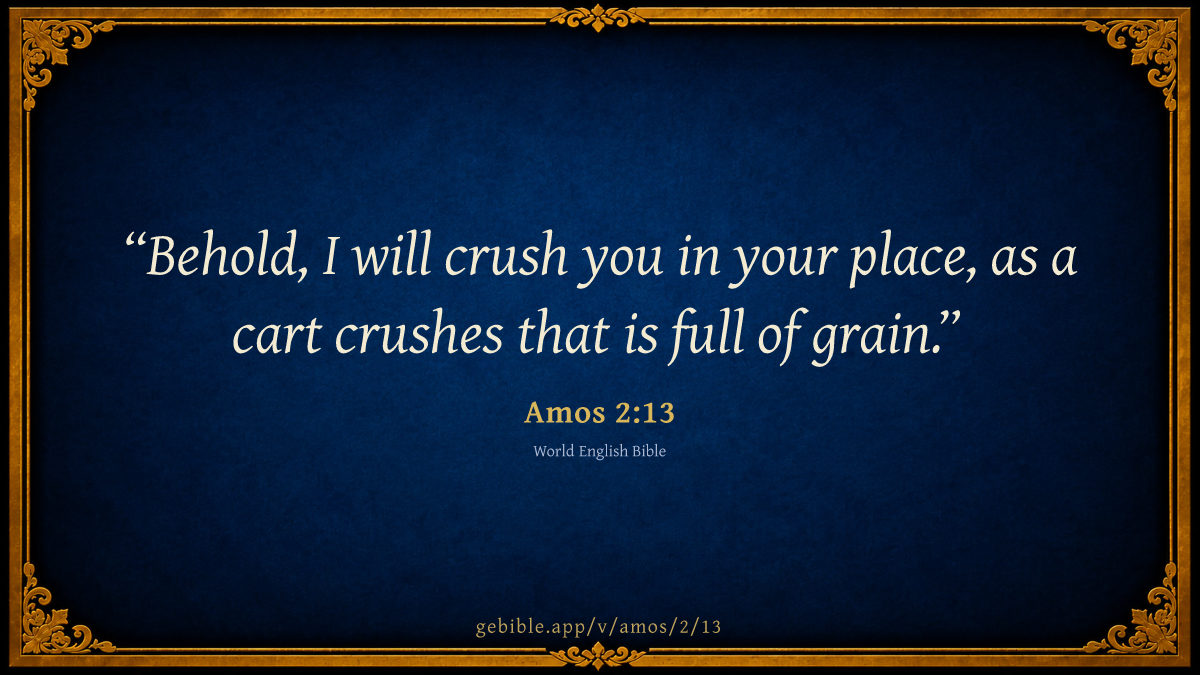
Behold, I will crush you in your place, as a cart crushes that is full of grain.
Parallel Translations
-
Behold, I will crush you in your place, as a cart crushes that is full of grain.
-
Behold, I am pressed under you, as a cart is pressed that is full of sheaves.
-
Behold, I will make it creak under you, as a cart creaketh that is full of sheaves.
Cross-references (7)
Passages linked to Amos 2:13 in the Treasury of Scripture Knowledge, ordered by reader-vote popularity; verse text shown in World English Bible.
- Isaiah 1:14 My soul hates your New Moons and your appointed feasts. They are a burden to me. I am weary of bearing them.
- Psalms 78:40 How often they rebelled against him in the wilderness, and grieved him in the desert!
- Isaiah 7:13 He said, “Listen now, house of David. Is it not enough for you to try the patience of men, that you will try the patience of my God also?
- Isaiah 43:24 You have bought me no sweet cane with money, nor have you filled me with the fat of your sacrifices, but you have burdened me with your sins. You have wearied me with your iniquities.
- Ezekiel 6:9 Those of you that escape will remember me among the nations where they are carried captive, how I have been broken with their lewd heart, which has departed from me, and with their eyes, which play the prostitute after their idols. Then they will loathe themselves in their own sight for the evils which they have committed in all their abominations.
- Ezekiel 16:43 “ ‘ “Because you have not remembered the days of your youth, but have raged against me in all these things; therefore, behold, I also will bring your way on your head,” says the Lord Yahweh: “and you shall not commit this lewdness with all your abominations.
- Malachi 2:17 You have wearied Yahweh with your words. Yet you say, ‘How have we wearied him?’ In that you say, ‘Everyone who does evil is good in Yahweh’s sight, and he delights in them;’ or ‘Where is the God of justice?’
Cross-references from openbible.info (CC BY 4.0)
Explain this verse (17 sources)
Historical commentary, presented as a primary source — not an endorsement.
Private notes
Saved on this device only — never synced or sent anywhere.
John Calvin 1540 · Public Domain The verb עיק, oik, in Hebrew is often transitive,…
The verb עיק, oik, in Hebrew is often transitive, and it is also a neuter. This place then may admit of two interpretations. The first is, that God was pressed under the Israelites, as a wagon groans under too much weight; and so God expostulates by Isaiah, that he was weighed down by the Israelites, ‘Ye constrain me,’ he says, ‘to labor under your sins’ (Isaiah 1:14) The sense then, that God was pressed down under them, may be viewed as not unsuitable: and yet the more received interpretation is this, “Behold, I will bind you fast as a wagon is bound.” I am, however, more inclined to take the first meaning, — that God here reprehends the Israelites, because he had been pressed down by them: for תחתיכם, tacheticam, properly signifies, “Under you,” which some render, but strainedly, “Is your place:” for when the verb is transitive, they say, that תחתיכם, tacheticam, must be rendered “In your place:” but this is frigid and forced; and the whole passage will run better, if we say, “I am bound fast under you, as though ye were a wagon full of sheaves; ” that is, “Ye are to me intolerable.” For God carried that people on his shoulders; and when they loaded him with the burden of iniquities, it is no wonder that he said that they were like a wagon — a wagon filled with many sheaves: “Ye are light as wind, but ye are also to me very burdensome, and I am forced at length to shake you off:” and this he afterwards shows.
John Calvin's Commentaries (1540-1563) — public domain. Text from the Calvin Translation Society English edition (1840s-50s) via the Christian Classics Ethereal Library (ccel.org). Calvin's coverage is partial (roughly two-thirds of the Bible); uncommented books and verses are honest gaps, never fabricated. The 19th-century editor's footnotes and remarks are omitted so the notes are faithfully Calvin's own voice.
Geneva Bible translators 1599 · Public Domain You have wearied me with your sins, Isa. 1:14.
You have wearied me with your sins, Isa. 1:14.
Geneva Bible (1599) marginal notes — public domain.
John Trapp 1656 · Public Domain Amo 2:13 Behold, I am pressed under you, as…
Amo 2:13 Behold, I am pressed under you, as a cart is pressed [that is] full of sheaves.
Ver. 13. Behold I am pressed under you, &c.] A country comparison (such as this prophet is full of), plain, but pithy; to show how God is pressed and oppressed with people’s sins, wearied as it were, Isa 43:24, and his patience even worn out; so that he can forbear them no longer, Isa 42:14, but like a travailing woman, that bites in her pain as long as she is able, at length cries out: so here, God hath much ado to forbear killing men in their sins; as he was ready to have a blow at Moses, when he met him in the inn, and could hardly hold his hands; he even groans under the pressure as a cart seems to do under an extraordinary load laid on it, till it creak and crack again; he seems to screech out to sinners, as Jer 44:4, "Oh, do not this abominable thing!" And (when he cannot be heard) to sigh out, "Ah, sinful nation, a people laden with iniquity," &c., Isa 1:4, as Fasciculus temporum, A.D. 884, bitterly bewailing the iniquities of those times, cries out, Heu heu, Domino Deus, &c. That ninth age is much complained of by many writers. God hath as much, nay, more, cause to complain of ours, considering his pains with us, and patience towards us, to so little purpose and profit. {See Trapp on "Mal 1:1"} Many interpreters make these words not a complaint, but a communication; rendering it thus, I will press or straiten your place as a cart full of sheaves presseth, &c.; either the ground whereon it goeth, or the corn which it thresheth out of the husk, Isa 28:27-28; or as the creature that lieth under the wheels of it is crushed in pieces. It was a memorable saying of Mr Bradford, martyr, He that will not tremble in threatening shall be crushed in pieces in feeling. These perverse Israelites would not be warned by any threatening, therefore they were pressed to some purpose in that sore famine and strait siege of Samaria. Obsidione vos premam, Press hard your seige, saith the Chaldee here; I will so beleaguer your city that there shall be no escaping. Look how a laden cart, onustum sibi, so laden that another sheaf can hardly be laid on, so gets stuck in narrow places, that it can neither go forward nor backward; so will I bring you into those distresses, that you shall not know how to avoid or abide them, στενοχωρουμενοι. {confer Psa 4:2 Pro 4:12 2Co 4:8} I will distress my distressers, and press with such piercing afflictions as shall make you sigh and screech out another while, Oh it is an evil thing and a bitter to forsake the Lord, &c., Jer 2:19. Oh, he is worse than mad that would buy the sweetest sin at so dear a rate.
John Trapp, A Commentary or Exposition upon All the Books of the Old and New Testament (1647–1656) — public domain. Text from a community e-Sword module.
Matthew Poole 1685 · Public Domain Hitherto the Lord by the prophet had declared the…
Hitherto the Lord by the prophet had declared the sins of the kingdom of the ten tribes, now he is about to pronounce judgment against them; he calls for their attention, and diligent weighing what he is about to speak.
I, the Lord, who have so multiplied mercies to this people,
Read full note →
am pressed under you, as a cart is pressed that is full of sheaves: some read this passage actively, and make this the sense, I will lead you with these judgments as a cart is loaded, and you shall cry and groan under these judgments, as a cart heavy loaded makes a noise in its motion under such pressures. Perhaps sheaves, the loading of a harvest season, are mentioned, to intimate the ripeness of their sins, and God’s reaping them or cutting them down by his judgments, and carrying them together to be thrashed by further judgments.
Matthew Poole's English Annotations on the Holy Bible (1683–1685) — public domain. Text from a community e-Sword/MySword module.
John Gill 1763 · Public Domain Behold, I are pressed under you,.... With the weight…
Behold, I are pressed under you,.... With the weight of their sins, with which they had made him to serve, and had wearied him; his patience was quite wore out, he could bear them no longer:
as a cart is pressed that is full of sheaves; as a cart in harvest time, in which the sheaves of corn are carried home; when one sheaf is laid upon another, till they can lay no more, and the cart is loaded and overloaded with them, and ready to break, or be pressed into the earth with them: thus. Jehovah represents himself as loaded and burdened with the sins of these people, and therefore would visit for them, and inflict deserved punishment. Some render it actively, "behold, I press" (z), or "am about to press your place, as a cart full of sheaves presseth" (a); the horse or horses which draw it, especially the last; or the ground it goes upon; or as a cart stuck with iron spikes, and loaded with stones, being drawn over a corn floor, presses the full sheaves, and beats out the grain, which was their way of pressing it: so the Lord signifies he would afflict and distress this people, bring them into strait circumstances, by a close siege, and other judgments, which should ruin and destroy them; and which was first begun by Tiglathpileser king of Assyria, and finished by Shalmaneser, who carried away the ten tribes captive. So the Targum,
Read full note →
"behold, I bring distress upon you, and it shall straiten you in your place, as a cart is straitened which is loaded with sheaves.''
(z) "angustabo", Vatablus; "coarctans", Montanus; "arcto", Mercerus; "premo, coarctabo, angustiis afficiam", Drusius; "pressurus sum", Junius & Tremellius, Piscator, Tarnovius; "arctaturus sum", Liveleus. (a) "coarctares", Montanus; "premit", Junius & Tremellius; Piscator, Tarnovius.
John Gill's Exposition of the Whole Bible (1746–1763) — public domain (CC PDM 1.0). Text via the HelloAO Bible API.
John Wesley 1765 · Public Domain Under you - Under the load of your sins.
Under you - Under the load of your sins.
John Wesley, Explanatory Notes Upon the Whole Bible (1754–1765) — public domain. Text via the GEBible commentary corpus.
Adam Clarke 1810 · Public Domain Verse 13. Behold, I am pressed under you] The…
Verse 13. Behold, I am pressed under you] The marginal reading is better: "Behold, I will press your place, as a cart full of sheaves presseth." I will bring over you the wheel of destruction; and it shall grind your place - your city and temple, as the wheel of a cart laden with sheaves presses down the ground, gravel, and stones over which it rolls.
Adam Clarke's Commentary on the Bible (1810–1826) — public domain. Text from a community e-Sword/MySword module.
Joseph Benson 1811 · Public Domain Amo 2:13-16. Behold I am pressed under you —…
Amo 2:13-16. Behold I am pressed under you — Your sins have quite tired out my patience, and I am weary with bearing them: compare Isa 43:24; Mal 2:17. In this sense the clause is understood by the LXX. and Vulgate. The marginal reading, however, is preferred by many commentators. Archbishop Newcome renders the verse, Behold, I will press your place as a loaded corn-wain presseth its sheaves; and Secker observes, The next verse being joined to this by the connective particle (and) makes it more natural that this should begin to express their punishment. Therefore flight shall perish from the swift — Even flight shall not secure the swift, for their enemies shall be swifter than they. The strong shall not strengthen his force — Their natural strength of body shall not deliver them. And he that is courageous shall flee away naked — Having cast away his armour, or upper garments, for greater expedition.
Joseph Benson's Commentary on the Old and New Testaments (1811–1818) — public domain. Text from a community e-Sword module.
Albert Barnes 1834 · Public Domain Behold, I am pressed under you - God bore…
Behold, I am pressed under you - God bore His people, as the wain bears the sheaves. “Ye yourselves have seen,” He said to them by Moses, “how I bare you on eagle’s wings, and brought you unto Myself” Exo 19:4. “Thou hast seen how the Lord thy God bare thee, as a man doth bear his son, in all the way that ye went, until ye came into this place” Deu 1:31. And by Isaiah, “He bare them and carried them all the days of old” Isa 63:9; and, “which are born” by Me “from the belly, which are carried from the womb” Isa 46:3. Now, He speaks of Himself as wearied by them, as by Isaiah, “thou hast wearied Me with thine iniquities” Isa 43:24; and by Malachi, “ye have wearied the Lord: yet ye say, where with have we wearied Him?” Mal 2:17. His long-suffering was, as it were, worn out by them. He was straitened under them, as the wain groans under the sheaves with which it is over-full. The words are literally, “Behold I, I” (emphatic I, your God, of whom it would seem impossible) “straiten myself” (that is, of My own Will allow Myself to be straitened“under you” ,
“As the wain full for itself,” that is, as full as ever it can contain, is “straitened, groans,” as we say. God says, (the word in Hebrew is half active) that He allows Himself to be straitened, as in Isaiah, He says, “I am weary to bear,” literally, “I let Myself be wearied.” We are simply passive under weariness or oppressiveness: God endures us, out of His own free condescension in enduring us. But it follows, that when He shall cease to endure our many and grievous sins, He will cast them and the sinner forth from Him.
Albert Barnes' Notes on the Bible (1834–1885) — public domain. Text from a community e-Sword/MySword module.
Haydock's Catholic Bible Commentary 1859 · Public Domain I will screek. Unable to bear any longer the…
I will screek. Unable to bear any longer the enormous load of your sins, &c. The Spirit of God, as St. Jerome takes notice, accommodates itself to the education of the prophet, and inspires him with encouragements taken from country affairs. (Challoner) --- Septuagint, "I am overturned." Hebrew, "pressed." (Calmet)
George Leo Haydock (1774–1849), Haydock's Catholic Family Bible and Commentary, 1859 edition — public domain. Excludes Psalms (Douay-Rheims chapter numbering differs from Protestant) and Deuterocanonical books (Catholic canon only).
Robert Jamieson, A. R. Fausset & David Brown 1871 · Public Domain I am pressed under you--so CALVIN (Compare Isa 1:14).…
I am pressed under you--so CALVIN (Compare Isa 1:14). The Margin translates actively, "I will depress your place," that is, "I will make it narrow," a metaphor for afflicting a people; the opposite of enlarging, that is, relieving (Psa 4:1; Pro 4:12). MAURER translates, "I will press you down" (not as Margin, "your place"; so the Hebrew, Job 40:12; or Amo 2:7 in Hebrew text). Amos, as a shepherd, appropriately draws his similes from rustic scenes.
Jamieson, Fausset & Brown — Commentary Critical and Explanatory on the Whole Bible (1871) — public domain (CC PDM 1.0). Text via the HelloAO Bible API.
Daniel D. Whedon 1874 · Public Domain 13-16. The punishment. Righteous retribution will overtake the sinful…
13-16. The punishment. Righteous retribution will overtake the sinful nation. Amo_2:13 is rendered more acceptably in the R.V., “Behold, I will press you in your place, as a cart presseth that is full of sheaves.”
Behold I will — The Hebrew construction implies the imminence of the judgment; better, “Behold, I am about to” (G.-K., 116p).
Read full note →
Press you in your place — The meaning of the verb, which occurs only here in the Old Testament, is doubtful. The cognate verb in Arabic means “to hinder,” “to cause to stop”; hence, “I will cause a stop under you.” If this meaning is accepted, the form of the second verb demands the translation “as a cart causes a stop.” This is strange, since we would expect “as a cart is caused to stop.” Others — so R.V. — connect the verb with the Aramaic and read, “I will press you in your place”; literally, I will press under you, which is thought to mean that he will hold them fast in their place, so that they cannot escape. This also is not without difficulties. (1) “I will press you in your place” would be quite satisfactory, but “I will press under you,” the literal rendering, is not so intelligible; and in the second clause, “as a cart is pressed,” would give good sense, not so “as a cart presseth.” (2) The presence of an Aramaic word in Hebrew at the time of Amos is peculiar. (3) Amo_2:14 implies flight, though the fugitives will be overtaken; nothing is said there about inability to move. For these reasons most commentators accept the emendation of Hitzig, who reads Amo_2:13, “Behold, I am about to cause it to totter under you, even as a wagon totters that is full of sheaves”; that is, the ground will totter under them — a figure of approaching ruin.
Daniel D. Whedon (gen. ed.), Commentary on the Old and New Testaments (1874–1909) — public domain. Text from a community e-Sword module.
The Cambridge Bible for Schools and Colleges 1878 · Public Domain 13. Behold, I am pressed under you, as a…
13. Behold, I am pressed under you, as a cart is pressed &c.] The intransitive sense of the Hifil conjugation העיק (properly, to shew pressure, or constraint), though just possible, cannot be said to be probable; and Behold (with the ptcp.) strongly supports the view that the verse introduces the description of the punishment. Better, therefore, with R.V., and many ancient and modern expositors (Targ., Ibn Ezra, Kimchi; Ges., Ew., Keil, &c.): “Behold, I will press (you) in your place, as a cart presseth that is full of sheaves” [in Hebrew beneath a person is said idiomatically for in his place, where he stands: see e.g. Jdg_7:21; Isa_25:10; Job_40:12]: Jehovah will press them where they stand, like a cart laden with sheaves, so that they will be held fast and unable to escape. The verb is, however, an Aramaic rather than a Hebrew one; nor does it occur elsewhere in the O.T. (only two derivatives in Psa_55:4; Psa_66:11): it is properly the Aramaic equivalent of the Hebr. הציק to constrain, distress (Jdg_14:17; Jer_19:9; Isa_29:2; Isa_51:13); and is used for it in the Targum of the three passages last quoted. It is doubtful, therefore, whether the text is correct. A plausible emendation is that of Wellh. (adopted with slight modification from Hitzig), מֵפִיק for מֵעִיק, and תָּפוּק for תָּעִיק: “Behold, I will make it totter beneath you, as a cart tottereth that is full of sheaves”; the ground will totter or give way under their feet,—the symbol of an approaching ruin.
13–16. The retribution.
The Cambridge Bible for Schools and Colleges (gen. ed. J. J. S. Perowne; Cambridge University Press, 1878–1918) — public domain. Text from a community e-Sword module.
Ellicott's Commentary for English Readers 1878 · Public Domain (13) I am pressed.—Baur, Pusey, and Speaker’s Commentary support…
(13) I am pressed.—Baur, Pusey, and Speaker’s Commentary support this rendering of the Heb. mç‘îq, the corresponding form in the next clause also being taken in the intransitive (i.e., passive sense). But it is unlikely that God, in this passage, should declare Himself “crushed” under the weight of Israel’s sin, for in the context it is Israel, and not God, who is described as the victim, Moreover, grammatical usage is against the rendering of mç‘îq as passive; nor does it favour Ewald’s, as well as Keil’s, interpretation “press you down” Translate (see margin) Behold, I am pressing down beneath you (literally, your place), just as the waggon, filled up with sheaves, presses down. Jehovah, in the awful judgment which He inflicts, is symbolised by the heavily-laden waggon. The expression “beneath you” suggests that the evil is not confined to the present. Israel, the nation weighted with the doom of past iniquities, bequeathes a yet more crushing load to future generations. If the text is sound, this appears the only satisfactory rendering of a difficult passage.
A Bible Commentary for English Readers, edited by Charles John Ellicott (1878–1897) — public domain. Text from a community e-Sword module.
The Pulpit Commentary 1880 · Public Domain Vers. 13-16 threaten severe punishment for the sins mentioned…
Vers. 13-16 threaten severe punishment for the sins mentioned above.
Behold, I am pressed under you; Septuagint, kuliw uJpokatw uJmwn, "I roll under you;" Vulgate, stridebo subter vos; Syriac, as Anglican; Hitzig, "I make it totter beneath you, as a cart tottereth;" Ewald, Keil," I will press you down, as the cart presseth;" Baur, Pusey, "I straiten myself under you, as a cart is straitened;" Revised Version, "I will press you in your place, as a cart presseth." The translation of Keil, which is that of Gesenius, is most suitable, meaning, "I will press you with the full force of war, as a loaded wain presses the earth over which it passes." The sense of the English Version is that God is burdened and wearied with their sins, as Isa_43:24; Mal_2:17. The verb, being hiphil, is an objection to this explanation. The comparison of the wain is very natural in the mouth of the shepherd Amos.
Read full note →
Vers. 13-16.
The wrath of outraged goodness.
wounded spirit who can bear?" Even God will not bear it forevermore. A "base contempt of covenant mercies," exemplified here, may go too far. The limit of intelligent forbearance will be passed, and the pent-up vials of wrath restrained will be poured forth.
I THE CRUSHER. "Behold, I will press you down as the cart presses that is filled with sheaves" (Keil). This is a strong figure. God, in his retributive action, is compared not only to a cart, but to a heavily loaded one, which crushes all it passes over. His stroke, when it falls, will be heavy in proportion as, in mercy, it has been long suspended. His love had long been spurned, and now at last it is turned into righteous hatred. Unspeakable goodness disregarded persistently will now give place to thick disasters. His power had been insanely dared, and Israel would now discover whether they had an arm like his. "On whomsoever it shall fall, it shall grind him to powder." How indignant love can be that has suffered persistent outrage! How stern goodness becomes when it finds itself thrown away on inappreciation and contempt! How overwhelming Omnipotence is, which nevertheless endures defiance from worms of the dust so long! How terrible God will be as a Foe where he will not be accepted as a Friend! (Psa_18:26; Pro_1:24-28)
II THE CRUSHED. These are not the nation in general, but each class in particular the strong, the courageous, the swift, the fighter, the runner, and the rider alike. None shall escape. God"s wrath, like his love, is distinctive rests not on masses, but on individuals. And, answering to this, the judgments which execute his wrath are elaborated in detail They are no more necessary than reluctant, no more reluctant than sure, no more sure than thorough.
The mills of God grind slowly, But they grind exceeding small.
It is noticeable, too, that of those who fall in the sweep of God"s sword, it is the best protected who are emphasized. Nothing is said of the weak and timid and slow. Their destruction might be taken for granted. But, lest any should cherish a hope of escape under any circumstances, the persons to whom such hope would be most natural are doomed by name. An occasion of remaining in sin is, with many wicked, the stealthy hope that somehow or other they will escape at last. (Isa_28:15) Perhaps they have nodefinite expectation, no theory even, on the subject. They know the Word of God to be decisive, and feel the chances are against them. But they cajole the judgment into negligently making the wish the father to the thought, and go down to death the half-conscious victims of a make believe. The gospel to such wants heralding with a Saviour"s warning cry, "How can ye escape the damnation of hell?
III THE CRUSHING. A variety of figures combine to illustrate this.
1. It cannot be resisted. "The strong one will not fortify his strength," etc. There are no arms we can use against God. They are suited to a material, not a spiritual, foe. There is no strength to be put in competition with his. The bare thought of a struggle is the climax of all absurdity. "Let the potsherds strive with the potsherds of the earth.
2. It cannot be faced. "The courageous one among the heroes will flee away." Man has strength, and confidence in it, for a struggle with fellow man. But his strength leaves him in God"s presence. (Joh_7:44) Hecannot even attempt resistance. "He falls at his feet like one dead.
3. It cannot be escaped. "The flight will be lost to the swift." To fly from Omnipresence is as inconceivable as to fight against Omnipotence. Darkness cannot hide, nor distance separate, from God. We live in his presence. We sin in his presence. We die in his presence. Even the destruction from his presence as gracious (2Th_1:9) is destruction in his presence as filling heaven and earth.
(1) Judgment is the obverse of grace. There are only the two ways of it. There is no compromise between obedience and disobedience. (Mat_12:30) So there is no via media between salvation and destruction. The coin of Scripture truth comes to us with a nimbus on the one side and a death"s head on the other. We may choose between the two, but one or other we must take. (Mar_16:16) God will save if he may, but he will destroy if he must.
(2) Grace is the converse of judgment. Judgment empties the strong of strength. Grace makes the weak to be strong in God. You may have either; and you must have one. Which shall it be?
Men"s sins a Divine burden.
The figure of the text is one taken by Amos from his own experience as a husbandman. In the harvest field the cart is piled high with sheaves to be taken to the garner or the threshing floor. The wain groans as poets put it beneath the load. Even so, it is represented that the sins of Israel oppress Jehovah; he is distressed by their magnitude and their aggravations.
I LIGHT IS CAST BY THIS LANGUAGE UPON THE CHARACTER OF GOD.
1. His repug nance to sin is here brought before us. The deities of the heathen do not seem to have been represented as hating sin, though they were pictured as resenting the neglect of their worshippers. It was otherwise with Jehovah, for he was not an invention of human ignorance and frailty. The Old Testament writers, with one consent, represent the Eternal as holy, and as hating sin as sin.
2. His distress at sin is conveyed in this declaration. This is no imperfection. Mere disapproval would have been an imperfection. But it is an encouraging view which we are justified in taking of the Divine character, as we read that God is pained by human iniquity. What an appeal to sinful man is this, "I am pressed under you"!
II LIGHT IS CAST BY THIS LANGUAGE UPON THE NATURE OF HUMAN SIN. Men"s transgressions are not unheeded by God, neither are they a matter of indifference to him. The Supreme Being is not oppressed by the vast care of the material universe. But sin is so heinous and awful that it affects his feelings if we may use language so human. Shall man be careless with regard to that which is so felt by the infinite heart? Of all ills there can be none like this.
III LIGHT IS CAST BY THIS LANGUAGE UPON THE PROSPECT OF REDEMPTION. This light may be dim, but it is an advance upon darkness. If man"s sin is so distressing to God, there is reason to hope that Divine wisdom and grace will concur to provide means for its forgiveness and its cancelling. The feeling which is uttered in the figurative language of the text found lull expression in the cross of Christ, in the gospel of salvation. T.
The Pulpit Commentary (1880–1919), ed. H.D.M. Spence-Jones & Joseph S. Exell — public domain. Text from a community e-Sword module.
The Biblical Illustrator 1887 · Public Domain Behold, I am pressed under you, as a cart…
Amo_2:13
Behold, I am pressed under you, as a cart is pressed that is full of sheaves.
Read full note →
--We go to-day to the gate of the harvest-field, to see the waggon piled up aloft with many sheaves come creaking forth, making ruts along the field. What a picture is a waggon loaded with corn of you and of me, as loaded with Gods mercies! Alas! that such a sign should be capable of another reading. That while God loadeth us with mercy, we should load Him withsin. The text is only a figure, since God cannot actually be oppressed by man. God speaks to us as a great father may talk to his little child. Just as a cart has the axles bent, and as the wheels creak under the excessive load, so the Lord says that under the load of human guilt He is pressed down, until He crieth out, because He can bear no longer the iniquity of those that offend against Him.
I. Sin is very grievous and burdensome to God. There is no suggestion anywhere that the whole burden of creation is any weight to the Most High. The heathen picture Atlas stooping beneath the globe; but the eternal God, who beareth up the pillars of the universe, fainteth not, neither is weary. Nor does providence fatigue the Lord. His incessant working has not diminished His strength, nor is there any failing, or thought of failing, with Him. But sin burdens God, though the world cannot; and iniquity presses the Most High, though the whole weight of providence is as the small dust of the balance.
1. Sin is the great spoiler of all Gods works. Sin looked on Eden, and withered all its flowers. Nothing tarnishes beauty so much as sin, for it mars Gods imago and erases His superscription.
2. Sin makes Gods creatures unhappy. Shall not, therefore, the Lord abhor it?
3. Sin attacks God in all His attributes. It assails Him on His throne, and stabs at His existence. What is sin? Is it not an insult to Gods wisdom? Does it not abuse Gods mercy?
4. Sin is an onslaught upon God Himself. For sin is atheism of heart. Surely sin is exceedingly sinful; so it must be grievous and burdensome to God.
II. Some sins are more especially grievous to God. There is no such thing as a little sin, and yet there are degrees of guilt. There are sins which especially provoke God.
1. Licentiousness.
2. Oppression.
3. Idolatry.
4. Blasphemy.
Many men are especially obnoxious to God, because of their length in sin God takes special note, and feeleth an especial weariness of sin that is mixed with obstinacy. And ingratitude is intensely burdensome to God. While it is true that sin is grievous to the Lord, it magnifies His mercy when we see that He bears the load. As the cart is not said to break, but is pressed only, so is He pressed, and yet He bears. If you or I were in Gods place, should we have borne it?
III. God, in the person of his son, did bear and take away sin. Here stood the great problem. God must punish sin, yet He desired to have mercy. Jesus comes to be the substitute for all who trust Him.
IV. If not in Christ, that same load will crush us for ever. After judgment, for a soul out of Christ, what awaits? (C. H. Spurgeon.)
Gods grief
(compare Hos_8:10; Hos_11:8):--These three passages give us an intimation, a glimpse of the burden and grief of the Infinite. What is this burden that presses on the heart of the Divine? What are the thorns under the golden crown of universal dominion? Can we know what they are? Yes, the burden of the King of princes is the sin of His creatures, and to clear it from the world is the one great problem of the Divine. If sin were committed by any who were independent of God--were it possible for such to exist--it might cause Him no such sorrow. But all are dependent on Him, closely united by creation. Sin is evidently a matter of greatest cost to God, and something much more awful than we can comprehend. Sin meets God in His world at every turn. Sin now rears its serpent head amid the glories of Gods creation, and is now working terrible damage in the fair world of our Father. It may seem a trifling thing to many; but it is a real burden and annoyance to God. It is not necessary that a man should have a sharp stone in his eye in order to feel a smart. A speck of dust, a grain of sand, will be sufficient to blot out to us for a season the glories of the most beautiful landscape. As to the presence of such a slight foreign substance, the eye is most sensitive, so is the nature of God to the presence of sin in His creature. To a Being of such great love it must be a great burden to see such multitudes of His creatures rushing on in the misery of sin. In proportion to the infinite tenderness of the Divine nature, so is the burden increased. God knows the far-reaching effects of mans sin. It is a very common thing to represent God as existing only in unalloyed happiness. It is only like Him to take up our burdens, to know our sorrows. He Is most like God when love leads to an infinite self-sacrifice in bearing mans burdens, and sympathising in human sorrow. We should not believe in Gods sympathy and love so much apart from this bearing some burden. We should not go to Him so readily. There was not, let us remember, in Christ, who manifested God, the appearance of submission to suffering. It was real suffering, because there was a real burden and sympathy. If the Divine Being sympathises with man, He also shows us that He wishes to have from us sympathy and love in return. We are to sorrow a little for the burden of the King of princes. And the measure of our power to enter into sympathy with the Divine is the measure of the strength of our spiritual character. (F. Hastings.)
Gods sin-burden
This verse, as it is by some translated, is a part of the sentence or threatening, showing that God would press their place or land, and fill it with heaps of judgments and enemies, as a cart is pressed and filled with sheaves in harvest. But as it is here translated, it is a general conclusion introductory to the sentence; wherein the Lord declareth, that the multitude and variety of these their sins did so provoke His justice and patience, that He might justly complain of them as insupportable and intolerable, as a cart groans under burdens; and therefore He would punish, as is declared in the following verses. Doctrine.
1. It is the way of secure sinners to lay over the weight of all their sins on God, and on His mercy, as if He were but a cart to lie under the burden of them all, that so they may sleep the sounder and sin the faster.
2. The Lord, even toward secure sinners, will take on this burden so far, as to suffer their manners long, before He cast it off, albeit He be provoked by every sin, and doth not allow their presumptuous casting off their iniquities upon Him, yet He doth not complain nor strike, till He be pressed, as a cart that is full of sheaves.
3. Gods patience and long-suffering will at last weary to endure the provocations of sinners, as becoming insupportable.
4. When the cup of mens iniquities is full, and God is about to bear them no longer, yet they may be so stupid as to need up-stirring to consider it. (George Hutcheson.)
Ill-treatment of God
Consider, then, for a moment, how bad human nature must be, if we think how ill it has treated its God. I remember William Huntington says, in his Autobiography, that one of the sharpest sensations of pain that he felt after he had been quickened by Divine grace was this: He felt such pity for God. I do not know that I ever met with the expression elsewhere, but it is a very expressive one, although I might prefer to say sympathy with God and grief that He should be so evil entreated. Ah, there are many men that are forgotten, that are despised, and that are trampled on by their fellows; but there never was a man who was so despised as the everlasting God has been. (C. H. Spurgeon.)
The Biblical Illustrator, edited by Joseph S. Exell (c. 1880s–1900s) — public domain. Text from a community e-Sword module.
unfoldingWord translationNotes 2017 · CC BY-SA 4.0 Connecting Statement:
Connecting Statement:
Yahweh continues his message of judgment on the people of Israel.
Read full note →
General Information:
The word "you" in these verses refers to the people of Israel.
Look
This alerts the reader to pay attention to what follows. AT: "Listen" or "Pay attention to what I am about to tell you"
I will crush you as a cart that is full of grain can crush someone
Yahweh compares his judgment on the people of Israel to crushing them with something very heavy. (See: Simile)
The swift ... the strong ... the mighty
These adjectives refer to people in general. AT: "Swift people ... strong people ... mighty people" or "The strong person ... the strong person ... the mighty person" (See: Nominal Adjectives)
translationWords
grain
might
save
unfoldingWord translationNotes — © Distant Shores Media and the Door43 World Missions Community, licensed CC BY-SA 4.0. Source: git.door43.org/Door43/en_tn.