
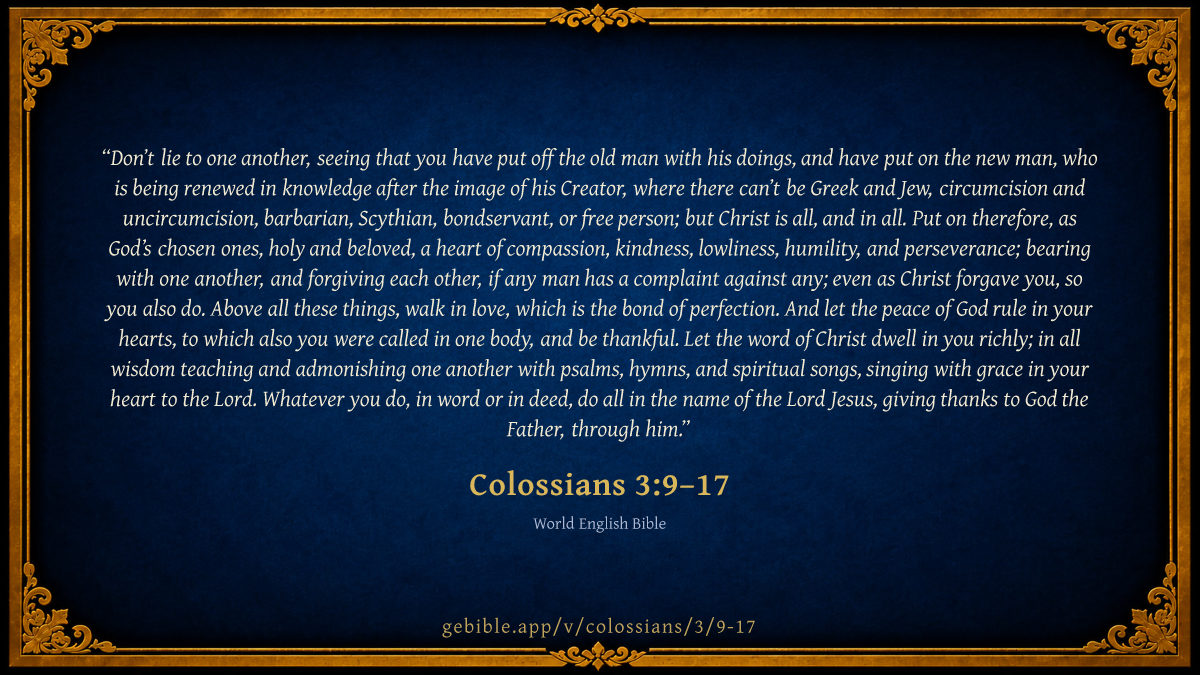
Don’t lie to one another, seeing that you have put off the old man with his doings, and have put on the new man, who is being renewed in knowledge after the image of his Creator, where there can’t be Greek and Jew, circumcision and uncircumcision, barbarian, Scythian, bondservant, or free person; but Christ is all, and in all.
Put on therefore, as God’s chosen ones, holy and beloved, a heart of compassion, kindness, lowliness, humility, and perseverance; bearing with one another, and forgiving each other, if any man has a complaint against any; even as Christ forgave you, so you also do.
Above all these things, walk in love, which is the bond of perfection. And let the peace of God rule in your hearts, to which also you were called in one body, and be thankful. Let the word of Christ dwell in you richly; in all wisdom teaching and admonishing one another with psalms, hymns, and spiritual songs, singing with grace in your heart to the Lord.
Whatever you do, in word or in deed, do all in the name of the Lord Jesus, giving thanks to God the Father, through him.
John Calvin 1540 · Public Domain On vv9, 10, 11, 12, 14, 15, 16, 17 9. Lie not. When he forbids lying, he condemns…
9. Lie not. When he forbids lying, he condemns every sort of cunning, and all base artifices of deception. For I do not understand the term as referring merely to calumnies, but I view it as contrasted in a general way with sincerity. Hence it might be allowable to render it more briefly, and I am not sure but that it might also be a better rendering, thus: Lie not one to another. He follows out, however, his argument as to the fellowship, which believers have in the death and resurrection of Christ, but employs other forms of expression.
The old man denotes — whatever we bring from our mother’s womb, and whatever we are by nature. It is put off by all that are renewed by Christ. The new man, on the other hand, is that which is renewed by the Spirit of Christ to the obedience of righteousness, or it is nature restored to its true integrity by the same Spirit. The old man, however, comes first in order, because we are first born from Adam, and afterwards are born again through Christ. And as what we have from Adam becomes old, and tends towards ruin, so what we obtain through Christ remains for ever, and is not frail; but, on the contrary, tends towards immortality. This passage is worthy of notice, inasmuch as a definition of regeneration may be gathered from it. For it contains two parts — the putting off of the old man, and the putting on of the new, and of these Paul here makes mention. It is also to be noticed, that the old man is distinguished by his works, as a tree is by its fruits. Hence it follows, that the depravity that is innate in us is denoted by the term old man
John Calvin's Commentaries (1540-1563) — public domain. Text from the Calvin Translation Society English edition (1840s-50s) via the Christian Classics Ethereal Library (ccel.org). Calvin's coverage is partial (roughly two-thirds of the Bible); uncommented books and verses are honest gaps, never fabricated. The 19th-century editor's footnotes and remarks are omitted so the notes are faithfully Calvin's own voice.
Geneva Bible translators 1599 · Public Domain On vv9, 10, 11, 12, 14, 15, 16, 17 A definition of our new birth taken of the…
A definition of our new birth taken of the parts thereof, which are the putting off of the old man, that is to say, of the wickedness which is in us by nature, and the restoring, and repairing of the new man, that is to say, of pureness which is given us by grace: but both of them are but begun in us in this present life, and by certain degrees finished: the one dying in us by little and little, and the other coming to the perfection of another life, by little and little.
Geneva Bible (1599) marginal notes — public domain.
John Trapp 1656 · Public Domain On vv9–17 9 Lie not one to another, seeing that ye…
9 Lie not one to another, seeing that ye have put off the old man with his deeds;
Ver. 9. Lie not one to another] No, not in jest, lest ye go to hell in earnest. {See Trapp on "Eph 4:25"}
Read full note →
Ye have put off the old man] As the serpent doth his slough, the eagle his bill, the lizard his skin in spring and autumn. (Arist. Hist. Animal. viii.)
John Trapp, A Commentary or Exposition upon All the Books of the Old and New Testament (1647–1656) — public domain. Text from a community e-Sword module.
Matthew Poole 1685 · Public Domain On vv9–17 Lie not one to another: here he puts them…
Lie not one to another: here he puts them upon laying aside that vice which violates the ninth commandment, being opposite to truth in word and work: see Eph 4:25, where he doth more fully urge the putting away lying, from the same argument that follows here: a lie being no other than that voluntary expression by word or deed, which accords not with the conception of the mind and heart, on purpose to deceive those with whom we do converse; contrary to the principles of a new creature, because God, after whose image he is renewed, hates it more than any vice, since it is contrary to truth, and proceeds from the father of lies, Psa 5:6; 15:2; Pro 12:22; Joh 8:44; Rev 21:8,27. They who in conversation do most stomach to be told of it, are most ordinarily guilty of it. But the apostle requires Christians indeed to put away all fraud and fallacy in commerce with men and one another, (as well as converse with God), that there may be in all due circumstances a just representation of that without which is conceived within, Eph 4:15; Jam 3:14.
Seeing that ye have put off the old man with his deeds: the apostle subjoins his reason from the parts of regeneration or sanctification, viz.
Read full note →
1. Mortification, which he reassumes under an elegant metaphor, (intimating his solicitude to have the foregoing and the like vices to be wholly laid aside, as much as was possible in this life), borrowed from the putting off old and worn garments, which did as it were crawl with vermin; intimating that if the old man, as the cause, were put off with loathing, then those inordinate affections and actions which did proceed from it would also be removed; see on Rom 6:6,11, with Eph 4:22; if that which is born of the flesh and contrary to the Spirit, Joh 3:6, with Gal 5:17, then inordinate affections and lusts, Gal 5:24.
(To see number 2: See Poole on "Col 3:10").
Matthew Poole's English Annotations on the Holy Bible (1683–1685) — public domain. Text from a community e-Sword/MySword module.
William Burkitt 1703 · Public Domain On vv11, 12, 14, 15, 16, 17 Where, that is, in which state of renovation, or…
Where, that is, in which state of renovation, or under the present gospel-dispensation, there is found with God no respect to any man’s person or nation, as before there was under the legal dispensation; now Jew and Gentile, male and female, bond and free, circumcised and uncircumcised, everyone that feareth God, and worketh righteousness, is accepted of God, through Christ, who is all, in all things, to all believers:
But how is Christ all in all unto his people?
Read full note →
Thus, his teaching is all in all in the work of illumination, his Spirit is all in all in the work of conversion, his death is all in all in the work of satisfaction, his righteousness is all in all in the matter of our justification, his grace is all in all in our satisfaction, his intercession is all in all in our acceptation, his peace is all in all in our consolation, his power is all in all in our resurrection, his presence is all in all in our glorification.
O blessed Jesus! art thou thus all to me? I will labour to be all to thee; I will give thee all that I am, my soul with all its faculties, my understanding, my heart, and my affections, particularly my love and my hatred, my joy and my sorrow, my hope and my fear, my body with all its members: For thou hast created, redeemed, and wilt glorify the body as well as the soul; and therefore I will glorify thee with my body and with my spirit, which is thine: I will also give thee all that I have, by consecrating it all to the service of Christ, and resigning up all to the will of Christ, and will intitle thee to all that I do, by making thy word my rule, and thy glory my end, in all my actions and undertakings.
William Burkitt's Expository Notes on the New Testament (1700–1703) — public domain. Text from a community e-Sword module.
Matthew Henry 1710 · Public Domain On v12 The apostle proceeds to exhort to mutual love and…
The apostle proceeds to exhort to mutual love and compassion: Put on therefore bowels of mercy, Col 3:12. We must not only put off anger and wrath (as Col 3:8), but we must put on compassion and kindness; not only cease to do evil, but learn to do well; not only not do hurt to any, but do what good we can to all.
I. The argument here used to enforce the exhortation is very affecting: Put on, as the elect of God, holy and beloved. Observe, 1. Those who are holy are the elect of God; and those who are the elect of God, and holy, are beloved - beloved of God, and ought to be so of all men. 2. Those who are the elect of God, holy and beloved, ought to conduct themselves in every thing as becomes them, and so as not to lose the credit of their holiness, nor the comfort of their being chosen and beloved. It becomes those who are holy towards God to be lowly and loving towards all men. Observe, What we must put on in particular. (1.) Compassion towards the miserable: Bowels of mercy, the tenderest mercies. Those who owe so much to mercy ought to be merciful to all who are proper objects of mercy. Be you merciful, as your Father is merciful, Luk 6:36. (2.) Kindness towards our friends, and those who love us. A courteous disposition becomes the elect of God; for the design of the gospel is not only to soften the minds of men, but to sweeten them, and to promote friendship among men as well as reconciliation with God. (3.) Humbleness of mind, in submission to those above us, and condescension to those below us. There must not only be a humble demeanour, but a humble mind. Learn of me, for I am meek and lowly in heart, Mat 11:29. (4.) Meekness towards those who have provoked us, or been any way injurious to us. We must not be transported into any indecency by our resentment of indignities and neglects: but must prudently bridle our own anger, and patiently bear the anger of others. (5.) Long-suffering towards those who continue to provoke us. Charity suffereth long, as well as is kind, Co1 13:4. Many can bear a short provocation who are weary of bearing when it grows long. But we must suffer long both the injuries of men and the rebukes of divine Providence. If God is long-suffering to us, under all our provocations of him, we should exercise long-suffering to others in like cases. (6.) Mutual forbearance, in consideration of the infirmities and deficiencies under which we all labour: Forbearing one another. We have all of us something which needs to be borne with, and this is a good reason why we should bear with others in what is disagreeable to us. We need the same good turn from others which we are bound to show them. (7.) A readiness to forgive injuries: Forgiving one another, if any man have a quarrel against any. While we are in this world, where there is so much corruption in our hearts, and so much occasion of difference and contention, quarrels will sometimes happen, even among the elect of God, who are holy and beloved, as Paul and Barnabas had a sharp contention, which parted them asunder one from the other (Act 15:39), and Paul and Peter, Gal 2:14. But it is our duty to forgive one another in such cases; not to bear any grudge, but put up with the affront and pass it by. And the reason is: Even as Christ forgave you, so also do you. The consideration that we are forgiven by Christ so many offences is a good reason why we should forgive others. It is an argument of the divinity of Christ that he had power on earth to forgive sins; and it is a branch of his example which we are obliged to follow, if we ourselves would be forgiven. Forgive us our trespasses, as we forgive those who trespass against us, Mat 6:12.
Read full note →
II. In order to all this, we are exhorted here to several things: - 1. To clothe ourselves with love (Col 3:14): Above all things put on charity: epi pasi di toutois - over all things. Let this be the upper garment, the robe, the livery, the mark of our dignity and distinction. Or, Let this be principal and chief, as the whole sum and abstract of the second table. Add to faith virtue, and to brotherly-kindness charity, Pe2 1:5-7. He lays the foundation in faith, and the top-stone in charity, which is the bond of perfectness, the cement and centre of all happy society. Christian unity consists of unanimity and mutual love. 2. To submit ourselves to the government of the peace of God (Col 3:15): Let the peace of God rule in your hearts, that is, God's being at peace with you, and the comfortable sense of his acceptance and favour: or, a disposition to peace among yourselves, a peaceable spirit, that keeps the peace, and makes peace. This is called the peace of God, because it is of his working in all who are his. The kingdom of God is righteousness and peace, Rom 14:17. "Let this peace rule in your heart - prevail and govern there, or as an umpire decide all matters of difference among you." - To which you are called in one body. We are called to this peace, to peace with God as our privilege and peace with our brethren as our duty. Being united in one body, we are called to be at peace one with another, as the members of the natural body; for we are the body of Christ, and members in particular, Co1 12:27. To preserve in us this peaceable disposition, we must be thankful. The work of thanksgiving to God is such a sweet and pleasant work that it will help to make us sweet and pleasant towards all men. "Instead of envying one another upon account of any particular favours and excellence, be thankful for his mercies, which are common to all of you." 3. To let the word of Christ dwell in us richly, Col 3:16. The gospel is the word of Christ, which has come to us; but that is not enough, it must dwell in us, or keep house - enoikeitō, not as a servant in a family, who is under another's control, but as a master, who has a right to prescribe to and direct all under his roof. We must take our instructions and directions from it, and our portion of meat and strength, of grace and comfort, in due season, as from the master of the household. It must dwell in us; that is, be always ready and at hand to us in every thing, and have its due influence and use. We must be familiarly acquainted with it, and know it for our good, Job 5:27. It must dwell in us richly: not only keep house in our hearts, but keep a good house. Many have the word of Christ dwelling in them, but it dwells in them but poorly; it has no mighty force and influence upon them. Then the soul prospers when the word of God dwells in us richly, when we have abundance of it in us, and are full of the scriptures and of the grace of Christ. And this in all wisdom. The proper office of wisdom is to apply what we know to ourselves, for our own direction. The word of Christ must dwell in us, not in all notion and speculation, to make us doctors, but in all wisdom, to make us good Christians, and enable us to conduct ourselves in every thing as becomes Wisdom's children. 4. To teach and admonish one another. This would contribute very much to our furtherance in all grace; for we sharpen ourselves by quickening others, and improve our knowledge by communicating it for their edification. We must admonish one another in psalms and hymns. Observe, Singing of psalms is a gospel ordinance: psalmois kai humnois kai ōdais - the Psalms of David, and spiritual hymns and odes, collected out of the scripture, and suited to special occasions, instead of their lewd and profane songs in their idolatrous worship. Religious poesy seems countenanced by these expressions and is capable of great edification. But, when we sing psalms, we make no melody unless we sing with grace in our hearts, unless we are suitably affected with what we sing and go along in it with true devotion and understanding. Singing of psalms is a teaching ordinance as well as a praising ordinance; and we are not only to quicken and encourage ourselves, but to teach and admonish one another, mutually excite our affections, and convey instructions. 5. All must be done in the name of Christ (Col 3:17): And whatsoever you do in word or deed, do all in the name of the Lord Jesus, according to his command and in compliance with his authority, by strength derived from him, with an eye to his glory, and depending upon his merit for the acceptance of what is good and the pardon of what is amiss, Giving thanks to God and the Father by him. Observe, (1.) We must give thanks in all things; whatsoever we do, we must still give thanks, Eph 5:20, Giving thanks always for all things. (2.) The Lord Jesus must be the Mediator of our praises as well as of our prayers. We give thanks to God and the Father in the name of the Lord Jesus Christ, Eph 5:20. Those who do all things in Christ's name will never want matter of thanksgiving to God, even the Father.
Matthew Henry's Commentary on the Whole Bible (1708–1710) — public domain (CC PDM 1.0). Text via the HelloAO Bible API.
John Gill 1763 · Public Domain On vv9–17 Lie not one to another.... Which is another vice…
Lie not one to another.... Which is another vice of the tongue, and to which mankind are very prone, and ought not to be done to any, and particularly to one another; since the saints are members one of another, and of the same body, which makes the sin the more unnatural; of this vice; see Gill on Eph 4:25, and is another sin that is to be put off, or put away; that is to be abstained from, and not used. The arguments dissuading from this, and the rest, follow,
seeing that ye have put off the old man, with his deeds. The Syriac, Arabic, and Ethiopic versions read this as an exhortation, as they do the next verse also. Who is meant by the old man; see Gill on Rom 6:6, and what by putting him off; see Gill on Eph 4:22, and as for "his deeds", they are the same with the deceitful lusts there mentioned, and the works of the flesh in Gal 5:19 and with the members of the body of sin in the context, Col 3:5. Some, as Beza, think, that here is an allusion to the rite of baptism in the primitive church; which, as he truly observes, was performed not by aspersion, but immersion; and which required a putting off, and a putting on of clothes, and when the baptized persons professed to renounce the sins of the flesh, and their former conversation, and to live a new life.
John Gill's Exposition of the Whole Bible (1746–1763) — public domain (CC PDM 1.0). Text via the HelloAO Bible API.
John Wesley 1765 · Public Domain On vv10–17 In knowledge - The knowledge of God, his will,…
In knowledge - The knowledge of God, his will, his word.
John Wesley, Explanatory Notes Upon the Whole Bible (1754–1765) — public domain. Text via the GEBible commentary corpus.
Adam Clarke 1810 · Public Domain On vv9–17 Verse 9. Lie not one to another] Do not…
Verse 9. Lie not one to another] Do not deceive each other; speak the truth in all your dealings; do not say, "My goods are so and so," when you know them to be otherwise; do not undervalue the goods of your neighbour, when your conscience tells you that you are not speaking the truth. It is naught, it is naught, saith the buyer; but afterwards he boasteth; i.e. he underrates his neighbour's property till he gets him persuaded to part with it for less than its worth; and when he has thus got it, he boasts what a good bargain he has made. Such a knave speaks not truth with his neighbour.
Ye have put off the old man] See Clarke on Ro 6:6; and particularly on Ro 13:11-14. Ye have received a religion widely different from that ye had before; act according to its principles.
Adam Clarke's Commentary on the Bible (1810–1826) — public domain. Text from a community e-Sword/MySword module.
Joseph Benson 1811 · Public Domain On vv12, 14 Col 3:12-13. Put on therefore — In a higher…
Col 3:12-13. Put on therefore — In a higher degree than before; as the elect, or chosen, of God — The appellation given in the New Testament to all the true disciples of Christ, to all that so believe in him as to be pardoned and renewed; see on Eph 1:4 : holy — Dedicated and conformed to him; and beloved — By him, or set apart to his service, and blessed with the tokens of his peculiar favour. Bowels of mercies — Οικτιρμων, of tender mercies, namely, toward all the afflicted, destitute, and distressed, especially those of the household of faith; kindness — Benevolence toward one another and all men, or sweetness of disposition, as χρηστοτης properly signifies; humbleness of mind — In your behaviour toward others, engaging you to condescend even to those that are in the lowest stations of life; meekness — Under whatever injuries or provocations you may receive, always restraining you from returning evil for evil, railing for railing, and from resenting any injury that may be done to you; long-suffering — Amidst the failings, weaknesses, and faults of your fellow-Christians; or when your trials, whether immediately from the hand of God or man, are either continued long, or are violent in their degree; forbearing — Or patiently bearing with one another, if any thing is now wrong; and forgiving one another — What is past; if any man have a quarrel — Μομφην, complaint; against any: even as Christ forgave you, &c. — And thereby set you an example, that you might be always disposed to forgive the faults of your offending fellow-Christians or fellow- creatures. See on Eph 4:32.
Joseph Benson's Commentary on the Old and New Testaments (1811–1818) — public domain. Text from a community e-Sword module.
Albert Barnes 1834 · Public Domain On vv9–17 Lie not one to another - Notes, Eph 4:25.
Lie not one to another - Notes, Eph 4:25.
Seeing that ye have put off the old man with his deeds - Your former corrupt and evil nature; Notes, Eph 4:22. The reason for putting away lying, stated in Eph 4:25, is, that we “are members one of another” - or are brethren. The reason assigned here is, that we have put off the old man with his deeds. The sense is, that lying is one of the fruits of sin. It is that which the corrupt nature of man naturally produces; and when that is put off, then all that that nature produces should be also put off with it. The vice of lying is a universal fruit of sin, and seems to exist everywhere where the gospel does not prevail; compare the notes at Tit 1:12. There is, perhaps, no single form of sin that reigns so universally in the pagan world.
Albert Barnes' Notes on the Bible (1834–1885) — public domain. Text from a community e-Sword/MySword module.
Haydock's Catholic Bible Commentary 1859 · Public Domain On vv10, 11, 14, 15, 16, 17 According to the image of him who created him.…
According to the image of him who created him. We are created in the image of God, inasmuch as our souls are spiritual and immortal, but here we are put in mind to imitate God by sanctity and justice, as God is holy and the fountain of justice. (Witham) --- The image or resemblance of our Creator was effaced by sin, but is retraced by Jesus Christ, who forms in us this new man. (Bible de Vence)
George Leo Haydock (1774–1849), Haydock's Catholic Family Bible and Commentary, 1859 edition — public domain. Excludes Psalms (Douay-Rheims chapter numbering differs from Protestant) and Deuterocanonical books (Catholic canon only).
Lange's Commentary on the Holy Scriptures 1864 · Public Domain On v12 b) Exhortation to Christian love one toward another, and…
b) Exhortation to Christian love one toward another, and to glorifying the name of Christ in word and work
Col_3:12-17
Read full note →
12Put on therefore, as the elect of God, holy [or saints]16 and beloved, bowels of mercies [mercy], kindness, humbleness of mind, meekness, longsuffering: 13Forbearing one another, and forgiving one another [each other],17 if any man have a quarrel [or complaint, μομφήν] against any: even as Christ18 forgave you, so also do ye [doing 14yourselves].19 And above [But over]20 all these things put on charity [love], which21 is the bond of perfectness. 15And let the peace of God [Christ]22 rule in your hearts, to the which also ye are [were] called in one body; and be ye thankful. 16Let the word of Christ dwell in you richly [; ] in all wisdom; [omit semi-colon ] teaching and admonishing one another in psalms and [omit and]23 hymns [and] spiritual songs, singing with grace [in grace24 singing] in your hearts to the Lord 17[God].25 And [everything] whatsoever ye do in word or deed, do all in the name of the Lord Jesus,26 giving thanks to God and the Father [God the Father]27 by him.
EXEGETICAL AND CRITICAL
The virtues of the new man in intercourse with the brethren (Col_3:12-14).
Col_3:12. Put on therefore.—To the “have put on the new man” (Col_3:10) there is joined, as a consequence (“therefore”), the positive precept, which finds a motive, as a continuing and valid requirement, in the “being renewed;” although they have put on the new man, they have yet to take up anew the single parts. [Ellicott, following Hoffmann, thinks οὔν has here more of its reflexive force, taking up what has been said and continuing it: “as you have put on the new man, put on all its characteristic qualities.” But even this paraphrase implies a “moral consequence.” “For although the putting on of the new man as a fact, has historically occurred through the conversion to Christ, yet it has, according to the nature of the new man, its continued acts, which should occur, viz., through the appropriation of those virtues, which the new man as such must possess” (Meyer).—R.]
As the elect of God, [holy or] saints and beloved, conditions the justice of the precept and the indispensableness of complying with it. “As” gives prominence to the actual condition, relation, in which they stand.—“Elect of God” is used substantively as Mat_24:31; Mar_13:27; Luk_18:7; Rom_8:33; Tit_1:1 : “saints” (ἄγιοι) as Rom_1:7; Rom_15:25-26; Rom_15:31; Rom_16:2; Rom_16:15; 1Co_1:2, etc. “Αγιος τοῦ θεοῦ (Mar_1:24; Luk_4:34; Joh_6:69) is a description of the Christian; ἄ γιοι αὐτοῦ (“His saints”) also occurs (2Th_1:10). The position of the genitive (τοῦ θεοῦ) however requires it to be joined with the first term (“elect”). “Beloved” is also used substantively as Eph_1:6. The climax here is unmistakable: as to the ground, they are without desert “elect of God,” as to their condition they are “saints,” as to their relation to God, they are, as the perfect denotes, the continued objects of His love (1Th_1:4; 2Th_2:13). Bengel: “the order of words corresponds exquisitely with the order of things: eternal election precedes sanctification in time, the sanctified feel love, and then imitate it.” The last, firmly founded on the preceding, has the stress laid on it. All three are correlatives of “putting on the new man,” which pre-supposes the “election of God” (Col_3:10-11). Hence neither are the last two substantives and the first an adjective (Bleek), nor the first subject and the two others predicates (Meyer, Bengel). [So also Eadie, Alford and Ellicott. Either view is admissible on grammatical grounds. Ellicott urges that the force of the exhortation rests on their character as “elect,” while Alford insists that as ἐκλεκτοί is a word, which must find its ground independently of us in the absolute will of God, it cannot be an adjunctive attribute of the other two. On the whole the view of Meyer, followed by the commentators just mentioned, and implied in the E. V., is preferable. For it seems better accordant with Paul’s method of stating the truth of Divine grace, and with the position of the Words to lay the emphasis upon the phrase “elect of God,” and hot to regard the three phrases as co-ordinate. “The consciousness of this extraordinary privilege, of being the elect of God, who as such are holy and beloved of God—how it must have affected the conscience of the readers and aroused them to the very virtues, corresponding with so high a position, which Paul here enjoins!” Meyer.—R.]
Bowels of mercy, kindness, humbleness of mind, meekness, long-suffering.—“Bowels of mercy” stands foremost; viscera with the quality of mercy, of which they are the seat. Php_2:1, we find “bowels and mercies.” The first word denotes what is inmost, most individual (Php_1:8; Phm_1:12; 2Co_6:12; 1Jn_3:17). Luk_1:78, “tender mercy of God” lit., “bowels of mercy of God” is similar. So Eph_4:32, “tender-hearted,” “heart of mercy” (εὔσπλαγχνοι). The manifestations of mercy then follow, forming a climax; “kindness” which as the opposite of “severity” (Rom_11:22) helps outward need, “humbleness of mind” (ταπεινοφροσύνην) which recognizes our own unworthiness and the superiority or talent of a brother, “meekness,” which as the opposite of “fierceness” (ἀγριότης), is mild toward faults which are blameworthy, and “long-suffering” which restrains itself so as to quietly bear reprehensible injuries in the hope of a better mind and consequent improvement on the part of the offender. See on Eph_4:2; Eph_4:32, Tittmann, Synon. I. 140–142. [Comp. Trench; Syn. New Testament, sub vocibus. He makes “meekness” to be at first in crespect to God, then toward men as growing out of this. But in this case it is primarily toward man, though implying the other as its ground (Alford, Ellicott, while Eadie excludes the reference to God).—R.]
Col_3:13. Forbearing one another and forgiving each other.—These participles define the modality of the exhibition of the virtues just mentioned; they must be appropriated by practice which makes the master. The present tense indicates permanence. On “forbearing,” see Eph_4:2, on “forgiving,” Eph_4:32. “One another” (ἀλλήλων) marks the purely reciprocal, mutual enduring, forbearing; “each other” (ἐαυτοῖς) indicates at the same time also, that they have experienced such forgiveness from without, from Him who is their Example. That which is difficult to bear and forgive in others, is not simply what one does against us, but also what he does in general, what is displeasing, unpleasant, or offensive in his manner, whatever in his relations to us may give occasion for blame (μομφήν), so that the participles refer to all the preceding virtues, not to the last one only. Bengel arbitrarily distinguishes: forbearing in present offences, forgiving past offences.
If any man have a complaint against any.—[Μομφή, only here in N. T., but classical: “ground of blame,” “just cause of complaint.”—R.] Tittmann, Syn. I. 29, distinguishes ἄμεμπτος and ἄμωμος—each is free from blame, the former because it is perfect and absolute in its members, the latter because it is free from vice; in the former nothing more can be desired, in the latter there is nothing to be reprehended. On this account, as well as because πρός not κατά is here used, a more general relation than that of hostility is indicated; this must be regarded as referring in general to an experience occurring every where, yet mildly described hypothetically, that one can easily find something to blame in another, as is indicated above. [The Greek conditional protasis here used always implies that the hypothesis is correct.—R.]
Even as Christ forgave you, so also doing yourselves.—Χαριζόμενοι is to be supplied in thought (Winer’s Gram. p. 526). Hence there is no parenthesis here, nor a disrupted sentence, as though an imperative were to be supplied. [The E. V. gives the imperative, which is objectionable; Ellicott preserves the construction by rendering as above—R.] This expression is explained, Col_2:13; Eph_4:32. Here we have “Christ,” in Eph_1:1 : “God in Christ;” this variation will explain Col_2:13. Bengel is excellent: christus, cui maxima fuerat nobiscum querendi causa. Accordingly “the grace (χάρις) of the Lord Jesus Christ” is often spoken of. “As” denotes the mode of forgiveness, as Luk_7:37-47; Luk_23:34, not the accomplishment of reconciliation with God by His death.
Col_3:14. But over all these things put on love.—“Love,” as in Col_1:4; Col_1:8; Eph_4:2, is to be taken as “brotherly love,” which must come over all those virtues, upon them (ἐνδύσασθε, Col_3:12), [So E. V. supplies “put on,” though “above” may or may not have the local or semi-local (Ellicott) force, which ἐπί here conveys. Eadie renders “in addition to,” weakening the force of the passage. Wordsworth quotes Clement, who apparently refers “love” to “love to God.”—R.] In reference to this “love,” the Apostle adds: which is the bond of perfectness.—By the neuter [ὁ, not ἤτις—R.] the putting on of love as an act, is denoted. [The article is wanting—hence Braune renders “a bond.” Ellicott says the omission may be due to the verb substantive.—R.] Σὐνδεσμος, the encircling band, reminds us of a girdle, put over the clothes to hold them together. The genitive therefore adds those virtues included under the category of “perfectness,” as Act_8:23 : “the bond of iniquity;” Eph_4:3 : “bond of peace.” It is parallel with “in love” (Eph_4:2). Comp. Rom_13:10 : “love is the fulfilling of the law.” The Pythagoreans called friendship “the bond of all the virtues.” Hence ὄ is not to be rejected and ἤτις substituted (Bleek), nor ἀγάπη to be regarded as neuter (Meyer); Col_2:19 is not a parallel case, since there the masculine is used, and the construction is according to the sense, as Christ is conceived of under κεφαλή. Nor is love to be regarded as the upper garment (Meyer), nor “bond” as “sum total” (Insbegriff, Olshausen), nor as the efficient cause of “perfectness” (Schenkel); nor yet is the genitive to be taken attributively as that of quality (Grotius). [To refer “which” to the putting on of love is a doubtful interpretation. It does not agree so well with the figurative representation of the Apostle, who has already been speaking (Col_3:12) of what they were to pat on, and seems to be mentioning here the last garment required to complete the attire. To make the act of putting on the “bond of perfectness” would be an unnecessary obscuring of the metaphor; especially as we may readily take ἀγάπη absolutely. There is the same objection perhaps to Meyer’s view, that love is here represented as an upper garment, but a close-fitting upper garment might well be, at the same time, the bond which enclosed and held together all the others. Adopting this view, we may not only say, that love itself is “that bond which unites all the graces into completeness and symmetry” (Eadie), but “without love there is no perfectness; this has its conditio sine qua non in the including of all its other parts in love” (Meyer). Love is the principal of all the other virtues, but is here named last, as if supplementary, because of the figure. Braune’s view of the genitive, which is that of Meyer, is to be preferred to that of Ellicott, who regards it as a genitive of the subject: “love is the bond which belongs to, is the distinctive feature of perfection.” Alford well remarks: “Those who find here justification by works, must be very hard put to discover support for that doctrine.”—R.]
The frame of mind in which Christian love is to be exercised. Col_3:15. And let the peace of Christ rule in your hearts.—This is not a command, but only a wish, the fulfilment of which is of importance, The subject, which in Php_4:7 is “the peace of God,” is that peace wrought by God through Christ in the Holy Ghost, which, according to Joh_14:27 (“my peace I give unto you”), can be accurately termed; of Christ.” (See Winer’s Gram. p. 175.) It is the calm of the soul resting on the consciousness of having a reconciled God and Father, in Christ the Saviour.—[Ellicott says, the idea in Php_4:7 “is substantially the same, except that perhaps peace is there contemplated as in its antithesis to anxious worldliness, while here it is rather to the hard, unloving and unquiet spirit that mars the union of the one body.” It must not be limited to, though it certainly includes, mutual concord.—R.]—The verb βραβεύω “to be an umpire,” and as such to award the prize as well as regulate the contest, marks the administrative activity in distinction from the legislative found in βασιλεύειν. [The idea of presiding, ordering, ruling, is to be retained; the reference to bestowing (Wordsworth), or even winning a prize, which some commentators find here, is forbidden by the phrase which follows.—R.]—The phrase “in your hearts,” ἐν ταῖς καρδίαις ὑμῶν, is not=“in you,” ἐν ὑμῖν (Col_3:16); it refers to the inner, most individual relations, where the peace of Christ is to rule; it is not therefore to be referred to the unity of believers among themselves (Greek Fathers, Calvin, Grotius, Meyer).
To the which also ye were called in one body.—[“To the which,” almost=for into it (Ellicott).—R.] This peace is the immediate end of the calling; this calling is marked by “also” (καί), which joins it to “rule,” as that to which the rule of peace has to correspond. The result of the consummation of the calling on the part of God, and of its acceptance on the part of men, is described by “in one body” This refers to the Church as the body of Christ (Eph_4:4; Eph_2:16); which is the sphere and place, in which this calling is consummated and the called are to move. Therefore it is not=εἰς ε͂ν σῶμα (Grotius), nor is the Church as an organism the object of the Divine calling (Schenkel), which is addressed to individual persons. The calling in itself and the implanting in the Church constitute a benefit, important on account of the peace joined with it, and obligating to friendliness toward the brother, who has become partaker of the same; hence Paul adds: and be ye thankful [sc. to God.—R.]—Comp. Col_2:7; Col_4:2; Eph_5:4. Knowledge of the benefit of the calling and the peace, together with gratitude therefor, must increase. The adjective (εὐχάριστοι) does not occur elsewhere in N. T. Incorrectly rendered “amiable,” “friendly,” by Jerome, Erasmus, Baehr, [Calvin].
Helps to the exercise of Christian love. Col_3:16-17.
Col_3:16. Let the word of Christ dwell in you richly.—“The word of Christ” is the word which He has spoken and caused to be proclaimed (1Th_1:8; 1Th_4:15; 2Th_3:1), and which communicates the inward peace, directing and leading to right conduct toward the brethren: “the word through which ye were called” (Bengel); elsewhere called “the word of God” (Col_1:25; 1Co_14:36; 2Co_2:17; 2Co_4:2) from its highest cause, “of truth” (Eph_1:5; Eph_1:13) from its purport, “of life” (Php_2:16) from its effect.But it must have a permanent locality, “as in a temple” (Bengel): let it dwell “among you,” as the context demands. It is not=“in your hearts.” (Col_3:15) “in you” (Theodoret, Beza and others). [Eadie: “within you;” Meyer, Alford : in you as a church, which seems to be Braune’s view. Preferable on the whole, and suggestive of the truth, that want of general diffusion of the word of Christ among the people “richly,” much prevents their obeying the following precept.—R.] “Richly” relates to substance, hence, not used in a stunted, abbreviated eclectic fashion. [“Not with a scanty foothold, but with a large and liberal occupancy” (Eadie).—R.] It does not refer to frequency of use, or to the members of the Church=among many (Schenkel).
In all wisdom teaching and admonishing one another in psalms, hymns and spiritual songs.—[“In all wisdom” is joined with what follows. The construction is thus rendered more harmonious; the preceding clause has its emphatic adverb last, and the two qualifying participial clauses each begin with an adverbial phrase of manner. Eadie, following the pointing of Tischendorf, joins “psalms,” etc., with the second clause, but this destroys the correspondence, while the objection he urges, in regard to psalms and hymns as the material of instruction, is not in keeping with his own quotation from Basil’s encomium on the Psalms—R.] The participles, which are to be joined with “you” in the nominative, just as in Eph_4:1-3 (Winer’s Gram. p. 532), refer to the application and use of the word present among them, describe the manner in which the word dwells among them. This explains “speaking to yourselves” (Eph_5:19). The first verb indicates the intellectual, the other the moral reference. To both belong the definition of manner “in all wisdom” (comp. Col_1:28), which is placed first emphatically, and the asyndetic datives which define the means to be used [or “the vehicle in which" the teaching and admonishing was communicated (Meyer).—R.]. These means act the more instructively and effectively, the more familiar one is with them, for the hymn grows out of the word of God and of Christ, and these grow into such songs, as the Bible, the Psalter and Church history attest. Tertullian : Post aquam mannalem et lumina, ut quisque de scripturis sacris vel proprio ingenio potest, provocatur in medium canere. Comp. Eph_5:19. The reference is to public worship, to the use of the word of Christ and singing at the agapæ and in the family circle; it should not be limited to the latter (Meyer).
In grace singing in your hearts to God.—[Braune adopts the reading ἐν χάριτι, and therefore renders “in gratitude” [Dankbarkeit), but with Lachmann, Tischendorf, Meyer, Alford, Ellicott, Wordsworth, it is better to retain the well supported article: τῇ χάριτι then refers to Divine grace, the element to which the singing was to be circumscribed,—that which should accompany it.—R.] The clause corresponds in its structure with the foregoing; “in all wisdom,”—“in grace,” the participles, then the closer definition; they are coördinate therefore. It is altogether improper to join both with “be ye thankful,” making “let the word. richly” parenthetical, or to connect “in psalms,” etc., with this clause (Schenkel), on the ground that singing instruction is inconceivable, or to join ἐν χάριτι with πνευματικαῖς (Luther: spiritual, lovely songs). Since “singing” on account of “in your hearts” (see Col_3:15) must be referred to something internal, and “to God” indicates its direction, “in grace” must be a closer definition of the singing; “in gratitude,” as 1Co_10:30. The meaning of χάρις is like gratia. It cannot mean “in gracefulness” (Col_4:6; Eph_4:29; Erasmus, Schenkel), nor in grace, nor with the article: in the grace impelling thereto (Chrysostom, Meyer). [If the article be retained, this is undoubtedly the meaning; not only because usus loquendi favors such a view, but because the other meaning: “thankfully” would be a flat and unmeaning anticipation of “giving thanks” below (Alford).—R.] The opinion that the phrase “in your hearts” refers to the existing abuse of singing with the mouth (Theofhylact) is not justified, since the reading is not τῇκαρδιᾴ, and the tone which accompanied instruction is here noted. [Yet the former clause seems to refer to singing with the mouth, and this to that “in the silence of the heart” (Meyer).—R.]
Col_3:17. And everything whatsoever ye do in word or deed, do all in the name of the Lord Jesus.—It is evident that “do” must be supplied with “all” (πάντα), and that “all in the name of the Lord Jesus” corresponds with “everything whatsoever” [πᾶνὄτι—the absolute nominative.—R.]; “everything whatsoever” referring to individual things, and “all” taking up the same collectively. On this account it is incorrect to explain it: “in every thing which ye do, do all in the name,” etc. (Meyer), or that out of the doing in general the doing in particular proceeds (Schenkel). [Eadie makes the plural “individualing” also.—R.] The repetition as well as the position of πάν, together with the giving of a category (“in word or deed”), and the marking of the individual acts (ὄ τι) as well as the conditional form (ἐὰν ποιῆτε) require that it be understood of the entire action (Bengel : facitis lato sensu ponitur, ut etiam to loqui incendat) and this should be “in the name of the Lord Jesus.” This is joined by “and” to “the word of Christ” (Col_3:16). In addition to His word, His Name, His Person should be availing to us; the former in us, and we in the latter, as in the life-sphere dearest to us, out of which we never go, the element which we cannot lack. See Eph_5:20; Php_2:10. The variation from “Christ” (Col_3:16) and “Jesus” here makes us think of the model of the Incarnate One in the form of a servant. “In the name” is not “with invocation of” (Chrysostom and others). Bengel extends it too far : ut perinde sit, ac si Christus faciat, Col_3:11, vel certi ut Christo omnia probetis.
Giving thanks to God the Father by him.—The participle refers to the mood which should ever attend their “doing” (see Col_2:7; Eph_5:20), and which expresses itself in hymn and song. The repetition (Col_3:15-17) marks the importance of “giving thanks.” On “God the Father,” see Eph_1:3; Eph_5:20; Eph_6:23; Col_1:2 As “Father” is without any closer definition, it means of course, “of Jesus.” [Alford, however, justly remarks: “the words must be taken as approximating in sense to that more technical meaning which they now bear, without exclusive reference to either our Lord or ourselves.”—R.]—δι’ αὐτοῦ “through him,” is, according to Eph_5:20,=“in the name of the Lord,” marking more strongly the mediation of the thanksgiving, the Christian sentiment (Rom_1:8; Rom_7:25). There is nothing here to indicate opposition to angel-worship (Theodoret, Baehr). [Alford : “ ‘through Him,’ as the one channel of all communication between God and ourselves, whether of grace coming to us, or of thanks coming from us. ‘No man cometh unto the Father but by me’ (δι’ ἐηοῦ), Joh_14:6.” Meyer: “For Jesus, as the personal, historical Mediator of the Messianic Salvation through His atoning work, is therefore for the Christian consciousness the Mediator of thanksgiving; He it is, through whose favor the Christian can and does give thanks.”—R.]
DOCTRINAL AND ETHICAL
1. Conduct determined by condition.28 The Christian is “elect,” “holy,” “beloved.” In the first there is a negative reference to the mass and world, out of which he is taken, in the second a positive reference to the same, asserting that he is consecrated to God, while the third declares, positively also, that he is an object of the love of God; the first denotes simply the occurred fact, the third gives prominence to the continued effect, while the second sets forth the status. The relation is constantly defined as passive; the Christian has experienced something, without previous merit or meritorious assistance. This conditions and promotes his conduct, with thankful zeal, in order to show in response what he has experienced, viz., love. [The Apostle here as always (comp. Romans 8; Ephesians 1) treats of “election” as a fact, which is made known to us, in order to awaken love in us. It is doubtless necessary that it be at times handled polemically and dogmatically, but he uses it most like Paul, who speaks of it as a fact, revealed by God, evidenced as true of persons by corresponding facts, viz., Divine acts of grace which make men “holy and beloved,” and in itself an act of Divine grace, which the Christian can so apprehend as to derive from it a constant motive to such Christian graces as the Apostle here enumerates. So far from being made thereby harsh, proud and unforgiving, they “therefore” put on bowels of mercy, kindness, humbleness of mind, etc.—R.]
2. The new Christian condition or relation is first of all a relation toward God, yet it at the same time influences essentially the relation between those concerned and transferred by it. It is precisely by this that it must prove itself, the religious by the social. First of all this relation of man to God brings a discord into the individual himself, because it divides him into the receding old man, and the advancing new man. The principle of the old man, selfishness, is made by this relation, to yield or become yielding to the principle of the new man, viz., self-denying and world-denying love and the social virtues: mercy, kindness, humility, meekness, long-suffering, appear as necessary manifestations of the reality of the relations towards God. These virtues must show themselves toward the sins, faults and offences of a brother, just as God’s love has shown and still shows itself toward us.
3. Christian love is active. In the social Christian virtues there is no weakness, effeminacy, indifference. It is not indifferent indolence but active love, energetically breaking out in these as its forms. The Apology for the Augsburg Confession, Colossians 3 : § 110, rightly repels the assertion of the Romanists, that love justifies, since it does not establish the relation to God, only proves that it has been established, in and by the conduct toward the brethren.
4. Christ, in whom God’s love has become and still becomes our portion, remains the only model, the exclusive norm.
5. His peace in the heart, His word in the Church, are the attendants of Christian love, the former as its tone, the latter as the means of promoting it; without the first, rest, confidence and joy were wanting, without the other, certainty, correctness and strength.
6. The Christian Song, deriving its contents and its growth from the word of God, promoted culture and progress in the Christian life; it is in itself a sermon from the Divine word, and has its value in the fact that it is such. The Christian entrusted with it, should use it in the wider and narrower circle of his associates. Produced by spiritual, natural endowments from the use of God’s word and experience in life and heart, it is an excellent means of edification and growth for the new man. [The question of Psalmody and public praise, is to be settled by (Col_3:16) and similar passages. The word of Christ is to be its substance; all that is not of the word of Christ is to be excluded, all that is, may be included. Hence the Psalter in the main source, but not the only one. “In all wisdom” is its mode, hence mere rhymes of a pious turn are not included. Its end is mutual edification, not entertainment, hence the hymn must be adapted to this end, and the singing of it “to edification.” Those who cannot sing to edification may sing in their hearts, but the text implies that “this teaching and admonishing” is not the privilege of a few, but of Christians as a body.—R.]
7. The walk in fellowship with Christ, the practice of Christian virtues, advances us from the rudiments of a pupil to the perfection of a master. Not for merit, but for growth, Christian walk and Christian virtue are indispensable.
8. Gratitude, corresponding with the status into which we have been brought, with the glory of our relation to God, is most important and constant in Christian conduct. [Hence the excellence of those symbols, which treat of Christian morality under the head of the gratitude of God for redemption. See Heidelberg Catechism. This view guards alike against the extremes of antinomianism and legalism.—R.]
HOMILETICAL AND PRACTICAL
The Christian’s station, ornament, strength, tone and weapon.—All morality takes its rise in religion, which is essentially love, given of God, who gave Himself and accepted us, or peace, in which all the antagonisms within the personality of the man himself in his conscience and will, or between himself and the world or his neighbor, or the nearest of all, i. e., God the Lord Himself, was and is taken away.—Love is not a garment, that can be thrown over other virtues, but the soul of all to hold them together, their germ and impulse, their strength and beauty.—Ought the word of God to do well in you, then live in it, and let it live into you.—It is rudeness of mind to have no taste for the sacred poetry of the Church, the flowering of the Divine word in a gifted human soul, and a misfortune to have no benefit of it in the joy and sorrow of life.—A stamp you must have, lo, nothing is current in his eyes but His own Image.
Starke:—Nothing gives the devil so much room to come into the heart as hatred and anger; God’s children drive out both by meekness and spit on the embers, so that they may not break out into a fire.—He who bids us put up the sword, allows us still a shield for our protection; He who has commanded us to be as doves, has desired that we be “wise as serpents.”—A little child, that falls so often and so easily, is lifted up and carried; so gently and tenderly must weak Christians be dealt with. The world sets itself to righting and fighting, if attacked even by a cross word; but a Christian overcomes all by forgiving and yielding; he yields his own right [not the right, however,] and does not think of revenging himself.—That the wolf devours the lamb is nothing uncommon, but that one lamb eats another is deplorable and unnatural; we who are Christ’s sheep will cherish love toward one another.—Behold the necessity of household devotion. All others have their assemblies, merchants, mechanics, etc., yes even the Godless, that they may mock at God and His word, should not believers then establish their holy assemblies ?—We must thank God not only for His benefits, but also for His fatherly chastisements. “Both in His gifts and in His chastisements, praise Him, who either wins thee by giving, that thou mayest not want, or punishes thee when wandering, that thou mayest not perish” (Augustine).
Schleiermacher:—Christian social life : 1) what the deeds peculiar to the new man are; 2) what is distributed to each by virtue of these peculiarities of the new man; 3) the common rule for every one.—Controversy does not divide love and is not against the Christian spirit, if it only proceeds from a desire after nothing save what is true and right.—Love “the bond of perfectness:” 1) by which all imperfections are balanced; 2) by which all that bears in itself only the appearance of the new man, not its true spirit, is overcome; 3) by which we become helpful to others.
Passavant:—Forbearance may be difficult in certain cases; forgiveness is harder still.—However necessary this gift (God’s word) from above is, it will be learned from daily experience, that the Christians here and there are a very sensitive folk, not permitting themselves to be easily admonished or exhorted, hence the so frequent halts and retreats.—The first Christians from among the Jews soon found in their Psalms from earlier ages, thoughts and words for the later inward experiences, for the thanksgiving, praise and adoration of their new life; and those who came out of heathenism, listened with wonder, when these words of the sacred singers were transferred into their own language, and learned thence the quiet joys and devotions of God’s children in Israel. But soon too under their beautiful sky new Psalms and hymns in their own Greek tongue were born out of the deep inspiration and the holy and happy feelings of their redeemed souls. This glorious gift of spiritual song contributed greatly to the spread of the pure gospel in the age of the Reformation. The great Reformer of the Germans with his friends soon became their choristers, and it is a precious privilege to follow them and so many God-inspired men of after days in singing these beautiful Psalms and sweet hymns.
Genzken :—The choice communion garment of the children of God: 1) who gives it to them (Col_3:15); 2) how it is woven (Col_3:12-15); 3) ho w we should put it on.—Harless :—The proper self-education for the maintenance of divine love and divine peace : 1) constant practice in obedience to God’s word; 2) sanctification of all our doings in the name of the Lord Jesus; 3) unceasing thanksgiving for God’s unmerited grace in Christ.—Schnur :—Spiritual songs: 1) Eagles of Christianity; 2) missionaries of Protestantism; 3) heart-preachers of our nation; 4) mouth of our worship; 5) the Apostles in our houses; 6) the crown of our congregations.—Wolf :—The comfort and joy of the Christian in spiritual songs. They serve: 1) as witnesses of the truth from all stations for the strengthening of our faith; 2) as confessions from the inner life of experienced Christians for the soothing of our spirits; 3) as awakening voices of the Spirit to enliven our own meditation.—Köhler:—The new man, as St. Paul depicts him, outshines all the lustre of the world! 1) His richly-colored garment; 2) his golden girdle; 3) his heart’s peace; 4) the weapons of his hand.—Pröhle :—Bible and hymn book, two precious household treasures; 1) their worth; 2) their use.—Love in all human unions, the most perfect bond : 1) the noblest; 2) the gentlest; 3) the firmest.—Exhortation to Christian families to engage in family worship; it Isaiah 1) a venerable custom inherited from our fathers, though unfortunately disappearing from many houses; 2) deeply grounded in the character of Christianity, as well as in the nature of the family circle; 3) of the most blessed influence upon the home life itself.
[Beveridge :
Col_3:17. Doing all in the name of the Lord Jesus. 1) What is meant by “the name of the Lord Jesus.” a. Lord of all, b. Jesus, Saviour, c. Lord Jesus by the Incarnation. d. Mighty works in His name. 2) And we ought to do all, etc., a. only what God commands or allows, b. in a firm faith in His Holy name. c. for His glory. 3) Instances of things thus done in God’s word. Religious assemblies, Sacraments, Thanksgiving, Censures of the church, Resisting the devil, even giving a cup of cold water. All that a Christian may do, can be done in His name.—R.]
[Burkitt:
Col_3:12. Humility is a certain evidence of our holiness, because it is a great part of our holiness.
Col_3:13. He must have no friends, that will have a friend with no faults, consequently Christians stand in need of forgiveness from each other.
Col_3:14. 1) The upper garment is larger and broader than the rest; so ought charity to extend itself to all persons and upon all occasions. 2) The upper garment is usually fairer than the rest; so doth charity shine brightest amongst all the graces. 3) The upper garment distinguishes the general orders and degrees of men; thus Christians are known by love, as by a livery; it is the bond that Christ’s sincere disciples wear.
Col_3:16. If the heart and affections be not stirred in this duty of singing, the outward grace, though never so graceful availeth nothing.—R.]
[Henry :
Col_3:12. They who owe so much to mercy, ought to be merciful to all who are proper objects of mercy.—There must not only be an humble carriage but an humble mind.
Col_3:13. We need the same good turn from others which we are obliged to show them.
Col_3:15. The work of thanksgiving to God is such a sweet and pleasant work, that it will help to make us sweet and pleasant towards all men.
Col_3:16. The gospel is the word of Christ, which is come to us; but that is not enough, it must dwell in us, or keep house, as a master, who has a right to prescribe and direct to all under his roof.
Col_3:17. They who do all things in Christ’s name, will never want matter of thanksgiving to God the Father.—R.]
[Eadie :
Col_3:14. “Love the bond of perfectness.” Bound up in this zone, every Christian. excellence fills its own place, and keeps it, and the whole character is sound, does not distort itself by excess, nor enfeeble itself by defect.
Col_3:15. A peace, which is not the peace of Christ, is often rudely disturbed, for it is but a dream and a slumber in the midst of volcanic power, which are employing the time in gathering up their energies for a more awful conflict.
Col_3:16. Such ought to be the habitual respect to Christ’s authority, such the constant and practical influence of His word within us, that even without reference to Him, or express consultation of Him, all we say or do should be said and done in His Spirit.—Art, science, literature, politics and business, should be all baptized into the spirit of Christ.—R.]
[Barnes:
Col_3:16. He who is permitted to make the hymns of a church need care little who preaches, or who makes the creed.
Col_3:17. We are to engage in every duty, not only in the name of Christ, but with thankfulness for the privilege of acting so that we may honor Him.—Schenkel :—The victory of peace in the heart: 1) It comes from Christ; 2) it is accomplished in the church; 3) it is constantly attended by thanksgiving.—The proper Christian congregational singing: 1) The choice of hymns; 2) the kind of singing; 3) the source from which it should spring; 4) the end, which it should aim at.—The nature of Christian gratitude as shown: 1) In that, for which the Christian is thankful; 2) In whom he thanks; 3) In whose name he gives thanks.—R.]
Footnotes:
[16]Col_3:12.—[Ἅγιοι, “saints,” if used substantively as Braune holds. See Exeg. Notes. There are several quite unimportant various readings in this verse; οι̇κτιρμοῦ and πραΰτητα are preferable to οι̇κτιρμῶν and πραότητα of the Rec.—R.]
[17]Col_3:13.—[Ἀλλήλων—ὲαυτοῖς; there is nothing in the E. V. to indicate that different words follow the two participles.—R.]
[18]Col_3:13.—Instead of ὁ Χριστός, C. [K. L., most versions, Tischendorf, Meyer, Ellicott, Wordsworth, Rec.], A. B. and others [Lachmann, Alford] read ὁ κυρίος. א. ὁ θεός. Besides, θεὸς τοῦ Χριστοῦ, deus in christo, occur.
[19]Col_3:13.—[To supply an imperative, with E. V., breaks the construction unnecessarily. If anything be supplied in English it should be the auxiliary participle as above.—R.]
[20]Col_3:14.—[Ἐπὶ πᾶσιν δὲ τούτοις. “But over all these;”—“above all” is ambiguous.—R.]
[21]Col_3:14.—A.B.C.F.G. and others read ö; ὅς in א. is a correction, as well as the later ἥτις; [Rec., grammatical emendatiou (Meyer, Alford).—R.]
[22]Col_3:15.—[Τοῦ Χριστοῦ on the authority of א. A. B. C. and most versions, modern editors generally, instead of ποῦ θεοῦ, Rec, followed by E. V.—R.]
[23]Col_3:16.—Καί before ὕμνοις and ᾠδαῖς added from Eph_5:19.
[24]Col_3:16.—[Braune omits the article before χάριτι and renders “in thanksgiving.” But it is retained by most modern editors on the authority of B. and others. See Exeg. Notes—R.]
[25]Col_3:16.—[Τῷθεῷ is the reading of the mass of MSS., adopted by most modern editors; κυριῷ, Rec. Lachmann, probably taken from Eph_5:19.—R.]
[26]Col_3:17.—B reads κυρίου Ἰησοῦ, א. inserts Χριστοῦ, others omit κυρίου. [Lachmann, Ellicott, Wordsworth follow the last reading; Tischendorf, Alford, Rec. that of B.—R].
[27]Col_3:17.—[Καί, probably from Eph_5:20, is omitted in א. A. B. C., by Lachmann, Tischendorf, Meyer, Alford, Ellicott, Wordsworth.—R.]
[28][I have thus attempted to retain the neatness of Braune’s sentence: “Das Verhalten ist durch das Verhältniss bestimmt,” with indifferent success.—R.]
Lange's Commentary on the Holy Scriptures (Critical, Doctrinal, and Homiletical), ed. John Peter Lange, English translation edited by Philip Schaff (1864–1880) — public domain. Text from a community e-Sword module.
Robert Jamieson, A. R. Fausset & David Brown 1871 · Public Domain On vv9–17 (Eph 4:25.)
(Eph 4:25.)
put off--Greek, "wholly put off"; utterly renounced [TITTMANN]. (Eph 4:22).
Read full note →
the old man--the unregenerate nature which ye had before conversion.
his deeds--habits of acting.
Jamieson, Fausset & Brown — Commentary Critical and Explanatory on the Whole Bible (1871) — public domain (CC PDM 1.0). Text via the HelloAO Bible API.
Daniel D. Whedon 1874 · Public Domain On vv9–17 9. Lie not—No lie is white in God’s sight.…
9. Lie not—No lie is white in God’s sight. See on Eph_4:25, where the positive side of truthfulness is also enjoined. Lying was then and is now a frightfully prevalent vice of heathen communities. A converted heathen does not step at once from the vileness of his old life into the habit of the highest Christian morality. He must learn its laws. His conscience must be brought under their control. Even then he will need frequent and repeated admonition, accompanied with the motives and discipline, which the gospel so amply furnishes. This sufficiently accounts for the occurrence of such counsels against vice as are found here and in other epistles. They are a perpetual testimony against the moral debasement existing every-where and among all classes without the gospel, and a setting forth for all time of the lofty purity which Christianity forever demands. But is not the counsel needed to-day, and even among many Christians? Lying about one another is wrong; but lying to one another is the thing forbidden. Concealments and misrepresentations in trade, false colouring in narrative, exaggerations and omissions in conversation, intentional conveyance of wrong impressions, violation of pledges, disregard of promises, refusal to pay subscriptions, breaking of solemn covenants, are only specimens of the lying of the present day.
Seeing that—This verse being properly separated from the eighth only by a comma, the motive here assigned applies to the entire precept in the eighth and ninth verses. The truth expressed is the same with that in Col_3:3, only under the different figure of a garment laid aside and another put on.
Read full note →
The old man—The former unregenerate nature, the flesh, which they that are Christ’s have crucified. Gal_5:24.
His deeds—The outward life inspired by this sinful nature, ranging from a neglect of the salvation of Christ to the low sensuality depicted above.
Daniel D. Whedon (gen. ed.), Commentary on the Old and New Testaments (1874–1909) — public domain. Text from a community e-Sword module.
The Cambridge Bible for Schools and Colleges 1878 · Public Domain On vv9–17 9. Lie not] Cp. Eph_4:25. Entire truthfulness is an…
9. Lie not] Cp. Eph_4:25. Entire truthfulness is an essential Christian characteristic, for Christ is “the Truth.” In the light of His words and deeds it is certain that nothing untruthful, not even the most “pious” of “frauds,” can possibly be holy.—The uniform emphasis on truthfulness in the precepts of Scripture is the more significant of the origin of Scripture when we remember the proverbial Oriental laxity about truth. See our note on Eph_4:25.
one to another] As Christian to Christian (cp. Eph_4:25). Not that truth was to be spoken less to heathen or misbeliever; as if fides non servanda esset cum ethnicis, cum hœreticis. But Christian intercourse was to be, so to speak, the nursery-plot for the right temper in all intercourse.
Read full note →
seeing that ye have put off] So R. V. Lightfoot recommends the translation “putting off,” taking this as part of the exhortation; as if to say, “put off the old man and lie no more.” This is fully allowed by the grammar; but we think that the parallel in Eph_4:21-24 (see our notes there) is much in favour of the A. V. and R. V. See further below on Col_3:10.—In position, possession, idea, they had “taken off” “the old man.” In experience, they were to “take off” the related sins.
the old man] Elsewhere only Rom_6:6; Eph_4:22 (where see our notes). In Romans it is a thing which “was crucified with Christ.”—It may be explained as “the old state,” the state of the unregenerate son of Adam, guilty under the sentence of the eternal law, and morally the slave of sin. To “take off” the old Man is to quit that position, stepping, in Christ, into the position of acceptance and of spiritual power and liberty.—“The old Man” is thus not identical with “the flesh,” which is an abiding element (Gal_5:16-17) in the regenerate, though it need never be the ruling element.—The phrases “old Man” and “new Man” have a probable inner reference to the First and Second Adam respectively (Rom_5:12-19; 1Co_15:21; 1Co_15:45-49). The “taking off” and “putting on” here may be explained as meaning, practically, “you broke connexion (of guilt and helplessness) with the First Adam, and formed connexion (of acceptance and of life) with the Second.”
with his deeds] See Rom_8:13, for the same Greek word; “the practices, machinations of the body.” And cp. Act_19:18.—“The old Man” is, so to speak, the parent of “the deceitfulness of sin” in all its phases; connexion with “the new Man” is the death-blow to it, as the anxious conscience is set at rest, the relation of the believer to God wholly altered, and a spiritual force not his own given to him.
The Cambridge Bible for Schools and Colleges (gen. ed. J. J. S. Perowne; Cambridge University Press, 1878–1918) — public domain. Text from a community e-Sword module.
Ellicott's Commentary for English Readers 1878 · Public Domain On vv9–17 (9) Lie not one to another.—Comp. Eph_4:25, and note…
(9) Lie not one to another.—Comp. Eph_4:25, and note the characteristic insertion there of a clause to which there is nothing here to correspond, “for we are members one of another.”
Seeing that ye (have) put off the old man.—Comp. the fuller description of Eph_4:22-24.
A Bible Commentary for English Readers, edited by Charles John Ellicott (1878–1897) — public domain. Text from a community e-Sword module.
The Pulpit Commentary 1880 · Public Domain On vv9–17 Lie not one to another, having stripped off the…
Lie not one to another, having stripped off the old man with his deeds (Eph_4:14, 15 20-25; 1Ti_1:6; Rev_21:8; Col_2:11; Rom_6:6 Rom_8:12, Rom_8:13; Gal_5:16, Gal_5:24) The imperatives of vers. 5 and 8 were aorists, enjoining a single, decisive act; this is present, as in vers. 1, 2, 15, 18, etc., giving a rule of life. Only in Colossians and Ephesians do we find the apostle give a general warning against lying. What reason there was for this we cannot tell; unless it lay in the deceit of the heretical teachers (Col_2:8: comp. Eph_4:14, Eph_4:15; Act_20:30; 2Co_11:13; 1Ti_4:2; 2Pe_2:1; Rev_2:2 Rev_3:9) The lying in question is uttered within the Church ("to one another"), and is fatal to its unity (ver. 11; Act_20:28-30) The following aorist participles, "having stripped off" and "having put on" (ver. 10), may, grammatically, be part of the command off," etc., and "lie not as e.g. in 1Th_5:8; Heb_12:1; or may state the fact on which that command is based. The latter view is preferable (Meyer, Alford, Ellicott, English Version; but see Lightfoot) for the participles describe a change already realized a change of principle, which has, however, still to be more fully carried out in practice (Col_2:11-13, 20 3:1, 3, 7, 11; Eph_4:20-24; Gal_3:27, Gal_3:28) in ver. 12 the imperative mood is resumed with an emphatic "therefore," implying a previous reference to fact. (On the double compound ajp ek dusamenoi, "having stripped off (and put) away," see notes, (Col_2:11, Col_2:15) The "Old man"; is the former self, the "I no longer living" (Gal_2:20) of the Colossian believer, to whom "the members that are upon the earth" (ver. 5) belonged the entire sinful personality of "him who is in the flesh". (Rom_8:8) His "deeds" ("practices," "habits of doing,"ssw) Rom_8:13; see Trench"s "Synonyms" on pra are the pursuits of which vers. 5, 8, 9 supply examples.
Vers. 9, 10.
Read full note →
The ground of these practical precepts.
that you have put off the old man with his deeds, and have put on the new man, which is being renewed unto knowledge after the image of him who created him." We have here the negative and the positive aspects of the great spiritual change effected in conversion.
I THE NEGATIVE ASPECT OF CONVERSION. "Ye have put off the old man with his deeds.
1. The old man is the old unconverted self, strong in his deeds of sin. His deeds are catalogued among the "works of the flesh;", (Gal_5:22, Gal_5:23) as well as in the context. He is to be discerned, indeed, by his works like a tree by its fruits.
2. The putting off of the old man is twofold, namely, at conversion and in the gradual process of sanctification. Some teach that the old man is an unchanged and unchangeable being, and that, as he has been crucified in Christ, (Rom_6:6) we have nothing more to do with him. In that case, if we have put on the new man, we are perfectly sinless.
(1) There is a putting off of the old man at our justification.
(2) There is a gradual putting off likewise a "mortifying your members which are upon the earth," which is to continue till we get rid of all his deeds. The counsel, therefore, to put off the old man and put on the new man is like the similar counsel, "Put ye on the Lord Jesus Christ", (Rom_13:14) addressed to those who had already "put on Christ". (Gal_3:27)
II THE POSITIVE ASPECT OF CONVERSION. "And have put on the new man." This is the regenerate man. He is a "new creation" (2Co_5:17; Gal_6:15)
1. The nature of this newness.
(1) He has a new nature from above". (Joh_3:3) He has "a new heart.
(2) He has a new obedience, both as to its spirit, its matter, and its end. (Rom_12:1)
(3) He has a new citizenship. (Php_3:20)
(4) He has new desires (Psa_51:2; Mat_5:6; 1Ti_4:8)
2. It is a nature constantly renewed unto full knowledge. "Which is being renewed unto knowledge." It is not at once complete, but in a state of constant development by the Holy Spirit. Knowledge is a principal part of the new grace of the believer.
(1) It is the beginning of eternal life. (Joh_17:3)
(2) It has transforming power. (2Co_7:1-8)
(3) It is necessary to our understanding the wiles of the devil and resisting the temptations of the world. (1Pe_5:9)
3. Its renewal is after a Divine pattern. "After the image of him who created him." The allusion is to Gen_1:26. The image of Christ in the believer is analogous to that of the image of God in the original man, but will be far more glorious, as the second Man is more glorious than the first man. Thus we see the process of putting on the new man in its beginning, (Gal_3:27) in its continuance, (Rom_13:14) and in its completeness. T.C. (1Co_15:53, 1Co_15:54)
The Pulpit Commentary (1880–1919), ed. H.D.M. Spence-Jones & Joseph S. Exell — public domain. Text from a community e-Sword module.
The Biblical Illustrator 1887 · Public Domain On vv9–17 Lie not one to another: seeing that ye have…
Col_3:9-11
Lie not one to another: seeing that ye have put off the old man and his deeds.
Read full note →
Spiritual renewal in Christ
The apostle enforces his exhortation by two arguments: first, Ye died with Christ, etc.; second, Ye have put off the old man, etc.
I. Every christian is the subject of a change. The old man refers to our degenerate nature, and its deeds the practical outcome of this degeneracy. The new man is the new nature, for the creation of which God has provided in His Son. The grand change takes place in the heart, and is perfected in the life. This change is--
1. Divine in its origin. It is not the result of human skill or self-development.
2. Progressive in its nature, which is being renewed. There is in every case a commencement, whether known or not, at regeneration; but as in the case of the new-born infant, its powers have to be expanded and renewed day by day. At no point in this progress can the Christian say, I have attained or am perfect. There is in this fact
(1) a solace which may well prevent discouragement at the consciousness of manifold imperfections; and
(2) a stimulus which should lead us to seek with ardour the influence and evidence of a progressive piety. A statue under the chisel of the sculptor is ever being renewed, until the marble form assumes a perfect likeness of the ideal; so under the hand of God the soul grows in the attributes of spiritual life and the beauties of holiness.
3. Glorious in its model. After the image of Him. Christ is the image of the invisible God, and comformity to Him is the pattern of our renewal. This includes much more than the mere restoration of the image lost by Adam.
4. Grand in its result. Renewed into knowledge; i.e., knowledge is not the means, but the purpose. It is that of God and things Divine. To know God and Jesus Christ, whom He has sent, is life eternal. To the attainment of some kinds of knowledge character is essential, and pre eminently it is so here. It is to be an intuition--not a cold intellectual acquisition (Rom_12:2; Eph_3:16-19). Life without this change is vanity. The old man may be rich and strong, but the new man only can see God and enter heaven. Except a man be born again, etc.
II. In this spiritual renewal human distinctions are of no avail or advantage.
1. National distinctions: Greek and Jew. One nation has no advantage over another. The sensual Hindoo, the literary Chinaman, the stolid Hottentot, the energetic European, are alike by sin removed from the life of God; and the gospel is equally adapted to all.
2. Ritual distinctions (Gal_6:15). A man born in a Christian country requires a change of heart as much as one who dwells in a pagan land. There may be much higher external privilege in one case than in the other, but that does not confer the change, nor is it to be confounded with it.
3. Political distinction: Barbarian, Scythian. The Scyttrians were at the lowest point of the scale of civilization. The savage and the polished citizen require alike the washing of regeneration.
4. Social distinction: Bond, free. The diversities of condition which divide men are unrecognized. Here rich and poor meet together.
III. In this spiritual change Christ is everything. All and in all, Christ.
1. He is the principle of the change. Every Christian is created anew in Christ Jesus.
2. He is its sustenance and strength. As the renewed soul feeds on Him by faith, so it grows up in Him. There can be no advancement away from Him.
3. He is its perfection. We are to be like Him, for we shall see Him as He is. (J. Spence, D. D.)
The new nature wrought out in the new life
I. The change of the spirits dress.
1. We have the same idea before. Death is equivalent to the putting off of the old, and resurrection to putting on of the new. The figure of the change of dress to express change of moral character is frequent in Scripture. Let thy priests be clothed with righteousness. Zechariah saw the high-priest change his filthy garments for festal robes when God caused his iniquity to pass from him. See also Christs parables of the Wedding Garment and Prodigal Son, and Pauls exhortation to Christs soldiers to put off their night-gear, the works of darkness, etc. In every reformatory the first thing done is to strip off and burn the rags of the new-comers, and then give them a bath, and dress them in clean clothes. Character is the garb of the soul. Habit means costume and custom.
2. The apostle hazards a mixed metaphor--Put on the new man--to show that what is put off and on is much more truly part of themselves than an article of dress. There is a deeper self which remains, the true man, the centre of personality. Thus the figure expresses the depth of the change and the identity of the person.
3. This entire change is assumed as having been realized at that point of time when the Colossians began to put their trust in Christ.
(1) Of course the contrast between the old and the new is greatest in converted heathens. With us, where Christianity is widely diffused, there is less room for a marked revolution. Many can point to no sudden change, or if they have been conscious of a change, have passed through it as gradually as night passes into day.
(2) But there are those who have grown up without God who must become Christians by sudden conversion. And why should this be regarded as impossible? Is it not often the case that some ignored principle has come, like a meteor in the atmosphere, into a mans mind, and exploded and blown to pieces the habits of a lifetime? And why should not this be so with the truth of Gods great love in Christ?
(3) The New Testament does not insist that everybody must become a Christian in the same fashion. Sometimes there will be a dividing line between the two states as sharp as the boundary of adjoining kingdoms; sometimes the one will melt imperceptibly into the other. Sometimes the revolution will be as swift as that of the wheel of a locomotive, sometimes slow and silent as the movement of a planet.
4. But however brought about, this is a certain mark of the Christian life.
(1) If there be any reality in the act by which we have laid hold of Christ, old things will have passed away--tastes, desires, etc.
and all things will have become new, because we move with a new love, have a new hope, aim, song.
(2) This is a most needful test for those who put too much stress on believing and feeling. Nor is it less needful to remember that this is a consequence of faith in Christ. Nothing else will strip the foul robes from a man. To try to begin with the second stage is like trying to build a house at the second story.
5. The practical conclusion: Seeing that. The change, though taking place in the inmost nature, needs to be wrought into character and wrought out in conduct. The leaven is in the dough, but to knead it thoroughly into the mass is a lifelong task, only accomplished by our continually repeated efforts.
6. So the apparently illogical, Put off what you have put off, and put on what you have put on, is vindicated. It means, Be consistent with your deepest selves; carry out in detail what you have already done in bulk. Cast out the enemy already ejected front the central fortress, from the isolated positions he still occupies. You may put off the old man, for he is put off already; you must do so, for there is still danger of his again wrapping his poisonous rags about your limbs.
II. The continuous growth of the new man, its aim and pattern.
1. The new man is being renewed--a continuous process, perhaps slow and difficult to discern, but, like all powers and habits, it steadily increases; and a similar process works to opposite results in the old man (Eph_4:22).
2. This renewing is on the man, not by him. There is a Divine side. The renewing is not merely effected by us, nor due only to the vital power of the new man, but by the renewing of the Holy Ghost. So there is hope for us in our striving, for He helps us. Work out your own salvation, etc.
3. The new man is renewed unto knowledge. Possibly there may be an allusion to the pretensions of the false teachers to a higher wisdom, There is but one way to press into the depths of the knowledge of God, viz., growth into His likeness. We understand one another best by sympathy. We know God only on condition of resemblance. For all simple souls, bewildered by the strife of tongues, and unapt for speculation, this is a message of gladness.
4. The new man is created after the image, etc. As in the first creation, so in the new. But the old image consisted mainly in the reasonable soul, the self-conscious personality, the broad distinctions between men and animals. That humanity, in a sense, still has, though marred. The coin bears His image and superscription, though rusty and defaced. But the new image consists in holiness. Though the majestic infinitudes of God can have no likeness in man, we may be holy as He is holy, be imitators of God, walk in love as He hath loved us, and in the light as He is in the light.
III. The grand unity of this creation.
1. Christ is all. Wherever that new nature is found, it lives by the life of Christ.
2. All who are His partake of that common gift. He is in all. There is no privileged class, as these teachers affirmed. Necessarily, therefore, surface distinctions disappear. Pauls catalogue may be profitably compared with Gal_3:28.
(1) Greek and Jew. The cleft of national distinctions, which never yawned more widely than this, ceases to separate.
(2) Circumcision and uncircumcision. Nothing makes deeper and bitterer antagonisms than differences in religious forms.
(3) Barbarian, Scythian: which reflects the Greek contempt for outside races as of lower culture. A cultivated class is always tempted to superciliousness, and a half-cultivated class more so, as was the case at Colossae. In the interests of the humble virtues Christianity wars against the pride of culture, the most heartless of all.
(4) Bondman, freeman. That gulf was too wide for compassion to cross, though not for hatred to stride over. The effacement of this distinction is seen in the letter to Philemon which was despatched with this.
3. Christianity waged no direct war against these evils. Revolution cures nothing. The only way to get rid of evils engendered in the constitution of society is to elevate and change the tone of thought and feeling, and then they die of atrophy. Change the climate, and you change the vegetation. Until you do, neither mowing nor uprooting will get rid of the foul growths. So the gospel does with all these lines of demarcation between men. What becomes of the ridges of sand that separate pool from pool at low water? The tide comes up and over them, and makes them all one, gathered into the oneness of the great sea. (A. Maclaren, D. D.)
New leaves pushing off the old
Manton says that Old leaves, if they remain upon the trees through the autumn and the winter, fall off in the spring. We have seen a hedge all thick with dry leaves throughout the winter, and neither frost nor wind has removed the withered foliage, but the spring has soon made a clearance. The new life dislodges the old, pushing it away as unsuitable to it. So our old corruptions are best removed by the growth of new graces. Old things are passed away; behold all things are become new. It is as the new life buds and opens that the old, worn-out things of our former state are compelled to quit their hold of us. Our wisdom lies in living near to God, that by the power of His Holy Spirit all our graces may be vigorous, and may exercise a sin-expelling power over our lives: the new leaves of grace pushing off our old sere affections and habits of sin. With converts from the world it is often better not to lay down stringent rules as to worldly amusements, but leave the new life and its holier joys to push off the old pleasures. Thus it will be done more naturally and more effectively. (C. H. Spurgeon.)
Life changed for the better
The leader of a very ungodly set of fellows in a dye-house became converted. Two of his fellow-workmen were so struck with the change that for a time they followed him in his new way, and behaved like good Christians. The ridicule and violence of the rest were, however, too strong for their resolution, and they turned to their old ways, while John, the first convert, clung close to Christ, and stood firm as a rock. John did not say much, but he answered scoffs and railing by a consistent Christian life. One day, however, when his fellow-workmen were boasting what good infidelity could do, and how much harm the Bible had done, his soul was stirred within him; he turned round, and said, feelingly, but firmly, Well, let us deal plainly in this matter, my friends, and judge of the tree by the fruit it bears. You call yourselves infidels.: Let us see what your principles do. I suppose what they do on a small scale they will do on a large one. Now, there are Tom and Jem, pointing to the two who went with him and then turned back. You have tried your principles on them. When they tried to serve Christ, they were civil, good-tempered, kind husbands and fathers. They were cheerful, hardworking, and ready to oblige. What have you made them? Look and see. They are cast down and cross; their mouths are full of cursing and filthiness; they are drunk every week; their children half clothed, their wives broken-hearted, their homes wretched. Now, I have tried Christ and His religion, and what has it done for me? You know well what I used to be. There was none of you who could drink so much, swear so desperately, and fight so masterly. I had no money, and no one would trust me. My wife was illused; I was ill-humoured, hateful, and hating. What has religion done for me? Thank God, I am not afraid to put it to you. Am I not a happier man than I was? Am I not a better workman and a kinder companion? Would I once have put up with what I now bear from you? I could beat any of you as easily now as ever. Why dont I? Do you ever hear a foul word from my mouth, or catch me at a public-house? Go and ask my neighbours if I have not altered for the better. Go and ask my wife. Let my house bear witness. God be praised, here is what Christianity has done for me; there is what infidelity has done for Jem and Tom. John stopped. The dyers had not a word to say. He used a logic they could not answer--the logic of a life. (Family Treasury.)
The nature of lying
If the following three circumstances concur--that what is uttered be false, that it was wished to announce a falsehood, and that it was the intention to deceive--then it has the qualities of a lie complete; for it is false both materially and formally. (Thomas Aquinas.)
Kinds of lies
There are lies pernicious, officious, and jocose. The first is employed for the sake of injury; the second for that of assistance; the third for diversion. But the Scripture denies any one of these to be lawful (Rev_21:8; Rev_22:15; Pro_12:22; Eph_4:25). (Bishop Davenant.)
Lying against reason
Language was instituted, not that men might deceive one another by it, but that they should use it to tell their mutual thoughts; it is therefore an act unlawful to reason for one to utter words to signify that which he doeth not intend in his mind. (Durandus.)
Speech and mind must be at one
Language is a natural sign of the understanding; it is therefore unnatural that any one should signify that by his speech which does not exist in his mind. (Aquinas.)
The disgrace of lying
Clear and sound dealing is the honour of mans nature; and that mixture of falsehood is like alloy in gold or silver, which may make the metal work better, but it debaseth it. For these windings and crooked courses are the goings of the serpent, which goeth basely upon the belly, not upon the feet. There is no vice that doth so, cover a man with shame as to be found false and perfidious; and therefore Montaigne saith prettily, If it be well weighed, to say that a man lieth is aa to say that he is brave towards God and a coward towards men. For a lie faces God and shrinks from man. (Lord Bacon.)
Lying unsafe
A liar is sooner caught than a cripple. Liars should have good memories, a lie has no legs. (Proverbs.)
Falsehood difficult to maintain
It is difficult to maintain falsehood. When the materials of a building are solid blocks of stone, very rude architecture will suffice; but a structure of rotten materials needs the most careful adjustment in order to make it stand. (Archbishop Whately.)
The folly of lying
Truth is always consistent with itself, and needs nothing to help it out; it is always near at hand, sits upon our lips, and is ready to drop out before we are aware. A lie is troublesome, and sets a mans invention upon the rack; and one trick needs a great many more to make it good. It is like building on a false foundation, which continually stands in need of props to shore it up; and proves at last more chargeable than to have raised a substantial building at first on a true and solid foundation. (Addison.)
Acting a lie
Once while Rowland Hill was spending an evening at the house of a friend, a lady, who was there on a visit, retired, that her little girl of four years old might go to bed. She returned in about half an hour, and said to a lady near her: She is gone to sleep; I put on my nightcap, and lay down by her, and she soon dropped off. Mr. Hill, who overheard this, said: Excuse me, madam: do you wish your child to grow up a liar? Oh dear, no, sir; I should be shocked at such a thing. Then bear with me when I say you must never act a lie before her. Children are very quick observers, and soon learn that that which assumes to be what it is not is a lie, whether acted or spoken. This was uttered with a kindness which precluded offence, yet with a seriousness that could not be forgotten.
Folly and misery of lying
The folly of lying consists in its defeating its own purpose. A habit of lying is generally detected in the end; and after detection, the liar, instead of deceiving, will not even be believed when he happens to speak the truth. Nay, every single lie is attended with such a variety of circumstances which lead to a detection, that iris often discovered. The use generally made of a lie is to cover a fault; but as this end is seldom answered, we only aggravate what we wish to conceal. In point even of prudence, an honest confession would serve us better. (R. Gilpin.)
Example of truthfulness
In the course of my acquaintance with Sir Robert Peel I never knew a man in whose truth and justice I had a more lively confidence. In the whole course of my communication with him I never knew an instance in which he did not show the strongest attachment to truth, and I never saw, in the whole course of my life, the smallest reason for suspecting that he stated anything which he did not firmly believe to be the fact. (The Duke of Wellington.)
Love of truth
One drizzly March evening, Stonewall Jackson was about to start at dusk for the residence of a friend a mile distant. Is it imperative that you go to-night? he was asked. Not specially so, he replied. Then why walk a mile in the rain if to-morrow will do as well? Well, I was talking with Colonel M this morning, and told him that my conversation with Cadet D was held in barracks on Monday. I have since recollected that it was held on the parade-ground, and that it was on Tuesday. Does anything depend on this statement? Nothing whatever. Why, in the name of reason, then, do you walk a mile in the rain for a perfectly unimportant thing? Simply because I have discovered it was a misstatement, and I could not sleep comfortably to-night unless I corrected it. And go he did. (H. O. Mackay.)
Truth and falsehood
I. The nature of the sin of lying. The youngest of us knows the thing too well--the intentional leading of others to understand as true what we know to be false.
1. It may be by a lying word--a sin of the tongue, telling a lie, speaking a lie.
2. It may be by a lying look--a sin of the eye--looking a lie.
3. It may be a lying act--a sin of the hand--acting a lie. This is one of the most common forms of it, and least thought of. Still to keep by school-life: It is the hour for arithmetic. You have got some hard sums to do--too hard for you to master without more time than you have got now. You ask your neighbour to show you his slate, or you look over the shoulder of the boy before you who is always correct, you see you have been mistaken, rub out the wrong figures, fill in the right--in a moment you are on your feet as having finished your work, read off your sum, get your mark, and, with it, credit for being one of the few who are correct. That is a theft, but it is also a lie; it is stealing, but it is also lying. It was not the tongue, but the hand that did it. And here let me warn you against being parties to the lies of others. You are a young servant. You have broken accidentally a favourite china bowl. You do not know what to do. It is the first time such a thing has happened with you. You fear your mistress will be angry; perhaps you will have to replace it out of your half years wage, small as it is, just on purpose to make you more careful for the future. So instead of making an immediate and full confession, explaining how it took place, and saying you will be more careful in time to come, you take up the pieces, and lay them aside till you have opportunity of getting them out of the way; or you join the broken piece in as neatly as yon can, set the bowl in the press, and the discovery is never made that you had any hand in it, till you are in another situation. You have been acting a lie; and I can hardly over-estimate the wrong you have done, most of all to yourself. When Jacob put the kid-skins on his hands and neck, and served up dainty meat to his old blind father Isaac, passing himself off for his brother Esau, he acted a lie; in was lying kindness. Before leaving this head, let me say a word regarding equivocating--that is, saying what has a double meaning--what may be taken up in two ways--the mere word true, the thing false--a kind of half-lie.
II. The character of this sin. It would take long to bring out all the bad features of it. Take the following:
1. It is a cowardly thing. No brave boy would lie. Cowards tell lies. Fear lies at the bottom of falsehood, and no liar need pretend to be brave. If I were in search of courageous boys, I would seek truthful ones. Our Scottish martyrs, the good Covenanters in olden times, were bright examples of strict adherence, not only to the truth, but to truthfulness; and There shall we find any more brave? A lie would have saved their lives--a single lying act--one lying bow of the head--but they would not.
2. It is a mean thing. It is not manly, Some of the cases I have mentioned, showing utter disregard to the feelings and interests of others, are base, shabby contemptible in the extreme. Never expect much at the hand of liars. They would sacrifice your interests to their own any day.
3. It is a God-dishonouring thing. How much is said of God in connection with truth! He is called the God of truth. It is said, He keepeth truth for ever. Every word of His is so unchangeable that His truth is just used for His word; they mean the same thing. He is called God who cannot lie. His people are called children that will not lie. Lying lips are said to be an abomination to Him. Truth is part of Gods likeness--Gods image. What dishonour, then, must be done to the God of truth by lying! You dont like lying things; a lying apple, beautiful and inviting without, but rotten within; a lying penny, bright but bad; a lying cat, that invites you to make much of it, and seems ever so friendly, and then bites or scratches you; a lying lottery, that promises a prize and gives a blank; a lying branch, that invites your foot to rest upon it, and then gives way and throws you to the ground. And God dislikes lying things too. This is the worst feature in it all--it is so dishonouring to God. This is seen in the way He speaks of it and punishes it.
4. It is a devilish thing. God is the God of truth, the devil is the father of lies, is a liar, ay, and the father of liars. Lying is so vile a thing, and the word lie is so black, even to the world, even to the wicked, even to careless children, that they try to use it as little as possible, and it is spoken and thought lightly of, under another name--a fib; it was only a fib--a kind of harmless, innocent falsehood--a little lie--a softer name for a bad, black thing.
III. The danger of it.
1. It is a growing sin. By this I mean it is always increasing. One lie leads to and necessitates another, till no one knows where it will end. It is like a snowball, the further it is rolled the more it increases in size. Once or twice indulged, it soon becomes a habit.
2. It leads to and is linked with many other sins. You seldom find lying alone. It is something like drinking: it leads to almost every other sin, and all other sins seek its help, and hide themselves under it. I can hardly fancy a liar to be honest--either to fear God or regard man.
3. It degrades the whole character. When a habit of lying has been formed, we may well fear the worst. When truthfulness goes, the whole character goes along with it. There is an end to all confidence. For a young apprentice, or a young servant, there is nothing I fear so much as untruthfulness.
IV. The punishment of it. This is two-fold.
1. Here--in the present world. There is the loss of character; the loss of all respect. There is degradation; misery; shame. No one can respect a liar. It carries its own punishment with it.
2. Hereafter--in the world to come. Remember, dear children I that sooner or later the lie will be discovered--every lie! If not here, at any rate hereafter.
V. Our duty regarding it. Lie not: putting away lying--speak the truth.
1. Strive against it.
2. Watch against it. You must not leave the door open.
3. Pray against it.
4. Seek to love the truth.
Get the heart filled with the love of Christ, and then you will love the truth, and of necessity hate lying. Every effort will strengthen you, and the more you seek after the truth, the stronger you will become in it. Rather be simple than deceitful; rather be the cheated than the cheater, for it is written, The Lord preserveth the simple. (J. H. Wilson.)
The Biblical Illustrator, edited by Joseph S. Exell (c. 1880s–1900s) — public domain. Text from a community e-Sword module.
The Expositor's Bible 1887 · Public Domain On vv9, 12, 15 Chapter 3 Part 3
Chapter 3 Part 3
THE NEW NATURE WROUGHT OUT IN NEW LIFE
Read full note →
Col_3:9-11 (R.V.)
IN previous chapter we were obliged to break the close connection between these words and the preceding. They adduce a reason for the moral exhortation going before, which at first sight may appear very illogical. "Put off these vices of the old nature because you have put off the old nature with its vices," sounds like, Do a thing because you have done it. But the apparent looseness of reasoning covers very accurate thought which a little consideration brings to light, and introduces a really cogent argument for the conduct it recommends. Nor do the principles contained in the verses now under examination look backward only to enforce the exhortation to put aside these evils. They also look forward, and are taken as the basis of the following exhortation, to put on the white robes of Christlikeness-which is coupled with this section by "therefore."
I. The first thing to be observed is the change of the spirits dress, which is taken for granted as having occurred in the experience of all Christians.
We have already found the same idea presented under the forms of death and resurrection. The "death" is equivalent to the "putting off of the old," and the "resurrection" to "the putting on of the new man." That figure of a change of dress to express a change of moral character is very obvious, and is frequent in Scripture. Many a psalm breathes such prayers as, "Let Thy priests be clothed with righteousness." Zechariah in vision saw the high-priestly representative of the nation standing before the Lord "in filthy garments," and heard the command to strip them off him, and clothe him in festival robes, in token that God had "caused his iniquity to pass from him."
Christ spoke His parable of the man at the wedding feast without the wedding garment, and of the prodigal, who was stripped of his rags stained with the filth of the swine troughs, and clothed with the best robe. Paul in many places touches the same image, as in his ringing exhortation- clear and rousing in its notes like the morning bugle-to Christs soldiers, to put off their night gear, "the works of darkness," and to brace on the armour of light, which sparkles in the morning sunrise. Every reformatory and orphanage yields an illustration of the image, where the first thing done is to strip off and burn the rags of the new comers, then to give them a bath and dress them in clean, sweet, new clothes. Most naturally dress is taken as the emblem of character, which is indeed the garb of the soul. Most naturally habit means both costume and custom.
But here we have a strange paradox introduced to the ruining of the rhetorical propriety of the figure. It is a "new man" that is put on. The Apostle does not mind hazarding a mixed metaphor, if it adds to the force of his speech, and he introduces this thought of the new man, though it somewhat jars, in order to impress on his readers that what they have to put off and on is much more truly part of themselves than an article of dress is. The "old man" is the unregenerate self; the new man is, of course, the regenerate self, the new Christian moral nature personified. There is a deeper self which remains the same throughout the change, the true man, the centre of personality; which is, as it were, draped in the moral nature, and can put it off and on. I myself change myself. The figure is vehement, and, if you will, paradoxical, but it expresses accurately and forcibly at once the depth of the change which passes on him who becomes a Christian, and the identity of the person through all change. If I am a Christian, there has passed on me a change so thorough that it is in one aspect a death, and in another a resurrection; in one aspect it is a putting off not merely of some garb of action, but of the old man, and in another a putting on not merely of some surface renovation, but of a new man-which is yet the same old self.
This entire change is taken for granted by Paul as having been realised in every Christian. It is here treated as having taken place at a certain point of time, namely when these Colossians began to put their trust in Jesus Christ, and in profession of that trust, and as a symbol of that change, were baptised.
Of course the contrast between the character before and after faith in Christ is strongest when, like the Christians at Colossae, converts have been brought out of heathenism. With us, where some knowledge of Christianity is widely diffused, and its indirect influence has shaped the characters even of those who reject it, there is less room for a marked revolution in character and conduct. There will be many true saints who can point to no sudden change as their conversion; but have grown up, sometimes from childhood, under Christian influences, or who, if they have distinctly been conscious of a change, have passed through it as gradually as night passes into day. Be it so. In many respects that will be the highest form of experience. Yet even such souls will be aware of a "new man" formed in them which is at variance with their own old selves, and will not escape the necessity of the conflict with their lower nature, the immolation and casting off of the unregenerate self. But there are also many people who have grown up without God or Christ, who must become Christians by the way of sudden conversion, if they are ever to become Christians at all.
Why should such sudden change be regarded as impossible? Is it not a matter of everyday experience that some long ignored principle may suddenly come, like a meteor into the atmosphere, into a mans mind and will, may catch fire as it travels, and may explode and blow to pieces the solid habits of a lifetime? And why should not the truth concerning Gods great love in Christ, which in too sad certainty is ignored by many, flame in upon blind eyes, and change the look of everything? The New Testament doctrine of conversion asserts that it may and does. It does not insist that everybody must become a Christian in the same fashion. Sometimes there will be a dividing line between the two states, as sharp as the boundary of adjoining kingdoms; sometimes the one will melt imperceptibly into the other. Sometimes the revolution will be as swift as that of the wheel of a locomotive, sometimes slow and silent as the movement of a planet in the sky. The main thing is that, whether suddenly or slowly, the face shall be turned to God. But however brought about, this putting off of the old sinful self is a certain mark of a Christian man. It can be assumed as true universally, and appealed to as the basis of exhortations such as those of the context. Believing certain truths does not make a Christian. If there have been any reality in the act by which we have laid hold of Christ as our Saviour, our whole being will be revolutionised; old things will have passed away-tastes, desires, ways of looking at the world, memories, habits, pricks of conscience, and all cords that bound us to our God-forgetting past- and all things will have become new, because we ourselves move in the midst of the old things as new creatures with new love burning in our hearts and new motives changing all our lives, and a new aim shining before us, and a new hope illuminating the blackness beyond, and a new song on our lips, and a new power in our hands, and a new Friend by our sides.
This is a wholesome and most needful test for all who call themselves Christians, and who are often tempted to put too much stress on believing and feeling, and to forget the supreme importance of the moral change which true Christianity effects. Nor is it less needful to remember that this resolute casting off of the garment spotted by the flesh, and putting on of the new man, is a consequence of faith in Christ and is only possible as a consequence. Nothing else will strip the foul robes from a man. The moral change comes second, the union with Jesus Christ by faith must come first. To try to begin with the second stage is like trying to begin to build a house at the second story.
But there is a practical conclusion drawn from this taken-for-granted change. Our text is introduced by "seeing that"; and though some doubts may be raised as to that translation and the logical connection of the paragraph, it appears on the whole most congruous with both the preceding and the following context, to retain it and to see here the reason for the exhortation which goes before-"Put off all these," and for that which follows-"Put on, therefore," the beautiful garment of love and compassion.
That great change, though taking place in the inmost nature whensoever a heart turns to Christ, needs to be wrought into character, and to be wrought out in conduct. The leaven is in the dough, but to knead it thoroughly into the mass is a life-long task, which is only accomplished by our own continually repeated efforts. The old garment clings to the limbs like the wet clothes of a half-drowned man, and it takes the work of a lifetime to get quite rid of it. The "old man" dies hard, and we have to repeat the sacrifice hour by hour. The new man has to be put on afresh day by day. So the apparently illogical exhortation, Put off what you have put off, and put on what you have put on, is fully vindicated. It means, Be consistent with your deepest selves. Carry out in detail what you have already done in bulk. Cast out the enemy, already ejected from the central fortress, from the isolated positions which he still occupies. You may put off the old man, for he is put off already; and the confidence that he is will give you strength for the struggle that still remains. You must put off the old man, for there is still danger of his again wrapping his poisonous rags about your limbs.
II. We have here the continuous growth of the new man, its aim and pattern.
The thought of the garment passes for the moment out of sight, and the Apostle enlarges on the greatness and glory of this "new man," partly as a stimulus to obeying the exhortation, partly, with allusion to some of the errors which he had been combating, and partly because his fervid spirit kindles at the mention of the mighty transformation.
The new man, says he, is "being renewed." This is one of the instances where minute accuracy in translation is not pedantic, but clear gain. When we say, with the Authorised Version, "is renewed," we speak of a completed act; when we say with the Revised Version, "is being renewed," we speak of a continuous process; and there can be no question that the latter is the true idea intended here. The growth of the new man is constant, perhaps slow and difficult to discern, if the intervals of comparison be short. But like all habits and powers it steadily increases. On the other hand, a similar process works to opposite results in the "old man," which, as Paul says in the instructive parallel passage in the Epistle to the Ephesians, {Eph_4:22} "waxeth corrupt, after the lusts of deceit." Both grow according to their inmost nature, the one steadily upwards; the other with accelerating speed downwards, till they are parted by the whole distance between the highest heaven and the lowest abyss. So mystic and awful is that solemn law of the persistent increase of the true ruling tendency of a mans nature, and its certain subjugation of the whole man to itself! It is to be observed that this renewing is represented in this clause as done on the new man, not by him. We have heard the exhortation to a continuous appropriation and increase of the new life by our own efforts. But there is a Divine side too, and the renewing is not merely effected by us, nor due only to the vital power of the new man, though growth is the sign of life there as everywhere, but is "the renewing by the Holy Ghost," whose touch quickens and whose indwelling renovates the inward man day by day. So there is hope for us in our striving, for He helps us; and the thought of that Divine renewal is not a pillow for indolence, but a spur to intenser energy, as Paul well knew when he wove the apparent paradox, "work out your own salvation, for it is God that worketh in you."
The new man is being renewed "unto knowledge." An advanced knowledge of God and Divine realities is the result of the progressive renewal. Possibly there may be a passing reference to the pretensions of the false teachers, who had so much to say about a higher wisdom open to the initiated, and to be won by ceremonial and asceticism. Their claims, hints Paul, are baseless; their pretended secrets a delusion; their method of attaining them a snare. There is but one way to press into the depths of the knowledge of God-namely growth into His likeness. We understand one another best by sympathy. We know God only on condition of resemblance. "If the eye were not sunlike how could it see the sun?" says Goethe. "If thou beest this, thou seest this," said Plotinus. Ever, as we grow in resemblance, shall we grow in knowledge, and ever as we grow in knowledge, shall we grow in resemblance. So in perpetual action and reaction of being and knowing, shall we draw nearer and nearer the unapproachable light, and receiving it full on our faces, shall be changed into the same image, as the moonbeams that touch the dark ocean transfigure its waves into silver radiance like their own. For all simple souls, bewildered by the strife of tongues and unapt for speculation, this is a message of gladness, that the way to know God is to be like Him, and the way to be like Him is to be renewed in the inward man, and the way to be renewed in the inward man is to put on Christ. They may wrangle and philosophise who will, but the path to God leads far away from all that. It may be trodden by a childs foot, and the wayfaring man though a fool shall not err therein, for all that is needed is a heart that desires to know Him, and is made like Him by love. Half the secret lies in the great word which tells us that we shall be like Him, for "we shall see Him as He is," and knowledge will work likeness. The other half lies in the great word which tells us that "blessed are the pure in heart, for they shall see God," and likeness will work a more perfect knowledge.
This new man is being renewed after the image of Him that created him. As in the first creation man was made in the image of God, so in the new creation. From the first moment in which the supernatural life is derived from Christ into the regenerated spirit, that new life is like its source. It is kindred, therefore it is like, as all derived life is. The childs life is like the fathers. But the image of God which the new man bears is more than that which was stamped on man in his creation. That consisted mainly, if not wholly, in the reasonable soul, and the self-conscious personality, the broad distinctions which separate man from other animals. The image of God is often said to have been lost by sin, but Scripture seems rather to consider it as inseparable from humanity, even when stained by transgression. Men are still images of God, though darkened and "carved in ebony." The coin bears His image and superscription, though rusty and defaced. But the image of God, which the new man bears from the beginning in a rudimentary form, and which is continually imprinting itself more deeply upon him, has for its principal feature holiness. Though the majestic infinitudes of God can have no likeness in man, however exalted, and our feebleness cannot copy His strength, nor our poor blind knowledge, with its vast circumference of ignorance, be like His ungrowing and unerring knowledge, we may be "holy as He is holy"; we may be "imitators of God as beloved children, and walk in love as He hath loved us": we may "walk in the light as He is in the light," with only the difference between His calm, eternal being, and our changeful and progressive motion therein; we may even "be perfect as our Father is perfect." This is the end of all our putting off the old and putting on the new. This is the ultimate purpose of God, in all His self-revelation. For this Christ has come and died and lives. For this the Spirit of God dwells in us. This is the immortal hope with which we may recreate and encourage our souls in our often weary struggles. Even our poor sinful natures may be transformed into that wondrous likeness. Coal and diamond are but varying forms of carbon, and the blackest lump dug from the deepest mine may be transmuted by the alchemy of that wondrous transforming union with Christ, into a brightness that shall flash back all the glory of the sunlight, and gleam forever, set in one of His many crowns.
III. We have here finally the grand unity of this new creation.
We may reverse the order of the words as they stand here, and consider the last clause first, inasmuch as it is the reason for the doing away of all distinctions of race, or ceremony, or culture, or social condition.
"Christ is all." Wherever that new nature is found, it lives by the life of Christ. He dwells in all who possess it. The Spirit of life in Christ is in them. His blood passes into their veins. The holy desires, the new tastes, the kindling love, the clearer vision, the gentleness and the strength, and whatsoever things beside are lovely and of good report, are all His-nay, we may say, are all Himself.
And, of course, all who are His are partakers of that common gift, and He is in all. There is no privileged class in Christs Church, as these false teachers in Colossae had taught. Against every attempt to limit the universality of the gospel, whether it came from Jewish Pharisees or Eastern philosophers, Paul protested with his whole soul. He has done so already in this Epistle, and does so here in his emphatic assertion that Christ was not the possession of an aristocracy of "intelligence," but belonged to every soul that trusted Him.
Necessarily, therefore, surface distinctions disappear. There is triumph in the roll of his rapid enumeration of these clefts that have so long kept brothers apart, and are now being filled up. He looks round on a world the antagonisms of which we can but faintly imagine, and his eye kindles and his voice rises into vibrating emotion, as he thinks of the mighty magnetism, that is drawing enemies towards the one centre in Christ. His catalogue here may profitably be compared with his other in the Epistle to the Galatians. {Gal_3:28} There he enumerates the three great distinctions which parted the old world: race (Jew and Greek), social condition (bond and free), and sex (male and female). These, he says, as separating powers, are done away in Christ. Here the list is modified, probably with reference to the errors in the Colossian Church.
"There cannot be Greek and Jew." The cleft of national distinctions, which certainly never yawned more widely than between the Jew and every other people, ceases to separate, and the teachers who had been trying to perpetuate that distinction in the Church were blind to the very meaning of the gospel. "Circumcision and uncircumcision" separated. Nothing makes deeper and bitterer antagonisms than differences in religious forms, and people who have not been born into them are usually the most passionate in adherence to them, so that cleft did not entirely coincide with the former. "Barbarian, Scythian," is not an antithesis, but a climax-the Scythians were looked upon as the most savage of barbarians. The Greek contempt for the outside races, which is reflected in this clause, was largely the contempt for a supposed lower stage of culture. As we have seen, Colossae especially needed the lesson that differences in culture disappeared in the unity of Christ, for the heretical teachers attached great importance to the wisdom which they professed to impart. A cultivated class is always tempted to superciliousness, and a halfcultivated class is even more so. There is abundance of that arrogance born of education among us today, and sorely needing and quite disbelieving the teaching that there are things which can make up for the want of what it possesses. It is in the interest of the humble virtues of the uneducated godly as well as of the nations called uncivilised, that Christianity wars against that most heartless and ruinous of all prides, the pride of culture, by its proclamation that in Christ, barbarian, Scythian, and the most polished thinker or scholar are one.
"Bondman, freeman" is again an antithesis. That gulf between master and slave was indeed wide and deep; too wide for compassion to cross, though not for hatred to stride over. The untold miseries of slavery in the old world are but dimly known; but it and war and degradation of women made an infernal trio which crushed more than half the race into a hell of horrors. Perhaps Paul may have been the more ready to add this clause to his catalogue because his thoughts had been occupied with the relation of master and slave on the occasion of the letter to Philemon which was sent along with this to Colossae.
Christianity waged no direct war against these social evils of antiquity, but it killed them much more effectually by breathing into the conscience of the world truths which made their continuance impossible. It girdled the tree, and left it to die-a much better and more thorough plan than dragging it out of the ground by main force. Revolution cures nothing. The only way to get rid of evils engrained in the constitution of society is to elevate and change the tone of thought and feeling, and then they die of atrophy. Change the climate, and you change the vegetation. Until you do, neither mowing nor uprooting will get rid of the foul growths.
So the gospel does with all these lines of demarcation between men. What becomes of them? What becomes of the ridges of sand that separate pool from pool at low water? The tide comes up over them and makes them all one, gathered into the oneness of the great sea. They may remain, but they are seen no more, and the roll of the wave is not interrupted by them. The powers and blessings of the Christ pass freely from heart to heart, hindered by no barriers. Christ founds a deeper unity independent of all these superficial distinctions, for the very conception of humanity is the product of Christianity, and the true foundation for the brotherhood of mankind is the revelation in Christ of the fatherhood of God. Christ is the brother of us all; His death is for every man; the blessing of His gospel is offered to each; He will dwell in the heart of any. Therefore all distinctions, national, ceremonial, intellectual, or social, fade into nothingness. Love is of no nation, and Christ is the property of no aristocracy in the Church. That great truth was a miraculous new thing in that old world, all torn apart by deep clefts like the grim canyons of American rivers. Strange it must have seemed to find slaves and their masters, Jew and Greek, sitting at one table and bound in fraternal ties. The world has not yet fully grasped that truth, and the Church has woefully failed in showing it to be a reality. But it arches above all our wars, and schisms, and wretched class distinctions, like a rainbow of promise, beneath whose open portal the world shall one day pass into that bright land where the Wandering peoples shall gather together in peace round the feet of Jesus, and there shall be one fold because there is one Shepherd.
William Robertson Nicoll, ed., The Expositor's Bible (London: Hodder & Stoughton, 1887–1910) — public domain. 65 of 66 books (1 Corinthians is not separately keyed, as that volume carries no machine-parseable verse references); section-level commentary keyed to the opening verse. Introductory and overview sections not keyed to a specific passage are excluded.
B. W. Johnson 1891 · Public Domain On vv9–17 9–11. Lie not. Christ is truth, and they who…
9–11. Lie not. Christ is truth, and they who are of Christ will be truth in word and deed. Seeing. Lying would be a proof that the old man (the old fleshly nature, Eph. 4:22; Rom. 6:6) with his deeds had not been put off.
B. W. Johnson's The People's New Testament with Notes (1889–1891) — public domain. Electronic text from the Christian Classics Ethereal Library (CCEL) ThML edition.
The Preacher's Complete Homiletical Commentary 1892 · Public Domain On vv9, 12, 14, 15, 16, 17 MAIN HOMILETICS OF THE PARAGRAPH.—Col_3:9-11
MAIN HOMILETICS OF THE PARAGRAPH.—Col_3:9-11
The New Spiritual Nature.
Read full note →
In the primitive Church it was customary for the new converts, after putting aside their heathenish vestments, to array themselves in white garments, that they might indicate, in the most public manner, the great change which had taken place. It was perhaps in allusion to this custom that the apostle bases his exhortation. A courtier would not dare to insult his sovereign by appearing before him in squalid and tattered garments, but would be specially studious to attire himself in a dress every way suited to his rank and character. So the believer would not dishonour God and disgrace the religion he has embraced by exhibiting the vices and passions that characterised his former unrenewed state, but is the more solicitous to magnify the grace of God in a life of outward consistency and purity. In the former verses the writer has insisted on sanctification in its negative aspect—the mortification of sin, the putting off the old man. In these words he deals with sanctification on its positive side, and shows that it is the putting on the new spiritual nature, in which the believer is ever advancing to a higher knowledge. Observe:—
I. That the possession of the new spiritual nature implies a complete change of the whole man.—“Seeing that ye have put off the old man, with his deeds, and have put on the new man” (Col_3:9-10). The believer has a twofold moral personality. There is in him the old man—the sinful principle; and there is in him also the new—the God-like, spiritual nature. Whatever we bring with us from the womb of our mother is the old man; whatever we receive by the grace of the Holy Spirit is the new. In the great spiritual transformation experienced by every believer there is a twofold and coincident operation—the putting off of the old and the putting on of the new; there is an act of renunciation and unclothing and an act of reception and investment. This change is complete; it pervades the whole man, ruling every power, fashioning the character, and inspiring the entire life. This change is divine in its origin and outworking. Man has no power of himself to effect the renewal of his nature. It is “not of the will of the flesh, nor of the will of man, but of God.” It is the triumph of divine grace, and to God only all praise is due.
II. That the new spiritual nature is ever advancing to a higher knowledge.—“Which is renewed in knowledge” (Col_3:10), which is ever being renewed unto perfect knowledge (Lightfoot). The present tense is used, and it is indicated that the new spiritual nature does not reach perfection at once, but is in a state of growth and development. The realisation of the new life in man is bounded by the amount and character of the knowledge he possesses, and by the clearness and tenacity with which that knowledge is apprehended and maintained. The experience may be below the actual knowledge possessed, but cannot be beyond it. Whatever degree of holiness the soul attains, it is still susceptible of advancement. The process of renewal is continually going on, as the statue grows, under the chisel of the sculptor, into a more perfect form of beauty. The knowledge referred to is the true knowledge of Christ as opposed to the false knowledge of the heretical teachers. The process of renewal increases the capacity of the believing soul to appreciate the knowledge of divine and heavenly realities, and the increase in the knowledge of the highest things reacts advantageously on the renewed nature. The higher we ascend in the knowledge of God, the more like Him do we become.
III. That the new spiritual nature is refashioned after the most perfect model.—“After the image of Him that created him” (Col_3:10). Man was originally created in the image of God, that image consisting in a moral resemblance—“in righteousness and true holiness.” Christ is Himself “the image of the invisible God,” and conformity to Him is the pattern of our renewal, the all-perfect standard towards which we are continually to approximate. The moral image which we lost in the fall of the first Adam is more than regained in the second Adam. Redemption places man on a higher platform than he would have occupied if he had retained the moral condition in which he was originally created. It brings him nearer to God, gives him a broader and more sympathetic insight into the divine character and purposes, and makes him more like God. In the spiritual region into which the believer in Christ is transferred all minor distinctions vanish. Not only do they not exist, they cannot exist. It is a region to which they are utterly unsuited, and cannot therefore be recognised.
IV. That the new spiritual nature is superior to all earthly distinctions.—
1. It is superior to all national distinctions. “Where there is neither Greek nor Jew” (Col_3:11). To the Jew the whole world was divided into two classes: Jews and Gentiles—the privileged and unprivileged portions of mankind; religious prerogative being taken as the line of demarcation. But such a narrow distinction is antagonistic to the broad and generous spirit of the gospel. Let a man be but renewed in Christ Jesus, and it inquires not as to what country he belongs.
2. It is superior to all ritualistic distinctions.—“Circumcision nor uncircumcision” (Col_3:11). It matters not whether a man is born in a Christian country, and brought up in the midst of the greatest ecclesiastical privileges, or whether he is cradled in the darkest paganism; in either case a change of heart is absolutely necessary. No branch of the universal Church can claim the exclusive right of admitting souls into heaven; and it is intolerable impertinence to insist upon the necessity of ceremonial observances in order to salvation—as was the case with the false teachers of Colossæ, and as is the case with the pretentious ritualism of the day. “In Christ Jesus neither circumcision availeth anything, nor uncircumcision, but a new creature.”
3. It is superior to all political distinctions.—“Barbarian, Scythian” (Col_3:11). Like the Jews, the Greeks divided mankind into two classes—Greeks and barbarians—civilisation and culture being now the criterion of distinction. The Scythian was the lowest type of barbarian. Christianity acknowledges no such distinction. Whether gathered from the most refined or most barbarous nation, all are one in Christ Jesus. The gospel has broken down the narrow and arbitrary classification of the race, maintained the right of all nations of the world to be classed as one genus, and replaced the barbarian by the more humane and unifying title of brother. Max Müller writes: “Humanity is a word which you look for in vain in Plato or Aristotle; the idea of mankind as one family, as the children of one God, is an idea of Christian growth; and the science of mankind, and of the languages of mankind, is a science which, without Christianity, would never have sprung into life.”
4. It is superior to all social distinctions.—“Bond nor free” (Col_3:11). The diversities of condition which divide men in the present world are unknown in the sphere of this spiritual renewal. The grace which changed the heart of Philemon the master also renewed the soul of Onesimus, his slave; and often the bondman is the first to enter into the liberty of the children of God. Here the rich and poor, the nobility and peasantry, meet together, and form one common brotherhood.
V. That the new spiritual nature recognises Christ as everything.—“But Christ is all, and in all” (Col_3:11). All belongs to Him; He originated and sustains all, and He is in all. He is everything to the believer—the source and centre of his life, the ideal after which he continually aspires, the possession by which He will be enriched for ever. The believer is a living, speaking, acting expression of the Christ within him. Christ, without the exclusion of any nation or sect, unites all; and so, through His indwelling in all, is Himself all.
Lessons.—
1. Christ is the Author, Pattern, and End of the new spiritual nature.
2. To put on the new spiritual nature it is essential to believe in Christ.
GERM NOTES ON THE VERSES
Col_3:9-11. Religion a Change of Life.
I. Evident by putting off the old nature and its sins (Col_3:9).
II. By putting on a new nature renewed after the divine likeness (Col_3:10).
III. Superior to all conventional distinctions (Col_3:11).
IV. In which Christ is everything (Col_3:11).
Col_3:11. Christ All and in All.
I. Christ is all and in all in the realm of creation.—The vast fabric of created things sprang into being at His word. Out of nothing He created all that is. The distance between being and no-being is so great that nothing short of infinite power can cause that to be which never before existed. The heavens are “the firmament of His power.” He made the stars, kindled their brilliant fires, fixed their rank, regulated their motions, and appointed their mission. He formed the earth, robed it in vestments of ever-changing beauty, and endowed it with unfailing productiveness. He fashioned man after the model of His own illustrious image, freighted him with faculties of wondrous compass, indicated the possibilities of his career, and the character of his destiny. Christ is the grand centre of the magnificent systems by which He is encircled, and which He has grouped around Himself by the exercise of His creative hand. On Him their continued existence every moment hangs.
II. Christ is all and in all in the sphere of providence.—He sustains and governs all. Close as population follows on the heels of production, food never fails for man and beast. Study the sublime epic on the divine preservation furnished by Psalms 104, and consider how the history of human experience in all ages confirms the truth. Christ controls all the forces of nature. The sweep of the heavenly bodies, the surge and re-surge of the tide, the eccentric course and velocity of the wind, the departure and return of the light, the roll of the dreaded thunder, the recurrent phases of the seasons, all are obedient to His nod. He is predominant among the spiritual agencies of the universe. He restricts the power of the great enemy of man. He restrains the flow of evil. He governs the complicated passions of human hearts, and makes even the wrath of men to praise Him. He guards, guides, and delivers His Church. The greatness of His providential power is seen in His accomplishing the mightiest results by insignificant instrumentalities. He is conducting all things to a glorious consummation.
III. Christ is all and in all in the work of redemption.—He suffered to the death on behalf of the sinning race. He was a voluntary victim. He was unique in His person—comprising in Himself the divine and human natures. As man, He met all the necessities of sinful and condemned humanity; as God, He answered all the requirements of the divine righteousness. While the greatest modern philosophers are puzzling their minds with an endless variety of methods for recovering man from his lapsed condition, we behold the problem solved in the life, sufferings, and death of Christ. That was a method of redemption that would never have occurred to a finite mind; and it is now beyond the range of the greatest human intellect to fathom. Christ, and Christ alone, could redeem. In that sphere He is all in all, or He is nothing. His work of redemption is an entrancing expression of the tenderest, deepest, most mysterious love.
IV. Christ is all and in all in the kingdom of glory.—He is the Head of all principalities and powers in the heavenly places. They depend on Him for life and purity, they obey His slightest word, they adore His infinite majesty, they delight in His hallowed fellowship. Christ is also Head over all things to the Church, which is His body; the fulness of Him that filleth all in all. He is the central attraction and source of bliss in the realm of glory. The redeemed cast their crowns before Him, and chant His praise in ceaseless anthems. If Christ were absent, heaven would lose its greatest charm.
“I love to think of heaven; its cloudless light,
Its tearless joys, its recognitions and its fellowships
Of love and joy unending; but when my mind anticipates
The sight of God incarnate, wearing on His hands,
And feet, and side, marks of the wounds
Which He, for me, on Calvary endured.
All heaven beside is swallowed up in this;
And He who was my hope of heaven below,
Becomes the glory of my heaven above.”
V. Christ is all and in all to the believing soul.—He appears as the great Emancipator; He delivers from the power of darkness, and translates the benighted but groping soul into the kingdom of light. He gives rest to the weary and heavy laden. He comforts the mourner. He defends and succours the tempted. He is the refuge in every time of distress. All the wants of the soul are anticipated and abundantly supplied. He will conduct safely through all the changeful scenes of this life; and finally invest the soul with the imperishable splendours of an endless future. Christ is the great necessity and the all-satisfying portion of the soul.
Lessons.—
1. Christ is supreme in all spheres.
2. Christ is the great need of the human soul.
3. Faith in Christ brings the soul into a personal participation in the divine fulness.
Christ is All and in All.
I. The essential glories of Christ.—He possesses all things.
II. Christ has purchased all blessings for us.—All temporal and all spiritual blessings.
III. All blessings are treasured up in Christ for the eternal use of His Church.
IV. He will keep His family in the possession of all good for ever.—W. Howels.
The Preacher's Complete Homiletical Commentary (gen. ed. Joseph S. Exell; Funk & Wagnalls, c. 1892) — public domain (pre-1929). A full-Bible homiletical/sermon-outline anthology covering 65 of 66 books (2 John is absent from the source module). Text from a community e-Sword module.
William B. Godbey 1900 · Public Domain On v11 11. What a contrast the religion of Jesus, reaching…
ARGUMENT 15
BROTHERHOOD OF THE SAINTS
Read full note →
11. What a contrast the religion of Jesus, reaching its Briarean arms around the world, gathering the Caucasian, the Mongolian, the Ethiopian, the Jew, the Mohammedan, the Buddhist, the Brahmin, the Romanist, and all the infinitely diversified Protestant sects into one universal brotherhood, filling the globe with Christian philanthropy, flooding the nations with holy benefactions, and making the plains resound and the mountains reverberate the praises of God! How decisive the contrast with the poor selfish sectarian religions filling the world with jargon, logomachy, and confusion! God’s ways are always right and successful. You see this wonderful eleventh verse concludes the paragraph on sin’s extermination. All of the sects let old Adam live. If they did not, then sectarian ecclesiasticisms would collapse forever, and perfect love inundate them in a sea of glory. The metropolitan pulpits must defend the man of sin, and make room for him, or carnal power is at an end.
12. We are nominated in conversion, and elected in sanctification. Sin goes out to make room for grace. Hence, following this wonderful paragraph on sin’s extermination (Col 3:5-11) we have election and perfect love, and the beautiful graces of goodness, humility, meekness, and long suffering, constituting the substratum of perfect love’s gorgeous temple.
13. Delighting to forgive all wrongs. So you wish somebody would treat you like a dog, so you will have a chance at the amiable blessing of forgiveness. Two neighbors living on adjoining lots fell out, quarreled, and fought, utterly stopping all comers and goers till the grass grew green over the path. One of them happens at a glorious revival, gets a knockdown conviction, rolls and cries at the mourner’s bench till two o’clock, and passes gloriously into life. “I can not go to bed for thinking of my neighbor; but must go to see him.” Arriving at four in the morning, he knocks at the door. “Who is that?” “It is Bill Johnson.” “Go away, you scoundrel, or I will kill you!” “But I want to tell you how I love you, and how mean I have treated you. O, do please forgive me for treating you so mean.” “Why, Bill, what is the matter with you?” “Glory to God! I got religion tonight, and won’t you please forgive me?” The door is thrown wide open. “O Bill, I have been a heap meaner to you than you have to me. If they get religion after that sort, I must go to that meeting, too; for I am the meanest man in the world.” So he goes, gets gloriously converted, and they live like David and Jonathan.
14. “In all of these things, Divine love, which is the bond of perfection.” The crucifixion of old Adam is negative sanctification. Then perfect love fills the vacuum, and inundates the soul, making your life a constant sunshine, and keeping old Adam out forever; for he can only live in the jungles of depravity, all of which have been transformed into fruitfulness and added to Immanuel’s lands.
15. In justification you have peace with God, but in sanctification the peace of God. Here it says “the peace of Christ.” Christ never had the peace of pardon, as he never had any sins to be pardoned. But he always had the peace of purity. as he always had a pure heart. Hence, you must get sanctified wholly, if you would have the peace of Christ; i.e., the peace of God. You see this follows that paragraph on sin’s extermination. If you will quit believing human creeds, written and oral, and believe the Bible, giving all your sins and all your doubts to the devil, where they belong, you learn the truth of sin’s destruction. So long as you believe unsanctified preachers, who seek to bring the standard down to their level, you will never enjoy the unutterably sweet experience of entire sanctification, as your attainment will never rise above your faith; but, glory to God it will come up to it.
16. “Let the Word of Christ dwell abundantly in your hearts, in all wisdom teaching and admonishing one another.” O what a blessing to us and to others to have the Word of Christ dwelling richly in us! It is our duty to be well posted in the Word of God, and freely give others the full benefit of our knowledge, not only teaching one another, but admonishing either the other, freely correcting the faults we see in one another in perfect love, enlightened by the Holy Ghost in the fear of God. O what a blessing God will thus make us to one another! Psalms, hymns, spiritual songs; what a contrast this with the old pipe-organ, the senseless preludes, interludes, and postludes, with the jargon of Satan’s choir squealing out an operatic song! God, help us to get back to the New Testament!
17. We are to do “everything in the name of the of Jesus.” Can you follow the senseless, extravagant fashions, wear jewelry, put on needless ornamentation in His name? Can you attend the theater and horserace in His name, taking him with you? Can you prevail on him to go with you to sociables, card parties, and festivals?
William B. Godbey, Commentary on the New Testament (1896–1900) — public domain. Text from a community e-Sword module.
C. I. Scofield 1917 · Public Domain On vv9, 10, 14, 15, 16 old man
old man
(See Scofield "Rom 6:6").
The Scofield Reference Bible (1917 edition), notes by C. I. Scofield — public domain. Text from a community e-Sword module.
Paul E. Kretzmann 1924 · Public Domain On v12 The Rule of God’s Peace and Its Effect on…
The Rule of God’s Peace and Its Effect on Various Stations in Life.
The Christians’ conduct toward one another
Read full note →
v. 12. Put on, therefore, as the elect of God, holy and beloved, bowels of mercies, kindness, humbleness of mind, meekness, longsuffering,
v. 13. forbearing one another, and forgiving one another, if any man have a quarrel against any; even as Christ forgave you, so also do ye.
v. 14. And above all these things, put on charity, which is the bond of perfectness.
v. 15. And let the peace of God rule in your hearts, to the which also ye are called in one body; and be ye thankful.
v. 16. Let the Word of Christ dwell in you richly in all wisdom, teaching and admonishing one another in psalms and hymns and spiritual songs, singing with race in your hearts to the Lord.
v. 17. And whatsoever ye do in word or deed, do all in the name of the Lord Jesus, giving thanks to God and the Father by Him.
The Christians being united in fellowship in Christ, it behooves them to lead a life in conformity with the intimacy and sacredness of that bond, to express in their whole lives and all their actions the love which unites them in Christ: Put on, then, as the elect of God, saints and beloved, a heart of compassion, kindness, humbleness, meekness, longsuffering. These are wonderful titles which the apostle applies to the Christians, and his use of them shows that he is an expert in the art of evangelical admonition. He calls the believers "elect of God," thereby indicating the source and fountain of all the spiritual blessings of God. God has chosen the Christians in Christ before the foundation of the world. According to His counsel of love He has elected certain people out of the mass of the redeemed to be holy and blameless before Him in love. Not by reason of our merits and works, but out of free grace, according to the good pleasure of His will, He has chosen us in Christ. A result of this election is that we are holy, cleansed, sanctified by the blood of the Lamb. Christ has borne the sins of all men earned forgiveness of sins for them all. The righteousness of Jesus is imputed to all that believe on Jesus Christ as their Savior. For the sake of Christ and His perfect righteousness they are holy before the face of God, without a spot or blemish. And therefore they are finally the beloved of the Lord. For the sake of Christ, His beloved Son, the Father loves us, the fullness of His good pleasure rests upon us, the complete measure of His love and mercy. These facts are the strongest possible inducements toward a holy life on our part; they should induce us to put on, to be clothed with, hearts of sympathy and compassion toward one another, that this feeling characterize our entire behavior toward one another. This term the apostle unfolds by naming some of the virtues that are combined with Christian love and compassion: kindness, a cordially loving disposition which knows no harshness; humility, lowliness of mind, that a Christian always places his own person on a lower level than that of all other believers; meekness, mildness over against his brother, which will overlook even an insult and knows no such thing as violent rage; long-suffering, which not only suffers wrong, but rejects every thought of vengeance and desires only the salvation of the sinner.
Just how these Christian virtues are brought out in practical life the apostle shows nest: Forbearing one another and forgiving each other, if any man have a complaint against any, even as also Christ forgave you, so also doing yourselves. Christians should forbear, literally, hold one another up. No Christian is perfect as long as he walks in the flesh of this body, and in spite of all vigilance blemishes and faults will show. Therefore there must be such mutual bearing and helping, with much charitable overlooking of slights and injuries, as will bring out the charitable disposition which should characterize all believers. Together with this, however, must be found the willingness to show mercy, to forgive. It is not only a matter of bearing and forbearing, but also of cordial remitting of sins that have happened. The forbearing is general, the forgiving is usually a matter between two persons; but in both respects there must be a cheerful willingness among the Christians. For they have herein the example of Christ, which they must endeavor to emulate and equal. In the case of injuries which happen in Christian congregations, we can at the worst speak only of complaints on account of insults in comparison with the unspeakably great mass of guilt which is charged against every man before God. And yet, Christ freely gave His holy blood, His divine life, into death to earn forgiveness of sins for us. Can there be any question, then, of our being ready at all times to forgive a fellow-Christian for any wrong done to us?
The compelling motive and cause of the Christian’s charitable behavior as here outlined is brought out by Paul as a climax of his admonition: But over all these things love, which is the bond of perfection. The apostle retains the figure of clothing which is put on. The final, most splendid garment, which holds all the other virtues together in the heart, is the girdle of love, of true, cordial affection for the brethren. Without love all the other Christian virtues and works are useless and vain. For love is the bond of perfection. With love binding the hearts of all Christians together, the ideal of Christian perfection is attained. This love, as Luther writes, causes us Christians to be of one mind, of one heart, of one pleasure; it unites rich and poor, rulers and subjects, sick and healthy, high and low, highly honored and despised.
This thought is enlarged in the next sentence: And the peace of Christ rule in your hearts, to which you were called in one body, and become thankful. Christ has gained for us the reconciliation of the Father, He has established peace between us and God. This peace He gives through the Gospel, making us certain that we are God’s dear children. This peace, therefore, should rule in our hearts, be the governing principle of our lives in love. We should maintain it over against the attacks of Satan, the world, and our own flesh; we should hold firmly to the conviction that the mercy of God rests upon us. This certainty will make all Christian virtues become a habit with us as a matter of fact, for our hearts will be filled with the enjoyment of this peace, to which we were called in conversion. Thus the fact also that all we Christians together form one body will be expressed in our lives. Thus our gratitude toward God, which is growing in the same rate as our understanding of the mercy of Christ toward us, will always find opportunities to show its appreciation of the divine grace. The best proof of the grateful condition of our hearts toward God is that by which we show in our entire lives those virtues and works which meet with His approbation.
As the means for bringing about this ideal condition among the Christians St. Paul names the edification of the Word in teaching and singing: The Word of Christ, let it dwell in you richly, in all wisdom teaching and admonishing each other in psalms and hymns and spiritual songs, in grace singing in your hearts to God; and everything, whatever you do in word and deed, do all in the name of the Lord Jesus, giving thanks to God the Father through Him. The Word of Christ is not only the sum total of His sayings as recorded in the Gospels, but the entire Word of God; for of this Christ Himself is the beginning, middle, and end. The preaching of sin and grace must dwell, must have its home, among the Christians. The Christian religion is not to be a matter of Sunday only or of the sermon alone; it should also not merely be an occasional guest in the Christian homes, but it should be a member of the household, to he used and consulted day after day. The abundant comfort and strength of the Gospel should be used abundantly, not only by the pastor in the pulpit and in the homes, but also by every individual Christian. It contains the right wisdom and teaches the right wisdom for both doctrine and admonition. Our brethren. Without love all the other Christian virtues and works are useless and vain. For love is the bond of perfection. With love binding the hearts of all Christians together, the ideal of Christian perfection is attained. This love, as Luther writes, causes us Christians to be of one mind, of one heart, of one pleasure; it unites rich and poor, rulers and subjects, sick and healthy, high and low, highly honored and despised. This thought is enlarged in the next sentence: And the peace of Christ rule in your hearts, to which you were called in one body, and become thankful. Christ has gained for us the reconciliation of the Father, He has established peace between us and God. This peace He gives through the Gospel, making us certain that we are God’s dear children. This peace, therefore, should rule in our hearts, be the governing principle of our lives in love. We should maintain it over against the attacks of Satan, the world, and our own flesh; we should hold firmly to the conviction that the mercy of God rests upon us. This certainty will make all Christian virtues become a habit with us as a matter of fact, for our hearts will be filled with the enjoyment of this peace, to which we were called in conversion. Thus the fact also that all we Christians together form one body will be expressed in our lives. Thus our gratitude toward God, which is growing in the same rate as our understanding of the mercy of Christ toward us, will always find opportunities to show its appreciation of the divine grace. The best proof of the grateful condition of our hearts toward God is that by which we show in our entire lives those virtues and works which meet with His approbation. As the means for bringing about this ideal condition among the Christians St. Paul names the edification of the Word in teaching and singing: The Word of Christ, let it dwell in you richly, in all wisdom teaching and admonishing each other in psalms and hymns and spiritual songs, in grace singing in your hearts to God; and everything, whatever you do in word and deed, do all in the name of the Lord Jesus, giving thanks to God the Father through Him. The Word of Christ is not only the sum total of His sayings as recorded in the Gospels, but the entire Word of God; for of this Christ Himself is the beginning, middle, and end. The preaching of sin and grace must dwell, must have its home, among the Christians. The Christian religion is not to be a matter of Sunday only or of the sermon alone; it should also not merely be an occasional guest in the Christian homes, but it should be a member of the household, to he used and consulted day after day. The abundant comfort and strength of the Gospel should be used abundantly, not only by the pastor in the pulpit and in the homes, but also by every individual Christian. It contains the right wisdom and teaches the right wisdom for both doctrine and admonition. Our constant endeavor must be not only to grow in knowledge of the way of salvation and to teach others, but also mutually to encourage one another to maintain an unflagging interest in true sanctification. This can be done also by the use of psalms, the incomparable poetry of Holy Writ, hymns which are intended chiefly for use in church services, and spiritual songs, such as are more popular in form and content, but also tell of the wonderful blessings of God for our salvation. All this should not be a mere mouth service on the part of the believers, but they should, at the same time, sing to God in their hearts, and that with grace. The mercy of God is the theme of their grateful singing, of their continuous thanksgiving, even when this is not accompanied with a single word of their mouths. In most cases, however, the sincere gratitude of the heart cannot be retained in silence, but out of the fullness of the heart the mouth will sing praises to God, the Father of all mercy. The apostle’s entire admonition is therefore fitly summarized in the rule that they do everything, no matter what it is, whether it be with words or with deeds, in the name of the Lord Jesus, through whom, as our Advocate, all thanks are given to God the Father. All our words and deeds must flow from true faith in Jesus, the Redeemer, and be spoken and performed to His glory, all our words and actions being expressions of our thankfulness.
Paul E. Kretzmann, Popular Commentary of the Bible (1921–1924) — public domain. Text from a community e-Sword module.
unfoldingWord translationNotes 2017 · CC BY-SA 4.0 On vv9, 12, 15 Connecting Statement:
Connecting Statement:
Paul continues to tell the believers how to live and reminds them that Christians should treat everyone according to the same standard.
Read full note →
you have taken off the old man with its practices, and you have put on the new man
Here Paul is speaking of a Christian's rejecting his old sinful life as if it were an old garment that he takes off in order to put on a new garment. It was very common for Israelites such as Paul to speak of moral qualities as if they were pieces of clothing. (See: Metaphor)
the image
This refers to Jesus Christ. (See: Metonymy)
there is no Greek and Jew, circumcision and uncircumcision, barbarian, Scythian, slave, freeman
These terms are examples of the categories of people that Paul says do not matter for God. God sees every person alike, not by race, religion, nationality, or social status. AT: "race, religion, culture, and social status do not matter" (See: Metonymy)
barbarian
a foreigner who does not know local customs
Scythian
This is someone from the land of Scythia, which was outside the Roman Empire. Greeks and Romans used this word for someone who grew up in a place where everyone did wicked things all the time.
Christ is all, and is in all
Nothing is excluded or left out of the rule of Christ. AT: "Christ is all important and lives in all his people" (See: Assumed Knowledge and Implicit Information)
translationWords
image of God
create
Greek
Jew
circumcise
circumcise
unfoldingWord translationNotes — © Distant Shores Media and the Door43 World Missions Community, licensed CC BY-SA 4.0. Source: git.door43.org/Door43/en_tn.
Tyndale Open Study Notes 2022 · CC BY-SA 4.0 On vv9, 11, 12, 15, 16, 17 3:9-10 your old sinful nature . . . your…
3:9-10 your old sinful nature . . . your new nature: Paul contrasts old and new identities (see also Rom 5:12-21; 6:6; Eph 4:22-24). Believers strip off their old life and put on Christ’s new life, allowing him to be Lord and to guide the way they live.
Tyndale Open Study Notes — © Tyndale Open Resources, licensed CC BY-SA 4.0. Text via the HelloAO Bible API.