
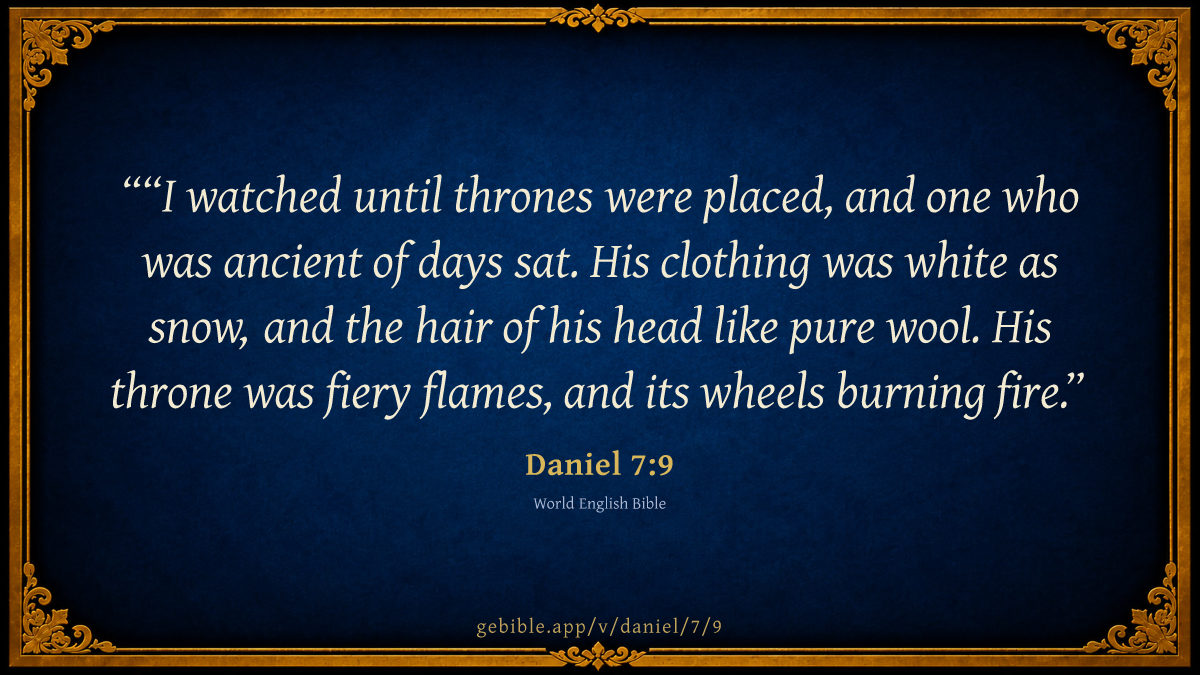
“I watched until thrones were placed, and one who was ancient of days sat. His clothing was white as snow, and the hair of his head like pure wool. His throne was fiery flames, and its wheels burning fire.
Parallel Translations
-
“I watched until thrones were placed, and one who was ancient of days sat. His clothing was white as snow, and the hair of his head like pure wool. His throne was fiery flames, and its wheels burning fire.
-
I beheld till the thrones were cast down, and the Ancient of days did sit, whose garment was white as snow, and the hair of his head like the pure wool: his throne was like the fiery flame, and his wheels as burning fire.
-
I beheld till thrones were placed, and one that was ancient of days did sit: his raiment was as white snow, and the hair of his head like pure wool; his throne was fiery flames, and the wheels thereof burning fire.
Cross-references (25)
Passages linked to Daniel 7:9 in the Treasury of Scripture Knowledge, ordered by reader-vote popularity; verse text shown in World English Bible.
- Revelation 1:14 His head and his hair were white as white wool, like snow. His eyes were like a flame of fire.
- Mark 9:3 His clothing became glistening, exceedingly white, like snow, such as no launderer on earth can whiten them.
- Daniel 7:13 “I saw in the night visions, and behold, there came with the clouds of the sky one like a son of man, and he came even to the ancient of days, and they brought him near before him.
- Matthew 17:2 He was changed before them. His face shone like the sun, and his garments became as white as the light.
- Daniel 7:22 until the ancient of days came, and judgment was given to the saints of the Most High, and the time came that the saints possessed the kingdom.
- Micah 5:2 But you, Bethlehem Ephrathah, being small among the clans of Judah, out of you one will come out to me that is to be ruler in Israel; whose goings out are from of old, from ancient times.
- Revelation 19:18–20:4 that you may eat the flesh of kings, the flesh of captains, the flesh of mighty men, and the flesh of horses and of those who sit on them, and the flesh of all men, both free and slave, small and great.” I saw the beast, and the kings of the earth, and their armies, gathered together to make war against him who sat on the horse, and against his army. The beast was taken, and with him the false prophet who worked the signs in his sight, with which he deceived those who had received the mark of the beast and those who worshiped his image. These two were thrown alive into the lake of fire that burns with sulfur. The rest were killed with the sword of him who sat on the horse, the sword which came out of his mouth. All the birds were filled with their flesh. I saw an angel coming down out of heaven, having the key of the abyss and a great chain in his hand. He seized the dragon, the old serpent, which is the devil and Satan, who deceives the whole inhabited earth, and bound him for a thousand years, and cast him into the abyss, and shut it, and sealed it over him, that he should deceive the nations no more, until the thousand years were finished. After this, he must be freed for a short time. I saw thrones, and they sat on them, and judgment was given to them. I saw the souls of those who had been beheaded for the testimony of Jesus, and for the word of God, and such as didn’t worship the beast nor his image, and didn’t receive the mark on their forehead and on their hand. They lived and reigned with Christ for a thousand years.
- 2 Thessalonians 1:7-8 and to give relief to you who are afflicted with us, when the Lord Jesus is revealed from heaven with his mighty angels in flaming fire, punishing those who don’t know God, and to those who don’t obey the Good News of our Lord Jesus,
- Ezekiel 1:13-21 As for the likeness of the living creatures, their appearance was like burning coals of fire, like the appearance of torches. The fire went up and down among the living creatures. The fire was bright, and lightning went out of the fire. The living creatures ran and returned as the appearance of a flash of lightning. Now as I saw the living creatures, behold, there was one wheel on the earth beside the living creatures, for each of the four faces of it. The appearance of the wheels and their work was like a beryl. The four of them had one likeness. Their appearance and their work was as it were a wheel within a wheel. When they went, they went in their four directions. They didn’t turn when they went. As for their rims, they were high and dreadful; and the four of them had their rims full of eyes all around. When the living creatures went, the wheels went beside them. When the living creatures were lifted up from the earth, the wheels were lifted up. Wherever the spirit was to go, they went. The spirit was to go there. The wheels were lifted up beside them; for the spirit of the living creature was in the wheels. When those went, these went. When those stood, these stood. When those were lifted up from the earth, the wheels were lifted up beside them; for the spirit of the living creature was in the wheels.
- Ezekiel 10:2-7 He spoke to the man clothed in linen, and said, “Go in between the whirling wheels, even under the cherub, and fill both your hands with coals of fire from between the cherubim, and scatter them over the city.” He went in as I watched. Now the cherubim stood on the right side of the house, when the man went in; and the cloud filled the inner court. Yahweh’s glory mounted up from the cherub, and stood over the threshold of the house; and the house was filled with the cloud, and the court was full of the brightness of Yahweh’s glory. The sound of the wings of the cherubim was heard even to the outer court, as the voice of God Almighty when he speaks. It came to pass, when he commanded the man clothed in linen, saying, “Take fire from between the whirling wheels, from between the cherubim,” that he went in, and stood beside a wheel. The cherub stretched out his hand from between the cherubim to the fire that was between the cherubim, and took some of it, and put it into the hands of him who was clothed in linen, who took it and went out.
- Psalms 90:2 Before the mountains were born, before you had formed the earth and the world, even from everlasting to everlasting, you are God.
- Psalms 102:24-25 I said, “My God, don’t take me away in the middle of my days. Your years are throughout all generations. Of old, you laid the foundation of the earth. The heavens are the work of your hands.
- Psalms 104:2-4 He covers himself with light as with a garment. He stretches out the heavens like a curtain. He lays the beams of his rooms in the waters. He makes the clouds his chariot. He walks on the wings of the wind. He makes his messengers winds, and his servants flames of fire.
- Isaiah 9:6 For a child is born to us. A son is given to us; and the government will be on his shoulders. His name will be called Wonderful Counselor, Mighty God, Everlasting Father, Prince of Peace.
- Daniel 2:34-35 You saw until a stone was cut out without hands, which struck the image on its feet that were of iron and clay, and broke them in pieces. Then the iron, the clay, the bronze, the silver, and the gold were broken in pieces together, and became like the chaff of the summer threshing floors. The wind carried them away, so that no place was found for them. The stone that struck the image became a great mountain, and filled the whole earth.
- Daniel 2:44-45 “In the days of those kings the God of heaven will set up a kingdom which will never be destroyed, nor will its sovereignty be left to another people; but it will break in pieces and consume all these kingdoms, and it will stand forever. Because you saw that a stone was cut out of the mountain without hands, and that it broke in pieces the iron, the bronze, the clay, the silver, and the gold; the great God has made known to the king what will happen hereafter. The dream is certain, and its interpretation sure.”
- Habakkuk 1:12 Aren’t you from everlasting, Yahweh my God, my Holy One? We will not die. Yahweh, you have appointed him for judgment. You, Rock, have established him to punish.
- Acts 2:33 Being therefore exalted by the right hand of God, and having received from the Father the promise of the Holy Spirit, he has poured out this, which you now see and hear.
- Philippians 3:9 and be found in him, not having a righteousness of my own, that which is of the law, but that which is through faith in Christ, the righteousness which is from God by faith,
- 2 Peter 3:7-10 But the heavens that exist now and the earth, by the same word have been stored up for fire, being reserved against the day of judgment and destruction of ungodly men. But don’t forget this one thing, beloved, that one day is with the Lord as a thousand years, and a thousand years as one day. The Lord is not slow concerning his promise, as some count slowness; but he is patient with us, not wishing that anyone should perish, but that all should come to repentance. But the day of the Lord will come as a thief in the night; in which the heavens will pass away with a great noise, and the elements will be dissolved with fervent heat, and the earth and the works that are in it will be burned up.
- Psalms 45:8 All your garments smell like myrrh, aloes, and cassia. Out of ivory palaces stringed instruments have made you glad.
- Acts 2:30 Therefore, being a prophet, and knowing that God had sworn with an oath to him that of the fruit of his body, according to the flesh, he would raise up the Christ to sit on his throne,
- 1 Corinthians 15:24-25 Then the end comes, when he will deliver up the Kingdom to God, even the Father, when he will have abolished all rule and all authority and power. For he must reign until he has put all his enemies under his feet.
- 1 Timothy 6:16 He alone has immortality, dwelling in unapproachable light, whom no man has seen, nor can see: to whom be honor and eternal power. Amen.
- 1 John 1:5 This is the message which we have heard from him and announce to you, that God is light, and in him is no darkness at all.
Cross-references from openbible.info (CC BY 4.0)
Explain this verse (20 sources)
Historical commentary, presented as a primary source — not an endorsement.
Private notes
Saved on this device only — never synced or sent anywhere.
John Calvin 1540 · Public Domain Daniel now relates how he saw another figure, namely,…
Daniel now relates how he saw another figure, namely, God sitting on his throne to exercise judgment. We shall see it afterwards concerning Christ, but Daniel now teaches only the appearance of God in his character of a judge. This was the reason why many persons extend this prophecy to the second Advent of Christ — an interpretation by no means correct, as I shall show more copiously in the proper place. But first it is worth while to consider here, why he says — the Ancient of days, meaning the eternal Deity himself, ascended the throne judgment. This scene seems unnecessary, because it is the peculiar office of God to govern the world; and as we know this cannot be done without upright judgment, it follows that God has been a perpetual judge from the creation of the world. Now, even a moderate acquaintance with the Scriptures shows how well this passage suits us by appealing to our senses; for unless God’s power is made conspicuous, we think it either abolished or interrupted. Hence those forms of expression which occur elsewhere; as, “How long art thou silent, O Lord; and how long wilt thou cease from us?” (Psalm 13:1; Psalm 9:7, and elsewhere,) and — God ascends his throne — for we should not acknowledge him as a judge, unless he really and experimentally proved himself such. This then is the reason why Daniel says God himself was seated in judgment.
But before we proceed further, we must observe the sense in which he says — thrones were either erected or east down — for the word רום, rum can be taken in either sense. Those who translate it, “Thrones were removed,” interpret it of the Four monarchies already mentioned. But; for my part, I rather incline to a different opinion. If any one prefers explaining’ it of these Monarchies, I do not contend with him, for that; sense is probable; and as far as the pith of the matter is concerned, there is not much difference. But I think the thrones or seats are here proceed to exhibit; the divine judgment, because the Prophet will immediately’ represent myriads of angels standing before God. We know’ how often angels are adorned with this title as if they were, assessors of Deity; and the form of speech which Daniel uses when he says, “The judgment was set,” will also agree with this. He speaks here of assessors with the judge, as if God did not sit alone, but had councilors joined with him. In my opinion the most suitable explanation is, — thrones were created for the Almighty to sit on with his councilors; not implying his need of any council, but of his own goodwill and mere favor he dignifies angels with this honor, as we shall see immediately. Daniel therefore describes, after our human fashion, the preparations for judgment; just as if any king should go publicly forth for the purpose of transacting any business of moment, and should ascend his tribunal. Councilors and nobles would sit around him on both sides, not partaking of his power, but rather increasing the splendor of his appearance. For if the king alone should occupy the whole place, the dignity would not be so magnificent as when his nobles, who depend upon him, are present on all sides, because they far surpass the ordinary multitude. Daniel, therefore, relates the vision presented to him in this form; first, ‘because he was a man dwelling in the flesh; and next, he did not see it for himself personally, but for the common benefit of the whole Church. Thus God wished to exhibit a representation which might infuse into the Prophet’s mind and into those of all the pious, a feeling of admiration, and yet might have something in common with human proceedings. Thrones, therefore, he says, were erected; afterwards, the Ancient of days was seated. I have already expounded how God then began to seat himself, as he had previously appeared to be passive, and not to exercise justice in the world. For when things are disturbed and mingled with much darkness, who can say, “God reigns?” God seems to be shut up in heaven, when things are discomposed and turbulent upon earth. On the other hand, he is said to ascend his tribunal when he assumes to himself the office of a judge, and openly demonstrates that he is neither asleep nor absent, although he lies hid from human perception.
Read full note →
This form of speech was very appropriate for denoting the coming of Christ. For God then chiefly displayed his supreme power, as Paul quotes a passage from the Psalms, (Psalm 68:8, in Ephesians 4:8,) “Thou hast ascended on high.” When the subject treated is the first coming of Christ, it ought not to be restricted to the thirty-three years of his sojourn in the world, but it embraces his ascension, and that preaching of the gospel which ushered in his kingdom;-this will be said again more clearly and copiously. Daniel appropriately relates how God was seated when the first advent of Christ is depicted, since the majesty of God shone in the person of Christ; for which reason he is called
“The invisible image of God and the character of his glory,” (Hebrews 1:3;)
that is, of the substance or person of the Father. God therefore, who had seemed for so many ages not to notice the world nor to care for his elect people, ascended his tribunal at the advent of Christ. To this subject the Psalms, from the 95th to the 100th, all relate — “God reigns, let the earth rejoice;” “God reigns, let the islands be afraid.” In truth, God had not dwelt in complete privacy before Christ’s advent; but. the empire which he had erected was hidden and unseen, until he showed forth his glory in the person of his only begotten Son. The Ancient of days, therefore, was seated
He now says, His raiment was white like snow the hair of his head was like pure wool. God here shows himself to his Prophet in the form of man. We know how impossible it is for us to behold God as he really exists, till we ourselves become like Him, as John says in his canonical epistle. (1 John 3:2.) As our capacity cannot endure the fullness of that surpassing glory which essentially belongs to God, whenever he appears to us, he must necessarily put on a form adapted to our comprehension. God, therefore, was never seen by the fathers in his own natural perfection; but as far as their capacities allowed, he afforded them a taste of his presence for the sure acknowledgment of his Deity; and yet they comprehended him as far as it was useful for them and they were able to bear it. This is the reason why God appeared with a white garment, which is characteristic of heaven; and with snowy hair, like white and clean wool. To the same purpose is the following: His throne was like sparks of fire, that is, like glowing fire; his wheels were like burning fire. God in reality neither occupies any throne, nor is carried on wheels; but, as I already said, we ought not to imagine God in his essence to be like any appearance, to his own Prophet and other holy fathers, but he put on various appearances, according to man’s comprehension, to whom he wished to give some signs of his presence. I need not dwell longer on these forms of speech, though subtle allegories are pleasing to many. I am satisfied with holding what is solid and sure. It now follows: —
John Calvin's Commentaries (1540-1563) — public domain. Text from the Calvin Translation Society English edition (1840s-50s) via the Christian Classics Ethereal Library (ccel.org). Calvin's coverage is partial (roughly two-thirds of the Bible); uncommented books and verses are honest gaps, never fabricated. The 19th-century editor's footnotes and remarks are omitted so the notes are faithfully Calvin's own voice.
Geneva Bible translators 1599 · Public Domain Meaning, the places where God and his Angels should…
Meaning, the places where God and his Angels should come to judge these Monarchies, which judgment should begin at the first coming of Christ.
That is, God which was before all times, and is here described as man’s nature is able to comprehend some portion of his glory.
Geneva Bible (1599) marginal notes — public domain.
John Trapp 1656 · Public Domain Dan 7:9 I beheld till the thrones were cast…
Dan 7:9 I beheld till the thrones were cast down, and the Ancient of days did sit, whose garment [was] white as snow, and the hair of his head like the pure wool: his throne [was like] the fiery flame, [and] his wheels [as] burning fire.
Ver. 9. I beheld till the thrones were cast down.] All these tyrannous dominions overturned. Some read it, "till the thrones were set up"; for till the last judgment Antichrist is to continue. {Dan 7:21-22; Dan 7:25-26}
Read full note →
And the Ancient of days did sit,] i.e., God Almighty, whom Thales, also a heathen philosopher, called πρεσβυτατον των οντων, the most ancient of all that are. {a} The poets say also that Saturn, the father of their gods, had his name from his fulness of years, {b} God’s eternity and wisdom is set forth; by this title here, like as also is, by his "white garments," his majesty and authority; by his "hair as pure wool," his innocence and integrity in judgment; by his "throne like the fiery flame," his just anger and severity, against the man of sin especially; by his "wheels" - or the wheels thereof, viz., of his throne; for princes’ thrones used in those days to be set upon wheels - "as burning fire" is set forth his facility and dexterity in executing his judgments, his efficacy also, since all things are fiery.
{a} Laert. in Vit. Thalet.
{b} Saturnus est appellatus quod saturetur annis. - Cic, de Nat. Deor., lib. ii.
John Trapp, A Commentary or Exposition upon All the Books of the Old and New Testament (1647–1656) — public domain. Text from a community e-Sword module.
Matthew Poole 1685 · Public Domain thrones cast down must be meant the kingdoms of…
By
thrones cast down must be meant the kingdoms of this world, destroyed by Christ the King and Judge of all, called the Ancient of days, because of his eternal Deity;
Read full note →
without beginning and end of days. Whose garment was white as snow; thus kings’ viceroys were clothed, as Joseph in fine silk, Gen 41:42, and Mordecai, Est 8:15.
The hair of his head like the pure wool; see Rev 1:14; noting his innocence, and righteousness in judgment, Isa 42:4.
His throne was like the fiery flame: this notes his majesty in judgment: see Psa 1:3,4; Mal 4:1; Rev 19:11,12.
His wheels as burning fire; arguing the greatest and most formidable state of the last Judge and judgment; alluding to the kings who had movable thrones, which had wheels: it notes also God’s swiftness in judgment, Mal 3:5.
Matthew Poole's English Annotations on the Holy Bible (1683–1685) — public domain. Text from a community e-Sword/MySword module.
Matthew Henry 1710 · Public Domain Whether we understand the fourth beast to signify the…
Whether we understand the fourth beast to signify the Syrian empire, or the Roman, or the former as the figure of the latter, it is plain that these verses are intended for the comfort and support of the people of God in reference to the persecutions they were likely to sustain both from the one and from the other, and from all their proud enemies in every age; for it is written for their learning on whom the ends of the world have come, that they also, through patience and comfort of this scripture, might have hope. Three things are here discovered that are very encouraging: -
I. That there is a judgment to come, and God is the Judge. Now men have their day, and every pretender thinks he should have his day, and struggles for it. But he that sits in heaven laughs at them, for he sees that his day is coming, Psa 37:13. I beheld (Dan 7:9) till the thrones were cast down, not only the thrones of these beasts, but all rule, authority, power, that are set up in opposition to the kingdom of God among men (Co1 15:24): such are the thrones of the kingdoms of the world, in comparison with God's kingdom; those that see them set up need but wait awhile, and they will see them cast down. I beheld till thrones were set up (so it may as well be read), Christ's throne and the throne of his Father. One of the rabbin confesses that these thrones are set up, one for God, another for the Son of David. It is the judgment that is here set, Dan 7:10. Now, 1. This is intended to proclaim God's wise and righteous government of the world by his providence; and an unspeakable satisfaction it gives to all good men, in the midst of the convulsions and revolutions of states and kingdoms, that the Lord has prepared his throne in the heavens and his kingdom rules over all (Psa 103:19), that verily there is a God that judges in the earth, Psa 58:11. 2. Perhaps it points at the destruction brought by the providence of God upon the empire of Syria, or that of Rome, for their tyrannizing over the people of God. But, 3. It seems principally designed to describe the last judgment, for though it follow not immediately upon the dominion of the fourth beast, nay, though it be yet to come, perhaps many ages to come, yet it was intended that in every age the people of God should encourage themselves, under their troubles, with the belief and prospect of it. Enoch, the seventh from Adam, prophesied of it, Jde 1:14. Does the mouth of the enemy speak great things, Dan 7:8. Here are far greater things which the mouth of the Lord has spoken. Many of the New Testament predictions of the judgment to come have a plain allusion to this vision, especially St John's vision of it, Rev 20:11, Rev 20:12. (1.) The Judge is the Ancient of days himself, God the Father, the glory of whose presence is here described. He is called the Ancient of days, because he is God from everlasting to everlasting. Among men we reckon that with the ancient is wisdom, and days shall speak; shall not all flesh then be silent before him who is the Ancient of days? The glory of the Judge is here set forth by his garment, which was white as snow, denoting his splendour and purity in all the administrations of his justice; and the hair of his head clean and white, as the pure wool, that, as the white and hoary head, he may appear venerable. (2.) The throne is very formidable. It is like the fiery flame, dreadful to the wicked that shall be summoned before it. And the throne being movable upon wheels, or at least the chariot in which he rode the circuit, the wheels thereof are as burning fire, to devour the adversaries; for our God is a consuming fire, and with him are everlasting burnings, Isa 33:14. This is enlarged upon, Dan 7:10. As to all his faithful friends there proceeds out of the throne of God and the Lamb a pure river of water of life (Rev 22:1), so to all his implacable enemies there issues and comes forth from his throne a fiery stream, a stream of brimstone (Isa 30:33), a fire that shall devour before him. He is a swift witness, and his word a word upon the wheels. (3.) The attendants are numerous and very splendid. The Shechinah is always attended with angels; it is so here (Dan 7:10): Thousand thousands minister to him, and ten thousand times ten thousand stand before him. It is his glory that he has such attendants, but much more his glory that he neither needs them nor can be benefited by them. See how numerous the heavenly hosts are (there are thousands of angels), and how obsequious they are - they stand before God, ready to go on his errands and to take the first intimation of his will and pleasure. They will particularly be employed as ministers of his justice in the last judgment day, when the Son of man shall come, and all the holy angels with him. Enoch prophesied that the Lord should come with his holy myriads. (4.) The process is fair and unexceptionable: The judgment is set, publicly and openly, that all may have recourse to it; and the books are opened. As in courts of judgment among men the proceedings are in writing and upon record, which is laid open when the cause comes to a hearing, the examination of witnesses is produced, and affidavits are read, to clear the matter of fact, and the statute and common-law books are consulted to find out what is the law, so, in the judgment of the great day, the equity of the sentence will be as incontestably evident as if there were books opened to justify it.
Read full note →
II. That the proud and cruel enemies of the church of God will certainly be reckoned with and brought down in due time, Dan 7:11, Dan 7:12. This is here represented to us, 1. In the destroying of the fourth beast. God's quarrel with this beast is because of the voice of the great words which the horn spoke, bidding defiance to Heaven, and triumphing over all that is sacred; this provokes God more than any thing, for the enemy to behave himself proudly, Deu 32:27. Therefore Pharaoh must be humbled, because he has said, Who is the Lord? and has said, I will pursue, I will overtake. Enoch foretold that therefore the Lord would come to judge the world, that he might convince all that are ungodly of their hard speeches, Jde 1:15. Note, Great words are but idle words, for which men must give account in the great day. And see what becomes of this beast that talks so big: He is slain, and his body destroyed and given to the burning flame. The Syrian empire, after Antiochus, was destroyed. He himself died of a miserable disease, his family was rooted out, the kingdom wasted by the Parthians and Armenians, and at length made a province of the Roman empire by Pompey. And the Roman empire itself (if we take that for the fourth beast), after it began to persecute Christianity, declined and wasted away, and the body of it was destroyed. So shall all thy enemies perish, O Lord! and be slain before thee. 2. In the diminishing and weakening of the other three beasts (Dan 7:12): They had their dominion taken away, and so were disabled from doing the mischiefs they had done to the church and people of God; but a prolonging in life was given them, for a time and a season, a set time, the bounds of which they could not pass. The power of the foregoing kingdoms was quite broken, but the people of them still remained in a mean, weak, and low condition. We may allude to this in describing the remainders of sin in the hearts of good people; they have corruptions in them, the lives of which are prolonged, so that they are not perfectly free from sin, but the dominion of them is taken away, so that sin does not reign in their mortal bodies. And thus God deals with his church's enemies; sometimes he breaks the teeth of them (Psa 3:7), when he does not break the neck of them, crushes the persecution, but reprieves the persecutors, that they may have space to repent. And it is fit that God, in doing his own work, should take his own time and way.
III. That the kingdom of the Messiah shall be set up, and kept up, in the world, in spite of all the opposition of the powers of darkness. Let the heathen rage and fret as long as they please, God will set his King upon his holy hill of Zion. Daniel sees this in vision, and comforts himself and his friends with the prospect of it. This is the same with Nebuchadnezzar's foresight of the stone cut out of the mountain without hands, which broke in pieces the image; but in this vision there is much more of pure gospel than in that. 1. The Messiah is here called the Son of man - one like unto the Son of man; for he was made in the likeness of sinful flesh, was found in fashion as a man. I saw one like unto the Son of man, one exactly agreeing with the idea formed in the divine counsels of him that in the fulness of time was to be the Mediator between God and man. He is like unto the son of man, but is indeed the Son of God. Our Savior seems plainly to refer to this vision when he says (Joh 5:27) that the Father has therefore given him authority to execute judgment because he is the Son of man, and because he is the person whom Daniel saw in vision, to whom a kingdom and dominion were to be given. 2. He is said to come with the clouds of heaven. Some refer this to his incarnation; he descended in the clouds of heaven, came into the world unseen, as the glory of the Lord took possession of the temple in a cloud. The empires of the world were beasts that rose out of the sea; but Christ's kingdom is from above: he is the Lord from heaven. I think it is rather to be referred to his ascension; when he returned to the Father the eye of his disciples followed him, till a cloud received him out of their sight, Act 1:9. He made that cloud his chariot, wherein he rode triumphantly to the upper world. He comes swiftly, irresistibly, and comes in state, for he comes with the clouds of heaven. 3. He is here represented as having a mighty interest in Heaven. When the cloud received him out of the sight of his disciples, it is worth while to enquire (as the sons of the prophets concerning Elijah in a like case) whither it carried him, where it lodged him; and here we are told, abundantly to our satisfaction, that he came to the Ancient of days; for he ascended to his Father and our Father, to his God and our God (Joh 20:17); from him he came forth, and to him he returns, to be glorified with him, and to sit down at his right hand. It was with a great deal of pleasure that he said, Now I go to him that sent me. But was he welcome? Yes, not doubt, he was, for they brought him near before him; he was introduced into his Father's presence, with the attendance and adorations of all the angels of God, Heb 1:6. God caused him to draw near and approach to him, as an advocate and undertaker for us (Jer 30:21), that we through him might be made nigh. By this solemn near approach which he made to the Ancient of days it appears that the Father accepted the sacrifice he offered, and the satisfaction he made, and was entirely well pleased with all he had done. He was brought near, as our high priest, who for us enters within the veil, and as our forerunner, 4. He is here represented as having a mighty influence upon this earth, Dan 7:14. When he went to be glorified with his Father he had a power given him over all flesh, Joh 17:2, Joh 17:5. With the prospect of this Daniel and his friends are here comforted, that not only the dominion of the church's enemies shall be taken away (Dan 7:12), but the church's head and best friend shall have the dominion given him; to him every knee shall bow and every tongue confess. Phi 2:9, Phi 2:10. To him are given glory and a kingdom, and they are given by him who has an unquestionable right to give them, which, some think with an eye to these words, our Savior teaches us to acknowledge in the close of the Lord's prayer, For thine is the kingdom, the power, and the glory. It is here foretold that the kingdom of the exalted Redeemer shall be, (1.) A universal kingdom, the only universal monarchy, whatever others have pretended to, or aimed at: All people, nations, and languages, shall fear him, and be under his jurisdiction, either as his willing subjects or as his conquered captives, to be either ruled or overruled by him. One way or other, the kingdoms of the world shall all become his kingdoms. (2.) An everlasting kingdom. His dominion shall not pass away to any successor, much less to any invader, and his kingdom is that which shall bot be destroyed. Even the gates of hell, or the infernal powers and policies, shall not prevail against it. The church shall continue militant to the end of time, and triumphant to the endless ages of eternity.
Matthew Henry's Commentary on the Whole Bible (1708–1710) — public domain (CC PDM 1.0). Text via the HelloAO Bible API.
John Gill 1763 · Public Domain I beheld till the thrones were cast down,.... On…
I beheld till the thrones were cast down,.... On which the governors of the above monarchies sat; and those of the ten kings, signified by the ten horns; and also that of the little horn. The prophet kept looking on the objects before him, till he in his dream, and the visions of the night, saw all those empires and kingdoms demolished, and all rule, power, and authority, put down, and way made for the glorious kingdom of the Messiah, and his saints with him; to this sense Aben Ezra, Saadiah, and Jacchiades, interpret the word used; but the Septuagint, Vulgate Latin, Syriac, and Arabic versions, render it, "until the thrones were set up" (q); for the judges to sit upon to try, judge, and condemn the four beasts or monarchies; in order to make way for the kingdom of the Son of man to take place in the spirituality and glory of it: here are more thrones than one; see Rev 20:4, one for the Ancient of days, and another for him who was like to the Son of man, brought near before him; and so the Jews (r) say, here were two thrones pitched and prepared, one for the Ancient of days, and another for David, that is, the Messiah, or Son of David; and so Jarchi paraphrases the words,
"the thrones were pitched and prepared to sit upon in judgment:''
Read full note →
and this sense is confirmed by the use of the word in Ezr 7:24 and in the Targum on Kg2 18:14 and to this agrees best the following clause:
and the Ancient of days did sit; on one of the thrones pitched, as chief Judge: this is to be understood of God the Father, as distinct from the Messiah, the Son of God, said to be like the Son of man brought unto him, Dan 7:13 and is so called, not only because he is from everlasting, and without beginning of days; but chiefly because he is permanent, and endures for ever; his years fail not, and of his days there will be no end; and he will be when these empires, signified by the four beasts, will be no more; and very fit to be Judge of them, because of his consummate wisdom and prudence, signified also by this phrase; and the divine Father of Christ is still more proper, because it is in Christ's cause the judgment will proceed; and this in order to introduce him openly into his dominions in the world:
whose garment was white as snow; denoting the purity of his nature, the brightness of his majesty, and his uncorruptness in judgment:
and the hair of his head like the pure wool; signifying his venerableness, gravity, wisdom, and ripeness of judgment; being wonderful in counsel, and excellent in working:
his throne was like the fiery flame; expressive of him, as awful and formidable, as a consuming fire; and of his piercing judgment, and the severity of it:
and his wheels as burning fire; the wheels of his throne; alluding to such seats and thrones as were made to turn about, and to be moved from place to place; denoting the power and providence of God everywhere; the clear view he has of all things, in all places; and his swiftness in the execution of his judgments.
(q) "subsellia posita sunt", Tigurine version; "solia posita sunt", Piscator, Cocceius; "throni elati sunt", Pagninus, Montanus. (r) T. Bab. Chagiga, fol. 14. 1. & Gloss in ib.
John Gill's Exposition of the Whole Bible (1746–1763) — public domain (CC PDM 1.0). Text via the HelloAO Bible API.
John Wesley 1765 · Public Domain The thrones - The kingdoms of this world were…
The thrones - The kingdoms of this world were destroyed by God the king, and judge of all, called the Ancient of days, because of his eternal deity.
John Wesley, Explanatory Notes Upon the Whole Bible (1754–1765) — public domain. Text via the GEBible commentary corpus.
Adam Clarke 1810 · Public Domain Verse 9. The thrones were cast down] דמיו might…
Verse 9. The thrones were cast down] דמיו might be translated erected, so the Vulgate, positi sunt, and so all the versions; but that ours is a proper translation, is sufficiently evident from Da 3:6; Da 3:16; Da 3:20; Da 6:17, c. where the original word can be used in no other sense than that of throwing or casting down. There is a reference here to preparations made for a general assize, or to the convocation of the sanhedrin, where the father of the consistory sat with his assessors on each side in the form of a semicircle, and the people stood before them.
The Ancient of days] God Almighty; and this is the only place in the sacred writings where God the Father is represented in a human form.
Adam Clarke's Commentary on the Bible (1810–1826) — public domain. Text from a community e-Sword/MySword module.
Joseph Benson 1811 · Public Domain Dan 7:9-10. I beheld till the thrones were cast…
Dan 7:9-10. I beheld till the thrones were cast down — Till all these earthly kingdoms were brought to an end, and all enemies and opposite powers were destroyed. But the word רמיו, here used, maybe rendered, were pitched, or placed, namely, for the reception of God, and his assessors in judgment, the saints and angels. Thus the LXX., εως οτου οι θρονοι ετεθησαν, till the thrones were placed, or set, or fixed; and so the Vulgate. And the verb in the text is used in the same sense in the Chaldee paraphrase on Jer 1:15; where our translation reads, They shall set every one his throne, &c. The following words justify this translation; And the Ancient of days did sit — That is, the eternal Judge of the world, who has been from everlasting, who is at present, and who shall always be: and whom the prophet thus describes, to adapt himself to human apprehensions, and to make the following part of his description more intelligible; but no similitude is pointed out, nor ought we from hence to attempt to represent the invisible God by any figure. The metaphors here used, says Bishop Newton, “are borrowed from the solemnities of earthly judicatories, and particularly of the great sanhedrim of the Jews, where the father of the consistory sat, with his assessors seated on each side of him, in the form of a semicircle, with the people standing before him: and from this description again was borrowed the description of the day of judgment in the New Testament.” Whose garment was white as snow — Signifying the unspotted righteousness of his proceedings. He is elsewhere described as covering himself with light as with a garment, Psa 104:2 : see also 1Jn 1:5. Kings and princes used anciently to wear white garments, as an emblem of perfect justice. And the hair of his head like the pure wool — To denote the eternity and maturity of his counsels, and that his decisions are all perfectly right and true, without the least mixture of any partial affections. His throne was like the fiery flame — Denoting his awful majesty, and the severity of his judgments on the ungodly; and his wheels of burning fire — Emblematical of the revolutions and dispensations of his providence, Eze 1:15, being dreadfully severe and destructive to the wicked. The reader will observe, God’s throne is here described in the nature of a triumphal chariot, supported by angels as so many fiery wheels. Grotius remarks, that the ancient thrones and sellæ curules had wheels. A fiery stream issued and came forth from before him — Signifying his justice and wrath in giving forth and executing sentence against the ungodly. Thousand thousands ministered unto him — His retinue was an innumerable company of angels; and ten thousand times ten thousand stood before him — To receive their sentence from his lips. The judgment was set — That is, the court, namely, God the supreme judge, and the saints as his assessors, made their public appearance. And the books were opened — That is, “those evidences which contained the laws and will of God, whether natural or revealed; those in which the actions of men, with all their circumstances of aggravation or extenuation were recorded; those from which the clearest and completest conviction might be adduced, in order to render the judgment such as that all should be obliged to acknowledge it to be the result of the most perfect truth and consummate justice: see Rev 20:12.” — Wintle.
Joseph Benson's Commentary on the Old and New Testaments (1811–1818) — public domain. Text from a community e-Sword module.
Albert Barnes 1834 · Public Domain I beheld - “I continued looking on these strange…
I beheld - “I continued looking on these strange sights, and contemplating these transformations.” This implies that some time elapsed before all these things had occurred. He looked on until he saw a solemn judgment passed on this fourth beast particularly, as if God had come forth in his majesty and glory to pronounce that judgment, and to bring the power and arrogance of the beast to an end.
Till the thrones were cast down - The Chaldee word (כרסון kâresâvân) means, properly, thrones - seats on which monarchs sit. So far as the word is concerned, it would apply either to a throne occupied by an earthly monarch, or to the throne of God. The use of the plural here would seem to imply, at least, that the reference is not to the throne of God, but to some other throne. Maurer and Lengerke suppose that the allusion is to the thrones on which the celestial beings sat in the solemn judgment that was to be pronounced - the throne of God, and the thrones or seats of the attending inhabitants of heaven, coming with him to the solemn judgment. Lengerke refers for illustration to 1Ki 22:19; Isa 6:1; Job 1:6, and Rev 5:11-12. But the word itself might be properly applied to the thrones of earthly monarchs as well as to the throne of God. The phrase “were cast down” (רמיו remı̂yv), in our translation, would seem to suppose that there was some throwing down, or overturning of thrones, at this period, and that the solemn judgment would follow this, or be consequent on this.
Read full note →
The Chaldee word (רמא remâh) means, as explained by Gesenius, to cast, to throw Dan 3:21, Dan 3:24; Dan 6:16-17; to set, to place, e. g., thrones; to impose tribute Ezr 7:24. The passage is rendered by the Latin Vulgate, throni positi sunt - “thrones were placed;” by the Greek, ἐτέθησαν etethēsan - “were placed.” So Luther, stuhle gesetzt; and so Lengerke, stuhle aufgestellt - the thrones were placed, or set up. The proper meaning, therefore, of the phrase would seem to be - not, as in our translation, that the “thrones would be cast down” - as if there was to be an overturning of thrones on the earth to mark this particular period of history - but that there was, in the vision, a setting up, or a placing of thrones for the purpose of administering judgment, etc., on the beast. The use of the plural is, doubtless, in accordance with the language elsewhere employed, to denote the fact that the great Judge would be surrounded with others who would be, as it were, associated in administering justice - either angels or redeemed spirits.
Nothing is more common in the Scripture than to represent others as thus associated with God in pronouncing judgment on men. Compare Mat 19:28; Luk 22:30; 1Co 6:2-3; 1Ti 5:21; Rev 2:26; Rev 4:4. The era, or period, therefore, marked here, would be when a solemn Divine judgment was to be passed on the “beast,” or when some events were to take place, as if such a judgment were pronounced. The events pertaining to the fourth beast were to be the last in the series preparatory to the reign of the saints, or the setting up of the kingdom of the Messiah, and therefore it is introduced in this manner, as if a solemn judgment scene were to occur.
And the Ancient of days did sit - Was seated for the purposes of judgment. The phrase “Ancient of days” - יומין עתיק ‛attı̂yq yômı̂yn - is one that denotes an elderly or old person; meaning, he who is most ancient as to days, and is equivalent to the French L’Eternel, or English, The Eternal. It occurs only in Dan 7:9, Dan 7:13, Dan 7:22, and is a representation of one venerable in years, sitting down for the purposes of judgment. The appellation does not of itself denote eternity, but it is employed, probably, with reference to the fact that God is eternal. God is often represented under some such appellation, as he that is “from everlasting to everlasting” Psa 90:2, “the first and the last” Isa 44:6, etc. There can be no doubt that the reference here is to God as a Judge, or as about to pronounce judgment, though there is no necessity for supposing that it will be in a visible and literal form, anymore than there is for supposing that all that is here represented by symbols will literally take place.
If it should be insisted on that the proper interpretation demands that there will be a literal and visible judgment, such as is here described, it may be replied that the same rigid interpretation would demand that there will be a literal “slaying of the beast, and a giving of his body to the flame” Dan 7:11, and more generally still, that all that is here referred to by symbols will literally occur. The fact, however, is, that all these events are referred to by symbols - symbols which have an expressive meaning, but which, by their very nature and design, are not to be literally understood. All that is fairly implied here is, that events would occur in regard to this fourth beast as if God should sit in solemn judgment on it, and should condemn it in the manner here referred to. We are, doubtless, in the fulfillment of this - to look for some event that will be of so decisive and marked a character, that it may be regarded as a Divine judgment in the case, or that will show the strongly marked Divine disapprobation - as really as if the judgment-seat were formally set, and God should appear in majesty to give sentence. Sitting was the usual posture among the ancients, as it is among the moderns, in pronouncing judgment. Among the ancients the judge sat on a throne or bench while the parties stood before him (compare Zec 4:13), and with the Greeks and Romans so essential was the sitting posture for a judge, that a sentence pronounced in any other posture was not valid. - Lengerke. It was a maxim, Animus sedendo magis sapit; or, as Servius on the AEn. i. 56, remarks, Est enim curantis et solliciti sedere.
Whose garment was white as snow - Whose robe. The reference here is to the long flowing robe that was worn by ancient princes, noblemen, or priests. See the notes at Isa 6:1. Compare the notes at Rev 1:13. White was an emblem of purity and honor, and was not an improper symbol of the purity of the judge, and of the justness of the sentence which he would pronounce. So the elder Pitt, in his celebrated speech against employing Indians in the war with the American people, besought the bishops to “interpose the unsullied purity of their lawn.” Lengerke supposes, as Prof. Stuart does on Rev 1:13, that the whiteness here referred to was not the mere color of the material of which the robe was made, but, was a celestial splendor or brightness, as if it were lightning or fire - such as is appropriate to the Divine Majesty. Lengerke refers here to Exo 19:18-24; Dan 2:22; Mat 17:2; 1Ti 6:16; 2 Esdras 7:55; Ascension of Isa 8:21-25; Rev 1:13-14; Rev 4:2-4. But the more correct interpretation is to suppose that this refers to a pure white robe, such as judges might wear, and which would not be an improper symbol of their office.
And the hair of his head like the pure wool - That is, for whiteness - a characteristic of venerable age. Compare the notes at Rev 1:14. The image here set before us is that of one venerable by years and wisdom.
His throne was like the fiery flame - The seat on which he sat seemed to be fire. That is, it was brilliant and splendid, as if it were a mass of flame.
And his wheels as burning fire - The wheels of his throne - for, as in Ezek. 1; 10, the throne on which Jehovah sat appeared to be on wheels. In Ezekiel Eze 1:16; Eze 10:9, the wheels of the throne appeared to be of the color of beryl; that is, they were like precious stones. Here, perhaps, they had only the appearance of a flame - as such wheels would seem to flash flames. So, Milton, in describing the chariot of the Son of God:
“Forth rush’d with whirlwind sound
The chariot of Paternal Deity,
Flashing thick flames, wheel within wheel undrawn,
Itself instinct with spirit, but convoyed
By four cherubic shapes; four faces each
Had wondrous; as with stars their bodies all,
And wings were set with eyes; with eyes the wheels
Of beryl, and careering fires between.”
- Par. Lost, b. vi.
Albert Barnes' Notes on the Bible (1834–1885) — public domain. Text from a community e-Sword/MySword module.
Haydock's Catholic Bible Commentary 1859 · Public Domain Ancient. The Son is born of the Father, and…
Ancient. The Son is born of the Father, and the Holy Ghost proceeds from both, yet all three are coeternal. (Worthington) --- Hence the Father is sometimes painted in this manner, though he be a pure spirit. His throne resembled that seen by Ezechiel, Chap. i. (Haydock) --- He takes cognizance of all, and punishes accordingly. (Calmet)
George Leo Haydock (1774–1849), Haydock's Catholic Family Bible and Commentary, 1859 edition — public domain. Excludes Psalms (Douay-Rheims chapter numbering differs from Protestant) and Deuterocanonical books (Catholic canon only).
Robert Jamieson, A. R. Fausset & David Brown 1871 · Public Domain I beheld till--I continued looking till.
I beheld till--I continued looking till.
thrones . . . cast down--rather, "thrones were placed" [Vulgate and LUTHER], namely, for the saints and elect angels to whom "judgment is given" (Dan 7:22), as assessors with the Judge. Compare Dan 7:10, "thousand thousands ministered unto Him" (Mat 19:28; Luk 22:30; Co1 6:2-3; Ti1 5:21; Rev 2:26; Rev 4:4). In English Version the thrones cast down are those of the previously mentioned kings who give place to Messiah.
Read full note →
Ancient of days--"The everlasting Father" (Isa 9:6). HE is the Judge here, as THE SON does not judge in His own cause, and it is His cause which is the one at issue with Antichrist.
sit--the attitude of a judge about to pass sentence.
white--The judicial purity of the Judge, and of all things round Him, is hereby expressed (Rev 1:14).
wheels--as Oriental thrones move on wheels. Like the rapid flame, God's judgments are most swift in falling where He wills them (Eze 1:15-16). The judgment here is not the last judgment, for then there will be no beast, and heaven and earth shall have passed away; but it is that on Antichrist (the last development of the fourth kingdom), typical of the last judgment: Christ coming to substitute the millennial kingdom of glory for that of the cross (Rev 17:12-14; Rev 19:15-21; Rev 11:15).
Jamieson, Fausset & Brown — Commentary Critical and Explanatory on the Whole Bible (1871) — public domain (CC PDM 1.0). Text via the HelloAO Bible API.
Daniel D. Whedon 1874 · Public Domain 9. Thrones were cast down — Literally, thrones were…
9. Thrones were cast down — Literally, thrones were placed. This “Ancient of the Day” (Meinhold) is a new name for Jehovah, expressing the well-recognized idea of his eternity (Psa_90:2; Psa_93:2), while the color of his hair and garments symbolizes the purity and holiness of the Judge who lives in light and who is enthroned upon cycles of flame. (Compare, especially notes, Ezekiel 1, 10; Psa_18:9-14.)
Daniel D. Whedon (gen. ed.), Commentary on the Old and New Testaments (1874–1909) — public domain. Text from a community e-Sword module.
The Cambridge Bible for Schools and Colleges 1878 · Public Domain 9. till thrones were placed (R.V.)] for the angelic…
9. till thrones were placed (R.V.)] for the angelic assessors of the Judge, who are not further mentioned, but who are naturally to be distinguished from the hosts which ‘stand,’ ministering before Him, in Dan_7:10. A.V. means, ‘till the thrones of the Gentile powers were overthrown’; but the rendering of R.V. is much preferable. Exactly the same expression occurs in the Targ. of Jer_1:15, ‘and they shall cast down (i.e. set down, place) each his throne in front of the gates of Jerusalem.’
the Ancient of days] The expression does not mean what the English words seem to imply, one who had existed from the days of eternity; it means simply an aged man; and the R.V., one that was ancient of days, is meant to indicate this. Exactly the same expression occurs in the Syriac version of Wis_2:10 for an ‘old man,’ and in Sir_25:4 (in the plural) for ‘elders.’ ‘What Daniel sees is not the eternal God Himself, but an aged man, in whose dignified and impressive form God reveals Himself: cf. Eze_1:26’ (Keil).
Read full note →
his raiment was white as snow] symbolizing purity (Isa_1:18; Psa_51:7). The white hair would have the same symbolism, though this would be natural independently in an aged man. The imagery of Rev_1:14 is derived from the present passage.
like pure wool] The imagery of the visions in the Book of Enoch is based largely upon that of the present passage of Daniel. With the words quoted, cf. Enoch xlvi. 1 (cited below, p. 106), and lxxi. 10.
his throne was fiery flames, and the wheels thereof burning fire] in accordance with the usual representation of God as surrounded by, or manifested in, fire, the most immaterial of elements, and at the same time the agency best suited to represent symbolically His power to destroy all that is sinful or unholy: cf.—in different connexions—Gen_15:17; Exo_3:2; Num_16:35; Deu_4:24; Psa_18:12-13; Psa_50:3; Psa_97:3; Isa_30:27; Eze_1:4; Eze_1:13; Eze_10:2; Eze_10:6-7 (fire between the cherubim supporting the Divine throne), Eze_1:27, Eze_8:2 (fire representing the Divine form). With the description itself, comp. also Enoch xiv. 18–22 (in the Greek text, p. 347 of Charles’ edition): ‘And I beheld, and saw a lofty throne … And underneath the throne there came forth rivers of flaming fire; and I could not look thereon. And the Great Glory sat thereon, and His raiment was brighter than the sun, and whiter than any snow … Fire burnt round about, and a great fire stood beside Him, and no one approacheth Him round about: thousand thousands stand before Him, and every word of His is deed.’
the wheels thereof] The throne is pictured implicitly as a chariot, as in Eze_1:15-28. The representation of the throne and wheels as being fire is, however, more than is found even in the visions of Ezekiel.
9–14. The judgement on the Gentile powers. The scene is majestically conceived. Thrones are set for the heavenly powers, the assessors of the Judge: the Almighty Himself appears in the likeness of an aged man, seated on a throne of flame: angels in countless myriads stand in attendance around Him: and the books recording the deeds of the Gentile rulers are opened. The four beasts are given over to destruction: while a figure in human form is brought before the Almighty in the clouds of heaven, and receives from Him an everlasting dominion.
The Cambridge Bible for Schools and Colleges (gen. ed. J. J. S. Perowne; Cambridge University Press, 1878–1918) — public domain. Text from a community e-Sword module.
Ellicott's Commentary for English Readers 1878 · Public Domain (9) I beheld.—Literally, I kept on looking, and suddenly…
(9) I beheld.—Literally, I kept on looking, and suddenly seats were placed, on which the assessors of the Great Judge were to sit. These have been interpreted from Psa_89:7 to be the angels, but a truer explanation is to be found in Mat_19:28. It should be noticed that those who sat on the thrones are distinguished from the countless multitude mentioned in Dan_7:10.
Ancient of days.—Literally, a very aged man. (Comp. Eze_1:26-28.) The attribute of age expresses the majesty of the judge. (Comp. Psa_55:19; Deu_33:27.) It may be remarked that notwithstanding the title “Ancient” is applied to the Deity, “Anou,” yet His titles, “generator and father of the gods,” are so completely at variance with Old Testament doctrines that it is inconceivable that Daniel should have incorporated in his vision any portions of Babylonian mythology. Similar remarks apply to Silik-moulou-khi, between whom and the Son of man (Dan_7:13) a parallel has been pointed out. The conception of the former is completely different from what is revealed about the latter.
Read full note →
White as snow.—Indicating, like the “pure wool,” the purity and justice of the Judge.
Fiery flame.—Fire appears in Scripture sometimes as a metaphor for affliction or punishment (e.g., 1Co_3:13, &c.), sometimes as a symbol of the chastening and punitive righteousness of God (Eze_1:13-14; Eze_1:27-28). Elsewhere it sets forth the fiery indignation which devours the enemies of God (Heb_10:27; Rev_19:11-12). The figure of speech is here used in each of these senses. The “wheels” represent the omnipresence of Almighty God.
A Bible Commentary for English Readers, edited by Charles John Ellicott (1878–1897) — public domain. Text from a community e-Sword module.
The Pulpit Commentary 1880 · Public Domain Vers. 9, 10. I beheld till the thrones were…
Vers. 9, 10. I beheld till the thrones were cast down, and the Ancient of days did sit, whose garment was white as snow, and the hair of his head like the pure wool: his throne was like the fiery flame, and his wheels as burning fire. A fiery stream issued and came forth from before him: thousand thousands ministered unto him, and ten thousand times ten thousand stood before him: the judgment was set, and the books were opened. The Septuagint Version here does not differ much from the Massoretic save that there are two cases of-doublet. Theodotion and the Peshitta are evidently translated from a text identical with that of the Massoretic. There is, however, one point where the versions agree against the Authorized Version the thrones are not cast down, they are "placed," as in the Revised. Luther and most German commentators render thus, as does Jerome. Ewald translates "cast," that is, "set." In the third chapter, where we have the same word, it means" cast down; "this leads us to prefer the Authorized rendering. The word for "throne" is to be observed. It means not so much the throne-royal as the seat of a judge (Behrmann); but the office of judge was that essentially of the king. The Ancient of days did sit. It is not the Ancient of days," but "one ancient in days," that is to say, the phrase is not appellative, but descriptive. After the thrones of these earlier kingdoms were cast down, then one appeared like an old man clad in a garment of snowy whiteness, and the hair of his head as wool. That this is a symbolic appearance of God is beyond doubt. Ewald remarks on the grandeur of the description as excelling in boldness even the vision of Ezekiel. The throne, the judgment-seat of the Ancient of days, is a chariot of "fiery flame," with "wheels of burning fire a description that suggests the translation of Elijah. His throne is at once the judge"s scat and the chariot of the warrior. From beneath this chariot-throne "a fiery stream issued forth." In the Book of Revelation, (Rev_22:1) from beneath the throne of God there issued the river of the water of life, clear as crystal Compare with this also Enoch 14:9-22. Enoch"s description is derived from this, but amplified to a great extent. Thousand thousands ministered unto him, and ten thousand times tea thousand stood before him. The word "thousands" in the Aramaic has the Hebrew plural termination in the K"thib, but in the most ancient forms of Aramaic there are many points where the two tongues have not yet diverged. The symbol here is of a royal court, only the numbers are vaster than any earthly court could show. The angels of God are present to carry out the decisions of the judgment. Compare with this Enoch 1:9 (Charles"s trans), "Lo! he comes with ten thousands of his holy ones, to execute judgment upon them." Those that minister unto the Judge are those whose duty it is to carry out the Divine sentence; those who stand before him are those who are spectators of this great assize. The judgment was set. This translation is not accurate. The word translated "was set" is the same as that rendered in the second clause of the preceding verse "did sit." Again, although deena", thus vocalized, means "judgment," it may be differently vocalized, dayyana, and mean "Judge." If we take the present pointing, the phrase may be taken as equivalent to "the assize began." And the books were opened. It ought to be noted that the word here used for" books" is derived from a root primarily meaning "engrave." The Babylonian books, as they have come down to us, are clay tablets "engraved" or "impressed" with letters. We have all manner of legal documents in this form. The piles of tiles and cylinders which contain the deeds of those before the judgment-seat stand before the Judge. One by one they are displayed before him. The scene presented is one of unspeakable grandeur, and all put before us with a few masterly strokes. We see the great fiery throne"; the Judge, awful with the dignity of unnumbered ages, attended by a million of angels who are ready to do his will; and a hundred million watching and listening spectators. We find that this description of the judgment in the first Apocalypse reappears, modified and made yet more solemn, in the last Apocalypse. We are, however, not to regard this as the final judgment. Daniel is rather admitted into the presence of God in the heavens, and sees his judgment continually being prepared against the wicked.
Vers. 9-14.
Read full note →
The real King-maker.
The panorama which passed before Daniel"s mind in the night-season did not terminate in a scene of confusion and misery. This scene of brutal ferocity occurs in the middle of a great tragedy, and leads on to a peaceful triumph of truth and righteousness. These inhuman kings were not masters of the situation. One higher than they watched the moral chaos from his supernal throne, and, out of the tangled mass of conflicting ambitions and passions, brought a condition of permanent prosperity and peace.
I OBSERVE THE DESCRIPTION OF HIS PERSON. He has the appearance of venerable age Ancient of days." These inhuman monsters were "but of yesterday;" and, knowing that their time was short, were eager to make for themselves a name, be the methods what they may. But the Ruler of the nations is "from everlasting." His years outnumber all the generations of men. Human tribes come and go; dynasties rise and fall; to him they are like the meteorological changes on an April day. He sits unmoved, the calm Monarch of the universe. His clothing, "white as snow," betokens the immaculate righteousness of his administration. No intelligent being has ever detected the slightest blemish in his just and impartial sway. It is not consistent with his supreme dignity to give an account of his doings to human creatures, but to the extent that our moral judgments can comprehend his acts, we can join with the seraphim in the acclamation, "Holy, holy, holy, is the Lord God Almighty;" "Just and true are thy ways, thou King of saints." He is not an indifferent spectator of human affairs. He may be slow to anger, yet is he the more sure to punish. "His throne was like the fiery flame, and his wheels as burning fire." Sin, lust, crime, of every sort, shall be swept from his domains with a fiery besom; yea, all creatures who identify themselves with wickedness. Every force and element in nature is his servant, and a stream of fire issues from his feet. The earth, long stained with shameful crime, shall be purified, and the saints shall emerge from the trial "as gold that has been purified." Though long delayed, complete retribution shall in due time come, and the oppressed among the sons of men shall be publicly vindicated and honoured.
II HIS SPLENDID RETINUE. His army is not reckoned by thousands, but by myriads, The largest number known to the ancients is put for an indefinite number. Everything that lives and breathes minister unto him. The orders and ranks of unfallen angels are his lieutenants. At a single glance of his eye they fly on fleetest wing to fulfil his Divine behests. One angel, with his invisible sword, scattered and decimated the proud army of Sennacherib. An east wind discomfited Pharaoh"s host. A few flakes of snow annihilated the regiments of Napoleon. More than once a thunderstorm has defeated the most valiant troops of warriors. The locust, one feeble branch of God"s military retinue, has chased a whole nation from the field. "To whom, then, shall we liken God?" And is not he a prodigious fool who challenges God to a contest? "Let the potsherds strive with the potsherds of the earth; but woe to the man who strives with his Maker!" Filled with Divine courage, "one man shall chase a thousand, and two put ten thousand to flight.
III HIS JUDICIAL. OCCUPATION. "The judgment was set." This language does not refer exclusively to the final and general judgment of mankind. It refers especially to a present judgment, and a special adjudication touching the ambitious kings. The activity of God"s mental judgment is never in suspense. Judicial acts are always proceeding. "For judgment," said Christ, "I am come into the world." Still, it is permitted us to think of state occasions, when public investigations are made, clear proofs of human guilt are adduced, and world-wide approval is given of Divine verdicts. "The books were opened," viz. the volume of Divine Law, clearly read by men; the book of history; the book of memory; the book of conscience. The decision shall not be reached with unseemly haste. The investigation shall proceed under the superintendence of Wisdom herself, and her calm decisions can never be called in question.
IV HIS ROYAL AWARDS. The act of Divine judgment, which was present to the view of Daniel, was an act concerning the "great beast." He had been seized by God"s detectives, and arraigned before the bar of heavenly justice. His last daring act of rebellion was that of speaking proud and defiant words against God. Thus the haughty oppressors of nations boast, "Our wills are our own: who is Lord over us?" But their discomfiture will be complete and overwhelming. The beast was slain. Life was withdrawn. Nor this only. His body was destroyed. As he had consumed others, so, by a righteous retribution, he shall be consumed in the burning flame. Lesser penalties are imposed on the other beasts. Further opportunity of amendment is given to some. Dominion is forfeited, but life for a brief season is prolonged. Yet, in this heavenly assize, there are not only wrongs punished; rights are vindicated. Obedience, excellence, merit, axe commended, are exalted to the highest place. The human monarchs, who abused their sovereign trust, shall be dethroned yea, destroyed; but in their place another shall arise a King of righteousness, a pattern Prince. Instead of savage beasts, there shall be, as King of nations, a Son of man a man fresh from the hands of God. His innate glory shall be partly veiled, "He came in the clouds of heaven." His is no usurped authority. He does not take this honour of himself. He professes allegiance to the world"s Ruler and Judge, and receives the kingdom at the hands of God. "Angels and principalities and powers" delight to do him honour; "they brought him near" the everlasting Father. The Son of man does not disdain to receive the kingdom from the Creator and Originator of all things. Because of his meekness and righteousness (not because of muscular power and violence) the Son of man receives investiture of universal sovereignty. Others, like Alexander and Timour, had aspired to this, but they were not worthy. Real merit shall at length rise to the surface, and reach the topmost place. Before him "every knee shall bow," either attracted by his grace or awed by his power. To him shall appertain, not a kingdom only, but transcendent glory, and dominion born of love. All nations and languages shall ultimately serve him, and his kingdom shall be durable as eternity. Universality and permanency are the indelible marks of Messiah"s empire. D.
The Pulpit Commentary (1880–1919), ed. H.D.M. Spence-Jones & Joseph S. Exell — public domain. Text from a community e-Sword module.
The Biblical Illustrator 1887 · Public Domain The ancient of days did sit.
Dan_7:9-10
The ancient of days did sit.
Read full note →
The Ancient of Days Coming to Judgment
Daniel claimed two offices for the Messiah.
1. He should be a King.
2. A Judge.
These claims rested on the unity of nature--the ancient of days being brought near and taking hold of, the Son of man; thus making both One and this One offering a propitiation--being out off, but not from Himself. The first claim has been met; Christ is the King! He shall be the Judge Kingship becomes the guarantee of Judgeship. We proceed to proclaim a coming judgment.
I. IT IS THE UNIVERSAL EXPRESSION OF OUR RACE.
1. By personal conscience.
2. By relative necessity.
3. By ideal anticipation.
II. IT IS THE UNIFORM TESTIMONY OF SCRIPTURE. The Bible teaches throughout that the judgment will take place. In this testimony we find three grand facts.
1. All the dead are reserved to judgment.
2. All the living are going to judgment
3. All conditions of life will be known at the judgment.
(1) Surroundings.
(2) Character.
(3) Destiny.
III. IT IS THE INVOLVED CULMINATION OF REDEMPTION.
1. It will exhibit the personal glory of our Redeemers character.
2. It will vindicate the supreme importance of our Redeemers mission.
3. It will display the impartiality of our Redeemers administration.
4. It will declare the immunities of our Redeemers followers. (Joseph Odell.)
The Worlds Assize
In metaphors borrowed from the solemnities of earthly tribunals, and particularly from those of the great Jewish Sanhedrim, the prophet describes the process of judgment. As, in that assembly, the father of the consistory sat with the assessors ranged on each side in the form of a semi-circle, with the people standing before him, so here the prophet speaks of God as seated on His throne of judgment, attended by thousand thousands who minister unto Him, whilst ten thousand times ten thousand stand in His presence. We are disposed to regard the language of the text as descriptive of the Great Assize.
I. THE GLORIOUS APPEARANCE OF OUR SAVIOUR.
1. That Christ will re-visit this earth is a fact stated in many passages of Scripture. What shall be the nature of the grandeur and glory of His final appearing, or how it will be displayed, none can tell.
II. ITS ATTENDANT CIRCUMSTANCES. More particularly as to ourselves and mankind at large. Mark how diverse the characters of those around the throne! What an affecting contrast is presented to our minds! (Edward Pizey, B. A.)
Manifestation or God by Fire
Grotius remarks that the ancient thrones and curule chairs had wheels. Those in the text being like burning fire. Dr. Cox observes: Prognosticate; at once the majesty of the Judge, piercing, penetrating, awful, and the rapid progress of those providential visitations which would bespeak the indignation of a sin-avenging Deity. The fire-scattering wheels, says Keil, show the omnipotence of the Divine throne of judgment--the going of the judgment of God the whole earth. He further observes: Fire, and the shining of fire, are the constant phenomena of the manifestation of God in the world. The fire which engirds His throne with flame pours itself forth as a stream from God into the world, consuming all that is sinful and hostile to Him, and rendering His people and kingdom glorious.
Thousand thousands ministered unto Him.
Benefits of Meditation on the Holy Angels
The thought that the Christian life consists in the performance of everyday duties on the principles of the Gospel, and with the temper and disposition of the blessed inhabitants of Heaven, may help to restrain us from two serious errors into which, from our extreme frailty, we must confess ourselves but too liable to fall. One error is the disposition to imagine that religion is a matter of so transcendantly high and spiritual a nature as to be quite above and unmixed with earthly things. The other error is the disposition to lower the standard and measure of Christian morality. It is of the highest importance that we pray and endeavour to have our elections deadened to this present world, and our minds drawn up to high and Heavenly things. Habitual reflection on the habits of glorified spirits in the beatific presence of their and our God would greatly tend to wean our affections from mean, unworthy objects, to fill us with humility and awe, and, at the same time, to give us a notion of our true dignity as Gods adopted children in Christ Jesus. The mere thought that there are in existence innumerable glorious immortal spirits--that their God is our God--that let our condition in this world be ever so poor and degraded, yet these blessed angels disdain not to acknowledge themselves our fellow-servants; that they care for us, and minister for us as Christians, and heirs of salvation, may well arouse us from the low-born cares and follies of this present world, lead us to consider what we are, and what we are coming to. To be in the presence and favour of the Almighty God, this and this only can constitute the happiness of all reasonable creatures, of angels in Heaven, or of men on earth. To live in the presence of God is the happiness of glorified spirits in Heaven. To live as in His presence is the great rule of holiness to men on earth. It is of great consequence for serious minds to raise their thoughts to high and Heavenly realities; especially to the thought of the innumerable society of good angels, who sing their Alleluias before the throne. (Serrmons by Authors Tracts for the Times.)
The Heavenly Service
The curtain of Heaven was lifted up, and Daniel, wrapt in the spirit and vision of prophecy, was favoured with a view of the celestial regions. The scene is laid in the wide etherial of the third heaven. The Ancient of Days appeared upon a burning throne, which, being provided with wheels, was the chariot in which He made the immense circuit of His dominion. A numerous and splendid host of angels and redeemed spirits minister unto Him, and stand before Him. To minister and to stand in Scripture language, mean service. These countless millions, therefore, stand before God to wait His commands, and then they minister unto Him, that is, they flee to do His sovereign pleasure. The truth to be gathered from this part of Daniels vision is, that Heaven is a state of exalted service.
I. THE PECULIAR NATURE OF THE HEAVENLY SERVICE.
1. It will be suited to a state of final reward. There will be nothing that will imply a state of probation or trial. When we reach Heaven, all service which had the nature of a means to attaining the end of moral perfection will pass away.
2. It will include all essential duties that are due from the creature to the Creator. Many of the duties of revealed religion will cease in Heaven, because they are designed to effect a temporary purpose only. Through eternity, angels and redeemed will be dependent upon God, and receive all good from Him. Love, and the manifestation of love, will be one portion of this exalted service. A holy fear of, and respect to, the majesty of God is due from the creature to the Creator, and the manifestation of this will be one part of the service of Heaven. A voluntary dependence on God; an absolute and unlimited subjection to His supreme authority; a continued aim at His glory--enter into the duty of the creature towards the Creator.
3. The Heavenly service will be the united service of angels and men. The assembly of Heaven is one, the worship or service is one, the temple is one, the song is one.
4. The Heavenly service will consist in immediate attendance upon God. Here ours is the service of trading for our great Master while He is in a far country. But in Heaven we shall serve in His presence; we shall be His personal attendants.
5. It will be a service of subordinate dominion. The Scriptures assure us that the saints are to be rulers and governors in the world to come. What an honour and satisfaction it will be to serve the King of kings and Lord of lords, as kings and rulers under Him, and this honour shall all the saints have.
6. The Heavenly service will be a sabbath service. The earthly sabbath is a type of Heaven, and it shadows forth the state and employments of the saints there. It is a rest from worldly toil and labour, but not a cessation of all activity and service.
7. The service of Heaven is temple service. The ancient temple was a type of Heaven.
8. The service of Heaven will be a service of praise. To think of God, to admire Him, to behold His glory and rejoice in it, to love and praise Him, will be the sweet employment of Heaven. The Heavenly service is the engagement of spirits freed from sin; pervaded with light, fired with love, enraptured with delight, and bound by sweet and immortal bonds to God and to each other for ever.
II. THE MANNER IN WHICH THIS SERVICE WILL BE RENDERED,
1. Without the least reluctance. The service of God will be voluntarily rendered, deeply loved, and highly enjoyed.
2. Without weakness.
3. Without weariness.
4. Without distraction.
5. Without intermission.
6. Without defect.
7. Without end.
If this service will be our happiness and honour in Heaven, let us take care that we deem it our happiness and honour on earth. None who refuse to serve God on earth shall serve Him in Heaven. (N. Gregory.)
The Biblical Illustrator, edited by Joseph S. Exell (c. 1880s–1900s) — public domain. Text from a community e-Sword module.
The Preacher's Complete Homiletical Commentary 1892 · Public Domain SECT. XXV.—THE JUDGMENT OF THE BEAST AND THE LITTLE…
HOMILETICS
SECT. XXV.—THE JUDGMENT OF THE BEAST AND THE LITTLE HORN (Chap. Dan_7:9-12; Dan_7:26)
Read full note →
Hitherto we have not met with much difficulty in the way of interpretation. Little room has been left either for doubt or hesitation. The case is somewhat different now. We approach the region of unfulfilled prophecy, naturally more difficult of interpretation, and leaving more room for mistake and difference of opinion. The field is interesting and inviting, but demands caution in its investigation. The word of prophecy is given for our guidance and comfort, as a light shining in a dark place. But we need the Spirit to interpret His own Word. “Open Thou mine eyes that I may behold wondrous things out of Thy law.” “In Thy light we shall see light.” “The Spirit searcheth all things, even the deep things of God,” and revealeth them unto us. “He knoweth what is in darkness, and the light dwelleth with Him.” It is His to reveal the “deep and secret things,” and to show us, as He has done in His Word, “things to come.” We have before us a passage of overwhelming grandeur and sublimity; the description of a scene of awful solemnity. The passage exhibits the judgment-seat of God, with myriads of attendant angels, and the infliction of pronounced doom on a large portion of the human race. The judgment is not indeed, like that in Revelation 20, the general judgment, terminating the reign of Christ and His saints on earth, and resembling in some of its features the present one. It is rather the judgment on the fourth beast, or Roman Empire, with its ten horns or kingdoms, and more especially the “Little Horn,” whose pride, persecution, and blasphemy are the special occasion of it.
I. The occasion of the judgment. This is distinctly said to be “the voice of the great words which the horn spake” (Dan_7:11). So in the interpretation by the angel it is said, “He shall speak great words against the Most High,” &c. “But the judgment shall sit, and they shall take away his kingdom” (Dan_7:25-26). He was to wear out the saints of the Most High, who were to be “given into his hand for a time, times, and the dividing of a time.” That allotted period was to terminate, and then the long-delayed judgment was to commence. That monstrous reign of blasphemy against God and cruelty to His saints was to be allowed no longer. “These things thou hast done, and I kept silence: thou thoughtest that I was altogether such an one as thyself. But I will reprove thee, and set them in order before thine eyes.” “Put ye in the sickle, for the harvest is ripe: come, get you down, for the press is full, the fats overflow; for the wickedness is great” (Psa_50:21; Joe_3:13). The occasion of the judgment is the sayings and doings of the Little Horn, [187] whose kingdom is therefore to be taken away; and the beast, to whom it belonged, of whose wickedness it was the concentration, and who had given to it its power, aided and abetted its doings, and so had identified itself with it, is, with its ten horns, to be slain, and its body “destroyed and given to the burning flame.”
[187] “Because of the voice of the great words which the horn spake.” The connection between the depriving the Papacy of its temporal dominions in 1870 and its “great words “or blasphemous pretensions was remarkable. “In the same year,” said the Times of the period, “the Papacy has assumed the highest spiritual exaltation to which it could aspire, and lost the temporal sovereignty which it had held for a thousand years.” The exaltation referred to was the decree of a General Council in Rome that the Popes were infallible in matters of doctrine. The circumstances attending the act were also remarkable. Arrangements had been made in the chamber where the Council sat, that, by means of mirrors suitably disposed, a glory expressive of divinity should appear to encircle the Pope’s head when the decree was passed. Strange to say, however, as if to rebuke the blasphemy and proclaim that the hour of doom had struck, the sun did not shine out that day: a violent storm burst over Rome; the sky was darkened by tempest, and the voices of the Council were lost in the roll of thunder. Within a day or two after, the Franco-German war was declared, which led to the immediate withdrawal of the French troops from Rome, and the consequent fall of the Pope’s temporal power, which for several years they had served alone to support. Jerome, and Roman Catholic writers after him, understanding the Little Horn to be the Antichrist that should appear immediately before the end of the world, view the judgment in the text as taking place at that time in his destruction. So Bullinger, Œcolampadius, and Osiander, who regard the fourth beast as either the Roman or Turkish Empire; while Willet, understanding the fourth beast of the Greek kingdom of the Seleucidæ, applies the passage to the first coming of Christ, but typically also to the final judgment, the judgment beginning with the first and ending with the second coming of Christ Calvin also refers it to the latter period.
II. The circumstances of the judgment. “The thrones were cast (rather, set or planted) down,” &c. [188] (Dan_7:9). We have—
[188] “The thrones were east down,” רְמִיוּ (remioo), “were set up.” Wintle: “were pitched.” So the Septuagint, Vulgate, and all the ancient versions, as well as Morus, Castalio, Piscator, and Calvin. The rendering also of Gesenius. The word used by the Targums in Jer_1:15 for “they set.” Keil has “they were thrown,” i.e., they were placed in order quickly or with a noise. This idea of haste or noise, however, does not seem necessarily included. Dr. Rule prefers the rendering of the English version, “were cut down,” but understands not the thrones of assessors, but of the ten kings formerly mentioned, which is unlikely. Keil, with most interpreters, understands them as seats for the assembly sitting in judgment with God; that assembly, in his view, consisting neither of the elders of Israel, as the Rabbins think, nor of glorified men, as Hengstenberg (on Rev_4:4) supposes; but of angels, according to Psa_89:8, “who are to be distinguished from the thousands and tens of thousands mentioned in Dan_7:10; for these do not sit upon thrones, but stand before God as servants to fulfil His commands and execute His judgments.” Hengstenberg’s view, however, will probably appear to most the more correct one. Lightfoot quotes from De Lyra: “He saith ‘thrones,’ because not only Christ shall judge, but the apostles and perfect men shall assist.” He adds, “So the saints shall at the day of judgment sit with Christ, and approve or applaud His judgment.”
1. The judge. “The Ancient (or permanent) of days did sit.” The expression indicative of the Godhead, the I am, the everlasting and unchanging Jehovah, who was, and is, and is to come. In Dan_7:13, the Father, or first person in the Godhead, appears to be meant; here probably the Son, or second person, who in virtue of His becoming the Son of Man has all judgment committed to Him [189]. “For the Father judgeth no man, but hath committed all judgment to the Son, and hath given Him power to execute judgment also, because He is the Son of Man.” “God shall judge the world in righteousness by that man whom He hath ordained.” “God shall judge the secrets of men by Jesus Christ.” “He (Jesus Christ) shall judge the quick and the dead at His appearing and His kingdom.” Judgment, however, is the attribute and prerogative of Godhead. “God is Judge Himself” (Psa_50:3-6). No other is capable of being so. Jesus occupies the judgment-seat as Supreme Judge because He is God, the Ancient of days. This character claimed by Jesus Himself. “I am Alpha and Omega, the beginning and the end, saith the Lord, which is, and which was, and which is to come, the Almighty” (Rev_1:8). Hence His appearance at the same time identical with that here given: “His head and His hairs were white like wool, as white as snow, and His eyes were as a flame of fire.” Stupendous contrast with His appearance before Pilate’s bar. Now the judge and the prisoner change places.
[189] “The Ancient of Days,” יוֹמִין עַתִּיק (’attiq yomin). Professor Bush, after Cocceius and Michaelis, translates, “permanent or enduring of days.” Keil has, “one advanced in days, very old,” and says this “is not the Eternal, for although God is meant, yet Daniel does not see the everlasting God, but an old man or a man of grey hairs, in whose majestic form God makes Himself visible (cf. Eze_1:26). Mr. Irving understood God the Father, coming in His unstained holiness to judge the arch-enemy of His Son and destroyer of His people, and to prepare the way for the coming of the Son of Man in the clouds of heaven.” So Dr. Rule. Œcolampadius understood it of Christ, the Lamb “slain from the foundation of the world.” So Dr. Cumming. Wintle understands the term עַתִּיק (’attiq) actively—“he that maketh the days old,” and applies it to Deity.
2. The throne. This was a “fiery flame,” and its “wheels,” on which it appeared to rest, or rather to move, [190] as “burning fire;” emblematic of searching investigation, fiery indignation, swift judgment. An object of supreme terribleness like the representation in Eze_1:26-28. The throne corresponding with the character of the judge. “Our God is a consuming fire.” “His eyes were as a flame of fire.” “Who among us can dwell with the devouring fire?” Expressive also of the object of the judgment, the infliction of punishment or burning wrath. It is “the great day of His wrath,” the “wrath of the Lamb.” “The nations were angry, and Thy wrath is come, and the time of the dead that they should be judged” (Rev_6:16-17; Rev_11:18). “The Lord Jesus shall be revealed from heaven with His mighty angels, in flaming fire taking vengeance on them that know not God,” &c. (2Th_1:7-8). “A fire goeth before Him and burneth up His enemies round about.” It is the time of “judgment and fiery indignation, that shall devour the adversaries” (Psa_97:3; Heb_10:27).
[190] “His wheels as burning fire.” Grotius remarks that the ancient thrones and curule chairs had wheels. Those in the text, being like “burning fire,” Dr. Cox observes, “prognosticate at once the majesty of the Judge, piercing, penetrating, awful, and the rapid progress of those providential visitations which would bespeak the indignation of a sin-avenging Deity.” The fire-scattering wheels, says Keil, “show the omnipresence of the divine throne of judgment,—the going of the judgment of God over the whole earth.” He further observes: “Fire and the shining of fire are the constant phenomena of the manifestation of God in the world. The fire which engirds his throne with flame pours itself forth as a stream from God into the world, consuming all that is sinful and hostile to Him, and rendering His people and kingdom glorious.”
3. The attendants. “Thrones.” Not one throne, but many thrones. The scene in accordance with earthly tribunals, where the judge has his assessors [191]. Apostles, saints, and martyrs elsewhere represented as sitting on thrones, with judgment given to them (Rev_20:4). The saints shall judge the world as assessors with Christ (1Co_6:2). “When the Son of Man shall sit on the throne of His glory, ye also shall sit on twelve thrones, judging the twelve tribes of Israel” (Mat_19:28). Innumerable angels also about the throne as the ministers of His justice. “Thousand thousands ministered to Him.” Angels employed as the executioners of His justice. “He will say to His angels, Gather the tares into bundles to burn them.” He will come “with His mighty angels, taking vengeance.” “The Son of Man shall come in His glory, and all the holy angels with Him” (Mat_25:31). His angels to be employed in gathering “out of His kingdom all things that offend (all the stumbling-blocks), and them which do iniquity” (Mat_13:41). His ministers in inflicting judgments on the Little Horn and the apostate nations of Christendom (Rev_16:1). Hence their appearance here about the throne.
[191] “Thrones.” From this representation of the judgment Rationalists have raised an objection to the genuineness of the book, as if it were borrowed from the circumstances and customs of the Persian court, while the prophecy purports to be given in the age of the last Chaldean king. To this objection Hengstenberg replies, that every feature of the picture can be pointed out in earlier writings of Scripture, as in Job 1, 2; 1Ki_22:19-22. So in Isaiah 6 the principal angels are represented as standing round the throne of God. Dr. Cox thinks that the sitting of the judgment, as thus prepared, has a clear reference to the solemnities and general construction of the Jewish Sanhedrim or Great Council. This, however, probably an institution of later times.
4. The accompaniments. “A fiery stream issued and came forth from before Him” (Dan_7:10). A further indication of the character and object of the judgment—fiery indignation. “It shall be very tempestuous round about Him” (Psa_50:3). This probably indicative of and connected with the judgment to be inflicted on the Beast,—“his body given to the burning flame;” the earth, or as much of it as shall be involved in the judgment, to be “burned up;” the elements to “melt with fervent heat;” the earth “reserved unto fire against the day of judgment and perdition of ungodly men” (2Pe_3:7; 2Pe_3:10).
III. The judgment itself. “The books were opened” (Dan_7:10). The significance and object of this indicated in the description given in the Apocalypse of the general judgment, “The dead were judged out of the things that were written in the books” (Rev_20:12). Reference to earthly courts and their judicial proceedings, the names of the acccused, with the crimes laid to their charge, being registered for examination [192]. Indicates the strict and impartial character of the judgment. A constant observation exercised in regard to the doings of the enemies of God and His people, and a full and accurate account preserved of them. All the sayings and doings of the Little Horn recorded in the book; all the great and blasphemous words spoken against the Most High; all the cruelties exercised by him and the nations that submitted to his authority or were inspired by his spirit; every blasphemous bull and persecuting edict that ever issued from the Vatican; every secret murder committed in the cells of the Inquisition; every deed of darkness and of blood perpetrated under the cloak and in the name of Christ’s religion, all registered in those awful but truth-telling books. Words as well as deeds preserved there for judgment. “By thy words thou shalt be justified, and by thy words thou shalt be condemned.” So Enoch testified before the Flood. “Behold the Lord cometh to execute judgment upon all, and to convince all that are ungodly among them of all their ungodly deeds which they have ungodly committed, and of all their hard speeches which ungodly sinners have spoken against Him” (Jud_1:14-15). Contrast with these records of ungodly words and deeds another book,—the book of life. “A book of remembrance was written before Him of them that feared the Lord and that thought upon His name;” of those who chose, with Moses, “rather to suffer affliction with the people of God than to enjoy the pleasures of sin for a season,” and rather to go to the stake or lay down their heads on the block than prove unfaithful to God and His truth.
[192] “The books were opened.” Hengstenberg derives the figure from the papers of the judge, in which the names of the criminals and their deeds are registered. Keil considers the books those in which the actions of men are recorded. Jerome, Willet, and others understand them of every one’s conscience; opened by God to each, says Œcolampadius, to see and confess His justice. Bede strangely regarded them as the Scriptures; and Calvin in like manner understands by them the manifestation of the knowledge of God to the world at the coming of Christ by the preaching of the Gospel.
IV. The consequences of the judgment. “The beast was slain, and his body destroyed and given to the burning flame.” “They shall take away his (the Little Horn’s) dominion, to consume and destroy it unto the end” (Dan_7:11; Dan_7:26). In the vision itself it is the beast or fourth empire on which the judgment is represented as taking effect; in the interpretation of the vision it is the Little Horn [193]. That horn thus identified with the beast, of which it was properly only a part. The judgment falls on the beast for the words of the Little Horn, so entirely were they one. The horn was only the concentration of the beast. The kingdoms of the beast, or Roman Empire, are represented in the Book of Revelation as giving their power to the beast (Rev_17:16-17), and we know, as a matter of fact, that that power was long exercised in obedience to the will of the Little Horn and in carrying out his persecuting edicts. When the Papacy delivered the heretic over to the civil power, that power was obedient, and put him to death. Thus also armies were raised for their extirpation. Justinian, in his celebrated edict, distinctly permitted the Roman pontiff to “use the powers of the empire against whomsoever he deemed heretical.” The spirit of the Little Horn is the spirit of the kingdoms of the beast, in so far as their subjects are not renewed by the Spirit of God. It is the spirit of pride, vainglory, worldliness, and enmity against God, and so of enmity against His saints. The judgment on the beast expressed either literally or figuratively, or both [194]. A literal destruction by fire not unlikely. Rome, the metropolis of the fourth beast, and seat of the Papacy or Little Horn, repeatedly represented in the Book of Revelation as awaiting this judgment (Rev_17:16-17; Rev_18:8). That a wide-spread conflagration will form at least one part of the judgment to be inflicted on the Papal kingdoms and those animated by the same spirit of unbelief and rebellion against God, seems indicated in such places as 2Th_1:8 and 2Th_2:8-12. According to Peter, the day of the Lord, in which this judgment shall be executed, is accompanied with a fire by which “the earth and the works therein shall be burned up” (2Pe_3:10). This may possibly commence with Rome and Italy, and extend to the other nations. It is well known that already beneath the sulphurous soil of Italy are subterranean fires ready to break out at the bidding of their Creator, who keeps them in store for His own purpose, like the fountains of the great deep, stored and then broken up for the destruction of the old world, when its wickedness made it ripe for judgment [195]. Possibly the destruction may be indicated in Dan_7:12 as extending to those countries that constituted the three preceding empires, Babylon, Persia, and Greece, whose dominion was taken away, though “their lives were prolonged for a season and a time” [196]. Of the Little Horn it is simply said that its dominion is “taken away, to consume and destroy it unto the end.” The Papacy was to cease to be a temporal power apparently by slow degrees. So also the Apostle seems to speak of the destruction of the Man of sin (2Th_2:8). This destruction doubtless includes alike the temporal and spiritual power of the Papacy, whatever form it may assume. The total loss of the temporal power in 1870 may, perhaps, be viewed as the completion of what began in 1793 in the French Convention, and was further advanced in 1798, when, in the Campo Vaccino, the ancient Roman Forum, the Pontifical Government was pronounced, in the midst of a large concourse of people, to be at an end; while on the following day fourteen cardinals, in the Pope’s absence, met in the Vatican, and signed the absolute renunciation of the temporal power [197]. This taking away of the temporal dominion of the Little Horn seemed to be completed on the 20th of September 1870, when Rome was declared the capital of Italy, and made the seat of government by Victor Emmanuel as its chosen king [198]. As a spiritual power, however, the Papacy has still many millions in Europe and elsewhere subject to its sway. This, though it may continue for some time longer to exercise its baleful influence in the souls of men, must also ultimately perish.
[193] Jerome and expositors in general, both Roman Catholic and Protestant, think the destruction of Antichrist and his members here meant. Calvin understood the passage of the Roman Empire when it began to decay after Trajan; but says that the slaying of the fourth beast and the giving of the kingdom and authority to the people of the saints does not seem to have been accomplished yet, and that all Christian interpreters agree in treating the prophecy as relating to the final day of Christ’s Advent. Bullinger applies the destruction of the fourth beast to the ruin of the Papal kingdoms; while Osiander and Œcolampadius understand the decay of the Turkish and Roman empires together. Junius thinks only of Antiochus Epiphanes, and Willet of the whole kingdom of the Seleucidæ. Irving thinks that not only the Little Horn or the Papacy is intended in the destruction, but all its supporters, “Yea, the whole beast of seven heads and ten horns, which had listened to the great words which it spake.” Dr. Rule observes that the prophet’s beholding “until the beast was slain,” &c., appears to intimate that the slaughter and the destruction will be gradual, perhaps very slow.
[194] “Given to the burning flame.” “The supposition that the burning is only the figure of destruction, as, for example, in Isa_9:4, is decidedly opposed by the parallel passages, Isa_66:14, which Daniel had in view, and Rev_19:20; Rev_20:10, where this prophecy is again taken up, and the judgment is expressed by a being cast into a lake of fire with everlasting torments.”—Keil.
[195] “The burning flame.” “Thus much being allowed from Scripture, let us now return to nature again, to seek out that part of the Christian world that from its own constitution is most subject to burning, by the sulphureousness of its soil and its fiery mountains and caverns. This we easily find to be the Roman territory or the country of Italy, which, by all accounts, ancient and modern, is a storehouse of fire; as if it was condemned to that fate by God and nature, and to be an incendiary, as it were, to the rest of the world. And seeing mystical Babylon, the seat of Antichrist, is the same Rome and its territory, as it is understood by most interpreters of former and later ages, you see both our lines meet in this point, and that there is fairness on both hands to conclude that at the glorious appearance of our Saviour the conflagration will begin at the city of Rome and the Roman territory. Nature hath saved us the pains of kindling fire in those parts of the earth; for since the memory of man there have always been subterraneous files.”—Burnet’s “Sacred Theory of the Earth.” Dr. M‘Cosh remarks in an article in the British and Foreign Evangelical Review for January 1881, that an old fisherman, more than 1800 years ago, anticipated the doctrine of modern science that the earth shall be burned up. The following communication from Vienna, dated April 12, 1881, appeared in the newspapers: “A rather severe shock of earthquake took place at the naval port of Pola and the surrounding district this morning at a quarter to ten o’clock. The earthquakes at Agram and the more terrible calamities at Cassamicciola (Ischia) and Chio, together with the increasing reports of shocks in Switzerland, Italy, and Central and South-Western Europe generally, are facts which are attracting much attention from Continental geologists.”
[196] “The rest of the beasts.” Bishop Newton observes regarding these: “They are all still alive, though the dominion of the first three is taken away. The nations of Chaldea and Assyria are still the first beast; those of Media and Persia are still the second beast; those of Macedonia, Greece, Thrace, Asia Minor, Syria, and Egypt are still the third beast; and those of Europe on this side of Greece are still the fourth.” Mr. Miles (Lectures on Daniel) remarks: “They must all perish together; the three await the execution of marked vengeance upon the fourth. When the power of Rome shall be extinguished by the glorious manifestation of the Redeemer, every secular kingdom shall disappear.” Dr. Cox thinks the meaning to be that although these three monarchs were dispossessed of empire, “yet their influence and impious principles still continued to operate, notwithstanding their temporal demolition.” Keil observes that “the death or disappearance of the first three beasts is not expressly remarked, but is here first indicated. These had their dominion taken away one after another, each at its appointed time, and their end is connected with that of the last, as denoting that in that hour, not merely the fourth kingdom, but also the first three, the whole world-power, is brought to an end by the last judgment; the unfolding of the world-power in its diverse phases is exhausted, and the kingdom of God is raised to everlasting supremacy.” Dr. Rule, however, says: “The sentence—‘And concerning the rest of the beasts, &c.’—seems most naturally to relate to them after the destruction of the fourth empire; for it continues the description. It does not appear to be simply an account of what God had done aforetime to those former empires, viz., that when He took away their world-rule, He left them in being as nations; but of something which shall be after the destruction of the fourth. This, however, will be made clear when the time comes.”
[197] The history is thus related by M. De la Bédollière (Le Domaine de Saint Pierre): “The possessions that remained to the Pope (in 1792) had for their limits in the north, Venice and the Gulf of Venice; in the east, the kingdom of Naples; in the south, the Tuscan Sea; in the west, the duchies of Tuscany, Modena, Mirandola, and Mentone. They were divided into twelve Legations or provinces: the Compagna of Rome, the Sabine country, the patrimony of St. Peter properly so called, the duchy of Castro, the province of Orvieto, the province of Perouse, the duchy of Spoleto, the duchy of Urbino, the march of Ancona, Romagna, Bologna, and Ferrara. The duchy of Benvenuto and the principality of Ponte Corvo were fiefs of the Church. Of the populations of these countries, some inclined to the principles of the Revolution in 1789, others were animated with a fanatical hatred against France and its doctrines.” When, in the month of March 1796, General Buonaparte took the command of the army of Italy, his prompt conquests in the north “were easy, for the majority of the population was favourable to the French. The reigning Pope, Pius VI., frightened at the progress of the French army, solicited an armistice. This was granted him on hard conditions, which, however, he ratified on the 23d of June 1796. He gave up to France the Legations of Bologna and Ferrara, the citadel of Ancona, which he was to deliver up, and all the coasts of the Adriatic Gulf from the mouths of the Po to that citadel, &c. The Pope having broken the armistice, the French troops immediately invaded the domain of St. Peter, and took Faenza, Forli, and Ravenna; after which the Pope, in consternation, wrote to Buonaparte begging a treaty, which was concluded at Tollentino on the 19th of February, the Pope yielding in perpetuity to the French Republic all his rights over the Legations of Bologna, Ferrara, and Romagna, on condition that it should be without any damage to the Catholic religion, and handing over to the treasurer of the French army ten millions of livres in specie, and five millions in diamonds and other valuables. In consequence of an emeute in Rome on the 28th December 1797, in which the French General Duphot was killed, Alexander Berthier, general-in-chief of the French army in Italy, received orders to take possession of Rome, which was done without striking a blow. On the 6th of February 1798, the chiefs of the revolutionary movement pronounced, in the name of a large concourse of people assembled in the Campo Vaccino (the ancient Forum), the fall of the Pontifical Government, and proclaimed the Republic. The Pope during these events kept himself concealed; but the cardinals, having met in the Vatican, had signed their absolute renunciation of the temporal power; and on the 7th of February fourteen among them attended at a solemn Te Deum, sung in the Church of St. Peter, with all the pomp of Catholicism, to celebrate the revolution which took away the throne from the head of the Catholic Church.”
[198] The French Catholic paper L’Univers, commenting on the debate on Rome in the French Assembly (July 1871), says: “All our hopes have been disappointed; in the only nation on which the Papacy could count the last support fails it. Humanly speaking, all is over.” The Roman correspondent of the Daily News says about the same time: “The Pope is twitting the more Ultramontane of the venerable members of the Sacred College, those who have been urging him to pursue reactionary courses, after the following fashion:—‘You see what it has all come to—just as I told you, just as I never ceased to predict. You insisted on my abjuring my early liberal policy, and now you see the result. It is by you that such calamities have been brought on the Church and on the world.’ ” On June 26 the Pope held a consistory, in which he said, “We are, my very dear brothers, in the hands of Divine Providence; we have nothing to expect from human aid, for man has abandoned us. Why should we dissemble? It is better I should tell you, that kings and governments, forgetting their promises, leave us to our fate.… We can hope for no help from any quarter. We have done all that was in our power, but our efforts have failed. All is over. Only a miracle can save us.” The republican Government of France, the country that formerly was the great support of the Papacy, in the latter end of 1880 passed and executed a decree which not only banished the Jesuits from the country, but closed the convents of most of the religious orders in France, in all twenty-nine, with about three thousand six hundred members, in addition to the two thousand four hundred and sixty Jesuits who were expelled.
V. The time of the judgment. As already observed, this is not the general judgment at the termination of Christ’s reign on earth, or, as the phrase is commonly understood, the end of the world. It appears rather to be an invisible judgment carried on within the veil and revealed by its effects and the execution of its sentence [199]. As occasioned by the “great words” of the Little Horn, and followed by the taking away of his dominion, it might seem to have already sat. As, however, the sentence is not yet by any means fully executed, it may be sitting now. The deeds of the Little Horn may not yet be finished, though the temporal power of the Papacy has apparently ceased. A new and more terrible form may possibly yet be assumed before its final and complete destruction shall take place by the brightness of the Lord’s appearing (2Th_2:2; 2Th_2:8) [200]. The words of warning addressed by the Saviour have their application at the present time: “Take heed to yourselves, lest at any time your hearts be overcharged with surfeiting and drunkenness and the cares of this life, and so that day come upon you unawares: for as a snare shall it come on all them that dwell on the face of the whole earth. Watch ye, therefore, and pray always, that ye may be counted worthy to escape all these things that shall come to pass, and to stand before the Son of Man.” “Behold I come as a thief; blessed is he that watcheth, and keepeth his garments, lest he walk naked and they see his shame” (Luk_21:34-36; Rev_16:15).
[199] “These passages (Rev_4:2; Rev_4:4; Rev_5:11; Rev_11:15-17), and others like them,” says Archdeacon Harrison, “show how, in the visions of prophecy, the throne of judgment of the everlasting King is in some sense ever at hand, ready to be revealed, and its unseen processes of judgment ever going on; though at certain times—and more awfully, we may believe, as the ‘mystery of iniquity ‘in its varied forms unfolds itself and the end of the world draws near—the spirit of prophecy, or the hand of Providence, draws back the veil, and exhibits the awful scene which Daniel saw in vision.”
[200] Materials seldom long wanting for such a development. It was believed by many that the first Napoleon was to perform the rôle of the final or infidel Antichrist. The same thing was anticipated by some regarding his nephew, the late Emperor, who professed to possess the spirit of his uncle, and to have a peculiar destiny to fulfil. The anticipations have not been fulfilled in either case. Such a development, however, can soon be made to appear if the word of prophecy and the purpose of God require it. The following lately appeared in the Weekly Review: “Whether you talk to Parisians or to Frenchmen in the provinces about the political prospects, nine times out of ten there will be the shrug of the shoulders and the remark that history repeats itself; and the last decades of the nineteenth century, like the last decades of the eighteenth, will be a period of anarchy and revolution.… The Republic itself shows signs of weakness, and moderate men of all parties are anxious. It is said that the execution of the decrees against the religious orders has done some harm to the Republic.… After the way in which M. Victor Hugo has lauded Voltaire, it would, perhaps, have been discreet to have tolerated even the Jesuits for a time, rather than to have given the Anti-Republicans the pretext for asserting that the Republic is antagonistic to religion. But the changes of ministry is the most menacing feature.… It is incontestable that M. Gambetta has made and unmade Ministries. He has power without official responsibility, and that is always perilous.… Unfortunately moderate men are becoming distrustful, and M. Gambetta may be compelled to rely upon the extreme section, the Reds, if he is to be the chief of a Republic. If M. Gambetta wins by the sole or main support of the Reds, his tenure of the highest position is not likely to be long or beneficial to France.”
As suggested by the passage, we may notice—
1. It is our comfort to know that there is a God that judgeth in the earth. Men not worn out by tyranny, oppression, and persecution, without an eye being kept upon their wrongs and the perpetrators of them. Flesh and sense ready at times to say, “My way is hid from the Lord, and my judgment is passed over by my God.” A sore trial for faith when the oppressor and persecutor prosper, and the cause of truth and righteousness seems well-nigh crushed. But God only appears to take no notice. Christ is in the ship, and though apparently asleep in the storm, He will awake at the right time, at the cry of His people, rebuke the oppressor’s wrath, and change the storm into a calm. Patience is to have her perfect work, that when we have done and suffered the will of God, we may inherit the promises. “He that shall come will come, and will not tarry.” The hour of deliverance shall arrive. The judgment will sit—is now indeed sitting. He who is “higher than the highest” takes not His eye from the haughty oppressor and persecutor of His people, and will, when the proper time arrives, “awake to the judgment which He has commanded.”
2. The infinite majesty of God and the awful consequences of His displeasure. The Lord is a God of judgment. His eyes, which are as a flame of fire, behold, and His eyelids try, the children of men. A fiery stream issues and goes forth from before Him. Who can stand when once He is angry? Our God is a consuming fire. How terrible to meet Him as an adversary! Yet sin makes Him our adversary. Prepare, then, to meet thy God. Agree with thine adversary quickly, whilst thou art in the way with Him. There is one, and only one, way of doing so. The Jews, to be reconciled to their offended king, made Blastus, his chamberlain, their friend. God has given His own Son as a sacrifice and Mediator, that we may make Him our friend, accept of Him, and put our trust in Him, and so be reconciled to God. This is God’s own way for meeting Him. Blessed are all they that put their trust in that provided Mediator. Such can see the fiery stream that issues from before Him, ready to devour the adversaries, without alarm. They can go forward to meet it singing, with the Apostle, “Who shall lay anything to the charge of God’s elect? It is God that justifieth.” Or, with Count Zinzendorf in the well-known hymn—
“Jesus, Thy blood and righteousness
My beauty are, my glorious dress.
Midst flaming worlds, in these arrayed,
With joy shall I lift up my head.
Bold shall I stand in that great day;
For who aught to my charge shall lay?
Fully absolved through these I am,
From sin and guilt, from fear and shame.”
3. The wisdom of preparing for a judgment to come. Whatever may be the case in regard to the judgment we have been considering, and whatever share we may or may not have in it, it is certain that we must all appear before the judgment-seat of Christ, to receive according to the things done in the body, whether good or bad. “It is appointed unto men once to die, and after that the judgment.” Each must then give account of himself to God. For all these things God will bring thee into judgment. Are our works those of the flesh or of the Spirit? Are they wrought in God or out of Him? Am I renewed or still unrenewed? Am I pardoned and accepted now in the Surety, the Lord our Righteousness? A place in the New Jerusalem or the Gehenna of fire depends on the question. “Blessed are they that do His commandments, that they may have right to enter in through the gates into the city;” or, as the Revised Version reads, “Blessed are they that wash their robes.” This is the beginning of doing His commandments. “Come now, let us reason together: though your sins be as scarlet, they shall be made as wool; though they be red as crimson, they shall be white as snow.” Reader, the fountain for sin and uncleanness is still open; if not already washed, wash now, and prepare for the judgment. “The blood of Jesus Christ, God’s Son, cleanseth us from all sin.” Trust in that blood and be clean.
The Preacher's Complete Homiletical Commentary (gen. ed. Joseph S. Exell; Funk & Wagnalls, c. 1892) — public domain (pre-1929). A full-Bible homiletical/sermon-outline anthology covering 65 of 66 books (2 John is absent from the source module). Text from a community e-Sword module.
unfoldingWord translationNotes 2017 · CC BY-SA 4.0 General Information:
General Information:
Most of the text of verses 9-14 is symbolic language with parallel lines that have similar meaning. For this reason, the ULB and UDB present them in poetic form. (See: Symbolic Language and Parallelism)
Read full note →
thrones were set in place
This can be stated in active form. AT: "someone set thrones in their places" (See: Active or Passive)
the Ancient of Days
This is a title for God that means he is eternal. AT: "the One Who Has Lived Forever" or "the One Who Has Always Lived"
took his seat ... His clothing ... the hair of his head
This passage describes God as sitting down, with clothing and hair like a person. This does not mean that God really is like this, but it is how Daniel saw God in a vision.
took his seat
This is an idiom that means he sat down. AT: "sat down on his throne" (See: Idiom)
His clothing was as white as snow
His clothing is compared to snow to show that it was very white. AT: "His clothing was very white"
the hair of his head was like pure wool
Something about God's hair looked like pure wool. Possible meanings are that 1) it was very white or 2) it was thick and curly. (See: Simile)
pure wool
"clean wool" or "wool that is washed"
His throne was flames ... its wheels were burning fire
This describes the throne of God and its wheels as if they were made of fire. The words "flames" and "burning fire" mean basically the same thing and can be translated the same way.
its wheels
It is unclear why God's throne is described as having wheels. Thrones normally do not have wheels, but the text clearly states that this throne has some kind of wheels. Use a general term for "wheels" if possible.
translationWords
throne
snow
fire
unfoldingWord translationNotes — © Distant Shores Media and the Door43 World Missions Community, licensed CC BY-SA 4.0. Source: git.door43.org/Door43/en_tn.
Tyndale Open Study Notes 2022 · CC BY-SA 4.0 7:9-10 The kingdoms of the world are represented by…
7:9-10 The kingdoms of the world are represented by fierce animals; the Kingdom of God is represented by a divine-human figure (also in 7:13-14) and by holy people. • the Ancient One: This name is a circumlocution for God, whose existence preceded all the nations and peoples of the earth. • White . . . hair and clothing represent wisdom and purity. The river of fire speaks of God’s purifying presence.
Tyndale Open Study Notes — © Tyndale Open Resources, licensed CC BY-SA 4.0. Text via the HelloAO Bible API.