
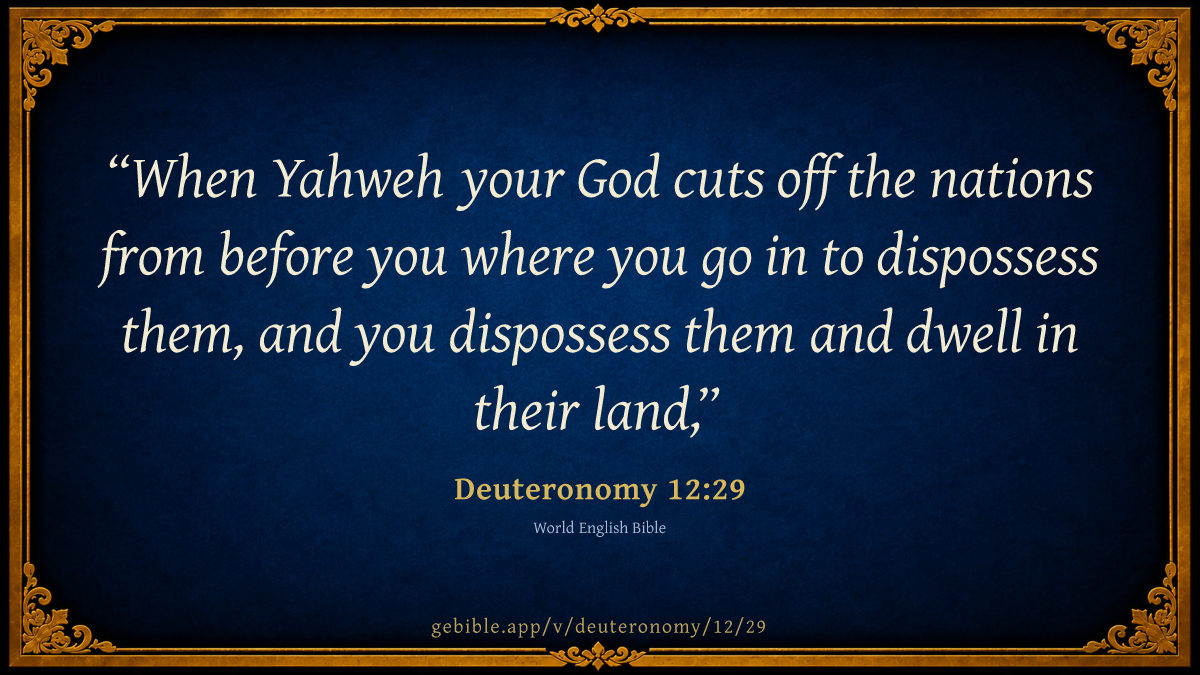
When Yahweh your God cuts off the nations from before you where you go in to dispossess them, and you dispossess them and dwell in their land,
Parallel Translations
-
When Yahweh your God cuts off the nations from before you where you go in to dispossess them, and you dispossess them and dwell in their land,
-
When the LORD thy God shall cut off the nations from before thee, whither thou goest to possess them, and thou succeedest them, and dwellest in their land;
-
When the LORD thy God shall cut off the nations from before thee, whither thou goest in to dispossess them, and thou dispossessest them, and dwellest in their land;
Cross-references (5)
Passages linked to Deuteronomy 12:29 in the Treasury of Scripture Knowledge, ordered by reader-vote popularity; verse text shown in World English Bible.
- Joshua 23:4 Behold, I have allotted to you these nations that remain, to be an inheritance for your tribes, from the Jordan, with all the nations that I have cut off, even to the great sea toward the going down of the sun.
- Deuteronomy 19:1 When Yahweh your God cuts off the nations whose land Yahweh your God gives you, and you succeed them and dwell in their cities and in their houses,
- Exodus 23:23 For my angel shall go before you, and bring you in to the Amorite, the Hittite, the Perizzite, the Canaanite, the Hivite, and the Jebusite; and I will cut them off.
- Deuteronomy 9:3 Know therefore today that Yahweh your God is he who goes over before you as a devouring fire. He will destroy them and he will bring them down before you. So you shall drive them out and make them perish quickly, as Yahweh has spoken to you.
- Psalms 78:55 He also drove out the nations before them, allotted them for an inheritance by line, and made the tribes of Israel to dwell in their tents.
Cross-references from openbible.info (CC BY 4.0)
Explain this verse (7 sources)
Historical commentary, presented as a primary source — not an endorsement.
Private notes
Saved on this device only — never synced or sent anywhere.
Matthew Poole 1685 · Public Domain Whither thou goest to possess them; of which phrase…
Whither thou goest to possess them; of which phrase see Deu 9:1; 11:23
Matthew Poole's English Annotations on the Holy Bible (1683–1685) — public domain. Text from a community e-Sword/MySword module.
John Gill 1763 · Public Domain When the Lord thy God shall cut off the…
When the Lord thy God shall cut off the nations from before thee,.... The seven nations of the land of Canaan, Deu 7:1,
whither thou goest to possess them, and thou succeedest them, and dwellest in their land; or to inherit them, and thou dost inherit them, by dwelling in their land.
John Gill's Exposition of the Whole Bible (1746–1763) — public domain (CC PDM 1.0). Text via the HelloAO Bible API.
Robert Jamieson, A. R. Fausset & David Brown 1871 · Public Domain Take heed to thyself that thou be not snared…
Take heed to thyself that thou be not snared by following them . . . saying, How did these nations serve their gods?--The Israelites, influenced by superstitious fear, too often endeavored to propitiate the deities of Canaan. Their Egyptian education had early impressed that bugbear notion of a set of local deities, who expected their dues of all who came to inhabit the country which they honored with their protection, and severely resented the neglect of payment in all newcomers [WARBURTON]. Taking into consideration the prevalence of this idea among them, we see that against an Egyptian influence was directed the full force of the wholesome caution with which this chapter closes.
Next: Deuteronomy Chapter 13
Jamieson, Fausset & Brown — Commentary Critical and Explanatory on the Whole Bible (1871) — public domain (CC PDM 1.0). Text via the HelloAO Bible API.
Daniel D. Whedon 1874 · Public Domain 29-32. Take heed to thyself — A solemn warning…
29-32. Take heed to thyself — A solemn warning against the idolatry of these Canaanite nations. “This caution is based upon the notion generally entertained in the ancient heathen world, that each country had its own tutelary deities, whom it would be perilous to neglect. Comp. 1Ki_20:23; 2Ki_17:26. Hence even in conquered districts the worship of the local deities was wont to be scrupulously maintained. But Israel was to shun such superstition.” — Speaker’s Commentary.
Daniel D. Whedon (gen. ed.), Commentary on the Old and New Testaments (1874–1909) — public domain. Text from a community e-Sword module.
The Cambridge Bible for Schools and Colleges 1878 · Public Domain 29–31. Transition to the Laws in 13 (and those…
29–31. Transition to the Laws in 13 (and those in Deu_16:21 to Deu_17:7)
When settled in W. Palestine Israel shall not inquire into the manner of the worship of the local deities, and so be enticed to imitate it in the worship of their own God, for the Canaanites in their worship practise every abomination to Jehovah: they even burn their children to the gods.—Here we meet one of the greater difficulties raised by the order of the laws in the code. For unless this short passage be merely one of the many exhortations, which, like a chorus, break in upon both the narratives and the laws of D, it is meant as an introduction to the laws against seducers to idolatry, which follow in ch. 13. Yet, as such, it is abrupt and incomplete; Deu_12:31 warns against every abomination to Jehovah, and then, instead of a list of those abominations, gives only one. Now others are given in Deu_16:21 to Deu_17:7; and that passage is clearly out of place where it stands, between laws relating to judicial authorities and procedure. The suggestion has therefore been made (first by Dillmann, cp. Driver on Deu_16:21 and Bertholet on Deu_12:29 and Marti in Kautzsch’s Heil. Schrift des A.T.) that Deu_16:21 to Deu_17:7 originally stood between Deu_12:29-31 and Deu_13:2 ff. There is much in favour of this suggestion; Deu_16:21 to Deu_17:7 naturally continues Deu_12:29-31 and has phrases in common with this (which thy God hateth and abomination), while its second part commanding the punishment of idolatrous Israelites as naturally leads up to the three laws in Deu_13:2 ff. (Deu_13:1 ff.). On the relation to Deu_12:29-31 of Deu_18:9-12, also on the sacrifice of children, see on the latter passage. A further difficulty is Deu_12:32 (Deu_13:1), see the note on it.
Read full note →
Deu_12:29. When the Lord thy God shall cut off the nations] So Deu_19:1 (cp. deuter. Jos_23:4 f.); beyond this the verses differ.
whither thou goest in to dispossess them] Characteristic of the Sg. passages, cp. Deu_9:5; Deu_19:1 has whose land the Lord thy God is about to give thee.
and thou shalt have dispossessed them] So Deu_19:1 : R.V. succeedest them.
and dwellest in their land] Deu_19:1, their cities.
Deu_12:30. take heed to thyself] See Deu_6:12.
ensnared to follow them] snared away after them; cp. Deu_7:16; Deu_7:25.
inquire not after] See on seek, Deu_12:5.
How do these nations, serve, etc.] Rather How used these nations to worship.
so will I do, I also or in my turn] The lighter form of the pronoun, ’anî, used in the Song 32 and throughout P, is found in D (which elsewhere uses the heavier form ’ânôki) only here and Deu_29:5; and is to he explained by the common O.T. usage of preferring ’anî when the pronoun is employed in emphasis as here.
The whole verse is true to the religious situation in which Israel found themselves after settlement in Canaan. They came under the belief, prevalent in antiquity, that not only must the gods of a land be propitiated by its invaders, but that worship must be offered only after the local mishpat or ritual (1Sa_26:19; 2Ki_17:25 ff.). So they inquired what that mishpat was and conformed to it the worship of their own God, with the result of confusing Him with the gods of the land.
for even their sons and their daughters do they burn] or used to burn. That the Semites (as well as other ancient races) sacrificed children has been amply proved. Mesha of Moab, hard pressed by Israel, slew his first-born to Kemosh (2Ki_3:27) just as we know, through the Greeks (Diod. Sic. xx. 14, Porph. apud Euseb. Praep. Evang. iv. (64, 4), was the practice of Phoenicians and Carthaginians in times of national danger or disaster. On human sacrifices among them, the Syrians, and ancient Arabs see notes to pp. 346 ff. of W. R. Smith’s Rel. Sem. For the Canaanites the evidence of the sacrifice of children by slaughter and burning is conclusive, both from the O.T. texts, and recent discoveries:—
At Gezer round the feet of the maṣṣeboth (see on Deu_16:22) and ‘over the whole area of the High Place the earth was discovered to be a regular cemetery in which the skeletons of young infants were buried. These infants were never more than a week old. Two at least showed marks of fire.’ They were buried in jars, each with a lamp and a bowl, as if symbols of fire and blood (R. A. S. Macalister, PEFQ, 1903, Bible Side Lights etc., 73 f.). At Ta‘anak Sellin found jars with the remains of 20 infants, some up to 5 years of age close to a rock altar (Tell Ta‘annek, 35 ff.). At Megiddo (Tell el-Mutesellim) under the corner of a temple four jars with remains of infants were dug up from a stratum probably of the late Israelite period. Others have been found under the walls of houses, but whether these were of still-born infants or of such as died naturally is not known; in Egypt, as the present writer has been informed by the American missionaries, the still-born children of Copts are buried in the house (whether with the hope that they may be re-born into it?). See further Frazer, Adonis, Attis etc. 78. But there can be no doubt of the fate of those found in the sanctuaries; the marks of fire on some and the presence of lamps and bowls prove slaughter and sacrifice by fire. So too the vb. burn used here and in Jer_7:31; Jer_19:5, as well as the story of Abraham and Isaac, indicates a full sacrifice, slaughter and at least partial consumption by fire on an altar. On this Eze_16:21 (cp. Eze_23:39) is explicit: thou hast slain my children and didst deliver them up in causing them to pass through (sc. the fire) to them. The fire was the means of their conveyance to the deity. Therefore the expression to make son or daughter pass through the fire (Deu_18:10) cannot he explained as merely a consecration or ordeal by fire. The data do not enable us to determine whether at any time the practice of devoting the firstborn was binding and universal among the Canaanites, or was confined to periods of calamity. That even among the Canaanites there was a revolt from it is proved by Mr Macalister’s discovery (op. cit. 170 f., PEFQ, 1903, 8 f.), in some strata of the pre-Israelite period, of lamps and bowls buried with the jars instead of children and as if in substitution for these.
The practice by Israel of sacrificing children after the same fashion and from the same motives is proved by the narratives and laws of the Old Testament as well as by the prophets:—
The story, which is found in E, Genesis 22, that the divine word bade Abraham sacrifice Isaac and then revealed a substitute in the ram, is evidence that at one time among the Hebrews the belief had prevailed in the duty of fathers to slay their children, if required, us proof of their fidelity to their God, but that by His mercy a substitute was allowed. This is confirmed by the form of the law in J, Exo_13:12. Though this sanctions the redemption of the firstborn son by an animal, the way in which it opens—thou shalt cause to pass over unto Jehovah all that openeth the womb and every firstling which thou hast that Cometh of a beast—indicates that the original principle, on which Israel acted, was that the firstborn of men, equally with those of animals, were due to the deity by sacrifice. In Judah in the 7th century the popular belief was that Jehovah Himself had given a law obliging the burning of children, for Jeremiah (or a deuteronomic writer whose words have been here placed among his prophecies) emphatically denies the existence of such a law: which I commanded not, neither came it into my mind (Jer_7:31, Jer_19:5). On the other hand Ezekiel supports the opinion that Israel’s God had given such a law and explains that this was in order to punish the second generation in the wilderness. 20:25: moreover I gave them also statutes not good and judgements whereby they should not live, and I polluted them in their own gifts, in that they caused to pass through (sc. the fire) all that openeth the womb, that I might make them desolate (see A. B. Davidson’s note on this passage in Ezekiel in this series).
There was therefore a memory in Israel that the fathers of the race had shared the general Semitic conscience that the sacrifice of children was sanctioned or even expressly commanded by God, but that from an early time He had permitted the substitution of an animal, which permission, J tells us, was expressly dictated by Moses at the Exodus. In the early centuries after the settlement there are no instances of child-sacrifice in Israel except in the story of Jephthah (and more doubtfully in that of Hiel, the re-builder of Jericho). And the cases which recur later are all explicable by the bad influence of the neighbouring heathen, and the panic produced by national disaster, either actual or threatened. So in the case of Ahaz (2Ki_16:4), the historical character of which there is no reason to doubt (see as against Moore, E.B. art. ‘Molech’ the present writer’s Jerusalem, ii. 127, 264); and so with the recrudescence of the practice in the 7th century under Manasseh, and the use of the horrible Topheth or Tephath in the valley of Hinnom (Jer_7:31; Jer_19:5; ‘Mi.’ Deu_6:6 f.; Eze_16:21; Eze_20:18 ff; Eze_23:39). The present Hebrew text of Jer. says that these sacrifices were offered to ‘Molech,’ but ‘there are grounds for believing that this was a divine title, Melek or King, rather than a name; and that the awful despot who demanded such a propitiation was regarded by the Jews as none other than their own God’ (Jerusalem, ii. 264). This is clear, as we have seen above, from the passages in Jeremiah and Ezekiel. And the reason is plain why D, a work of the 7th century, should alone of all Israel’s law-books be ardent, equally with the great prophets of the time, in repudiating child-sacrifice.
The Cambridge Bible for Schools and Colleges (gen. ed. J. J. S. Perowne; Cambridge University Press, 1878–1918) — public domain. Text from a community e-Sword module.
The Pulpit Commentary 1880 · Public Domain Vers. 29, 30. Here the speaker reverts to the…
Vers. 29, 30. Here the speaker reverts to the admonition with which he began this part of his address (ver. 2); and warns the people against having any intercourse with the Canaanites in their idolatrous practices. That thou enquire not after their gods. It was a general belief among the heathen that to ignore or neglect the deities of a country was sure to bring calamity; (cf. 2Ki_17:26) hence the need of cautioning the Israelites against inquiring after the gods of the Canaanites when they should be settled in their land.
Vers. 29-32. Unworthy inquiries.
Read full note →
We have here
I BALEFUL SUPERSTITION. The ground of these inquiries about the gods of the place was a lurking belief in their reality. There was a superstitious feeling that the woods, hills, streams, etc., must have their deities, whom it would be well to propitiate and worship. The country as a whole, and special districts of it, had gods, and, Jehovah notwithstanding, the superstitious part of the community stood in dread of them. Superstitions are hard to eradicate. We have examples in the survival of the belief in witches, fairies, charms, omens, lucky and unlucky days, etc., among ourselves. Till a recent period, it was the custom in parts of the Scottish Highlands to sacrifice bulls to local saints. And the practice of burying a live cock for the cure of epilepsy is said to survive till the present hour. Born of ignorance, and acting as a check on all enlightenment and progress, superstition is the parent of innumerable evils, besides debasing and enslaving mind and conscience. Its influence should be combated by every legitimate means.
II PRURIENT CURIOSITY. The superstitious motive did not act alone. This itching desire to hear about the gods of the place, and how the nations served them, was symptomatic of a prurient disposition. There was, unfortunately, too much in the way in which these nations had "served their gods" to excite and interest the passions of the dissolute. It is a dangerous token when those who ought to know better begin to manifest a prurient curiosity about what is evil. It leads to prying into matters which had better remain hidden, to inquiries at persons whose very society is dangerous, to the reading of obscene books, the visiting of bad places, the keeping of immoral company, etc. At the bottom of such inquiries there is invariably a secret sympathy, which is bound, as time advances, to yield fruit in evil practices.
III SERVILE IMITATION. The idolatry of the Israelites was signalized by a strange want of originality. They invented no gods of their own. They were content to be imitators. The nations before them had gods. The nations around them had gods. They wanted to be like the rest, and have gods too hence their inquiries. A curious illustration of the force of the principle of imitation. It is one of the ruling principles in human nature. Imitation is easier than invention. The tendency invariably is to "follow the crowd." It matters nothing that it is "to do evil." The fashion of the time and place must be observed. There are people who would almost rather die than be out of the fashion. Yet what a weakness is this, and how opposed to all true and right manhood! "Be not conformed to the world". J.O. (Rom_12:2)
Vers. 29-32. The subtle ensnarements of idolatry.
A spirit of vain curiosity is to be repressed at its beginning. So weak is human nature, and so subtle is the working of sin, that prying curiosity into evil customs works practical mischief. Human life, to be a success, must be a perpetual battle with moral evil. We cannot afford to parley with the enemy nor give him a single advantage. Incessant watchfulness is our safety.
I IDOLATRY HAS GREAT FASCINATIONS FOR MAN"S SENSUOUS NATURE. There is in all men a yearning for visible signs of God. "Show us some sign!" is the natural demand of the human mind. Even Moses had passionately asked, "I beseech thee, show me thy glory." Satan employs a thousand wily artifices to corrupt the spiritual impulses of the heart. Speciously, idolatry asks to be tolerated as a symbol, and then detains our faith as if it were the substantial object.
II IDOLATRY IS THE FRUITFUL PARENT OF VICE AND CRUELTY. We can never deal with forms of idolatry as if they were mere intellectual vagaries. The worship of material images has always been associated with sensuality, obscenity, and vice. It deteriorates human nature, hardens sensibility, and clips the wing of aspiration. When the seed has grown to the mature tree, human victims are demanded as oblations. "The children were compelled to pass through the fire." Atrocious cruelty is the last effect.
III IDOLATRY IS HATEFUL IN GOD"S ESTEEM. It is impossible for us to err if we make the supreme God our model. To the extent that we know God, we must endeavor to assimilate our tastes to his, to love what he loves and to hate what he hates. Idolatry, in any form (whether of graven image, or material wealth, or human friend) is overt treason against God. If we cannot see the inherent wickedness of idolatry, it should be enough for us to know that it is an abomination before God, "a smoke in his eyes; a stench in his nostrils.
IV IDOLATRY IS A SOURCE OF NATIONAL AND INDIVIDUAL RUIN. In that early period of human history, the spirit of idolatry must have been rampant. It was the curse of the age. Although the Hebrews had seen the practical effects of idolatry in Egypt; although they had themselves been the executors of God"s vengeance against idolatry in Canaan; nevertheless the tendencies to idolatry were, humanly speaking, irresistible. It had been the source of Pharaoh"s overthrow. It had been the occasion of a great slaughter among the Hebrews under the peaks of Sinai. It was the parent of the vices and crimes that prevailed among the Amorites. Idolatry is doomed by an eternal decree, and if men persist in identifying themselves with it, they are doomed also. Let us be well guarded against so insidious an evil! D.
The Pulpit Commentary (1880–1919), ed. H.D.M. Spence-Jones & Joseph S. Exell — public domain. Text from a community e-Sword module.
unfoldingWord translationNotes 2017 · CC BY-SA 4.0 cuts off the nations
cuts off the nations
Yahweh destroying the people groups in Canaan is spoken of as if he were cutting them off, as one would cut a piece of cloth or cut a branch from a tree. (See: Metaphor)
Read full note →
the nations
Here "nations" represents the people living in Canaan. (See: Metonymy)
when you go in to dispossess them, and you dispossess them
"when you take everything from them"
pay attention to yourself
"be careful"
that you are not trapped into following them ... trapped into investigating their gods, into asking
A person learning about and worshiping other gods is spoken of as if they are caught in a hunter's trap. This can be stated in active form. AT: "that you do not act like them ... that you do try to learn about their gods, asking" (See: Metaphor and Active or Passive)
not trapped into following them
The Israelites worshiping idols as the people groups of Canaan worship idols is spoken of as if the Israelites were following behind the other people groups. (See: Metaphor)
after they are destroyed from before you
This can be stated in active form. AT: "after Yahweh destroys them before you" (See: Active or Passive)
into asking, 'How do these nations worship their gods? I will do the same.'
This is a quotation within a quotation. A direct quotation can be stated as an indirect quotation. AT: "into asking about how those people groups worship their gods so that you can do the same." (See:Quotes Within Quotes and Direct and Indirect Quotations)
translationWords
Yahweh
God
cut off
nation
false god
worship
unfoldingWord translationNotes — © Distant Shores Media and the Door43 World Missions Community, licensed CC BY-SA 4.0. Source: git.door43.org/Door43/en_tn.