Deuteronomy 24:20-21 sits inside this longer paragraph.
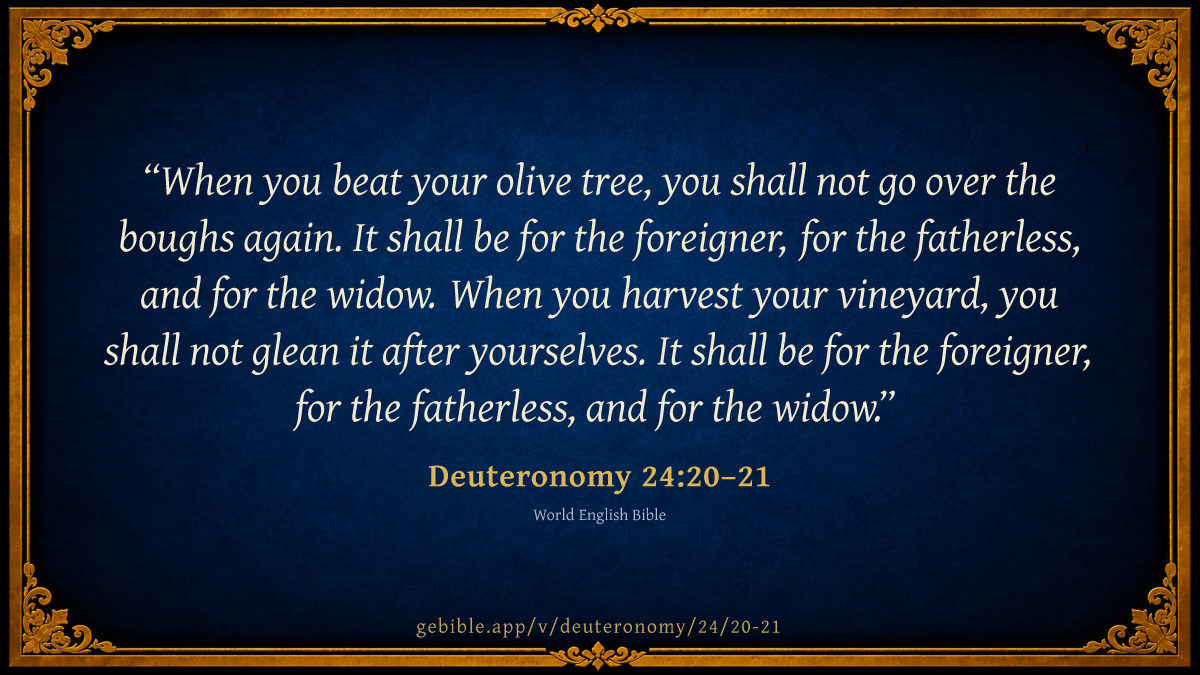
19When you reap your harvest in your field, and have forgotten a sheaf in the field, you shall not go again to get it. It shall be for the foreigner, for the fatherless, and for the widow, that Yahweh your God may bless you in all the work of your hands. 20When you beat your olive tree, you shall not go over the boughs again. It shall be for the foreigner, for the fatherless, and for the widow.
21When you harvest your vineyard, you shall not glean it after yourselves. It shall be for the foreigner, for the fatherless, and for the widow. 22You shall remember that you were a slave in the land of Egypt. Therefore I command you to do this thing.

Geneva Bible translators 1599 · Public Domain On vv20–21 Or, gatherest thine olives.
Or, gatherest thine olives.
Geneva Bible (1599) marginal notes — public domain.
Matthew Poole 1685 · Public Domain On v20 When thou beatest thine olive tree with staves, as…
When thou beatest thine olive tree with staves, as they used to do to fetch down the olives.
Matthew Poole's English Annotations on the Holy Bible (1683–1685) — public domain. Text from a community e-Sword/MySword module.
John Gill 1763 · Public Domain On vv20–21 When thou beatest thine olive tree,.... With sticks and…
When thou beatest thine olive tree,.... With sticks and staves, to get off the olives when ripe:
thou shall not go over the boughs again; to beat off some few that may remain; they were not nicely to examine the boughs over again, whether there were any left or not:
Read full note →
it shall be for the stranger, for the fatherless, and for the widow; who might come into their oliveyards after the trees had been beaten, and gather what were left.
John Gill's Exposition of the Whole Bible (1746–1763) — public domain (CC PDM 1.0). Text via the HelloAO Bible API.
The Cambridge Bible for Schools and Colleges 1878 · Public Domain On vv20–21 20. beatest thine olive tree] Isa_27:6; Isa_24:13 (but with…
20. beatest thine olive tree] Isa_27:6; Isa_24:13 (but with another vb. for beating). ‘Some climb into the trees and shake the boughs, while others stand below and beat off the fruit with long slender poles’ (Van Lennep, op. cit. 128).
The Cambridge Bible for Schools and Colleges (gen. ed. J. J. S. Perowne; Cambridge University Press, 1878–1918) — public domain. Text from a community e-Sword module.
The Pulpit Commentary 1880 · Public Domain On v21 Thou shalt not glean it afterward; literally, Thou shalt…
Thou shalt not glean it afterward; literally, Thou shalt not glean after thee, i.e. after thou hast reaped and gathered for thyself. It is still the custom among the Arabs for the poor to be allowed to gather the berries that may be left on the olive trees after they have been beaten and the main produce carried off by the owner. All the injunctions in this section are adapted to preserve relations of brotherliness and love among the people of the Lord.
The Pulpit Commentary (1880–1919), ed. H.D.M. Spence-Jones & Joseph S. Exell — public domain. Text from a community e-Sword module.
unfoldingWord translationNotes 2017 · CC BY-SA 4.0 On v21 General Information:
General Information:
Moses speaks to the Israelites as if they were one man, so the words "you" and "your" here are singular. (See: Forms of You)
Read full note →
What is left over will be for the foreigner, for the fatherless, and for the widow
"The grapes that you do not pick will be for the foreigner, the fatherless, and the widow to pick"
for the foreigner, for the fatherless, and for the widow
These refer to groups of people. AT: "for foreigners, for those who are fatherless, and for the widows" (See: Generic Noun Phrases)
call to mind
This is an idiom. AT: "remember" (See: Idiom)
translationWords
grape
vineyard
glean
alien
servant
Egypt
obey
command
unfoldingWord translationNotes — © Distant Shores Media and the Door43 World Missions Community, licensed CC BY-SA 4.0. Source: git.door43.org/Door43/en_tn.