
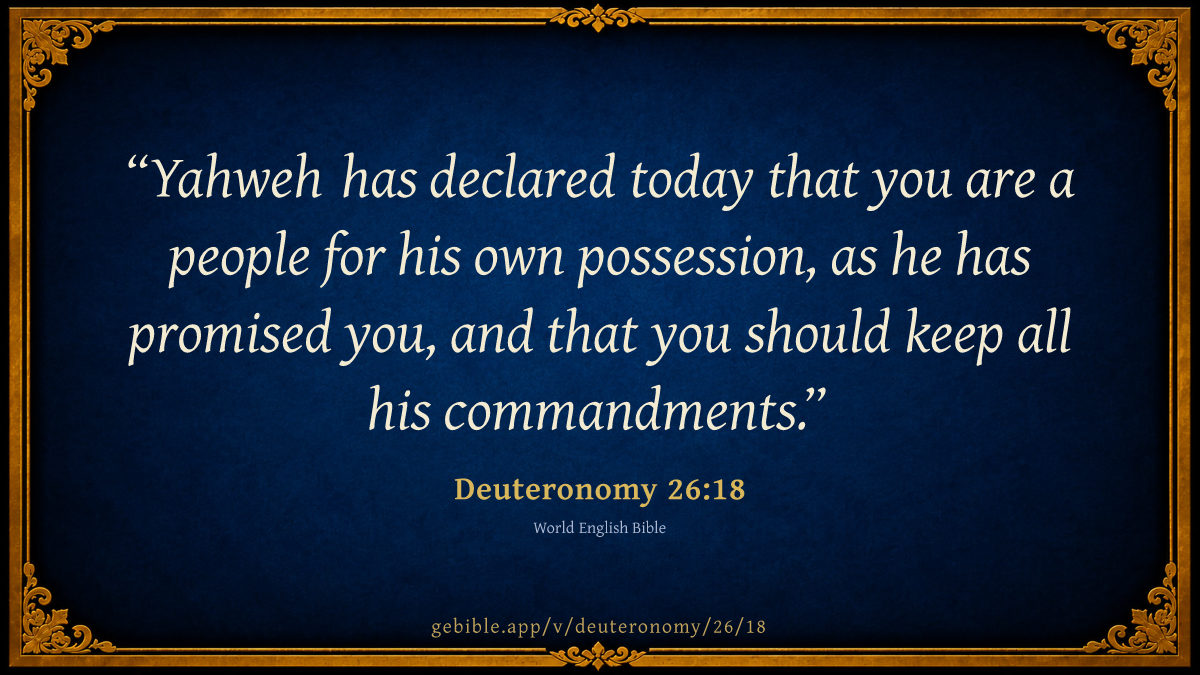
Yahweh has declared today that you are a people for his own possession, as he has promised you, and that you should keep all his commandments.
Parallel Translations
-
Yahweh has declared today that you are a people for his own possession, as he has promised you, and that you should keep all his commandments.
-
And the LORD hath avouched thee this day to be his peculiar people, as he hath promised thee, and that thou shouldest keep all his commandments;
-
And the LORD hath avouched thee this day to be His own treasure, as He hath promised thee, and that thou shouldest keep all His commandments;
Cross-references (10)
Passages linked to Deuteronomy 26:18 in the Treasury of Scripture Knowledge, ordered by reader-vote popularity; verse text shown in World English Bible.
- Deuteronomy 7:6 For you are a holy people to Yahweh your God. Yahweh your God has chosen you to be a people for his own possession, above all peoples who are on the face of the earth.
- Deuteronomy 14:2 For you are a holy people to Yahweh your God, and Yahweh has chosen you to be a people for his own possession, above all peoples who are on the face of the earth.
- Deuteronomy 28:9 Yahweh will establish you for a holy people to himself, as he has sworn to you, if you shall keep the commandments of Yahweh your God, and walk in his ways.
- Titus 2:14 who gave himself for us, that he might redeem us from all iniquity, and purify for himself a people for his own possession, zealous for good works.
- Exodus 6:7 I will take you to myself for a people. I will be your God; and you shall know that I am Yahweh your God, who brings you out from under the burdens of the Egyptians.
- Ezekiel 36:25-27 I will sprinkle clean water on you, and you will be clean. I will cleanse you from all your filthiness, and from all your idols. I will also give you a new heart, and I will put a new spirit within you. I will take away the stony heart out of your flesh, and I will give you a heart of flesh. I will put my Spirit within you, and cause you to walk in my statutes. You will keep my ordinances and do them.
- Romans 16:26
- Exodus 19:5-6 Now therefore, if you will indeed obey my voice, and keep my covenant, then you shall be my own possession from among all peoples; for all the earth is mine; and you shall be to me a kingdom of priests, and a holy nation.’ These are the words which you shall speak to the children of Israel.”
- Psalms 119:6 Then I wouldn’t be disappointed, when I consider all of your commandments.
- Jeremiah 31:32-34 not according to the covenant that I made with their fathers in the day that I took them by the hand to bring them out of the land of Egypt; which covenant of mine they broke, although I was a husband to them,” says Yahweh. “But this is the covenant that I will make with the house of Israel after those days,” says Yahweh: “I will put my law in their inward parts, and I will write it in their heart. I will be their God, and they shall be my people. They will no longer each teach his neighbor, and every man teach his brother, saying, ‘Know Yahweh;’ for they will all know me, from their least to their greatest,” says Yahweh: “for I will forgive their iniquity, and I will remember their sin no more.”
Cross-references from openbible.info (CC BY 4.0)
Explain this verse (9 sources)
Historical commentary, presented as a primary source — not an endorsement.
Private notes
Saved on this device only — never synced or sent anywhere.
Geneva Bible translators 1599 · Public Domain Signifying that there is a mutual bond between God…
Signifying that there is a mutual bond between God and his people.
Geneva Bible (1599) marginal notes — public domain.
Matthew Poole 1685 · Public Domain Hath owned thee for such before all the world…
Hath owned thee for such before all the world by eminent and glorious communications and manifestations of his power and grace and favour in time and for thee, by a solemn entering into covenant with thee, and giving peculiar laws, promises, and privileges to thee above all mankind. That thou shouldest keep all his commandments; which is here mentioned as an act of God’s, because though this be man’s duty, yet it is the work of’ God’s grace, that he will vouchsafe to give us such commands, that he doth require and will accept of our obedience to them, and that we have any power or will to obey them, Eze 36:26,27.
Matthew Poole's English Annotations on the Holy Bible (1683–1685) — public domain. Text from a community e-Sword/MySword module.
John Gill 1763 · Public Domain And the Lord hath avouched thee this day to…
And the Lord hath avouched thee this day to be his peculiar people,.... Affirmed and declared them to be his special people, above all people on the face of the earth, and that they were looked upon and considered by him as his jewels, his peculiar treasure:
as he hath promised thee; on condition of their obedience to him, as he did in Exo 19:5,
Read full note →
and that thou shouldest keep all his commandments; at the same time declared this as his will, that they should observe all his precepts, to which they were laid under obligation by the special favour and peculiar privileges he bestowed upon them, Deu 7:6. The Targums interpret both these verses of the people of Israel choosing and making the Lord their King, and of his being made King over them; and so it respects their peculiar form of civil government, being a theocracy. The Lord's people in Christ are a peculiar people; they are distinct from all people, and are peculiarly regarded by him; they are the objects of his peculiar love, and receive peculiar favours from him; and whom having chosen and redeemed, he calls by his special grace, and witnesses their special relation to him by his Spirit; which grace obliges and excites them to a cheerful obedience to his commands.
John Gill's Exposition of the Whole Bible (1746–1763) — public domain (CC PDM 1.0). Text via the HelloAO Bible API.
John Wesley 1765 · Public Domain Avouched thee - Hath owned thee for such before…
Avouched thee - Hath owned thee for such before all the world by eminent and glorious manifestations of his power and favour, by a solemn entering into covenant with thee, and giving peculiar laws, promises, and privileges to thee above all mankind.
John Wesley, Explanatory Notes Upon the Whole Bible (1754–1765) — public domain. Text via the GEBible commentary corpus.
Adam Clarke 1810 · Public Domain Verse 18. And the Lord hath avouched] Publicly declared,…
Verse 18. And the Lord hath avouched] Publicly declared, by the blessings he pours down upon them, that he has taken them to be his peculiar people. Thus the covenant is made and ratified between God and his followers.
Adam Clarke's Commentary on the Bible (1810–1826) — public domain. Text from a community e-Sword/MySword module.
Daniel D. Whedon 1874 · Public Domain 18. And the Lord hath avouched thee this day…
18. And the Lord hath avouched thee this day — And Jehovah hath promised you this day that you shall be his peculiar people.
Daniel D. Whedon (gen. ed.), Commentary on the Old and New Testaments (1874–1909) — public domain. Text from a community e-Sword module.
The Cambridge Bible for Schools and Colleges 1878 · Public Domain 18. and Jehovah hath caused thee to say this…
18. and Jehovah hath caused thee to say this day that thou wilt be unto him a peculiar people … and wilt keep all his commandments] Elsewhere in D the singular relation of Israel to Jehovah is stated as His promise and act, Deu_7:6, q.v., Deu_14:2; cp. Deu_27:9, Deu_29:13 (12). Here is the converse, the people’s engagement to be such, as in 2Ki_11:17. Israel becomes His peculiar people by keeping all His commandments; that is the main thing! The phrase, as he hath said to thee, though unnecessary, is not the ‘senseless addition,’ which Steuern, alleges.
The Cambridge Bible for Schools and Colleges (gen. ed. J. J. S. Perowne; Cambridge University Press, 1878–1918) — public domain. Text from a community e-Sword module.
The Pulpit Commentary 1880 · Public Domain So, on the other hand, God had given Israel…
So, on the other hand, God had given Israel occasion to say that they were his special people, his treasured possession, (cf. Exo_19:5, Exo_19:6) whose it was, as such, to keep all his commandments, and to whom he would be faithful to fulfill all that he had promised.
The Pulpit Commentary (1880–1919), ed. H.D.M. Spence-Jones & Joseph S. Exell — public domain. Text from a community e-Sword module.
unfoldingWord translationNotes 2017 · CC BY-SA 4.0 General Information:
General Information:
Moses speaks to the Israelites as if they were one man, so the words "you" and "your" here are singular. (See: Forms of You)
Read full note →
a people who are his own possession
"a people who belong to him"
he will set you high above
This is an idiom. AT: "he will make you more important than" or "he will make you greater than" (See: Idiom)
he will set you high above all the other nations that he has made, and you will receive praise, fame, and honor
Possible meanings are 1) "he will cause you to become greater than any other nation that he has established, and he will enable you to praise him and honor him" or 2) "he will have people praise you more than they praise every other nation that he has made; people will say that you are better than any other nation, and they will honor you."
You will be a people that is set apart to Yahweh your God
Yahweh choosing the people of Israel to belong to him in a special way is spoken of as if Yahweh set them apart from all other nations. This can be stated in active form. AT: "Yahweh your God will set you apart from other nations" (See: Metaphor and Active or Passive)
translationWords
acknowledge
people of God
possess
promise
command
nation
praise
honor
set apart
unfoldingWord translationNotes — © Distant Shores Media and the Door43 World Missions Community, licensed CC BY-SA 4.0. Source: git.door43.org/Door43/en_tn.