
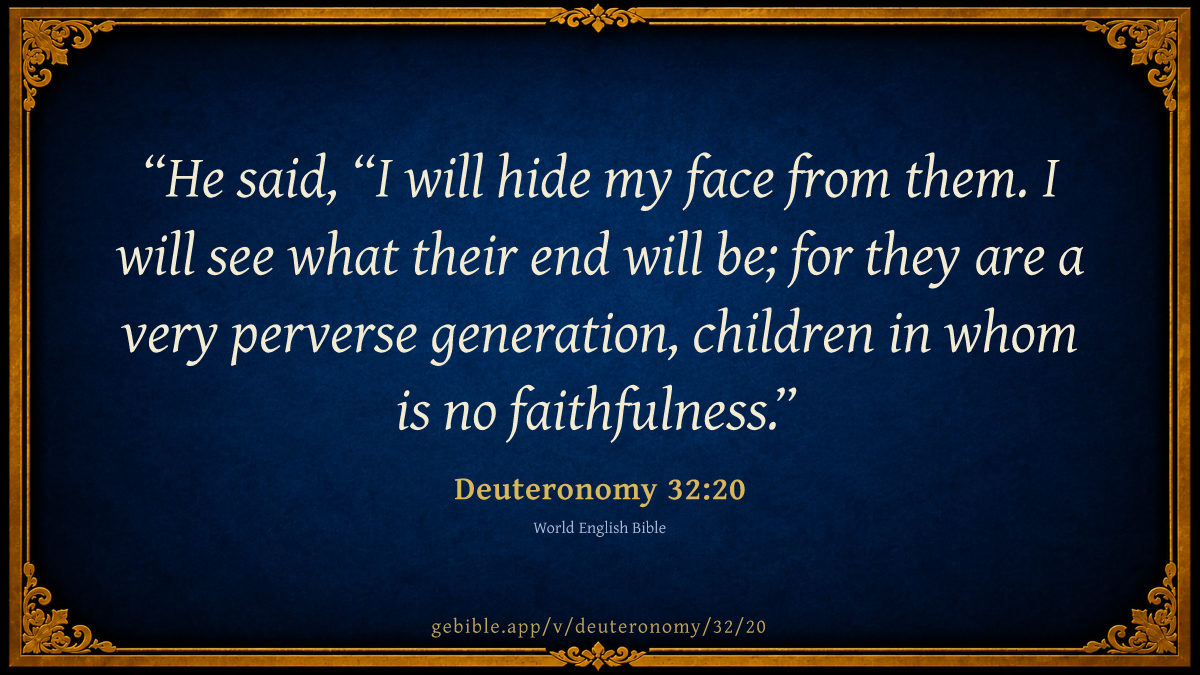
He said, “I will hide my face from them. I will see what their end will be; for they are a very perverse generation, children in whom is no faithfulness.
Parallel Translations
-
He said, “I will hide my face from them. I will see what their end will be; for they are a very perverse generation, children in whom is no faithfulness.
-
And he said, I will hide my face from them, I will see what their end shall be: for they are a very froward generation, children in whom is no faith.
-
And He said: 'I will hide My face from them, I will see what their end shall be; for they are a very froward generation, children in whom is no faithfulness.
Cross-references (18)
Passages linked to Deuteronomy 32:20 in the Treasury of Scripture Knowledge, ordered by reader-vote popularity; verse text shown in World English Bible.
- Deuteronomy 31:17-18 Then my anger shall be kindled against them in that day, and I will forsake them, and I will hide my face from them, and they shall be devoured, and many evils and troubles shall come on them; so that they will say in that day, ‘Haven’t these evils come on us because our God is not among us?’ I will surely hide my face in that day for all the evil which they have done, in that they have turned to other gods.
- Deuteronomy 32:5 They have dealt corruptly with him. They are not his children, because of their defect. They are a perverse and crooked generation.
- Luke 7:31-32 “To what then should I compare the people of this generation? What are they like? They are like children who sit in the marketplace, and call to one another, saying, ‘We piped to you, and you didn’t dance. We mourned, and you didn’t weep.’
- Deuteronomy 31:29 For I know that after my death you will utterly corrupt yourselves, and turn away from the way which I have commanded you; and evil will happen to you in the latter days, because you will do that which is evil in Yahweh’s sight, to provoke him to anger through the work of your hands.”
- 2 Chronicles 20:20 They rose early in the morning, and went out into the wilderness of Tekoa. As they went out, Jehoshaphat stood and said, “Listen to me, Judah, and you inhabitants of Jerusalem! Believe in Yahweh your God, so you will be established! Believe his prophets, so you will prosper.”
- Job 13:24 Why do you hide your face, and consider me your enemy?
- Job 34:29 When he gives quietness, who then can condemn? When he hides his face, who then can see him? He is over a nation or a man alike,
- Isaiah 7:9 The head of Ephraim is Samaria, and the head of Samaria is Remaliah’s son. If you will not believe, surely you shall not be established.’ ”
- Isaiah 30:9 For it is a rebellious people, lying children, children who will not hear Yahweh’s law;
- Isaiah 64:7 There is no one who calls on your name, who stirs himself up to take hold of you; for you have hidden your face from us, and have consumed us by means of our iniquities.
- Isaiah 65:2-5 I have spread out my hands all day to a rebellious people, who walk in a way that is not good, after their own thoughts; a people who provoke me to my face continually, sacrificing in gardens, and burning incense on bricks; who sit among the graves, and spend nights in secret places; who eat pig’s meat, and broth of abominable things is in their vessels; who say, ‘Stay by yourself, don’t come near to me, for I am holier than you.’ These are smoke in my nose, a fire that burns all day.
- Jeremiah 18:17 I will scatter them as with an east wind before the enemy. I will show them the back, and not the face, in the day of their calamity.
- Hosea 9:12 Though they bring up their children, yet I will bereave them, so that not a man shall be left. Indeed, woe also to them when I depart from them!
- Matthew 11:16-17 “But to what shall I compare this generation? It is like children sitting in the marketplaces, who call to their companions and say, ‘We played the flute for you, and you didn’t dance. We mourned for you, and you didn’t lament.’
- Matthew 17:17 Jesus answered, “Faithless and perverse generation! How long will I be with you? How long will I bear with you? Bring him here to me.”
- Mark 9:19 He answered him, “Unbelieving generation, how long shall I be with you? How long shall I bear with you? Bring him to me.”
- Luke 18:8 I tell you that he will avenge them quickly. Nevertheless, when the Son of Man comes, will he find faith on the earth?”
- Hebrews 11:6 Without faith it is impossible to be well pleasing to him, for he who comes to God must believe that he exists, and that he is a rewarder of those who seek him.
Cross-references from openbible.info (CC BY 4.0)
Explain this verse (13 sources)
Historical commentary, presented as a primary source — not an endorsement.
Private notes
Saved on this device only — never synced or sent anywhere.
John Trapp 1656 · Public Domain Deu 32:20 And he said, I will hide my…
Deu 32:20 And he said, I will hide my face from them, I will see what their end [shall be]: for they [are] a very froward generation, children in whom [is] no faith.
Ver. 20. I will see what their end shall be.] This is spoken after the manner of men; as likewise that in Deu 32:27.
Read full note →
In whom is no faith,] i.e., Fidelity; as Mat 23:23; there is no trusting them, or taking their words.
John Trapp, A Commentary or Exposition upon All the Books of the Old and New Testament (1647–1656) — public domain. Text from a community e-Sword module.
Matthew Poole 1685 · Public Domain I will see what their end shall be; I…
I will see what their end shall be; I will see and observe what will be the issue of all this, what will become of them at last; but this God doth not see only by way of speculation, but practically, i.e. considers with himself what he shall do with them, and how he shall punish them, and sees what he wills or purposes to do. A speech after the manner of men. Or
I will see is put for I will make them and others to see, what the fruit of such actions shall be. Hebrew verbs in cal do ofttimes take the signification of hiphil. In whom there is no faith; perfidious, that have broken their covenant so solemnly made with me.
Matthew Poole's English Annotations on the Holy Bible (1683–1685) — public domain. Text from a community e-Sword/MySword module.
John Gill 1763 · Public Domain They have moved me to jealousy with that which…
They have moved me to jealousy with that which is not God,.... With a false messiah; for after the death of Jesus, the true Messiah, God as well as man, many false Christs arose, as he predicted, and were received for a time, who were mere men, and deceivers; and their now vainly expected messiah, or whom they look for, according to their own sense of him, is no other than a mere creature, and not God: or with the idol of their own righteousness; which, as an idol is nothing in the world, that is, nothing in the business of justification, and put in the room of Christ highly provokes the Lord to jealousy:
they have provoked me to anger with their vanities; such were their false Christs they in vain trusted in, and such the idol of their own righteousness they set up, but could not make to stand; and such were the traditions of their elders; they put upon an equality with, or above the word of God; all which stirred up the wrath and anger of God against them:
Read full note →
and I will move them to jealousy with those which are not a people: this is not to be understood of any particular nation, but of the Gentiles in general, and of God's elect among them, and of the calling of them; which would be provoking to the Jews, as the Apostle Paul has taught us to understand it, Rom 10:19. These were not the people of God, or not my people, as he says Rom 9:25; In some sense indeed they were his people, being chosen by him, and taken into covenant with him; for he is God not of the Jews only, but of the Gentiles also; and those were given to Christ as his people, and are his other sheep which were not of the Jewish fold; and who were redeemed by him to be a peculiar people out of every kindred, tongue, people, and nation, all which was before their calling: yet, in another sense they were not his people; they were without any spiritual privileges, the word and ordinances, without the knowledge of God and Christ, without communion with them; they were not a people near unto the Lord, he had not laid hold on and formed them for himself in regeneration and conversion; they were not reckoned the people of God, nor called so, and especially by the Jews, who accounted themselves to be the only people of God; see Eph 2:11,
I will provoke them to anger with a foolish nation; either the Romans in particular are meant, so called because of their gross idolatry, to which they were addicted, who otherwise in their political affairs were a wise and understanding people; to these Judea became a province, and were subject to tribute; and by the exactions of the Romans, and their ill usage of them, they were provoked to rise against them, which issued in their ruin: or rather the Gentiles in general, who might be called foolish because of their superstition and idolatry, ignorance, and blindness in religious matters, and especially were so in the account of the Jews; and the elect of God among them in particular, who in their state of unregeneracy were foolish, as all unregenerate men are; both their principles and practices were foolish, and they were the foolish things of the Gentile world that God chose and called: and the calling of them was exceedingly provoking to the Jews; which was as if a man, moved to jealousy by the behaviour of his wife, should strip her of her ornaments and jewels, and reject her as his wife; and take another before her eyes of mean estate, and marry her, and put her ornaments on her, to which the allusion is; for the Lord, being moved to jealousy by the conduct of the Jewish nation towards him, rejected them from being his people, and stripped them of all their privileges, civil and religious, and took the Gentiles in the room of them, and so in just retaliation moved them to jealousy and wrath. It was displeasing to the carnal Jews to hear of the prophecies of the calling of the Gentiles, Rom 10:20; and the first display of grace to them was resented even by believing Jews themselves at first, Act 11:2. The anger of the Scribes and Pharisees on this account is thought by some to be hinted at in the parable of the two sons, Luk 15:27. The Jews were offended with Christ for eating with publicans, the Roman tax gatherers, and were greatly displeased when he told them the kingdom of God would be taken from them, and given to another nation, Mat 9:10 Mat 21:43. Their rage and envy were very great when the Gospel was first preached to the Gentiles, Act 13:41; and there is such an extraordinary instance of their spite and malice to the Gentiles, and of their jealousy and anger they were moved unto, as is not to be paralleled, Th1 2:15.
John Gill's Exposition of the Whole Bible (1746–1763) — public domain (CC PDM 1.0). Text via the HelloAO Bible API.
John Wesley 1765 · Public Domain I will see - I will make them and…
I will see - I will make them and others see, what the fruit of such actions shall be. No faith - No fidelity: perfidious, that have broken their covenant so solemnly made with me.
John Wesley, Explanatory Notes Upon the Whole Bible (1754–1765) — public domain. Text via the GEBible commentary corpus.
Adam Clarke 1810 · Public Domain Verse 20. Children in whom is no faith] לא…
Verse 20. Children in whom is no faith] לא אמן בם lo emon bam, "There is no steadfastness in them," they can never be depended on. They are fickle, because they are faithless.
Adam Clarke's Commentary on the Bible (1810–1826) — public domain. Text from a community e-Sword/MySword module.
Joseph Benson 1811 · Public Domain Deu 32:20. I will see what their end will…
Deu 32:20. I will see what their end will be — I will make them and others see what the fruit of such actions shall be. No faith — No fidelity. They were notoriously perfidious, and had so often broke their covenant with God, that they were not to be trusted when they made profession of repentance. To the truth of this their whole history bears witness. But besides this, in another sense they were destitute of faith. They did not truly believe the words God had spoken to them; they had not faith either in his promises or threatenings. And they put no trust or confidence in his glorious perfections, in his power, love, or faithfulness. Alas! how justly may God make the same complaint concerning many professors of Christianity! They are children in whom is no faith. They have not a firm reliance on the truth and importance of what God has spoken, and on the divine attributes engaged to make it good. Whatever is not the object of their senses, they either believe but faintly, or not at all. Here is the great failing of most professors of the true religion, the grand source of their sins and miseries. For it is faith only that can unite man to God, and produce love and obedience: it is this only that can raise him from earth to heaven! Reader, hast thou faith? Remember, without faith it is impossible to please God. From this verse to the 29th, Moses personates God speaking.
Joseph Benson's Commentary on the Old and New Testaments (1811–1818) — public domain. Text from a community e-Sword module.
Haydock's Catholic Bible Commentary 1859 · Public Domain From them. The Jews themselves acknowledged, in the siege…
From them. The Jews themselves acknowledged, in the siege of Jerusalem, that God had abandoned and given up to destruction his once beloved people. (Josephus, Jewish Wars vii. 8.) (Calmet) --- Consider, or look on their utter ruin with indifference, or rather with complacency. (Haydock) --- I will laugh at your destruction, Proverbs i. 16. (Calmet) --- God loves without seeing any preceding merit in his creatures, but he never abandons them till they have first proved unfaithful. (Worthington)
George Leo Haydock (1774–1849), Haydock's Catholic Family Bible and Commentary, 1859 edition — public domain. Excludes Psalms (Douay-Rheims chapter numbering differs from Protestant) and Deuterocanonical books (Catholic canon only).
Daniel D. Whedon 1874 · Public Domain 20. Children in whom is no faith — Sons…
20. Children in whom is no faith — Sons in whom there is no faithfulness. Comp. Deu_31:17-18.
Daniel D. Whedon (gen. ed.), Commentary on the Old and New Testaments (1874–1909) — public domain. Text from a community e-Sword module.
The Cambridge Bible for Schools and Colleges 1878 · Public Domain 20. And he said] A gloss, it overloads the…
20. And he said] A gloss, it overloads the rhythm.
Let me hide, etc.] Deu_31:17 f.
Read full note →
their end] Lit. their afterwards, see on Deu_4:30.
a very froward, etc.] Heb. is stronger, a generation of upturnings or overthrows (only here and in Prov.); not perverse but subversive; and so children in whom is no faithfulness, reliableness, or ‘staith.’
The Cambridge Bible for Schools and Colleges (gen. ed. J. J. S. Perowne; Cambridge University Press, 1878–1918) — public domain. Text from a community e-Sword module.
Ellicott's Commentary for English Readers 1878 · Public Domain (20) A very froward generation.—Literally, a generation of perversities.
(20) A very froward generation.—Literally, a generation of perversities.
Children in whom is no faith.—Literally, children !—there is no relying on them. (Comp. Deu_5:5.) Faith is not used in the sense of “belief” or “confidence,” but as in the expression to “keep faith,” or to “break faith,” children who will keep no faith with one.
A Bible Commentary for English Readers, edited by Charles John Ellicott (1878–1897) — public domain. Text from a community e-Sword module.
The Pulpit Commentary 1880 · Public Domain God himself comes forth to announce his resolution to…
God himself comes forth to announce his resolution to withdraw his favor from them, and to inflict chastisement upon them; he would withdraw his protecting care of them, and see how they would fare without that; and he would also send on them the tokens of his displeasure. A very froward generation, etc.; literally, a generation of perversities, an utterly perverse and faithless race.
Vers. 20-28. The Divine mind influenced by reasons.
Read full note →
Moses, in uttering this song, is "borne along" (2Pe_1:21) by a power working through him and yet not of him, to make a most remarkable assertion in the Name of Jehovah; viz. that Israel"s Deliverer was moved by fear of the wrath of the enemy not to destroy them altogether! How is this to be understood? Some might perhaps pass it over as a piece of obsolete anthropomorphism. So will not we. To us, many a sentence in the grand old volume, which at first sight seemed uncouth and almost repellent in its archaism, has on further study yielded up treasures of delight with which we would not willingly part. Perhaps it may be so here.
Note The verb "I said," in ver. 26, is rendered by Keil, "I should say." This shows the sense more clearly, I should say, I will blow them away, I will blot out the remembrance of them among men; if I did not fear wrath upon the enemy i.e. "displeasure on the part of God at the arrogant boasting of the enemy, which was opposed to the glory of God" (Vitringa, quoted by Keil, in loc.) that their enemies might mistake it, that they might say, Our hand was high, and Jehovah has not done all rids. For," etc. If we analyze these words, we shall find that they are separable into six main thoughts, expressed or implied.
1. That Israel was a people void of understanding.
2. That they consequently tried the patience of God, as falling very far below his ideal and their duty and honor.
3. That it would have been no great loss to the world if they should therefore be blotted out of being, and should actually drop out of the remembrance of the nations.
4. That if this extreme punishment should be meted out, then the adversary would glory over them and against them, and say that Israel"s God either could not or would not guard the people whom he chose: that their enemies were mightier than their Redeemer.
5. That such a result would veil the glory of Jehovah, and make men uncertain whether God had a special people in the world or no.
6. That consequently, for his own sake, God would punish, but in measure; he would scourge, but not destroy. Hence there stands forth this great and glorious truth, God will so govern and discipline his people as to reveal his own glory in them and by them. This is the thought we now propose to develop in a series of considerations arranged according to the structure of the text.
I GOD HAS AN ISRAEL NOW. (Eph 2; Heb_12:18-28) The redemption from Egypt, the march through the wilderness, the formation of a commonwealth, the inheritance of Canaan, are all at once symbolic and typical of a greater deliverance, a nobler commonwealth, a spiritual pilgrimage, a heavenly home.
II During the march of the Church of God through the wilderness of this world, GOD"S PEOPLE OFTEN FALL VERY FAR BELOW THE IDEAL SET BEFORE THEM. They try the patience of God, and excite the wonder, the laughter, and the ridicule of man. Think of what has been done in the name of religion! Think of the sharp controversies, the angry words, and the prolonged strife of Christendom! Think of the number of inconsistent professors, who cause our enemies to laugh among themselves! etc.
III SO GRIEVOUS HAVE BEEN THE STAINS AND BLOTS THUS BROUGHT ON THE CHRISTIAN NAME, THAT MEN HAVE BEEN TEMPTED EVEN TO THINK THAT GOD"S CHURCH WAS AN INCUBUS IN THE WORLD; yea, that it might, with advantage to mankind, have ceased to exist. For certain it is that the great God could, even if his Church should become extinct, create a purer and nobler people in their stead, who would honor him and bless the world!
IV MANY OF THE ADVERSARIES ARE WISHING FOR AND SEEKING TO BRING ABOUT THE CHURCH"S EXTINCTION. They would destroy the fellowship by sapping the life thereof. They would sap the life by undermining the faith. And never more eagerly than now they are at work to educate men into the belief that God never had a people, that the people never had a God, and that all the faith they have been cherishing for ages has been based on a delusion and a lie!
V IF SUCH A RESULT WERE TO ACCRUE, HOW WOULD THE ENEMY GLORY! They would say, "Our hand is high, and the Lord hath not done all this." If only the Church should be driven from her moorings, if her anchor of hope should become unusable, and she should be difted out to a wild, pathless, shoreless sea, what glorying there would be in the enemy"s camp! "Ha, ha! so we would have it!" "How would the powers of darkness boast if but one praying soul were lost!
VI SUCH A POSSIBILITY IS GUARDED AGAINST IN THE DIVINE COUNSELS. It is just such a provision that is indicated in the text. God will not let the "adversaries behave themselves strangely" in this way. They will never have the chance! The Church is built on a rock, from which it can never be dislodged. The day will never come when it will cease to exist; And ever will God remember the word on which he has caused us to hope!
VII GOD GUARDS AGAINST ANY SUCH POSSIBILITY, BY DOING WHAT HE DOES FOR HIS OWN SAKE. The revelation of his own honor and glory in the eyes of men is too precious in his eye for him to let things so move on that all trace thereof is lost to his own people (cf. Isa 43 Isa 45; Eze_36:21, Eze_36:22, Eze_36:32; Psa_106:7, Psa_106:8; Eze_20:9, Eze_20:14, Eze_20:22) See too what argument Daniel uses in prayer. (Dan_9:19) David also. (Psa_25:11)
For the sake of his own honor, God will purify his Church from all corruption by the spirit of judgment, and by the spirit of burning; and while thus jealous for his people"s purity, he will as jealously watch over them, so that "upon all the glory there shall be a defense". (Isa_4:2-6; cf. 1Co_11:32; 1Pe_4:17)
IN CONCLUSION.
1. Let the righteous rejoice, yea, let them exceedingly rejoice. God"s supreme aim is that his glory shall he revealed. The bringing of it forth to clear light is the aim and tendency of events, without let or pause.
2. Let all men clearly distinguish between the two providential processes which are ever, ever in process of fulfillment. One, the purification of the Church. The other, the condemnation and confusion of the world.
3. Let the wicked tremble. Or if they are too benumbed to tremble, let them at least cease to make merry over the corruptions of the Church. They may laugh now. They will not laugh always. The severing processes of God"s judgment are going on now, and they will issue in everlasting contempt" to the ungodly, and in the redemption of Israel from all his iniquities!
Vers. 20-29. The pleading of Divine wisdom.
The judicial anger of God is not an uncontrollable passion; it acts in harmony with infinite wisdom. The vast and varied interests of all God"s creatures are tenderly considered in the act of judicial retribution. We have here
I GOD"S ESTIMATE OF HUMAN DESERT. Were guilty men alone to be considered, no penalty would be too severe as the award for their high-handed offences. Every vestige of merit has disappeared. The consensus of all righteous beings requires unreserved condemnation. Nor can the condemned offender himself escape this conclusion. When his conscience awakes to ponder his guilt, he joins in his own condemnation; he confesses the justice of his sentence. If the demerit of the sinner were the only question to be solved, the answer would be at once forthcoming; the verdict would be complete destruction.
II WE SEE GOD"S FORESIGHT EMBRACING WIDER INTERESTS.
1. The advantage of other races is, by God, taken into the account. What effect upon other nations will the condign punishment of Israel have? Will it make them self-confident, arrogant, defiant? The true king has at heart the well-being of all his subjects.
2. The honor of God himself must be taken into account. The public reputation of God is indissolubly bound up with the well-being of his intelligent creatures. His honor is dear to him; for his honor is nothing more than his native excellence illustrated and made known.
3. How graciously the Most High accommodates his speech to suit the conceptions of men! As a man may fear the wrath of his foes, so God (to bring his doings within the compass of the human understanding) speaks of himself as the subject of fear. In our present state, we cannot rise to the comprehension of God as he is; our knowledge of him is conditioned by our limitations of mind.
III GOD"S GRIEF FOR HUMAN FOLLY. The tender affection of God in pleading with men to avoid sin is very impressive; but more impressive still are his exclamations of grief when the final step has been taken, and when, for many, recovery is impossible. Thus when Jesus looked down from Olivet upon the guilty metropolis, and knew that the die was cast, he nevertheless wept and said, "How often would I have gathered your children, as a hen her brood; but ye would not! Behold, your house is left unto you desolate!" So too in the Psalms God thus speaks, "Oh that my people had hearkened unto me! that Israel had walked in my ways!" The measure of God"s love transcends all known limits; its forms are infinite in their variety! When every remedial measure has been tried in vain, love can only weep. D.
The Pulpit Commentary (1880–1919), ed. H.D.M. Spence-Jones & Joseph S. Exell — public domain. Text from a community e-Sword module.
The Biblical Illustrator 1887 · Public Domain A very froward generation.
Deu_32:20
A very froward generation.
Read full note →
The frowardness of unbelief
1. Unbelief is a very froward thing, because, in the first place, it gives God the lie. Can anything be worse than this? God saith, Believe on the Lord Jesus Christ and thou shalt, be saved, and the unbeliever replies, I cannot believe that Jesus will save me. Oh, soul, can you dare to look up to the Cross of Jesus and say, There is no life in a look at the Crucified One for me? Can you even think of the Holy Spirit, and then say that He has no power to change a heart so black and hard as yours?
2. Again, unbelief is great frowardness, because it refuses Gods way of salvation. No man can read the Scriptures without seeing that Gods way of salvation is not by work nor by feelings, but by trusting in the Son of God, who has offered a full atonement for sin. Now the sinner says, Lord, I would do or suffer anything if I might thereby be saved.
3. Unbelief is a very froward thing, again, because it very often makes unreasonable demands of God. When Thomas said, Except I put my finger into the print of the nails, and thrust my hand into His side, I will not believe, he was speaking very frowardly. I have heard the sinner say, Oh, sir, if I could have a dream, if I could be broken down with anguish, or if I could enjoy some remarkable revelation, then I would believe God; this also is frowardness.
4. Unbelief is very froward, next, because it indulges hard thoughts of God. Do you say that Salvation by faith is too good to be true? Is anything too good to come from God, who is infinitely good?
5. And yet again, unbelief is a very froward thing because it disparages the Lord Jesus. Oh, soul, dost thou doubt the infinite virtue of the Divine sacrifice? Dost thou question the power of the intercession of the risen Lord?
6. And do you not think it is another instance of great frowardness that unbelief casts reflections upon the Holy Spirit? Not save thee? Who art thou that thou shouldst stand out against the witness of the Spirit of truth? Wilt thou refuse the three-fold witness of the Spirit, the water, and the blood? (C. H. Spurgeon.)
Children in whom is no faith.
Faith in its higher sense
Do not misunderstand that word faith. It is a Christian word; here it does not occur in its spiritual or Christian sense. Faith is a word which belongs to Christ, not to Moses. The word faith here means covenant-keeping, reality, honesty to vows. They have signed a paper, but they will break the bond: they are children in whom is no faith, no reliance, no trust. This is not the sixth sense, this is not reason on wings; this is simple truthfulness and covenant-keeping honour. Faith is not born yet in the Bible, as to name and definite influence--though many a man in the old book was moved by faith who could not account for his own motives and impulse. We are called to faith in its highest sense; and in being called to faith in its highest sense, we are not called upon to renounce reason. Should I say to a child, Dear little one, your two hands are not strong enough to take up that weight, even of gold, but I could find you a third one, and with that you could lift it easily, and with that it would be no weight; you could carry it always without weariness and without fatigue--do I dishonour the other hands? Do I put the child to some humiliation? Do I ignore what little power it has? Certainly not: I increase it, I magnify it, I honour it; so does the great and loving One, who wishes us to pray without ceasing, magnify reason by saying, It wants faith; faith magnifies the senses by saying, They are five in number, and I can make them six; do not dispense with any one of them, keep them all in their integrity, but you want the sixth sense that lays hold upon the invisible and the eternal. We cannot, therefore, keep covenants and honour vows in the sense in which the word faith is used here, with any completeness, until we are inspired by the higher faith--that all-encompassing trust in God, that marvellous sixth sense which sees God. Lord, increase our faith! May our prosperity never interfere with our prayer! Give us what Thou wilt--poverty, riches, health, disease, strength, or weakness, but take not Thy Holy Spirit from us. (J. Parker, D. D.)
The faithless generation
Without faith it is impossible to please God,--impossible to do that which is the proper end of our being; in which, if we should fail, it were far better for us that we had never been born. The like is not said of charity, or any other Christian grace, but faith only. Not that we can expect to please God, if any of the ornaments of a meek, gentle, and Christian spirit be wanting in our character; but because there is a peculiar necessity for the addition of faith, which entitles it to this mark of distinction. There is not a single link in the chain of evangelical virtues and graces which can be said to be unnecessary; but that link is necessary above all which is the end of the chain, and which connects it with God Himself. In the text, God complains of the provoking of His sons and daughters, the rebellious seed of Abraham; and He lays all the faults of their character to this capital defect, that they are children in whom is no faith.
I. The want of faith in the present state of the Christian world.
1. The excessive attention bestowed upon mere earthly and sensible objects. The common phrase Seeing is believing is a plain confession that we walk by sight, not by faith. The sum of our creed is this: that the good things of this world are solid and substantial; those of the next world, visionary and chimerical.
2. The prevailing and increasing neglect, of ordinances. This springs out of the faithless and infidel notion that they are not material, that they are mere ceremonies, that there is no virtue in them. Here is a direct denial of faith.
3. The general shyness and reserve which prevails among religious persons. If it cannot be said of us, as of the ungodly and profane, that God is not in all our thoughts, it cannot surely be denied that He is not in all our talk. The want of faith is at the bottom of this. We are not fully persuaded in our own minds, and therefore we feel an awkwardness and reserve in communicating our thoughts to each other.
4. The carelessness and indifference which generally prevails in regard to the sacraments of the Church.
II. What is the natural conclusion of all this? If the want of faith be the cause of all our disorders, the plain remedy is to go where we may get more faith; to take what little we have, and to throw ourselves at the feet of Christ, saying, Lord, I believe; help Thou mine unbelief. And your minister, as in all your prayers, will go before you in this likewise. Lord, increase my faith; that I may, both by my life and doctrine, set forth Thy true and lively Word, and rightly of these solemn things. (Homilist.)
Considering the latter end
I. An implied lamentation.
II. A description of true folly.
III. An all-important duty. Considering our latter end--
1. Reminds us of its certainty.
2. Urges preparation.
3. Will prevent us from being taken by surprise. (Homilist.)
On the remembrance of death
I. In the first place, death, were it seriously attended to, would direct our judgment and correct those false things which are the great sources of all our mistakes in life. Would it not lower our opinion of temporal enjoyments if this sentiment were familiar to our minds that we must shortly be torn from them? How would it raise our esteem of Christian dispositions! In what lively colours would we see the evil of sin, and the danger of practising it, did we live in the remembrance of that awful event which will fix our eternal condition! Would we not see the great importance of time, and the absolute necessity of improving it, if we thought that it is short and uncertain, and that eternity depends upon it?
II. The serious contemplation of death, besides correcting our mistaken notions, would help to moderate our unruly passions, which are so difficult to be restrained. At the lively idea of death all the passions subside and leave the soul in a state of serious tranquillity. Pride falls; vanity is extinguished; envy dies; resentment cools; and the fond admiration of worldly things decays and vanishes.
III. An habitual attention to our latter end, as it would wean our affections from the things of time and sense, would fix them upon objects of a spiritual and eternal nature. The great virtues of the Christian life, such as love to God and love to man, are not, like worldly possessions, of a perishing kind. They continue after this life; they are the qualifications for admission into the kingdom of glory; nay, they constitute the very temper of heaven itself, and are the essential ingredients of future and eternal happiness. Death guides the imagination forward into futurity; it gives the rewards and punishments of the world to come their full weight and impression upon us. Thus, by suggesting the most powerful motives to a godly life, it will naturally deter men from sin and enforce the practice of holiness and virtue. It will engage them to avoid that course of life which would expose them to the future punishment. And it will excite them, by a patient continuance in well doing, to seek for glory, honour, and immortality in the kingdom of heaven. As death, from the consideration of its awful consequences, enforces a holy life; so by representing the shortness and uncertainty of time, it would lead us instantly to set about the great business of human life, and to pursue it with unremitting attention. Why do men allow themselves the continued practice of vice? It is because they flatter themselves with the hopes of living still longer, and with designs of future repentance: and thus the great business of eternity is frequently put off, from day to day, till sickness or death overtakes them. Now there is not a surer, there is not a more effectual, way of avoiding this fatal mistake, than by remembering our latter end.
IV. It would cause us to take heed lest at any time we should be overcharged with surfeiting and drunkenness and cares of this world, and thus the dart of death come upon us unawares. It is one of the great advantages of considering death that it would help to keep our temper even and composed in every condition of life. As in prosperity, it would preserve us from insolence, so under adversity, from dejection of mind.
V. In the last place, by frequently meditating on our latter end, we might make the idea of death familiar to our minds, and overcome the fear of it. The awe which it naturally strikes upon the mind wears off in proportion as we increase our acquaintance with it. But instead of cultivating this acquaintance, we industriously avoid it; and the surprise must add to the horror of its appearance whenever it constrains, as sometimes it will constrain, our attention. There are certain occasions on which it is impossible for us to shun the remembrance of death. (Andrew Donnan.)
The consideration of death
I. What it is for a man to consider his latter end. By the latter end of a particular person I understand the same that Balaam does in his wish (Num_23:10), where it is plain by his last end he means the time of his death, which Solomon, in Ecc_7:2, calls the end of all men. And so indeed it is, as to all the concerns of this life and opportunities of providing for another. It puts an end to all the projects, the labours, the cares of the men of this world for the obtaining of the good things of it, and to the satisfaction they take in the enjoying those they have gotten. It puts an end to the work of good men, to all the hardships and their conflicts with their spiritual enemies. Finally, it puts an end to all that good or bad can do or suffer, which shall come into their future account. But though a mans latter end be the dissolution of the present union of soul and body, and puts a final period to all the actions of this life, yet is it the opening of a new scene, the entrance upon another state. Before I proceed to show what is implied in the word consider, it may not be amiss to form some propositions of our latter end, which may be the objects of your consideration. As--
1. That it is very certain that such a time as this will once happen to every one of us.
2. That, though it be certain that such a time will once come, it is not certain when it will come.
3. That as it is certain that such a time will once happen to every one of us, but uncertain when, so it is sure that it cannot be long first; for what is our life--the longest life that anyone arrives to? This is to be the object of our consideration, which implies three things.
(1) An undoubting assent to the truth of it, for propositions, however true in themselves, if they are not so to me, can make no great impression upon me.
(2) A frequent reflecting upon and revolving in my mind; for propositions which I have assented to, if I think not of them, are not like to have much more influence upon me than those which I deny or question.
(3) And chiefly, a diligent application of it to the government of my life, and the conducting it by such measures as that belief will suggest; for only such a practical consideration of this latter end will make a man wise.
II. How wise it will make him; what wise practices will be the effects of such consideration. And surely it will be allowed that it will make him very wise if it makes him wise for this world and the next too.
1. As to this world, that is certainly true wisdom which will carry a man most quietly through it with the least vexation. Now, most of the disturbances and uneasiness we meet with here arise either from our own false notions and imprudent pursuit of the good things of this world, or from those evils which befall us by the permission of providence; and the consideration of our latter end will go a great way towards the preventing or removing the former, and the alleviating and supporting us under the latter.
2. But the greatest advantage of the consideration of our latter end is that it makes us wise for the other world.
(1) To be frugal of our time, and husband it to the best advantage. This short day is all the season of working; when the night comes no one can work. Have I a great work to do in that short time? Does my eternal bliss or woe depend upon my finishing that work? And can I be so foolish as to squander away this time in idleness or riot, in vain recreations and loose conversation? Shall I suffer sleep and pleasure and sin to share it among them?
(2) Not to defer our repentance.
(3) To make use of all the means of grace that are offered us, and not neglect one opportunity that is put into our hands of waiting upon God in His holy ordinances, or of doing good to our neighbour according to our power.
(4) To go on with the work and service of God, and persevere to the end with alacrity; for it shows me these two things--
(a) That my service can be but short. And--
(b) That I shall quickly receive my wages. (Bp. Wm. Talbot.)
Memento mori
Some years ago a celebrated author--Drelincourt--wrote a work on Death, a valuable work in itself, but it commanded no sale whatever. Anything men will think of rather than death--any fiction, any lie. But this stern reality, this master truth, he puts away, and will not suffer it to enter his thoughts. The older Egyptians were wiser than we are. We are told that at every feast there was always one extraordinary guest that sat at the head of the table. He ate not, he drank not, he spake not, he was closely veiled. It was a skeleton which they had placed there to warn them that even in their feastings they should remember there would be an end of life. Yet our text tells us that we should be wise if we would consider our latter end. And certainly we should be, for the practical effect of a true meditation of death would be exceedingly healthful to our spirits. It would cool that ardour of covetousness, that fever of avarice, if we did but remember that we should have to leave our stores. It would certainly help us to sit loose by the things which we here possess. Perhaps it might lead us to set our affections upon things above, and not upon the mouldering things below. At any rate, thoughts of death might often check us when we are about to sin.
I. Consider death.
1. Its origin. Man is a suicide. Our sin, the sin of the human race, slays the race. We die because we have sinned. How this should make us hate sin!
2. Its certainty. Die I must. There is a black camel upon which Death rides, say the Arabs, and that must kneel at every mans door. I must cross that river Jordan. I may use a thousand stratagems, but I cannot escape. Even now I am today like the deer surrounded by the hunters in a circle, a circle which is narrowing every day; and soon must I fall and pour out my life upon the ground. Let me never forget, then, that while other things are uncertain, death is sure.
3. Then, looking a little further into this shade, let me remember the time of my death. To God it is fixed and certain. He has ordained the hour in which I must expire. But to me it is quite uncertain. I know not when, nor where, nor how I shall breathe out my life. Oh, let us bethink, then, how uncertain life is. Talk we of a hair; it is something massive when compared with the thread of life. Speak we of a spiders web; it is ponderous compared with the web of life. We are but as a bubble; nay, less substantial. As a moments foam upon the breaker, such are we. Oh, let us, then, prepare to meet our God, because when and how we shall appear before Him is quite unknown to us.
4. The terrors which surround death. To the best men in the world, dying is a solemn thing--a launching on an unknown sea. Farewell! to that house which I have so fondly called my home. Farewell! to her who has shared my life and been the beloved one of my bosom. Farewell all things--the estate, the gold, the silver. Farewell! earth. The fairest beauties melt away, thy most melodious strains die in the dim distance. I hear no more and see no more. No church bell now shall summon me to the house of God. If I have neglected Christ I shall hear of Christ no more. No grace presented now; no strivings of the Spirit.
5. The results of death. For, verily, its results and terrors to the wicked are the same. Oh, that ye were wise to consider them! Let me, however, remind the Christian that death to him should never be a subject upon which he should be loath to meditate. To die!--to shake off my weakness and to be girded with omnipotence. Say unto them your warfare is accomplished, your sin is pardoned, and you shall see your Lords face without a veil between.
II. I desire you now to consider the warning which death hath already given to each one of us. Death hath been very near to many of us; he has crossed the ecliptic of our life many and many a time. That baleful planet has often been in close conjunction with us. Let us just observe how frequently he has been in our house. Think, again, what solemn and repeated warnings we have had of late, not in our families, but, in the wide, wide world. Here, there, everywhere, O Death! I see thy doings. At home, abroad, on the sea, and across the sea, thou art doing marvels. Death has given home-strokes to all of us. Put thy finger in thy own mouth, for thou hast Deaths mark there. What mean those decaying teeth, those twitching pains in the gums?--an agony despised by those alone who feel it not. Why do some parts of the house tremble and hurry to decay? Because the rottenness that is in the teeth is in the whole body. You talk of a decayed tooth: remember it is but part of a decayed man. What mean those lungs that are so soon exhausted of their breathing if you travel up a flight of stairs to your bed? Why is it you need your optic glasses to your eyes, but that they that look out of the windows are darkened? Why that affected hearing?
III. And now will you, in the last place, picture yourself as dying now. (C. H. Spurgeon.)
True wisdom desirable
I. Lack of wisdom. Wisdom is sometimes used for religion, and the connection between them is very close. Sin is--
(1) Ignorance of self.
(2) Ignorance of God.
(3) Ignorance of future consequences.
And ignorance is folly--inasmuch as it is the cause of folly, the spirit of folly, and the seed of folly.
II. A neglected duty. The latter end is the great crisis of existence. Why do men neglect its consideration?
(1) Because the prospect is not pleasant.
(2) Because of the natural buoyancy of human life.
(3) To look at our latter end will give us a true estimate of our own worth.
(4) To look at our latter end will cause us to use the time that remains for the highest ends. (Homilist.)
The habitual consideration of death
I. The event that is to be contemplated. This is his last end: no other changes shall happen to him on earth; no more shall he be visible among the children of men; no more shall he be occupied in its business, encumbered by its cares, entangled by its temptations, and fettered by its engagements. It is all gone and past.
II. The consideration which it demands.
1. We are to consider that this change must happen to us all.
2. We are to consider that this may happen at any time. It may happen to you in manhood, amidst all the cares and duties of life. It may happen to you in youth. It may appear to you in childhood. Death waits not for confirmed age and trembling years to realise his triumphs, but smites when and where he will.
3. We are to consider our latter end so as to ascertain whether we are prepared to meet it. Are you ready to renounce the things of the present life?
4. Then consider not only whether you are prepared to renounce the things of this life, but whether you are prepared for the events which will immediately follow. Scripture teaches us that two great events will follow immediately upon this latter end of our life; we must meet God, and we must stand in judgment.
5. We are not only to consider whether we are prepared for the great change, but we are deeply to ponder the consequences of being unprepared to meet it.
6. Then consider the method by which alone we can be prepared to meet this last end. Happily we are blessed with a revelation from God; happily that revelation contains within itself the grand preparation of redeeming and recovering mercy; and happily this is the only sovereign remedy, whilst all others are excluded from our confidence and our hope. The method, therefore, by which we can expect to meet God in peace is the method of His own device; devised by His infinite wisdom, and accomplished by a power also infinite, becoming the proof of a love also infinite. Consider that your hope and security lie in not devising your own method of happiness, but in accepting Gods method of happiness, in bowing to Gods proposition, and believing in Gods dear Son. (A. Reed.)
On death
I. In what manner should we consider our latter end?
1. Thoroughly; I mean with judgment and understanding, so as to form just and regular apprehensions concerning its causes and consequences.
2. Seasonably. It must be thought of and provided for beforehand.
II. The wisdom and advantage of considering our latter end.
1. It would help us to form a truer estimate of life.
2. It would dispose us to reason and to act. (S. Lavington.)
The latter end
I. Reflect upon this consideration as a course of wisdom. Mans comparative wisdom in the affairs of this life is wholly estimated by his disposition to anticipate the results of his own actions, and his ability to calculate upon those results with success.
II. Reflect upon the circumstances connected with this latter end, which are especially to be considered. Consider the trials which will be involved in it, the peculiar wants which it will manifest, the results which must flow from it, the provisions which it will require.
III. Upon the authority of the truths which have been thus presented to you, I trust I may now urge you to a practical fulfilment of this duty. When you consider the latter end of others, and contrast together the various issues of their lives; when you behold the piety of youth and active life rising into the joy and peace of a Christians departure, and mark the final triumph of a soul which has wisely considered and provided for its whole responsibility, you cannot fail to see how much has been gained by adopting the Gospel as the powerful and practical principle of conduct in the morning of mans day of grace. (S. H. Tyng, D. D.)
The consideration of death
That there is very generally a strange want of reflection and concern respecting our condition as mortal is most apparent in many plain familiar truths. Perhaps nothing in the world that appears so out of consistency is so obvious. The fact of a whole race dead, from the beginning of time to the present generation, comes with but little impression on us, except at occasional moments. In surveying history it is with the men of past ages as living that our thoughts are busy. But there is no need of illustrations of such wide reference. The insensibility may be shown in more familiar exemplifications. Persons inhabiting a house of considerable age--how often are they reminded that persons formerly occupying its apartments, treading its avenues, are dead, with a pointed application of this thought to themselves? And so of places of worship, and of other resort. But there is still more immediate evidence. How little effect, in the way of reflection on ourselves, appears to be produced by the instances and spectacles of actual mortality; the termination of a life in our near neighbourhood, or among those whom we well knew! Persons frequently and officially conversant with circumstances of death are often very remarkably estranged from reflection upon it, as applied to themselves. Consider, again, how little and seldom we are struck with the reflection, how many things we are exposed to that might cause death! what little things might be fatal! But we go forward just as if none of these smaller poisoned arrows of death were flying, or of the greater darts either. Observe, too, how soon a recovery from danger sets aside the serious thought of death. Observe, again, how schemes are formed for a long future time, with as much interest and as much anticipating confidence as if there were no such thing in the world as death. And when it is asked, And how comes this to be? the general explanation is that which accounts for everything that is wrong--namely, the fearful radical depravity of our nature. But to assign this general cause does not suffice to the inquiry. There doubtless are special causes, through which that great general one operates, availing itself of them.
1. One of these may be the perfect distinctness of life and death. They do not partially co-exist in the individual like imperfect health with a degree of illness. We have life absolutely, and death not at all; so that we can make no experimental comparison between them; we cannot know by means of the one what the other is.
2. Again, we think that even the certainty and the universality of death may be numbered among the causes tending to withdraw mens thoughts from it.
3. We might specify another thing as one of the causes sought for; that is, the utter inability to form any defined idea of the manner of existence after death. The thoughts sent onward to that boundary of life cannot stop there; the mere termination itself is nothing; they look beyond; but beyond is thickest darkness, as often as they go there; so that there is, as it were, nothing shown to draw the mind thither to look over the limit. But, after all, the chief causes that there is so little thought and concern on this great subject are of a much more obvious kind, and involving guilt.
4. One is a general presumption of having long to live. In each stage of life still this beguiled confidence is indulged.
5. Another great cause of the thoughtlessness and insensibility (indeed, it is both cause and effect) is that men occupy their whole soul and life with things to preclude the thought of its end.
6. We may add to these causes an inadequate, contracted notion of what is necessary as a preparation for the event.
7. And to give full force to all these causes, there is, in a large proportion of men, a formal, systematic endeavour to keep off the thought of death. A strong action to turn the thoughts in another direction--an amusing book seized, or a hasty recourse to occupation, or an excursion, or a going into a gay circle, possibly a plunge into intemperance. And all the unfortunate things that may have befallen have not been a measure of calamity equal to that involved in the success of this endeavour! We have hardly a moment left for the topics of admonition and remonstrance against indulging such a habit of the soul. But let it be impressed upon us that to end our life is the mightiest event that awaits us in this world. And it is that which we are living but to come to. It holds out a grand protest against being absorbed and lost in this world. It is the termination of a period confessedly introductory and probationary. Without thinking of it, often and with deep interest, there is no possibility that our scheme and course of life should be directed to the supreme purpose of life. To have been thoughtless of it, then, will ultimately be an immense calamity; it will be to be in a state unprepared for it. (J. Foster.)
Of the consideration of our latter end, and the benefits of it
1. Men are not willing to entertain this unwelcome thought of their own latter end; the thought whereof is so troublesome a guest, that it seems to disparage all those present enjoyments of sense that this life affords.
2. A vain foolish conceit that the consideration of our latter end is a kind of presage and invitation of it.
3. A great difficulty that ordinarily attends our human condition, to think otherwise concerning our condition than what at present we feel and find.
4. It is true, this is the way of mankind to put from us the evil day, and the thoughts of it; but this our way is our folly, and one of the greatest occasions of those other follies that commonly attend our lives; and therefore the great means to cure this folly and to make us wise, is wisely to consider our latter end.
I. The consideration of our latter end doth in no sort make our lives the shorter, but it is a great means to make our lives the better.
1. It is a great monition and warning of us to avoid sin, and a great means to prevent it. When I shall consider that certainly I must die, and I know not how soon, why should I commit those things, that if they hasten not my latter end, yet they will make it more uneasy and troublesome by the reflection upon what I have done amiss? I may die tomorrow; why should I then commit that evil that will then be gall and bitterness unto me? Would I do it if I were to die tomorrow? why should I then do it today? Perchance it may be the last act of my life, and however let me not conclude so ill; for, for aught I know, it may be my concluding act in this scene of my life.
2. It is a great motive and means to put us upon the best and most profitable improvement of our time.
3. Most certainly the wise consideration of our latter end, and the employing of ourselves, upon that account, upon that one thing necessary, renders the life the most contenting and comfortable life in the world: for as a man, that is aforehand in the world, hath a much more quiet life in order to externals, than he that is behindhand; so such a man that takes his opportunity to gain a stock of grace and favour with God, that hath made his peace with his Maker through Christ Jesus, hath done a great part of the chief business of his life, and is ready upon all occasions, for all conditions, whereunto the Divine Providence shall assign him, whether of life or death, or health or sickness, or poverty or riches; he is, as it were, aforehand in the business and concern of his everlasting, and of his present state also.
II. As thus this consideration makes life better, so it makes death easy.
1. By frequent consideration of death and dissolution, he is taught not to fear it; he is, as it were, acquainted with it aforehand, by often preparation for it.
2. By frequent consideration of our latter end, death comes to be no surprise unto us.
3. The greatest sting and terror of death are the unrepented sins of the past life; the reflection upon these is that which is the strength, the venom of death itself. He, therefore, that wisely considers his latter end, takes care to make his peace with God in his lifetime; and by true faith and repentance to get his pardon scaled; to husband his time in the fear of God; to observe His will, and keep His laws; to have his conscience clean and clear. And being thus prepared, the malignity of death is cured, and the bitterness of it healed, and the fear of it removed.
4. But that which, above all, makes death easy to such a considering man is this: that by the help of this consideration, and the due improvement of it, as is before shown, death to such a man becomes nothing else but a gate unto a better life. Not so much a dissolution of his present life, as a change of it for a far more glorious, happy, and immortal life. So that though the body dies, the man dies not; for the soul, which is indeed the man, makes but a transition from her life in the body to a life in heaven. I shall now add some cautions that are necessary to be annexed to this consideration.
We are to know, that although death be thus subdued, and rendered rather a benefit than a terror to good men; yet--
1. Death is not to be wished or desired, though it be not an object to be feared, it is a thing not to be coveted; for certainly life is the greatest temporal blessing in this world.
2. As the business and employments of our life must not estrange us from the thought of death, so again we must be careful that the overmuch thought of death do not so possess our minds as to make us forget the concerns of our life, nor neglect the business which that portion of time is allowed us for. As the business of fitting our souls for heaven; the sober businesses of our callings, relations, places, stations? Nay, the comfortable, thankful, sober enjoyments of those honest lawful corn forts of our life that God lends us; so as it be done with great sobriety and moderation, as in the presence of God, and with much thankfulness to Him; for this is part of that very duty we owe to God for those very external comforts and blessings we enjoy. (Sir M. Hale.)
The wisdom of considering our latter end
I. The duty here mentioned. To consider our latter end is--
1. To familiarise our minds to the thought of death, and of that eternal state on which death is the entrance.
2. To consider how we may provide for our welfare in our latter end.
3. To devote ourselves mainly to the great work of providing for our welfare in our latter end.
II. The wisdom of attending to it.
1. Because such attention is pleasing to the Most High.
2. Because the neglect of it will infallibly expose us to the tremendous effects of Gods righteous indignation.
3. Because it serves to facilitate our victory over the delusions of the world.
4. Because it tends to administer support under every affliction which assails us.
5. Because it will be the means of giving us a good hope in death. (J. Natt, B. D.)
The close of the year
The wish which Moses here utters for the congregation of Israel is a wish to which a minister of the Gospel may also give utterance in behalf of his congregation, more especially at the present season. For surely it behoves us also--who have been brought to the knowledge of Christ, and of the power of His resurrection--to consider our latter end: and so much the more as we have received a fuller and clearer assurance of what that end is to be, both of the glory to which we are called, and of the misery which we may draw down on our souls. The advance of time itself is unseen, unfelt. Its footsteps fall so lightly that they do not strike on any of our senses. Drop after drop bubbles up from the sightless fountain of eternity; and yet their bubbling is not heard. Wave rolls on after wave in never-resting, never-ending flow; and yet there are no sounds of their breaking against the shore. Time never halts so that we should catch hold of it, has no voice that we should hear it, no outward form or body that we should see it. But man for his own purposes has gathered it up into hours and days and weeks and months and years; inasmuch as without such measures of time none of the business of this world could be carried on. Hardly without them could we hold any intercourse with our neighbours, or have any orderly knowledge whatsoever. This division of time, it is true, is little heeded by most persons, except with reference to the concerns of their worldly life. Yet none who have a right notion of the importance of good housekeeping for the management of Our heavenly, no less than of our earthly concerns, will fail to do that with regard to their spiritual life, without which there can be no good housekeeping anywhere. At the end of every day they who are anxious to do well and to prosper in this world will cast their thoughts over what they have done, and will consider what they have left undone that they ought to have done; they will calculate what they have spent, what they have sold, what they have gained, what they have lost, and will strike a balance. At the end of a week they take in a wider field; they cast up the accounts of the whole week, and estimate its profit and its loss. But at the close of the year the range is a great deal wider still; then the accounts of the whole year are to be got in, and put in order and cast up and settled. No one who has any portion of the riches of this world, and who desires to keep out of difficulties will neglect this; no one who is engaged in the traffic of this world can neglect it without bringing on certain ruin. This, too, is the very work which you ought now to be engaged in. The old year is on its last legs, and will soon be laid with the multitude of those that have passed away before it. That we have all of us been far too forgetful of God during the past year, no one will deny. The very best and godliest amongst us will be the first to acknowledge this. Others may make the acknowledgment carelessly; but the pious will be stricken with grief and shame. Yet surely there is something very strange in this forgetfulness. For would it not be strange if a servant were to forget his master, in whose house he was living and who fed and clothed him? Would it not be strange if a son were to forget his father, to whom he owed his life, his nurture and support, his education, all that he has and all that he knows? Now, God is in a far higher sense our Master and Father, and has done far more for us than any earthly master ever did for his servants, or any Earthly father for his children. What I wish to urge upon you is the pressing importance of undertaking a strict and solemn examination of the whole flame and fashion of your life during the last year of your actions, of your feelings, of your thoughts. Take care that the account be a true one; it is a matter of life and death. Try your heart at the bar of your conscience, as though before a judge; and do not exercise your subtilty in trying to diminish or excuse or conceal your offences, but rather in drawing them forth to the light, in uncovering their nakedness and exposing their enormity. Endeavour to look into your hearts with the same eye with which God looks into them; and then to confess all your sins to God. Throw yourself on the mercy of your Saviour; beseech Him to forgive you; beseech Him to heal you; beseech Him to grant you His Spirit, that you may be purified from these your sins. Reckon up the list of them, and write it on your hearts, that it may ever be before you to put you on your guard in the hour of temptation. Weigh your actions with reference, not to the fruit they are to bear in this world, but to the fruit they are to bear in the next world; and in all your plans and purposes, in all your hopes and wishes, whatever their immediate purposes may be, consider your latter end. (J. C. Hare, M. A.)
The usefulness of consideration, in order to repentance
I. That God doth really and heartily desire the happiness of men and to prevent their misery and ruin. For the very design of these words is to express this to us, and it is done in a very vehement and, as I may say, passionate manner.
II. That it is a great point of wisdom to consider seriously the last issue and consequence of our actions, whither they tend, and what will follow upon them. And therefore wisdom is here described by the consideration of our latter end.
III. That this is an excellent means to prevent that misery which will otherwise befall us. And this is necessarily implied in this wish, that if they would but consider these things they might be prevented.
IV. That the want of this consideration is the great cause of mens ruin. And this is likewise implied in the words, that one great reason of mens ruin is because they are not so wise as to consider the fatal consequences of a sinful course. This is the desperate folly of mankind, that they seldom think seriously of the consequence of their actions, and least of all such as are of greatest concernment to them, and have the chief influence upon their eternal condition. They do not consider what mischief and inconveniency a wicked life may plunge them into in this world, what trouble and disturbance it may give them when they come to die.
1. That consideration is the proper act of reasonable creatures, and that whereby we show ourselves men. So the prophet intimates (Isa_46:8).
2. Whether we consider it or not, our latter end will come; and all those dismal consequences of a sinful course, which God hath so plainly threatened, and our own consciences do so much dread, will certainly overtake us at last; and we cannot by not thinking of these things ever prevent or avoid them. (Archbishop Tillotson.)
The wise man for futurity
I. Some circumstances of our latter end which it becomes us to consider.
1. Death will part asunder the body and the soul.
2. Death will dissolve all our earthly ties.
3. Death will strip us of all our titles, and of that office, power, and influence which they imply.
4. Death will level all distinctions.
5. Death will strip us of our earthly possessions.
6. Death must bring all our schemes to a close.
7. Death will finish our period of usefulness.
8. Death will finish our character, and close our accounts for the judgment.
II. The wisdom of properly considering the circumstances of our latter end.
1. God has pronounced it wise to consider our latter end, and act with constant and careful reference to the life to come.
2. The wisdom of such a course is inferred from the fact that in all other things we consider it indispensable.
3. To make death a matter of previous calculation is necessary to the promotion of our temporal interest and that of our heirs.
4. To well consider our latter end will tend to forward our preparation for the scenes of death. (D. A. Clark.)
The inevitable beyond
Most impractical must every man appear who genuinely believes in the things that are unseen. The man called practical by the men of this world is he who busies himself building his house in the sand, while he does not even bespeak a lodging in the inevitable beyond. (George Macdonald.)
Living without thought of death
In a good pasture where many good oxen are, the butcher comes and fetcheth away one and kills it; next day he fetcheth away another, and kills that toe. Now, those which he leaves behind feed and fat themselves till they are driven to the slaughter, not considering what is become of their fellows or what shall become of themselves. So when death coming amongst a multitude of men, here taking one, and there another, we pamper up ourselves till he overtakes us also; we live as though, like Adam and Abel, we never saw a man die before us, whereas every churchyard, every age, every sickness should be a preacher of mortality unto us. (J. Spencer.)
The Biblical Illustrator, edited by Joseph S. Exell (c. 1880s–1900s) — public domain. Text from a community e-Sword module.
Tyndale Open Study Notes 2022 · CC BY-SA 4.0 32:20 The phrase without integrity indicates disloyalty to the…
32:20 The phrase without integrity indicates disloyalty to the covenant. Israel had promised to be true to the Lord but had consistently been unfaithful (see Exod 19:8).
Tyndale Open Study Notes — © Tyndale Open Resources, licensed CC BY-SA 4.0. Text via the HelloAO Bible API.