
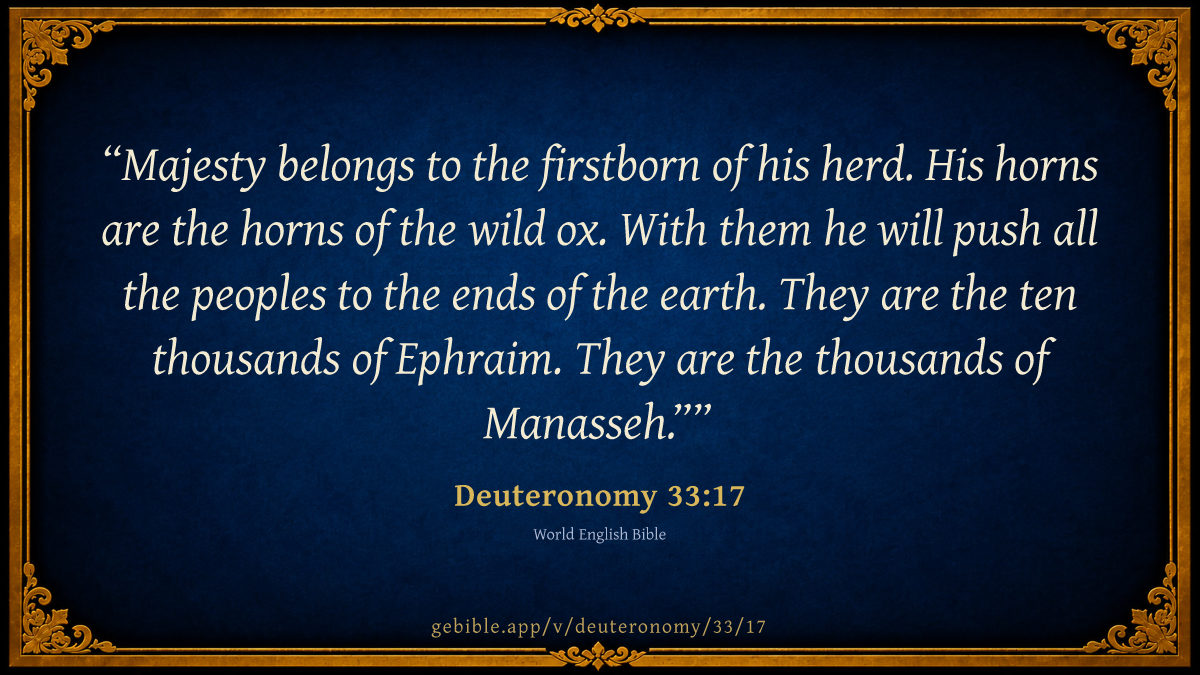
Majesty belongs to the firstborn of his herd. His horns are the horns of the wild ox. With them he will push all the peoples to the ends of the earth. They are the ten thousands of Ephraim. They are the thousands of Manasseh.”
Parallel Translations
-
Majesty belongs to the firstborn of his herd. His horns are the horns of the wild ox. With them he will push all the peoples to the ends of the earth. They are the ten thousands of Ephraim. They are the thousands of Manasseh.”
-
His glory is like the firstling of his bullock, and his horns are like the horns of unicorns: with them he shall push the people together to the ends of the earth: and they are the ten thousands of Ephraim, and they are the thousands of Manasseh.
-
His firstling bullock, majesty is his; and his horns are the horns of the wild-ox; with them he shall gore the peoples all of them, even the ends of the earth; and they are the ten thousands of Ephraim, and they are the thousands of Manasseh.
Cross-references (17)
Passages linked to Deuteronomy 33:17 in the Treasury of Scripture Knowledge, ordered by reader-vote popularity; verse text shown in World English Bible.
- Numbers 23:22 God brings them out of Egypt. He has as it were the strength of the wild ox.
- 1 Kings 22:11 Zedekiah the son of Chenaanah made himself horns of iron, and said, “Yahweh says, ‘With these you will push the Syrians, until they are consumed.’ ”
- Psalms 44:5 Through you, will we push down our adversaries. Through your name, we will tread down those who rise up against us.
- Genesis 48:19 His father refused, and said, “I know, my son, I know. He also will become a people, and he also will be great. However, his younger brother will be greater than he, and his offspring will become a multitude of nations.”
- Numbers 24:8 God brings him out of Egypt. He has as it were the strength of the wild ox. He shall consume the nations his adversaries, shall break their bones in pieces, and pierce them with his arrows.
- Psalms 92:10 But you have exalted my horn like that of the wild ox. I am anointed with fresh oil.
- Numbers 26:34 These are the families of Manasseh. Those who were counted of them were fifty-two thousand seven hundred.
- Numbers 26:37 These are the families of the sons of Ephraim according to those who were counted of them, thirty-two thousand five hundred. These are the sons of Joseph after their families.
- 1 Chronicles 5:1 The sons of Reuben the firstborn of Israel (for he was the firstborn; but, because he defiled his father’s couch, his birthright was given to the sons of Joseph the son of Israel; and the genealogy is not to be listed according to the birthright.
- 2 Chronicles 18:10 Zedekiah the son of Chenaanah made himself horns of iron and said, “Yahweh says, ‘With these you shall push the Syrians, until they are consumed.’ ”
- Job 39:9-10 “Will the wild ox be content to serve you? Or will he stay by your feeding trough? Can you hold the wild ox in the furrow with his harness? Or will he till the valleys after you?
- Psalms 22:21 Save me from the lion’s mouth! Yes, you have rescued me from the horns of the wild oxen.
- Psalms 29:6 He makes them also to skip like a calf; Lebanon and Sirion like a young, wild ox.
- Isaiah 34:7 The wild oxen will come down with them, and the young bulls with the mighty bulls; and their land will be drunken with blood, and their dust made greasy with fat.
- Hosea 5:3 I know Ephraim, and Israel is not hidden from me; for now, Ephraim, you have played the prostitute. Israel is defiled.
- Hosea 6:4 “Ephraim, what shall I do to you? Judah, what shall I do to you? For your love is like a morning cloud, and like the dew that disappears early.
- Hosea 7:1 When I would heal Israel, then the iniquity of Ephraim is uncovered, also the wickedness of Samaria; for they commit falsehood, and the thief enters in, and the gang of robbers ravages outside.
Cross-references from openbible.info (CC BY 4.0)
Explain this verse (13 sources)
Historical commentary, presented as a primary source — not an endorsement.
Private notes
Saved on this device only — never synced or sent anywhere.
Geneva Bible translators 1599 · Public Domain Or, strength.
Or, strength.
Geneva Bible (1599) marginal notes — public domain.
John Trapp 1656 · Public Domain Deu 33:17 His glory [is like] the firstling of…
Deu 33:17 His glory [is like] the firstling of his bullock, and his horns [are like] the horns of unicorns: with them he shall push the people together to the ends of the earth: and they [are] the ten thousands of Ephraim, and they [are] the thousands of Manasseh.
Ver. 17. His horns are like the horns of unicorns.] Justin Martyr {a} and some other of the ancients {b} have strangely racked and wrested this text, to wring out of it the sign of the cross, resembled and represented by the horn of a unicorn. At nihil hic de Christo, nihil de cruce.
Read full note →
He shall push the people together.] As General Joshua, of this tribe, did notably; so that Phoenicians ran away into a far country, and renowned his valour by a monument set up in Africa. Howbeit, Gratius ei fuit nomen pietatis, quam potestatis, as Tertullian saith of Augustus: He is more famous for his piety than for his prowess.
{a} Advers. Tryph.
{b} Tertul. Adver. Judaeos, cap. 10. Ambrose, De Benedict. Pat.
John Trapp, A Commentary or Exposition upon All the Books of the Old and New Testament (1647–1656) — public domain. Text from a community e-Sword module.
Matthew Poole 1685 · Public Domain The firstling of his bullock; in whose countenance there…
The firstling of his bullock; in whose countenance there is a kind of awful majesty and comely generosity, as Tully, Aelian, &c. observe. This seems to note the kingdom which Ephraim should obtain in Jeroboam and his successors.
His horns are like the horns of unicorns; his strength and power shall be very great.
Read full note →
He shall push the people, i.e. all that shall oppose him, and particularly the Canaanites.
To the ends of the earth, i.e. of the land of Canaan.
They are the ten thousands of Ephraim, and they are the thousands of Manasseh; though Manasseh be now more numerous, yet Ephraim shall shortly outstrip him, as was foretold, Gen 48:19.
Matthew Poole's English Annotations on the Holy Bible (1683–1685) — public domain. Text from a community e-Sword/MySword module.
John Gill 1763 · Public Domain And of Zebulun he said,.... The tribe of Zebulun,…
And of Zebulun he said,.... The tribe of Zebulun, as the Targums of Jonathan and Jerusalem, with whom Issachar is joined, they being brethren, and of the same mother as well as father; though Zebulun the youngest is set before Issachar the older, as in Jacob's blessing, Gen 49:13,
rejoice, Zebulun, in thy going out; in their going out to sea, to merchandise, to traffic in foreign parts, it being a maritime tribe, see Gen 49:13; and so are called upon to rejoice and be thankful for their safe preservation on the seas, and success in trade; and to this sense are the paraphrases of Jonathan and Jerusalem: though Onkelos interprets it of their going out to war against their enemies, and certain it is that they were also a warlike as well as a seafaring tribe; see Jdg 5:18,
Read full note →
and Issachar, in thy tents; being a tribe that stayed at home, and attended to husbandry, and dwelt in tents, to take care of and feed their cattle; in doing which they should be prosperous, and have occasion to rejoice, and be thankful to the Lord: though the Targums of Jonathan and Jerusalem carry it to a different sense, to their schools, in which they dwelt: this tribe being, as supposed, a learned tribe, studious, in the law; which is gathered from Ch1 12:32.
John Gill's Exposition of the Whole Bible (1746–1763) — public domain (CC PDM 1.0). Text via the HelloAO Bible API.
John Wesley 1765 · Public Domain His glory is like the firstling of his bullock…
His glory is like the firstling of his bullock - Or young bull, which is a stately creature, and was therefore formerly used as an emblem of royal majesty. This seems to note the kingdom which Ephraim should obtain in Jeroboam and his successors. His horns - His strength and power shall be very great. The people - All that shall oppose him, and particularly the Canaanites. The ten thousands - Of the land of Canaan. Though Manasseh be now more numerous, yet Ephraim shall shortly outstrip him, as was foretold Gen. xlviii, 17-19.
John Wesley, Explanatory Notes Upon the Whole Bible (1754–1765) — public domain. Text via the GEBible commentary corpus.
Adam Clarke 1810 · Public Domain Verse 17. His glory is like the firstling of…
Verse 17. His glory is like the firstling of his bullock] This similitude is very obscure. A bullock was the most excellent of animals among the Jews, not only because of its acceptableness in sacrifice to God, but because of its great usefulness in agriculture. There is something peculiarly noble and dignified in the appearance of the ox, and his greatest ornament are his fine horns; these the inspired penman has particularly in view, as the following clause proves; and it is well known that in Scriptural language horns are the emblem of strength, glory, and sovereignty; Ps 75:5; Ps 75:10; Ps 89:17; Ps 89:24; Ps 112:9; Dan 8:3, c. Lu 1:69; Re 17:3, c.
His horns are like the horns of unicorns] ראם reem, which we translate unicorn, from the μονοκερως monokeros of the Septuagint, signifies, according to Bochart, the mountain goat and according to others, the rhinoceros, a very large quadruped with one great horn on his nose, from which circumstance his name is derived. See the notes on Nu 23:22; Nu 24:8. Reem is in the singular number, and because the horns of a unicorn, a one-horned animal, would have appeared absurd, our translators, with an unfaithfulness not common to them, put the word in the plural number.
Read full note →
To the ends of the earth] Of the land of Canaan, for Joshua with his armies conquered all this land, and drove the ancient inhabitants out before him.
They are the ten thousands of Ephraim, c.] That is, The horns signify the ten thousands of Ephraim, and the thousands of Manasseh. Jacob prophesied, Ge 48:19, that the younger should be greater than the elder so here TENS of thousands are given to Ephraim, and only thousands to Manasseh. See the census, Nu 1:33-35.
Adam Clarke's Commentary on the Bible (1810–1826) — public domain. Text from a community e-Sword/MySword module.
Joseph Benson 1811 · Public Domain Deu 33:17. His glory is like the firstling of…
Deu 33:17. His glory is like the firstling of his bullock — Or the prime and fairest bullock of the herd. For things that excel in their kind are called firstborn in Scripture. The beauty and strength of this tribe are compared to this stately creature, and a bullock being the best emblem of power among the beasts of the pasture, it seems to be here used to denote the superior honour and dignity of the house of Joseph above the rest of the tribes of Israel. Indeed, a bullock, as Bochart shows, was formerly used as an image of kingly power and dignity, and therefore seems here to denote the kingdom which Ephraim should obtain in Jeroboam and his successors. His horns are like the horns of unicorns — A horn is a common Scripture emblem of power and force. So this is a further description of the house of Joseph. With them he shall push the people together — That is, throw down all that oppose him, particularly the Canaanites; to the ends of the earth — That is, of the land of Canaan. The ten thousands of Ephraim, and the thousands of Manasseh — Or, such are, &c.; that is, these blessings belong to the two numerous branches of the house of Joseph. Here he ascribes to Ephraim ten thousands, and to Manasseh only thousands; thus foreshowing, that Ephraim the younger was to be the more numerous of the two, as Jacob had before prophesied of them.
Joseph Benson's Commentary on the Old and New Testaments (1811–1818) — public domain. Text from a community e-Sword module.
Haydock's Catholic Bible Commentary 1859 · Public Domain Bullock, or cow. Shor, denotes all the species, chap.…
Bullock, or cow. Shor, denotes all the species, chap. xv. 19. --- Firstling, is likewise often put for the most excellent. Thus "his beauty, like the finest bullock." The Egyptians had a high esteem for bulls; and Elian (ii. 10,) informs us that Mnevis, one of their kings, ordered the people to adore the bull, as the most beautiful of animals. Moses points at the kingdom of Israel, which was chiefly governed by the tribe of Ephraim; or perhaps he alludes to Josue, (Calmet) who was to succeed him, and to conquer the nations on the other side of the Jordan, with so much resolution and ability. (Haydock) --- Rhinoceros, as stronger and more penetrating. See Numbers xxxii. 22. (Calmet) --- Horns, designate strength and beauty, Psalm lxxiv. (Menochius) --- Push, alluding to the manner in which bulls attack their opponents, and hurl them into the air, sparsa ad pugnam proludit arena. (Georg. iii.) (Calmet) --- Some of the Fathers have explained this passage of Jesus Christ, the first-born of the creation, who is possessed of all the treasures of wisdom (Haydock) and beauty, whose strength drew all things to himself, after he had lifted up the nations on his cross, as it were with horns, and rescued them from the power of the devil. (St. Augustine, q. ultra[last]) (Calmet) --- Manasses. To these two tribes, the blessings of their father, Joseph, belong; and their multitudes shall render them very formidable to the nations around them, as long as they obey their God. (Haydock) --- The younger brother, Ephraim, is preferred before the elder, Genesis xlviii. (Worthington)
George Leo Haydock (1774–1849), Haydock's Catholic Family Bible and Commentary, 1859 edition — public domain. Excludes Psalms (Douay-Rheims chapter numbering differs from Protestant) and Deuterocanonical books (Catholic canon only).
Daniel D. Whedon 1874 · Public Domain 17. The firstling of his bullock — The emblem…
17. The firstling of his bullock — The emblem of the tribe of Ephraim, a powerful tribe.
Horns of unicorns — Rather, wild bulls.
Daniel D. Whedon (gen. ed.), Commentary on the Old and New Testaments (1874–1909) — public domain. Text from a community e-Sword module.
The Cambridge Bible for Schools and Colleges 1878 · Public Domain 17. For these two hierodules the Heb. is ḳadesh…
17. For these two hierodules the Heb. is ḳadesh (masc.) and ḳedeshah (fem.) and means simply set apari, consecrated (cp. above, pp. 108 ff.), the former being probably the unsexed man referred to in Deu_22:5, Deu_23:1.
17. The firstling of his bullock] Ephraim, Gen_48:13 ff.
Read full note →
wild-ox] Heb. re’em, Ar. ri’m = the white antelope, leucoryx (see on Deu_14:5), but the descriptions in the O.T. prove that the Heb. re’em was rather the Ass. rimu, a gigantic species of ox (‘Bos primigenius’) now extinct, though its teeth have been found in the valley of the Nahr el-Kelb, in the district where Tiglath Pileser i. (b.c. 1120 ff.) hunted the rimu (Tristr. Nat. Hist. of the Bible, 146 ff., Houghton, Trans. Soc. Bibl. Arch. v. 33, 326 ff.; see more fully Driver’s note).
These be] So (without and) Sam. LXX, etc.
The Cambridge Bible for Schools and Colleges (gen. ed. J. J. S. Perowne; Cambridge University Press, 1878–1918) — public domain. Text from a community e-Sword module.
Ellicott's Commentary for English Readers 1878 · Public Domain (17) They are the ten thousands of Ephraim, and…
(17) They are the ten thousands of Ephraim, and they are the thousands of Manasseh.—Rashi refers this to the ten thousands slain by Joshua, the Ephraimite leader, and the thousands slain by Gideon, who was of the tribe of Manasseh. He expounds nearly the whole of the verse in reference to Joshua and the conquest of Canaan. There is an obvious similarity in the song of the Israelitish women after the defeat of the Philistines, “Saul hath slain his thousands, and David his ten thousands.” The people “pushed to the ends of the earth” are taken to be the thousands and ten thousands of conquered Canaanites and Midianites. For a similar metaphor, see 1Ki_22:11. Otherwise the ten thousands of Ephraim and the thousands of Manasseh would be the two-horned power of Joseph. (Comp. Dan_8:3; Dan_8:20 for a simile of the same kind.)
A Bible Commentary for English Readers, edited by Charles John Ellicott (1878–1897) — public domain. Text from a community e-Sword module.
unfoldingWord translationNotes 2017 · CC BY-SA 4.0 General Information:
General Information:
Moses continues to bless the tribes of Israel; the blessings are short poems. He continues to describe the tribe of Joseph, which he began to do in Deuteronomy 33:13. (See: Parallelism)
Read full note →
The firstborn of an ox, majestic is he
The ox is a metaphor for something large and strong. The word "firstborn" is a metaphor for honor. AT: "People will honor Joseph's descendants, who are many and powerful" (See: Metaphor)
his horns are the horns of
The horn is a metaphor for strength. AT: "he is as strong as" (See: Metaphor)
With them he will push
Pushing with his horns is a metaphor for strength. AT: "He is so strong that he will push" (See: Metaphor)
ten thousands of Ephraim ... the thousands of Manasseh
This means the tribe of Ephraim will be stronger than the tribe of Manasseh. AT: "the people of Ephraim, who number many times 10,000 ... the people of Manasseh, who number many times 1,000" (See: Numbers)
translationWords
firstborn
cow
majesty
Ephraim
Manasseh
unfoldingWord translationNotes — © Distant Shores Media and the Door43 World Missions Community, licensed CC BY-SA 4.0. Source: git.door43.org/Door43/en_tn.
Tyndale Open Study Notes 2022 · CC BY-SA 4.0 33:17 Ephraim is listed first because he received the…
33:17 Ephraim is listed first because he received the blessing of the firstborn over Manasseh (Gen 48:8-22). Manasseh, the firstborn, would normally have received the double portion belonging to the firstborn (cp. Deut 21:17), but Jacob gave it to Ephraim, Joseph’s younger son. Moses’ blessing reflects Jacob’s blessing by listing the tribe of Ephraim as numbering in multitudes (literally tens of thousands) and Manasseh in thousands. After the conquest and establishment of the nation, Ephraim became the dominant tribe of the north; later, after the kingdom was divided following Solomon’s death (1 Kgs 12), the name Ephraim was used interchangeably with Israel in speaking of the northern kingdom.
Tyndale Open Study Notes — © Tyndale Open Resources, licensed CC BY-SA 4.0. Text via the HelloAO Bible API.