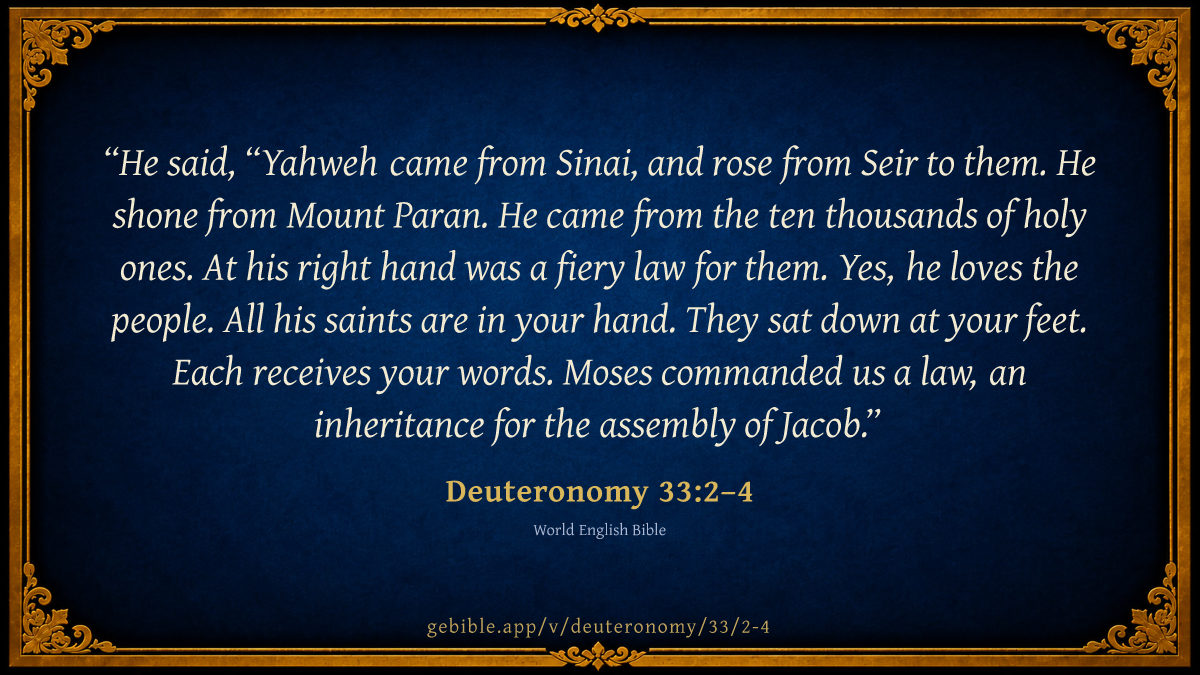
2He said, “Yahweh came from Sinai, and rose from Seir to them. He shone from Mount Paran. He came from the ten thousands of holy ones. At his right hand was a fiery law for them.
3Yes, he loves the people. All his saints are in your hand. They sat down at your feet. Each receives your words.
4Moses commanded us a law, an inheritance for the assembly of Jacob.
2 He said, “Yahweh came from Sinai, and rose from Seir to them. He shone from Mount Paran. He came from the ten thousands of holy ones. At his right hand was a fiery law for them.
3 Yes, he loves the people. All his saints are in your hand. They sat down at your feet. Each receives your words.
4 Moses commanded us a law, an inheritance for the assembly of Jacob.
KJVKing James Version
2 And he said, The LORD came from Sinai, and rose up from Seir unto them; he shined forth from mount Paran, and he came with ten thousands of saints: from his right hand went a fiery law for them.
3 Yea, he loved the people; all his saints are in thy hand: and they sat down at thy feet; every one shall receive of thy words.
4 Moses commanded us a law, even the inheritance of the congregation of Jacob.
Show all 3 translations
JPSJPS Tanakh (1917)
2 And he said: The LORD came from Sinai, and rose from Seir unto them; He shined forth from mount Paran, and He came from the myriads holy, at His right hand was a fiery law unto them.
3 Yea, He loveth the peoples, all His holy ones — they are in Thy hand; and they sit down at Thy feet, receiving of Thy words.
4 Moses commanded us a law, an inheritance of the congregation of Jacob.
Habakkuk 3:3(v2)God came from Teman, the Holy One from Mount Paran. His glory covered the heavens, and his praise filled the earth.
Luke 10:39(v3)She had a sister called Mary, who also sat at Jesus’ feet, and heard his word.
Jude 1:14(v2)About these also Enoch, the seventh from Adam, prophesied, saying, “Behold, the Lord came with ten thousands of his holy ones,
Revelation 5:11(v2)I saw, and I heard something like a voice of many angels around the throne, the living creatures, and the elders. The number of them was…
Judges 5:4-5(v2)“Yahweh, when you went out of Seir, when you marched out of the field of Edom, the earth trembled, the sky also dropped. Yes, the clouds…
Show all 48 cross-references
Psalms 68:17(v2)The chariots of God are tens of thousands and thousands of thousands. The Lord is among them, from Sinai, into the sanctuary.
Acts 7:53(v2)You received the law as it was ordained by angels, and didn’t keep it!”
Psalms 68:7-8(v2)God, when you went out before your people, when you marched through the wilderness... The earth trembled. The sky also poured down rain at…
Hebrews 2:2(v2)For if the word spoken through angels proved steadfast, and every transgression and disobedience received a just penalty,
Exodus 19:18-20(v2)All of Mount Sinai smoked, because Yahweh descended on it in fire; and its smoke ascended like the smoke of a furnace, and the whole…
Deuteronomy 7:6-8(v3)For you are a holy people to Yahweh your God. Yahweh your God has chosen you to be a people for his own possession, above all peoples who…
Daniel 7:9-10(v2)“I watched until thrones were placed, and one who was ancient of days sat. His clothing was white as snow, and the hair of his head like…
Malachi 1:2(v3)“I have loved you,” says Yahweh. Yet you say, “How have you loved us?” “Wasn’t Esau Jacob’s brother?” says Yahweh, “Yet I loved Jacob;
Psalms 119:111(v4)I have taken your testimonies as a heritage forever, for they are the joy of my heart.
Luke 8:35(v3)People went out to see what had happened. They came to Jesus and found the man from whom the demons had gone out, sitting at Jesus’ feet,…
John 1:17(v4)For the law was given through Moses. Grace and truth were realized through Jesus Christ.
John 7:19(v4)Didn’t Moses give you the law, and yet none of you keeps the law? Why do you seek to kill me?”
Acts 22:3(v3)“I am indeed a Jew, born in Tarsus of Cilicia, but brought up in this city at the feet of Gamaliel, instructed according to the strict…
Romans 8:35-39(v3)Who shall separate us from the love of Christ? Could oppression, or anguish, or persecution, or famine, or nakedness, or peril, or sword?…
2 Corinthians 3:7(v2)But if the service of death, written engraved on stones, came with glory, so that the children of Israel could not look steadfastly on the…
2 Corinthians 3:9(v2)For if the service of condemnation has glory, the service of righteousness exceeds much more in glory.
Galatians 3:10(v2)For as many as are of the works of the law are under a curse. For it is written, “Cursed is everyone who doesn’t continue in all things…
Galatians 3:19(v2)Then why is there the law? It was added because of transgressions, until the offspring should come to whom the promise has been made. It…
Ephesians 2:4-5(v3)But God, being rich in mercy, for his great love with which he loved us, even when we were dead through our trespasses, made us alive…
Colossians 3:3-4(v3)For you died, and your life is hidden with Christ in God. When Christ, our life, is revealed, then you will also be revealed with him in…
2 Thessalonians 1:7(v2)and to give relief to you who are afflicted with us, when the Lord Jesus is revealed from heaven with his mighty angels in flaming fire,
Hebrews 12:20(v2)for they could not stand that which was commanded, “If even an animal touches the mountain, it shall be stoned”.
1 Peter 1:5(v3)who by the power of God are guarded through faith for a salvation ready to be revealed in the last time.
Exodus 19:5-6(v3)Now therefore, if you will indeed obey my voice, and keep my covenant, then you shall be my own possession from among all peoples; for all…
Deuteronomy 14:2(v3)For you are a holy people to Yahweh your God, and Yahweh has chosen you to be a people for his own possession, above all peoples who are on…
1 Samuel 2:9(v3)He will keep the feet of his holy ones, but the wicked will be put to silence in darkness; for no man will prevail by strength.
Psalms 31:15(v3)My times are in your hand. Deliver me from the hand of my enemies, and from those who persecute me.
Psalms 47:4(v3)He chooses our inheritance for us, the glory of Jacob whom he loved.
Psalms 50:5(v3)“Gather my saints together to me, those who have made a covenant with me by sacrifice.”
Psalms 147:19-20(v3)He shows his word to Jacob, his statutes and his ordinances to Israel. He has not done this for just any nation. They don’t know his…
Proverbs 2:1(v3)My son, if you will receive my words, and store up my commandments within you,
Jeremiah 31:3(v3)Yahweh appeared of old to me, saying, “Yes, I have loved you with an everlasting love. Therefore I have drawn you with loving kindness.
Jeremiah 32:40(v3)I will make an everlasting covenant with them, that I will not turn away from following them, to do them good. I will put my fear in their…
Hosea 11:1(v3)“When Israel was a child, then I loved him, and called my son out of Egypt.
Luke 2:46(v3)After three days they found him in the temple, sitting in the middle of the teachers, both listening to them, and asking them questions.
John 10:28-29(v3)I give eternal life to them. They will never perish, and no one will snatch them out of my hand. My Father who has given them to me is…
John 17:11-15(v3)I am no more in the world, but these are in the world, and I am coming to you. Holy Father, keep them through your name which you have…
Romans 9:11-13(v3)For being not yet born, neither having done anything good or bad, that the purpose of God according to election might stand, not of works,…
Deuteronomy 5:22(v2)Yahweh spoke these words to all your assembly on the mountain out of the middle of the fire, of the cloud, and of the thick darkness, with…
Deuteronomy 9:26-29(v4)I prayed to Yahweh, and said, “Lord Yahweh, don’t destroy your people and your inheritance that you have redeemed through your greatness,…
Psalms 119:72(v4)The law of your mouth is better to me than thousands of pieces of gold and silver.
1 Thessalonians 1:6(v3)You became imitators of us and of the Lord, having received the word in much affliction, with joy of the Holy Spirit,
1 John 4:19(v3)We love him, because he first loved us.
Cross-references from openbible.info (CC BY 4.0)
Explain this passage (18 sources)
Historical commentary, presented as a primary source — not an endorsement.
Geneva Bible translators1599 · Public DomainOn vv2–4Meaning, infinite Angels.
Meaning, infinite Angels.
Geneva Bible (1599) marginal notes — public domain.
John Trapp1656 · Public DomainOn vv2–4Deu 33:2 And he said, The LORD came from…
Deu 33:2 And he said, The LORD came from Sinai, and rose up from Seir unto them; he shined forth from mount Paran, and he came with ten thousands of saints: from his right hand [went] a fiery law for them.
Ver. 2. Went a fiery law for them.] This fire wherein the law was given, and shall be required, is still in it, and will never out; hence are those terrors which it flasheth in every conscience that hath felt remorse of sin. Every man’s heart is a Sinai, and resembles to him both heaven and hell. "The sting of death is sin, and the strength of sin is the law." {1Co 15:56}
John Trapp, A Commentary or Exposition upon All the Books of the Old and New Testament (1647–1656) — public domain. Text from a community e-Sword module.
Matthew Poole1685 · Public DomainOn vv2–4The Lord came, to wit, to the Israelites, i.e.…
The Lord came, to wit, to the Israelites, i.e. manifested graciously and gloriously among them.
From Sinai, i.e. beginning at Sinai, where the first and most glorious appearance of God was, and so going on with them to Seir and Paran. Or, to Sinai, the particle mem oft signifying to, as is evident by comparing Isa 59:20, with Rom 11:26; 1Ki 8:30, with 2Ch 6:21; 2Sa 6:2, with 1Ch 13:6. See also Gen 2:8; 11:2; 13:11; 1Sa 14:15. Or, in Sinai; mem being put for beth, in, as Exo 25:18; Deu 15:1; Job 19:26; Psa 68:29; 72:16.
Read full note →
Rose up; he appeared or showed himself, as the sun doth when it riseth.
From Seir, i.e. from the mountain or land of Edom, which is called Seir, Gen 32:3; 36:8; Deu 2:4, to which place the Israelites came, Num 20:14, &c.; and from thence God led them on towards the Land of Promise, and then gloriously appeared for them in subduing Sihon and Og before them, and giving their countries unto them; which glorious work of God’s is particularly celebrated Jdg 5:4. But because the land of Seir or Edom is sometimes taken more largely, and so reacheth even to the Red Sea, as appears from 1Ki 9:26, and therefore Mount Sinai was near to it; and because Paran, which here follows, was also near Sinai, as being the next station into which they came from the wilderness of Sinai, Num 10:12; all this verse may belong to God’s appearance in Mount Sinai, where that glorious light which shone upon Mount-Sinai directly did in all probability scatter its beams into adjacent parts, such as Seir and Paean were; and so this is only a poetical and prophetical variation of the phrase and expression of the same thing in divers words, and God coming, or rising, or shining from or to or in Sinai, and Sear, and Paran note one and the same illustrious action of God appearing there with
ten thousands of his saints or holy angels, and there giving
a fiery law to them, as it here follows. And this interpretation may receive some strength from Hab 3:3, where this glorious march of God before his people is remembered; only teman, which signifies the south, is put for Seir, which is here, possibly to signify that that Seir which is here mentioned was to be understood of the southern part of the country of Seir or Edom, which was that part adjoining to the Red Sea. Others refer this of Seir to the brazen serpent, that eminent type of Christ, which was erected in this place.
Mount Paran; a place where God eminently manifested his presence and goodness, both in giving the people flesh which they desired, and in appointing the seventy elders, and pouring forth his Spirit upon them, Num 11; though the exposition mentioned in the foregoing branch may seem more probable. With
ten thousands of saints, i.e. with a a great company of holy angels, Psa 68:17; Dan 7:10, which attended upon him in this great and glorious work of giving the law, as may be gathered from Act 7:53; Gal 3:19; Heb 2:2; 12:22.
From his right hand; which both wrote the law and gave it to men; an allusion to men, who ordinarily write and give gifts with their right, and not with their left hand.
A fiery law. The law is called fiery, partly, because it is of a fiery nature, purging, and searching, and inflaming, for which reasons God’s word is compared to fire, Jer 23:29; partly, to signify that fiery wrath and curse which it inflicteth upon sinners for the violation of it, 2Co 3:7,9; and principally, because it was delivered out of the midst of the fire, Exo 19:16,18; Deu 4:11; 5:22,23.
Matthew Poole's English Annotations on the Holy Bible (1683–1685) — public domain. Text from a community e-Sword/MySword module.
John Gill1763 · Public DomainOn vv2–4Yea, he loved the people,.... The people of Israel,…
Yea, he loved the people,.... The people of Israel, of which his giving the law to them in such a glorious manner was an instance, and was a distinguishing blessing which other nations were not favoured with, see Deu 4:6; how much more is the love of God shown to his spiritual Israel and special people, by giving them his Gospel, the precious truths, promises, and ordinances of it, and, above all, in giving them his Son to be the Redeemer and Saviour of them, as revealed therein! these he embraces in his arms and in his bosom, as the word here signifies; admitting them to great nearness and familiarity with him, to commune with Father, Son, and Spirit, to a participation of all the blessings of grace here, and to the enjoyment of glory hereafter:
all his saints are in thy hand; not the sons of Levi, who were round about the ark, as Aben Ezra interprets it; rather all the people of Israel, who were chosen to be an holy people to the Lord above all people, and who were the care of his providence, protected by his power, and guided with his right hand; and were in a wonderful manner kept and preserved by him, both at the time of the giving of the law, and in their passage through the wilderness; it is eminently true of the chosen people of God, who are given to Christ, and made his care and charge, as all such who are sanctified and set apart by God the Father are, they are preserved in Christ, Jde 1:1; and these are sanctified in and by Christ, and by the Spirit of Christ, and so may be truly called his saints; and they are in the hands of Christ, as dear to him as his right hand, highly valued by him, held in his right hand; they are in his possession, are his peculiar people, portion, and inheritance, they are at his dispose, under his guidance and direction; and are in his custody and under his protection, and where they are safe from every enemy, and can never be snatched, taken, or removed from thence; see Joh 10:28; here they are put by the Father, as an instance of his love to them, and care of them, though not without the consent and desire of the Son, and this was done in eternity, when they were chosen in him:
Read full note →
and they sat down at thy feet; which may respect the position of the Israelites at the bottom of Mount Sinai, while the law was giving, which may be said to be the feet of the Lord, he being on the top of the mount, see Exo 19:17; all the Targums interpret it of the feet of the cloud of glory, they pitching their tents where that rested, Num 9:17; some think it an allusion to scholars sitting at the feet of their masters to receive instructions from them, see Act 22:3; so the disciples and followers of Christ sit at his feet, attending on his word and ordinances with calmness and serenity of mind, with much spiritual pleasure and delight, and where they continue and abide; and which may denote their modesty and humility, their subjection to his ordinances, and readiness to receive his doctrines, and their perseverance in them, see Mar 5:15; the word signifies, in the Arabic language, to sit down at a table (e), and so the word is used in the Arabic version of Mat 8:11; and the ancient manner being reclining, the guests might be said to sit at the feet of each, especially at the feet of the master; so Christ sits at his table, and his people with him at his feet, Sol 1:12,
everyone shall receive of thy words; of the words of the law, as the Israelites, who heard them and promised obedience to them, Exo 24:7; and would hear and receive them again, Jos 8:34; and so Christ's disciples, everyone of them that hath heard and learned of the Father, and comes to him, and believes in him, receives the words or doctrines given him by the Father, Joh 17:8; so as to understand them, approve of them, love them, believe them, and act according to them; these they receive into their hearts as well as into their heads, with all readiness, gladness, and meekness; even everyone of the persons before described or loved by the Lord, are in the hands of Christ and sitting at his feet.
(e) Hence "a table", with the Talmudists. T. Bab. Beracot, fol. 42. 1. Pesach. fol. 110. 2. Kiddushin, fol. 81. 1.
John Gill's Exposition of the Whole Bible (1746–1763) — public domain (CC PDM 1.0). Text via the HelloAO Bible API.
John Wesley1765 · Public DomainOn vv2–4The Lord came - Namely, to the Israelites, manifested…
The Lord came - Namely, to the Israelites, manifested himself graciously and gloriously among them. From Sinai - Beginning at Sinai, where the first appearance of God was, and so going on with them to Seir and Paran. And rose up - He appeared or shewed himself, as the sun doth when it riseth. From Seir - From the mountain or land of Edom, to which place the Israelites came, Num. xx, 14, &c. and from thence God led them on towards the land of promise, and then gloriously appeared for them in subduing Sihon and Og before them. But because the land of Edom is sometimes taken more largely, and so reacheth even to the Red-sea, and therefore Mount Sinai was near to it, and because Paran was also near Sinai, being the next station into which they came from the wilderness of Sinai: all this verse may belong to God's appearance in Mount Sinai, where that glorious light which shone upon Mount Sinai directly, did in all probability scatter its beams into adjacent parts, such as Seir and Paran were. And if so, this is only a poetical expression of the same thing in divers words, and God coming or rising or shining from or to or in Sinai and Seir and Paran note one and the same illustrious action of God appearing there with ten thousands of his saints or holy angels, and giving a fiery law to them. Paran - A place where God eminently manifested his presence and goodness both in giving the people flesh which they desired, and in appointing the seventy elders and pouring forth his spirit upon them. With ten thousands of saints - That is, with a great company of holy angels, Psalm lxviii, 17 Dan. vii, 10, which attended upon him in this great and glorious work of giving the law, as may be gathered from Acts vii, 53 Gal. iii, 19. From his right hand - Which both wrote the law and gave it to men. An allusion to men who ordinarily write and give gifts with their right hand. A fiery law - The law is called fiery, because it is of a fiery nature purging and searching and inflaming, to signify that fiery wrath which it inflicteth upon sinners for the violation of it, and principally because it was delivered out of the midst of the fire.
John Wesley, Explanatory Notes Upon the Whole Bible (1754–1765) — public domain. Text via the GEBible commentary corpus.
Adam Clarke1810 · Public DomainOn v3Verse 3. Yea, he loved the people] This is…
Verse 3. Yea, he loved the people] This is the inference which Moses makes from those glorious appearances, that God truly loved the people; and that all his saints, קדשיו kedoshaiv, the people whom he had consecrated to himself, were under his especial benediction; and that in order to make them a holy nation, God had displayed his glory on Mount Sinai, where they had fallen prostrate at his feet with the humblest adoration, sincerely promising the most affectionate obedience; and that God had there commanded them a law which was to be the possession and inheritance of the children of Jacob, De 33:4. And to crown the whole, he had not only blessed them as their lawgiver, but had also vouchsafed to be their king, De 33:5.
Dr. Kennicott proposes to translate the whole five verses thus: -
Read full note →
-- Verse 1. And this is the blessing wherewith Moses, the man of God, blessed the children of Israel before his death. And he said,
2. Jehovah came from SINAI,
And he arose upon them from SEIR;
He shone forth from Mount PARAN,
And he came from MERIBAH-KADESH:
From his right hand a fire shone forth upon them.
3. Truly, he loved the people,
And he blessed all his saints:
For they fell down at his feet,
And they received of his words.
4. He commanded us a law,
The inheritance of the congregation of Jacob.
5. And he became king in Jeshurun;
When the heads of the people were assembled,
Together with the tribes of Israel.
We have already seen that Dr. Kennicott reads מריבה קדש Meribah-Kadesh, the name of a place, instead of מרבבת קדש meribeboth kodesh, which, by a most unnatural and forced construction, our version renders ten thousands of saints, a translation which no circumstance of the history justifies.
Instead of a fiery law, אש דת esh dath, he reads, following the Samaritan version, אש אור esh ur, a fire shining out upon them. In vindication of this change in the original, it may be observed,
1. That, though דת dath signifies a law, yet it is a Chaldee term, and appears nowhere in any part of the sacred writings previously to the Babylonish captivity: תורה torah being the term constantly used to express the Law, at all times prior to the corruption of the Hebrew, by the Chaldee.
2. That the word itself is obscure in its present situation, as the Hebrew Bibles write it and esh in one word eshdath, which has no meaning; and which, in order to give it one, the Massorah directs should be read separate, though written connected.
3. That the word is not acknowledged by the two most ancient versions, the Septuagint and Syriac.
4. That in the parallel place, Hab 3:3-4, a word is used which expresses the rays of light, קרנים karnayim, horns, that is, splendours, rays, or effulgence of light.
5. That on all these accounts, together with the almost impossibility of giving a rational meaning to the text as it now stands, the translation contended for should be adopted.
Instead of All his saints are in his hand, Dr. Kennicott reads, He blessed all his saints - changing בידך beyadecha, into ברך barach, he blessed, which word, all who understand the Hebrew letters will see, might be easily mistaken for the other; the ד daleth and the ר resh being, not only in MSS., but also in printed books, often so much alike, that analogy alone can determine which is the true letter; and except in the insertion of the י yod, which might have been easily mistaken for the apex at the top of the ב beth very frequent in MSS., both words have the nearest resemblance. To this may be added, that the Syriac authorizes this rendering.
Instead of לרגלך leraglecha, and מדברתיך middabberotheycha, THY feet, and THY words, Dr. Kennicott reads the pronouns in the third person singular, לרגליו leraglaiv and מדברותיו middabberothaiv, HIS feet, HIS words, in which he is supported both by the Septuagint and Vulgate. He also changes ישא yissa, HE shall receive, into ישאו yisseu, THEY shall receive.
He contends also that משה Mosheh, Moses, in the fourth verse, was written by mistake for the following word מורשה morashah, inheritance; and when the scribe found he had inserted a wrong word, he added the proper one, and did not erase the first. The word Moses, he thinks, should therefore be left out of the text, as it is improbable that he should here introduce his own name; and that if the word be allowed to be legitimate, then the word king must apply to him, and not to GOD, which would be most absurd. See Kennicott's first Dissertation, p. 422, &c.
Adam Clarke's Commentary on the Bible (1810–1826) — public domain. Text from a community e-Sword/MySword module.
Joseph Benson1811 · Public DomainOn vv2–4Deu 33:2. The Lord came — Namely, to the…
Deu 33:2. The Lord came — Namely, to the Israelites; manifested himself graciously and gloriously among them. He begins with this, that he may, in the first place, make them sensible of that most signal blessing which God had bestowed upon them, in choosing them to be his peculiar people. From Sinai — Beginning at Sinai, where the first appearance of God was. And rose up from Seir unto them, &c. — The plain meaning of the word is, that the same divine presence which was manifested to them on mount Sinai, accompanied them through all their journeys and encampments, especially about mount Seir and Paran, the principal places of their abode, till they came to the plains of Moab, where they were now encamped. Rose up from Seir — Namely, when, upon the removal of the cloud of glory, they marched from the neighbourhood of Idumea, in which is mount Seir. The original word signifies that his presence rose upon them like the sun from the mount, (Mal 4:2,) and spread abroad his beams upon them from Paran, namely, when they encamped below that mount, whither they came from the wilderness of Sinai, Num 10:12; Num 13:1-3. Here God eminently manifested his presence and goodness, both in giving the people flesh, which they desired, and in appointing the seventy elders, and pouring forth his Spirit upon them. He came with ten thousands of his saints — Or holy ones, that is, angels, who attended him at the giving of the law, Psa 68:17; see also Act 7:53; Gal 3:19, and Heb 2:2. From his right hand — An allusion to the manner of men, who ordinarily both write and give gifts with their right hands. Thus God both wrote and gave the law. A fiery law — The law is termed fiery, because, like fire, it is of a searching, purging, and enflaming nature; because it inflicts fiery wrath on sinners for the violation of it, and principally, because it was delivered out of the midst of fire.
Joseph Benson's Commentary on the Old and New Testaments (1811–1818) — public domain. Text from a community e-Sword module.
Albert Barnes1834 · Public DomainOn vv2–3By “Seir” is to be understood the mountain-land of…
By “Seir” is to be understood the mountain-land of the Edomites, and by “mount Paran” the range which forms the northern boundary of the desert of Sinai (compare Gen 14:6 note). Thus the verse forms a poetical description of the vast arena upon which the glorious manifestation of the Lord in the giving of the covenant took place.
With ten thousands of saints - Render, from amidst ten thousands of holy ones: literally from myriads of holiness, i. e., holy Angels (compare Zec 14:5). God is represented as leaving heaven where He dwells amidst the host of the Angels 1Ki 22:19 and descending in majesty to earth Mic 1:3.
Read full note →
A fiery law - more literally as in the margin, with perhaps an allusion to the pillar of fire Exo 13:21. The word is much disputed.
Albert Barnes' Notes on the Bible (1834–1885) — public domain. Text from a community e-Sword/MySword module.
Haydock's Catholic Bible Commentary1859 · Public DomainOn vv2–4Pharan. Habacuc iii. 3, mentions this apparition. See also…
Pharan. Habacuc iii. 3, mentions this apparition. See also Psalm lxvii. 9. --- Saints. God was accompanied by legions of angels, when he delivered the law to the Israelites, who are styled a nation of saints, Numbers xvi. 3. Septuagint, "he hastened from Mount Pharan, with ten thousands to Cades. At his right hand are his angels attending." (Haydock) --- Kodesh does not mean saints, but holiness, or the city of Cades; and the preceding word, which Protestants translate, with ten thousands, more probably refers to another title of the city, as it is specified Meriba-Cadesh, chap. xxxii. 51., and Ezechiel xlviii. 28. (Kennicott) --- Law. Chaldean, "from the midst of the fire he has given us a law, written with his own hand." We may translate, "He hath shone from Mount Pharan, and multitudes accompanied him. The Holy One, who hath in his hand fire and the law." See Isaias vi. 3. God conducted his people, like a victorious general, through the wilderness, frequently appearing to them to strike terror into the rebellious. (Calmet) --- When he first descended upon Sinai, his glory shone on Pharan and Seir, as it were in its progress thither. (Menochius) --- The law is styled fiery, not only because it was given from the midst of flames, but also because it was to be put in execution with the utmost rigour. (Haydock) --- But doth is Chaldean, and no where else used for the law in the books written before the captivity, nor is it acknowledged by the Septuagint, Syriac, &c. Perhaps it was originally aur, as it is in the Samaritan version, "shone forth," conformably to a similar passage, Habacuc iii. 4. "His brightness was as the sun, horns, or rather splendours (issuing forth) from his hand," &c. (Kennicott)
George Leo Haydock (1774–1849), Haydock's Catholic Family Bible and Commentary, 1859 edition — public domain. Excludes Psalms (Douay-Rheims chapter numbering differs from Protestant) and Deuterocanonical books (Catholic canon only).
Robert Jamieson, A. R. Fausset & David Brown1871 · Public DomainOn v2The Lord came--Under a beautiful metaphor, borrowed from the…
The Lord came--Under a beautiful metaphor, borrowed from the dawn and progressive splendor of the sun, the Majesty of God is sublimely described as a divine light which appeared in Sinai and scattered its beams on all the adjoining region in directing Israel's march to Canaan. In these descriptions of a theophania, God is represented as coming from the south, and the allusion is in general to the thunderings and lightnings of Sinai; but other mountains in the same direction are mentioned with it. The location of Seir was on the east of the Ghor; mount Paran was either the chain on the west of the Ghor, or rather the mountains on the southern border of the desert towards the peninsula [ROBINSON]. (Compare Jdg 5:4-5; Psa 68:7-8; Hab 3:3).
ten thousands of saints--rendered by some, "with the ten thousand of Kadesh," or perhaps better still, "from Meribah" [EWALD].
Read full note →
a fiery law--so called both because of the thunder and lightning which accompanied its promulgation (Exo 19:16-18; Deu 4:11), and the fierce, unrelenting curse denounced against the violation of its precepts (Co2 3:7-9). Notwithstanding those awe-inspiring symbols of Majesty that were displayed on Sinai, the law was really given in kindness and love (Deu 33:3), as a means of promoting both the temporal and eternal welfare of the people. And it was "the inheritance of the congregation of Jacob," not only from the hereditary obligation under which that people were laid to observe it, but from its being the grand distinction, the peculiar privilege of the nation.
Jamieson, Fausset & Brown — Commentary Critical and Explanatory on the Whole Bible (1871) — public domain (CC PDM 1.0). Text via the HelloAO Bible API.
Daniel D. Whedon1874 · Public DomainOn vv2–42. The Lord came from Sinai, and rose up…
2. The Lord came from Sinai, and rose up from Seir unto them; he shined forth from Mount Paran — These expressions do not refer to different appearances of Jehovah, but to that signal manifestation of himself at the giving of the law. The language is highly poetical. It is as though Moses saw the glory of Jehovah shine forth from the lofty heights of Sinai to the heights of Edom on the east and to the mountains of Paran, which form the boundary of the desert, on the north. “The glory of the Lord who appeared upon Sinai sent its beams even to the eastern and northern extremities of the desert.” — Keil. Comp. Jdg_5:4-5, and Hab_3:3.
And he came with ten thousands of saints — Literally, from myriads of holiness. The expression is meant to describe Jehovah leaving his heavenly abode, where he dwells surrounded by holy ones, and coming down to announce the law to his people.
Read full note →
From his right hand went a fiery law for them — Our English version here follows the Vulgate. As the Hebrew reads, the literal rendering would be fire of law, a fire which was a law for them. Gesenius thinks it would be better referred to the pillar of fire, (Exo_13:21,) which was as a law to direct them, than to the lightnings which Jehovah employs for his servants. Some Hebrew manuscripts write אשׁ דתas one word. If this reading should be accepted it might be rendered so as to refer to flashes of lightning. Comp. Hab_3:4.
Daniel D. Whedon (gen. ed.), Commentary on the Old and New Testaments (1874–1909) — public domain. Text from a community e-Sword module.
The Cambridge Bible for Schools and Colleges1878 · Public DomainOn vv2–42 (3). Nor shall the Son of an Unlawful…
2 (3). Nor shall the Son of an Unlawful Marriage Enter the Congregation nor his Descendants.
bastard] This meaning is derived from the LXX ἐκ πόρνης. More probably the Heb. mamzer (elsewhere only in Zec_9:6) signifies the offspring either of such unlawful unions as are exemplified in Deu_22:30 (Deu_23:1), which was the opinion of the Rabbis (Mishnah, ‘Yebamoth’ Deu_4:13, cp. Levy, Chald. u. Neuhebr. Wörterbuch, sub voce), or of the equally forbidden marriages with foreign wives, Neh_13:23 ff.
Read full note →
2. The Lord] Jehovah; as frequently, the Divine Name opens the poem; see on Deu_1:6.
Sinai] See Deu_1:2; Deu_1:6, on Ḥoreb, and on the view that the mountain lay in Se‘îr cp. Jdg_5:4.
rose] Like the sun: rays, or beams, forth.
unto them] So Heb. and Sam. But LXX, Targ., Vulg. read to us. V. Gall (followed by Berth. and Marti) reads to his people.
shined forth] Or flashed, so of God in Psa_50:2; Psa_80:1 (2), Psa_94:1; and Job.
Paran] See Deu_1:1; mount Paran, as in Hab_3:3, is not to be identified with any one range in that mountainous wilderness: mount is collective.
came] Better comes, hies or is sped; a vb common in Aram. but in Heb. used only in poetry.
from Merîbath-Kadesh] A probable conjecture from the Heb. meribeboth-ḳodesh = from holy myriads and LXX with myriads of Ḳadesh. Others propose, with him (so Sam. Pesh. Targ. instead of comes) were holy chariots (markeboth-kodesh). From the Targ. with him were holy myriads arose the late Jewish belief that angels (cp. LXX ἄγγελοι in next clause) ministered at the giving of the Law, Act_7:53, Gal_3:19, Heb_2:2.
At his right hand] Or from; confirmed by the Versions; yet it is possible that for mîmîno we should read miyyamîn = from the South, in parallel to the previous lines.
was a fiery law] Very questionable. The Heb. consonants ’sh d th are written as one word, but read by the Massoretes as two, ’esh dath = fire, law; but their construction is awkward and dath is a late word from the Persian and improbable here. Sam. reads two words, each = light; if the first be read as a vb we get the probable there flashed light. Dillm. adding two consonants reads a burning fire. By reading one word we have an equivalent of the Aram. ’ashidoth = lightning flashes; cp. Hab_3:4, He had horns (i.e. rays) from his hand. LXX ἄγγελοι, cp. Psa_104:4 his ministers a flame of fire. The line may be an intrusion; it is not one of a couplet.
2–5. The Proem—The Origin of Israel
The Revelation by which the tribes became a nation is described in the mingled figures of a dawn and a thunderstorm, theophanies frequent in the Ar. poetry of the desert where natural phenomena suggestive of divine appearance and power are few (hardly more than these and the rainbow); and used several times in Heb. poetry of Jehovah the Inhabiter of Sinai; Jdg_5:4 f., Hab_3:3 ff.; cp. Psa_18:29. and contrast 1Ki_19:11 f. See further Early Poetry of Israel, 56 ff.
2 The Lord from Sinai is come
And risen on us from Se‘îr,
Hath flashed from the hills of Parán,
And sped from Merîbath-Ḳadesh.
[From the South (?) blazed fire (?) on them.]
3 Lover indeed of His people,
His hallowed are all in His hand,
They, they fall in (?) at Thy feet,
They take up Thine orders.
4 [Moses commanded us law]
His domain is the Assembly of Jacob,
5 And King He became in Yeshurun,
When the heads of the people were gathered,
The tribes of Israel were one.
The Cambridge Bible for Schools and Colleges (gen. ed. J. J. S. Perowne; Cambridge University Press, 1878–1918) — public domain. Text from a community e-Sword module.
Ellicott's Commentary for English Readers1878 · Public DomainOn vv2–4(2) “And he said, Jehovah came from Sinai,
(2) “And he said, Jehovah came from Sinai,
And dawned upon them from Seir;
Read full note →
He shone forth from mount Paran.
And there came from the ten thousands of holiness,
From His right hand, a fire of law [10] for them.”
[10] On this expression see an additional note at the end of the book.
The appearance of God on Sinai is described as a sunrise. His light rose from Sinai, and the tops of the hills of Seir caught its rays. The full blaze of light shone on Paran. (Comp. Psa_1:2 : “Out of Zion, the perfection of beauty, God hath shined.”) He came with ten thousands of saints is a mere mistranslation. The preposition is “from,” not “with.” If the verb “he came,” in the fourth line, is taken to refer to God, we must translate: “He came from ten thousands of saints” (to sinful men). Rashi takes “from” to mean “part of.” “There came some of His ten thousands of saints, but not all of them.” I believe the true translation is what I have given. The law itself was “ordained by angels in the hand of a mediator” (Gal_3:19). It is called “the word spoken by angels” in Heb_2:2. The language of Dan_7:10—“A fiery stream issued and came forth from before Him: thousand thousands ministered unto Him”—supplies a complete parallel. The fiery law came from the ten thousands on “His right hand;” or from them, and from His right hand. This construction is by far the most simple, and agrees with what we read elsewhere.
ADDITIONAL NOTE ON Deu_33:2. “A FIERY LAW.”
THE original expression, eshdath or esh dath, sometimes written as one word, and sometimes as two, has created some difficulty. Esh is “fire,” and dath, if taken as a distinct word, is “law.” But dath does not appear elsewhere in the Hebrew of the Old Testament, until we meet it in the book of Esther, where it occurs frequently. It is also found in Ezr_8:36. In the Chaldee of Daniel and Ezra it occurs six times. Modern authorities assert that it is properly a Persian word. But since it is found in the Chaldee of Daniel, it was in use among the Chaldæans before the Persian empire. The word has Semitic affinities. The Hebrewsyllable thêth would have nearly the same meaning. A datum (or dictum) is the nearest equivalent that we have. There seems no reason to doubt that the word dath had obtained a place both in Chaldee and in Hebrew at the time of the Captivity. It is perfectly possible that its existence in Chaldee dates very much earlier. We must remember that Chaldee was the language of the family of Abraham before they adopted Hebrew. “A Syrian ready to perish was my father,” is the confession dictated by Moses in Deu_26:5. Syriac and Chaldee in the Old Testament are names of the same language. In the Babylonish captivity the Jews really returned to their ancestral language. It is therefore quite conceivable that Chaldæan words lingered among them until the Exodus; and this word dath, if it be a true Chaldæan word, may be an example. But, obviously, these Chaldæan reminiscences would be fewer as the years rolled on. The three Targums all take dath to be “law” in this place. The LXX. has “angels” (ἄγγελοι), instead of the combination eshdath. Possibly the word was taken as ashdoth (plural of the Chaldee ashda), meaning “rays” (of light?) and so “angels.” Comp., “He maketh His angels spirits, and His ministers a flame of fire;” they “ran and returned as a flash of lightning” (Psa_104:4; Eze_1:14). It is also possible that the LXX. read r instead of d in the word which they had before them, and that they arrived at the meaning “angels” through the Hebrew word shârath, “to minister.” The confusion between r and d, which are extremely alike in Hebrew, is very common. The parallels referred to in the notes on the verse show that “fiery law” will yield a good sense. The only question is whether dath, “law,” can be reasonably supposed to have occurred in the Mosaic writings. If the word were at all generally known at that period, to whatever language it properly belonged, it would hardly have escaped such a man as Moses. I think it quite possible that the common translation may be right. The Hebrew commentators accept it. The only alternative I can suggest is that of the LXX., which cannot be verified with certainty.
A Bible Commentary for English Readers, edited by Charles John Ellicott (1878–1897) — public domain. Text from a community e-Sword module.
The Pulpit Commentary1880 · Public DomainOn vv2–4And he said. Here begin the words of Moses.…
And he said. Here begin the words of Moses. He commences by depicting the majesty of Jehovah as he appeared to Israel when he came to make the covenant with them and give them his Law. The Lord came from Sinai, and rose up from Seir unto them, etc. Seir is the mountain land of Edom to the cast of Sinai. Mount Paran is probably the range of lofty hills which form the southern boundary of the Promised Land to the north of the desert of Et-Tih. These places are not mentioned as scenes of different manifestations of the Divine glory, but as indicating the extent to which the one manifestation given at Sinai reached. The light of the Divine glory that rested on Sinai was reflected also from the mountains of Seir and Paran. (cf. Heb_3:3; Jud_1:5:4) He came with ten thousands of saints; rather, he came from ten thousands of holy ones; literally, out from myriads of holiness; i.e. "from his celestial seat, where myriads of angels surround his throne" (Rosenm The rendering "with," though that of the Targum, LXX, and Vulgate, cannot be retained; nor does Scripture represent God as attended by angels when he comes forth to manifest his glory to men. They are represented as surrounding his throne in heaven (1Ki_22:19; Job_1:6; Dan_7:10) as his servants awaiting his behest, and his host that do his pleasure (Gen_28:12 Gen_32:2, Gen_32:3; Psa_103:21) and God is represented as dwelling in the midst of them. (Psa_68:17) Hence he is represented here as coming forth from among them to manifest himself to his people. A fiery law. There is a various reading here; instead of tD vae, fire of law, many codices have tdva in one word, and this is supported by the Samaritan text and other authorities, and is accepted by most critics and interpreters. It is a fatal objection to the textual reading that tD is not a Semitic word, but one of Persian origin, brought by the Jews from Babylonia, and found only in the post-exilian books (Est_1:8, 19 2:8, 12 3:8, 14 4:11, 15; Ezr_7:12, 21 8:36; Dan_2:9, Dan_2:13, 15 6:5, 9, 13, 16) and in them as applied to the Law of God only by heathens. It is, therefore, altogether improbable that this word should be found in any Hebrew writing anterior to the Captivity. Besides, what is the sense of tD vae, supposing td to mean "law?" The words cannot be rendered, as in the Authorized Version, by "fiery law;" they can only be rendered by "a fire, a law," or "a fire of law," and What either of these may mean it is not easy to see. The ancient versions vary here very considerably: LXX, ejk dexiwn aujtou aggeloi met aujtou: Vulgate, fin dextera ejus ignea lex; Targum of Onkelos, "Written by his right hand, from the midst of the fire, a law gave he to us;" Syriac, "With myriads of his saints at his right hand. He gave to them, and also caused all peoples to love them." The best Hebrew manuscripts have tdva as one word. The Masoretic note is, "The Chatiph is one word, and the K"ri two." The word tdva is best explained as a compound of vae, fire, and adv, an Aramaic word signifying to throw or dart; the Syriac, or the Hebrew hd; y; having the same signification, so that the meaning is "fire-dartings:" from his right hand went rays of fire like arrows shot forth. (cf. Hab_3:4; Exo_19:16) To them; i.e. to the Israelites, to whom this manifestation was vouchsafed.
HOMILIES BY J. ORR. Ver. 2. A fiery Law.
Read full note →
The fieriness of the Law, significant:
1. Of the holiness from which the Law emanated.
2. Of the fiery sanctions by which it is guarded.
3. Of the threatening aspect which it wears to sinners.
4. Of the purifying effects which it exerts in the hearts and consciences of believers. J.O.
The Pulpit Commentary (1880–1919), ed. H.D.M. Spence-Jones & Joseph S. Exell — public domain. Text from a community e-Sword module.
The Biblical Illustrator1887 · Public DomainOn v2From His right hand went a fiery law for…
Deu_33:2-5
From His right hand went a fiery law for them.
Read full note →
Yea, He loved the people.
The law of antagonism
At first sight the text might seem to involve a contradiction, but closer consideration will show that it expresses a great truth, namely, that the severity of human life is an expression of the Divine goodness.
I. In nature. The fiery law published at Sinai is proclaimed from every mountaintop; it burns and blazes through all the earth; the sea also is crystal mingled with fire. Nature knows nothing of indulgence; she makes no concessions to ignorance, folly, or weakness. Nature is imperative, uncompromising, terrible. In our day the severity of nature has been recognised as the struggle for existence, and students have shown with great clearness and power how full the world is of antagonism and suffering; yet these same students distinctly perceive that the struggle for existence is at bottom merciful, and that whenever nature chooses an evil it is a lesser evil to prevent a greater.
1. They see the advantage of severity so far as all sound and healthy things are concerned. If the conditions of life are in any degree softened, it is to the detriment of the noble organisms concerned.
2. They see also the advantage of severity so far as defective things are concerned. It is better for the world at large that weak organisms should be eliminated, otherwise the earth would be filled with imperfection and wretchedness; it is better for the creatures concerned that they should perish, for why should a miserable existence be indefinitely prolonged?
II. In civilisation. It is not by gentle yielding restrictions, by pliant understandings, by soft phrases, by light penalties easily remitted, by facility and complaisance, by the coddling of the individual, and the pampering of the nations, but by laws most exacting and rigorous, that God governs the race and conducts it to ultimate perfection. And yet once more we may see that the fiery law is only a definition of love.
1. Take the struggle of man with nature. The tropical sun burns us; the Arctic cold freezes us; in temperate regions the changeability of the weather troubles us; everywhere we experience the fury of the elements. All climates and countries have their special inconveniences, inhospitalities, and scourges. But is not this conflict with nature part of the inspiration and programme of civilisation? Contending with the globe, we are like Jacob wrestling with the angel. The fight is long and hard amid the mystery and the darkness, and the great Power seems reluctant to bless us; but the breaking of the day comes, and we find ourselves blest with corn, wine, oil, purple, feasts, flowers. Ah! and with gifts far beyond those of basket and store--ripened intelligence, self-reliance, courage, skill, manliness, virtue.
2. Take the struggle of man with man. Society is a great system of antitheses. There are international rivalries--a relentless competition between the several races and nations for power and supremacy. The various peoples watch each other across the seas; the earth is full of feuds, stratagems, competitions. And within the separate communities what complex and unceasing emulations and antagonisms exist! But this social rivalry brings its rich compensations. Solicitude, fatigue, difficulty, danger, hunger, these are the true king-makers; and the misfortune with many rich families today is, that they are being gradually let down because they are losing sight of the wolf. The wolf not merely suckled Romulus; it suckles all kings of men. The wolf is not a wolf at all; it is an angel in wolves clothing, saving us from rust, sloth, effeminacy, cowardice, baseness, from a miserable superficiality of thought, life, and character.
III. In character. When we are called upon to perform duties utterly repugnant to flesh and blood, to suffer grievous losses, to experience bitterest disappointments, to bleed under social humiliations, to be tortured by pain, to lose those whose love was our life, to endure the great fight of afflictions which sooner or later comes upon us all, we may rationally and consolingly murmur to ourselves, This is a lesser evil to prevent a greater. For as the catastrophes of nature are, after all, but partial and temporary, preventing immeasurably greater calamities, so our physical pain, impoverishment, social suffering, severe toil, bereavement, and all our terrestrial woes are the lesser evils, saving us from the infinitely greater one of the superficiality, corruption, misery, and ruin of the soul. And not only is the fiery law a wall of fire securing our salvation from the abyss; it is also a call unto a high and splendid perfection. It shows the way to the dignities, freedoms, treasures, felicities, perfections, of the highest universe and the unending life.
1. Let us not reject the law of Sinai because of its severity. The musician with the harp believes in strait-lacing, and it is only when the strings are stretched nigh to the breaking that he brings out the finest music. So in human life, caprice, licence, abandonment mean dissonance and misery; only through obligation, duty, discipline do all the chords of our nature become tuned to the music of a sweet perfection.
2. Let us not reject the Lord Jesus because He comes to us with a cross. To attain the highest, we must be crucified with Christ.
3. Let us not shrink from the tribulations of life. Beloved, think it not strange concerning the fiery trial which is to try you, as though some strange thing happened unto you: but rejoice, etc. The whole case is here. We must not consider the fiery trial a strange thing. It is the universal order. We witness it in all nature; we discern it in all the history of civilisation; it is the common experience. The fiery trial is not some ordeal peculiar to the Christian saints; it is appointed to the whole of humanity. We must not consider the fiery trial an uncompensated thing. The cross we carry is no longer a pitiless and crushing burden; we look to its ultimate design, and know it as the rough but precious instrument of our purification and perfecting. (W. L. Watkinson.)
All His saints are in Thy hand.
Saints in the Lords hand
These holy ones are distinguished by many things from each other. Some of them are in public life and some in private. Some are rich and some poor. Some are young and some old. But all are equally dear to God; and partakers of the common salvation; in which there is neither Jew nor Greek, for we are all one in Christ Jesus. This honour have all His saints--All His saints are in His hand.
1. In His fashioning hand. They are the clay, He is the potter; and He makes them vessels of honour, prepared unto every good work.
2. In His preserving hand. For now they are precious, they are the more exposed. They are called a crown and a diadem; and the powers of darkness would gladly seize it.
3. In His guiding hand. Though God, says Bishop Hall, has a large family, none of His children are able to go alone: they are too weak, as well as too ignorant. But fear not, says God: I will strengthen thee, yea, I will help thee, yea, I will uphold thee with the right hand of My righteousness.
4. In His chastening hand. (W. Jay.)
God and His saints
I. The Divine love which is the foundation of all. He loved the people. The word used here is probably connected with words in an allied language, which mean the bosom, and a tender embrace; so the picture we have is of the great Divine Lover folding the people to His heart, as a mother her child, and cherishing them in His bosom.
2. The word is in a form which implies that the act is continuous and perpetual. Timeless, eternal love--always the same.
3. Mark the place in the song where this comes in. It is the beginning of everything. This old singer, with the mists of antiquity round him, who knew nothing about the Cross or the historic Christ, who had only that which modern thinkers tell us is a revelation of a wrathful God, somehow or other rose to the height of the evangelical conception of Gods love as the foundation of the very existence of a people who are His.
4. If the question is asked, Why does God thus love? the only answer is, Because He is God. The love of God is inseparable from His being, and flows forth before, and independent of, anything in the creature which could draw it out. It is like an artesian well, or a fountain springing up from unknown depths in obedience to its own impulse.
II. The guardian care extended to all those that answer love by love. All His saints are in Thy hand.
1. A saint is a man that answers Gods love by his love. The root idea of sanctity or holiness is not moral character, goodness of disposition and action, but separation from the world and consecration to God. As surely as a magnet applied to a heap of miscellaneous filings will pick out every little bit of iron there, so surely will that love which God bears to the people, when it is responded to, draw to itself, and therefore draw out of the heap, the men that feel its impulse and its preciousness.
2. The saints lie in Gods hand.
(1) Absolute security; for, will He not close His fingers over His palm to keep the soul that has laid itself there?
(2) Submission. Do not try to get out of Gods hand. Be content to be guided, as the steersmans hand turns the spokes of the wheel and directs the ship.
III. The docile obedience of those that are thus guarded. They sat down at Thy feet; everyone shall receive of Thy words. These two clauses make up one picture, and one easily understands what it is. It presents a group of docile scholars, sitting at the Masters feet. He is teaching them, and they listen open-mouthed and open-eared to what He says, and will take His words into their lives, like Mary sitting at Christs feet, whilst Martha was bustling about His meal. But perhaps, instead of sitting down at Thy feet, we should read followed at Thy feet. That suggests the familiar metaphor of a guide and those led by him who without him knew not their road. As a dog follows his master, as the sheep their shepherd, so, this singer felt, will saints follow the God whom they love. Religion is imitation of God. They follow at His foot. That is the blessedness and the power of Christian morality, that it is keeping close at Christs heels, and that, instead of its being said to us, Go, He says, Come; and instead of us being bade to hew out for ourselves a path of duty, He says to us, He that followeth Me shall not walk in darkness, but shall have the light of life. They receive His words. Yes, if you will keep close to Him, He will turn round and speak to you. If you are near enough to Him to catch His whisper He will not leave you without guidance. That is one side of the thought, that following we receive what He says, whereas the people that are away far behind Him scarcely know what His will is, and never can catch the low whisper which will come to us by providences, by movements in our own spirits, through the exercise of our faculties of judgment and common sense, if only we will keep near to Him. (A. Maclaren, D. D.)
The Biblical Illustrator, edited by Joseph S. Exell (c. 1880s–1900s) — public domain. Text from a community e-Sword module.
Alexander MacLaren1905 · Public DomainOn v3
Deuteronomy
GOD AND HIS SAINTS
Read full note →
Deu 33:3.
The great ode of which these words are a part is called ‘the blessing wherewith Moses blessed the children of Israel before his death.’ It is mainly an invocation of blessing from Heaven on the various tribes, but it begins, as the national existence of Israel began, with the revelation of God on Sinai, and it lays that as the foundation of everything. It does not matter, for my purposes, in the smallest degree, who was the author of this great song. Whoever he was, he has, by dint of divine inspiration and of his own sympathy with the inmost spirit of the Old Covenant, anticipated the deepest things of Christian truth; and these are here in the words of our text.
I. The first thing that I would point out is the Divine Love which is the foundation of all.
‘He loved the people.’ That is the beginning of everything. The word that this singer uses is one that only appears in this place, and if we regard its etymology, there lies in it a very tender and beautiful expression of the warmth of the divine love, for it is probably connected with words in an allied language which mean the bosom and a tender embrace, and so the picture that we have is of that great divine Lover folding ‘the people’ to His heart, as a mother might her child, and cherishing them in His bosom.
Still further, the word is in a form in the Hebrew which implies that the act spoken about is neither past, present, nor future only, but continuous and perpetual. Thus it suggests to us the thought of timeless, eternal love, which has no beginning, and therefore has no end, which does not grow, and therefore will never decline nor decay, but which runs on upon one lofty level, with neither ups nor downs, and with no variation of the impulse which sends it forth; always the same, and always holding its objects in the fervent embrace of which the text speaks.
Further, mark the place in this great song where this thought comes in. As I said, it is laid as the beginning of everything. ‘We love Him because He first loved us’ was the height to which the last of the Apostles attained in the last of his writings. But this old singer, with the mists of antiquity around him, who knew nothing about the Cross, nothing about the historical Christ, who had only that which modern thinkers tell us is a revelation of a wrathful God, somehow or other rose to the height of the evangelical conception of God’s love as the foundation of the very existence of a people who are His. Like an orchid growing on a block of dry wood and putting forth a gorgeous bloom, this singer, with so much less to feed his faith than we have, has yet borne this fair flower of deep and devout insight into the secret of things and the heart of God. ‘He loved the people’- therefore He formed them for Himself; therefore He brought them out of bondage; therefore He came down in flashing fire on Sinai and made known His will, which to know and do is life. All begins from the tender, timeless love of God.
And if the question is asked, Why does God thus love? the only answer is, Because he is God. ‘Not for your sakes, O house of Israel . . . but for Mine own name’s sake.’ The love of God is self-originated. In it, as in all His acts, He is His own motive, as His name, ‘I am that I am,’ proclaims. It is inseparable from His being, and flows forth before, and independent of, anything in the creature which could draw it out. Men’s love is attracted by their perception or their imagination of something loveable in its objects. It is like a well, where there has to be much work of the pump-handle before the gush comes. God’s love is like an artesian well, or a fountain springing up from unknown depths in obedience to its own impulse. All that we can say is, ‘Thou art God. It is Thy nature and property to be merciful.’
‘God loved the people.’ The bed-rock is the spontaneous, unalterable, inexhaustible, ever-active, fervent love of God, like that with which a mother clasps her child to her maternal breast. The fair flower of this great thought was a product of Judaism. Let no man say that the God of Love is unknown to the Old Testament.
II. Notice how, with this for a basis, we have next the guardian care extended to all those that answer love by love.
The singer goes on to say, mixing up his pronouns, in the fashion of Hebrew poetry, somewhat arbitrarily, ‘all His saints are in Thy hand.’ Now, what is a ‘saint’? A man who answers God’s love by his love. The notion of a saint has been marred and mutilated by the Church and the world. It has been taken as a special designation of certain selected individuals, mostly of the ascetic and monastic type, whereas it belongs to every one of God’s people. It has been taken by the world to mean sanctimoniousness and not sanctity, and is a term of contempt rather than of admiration on their lips. And even those of us, who have got beyond thinking that it is a title of honour belonging only to the aristocracy of Christ’s Kingdom, are too apt to mistake what it really does mean. It may be useful to say a word about the Scriptural use and true meaning of that much-abused term. The root idea of sanctity or holiness is not moral character, goodness of disposition and of action, but it is separation from the world and consecration to God. As surely as a magnet applied to a heap of miscellaneous filings will pick out every little bit of iron there, so surely will that love which He bears to the people, when it is responded to, draw to itself, and therefore draw out of the heap, the men that feel its impulse and its preciousness. And so ‘saint’ means, secondly, righteous and pure, but it means, first, knit to God, separated from evil, and separated by the power of His received love.
Now, brethren, here is a question for each of us: Do I yield to that timeless, tender clasp of the divine Father and Mother in one? Do I answer it by my love? If I do, then I am a ‘saint,’ because I belong to Him, and He belongs to me, and in that commerce I have broken with the world. If we are true to ourselves, and true to our Lord, and true to the relation between us, the purity of character, which is popularly supposed to be the meaning of holiness, will come. Not without effort, not without set-backs, not without slow advance, but it will come; for he that is consecrated to the Lord is ‘separated’ from iniquity. Such is the meaning of ‘saint.’
‘All His saints are in Thy hand.’ The first metaphor of our text spoke of God’s bosom, to which He drew the people and folded them there. This one speaks of His ‘hand.’ They lie in it. That means two things. It means absolute security, for will He not close His fingers over His palm to keep the soul that has laid itself there? And ‘none shall pluck them out of My Father’s hand.’ No one but yourself can do that. And you can do it, if you cease to respond to His love, and so cease to be a saint. Then you will fall out of His hand, and how far you will fall God only knows.
Being in God’s hand means also submission. Loyola said to his black army, ‘Be like a stick in a man’s hand.’ That meant utter submission and abnegation of self, the willingness to be put anywhere, and used anyhow, and done anything with. And if I by my reception of, and response to, that timeless love, am a saint belonging to God, then not only shall I be secure, but I must be submissive. ‘All His saints are in Thy hand.’ Do not try to get out of it; be content to let it guide you as the steersman’s hand turns the spokes of the wheel and directs the ship.
Now, there is a last thought here. I have spoken of the foundation of all as being divine love, of the security and guardian care of the saints, and there follows one thought more:-
III. The docile obedience of those that are thus guarded.
As the words stand in our Bible, they are as follow:-’They sat down at Thy feet; every one shall receive of Thy words.’ These two clauses make up one picture, and one easily understands what it is. It represents a group of docile scholars, sitting at the Master’s feet. He is teaching them, and they listen open-mouthed and open-eared to what he says, and will take his words into their lives, like Mary sitting at Christ’s feet, whilst Martha was bustling about His meal. But, beautiful as that picture is, there has been suggested a little variation in the words which gives another one that strikes me as being even more beautiful. There are some difficulties of language with which I need not trouble you. But the general result is this, that perhaps instead of ‘sitting down at Thy feet’ we should read ‘followed at Thy feet.’ That suggests the familiar metaphor of a guide and those led by him who, without him, know not their road. As a dog follows his master, as the sheep their shepherd, so, this singer felt, will saints follow the God whom they love. Religion is imitation of God. That was a deep thought for such a stage of revelation, and it in part anticipates Christ’s tender words: ‘He goeth before them, and the sheep follow Him, for they know His voice.’ They follow at His feet. That is the blessedness and the power of Christian morality, that it is keeping close at Christ’s heels, and that instead of its being said to us, ‘Go,’ He says, ‘Come,’ and instead of our being bid to hew out for ourselves a path of duty, He says to us, ‘He that followeth Me shall not walk in darkness, but shall have the light of life.’ They follow at His feet, as the dog at his master’s, as the sheep at their shepherd’s.
They ‘receive His words.’ Yes, if you will keep close to Him, He will turn round and speak to you. If you are near enough to Him to catch His whisper He will not leave you without guidance. That is one side of the thought, that following we receive what He says, whereas the people that are away far behind Him scarcely know what His will is, and never can catch the low whisper which will come to us by providences, by movements in our own spirits, through the exercise of our own faculties of judgment and common-sense, if only we will keep near to Him. ‘Be ye not as the horse or as the mule, which have no understanding, whose mouths must be held in with bit and with bridle, else they will not come near to thee,’ but walk close behind Him, and then the promise will be fulfilled: ‘I will guide thee with Mine eye.’ A glance tells two people who are in sympathy what each wishes, and Jesus Christ will speak to us, if we keep close at His heels.
They that follow Him will ‘receive His words’ in another sense. They will take them in, and His words will not be wasted. And they will receive them in yet another sense. They will carry them out and do them, and His words will not be in vain.
So, dear brethren, the peace, the strength, the blessedness, the goodness, of our lives flow from these three stages, which this singer so long ago had found to be the essence of everything, recognition of the timeless tenderness of God, the yielding to and answering that love, so that it separates us for Himself, the calm security and happy submission which follow thereon, the imitation of Him in daily life, and the walking in His steps, which is rewarded and made more perfect by hearing more distinctly the whisper of His loving, commanding voice.
Alexander MacLaren, Expositions of Holy Scripture (1904–1910) — public domain. Text from a community e-Sword module.
unfoldingWord translationNotes2017 · CC BY-SA 4.0On v3General Information:
General Information:
Moses continues to bless the tribes of Israel, which he began to do in Deuteronomy 33:2. Moses speaks the blessing in the form of short poems. (See: Parallelism)
Read full note →
General Information:
These verses are difficult to understand.
the peoples
"the people of Israel"
all his holy ones are in your hand ... your feet ... your words
The pronouns "his" and "your" refer to Yahweh. AT: "all Yahweh's holy ones are in his hand ... his feet ... his words" (See: Pronouns)
all his holy ones are in your hand
The hand is a metonym for power and protection. AT: "you protect all his holy people" (See: Metonymy)
Tyndale Open Study Notes2022 · CC BY-SA 4.0On vv2–433:2 This poetic account does not establish an itinerary…
33:2 This poetic account does not establish an itinerary that God followed. Instead, it portrays God in his splendor as he came at certain times and places to lead his people against their foes in God’s war. • Mount Paran is the highlands of Paran in the northeast region of the Sinai Peninsula (see 1:1).

Geneva Bible translators 1599 · Public Domain On vv2–4 Meaning, infinite Angels.
Meaning, infinite Angels.
Geneva Bible (1599) marginal notes — public domain.
John Trapp 1656 · Public Domain On vv2–4 Deu 33:2 And he said, The LORD came from…
Deu 33:2 And he said, The LORD came from Sinai, and rose up from Seir unto them; he shined forth from mount Paran, and he came with ten thousands of saints: from his right hand [went] a fiery law for them.
Ver. 2. Went a fiery law for them.] This fire wherein the law was given, and shall be required, is still in it, and will never out; hence are those terrors which it flasheth in every conscience that hath felt remorse of sin. Every man’s heart is a Sinai, and resembles to him both heaven and hell. "The sting of death is sin, and the strength of sin is the law." {1Co 15:56}
John Trapp, A Commentary or Exposition upon All the Books of the Old and New Testament (1647–1656) — public domain. Text from a community e-Sword module.
Matthew Poole 1685 · Public Domain On vv2–4 The Lord came, to wit, to the Israelites, i.e.…
The Lord came, to wit, to the Israelites, i.e. manifested graciously and gloriously among them.
From Sinai, i.e. beginning at Sinai, where the first and most glorious appearance of God was, and so going on with them to Seir and Paran. Or, to Sinai, the particle mem oft signifying to, as is evident by comparing Isa 59:20, with Rom 11:26; 1Ki 8:30, with 2Ch 6:21; 2Sa 6:2, with 1Ch 13:6. See also Gen 2:8; 11:2; 13:11; 1Sa 14:15. Or, in Sinai; mem being put for beth, in, as Exo 25:18; Deu 15:1; Job 19:26; Psa 68:29; 72:16.
Read full note →
Rose up; he appeared or showed himself, as the sun doth when it riseth.
From Seir, i.e. from the mountain or land of Edom, which is called Seir, Gen 32:3; 36:8; Deu 2:4, to which place the Israelites came, Num 20:14, &c.; and from thence God led them on towards the Land of Promise, and then gloriously appeared for them in subduing Sihon and Og before them, and giving their countries unto them; which glorious work of God’s is particularly celebrated Jdg 5:4. But because the land of Seir or Edom is sometimes taken more largely, and so reacheth even to the Red Sea, as appears from 1Ki 9:26, and therefore Mount Sinai was near to it; and because Paran, which here follows, was also near Sinai, as being the next station into which they came from the wilderness of Sinai, Num 10:12; all this verse may belong to God’s appearance in Mount Sinai, where that glorious light which shone upon Mount-Sinai directly did in all probability scatter its beams into adjacent parts, such as Seir and Paean were; and so this is only a poetical and prophetical variation of the phrase and expression of the same thing in divers words, and God coming, or rising, or shining from or to or in Sinai, and Sear, and Paran note one and the same illustrious action of God appearing there with
ten thousands of his saints or holy angels, and there giving
a fiery law to them, as it here follows. And this interpretation may receive some strength from Hab 3:3, where this glorious march of God before his people is remembered; only teman, which signifies the south, is put for Seir, which is here, possibly to signify that that Seir which is here mentioned was to be understood of the southern part of the country of Seir or Edom, which was that part adjoining to the Red Sea. Others refer this of Seir to the brazen serpent, that eminent type of Christ, which was erected in this place.
Mount Paran; a place where God eminently manifested his presence and goodness, both in giving the people flesh which they desired, and in appointing the seventy elders, and pouring forth his Spirit upon them, Num 11; though the exposition mentioned in the foregoing branch may seem more probable. With
ten thousands of saints, i.e. with a a great company of holy angels, Psa 68:17; Dan 7:10, which attended upon him in this great and glorious work of giving the law, as may be gathered from Act 7:53; Gal 3:19; Heb 2:2; 12:22.
From his right hand; which both wrote the law and gave it to men; an allusion to men, who ordinarily write and give gifts with their right, and not with their left hand.
A fiery law. The law is called fiery, partly, because it is of a fiery nature, purging, and searching, and inflaming, for which reasons God’s word is compared to fire, Jer 23:29; partly, to signify that fiery wrath and curse which it inflicteth upon sinners for the violation of it, 2Co 3:7,9; and principally, because it was delivered out of the midst of the fire, Exo 19:16,18; Deu 4:11; 5:22,23.
Matthew Poole's English Annotations on the Holy Bible (1683–1685) — public domain. Text from a community e-Sword/MySword module.
John Gill 1763 · Public Domain On vv2–4 Yea, he loved the people,.... The people of Israel,…
Yea, he loved the people,.... The people of Israel, of which his giving the law to them in such a glorious manner was an instance, and was a distinguishing blessing which other nations were not favoured with, see Deu 4:6; how much more is the love of God shown to his spiritual Israel and special people, by giving them his Gospel, the precious truths, promises, and ordinances of it, and, above all, in giving them his Son to be the Redeemer and Saviour of them, as revealed therein! these he embraces in his arms and in his bosom, as the word here signifies; admitting them to great nearness and familiarity with him, to commune with Father, Son, and Spirit, to a participation of all the blessings of grace here, and to the enjoyment of glory hereafter:
all his saints are in thy hand; not the sons of Levi, who were round about the ark, as Aben Ezra interprets it; rather all the people of Israel, who were chosen to be an holy people to the Lord above all people, and who were the care of his providence, protected by his power, and guided with his right hand; and were in a wonderful manner kept and preserved by him, both at the time of the giving of the law, and in their passage through the wilderness; it is eminently true of the chosen people of God, who are given to Christ, and made his care and charge, as all such who are sanctified and set apart by God the Father are, they are preserved in Christ, Jde 1:1; and these are sanctified in and by Christ, and by the Spirit of Christ, and so may be truly called his saints; and they are in the hands of Christ, as dear to him as his right hand, highly valued by him, held in his right hand; they are in his possession, are his peculiar people, portion, and inheritance, they are at his dispose, under his guidance and direction; and are in his custody and under his protection, and where they are safe from every enemy, and can never be snatched, taken, or removed from thence; see Joh 10:28; here they are put by the Father, as an instance of his love to them, and care of them, though not without the consent and desire of the Son, and this was done in eternity, when they were chosen in him:
Read full note →
and they sat down at thy feet; which may respect the position of the Israelites at the bottom of Mount Sinai, while the law was giving, which may be said to be the feet of the Lord, he being on the top of the mount, see Exo 19:17; all the Targums interpret it of the feet of the cloud of glory, they pitching their tents where that rested, Num 9:17; some think it an allusion to scholars sitting at the feet of their masters to receive instructions from them, see Act 22:3; so the disciples and followers of Christ sit at his feet, attending on his word and ordinances with calmness and serenity of mind, with much spiritual pleasure and delight, and where they continue and abide; and which may denote their modesty and humility, their subjection to his ordinances, and readiness to receive his doctrines, and their perseverance in them, see Mar 5:15; the word signifies, in the Arabic language, to sit down at a table (e), and so the word is used in the Arabic version of Mat 8:11; and the ancient manner being reclining, the guests might be said to sit at the feet of each, especially at the feet of the master; so Christ sits at his table, and his people with him at his feet, Sol 1:12,
everyone shall receive of thy words; of the words of the law, as the Israelites, who heard them and promised obedience to them, Exo 24:7; and would hear and receive them again, Jos 8:34; and so Christ's disciples, everyone of them that hath heard and learned of the Father, and comes to him, and believes in him, receives the words or doctrines given him by the Father, Joh 17:8; so as to understand them, approve of them, love them, believe them, and act according to them; these they receive into their hearts as well as into their heads, with all readiness, gladness, and meekness; even everyone of the persons before described or loved by the Lord, are in the hands of Christ and sitting at his feet.
(e) Hence "a table", with the Talmudists. T. Bab. Beracot, fol. 42. 1. Pesach. fol. 110. 2. Kiddushin, fol. 81. 1.
John Gill's Exposition of the Whole Bible (1746–1763) — public domain (CC PDM 1.0). Text via the HelloAO Bible API.
John Wesley 1765 · Public Domain On vv2–4 The Lord came - Namely, to the Israelites, manifested…
The Lord came - Namely, to the Israelites, manifested himself graciously and gloriously among them. From Sinai - Beginning at Sinai, where the first appearance of God was, and so going on with them to Seir and Paran. And rose up - He appeared or shewed himself, as the sun doth when it riseth. From Seir - From the mountain or land of Edom, to which place the Israelites came, Num. xx, 14, &c. and from thence God led them on towards the land of promise, and then gloriously appeared for them in subduing Sihon and Og before them. But because the land of Edom is sometimes taken more largely, and so reacheth even to the Red-sea, and therefore Mount Sinai was near to it, and because Paran was also near Sinai, being the next station into which they came from the wilderness of Sinai: all this verse may belong to God's appearance in Mount Sinai, where that glorious light which shone upon Mount Sinai directly, did in all probability scatter its beams into adjacent parts, such as Seir and Paran were. And if so, this is only a poetical expression of the same thing in divers words, and God coming or rising or shining from or to or in Sinai and Seir and Paran note one and the same illustrious action of God appearing there with ten thousands of his saints or holy angels, and giving a fiery law to them. Paran - A place where God eminently manifested his presence and goodness both in giving the people flesh which they desired, and in appointing the seventy elders and pouring forth his spirit upon them. With ten thousands of saints - That is, with a great company of holy angels, Psalm lxviii, 17 Dan. vii, 10, which attended upon him in this great and glorious work of giving the law, as may be gathered from Acts vii, 53 Gal. iii, 19. From his right hand - Which both wrote the law and gave it to men. An allusion to men who ordinarily write and give gifts with their right hand. A fiery law - The law is called fiery, because it is of a fiery nature purging and searching and inflaming, to signify that fiery wrath which it inflicteth upon sinners for the violation of it, and principally because it was delivered out of the midst of the fire.
John Wesley, Explanatory Notes Upon the Whole Bible (1754–1765) — public domain. Text via the GEBible commentary corpus.
Adam Clarke 1810 · Public Domain On v3 Verse 3. Yea, he loved the people] This is…
Verse 3. Yea, he loved the people] This is the inference which Moses makes from those glorious appearances, that God truly loved the people; and that all his saints, קדשיו kedoshaiv, the people whom he had consecrated to himself, were under his especial benediction; and that in order to make them a holy nation, God had displayed his glory on Mount Sinai, where they had fallen prostrate at his feet with the humblest adoration, sincerely promising the most affectionate obedience; and that God had there commanded them a law which was to be the possession and inheritance of the children of Jacob, De 33:4. And to crown the whole, he had not only blessed them as their lawgiver, but had also vouchsafed to be their king, De 33:5.
Dr. Kennicott proposes to translate the whole five verses thus: -
Read full note →
-- Verse 1. And this is the blessing wherewith Moses, the man of God, blessed the children of Israel before his death. And he said,
2. Jehovah came from SINAI,
And he arose upon them from SEIR;
He shone forth from Mount PARAN,
And he came from MERIBAH-KADESH:
From his right hand a fire shone forth upon them.
3. Truly, he loved the people,
And he blessed all his saints:
For they fell down at his feet,
And they received of his words.
4. He commanded us a law,
The inheritance of the congregation of Jacob.
5. And he became king in Jeshurun;
When the heads of the people were assembled,
Together with the tribes of Israel.
We have already seen that Dr. Kennicott reads מריבה קדש Meribah-Kadesh, the name of a place, instead of מרבבת קדש meribeboth kodesh, which, by a most unnatural and forced construction, our version renders ten thousands of saints, a translation which no circumstance of the history justifies.
Instead of a fiery law, אש דת esh dath, he reads, following the Samaritan version, אש אור esh ur, a fire shining out upon them. In vindication of this change in the original, it may be observed,
1. That, though דת dath signifies a law, yet it is a Chaldee term, and appears nowhere in any part of the sacred writings previously to the Babylonish captivity: תורה torah being the term constantly used to express the Law, at all times prior to the corruption of the Hebrew, by the Chaldee.
2. That the word itself is obscure in its present situation, as the Hebrew Bibles write it and esh in one word eshdath, which has no meaning; and which, in order to give it one, the Massorah directs should be read separate, though written connected.
3. That the word is not acknowledged by the two most ancient versions, the Septuagint and Syriac.
4. That in the parallel place, Hab 3:3-4, a word is used which expresses the rays of light, קרנים karnayim, horns, that is, splendours, rays, or effulgence of light.
5. That on all these accounts, together with the almost impossibility of giving a rational meaning to the text as it now stands, the translation contended for should be adopted.
Instead of All his saints are in his hand, Dr. Kennicott reads, He blessed all his saints - changing בידך beyadecha, into ברך barach, he blessed, which word, all who understand the Hebrew letters will see, might be easily mistaken for the other; the ד daleth and the ר resh being, not only in MSS., but also in printed books, often so much alike, that analogy alone can determine which is the true letter; and except in the insertion of the י yod, which might have been easily mistaken for the apex at the top of the ב beth very frequent in MSS., both words have the nearest resemblance. To this may be added, that the Syriac authorizes this rendering.
Instead of לרגלך leraglecha, and מדברתיך middabberotheycha, THY feet, and THY words, Dr. Kennicott reads the pronouns in the third person singular, לרגליו leraglaiv and מדברותיו middabberothaiv, HIS feet, HIS words, in which he is supported both by the Septuagint and Vulgate. He also changes ישא yissa, HE shall receive, into ישאו yisseu, THEY shall receive.
He contends also that משה Mosheh, Moses, in the fourth verse, was written by mistake for the following word מורשה morashah, inheritance; and when the scribe found he had inserted a wrong word, he added the proper one, and did not erase the first. The word Moses, he thinks, should therefore be left out of the text, as it is improbable that he should here introduce his own name; and that if the word be allowed to be legitimate, then the word king must apply to him, and not to GOD, which would be most absurd. See Kennicott's first Dissertation, p. 422, &c.
Adam Clarke's Commentary on the Bible (1810–1826) — public domain. Text from a community e-Sword/MySword module.
Joseph Benson 1811 · Public Domain On vv2–4 Deu 33:2. The Lord came — Namely, to the…
Deu 33:2. The Lord came — Namely, to the Israelites; manifested himself graciously and gloriously among them. He begins with this, that he may, in the first place, make them sensible of that most signal blessing which God had bestowed upon them, in choosing them to be his peculiar people. From Sinai — Beginning at Sinai, where the first appearance of God was. And rose up from Seir unto them, &c. — The plain meaning of the word is, that the same divine presence which was manifested to them on mount Sinai, accompanied them through all their journeys and encampments, especially about mount Seir and Paran, the principal places of their abode, till they came to the plains of Moab, where they were now encamped. Rose up from Seir — Namely, when, upon the removal of the cloud of glory, they marched from the neighbourhood of Idumea, in which is mount Seir. The original word signifies that his presence rose upon them like the sun from the mount, (Mal 4:2,) and spread abroad his beams upon them from Paran, namely, when they encamped below that mount, whither they came from the wilderness of Sinai, Num 10:12; Num 13:1-3. Here God eminently manifested his presence and goodness, both in giving the people flesh, which they desired, and in appointing the seventy elders, and pouring forth his Spirit upon them. He came with ten thousands of his saints — Or holy ones, that is, angels, who attended him at the giving of the law, Psa 68:17; see also Act 7:53; Gal 3:19, and Heb 2:2. From his right hand — An allusion to the manner of men, who ordinarily both write and give gifts with their right hands. Thus God both wrote and gave the law. A fiery law — The law is termed fiery, because, like fire, it is of a searching, purging, and enflaming nature; because it inflicts fiery wrath on sinners for the violation of it, and principally, because it was delivered out of the midst of fire.
Joseph Benson's Commentary on the Old and New Testaments (1811–1818) — public domain. Text from a community e-Sword module.
Albert Barnes 1834 · Public Domain On vv2–3 By “Seir” is to be understood the mountain-land of…
By “Seir” is to be understood the mountain-land of the Edomites, and by “mount Paran” the range which forms the northern boundary of the desert of Sinai (compare Gen 14:6 note). Thus the verse forms a poetical description of the vast arena upon which the glorious manifestation of the Lord in the giving of the covenant took place.
With ten thousands of saints - Render, from amidst ten thousands of holy ones: literally from myriads of holiness, i. e., holy Angels (compare Zec 14:5). God is represented as leaving heaven where He dwells amidst the host of the Angels 1Ki 22:19 and descending in majesty to earth Mic 1:3.
Read full note →
A fiery law - more literally as in the margin, with perhaps an allusion to the pillar of fire Exo 13:21. The word is much disputed.
Albert Barnes' Notes on the Bible (1834–1885) — public domain. Text from a community e-Sword/MySword module.
Haydock's Catholic Bible Commentary 1859 · Public Domain On vv2–4 Pharan. Habacuc iii. 3, mentions this apparition. See also…
Pharan. Habacuc iii. 3, mentions this apparition. See also Psalm lxvii. 9. --- Saints. God was accompanied by legions of angels, when he delivered the law to the Israelites, who are styled a nation of saints, Numbers xvi. 3. Septuagint, "he hastened from Mount Pharan, with ten thousands to Cades. At his right hand are his angels attending." (Haydock) --- Kodesh does not mean saints, but holiness, or the city of Cades; and the preceding word, which Protestants translate, with ten thousands, more probably refers to another title of the city, as it is specified Meriba-Cadesh, chap. xxxii. 51., and Ezechiel xlviii. 28. (Kennicott) --- Law. Chaldean, "from the midst of the fire he has given us a law, written with his own hand." We may translate, "He hath shone from Mount Pharan, and multitudes accompanied him. The Holy One, who hath in his hand fire and the law." See Isaias vi. 3. God conducted his people, like a victorious general, through the wilderness, frequently appearing to them to strike terror into the rebellious. (Calmet) --- When he first descended upon Sinai, his glory shone on Pharan and Seir, as it were in its progress thither. (Menochius) --- The law is styled fiery, not only because it was given from the midst of flames, but also because it was to be put in execution with the utmost rigour. (Haydock) --- But doth is Chaldean, and no where else used for the law in the books written before the captivity, nor is it acknowledged by the Septuagint, Syriac, &c. Perhaps it was originally aur, as it is in the Samaritan version, "shone forth," conformably to a similar passage, Habacuc iii. 4. "His brightness was as the sun, horns, or rather splendours (issuing forth) from his hand," &c. (Kennicott)
George Leo Haydock (1774–1849), Haydock's Catholic Family Bible and Commentary, 1859 edition — public domain. Excludes Psalms (Douay-Rheims chapter numbering differs from Protestant) and Deuterocanonical books (Catholic canon only).
Robert Jamieson, A. R. Fausset & David Brown 1871 · Public Domain On v2 The Lord came--Under a beautiful metaphor, borrowed from the…
The Lord came--Under a beautiful metaphor, borrowed from the dawn and progressive splendor of the sun, the Majesty of God is sublimely described as a divine light which appeared in Sinai and scattered its beams on all the adjoining region in directing Israel's march to Canaan. In these descriptions of a theophania, God is represented as coming from the south, and the allusion is in general to the thunderings and lightnings of Sinai; but other mountains in the same direction are mentioned with it. The location of Seir was on the east of the Ghor; mount Paran was either the chain on the west of the Ghor, or rather the mountains on the southern border of the desert towards the peninsula [ROBINSON]. (Compare Jdg 5:4-5; Psa 68:7-8; Hab 3:3).
ten thousands of saints--rendered by some, "with the ten thousand of Kadesh," or perhaps better still, "from Meribah" [EWALD].
Read full note →
a fiery law--so called both because of the thunder and lightning which accompanied its promulgation (Exo 19:16-18; Deu 4:11), and the fierce, unrelenting curse denounced against the violation of its precepts (Co2 3:7-9). Notwithstanding those awe-inspiring symbols of Majesty that were displayed on Sinai, the law was really given in kindness and love (Deu 33:3), as a means of promoting both the temporal and eternal welfare of the people. And it was "the inheritance of the congregation of Jacob," not only from the hereditary obligation under which that people were laid to observe it, but from its being the grand distinction, the peculiar privilege of the nation.
Jamieson, Fausset & Brown — Commentary Critical and Explanatory on the Whole Bible (1871) — public domain (CC PDM 1.0). Text via the HelloAO Bible API.
Daniel D. Whedon 1874 · Public Domain On vv2–4 2. The Lord came from Sinai, and rose up…
2. The Lord came from Sinai, and rose up from Seir unto them; he shined forth from Mount Paran — These expressions do not refer to different appearances of Jehovah, but to that signal manifestation of himself at the giving of the law. The language is highly poetical. It is as though Moses saw the glory of Jehovah shine forth from the lofty heights of Sinai to the heights of Edom on the east and to the mountains of Paran, which form the boundary of the desert, on the north. “The glory of the Lord who appeared upon Sinai sent its beams even to the eastern and northern extremities of the desert.” — Keil. Comp. Jdg_5:4-5, and Hab_3:3.
And he came with ten thousands of saints — Literally, from myriads of holiness. The expression is meant to describe Jehovah leaving his heavenly abode, where he dwells surrounded by holy ones, and coming down to announce the law to his people.
Read full note →
From his right hand went a fiery law for them — Our English version here follows the Vulgate. As the Hebrew reads, the literal rendering would be fire of law, a fire which was a law for them. Gesenius thinks it would be better referred to the pillar of fire, (Exo_13:21,) which was as a law to direct them, than to the lightnings which Jehovah employs for his servants. Some Hebrew manuscripts write אשׁ דתas one word. If this reading should be accepted it might be rendered so as to refer to flashes of lightning. Comp. Hab_3:4.
Daniel D. Whedon (gen. ed.), Commentary on the Old and New Testaments (1874–1909) — public domain. Text from a community e-Sword module.
The Cambridge Bible for Schools and Colleges 1878 · Public Domain On vv2–4 2 (3). Nor shall the Son of an Unlawful…
2 (3). Nor shall the Son of an Unlawful Marriage Enter the Congregation nor his Descendants.
bastard] This meaning is derived from the LXX ἐκ πόρνης. More probably the Heb. mamzer (elsewhere only in Zec_9:6) signifies the offspring either of such unlawful unions as are exemplified in Deu_22:30 (Deu_23:1), which was the opinion of the Rabbis (Mishnah, ‘Yebamoth’ Deu_4:13, cp. Levy, Chald. u. Neuhebr. Wörterbuch, sub voce), or of the equally forbidden marriages with foreign wives, Neh_13:23 ff.
Read full note →
2. The Lord] Jehovah; as frequently, the Divine Name opens the poem; see on Deu_1:6.
Sinai] See Deu_1:2; Deu_1:6, on Ḥoreb, and on the view that the mountain lay in Se‘îr cp. Jdg_5:4.
rose] Like the sun: rays, or beams, forth.
unto them] So Heb. and Sam. But LXX, Targ., Vulg. read to us. V. Gall (followed by Berth. and Marti) reads to his people.
shined forth] Or flashed, so of God in Psa_50:2; Psa_80:1 (2), Psa_94:1; and Job.
Paran] See Deu_1:1; mount Paran, as in Hab_3:3, is not to be identified with any one range in that mountainous wilderness: mount is collective.
came] Better comes, hies or is sped; a vb common in Aram. but in Heb. used only in poetry.
from Merîbath-Kadesh] A probable conjecture from the Heb. meribeboth-ḳodesh = from holy myriads and LXX with myriads of Ḳadesh. Others propose, with him (so Sam. Pesh. Targ. instead of comes) were holy chariots (markeboth-kodesh). From the Targ. with him were holy myriads arose the late Jewish belief that angels (cp. LXX ἄγγελοι in next clause) ministered at the giving of the Law, Act_7:53, Gal_3:19, Heb_2:2.
At his right hand] Or from; confirmed by the Versions; yet it is possible that for mîmîno we should read miyyamîn = from the South, in parallel to the previous lines.
was a fiery law] Very questionable. The Heb. consonants ’sh d th are written as one word, but read by the Massoretes as two, ’esh dath = fire, law; but their construction is awkward and dath is a late word from the Persian and improbable here. Sam. reads two words, each = light; if the first be read as a vb we get the probable there flashed light. Dillm. adding two consonants reads a burning fire. By reading one word we have an equivalent of the Aram. ’ashidoth = lightning flashes; cp. Hab_3:4, He had horns (i.e. rays) from his hand. LXX ἄγγελοι, cp. Psa_104:4 his ministers a flame of fire. The line may be an intrusion; it is not one of a couplet.
2–5. The Proem—The Origin of Israel
The Revelation by which the tribes became a nation is described in the mingled figures of a dawn and a thunderstorm, theophanies frequent in the Ar. poetry of the desert where natural phenomena suggestive of divine appearance and power are few (hardly more than these and the rainbow); and used several times in Heb. poetry of Jehovah the Inhabiter of Sinai; Jdg_5:4 f., Hab_3:3 ff.; cp. Psa_18:29. and contrast 1Ki_19:11 f. See further Early Poetry of Israel, 56 ff.
2 The Lord from Sinai is come
And risen on us from Se‘îr,
Hath flashed from the hills of Parán,
And sped from Merîbath-Ḳadesh.
[From the South (?) blazed fire (?) on them.]
3 Lover indeed of His people,
His hallowed are all in His hand,
They, they fall in (?) at Thy feet,
They take up Thine orders.
4 [Moses commanded us law]
His domain is the Assembly of Jacob,
5 And King He became in Yeshurun,
When the heads of the people were gathered,
The tribes of Israel were one.
The Cambridge Bible for Schools and Colleges (gen. ed. J. J. S. Perowne; Cambridge University Press, 1878–1918) — public domain. Text from a community e-Sword module.
Ellicott's Commentary for English Readers 1878 · Public Domain On vv2–4 (2) “And he said, Jehovah came from Sinai,
(2) “And he said, Jehovah came from Sinai,
And dawned upon them from Seir;
Read full note →
He shone forth from mount Paran.
And there came from the ten thousands of holiness,
From His right hand, a fire of law [10] for them.”
[10] On this expression see an additional note at the end of the book.
The appearance of God on Sinai is described as a sunrise. His light rose from Sinai, and the tops of the hills of Seir caught its rays. The full blaze of light shone on Paran. (Comp. Psa_1:2 : “Out of Zion, the perfection of beauty, God hath shined.”) He came with ten thousands of saints is a mere mistranslation. The preposition is “from,” not “with.” If the verb “he came,” in the fourth line, is taken to refer to God, we must translate: “He came from ten thousands of saints” (to sinful men). Rashi takes “from” to mean “part of.” “There came some of His ten thousands of saints, but not all of them.” I believe the true translation is what I have given. The law itself was “ordained by angels in the hand of a mediator” (Gal_3:19). It is called “the word spoken by angels” in Heb_2:2. The language of Dan_7:10—“A fiery stream issued and came forth from before Him: thousand thousands ministered unto Him”—supplies a complete parallel. The fiery law came from the ten thousands on “His right hand;” or from them, and from His right hand. This construction is by far the most simple, and agrees with what we read elsewhere.
ADDITIONAL NOTE ON Deu_33:2. “A FIERY LAW.”
THE original expression, eshdath or esh dath, sometimes written as one word, and sometimes as two, has created some difficulty. Esh is “fire,” and dath, if taken as a distinct word, is “law.” But dath does not appear elsewhere in the Hebrew of the Old Testament, until we meet it in the book of Esther, where it occurs frequently. It is also found in Ezr_8:36. In the Chaldee of Daniel and Ezra it occurs six times. Modern authorities assert that it is properly a Persian word. But since it is found in the Chaldee of Daniel, it was in use among the Chaldæans before the Persian empire. The word has Semitic affinities. The Hebrewsyllable thêth would have nearly the same meaning. A datum (or dictum) is the nearest equivalent that we have. There seems no reason to doubt that the word dath had obtained a place both in Chaldee and in Hebrew at the time of the Captivity. It is perfectly possible that its existence in Chaldee dates very much earlier. We must remember that Chaldee was the language of the family of Abraham before they adopted Hebrew. “A Syrian ready to perish was my father,” is the confession dictated by Moses in Deu_26:5. Syriac and Chaldee in the Old Testament are names of the same language. In the Babylonish captivity the Jews really returned to their ancestral language. It is therefore quite conceivable that Chaldæan words lingered among them until the Exodus; and this word dath, if it be a true Chaldæan word, may be an example. But, obviously, these Chaldæan reminiscences would be fewer as the years rolled on. The three Targums all take dath to be “law” in this place. The LXX. has “angels” (ἄγγελοι), instead of the combination eshdath. Possibly the word was taken as ashdoth (plural of the Chaldee ashda), meaning “rays” (of light?) and so “angels.” Comp., “He maketh His angels spirits, and His ministers a flame of fire;” they “ran and returned as a flash of lightning” (Psa_104:4; Eze_1:14). It is also possible that the LXX. read r instead of d in the word which they had before them, and that they arrived at the meaning “angels” through the Hebrew word shârath, “to minister.” The confusion between r and d, which are extremely alike in Hebrew, is very common. The parallels referred to in the notes on the verse show that “fiery law” will yield a good sense. The only question is whether dath, “law,” can be reasonably supposed to have occurred in the Mosaic writings. If the word were at all generally known at that period, to whatever language it properly belonged, it would hardly have escaped such a man as Moses. I think it quite possible that the common translation may be right. The Hebrew commentators accept it. The only alternative I can suggest is that of the LXX., which cannot be verified with certainty.
A Bible Commentary for English Readers, edited by Charles John Ellicott (1878–1897) — public domain. Text from a community e-Sword module.
The Pulpit Commentary 1880 · Public Domain On vv2–4 And he said. Here begin the words of Moses.…
And he said. Here begin the words of Moses. He commences by depicting the majesty of Jehovah as he appeared to Israel when he came to make the covenant with them and give them his Law. The Lord came from Sinai, and rose up from Seir unto them, etc. Seir is the mountain land of Edom to the cast of Sinai. Mount Paran is probably the range of lofty hills which form the southern boundary of the Promised Land to the north of the desert of Et-Tih. These places are not mentioned as scenes of different manifestations of the Divine glory, but as indicating the extent to which the one manifestation given at Sinai reached. The light of the Divine glory that rested on Sinai was reflected also from the mountains of Seir and Paran. (cf. Heb_3:3; Jud_1:5:4) He came with ten thousands of saints; rather, he came from ten thousands of holy ones; literally, out from myriads of holiness; i.e. "from his celestial seat, where myriads of angels surround his throne" (Rosenm The rendering "with," though that of the Targum, LXX, and Vulgate, cannot be retained; nor does Scripture represent God as attended by angels when he comes forth to manifest his glory to men. They are represented as surrounding his throne in heaven (1Ki_22:19; Job_1:6; Dan_7:10) as his servants awaiting his behest, and his host that do his pleasure (Gen_28:12 Gen_32:2, Gen_32:3; Psa_103:21) and God is represented as dwelling in the midst of them. (Psa_68:17) Hence he is represented here as coming forth from among them to manifest himself to his people. A fiery law. There is a various reading here; instead of tD vae, fire of law, many codices have tdva in one word, and this is supported by the Samaritan text and other authorities, and is accepted by most critics and interpreters. It is a fatal objection to the textual reading that tD is not a Semitic word, but one of Persian origin, brought by the Jews from Babylonia, and found only in the post-exilian books (Est_1:8, 19 2:8, 12 3:8, 14 4:11, 15; Ezr_7:12, 21 8:36; Dan_2:9, Dan_2:13, 15 6:5, 9, 13, 16) and in them as applied to the Law of God only by heathens. It is, therefore, altogether improbable that this word should be found in any Hebrew writing anterior to the Captivity. Besides, what is the sense of tD vae, supposing td to mean "law?" The words cannot be rendered, as in the Authorized Version, by "fiery law;" they can only be rendered by "a fire, a law," or "a fire of law," and What either of these may mean it is not easy to see. The ancient versions vary here very considerably: LXX, ejk dexiwn aujtou aggeloi met aujtou: Vulgate, fin dextera ejus ignea lex; Targum of Onkelos, "Written by his right hand, from the midst of the fire, a law gave he to us;" Syriac, "With myriads of his saints at his right hand. He gave to them, and also caused all peoples to love them." The best Hebrew manuscripts have tdva as one word. The Masoretic note is, "The Chatiph is one word, and the K"ri two." The word tdva is best explained as a compound of vae, fire, and adv, an Aramaic word signifying to throw or dart; the Syriac, or the Hebrew hd; y; having the same signification, so that the meaning is "fire-dartings:" from his right hand went rays of fire like arrows shot forth. (cf. Hab_3:4; Exo_19:16) To them; i.e. to the Israelites, to whom this manifestation was vouchsafed.
HOMILIES BY J. ORR. Ver. 2. A fiery Law.
Read full note →
The fieriness of the Law, significant:
1. Of the holiness from which the Law emanated.
2. Of the fiery sanctions by which it is guarded.
3. Of the threatening aspect which it wears to sinners.
4. Of the purifying effects which it exerts in the hearts and consciences of believers. J.O.
The Pulpit Commentary (1880–1919), ed. H.D.M. Spence-Jones & Joseph S. Exell — public domain. Text from a community e-Sword module.
The Biblical Illustrator 1887 · Public Domain On v2 From His right hand went a fiery law for…
Deu_33:2-5
From His right hand went a fiery law for them.
Read full note →
Yea, He loved the people.
The law of antagonism
At first sight the text might seem to involve a contradiction, but closer consideration will show that it expresses a great truth, namely, that the severity of human life is an expression of the Divine goodness.
I. In nature. The fiery law published at Sinai is proclaimed from every mountaintop; it burns and blazes through all the earth; the sea also is crystal mingled with fire. Nature knows nothing of indulgence; she makes no concessions to ignorance, folly, or weakness. Nature is imperative, uncompromising, terrible. In our day the severity of nature has been recognised as the struggle for existence, and students have shown with great clearness and power how full the world is of antagonism and suffering; yet these same students distinctly perceive that the struggle for existence is at bottom merciful, and that whenever nature chooses an evil it is a lesser evil to prevent a greater.
1. They see the advantage of severity so far as all sound and healthy things are concerned. If the conditions of life are in any degree softened, it is to the detriment of the noble organisms concerned.
2. They see also the advantage of severity so far as defective things are concerned. It is better for the world at large that weak organisms should be eliminated, otherwise the earth would be filled with imperfection and wretchedness; it is better for the creatures concerned that they should perish, for why should a miserable existence be indefinitely prolonged?
II. In civilisation. It is not by gentle yielding restrictions, by pliant understandings, by soft phrases, by light penalties easily remitted, by facility and complaisance, by the coddling of the individual, and the pampering of the nations, but by laws most exacting and rigorous, that God governs the race and conducts it to ultimate perfection. And yet once more we may see that the fiery law is only a definition of love.
1. Take the struggle of man with nature. The tropical sun burns us; the Arctic cold freezes us; in temperate regions the changeability of the weather troubles us; everywhere we experience the fury of the elements. All climates and countries have their special inconveniences, inhospitalities, and scourges. But is not this conflict with nature part of the inspiration and programme of civilisation? Contending with the globe, we are like Jacob wrestling with the angel. The fight is long and hard amid the mystery and the darkness, and the great Power seems reluctant to bless us; but the breaking of the day comes, and we find ourselves blest with corn, wine, oil, purple, feasts, flowers. Ah! and with gifts far beyond those of basket and store--ripened intelligence, self-reliance, courage, skill, manliness, virtue.
2. Take the struggle of man with man. Society is a great system of antitheses. There are international rivalries--a relentless competition between the several races and nations for power and supremacy. The various peoples watch each other across the seas; the earth is full of feuds, stratagems, competitions. And within the separate communities what complex and unceasing emulations and antagonisms exist! But this social rivalry brings its rich compensations. Solicitude, fatigue, difficulty, danger, hunger, these are the true king-makers; and the misfortune with many rich families today is, that they are being gradually let down because they are losing sight of the wolf. The wolf not merely suckled Romulus; it suckles all kings of men. The wolf is not a wolf at all; it is an angel in wolves clothing, saving us from rust, sloth, effeminacy, cowardice, baseness, from a miserable superficiality of thought, life, and character.
III. In character. When we are called upon to perform duties utterly repugnant to flesh and blood, to suffer grievous losses, to experience bitterest disappointments, to bleed under social humiliations, to be tortured by pain, to lose those whose love was our life, to endure the great fight of afflictions which sooner or later comes upon us all, we may rationally and consolingly murmur to ourselves, This is a lesser evil to prevent a greater. For as the catastrophes of nature are, after all, but partial and temporary, preventing immeasurably greater calamities, so our physical pain, impoverishment, social suffering, severe toil, bereavement, and all our terrestrial woes are the lesser evils, saving us from the infinitely greater one of the superficiality, corruption, misery, and ruin of the soul. And not only is the fiery law a wall of fire securing our salvation from the abyss; it is also a call unto a high and splendid perfection. It shows the way to the dignities, freedoms, treasures, felicities, perfections, of the highest universe and the unending life.
1. Let us not reject the law of Sinai because of its severity. The musician with the harp believes in strait-lacing, and it is only when the strings are stretched nigh to the breaking that he brings out the finest music. So in human life, caprice, licence, abandonment mean dissonance and misery; only through obligation, duty, discipline do all the chords of our nature become tuned to the music of a sweet perfection.
2. Let us not reject the Lord Jesus because He comes to us with a cross. To attain the highest, we must be crucified with Christ.
3. Let us not shrink from the tribulations of life. Beloved, think it not strange concerning the fiery trial which is to try you, as though some strange thing happened unto you: but rejoice, etc. The whole case is here. We must not consider the fiery trial a strange thing. It is the universal order. We witness it in all nature; we discern it in all the history of civilisation; it is the common experience. The fiery trial is not some ordeal peculiar to the Christian saints; it is appointed to the whole of humanity. We must not consider the fiery trial an uncompensated thing. The cross we carry is no longer a pitiless and crushing burden; we look to its ultimate design, and know it as the rough but precious instrument of our purification and perfecting. (W. L. Watkinson.)
All His saints are in Thy hand.
Saints in the Lords hand
These holy ones are distinguished by many things from each other. Some of them are in public life and some in private. Some are rich and some poor. Some are young and some old. But all are equally dear to God; and partakers of the common salvation; in which there is neither Jew nor Greek, for we are all one in Christ Jesus. This honour have all His saints--All His saints are in His hand.
1. In His fashioning hand. They are the clay, He is the potter; and He makes them vessels of honour, prepared unto every good work.
2. In His preserving hand. For now they are precious, they are the more exposed. They are called a crown and a diadem; and the powers of darkness would gladly seize it.
3. In His guiding hand. Though God, says Bishop Hall, has a large family, none of His children are able to go alone: they are too weak, as well as too ignorant. But fear not, says God: I will strengthen thee, yea, I will help thee, yea, I will uphold thee with the right hand of My righteousness.
4. In His chastening hand. (W. Jay.)
God and His saints
I. The Divine love which is the foundation of all. He loved the people. The word used here is probably connected with words in an allied language, which mean the bosom, and a tender embrace; so the picture we have is of the great Divine Lover folding the people to His heart, as a mother her child, and cherishing them in His bosom.
2. The word is in a form which implies that the act is continuous and perpetual. Timeless, eternal love--always the same.
3. Mark the place in the song where this comes in. It is the beginning of everything. This old singer, with the mists of antiquity round him, who knew nothing about the Cross or the historic Christ, who had only that which modern thinkers tell us is a revelation of a wrathful God, somehow or other rose to the height of the evangelical conception of Gods love as the foundation of the very existence of a people who are His.
4. If the question is asked, Why does God thus love? the only answer is, Because He is God. The love of God is inseparable from His being, and flows forth before, and independent of, anything in the creature which could draw it out. It is like an artesian well, or a fountain springing up from unknown depths in obedience to its own impulse.
II. The guardian care extended to all those that answer love by love. All His saints are in Thy hand.
1. A saint is a man that answers Gods love by his love. The root idea of sanctity or holiness is not moral character, goodness of disposition and action, but separation from the world and consecration to God. As surely as a magnet applied to a heap of miscellaneous filings will pick out every little bit of iron there, so surely will that love which God bears to the people, when it is responded to, draw to itself, and therefore draw out of the heap, the men that feel its impulse and its preciousness.
2. The saints lie in Gods hand.
(1) Absolute security; for, will He not close His fingers over His palm to keep the soul that has laid itself there?
(2) Submission. Do not try to get out of Gods hand. Be content to be guided, as the steersmans hand turns the spokes of the wheel and directs the ship.
III. The docile obedience of those that are thus guarded. They sat down at Thy feet; everyone shall receive of Thy words. These two clauses make up one picture, and one easily understands what it is. It presents a group of docile scholars, sitting at the Masters feet. He is teaching them, and they listen open-mouthed and open-eared to what He says, and will take His words into their lives, like Mary sitting at Christs feet, whilst Martha was bustling about His meal. But perhaps, instead of sitting down at Thy feet, we should read followed at Thy feet. That suggests the familiar metaphor of a guide and those led by him who without him knew not their road. As a dog follows his master, as the sheep their shepherd, so, this singer felt, will saints follow the God whom they love. Religion is imitation of God. They follow at His foot. That is the blessedness and the power of Christian morality, that it is keeping close at Christs heels, and that, instead of its being said to us, Go, He says, Come; and instead of us being bade to hew out for ourselves a path of duty, He says to us, He that followeth Me shall not walk in darkness, but shall have the light of life. They receive His words. Yes, if you will keep close to Him, He will turn round and speak to you. If you are near enough to Him to catch His whisper He will not leave you without guidance. That is one side of the thought, that following we receive what He says, whereas the people that are away far behind Him scarcely know what His will is, and never can catch the low whisper which will come to us by providences, by movements in our own spirits, through the exercise of our faculties of judgment and common sense, if only we will keep near to Him. (A. Maclaren, D. D.)
The Biblical Illustrator, edited by Joseph S. Exell (c. 1880s–1900s) — public domain. Text from a community e-Sword module.
Alexander MacLaren 1905 · Public Domain On v3
Deuteronomy
GOD AND HIS SAINTS
Read full note →
Deu 33:3.
The great ode of which these words are a part is called ‘the blessing wherewith Moses blessed the children of Israel before his death.’ It is mainly an invocation of blessing from Heaven on the various tribes, but it begins, as the national existence of Israel began, with the revelation of God on Sinai, and it lays that as the foundation of everything. It does not matter, for my purposes, in the smallest degree, who was the author of this great song. Whoever he was, he has, by dint of divine inspiration and of his own sympathy with the inmost spirit of the Old Covenant, anticipated the deepest things of Christian truth; and these are here in the words of our text.
I. The first thing that I would point out is the Divine Love which is the foundation of all.
‘He loved the people.’ That is the beginning of everything. The word that this singer uses is one that only appears in this place, and if we regard its etymology, there lies in it a very tender and beautiful expression of the warmth of the divine love, for it is probably connected with words in an allied language which mean the bosom and a tender embrace, and so the picture that we have is of that great divine Lover folding ‘the people’ to His heart, as a mother might her child, and cherishing them in His bosom.
Still further, the word is in a form in the Hebrew which implies that the act spoken about is neither past, present, nor future only, but continuous and perpetual. Thus it suggests to us the thought of timeless, eternal love, which has no beginning, and therefore has no end, which does not grow, and therefore will never decline nor decay, but which runs on upon one lofty level, with neither ups nor downs, and with no variation of the impulse which sends it forth; always the same, and always holding its objects in the fervent embrace of which the text speaks.
Further, mark the place in this great song where this thought comes in. As I said, it is laid as the beginning of everything. ‘We love Him because He first loved us’ was the height to which the last of the Apostles attained in the last of his writings. But this old singer, with the mists of antiquity around him, who knew nothing about the Cross, nothing about the historical Christ, who had only that which modern thinkers tell us is a revelation of a wrathful God, somehow or other rose to the height of the evangelical conception of God’s love as the foundation of the very existence of a people who are His. Like an orchid growing on a block of dry wood and putting forth a gorgeous bloom, this singer, with so much less to feed his faith than we have, has yet borne this fair flower of deep and devout insight into the secret of things and the heart of God. ‘He loved the people’- therefore He formed them for Himself; therefore He brought them out of bondage; therefore He came down in flashing fire on Sinai and made known His will, which to know and do is life. All begins from the tender, timeless love of God.
And if the question is asked, Why does God thus love? the only answer is, Because he is God. ‘Not for your sakes, O house of Israel . . . but for Mine own name’s sake.’ The love of God is self-originated. In it, as in all His acts, He is His own motive, as His name, ‘I am that I am,’ proclaims. It is inseparable from His being, and flows forth before, and independent of, anything in the creature which could draw it out. Men’s love is attracted by their perception or their imagination of something loveable in its objects. It is like a well, where there has to be much work of the pump-handle before the gush comes. God’s love is like an artesian well, or a fountain springing up from unknown depths in obedience to its own impulse. All that we can say is, ‘Thou art God. It is Thy nature and property to be merciful.’
‘God loved the people.’ The bed-rock is the spontaneous, unalterable, inexhaustible, ever-active, fervent love of God, like that with which a mother clasps her child to her maternal breast. The fair flower of this great thought was a product of Judaism. Let no man say that the God of Love is unknown to the Old Testament.
II. Notice how, with this for a basis, we have next the guardian care extended to all those that answer love by love.
The singer goes on to say, mixing up his pronouns, in the fashion of Hebrew poetry, somewhat arbitrarily, ‘all His saints are in Thy hand.’ Now, what is a ‘saint’? A man who answers God’s love by his love. The notion of a saint has been marred and mutilated by the Church and the world. It has been taken as a special designation of certain selected individuals, mostly of the ascetic and monastic type, whereas it belongs to every one of God’s people. It has been taken by the world to mean sanctimoniousness and not sanctity, and is a term of contempt rather than of admiration on their lips. And even those of us, who have got beyond thinking that it is a title of honour belonging only to the aristocracy of Christ’s Kingdom, are too apt to mistake what it really does mean. It may be useful to say a word about the Scriptural use and true meaning of that much-abused term. The root idea of sanctity or holiness is not moral character, goodness of disposition and of action, but it is separation from the world and consecration to God. As surely as a magnet applied to a heap of miscellaneous filings will pick out every little bit of iron there, so surely will that love which He bears to the people, when it is responded to, draw to itself, and therefore draw out of the heap, the men that feel its impulse and its preciousness. And so ‘saint’ means, secondly, righteous and pure, but it means, first, knit to God, separated from evil, and separated by the power of His received love.
Now, brethren, here is a question for each of us: Do I yield to that timeless, tender clasp of the divine Father and Mother in one? Do I answer it by my love? If I do, then I am a ‘saint,’ because I belong to Him, and He belongs to me, and in that commerce I have broken with the world. If we are true to ourselves, and true to our Lord, and true to the relation between us, the purity of character, which is popularly supposed to be the meaning of holiness, will come. Not without effort, not without set-backs, not without slow advance, but it will come; for he that is consecrated to the Lord is ‘separated’ from iniquity. Such is the meaning of ‘saint.’
‘All His saints are in Thy hand.’ The first metaphor of our text spoke of God’s bosom, to which He drew the people and folded them there. This one speaks of His ‘hand.’ They lie in it. That means two things. It means absolute security, for will He not close His fingers over His palm to keep the soul that has laid itself there? And ‘none shall pluck them out of My Father’s hand.’ No one but yourself can do that. And you can do it, if you cease to respond to His love, and so cease to be a saint. Then you will fall out of His hand, and how far you will fall God only knows.
Being in God’s hand means also submission. Loyola said to his black army, ‘Be like a stick in a man’s hand.’ That meant utter submission and abnegation of self, the willingness to be put anywhere, and used anyhow, and done anything with. And if I by my reception of, and response to, that timeless love, am a saint belonging to God, then not only shall I be secure, but I must be submissive. ‘All His saints are in Thy hand.’ Do not try to get out of it; be content to let it guide you as the steersman’s hand turns the spokes of the wheel and directs the ship.
Now, there is a last thought here. I have spoken of the foundation of all as being divine love, of the security and guardian care of the saints, and there follows one thought more:-
III. The docile obedience of those that are thus guarded.
As the words stand in our Bible, they are as follow:-’They sat down at Thy feet; every one shall receive of Thy words.’ These two clauses make up one picture, and one easily understands what it is. It represents a group of docile scholars, sitting at the Master’s feet. He is teaching them, and they listen open-mouthed and open-eared to what he says, and will take his words into their lives, like Mary sitting at Christ’s feet, whilst Martha was bustling about His meal. But, beautiful as that picture is, there has been suggested a little variation in the words which gives another one that strikes me as being even more beautiful. There are some difficulties of language with which I need not trouble you. But the general result is this, that perhaps instead of ‘sitting down at Thy feet’ we should read ‘followed at Thy feet.’ That suggests the familiar metaphor of a guide and those led by him who, without him, know not their road. As a dog follows his master, as the sheep their shepherd, so, this singer felt, will saints follow the God whom they love. Religion is imitation of God. That was a deep thought for such a stage of revelation, and it in part anticipates Christ’s tender words: ‘He goeth before them, and the sheep follow Him, for they know His voice.’ They follow at His feet. That is the blessedness and the power of Christian morality, that it is keeping close at Christ’s heels, and that instead of its being said to us, ‘Go,’ He says, ‘Come,’ and instead of our being bid to hew out for ourselves a path of duty, He says to us, ‘He that followeth Me shall not walk in darkness, but shall have the light of life.’ They follow at His feet, as the dog at his master’s, as the sheep at their shepherd’s.
They ‘receive His words.’ Yes, if you will keep close to Him, He will turn round and speak to you. If you are near enough to Him to catch His whisper He will not leave you without guidance. That is one side of the thought, that following we receive what He says, whereas the people that are away far behind Him scarcely know what His will is, and never can catch the low whisper which will come to us by providences, by movements in our own spirits, through the exercise of our own faculties of judgment and common-sense, if only we will keep near to Him. ‘Be ye not as the horse or as the mule, which have no understanding, whose mouths must be held in with bit and with bridle, else they will not come near to thee,’ but walk close behind Him, and then the promise will be fulfilled: ‘I will guide thee with Mine eye.’ A glance tells two people who are in sympathy what each wishes, and Jesus Christ will speak to us, if we keep close at His heels.
They that follow Him will ‘receive His words’ in another sense. They will take them in, and His words will not be wasted. And they will receive them in yet another sense. They will carry them out and do them, and His words will not be in vain.
So, dear brethren, the peace, the strength, the blessedness, the goodness, of our lives flow from these three stages, which this singer so long ago had found to be the essence of everything, recognition of the timeless tenderness of God, the yielding to and answering that love, so that it separates us for Himself, the calm security and happy submission which follow thereon, the imitation of Him in daily life, and the walking in His steps, which is rewarded and made more perfect by hearing more distinctly the whisper of His loving, commanding voice.
Alexander MacLaren, Expositions of Holy Scripture (1904–1910) — public domain. Text from a community e-Sword module.
unfoldingWord translationNotes 2017 · CC BY-SA 4.0 On v3 General Information:
General Information:
Moses continues to bless the tribes of Israel, which he began to do in Deuteronomy 33:2. Moses speaks the blessing in the form of short poems. (See: Parallelism)
Read full note →
General Information:
These verses are difficult to understand.
the peoples
"the people of Israel"
all his holy ones are in your hand ... your feet ... your words
The pronouns "his" and "your" refer to Yahweh. AT: "all Yahweh's holy ones are in his hand ... his feet ... his words" (See: Pronouns)
all his holy ones are in your hand
The hand is a metonym for power and protection. AT: "you protect all his holy people" (See: Metonymy)
an inheritance
"a possession" or "a precious possession"
translationWords
love
holy
hand
bow
receive
word
command
law, laws
inherit
assembly
Jacob
unfoldingWord translationNotes — © Distant Shores Media and the Door43 World Missions Community, licensed CC BY-SA 4.0. Source: git.door43.org/Door43/en_tn.
Tyndale Open Study Notes 2022 · CC BY-SA 4.0 On vv2–4 33:2 This poetic account does not establish an itinerary…
33:2 This poetic account does not establish an itinerary that God followed. Instead, it portrays God in his splendor as he came at certain times and places to lead his people against their foes in God’s war. • Mount Paran is the highlands of Paran in the northeast region of the Sinai Peninsula (see 1:1).
Tyndale Open Study Notes — © Tyndale Open Resources, licensed CC BY-SA 4.0. Text via the HelloAO Bible API.