
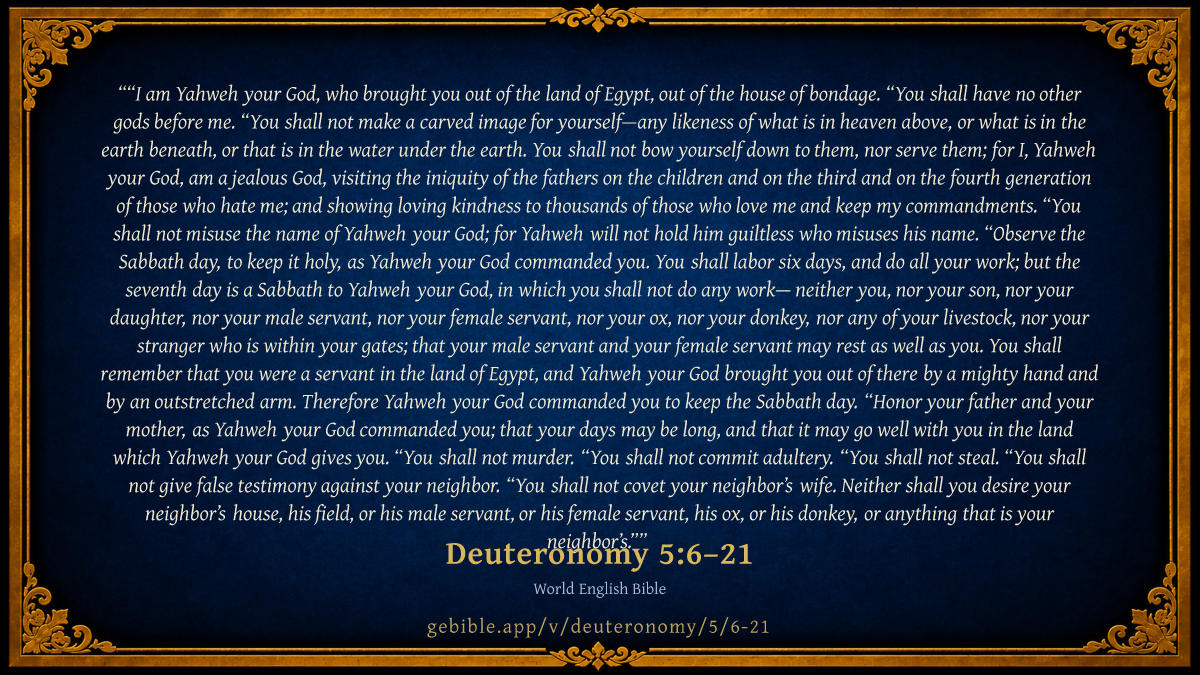
“I am Yahweh your God, who brought you out of the land of Egypt, out of the house of bondage.
“You shall have no other gods before me.
“You shall not make a carved image for yourself—any likeness of what is in heaven above, or what is in the earth beneath, or that is in the water under the earth. You shall not bow yourself down to them, nor serve them; for I, Yahweh your God, am a jealous God, visiting the iniquity of the fathers on the children and on the third and on the fourth generation of those who hate me; and showing loving kindness to thousands of those who love me and keep my commandments.
“You shall not misuse the name of Yahweh your God; for Yahweh will not hold him guiltless who misuses his name.
“Observe the Sabbath day, to keep it holy, as Yahweh your God commanded you. You shall labor six days, and do all your work; but the seventh day is a Sabbath to Yahweh your God, in which you shall not do any work— neither you, nor your son, nor your daughter, nor your male servant, nor your female servant, nor your ox, nor your donkey, nor any of your livestock, nor your stranger who is within your gates; that your male servant and your female servant may rest as well as you. You shall remember that you were a servant in the land of Egypt, and Yahweh your God brought you out of there by a mighty hand and by an outstretched arm. Therefore Yahweh your God commanded you to keep the Sabbath day.
“Honor your father and your mother, as Yahweh your God commanded you; that your days may be long, and that it may go well with you in the land which Yahweh your God gives you.
“You shall not murder.
“You shall not commit adultery.
“You shall not steal.
“You shall not give false testimony against your neighbor.
“You shall not covet your neighbor’s wife. Neither shall you desire your neighbor’s house, his field, or his male servant, or his female servant, his ox, or his donkey, or anything that is your neighbor’s.”
Geneva Bible translators 1599 · Public Domain On vv6, 7, 9, 10, 13, 16, 21 Or, servant.
Or, servant.
Geneva Bible (1599) marginal notes — public domain.
John Trapp 1656 · Public Domain On vv6, 12, 15, 18 Deu 5:6 I [am] the LORD thy God, which…
Deu 5:6 I [am] the LORD thy God, which brought thee out of the land of Egypt, from the house of bondage.
Ver. 6. I am the Lord, &c.] {See Trapp on "Exo 20:1"} &c It is well observed by a reverend writer, {a} that the two tables of the law are in their object answerable to the two natures of Christ. For God is the object of the one, man of the other: and as they meet together in the person of Christ, so must they be united in the affections of a Christian.
Read full note →
{a} Mr Ley’s Pattern of Piety.
John Trapp, A Commentary or Exposition upon All the Books of the Old and New Testament (1647–1656) — public domain. Text from a community e-Sword module.
Matthew Poole 1685 · Public Domain On vv6, 12, 15, 21 The ten commandments, delivered Exo 20, are here repeated…
The ten commandments, delivered Exo 20, are here repeated with some small difference of words, but the sense is perfectly the same, and therefore the explication of them must be fetched thence.
Matthew Poole's English Annotations on the Holy Bible (1683–1685) — public domain. Text from a community e-Sword/MySword module.
Matthew Henry 1710 · Public Domain On v6 Here is the repetition of the ten commandments, in…
Here is the repetition of the ten commandments, in which observe, 1. Though they had been spoken before, and written, yet they are again rehearsed; for precept must be upon precept, and line upon line, and all little enough to keep the word of God in our minds and to preserve and renew the impressions of it. We have need to have the same things often inculcated upon us. See Phi 3:1. 2. There is some variation here from that record (Ex. 20), as there is between the Lord's prayer as it is in Mt. 6 and as it is Lu. 11. In both it is more necessary that we tie ourselves to the things than to the words unalterably. 3. The most considerable variation is in the fourth commandment. In Ex. 20 the reason annexed is taken from the creation of the world; here it is taken from their deliverance out of Egypt, because that was typical of our redemption by Jesus Christ, in remembrance of which the Christian sabbath was to be observed: Remember that thou wast a servant, and God brought thee out, Deu 5:15. And Therefore, (1.) "It is fit that thy servants should be favoured by the sabbath-rest; for thou knowest the heart of a servant, and how welcome one day's ease will be after six days' labour." (2.) "It is fit that thy God should be honoured by the sabbath-work, and the religious services of the day, in consideration of the great things he has done for thee." In the resurrection of Christ we were brought into the glorious liberty of the children of God, with a mighty hand and an outstretched arm; therefore, by the gospel-edition of the law, we are directed to observe the first day of the week, in remembrance of that glorious work of power and grace. 4. It is added in the fifth commandment, That it may go well with thee, which addition the apostle quotes, and puts first (Eph 6:3), that it may be well with thee, and that thou mayest live long. If there be instances of some that have been very dutiful to their parents, and yet have not lived long upon earth, we may reconcile it to the promise by this explication of it, Whether they live long or no, it shall go well with them, either in this world or in a better. See Ecc 8:12. 5. The last five commandments are connected or coupled together, which they are not in Exodus: Neither shalt thou commit adultery, neither shalt thou steal, etc., which intimate that God's commands are all of a piece: the same authority that obliges us to one obliges us to another; and we must not be partial in the law, but have respect to all God's commandments, for he that offends in one point is guilty of all, Jam 2:10, Jam 2:11. 6. That these commandments were given with a great deal of awful solemnity, Deu 5:22. (1.) They were spoken with a great voice out of the fire, and thick darkness. That was a dispensation of terror, designed to make the gospel of grace the more welcome, and to be a specimen of the terrors of the judgment-day, Psa 50:3, Psa 50:4. (2.) He added no more. What other laws he gave them were sent by Moses, but no more were spoken in the same manner that the ten commandments were. He added no more, therefore we must not add: the law of the Lord is perfect. (3.) He wrote them in two tables of stone, that they might be preserved from corruption, and might be transmitted pure and entire to posterity, for whose use they were intended, as well as for the present generation. These being the heads of the covenant, the chest in which the written tables were deposited was called the ark of the covenant. See Rev 11:19.
Matthew Henry's Commentary on the Whole Bible (1708–1710) — public domain (CC PDM 1.0). Text via the HelloAO Bible API.
John Gill 1763 · Public Domain On vv6, 12, 14, 15, 16, 17, 21 Nor thine ox, nor thine ass,.... In Exo 20:10,…
Nor thine ox, nor thine ass,.... In Exo 20:10, it is only in general said:
nor thy cattle: here by way of illustration and explanation the ox and the ass are particularly mentioned; the one being used in ploughing ground, and treading out the corn, and the other in carrying burdens; and it is added:
Read full note →
nor any of thy cattle; as their camels, or whatever else they were wont to use in any kind of service; they were none of them to do any kind of work on the sabbath day. The following clause also is not used before, which expresses the end of this institution:
that thy manservant and thy maidservant may have rest as well as thee; which if the cattle had not rest, they could not have, being obliged to attend them at the plough or elsewhere; and this respects not only hired, but bond servants and maidens.
John Gill's Exposition of the Whole Bible (1746–1763) — public domain (CC PDM 1.0). Text via the HelloAO Bible API.
John Wesley 1765 · Public Domain On vv7, 8, 11, 12, 16, 17, 18, 19, 20, 21 There being little said, concerning the spiritual sense of…
There being little said, concerning the spiritual sense of the Ten Commandments, in the notes on the twentieth of Exodus, I think it needful to add a few questions here, which the reader may answer between God and his own soul. Thou shalt have none other gods before me - Hast thou worshipped God in spirit and in truth? Hast thou proposed to thyself no end besides him? Hath he been the end of all thy actions? Hast thou sought for any other happiness, than the knowledge and love of God? Dost thou experimentally know the only true God, and Jesus Christ whom he hath sent? Dost thou love God? Dost thou love him with all thy heart, with all thy soul, and with all thy strength; so as to love nothing else but in that manner and degree which tends to increase thy love of him? Hast thou found happiness in God? Is he the desire of thine eyes, the joy of thy heart? If not, thou hast other gods before him.
John Wesley, Explanatory Notes Upon the Whole Bible (1754–1765) — public domain. Text via the GEBible commentary corpus.
Adam Clarke 1810 · Public Domain On vv6, 15, 21 Verse 6. I am the Lord thy God] See…
Verse 6. I am the Lord thy God] See these commandments explained in Clarke's notes on "Ex 20:2", &c.
Adam Clarke's Commentary on the Bible (1810–1826) — public domain. Text from a community e-Sword/MySword module.
Joseph Benson 1811 · Public Domain On vv6, 7, 8, 11, 12, 16, 17, 18, 19, 20, 21 Deu 5:6. I am the Lord thy God —…
Deu 5:6. I am the Lord thy God — The ten commandments, delivered Exodus 20., are here repeated, with some small difference of words, but the sense is perfectly the same. There being little said concerning the spiritual meaning of the ten commandments in the notes there, it may not be improper to add a few inquiries here, which the reader may answer between God and his own soul.
Joseph Benson's Commentary on the Old and New Testaments (1811–1818) — public domain. Text from a community e-Sword module.
Albert Barnes 1834 · Public Domain On v6 Compare Exo. 20 and notes.
Compare Exo. 20 and notes.
Moses here adopts the Ten Words as a ground from which he may proceed to reprove, warn, and exhort; and repeats them, with a certain measure of freedom and adaptation. Our Lord Mar 10:19 and Paul Eph 6:2-3 deal similarly with the same subject. Speaker and hearers recognized, however, a statutory and authoritative form of the laws in question, which, because it was familiar to both parties, needed not to be reproduced with verbal fidelity.
Read full note →
Deu 5:12-15
The exhortation to observe the Sabbath and allow time of rest to servants (compare Exo 23:12) is pointed by reminding the people that they too were formerly servants themselves. The bondage in Egypt and the deliverance from it are not assigned as grounds for the institution of the Sabbath, which is of far older date (see Gen 2:3), but rather as suggesting motives for the religious observance of that institution. The Exodus was an entrance into rest from the toils of the house of bondage, and is thought actually to have occurred on the Sabbath day or “rest” day.
Deu 5:16
The blessing of general well-being here annexed to the keeping of the fifth commandment, is no real addition to the promise, but only an amplification of its expression.
Deu 5:21
The “field” is added to the list of objects specifically forbidden in the parallel passage Exo 20:17. The addition seems very natural in one who was speaking with the partition of Canaan among his hearers directly in view.
Albert Barnes' Notes on the Bible (1834–1885) — public domain. Text from a community e-Sword/MySword module.
Haydock's Catholic Bible Commentary 1859 · Public Domain On vv7, 9, 11, 15, 18, 20, 21 Sight. Chaldean, "Thou shalt not have any other god…
Sight. Chaldean, "Thou shalt not have any other god but me." Elohim often designates the true God. (Calmet) --- See the decalogue explained, (Exodus xx.,) where we have observed, that pictures are only forbidden when they are the objects of sovereign worship, as the context here plainly shews, ver. 9. Other images God himself authorized, (Worthington) even in the old law, and in the most sacred place, where people were ordered to fall prostrate before the ark, to adore his footstool, Psalm xcviii. 5. If, therefore, a people so prone to idolatry as the Jews were, might have pictures in the temple of God without danger, how can any one suppose that the images of Jesus Christ, and of his saints, are necessary incentive to idolatry among Christians, who all know that God will allow of no rival! (Haydock)
George Leo Haydock (1774–1849), Haydock's Catholic Family Bible and Commentary, 1859 edition — public domain. Excludes Psalms (Douay-Rheims chapter numbering differs from Protestant) and Deuterocanonical books (Catholic canon only).
Robert Jamieson, A. R. Fausset & David Brown 1871 · Public Domain On vv6, 12, 14, 16, 21 I am the Lord thy God--The word "Lord" is…
I am the Lord thy God--The word "Lord" is expressive of authority or dominion; and God, who by natural claim as well as by covenant relation was entitled to exercise supremacy over His people Israel, had a sovereign right to establish laws for their government. [See on Exo 20:2.] The commandments which follow are, with a few slight verbal alterations, the same as formerly recorded (Exo. 20:1-17), and in some of them there is a distinct reference to that promulgation.
Jamieson, Fausset & Brown — Commentary Critical and Explanatory on the Whole Bible (1871) — public domain (CC PDM 1.0). Text via the HelloAO Bible API.
Daniel D. Whedon 1874 · Public Domain On vv6, 12, 16, 18 REPETITION OF THE TEN COMMANDMENTS, Deu_5:6-21.
REPETITION OF THE TEN COMMANDMENTS, Deu_5:6-21.
Here, on the plains of Moab, in sight of the Land of Promise, thirty-eight years after the first announcement of the law on Sinai, Moses repeats the code which Jehovah had given for the moral guidance of his people. There are variations in language, but not such as to change the meaning of a single commandment. We may suppose that in Exodus we have an exact copy of the law as written on the tables of stone. Here the substance is given in an address, so that we are not to expect exact verbal agreement. Comp. notes on Exodus 20.
Daniel D. Whedon (gen. ed.), Commentary on the Old and New Testaments (1874–1909) — public domain. Text from a community e-Sword module.
The Cambridge Bible for Schools and Colleges 1878 · Public Domain On vv6, 7, 8, 9, 10, 11, 12, 14, 15, 16, 17, 21 6. ‘The Preface’ to the Ten Commandments: the same…
6. ‘The Preface’ to the Ten Commandments: the same as in Exo_20:2. The phrases used, though occurring much more frequently in D, are also found (either exactly as here or with grammatical variations) in J and E (see on Exo_20:2); so it is difficult to say whether the original form was simply I am Jehovah or the long one before us. A Preface longer than each of the separate words is not unnatural; yet the original may have been simply I am Jehovah thy God as in ch. 6.
The Preface states the Lawgiver’s Name, and His obligations upon Israel, ‘whereby He prepares their minds for obedience1[124],’ by calling on their loyalty and gratitude. This tenderness of the Preface (Matthew Henry contrasts it with the awfulness of the Theophany from which it issues) and its appeal to high motives are characteristic of D. But in all the traditions of the origins of Israel’s religion the note of redemption is fundamental; Grace is prior to Law, God’s saving deeds to His commandments. The stress laid upon the Preface by theologians in their practical application of the Decalogue to Christianity is therefore just. The form of the Preface is similar to the opening phrases on several Semitic royal monuments: the Moabite stone, ‘I am Mesha son of Kemosh’; the Byblus stele, ‘I am Yeḥawmilk, King of Gebal, etc.’; the Sidon sarcophagus, ‘I am Tabnith … King of the Sidonians, etc.’ But see Driver, Sam.2 p. xxiv. The prologue to the Code of Ḫammurabi is a record of the lawgiver’s achievements.
Read full note →
[124] Calvin.
house of bondage] bondmen, see on Deu_6:12.
The Cambridge Bible for Schools and Colleges (gen. ed. J. J. S. Perowne; Cambridge University Press, 1878–1918) — public domain. Text from a community e-Sword module.
Ellicott's Commentary for English Readers 1878 · Public Domain On vv6, 7, 9, 10, 11, 12, 16, 17, 21 (6) I am the Lord thy God.—It should never…
(6) I am the Lord thy God.—It should never be forgotten that this sentence is an integral part of the Decalogue, and also the first part. The declaration of Divine relationship, with all that it implies—the covenanted adoption of Israel by Jehovah—precedes all the requirements of the Law. The Law is, therefore, primarily a covenant in the strictest sense.
A Bible Commentary for English Readers, edited by Charles John Ellicott (1878–1897) — public domain. Text from a community e-Sword module.
The Pulpit Commentary 1880 · Public Domain On vv6, 7, 8, 11, 12, 16, 17, 18, 19, 20, 21 I am Jehovah thy God. "The Law, the establishing…
I am Jehovah thy God. "The Law, the establishing rule for men, can proceed only from him who alone and over all stands fast; i.e. from God, specially as Jehovah. The eternal, unchangeable One, since he demands the obedience of faith (is not merely the moral imperative), must not only reveal himself, but in revealing himself must claim Israel as loyal and faithful; thy God" (Schroeder).
Ver. 6. The Divine Law based on a divinely revealed relationship.
Read full note →
am the Lord thy God," etc. This little word thy, in this connection, gives us the basis on which the Law was set. Of the event called the giving of the Law," we feel the thrill even now. That Law has in it four features, corresponding to one or other of the aspects in which the people to whom it was first given may be regarded. They were
(1) members of the great human family, moral, responsible beings, amenable to the government of God. They were
(2) a Church in the wilderness, with their own institutions, which embodied the worship appropriate to the religion enjoined upon them. They were
(3) a people rescued from bondage, about to have a commonwealth of their own, for which sundry civil and political regulations had to be provided. They were
(4) a nation which for years was to be in a wandering state, yet destined in the long run to find a home in Palestine. Adapted to them in this last-named aspect, they had sanitary laws; for them in the third aspect there were civil and political laws; for them in the second aspect there were religious institutions; and for them in the first aspect there was the great moral law. The set of rules having reference to health would be binding only so far as the laws of climate and modes of life necessitated their continued observance. The civil law would be but temporary so far as it received its complexion from the idolatrous surroundings of the people. The ceremonial law would pass away in form, but the underlying principles of it are permanent. The moral law is unchanging as man"s nature, and enduring as his relation to God. It is given in the ten commandments, of which the first enjoins supreme love to the Divine Being: the second, recognition of the spirituality of the Divine nature: the third, reverence for the Divine Name: the fourth, care for Divine worship: the fifth inculcates religion in the home: the sixth, the religion of the temper: the seventh, the religion of the body: the eighth, the religion of the band: the ninth, the religion of the tongue: the tenth, the religion of the heart. But antecedently to the Law in any of its aspects, there is a question of deep interest and importance, viz. From whom came it? The reasons for obedience to it come very largely out of the answer to be given to that question. Now, the words in Deu_5:6, which precede the Law itself, are not merely a preface to it, they are at once the basis of it and the reason for obedience to it. And these words should be opened up clearly in every case where the Decalogue is about to be expounded. The Law is not set on law, but on grace! For observe
I HERE IS A SPECIAL VIEW OF GOD PRESENTED TO THE PEOPLE TO DRAW FORTH THEIR ATTENTION AND WIN THEIR ALLEGIANCE. Thy God." The Hebrews were never expected to believe in, obey, or love an absolutely unrelated Being. THERE IS NO SUCH BEING! God is related to all the creatures he has made. Hence our knowledge of him is not unreal, because it is relative; but real, because in knowing God"s relations to us, we, so far, know him as he is. God was Israel"s Redeemer. He had redeemed them that they might be his. He would have the entire life of his redeemed ones spent in covenant relationship with him. Hence he sets his own Law on the basis of those relations. And so it is now. We are not expected to love a Being whose relations to us are doubtful or obscure, or whose mind and will towards us are unknown. We love because he first loved us.
II THE VARIED ASPECTS OF CHRISTIAN TRUTH ARE SET UPON A LIKE BASIS, AND HAVE IN IT THEIR REASON AND POWER. The following suggestions may be developed largely with great advantage.
1. The conception of law is materially changed when we know that it comes from One who loves us infinitely, and cares for us with a tender care. This gives sweetness to the command. We are "under law to Christ.
2. "The Lord thy God;" that gives the worship of God its charm.
3. This is the truth which is objectively disclosed by the Incarnation.
4. It is the truth which the Holy Ghost graves on the hearts of the saints. (Rom_8:15)
1. This truth shows us that real religion is love responding to love. (1Jn_4:19)
2. It gives a manifest ground for trust. We know whom we have believed.
3. It gives a charm to every precept.
4. It gives meaning to every trial. (Deu_8:5)
5. It is in the light of this truth that prayer becomes possible, and is seen to be reasonable.
6. This gives a solemn aspect to our responsibility (Psa_81:10; Amo_4:12; Heb_4:13)
7. The fuller understanding of the words, My God," will be the result of ripeness in grace (Zec_13:9; Isa_41:10-20)
8. This is pre-eminently the truth which gives its certainty and its glow to the hope of future glory (Mar_12:26; Heb_11:16 Rev_21:3, Rev_21:7)
III SEEING THE WIDE BEARING AND VAST IMPORTANCE OF THE TRUTH IN THE TEXT, WHAT SHOULD BE WITH US ITS PRACTICAL OUTCOME?
1. Seeing the fearful havoc agnosticism would make, if it should ever come to govern human thinking, let us show men:
(1) That a God out of relation to us does not exist.
(2) That the one God is related to us as Creator, etc.
(3) That his varied relations are explicitly revealed, specially through the Son and through the Holy Ghost.
(4) That these relations are to be apprehended by our moral and spiritual nature, and not by the intellect alone. It should never make us stagger that, after getting to the very outer rim of natural knowledge, men should look out on an awful blank, and call it "the great unknown." It shows us only that they cannot find God in that way not that there is no way of finding God, still less that God cannot find us or make his communications intelligible to us. Do not let us suffer men to think that God cannot be found because no one can find him out to perfection! He is our God.
2. Since God is our God, let us cultivate fellowship with him. It is for this purpose he hath revealed himself, that we may come to him ( (1 John. (Heb_10:19-22)
3. Let us seek to realize the blessedness of a known and happy relationship to God, enjoyed through Christ, by the Spirit, in a life of penitence, faith, devotion, and love (Isa_61:10; 1Ch_12:18; Psa_68:28 Psa_46:1 Psa_18:29 Psa_146:5)
4. Let faith in the love of our God fill up our duties with glorious meaning, and make the discharge of them a delight (Deu_6:5 Deu_28:58; Lev_25:38 Lev_11:45; Isa_41:10; Jer_3:13; Rom_12:1)
5. Let the fact that God is our God create, confirm, and perpetuate our assurance of immortal blessedness. See the wonderful words in Mat_22:31, Mat_22:32; Heb_11:16. As if God would be ashamed to be called our God, if he did not mean to do something worthy of the name! Wondrous grace! How perfect the reconciliation effected by Christ, to bring together the holy God and sinful men in blest accord and union forever!
Vers. 6-21. The Divine plan for the conduct of our life on earth.
Had we been left in ignorance what the Divine intention in human life was, it had been a calamity indeed. Waste and failure must have been the disastrous result. For every honest-minded man, ample direction from the Supreme Source of authority is supplied. The most cogent argument is not always the most convincing. God might here have prefaced his ten words with a proper assertion of his indisputable sovereignty. But he prefers to appeal to his recent interposition his emancipation of the people from Egyptian bondage. As if he had said, "I, who released you from grinding misery I, who created your liberty, and founded your nation, now command your loyalty. Let the lives which I have ransomed be spent as I now direct.
I How HUMAN LIFE IS TO BE DIRECTED GOD-WARD.
1. That God must be supreme in our regard and affection. "Thou shalt have none other gods before me." This claim is founded in absolute right. The Proprietor has complete dominion over the work of his hands. If his workmanship does not please him, he is at liberty to destroy it. His claim is further pressed on the ground of his transcendent excellence. Essential and unapproachable goodness is he; hence his claims on worship rest upon his intrinsic worth. And his claim to reverent regard proceeds likewise on human benefit. God"s glory and man"s advantage are only different aspects of the same eternal truth. To give him all is to enrich ourselves.
2. That God must be supreme in our acts of worship. To picture him forth by material images is an impossibility. The plausible plea of human nature has always been that material forms serve as aids to worship the Unseen. But the facts of human experience have uniformly disproved this hypothesis. It may cost us severe exertion of mind to lift our souls up to the worship of the true God; yet this very exertion is an unspeakable advantage. God has no pleasure in imposing on us hard tasks for their own sake; yet, for the high gain to his servants, be does impose them. Throughout the Scriptures, idolatry is represented as spiritual adultery; hence, condescending to human modes of speech, the displeasure of God is described as jealousy. Jealousy is quick-sighted, deep-seated, swift-footed. All revelation of God is an accommodation to human ignorance and feebleness. The visitation of punishment upon the children, and upon the children"s children, is not to be construed as excessively severe, much less as unrighteous. The thrice-holy God can never be unjust. The idolatrous spirit would be entailed to children by natural law; hence punishment would culminate in final disaster. The menace was gracious, because, if parents will not abstain from sin for their own sakes, they sometimes will for the sake of their children. The mercy shall be far more ample than the wrath. The anger may be entailed on a few, and that in proportion always to the sin; the mercy shall flow, like a mighty river, to "thousands." True worship fosters love, and stimulates practical obedience.
3. God"s authority is supreme over our speech. The faculty of speech is a noble endowment, and differentiates man from the inferior races. The tongue is a mighty instrument, either for evil or for good.
(1) We take God"s Name in vain when we make an insincere or superficial profession of attachment. We wear his Name lightly and frivolously if our service is formal and nominal.
(2) We take his Name in vain when we are unfaithful in the performance of our vows. Men pledge themselves to be his in moments of peril, and forget their pledges when safety comes.
(3) We take God"s Name in vain when we use it to give force and emphasis to a falsehood. Whether in private converse, or in a court of justice, we use God"s Name to produce a stronger persuasion in others" minds, we contract fearful guilt if we use that sacred Name to bolster up a lie.
(4) We take God"s Name in vain whenever we use it needlessly, flippantly, or in jest. The moral effect upon men is pernicious, corrupting, deadly. The penalty is set forth in negative language, but it is intended to convey deep impression. Others may hold it as a venial sin; not so God.
4. God"s authority over the employment of our time. All time belongs to God. He hath created it. Every successive breath we inspire is by his sustaining power. Since we are completely his, his claim must be recognized through every passing minute. But just as he allows to men the productions of the soil, but requires the firstfruits to be presented to him the earnest of the whole; so also the firstfruits of our time he claims for special acts of worship. One day in seven he requires to be thus consecrated; but whether the first or the seventh depends wholly on the mode of human calculation. The grounds on which the institution rests are many. Even God felt it to be good to "rest" from his acts of creation. In some sense, he ceased for a time to work. Review and contemplation formed his Sabbath. His claims to have his day observed are myriad-fold. If Sabbath observance was beneficial for Jews, is it not for Gentiles? If it was a blessing to man in the early ages, has it now become a curse? Even the inferior creation was to share in the boon. Strangers and foreigners would learn to admire the gracious arrangement, and learn the considerate kindness of the Hebrews" God.
II WE LEARN HOW OUR LIFE IS TO BE CONDUCTED MANWARD.
1. In accordance with the degree of kinship. A parent has claims beyond all other men upon our love, obedience, and service. Parents are deserving our heartfelt honor. They claim this on the ground of position and relationship, irrespective of personal merit. Parents stand towards their children, through all the years of infancy, in the stead of God. For years the human babe is wholly dependent upon its parent; and this serves as schooling and discipline, whereby it learns its dependence upon a higher Parent yet. The disposition and conduct required in us towards our parents is the same in kind as that required towards God. Filial reverence is the first germ of true religion. Hence the promises of reward are akin. The family institution is the foundation of the political fabric. The health and well-being of home is the fount of national prosperity. If parents are honored, "it shall be well with thee." This, a law for individuals, a law for society, and a law for nations.
2. Our duty towards all men. We are to respect their persons. Their life and health are to be as dear to us as our own. We are to respect their virtue. The lower passions are to be held in restraint. Occasions for lust must be avoided. A bridle must be put upon the glances of the eye. We are to respect their property. This duty has extensive scope. It means that we should deal with others as if they were ourselves. All dishonest dealing, false representations in commerce, overreaching in bargains, fraudulent marks, are condemned. We are to have respect to their reputation. It ought to please us as much to see a conspicuous virtue, a generous quality, in another, as if it shone in ourselves. Idle tale-bearing is forbidden, as also detraction, slander, unfavorable interpretation of others" deeds, and suspicion of their motives. We are charged, as the servants of God, to "love our neighbors even as ourselves.
3. This Divine Law carries its sanctions into our interior life. "Thou shalt not covet." Improper and irregular desires are to be repressed. Like a wise Ruler, God proceeds to the very root of sin to the very core of evil. "Tis easiest to strangle the serpent at its birth. If only this fountain were pure, all its streams would be likewise pure. Let the salt of purification be applied here! There is scope for coveting a direction in which it may lawfully run. It may run Godward. It may fix its eyes and its hands on heavenly treasures. For in securing these we defraud no one else. Therefore, we may with advantage all round "covet earnestly the best gifts." Desire after heavenly gifts and riches is never untimely or excessive, never irregular or inordinate. Hence, as an antidote to a covetous disposition, we may well nourish heavenly hope. "Delight in God" will bring a most satisfying fruition of desire. Sowing in this fertile field yields a prolific harvest. The Decalogue is complete. God "added no more." Authority centers here. D.
The Pulpit Commentary (1880–1919), ed. H.D.M. Spence-Jones & Joseph S. Exell — public domain. Text from a community e-Sword module.
The Biblical Illustrator 1887 · Public Domain On vv6, 7, 8, 11, 12, 16, 17, 18, 19, 20, 21 I am the Lord thy God.
Deu_5:6
I am the Lord thy God.
Read full note →
The mission of law
In a general sense law is the manner in which an act shall be performed. In civil life it is a legislative declaration how a citizen shall act; in morals it is a rule of conduct proceeding from one who has the right to rule, and directed to those who have the ability to obey. In this sense laws are mandatory, prohibitory, permissive, according to the object to be obtained, commanding what shall be done, forbidding what shall not be done, permitting what may be done. There is an antagonism prevailing in our country and in other lands against the authority of these old mandates received by Moses from the hand of the Almighty. It is difficult to understand that some who assert the uniformity of nature, or what they are pleased to call material law, yet seek to emancipate themselves from moral obligation, which is natural law. They declare for absolute liberty; that man should be governed by his own tastes, desires, and passions; that he should gratify himself without interference from society or the restrictions of law. It is enough to say that man is not constituted for such conditions of liberty, for restraint seems to be as beneficial as law itself. Man is organised restriction, ever subject to consequences and penalties. He cannot pass a certain boundary without peril; he is a living code of law. Unlimited gratification is the right of no man. Such is his constitution that man can think so far, can see so much, can eat and drink to such a degree, can sleep so long, endure so much, and beyond this he cannot go. He is ever within the embrace of law--Thus far shalt thou go, and no further. It is true of him in his worst and in his best estate. The law of limitation is as prevalent as law itself. Atoms and worlds, liquids and solids, plants and animals are bounded by limitations. Flowers bloom, trees grow, fish swim, birds fly, beasts roam, lightnings flash, thunders peal, winds blow, oceans roll, all within limitations. The gem is crystallised, the dewdrop is moulded, trees are carbonised, rocks metallised, clouds become rain, and the sun sends forth his wealth of health and beauty, all within limitations. Throw off this law of restriction, and the roots of the trees would take hold of the foundations of the earth and their branches would sweep the stars; throw it off, and mans growth would be perpetuated until his brow reached the heavens. Throw it off, and the planets would rush in wildest confusion. Man is no exception in this higher nature; excess is ruin. He must not encroach upon the domain of the Infinite. His vices are bounded by consequences and penalties. Excessive gratification multiplies his sorrows and hastens him to a premature grave. He is boundless in nothing but intelligence and virtue; in these he can approach the Infinite, but never reach Him. This is his highest ideal. Man hates restraint; his foolish cry is, Give us liberty or give us death; but such liberty is without order. Natural liberty is acting without the restraints of nature; civil liberty is acting with abridged natural freedom; moral liberty is acting within the limitations of moral law. There is a difference between the power to disobey and the right to disobey. A citizen may have the power to take the property of another, but not the right. There is nothing more wholesome for a man to realise than the certainty of law, immutable, inflexible, inexorable. Law is a Shylock; the consequences of violation are sure to come. There is nothing more majestic and solemn than the eternity of law. Human enactments are repealed, human obligations are for a term of years; but the obligations of the law of God will last while He is on the throne of the universe. In our aversion to restraint we are tempted to ask, Who is Jehovah, that we should obey? What is the ground of obligation to Him? Civil government has authority over us, because of the social relations which the Creator has established between man and man, and because of common consent; parental authority springs from relationship, but Gods authority has its source in absolute possession. He made us, and not we ourselves; we are the offspring of His power--Ye are not your own. Herein is the eternal fitness of things. From this is the greatest good. The power to enforce His commands may be the subordinate reason for obedience, but it is not the highest. A giant is not necessarily a ruler; might is not right. We must look for a more beneficent reason. Certain special duties may derive their apparent obligations from certain relations. Endowed with intelligence, I should adore God for His wonderful works. Possessing life, reason, and affections and other sources of happiness incident to my being, I owe Him gratitude founded on natural sentiment and demanded by all that is reasonable. But these relations are not necessarily the reason of obedience, nor does His right to rule me and my duty to obey Him flow out of His will. Why has He the right to will me to do thus and thus? But if we look a little deeper, a little closer, we shall discover that His right to will and my duty to obey are from His absolute possession. That right has no limitation. It can never be transferred, or alienated, or destroyed. The heavens are Thine, the earth also is Thine: as for the world and the fulness thereof, Thou hast founded them. It is a law of nations that the first discoverer of a country is esteemed the rightful possessor and lord thereof; that the originator of a successful invention has unquestionable dominion of the property therein on the score of justice; that the author of a beneficent truth, whether in the domain of science, government, or religion, has priority of claim to the honour and benefits thereof. These things have reached the majesty of international law; hence the long and vexatious controversies touching the relative claims of Columbus and Amerigo Vespucci as to the discovery of this country; the rival claims of Gutenberg and Faust touching the invention of the art of printing; the first demonstration of the circulation of the blood, whether Harvey or Fabricius or Padua; who first identified lightning and electricity, whether Abbe Nollet or our own Franklin, and whether Darwin or Wallace is the author of the theory of natural selection. Men and nations have jealously guarded and vindicated this right of priority of claim; for its maintenance battles have been fought and empires have toppled to their fall. When a man comes into the possession of a block of marble by discovery or presentation or purchase, and adds to its value by his deft fingers with mallet and chisel, and sculptures thereon some bird, or man, or angel, it is the consent of mankind that he has an additional claim to that piece of marble growing out of the right of possession and the success of his skill. Thy hands have made me and fashioned me. (J. P. Newman, D. D.)
Gods laws of life
In the present day we hear and read a great deal concerning law. The laws of nature is a much more common expression now than in the days of our forefathers; for the study of nature, the investigation of its wonders, and the examination of its phenomena are now more thorough and general and successful than they used to be; and the progress of science has made this expression very familiar to us. All things are in subjection to law, in the heavens above, and in the earth beneath; all things, from a world to a sand grain, from a mighty constellation to a rounded pebble, from the great and wide sea to the tiny dew drop, from the giant banyan tree to the lowly shrub, from behemoth to the insect, are subject to law. The laws of nature, instead of excluding the God of nature, are the beautiful expression of His thought and will. The order of the universe has originated ill the mind of Him who created it. As Hooker finely said, Law has its seat in the bosom of God, and its voice is the harmony of the world. Gods moral law was given to man as an intelligent and moral being. This law is written in mans nature. A philosopher said that two things filled his soul with awe--the starry heaven above, and the moral law within. But if the law was already found in mans conscience, what need was there to proclaim it on Mount Sinai?
1. First, because the record was becoming obscure through growing depravity; the letters were defaced, the moral sense was blunted. Sir Walter Scotts Old Mortality renewed the inscriptions on the old moss-grown tombstones, cut out with his chisel and hammer the letters which time and decay had nearly obliterated. But there was no teacher among the heathen that could renew the inscription on mans nature, and restore the defaced letters, and remove the grime that had gathered around them. The conscience, like all the other faculties, needed education and training.
2. Secondly, it was necessary that Israel should have a Divine standard of conduct. Having just been delivered from the house of Egyptian bondage, and having been contaminated by the influence of Egyptian idolatry, it was necessary that they should have a rule of life that was clear and unmistakable. They needed a revealed and written standard of duty.
3. Thirdly, it was necessary, in order to preserve to all coming ages Gods judgment of what man ought to be, Gods ideal of mans life. A revelation by word of mouth would not suffice; for oral tradition would in time be corrupted. There are some human laws that are necessary for some peoples, and not for others; but this is the same in every climate and country--among the Esquimaux in the land of everlasting snows, and among the dusky tribes of Africa, among the civilised nations of Europe, and among savages, among rich and poor, learned and unlearned, Jew and Greek, Barbarian, Scythian, bond and free. And this law is unchangeable in its character. Physical laws may be suspended by other or higher laws; as animal food is preserved by salt, and gravitation is overcome by life. Till heaven and earth pass, one jot or one tittle shall in no wise pass from the law, till all be fulfilled. I fear that in the present age we are in danger of losing sight of God as our Ruler. We dwell, and rightly, on the revelation of the Fatherhood of God. Our Father. What name so attractive and beautiful and helpful as this? But He is also King; He sways a sceptre of righteousness; He exercises dominion; He claims obedience; He demands service. I will put My laws into their mind, and write them in their hearts. And God spake all these words. God is the Eternal Home of righteousness, and He has made known His righteous will to men. God spake. Sin had put an end to the communications between earth and heaven; but God broke the silence. It would be terrible to think of God dwelling in the heavens, and not saying a word to us. The Psalmists cry was, Be not silent to me, lest I be like them that go down into the pit. In this introduction or preface to the words of the law we see the grounds on which He claims authority over men, and demands their obedience and homage and service; these grounds are--His relation to them, and His merciful deliverance of them.
I. His relation to them. I am the Lord thy God. He was the God of their fathers; He had called Abram out of Ur of the Chaldees from among idolaters; He was the fear of Isaac; He was the helper of Jacob. And here He says to their descendants, I am the Lord thy God, or I am Jehovah, thy God. This was the name by which He made Himself known to Moses from the burning bush. God was now about to unfold the meaning of the name in the history of His people. It denotes His eternal self-existence. I am Jehovah, I change not. Change is essential to finite beings; to their glory, and blessedness, and peace. Without progress--and progress implies change--a mans life anywhere would be wretched. Thank God we may be changed; for to be fixed in our present state of ignorance and sin and weakness would be untold misery. But God changes not; and this is His glory. He is so perfect that no change could make Him wiser, or holier, or more blessed than He is. Like the fire in the bush, His glory is flaming through the universe; but it does not depend upon the universe for its existence. And this name not only denotes essential existence, but it was also the covenant name of God, and contained the promise of future manifestation; and this was very appropriate on the threshold of Jewish history, when the horde of Egyptian slaves were about to be converted into an army of brave men. I am Jehovah, thy God. He was entering into a close relation to them. And He is now entering into a covenant relation with all who trust in His name. Our God. Jehovah, our God! The Self-existent, our God! The Ruler of all things, our God! The All-sufficient, the Eternal on our side! What grander revelation can we have than this? The unity of the nation is indicated in the use of the singular pronoun, I am Jehovah, thy God, which have brought thee out. The Psalmist said, I will sing praise to my God. And this was the keynote of many of the Psalms. My God--mine personally, mine consciously, mine forever. One man claiming God as his own! You may tell me that God is ruling the universe, guiding the stupendous worlds. But what about me? I have my sorrows, my burdens, my hopes, my grave before me. Whom have I in heaven but Thee? and there is none on the earth that I desire beside Thee.
II. The other ground on which He claims authority over men is found in the merciful deliverance He has wrought out on their behalf. Which have brought thee out of the land of Egypt, out of the house of bondage. Egypt was the home of civilisation, of culture, of art, of power. Into Egypt Abram came in his wanderings; the children of Jacob went down there in time of famine; Joseph ruled as prime minister there; it was the nursery of Abrahams race; and there they grew to be a great people. What was the object of mentioning this event in the introduction to the law? Was it not to show that Gods claims to obedience are based on His faithfulness, and that love is the parent of law? The people were first freed, and then they received the law. God manifests Himself on our behalf, and then claims our obedience. We cannot liberate ourselves from the bondage of sin; for this is a slavery which neither millions of money nor the exploits on battlefields can destroy, a slavery which no Emancipation Act can terminate. But One has interposed for us; the Paschal Lamb has been offered; Christ our passover was sacrificed for us. According to the course of history, the law precedes the Gospel; but in the experience of the saved sinner the Gospel precedes the law. There is gratitude felt for the redemption from bondage, and that gratitude leads to obedience and consecration. His delight is in the law of the Lord. (James Owen.)
The preface to the Decalogue
I. He makes way to the obeying of His laws by propounding His sovereign power: I am the Lord thy God, I am Jehovah, the only true God; I am self-existent, and I give being unto all things. My essence is eternal and unchangeable; I do what I please in heaven and earth; My power and dominion are infinite. This is a very suitable introduction to the commandments. It is a prevalent motive, a powerful argument to induce us to yield obedience to whatever God shall be pleased to propound as our duty. Besides, Thou signifies the equality of the obligation; God speaking to all the people as to one man, that every person may think himself concerned to obey, and that no man may plead exception. This Lord, this Jehovah, who here speaks, is God over all; His authority and sovereignty are unlimited.
II. Not only the sovereignty, but the goodness of God is mentioned here as an argument of obedience--I am the Lord thy God, who brought thee out of the land of Egypt, out of the house of bondage. We have by the gracious undertakings of Christ been brought out of the house of bondage, delivered from that captivity and slavery wherein Satan and our own guilt had involved us. This Divine philanthropy, this transcendent beneficence, together with all the other blessings, mercies, and favours conferred upon us, are forcible engagements, yea, strong allurements to obedience. (J. Edwards, D. D.)
Introduction to the Decalogue
The Ten Commandments stand alone, not only in the Old Testament, but in the moral development and education of our race. They form the groundwork, the bedrock, on which all goodness and morality are built.
I. Some interesting particulars in the record of these Ten Commandments.
1. There are two distinct versions, differing considerably in detail, yet in substance identical. Inspiration is concerned with great realities, not with trivialities; and both Exodus and Deuteronomy are right when they tell us these were the words God spake, if we do not interpret that statement to mean that it pledges us to believe the verbal accuracy of each record. Two accounts of the same occurrence may be absolutely true, and yet differ considerably in mere verbal correctness.
2. They are never called the Ten Commandments in the Old Testament, usually The Ten Words, or The Testimony. This fact is not unimportant, for the term word conveys a richer idea of a revelation from God than the word commandment. A commandment is a law binding on those who hear it, but is not necessarily a revelation of the character of the person who gives it; but the word of the Lord is not merely an utterance of God, but a revelation from God. The same truth is conveyed in the name most frequently given to the Ten Commandments in the Old Testament, The Testimony. It is Gods own utterance of His will to His people, of His revelation concerning Himself, of what He bids them do.
3. The number of the commandments is significant. There are ten, and ten is the only complete number. After we count ten we begin again, for ten completes the number of the primary digits.
(1) The law God gives to His people is a complete code of moral goodness. The law of the Lord is perfect, as the Psalmist sings; it lacks nothing; it is full, and rounded, and complete; and if we keep this law we shall be perfect men.
(2) The natural division of the number ten into two halves of five each suggests, I think, a second truth. If ten be the symbol of completeness, five must necessarily be an incomplete number, for it wants the other five to make it complete; and so the one half of the Decalogue is incomplete without the other. No one who is religious without morality is a good man; no man who is moral without being religious is a good man.
4. It is hardly correct to say that the first five commandments relate to duty to God, and the second five to the duty to man, for the Fifth Commandment touches the honour due to parents; but, on the other hand, there is another simple and underlying principle that explains and justifies the division of the Ten Commandments into two equal halves of five each. There was a well-known and rational division in ancient ethics between piety and justice. Piety always included in ancient morals the idea of filial reverence. Reverence itself is perhaps the better word for the goodness in the first five commandments; righteousness is the better word for the goodness commanded in the second five. If we bear this in mind we shall at once discern the reason for the division of the two laws into two equal halves. The first five inculcate reverence to God, and to those who on earth represent God in the human relation; the second five teach the duty of righteousness--that is, of right conduct as between man and man. And notice that not one of the commandments of the second table, as it is called, that which touches human duty, has any sanction attached to it. On the other hand, in the first half, the commandments which concern reverence, we find a sanction attached to the second, third, fourth, and fifth laws, while in the second table there is none. The reason for this is obvious. All human duty and human rights are reciprocal. They need nothing more than their own statement to secure their obligation.
II. The limitations, from an ethical standpoint, of the Ten Commandments.
1. With the exception of the last, the Tenth Commandment, all deal with actions alone, and it is remarkable that the only one of the ten that does pass beyond external action, and forbids evil thought, Thou shalt not covet, was the commandment that led to St. Pauls conversion, or at any rate to his conviction of sin (Rom_7:7).
2. The Ten Commandments, with two exceptions, are negative in form. Thou shalt not occurs eight times, Thou shalt only twice. To forbid wrong-doing is absolutely necessary, but the not doing of wrong is not the highest ideal of morality.
III. The incompleteness and limitations and defects of the Ten Commandments are best seen if we take one of them and compare it with the law of Christ. Thou shalt do no murder, for example, is one of these Jewish laws as necessary and as binding today as when it was first spoken. But now compare it with the law of Christ, as declared in the Sermon on the Mount (Mat_5:21-22). We see at once the contrast. Christs law is higher and more spiritual than the law of Moses. And so with all these Ten Commandments. The Decalogue does not from any point of view represent an ideal and perfect code of ethics. As moonlight or starlight is to sunlight, so the Ten Commandments are to the law of Christ. One often wonders what would be the effect on the moral life of the Church if at the regular services on the Sunday there was the recital, week by week, of the laws of Christ, or, at any rate, of some of them, followed each one, it may be, by the prayer, Lord have mercy upon us, and incline our hearts to keep this law,
IV. Notice the significant fact that the Law of God was not given to His people until their redemption from Egypt was completed. This is the Divine order--redemption by the passover sacrifice, and shedding of the blood of the innocent lamb, then the giving of the law. This was the order in Judaism, and in Christianity the same significant order is preserved. We are first redeemed by the precious blood of Christ from the curse and power of sin, from death; and then we are bidden to keep the law of Christ. The Divine order is not, Do this and live, but, Live and do this: redemption first, obedience afterwards. This order is not an arbitrary and unmeaning one. It lies in the eternal necessities of our being. Can a dead man do anything? Can a corpse obey a single command? Can it even hear one? And if we are dead in trespasses and sins, our first need is not a law, but a life: first deliverance from the doom of sin, first redemption, and then, and not till then, the sinner, saved from the prison house of death, falls at his Lords feet and cries, Lord, I am Thy servant, I am Thy servant, Thou hast loosed my bonds. (G. S. Barrett, D. D.)
The preface
I. The Lawgiver is their God. Men are naturally religious; that is, they have a fear of, a reverence for, some powerful Being who has power to do them good or evil, and whose favour they wish to enjoy; that Being is their God, and they are His people. The gods of the heathen are false gods. There is but one living and true God, the God of the Bible, the God of Israel. Whom should Israel obey but their God? He has made them, rules over them, has care of them; He knows their nature, knows what is good for them, knows what they should do and be; He will seek only their good and their perfection; He will speak only what it is best for them to hear.
II. The Lawgiver is their Redeemer. This is an additional reason for obedience. For who can so well rule and govern the free as He who made them free? And whom are freemen bound to obey but Him who redeemed them? But someone may ask, Why should there be laws for the free? Why combine law and freedom? Is it for the mere exercise of arbitrary power as sovereign Lord? He is Sovereign, and is the source of all power and law. But He has mans good in view. Laws are needful for the imperfect. Children get rules; as they grow up into the mind of the father, minute and multiplied rules begin to cease, because the law is now in them, and is, as it were, part of them.
III. The Lawgiver is Jehovah. This name conveys a third reason for obedience. It indicates that God is self-existent, eternal, and unchangeable (Mal_3:6). Surely, then, Jehovah is a precious covenant for Israels God, and for Israel to know Him by. It speaks of Him as the eternally unchangeable One, and therefore ever faithful and true, to be trusted most fully. Conclusion--
1. Freedom and law are both of God, and therefore perfectly compatible and harmonious.
2. Freedom and holiness go together. (James Matthew, B. D.)
The Decalogue
I. There is first to be noted, the aspect in which the great Lawgiver here presents Himself to His people: I am Jehovah, thy God, who have brought thee out of the land of Egypt, out of the house of bondage. Jehovah, the unchangeable and eternal, the great I am; this alone, had it been all, was a lofty idea for men who had been so long enveloped in the murky atmosphere of idolatry; and if deeply impressed upon their hearts, and made a pervading element in their religion and polity, would have nobly elevated the seed of Israel above all the nations then existing on the earth. But there is more a great deal than this in the personal announcement which introduces the ten fundamental precepts; it is His faithful love and sufficiency for all future time, to protect them from evil or bring them salvation.
II. Yet it did not the less on that account assume--being a revelation of law in form as well as substance, it could not but assume--a predominantly stringent and imperative character. The loving spirit in which it opens is not, indeed, absent from the body of its enactments, though, for the most part, formally disguised; but even in form it reappears more than once--especially in the assurance of mercy to the thousands who should love God and keep His commandments, and the promise of long continuance on the land of rest and blessing, associated respectively with the second and the fifth precepts of the law. But these are only, as it were, the relieving clauses of the code: the law itself, in every one of the obligations it imposes, takes the imperative form--Thou shalt do this, Thou shalt not do that; and this just because it is law, and must leave no doubt that the course it prescribes is the one that ought to be taken, and must be taken, by everyone who is in a sound moral condition. Still, the negative is doubtless in itself the lower form of command; and when so largely employed as it is in the Decalogue, it must be regarded as striving to meet the strong current of evil that runs in the human heart. III, Viewing the law thus, as essentially the law of love, which it seeks to protect as well as to evoke and direct, let us glance briefly at the details, that we may see how entirely these accord, alike in their nature and their orderly arrangement, with the general idea, and provide for its proper exemplification. As love has unspeakably its grandest object in God, so precedence is justly given to what directly concerns Him--implying also that religion is the basis of morality, that the right adjustment of mens relation to God tends to ensure the proper maintenance of their relations one to another. God, therefore, must hold the supreme place in their regard, must receive the homage of their love and obedience; and this in regard to His being, His worship, His name, and His day. The next command may also be taken in the same connection--a step further in the same line, since earthly parents are in a peculiar sense Gods representatives among men. This, however, touches on the second division of moral duty, that which concerns mens relation to each other; and according to the particular aspect in which it is contemplated, the fifth command may be assigned to the first or to the second table of the law. Scripture itself makes no formal division. Though it speaks frequently enough of two tables, it nowhere indicates where the one terminates and the other begins--purposely, perhaps, to teach us that the distinction is not to be very sharply drawn, and that the contents of the one gradually approximate and at last pass over into the other. And finally, to show that neither tongue, nor hands, nor any other member of our body, or any means and opportunities at our command--that not these alone are laid under contribution to this principle of love, but the seat also and fountain of all desire, all purpose and action--the Decalogue closes with the precept which forbids us to lust after or covet wife, house, possessions, anything whatever that is our neighbours--a precept which reaches to the inmost thoughts and intents of the heart, and requires that all even there should be under the control of a love which thinketh no evil, which abhors the very thought of adding to ones own heritage of good by wrongfully infringing on what is anothers. Viewed thus as enshrining the great principle of love, and in a series of commands chalking out the courses of righteous action it was to follow, of unrighteous action it was to shun, the law of the two tables may justly be pronounced unique--so compact in form, so orderly in arrangement, so comprehensive in range, so free from everything narrow and punctilious--altogether the fitting reflex of the character of the Supremely Pure and Good in His relation to the members of His earthly kingdom. (P. Fairbairn, D. D.)
Rules for the understanding of the Decalogue
For the right understanding of the Ten Commandments these rules are to be observed--
I. That the law is perfect, and bindeth everyone to full conformity in the whole man unto the righteousness thereof and unto entire obedience forever, so as to require the utmost perfection of every duty and to forbid the least degree of every sin.
II. That it is spiritual and so reacheth the understanding, will, affections, and all other powers of the soul, as well as words, works, and gestures.
III. That one and the same thing, in divers respects, is required or forbidden in several commandments.
IV. That as where a duty is commanded the contrary sin is forbidden and where a sin is forbidden the contrary duty is commanded: So, where a promise is annexed, the contrary threatening is included; and where a threatening is annexed, the contrary promise is included.
V. That what God forbids is at no time to be done; what He commands is always our duty, and yet every particular duty is not to be done at all times.
VI. That under one sin or duty, all of the same kind are forbidden or commanded, together with all the causes, means, occasions, and appearances thereof, and provocations thereunto.
VII. That what is forbidden or commanded to ourselves we are bound, according to our places, to endeavour that it may be avoided or performed by others, according to the duty of their places.
VIII. That, in what is commanded to others, we are bound according to our places and callings to be helpful to them, and to take heed of partaking with others in what is forbidden. (Thomas Ridglet, D. D.)
The Biblical Illustrator, edited by Joseph S. Exell (c. 1880s–1900s) — public domain. Text from a community e-Sword module.
unfoldingWord translationNotes 2017 · CC BY-SA 4.0 On vv7, 9, 11, 12, 15, 16, 17, 21 General Information:
General Information:
Moses continues reminding the people what Yahweh has commanded them. The phrases "you will" and "you will not" are commands. He speaks to the Israelites as if they were one person. (See: Forms of You)
Read full note →
You will have no other gods before me
"You must not worship any other gods but me"
that is in the earth beneath, or that is in the water below
This can be made more explicit. AT: "that is in the earth beneath your feet, or that is in the water below the earth" (See: Assumed Knowledge and Implicit Information)
translationWords
false god
image
like
heaven
earth
water
unfoldingWord translationNotes — © Distant Shores Media and the Door43 World Missions Community, licensed CC BY-SA 4.0. Source: git.door43.org/Door43/en_tn.
Tyndale Open Study Notes 2022 · CC BY-SA 4.0 On vv9, 10, 11, 12, 15, 16, 17, 18, 21 5:9 The children of sinful parents are not punished…
5:9 The children of sinful parents are not punished for the wrongdoings of their mothers and fathers, but the sins of any generation have consequences that last for generations (see 2 Sam 12:10). • The term reject (literally hate) does not relate to having bitter and hostile feelings but to forsaking a relationship.
Tyndale Open Study Notes — © Tyndale Open Resources, licensed CC BY-SA 4.0. Text via the HelloAO Bible API.