
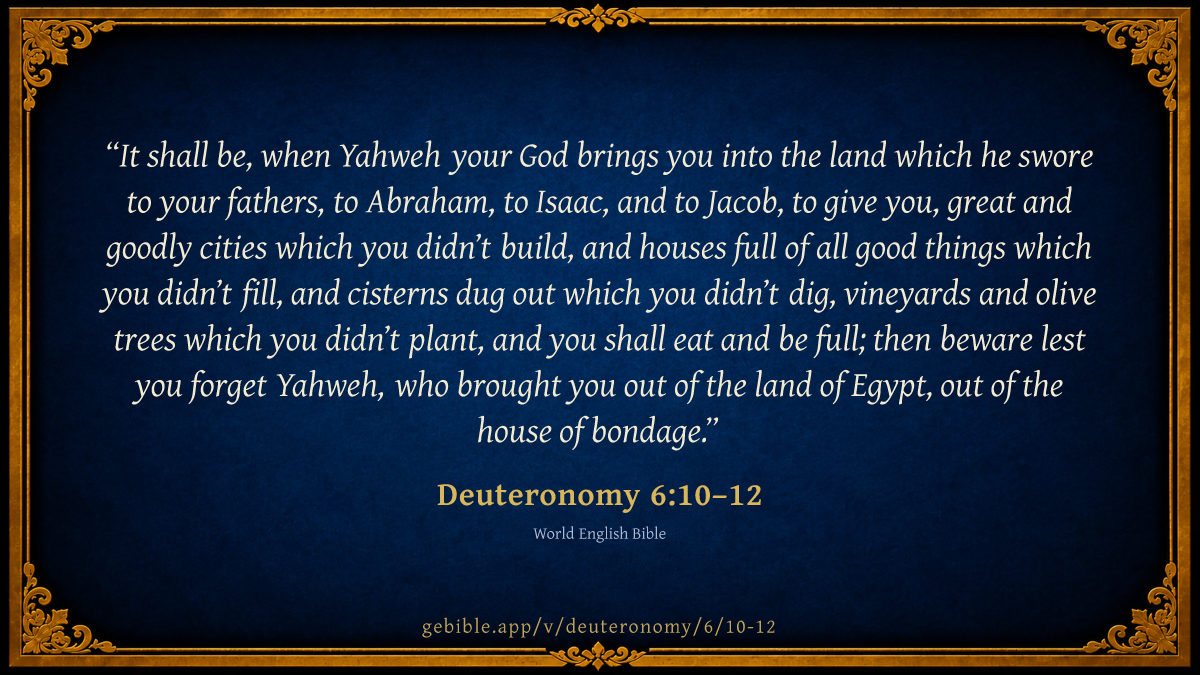
It shall be, when Yahweh your God brings you into the land which he swore to your fathers, to Abraham, to Isaac, and to Jacob, to give you, great and goodly cities which you didn’t build, and houses full of all good things which you didn’t fill, and cisterns dug out which you didn’t dig, vineyards and olive trees which you didn’t plant, and you shall eat and be full; then beware lest you forget Yahweh, who brought you out of the land of Egypt, out of the house of bondage.
Show the surrounding paragraph
Deuteronomy 6:10-12 sits inside this longer paragraph.
It shall be, when Yahweh your God brings you into the land which he swore to your fathers, to Abraham, to Isaac, and to Jacob, to give you, great and goodly cities which you didn’t build, and houses full of all good things which you didn’t fill, and cisterns dug out which you didn’t dig, vineyards and olive trees which you didn’t plant, and you shall eat and be full; then beware lest you forget Yahweh, who brought you out of the land of Egypt, out of the house of bondage. You shall fear Yahweh your God; and you shall serve him, and shall swear by his name. You shall not go after other gods, of the gods of the peoples who are around you, for Yahweh your God among you is a jealous God, lest the anger of Yahweh your God be kindled against you, and he destroy you from off the face of the earth. You shall not tempt Yahweh your God, as you tempted him in Massah. You shall diligently keep the commandments of Yahweh your God, and his testimonies, and his statutes, which he has commanded you. You shall do that which is right and good in Yahweh’s sight, that it may be well with you and that you may go in and possess the good land which Yahweh swore to your fathers, to thrust out all your enemies from before you, as Yahweh has spoken.
Parallel Translations
-
It shall be, when Yahweh your God brings you into the land which he swore to your fathers, to Abraham, to Isaac, and to Jacob, to give you, great and goodly cities which you didn’t build,
and houses full of all good things which you didn’t fill, and cisterns dug out which you didn’t dig, vineyards and olive trees which you didn’t plant, and you shall eat and be full;
then beware lest you forget Yahweh, who brought you out of the land of Egypt, out of the house of bondage.
-
And it shall be, when the LORD thy God shall have brought thee into the land which he sware unto thy fathers, to Abraham, to Isaac, and to Jacob, to give thee great and goodly cities, which thou buildedst not,
And houses full of all good things, which thou filledst not, and wells digged, which thou diggedst not, vineyards and olive trees, which thou plantedst not; when thou shalt have eaten and be full;
Then beware lest thou forget the LORD, which brought thee forth out of the land of Egypt, from the house of bondage.
Show all 3 translations
-
And it shall be, when the LORD thy God shall bring thee into the land which He swore unto thy fathers, to Abraham, to Isaac, and to Jacob, to give thee — great and goodly cities, which thou didst not build,
and houses full of all good things, which thou didst not fill, and cisterns hewn out, which thou the didst not hew, vineyards and olive-trees, which thou didst not plant, and thou shalt eat and be satisfied —
then beware lest thou forget the LORD, who brought thee forth out of the land of Egypt, out of the house of bondage.
Cross-references (16)
- Joshua 24:13 (v10) I gave you a land on which you had not labored, and cities which you didn’t build, and you live in them. You eat of vineyards and olive…
- Deuteronomy 7:12-18 (v11) It shall happen, because you listen to these ordinances and keep and do them, that Yahweh your God will keep with you the covenant and the…
- Deuteronomy 8:10-20 (v11) You shall eat and be full, and you shall bless Yahweh your God for the good land which he has given you. Beware lest you forget Yahweh your…
- Psalms 105:44 (v10) He gave them the lands of the nations. They took the labor of the peoples in possession,
- Nehemiah 9:25 (v10) They took fortified cities and a rich land, and possessed houses full of all good things, cisterns dug out, vineyards, olive groves, and…
Show all 16 cross-references
- Ezekiel 16:10-20 (v11) I clothed you also with embroidered work, and put sealskin sandals on you. I dressed you with fine linen and covered you with silk. I…
- Genesis 26:3 (v10) Live in this land, and I will be with you, and will bless you. For I will give to you, and to your offspring, all these lands, and I will…
- Psalms 78:55 (v10) He also drove out the nations before them, allotted them for an inheritance by line, and made the tribes of Israel to dwell in their tents.
- Genesis 13:15-17 (v10) for I will give all the land which you see to you and to your offspring forever. I will make your offspring as the dust of the earth, so…
- Genesis 15:18 (v10) In that day Yahweh made a covenant with Abram, saying, “I have given this land to your offspring, from the river of Egypt to the great…
- Genesis 28:13 (v10) Behold, Yahweh stood above it, and said, “I am Yahweh, the God of Abraham your father, and the God of Isaac. I will give the land you lie…
- Jeremiah 2:31-32 (v11) Generation, consider Yahweh’s word. Have I been a wilderness to Israel? Or a land of thick darkness? Why do my people say, ‘We have broken…
- Deuteronomy 32:15 (v11) But Jeshurun grew fat, and kicked. You have grown fat. You have grown thick. You have become sleek. Then he abandoned God who made him, and…
- Proverbs 30:8-9 (v11) Remove far from me falsehood and lies. Give me neither poverty nor riches. Feed me with the food that is needful for me, lest I be full,…
- Judges 3:7 (v11) The children of Israel did that which was evil in Yahweh’s sight, and forgot Yahweh their God, and served the Baals and the Asheroth.
- Matthew 19:23-24 (v11) Jesus said to his disciples, “Most certainly I say to you, a rich man will enter into the Kingdom of Heaven with difficulty. Again I tell…
Cross-references from openbible.info (CC BY 4.0)
Explain this passage (11 sources)
Historical commentary, presented as a primary source — not an endorsement.
Private notes
Saved on this device only — never synced or sent anywhere.
Geneva Bible translators 1599 · Public Domain On v12 Let not wealth and ease cause thee forget God’s…
Let not wealth and ease cause thee forget God’s mercies, whereby thou wast delivered out of misery.
Geneva Bible (1599) marginal notes — public domain.
John Trapp 1656 · Public Domain On vv11–12 Deu 6:11 And houses full of all good [things],…
Deu 6:11 And houses full of all good [things], which thou filledst not, and wells digged, which thou diggedst not, vineyards and olive trees, which thou plantedst not; when thou shalt have eaten and be full;
Ver. 11. When thou shalt have eaten and be full.] Saturity oft breeds security; fulness, forgetfulness. The best, when full fed, are apt to wax wanton and will be dipping their fingers sometimes in the devil’s sauce: Ipsis opibus lascivire coepit ecclesia. {a} The moon never suffers eclipse but at the full, and that by the earth’s interposition. The young mules, when they have sucked, turn up their heels and kick at the dam.
Read full note →
{a} Platina.
John Trapp, A Commentary or Exposition upon All the Books of the Old and New Testament (1647–1656) — public domain. Text from a community e-Sword module.
John Gill 1763 · Public Domain On vv10–12 And it shall be, when the Lord thy God…
And it shall be, when the Lord thy God shall have brought thee into the land,.... The land of Canaan, on the borders of which they now were, and were just going into:
which he sware unto thy fathers, to Abraham, to Isaac, and to Jacob, to give thee; of his own free favour and good will, without any merit and desert of theirs, and in which would be found
Read full note →
great and goodly cities, which thou buildedst not; large and capacious, delightfully situated, well built, and strongly fortified, without any pains or expense of theirs; all ready for them to take possession of, and dwell in; and so should no longer reside in tents or booths, as they had for forty years past, but in spacious and noble cities.
John Gill's Exposition of the Whole Bible (1746–1763) — public domain (CC PDM 1.0). Text via the HelloAO Bible API.
Adam Clarke 1810 · Public Domain On v12 Verse 12. Beware lest thou forget the Lord] In…
Verse 12. Beware lest thou forget the Lord] In earthly prosperity men are apt to forget heavenly things. While the animal senses have every thing they can wish, it is difficult for the soul to urge its way to heaven; the animal man is happy, and the desires of the soul are absorbed in those of the flesh. God knows this well; and therefore, in his love to man, makes comparative poverty and frequent affliction his general lot. Should not every soul therefore magnify God for this lot in life? "Before I was afflicted," says David, "I went astray;" and had it not been for poverty and affliction, as instruments in the hands of God's grace, multitudes of souls now happy in heaven would have been wretched in hell. It is not too much to speak thus far; because we ever see that the rich and the affluent are generally negligent of God and the interests of their souls. It must however be granted that extreme poverty is as injurious to religion as excessive affluence. Hence the wisdom as well as piety of Agur's prayer, Pr 30:7-9: "Give me neither poverty nor riches, lest I be full and deny thee, or lest I be poor and steal," &c.
Adam Clarke's Commentary on the Bible (1810–1826) — public domain. Text from a community e-Sword/MySword module.
Albert Barnes 1834 · Public Domain On v10 The Israelites were at the point of quitting a…
The Israelites were at the point of quitting a normal, life for a fixed and settled abode in the midst of other nations; they were exchanging a condition of comparative poverty for great and goodly cities, houses and vineyards. There was therefore before them a double danger;
(1) a God-forgetting worldliness, and
Read full note →
(2) a false tolerance of the idolatries practiced by those about to become their neighbors.
The former error Moses strives to guard against in the verses before us; the latter in Deu 7:1-11.
Deu 6:13
The command “to swear by His Name” is not inconsistent with the Lord’s injunction Mat 5:34, “Swear not at all.” Moses refers to legal swearing, our Lord to swearing in common conversation. It is not the purpose of Moses to encourage the practice of taking oaths, but to forbid that, when taken, they should be taken in any other name than that of Israel’s God. The oath involves an invocation of Deity, and so a solemn recognition of Him whose Name is made use of in it. Hence, it comes especially within the scope of the commandment Moses is enforcing.
Deu 6:25
It shall be our righteousness - i. e., God will esteem us as righteous and deal with us accordingly. From the very beginning made Moses the whole righteousness of the Law to depend entirely on a right state of the heart, in one word, upon faith.
Albert Barnes' Notes on the Bible (1834–1885) — public domain. Text from a community e-Sword/MySword module.
Haydock's Catholic Bible Commentary 1859 · Public Domain On v12 Full. Our Saviour seems to apply this to his…
Full. Our Saviour seems to apply this to his disciples, in a spiritual sense, remarking that Moses and the prophets had prepared the way for them. Others have laboured, and you have entered into their labours, John iv. 38. (Haydock)
George Leo Haydock (1774–1849), Haydock's Catholic Family Bible and Commentary, 1859 edition — public domain. Excludes Psalms (Douay-Rheims chapter numbering differs from Protestant) and Deuterocanonical books (Catholic canon only).
The Cambridge Bible for Schools and Colleges 1878 · Public Domain On vv10–12 10. And it shall be, when Jehovah thy God…
10. And it shall be, when Jehovah thy God shall bring thee into, etc.] A formula partly derived from J (Exo_13:5; Exo_13:11, the land of the Canaanite), but varied by D, which adds thy God and otherwise characteristically expands it. Similarly Deu_7:1, Deu_11:29. See also Deu_4:38; Deu_6:23; Deu_8:7; Deu_9:4; Deu_9:28; Deu_31:20-21.
which he sware] Deu_1:8. Thus in the forefront of the warning not to yield to the worship of the gods of their new land the fact is emphasised in solemn phrases that it is Jehovah who brings them into it.
Read full note →
10–15. The chief temptations to forget the duties just enforced will meet Israel when they enter upon the enjoyment of the civilisation of the land they are about to reach: a civilisation to which they have not contributed, and which they may be moved to impute to other gods than their own who is bringing them to it. The relevancy of this section to the preceding, and their close connection, are clear.
The Cambridge Bible for Schools and Colleges (gen. ed. J. J. S. Perowne; Cambridge University Press, 1878–1918) — public domain. Text from a community e-Sword module.
Ellicott's Commentary for English Readers 1878 · Public Domain On v10 (10-13) The song of Moses supplies a prophetic comment…
(10-13) The song of Moses supplies a prophetic comment upon this in Deu_32:15 : “Jeshurun waxed fat, and kicked . . . then he forsook God.” “In all time of our wealth, good Lord, deliver us.”
A Bible Commentary for English Readers, edited by Charles John Ellicott (1878–1897) — public domain. Text from a community e-Sword module.
The Pulpit Commentary 1880 · Public Domain On v10 Vers. 10-12. As the Israelites were about to enter…
Vers. 10-12. As the Israelites were about to enter upon the possession of a rich and fertile land, where everything for their accommodation and comfort was already provided for them, there was a danger of their being so engrossed with their new possessions as to forget the Lord and his gracious dealings with them. They are, therefore, here warned against the danger to which they would be thus exposed. House of bondage. (Exo_13:3)
Vers. 10-19. Dangers ahead! Beware!
Read full note →
The forecast of Moses is here directed to a period when Israel would have taken possession of the Promised Land (ver. 10). There, their deliverance would be entire and complete. No longer would they he wanderers hither and thither, but would be occupants of a land that they would call their own. Neither from the nation to which they were once in bondage, nor from those which they were called on to supplant, would they fear aught any longer! And yet there is throughout this paragraph a voice of warning, as if danger would attend them still! It would be so. But the danger would be from within rather than from without: When thou shalt have eaten and be full; then beware lest thou forget the Lord," etc. Whence, observe
I NO AMOUNT OF OUTWARD PROSPERITY CAN DELIVER A MAN FROM HIMSELF! By the time the state of calm was attained, which is here indicated, there would cease to be danger from hostile foes, at least for a while; but there would he perils of another kind, which would attend them even in the Promised Land. If Israel could have left themselves behind, it had been otherwise; but alas! go where they might, they must perforce take themselves with them, with all their liability to err, all the proneness to sin, and all the temptation to doubt or to pride. And not all the spears and slings of warriors could put the people in such peril as the corruptions of their own hearts! And so it is with us now and ever. We carry ourselves about with us everywhere; we cannot escape. There is within each one"s heart a "root of bitterness," "a root that beareth gall and wormwood;" and let earthly circumstances be as fair, as easy, and as pleasant as they may, yet, unless we heed the danger within, they can do but very little to ensure our peace. And herein lies the great mistake of monasticism, as even Augustine reminded his hearers. He told them that it was vain for them to attempt to flee out of the world in order to escape corruption, for wherever they might be they would carry the evil within them. Never let us look to outer circumstances alone to ensure our entire rest. Not even a perfect world could bring us that, unless we were first made perfect.
II THERE ARE THREE PERILS SPECIFIED HERE TO WHICH PROSPERITY MAY EXPOSE US.
1. The first is that of "forgetting the Lord" (ver. 12). When fields and vineyards and olive yards increase, and our cup is overflowing, then we are apt to lose sight of him to whom we owe all; and this not only in the receiving but in the using thereof (cf. Hos_10:1) Too apt are we to say in our pride, "My river is my own; I have made it for myself." So also are we apt to let our enjoyments conceal our God from view, and to think only of the mercies, while we forget to glorify God in the use of them. Nor is it any uncommon evil for men to be so set upon the enjoyment of this world"s comforts, as to forget almost or altogether that higher world for which they are bound to live, and that future life on which all soon must enter.
2. Another danger indicated is that of undue tolerance of the idolatries which were round about them (ver. 14). One effect of prosperity is easygoingness; and that, unless checked and guarded, will degenerate into a looseness of principle, whereby, under cover of suavity and amiability, respect for the convictions of others may come to be substituted by our having no very strong ones of our own. Nothing is more common than to see worldly aggrandizement attended by deterioration of moral sensibility.
3. A third danger specified is that of "tempting the Lord" when prosperity meets with a check. This seems to be the danger indicated in ver. 16, by a reference to "Massah". (see Exo_17:2-7) At this place of sojourn there was a lack of water. The people murmured. They tempted the Lord and said, "Is the Lord among us or not?" As if they ceased to believe in God"s presence with them, the moment he made them thus feel their dependence upon him! Strange perversity! Yet how like ourselves! The course of worldly prosperity scarcely ever runs with absolute smoothness for many years together. And the self-will engendered and strengthened in times of ease leads men to repine and complain bitterly the moment that ease receives a check. In times of prosperity men forget God, and then when adversity comes they often complain as if God had forgotten them. How much does God see, even in the people he takes for his own special care, to tax his patience, and to try his long-suffering love!
III BY WAY OF GUARDING THEM BEFOREHAND AGAINST THESE PERILS, MOSES SHOWS ISRAEL THE DUTIES WHICH THEY ARE DILIGENTLY TO OBSERVE.
1. They are to fear the Lord only (ver. 13).
2. They are to swear by him only, (see LXX and Mat_4:10) i.e. to cherish a profound reverence for him as the Author of all mercies, and as the sole Regulator of their lives. The honor of his Name is to be supreme.
3. They are to give the supreme affection of the heart to God, so that they may not provoke his jealousy (ver. 15).
4. They are to serve him by constant obedience (ver. 18). By the constant recognition of these four duties, they will do much to guard themselves from yielding to the perils attendant on their growing wealth and ease. (This may be compared with the apostolic maxim, "Walk in the Spirit, and ye shall not fulfill the lusts of the flesh.") Evil is most successfully counteracted by the positive and earnest pursuit of the opposite good.
IV IF THESE DUTIES WERE LOYALLY DISCHARGED, EARTHLY PROSPERITY AND SPIRITUAL WEALTH WOULD GO TOGETHER. Ver. 18, "That it may be well with thee," etc. Whether our earthly circumstances are helps or hindrances to us Godward, will depend much more on what we bring to them than on what they bring to us. And however, on the side of this life, things may favor us and circumstances befriend, it is only as they help us to serve God better that they are really blessings to us: it is "well" with us only when God is well pleased with us. So much stress did Moses attach to the maintenance of unswerving loyalty to God, that he intimates that the possession of the land is secured to them only so far as they are true to their Great Deliverer (vers. 18, 19).
V SINCE THE TIME OF MOSES, THIS PARAGRAPH HAS BECOME FAR MORE SACRED TO US, BY THE USE WHICH OUR SAVIOR MADE OF IT IN A TIME OF SORE TEMPTATION. It is never to be forgotten, that our Lord repelled the tempter by the words, "It is written," etc. Of the three passages used as weapons for the discomfiture of the evil one, two are taken from this very paragraph. (see Mat_4:7, Mat_4:10) So that we are warranted in using it as our armory from whence we may fetch the darts which shall make the tempter flee. These precepts cannot be needed by us less than they were by the Son of man. From him let us learn a use of the Divine Word that may serve us in a thousand assaults of the destroyer. For not until we do this can we discover the varied uses to which we may put the Word of God in the actual struggle of life. We, like our Master, have to be made perfect through suffering. Now we may suffer from want, hunger, and privation; and at another time all the kingdoms of the world, in a moment of time, may be set before us, to dazzle by their glare. We need to take to us the whole armor of God, that we may be able to stand in the evil day, and having done all, to stand. Go wheresoever we may, let our surroundings be easy and prosperous as they may, dangers will attend us everywhere, till we cross the pearly gate across whose threshold sin never comes. At one time it may be that adversity makes us fretful and apt to tempt the Lord, and then at another prosperity may make us slothful, and a sinful indifference may lull us to sleep. Our chief dangers are from within. But here in this holy Book are promises to cheer us when drooping, and warnings to quicken us when sluggish. Here is an arsenal from whence we may fetch our weapons, and a storehouse whence we may draw our supplies. Yea, in this wondrous quiver there are arrows which will be sharp in the hearts of the King"s enemies, which shall pierce them to their fall!
Vers. 10-19. The peril of prosperity.
Secular prosperity is hazardous. Unless the ship have ample ballast in the hold, a strong gale, however favorable, will be likely to capsize the ship and bury her in the caverns of the sea. The greater our earthly abundance, the greater our need of religious principle.
I WISE MEN INHERIT THE FRUIT OF OTHERS" LABORS. Under the leadership of God, the Hebrews inherited cities which the Canaanites had built, and vineyards which the Amorites had planted. If we knew all the facts of the case, we should admire this as an act of righteous wisdom. We do know that the iniquity of the Amorites was a cup full to the brim. The Hebrews, with all their faults, were a superior race. Similar displacements have gone on in all the lands of the world. It is an instance of the survival of the fittest." Redeemed men are destined to be the lords of the earth. The Church shall possess and rule the world. All things are ours." This inheritance of Canaan, with its cities and cattle and wealth, ought to have produced a deep sense of gratitude. All the Hebrews enjoyed they owed to the bountiful hand of God.
II SUDDEN PROSPERITY IS A SEVERE STRAIN ON PIETY. The sense of daily and hourly dependence upon God for material food is an advantage; it is a constant incentive to gratitude and faith. Poor human nature cannot bear much indulgence. Poverty is more conducive to piety than wealth has ever been. Hence our Lord chose a state of poverty as most suited to his mission. How hardly shall they that have riches enter into the kingdom of heaven!" So long as men continue in the flesh, they prefer a visible God to an invisible. So they say to gold, "Thou art my god." To be singular in religious belief and practice is always an arduous effort. The example of others has always been a sore temptation. Unless we can persuade them by the three of our superior faith, they are sure to bias us injuriously. Our safety lies in a stalwart and fearless piety.
III TO FALL FROM THE FAVOR TO THE FROWN OF GOD IS IMMEASURABLE AND COMPLETE. It would have been better for their peace and their reputation not to have inherited the land, than to be ejected from it again. It is a tremendous calamity, having been lifted high, to be thrown down. The effect of disloyalty among the Hebrews would not simply be a replacement in their former state; it would be destruction from the face of the earth. In the realm of morals, we cannot descend to a station we had occupied aforetime. If there is declension, retrogression, fall, it must be to a lower level than float we formerly held. The penalties imposed by righteousness are complete and remediless. We may well "stand in awe and sin not." It is perilous in the extreme to "try" God"s patience to make experiments on the long-suffering of God. Suddenly, he "whets his glittering sword, and his hand takes hold on judgment.
IV HOPE IS AN INSPIRATION OF STRENGTH. Although Moses has addressed to them these cautions, and pointed out these perils, he will not think so meanly of them as to forecast their fall. He will cherish in his own breast the bright hope of their loyalty. He will call into exercise their own best principles and aspirations. He confidently predicts their wise and upward course, and sketches before their eyes their future greatness and security. Herein is wise generalship. If hope kindles her lamp in the human breast, all is not lost. This is Heaven"s cordial for a fainting soul. D.
Vers. 10-16. The creature displacing the Creator.
I THE PRONENESS OF THE HEART TO ADMIT THE WORLD INTO GOD"S PLACE. (Ver. 12.) The tendency is universal. A result of the Fall, in subverting the original constitution of man"s nature. That result twofold:
1. In giving to the worldly and sensuous principles in the soul an undue predominance; while:
2. Destroying that love of God, and sense of dependence on him, which would counteract their operation. There may be no "going after other gods" in the sense of ver. 14, yet the first commandment may be broken by making the world itself our god giving it the place of the true God in our affections. The principle of worldliness usually operates secretly. The heart is "secretly enticed," does not perceive the progress of its declensions, (Hos_7:9) fights against the admission of it. (Rev_3:17)
II THE PECULIAR CONNECTION OF THIS TEMPTATION WITH PROSPERITY, (Vers. 10, 11.) Not, indeed, so peculiarly connected with it, but that the poor man may fall into the same snare. But riches unquestionably constitute a temptation which few succeed in resisting (cf. Deu_8:11-19; Pro_30:8, Pro_30:9; Mat_19:22-27; 1Ti_6:9, 1Ti_6:10, 1Ti_6:17, etc.) The temptation is the greater:
1. If worldly possessions are very abundant (ver. 11).
2. If the prosperity, is sudden (vers. 10, 11).
3. If it is freely enjoyed (ver. 11) eaten, and art full". (Deu_8:10)
III THE SAFEGUARDS AGAINST THIS TEMPTATION. There are safeguards. Bible examples show that riches may be used with glory to God, happiness to self, and good to mankind (Abraham, Joseph, Job, Daniel, etc.). Among the foremost we would place the cultivation of a thankful spirit (cf. Deu_8:10) the remembrance of God as the Giver of what we have; also the remembrance of God"s past mercies to us (vers. 12, 13). Other safeguards are:
1. Serving God with our possessions (ver. 13). The serving will include serving with our wealth, using what he has given for his glory, as good stewards, and not luxuriously and wastefully spending all on self. (Luk_12:15-21)
2. Making public acknowledgment of God (ver. 13). The spirit of this command is kept by being willing, on all proper occasions, boldly and without shame to avow God to be our God. The man of wealth who will do this is carried at one stroke above half the dangers of his position.
3. Non-conformity to the worlds ways (ver. 14). It is not easy to avoid being led away by fashion, love of appearance, social custom, etc. The good man will beware of the snare, and keep aloof. (Rom_12:2)
IV THE PENALTY OF YIELDING TO THE TEMPTATION. (Ver. 15.) God"s wrath is kindled and destroys the transgressor.
1. He is destroyed spiritually.
2. He may be temporally. (Psa_37:35 Psa_73:18, Psa_73:19)
3. He will be eternally. J.O.
The Pulpit Commentary (1880–1919), ed. H.D.M. Spence-Jones & Joseph S. Exell — public domain. Text from a community e-Sword module.
The Biblical Illustrator 1887 · Public Domain On v10 Cities which thou buildedst not.
Deu_6:10-12
Cities which thou buildedst not.
Read full note →
The Divine transference of mans property
I. Gods right to the secular property of men. Not merely the and, but also all productions of labour, belong to Him.
II. The fate of all earthly possessions. The only property that we can retain, that we can carry with us, and which can bless us wherever we go, is moral--the property of a holy character.
III. The principle of entail in Gods government of man. One man labours, and another man enters into his labours. So it has ever been, so it is now.
1. It is so politically.
2. Socially.
3. Religiously.
IV. A type of a good time that is coming. The Church shall take the property of the world.
V. The primary condition of mans well-being in every age. Beware lest thou forget the Lord.
1. That forgetfulness of the Lord is an immense evil.
2. That worldly prosperity exposes us to this immense evil. (Homilist.)
Beware lest thou forget the Lord.
The dangers of prosperity, and the means of avoiding them
I. The dangers of prosperity. One danger to be apprehended from prosperity is, that a man may thereby be led to forget God as the Author of his blessings, and the Sovereign Disposer of those events which have issued in success. Alienation of heart from God is the result of our fallen state. Should prosperity come upon us unexpectedly, without any previous effort on our part, there is fuel, as it were, applied to the unhallowed fire within, which causes the natural carnality of our hearts to exhibit itself with a force before unknown. Should, however, mans prosperity in this world be the result of well-directed efforts of his own, there is a temptation lest we should forget God who has given us power to succeed in our endeavours, lest we should attribute to our own strength or wisdom what is due chiefly to Him of whom we have received our all, and to whom all the praise is due. But we may notice other dangers connected with worldly prosperity. There is a security sometimes issuing out of it which is altogether inconsistent with mans frail and uncertain tenure (Psa_30:6; Psa_49:11; Job_29:18; Luk_12:16; Luk_12:19; Luk_12:21). We should not undervalue the blessing of temporal welfare; it is Gods gift, and ought to be enjoyed with thankfulness in Him. It is then sweetest when it is possessed as the fruit of His goodness towards us, and when we consider ourselves as accountable to Him for the use of it. But dependence upon our worldly treasures is at once irreligion and folly. To look for happiness, as issuing out of anything in this present world independent of God, is to search for bright colours in the dark--is to mistake the end of our being, and to occupy ourselves with a fruitless toil.
II. Methods by which these dangers may be counteracted.
1. First and chiefly: God must be before our eyes. We should enshrine Him in our heart and memory, not only as our omnipotent Creator, but as our Protector--as our Governor--as the Author and Giver of all good things--as the Sovereign Disposer of all events--by whom the ravens are fed, and thy lilies of the field do grow and clothe themselves with beauty.
2. Another means for avoiding the danger of prosperity is this: meditation upon God. Our danger arises from thinking too much of ourselves. To overcome this danger we must meditate often upon God; upon His goodness, glory, and majesty.
3. But last of all, that we may not be overwhelmed by the dangers which threaten us from worldly prosperity, we must meditate much and deeply upon the superior glory of eternal realities. Our hearts must be imbued with the love of Christ. Our hearts must dwell on His matchless grace in dying for us. In this way we must endeavour to form some estimate of the glorious salvation which is in store for us hereafter. Against the riches, honours, and comforts of this present world we must set the riches which no moth corrupteth, the honour which cometh only from God; the consolations of His Spirit, and the happiness of the redeemed. (H. J. Hastings, M. A.)
Sudden prosperity fatal to religion
I. That a just sense of the Supreme Being is the best security for a mans virtue. I say a just sense, because wrong apprehensions of the Deity have generally had a very unhappy influence on the interests of virtue; as is evident to everyone who compares the religion and manners of the heathen world. This was probably the reason why Moses was so solicitous to suppress all personal representations of the Deity through his whole economy; he knew very well that the people would naturally borrow their idea of God from the representations they saw of Him, and that the idea of their God would be the measure of their morality. There are few things that have contributed more to the extent of vice than the hope of secrecy, which vanishes at the very apprehension of a Being who seeth in secret. But our idea of the Deity stops not here; we consider Him not barely as a spectator of our actions, but as a judge of them too; and he must be an insolent offender, indeed, who will dare to commit a crime in the sight of Him who he knows will judge him, who he is sure will condemn him for it. The hope of reward and fear of punishment add fresh vigour to the cause of virtue.
II. This sense of God is often much effaced, sometimes absolutely lost, in a state of ease and affluence. The observation of Moses has its foundation in nature, is evident to experience, and confirmed by a greater than Moses, who tells us how difficult it is for those who trust in riches to enter into the kingdom of God; and we find how difficult it is for those who have them not to trust in them. When we are under any immediate presence of affliction, when we are despised and deserted by men, we look upon God as a present help in trouble; but that exigence is no sooner over than we begin to see Him at a great distance. We no longer call to heaven for that satisfaction which we can now find from earth, but depend upon the second cause for that support which can never be attained but from the First. We begin to fancy ourselves established even beyond the reach of providence, or the possibility of change. There is something in the very nature of ease which is apt to enervate the mind and introduce a languid effeminacy into all its faculties. The senses, by an habitual indulgence, gain ground upon the understanding and usurp the province of reason, which must inevitably decline in proportion as the sensual affections prevail; the spirit becomes less willing as the flesh grows more weak; we sink into an indolent oblivion of our Maker, and fall amongst the number of those who are lovers of pleasures more than lovers of God. It is obvious to observe here, that as every corruption in our principles is followed by proportionate decay in our practice, so every corruption in our practice is attended with an equal decay in our principles; from whence it appears that religion and virtue are inseparably united, they must flourish and fall together; they are lovely in their lives, and in their deaths they cannot be divided.
III. A state of ease and affluence, as it tempts us strongly to lose, so it lays us under greater obligations to retain and improve that sense of God upon our minds. You, who inhabit great and goodly cities which you did not build, who inherit houses full of all good things which you did not fill; you, whose fortunes seem to be showered upon you directly from heaven, while others are forced by the sweat of their brows to raise them from the earth; as you are blessed with higher degrees of the bounties of God, so are you more eminently obliged to preserve a stronger sense of them. Your duty increases with the eminence of your station, and your obligations to it are multiplied by the number of your advantages.
IV. I shall now point out to you, in the last place, some of those means which seem most likely to preserve and improve those conceptions upon our minds. And I think there can be no better than those which Moses recommends to the Israelites in Deu_6:6-7. When you thus begin and end sour day, when you thus open your morning and close your evening, you cannot absolutely forget the Lord, especially if you make Him the subject of your conversation too. The next direction is, to teach the commandments of God to your children; but a man cannot well teach that to another of which he is ignorant himself. And every time you endeavour to imprint a sense of God upon the minds of your children, you must necessarily make so strong an impression of it upon your own that you can never be able to forget the Lord. (T. Ashton, D. D.)
Forgetfulness of God
It is remarkable how frequently in the Book of Deuteronomy, when God is giving His final summary of instructions to the Israelites, the warning is repeated, that the Jewish Church forget not God and His dealings with them in connection with their deliverance from Egypt. Such warnings strike us the more forcibly, because the people to whom they were addressed had come into the closest contact with God, and had been favoured with the clearest visible evidences of His presence. To have seen Jesus in the flesh, to have witnessed His miracles, these would have been privileges the memory of which could have never passed away. Now, all such reasonings are mere self-deception. That there is a deep fallacy involved therein is manifest from the fact that the Jewish Church, which had the most abundant ocular demonstration of God and of His power, is so repeatedly cautioned against this forgetfulness of God. With this fact impressed upon our minds it will be profitable to consider the ways in which forgetfulness of God displays itself.
1. This tendency will be perceived in respect to God Himself. We acknowledge that it is in God that we live and move and have our being; yet we rarely find a sustained recognition of God. We do not walk day by day as seeing by the eye of faith Him who is invisible. What an importance would it give to life could we attain to that deep sense of the consciousness of Gods immediate presence and majesty which is implied in the brief but full description of the spiritual life of those of whom it is recorded, that they walked with God.
2. But besides this forgetfulness of God in His abstract nature and perfections, we trace this evil in a similar forgetfulness of Him in His operations. God in His glorious majesty dwelleth in the highest heavens, but in His operations and providential dealings He is ever, as it were, coming down to earth and meeting us closely and continually in the pathway of our lives. Every comfort is held out to our acceptance by the hand of God; in every trial we may trace the discipline of God. But this we over look: human agency, second causes, personal effort, self-dependence, come in between us and God. Backsliding Israel at length reached this point, that they knew not that it was God who gave them their corn and wine and oil, and multiplied their silver and gold, which they prepared for Baal.
3. Forgetfulness of God also displays itself in respect to that covenant which He has made with us in Christ. The Jewish Church had a special warning upon this head: Take heed unto yourselves, lest ye forget the covenant of the Lord your God which He made with you. A covenant with man is not disregarded nor trifled with. We are less scrupulous with respect to God. Our covenant with God goes beyond that of the Jewish Church, in that it brings Christ before us in His finished work, and no longer veiled in types and shadows. All that God can give to sinful man is our covenant portion in the Son of His love, the Lord Jesus Christ.
4. Another painful feature of this infirmity is to be found in the forgetfulness of the Lord Jesus as our Saviour. It is noted as one point in the sinfulness of Israel, that they forgat God their Saviour, who had done great things in Egypt. The Passover was to be the means of maintaining a devout remembrance of this deliverance. In like manner the Lords Supper was to be a commemorative ordinance to keep ever before the minds of His people a lively remembrance of their greater deliverance by the death and sufferings of the Redeemer. Do this, says our Lord, in remembrance of Me. The grace and condescension, the tender love and never-failing compassion of the Saviour, His sufferings, and agony, and death, fade from our recollection.
5. We may notice one other form of this forgetfulness of Divine things. In addition to those ordinary influences of the means of grace upon the soul which the believer experiences, there are some occasions of special blessing. Some striking or alarming providence of God brings us, as it were, into His immediate presence; under the preaching of the Word, or in the prayerful study of it, the mysteries of spiritual truth are opened to the mind; it is a time of bright light, of quickened affections, of holy aspirations, of heavenly communion with God. In the moment of such ecstasy we feel how good it is to be here, and imagine that we shall go forth with the holy influence of such a season abidingly with us. It is a new era in our spiritual life. We can never be again engrossed, as in times fast, with the vanities of time. Yet the memory here again betrays its trust. Forgetfulness of the heights which we have reached lowers the tone of our spiritual life; coldness creeps over the soul; and it is well if we escape the state of backsliding Israel, when she went after her lovers, and forgot Me, saith the Lord.
6. This forgetfulness of God cannot be confined to any one period of life; it meets us everywhere. As we look back upon the sins of our youth, this rises up as one of the most overwhelming. Amidst the buoyant spirits of our early days, and the cheerfulness of home, and the freshness of our first affections, where was God? What place did He occupy in our minds and in our hearts. Remember now thy Creator in the days of thy youth. But as years pass on, and manhood succeeds to youth, other objects engross the thoughts to the exclusion of God. The cares and anxieties attendant upon the start in life, the turmoil of business, the engrossing and ensnaring contact with the world,--these present no atmosphere favourable to the cultivation of habitual converse with God. Nor, if we follow on our search into advanced life, do we find it otherwise. Grey hairs and decreasing strength would seem to give a sufficiently solemn warning to prepare to meet God; but it is remarkable how entirely indifference and insensibility to Divine things mark an old age which succeeds a manhood of worldliness and a youth of thoughtlessness. Thus does forgetfulness of God accompany the worldly man through every period of his earthly life; and, in the case of the believer, the danger is equally present, and forms a main element in the severe conflict of his inner life. But though sin has introduced this infirmity into our fallen nature, God has not left us without a remedy.
The evil may, through grace, be counteracted and overcome; and in order to this, the following suggestions are offered to the earnest Christian.
1. Realise the danger. Understand that the memory has a tendency to betray its trust, and neglect its duty in that which relates to God. There are many circumstances in our ordinary life which never pass away. Let a man be exposed to shipwreck, or to a railway accident, the horrors of the scene would be ever before him. There are many scenes of domestic interest which never lose their freshness. But it is otherwise in our spiritual life; and we should know it and feel it. Many an Israelite probably thought that he never could forget the passage through the Red Sea, or the terrors of Mount Sinai; but they did forget them. And so we think that the strong impression and deep conviction is to abide with us. Or we think, perhaps, that though gone for a while, it is only hidden in some secret place of memorys storehouse, and when needed will be produced again. But we are mistaken; and when we sit down to recall the past dealings with God, memory retains little beyond the bare fact; all the lesser yet perhaps more striking and instructive peculiarities of the dispensation are lost.
2. With this danger realised we next observe the need of much diligence and pains to counteract it. The natural faculty of memory differs greatly in its power in different individuals; but when weak, either generally or in any particular respect, we have recourse to certain means and helps for assisting and strengthening it. A careful and systematic classification of events, or the aid of a Memoria Technica, or a well-arranged commonplace book, will go far to supply the deficiencies of memory. Men will think no pains too great which will enable them thus to master the events of history or the facts of science. But when we pass from the subjects of human learning to the record of Gods dealings with the Church and our own souls, all such efforts on our part are deemed useless and superfluous. We must be careful, too, in carrying out into corresponding action any impressions which have been made upon our minds, so as to fix them in the character by habits resulting from them. And we must note any dealings of God with us in providence or in grace which seem calculated to bring us nearer to Himself, in patient dependence or in grateful love.
3. In the use of these and like helps it is necessarily implied that the soul will be seeking by earnest prayer the effectual aid of the Holy Spirit. We have viewed this forgetfulness of God as an inseparable consequence of our fallen nature, and one which no amount of outward and sensible evidence or impression can of itself obviate, as the case of the Israelites hilly proves. A similar, and even stronger, proof is presented in the case of the apostles. They had enjoyed unrestrained intercourse with our blessed Lord for several years. His conversation, His teaching, never could be forgotten. Yet the mere moral and physical effects of this teaching would be counteracted by the weak and treacherous nature of human memory; and hence our Lord promises a direct operation of the Holy Spirit to remedy this infirmity: The Holy Ghost, whom the Father will send in My name, He shall teach you all things, and bring all things to your remembrance, whatsoever I have said unto you. (Christian Observer.)
The danger of forgetting God
I. The tendency that there is in us to forget God.
1. Forgetting the presence of God.
2. Forgetfulness of God in worship.
3. Forgetting the commandments of God.
4. Forgetting Gods redeeming love.
II. The cause of forgetfulness of God. Prosperity.
III. The danger of this forgetfulness. Now, just let me show you that the Scripture tells us that they shall be turned into hell who forget God. Now consider this, ye that forget God, lest I tear you in pieces, and there be none to deliver! But the danger of living without God is the danger of dying without God; and the man that dies without God dies without hope. You will recollect that God in a special manner complains of this with reference to His ancient people. In the first chapter of Isaiah we are told that He had nourished and brought up children, but that Israel bad rebelled against Him; that the ox knew his owner, and the ass his masters crib, but Israel, Gods own people, did not consider. Are there not many amongst you that do not consider? Are there not some amongst us that have forgotten God? But so strongly has the Scripture laid down the danger which awaits the forgetters of God, that we find that God in a special manner has condescended to help us that we may remember Him. For instance, let us look at the very text, and at that part of the text to which I was referring just now. Beware lest thou forget the Lord, which brought thee forth out of the land of Egypt, from the house of bondage. Why, what great things God has done for us to remind us of redeeming love? What a blessing it is that we have a special ordinance, which it is impossible to approach with any light in our minds, without reflecting that it represents the dying love of Jesus, and is, as it were, bidding us ask ourselves whether we have a thankful remembrance of the death of Christ! What a blessing it is that God has appointed men in a special manner to go forth and to preach that Gospel which shall remind their fellow sinners of that same redeeming level God has done everything to prevent our forgetting Him, and lead us to consider our ways, and consider our personal relationship to Him, to consider our daily dependence upon Him for the things of this life, and to consider our complete dependence upon Him for the things of the life to come. (Bp. Villiers.)
Beware of prosperity
Mark the conception which Moses formed of all advancing civilisation. How much we have that we have not done ourselves! We are born into a world that is already furnished with the library, with the altar, with the Bible. Men born into civilised countries have not to make their own roads. We are born into the possession of riches. The poorest man in the land is an inheritor of all but infinite wealth, in every department of civilisation. In the very act of complaining of his poverty he is acknowledging his resources. His poverty is only poverty because of its relation to other things which indicate the progress of the ages that went before. Young men come into fortunes they never worked for; we all come into possessions for which our fathers toiled. We could not assemble in Gods house in peace and quietness today if the martyrs had not founded the Church upon their very blood. Men today enjoy the liberty for which other men paid their lives. Coming into a civilisation so ripe and rich, having everything made ready to our hands, the whole system of society telephoned so that we can communicate with distant friends and bring them within hearing, the table loaded with everything which a healthy appetite can desire--all these things constitute a temptation, if not rightly received. Moses drew the picture, and then said, Beware. In the time of prosperity and fulness, then beware lest thou forget, etc. Prosperity has its trials. Poverty may be a spiritual blessing. The impoverishment and punishment of the flesh may be religiously helpful. There are anxieties connected with wealth as well as with poverty. The high and the mighty amongst us have their pains and their difficulties, as well as the lowliest and weakest members of society. Ever let men hear this word of caution, Beware. When the harvest is the best harvest that ever was grown in our fields, then beware. When health is long-continued and the doctor an unknown stranger in the house, then beware. When house is added to house and land to land, then beware. Men have been ruined by prosperity. (J. Parker, D. D.)
Danger of prosperity
Many are not able to suffer and endure prosperity; it is like the light of the sun to a weak eye; glorious, indeed, in itself, but not proportioned to such an instrument; Adam himself (as the Rabbins say) did not dwell one night in paradise, but was poisoned with prosperity, with the beauty of his fair wife, and a beauteous tree: and Noah and Lot were both righteous and exemplary, the one to Sodom, and the other to the old world, so long as they lived in a place in which they were obnoxious to the common suffering; but as soon as the one of them had escaped from drowning and the other from burning, and put into security, they fell into crimes which have dishonoured their memories for above thirty generations together, the crimes of drunkenness and incest. Wealth and a full fortune make men licentiously vicious, tempting a man with power, to act all that he can desire or design viciously. (Bp. Taylor.)
Forgetfulness through prosperity
Strolling along the banks of a pond, Gotthold observed a pike basking in the sun, and so pleased with the sweet soothing rays as to forget itself and the danger to which it was exposed. Thereupon a boy approached, and with a snare formed of a horsehair and fastened to the end of a rod, which he skilfully cast over his head, pulled it in an instant out of the water. Ah me! said Gotthold, with a deep sigh, how evidently do I here behold shadowed forth the danger of my poor soul! When the beams of temporal prosperity play upon us to our hearts content, so grateful are they to corrupt flesh and blood that, immersed in sordid pleasure, luxury, and security, we lose all sense of spiritual danger, and all thought of eternity. In this state many are, in fact, suddenly snatched away to the eternal ruin of their souls.
Forgetfulness of God but too easy
The solemn possibility is the possibility of forgetting God and Gods providence in human life. We may not have endeavoured to expunge, as by an express and malicious effort; but memory is treacherous; the faculty of recollection is otherwise than religiously employed, and before we are quite aware of what has been done, a complete wreck has been wrought in the memory of the soul. There will settle upon the intellectual faculties themselves, and upon the senses of the body, a stupidity amounting to sinfulness. The eye is meant to be the ally of the memory. Many men can only remember through the vision; they have no memory for things abstract, but once let them see clearly an object or a writing, and they say they can hold the vision evermore. (J. Parker, D. D.)
The Biblical Illustrator, edited by Joseph S. Exell (c. 1880s–1900s) — public domain. Text from a community e-Sword module.
unfoldingWord translationNotes 2017 · CC BY-SA 4.0 On v10 General Information:
General Information:
Moses continues to tell the people of Israel Yahweh's words as if the Israelites are one person. (See: Forms of You)
Read full note →
large and very good cities that you did not build
All these cities will belong to the people of Israel when they conquer the people in Canaan.
out of the house of bondage
Here the metonym "house of bondage" refers to Egypt, the place where the people of Israel had been slaves. AT: "out of the place where you were slaves" (See: Metonymy)
translationWords
Yahweh
God
oath
ancestor
Abraham
Isaac
Jacob
vineyard
olive
Egypt
house
enslave
unfoldingWord translationNotes — © Distant Shores Media and the Door43 World Missions Community, licensed CC BY-SA 4.0. Source: git.door43.org/Door43/en_tn.